From Regenerative Mechanisms to Clinical Practice: Current Status, Controversies, and Future Perspectives of Platelet-Rich Plasma in Urology and Sexual Medicine

Abstract
1. Introduction
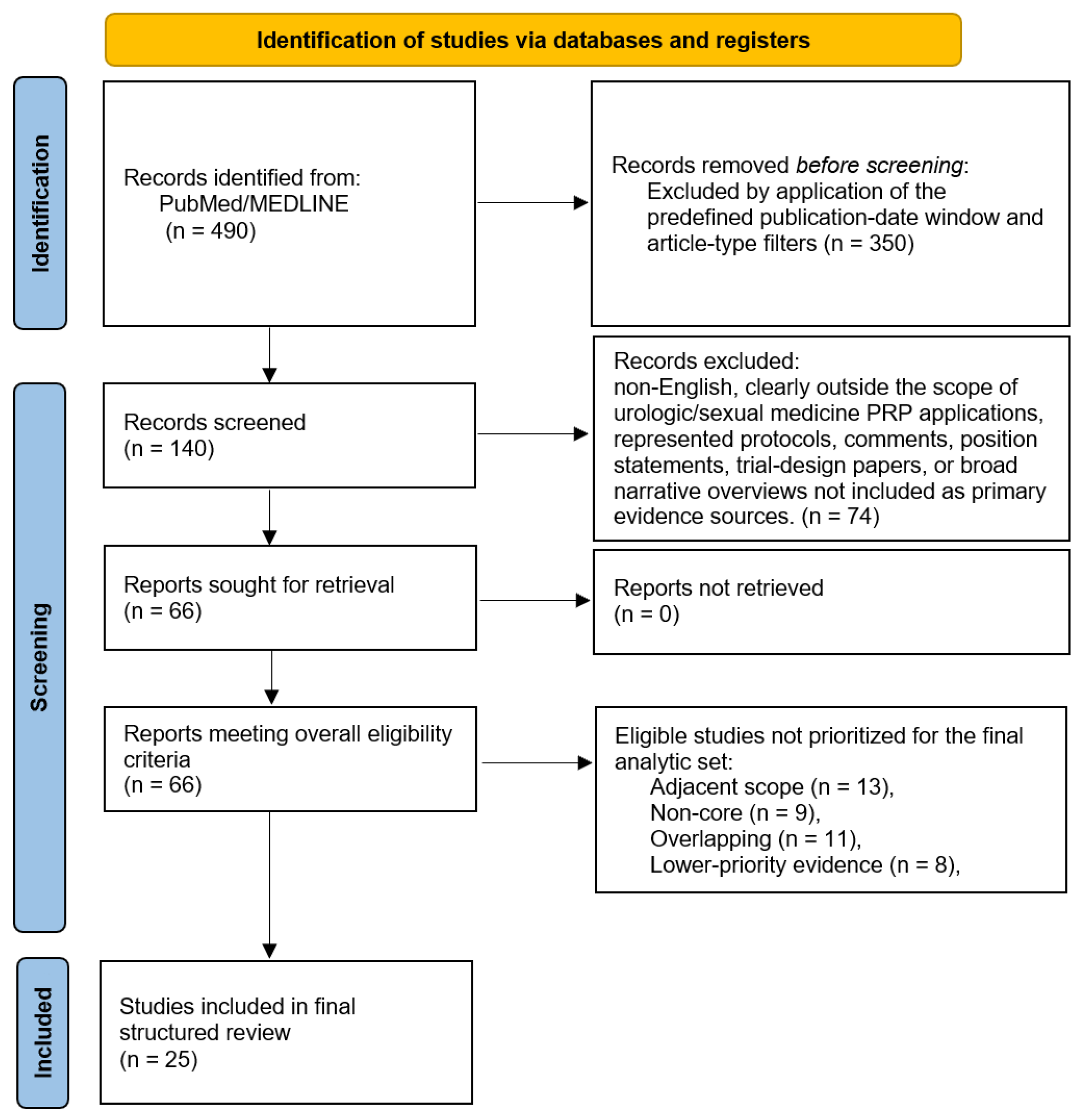
2. Methods
2.1. Review Design and Reporting Approach
2.2. Search Strategy and Information Source
2.3. Eligibility Criteria, Study Selection, and Prioritization
2.4. Data Extraction and Synthesis Framework
- (1)
- PRP product variables: baseline whole-blood platelet count; final platelet concentration; absolute platelet dose delivered per session; leukocyte content; RBC contamination; activation method and timing; preparation protocol (single/double spin, RCF, time, device); handling/sterility (closed vs. open, time to injection).
- (2)
- Delivery variables: route (intracavernosal, intraplaque, intravesical/submucosal, periurethral/urethral sphincter, intravaginal), injection mapping, imaging guidance, volume/session, number of sessions, interval, co-interventions (PDE5i, Li-ESWT).
- (3)
- Outcomes: validated patient-reported outcomes (IIEF-EF/IIEF-5/EHS; PD curvature; SUI questionnaires/pad tests; IC symptom scores), objective endpoints when available (penile Doppler PSV/EDV with standardized stimulation), follow-up timepoints, and adverse event definitions.
- (1)
- product/protocol heterogeneity;
- (2)
- risk-of-bias vulnerabilities (blinding, allocation concealment, selective reporting);
- (3)
- short vs. long-term outcomes;
- (4)
- clinical meaningfulness.
2.5. Critical Appraisal and Risk-of-Bias Consideration
2.6. Artificial Intelligence Use Disclosure
3. PRP as a Biological Product: Definitions, Classifications, and Why Standardization Matters
3.1. What Constitutes PRP and Why the Label Alone Is Not Enough
3.2. Preparation Techniques and Their Downstream Biological Consequences
3.3. Beyond Platelets: Leukocytes, Plasma Proteins, and Omics Profiles
4. Mechanistic Rationale in Urology and Sexual Medicine
4.1. Nerve Regeneration: Neurotrophic Signaling and Schwann Cell Support
4.2. Angiogenesis and Endothelial Support: VEGF and Beyond
4.3. ECM Remodeling and Fibrosis
4.4. Immune Modulation and Microenvironment Optimization
5. Current Clinical Applications of PRP in Urology and Sexual Medicine
5.1. PRP Treatment for Erectile Dysfunction
5.1.1. Rationale for PRP in ED
5.1.2. Outcomes Used in PRP-ED Trials
5.1.3. Critical Synthesis of Randomized and Prospective Evidence in ED
5.1.4. Aggregate Signal and Clinical Interpretation
5.2. Neurogenic ED and the Place of PRP Within a Broader Regenerative Landscape
5.2.1. Pathophysiology
5.2.2. Regenerative Strategies Beyond PRP: Stem Cells, Biomaterials, and Molecular Targets
5.2.3. PRP for Neurogenic ED: What We Can Infer from Preclinical Evidence
- (1)
- Timing and dosing: animal studies often administer PRP early after injury; many human patients present later with established fibrosis.
- (2)
- Injury severity: surgical traction, thermal injury, and patient-specific anatomy create heterogeneous nerve damage patterns.
- (3)
- Comorbidities: diabetes, vascular disease, and aging can impair repair capacity and platelet function, potentially reducing PRP potency.
5.3. Combination Therapy Strategies: PRP with Li-ESWT, PDE5is, and Other Modalities
5.3.1. PRP Plus Li-ESWT
5.3.2. PRP Plus Conventional Pharmacotherapy (e.g., PDE5i)
5.3.3. Implications for Trial Design
6. Other Applications Across Urology and Sexual Medicine
6.1. Peyronie’s Disease (PD)
6.2. Interstitial Cystitis/Bladder Pain Syndrome (IC/BPS)
6.3. Female Sexual Medicine and Pelvic Floor Disorders
6.3.1. Genitourinary Syndrome of Menopause (GSM)
6.3.2. Stress Urinary Incontinence (SUI)
6.3.3. Pelvic Organ Prolapse (POP)
6.3.4. Vulvovaginal Disorders and Lichen Sclerosus
6.4. Male Infertility and Reproductive Applications: Mostly Early-Stage Evidence
7. Discussion
7.1. What This Review Adds
7.2. Safety and Adverse Events
- (1)
- Long-term safety of repeated injections, especially when PRP is administered in multiple courses or combined with other regenerative modalities.
- (2)
- Product variability and contamination risks related to preparation protocols and sterility in real-world settings.
- (3)
- Risk in comorbid populations, such as diabetes or vascular disease, where baseline platelet function and inflammatory status may differ and where local tissue perfusion may be compromised.
7.3. Ethical and Regulatory Considerations
7.4. Why Studies Disagree: A Critical Synthesis of Heterogeneity
7.4.1. PRP Product Heterogeneity
7.4.2. Protocol Heterogeneity
7.5. Endpoint Heterogeneity and Follow-Up Duration
7.6. Patient Selection and Disease Stage
7.7. Recommendations for Future Trials and Standardization
7.7.1. The Minimum PRP Reporting Checklist for Urology/Sexual Medicine Trials (PRP-Uro Checklist)
7.7.2. Genesis and Justification of the PRP-Uro Checklist
7.7.3. How the Checklist Can Be Used in Practice
- (i)
- Authors can use it prospectively during protocol development to ensure that the biologic intervention is defined before recruitment begins.
- (ii)
- Peer reviewers can use it to determine whether a manuscript provides enough detail to support reproducibility and biological interpretation.
- (iii)
- Editors and journals can adopt it as a supplementary reporting requirement for PRP-based interventional studies in urology and sexual medicine.
- (iv)
- Professional societies and collaborative groups may use it as a starting point for broader consensus-building.
7.7.4. Illustrative Application of the Checklist
7.7.5. Trial Design Priorities
- (1)
- (2)
- Formal assessment of blinding integrity in injection-based studies.
- (3)
- Biologically meaningful characterization of the PRP product.
- (4)
- Prespecified severity-stratified responder definitions and MCID thresholds.
- (5)
- Objective endpoints alongside symptom measures where feasible.
- (6)
- Longer follow-up, ideally at least 6–12 months for ED and other regenerative claims.
- (7)
- Explicit control and reporting of co-interventions.
- (8)
- Phenotype-driven enrollment or stratification by etiology, severity, and comorbidity. [43].
8. Conclusions
Author Contributions
Funding
Institutional Review Board Statement
Informed Consent Statement
Data Availability Statement
Acknowledgments
Conflicts of Interest
Abbreviations
| PRP | Platelet-Rich Plasma |
| ED | Erectile Dysfunction |
| PD | Peyronie’s Disease |
| SUI | Stress Urinary Incontinence |
| IC/BPS | Interstitial Cystitis/Bladder Pain Syndrome |
| PDE5i | Phosphodiesterase Type 5 Inhibitors |
| Li-ESWT | Low-Intensity Extracorporeal Shockwave Therapy |
| IIEF | International Index of Erectile Function |
| IIEF-EF | International Index of Erectile Function—Erectile Function domain |
| EHS | Erection Hardness Score |
| PSV | Peak Systolic Velocity |
| EDV | End-Diastolic Velocity |
| ICP/MAP | Intracavernosal Pressure/Mean Arterial Pressure |
| VEGF | Vascular Endothelial Growth Factor |
| TGF-β | Transforming Growth Factor-beta |
| PDGF | Platelet-Derived Growth Factor |
| IGF-1 | Insulin-like Growth Factor-1 |
| BDNF | Brain-Derived Neurotrophic Factor |
| ECM | Extracellular Matrix |
| MSCs | Mesenchymal Stem Cells |
| EVs | Extracellular Vesicles |
| TNF-α | Tumor Necrosis Factor-alpha |
| GSM | Genitourinary Syndrome of Menopause |
| POP | Pelvic Organ Prolapse |
| SSCs | Spermatogonial Stem Cells |
| RCT | Randomized Controlled Trial |
| MCID | Minimal Clinically Important Difference |
| P-PRP | Pure Platelet-Rich Plasma |
| L-PRP | Leukocyte- and Platelet-Rich Plasma |
| P-PRF | Pure Platelet-Rich Fibrin |
| L-PRF | Leukocyte- and Platelet-Rich Fibrin |
| RCF | Relative Centrifugal Force |
| Wnt | Wingless-type MMTV integration site family |
| proNGF | Pro-Nerve Growth Factor |
| CXCL5 | C-X-C Motif Chemokine Ligand 5 |
| S1PR1 | Sphingosine-1-Phosphate Receptor 1 |
| PI3K/Akt | Phosphoinositide 3-Kinase/Protein Kinase B |
Appendix A. Search Strategies
Appendix B. Search Filter Details
References
- Anastasiadis, E.; Ahmed, R.; Khoja, A.K.; Yap, T. Erectile dysfunction: Is platelet-rich plasma the new frontier for treatment in patients with erectile dysfunction? A review of the existing evidence. Front. Reprod. Health 2022, 4, 944765. [Google Scholar] [CrossRef] [Scilit] [PubMed]
- Castiglione, F.; Cakir, O.O.; Satchi, M.; Fallara, G.; Pang, K.H.; European Society for Sexual Medicine Scientific Collaboration and Partnership. The Current Role and Implications of Stem Cell Therapy in Erectile Dysfunction: A Transformation from Caterpillar to Butterfly Is Required. Eur. Urol. Focus 2023, 9, 28–31. [Google Scholar] [CrossRef] [Scilit] [PubMed]
- Cecerska-Heryć, E.; Goszka, M.; Serwin, N.; Roszak, M.; Grygorcewicz, B.; Heryć, R.; Dołęgowska, B. Applications of the regenerative capacity of platelets in modern medicine. Cytokine Growth Factor Rev. 2022, 64, 84–94. [Google Scholar] [CrossRef] [Scilit] [PubMed]
- Huang, Y.C.; Wu, C.T.; Chen, M.F.; Kuo, Y.H.; Li, J.M.; Shi, C.S. Intracavernous injection of autologous platelet-rich plasma ameliorates hyperlipidemia-associated erectile dysfunction in a rat model. Sex. Med. 2021, 9, 100317. [Google Scholar] [CrossRef] [Scilit] [PubMed]
- Lim, J.J.; Belk, J.W.; Wharton, B.R.; McCarthy, T.P.; McCarty, E.C.; Dragoo, J.L.; Frank, R.M. Most orthopaedic platelet-rich plasma investigations don’t report protocols and composition: An updated systematic review. Arthroscopy 2025, 41, 821–834. [Google Scholar] [CrossRef] [Scilit] [PubMed]
- Rahman, E.; Rao, P.; Abu-Farsakh, H.N.; Thonse, C.; Ali, I.; Upton, A.E.; Baratikkae, S.Y.; Carruthers, J.D.A.; Mosahebi, A.; Heidari, N.; et al. Systematic review of platelet-rich plasma in medical and surgical specialties: Quality, evaluation, evidence, and enforcement. J. Clin. Med. 2024, 13, 4571. [Google Scholar] [CrossRef] [Scilit] [PubMed]
- Marín Fermín, T.; Calcei, J.G.; Della Vedova, F.; Martinez Cano, J.P.; Arias Calderon, C.; Imam, M.A.; Khoury, M.; Laupheimer, M.W.; D’Hooghe, P. Review of Dohan Ehrenfest et al. (2009) on “Classification of platelet concentrates: From pure platelet-rich plasma (P-PRP) to leucocyte- and platelet-rich fibrin (L-PRF)”. J. ISAKOS 2024, 9, 215–220. [Google Scholar] [CrossRef] [Scilit]
- Saqlain, N.; Mazher, N.; Fateen, T.; Siddique, A. Comparison of single and double centrifugation methods for preparation of platelet-rich plasma (PRP). Pak. J. Med. Sci. 2023, 39, 634–637. [Google Scholar] [CrossRef] [Scilit]
- Turajane, T.; Cheeva-Akrapan, V.; Saengsirinavin, P.; Lappaiwong, W. Composition of platelet-rich plasma prepared from knee osteoarthritic patients: Platelets, leukocytes, and subtypes of leukocyte. Cureus 2023, 15, e36399. [Google Scholar] [CrossRef] [Scilit] [PubMed]
- Gentile, P.; Calabrese, C.; De Angelis, B.; Dionisi, L.; Pizzicannella, J.; Kothari, A.; De Fazio, D.; Garcovich, S. Impact of the different preparation methods to obtain autologous non-activated platelet-rich plasma (A-PRP) and activated platelet-rich plasma (AA-PRP) in plastic surgery: Wound healing and hair regrowth evaluation. Int. J. Mol. Sci. 2020, 21, 431. [Google Scholar] [CrossRef] [Scilit] [PubMed]
- Melnikov, D.V.; Kirillova, K.A.; Zakharenko, A.S.; Sinelnikov, M.Y.; Ragimov, A.A.; Istranov, A.L.; Startseva, O.I. Effect of cryo-processing on platelet-rich autoplasma preparations. Sovrem. Tehnol. Med. 2021, 12, 54–60. [Google Scholar] [CrossRef] [Scilit] [PubMed]
- Mercader Ruiz, J.; Beitia, M.; Delgado, D.; Sánchez, P.; Sánchez, M.B.; Oraa, J.; Benito-Lopez, F.; Basabe-Desmonts, L.; Sánchez, M. Method to obtain a plasma rich in platelet- and plasma-growth factors based on water evaporation. PLoS ONE 2024, 19, e0297001. [Google Scholar] [CrossRef] [Scilit]
- Wu, W.S.; Chen, L.R.; Chen, K.H. Platelet-rich plasma (PRP): Molecular mechanisms, actions and clinical applications in human body. Int. J. Mol. Sci. 2025, 26, 10804. [Google Scholar] [CrossRef] [Scilit] [PubMed]
- Del Amo, C.; Perez-Valle, A.; Atilano, L.; Andia, I. Unraveling the signaling secretome of platelet-rich plasma: Towards a better understanding of its therapeutic potential in knee osteoarthritis. J. Clin. Med. 2022, 11, 473. [Google Scholar] [CrossRef] [Scilit] [PubMed]
- Fidan, B.B.; Koç, E.; Özotuk, E.Ç.; Kaplan, O.; Çelebier, M.; Korkusuz, F. Do preparation techniques transform the metabolite profile of platelet-rich plasma? Bioengineering 2025, 12, 774. [Google Scholar] [CrossRef] [Scilit] [PubMed]
- Le, N.T.N.; Han, C.L.; Delila, L.; Nebie, O.; Chien, H.T.; Wu, Y.W.; Buée, L.; Blum, D.; Burnouf, T. Proteomics of human platelet lysates and insight from animal studies on platelet protein diffusion to hippocampus upon intranasal administration. APL Bioeng. 2024, 8, 026111. [Google Scholar] [CrossRef] [Scilit] [PubMed]
- Wang, S.L.; Liu, X.L.; Kang, Z.C.; Wang, Y.S. Platelet-rich plasma promotes peripheral nerve regeneration after sciatic nerve injury. Neural Regen. Res. 2023, 18, 375–381. [Google Scholar] [CrossRef] [Scilit]
- Kim, J.W.; Kim, J.M.; Choi, M.E.; Jeon, E.J.; Park, J.M.; Kim, Y.M.; Choi, S.H.; Eom, T.; Shim, B.S.; Choi, J.S. Platelet-rich plasma loaded nerve guidance conduit as implantable biocompatible materials for recurrent laryngeal nerve regeneration. NPJ Regen. Med. 2022, 7, 49. [Google Scholar] [CrossRef] [Scilit]
- Winias, S.; Sarasati, A.; Wicaksono, S.; Ayuningtyas, N.F.; Ernawati, D.S.; Radithia, D. BDNF and Krox20 as indicators of platelet-rich plasma-induced nerve regeneration in a neuropathic orofacial pain model. Eur. J. Dent. 2024, 18, 131–137. [Google Scholar] [CrossRef] [Scilit]
- Zhang, Y.; Yi, D.; Hong, Q.; Cao, J.; Geng, X.; Liu, J.; Xu, C.; Cao, M.; Chen, C.; Xu, S.; et al. Platelet-rich plasma-derived exosomes boost mesenchymal stem cells to promote peripheral nerve regeneration. J. Control. Release 2024, 367, 265–282. [Google Scholar] [CrossRef] [Scilit]
- Zhang, Y.; Yi, D.; Hong, Q.; Liu, C.; Chi, K.; Liu, J.; Li, X.; Ye, Y.; Zhu, Y.; Peng, N. Platelet-rich plasma-derived exosomes enhance mesenchymal stem cell paracrine function and nerve regeneration potential. Biochem. Biophys. Res. Commun. 2024, 699, 149496. [Google Scholar] [CrossRef] [Scilit] [PubMed]
- Ismy, J.; Khalilullah, S.A.; Maulana, R.; Hidayatullah, F. A potential treatment for erectile dysfunction: Effect of platelet-rich plasma administration on axon and collagen regeneration in cavernous nerve injury. Narra J 2024, 4, e880. [Google Scholar] [CrossRef] [Scilit]
- Kamayana, J.A.S.; Hamid, A.R.R.H.; Mahadewa, T.G.B.; Sanjaya, I.G.P.H.; Darmajaya, I.M.; Dewi, I.G.A.S.M. Preconditioning local injection of activated platelet-rich plasma increases angiogenesis, VEGF levels, and viability of modified McFarlane flap in diabetes-induced rats. Arch. Plast. Surg. 2024, 51, 432–440. [Google Scholar] [CrossRef] [Scilit]
- Chen, T.; Song, P.; He, M.; Rui, S.; Duan, X.; Ma, Y.; Armstrong, D.G.; Deng, W. Sphingosine-1-phosphate derived from PRP-Exos promotes angiogenesis in diabetic wound healing via the S1PR1/AKT/FN1 signalling pathway. Burn. Trauma 2023, 11, tkad003. [Google Scholar] [CrossRef] [Scilit] [PubMed]
- Masterson, T.A.; Molina, M.; Ledesma, B.; Zucker, I.; Saltzman, R.; Ibrahim, E.; Han, S.; Reis, I.M.; Ramasamy, R. Platelet-rich plasma for the treatment of erectile dysfunction: A prospective, randomized, double-blind, placebo-controlled clinical trial. J. Urol. 2023, 210, 154–161. [Google Scholar] [CrossRef] [Scilit]
- Ragheb, A.M.; Lotfy, A.M.; Fahmy, M.; Elmarakbi, A.A. Safety and efficacy of platelet-rich plasma injection for treatment of erectile dysfunction: A prospective randomized controlled study. Basic Clin. Androl. 2024, 34, 16. [Google Scholar] [CrossRef] [Scilit] [PubMed]
- Asmundo, M.G.; Durukan, E.; von Rohden, E.; Thy, S.A.; Jensen, C.F.S.; Fode, M. Platelet-rich plasma therapy in erectile dysfunction and Peyronie’s disease: A systematic review of the literature. World J. Urol. 2024, 42, 359. [Google Scholar] [CrossRef] [Scilit] [PubMed]
- Berndt, S.; Carpentier, G.; Turzi, A.; Borlat, F.; Cuendet, M.; Modarressi, A. Angiogenesis is differentially modulated by platelet-derived products. Biomedicines 2021, 9, 251. [Google Scholar] [CrossRef] [Scilit]
- Wang, H.C.; Li, Z.; Li, Z.; Wang, X.; Long, X. Platelet-rich plasma combined fat transplantation for the treatment of bleomycin-induced murine scleroderma. Ann. Plast. Surg. 2023, 90, 626–630. [Google Scholar] [CrossRef] [Scilit] [PubMed]
- Stilhano, R.S.; Denapoli, P.M.A.; Gallo, C.C.; Samoto, V.Y.; Ingham, S.J.M.; Abdalla, R.J.; Koh, T.J.; Han, S.W. Regenerative effect of platelet-rich plasma in the murine ischemic limbs. Life Sci. 2021, 284, 119934. [Google Scholar] [CrossRef] [Scilit] [PubMed]
- Yadav, A.; Ramasamy, T.S.; Lin, S.C.; Chen, S.H.; Lu, J.; Liu, Y.H.; Lu, F.I.; Hsueh, Y.Y.; Lin, S.P.; Wu, C.C. Autologous platelet-rich growth factor reduces M1 macrophages and modulates inflammatory microenvironments to promote sciatic nerve regeneration. Biomedicines 2022, 10, 1991. [Google Scholar] [CrossRef] [Scilit]
- Dong, Q.; Yang, X.; Liang, X.; Liu, J.; Wang, B.; Zhao, Y.; Huselstein, C.; Feng, X.; Tong, Z.; Chen, Y. Composite hydrogel conduit incorporated with platelet-rich plasma improved the regenerative microenvironment for peripheral nerve repair. ACS Appl. Mater. Interfaces 2023, 15, 24120–24133. [Google Scholar] [CrossRef] [Scilit]
- Dai, P.; Wu, Y.; Gao, Y.; Li, M.; Zhu, M.; Xu, H.; Feng, X.; Jin, Y.; Zhang, X. Multiomics analysis of platelet-rich plasma promoting biological performance of mesenchymal stem cells. BMC Genom. 2024, 25, 564. [Google Scholar] [CrossRef] [Scilit] [PubMed]
- Chen, E.; Chen, Z.; Chen, L.; Hu, X. Platelet-derived respiratory-competent mitochondria transfer to mesenchymal stem cells to promote wound healing via metabolic reprogramming. Platelets 2022, 33, 171–173. [Google Scholar] [CrossRef] [Scilit] [PubMed]
- Khodamoradi, K.; Dullea, A.; Golan, R.; Molina, M.; Arora, H.; Masterson, T.A.; Ramasamy, R. Platelet rich plasma (PRP) growth factor concentration varies in men with erectile dysfunction. J. Sex. Med. 2022, 19, 1488–1493. [Google Scholar] [CrossRef] [Scilit] [PubMed]
- Shaher, H.; Fathi, A.; Elbashir, S.; Abdelbaki, S.A.; Soliman, T. Is platelet rich plasma safe and effective in treatment of erectile dysfunction? Randomized controlled study. Urology 2023, 175, 114–119. [Google Scholar] [CrossRef] [Scilit] [PubMed]
- Huang, H.; Qin, J.; Wen, Z.; Liu, Y.; Chen, C.; Wang, C.; Li, H.; Yang, X. Efficacy and safety of platelet-rich plasma (PRP) in erectile dysfunction (ED): A systematic review and meta-analysis. Transl. Androl. Urol. 2024, 13, 970–982. [Google Scholar] [CrossRef] [Scilit]
- Poulios, E.; Mykoniatis, I.; Pyrgidis, N.; Zilotis, F.; Kapoteli, P.; Kotsiris, D.; Kalyvianakis, D.; Hatzichristou, D. Platelet-rich plasma (PRP) improves erectile function: A double-blind, randomized, placebo-controlled clinical trial. J. Sex. Med. 2021, 18, 926–935. [Google Scholar] [CrossRef] [Scilit] [PubMed]
- Francomano, D.; Iuliano, S.; Dehò, F.; Capogrosso, P.; Tuzzolo, P.; LAVignera, S.; Antonini, G.; Aversa, A. Regenerative treatment with platelet-rich plasma in patients with refractory erectile dysfunction: Short-term outcomes and predictive value of mean platelet volume. Minerva Endocrinol. 2025, 50, 267–275. [Google Scholar] [CrossRef] [Scilit]
- Suharyani, S.; Leonardo, M.; Oentoeng, H.H.; Pardamean Lumban Tobing, E.R.; Tansol, C.; Hariyanto, T.I. Efficacy and safety of platelet-rich plasma intracavernous injection for patients with erectile dysfunction: A systematic review, meta-analysis, and meta-regression. Asian J. Urol. 2024, 11, 545–554. [Google Scholar] [CrossRef] [Scilit]
- Taş, T.; Çakıroğlu, B.; Arda, E.; Onuk, Ö.; Nuhoğlu, B. Early clinical results of the tolerability, safety, and efficacy of autologous platelet-rich plasma administration in erectile dysfunction. Sex. Med. 2021, 9, 100313. [Google Scholar] [CrossRef] [Scilit] [PubMed]
- Zaghloul, A.S.; El-Nashaar, A.M.; Said, S.Z.; Osman, I.A.; Mostafa, T. Assessment of the intracavernosal injection platelet-rich plasma in addition to daily oral tadalafil intake in diabetic patients with erectile dysfunction non-responding to on-demand oral PDE5 inhibitors. Andrologia 2022, 54, e14421. [Google Scholar] [CrossRef] [Scilit] [PubMed]
- Zaghloul, A.S.; Mahmoud ElNashar, A.E.R.; GamalEl Din, S.F.; Zaki Said, S.; Saad, H.M.; Refaat Eldebs, H.; Abdel Latif Osman, I. Smoking status and the baseline international index of erectile function score can predict satisfactory response to platelet-rich plasma in patients with erectile dysfunction: A prospective pilot study. Andrologia 2021, 53, e14162. [Google Scholar] [CrossRef] [Scilit]
- Zhou, Z.; Wang, Y.; Chai, Y.; Wang, T.; Yan, P.; Zhang, Y.; Yang, X. The efficacy of platelet-rich plasma (PRP) alone or in combination with low intensity shock wave therapy (Li-SWT) in treating erectile dysfunction: A systematic review and meta-analysis of seven randomized controlled trials. Aging Male 2025, 28, 2472786. [Google Scholar] [CrossRef] [Scilit]
- Dachille, G.; Panunzio, A.; Bizzotto, L.; D’Agostino, M.V.; Greco, F.; Guglielmi, G.; Carbonara, U.; Spilotros, M.; Citarella, C.; Ostuni, A.; et al. Platelet-rich plasma intra-plaque injections rapidly reduce penile curvature and improve sexual function in Peyronie’s disease patients: Results from a prospective large-cohort study. World J. Urol. 2025, 43, 306. [Google Scholar] [CrossRef] [Scilit]
- Matz, E.L.; Scarberry, K.; Terlecki, R. Platelet-rich plasma and cellular therapies for sexual medicine and beyond. Sex. Med. Rev. 2022, 10, 174–179. [Google Scholar] [CrossRef] [Scilit]
- Poulios, E.; Mykoniatis, I.; Pyrgidis, N.; Kalyvianakis, D.; Hatzichristou, D. Platelet-rich plasma for the treatment of erectile dysfunction: A systematic review of preclinical and clinical studies. Sex. Med. Rev. 2023, 11, 359–368. [Google Scholar] [CrossRef] [Scilit]
- Akakpo, W.; Schirmann, A.; Ferretti, L.; Ben-Naoum, K.; Carnicelli, D.; Graziana, J.P.; Hupertan, V.; Madec, F.X.; Marcelli, F.; Methorst, C.; et al. Biotherapies for erectile dysfunction and Peyronie’s disease: Where are we now? Prog. Urol. 2020, 30, 1000–1013. [Google Scholar] [CrossRef] [Scilit]
- Yang, W.; Qiu, C.; Zhai, J.; Zhang, W.; Huang, C.; Shao, J.; Zhang, J.; Chen, S.; Miao, X.; Chen, P.; et al. Ultrasound-targeted microbubble destruction mediates PDE5i/NO integration for cavernosum remodeling and penile rehabilitation. Bioeng. Transl. Med. 2023, 8, e10568. [Google Scholar] [CrossRef] [Scilit]
- Chung, D.Y.; Song, K.M.; Choi, M.J.; Limanjaya, A.; Ghatak, K.; Ock, J.; Yin, G.N.; Hong, C.H.; Hong, S.S.; Suh, J.K.; et al. Neutralizing antibody to proNGF rescues erectile function by regulating the expression of neurotrophic and angiogenic factors in a mouse model of cavernous nerve injury. Andrology 2021, 9, 329–341. [Google Scholar] [CrossRef] [Scilit] [PubMed]
- Gu, X.; Thakker, P.U.; Matz, E.L.; Terlecki, R.P.; Marini, F.C.; Allickson, J.G.; Lue, T.F.; Lin, G.; Atala, A.; Yoo, J.J.; et al. Dynamic changes in erectile function and histological architecture after intracorporal injection of human placental stem cells in a pelvic neurovascular injury rat model. J. Sex. Med. 2020, 17, 400–411. [Google Scholar] [CrossRef] [Scilit] [PubMed]
- Wang, W.; Liu, Y.; Zhou, Z.H.; Pang, K.; Wang, J.K.; Huan, P.F.; Lu, J.R.; Zhu, T.; Zhu, Z.B.; Han, C.H. Effects of human umbilical cord-derived mesenchymal stem cell therapy for cavernous nerve injury-induced erectile dysfunction in the rat model. Asian J. Androl. 2025, 27, 508–515. [Google Scholar] [CrossRef] [Scilit]
- Shao, J.; Nie, P.; Yang, W.; Guo, R.; Ding, D.; Liang, R.; Wei, B.; Wei, H. An EPO-loaded multifunctional hydrogel synergizing with adipose-derived stem cells restores neurogenic erectile function via enhancing nerve regeneration and penile rehabilitation. Bioeng. Transl. Med. 2022, 7, e10319. [Google Scholar] [CrossRef] [Scilit]
- Kim, J.H.; Yun, J.H.; Song, E.S.; Kim, S.U.; Lee, H.J.; Song, Y.S. Improvement of damaged cavernosa followed by neuron-like differentiation at injured cavernous nerve after transplantation of stem cells seeded on the PLA nanofiber in rats with cavernous nerve injury. Mol. Biol. Rep. 2021, 48, 3549–3559. [Google Scholar] [CrossRef] [Scilit]
- Gu, S.J.; Li, M.; Yuan, Y.M.; Xin, Z.C.; Guan, R.L. A novel flavonoid derivative of icariside II improves erectile dysfunction in a rat model of cavernous nerve injury. Andrology 2021, 9, 1893–1901. [Google Scholar] [CrossRef] [Scilit]
- Wu, Y.N.; Liao, C.H.; Chen, K.C.; Chiang, H.S. CXCL5 cytokine is a major factor in platelet-rich plasma’s preservation of erectile function in rats after bilateral cavernous nerve injury. J. Sex. Med. 2021, 18, 698–710. [Google Scholar] [CrossRef] [Scilit] [PubMed]
- Liao, C.H.; Lee, K.H.; Chung, S.D.; Chen, K.C.; Praveen Rajneesh, C.; Chen, B.H.; Cheng, J.H.; Lin, W.Y.; Chiang, H.S.; Wu, Y.N. Intracavernous injection of platelet-rich plasma therapy enhances erectile function and decreases the mortality rate in streptozotocin-induced diabetic rats. Int. J. Mol. Sci. 2022, 23, 3017. [Google Scholar] [CrossRef] [Scilit]
- Matthew, A.N.; Rogers, D.E.; Grob, G.; Blottner, M.; Kodama, S.; Krzastek, S.C. The use of low-intensity extracorporeal shockwave therapy in management of erectile dysfunction following prostate cancer treatment: A review of the current literature. Transl. Androl. Urol. 2023, 12, 1023–1032. [Google Scholar] [CrossRef] [Scilit] [PubMed]
- Dogan, K.; Cil, G. Erectile function recovery using shockwave and platelet-rich plasma: A single-centre prospective comparative study. Arch. Esp. Urol. 2025, 78, 1029–1036. [Google Scholar] [CrossRef] [Scilit]
- Ergün, M.; Sağır, S. Low-intensity extracorporeal shock wave therapy and platelet-rich plasma: Effective combination treatment of chronic-phase Peyronie’s disease. Arch. Esp. Urol. 2025, 78, 164–169. [Google Scholar] [CrossRef] [Scilit]
- Karakose, A.; Yitgin, Y. A new alternative approach to management of acute phase Peyronie’s disease: Low intensity extracorporeal shockwave therapy and platelet-rich plasma. Minerva Urol. Nephrol. 2024, 76, 367–372. [Google Scholar] [CrossRef] [Scilit]
- Ledesma, B.R.; Velasquez, D.A.; Egemba, C.; Molina, M.; Ibrahim, E.; Costantini-Mesquita, F.; Deebel, N.A.; Han, S.; Reis, I.M.; Saltzman, R.; et al. A phase 2 randomized, placebo-controlled crossover trial to evaluate safety and efficacy of platelet-rich plasma injections for Peyronie’s disease: Clinical trial update. Int. J. Impot. Res. 2024, 36, 813–817. [Google Scholar] [CrossRef] [Scilit]
- Jhang, J.F.; Jiang, Y.H.; Lin, T.Y.; Kuo, H.C. The tumor necrosis factor-α level in platelet-rich plasma might be associated with treatment outcome in patients with interstitial cystitis/bladder pain syndrome or recurrent urinary tract infection. Int. J. Mol. Sci. 2023, 25, 163. [Google Scholar] [CrossRef] [Scilit]
- Mourad, M.S.; Tawfick, A.; Kotb, M.; Saleh, I.M.; Salim, M.S.; Samir, Y.R. Efficacy and safety of submucosal intravesical injection of platelet-rich plasma in the treatment of interstitial cystitis/painful bladder syndrome. Int. Urogynecol. J. 2026, 37, 655–662. [Google Scholar] [CrossRef] [Scilit]
- Zheng, Q.; Zhang, P.; Guo, W.; Zhang, J.; Zhang, F.; Ma, C.; Yang, Y.; Cui, L.; Wu, Y.; Zhang, L. A standardized protocol for modified platelet-rich plasma collection for the treatment of interstitial cystitis/bladder pain syndrome. Bladder 2025, 12, e21200034. [Google Scholar] [CrossRef] [Scilit]
- Chen, A.H.; Trabuco, E.C.; Chumsri, S.; Thielen, J.M.; Cornella, J.L.; Shapiro, S.A.; Heckman, M.G.; Dukes, R.E.; Arthurs, J.R.; Blumenfeld, S.G.; et al. Platelet-rich plasma for genitourinary syndrome of menopause in breast cancer survivors. Obstet. Gynecol. 2025, 146, 728–736. [Google Scholar] [CrossRef] [Scilit] [PubMed]
- Sacarin, G.; Abu-Awwad, A.; Razvan, N.; Craina, M.; Hogea, B.; Sorop, B.; Abu-Awwad, S.A.; Diaconu, M.; Pilut, N.C.; Suba, M.I. Sexual quality of life in postmenopausal women: A comparative randomized controlled trial of intravaginal PRP therapy versus local hormonal treatments. Medicina 2025, 61, 1140. [Google Scholar] [CrossRef] [Scilit] [PubMed]
- Liu, J.; Liu, Z.; Tang, Y.; Munoz, A.; Zhang, Y.; Li, X. Treatment with platelet-rich plasma attenuates proprioceptor abnormalities in a rat model of postpartum stress urinary incontinence. Int. Urogynecol. J. 2022, 33, 2159–2167. [Google Scholar] [CrossRef] [Scilit]
- Long, C.Y.; Lin, K.L.; Shen, C.R.; Ker, C.R.; Liu, Y.Y.; Loo, Z.X.; Hsiao, H.H.; Lee, Y.C. A pilot study: Effectiveness of local injection of autologous platelet-rich plasma in treating women with stress urinary incontinence. Sci. Rep. 2021, 11, 1584. [Google Scholar] [CrossRef] [Scilit]
- Jiang, Y.H.; Lee, P.J.; Kuo, H.C. Therapeutic efficacy of urethral sphincter injections of platelet-rich plasma for the treatment of stress urinary incontinence due to intrinsic sphincter deficiency: A proof-of-concept clinical trial. Int. Neurourol. J. 2021, 25, 51–58. [Google Scholar] [CrossRef] [Scilit] [PubMed]
- Athanasiou, S.; Kalantzis, C.; Zacharakis, D.; Kathopoulis, N.; Pontikaki, A.; Grigoriadis, T. The Use of Platelet-rich Plasma as a Novel Nonsurgical Treatment of the Female Stress Urinary Incontinence: A Prospective Pilot Study. Female Pelvic Med. Reconstr. Surg. 2021, 27, e668–e672. [Google Scholar] [CrossRef] [Scilit]
- Grigoriadis, T.; Kalantzis, C.; Zacharakis, D.; Kathopoulis, N.; Prodromidou, A.; Xadzilia, S.; Athanasiou, S. Platelet-Rich Plasma for the Treatment of Stress Urinary Incontinence—A Randomized Trial. Urogynecology 2024, 30, 42–49. [Google Scholar] [CrossRef] [Scilit]
- Ashton, L.; Nakatsuka, H.; Johnson, C.M.; Kenne, K.; Kreder, K.J.; Kruse, R.; Wendt, L.; Takacs, E.B.; Vollstedt, A.J. A Single Injection of Platelet-rich Plasma Injection for the Treatment of Stress Urinary Incontinence in Females: A Randomized Placebo-controlled Trial. Urology 2024, 193, 63–68. [Google Scholar] [CrossRef] [Scilit] [PubMed]
- Prodromidou, A.; Zacharakis, D.; Athanasiou, S.; Protopapas, A.; Michala, L.; Kathopoulis, N.; Grigoriadis, T. The emerging role on the use of platelet-rich plasma products in the management of urogynaecological disorders. Surg. Innov. 2022, 29, 80–87. [Google Scholar] [CrossRef] [Scilit] [PubMed]
- De Ponte, A.; Cabrera, S.; Sparice, S.S.B.; Baulies, S.; Rodríguez, I. Platelet-rich plasma in the management of vulvovaginal disorders: A systematic review. J. Sex. Med. 2026, 23, qdaf307. [Google Scholar] [CrossRef] [Scilit]
- Villalpando, B.K.; Wyles, S.P.; Schaefer, L.A.; Bodiford, K.J.; Bruce, A.J. Platelet-rich plasma for the treatment of lichen sclerosus. Plast. Aesthetic Res. 2021, 8, 63. [Google Scholar] [CrossRef] [Scilit]
- Paganelli, A.; Contu, L.; Condorelli, A.; Ficarelli, E.; Motolese, A.; Paganelli, R.; Motolese, A. Platelet-rich plasma (PRP) and adipose-derived stem cell (ADSC) therapy in the treatment of genital lichen sclerosus: A comprehensive review. Int. J. Mol. Sci. 2023, 24, 16107. [Google Scholar] [CrossRef] [Scilit] [PubMed]
- Dankova, I.; Pyrgidis, N.; Tishukov, M.; Georgiadou, E.; Nigdelis, M.P.; Solomayer, E.F.; Marcon, J.; Stief, C.G.; Hatzichristou, D. Efficacy and safety of platelet-rich plasma injections for the treatment of female sexual dysfunction and stress urinary incontinence: A systematic review. Biomedicines 2023, 11, 2919. [Google Scholar] [CrossRef] [Scilit] [PubMed]
- Khadivi, F.; Koruji, M.; Akbari, M.; Jabari, A.; Talebi, A.; Ashouri Movassagh, S.; Panahi Boroujeni, A.; Feizollahi, N.; Nikmahzar, A.; Pourahmadi, M.; et al. Application of platelet-rich plasma (PRP) improves self-renewal of human spermatogonial stem cells in two-dimensional and three-dimensional culture systems. Acta Histochem. 2020, 122, 151627. [Google Scholar] [CrossRef] [Scilit]
- Moreno Aguilera, P.; Becerra Perdomo, G.A.; Martínez-Cano, J.P.; Figueroa Berríos, M.L.; Della Vedova, F.; Nakamura, N.; Sciarretta, F.V.; Lazzaretti Fernandes, T.; Marín Fermín, T. Laws and regulations on platelet-rich plasma use for musculoskeletal pathologies in South America: A narrative review. Int. Orthop. 2025, 50, 21–34. [Google Scholar] [CrossRef] [Scilit]
- Colomer-Selva, R.; Tvarijonavciute, A.; Franco-Martínez, L.; Hernández-Guerra, Á.M.; Carrillo, J.M.; Rubio, M.; Sopena, J.J.; Satué, K. Physiological factors affecting platelet-rich plasma variability in human and veterinary medicine. Front. Vet. Sci. 2025, 12, 1571373. [Google Scholar] [CrossRef] [Scilit] [PubMed]
- Mochizuki, T.; Ushiki, T.; Suzuki, K.; Sato, M.; Ishiguro, H.; Suwabe, T.; Edama, M.; Omori, G.; Yamamoto, N.; Kawase, T. Characterization of leukocyte- and platelet-rich plasma derived from female college athletes: Growth factor, inflammatory cytokines, and anti-inflammatory cytokine levels. Int. J. Mol. Sci. 2023, 24, 13592. [Google Scholar] [CrossRef] [Scilit] [PubMed]
- Qin, H.; Yang, H.; Wang, J.; Jiang, D.; Chen, Y.; Wang, W.; Wang, A. Progress in the clinical application of allogeneic platelet-rich plasma for diabetic foot treatment. Front. Endocrinol. 2025, 16, 1694691. [Google Scholar] [CrossRef] [Scilit] [PubMed]
- Koller, D.; Beam, A.; Manrai, A.; Ashley, E.; Liu, X.; Gichoya, J.; Holmes, C.; Zou, J.; Dagan, N.; Wong, T.Y.; et al. Why We Support and Encourage the Use of Large Language Models in NEJM AI Submissions. NEJM AI 2024, 1, AIe2300128M. [Google Scholar] [CrossRef] [Scilit]


| Study | Population | Design/Sample Size | PRP Preparation/Product Characterization | Delivery Protocol/Comparator | Main Efficacy Findings | Safety Findings | Strengths | Limitations |
|---|---|---|---|---|---|---|---|---|
| Poulios et al., 2021 [38] | Men with mild-to-moderate vasculogenic ED | Double-blind RCT; n = 60 | Magellan Autologous Platelet Separator; PRP composition incompletely characterized in terms of leukocyte content, growth factors, and absolute platelet dose | Intracavernosal PRP; 2 sessions, 1 month apart; placebo saline comparator | MCID achieved in 76% vs. 25% at 1 month, 69% vs. 39% at 3 months, and 69% vs. 27% at 6 months in PRP vs. placebo | No major adverse events; no hemorrhagic adverse events reported | Best-described sham-controlled ED RCT; clinically interpretable responder analysis | Small sample size; per-protocol denominator changes; incomplete PRP biologic characterization |
| Masterson et al., 2023 [25] | Men aged 30–75 with organic ED, IIEF 11–25 | Prospective double-blind placebo-controlled RCT; n = 61 | Arthrex Angel system; 120 mL blood processed to ~5 mL PRP; platelet/leukocyte characterization incomplete in publication summary | 2.5 mL per corpus cavernosum at each of 2 sessions, 28 ± 7 days apart; saline comparator | MCID at 1 month after second injection: 58.3% vs. 53.6%, p = 0.7; no significant between-group superiority despite within-group improvements in both arms | One new plaque in PRP arm; one hematoma in placebo arm; no major complications | Well-controlled design; careful placebo comparator; transparent neutral result | Underpowered; attrition; substantial placebo response; incomplete biologic dosing detail |
| Shaher et al., 2023 [36] | Sexually active men with mild-to-moderate vasculogenic ED | Randomized double-blind placebo-controlled study; n ≈ 100 analyzed as 50/50 in systematic review table | Autologous PRP; preparation details incompletely reported | 3 mL into each corpus cavernosum at 3 sites; repeated twice at 2-week intervals; saline comparator | MCID at 1, 3, and 6 months favored PRP: 76% vs. 18%, 72% vs. 16%, 70% vs. 16% | No major complications reported | Larger sample than most ED PRP trials | Blinding/randomization details insufficiently reported; incomplete between-group continuous outcome reporting; no severe ED |
| Ragheb et al., 2024 [26] | Men with mild-to-moderate ED | Prospective randomized comparative study; n = 52 | PRFM rather than liquid PRP; Magellan system with CaCl2 activation | Intracavernosal PRFM, 3 injections; saline comparator | No significant between-group difference in IIEF outcomes | No serious complications reported | Randomized comparative design | Product was PRFM, limiting comparability with the PRP literature; small sample; incomplete product characterization |
| Francomano et al., 2025 [39] | Vasculogenic ED, PDE5i non-responders | Prospective single-arm; n = 150 | 5 mL PRP after 1500 rpm × 15 min; composition incompletely characterized | Single intracavernosal session, 5 mL per corpus cavernosum | IIEF-5 improved from 12 ± 2.6 to 19 ± 3.0; PSV improved from 32 ± 5.5 to 42 ± 7.6 cm/s | Dull pain in 16; slight hematoma in 2 | Largest prospective ED PRP cohort | No control; short follow-up; single-arm design |
| Taş et al., 2021 [41] | Treatment-naïve vasculogenic ED with metabolic syndrome | Prospective single-arm; n = 31 | PRP concentration reported as 1000–2000 × 103/µL | 3 injections, 15 days apart; 3 mL into each corpora cavernosa with penile clamp | 61.3% improved; IIEF-EF significantly improved over 6 months | Mild bruising; one 4 mm ventral fibrotic plaque | Some platelet concentration reporting | No control group; small sample |
| Zaghloul et al., 2021/2022 [42,43] | PDE5i non-responders; one study focused on diabetic vs. non-diabetic men | Prospective cohorts | Double-spin preparation; composition incompletely reported | Repeated intracavernosal PRP plus high-dose PDE5i continuation | Significant IIEF-5 improvement reported; one study showed duplex parameter improvement | Mild injection pain; no major events | Suggests feasibility in difficult populations | Major confounding from concurrent tadalafil and on-demand vardenafil; no controls |
| Study | Design | Selection Bias | Performance/Detection Bias | Intervention Reporting Bias | Attrition/Reporting Bias | Overall Risk of Bias |
|---|---|---|---|---|---|---|
| Poulios et al., 2021 [38] | Double-blind RCT | Some concerns: randomized, but allocation concealment details not clearly reported in the evidence table | Low risk: double-blind, saline placebo comparator | High risk/some concerns: PRP composition incompletely characterized, including leukocyte content, growth factors, and absolute platelet dose | Some concerns: per-protocol denominator changes noted despite clinically interpretable responder analysis | Some concerns |
| Masterson et al., 2023 [25] | Double-blind placebo-controlled RCT | Some concerns: randomized design, but allocation concealment not fully detailed in the summary | Low risk: placebo-controlled, double-blind | Some concerns: device and blood volume reported, but platelet/leukocyte characterization and biologic dose incomplete | Some concerns: underpowered, with attrition; neutral result transparently reported | Some concerns |
| Shaher et al., 2023 [36] | Randomized double-blind placebo-controlled study | Some concerns to high risk: randomization process insufficiently reported | Some concerns: described as double-blind, but blinding procedures insufficiently detailed | High risk: preparation details incompletely reported | Some concerns to high risk: incomplete between-group continuous outcome reporting | High risk/some concerns |
| Ragheb et al., 2024 [26] | Prospective randomized comparative study | Some concerns: randomized, but allocation/concealment details unclear | Some concerns: comparator present, but blinding not clearly stated | High risk: PRFM rather than conventional liquid PRP; incomplete product characterization limits comparability | Some concerns: no significant between-group difference reported, but sample small and reporting depth limited | Some concerns to high risk |
| Francomano et al., 2025 [39] | Prospective single-arm study | High risk: no randomization or control group | High risk: no blinding; uncontrolled design | High risk: PRP composition incompletely characterized | High risk: single-arm pre–post design with short follow-up | High risk |
| Taş et al., 2021 [41] | Prospective single-arm study | High risk: no randomization or control group | High risk: no blinding; uncontrolled design | Some concerns: platelet concentration reported, but broader biologic characterization incomplete | High risk: small sample, no control group | High risk |
| Zaghloul et al., 2021/2022 [42,43] | Prospective cohort studies | High risk: no randomization or control group | High risk: no blinding; strong confounding from concomitant PDE5i continuation | Some concerns to high risk: composition incompletely reported | High risk: major confounding and uncontrolled observational design | High risk |
| Study | Population/Phase | Design/Sample Size | PRP Preparation/Characterization | Delivery Protocol/Comparator | Main Efficacy Findings | Safety Findings | Strengths | Limitations |
|---|---|---|---|---|---|---|---|---|
| Dachille et al., 2025 [45] | PD patients; phase not explicitly stated | Prospective single-arm large cohort; n = 72 | Intraplaque PRP; composition not fully detailed in abstract | Three injections of 6 mL, 2 weeks apart | Plaque size decreased from 11.1 mm to 8.2 mm (p = 0.004); curvature decreased from 50° to 40° (p < 0.001); PDQ domains improved; IIEF-5 not significantly changed (p = 0.3) | No adverse events/side effects reported | Prospective design; relatively large PD cohort; objective plaque and curvature outcomes; PDQ included | No comparator; short-term follow-up; PRP composition incomplete; erectile function not improved |
| Ergün and Sağır, 2025 [60] | Chronic-phase PD, disease duration ≥ 1 year | Retrospective single-arm combination study; n = 26 | 20 mL blood; double-spin (980 g then 1900 g); 2 mL PRP obtained | 3 PRP + 6 Li-ESWT sessions over 3 weeks; no control arm | Mean curvature improved from 40.25° ± 10.57° to 30.15° ± 11.91° (p < 0.05); plaque size change not significant; 53.8% satisfied | Mild bruising in 2; 1 new plaque elsewhere; no major adverse events | Clearly defined chronic-phase cohort; protocol details provided | Combination therapy prevents attribution to PRP alone; retrospective; small sample; no validated PD questionnaires |
| Karakose and Yitgin, 2024 [61] | Acute-phase PD | Retrospective comparative study; n = 159 (group 1 oral therapy n = 77; group 2 Li-ESWT + PRP + tadalafil n = 82) | 30 cc blood; two centrifugations at 1200 RCF; 3 cc PRP | Group 2 received Li-ESWT + PRP weekly for 6 weeks + daily tadalafil; group 1 received vitamin E + colchicine + tadalafil | Greater improvement in group 2 vs. group 1 in plaque size (−6.1 vs. −1.1 mm), curvature (−10.5° vs. −4.5°), IIEF-5, and VAS; all p < 0.001 between groups | No ecchymosis/hematoma reported in intervention group; no systemic reactions | Comparative design; larger acute-phase cohort; includes pain and erectile outcomes | Retrospective; multimodal intervention; non-randomized; comparator not placebo; impossible to isolate PRP contribution |
| Ledesma et al., 2024 [62] | PD patients; phase not explicitly stated | Phase 2 randomized, placebo-controlled crossover trial; n = 41 randomized, preliminary analysis reported for 28 patients | PRFM via Arthrex Angel + calcium chloride | Intralesional penile injections; 2 injections of PRP or placebo over 3 months, followed by crossover to 2 injections of alternate treatment over the next 3 months | Preliminary results suggested no significant change in IIEF scores; PDQ score decreased significantly only in the placebo–PRP sequence, not in the PRP–placebo sequence; baseline median curvature was 40° in both groups; at 6 months, curvature reduction was significant in the PRP–placebo group (40° to 25°, p = 0.047) but not in the placebo–PRP group (40° to 32.5°, p = 0.490); authors interpreted findings as suggesting a possible delayed PRP effect | No adverse events, including no penile complications, reported during follow-up | Randomized placebo-controlled design; crossover structure allowed within-study comparison; included pain, curvature, PDQ, and erectile function outcomes; favorable short-term safety profile | Preliminary analysis only; small effective sample size; crossover design complicates interpretation of durability and carryover effects; incomplete PRP biologic characterization; efficacy signal inconsistent across outcomes |
| Study | Population | Design/Sample Size | PRP Preparation/Characterization | Delivery Protocol/Comparator | Main Efficacy Findings | Safety Findings | Strengths | Limitations |
|---|---|---|---|---|---|---|---|---|
| Mourad et al., 2025 [64] | IC/PBS refractory to conventional treatment | Prospective one-arm clinical trial; n = 30 enrolled, n = 26 analyzed | 50 mL blood; double-spin (100 g × 15 min, then 1600 g × 20 min); 10 mL PRP, estimated ~1,000,000 platelets/µL (~4× baseline) | Single session, 20 submucosal injections of 0.5 mL; posterior and lateral bladder walls | At 6 months, 16/26 (61.5%) achieved success (GRA ≥ 2); significant reductions in ICSI, ICPI, pain VAS, frequency, and nocturia; FBC increased from 139.7 ± 6.3 to 290.1 ± 71.3 mL | Hematuria in 11.5%, UTI in 15.4% | Clearly described PRP preparation and injection technique; includes prespecified success definition and NRI sensitivity | No control group; complete-case analysis primary; modest sample; single-session design may limit durability |
| Zheng et al., 2025 [65] | Non-Hunner IC/BPS refractory to ≥3 treatments | Prospective protocol/feasibility study; n = 17 | Blood cell separator protocol; mean platelet enrichment coefficient 5.11 ± 1.27; mean PRP collection volume 125.1 ± 17.5 mL; aliquoted and cryopreserved | Intended 6 intravesical submucosal injections; one bag same day, remainder stored at −80 °C | Symptom improvement in 12/17 (70.6%) by GRA ≥ 5; O’Leary–Sant and VAS improved significantly; no change in several diary metrics | No collection-related adverse events; one gross hematuria after 4th injection | Valuable protocol standardization paper; detailed collection logistics; biologic enrichment reported | Small exploratory cohort; variable completion of injection course; no comparator; focus partly on collection feasibility rather than efficacy |
| Jhang et al., 2023 [63] | IC/BPS refractory to conventional treatment | Prospective clinical trial | Prior standard PRP method | Repeated intravesical PRP injections | Reported symptom improvement and safety | Generally acceptable short-term safety | Foundational human IC/BPS PRP study | Earlier small uncontrolled design |
| Study | Population | Design/Sample Size | PRP Preparation/Characterization | Delivery Protocol/Comparator | Main Efficacy Findings | Safety Findings | Strengths | Limitations |
|---|---|---|---|---|---|---|---|---|
| Long et al., 2021 [69] | Women with mild-to-severe SUI | Prospective pilot interventional study; n = 20 | RegenKit; 20 mL whole blood; ~10 mL total PRP produced; platelet concentration ~1.6× baseline | Anterior vaginal wall/mid-urethral region; 5 mL/session; monthly ×3 | Significant improvement in ICIQ-SF, UDI-6, and IIQ-7 at 1 and 6 months; overall efficacy 12/20 (60%) improved/cured | No adverse reactions reported | First dedicated female SUI PRP pilot; complete 6-month follow-up | No control group; small sample; mainly questionnaire-based outcomes; low platelet enrichment |
| Jiang et al., 2021 [70] | Men and women with SUI due to urodynamically proven intrinsic sphincter deficiency | Prospective proof-of-concept trial; n = 35 | 50 mL blood; double-spin; PRP platelet concentration 2.5–5× whole blood | Urethral sphincter injection, 5 mL at 5 sites, monthly ×4 | Complete dryness in 20%; moderate improvement in 40%; total success 60%; VAS improved from 6.57 ± 1.89 to 3.77 ± 2.41; ALPP increased from 98.3 ± 55.8 to 157.3 ± 79.3 cmH2O | Mild hematuria/dysuria in 28.6%, resolved conservatively; no UTI or retention | Includes objective urodynamics; mechanistically targeted ISD population | No control group; mixed etiologies; lower efficacy in neurogenic SUI |
| Athanasiou et al., 2021 [71] | Female SUI | Prospective pilot | RegenKit | Anterior vaginal wall/periurethral, 5.5 mL, twice in 4–6 weeks | ICIQ-FLUTS and 1 h pad test improved | No major safety signal emphasized | Includes objective pad test | Small uncontrolled study |
| Grigoriadis et al., 2024 [72] | Women with SUI and urodynamic stress incontinence | Double-blind randomized sham-controlled trial; n = 50 | Autologous PRP; biologic characterization incompletely reported in abstract | Periurethral injection at 3 urethral levels; 2 sessions, 4- to 6-week intervals; sham saline comparator | Significant improvement in subjective symptoms versus sham; subjective cure 32% vs. 4%; significant reduction in 1 h pad test urine loss at 6 months | No adverse events reported | High-quality sham-controlled design; included objective pad test and validated symptom questionnaires | Small single-center trial; limited PRP processing detail; no long-term follow-up beyond 6 months |
| Ashton et al., 2024 [73] | Women with stress-predominant urinary incontinence | Single-blind randomized placebo-controlled trial; n = 50 | 5 mL autologous PRP; biologic characterization incompletely reported | Single mid-urethral anterior vaginal wall injection vs. saline placebo | No significant difference in composite treatment success at 6 months | Minor adverse events, similar between groups | Placebo-controlled randomized design with objective and subjective endpoint components | Small single-center study; single-blind design; limited PRP reporting; one-time injection protocol may have been insufficient |
| Liu et al., 2022 [68] | Rat postpartum SUI model | Preclinical animal study; control n = 10, PSUI n = 10, PSUI+PRP n = 10 | Autologous PRP to pelvic floor muscles | Ultrasound-guided pelvic floor PRP injection | BLPP and ALPP significantly improved; PRP attenuated proprioceptor abnormalities and increased NT-3/MY-32 expression | Preclinical safety only | Supports mechanistic plausibility | Not human evidence |
| Domain | Reporting Item | Purpose |
|---|---|---|
| Study design | Study design and comparator | Defines internal validity and clinical interpretability |
| Trial registration and/or protocol availability | Reduces selective reporting | |
| Prespecified primary and secondary endpoints | Clarifies hypothesis-driven outcome assessment | |
| Sample size justification | Helps assess statistical robustness | |
| Population | Diagnostic criteria | Ensures cross-study comparability |
| Disease subtype or phase | Captures biologically relevant heterogeneity | |
| Baseline severity and symptom duration | Supports case-mix interpretation | |
| Prior and concomitant therapies | Identifies major confounders | |
| PRP source and processing | Whole-blood collection volume | Enables estimation of biologic dose |
| Device/kit and manufacturer | Major determinant of product variability | |
| Centrifugation parameters | Essential for reproducibility | |
| Anticoagulant and activation method | Influences PRP composition and growth factor release | |
| Final PRP volume | Required for dose standardization | |
| Platelet count in whole blood and PRP | Minimum biologic characterization | |
| Platelet enrichment ratio and, ideally, absolute platelet dose | Improves dose comparability | |
| Leukocyte and erythrocyte content | Distinguishes PRP subtype | |
| Storage conditions | Important for repeated-treatment protocols | |
| Delivery protocol | Anatomical target and route | Determines mechanistic plausibility and safety |
| Number of injections, interval, and total course | Major source of protocol heterogeneity | |
| Volume per site and per session | Required for reproducibility | |
| Guidance and anesthesia | Affects accuracy and tolerability | |
| Co-interventions | Essential for attribution of efficacy | |
| Outcome assessment | Validated disease-specific instruments | Improves interpretability |
| Objective endpoints where applicable | Reduces reliance on subjective outcomes alone | |
| Follow-up timepoints and durability | Captures persistence of effect | |
| Definition of treatment success/MCID/responder threshold | Prevents post hoc outcome inflation | |
| Safety | Immediate procedural complications | Core procedural safety reporting |
| Delayed adverse events and severity | Supports balanced risk–benefit assessment | |
| Indication-specific adverse events | Improves clinical relevance | |
| Analysis and transparency | Missing data and attrition handling | Important in small regenerative medicine studies |
| Between-group comparisons where applicable | Strengthens causal inference | |
| Conflicts of interest and device involvement | Important in procedure- and device-dependent interventions |
Disclaimer/Publisher’s Note: The statements, opinions and data contained in all publications are solely those of the individual author(s) and contributor(s) and not of MDPI and/or the editor(s). MDPI and/or the editor(s) disclaim responsibility for any injury to people or property resulting from any ideas, methods, instructions or products referred to in the content. |
© 2026 by the authors. Licensee MDPI, Basel, Switzerland. This article is an open access article distributed under the terms and conditions of the Creative Commons Attribution (CC BY) license.
Share and Cite
Qu, R.; Gu, J.; Luo, Y.; Yang, L.; Dai, Y. From Regenerative Mechanisms to Clinical Practice: Current Status, Controversies, and Future Perspectives of Platelet-Rich Plasma in Urology and Sexual Medicine. J. Clin. Med. 2026, 15, 2949. https://doi.org/10.3390/jcm15082949
Qu R, Gu J, Luo Y, Yang L, Dai Y. From Regenerative Mechanisms to Clinical Practice: Current Status, Controversies, and Future Perspectives of Platelet-Rich Plasma in Urology and Sexual Medicine. Journal of Clinical Medicine. 2026; 15(8):2949. https://doi.org/10.3390/jcm15082949
Chicago/Turabian StyleQu, Rui, Jiaqi Gu, Yi Luo, Luo Yang, and Yi Dai. 2026. "From Regenerative Mechanisms to Clinical Practice: Current Status, Controversies, and Future Perspectives of Platelet-Rich Plasma in Urology and Sexual Medicine" Journal of Clinical Medicine 15, no. 8: 2949. https://doi.org/10.3390/jcm15082949
APA StyleQu, R., Gu, J., Luo, Y., Yang, L., & Dai, Y. (2026). From Regenerative Mechanisms to Clinical Practice: Current Status, Controversies, and Future Perspectives of Platelet-Rich Plasma in Urology and Sexual Medicine. Journal of Clinical Medicine, 15(8), 2949. https://doi.org/10.3390/jcm15082949