Article

Standard Intravenous Concentrations in German Neonatal Intensive Care: Results of a National Consensus and Cross-Sectional Survey

1
Hospital Pharmacy, RWTH Aachen University Hospital, 52074 Aachen, Germany
2
Pharmacy Department, University Hospital Carl Gustav Carus (AöR), TU Dresden, 01307 Dresden, Germany
3
Section of Neonatology, Department of Pediatric and Adolescent Medicine, RWTH Aachen University Hospital, 52074 Aachen, Germany
4
Department of Neonatology, Medical Center at the Johannes Gutenberg University Mainz, 55131 Mainz, Germany
5
Department of Pediatrics and Adolescent Medicine, Universitätsklinikum Erlangen, Friedrich-Alexander-Universität Erlangen-Nürnberg (FAU), 91054 Erlangen, Germany
6
Hospital Pharmacy, University Hospital Halle (Saale), 06120 Halle (Saale), Germany
7
Hospital Pharmacy, University Children’s Hospital Tübingen, 72076 Tübingen, Germany
8
Department of Neonatology, Charité—Universitätsmedizin Berlin, 10117 Berlin, Germany
9
Hospital Pharmacy, Medical Center at the Johannes Gutenberg University Mainz, 55131 Mainz, Germany
10
Department of Neonatology, University Children’s Hospital Tübingen, 72076 Tübingen, Germany
11
Pharmacy Department, Johannes Gutenberg University Mainz, 55131 Mainz, Germany
12
Institute of Clinical Pharmacology, RWTH Aachen University Hospital, 52074 Aachen, Germany
*
Author to whom correspondence should be addressed.
These authors have contributed equally to this work.
J. Clin. Med. 2026, 15(8), 2921; https://doi.org/10.3390/jcm15082921
Submission received: 12 March 2026 / Revised: 1 April 2026 / Accepted: 9 April 2026 / Published: 11 April 2026
(This article belongs to the Special Issue Clinical Advances in Pediatric Critical Care Medicine)

Abstract

Background/Objectives: Medication errors remain a patient safety concern in neonatal intensive care units (NICU), mainly due to multiple dilution steps, a lack of standardized preparation instructions, and the frequent use of high-alert medications. While standard concentrations (SCs) for intravenous (iv) medication are recommended internationally, a national standard is missing for NICUs in Germany. The aim of this study was to evaluate a proposal for a national list of standardized iv medication concentrations to be used in German NICUs. Methods: In collaboration with the German Society for Neonatology and Pediatric Intensive Care (GNPI) and the Federal Association of German Hospital Pharmacists (ADKA), a multiprofessional expert team, including experts from the medication safety initiatives TELE-KASPER and Kinderformularium.DE and affiliated with seven German university hospitals, evaluated SCs for infusion medication administered to infants weighing 500 g to 5 kg. The evaluation process was based on international SCs lists, clinical practice, stability data, and handling aspects. Medication used in at least four of the seven hospitals was shortlisted. In the first round of the consensus process, an online survey submitted to the German Level-1 NICUs (n = 165) and their affiliated hospital pharmacies identified preferred SCs. In the second round of the consensus process, the expert team further evaluated the results of the survey. Results: The survey response rate was 52%. The consensus process resulted in a list encompassing 50 iv medications and 80 appropriate SCs. Ancillary information on preparation, stability, osmolarity, pH, and practical administration was added. Conclusions: The proposed SCs for infusion medication used in NICUs have the potential to reduce medication errors, simplify electronic prescribing, and improve workflow efficiency. Implementation aligns with international patient safety initiatives to improve medication safety in pediatric patients.

1. Introduction

Medication errors related to intravenous (iv) infusion in neonatal intensive care units (NICU) remain a concern for patient safety [1,2,3]. Studies report medication error rates ranging from 4 to 35.1 per 1000 patient-days in NICUs [2]. A German study found that 1.5% of error opportunities resulted in errors during iv medication preparation and administration in NICU/pediatric ICU settings [4]. Weight-based dosing and multiple dilution steps increase the likelihood of medication errors during prescribing, preparation, and administration in this specific population. The errors can have particularly severe consequences, since the patient population is vulnerable and high-alert medications are often used [5]. Since the early 2000s, various international organizations, including the American Society of Health-System Pharmacists (ASHP), the Royal College of Paediatrics and Child Health (RCPCH), and the Neonatal and Paediatric Pharmacy Group (NPPG), have recommended the use of standard concentrations (SCs) for pediatric and neonatal patients to minimize the risk of medication errors [6,7]. The established international literature, such as the Pediatric Injectable Drugs (The Teddy Bear Book), further supports standardized approaches to the preparation and administration of pediatric iv medications [8]. While a few countries, such as the UK, Ireland, Sweden, and Spain, have adopted SCs for iv medications in pediatric patients on a national level, it is more common for neonatal and pediatric units to develop SCs on their own [9,10,11,12,13]. In weight-based dosing, switching from variable concentrations with fixed infusion volumes to SCs with varying infusion volumes reduces the number of calculation steps and facilitates electronic prescribing [14]. Centralized preparation of infusion solutions in hospital pharmacies can increase the preparation accuracy and decrease the risk of antimicrobial contamination [15,16]. Studies implementing SCs accomplished positive outcomes, including reductions in prescribing and preparation errors, improvements in workflow efficiency, and increased staff satisfaction [14]. Moreover, clinical practice in NICUs is often based on individual approaches and local guidelines. SCs have been suggested as an approach to reduce variability and to provide a more evidence-based foundation for clinical decision-making [17].
Germany has established nationwide SCs for adult ICU patients but lacks a nationwide recommendation for neonatal SCs [18]. Most NICUs still depend on local SC lists or use varying concentrations that result from calculating doses based on weight. This variability can cause errors at care transition and requires a change in routines whenever health care staff move between institutions [19]. The aim of this study was to evaluate a national SC list to be used in German NICUs to improve medication and patient safety and to align with international patient safety initiatives [6,7,20,21]. The focus is on iv medication for neonatal patients weighing 500 g to 5 kg. Antineoplastic, electrolyte, and parenteral nutrition infusion solutions were not considered, as antineoplastic agents are rare in this population, and electrolytes and parenteral nutrition are multicomponent and individualized based on laboratory parameters.

2. Materials and Methods

Ethical approval (EK 25-259) was waived by the local ethics committee of the RWTH Aachen University Hospital, Aachen, Germany.

2.1. Project Initialization

The project was started in September 2023 by a multiprofessional expert team initially founded by two German university hospitals and subsequently expanded to seven university hospitals through the inclusion of experts from national medication safety initiatives (TELE-KASPER and Kinderformularium.DE) and professional societies (the German Society for Neonatology and Pediatric Intensive Care (GNPI) and the Federal Association of German Hospital Pharmacists (ADKA)). Members were ward pharmacists, pharmacists responsible for pharmacy-based preparation units, neonatologists, pediatricians, and a neonatal nursing expert. In one session, expert guests from the UK and Sweden shared their experiences and provided international input.

2.2. Compilation of a Medication Shortlist

In a pre-study, medication and SCs used in the NICUs of the seven founding university hospitals were compiled. In four online expert team meetings, the shortlist was evaluated based on the following aspects:
  • Used in at least four of the seven NICUs;
  • Recommended for neonates according to a positive benefit-risk ratio (criteria, e.g., adverse effects);
  • Administered as bolus, short infusion, or continuous infusion;
  • Licensed product available in Germany.

2.3. Evaluation of SCs to Be Listed

During eight online meetings, SCs of the medications on the shortlist to be used in preterm and term infants with a body weight ranging from 500 g to 5 kg, were evaluated. The consensus was made by assessing the following aspects using the experience of the expert team:
  • SCs established at the NICUs of the expert team;
  • SCs established in the USA, UK, and Sweden [6,7,22];
  • Resulting volume load;
  • Resulting infusion rate (minimum 0.1 mL per hour [23], maximum depending on the medication);
  • Concentrations recommended in the summary of product characteristics (SmPCs) of licensed medicinal products;
  • Physicochemical stability of SC infusion solution;
  • Practical aspects of reconstitution/preparation (e.g., complexity of calculation, number of dilution steps, measurability of doses, volume expansion of drug solutions, concentrations of licensed medicinal products).
Volume expansion means that the volume of the reconstituted solution is slightly higher than the volume of diluent added to the vial. The actual concentration differs from the theoretical one, but should be used as a calculation basis. These medications require careful monitoring throughout the prescribing process, preparation, and calculation of infusion rates. Moreover, changes in the starting material may lead to different volume expansion and must be respected.

2.4. Nationwide Survey Regarding the SC Proposal List

Invitations to the nationwide survey were sent to the head physician of the German Level-1 NICUs (n = 165), listed in the IQTIG (German Institute for Quality Assurance and Transparency in Health Care) perinatal center registry (accessed December 2024), and the head of the affiliated pharmacy. The survey was conducted online (LimeSurvey GmbH, n.d., https://www.limesurvey.org/de, accessed between September 2024 and March 2025) and in a printed version between 19 January and 2 March 2025 (6 weeks). The survey access code was restricted to receive only one answer per NICU. After three weeks, reminder emails were sent to the participants, supplemented by a general announcement via the mailing list of the German Society of Hospital Pharmacists, ADKA e.V.
For each medication, participants were asked whether the proposed SC is appropriate in their setting. If not, respondents should report if the medication is not used at all, or which alternative concentration and administration route (bolus, short infusion, continuous infusion) should be listed as SC, and for what reason (see Figure S1).

2.5. Expert Evaluation of the SC Proposal List

In the second round of the consensus process, each expert initially reviewed the survey results to determine whether the proposed SCs should be kept or adjusted. This round was joined by two additional pediatricians. The results of the individual evaluation were compiled, and medications without full expert consensus on their concentrations were discussed. Final adjustments were made during four online meetings. To ensure appropriate infusion rates and volumes, the final SCs were cross-checked to match dosing recommendations of the German Kinderformularium.DE (accessed September 2025) [24].

2.6. Supplemental Information for the SC Proposal List

For each listed SC, practical instructions as well as published data on osmolarity, pH values, and stability were searched and added. Information sources included the SmPC, Kinderformularium.DE, Stabilis.org, and Päd i.v. database (see Table S1) [24,25,26]. In-use stability was evaluated for ready-to-administer solutions stored for 24 h at room temperature in polypropylene (PP) syringes. When compatibility data with PP containers was not available, information on other container materials was inserted. Limits set for peripheral vein administration were <900 mOsm/L and pH ≥ 5 and ≤9 [27,28,29]. When data of the proposed SC infusion solution were missing, data of similar concentrations or dilution conditions were given alternatively.

3. Results

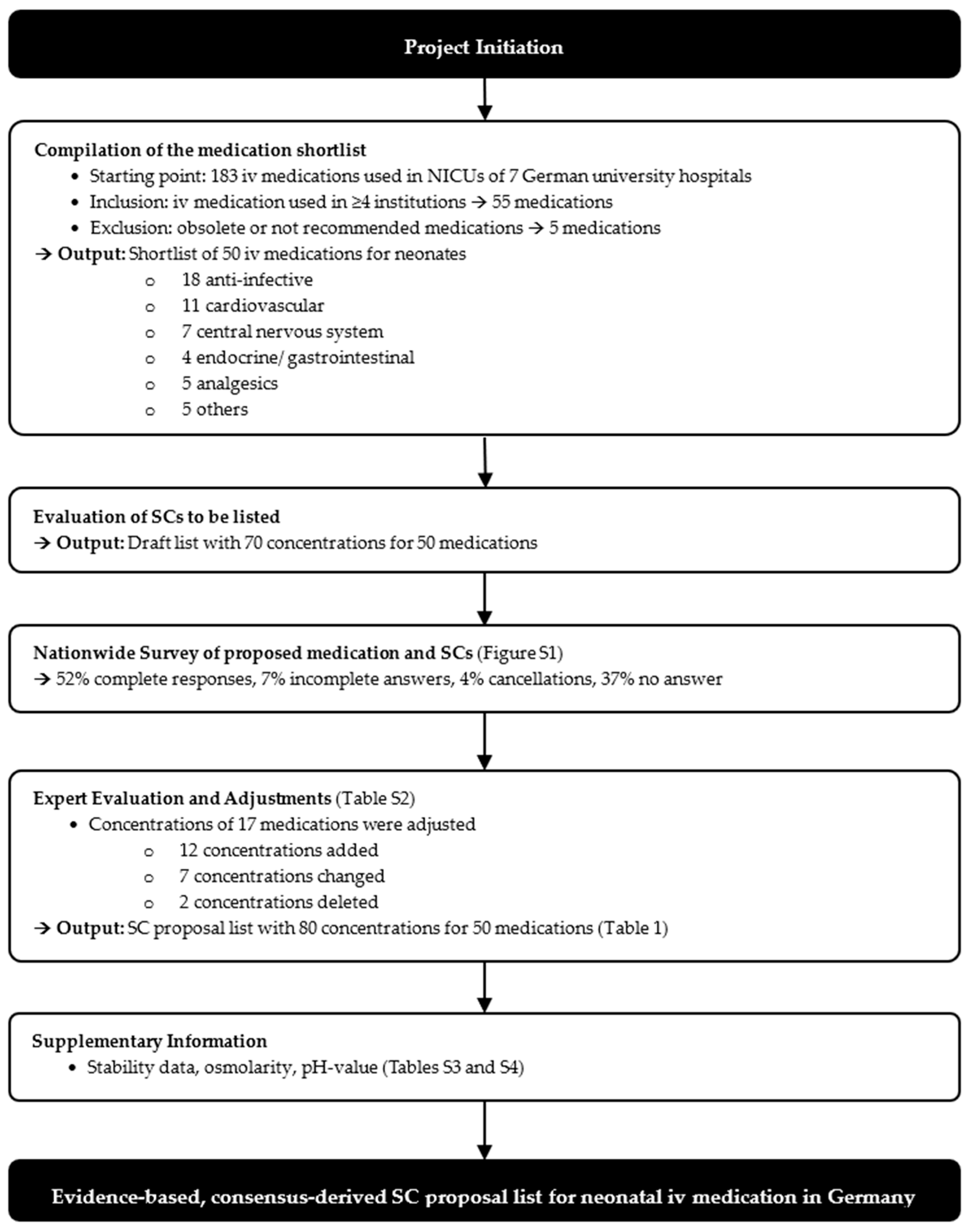
Results of the evaluation process regarding iv medications and SCs to be used in neonatal patients (weight 500 g–5 kg) are shown in Figure 1.
The five medications excluded from the shortlist were amoxicillin/clavulanic acid, amphotericin B liposomal, metamizole, methylprednisolone, and piritramide, as a positive benefit–risk balance in neonatal use has not been demonstrated.
SCs were evaluated for 50 medications with a total of 70 proposed SCs in a nationwide survey among German NICUs. Table S2 provides a detailed summary of the responses, including the frequency of suggested alternative concentrations. Many alternative suggestions were weight-based, and overlaps of a specific alternative concentration across multiple sites were uncommon, which affects the interpretation of the number of alternative concentrations. Therefore, the evaluation of the proposed SCs could not rely on the ratio of approvals to suggested changes. Instead, it required expert judgment, which was carried out in the second consensus round, during which experts independently reviewed the survey results and assessed whether each SC should be kept or adjusted.
Medications for which full consensus was reached were retained unchanged, whereas those with partial agreement were discussed and adjusted as needed (see Table S2). For example, the SCs of aciclovir, alprostadil, and ampicillin were kept as proposed (100% agreement within the expert team), whereas the SC for amiodarone (5 mg/mL) was discussed again, as only 67% of experts agreed, and another SC of 1 mg/mL was added. The level of expert agreement on keeping the proposed SCs ranges from 17% to 100%. In total, the proposed SCs of 17 medications were changed. This approach of a second consensus round allowed the expert team to incorporate preferred alternative concentrations when appropriate and ensure that the final SCs reflected both the survey input and expert judgment.
The finalized German SC proposal list (see Table 1) includes 50 iv medications and 80 concentrations for neonates, including important information like off-label use, critical excipients, and deviating concentrations given in the SmPC.
Volume expansion during reconstitution is reported for ampicillin/sulbactam, ceftazidime, cefuroxime, and flucloxacillin. It is important to keep in mind that the actual concentrations after reconstitution differ from the theoretical concentrations based on the nominal diluent volume. In contrast to adult care, where the entire vial content is administered, volume expansion is of clinical relevance in neonatal and pediatric settings, where partial volumes are withdrawn from reconstituted vials. The SCs proposed in this list are based on actual concentrations. Due to product-specific volume expansion, deviations may occur in clinical practice. Therefore, cefuroxime should be reconstituted using the specified vial sizes, as different vial sizes may result in different actual concentrations. In neonatal and pediatric settings, caution is required when prescribing, preparing, and administering medications with volume expansion during reconstitution, as this variability may affect the accuracy of dosing. From a practical perspective, future efforts by manufacturers should aim to facilitate the preparation of SCs with round values (e.g., 50 or 100 mg/mL). Currently, achieving such concentrations often requires highly precise volume measurements with decimal places, which may be challenging in routine clinical practice. Therefore, the use of non-rounded SCs remains more feasible, as infusion rates typically require decimal precision anyway.
To achieve a peripherally applicable infusion, cefotaxime should only be reconstituted with sterile water for injection. Several medications contain critical excipients, including ethanol (e.g., alprostadil, phenobarbital) or propylene glycol (e.g., phenobarbital), which are listed to ensure consideration during prescribing. Supplementary information, such as preparation instructions, stability data, osmolarity, and pH values, is provided in Table S3. Data about feasible weight-adapted infusion rates and weight-based daily infusion volume in correlation to weight-based dosing rates are given in Table S4.

4. Discussion

The implementation of SCs for iv medication is an important strategy to reduce medication errors and enhance workflow efficiency in NICUs [14]. SCs enable closed-loop medication management with smart infusion pumps, reduce the need for bedside calculations, and harmonize preparation practices [34,35,36,37,38,39]. Consequently, the use of SCs can improve patient safety and consistency in clinical practice [14].
The scope of standardization and the degree of implementation and technological integration vary across countries [7,19,22,40,41]. Different from the other national frameworks, including neonatal and pediatric iv medication, this work focused on neonates with a body weight ranging from 500 g to 5 kg and iv medication administered as continuous infusion, short infusion, and bolus injection [7,19,22,41]. A nationwide SC list for pediatric patients > 5 kg body weight up to adults will be targeted in a follow-up project. The UK guideline focused on continuous infusions, whereas the Swedish guideline standardized concentrations for all administration routes (e.g., iv, oral, rectal, inhalation) [7,22,40]. Ireland has already developed a smart infusion pump database as a national standard of care [19,38]. Listing of clinically relevant information, such as off-label use and critical excipients, as well as preparation instructions, pH values, osmolarities, and in-use stability data, may be useful not only in Germany. Comparing the German SC proposal list with the SC lists published by ASHP, UK, and Sweden, the number of overlapping medications and SC is low (see Table 2) [6,7,22].
Eight medications (amiodarone, alprostadil, fentanyl, furosemide, heparin, human insulin, midazolam, and milrinone) are included in all four frameworks, but only two SCs are identical (1 IU/mL insulin and 1 mg/mL midazolam) [6,7,22]. Several factors may explain these discrepancies. First, the included patient populations differ between frameworks (neonatal versus pediatric populations), which leads to different dosing requirements and daily fluid volume ranges. While the German SC proposal list focuses on neonates weighing 500 g to 5 kg, the UK framework and the Swedish ePed include all children under 18 years of age, whereas the ASHP framework defines SCs for children weighing less than 50 kg [6,7,22]. Second, while most licensed medicinal products in Europe are available in similar vial sizes and concentrations, additional vial strengths (e.g., for many antibiotics and catecholamines) as well as different concentrations (e.g., heparin and phenobarbital) are available in the United States. National differences in licensed medicinal products and available vial sizes may influence feasible SCs. Third, variations in clinical practice, such as administration routes, fluid restrictions, and preparation protocols, may contribute to divergent SCs. Finally, regulatory requirements and national guidelines may further influence SC proposals.
The low degree of overlap may limit the transferability of safety strategies, such as smart infusion pump drug libraries, and increase the risk of medication errors in settings involving international staff or cross-border care. Therefore, future efforts should focus on international harmonization. Collaborative initiatives between international societies and regulatory authorities may support the development of consensus-based international SCs while considering national constraints.
The proposed SCs aim to provide as many concentrations as necessary, but as few as possible to minimize confusion and the risk of mix-ups [34,36]. Nevertheless, not all clinical scenarios can be fully covered by SCs. Patient-individual dosing or fluid volume needs may still require patient-specific preparation and concentrations [42]. As some proposed SCs are not in accordance with the SmPC, their use remains off-label and falls under the responsibility of the prescribing neonatologist. However, the development of SCs, based on clinical experience across multiple German NICUs and complemented by stability data, provides a scientific framework for decision support. This approach facilitates a shift from individual practices toward a more evidence-based use. There is still information about stability, compatibility with PP syringes, osmolarities, and pH values missing. Further studies are needed to investigate the physicochemical characteristics and ensure safe use of proposed SCs. We encourage manufacturers of licensed medicinal products to evaluate appropriate SCs, provide preparation instructions, and compatibility data with 50 mL syringes used as primary containers in the SmPC.
A safe and sustainable implementation of SCs requires multiprofessional collaboration among physicians, pharmacists, and nurses. Developing staff training strategies, labeling strategies, and integration into computerized physician order entry and smart infusion pump libraries are highly recommended procedures when introducing SCs [36,43]. In hospitals that already use institution-specific SCs, alignment with national standards should be approached cautiously and implemented gradually to ensure safety and acceptance. Ongoing revision will be necessary to adapt the proposed SCs to clinical feedback and emerging evidence. Establishing a centralized database for smart infusion pumps could ensure consistent use of SCs across hospitals [19].

5. Conclusions

The development of a national SC list for neonatal iv infusions, covering 50 medications with 80 concentrations, is an important step toward safe and efficient usage of neonatal medication in Germany. By reducing variability in prescribing, preparation, and administration, the proposed SCs assist patient safety and facilitate the integration of closed-loop medication management. However, implementation will require changes in established practices and acceptance in clinical settings. Continuous evaluation and future updates based on practical experience and emerging evidence will be necessary. In the future, national and international harmonization of SCs may further enhance patient safety in this vulnerable patient population.

Supplementary Materials

The following supporting information can be downloaded at: https://www.mdpi.com/article/10.3390/jcm15082921/s1, Table S1. Databases used for supporting information on SCs, Table S2. Survey results and expert evaluation of the SC proposal list, Table S3. Information on preparation and administration of the SC Proposal List, References–Table S3, Table S4. Information on Dosing, Infusion Rates, and Infusion Volumes of the SC proposal list, Figure S1. Nationwide survey on the SC proposal list (printed version; survey translated from German).

Author Contributions

Conceptualization, L.W., K.B.K. and A.E.; methodology, L.W., I.K., K.B.K. and A.E.; software, L.W.; validation, K.B.K. and A.E.; formal analysis, L.W.; investigation, L.W., A.K., M.S., T.O., D.W., J.H.-Z., F.S., D.B., B.R., S.S., R.G., K.B.K. and A.E.; resources, A.E.; data curation, L.W.; writing—original draft preparation, L.W.; writing—review and editing, A.K., M.S., T.O., D.W., J.H.-Z., F.S., D.B., B.R., S.S., R.G., I.K., K.B.K. and A.E.; visualization, L.W.; supervision, K.B.K. and A.E.; project administration, L.W., K.B.K. and A.E.; funding acquisition, none. All authors commented on previous versions of the manuscript. All authors have read and agreed to the published version of the manuscript.

Funding

This research received no external funding.

Institutional Review Board Statement

Ethical review and approval were waived for this study due to the study not involving humans or animals.

Informed Consent Statement

Patient consent was waived due to the fact that no patients were involved in this study.

Data Availability Statement

The original contributions presented in this study are included in the article/Supplementary Material. Further inquiries can be directed to the corresponding author.

Acknowledgments

We thank Nora Bruns and Richard Biedermann for their contributions in the second round of the consensus process, facilitating the alignment between neonatal and pediatric standard concentrations. Our gratitude extends to Heike Hilgarth (ADKA and Section for Pediatric Intensive Care and Emergency Medicine of the German Interdisciplinary Association for Intensive Care and Emergency Medicine (DIVI)) for her valuable expert input. We also thank Ursula Gramlich for representing the research group of the website Kinderformularium.DE in the first meetings and Stephen Tomlin (UK), Nanna Christiansen (UK) and Per Nydert (Sweden) for sharing their experience of developing national neonatal standard concentrations. Finally, we thank all physicians, pharmacists, and nurses who participated in the survey and therefore enabled consensus building. Artificial intelligence was used for language assistance only. We employed ChatGPT (OpenAI, GPT-5 series) to improve readability and rephrase certain sections of the text. All content was reviewed and approved by the authors.

Conflicts of Interest

The authors declare no conflicts of interest.

Abbreviations

The following abbreviations are used in this manuscript:
ADKAFederal Association of German Hospital Pharmacists
ASHPAmerican Society of Health-System Pharmacists
GNPIGerman Society for Neonatology and Pediatric Intensive Care
IQTIGGerman Institute for Quality Assurance and Transparency in Health Care
ivintravenous
NICUneonatal intensive care unit
NPPGNeonatal and Paediatric Pharmacy Group
PPpolypropylene
RCPCHRoyal College of Paediatrics and Child Health
SCstandard concentration
SmPCsummary of product characteristic
WFIsterile water for injection

References

  1. Sutherland, A.; Phipps, D.L.; Tomlin, S.; Ashcroft, D.M. Mapping the Prevalence and Nature of Drug Related Problems among Hospitalised Children in the United Kingdom: A Systematic Review. BMC Pediatr. 2019, 19, 486. [Google Scholar] [CrossRef] [PubMed]
  2. Alghamdi, A.A.; Keers, R.N.; Sutherland, A.; Ashcroft, D.M. Prevalence and Nature of Medication Errors and Preventable Adverse Drug Events in Paediatric and Neonatal Intensive Care Settings: A Systematic Review. Drug Saf. 2019, 42, 1423–1436. [Google Scholar] [CrossRef]
  3. Henry Basil, J.; Premakumar, C.M.; Mhd Ali, A.; Mohd Tahir, N.A.; Seman, Z.; Voo, J.Y.H.; Ishak, S.; Mohamed Shah, N. Prevalence and Factors Associated with Medication Administration Errors in the Neonatal Intensive Care Unit: A Multicentre, Nationwide Direct Observational Study. J. Adv. Nurs. 2025, 81, 820–833. [Google Scholar] [CrossRef] [PubMed]
  4. Hermanspann, T.; van der Linden, E.; Schoberer, M.; Fitzner, C.; Orlikowsky, T.; Marx, G.; Eisert, A. Evaluation to Improve the Quality of Medication Preparation and Administration in Pediatric and Adult Intensive Care Units. Drug Healthc. Patient Saf. 2019, 11, 11–18. [Google Scholar] [CrossRef]
  5. Santesteban, E.; Arenas, S.; Campino, A. Medication Errors in Neonatal Care: A Systematic Review of Types of Errors and Effectiveness of Preventive Strategies. J. Neonatal Nurs. 2015, 21, 200–208. [Google Scholar] [CrossRef]
  6. ASHP Standardize 4 Safety Initiative: Pediatric Continuous Infusion Standards. Available online: https://www.ashp.org/-/media/assets/pharmacy-practice/s4s/docs/Pediatric-Infusion-Standards.pdf (accessed on 9 November 2025).
  7. Neonatal & Paediatric Pharmacy Group; British Association of Perinatal Medicine; Paediatric Critical Care Society; Royal College of Paediatrics and Child Health. Standardising Intravenous Infusion Concentrations for Neonates and Children in the UK. Available online: https://nppg.org.uk/wp-content/uploads/2025/01/Standard-Infusions-Nov-2024-Final.pdf (accessed on 9 August 2025).
  8. Phelps, S.J.; Hagemann, T.M.; Lee, K.R. Pediatric Injectable Drugs (The Teddy Bear Book), 12th ed.; American Society of Health-System Pharmacists: Bethesda, MD, USA, 2024. [Google Scholar]
  9. Irwin, D.; Vaillancourt, R.; Dalgleish, D.; Thomas, M.; Grenier, S.; Wong, E.; Wright, M.; Sears, M.; Doherty, D.; Gaboury, I. Standard Concentrations of High-Alert Drug Infusions across Paediatric Acute Care. Paediatr. Child Health 2008, 13, 371–376. [Google Scholar] [CrossRef]
  10. Cree, M.; Health, Q. Adherence to Standard Medication Infusion Concentrations and Its Impact on Paediatric Intensive Care Patient Outcomes. Aust. Crit. Care 2018, 31, 213–217. [Google Scholar] [CrossRef] [PubMed]
  11. Mitchell, A.; Sommo, P.; Mocerine, T.; Lesar, T. A Standardized Approach to Pediatric Parenteral Medication Delivery. Hosp. Pharm. 2004, 39, 433–459. [Google Scholar] [CrossRef]
  12. Mulvihill, C.; McDonald, D. Standardized Neonatal Continuous Infusion Concentrations: A Quality Improvement Initiative. Am. J. Health Syst. Pharm. 2023, 80, 61–67. [Google Scholar] [CrossRef]
  13. MacKay, M.W.; Cash, J.; Farr, F.; Holley, M.; Jones, K.; Boehme, S. Improving Pediatric Outcomes through Intravenous and Oral Medication Standardization. J. Pediatr. Pharmacol. Ther. 2009, 14, 226–235. [Google Scholar] [CrossRef] [PubMed]
  14. Wende, L.; Schoberer, M.; Kaune, A.; Kreutzer, K.B.; Orlikowsky, T.; Christiansen, N.; Nydert, P.; Schubert, S.; Eisert, A. The Effect of Standard Concentration Infusions on Medication Errors in Neonatal and Pediatric Healthcare Settings: A Systematic Review. J. Clin. Med. 2025, 14, 7965. [Google Scholar] [CrossRef]
  15. Kaufmann, J.; Wolf, A.R.; Becke, K.; Laschat, M.; Wappler, F.; Engelhardt, T. Drug Safety in Paediatric Anaesthesia. Br. J. Anaesth. 2017, 118, 670–679. [Google Scholar] [CrossRef]
  16. von Hobe, S.; Schoberer, M.; Orlikowsky, T.; Müller, J.; Kusch, N.; Eisert, A. Impact of a Bundle of Interventions on the Spectrum of Parenteral Drug Preparation Errors in a Neonatal and Pediatric Intensive Care Unit. J. Clin. Med. 2024, 13, 6053. [Google Scholar] [CrossRef]
  17. Swanson, A. Nix the Six: Raise the Bar on Medication Delivery. Newborn Infant Nurs. Rev. 2006, 6, 230–236. [Google Scholar] [CrossRef]
  18. Kreysing, L.; Hilgarth, H.; Bodenstein, M.; Haake, N.; Kaltwasser, A.; Köck, J.A.; Meyn, D.; Riessen, R.; Waydhas, C.; Krämer, I. Recommendations on Standard Concentrations for Continuous Infusion of Medicinal Products in Intensive Care Units. Med. Klin. Intensivmed. Notfmed 2025, 120, 199–207. [Google Scholar] [CrossRef]
  19. Howlett, M.M.; Sutton, S.; Mcgrath, E.L.; Breatnach, C.V. Implementation of a National System for Best Practice Delivery of Paediatric Infusions. Int. J. Clin. Pharm. 2024, 46, 4–13. [Google Scholar] [CrossRef] [PubMed]
  20. Institute for Safe Medication Practices Targeted Medication Safety Best Practices for Hospitals. Available online: https://www.ismp.org/guidelines/best-practices-hospitals (accessed on 9 August 2025).
  21. Institute for Safe Medication Practices (ISMP). ISMP Medication Safety Alert; Medscape: New York, NY, USA, 2005; p. 4. [Google Scholar]
  22. The Swedish National Formulary for Children EPed. Available online: https://eped.se/about-eped/ (accessed on 9 August 2025).
  23. Cardinal Health, Inc. Alaris® GH Spritzenpumpe Gebrauchsanweisung—Deutsch; 1000DF00026 Ausg. 1; Cardinal Health, Inc.: Dublin, OH, USA, 2006. [Google Scholar]
  24. Uniklinikum Erlangen Kinderformularium.DE. Available online: https://kinderformularium.de/sign_in/startseite (accessed on 12 October 2025).
  25. Stabilis 4.0. Available online: https://www.stabilis.org/ (accessed on 12 December 2025).
  26. Bundesverband Deutscher Krankenhausapotheker e. V. PÄD i.v.—ADKA Arzneimittel-Info-Datenbank. Available online: https://www.adka-aminfo.de/paediv (accessed on 12 December 2025).
  27. Gorski, L.A.; Hagle, M.E.; Bierman, S. Intermittently Delivered IV Medication and PH: Reevaluating the Evidence. J. Infus. Nurs. 2015, 38, 27–46. [Google Scholar] [CrossRef]
  28. Boullata, J.I.; Gilbert, K.; Sacks, G.; Labossiere, R.J.; Crill, C.; Goday, P.; Kumpf, V.J.; Mattox, T.W.; Plogsted, S.; Holcombe, B.; et al. A.S.P.E.N. Clinical Guidelines: Parenteral Nutrition Ordering, Order Review, Compounding, Labeling, and Dispensing. JPEN 2014, 38, 334–377. [Google Scholar] [CrossRef]
  29. Fessler, A.G.; Rejrat, C.E. Re-Evaluating Safe Osmolarity for Peripheral Parenteral Nutrition in Neonatal Intensive Care Patients. JPPT 2021, 26, 632–637. [Google Scholar] [CrossRef] [PubMed]
  30. Mian, P.; Bolhuis, M.S.; Maurer, J.M.; van Stuijvenberg, M. Adsorption of Insulin onto Neonatal Infusion Sets: Should Intravenous Administration of Insulin to Treat Hyperglycemia in Preterm Babies on the NICU Be Proceeded by priming of the Intravenous System, Adding of Albumin, or Non-priming to Get to a Stable Insulin Dose? Mol. Cell. Pediatr. 2022, 9, 20. [Google Scholar] [CrossRef] [PubMed]
  31. King Edward Memorial Hospital; Perth Children’s Hospital Neonatology. Insulin Short-Acting (Actrapid®); Version 3.1.; King Edward Memorial Hospital: Perth, Australia, 2020. [Google Scholar]
  32. Préta, L.-H.; Genay, S.; Malat, C.; Carta, N.; Boukhris, M.R.; Verspieren, J.; Odou, P.; Storme, L.; Décaudin, B. Optimising Insulin Aspart Practices in a Neonatal Intensive Care Unit: A Clinical and Pharmaco-Technical Study. Eur. J. Pediatr. 2021, 180, 2985–2992. [Google Scholar] [CrossRef]
  33. Fuloria, M.; Friedberg, M.A.; DuRant, R.H.; Aschner, J.L. Effect of Flow Rate and Insulin Priming on the Recovery of Insulin from Microbore Infusion Tubing. Pediatrics 1998, 102, 1401–1406. [Google Scholar] [CrossRef]
  34. Rashed, A.N.; Whittlesea, C.; Davies, C.; Forbes, B.; Tomlin, S. Standardised Concentrations of Morphine Infusions for Nurse/Patient-Controlled Analgesia Use in Children. BMC Anesthesiol. 2019, 19, 26. [Google Scholar] [CrossRef] [PubMed]
  35. Arenas-López, S.; Stanley, I.M.; Tunstell, P.; Aguado-Lorenzo, V.; Philip, J.; Perkins, J.; Durward, A.; Calleja-Hernández, M.A.; Tibby, S.M. Safe Implementation of Standard Concentration Infusions in Paediatric Intensive Care. J. Pharm. Pharmacol. 2017, 69, 529–536. [Google Scholar] [CrossRef] [PubMed]
  36. Larsen, G.Y.; Parker, H.B.; Cash, J.; O’Connell, M.; Grant, M.J.C. Standard Drug Concentrations and Smart-Pump Technology Reduce Continuous-Medication-Infusion Errors in Pediatric Patients. Pediatrics 2005, 116, e21–e25. [Google Scholar] [CrossRef] [PubMed]
  37. Polischuk, E.; Vetterly, C.G.; Crowley, K.L.; Thompson, A.; Goff, J.; Nguyen-Ha, P.-T.; Modery, C. Implementation of a Standardized Process for Ordering and Dispensing of High-Alert Emergency Medication Infusions. J. Pediatr. Pharmacol. Ther. 2012, 17, 166–172. [Google Scholar] [CrossRef]
  38. Howlett, M.M.; Breatnach, C.V.; Brereton, E.; Cleary, B.J. Direct Observational Study of Interfaced Smart-Pumps in Pediatric Intensive Care. Appl. Clin. Inform. 2020, 11, 659–670. [Google Scholar] [CrossRef]
  39. Roman, N. Innovative Solutions: Standardized Concentrations Facilitate the Use of Continuous Infusions for Pediatric Intensive Care Unit Nurses at a Community Hospital. Dimens. Crit. Care Nurs. 2005, 24, 275–278. [Google Scholar] [CrossRef]
  40. Garnemark, C.A.; Nydert, P.; Lindemalm, S. The Swedish National Formulary for Children EPed. Comment on Shaniv et al. A Callout for International Collaboration. Reply to Giger, E.V.; Tilen, R. Comment on “Shaniv et al. Neonatal Drug Formularies—A Global Scope. Children 2023, 10, 848”. Children 2023, 10, 1803. Children 2024, 11, 1339. [Google Scholar] [CrossRef]
  41. Taladriz-Sender, I.; Manrique-Rodríguez, S.; Fernández-Llamazares, C.M.; Herranz-Alonso, A.; Sanjurjo-Sáez, M. Standardisation of Intravenous Infusion Therapy for Paediatrics: Big Challenges for the Little Patients. Eur. J. Hosp. Pharm. 2024, 31, 274–280. [Google Scholar] [CrossRef] [PubMed]
  42. Niemi, K.; Geary, S.; Larrabee, M.; Brown, K.R. Standardized Vasoactive Medications: A Unified System for Every Patient, Everywhere. Hosp. Pharm. 2005, 40, 984–993. [Google Scholar] [CrossRef]
  43. Aghighi, N.; Aryankhesal, A.; Raeissi, P. Factors Affecting the Recurrence of Medical Errors in Hospitals and the Preventive Strategies: A Scoping Review. J. Med. Ethics Hist. Med. 2022, 15, 7. [Google Scholar] [CrossRef] [PubMed]
Figure 1. Flowchart of the development of a nationwide SC proposal list for neonatal iv medication. iv: intravenous, SC: standard concentration, NICU: neonatal intensive care.
Jcm 15 02921 g001
Table 1. German SC proposal list for neonatal intravenous medication.
Nr.MedicationRecommended Standard ConcentrationAdministration RouteAncillary Information
1Aciclovir5 mg/mL short infusion
2Alprostadil1 µg/mLcontinuous infusionContains ethanol!
2 µg/mLcontinuous infusion
3Amiodarone HCl1 mg/mLcontinuous infusionOff-label
Contains benzyl alcohol!
Central venous administration if continuous infusion or >2 mg/mL
5 mg/mLbolus
4Ampicillin100 mg/mLbolus
5Ampicillin/Sulbactam100/50 mg/mLbolusVolume expansion!
After adding 3.2 mL WFI, 4.2 mL can be withdrawn from the vial.
6Cefotaxime100 mg/mL bolus/short infusionDue to osmolarity, cefotaxime must only be dissolved with WFI.
7Ceftazidime90 mg/mLbolus/short infusionVolume expansion!
Reconstitution results in a concentration of 90 mg/mL.
8Cefuroxime116 mg/mLbolusVolume expansion!
Reconstitution results in a concentration of 116 mg/mL, using 250 mg and 750 mg vials.
9Clarithromycin2 mg/mLshort infusionOff-label
10Clindamycin5 mg/mLshort infusionOff-label under 4 weeks!
Ratiopharm® does not contain benzyl alcohol. Other licensed products do.
11Clonidine HCl1.5 µg/mLcontinuous infusionOff-label
7.5 µg/mLcontinuous infusion
12Caffeine citrate20 mg/mLbolus/short infusion
13Dexamethasone-21-dihydrogenphosphate0.1 mg/mLbolusOff-label
0.5 mg/mLbolus
14Dobutamine0.5 mg/mLcontinuous infusionOff-label in preterm infants!
Central venous administration > 1 mg/mL
1 mg/mLcontinuous infusion
2.5 mg/mLcontinuous infusion
15Dopamine HCl0.5 mg/mLcontinuous infusionOff-label
Central venous administration
1 mg/mLcontinuous infusion
2.5 mg/mLcontinuous infusion
16Doxapram HCl · 1 H2O1 mg/mLcontinuous infusionMust be administered as a push infusion.
2 mg/mLcontinuous infusion
17Epinephrine10 µg/mLcontinuous infusionContains sodium metabisulfite! (max. 0.5 mg/mL)
Concentrations differ from SmPC.
20 µg/mLcontinuous infusion
40 µg/mLcontinuous infusion
18Erythromycin5 mg/mLshort infusionOff-label in preterm infants!
19Esketamine0.5 mg/mLbolus/continuous infusion
5 mg/mLbolus/continuous infusion
20Esmolol HCl10 mg/mLcontinuous infusionOff-label
21Fentanyl2.5 µg/mLbolus/continuous infusionOff-label
5 µg/mLbolus/continuous infusion
10 µg/mLbolus/continuous infusion
22Flucloxacillin48.5 mg/mL short infusionVolume expansion!
Reconstitution results in a concentration of 48.5 mg/mL.
23Fluconazole2 mg/mL short infusionOff-label in preterm infants!
24Furosemide0.2 mg/mL continuous infusionOff-label under 1 month!
0.4 mg/mLcontinuous infusion
1 mg/mLbolus/continuous infusion
5 mg/mLbolus
25Gentamicin2 mg/mLshort infusionOff-label in preterm infants!
26Heparin Na1 IU/mLcontinuous infusionOff-label under 1 month!
100 IU/mLcontinuous infusion
27Human Insulin0.02 IU/mL continuous infusionContains phenol!
Beware of insulin adsorption to infusion lines and syringes: Before administration, prime the line for 20 to 60 min with 20 mL 5 IU/mL insulin solution and flush with the insulin solution to be administered, afterwards. Monitor the first 3 to 6 h for overdosing [30,31,32,33].
Concentrations differ from SmPC.
0.2 IU/mLcontinuous infusion
1 IU/mLcontinuous infusion
28Hydrocortisone1 mg/mLbolusOff-label
29Ibuprofen5 mg/mLshort infusion
30Indomethacin0.2 mg/mLshort infusionImported medicinal product
31Levetiracetam10 mg/mL short infusionOff-label
32Meropenem10 mg/mL short infusion, also prolongedOff-label
33Metronidazole5 mg/mLshort infusion
34Midazolam0.1 mg/mLbolusManual injection feasible.
Beware of neurotoxicity!
1 mg/mLbolus
35Milrinone50 µg/mLcontinuous infusion
200 µg/mLcontinuous infusion
36Morphine salts10 µg/mLcontinuous infusion Morphine HCl and sulfate salts are treated equally regarding concentrations and dosing.
100 µg/mLbolus/continuous infusion
200 µg/mLbolus/continuous infusion
37Naloxone HCl40 µg/mL bolus
100 µg/mLbolus
38Norepinephrine10 µg/mLcontinuous infusionOff-label
Central venous administration is preferred.
20 µg/mL continuous infusion
40 µg/mLcontinuous infusion
39Paracetamol10 mg/mLshort infusionOff-label in preterm infants!
Beware of overdosing!
40Penicillin G0.1 Mio IU/mLbolus
41Phenobarbital (base)10 mg/mLbolus/short infusionContains ethanol and propylene glycol!
CAUTION: Dosage and concentration are given as base, not as sodium salt.
Concentrations differ from SmPC.
42Phytomenadione (Vitamin K1)1 mg/mL bolusConcentrations differ from SmPC.
43Piperacillin/Tazobactam100/12.5 mg/mL short infusion, also prolongedOff-label
44Prednisolone-21-hydrogensuccinate1 mg/mLbolus
5 mg/mLbolus
45Propofol5 mg/mLbolusOff-label
46Sildenafil0.16 mg/mL continuous infusion Off-label
0.8 mg/mLbolus/short infusion
47Teicoplanin10 mg/mLshort infusion
48Theophylline1 mg/mLcontinuous infusionOff-label
49Vancomycin HCl5 mg/mLshort infusion
50Vecuronium Br0.1 mg/mLbolus/continuous infusion
1 mg/mLbolus/continuous infusion
SmPC: summary of product characteristics, WFI: sterile water for injection.
Table 2. Comparison of the German SC proposal list to international SC frameworks.
UK [7]Sweden [22]ASHP [6]All Frameworks [6,7,22]
Overlapping medication [n]1627178
Overlapping SC [n]1914142
ASHP: American Society of Health-System Pharmacists, SC: standard concentration.
Disclaimer/Publisher’s Note: The statements, opinions and data contained in all publications are solely those of the individual author(s) and contributor(s) and not of MDPI and/or the editor(s). MDPI and/or the editor(s) disclaim responsibility for any injury to people or property resulting from any ideas, methods, instructions or products referred to in the content.