Construction of a Nomogram Prediction Model for Mortality Risk Within 14 Days in Patients with Acute Myocardial Infarction and Ventricular Septal Rupture
 , , ,
, , , 
Abstract
1. Introduction
2. Materials and Methods
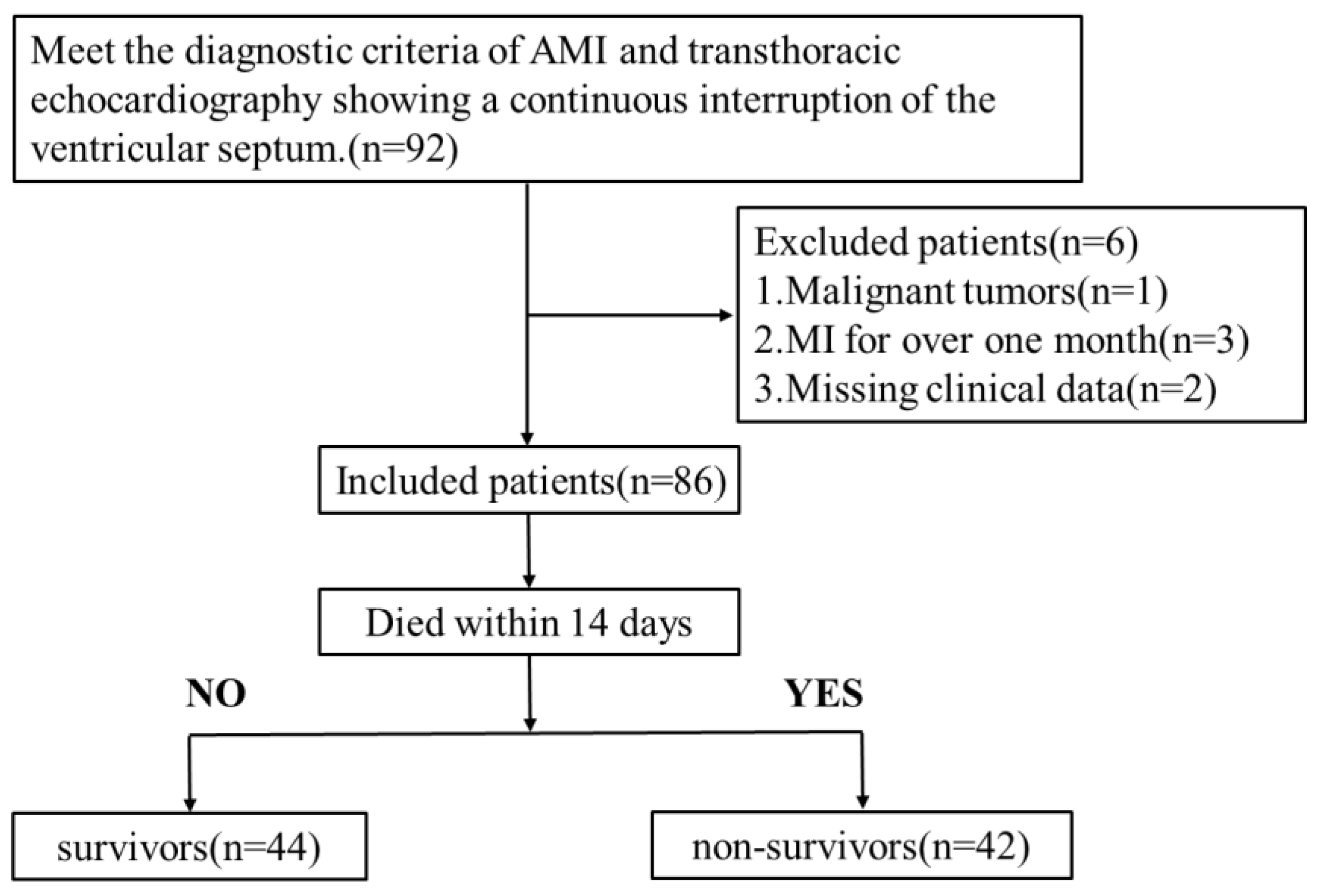
2.1. Population
2.2. Data Collection
2.3. Lasso Regression Analysis
2.4. Logistic Regression Analysis
2.5. Construction and Evaluation of the Nomogram Prediction Model
2.6. Statistical Analysis
3. Results
3.1. Analysis of Baseline Data Clinical Parameters in VSR Patients
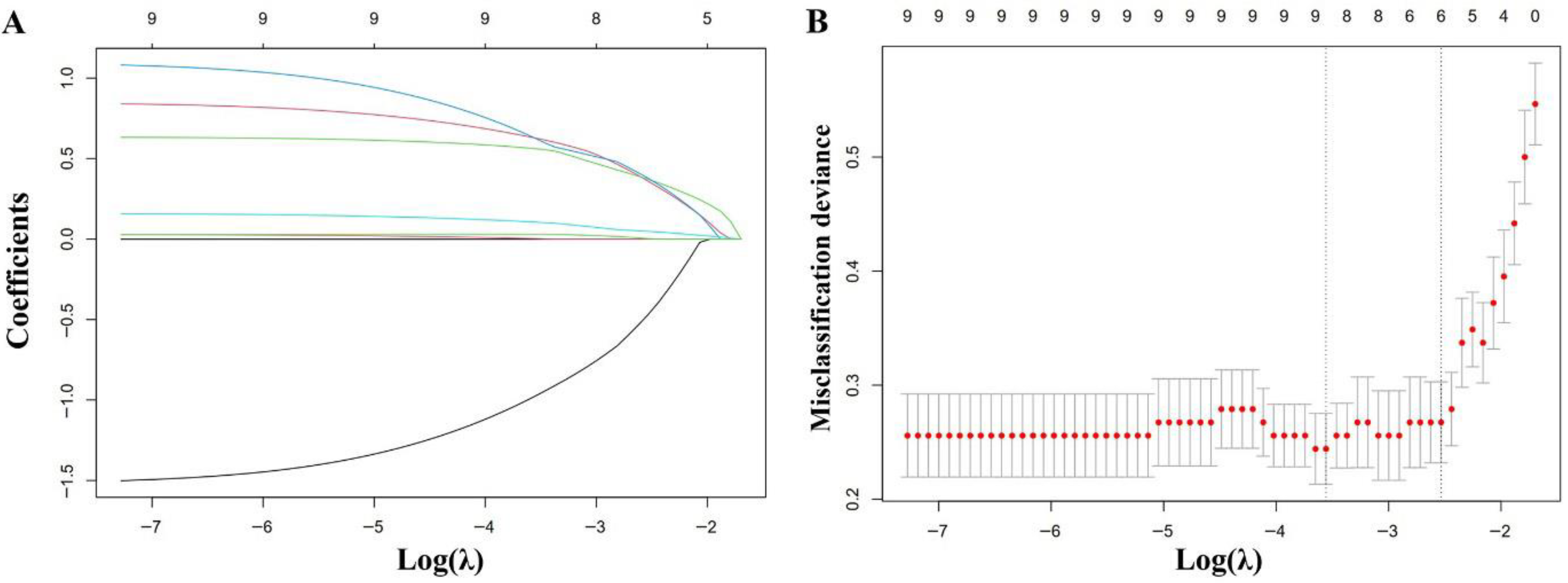
3.2. Results of Lasso Regression Analysis
3.3. Results of Logistic Regression Analysis
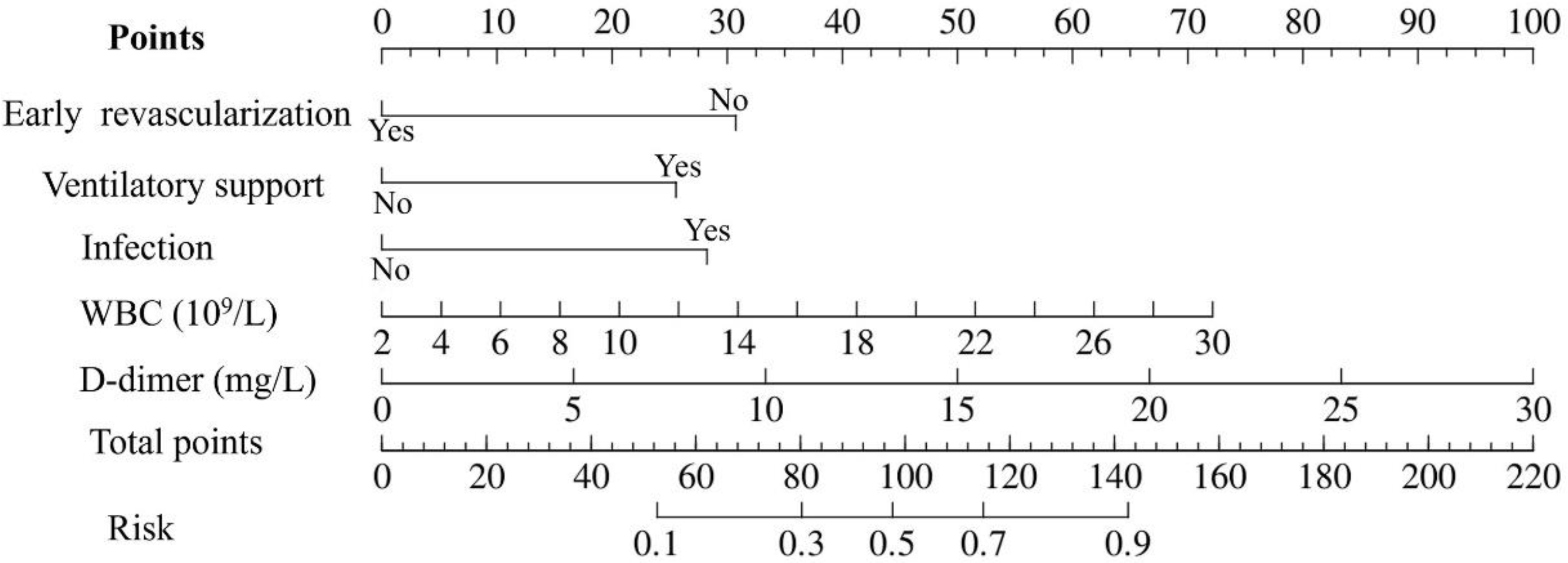
3.4. Establishment and Analysis of the Nomogram Prediction Model
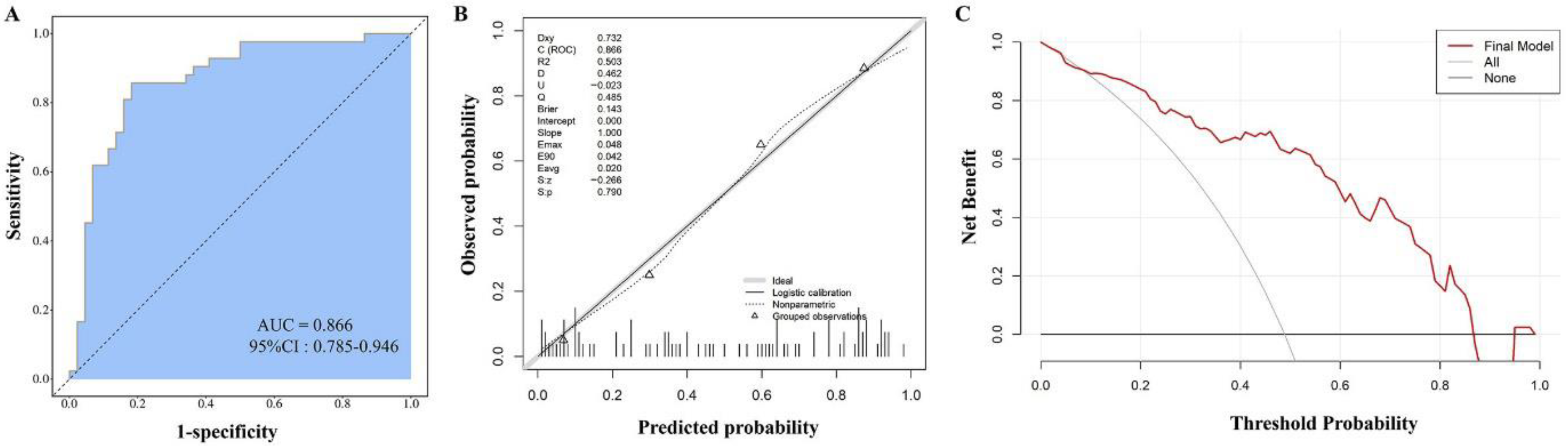
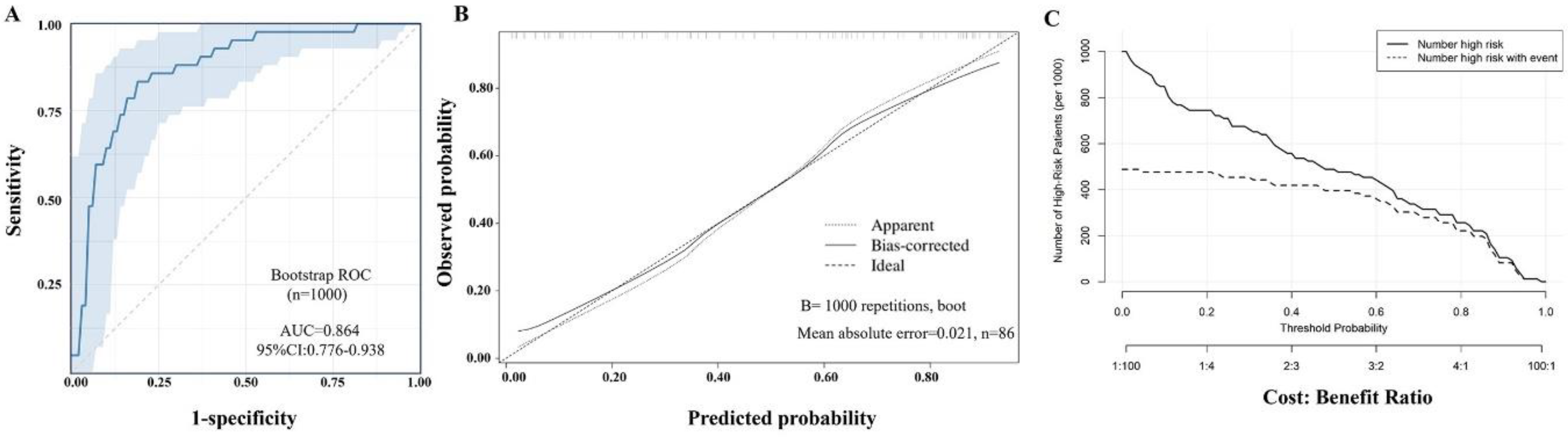
3.5. Analysis of Internal Validation by the Bootstrap Method
4. Discussion
Supplementary Materials
Author Contributions
Funding
Institutional Review Board Statement
Informed Consent Statement
Data Availability Statement
Conflicts of Interest
References
- Honda, S.; Asaumi, Y.; Yamane, T.; Nagai, T.; Miyagi, T.; Noguchi, T.; Anzai, T.; Goto, Y.; Ishihara, M.; Nishimura, K.; et al. Trends in the clinical and pathological characteristics of cardiac rupture in patients with acute myocardial infarction over 35 years. J. Am. Heart Assoc. 2014, 3, e984. [Google Scholar] [CrossRef]
- Cubeddu, R.J.; Lorusso, R.; Ronco, D.; Matteucci, M.; Axline, M.S.; Moreno, P.R. Ventricular Septal Rupture After Myocardial Infarction: JACC Focus Seminar 3/5. J. Am. Coll. Cardiol. 2024, 83, 1886–1901. [Google Scholar] [CrossRef]
- Yip, H.K.; Wu, C.J.; Chang, H.W.; Wang, C.P.; Cheng, C.I.; Chua, S.; Chen, M.C. Cardiac rupture complicating acute myocardial infarction in the direct percutaneous coronary intervention reperfusion era. Chest 2003, 124, 565–571. [Google Scholar] [CrossRef] [PubMed]
- Elbadawi, A.; Elgendy, I.Y.; Mahmoud, K.; Barakat, A.F.; Mentias, A.; Mohamed, A.H.; Ogunbayo, G.O.; Megaly, M.; Saad, M.; Omer, M.A.; et al. Temporal Trends and Outcomes of Mechanical Complications in Patients with Acute Myocardial Infarction. JACC Cardiovasc. Interv. 2019, 12, 1825–1836. [Google Scholar] [CrossRef]
- Ellis, C.J.; Parkinson, G.F.; Jaffe, W.M.; Campbell, M.J.; Kerr, A.R. Good long-term outcome following surgical repair of post-infarction ventricular septal defect. Aust. N. Z. J. Med. 1995, 25, 330–336. [Google Scholar] [CrossRef]
- Matteucci, M.; Ronco, D.; Kowalewski, M.; Massimi, G.; De Bonis, M.; Formica, F.; Jiritano, F.; Folliguet, T.; Bonaros, N.; Sponga, S.; et al. Long-term survival after surgical treatment for post-infarction mechanical complications: Results from the Caution study. Eur. Heart J. Qual. Care Clin. Outcomes 2024, 10, 737–749. [Google Scholar] [CrossRef] [PubMed]
- Ronco, D.; Matteucci, M.; Kowalewski, M.; De Bonis, M.; Formica, F.; Jiritano, F.; Fina, D.; Folliguet, T.; Bonaros, N.; Russo, C.F.; et al. Surgical Treatment of Postinfarction Ventricular Septal Rupture. JAMA Netw. Open 2021, 4, e2128309. [Google Scholar] [CrossRef] [PubMed]
- Arnaoutakis, G.J.; Zhao, Y.; George, T.J.; Sciortino, C.M.; McCarthy, P.M.; Conte, J.V. Surgical repair of ventricular septal defect after myocardial infarction: Outcomes from the Society of Thoracic Surgeons National Database. Ann. Thorac. Surg. 2012, 94, 436–444. [Google Scholar] [CrossRef] [PubMed]
- Giblett, J.P.; Jenkins, D.P.; Calvert, P.A. Transcatheter treatment of postinfarct ventricular septal defects. Heart (Br. Card. Soc.) 2020, 106, 878–884. [Google Scholar] [CrossRef]
- Crenshaw, B.S.; Granger, C.B.; Birnbaum, Y.; Pieper, K.S.; Morris, D.C.; Kleiman, N.S.; Vahanian, A.; Califf, R.M.; Topol, E.J. Risk factors, angiographic patterns, and outcomes in patients with ventricular septal defect complicating acute myocardial infarction. GUSTO-I (Global Utilization of Streptokinase and TPA for Occluded Coronary Arteries) Trial Investigators. Circulation 2000, 101, 27–32. [Google Scholar] [CrossRef]
- Kageyama, S.; Nakanishi, Y.; Murata, K.; Nawada, R.; Onodera, T.; Sakamoto, A.; Yamazaki, F.; Miura, Y.; Maekawa, Y. Mortality and predictors of survival in patients with recent ventricular septal rupture. Heart Vessel. 2020, 35, 1672–1680. [Google Scholar] [CrossRef]
- Moreyra, A.E.; Huang, M.S.; Wilson, A.C.; Deng, Y.; Cosgrove, N.M.; Kostis, J.B.; Midas, S.G.M. Trends in incidence and mortality rates of ventricular septal rupture during acute myocardial infarction. Am. J. Cardiol. 2010, 106, 1095–1100. [Google Scholar] [CrossRef]
- Bakhshi, H.; Gattani, R.; Ekanem, E.; Singh, R.; Desai, M.; Speir, A.M.; Sinha, S.S.; Sherwood, M.W.; Tehrani, B.; Batchelor, W. Ventricular septal rupture and cardiogenic shock complicating STEMI during COVID-19 pandemic: An old foe re-emerges. Heart Lung J. Crit. Care 2021, 50, 292–295. [Google Scholar] [CrossRef]
- Matteucci, M.; Ronco, D.; Corazzari, C.; Fina, D.; Jiritano, F.; Meani, P.; Kowalewski, M.; Beghi, C.; Lorusso, R. Surgical Repair of Postinfarction Ventricular Septal Rupture: Systematic Review and Meta-Analysis. Ann. Thorac. Surg. 2021, 112, 326–337. [Google Scholar] [CrossRef]
- Giblett, J.P.; Matetic, A.; Jenkins, D.; Ng, C.Y.; Venuraju, S.; MacCarthy, T.; Vibhishanan, J.; O’Neill, J.P.; Kirmani, B.H.; Pullan, D.M.; et al. Post-infarction ventricular septal defect: Percutaneous or surgical management in the UK national registry. Eur. Heart J. 2022, 43, 5020–5032. [Google Scholar] [CrossRef] [PubMed]
- French, J.K.; Hellkamp, A.S.; Armstrong, P.W.; Cohen, E.; Kleiman, N.S.; O’Connor, C.M.; Holmes, D.R.; Hochman, J.S.; Granger, C.B.; Mahaffey, K.W. Mechanical complications after percutaneous coronary intervention in ST-elevation myocardial infarction (from APEX-AMI). Am. J. Cardiol. 2010, 105, 59–63. [Google Scholar] [CrossRef] [PubMed]
- López-Sendón, J.; Gurfinkel, E.P.; Lopez De Sa, E.; Agnelli, G.; Gore, J.M.; Steg, P.G.; Eagle, K.A.; Cantador, J.R.; Fitzgerald, G.; Granger, C.B.; et al. Factors related to heart rupture in acute coronary syndromes in the Global Registry of Acute Coronary Events. Eur. Heart J. 2010, 31, 1449–1456. [Google Scholar] [CrossRef]
- Figueras, J.; Alcalde, O.; Barrabés, J.A.; Serra, V.; Alguersuari, J.; Cortadellas, J.; Lidón, R. Changes in hospital mortality rates in 425 patients with acute ST-elevation myocardial infarction and cardiac rupture over a 30-year period. Circulation 2008, 118, 2783–2789. [Google Scholar] [CrossRef]
- Yip, H.; Fang, C.; Tsai, K.; Chang, H.; Yeh, K.; Fu, M.; Wu, C. The potential impact of primary percutaneous coronary intervention on ventricular septal rupture complicating acute myocardial infarction. Chest 2004, 125, 1622–1628. [Google Scholar] [CrossRef] [PubMed]
- Goldsweig, A.M.; Wang, Y.; Forrest, J.K.; Cleman, M.W.; Minges, K.E.; Mangi, A.A.; Aronow, H.D.; Krumholz, H.M.; Curtis, J.P. Ventricular septal rupture complicating acute myocardial infarction: Incidence, treatment, and outcomes among medicare beneficiaries 1999–2014. Catheter. Cardiovasc. Interv. 2018, 92, 1104–1115. [Google Scholar] [CrossRef]
- Bouisset, F.; Deney, A.; Ferrières, J.; Panagides, V.; Becker, M.; Riviere, N.; Yvorel, C.; Commeau, P.; Adjedj, J.; Benamer, H.; et al. Mechanical complications in ST-elevation myocardial infarction: The impact of pre-hospital delay. Int. J. Cardiol. 2021, 345, 14–19. [Google Scholar] [CrossRef]
- Damluji, A.A.; van Diepen, S.; Katz, J.N.; Menon, V.; Tamis-Holland, J.E.; Bakitas, M.; Cohen, M.G.; Balsam, L.B.; Chikwe, J.; American Heart Association Council on Clinical Cardiology; et al. Mechanical Complications of Acute Myocardial Infarction: A Scientific Statement from the American Heart Association. Circulation 2021, 144, e16–e35. [Google Scholar] [CrossRef] [PubMed]
- Shibasaki, I.; Otani, N.; Saito, S.; Ogawa, H.; Masawa, T.; Tsuchiya, G.; Takei, Y.; Tezuka, M.; Kanazawa, Y.; Kanno, Y.; et al. Overview of mechanical circulatory support for the management of post-myocardial infarction ventricular septal rupture. J. Cardiol. 2023, 81, 491–497. [Google Scholar] [CrossRef]
- Ronco, D.; Matteucci, M.; Ravaux, J.M.; Marra, S.; Torchio, F.; Corazzari, C.; Massimi, G.; Beghi, C.; Maessen, J.; Lorusso, R. Mechanical Circulatory Support as a Bridge to Definitive Treatment in Post-Infarction Ventricular Septal Rupture. JACC. Cardiovasc. Interv. 2021, 14, 1053–1066. [Google Scholar] [CrossRef] [PubMed]
- Thiele, H.; Zeymer, U.; Neumann, F.; Ferenc, M.; Olbrich, H.; Hausleiter, J.; Richardt, G.; Hennersdorf, M.; Empen, K.; Fuernau, G.; et al. Intraaortic balloon support for myocardial infarction with cardiogenic shock. N. Engl. J. Med. 2012, 367, 1287–1296. [Google Scholar] [CrossRef]
- Gao, X.; Tsai, A.; Al-Sharea, A.; Su, Y.; Moore, S.; Han, L.; Kiriazis, H.; Dart, A.M.; Murphy, A.J.; Du, X. Inhibition of the Renin-Angiotensin System Post Myocardial Infarction Prevents Inflammation-Associated Acute Cardiac Rupture. Cardiovasc. Drug Ther. 2017, 31, 145–156. [Google Scholar] [CrossRef] [PubMed]
- Gong, W.; Ma, Y.; Li, A.; Shi, H.; Nie, S. Trimetazidine suppresses oxidative stress, inhibits MMP-2 and MMP-9 expression, and prevents cardiac rupture in mice with myocardial infarction. Cardiovasc. Ther. 2018, 36, e12460. [Google Scholar] [CrossRef]
- Zhang, X.; Bian, L.; Tian, N. The Clinical Outcomes of Ventricular Septal Rupture Secondary to Acute Myocardial Infarction: A Retrospective, Observational Trial. J. Interv. Cardiol. 2021, 2021, 3900269. [Google Scholar] [CrossRef] [PubMed]
- Zhang, Z.; Liu, Y.; Cheng, Q.; Zhang, J.; Gao, C. Development of a nomogram to predict 30-day mortality in patients with post-infarction ventricular septal rupture. Sci. Rep. 2024, 14, 17690. [Google Scholar] [CrossRef]
- Jones, B.M.; Kapadia, S.R.; Smedira, N.G.; Robich, M.; Tuzcu, E.M.; Menon, V.; Krishnaswamy, A. Ventricular septal rupture complicating acute myocardial infarction: A contemporary review. Eur. Heart J. 2014, 35, 2060–2068. [Google Scholar] [CrossRef]
- Erkol, A.; Oduncu, V.; Turan, B.; Kılıçgedik, A.; Sırma, D.; Gözübüyük, G.; Karabay, C.Y.; Guler, A.; Dündar, C.; Tigen, K.; et al. The value of plasma D-dimer level on admission in predicting no-reflow after primary percutaneous coronary intervention and long-term prognosis in patients with acute ST segment elevation myocardial infarction. J. Thromb. Thrombolys 2014, 38, 339–347. [Google Scholar] [CrossRef] [PubMed]
- Biccirè, F.G.; Farcomeni, A.; Gaudio, C.; Pignatelli, P.; Tanzilli, G.; Pastori, D. D-dimer for risk stratification and antithrombotic treatment management in acute coronary syndrome patients: A systematic review and metanalysis. Thromb. J. 2021, 19, 102, Erratum in Thromb. J. 2022, 20, 7. [Google Scholar] [CrossRef] [PubMed]



| Variables | Total (n = 86) | Survival Group (n = 44) | Dead Group (n = 42) | Statistic | p-Value |
|---|---|---|---|---|---|
| Age (years) | 72.50 (66.25, 78.00) | 72.50 (65.75, 78.00) | 72.50 (67.00, 79.25) | Z = −0.19 | 0.849 |
| Gender, n (%) | χ2 = 3.07 | 0.080 | |||
| Female | 47 (54.65) | 20 (45.45) | 27 (64.29) | ||
| Male | 39 (45.35) | 24 (54.55) | 15 (35.71) | ||
| Temperature (°C) | 36.50 (36.30, 36.60) | 36.50 (36.30, 36.60) | 36.55 (36.32, 36.70) | Z = −1.42 | 0.155 |
| SBP (mmHg) | 110.00 (100.00, 122.75) | 110.00 (100.75, 129.00) | 110.00 (99.25, 120.75) | Z = −0.64 | 0.522 |
| DBP (mmHg) | 71.50 (65.25, 83.00) | 70.00 (65.00, 83.25) | 73.00 (66.25, 82.50) | Z = −0.39 | 0.697 |
| HR (beat/min) | 100.00 (90.25, 112.00) | 99.00 (88.75, 109.25) | 103.00 (93.75, 114.00) | Z = −1.33 | 0.183 |
| WBC (109/L) | 12.00 (8.70, 16.54) | 9.62 (7.02, 12.82) | 14.96 (10.57, 17.18) | Z = −3.72 | <0.001 |
| Hemoglobin (g/L) | 119.50 (106.50, 128.75) | 118.00 (105.75, 127.25) | 121.00 (108.00, 130.75) | Z = −0.64 | 0.522 |
| Platelet (109/L) | 231.50 (145.00, 296.50) | 221.50 (120.50, 294.25) | 233.50 (150.50, 304.75) | Z = −0.50 | 0.619 |
| K+(mmol/L) | 3.94 (3.62, 4.38) | 3.92 (3.48, 4.26) | 4.06 (3.75, 4.71) | Z = −1.86 | 0.063 |
| Na+ (mmol/L) | 136.35 (132.72, 138.28) | 137.00 (134.00, 138.60) | 135.35 (131.00, 138.17) | Z = −1.82 | 0.068 |
| Albumin (g/L) | 33.10 (30.72, 36.88) | 33.35 (31.43, 36.35) | 32.90 (30.13, 37.08) | Z = −0.83 | 0.409 |
| CREA(μmol/L) | 102.85 (66.50, 197.85) | 84.60 (62.00, 152.75) | 131.25 (77.53, 217.62) | Z = −1.89 | 0.058 |
| CK(U/L) | 251.00 (83.25, 790.50) | 141.00 (60.00, 434.50) | 537.50 (174.00, 973.25) | Z = −2.84 | 0.004 |
| CK-MB(U/L) | 21.00 (13.25, 67.00) | 18.50 (11.75, 54.17) | 42.00 (17.25, 91.75) | Z = −2.22 | 0.027 |
| NT-proBNP (pg/mL) | 8857.78 (3110.30, 10000.00) | 6235.43 (2962.10, 10000.00) | 10000.00 (4297.60, 10000.00) | Z = −1.63 | 0.103 |
| TNI (ng/mL) | 3.98 (0.95, 17.56) | 1.20 (0.23, 8.79) | 7.56 (3.29, 20.89) | Z = −3.54 | <0.001 |
| D-dimer (mg/L) | 2.05 (1.05, 4.04) | 1.56 (0.79, 2.40) | 2.63 (1.15, 6.18) | Z = −2.70 | 0.007 |
| Urea (mmol/L) | 12.18 (7.88, 19.89) | 11.35 (7.63, 17.09) | 12.98 (8.06, 22.84) | Z = −1.27 | 0.206 |
| Uric acid(µmol/L) | 495.00 (366.75, 630.00) | 441.00 (361.93, 523.75) | 533.50 (396.00, 838.75) | Z = −1.78 | 0.076 |
| TG (mmol/L) | 1.32 (1.01, 1.65) | 1.27 (1.00, 1.49) | 1.33 (1.05, 1.94) | Z = −1.70 | 0.089 |
| TC (mmol/L) | 3.65 (2.95, 4.59) | 3.59 (2.94, 4.05) | 3.69 (2.97, 4.64) | Z = −0.65 | 0.514 |
| HDL (mmol/L) | 0.77 (0.63, 0.95) | 0.83 (0.64, 0.98) | 0.76 (0.61, 0.87) | Z = −1.40 | 0.160 |
| LDL (mmol/L) | 2.17 (1.86, 2.88) | 2.14 (1.81, 2.81) | 2.23 (1.90, 2.94) | Z = −0.85 | 0.397 |
| TBIL (µmol/L) | 14.80 (9.20, 24.70) | 12.45 (8.38, 20.30) | 15.75 (11.30, 27.18) | Z = −1.61 | 0.108 |
| DBIL (µmol/L) | 5.25 (3.90, 11.47) | 5.20 (3.77, 9.93) | 5.95 (4.10, 14.67) | Z = −1.21 | 0.225 |
| IBIL (µmol/L) | 7.45 (4.95, 11.38) | 6.95 (5.05, 11.00) | 7.70 (5.15, 11.88) | Z = −0.88 | 0.380 |
| Early revascularization, n (%) | χ2 = 5.93 | 0.015 | |||
| No | 66 (76.74) | 29 (65.91) | 37 (88.10) | ||
| Yes | 20 (23.26) | 15 (34.09) | 5 (11.90) | ||
| A to D, n (%) | χ2 = 0.38 | 0.535 | |||
| 0(≤12 h) | 36 (41.86) | 17 (38.64) | 19 (45.24) | ||
| 1(>12 h) | 50 (58.14) | 27 (61.36) | 23 (54.76) | ||
| Anterior wall infarction, n (%) | χ2 = 0.01 | 0.912 | |||
| No | 68 (79.07) | 35 (79.55) | 33 (78.57) | ||
| Yes | 18 (20.93) | 9 (20.45) | 9 (21.43) | ||
| CS, n (%) | χ2 = 2.30 | 0.130 | |||
| No | 42 (48.84) | 25 (56.82) | 17 (40.48) | ||
| Yes | 44 (51.16) | 19 (43.18) | 25 (59.52) | ||
| Hypertension, n (%) | - | 0.346 | |||
| No | 24 (27.91) | 10 (22.73) | 14 (33.33) | ||
| Grade I | 6 (6.98) | 5 (11.36) | 1 (2.38) | ||
| Grade II | 24 (27.91) | 13 (29.55) | 11 (26.19) | ||
| Grade III | 32 (37.21) | 16 (36.36) | 16 (38.10) | ||
| Diabetes, n (%) | χ2 = 0.41 | 0.521 | |||
| No | 44 (51.16) | 24 (54.55) | 20 (47.62) | ||
| Yes | 42 (48.84) | 20 (45.45) | 22 (52.38) | ||
| Renal insufficiency, n (%) | χ2 = 0.14 | 0.709 | |||
| No | 65 (75.58) | 34 (77.27) | 31 (73.81) | ||
| Yes | 21 (24.42) | 10 (22.73) | 11 (26.19) | ||
| Hepatic insufficiency, n (%) | χ2 = 0.03 | 0.855 | |||
| No | 50 (58.14) | 26 (59.09) | 24 (57.14) | ||
| Yes | 36 (41.86) | 18 (40.91) | 18 (42.86) | ||
| PPCI, n (%) | χ2 = 0.00 | 1.000 | |||
| No | 82 (95.35) | 42 (95.45) | 40 (95.24) | ||
| Yes | 4 (4.65) | 2 (4.55) | 2 (4.76) | ||
| AF, n (%) | χ2 = 0.14 | 0.708 | |||
| No | 67 (77.91) | 35 (79.55) | 32 (76.19) | ||
| Yes | 19 (22.09) | 9 (20.45) | 10 (23.81) | ||
| Ventricular aneurysm, n (%) | χ2 = 0.07 | 0.796 | |||
| No | 76 (88.37) | 38 (86.36) | 38 (90.48) | ||
| Yes | 10 (11.63) | 6 (13.64) | 4 (9.52) | ||
| IABP, n (%) | χ2 = 1.01 | 0.315 | |||
| No | 16 (18.60) | 10 (22.73) | 6 (14.29) | ||
| Yes | 70 (81.40) | 34 (77.27) | 36 (85.71) | ||
| Ventilatory support, n (%) | χ2 = 10.52 | 0.001 | |||
| No | 50 (58.14) | 33 (75.00) | 17 (40.48) | ||
| Yes | 36 (41.86) | 11 (25.00) | 25 (59.52) | ||
| Vasoactive drug, n (%) | χ2 = 11.59 | <0.001 | |||
| No | 32 (37.21) | 24 (54.55) | 8 (19.05) | ||
| Yes | 54 (62.79) | 20 (45.45) | 34 (80.95) | ||
| Infection, n (%) | χ2 = 9.06 | 0.003 | |||
| No | 30 (34.88) | 22 (50.00) | 8 (19.05) | ||
| Yes | 56 (65.12) | 22 (50.00) | 34 (80.95) | ||
| PASP (mmHg), n (%) | χ2 = 0.97 | 0.324 | |||
| ≤35 mmHg | 57 (66.28) | 27 (61.36) | 30 (71.43) | ||
| >35 mmHg | 29 (33.72) | 17 (38.64) | 12 (28.57) | ||
| Size, n (%) | χ2 = 0.50 | 0.479 | |||
| ≤10 mm | 34 (39.53) | 19 (43.18) | 15 (35.71) | ||
| >10 mm | 52 (60.47) | 25 (56.82) | 27 (64.29) | ||
| Location, n (%) | χ2 = 0.10 | 0.756 | |||
| anterior | 58 (67.44) | 29 (65.91) | 29 (69.05) | ||
| posterior | 28 (32.56) | 15 (34.09) | 13 (30.95) | ||
| LVEDD (mm) | 56.00 (49.25, 60.00) | 53.50 (49.75, 61.00) | 57.00 (49.25, 60.00) | Z = −0.09 | 0.931 |
| LVEF (%) | 47.00 (40.25, 55.75) | 48.00 (41.75, 56.00) | 45.50 (39.25, 53.75) | Z = −1.12 | 0.261 |
| Variables | Univariate Logistic Regression Analysis | Multivariable Logistic Regression Analysis | ||||||||
|---|---|---|---|---|---|---|---|---|---|---|
| β | SE | Z | p | OR (95%CI) | β | SE | Z | p | OR (95%CI) | |
| WBC (109/L) | 0.17 | 0.05 | 3.39 | <0.001 | 1.18 (1.07~1.30) | 0.13 | 0.06 | 2.05 | 0.040 | 1.13 (1.01~1.28) |
| D-dimer (mg/L) | 0.27 | 0.09 | 3.01 | 0.003 | 1.30 (1.10~1.55) | 0.16 | 0.08 | 2.02 | 0.043 | 1.18 (1.01~1.38) |
| Early revascularization | ||||||||||
| No | 1.00 (Reference) | 1.00 (Reference) | ||||||||
| Yes | −1.73 | 0.57 | −3.05 | 0.002 | 0.18 (0.06~0.54) | −1.50 | 0.70 | −2.15 | 0.032 | 0.22 (0.06~0.88) |
| Ventilatory support | ||||||||||
| No | 1.00 (Reference) | 1.00 (Reference) | ||||||||
| Yes | 1.48 | 0.47 | 3.16 | 0.002 | 4.41 (1.76~11.06) | 1.25 | 0.60 | 2.08 | 0.038 | 3.48 (1.07~11.29) |
| Vasoactive drug | ||||||||||
| No | 1.00 (Reference) | |||||||||
| Yes | 0.58 | 0.51 | 1.13 | 0.260 | 1.78 (0.65~4.88) | |||||
| Infection | ||||||||||
| No | 1.00 (Reference) | 1.00 (Reference) | ||||||||
| Yes | 1.61 | 0.53 | 3.01 | 0.003 | 5.00 (1.75~14.27) | 1.38 | 0.69 | 1.99 | 0.047 | 3.97 (1.02~15.42) |
| Model | Variables | AUC | 95% CI | Sensitivity | Specificity | PPV | NPV |
|---|---|---|---|---|---|---|---|
| Model 1 | Early revascularization | 0.656 | 0.567–0.745 | 0.881 | 0.432 | 0.597 | 0.792 |
| Model 2 | Early revascularization + ventilatory support | 0.754 | 0.658–0.850 | 0.524 | 0.864 | 0.786 | 0.655 |
| Model 3 | Early revascularization + ventilatory support + infection | 0.767 | 0.667–0.866 | 0.762 | 0.659 | 0.681 | 0.744 |
| Model 4 | Early revascularization + ventilatory support + infection+ WBC count | 0.803 | 0.744–0.923 | 0.810 | 0.795 | 0.791 | 0.814 |
| Model 5 | Early revascularization + ventilatory support + infection+ WBC count + D-dimer | 0.866 | 0.785–0.946 | 0.857 | 0.818 | 0.818 | 0.858 |
Disclaimer/Publisher’s Note: The statements, opinions and data contained in all publications are solely those of the individual author(s) and contributor(s) and not of MDPI and/or the editor(s). MDPI and/or the editor(s) disclaim responsibility for any injury to people or property resulting from any ideas, methods, instructions or products referred to in the content. |
© 2026 by the authors. Licensee MDPI, Basel, Switzerland. This article is an open access article distributed under the terms and conditions of the Creative Commons Attribution (CC BY) license.
Share and Cite
Luo, J.; Huang, B.; Ruan, H.-Y.; Xie, D.-J.; Wang, G.-F.; Zhou, L.; Zhou, L.; Chen, S.-L. Construction of a Nomogram Prediction Model for Mortality Risk Within 14 Days in Patients with Acute Myocardial Infarction and Ventricular Septal Rupture. J. Clin. Med. 2026, 15, 2919. https://doi.org/10.3390/jcm15082919
Luo J, Huang B, Ruan H-Y, Xie D-J, Wang G-F, Zhou L, Zhou L, Chen S-L. Construction of a Nomogram Prediction Model for Mortality Risk Within 14 Days in Patients with Acute Myocardial Infarction and Ventricular Septal Rupture. Journal of Clinical Medicine. 2026; 15(8):2919. https://doi.org/10.3390/jcm15082919
Chicago/Turabian StyleLuo, Jie, Ben Huang, Hao-Yu Ruan, Du-Jiang Xie, Gao-Feng Wang, Lei Zhou, Ling Zhou, and Shao-Liang Chen. 2026. "Construction of a Nomogram Prediction Model for Mortality Risk Within 14 Days in Patients with Acute Myocardial Infarction and Ventricular Septal Rupture" Journal of Clinical Medicine 15, no. 8: 2919. https://doi.org/10.3390/jcm15082919
APA StyleLuo, J., Huang, B., Ruan, H.-Y., Xie, D.-J., Wang, G.-F., Zhou, L., Zhou, L., & Chen, S.-L. (2026). Construction of a Nomogram Prediction Model for Mortality Risk Within 14 Days in Patients with Acute Myocardial Infarction and Ventricular Septal Rupture. Journal of Clinical Medicine, 15(8), 2919. https://doi.org/10.3390/jcm15082919