Testing a Personalised Dysautonomia Management Protocol in Patients with Orthostatic Intolerance and a Diagnosis of Myalgic Encephalomyelitis/Chronic Fatigue Syndrome or Long COVID
 , , ,
, , , 
Abstract
1. Introduction
- Frequent symptoms that occur with standing, such as light-headedness, palpitations, tremor, generalised weakness, blurred vision, exercise intolerance, and fatigue;
- A sustained increase in heart rate of ≥30 beats per minute when moving from a recumbent to a standing position (the term ‘sustained’ refers to at least two consecutive 1-min readings);
- The absence of orthostatic hypotension.
2. Materials and Methods
2.1. Recruitment
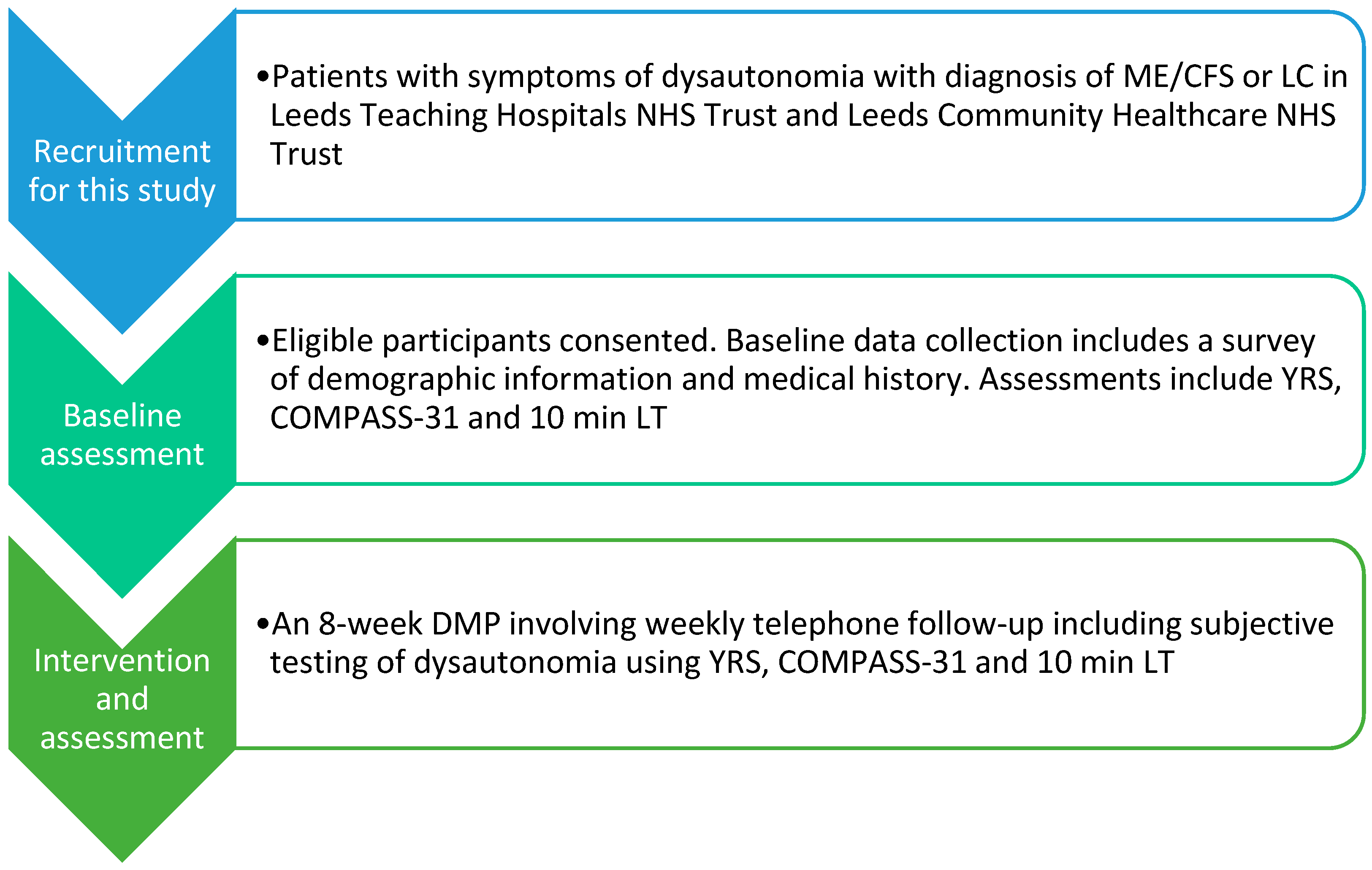
- Individuals diagnosed with ME/CFS or LC and experiencing symptoms of dysautonomia, such as fatigue, dizziness, palpitations, pain, brain fog, thermoregulatory disturbances, bladder/bowel problems and PESE or ‘crash’ episodes.
- Evidence of dysautonomia when objectively tested using the 10 min LT.
- Ability to understand and willingness to sign a written informed consent document.
- Stated willingness to comply with all study procedures and availability for the duration of the study.
- Ability to read and understand English.
- Pregnancy.
- Individuals diagnosed with advanced heart disease, e.g., severe heart failure, recent myocardial infarction, uncontrolled hypertension, or ongoing investigations for arrhythmias.
- Inability to provide informed consent.
2.2. Intervention and Follow-Up Cycles
2.2.1. Two Weeks: Increase Fluid Intake to 3 L a Day
2.2.2. Two Weeks: Increase Salt Intake to 10 g a Day
2.2.3. Two Weeks: Pacing to Avoid Crashes
2.2.4. Two Weeks: Calf Activation Movements
2.3. Outcome Measures
2.4. Statistical Analysis
3. Results
3.1. Primary Outcomes
3.2. Secondary Outcome
3.3. Adverse Events
4. Discussion
5. Conclusions
Supplementary Materials
Author Contributions
Funding
Institutional Review Board Statement
Informed Consent Statement
Data Availability Statement
Conflicts of Interest
Abbreviations
| DMP | Dysautonomia management protocol |
| ME/CFS | Myalgic encephalomyelitis/chronic fatigue syndrome |
| LC | Long COVID |
| OH | Orthostatic hypotension |
| PoTS | Postural orthostatic tachycardia syndrome |
| LT | Lean test |
| COMPASS-31 | Composite Autonomic Symptom Score questionnaire |
| YRS | Yorkshire Rehabilitation Scale |
| PESE | Post exertional symptom exacerbation |
| UK | United Kingdom |
| NHS | National Health Service |
| BP | Blood pressure |
| HR | Heart rate |
| BMI | Body mass index |
| EDS | Ehlers–Danlos syndrome |
References
- Office for National Statistics. Prevalence of Ongoing Symptoms Following Coronavirus (COVID-19) Infection in the UK: 2 February 2023. Available online: https://www.ons.gov.uk/peoplepopulationandcommunity/healthandsocialcare/conditionsanddiseases/bulletins/prevalenceofongoingsymptomsfollowingcoronaviruscovid19infectionintheuk/2february2023 (accessed on 18 March 2026).
- Reichgott, M.J. Clinical evidence of dysautonomia. In Clinical Methods: The History, Physical, and Laboratory Examinations, 3rd ed.; Walker, H.K., Hall, W.D., Hurst, J.W., Eds.; Butterworths: Boston, MA, USA, 1990. [Google Scholar]
- Wells, R.; Elliott, A.D.; Mahajan, R.; Page, A.; Iodice, V.; Sanders, P.; Lau, D.H. Efficacy of therapies for postural tachycardia syndrome: A systematic review and meta-analysis. Mayo Clin. Proc. 2018, 93, 1043–1053. [Google Scholar] [CrossRef]
- Greenhalgh, T.; Sivan, M.; Perlowski, A.; Nikolich, J.Ž. Long COVID: A clinical update. Lancet 2024, 404, 707–724. [Google Scholar] [CrossRef] [PubMed]
- Miller, A.J.; Raj, S.R. Pharmacotherapy for postural tachycardia syndrome. Auton. Neurosci. 2018, 215, 28–36. [Google Scholar] [CrossRef]
- Sheldon, R.S.; Grubb, B.P.; Olshansky, B.; Shen, W.-K.; Calkins, H.; Brignole, M.; Raj, S.R.; Krahn, A.D.; Morillo, C.A.; Stewart, J.M.; et al. 2015 Heart Rhythm Society expert consensus statement on the diagnosis and treatment of postural tachycardia syndrome, inappropriate sinus tachycardia, and vasovagal syncope. Heart Rhythm 2015, 12, e41–e63. [Google Scholar] [CrossRef] [PubMed]
- Isaac, R.O.; Corrado, J.; Sivan, M. Detecting orthostatic intolerance in long COVID in a clinic setting. Int. J. Environ. Res. Public Health 2023, 20, 5804. [Google Scholar] [CrossRef] [PubMed]
- Newton, J.L.; Okonkwo, O.; Sutcliffe, K.; Seth, A.; Shin, J.; Jones, D.E.J. Symptoms of autonomic dysfunction in chronic fatigue syndrome. Q. J. Med. 2007, 100, 519–526. [Google Scholar] [CrossRef]
- van Campen, C.L.M.; Verheugt, F.W.; Rowe, P.C.; Visser, F.C. Cerebral blood flow is reduced in ME/CFS during head-up tilt testing even in the absence of hypotension or tachycardia: A quantitative, controlled study using Doppler echography. Clin. Neurophysiol. Pract. 2020, 5, 50–58. [Google Scholar] [CrossRef]
- Larsen, N.W.; Stiles, L.E.; Shaik, R.; Schneider, L.; Muppidi, S.; Tsui, C.T.; Geng, L.N.; Bonilla, H.; Miglis, M.G. Characterization of autonomic symptom burden in long COVID: A global survey of 2,314 adults. Front. Neurol. 2022, 13, 1012668. [Google Scholar] [CrossRef]
- Lee, C.; Greenwood, D.C.; Master, H.; Balasundaram, K.; Williams, P.; Scott, J.T.; Wood, C.; Cooper, R.; Darbyshire, J.L.; Espinosa Gonzalez, A.; et al. Prevalence of orthostatic intolerance in Long Covid clinic patients and healthy volunteers: A multicentre study. J. Med. Virol. 2024, 96, e29486. [Google Scholar] [CrossRef]
- Freeman, R.; Wieling, W.; Axelrod, F.B.; Benditt, D.G.; Benarroch, E.; Biaggioni, I.; Cheshire, W.P.; Chelimsky, T.; Cortelli, P.; Gibbons, C.H.; et al. Consensus statement on the definition of orthostatic hypotension, neurally mediated syncope and the postural tachycardia syndrome. Clin. Auton. Res. 2011, 21, 69–72. [Google Scholar] [CrossRef]
- Kirbiš, M.; Grad, A.; Meglič, B.; Bajrović, F.F. Comparison of active standing test, head-up tilt test and 24-h ambulatory heart rate and blood pressure monitoring in diagnosing postural tachycardia. Funct. Neurol. 2013, 28, 39–46. [Google Scholar]
- Sivan, M.; Corrado, J.; Mathias, C. The adapted Autonomic Profile (aAP) home-based test for the evaluation of neuro-cardiovascular autonomic dysfunction. Adv. Clin. Neurosci. Rehabil. 2022, 21, 10–13. [Google Scholar] [CrossRef]
- Sletten, D.M.; Suarez, G.A.; Low, P.A.; Mandrekar, J.; Singer, W. COMPASS 31: A refined and abbreviated composite autonomic symptom score. Mayo Clin. Proc. 2012, 87, 1196–1201. [Google Scholar] [CrossRef]
- Sivan, M.; Preston, N.; Parkin, A.; Makower, S.; Gee, J.; Ross, D.; Tarrant, R.; Davison, J.; Halpin, S.; O’Connor, R.J. The modified COVID-19 Yorkshire Rehabilitation Scale (C19-YRSm) patient-reported outcome measure for Long Covid or Post-COVID-19 syndrome. J. Med. Virol. 2022, 94, 4253–4264. [Google Scholar]
- O’Dell, J.A.; Walker, A.; Latham, A.J.; Parisian, D.J.; Branch, L.E.; Vanderburg, D.D.; Cox, A.A.; Chavis, S.; Smith, S.E. The diagnostic journey of dysautonomia patients: Insights from a patient-reported outcome study. J. Patient Exp. 2025, 12, 23743735251314651. [Google Scholar] [CrossRef] [PubMed]
- George, S.A.; Bivens, T.B.; Howden, E.J.; Saleem, Y.; Galbreath, M.M.; Hendrickson, D.; Fu, Q.; Levine, B.D. The international POTS registry: Evaluating the efficacy of an exercise training intervention in a community setting. Heart Rhythm 2016, 13, 943–950. [Google Scholar] [CrossRef] [PubMed]
- Fu, Q.; VanGundy, T.B.; Shibata, S.; Auchus, R.J.; Williams, G.H.; Levine, B.D. Exercise training versus propranolol in the treatment of the postural orthostatic tachycardia syndrome. Hypertension 2011, 58, 167–175. [Google Scholar] [CrossRef]
- Bagai, K.; Peltier, A.C.; Malow, B.A.; Diedrich, A.; Shibao, C.A.; Black, B.K.; Paranjape, S.Y.; Orozco, C.; Biaggioni, I.; Robertson, D. Objective sleep assessments in patients with postural tachycardia syndrome using overnight polysomnograms. J. Clin. Sleep Med. 2016, 12, 727–733. [Google Scholar] [CrossRef] [PubMed]
- Puri, B.K.; Lee, G.S. Clinical assessment of autonomic function in fibromyalgia by the refined and abbreviated composite autonomic symptom Score (COMPASS 31): A case-controlled study. Rev. Recent Clin. Trials 2022, 17, 53–57. [Google Scholar] [CrossRef]
- Lee, J.; Vernon, S.D.; Jeys, P.; Ali, W.; Campos, A.; Unutmaz, D.; Yellman, B.; Bateman, L. Hemodynamics during the 10-minute NASA Lean Test: Evidence of circulatory decompensation in a subset of ME/CFS patients. J. Transl. Med. 2020, 18, 314–319. [Google Scholar] [CrossRef]
- Shannon, J.R.; Diedrich, A.; Biaggioni, I.; Tank, J.; Robertson, R.M.; Robertson, D.; Jordan, J. Water drinking as a treatment for orthostatic syndromes. Am. J. Med. 2002, 112, 355–360. [Google Scholar] [CrossRef] [PubMed]
- Taneja, I.; Raj, S.R.; Harris, P.; Byrne, D.; Jordan, J.; Roberson, D. Autonomic effect of water ingestion in Postural Tachycardia Syndrome. FASEB J. 2007, 21, A512. [Google Scholar] [CrossRef]
- Z’Graggen, W.; Hess, C.; Humm, A. Acute fluid ingestion in the treatment of orthostatic intolerance–important implications for daily practice. Eur. J. Neurol. 2010, 17, 1370–1376. [Google Scholar] [CrossRef]
- Rodriguez, B.; Zimmermann, R.; Gutbrod, K.; Heinemann, D.; Z’Graggen, W.J. Orthostatic cognitive dysfunction in postural tachycardia syndrome after rapid water drinking. Front. Neurosci. 2019, 13, 327. [Google Scholar] [CrossRef]
- Mathias, C.; Young, T. Water drinking in the management of orthostatic intolerance due to orthostatic hypotension, vasovagal syncope and the postural tachycardia syndrome. Eur. J. Neurol. 2004, 11, 613–619. [Google Scholar] [CrossRef]
- Celedonio, J.; Garland, E.; Nwazue, V.; Paranjape, S.; Black, B.; Okamoto, L. Effects of high sodium intake on blood volume and catecholamines in patients with postural tachycardia syndrome and healthy females. Clin. Auton. Res. 2014, 24, 211. [Google Scholar]
- Nwazue, V.; Garland, E.; Black, B.; Okamoto, L.; Paranjape, S.; Shibao, C.; Biaggioni, I.; Robertson, D.; Raj, S. Differential effects of dietary salt on blood volume regulation in postural tachycardia syndrome and healthy subjects. Clin. Auton. Res. 2013, 23, 269. [Google Scholar]
- Blitshteyn, S. Dietary sodium intake and migraine: Is salt the answer? Headache J. Head Face Pain 2016, 56, 1210–1211. [Google Scholar] [CrossRef] [PubMed]
- Sivan, M.; McKeever, V.; Natt, M.; Newton, J. A global need for more awareness of dysautonomia in postviral syndromes. J. Med. Virol. 2023, 95, e29048. [Google Scholar] [CrossRef] [PubMed]



| Recruited DMP Patients n = 22 | Completed DMP Patients n = 16 | |
|---|---|---|
| Demographics | ||
| Age, years (range) | 39 (17.25–63.2) | 40.5 (18.8–63.2) |
| White British | 18 | 14 |
| Mixed | 2 | 1 |
| Arab | 1 | |
| White other | 1 | 1 |
| Female | 20 | 15 |
| Single | 5 | 3 |
| Married/in relationship | 17 | 13 |
| Professional occupation | 7 | 6 |
| Unemployed | 6 | 3 |
| Student | 3 | 2 |
| Associate professional | 2 | 1 |
| Caring role | 2 | 2 |
| Administrative role | 1 | 1 |
| Retired | 1 | 1 |
| Current smoker | 2 | 2 |
| Body mass index, kg/m2 (range) | 29.2 (17.7–47.9) | 28.3 (17.7–47.9) |
| Diagnosis | ||
| ME/CFS | 14 | 11 |
| LC | 8 | 5 |
| Duration of dysautonomia symptoms, years (range) | 7 (0.6–30) | 8.3 (0.6–30) |
| Profile on baseline LT | ||
| PoTS | 20 | 15 |
| OH | 2 | 1 |
| Comorbidities | Recruited DMP Patients n = 22 | Completed DMP Patients n = 16 |
|---|---|---|
| Fibromyalgia | 10 | 7 |
| Asthma | 7 | 7 |
| EDS/hypermobility syndrome | 6 | 6 |
| Depression and anxiety | 4 | 4 |
| Chronic pain | 4 | 1 |
| Migraines | 4 | 4 |
| Reflux | 4 | 3 |
| IBS | 3 | 2 |
| Raynaud’s | 2 | 2 |
| ADHD | 2 | 2 |
| Autism | 2 | 2 |
| Other conditions experienced with a frequency of one: | Type 2 diabetes, Hypertension, Fatty liver, Epilepsy, Overactive bladder, Endometriosis, Sleep apnoea, Hyperhidrosis, Restless legs, Vertigo | |
| Recruited DMP Patients n = 22 | Completed DMP Patients n = 16 | |
|---|---|---|
| Duloxetine | 2 | 2 |
| Gabapentin | 5 | 4 |
| Pregabalin | 3 | 2 |
| Amitriptyline | 2 | 2 |
| Paracetamol | 4 | 4 |
| Ibuprofen | 2 | 2 |
| Lansoprazole | 2 | 2 |
| Omeprazole | 4 | 3 |
| Symbicort inhaler | 2 | 2 |
| Sertraline | 2 | 2 |
| Fluoxetine | 2 | 2 |
| Mirtazapine | 2 | 2 |
| Fexofenadine | 3 | 2 |
| Desogestrel | 5 | 4 |
| Hormone replacement therapy | 3 | 2 |
| Other medications taken with a frequency of one: | Tramadol, nefopam, buscopan, clonidine, baclofen, montelukast, fostair inhaler, budesonide inhaler, salbutamol inhaler, metformin, gliclazide, semaglutide, empagliflozin, aspirin, ramipril, amlodipine, nifedipine, fludrocortisone, atorvastatin, methylphenidate, lamotrigine, escitalopram, citalopram, sumatriptan, propranolol (prn for anxiety), zolpidem, loratadine, cetirizine, ketotifen, mometasone nasal spray, clinitas carbomer eye gel, microgynon, codeine, naproxen, tranexamic acid, movicol, loperamide, colesevelam, mounjaro, famotidine | |
| Baseline Score | Post-DMP Score | Change | p Value | |
|---|---|---|---|---|
| COMPASS-31 YRS (SS score) YRS (FD score) | 44.99 | 37.24 | 7.74 (improvement) | 0.045 * |
| 19.13 | 17.13 | 2.0 (improvement) | 0.16 | |
| 9.88 | 8.81 | 1.06 (improvement) | 0.22 | |
| HR (2-week average) Systolic BP (2-week average) | 33.81 | 28.93 | 4.88 (improvement) | 0.03 * |
| −5.09 | −3.34 | 1.75 (improvement) | 0.40 | |
| Diastolic BP (2-week average) | 3.69 | 1.48 | 2.20 (deterioration) | 0.13 |
| LC | ME/CFS | |
|---|---|---|
| PoTS only | 4 | |
| PoTS or OH | 1 | 4 |
| PoTS or borderline | 1 | 3 |
| PoTS or OH or borderline | 3 |
Disclaimer/Publisher’s Note: The statements, opinions and data contained in all publications are solely those of the individual author(s) and contributor(s) and not of MDPI and/or the editor(s). MDPI and/or the editor(s) disclaim responsibility for any injury to people or property resulting from any ideas, methods, instructions or products referred to in the content. |
© 2026 by the authors. Licensee MDPI, Basel, Switzerland. This article is an open access article distributed under the terms and conditions of the Creative Commons Attribution (CC BY) license.
Share and Cite
Barr, J.; Marsden, L.; Dassanayake, T.; Almutairi, N.; McKeever, V.; Gaber, T.; Tarrant, R.; Godfrey, B.; Witton, S.; Sivan, M. Testing a Personalised Dysautonomia Management Protocol in Patients with Orthostatic Intolerance and a Diagnosis of Myalgic Encephalomyelitis/Chronic Fatigue Syndrome or Long COVID. J. Clin. Med. 2026, 15, 2510. https://doi.org/10.3390/jcm15072510
Barr J, Marsden L, Dassanayake T, Almutairi N, McKeever V, Gaber T, Tarrant R, Godfrey B, Witton S, Sivan M. Testing a Personalised Dysautonomia Management Protocol in Patients with Orthostatic Intolerance and a Diagnosis of Myalgic Encephalomyelitis/Chronic Fatigue Syndrome or Long COVID. Journal of Clinical Medicine. 2026; 15(7):2510. https://doi.org/10.3390/jcm15072510
Chicago/Turabian StyleBarr, Julia, Lowri Marsden, Theshan Dassanayake, Norah Almutairi, Vikki McKeever, Tarek Gaber, Rachel Tarrant, Belinda Godfrey, Sharon Witton, and Manoj Sivan. 2026. "Testing a Personalised Dysautonomia Management Protocol in Patients with Orthostatic Intolerance and a Diagnosis of Myalgic Encephalomyelitis/Chronic Fatigue Syndrome or Long COVID" Journal of Clinical Medicine 15, no. 7: 2510. https://doi.org/10.3390/jcm15072510
APA StyleBarr, J., Marsden, L., Dassanayake, T., Almutairi, N., McKeever, V., Gaber, T., Tarrant, R., Godfrey, B., Witton, S., & Sivan, M. (2026). Testing a Personalised Dysautonomia Management Protocol in Patients with Orthostatic Intolerance and a Diagnosis of Myalgic Encephalomyelitis/Chronic Fatigue Syndrome or Long COVID. Journal of Clinical Medicine, 15(7), 2510. https://doi.org/10.3390/jcm15072510