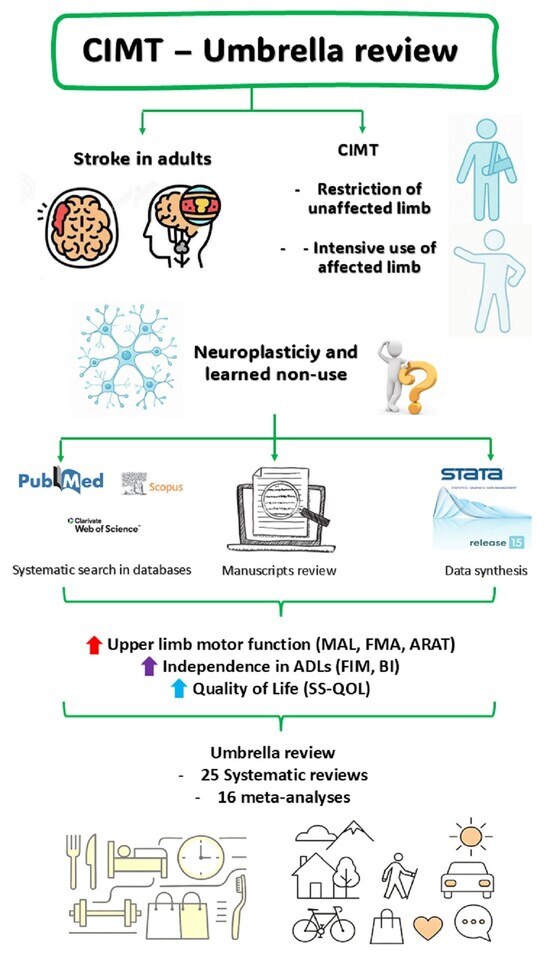
Constraint-Induced Movement Therapy in the Rehabilitation of Adults After Stroke: An Umbrella Review


 , , , , and
Abstract
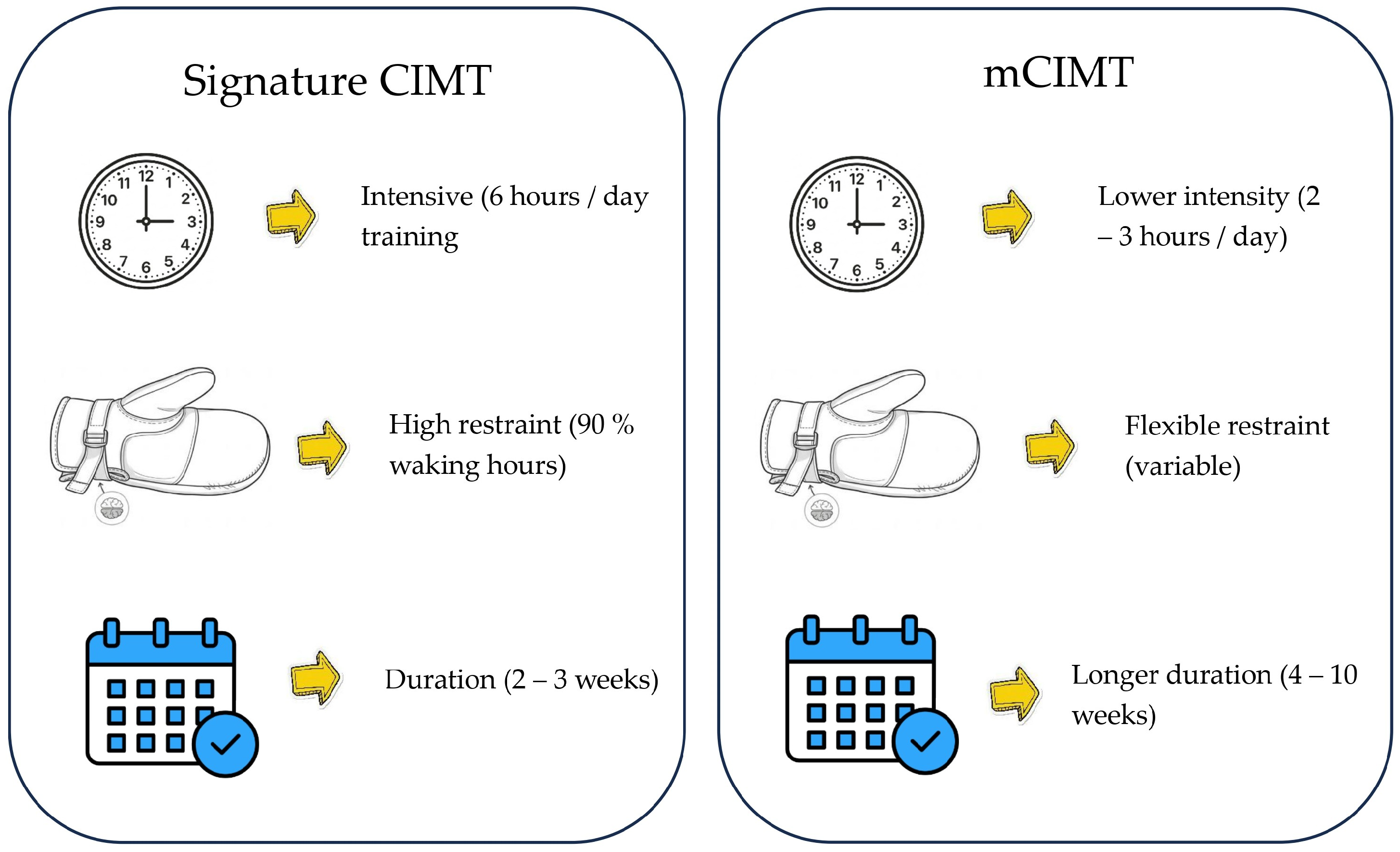
1. Introduction
2. Materials and Methods
2.1. Search Strategy
2.2. Eligibility Criteria
2.3. Data Extraction
2.4. Methodological Quality Assessment
2.5. Assessment of the Quality of Evidence
2.6. Overlap of Primary Studies
2.7. Data Analysis
3. Results
3.1. Baseline Characteristics
3.2. Methodological Quality Assessment and GRADE
3.3. Overlap of Primary Studies
3.4. Data Synthesis
4. Discussion
5. Conclusions
Supplementary Materials
Author Contributions
Funding
Institutional Review Board Statement
Informed Consent Statement
Data Availability Statement
Acknowledgments
Conflicts of Interest
Abbreviations
| ADLs | Activities of Daily Living |
| ARAT | Action Research Arm Test |
| BBT | Box and Block Test |
| BI | Barthel Index |
| BTX | Botulinum Toxin |
| CCA | Corrected Covered Area |
| CGs | Control Groups |
| CIMT | Constraint-Induced Movement Therapy |
| CIs | Confidence Intervals |
| EGs | Experimental Groups |
| FIM | Functional Independence Measure |
| FMA | Fugl Meyer Assessment |
| GRADE | Grading of Recommendations, Assessment, Development, and Evaluation |
| LL | Lower Limb |
| MAL | Motor Activity Log |
| MAS | Modified Ashworth Scale |
| mCIMT | modified Constraint-Induced Movement Therapy |
| NES | Neuromuscular Electrical Stimulation |
| NI | Number of Identification |
| NR | Non-Reported |
| OT | Occupational Therapy |
| PRISMA | Preferred Reporting Items for Systematic Reviews and Meta-Analysis |
| QoL | Quality of Life |
| RCTs | Randomized Controlled Trials |
| SF-12 | Short Form-12 |
| SF-36 | Short Form-36 |
| SIS | Stroke Impact Scale |
| SMDs | Standard Measure Differences |
| SS-QOL | Stroke Specific Quality of Life Scale |
| UL | Upper Limb |
| VR | Virtual Reality |
| WMFT | Wolf Motor Function Test |
References
- Pollock, A.; Farmer, S.E.; Brady, M.C.; Langhorne, P.; Mead, G.E.; Mehrholz, J.; Van Wijck, F. Interventions for improving upper limb function after stroke. Cochrane Database Syst. Rev. 2014, 2014, CD010820. [Google Scholar] [CrossRef]
- French, B.; Thomas, L.H.; Coupe, J.; Mcmahon, N.E.; Connell, L.; Harrison, J.; Sutton, C.J.; Tishkovskaya, S.; Watkins, C.L. Repetitive task training for improving functional ability after stroke. Cochrane Database Syst. Rev. 2016, 2016, CD006073. [Google Scholar] [CrossRef]
- Sanchez, L.; Asuncion, B.M.; Tayag, K.R.; Chua, C.; Escandor, S.J.; Dones, V.C., 3rd. Effectiveness of constraint-induced movement therapy (CIMT)-Telerehabilitation compared to traditional CIMT on upper extremity dysfunction of adult chronic stroke patients-A systematic review and meta-analysis. Physiother. Res. Int. 2024, 29, e2090. [Google Scholar] [CrossRef]
- McIntyre, A.; Viana, R.; Janzen, S.; Mehta, S.; Pereira, S.; Teasell, R. Systematic review and meta-analysis of constraint-induced movement therapy in the hemiparetic upper extremity more than six months post-stroke. Top. Stroke Rehabil. 2012, 19, 499–513. [Google Scholar] [CrossRef]
- Ekechukwu, E.N.D.; Olowoyo, P.; Nwankwo, K.O.; Olaleye, O.A.; Ogbodo, V.E.; Hamzat, T.K.; Owolabi, M.O. Pragmatic solutions for stroke recovery and improved quality of life in low-and middle-income countries—A systematic review. Front. Neurol. 2020, 11, 337. [Google Scholar] [CrossRef]
- Kaneko, T.; Maeda, M.; Yokoyama, H.; Kai, S.; Obuchi, K.; Takase, S.; Horimoto, T.; Shimada, R.; Moriya, T.; Ohmae, H.; et al. Therapeutic effect of adjuvant therapy added to constraint-induced movement therapy in patients with subacute to chronic stroke: A systematic review and meta-analysis. Disabil. Rehabil. 2024, 46, 4098–4112. [Google Scholar] [CrossRef]
- Gao, C.; Li, X.; Li, F.; Li, J.; Zhang, J. Nonpharmacological interventions on quality of life in stroke survivors: A systematic review and meta-analysis. Worldviews Evid. Based Nurs. 2024, 21, 158–182. [Google Scholar] [CrossRef] [PubMed]
- Hatem, S.M.; Saussez, G.; della Faille, M.; Prist, V.; Zhang, X.; Dispa, D.; Bleyenheuft, Y. Rehabilitation of motor function after stroke: A multiple systematic review focused on techniques to stimulate upper extremity recovery. Front. Hum. Neurosci. 2016, 10, 442. [Google Scholar] [CrossRef] [PubMed]
- Nijland, R.; Kwakkel, G.; Bakers, J.; van Wegen, E. Constraint-induced movement therapy for the upper paretic limb in acute or subacute stroke: A systematic review. Int. J. Stroke 2011, 6, 425–433. [Google Scholar] [CrossRef] [PubMed]
- Corbetta, D.; Sirtori, V.; Moja, L.; Gatti, R. Constraint-induced movement therapy in stroke patients: Systematic review and meta-analysis. Eur. J. Phys. Rehabil. Med. 2010, 46, 537–544. [Google Scholar]
- Jeon, B.J.; Kim, W.H.; Park, E.Y. Effect of task-oriented training for people with stroke: A meta-analysis focused on repetitive or circuit training. Top. Stroke Rehabil. 2015, 22, 34–43. [Google Scholar] [CrossRef]
- Page, M.J.; McKenzie, J.E.; Bossuyt, P.M.; Boutron, I.; Hoffmann, T.C.; Mulrow, C.D.; Shamseer, L.; Tetzlaff, J.M.; Akl, E.A.; Brennan, S.E.; et al. The PRISMA 2020 statement: An updated guideline for reporting systematic reviews. BMJ 2021, 372, n71. [Google Scholar] [CrossRef] [PubMed]
- Cumpston, M.; Li, T.; Page, M.J.; Chandler, J.; Welch, V.A.; Higgins, J.P.; Thomas, J. Updated guidance for trusted systematic reviews: A new edition of the Cochrane Handbook for Systematic Reviews of Interventions. Cochrane Database Syst. Rev. 2019, 10, ED000142. [Google Scholar] [CrossRef]
- Kwakkel, G.; Lannin, N.A.; Borschmann, K.; English, C.; Ali, M.; Churilov, L.; Saposnik, G.; Winstein, C.; van Wegen, E.E.; Wolf, S.L.; et al. Standardized measurement of sensorimotor recovery after stroke: Consensus-based core recommendations from the Stroke Recovery and Rehabilitation Roundtable. Int. J. Stroke 2017, 12, 451–461. [Google Scholar] [CrossRef] [PubMed]
- World Health Organization. International Classification of Functioning Disability Health: ICF; World Health Organization: Geneva, Switzerland, 2001. [Google Scholar]
- Taub, E.; Uswatte, G.; Pidikiti, R. Constraint-Induced Movement Therapy: A new family of techniques with broad applicability to physical rehabilitation--a clinical review. J. Rehabil. Res. Dev. 1999, 36, 237–251. [Google Scholar]
- Gauthier, L.V.; Taub, E.; Perkins, C.; Ortmann, M.; Mark, V.W.; Uswatte, G. Remodelling the brain: Plasticity of structural connectivity after intensive rehabilitation. Arch. Phys. Med. Rehabil. 2008, 89, 1641–1647. [Google Scholar]
- Shea, B.J.; Reeves, B.C.; Wells, G.; Thuku, M.; Hamel, C.; Moran, J.; Moher, D.; Tugwell, P.; Welch, V.; Kristjansson, E.; et al. AMSTAR 2: A critical appraisal tool for systematic reviews that include randomized or nonrandomized studies of healthcare interventions, or both. BMJ 2017, 358, j4008. [Google Scholar] [CrossRef] [PubMed]
- Sanabria, A.J.; Rigau, D.; Rotaeche, R.; Selva, A.; Marzo-Castillejo, M.; Alonso-Coello, P. Sistema GRADE: Metodología para la realización de recomendaciones para la práctica clínica. Aten. Primaria 2015, 47, 48–55. [Google Scholar] [CrossRef]
- Bonaiuti, D.; Rebasti, L.; Sioli, P. The constraint induced movement therapy: A systematic review of randomized controlled trials on the adult stroke patients. Eur. Medicophysica 2007, 43, 139–146. [Google Scholar]
- García-Rudolph, A.; Laxe, S.; Saurí, J.; Opisso, E.; Tormos, J.M.; Bernabeu, M. Evidence of chronic Stroke rehabilitation interventions in activities and participation outcomes: Systematic review of meta-analyses of randomized controlled trials. Eur. J. Phys. Rehabil. Med. 2019, 55, 695–709. [Google Scholar] [CrossRef]
- Hakkennes, S.; Keating, J.L. Constraint-induced movement therapy following stroke: A systematic review of randomized controlled trials. Aust. J. Physiother. 2005, 51, 221–231. [Google Scholar] [CrossRef]
- Hussain, M.; Fatima, A.; Ahmad, A.; Gilani, S.A. Effects of task oriented rehabilitation of upper extremity after stroke: A systematic review. J. Pak. Med. Assoc. 2022, 72, 1406–1413. [Google Scholar] [CrossRef]
- Pulman, J.; Buckley, E. Assessing the efficacy of different upper limb hemiparesis interventions on improving health-related quality of life in stroke patients: A systematic review. Top. Stroke Rehabil. 2013, 20, 171–188. [Google Scholar] [CrossRef]
- Corbetta, D.; Sirtori, V.; Castellini, G.; Moja, L.; Gatti, R. Constraint-induced movement therapy for upper extremities in people with stroke. Cochrane Database Syst. Rev. 2015, 2017, CD004433. [Google Scholar] [CrossRef] [PubMed]
- de Azevedo, J.A.; Barbosa, F.D.S.; Seixas, V.M.; da Silva Scipioni, K.R.D.; Sampaio, P.Y.S.; da Cruz, D.M.C.; Piscitelli, D.; Chui, K.K.; de Freitas Zanona, A. Effects of constraint-induced movement therapy on activity and participation after a stroke: Systematic review and meta-analysis. Front. Hum. Neurosci. 2022, 16, 987061. [Google Scholar] [CrossRef] [PubMed]
- Etoom, M.; Hawamdeh, M.; Hawamdeh, Z.; Alwardat, M.; Giordani, L.; Bacciu, S.; Scarpini, C.; Foti, C. Constraint-induced movement therapy as a rehabilitation intervention for upper extremity in stroke patients: Systematic review and meta-analysis. Int. J. Rehabil. Res. 2016, 39, 197–210. [Google Scholar] [CrossRef] [PubMed]
- Hestetun-Mandrup, A.M.; Toh, Z.A.; Oh, H.X.; He, H.G.; Martinsen, A.C.T.; Pikkarainen, M. Effectiveness of digital home rehabilitation and supervision for stroke survivors: A systematic review and meta-analysis. Digit Health 2024, 10, 20552076241256861. [Google Scholar] [CrossRef]
- Liu, X.H.; Huai, J.; Gao, J.; Zhang, Y.; Yue, S.W. Constraint-induced movement therapy in treatment of acute and subacute stroke: A meta-analysis of 16 randomized controlled trials. Neural Regen. Res. 2017, 12, 1443–1450. [Google Scholar]
- Peurala, S.H.; Kantanen, M.P.; Sjögren, T.; Paltamaa, J.; Karhula, M.; Heinonen, A. Effectiveness of constraint-induced movement therapy on activity and participation after stroke: A systematic review and meta-analysis of randomized controlled trials. Clin. Rehabil. 2012, 26, 209–223. [Google Scholar] [CrossRef]
- Pulman, J.; Buckley, E.; Clark-Carter, D. A meta-analysis evaluating the effectiveness of two different upper limb hemiparesis interventions on improving health-related quality of life following stroke. Top. Stroke Rehabil. 2013, 20, 189–196. [Google Scholar] [CrossRef]
- Shi, Y.X.; Tian, J.H.; Yang, K.H.; Zhao, Y. Modified constraint-induced movement therapy versus traditional rehabilitation in patients with upper-extremity dysfunction after stroke: A systematic review and meta-analysis. Arch. Phys. Med. Rehabil. 2011, 92, 972–982. [Google Scholar] [CrossRef] [PubMed]
- Thrane, G.; Friborg, O.; Anke, A.; Indredavik, B. A meta-analysis of constraint-induced movement therapy after stroke. J. Rehabil. Med. 2014, 46, 833–842. [Google Scholar] [CrossRef] [PubMed]



| N.I Study | Reference | Studies Included (n) | Type of Stroke and Phase of Development | Number of Subjects | Age Range (Years) | Intervention (EG) | Comparison (CG) | Duration (Weeks) | Study Variables | Assessment Tools | Quality Assessment—AMSTAR 2 |
|---|---|---|---|---|---|---|---|---|---|---|---|
| 1 | Bonaiuti et al. (2007) [20] | 9 RCTs | N. R | 243 (EG: 113) (CG: 130) | N.R, 18–95 in some studies | CIMT | Conventional therapy | 2–10 | UL motor function, ADLs performance, treatment adherence | ARAT, MAL FMA, WMFT, BI, FIM | Low |
| 2 | Ekechukwu et al. (2020) [5] | 347 RCTs | Ischemic and hemorrhagic, in acute, subacute, and chronic phases | N.R | N.R. adults + 18 years | CIMT, VR, videogames, NES, OT, robotic devices, task-based therapy | Conventional therapy | Variable | ADLs performance, gait, muscular strength, quality of life, motor function, spasticity, mobility | FMA, WMFT, ARAT, BBT, BI, MAL, FIM, SIS, 6-Minute Walk Test, 10-Meter Walk Test, SF-36 | Moderate |
| 3 | French et al. (2016) [2] | 33 RCTs | Ischemic and hemorrhagic, in acute, subacute and chronic phases | 1853 (EG: 913) (CG: 940) | 18-70 | Task Repetitive Training | Usual care and/or no treatment | 2-20 | UL and LL motor function, ADLs performance, quality of life, global motor function | ARAT, WMFT, MAS, MAL, 6 Minute Walk Test, Berg Balance Scale, Timed Up and Go Test, BI, FIM, SF-36, SIS | High |
| 4 | García-Rudolph et al. (2019) [21] | 31 RCTs | Ischemic and hemorrhagic, in chronic phase | 25275 (EG: 12589) (CG: 12686) | N.R, adults + 18 years | CIMT, NES, robotic devices, task-based therapy | Standard care, usual care, or no treatment | Variable | ADLs performance, mobility, UL motor function, quality of life and functional recovery | BI, FIM, MAL, SS-QOL | Moderate |
| 5 | Hakkenees y Keating (2005) [22] | 14 RCTs | Ischemic and hemorrhagic, in acute, subacute and chronic phases | N.R | N.R, adults + 18 years | CIMT, mCIMT | Standard care, alternative therapies, or no intervention | 2–10 | UL motor function, ADLs performance, quality of life | ARAT, WMFT, FMA, MAL, FIM | Moderate |
| 6 | Hatem et al. (2016) [8] | 270 RCTs | Ischemic and hemorrhagic, in acute, subacute and chronic phases | N.R | N.R, + 18 years | CIMT, mirror therapy, robotics, VR, and brain stimulation | Conventional therapy | 2–26 | ADLs performance, functional disability, motor function UE | FMA, MAL, ARAT, SS-QOL | Moderate |
| 7 | Hussain et al. (2022) [23] | 16 RCTs | Ischemic and hemorrhagic in acute, subacute and chronic phases | 865 (EG: 499) (CG: 366) | 30–85 | Task-oriented rehabilitation | Conventional or noninterventional therapy | 2–6 | UL motor function, ADLs performance, quality of life | FMA, WMFT, BBT, MAS | Moderate |
| 8 | Pollock et al. (2014) [1] | 40 RCTs | Ischemic and hemorrhagic, in acute, subacute and chronic phases | 18078 (EG: 9017) (CG: 9061) | N.R, + 18 years | CIMT, mental practice, mirror therapy, VR, electrical stimulation, unilateral and bilateral training | No intervention, conventional therapy, placebo or alternative intervention | Variable | UL functionality, ADLs performance, motor impairment and quality of life | ARAT, FMA, MAL, WMFT, BI | High |
| 9 | Pulman y Buckley (2013) [24] | 22 RCTs | Ischemic and hemorrhagic, in subacute and chronic phases | 1503 (EG: NR) (CG: NR) | 23–83 | CIMT, BTX, Task-oriented rehabilitation, robotic devices, mirror therapy, NES | Conventional or noninterventional therapy | 2–52 | Quality of life, motor function, strength, movility, ADLs performance, pain | SIS, Nottingham Health Profile, Sickness Impact Profile, SF-36, SS-QOL | Moderate |
| N.I Study | Reference | Studies Included (n) | Type of Stroke and Phase of Development | Number of Subjects | Age Range (Years) | Intervention (GE) | Comparison (GC) | Duration (Weeks) | Study Variables | Assessment Tools | Quality Assessment—AMSTAR 2 |
|---|---|---|---|---|---|---|---|---|---|---|---|
| 10 | Corbetta et al. (2015) [25] | 42 RCTs | Ischemic and hemorrhagic, N.S phase | 1453 (EG: 732) (CG: 721) | 37–87 | CIMT and mCIMT | Conventional physiotherapy treatment and/or no treatment | 2–10 | UL motor function, perception of use of affected arm, dexterity, quality of life, disability, ADL performance | BI, SIS, FMA, MAL | High |
| 11 | Corbetta et al. (2010) [10] | 18 RCTs | Ischemic and hemorrhagic, N.S phase | 674 (EG: N.S) (CG: N.S) | 36–87 | CIMT, mCIMT, FU | Conventional rehabilitation (Physiotherapy and/or OT) and/or absence of treatment | 2–10 | UL motor function, disability, ADLs performance | BI, FIM, ARAT, WMFT, MAS | High |
| 12 | De Azevedo et al. (2022) [26] | 21 RCTs | Ischemic and hemorrhagic, in acute, subacute and chronic phases | N.R | 18–90 | CIMT, CIMT + Mirror therapy | Conventional therapy (Physiotherapy and OT) | 2–10 | UL motor function, ADLs performance, social participation | FMA, WMFT, ARAT, MBI, MAL, FIM | Moderate |
| 13 | Etoom et al. (2016) [27] | 38 RCTs | Ischemic and hemorrhagic, in acute, subacute and chronic phases | 1561 (EG: 769) (CG: 792) | 18–87 | CIMT and mCIMT | Conventional rehabilitation and/or no intervention | 2–10 | UL motor function, ADLs performance, functional mobility | FMA, MAL, WMFT, ARAT | Moderate |
| 14 | Gao et al. (2024) [7] | 34 RCTs | Ischemic and hemorrhagic, in acute, subacute and chronic phases | 2399 (EG: 1212) (CG: 1187) | 18–87 | CIMT, physical exercise, music therapy and art therapy | Standard care or no intervention | Variable | Quality of life; physical, mental, and social function; ADLs performance | SIS, SF-36, EQ-5D, SS-QOL | High |
| 15 | Hestetun-Mandrup et al. (2024) [28] | 13 RCTs | Ischemic and hemorrhagic, in subacute and chronic phases | 571 (EG: 290) (CG: 293) | N.R, +18 years | VR, CIMT, telerehabilitation apps | Conventional rehabilitation | 2–8 | Motor function, gait, quality of life | FMA, WMFT, MAS, BBS, MAL, SIS, SS-QOL | High |
| 16 | Jeon et al. (2015) [11] | 11 RCTs | Ischemic and hemorrhagic, in acute, subacute and chronic phases | 469 (EG: 239) (CG: 230) | N.R, +18 years | Task Repetitive Training | Standard care or no intervention | 2–6 | UL and LE motor function, walking speed and endurance, balance, muscle strength | TUG, BBS, FMA, 6-Minute Walk Test | Moderate |
| 17 | Kaneko et al. (2024) [6] | 18 RCTs | Ischemic and hemorrhagic, in subacute and chronic phases | 330 (EG: 167) (CG: 163) | 54–60 | CIMT + adjuvant therapies (mirror therapy, electrical stimulation, mental practice) | Standard CIMT | 2–10 | UL motor function, ADLs performance, quality of movement, perceived use of the affected arm | FMA, MAL, ARAT | High |
| 18 | Liu et al. (2017) [29] | 16 RCTs | Ischemic and hemorrhagic, in acute and subacute phases | 710 (EG: 370) (CG: 340) | N.R, +18 years | CIMT, mCIMT of high and low intensity | Traditional rehabilitation therapy | 2–10 | UL motor function, ADLs performance | FMA, ARAT, MAL, MBI, WMFT | Moderate |
| 19 | McIntyre et al. (2012) [4] | 16 RCTs | Ischemic and hemorrhagic, in chronic phase | 571 (EG: 266) (CG: 305) | 30–87 | CIMT, mCIMT | Traditional rehabilitation therapy or no intervention | 2–10 | UL motor function, motor recovery, ADLs performance | MAL, FMA, ARAT, WMFT, FIM | Moderate |
| 20 | Nijland et al. (2011) [9] | 5 RCTs | Ischemic and hemorrhagic, in acute and subacute phases | 106 (EG: 64) (CG: 42) | N.R, +18 years | CIMT, CIMT of low intensity | Conventional therapy or standard care | 2–3 | UL motor function, manual dexterity, perceived use of the affected arm, quality of movement | FMA, ARAT, MAL, GPT | Moderate |
| 21 | Peurala et al. (2012) [30] | 27 RCTs | Ischemic and hemorrhagic, in acute, subacute and chronic phases | N.R | N.R, +18 years | CIMT, mCIMT | Conventional care or no intervention | 2–10 | UL motor function, self-care, ADLs performance | MAL, ARAT, WMFT, FIM, BI | Moderate |
| 22 | Pulman et al. (2013) [24] | 6 RCTs | Ischemic and hemorrhagic, in subacute and chronic phases | 612 (EG: 237) (CG: 375) | 23–83 | CIMT, conventional rehabilitation, Bilateral training | BTX-Type A | EG: 2–3 to 12 months CG: 12–24 | Quality of life, strength, hand function, ADLs performance, participation, memory, communication | SIS, Stroke Adapted Sickness Impact Profile, European Quality of Life-5D | Moderate |
| 23 | Sanchez et al. (2024) [3] | 2 RCTs | Ischemic and hemorrhagic, in chronic phase | 109 (EG: 57) (CG: 52) | 31–83 | CIMT, telerehabilitation | Traditional CIMT | 2–3 | UL motor function, daily use of the affected arm | WMFT, MAL, Quality of Life in Neurological Conditions | High |
| 24 | Shi et al. (2011) [32] | 13 RCTs | Ischemic and hemorrhagic, in acute, subacute and chronic phases | 278 (EG: 143) (CG: 135) | 31–83 | mCIMT | Traditional rehabilitation (Physiotherapy and OT) | 2–10 | UL motor function, functional disability, perceived use of the affected arm, kinematic analysis of movement | FMA, ARAT, WMFT, FIM, BI, MAL, kinematic analysis | Moderate |
| 25 | Thrane et al. (2014) [33] | 23 RCTs | Ischemic and hemorrhagic, in acute, subacute and chronic phases | 1002 (EG: 519) (CG: 483) | 48–71 | CIMT, mCIMT | Traditional therapy | 1–4 | UL motor function, ADLs performance, participation | FMA, ARAT, MAL, WMFT, BI | Moderate |
Disclaimer/Publisher’s Note: The statements, opinions and data contained in all publications are solely those of the individual author(s) and contributor(s) and not of MDPI and/or the editor(s). MDPI and/or the editor(s) disclaim responsibility for any injury to people or property resulting from any ideas, methods, instructions or products referred to in the content. |
© 2026 by the authors. Licensee MDPI, Basel, Switzerland. This article is an open access article distributed under the terms and conditions of the Creative Commons Attribution (CC BY) license.
Share and Cite
Conchillo-Liria, J.; Cavero-Redondo, I.; Saz-Lara, A.; Moreno-Herraiz, N.; Calvo-Utrilla, C.; González-Collado, A.; Otero-Luis, I. Constraint-Induced Movement Therapy in the Rehabilitation of Adults After Stroke: An Umbrella Review. J. Clin. Med. 2026, 15, 2451. https://doi.org/10.3390/jcm15062451
Conchillo-Liria J, Cavero-Redondo I, Saz-Lara A, Moreno-Herraiz N, Calvo-Utrilla C, González-Collado A, Otero-Luis I. Constraint-Induced Movement Therapy in the Rehabilitation of Adults After Stroke: An Umbrella Review. Journal of Clinical Medicine. 2026; 15(6):2451. https://doi.org/10.3390/jcm15062451
Chicago/Turabian StyleConchillo-Liria, José, Iván Cavero-Redondo, Alicia Saz-Lara, Nerea Moreno-Herraiz, Candela Calvo-Utrilla, Ana González-Collado, and Iris Otero-Luis. 2026. "Constraint-Induced Movement Therapy in the Rehabilitation of Adults After Stroke: An Umbrella Review" Journal of Clinical Medicine 15, no. 6: 2451. https://doi.org/10.3390/jcm15062451
APA StyleConchillo-Liria, J., Cavero-Redondo, I., Saz-Lara, A., Moreno-Herraiz, N., Calvo-Utrilla, C., González-Collado, A., & Otero-Luis, I. (2026). Constraint-Induced Movement Therapy in the Rehabilitation of Adults After Stroke: An Umbrella Review. Journal of Clinical Medicine, 15(6), 2451. https://doi.org/10.3390/jcm15062451