Identification of High-Risk Individuals for Osteoporosis and Fragility Fractures in Cushing’s Syndrome: A Promising Predictive Approach
 , and
, and
Abstract
1. Introduction
2. Methods
2.1. Study Population
2.2. Data Collection
2.3. Statistical Analysis
2.4. Developing the Cushing-Related Osteoporosis Risk Estimation (CORE) Score
3. Results
3.1. Patient Characteristics
3.2. Prevalence of Osteoporosis by CS Subtype
3.3. Results of Predictive Factors for Osteoporosis in CS
3.4. CORE Score Predicts Osteoporosis and Osteoporotic Fracture Risk in CS Within Our Cohort
4. Discussion
5. Conclusions
Author Contributions
Funding
Institutional Review Board Statement
Informed Consent Statement
Data Availability Statement
Conflicts of Interest
Abbreviations
| CS | Cushing Syndrome |
| CORE | Cushing-Related Osteoporosis Risk Estimation |
| DXA | Dual-energy X-Ray Absorptiometry |
| 24-h UFC | 24 h Urinary Free Cortisol Level |
| DST | Dexamethasone Suppression Test |
| DHEA-S | Dehydroepiandrosterone Sulfate |
| 25-OH vitamin D | 25-hydroxyvitamin D |
| BMD | Bone Mineral Density |
| ROC | Receiver Operating Characteristic |
| DM | Diabetes Mellitus |
| AUC | Area Under The Curve |
| OR | Odds Ratios |
| CI | Confidence Intervals |
| B | Beta Coefficients |
References
- Nieman, L.K.; Castinetti, F.; Newell-Price, J.; Valassi, E.; Drouin, J.; Takahashi, Y.; Lacroix, A. Cushing syndrome. Nat. Rev. Dis. Primers 2025, 11, 4. [Google Scholar] [CrossRef]
- Voelker, R. What Is Cushing Syndrome? JAMA 2024, 331, 1070. [Google Scholar] [CrossRef]
- Nieman, L.K.; Biller, B.M.K.; Findling, J.W.; Murad, M.H.; Newell-Price, J.; Savage, M.O.; Tabarin, A. Treatment of Cushing’s Syndrome: An Endocrine Society Clinical Practice Guideline. J. Clin. Endocrinol. Metab. 2015, 100, 2807–2831. [Google Scholar] [CrossRef]
- Sharma, S.T.; Nieman, L.K. Cushing’s Syndrome: All Variants, Detection, and Treatment. Endocrinol. Metab. Clin. N. Am. 2011, 40, 379–391. [Google Scholar] [CrossRef]
- Pivonello, R.; Isidori, A.M.; De Martino, M.C.; Newell-Price, J.; Biller, B.M.K.; Colao, A. Complications of Cushing’s syndrome: State of the art. Lancet Diabetes Endocrinol. 2016, 4, 611–629. [Google Scholar] [CrossRef]
- Hsu, C.H.; Hsu, C.L.; Langley, A.; Wojcik, C.; Iraganje, E.; Grygiel-Górniak, B. Glucocorticoid-induced osteoporosis—From molecular mechanism to clinical practice. Drugs Ther. Perspect. 2024, 40, 315–329. [Google Scholar] [CrossRef]
- Chen, M.; Fu, W.; Xu, H.; Liu, C. Pathogenic mechanisms of glucocorticoid-induced osteoporosis. Cytokine Growth Factor Rev. 2023, 70, 54–66. [Google Scholar] [CrossRef]
- van den Beld, A.W.; Kaufman, J.M.; Zillikens, M.C.; Lamberts, S.W.J.; Egan, J.M.; van der Lely, A.J. The physiology of endocrine systems with ageing. Lancet Diabetes Endocrinol. 2018, 6, 647–658. [Google Scholar] [CrossRef] [PubMed]
- Radecka, A.; Lubkowska, A. The Significance of Dual-Energy X-ray Absorptiometry (DXA) Examination in Cushing’s Syndrome—A Systematic Review. Diagnostics 2023, 13, 1576. [Google Scholar] [CrossRef] [PubMed]
- Zdrojowy-Wełna, A.; Stachowska, B.; Bolanowski, M. Cushing’s disease and bone. Pituitary 2024, 27, 837–846. [Google Scholar] [CrossRef]
- Karolina Cylke, F.; Maria, S.-B. Bone metabolism disorders in endogenous Cushing syndrome. Wiedza Medyczna 2023, 5, 15–20. [Google Scholar] [CrossRef]
- Kimura Takiguchi, M.; Morimoto, S.; Watanabe, D.; Abe, K.; Ichihara, A. Urinary free cortisol excretion is associated with lumbar bone density in patients with adrenal Cushing’s syndrome. Hypertens. Res. 2022, 45, 1632–1642. [Google Scholar]
- Stachowska, B.; Halupczok-Żyła, J.; Kuliczkowska-Płaksej, J.; Syrycka, J.; Bolanowski, M. Decreased Trabecular Bone Score in Patients With Active Endogenous Cushing’s Syndrome. Front. Endocrinol. 2021, 11, 2020. [Google Scholar] [CrossRef]
- Fleseriu, M.; Auchus, R.; Bancos, I.; Ben-Shlomo, A.; Bertherat, J.; Biermasz, N.R.; Boguszewski, C.L.; Bronstein, M.D.; Buchfelder, M.; Carmichael, J.D.; et al. Consensus on diagnosis and management of Cushing’s disease: A guideline update. Lancet Diabetes Endocrinol. 2021, 9, 847–875. [Google Scholar] [CrossRef]
- Compston, J.E.; McClung, M.R.; Leslie, W.D. Osteoporosis. Lancet 2019, 393, 364–376. [Google Scholar] [CrossRef]
- Rahaman, S.H.; Jyotsna, V.P.; Kandasamy, D.; Shreenivas, V.; Gupta, N.; Tandon, N. Bone Health in Patients with Cushing’s Syndrome. Indian J. Endocrinol. Metab. 2018, 22, 766–769. [Google Scholar]
- Ohmori, N.; Nomura, K.; Ohmori, K.; Kato, Y.; Itoh, T.; Takano, K. Osteoporosis is more prevalent in adrenal than in pituitary Cushing’s syndrome. Endocr. J. 2003, 50, 1–7. [Google Scholar] [CrossRef][Green Version]
- Vestergaard, P.; Lindholm, J.; Jørgensen, J.O.; Hagen, C.; Hoeck, H.C.; Laurberg, P.; Rejnmark, L.; Brixen, K.; Kristensen, L.; Feldt-Rasmussen, U.; et al. Increased risk of osteoporotic fractures in patients with Cushing’s syndrome. Eur. J. Endocrinol. 2002, 146, 51–56. [Google Scholar] [CrossRef]
- Zilio, M.; Barbot, M.; Ceccato, F.; Camozzi, V.; Bilora, F.; Casonato, A.; Frigo, A.C.; Albiger, N.; Daidone, V.; Mazzai, L.; et al. Diagnosis and complications of Cushing’s disease: Gender-related differences. Clin. Endocrinol. 2014, 80, 403–410. [Google Scholar] [CrossRef]
- Liu, Y.; Liu, Y.; Huang, Y.; Le, S.; Jiang, H.; Ruan, B.; Ao, X.; Shi, X.; Fu, X.; Wang, S. The effect of overweight or obesity on osteoporosis: A systematic review and meta-analysis. Clin. Nutr. 2023, 42, 2457–2467. [Google Scholar] [CrossRef]
- Zhao, S.; Hong, J.; Li, H.; Zhang, X.; Wan, Y.; Chen, B. Associations of Body Mass Index and Percent Body Fat with Osteoporosis, Sarcopenia, and Osteosarcopenia: A Retrospective Study Based on Postmenopausal Women in China. Healthcare 2025, 13, 28. [Google Scholar]
- EUROSTAT; Européenne UeC. Active Ageing and Solidarity Between Generations: A Statistical Portrait of the European Union 2012; Publications office of the European Union: Luxembourg, 2012. [Google Scholar]
- Palacios, S.; Henderson, V.; Siseles, N.; Tan, D.; Villaseca, P. Age of menopause and impact of climacteric symptoms by geographical region. Climacteric 2010, 13, 419–428. [Google Scholar] [CrossRef]
- Amodru, V.; Ferriere, A.; Tabarin, A.; Castinetti, F.; Tsagarakis, S.; Toth, M.; Feelders, R.A.; Webb, S.M.; Reincke, M.; Netea-Maier, R.; et al. Cushing’s syndrome in the elderly: Data from the European Registry on Cushing’s syndrome. Eur. J. Endocrinol. 2023, 188, 395–406. [Google Scholar]
- Tauchmanovà, L.; Pivonello, R.; Di Somma, C.; Rossi, R.; De Martino, M.C.; Camera, L.; Klain, M.; Salvatore, M.; Lombardi, G.; Colao, A. Bone demineralization and vertebral fractures in endogenous cortisol excess: Role of disease etiology and gonadal status. J. Clin. Endocrinol. Metab. 2006, 91, 1779–1784. [Google Scholar] [CrossRef]
- Hofbauer, L.C.; Busse, B.; Eastell, R.; Ferrari, S.; Frost, M.; Müller, R.; Burden, A.M.; Rivadeneira, F.; Napoli, N.; Rauner, M. Bone fragility in diabetes: Novel concepts and clinical implications. Lancet Diabetes Endocrinol. 2022, 10, 207–220. [Google Scholar] [CrossRef]
- Trementino, L.; Appolloni, G.; Ceccoli, L.; Marcelli, G.; Concettoni, C.; Boscaro, M.; Arnaldi, G. Bone complications in patients with Cushing’s syndrome: Looking for clinical, biochemical, and genetic determinants. Osteoporos. Int. 2014, 25, 913–921. [Google Scholar]
- Raff, H.; Raff, J.L.; Findling, J.W. Late-night salivary cortisol as a screening test for Cushing’s syndrome. J. Clin. Endocrinol. Metab. 1998, 83, 2681–2686. [Google Scholar]
- Lionetto, L.; De Bernardini, D.; Costanzi, G.; Maggio, R.; Aloini, M.E.; Roberto, G.; Ricci, F.; Biondo, I.; Lardo, P.; Salerno, G.; et al. The Combination of Afternoon and Midnight Salivary Cortisol Improves the Diagnosis of Cushing Syndrome. Am. J. Med. 2025, 138, 1296–1303. [Google Scholar] [CrossRef]
- Manetti, L.; Rossi, G.; Grasso, L.; Raffaelli, V.; Scattina, I.; Del Sarto, S.; Cosottini, M.; Iannelli, A.; Gasperi, M.; Bogazzi, F.; et al. Usefulness of salivary cortisol in the diagnosis of hypercortisolism: Comparison with serum and urinary cortisol. Eur. J. Endocrinol. 2013, 168, 315–321. [Google Scholar] [CrossRef]
- Shevroja, E.; Marques-Vidal, P.; Aubry-Rozier, B.; Hans, G.; Rivadeneira, F.; Lamy, O.; Hans, D. Cohort Profile: The OsteoLaus study. Int. J. Epidemiol. 2018, 48, 1046–1047. [Google Scholar]
- Tan, E.; Guignat, L.; Dellal, A.; Winzenrieth, R.; Cormier, C.; Koumakis, E. Trabecular bone score (TBS) in Cushing’s disease: TBS gain after hypercortisolism normalization. Bone 2024, 184, 117109. [Google Scholar]
- Giuliodori, A.; Soudah, E.; Malouf, J.; Martel-Duguech, L.; Amodru, V.; Gil, J.; Hernández, J.; Domingo, M.P.; Webb, S.M.; Valassi, E. Evaluation of bone-related mechanical properties in female patients with long-term remission of Cushing’s syndrome using quantitative computed tomography-based finite element analysis. Eur. J. Endocrinol. 2024, 190, 86–95. [Google Scholar] [CrossRef]



| Variable | Osteoporotic Patients | Non-Osteoporotic Patients | p-Value |
|---|---|---|---|
| Gender, (n) | 0.826 | ||
| Man | 8 | 13 | |
| Woman | 42 | 76 | |
| Age, years (mean, SD) | 55 ± 11.8 | 47 ± 12.2 | <0.001 |
| Duration of symptoms, months (median, IQR) | 13 (8–24) | 10 (6–13) | 0.004 |
| BMI, kg/m2 (median, IQR) | 31 (29.3–33.2) | 31.3 (29.3–35.2) | 0.541 |
| Basal cortisol, μg/dL (median, IQR) | 21 (18–25) | 15.85 (12–21.25) | <0.001 |
| 2 mg DST cortisol, μg/dL (median, IQR) | 10 (5.45–14.1) | 6.2 (3.65–12.3) | 0.072 |
| 1 mg DST cortisol, μg/dL (median, IQR) | 11 (6.2–17) | 9.15 (4.90–14.15) | 0.199 |
| 24 h UFC (<45 μg/24 h) (median, IQR) | 92 (65–260) | 94.5 (52–166.25) | 0.729 |
| Midnight serum cortisol (<7.5 μg/dL) (median, IQR) | 15 (12–18.4) | 10 (7.75–15.92) | <0.001 |
| Late-night salivary cortisol, (<0.42 μg/dL) (median, IQR) | 0.48 (0.20–0.825) | 0.205 (0.15–0.46) | <0.001 |
| DHEA-S, μg/dL (median, IQR) | 112 (29.5–166) | 88 (24–193) | 0.837 |
| 25-OH vitamin D, ng/mL (median, IQR) | 12 (9.2–17) | 16 (12–22) | 0.016 |
| Diabetes mellitus (%) | 74% | 38.2% | <0.001 |
| Hypertension (%) | 85.7% | 67.1% | 0.010 |
| Cushing’s Syndrome Subtype | Osteoporotic Patients n (%) | Non-Osteoporotic Patients n (%) | Age (Mean ± SD) | Gender (n) (F/M) | Osteoporotic Fracture n (%) |
|---|---|---|---|---|---|
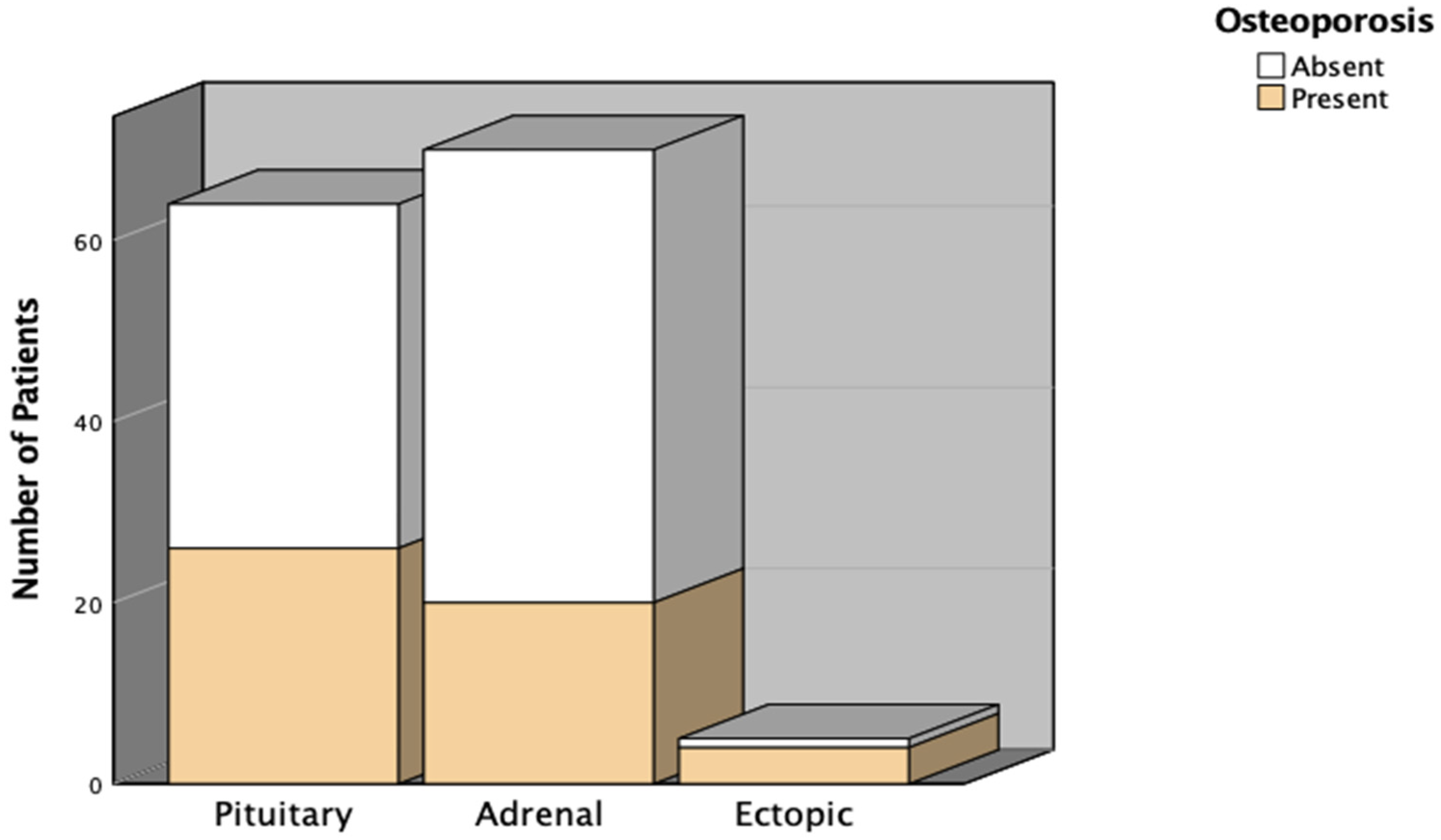
| Pituitary | 26 (40.6%) | 38 (59.4%) | 49 ± 12.4 | 58/6 | 12 (18.8%) |
| Adrenal | 20 (28.6%) | 50 (71.4%) | 51 ± 13 | 58/12 | 6 (8.6%) |
| Ectopic | 4 (80%) | 1 (20%) | 53 ± 12.2 | 2/3 | 1 (20%) |
| Total | 50 (36%) | 89 (64%) | - | 139 | 19 (13.7%) |
| Variable | Optimal Cut-Off | Sensitivity (%) | Specificity (%) |
|---|---|---|---|
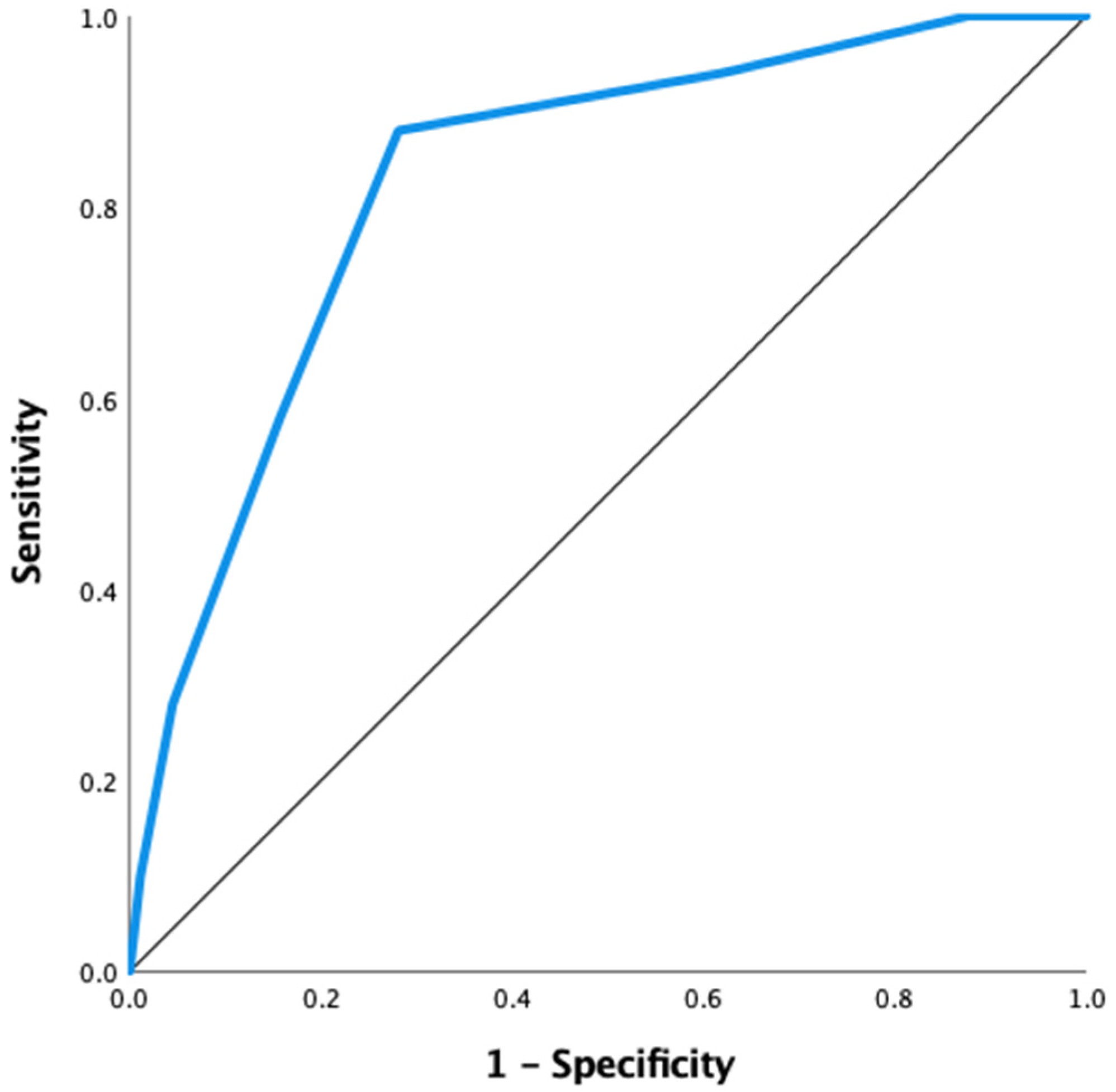
| Age | 51 | 46.3 | 84.3 |
| Symptom Duration | 13.5 months | 50 | 76.4 |
| Midnight Serum Cortisol | 10.25 μg/dL | 87.5 | 57.3 |
| Late-night salivary Cortisol | 0.42 μg/dL | 62.5 | 75.6 |
| Variable | Odds Ratio (Exp(B)) | 95% CI (Lower–Upper) | p-Value |
|---|---|---|---|
| Gender (male ref.) | 0.898 | 0.345–2.341 | 0.826 |
| Late-night salivary cortisol ≥ 0.42 μg/dL | 4.342 | 2.114–8.920 | <0.001 |
| Midnight serum cortisol ≥ 10.25 μg/dL | 9.402 | 3.635–24.315 | <0.001 |
| Symptom duration ≥ 13.5 months | 5.328 | 2.427–11.699 | <0.001 |
| Age ≥ 51 years | 2.611 | 1.315–5.184 | 0.006 |
| Hypertension | 3.436 | 1.301–9.079 | 0.013 |
| Diabetes Mellitus | 4.604 | 2.147–9.874 | <0.001 |
| Basal cortisol level, μg/dL | 1.048 | 1.003–1.095 | 0.035 |
| 24 h UFC, μg/24 h | 1.000 | 1.000–1.001 | 0.367 |
| Body Mass Index | 0.911 | 0.844–0.984 | 0.017 |
| 1 mg DST cortisol, μg/dL | 1.026 | 0.990–1.064 | 0.162 |
| 25-OH vitamin D, ng/mL | 0.959 | 0.911–1.010 | 0.115 |
| Variable | B | Odds Ratio (Exp(B)) | 95% Confidence Interval (Lower–Upper) | p-Value |
|---|---|---|---|---|
| Gender (male ref.) | 0.378 | 1.45 | 0.36–5.88 | 0.595 |
| Body Mass Index | −0.06 | 0.99 | 0.87–1.12 | 0.929 |
| Age ≥ 51 years | 1.899 | 6.68 | 1.76–25.35 | 0.005 |
| Symptom duration ≥ 13.5 months | 2.340 | 10.38 | 2.73–38.84 | <0.001 |
| Diabetes Mellitus | 1.653 | 5.22 | 1.50–18.12 | 0.009 |
| Hypertension | 0.514 | 1.67 | 0.37–7.40 | 0.499 |
| Late-night salivary cortisol ≥ 0.42 μg/dL | 1.670 | 5.30 | 1.46–19.20 | 0.011 |
| Midnight serum cortisol ≥ 10.25 μg/dL | 1.760 | 5.81 | 1.46–23.03 | 0.012 |
| Basal cortisol level, μg/dL | 0.024 | 1.02 | 0.97–1.08 | 0.347 |
| 25-OH vitamin D, ng/mL | −0.086 | 0.92 | 0.84–1.01 | 0.073 |
| Risk Factor | Beta Coefficient (B) | Normalized B (B/1.653) | Assigned Points |
|---|---|---|---|
| Late-night salivary cortisol ≥ 0.42 μg/dL | 1.670 | 1.01 | 1 |
| Midnight serum cortisol ≥ 10.25 μg/dL | 1.760 | 1.06 | 1 |
| Symptom duration ≥ 13.5 months | 2.340 | 1.41 | 2 |
| Diabetes Mellitus | 1.653 | 1.00 | 1 |
| Age ≥ 51 years | 1.899 | 1.14 | 1 |
| Variable | B | OR (95% CI) | p (Univariate) | B | OR (95% CI) | p (Multivariate) |
|---|---|---|---|---|---|---|
| Gender (male ref.) | 1.28 | 3.6 (0.45–28.53) | 0.225 | 0.873 | 3.93 (0.46–33.90) | 0.213 |
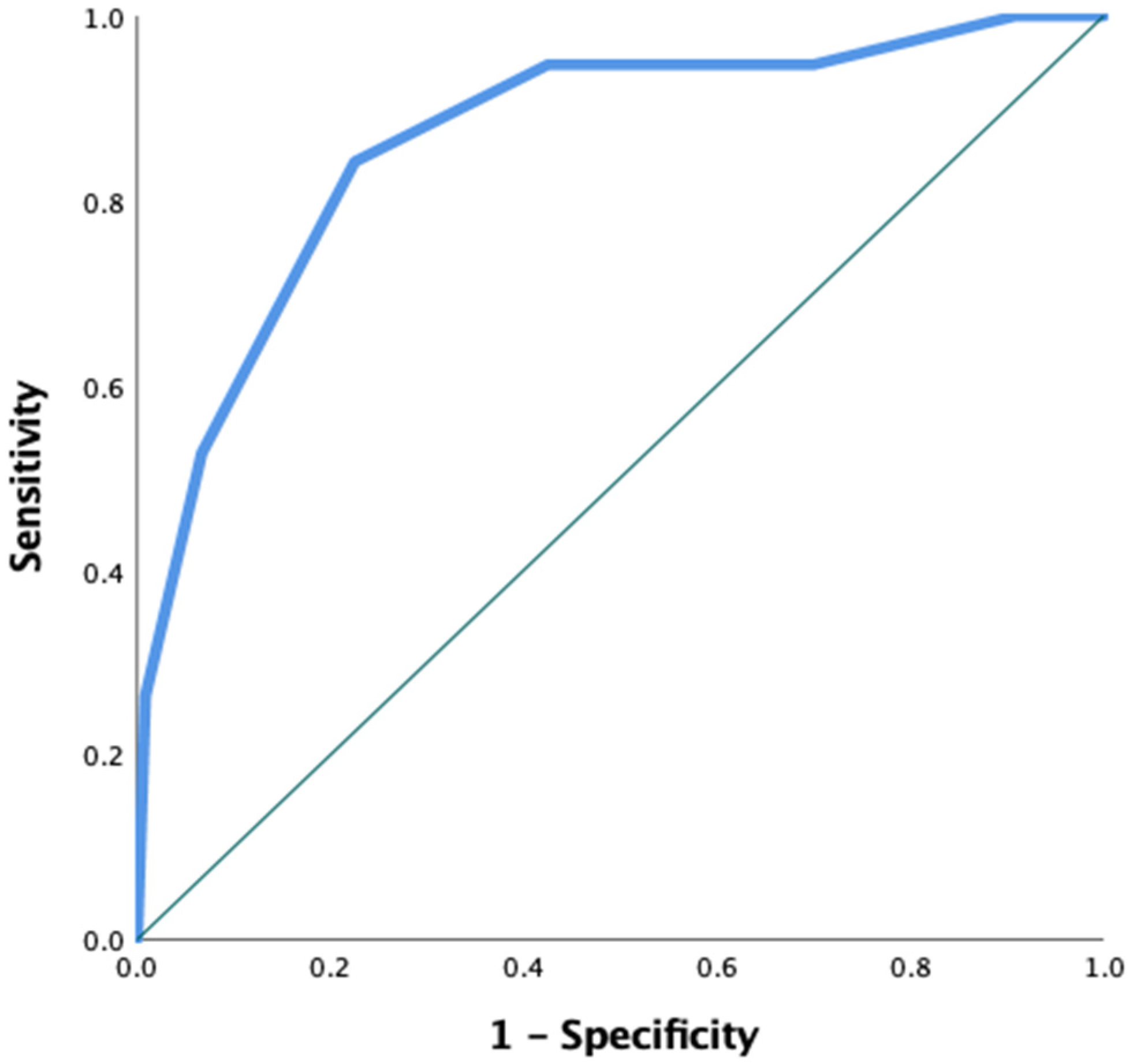
| CORE Score | 1.16 | 3.20 (1.94–5.29) | 0.003 | 1.016 | 3.13 (1.91–5.13) | <0.001 |
| 24 h urinary free cortisol (μg/24 h) | 0.000 | 1.00 (0.99–1.00) | 0.998 | - | - | - |
| Body mass index (kg/m2) | −0.87 | 0.92 (0.81–1.03) | 0.151 | - | - | - |
| 1 mg DST (μg/dL) | 0.014 | 1.01 (0.97–1.05) | 0.473 | - | - | - |
| 25-OH Vitamin D, (ng/mL) | −0.060 | 0.94 (0.85–1.04) | 0.241 | - | - | - |
Disclaimer/Publisher’s Note: The statements, opinions and data contained in all publications are solely those of the individual author(s) and contributor(s) and not of MDPI and/or the editor(s). MDPI and/or the editor(s) disclaim responsibility for any injury to people or property resulting from any ideas, methods, instructions or products referred to in the content. |
© 2026 by the authors. Licensee MDPI, Basel, Switzerland. This article is an open access article distributed under the terms and conditions of the Creative Commons Attribution (CC BY) license.
Share and Cite
Ucgul, E.; Menekse, B.; Boz, O.; Demirci, H.; Ucan, B.; Cakal, E.; Araki, T.; Kizilgul, M. Identification of High-Risk Individuals for Osteoporosis and Fragility Fractures in Cushing’s Syndrome: A Promising Predictive Approach. J. Clin. Med. 2026, 15, 2442. https://doi.org/10.3390/jcm15062442
Ucgul E, Menekse B, Boz O, Demirci H, Ucan B, Cakal E, Araki T, Kizilgul M. Identification of High-Risk Individuals for Osteoporosis and Fragility Fractures in Cushing’s Syndrome: A Promising Predictive Approach. Journal of Clinical Medicine. 2026; 15(6):2442. https://doi.org/10.3390/jcm15062442
Chicago/Turabian StyleUcgul, Enes, Burak Menekse, Ogulcan Boz, Huseyin Demirci, Bekir Ucan, Erman Cakal, Takako Araki, and Muhammed Kizilgul. 2026. "Identification of High-Risk Individuals for Osteoporosis and Fragility Fractures in Cushing’s Syndrome: A Promising Predictive Approach" Journal of Clinical Medicine 15, no. 6: 2442. https://doi.org/10.3390/jcm15062442
APA StyleUcgul, E., Menekse, B., Boz, O., Demirci, H., Ucan, B., Cakal, E., Araki, T., & Kizilgul, M. (2026). Identification of High-Risk Individuals for Osteoporosis and Fragility Fractures in Cushing’s Syndrome: A Promising Predictive Approach. Journal of Clinical Medicine, 15(6), 2442. https://doi.org/10.3390/jcm15062442