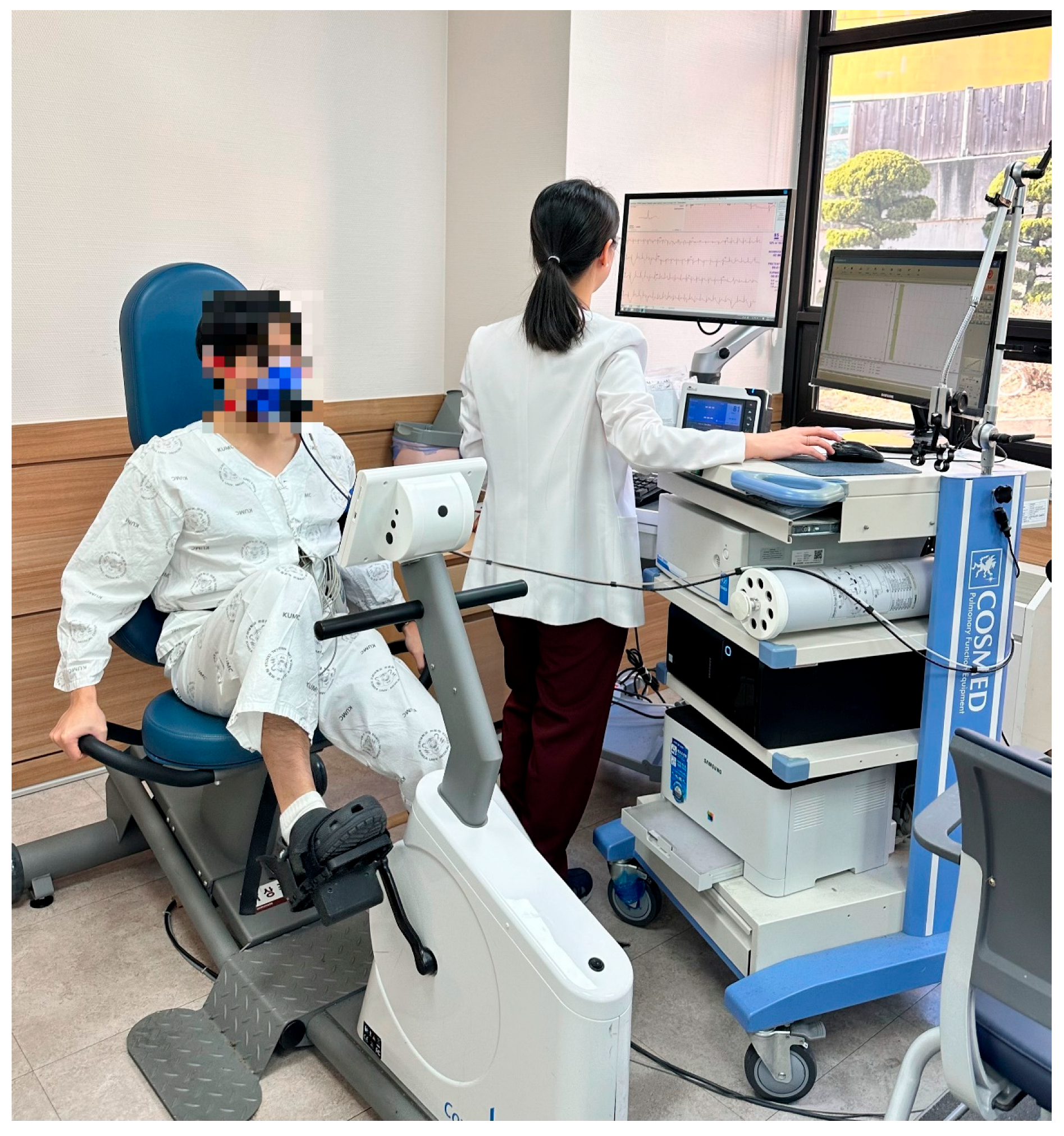
Feasibility and Utility of Recumbent Ergometer-Based Cardiopulmonary Exercise Test in Phase 1 Cardiac Rehabilitation Following Cardiac Surgery: A Pilot Study
 , , and
Abstract
1. Introduction
2. Methods
2.1. Study Objectives
2.2. Study Population
2.3. Study Protocol
2.4. Statistical Analysis
3. Results
3.1. Baseline Characteristics
3.2. Assessments of Functional Capacity
3.3. Results of Recumbent Ergometer-Based Submaximal CPET
3.4. Discussion
3.5. Limitations
4. Conclusions
Author Contributions
Funding
Institutional Review Board Statement
Informed Consent Statement
Data Availability Statement
Conflicts of Interest
Abbreviations
| CVD | Cardiovascular disease |
| CABG | coronary artery bypass grafting |
| CR | cardiac rehabilitation |
| HR | heart rate |
| ECG | electrocardiogram |
| CPET | cardiopulmonary exercise test |
| CBCR | center-based cardiac rehabilitation |
| HBCR | home-based cardiac rehabilitation |
| 6MWT | 6 min walk test |
| EQ-5D | EuroQol-5 dimension |
| SF-36 | short-form 36-item health survey |
| PCS | Physical component summary |
| MCS | Mental component summary |
| KASI | Korean Activity Scale/Index |
| MET | metabolic equivalent of task |
| Wmax | maximal work capacity |
| RPE | rate of perceived exertion |
References
- Nam, S.W.; Song, I.A.; Oh, T.K. Trends in Cardiovascular Surgery in South Korea: A Nationwide Cohort Study from 2010 to 2019. J. Cardiothorac. Vasc. Anesth. 2023, 37, 1651–1658. [Google Scholar] [CrossRef]
- Kang, H.J.; Wang, J.; Cho, E.J.; Kim, H.L.; Lee, C.J.; Park, J.H.; Kang, J.; Suh, J.; Choi, K.H.; Lee, S.Y.; et al. Addressing Cardiovascular Diseases Challenges in South Korea: Strategies to Improve Outcomes. Korean Circ. J. 2025, 55, 557–583. [Google Scholar] [CrossRef]
- Heidenreich, P.A.; Fonarow, G.C.; Breathett, K.; Jurgens, C.Y.; Pisani, B.A.; Pozehl, B.J.; Spertus, J.A.; Taylor, K.G.; Thibodeau, J.T.; Yancy, C.W. 2020 ACC/AHA clinical performance and quality measures for adults with heart failure: A report of the American College of Cardiology/American Heart Association Task Force on Performance Measures. Circ. Cardiovasc. Qual. Outcomes 2020, 13, e000099. [Google Scholar] [CrossRef]
- Visseren, F.L.J.; Mach, F.; Smulders, Y.M.; Carballo, D.; Koskinas, K.C.; Bäck, M.; Benetos, A.; Biffi, A.; Boavida, J.-M.; Capodanno, D.; et al. 2021 ESC Guidelines on cardiovascular disease prevention in clinical practice: Developed by the Task Force for cardiovascular disease prevention in clinical practice with representatives of the European Society of Cardiology and 12 medical societies With the special contribution of the European Association of Preventive Cardiology (EAPC). Eur. Heart J. 2021, 42, 3227–3337. [Google Scholar] [CrossRef]
- Kim, C.; Sung, J.; Lee, J.H.; Kim, W.S.; Lee, G.J.; Jee, S.; Jung, I.Y.; Rah, U.W.; Kim, B.O.; Choi, K.H.; et al. Clinical Practice Guideline for Cardiac Rehabilitation in Korea. Ann. Rehabil. Med. 2019, 43, 355–443. [Google Scholar] [CrossRef]
- Varma, N.; Marrouche, N.F.; Aguinaga, L.; Albert, C.M.; Arbelo, E.; Choi, J.-I.; Chung, M.K.; Conte, G.; Dagher, L.; Epstein, L.M. HRS/EHRA/APHRS/LAHRS/ACC/AHA worldwide practice update for telehealth and arrhythmia monitoring during and after a pandemic: Developed in partnership with and endorsed by the American College of Cardiology (ACC), the American Heart Association (AHA), the Asia Pacific Heart Rhythm Society (APHRS), the European Heart Rhythm Association (EHRA), the Heart Rhythm Society (HRS), and the Latin American Heart Rhythm Society (LAHRS). EP Eur. 2021, 23, 313. [Google Scholar]
- Ambrosetti, M.; Abreu, A.; Corrà, U.; Davos, C.H.; Hansen, D.; Frederix, I.; Iliou, M.C.; Pedretti, R.F.E.; Schmid, J.P.; Vigorito, C.; et al. Secondary prevention through comprehensive cardiovascular rehabilitation: From knowledge to implementation. 2020 update. A position paper from the Secondary Prevention and Rehabilitation Section of the European Association of Preventive Cardiology. Eur. J. Prev. Cardiol. 2021, 28, 460–495. [Google Scholar] [CrossRef]
- Price, K.J.; Gordon, B.A.; Bird, S.R.; Benson, A.C. A review of guidelines for cardiac rehabilitation exercise programmes: Is there an international consensus? Eur. J. Prev. Cardiol. 2016, 23, 1715–1733. [Google Scholar] [CrossRef]
- Nohara, R.; Adachi, H.; Goto, Y.; Hasegawa, E.; Ishihara, S.; Itoh, H.; Kimura, Y.; Maehara, K.; Makita, S.; Matsuo, H.; et al. Guidelines for Rehabilitation in Patients with Cardiovascular Disease (JCS 2012)—Digest Version. Circ. J. 2014, 78, 2022–2093. [Google Scholar] [CrossRef]
- Gibbons, R.J.; Beasley, J.W.; Duvernoy, W.F.C.; Mark, D.B.; McCallister, B.D.; Winters, W.L.; Ritchie, J.L.; Cheitlin, M.D.; Eagle, K.A.; Gardner, T.J.; et al. ACC/AHA guidelines for exercise testing: Executive summary—A report of the American College of Cardiology American Heart Association task force on practice guidelines (Committee on exercise testing). Circulation 1997, 96, 345–354. [Google Scholar] [CrossRef]
- Christopherson, D.J.; Shively, M.; Sivarajan, E.S. Low-level exercise testing before and after coronary artery bypass surgery. Int. J. Nurs. Stud. 1984, 21, 241–253. [Google Scholar] [CrossRef]
- Krone, R.J.; Gillespie, J.A.; Weld, F.M.; Miller, J.P.; Moss, A.J. Low-level exercise testing after myocardial infarction: Usefulness in enhancing clinical risk stratification. Circulation 1985, 71, 80–89. [Google Scholar] [CrossRef]
- Ren, C.; Zhu, J.X.; Shen, T.; Song, Y.X.; Tao, L.Y.; Xu, S.L.; Zhao, W.; Gao, W. Comparison Between Treadmill and Bicycle Ergometer Exercises in Terms of Safety of Cardiopulmonary Exercise Testing in Patients with Coronary Heart Disease. Front. Cardiovasc. Med. 2022, 9, 864637. [Google Scholar] [CrossRef]
- Le, J.N.; Zhou, R.; Tao, R.; Dharmavaram, N.; Dhingra, R.; Runo, J.; Forfia, P.; Raza, F. Recumbent Ergometer vs Treadmill Cardiopulmonary Exercise Test in HFpEF: Implications for Chronotropic Response and Exercise Capacity. J. Card. Fail. 2023, 29, 407–413. [Google Scholar] [CrossRef]
- Sezai, A.; Shimokawa, T.; Kanaoka, K.; Fukuma, N.; Sekino, H.; Shiraishi, H.; Sumita, Y.; Nakai, M.; Iwanaga, Y.; Furukawa, Y.; et al. Efficacy of Early Cardiac Rehabilitation After Cardiac Surgery—Verification Using Japanese Diagnosis Procedure Combination Data. Circ. Rep. 2022, 4, 505–516. [Google Scholar] [CrossRef] [PubMed]
- Pack, Q.R.; Dudycha, K.J.; Roschen, K.P.; Thomas, R.J.; Squires, R.W. Safety of Early Enrollment into Outpatient Cardiac Rehabilitation After Open Heart Surgery. Am. J. Cardiol. 2015, 115, 548–552. [Google Scholar] [CrossRef] [PubMed]
- Nilsson, H.; Nylander, E.; Borg, S.; Tamás, É.; Hedman, K. Cardiopulmonary exercise testing for evaluation of a randomized exercise training intervention following aortic valve replacement. Clin. Physiol. Funct. Imaging 2019, 39, 103–110. [Google Scholar] [CrossRef]
- Kim, S.H.; Cha, S.; Kang, S.; Han, K.; Paik, N.J.; Kim, W.S. High prevalence of physical inactivity after heart valve surgery and its association with long-term mortality: A nationwide cohort study. Eur. J. Prev. Cardiol. 2021, 28, 749–757. [Google Scholar] [CrossRef]
- Kim, Y.M.; Kim, B.R.; Pyun, S.B.; Jung, J.S.; Kim, H.J.; Son, H.S. Feasibility and Safety of Early Cardiac Rehabilitation Using Remote Electrocardiogram Monitoring in Patients with Cardiac Surgery: A Pilot Study. J. Clin. Med. 2025, 14, 4887. [Google Scholar] [CrossRef]
- Balady, G.J.; Arena, R.; Sietsema, K.; Myers, J.; Coke, L.; Fletcher, G.F.; Forman, D.; Franklin, B.; Guazzi, M.; Gulati, M.; et al. Clinician’s Guide to cardiopulmonary exercise testing in adults: A scientific statement from the American Heart Association. Circulation 2010, 122, 191–225. [Google Scholar] [CrossRef]
- Lockwood, P.A.; Yoder, J.E.; Deuster, P.A. Comparison and cross-validation of cycle ergometry estimates of VO2max. Med. Sci. Sports Exerc. 1997, 29, 1513–1520. [Google Scholar] [CrossRef]
- Bohannon, R.W. Hand-grip dynamometry predicts future outcomes in aging adults. J. Geriatr. Phys. Ther. 2008, 31, 3–10. [Google Scholar] [CrossRef]
- Rantanen, T.; Guralnik, J.M.; Foley, D.; Masaki, K.; Leveille, S.; Curb, J.D.; White, L. Midlife hand grip strength as a predictor of old age disability. Jama 1999, 281, 558–560. [Google Scholar] [CrossRef]
- Fu, L.Y.; Zhang, Y.Y.; Shao, B.H.; Liu, X.J.; Yuan, B.; Wang, Z.Q.; Chen, T.A.; Liu, Z.G.; Liu, X.C.; Guo, Q. Perioperative poor grip strength recovery is associated with 30-day complication rate after cardiac surgery discharge in middle-aged and older adults-a prospective observational study. Bmc Cardiovasc. Disord. 2019, 19, 266. [Google Scholar] [CrossRef]
- Enright, P.L. The six-minute walk test. Respir. Care 2003, 48, 783–785. [Google Scholar] [CrossRef]
- Borg, G.A.V. Psychophysical Bases of Perceived Exertion. Med. Sci. Sports Exerc. 1982, 14, 377–381. [Google Scholar] [CrossRef]
- Sung, J.; On, Y.K.; Kim, H.S.; Chae, I.H.; Sohn, D.W.; Oh, B.H.; Lee, M.M.; Park, Y.B.; Choi, Y.S.; Lee, Y.W. Development of Korean activity scale/index (KASI). Korean Circ. J. 2000, 30, 1004–1009. [Google Scholar] [CrossRef]
- Shaw, L.J.; Olson, M.B.; Kip, K.; Kelsey, S.F.; Johnson, B.D.; Mark, D.B.; Reis, S.E.; Mankad, S.; Rogers, W.J.; Pohost, G.M.; et al. The value of estimated functional capacity in estimating outcome: Results from the NHBLI-Sponsored Women’s Ischemia Syndrome Evaluation (WISE) Study. J. Am. Coll. Cardiol. 2006, 47, S36–S43. [Google Scholar] [CrossRef]
- Rabin, R.; Charro, F.d. EQ-SD: A measure of health status from the EuroQol Group. Ann. Med. 2001, 33, 337–343. [Google Scholar] [CrossRef]
- Kim, M.-H.; Cho, Y.-S.; Uhm, W.-S.; Kim, S.; Bae, S.-C. Cross-cultural adaptation and validation of the Korean version of the EQ-5D in patients with rheumatic diseases. Qual. Life Res. 2005, 14, 1401–1406. [Google Scholar] [CrossRef]
- Lee, Y.K.; Nam, H.; Chuang, L.H.; Kim, K.Y.; Yang, H.K.; Kwon, I.S.; Kind, P.; Kweon, S.S.; Kim, Y.T. South Korean time trade-off values for EQ-5D health states: Modeling with observed values for 101 health states . Value Health 2009, 12, 1187–1193. [Google Scholar] [CrossRef]
- Ware, J.E. SF-36 health survey update. Spine 2000, 25, 3130–3139. [Google Scholar] [CrossRef]
- Han, C.W.; Lee, E.J.; Iwaya, T.; Kataoka, H.; Kohzuki, M. Development of the Korean version of short-form 36-item health survey: Health related QOL of healthy elderly people and elderly patients in Korea. Tohoku J. Exp. Med. 2004, 203, 189–194. [Google Scholar] [CrossRef]
- Hamm, L.F.; Crow, R.S.; Stull, G.A.; Hannan, P. Safety and characteristics of exercise testing early after acute myocardial infarction. Am. J. Cardiol. 1989, 63, 1193–1197. [Google Scholar] [CrossRef]
- Miller, D.H.; Borer, J.S. Exercise testing early after myocardial infarction. Risks and benefits. Am. J. Med. 1982, 72, 427–438. [Google Scholar] [CrossRef] [PubMed]
- Kim, C.; Park, Y.B.; Kim, D.Y.; Kim, Y.J. The Safety of Early Exercise Stress Test after Coronary Intervention. J. Korean Acad. Rehabil. Med. 2010, 34, 6. [Google Scholar]
- Butman, S.M.; Olson, H.G.; Gardin, J.M.; Piters, K.M.; Hullett, M.; Butman, L.K. Submaximal exercise testing after stabilization of unstable angina pectoris. J. Am. Coll. Cardiol. 1984, 4, 667–673. [Google Scholar] [CrossRef]
- Haglund, E.K.; Bremander, A.B. Aerobic capacity in patients with rheumatoid arthritis: A comparison of two submaximal test methods. Musculoskelet. Care 2009, 7, 288–299. [Google Scholar] [CrossRef] [PubMed]
- Stringer, W.W. Cardiopulmonary exercise testing: Current applications. Expert Rev. Respir. Med. 2010, 4, 179–188. [Google Scholar] [CrossRef]
- Takeyama, J.; Itoh, H.; Kato, M.; Koike, A.; Aoki, K.; Fu, L.T.; Watanabe, H.; Nagayama, M.; Katagiri, T. Effects of physical training on the recovery of the autonomic nervous activity during exercise after coronary artery bypass grafting: Effects of physical training after CABG. Jpn. Circ. J. 2000, 64, 809–813. [Google Scholar] [CrossRef]
- Wehrle, A.; Waibel, S.; Gollhofer, A.; Roecker, K. Power Output and Efficiency During Supine, Recumbent, and Upright Cycle Ergometry. Front. Sports Act. Living 2021, 3, 667564. [Google Scholar] [CrossRef]
- Pauletti, H.O.; Gomes, W.J.; Rocco, I.S.; Viceconte, M.; Garcia, B.C.M.; Marcondi, N.O.; Bublitz, C.B.; Costa, A.D.S.; Paiva, T.P.; Spina, G.D.; et al. Early Six-Minute Walk Test May Predict Midterm Outcomes Following Coronary Artery Bypass Grafting. Braz. J. Cardiovasc. Surg. 2023, 38, e20220459. [Google Scholar] [CrossRef] [PubMed]
- Doyle, M.P.; Indraratna, P.; Tardo, D.T.; Peeceeyen, S.C.; Peoples, G.E. Safety and efficacy of aerobic exercise commenced early after cardiac surgery: A systematic review and meta-analysis. Eur. J. Prev. Cardiol. 2019, 26, 36–45. [Google Scholar] [CrossRef] [PubMed]
- Alison, J.A.; Kenny, P.; King, M.T.; McKinley, S.; Aitken, L.M.; Leslie, G.D.; Elliott, D. Repeatability of the six-minute walk test and relation to physical function in survivors of a critical illness. Phys. Ther. 2012, 92, 1556–1563. [Google Scholar] [CrossRef] [PubMed]


| Absolute Indication for Stop Test | Pre-Established Termination Criteria |
|---|---|
| -ST-segment elevation > 1 mm without abnormal Q waves in ECG channels excluding V1 and aVR -Decrease in SBP > 10 mmHg or a drop below resting SBP -Severe or higher-grade angina (angina scale Grade 3–4) -Able to ambulate without physical assistance -Exacerbation of neurological symptoms (ex. dizziness and ataxia) -Cyanosis or pallor -Persistent ventricular tachycardia -Patient’s desire to discontinue the test | -HR > 120 beats per minute. -Reaching 70% of the maximum predicted heart rate based on the patient’s age. -Achieving a pre-determined MET level (typically 5–7). -Uncontrolled medical condition -RPE (Rating of Perceived Exertion) exceeds 15 on the Borg 6–20 grade scale. |
| Variables | Values |
|---|---|
| Age (years) | 62.50 ± 1.99 |
| Sex, males/females | 15 (75)/5 (25) |
| Height (cm) | 166.14 ± 1.99 |
| Weight (kg) | 66.28 ± 1.82 |
| Body mass index (kg/m2) | 23.97 ± 0.43 |
| Normal weight (18.5–22.9) | 5 (25) |
| Overweight (23.0–24.9) | 8 (40) |
| Obese (≥25.0) | 7 (35) |
| Atrial fibrillation | 5 (25) |
| NT-pro BNP (pg/mL, N = 15) | 597 (129; 1555) |
| E/e’ ratio (N = 15) | 10.9 (9.3; 14.6) |
| Left Atrial volume index (mL/m2, N = 16) | 55.1 (33.1; 68.9) |
| Time to start CR (days) | 5.0 (5.0; 6.0) |
| Time to CPET (days) | 9.0 (8.0; 12.5) |
| Surgery type (%) | |
| Valve surgery | 10 (50) |
| CABG | 8 (40) |
| Total arch replacement | 1 (5) |
| Coronary artery fistulectomy | 1 (5) |
| Cause of surgery (%) | |
| Infective endocarditis | 5 (25) |
| Valve disease | 5 (25) |
| Stable angina | 4 (20) |
| Myocardial infarction | 3 (15) |
| Unstable angina | 1 (5) |
| Acute Aortic Dissection (DeBakey type 1) | 1 (5) |
| Coronary arteriovenous fistula | 1 (5) |
| Variables | Values |
|---|---|
| Grip strength test (kg) | 29.93 ± 1.71 |
| 6MWT (m) | 350.15 ± 18.85 |
| KASI | 10.26 ± 0.77 |
| EQ-5D | 0.72 (0.68; 0.72) |
| SF-36 | |
| Total | 106.48 ± 3.13 |
| PCS | 47.14 ± 1.57 |
| MCS | 59.34 ± 2.18 |
| Values | |
|---|---|
| CPET duration (second) | 411.75 ± 168.25 |
| Submaximal peak VO2 (mL/kg/min) | 12.32 ± 0.75 |
| Percentage of VO2 max (%) | 46.65 ± 2.08 |
| Submaximal peak MET | 3.52 ± 0.22 |
| Submaximal peak RER | 1.01 (0.98; 1.12) |
| Wmax (Watt) | 63.00 ± 7.00 |
| Submaximal peak RPE | 15.00 ± 0.51 |
| Submaximal peak HR (beats/min) | 111.8 ± 3.76 |
| Percentage of age-predicted maximal HR (%) | 70.95 ± 2.09 |
| Submaximal peak systolic BP (mmHg) | 162.60 ± 4.47 |
| Variables | Partial Correlation Coefficient | 95% CI | p-Value |
|---|---|---|---|
| 6MWT (m) | 0.522 * | 0.057–0.789 | 0.026 |
| Grip strength test | 0.065 | −0.416–0.514 | 0.799 |
| KASI | 0.586 * | 0.147–0.821 | 0.011 |
| EQ-5D | −0.111 | −0.547–0.378 | 0.662 |
| SF-36 | |||
| Total | 0.438 | −0.049–0.746 | 0.069 |
| PCS | 0.546 * | 0.090–0.801 | 0.019 |
| MCS | 0.194 | −0.305–0.602 | 0.440 |
Disclaimer/Publisher’s Note: The statements, opinions and data contained in all publications are solely those of the individual author(s) and contributor(s) and not of MDPI and/or the editor(s). MDPI and/or the editor(s) disclaim responsibility for any injury to people or property resulting from any ideas, methods, instructions or products referred to in the content. |
© 2026 by the authors. Licensee MDPI, Basel, Switzerland. This article is an open access article distributed under the terms and conditions of the Creative Commons Attribution (CC BY) license.
Share and Cite
Kim, Y.M.; Kim, B.R.; Son, H.S.; Pyun, S.B.; Jung, J.S.; Kim, H.J. Feasibility and Utility of Recumbent Ergometer-Based Cardiopulmonary Exercise Test in Phase 1 Cardiac Rehabilitation Following Cardiac Surgery: A Pilot Study. J. Clin. Med. 2026, 15, 2429. https://doi.org/10.3390/jcm15062429
Kim YM, Kim BR, Son HS, Pyun SB, Jung JS, Kim HJ. Feasibility and Utility of Recumbent Ergometer-Based Cardiopulmonary Exercise Test in Phase 1 Cardiac Rehabilitation Following Cardiac Surgery: A Pilot Study. Journal of Clinical Medicine. 2026; 15(6):2429. https://doi.org/10.3390/jcm15062429
Chicago/Turabian StyleKim, Yeon Mi, Bo Ryun Kim, Ho Sung Son, Sung Bom Pyun, Jae Seung Jung, and Hee Jung Kim. 2026. "Feasibility and Utility of Recumbent Ergometer-Based Cardiopulmonary Exercise Test in Phase 1 Cardiac Rehabilitation Following Cardiac Surgery: A Pilot Study" Journal of Clinical Medicine 15, no. 6: 2429. https://doi.org/10.3390/jcm15062429
APA StyleKim, Y. M., Kim, B. R., Son, H. S., Pyun, S. B., Jung, J. S., & Kim, H. J. (2026). Feasibility and Utility of Recumbent Ergometer-Based Cardiopulmonary Exercise Test in Phase 1 Cardiac Rehabilitation Following Cardiac Surgery: A Pilot Study. Journal of Clinical Medicine, 15(6), 2429. https://doi.org/10.3390/jcm15062429