Diagnosis and Treatment of Ectopic Pregnancy in a Cesarean Section Scar—Case Report

 , , ,
, , ,  and
and
Abstract
1. Introduction
- Grade I—the gestational sac (chorion) is implanted into less than half of the myometrium.
- Grade II—the gestational sac extends into more than half of the myometrium.
- Grade III—the gestational sac extends beyond the myometrium and serosal membrane of the uterus.
- Grade IV—the gestational sac becomes an amorphous tumor with abundant vascularization in the scar after a cesarean section.
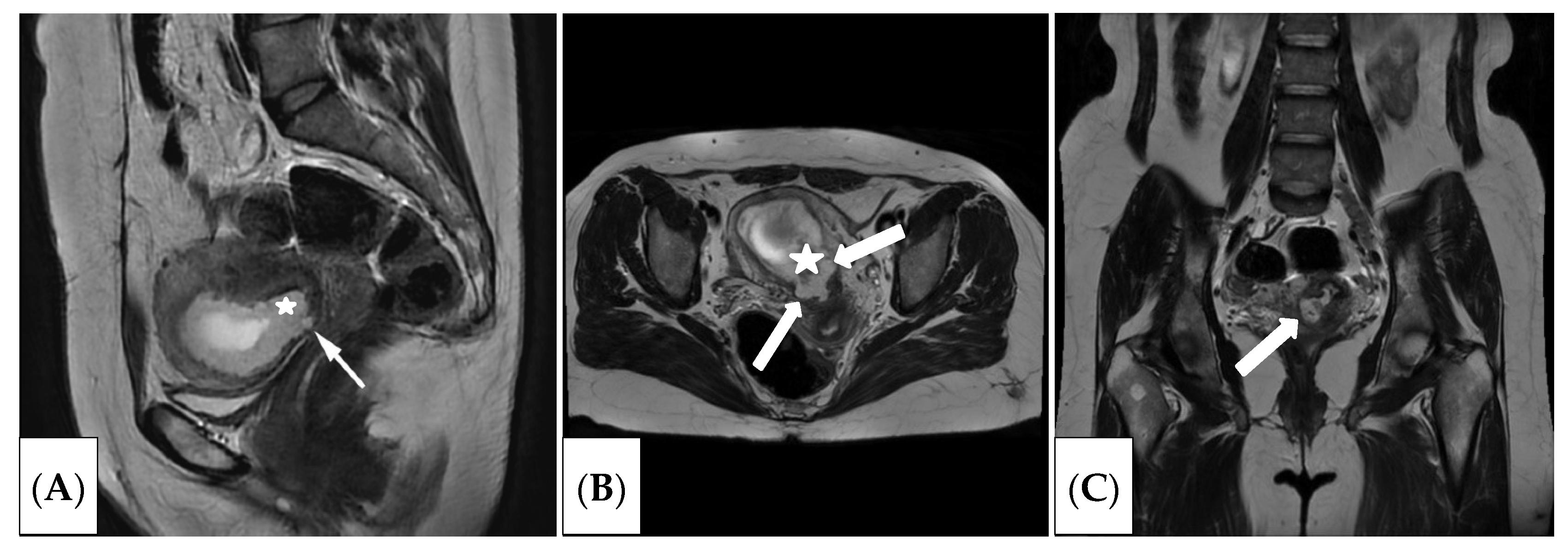
- However, in complex and controversial cases, MRI is used. MRI is a complementary diagnostic method to assess parameters such as the location of the gestational sac and signs of thinning of the lower uterine segment. It is very important to visualize the degree of chorionic invasion into the uterine wall and uterine isthmus. Its most valuable feature is the ability to determine the depth of chorionic invasion, including involvement of adjacent organs.
- According to the literature, SNP may be divided also into two types. Type 1 (endogenous) is where the initially implanted gestational sac in the cesarean scar gradually invades the uterine cavity [9]. In this case, there is a chance to prolong the pregnancy until the third trimester and give birth to a viable child. Type 2 (exogenous) occurs when the gestational sac is implanted in the cesarean scar, penetrating deeper towards the serosal uterine surface [9].
- Based on MRI analysis, it is possible to classify the location of the gestational sac relative to the scar niche, which directly impacts the pregnancy outcome and prognosis. SNP may be divided into two [9] or three types [9,10,11,12]. In accordance with the classification, exogenous type [9] or type III [12] carry a higher risk of massive bleeding and uterine rupture in the first trimester of pregnancy [10,11,12].
- T2-weighted images (T2WIs) in the sagittal plane are used for assessment. The location of the gestational sac is the determining factor. Therefore, Type II is characterized by its localization partially within the scar niche and partially within the uterine cavity. This type of pregnancy is not always associated with the risk of scar rupture and bleeding as the pregnancy progresses, as the gestational sac is partially located within the uterine cavity. This type of pregnancy can be dynamically monitored and prolonged at the patient’s insistent desire. However, as pregnancy progresses, placenta accreta and placenta increta of varying severity may occur. But, in cases of late diagnosis, massive bleeding, and the woman’s unwillingness to preserve her reproductive health, patients undergo total hysterectomy [11,13]. With timely diagnosis in the early stages of gestation, the patient can undergo treatment, including hysteroresectoscopy with removal of the gestational sac, or use more gentle methods or try prolong the pregnancy. In cases of CS damage and its failure, one-stage metroplasty can be performed, which allows preservation of fertility. To reduce the blood supply to the pelvic organs, uterine artery embolization may be performed beforehand [14,15].
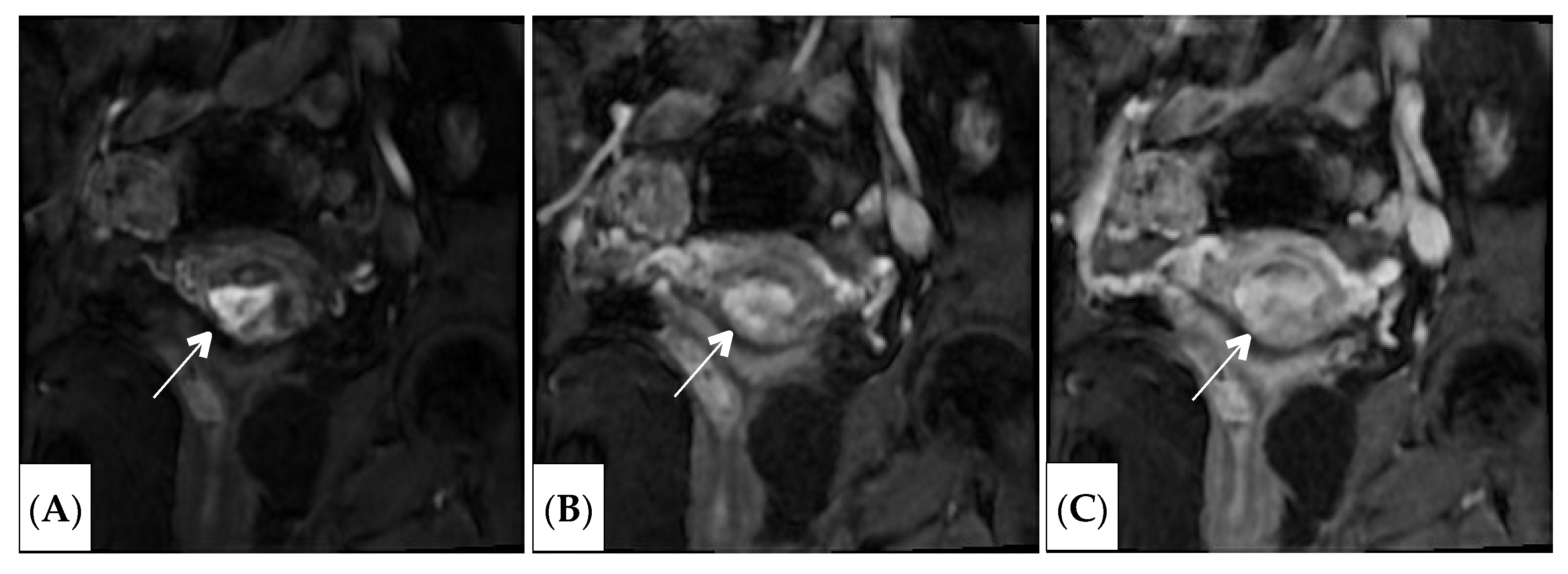
- Unfortunately, according to current clinical guidelines, the use of contrast (for both ultrasound and MRI) is limited in pregnancy, which prevents its widespread use in clinical practice. Moreover, it would be crucial for practicing physicians to understand how contrast enhancement improves diagnostics. In the presented case, given that the woman did not wish to continue her current pregnancy, it would have been possible to use contrast enhancement during MRI and demonstrate its potential for clinical practice [16].
- The aim of the study is to clarify the clinical practices to follow in cases where an MRI examination with contrast agent is indicated to be performed on a pregnant patient.
2. Case Report
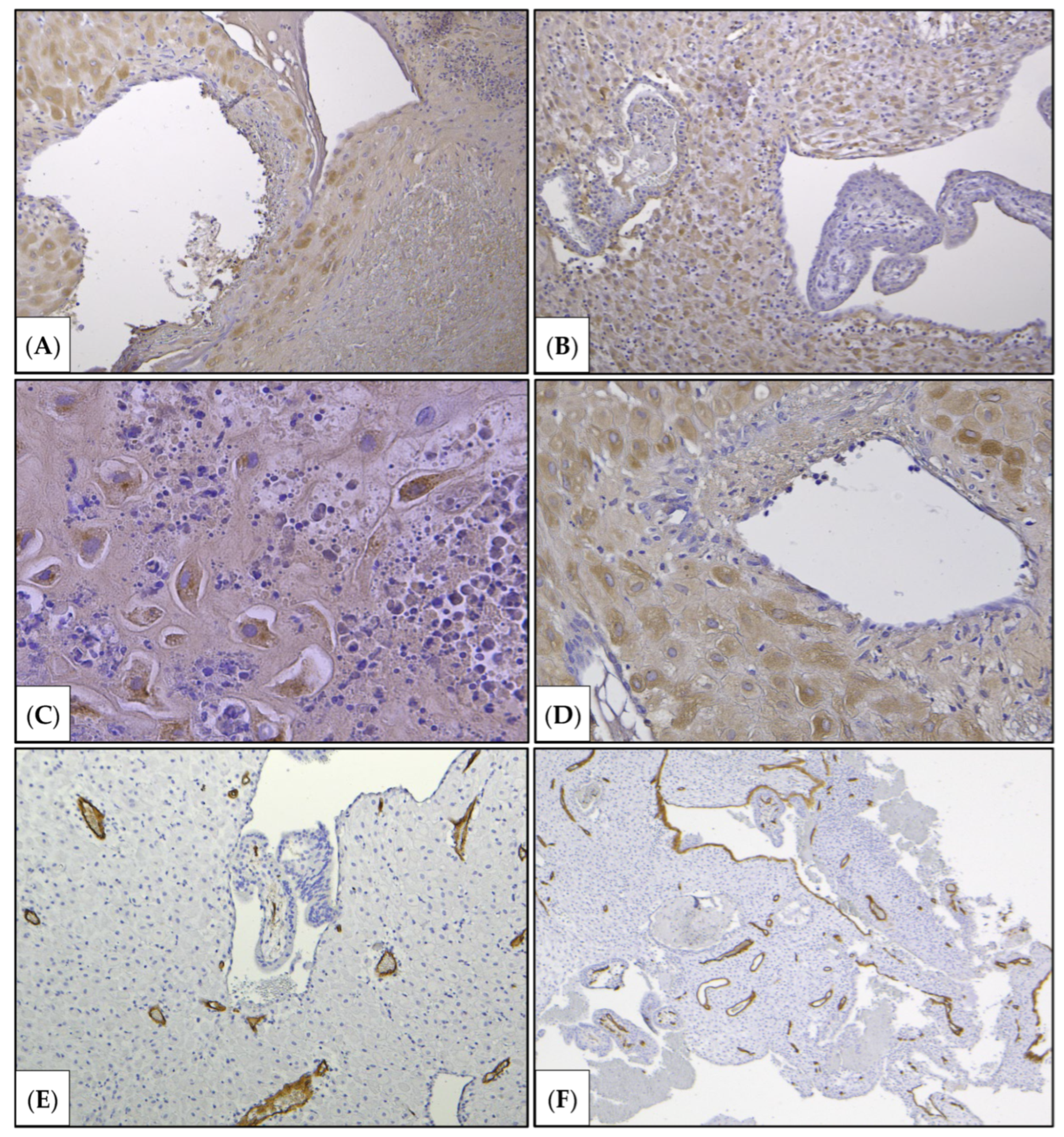
2.1. Histological Study
2.2. Immunohistochemical Examination
3. Results and Discussion
4. Conclusions
Author Contributions
Funding
Institutional Review Board Statement
Informed Consent Statement
Data Availability Statement
Conflicts of Interest
Abbreviations
| CS | Cesarean section |
| GS | Gestational sac GS |
| PAS | Placenta accreta spectrum disorder |
| SNP | Scar niche pregnancy |
References
- Jauniaux, E.; Grønbeck, L.; Bunce, C.; Langhoff-Roos, J.; Collins, S.L. Epidemiology of placenta previa accreta: A systematic review and meta-analysis. BMJ Open 2019, 9, e031193. [Google Scholar] [CrossRef]
- Timor-Tritsch, I.E.; Monteagudo, A.; Calì, G.; D’Antonio, F.; Kaelin Agten, A. Cesarean Scar Pregnancy: Diagnosis and Pathogenesis. Obstet. Gynecol. Clin. N. Am. 2019, 46, 573–586. [Google Scholar] [CrossRef]
- White, A.; Malik, M.; Pruszynski, J.E.; Do, Q.N.; Spong, C.Y.; Herrera, C.L. Contemporary Placenta Accreta Spectrum Disorder Incidence and Risk Factors. Obstet. Gynecol. 2025, 145, 665–673. [Google Scholar] [CrossRef]
- Morlando, M.; Buca, D.; Timor-Tritsch, I.; Cali, G.; Palacios-Jaraquemada, J.; Monteagudo, A.; Khalil, A.; Cennamo, C.; La Manna, V.; Liberati, M.; et al. Reproductive outcome after cesarean scar pregnancy: A systematic review and meta-analysis. Acta Obstet. Gynecol. Scand. 2020, 99, 1278–1289. [Google Scholar] [CrossRef]
- Anant, M.; Paswan, A.; Jyoti, C. Cesarean Scar Ectopic Pregnancy: The Lurking Danger in Post Cesarean Failed Medical Abortion. J. Fam. Reprod. Health 2019, 13, 180–183. [Google Scholar] [CrossRef]
- Miller, R.; Timor-Tritsch, I.E.; Gyamfi Bannerman, C. Society for Maternal-Fetal Medicine (SMFM) Consult Series #49: Cesarean scar pregnancy. Am. J. Obstet. Gynecol. 2020, 222, B2–B14. [Google Scholar] [CrossRef]
- Jauniaux, E.; D’Antonio, F.; Bhide, A.; Prefumo, F.; Silver, R.M.; Hussein, A.M.; Shainker, S.A.; Chantraine, F.; Alfirevic, Z.; Delphi consensus expert panel. Modified Delphi study of ultrasound signs associated with placenta accreta spectrum. Ultrasound Obstet. Gynecol. 2023, 61, 518–525. [Google Scholar] [CrossRef] [PubMed]
- Lakshmy, R.S.; Nity, R.; Meenakshi, R. Pitfalls in Ultrasound Diagnosis of Cesarean Scar Pregnancy. J. Obstet. Gynaecol. India 2018, 68, 164–172. [Google Scholar] [CrossRef]
- Lin, S.-Y.; Hsieh, C.-J.; Tu, Y.-A.; Li, Y.-P.; Lee, C.-N.; Hsu, W.-W.; Shih, J.-C. New ultrasound grading system for caesarean scar pregnancy and its implication for management strategies: An observational cohort study. PLoS ONE 2018, 13, e0202020. [Google Scholar] [CrossRef]
- Jayaram, P.M.; Okunoye, G.O.; Konje, J. Caesarean scar ectopic pregnancy: Diagnostic challenges and management options. Obstet. Gynaecol. 2017, 19, 13–20. [Google Scholar] [CrossRef]
- Elson, C.J.; Salim, R.; Potdar, N.; Chetty, M.; Ross, J.A.; Kirk, E.J.; on behalf of the Royal College of Obstetricians and Gynaecologists. Green-Top Guideline: Diagnosis and Management of Ectopic Pregnancy; RCOG Press: London, UK, 2022. [Google Scholar]
- Vial, Y.; Petignat, P.; Hohlfeld, P. Pregnancy in a cesarean scar. Ultrasound Obstet. Gynecol. 2000, 16, 592–593. [Google Scholar] [CrossRef]
- Peng, K.W.; Lei, Z.; Xiao, T.H.; Jia, F.G.; Zhong, W.X.; Gao, Y.; Shen, B.X.; Xie, J.W. First trimester caesarean scar ectopic pregnancy evaluation using MRI. Clin. Radiol. 2014, 69, 123–129. [Google Scholar] [CrossRef]
- Webster, K.; Horsley, R.; Stott, A.; Downes, K. Ectopic pregnancy and miscarriage: Diagnosis and initial management: Summary of updated NICE guidance. BMJ 2019, 367, l6334. [Google Scholar] [CrossRef] [PubMed]
- Po, L.; Thomas, J.; Mills, K.; Zakhari, A.; Tulandi, T.; Shuman, M.; Page, A. Guideline No. 414: Management of Pregnancy of Unknown Location and Tubal and Nontubal Ectopic Pregnancies. J. Obstet. Gynaecol. Can. 2021, 43, 1377–1388. [Google Scholar] [CrossRef]
- Perelli, F.; Turrini, I.; Giorgi, M.G.; Renda, I.; Vidiri, A.; Straface, G.; Scatena, E.; D’Indinosante, M.; Marchi, L.; Giusti, M.; et al. Contrast Agents during Pregnancy: Pros and Cons When Really Needed. Int. J. Environ. Res. Public Health 2022, 19, 16699. [Google Scholar] [CrossRef] [PubMed]
- Palacios-Jaraquemada, J.M.; Basanta, N.; Labrousse, C.; Martínez, M. Pregnancy outcome in women with prior placenta accreta spectrum disorders treated with conservative-reconstructive surgery: Analysis of 202 cases. J. Matern. Fetal Neonatal Med. 2022, 35, 6297–6301. [Google Scholar] [CrossRef]
- Dominoni, M.; Torella, M.; Molitierno, R.; Fordellone, M.; Saccone, G.; Colacurci, D.; Laganà, A.S.; Pano, M.R.; Gardella, B.; La Verde, M. Single-versus double-layer uterine closure at the time of cesarean delivery and risk of uterine scar niche: A systematic review and meta-analysis of randomized trials. Arch. Gynecol. Obstet. 2025, 312, 1095–1106. [Google Scholar] [CrossRef]
- Harzif, A.K.; Maidarti, M.; Shadrina, A.; Saroyo, Y.B. Cesarean scar pregnancy management: Different approaches for different situations; A case series. Ann. Med. Surg. 2021, 70, 102808. [Google Scholar] [CrossRef] [PubMed]
- Verberkt, C.; Stegwee, S.I.; Van der Voet, L.F.; Van Baal, W.M.; Kapiteijn, K.; Geomini, P.M.A.J.; Van Eekelen, R.; de Groot, C.J.M.; de Leeuw, R.A.; Huirne, J.A.F.; et al. Single-layer vs double-layer uterine closure during cesarean delivery: 3-year follow-up of a randomized controlled trial (2Close study). Am. J. Obstet. Gynecol. 2024, 231, 346.e1–346.e11. [Google Scholar] [CrossRef]
- Agarwal, N.; Gainder, S.; Chopra, S.; Rohilla, M.; Prasad, G.; Jain, V. The Management of ectopic scar: A single-center experience. Cureus 2021, 13, e15881. [Google Scholar] [CrossRef]
- MacGregor, B.; Madejowski, S.; Leach, H.; Macdonald, C.; Dale, J.; Grove, A.; Heazell, A.E.P.; Parsons, J.; Staniszewska, S.; Hillman, S. Interventions to Improve Outcomes After Pregnancy Loss: A Systematic Review. BJOG 2025, 133, 365–374. [Google Scholar] [CrossRef]
- Gerday, A.; Lourtie, A.; Pirard, C.; Laurent, P.; Wyns, C.; Jadoul, P.; Squifflet, J.L.; Dolmans, M.M.; Van Gossum, J.P.; Hammer, F.; et al. Experience with medical treatment of Cesarean scar ectopic pregnancy (CSEP) with local ultrasound-guided methotrexate injection. Front. Med. 2020, 7, 564764. [Google Scholar] [CrossRef]
- Karahasanoglu, A.; Uzun, I.; Deregözü, A.; Ozdemir, M. Successful treatment of Cesarean scar pregnancy with suction curettage: Our experiences in early pregnancy. Ochsner J. 2018, 18, 222–225. [Google Scholar] [CrossRef]
- Sukhikh, G.T.; Shmakov, R.G.; Kurtser, M.A.; Barinov, S.V.; Chuprynin, V.D.; Mikheeva, A.A.; Amiraslanov, E.Y.; Grigoryan, A.M.; Konoplev, B.A.; Kutakova, Y.Y.; et al. Surgical management of placenta accreta spectrum in the Russian Federation (a pilot multicenter study). Akush. Ginekol. 2024, 50–66. (In Russian) [Google Scholar] [CrossRef]
- Kulabukhova, P.V.; Nizyaeva, N.V.; Milovanov, A.P.; Artemyeva, K.A.; Mhitarov, V.A.; Bychenko, V.G. Uterine layers hypervascularization in atypical placentation: The comparison of magnetic resonance imaging with vascular pathomorphology. Alm. Clin. Med. 2024, 52, 197–212. [Google Scholar] [CrossRef]
- Buyanova, S.N.; Torobaeva, M.T.; Logutova, L.S.; Chechneva, M.A.; Yudina, N.V.; Barinova, I.V. Tactics for managing pregnant women with a fertilized egg in the cesarean section scar “niche”. Russ. Bull. Obstet. Gynecol. 2023, 23, 65–70. [Google Scholar] [CrossRef]
- Wong, W.S.F.; Fung, W.T. Magnetic Resonance Imaging in the Evaluation of Cesarean Scar Defect. Gynecol. Minim. Invasive Ther. 2018, 7, 104–107. [Google Scholar] [CrossRef]
- Chen, R.; An, J.; Guo, Q.; Lin, Q.; Yang, L.; Wang, Y. Temporary ligation of the bilateral uterine arteries during laparoscopy combined with hysteroscopy in the treatment of Caesarean scar pregnancy: Experience at a Chinese Teaching Hospital. Int. J. Gen. Med. 2021, 14, 2087–2094. [Google Scholar] [CrossRef] [PubMed]
- Alghamdi, S.A., Sr. Gadolinium-Based Contrast Agents in Pregnant Women: A Literature Review of MRI Safety. Cureus 2023, 15, e38493. [Google Scholar] [CrossRef]
- Clinical guidelines of the Russian Ministry of Health: Ectopic Pregnancy. ID: 642. Akusherstvo Ginekol./Obstet. Gynecol. 2025, 94, 32–47. (In Russian) [CrossRef]
- Kulikov, I.A.; Nizyaeva, N.V.; Sukhacheva, T.V.; Serov, R.A.; Tikhonova, N.B.; Fokina, T.V.; Milovanov, A.P.; Belousova, T.N.; Milyutina, E.R.; Mikhaleva, L.M. Comparative morphological characteristics of the uteroplacental area in abnormal placentation. Acta Biomed. Sci. 2023, 8, 68–79. (In Russian) [Google Scholar] [CrossRef]
- Milovanov, A.P.; Nizyaeva, N.V.; Fokina, T.V.; Tikhonova, N.B.; Kulikov, I.A.; Shmakov, R.G. Clinical and morphological characteristics of the atypical placentation spectrum in the uterus. Russ. J. Arch. Pathol. 2023, 85, 13–20. (In Russian) [Google Scholar] [CrossRef] [PubMed]


Disclaimer/Publisher’s Note: The statements, opinions and data contained in all publications are solely those of the individual author(s) and contributor(s) and not of MDPI and/or the editor(s). MDPI and/or the editor(s) disclaim responsibility for any injury to people or property resulting from any ideas, methods, instructions or products referred to in the content. |
© 2026 by the authors. Licensee MDPI, Basel, Switzerland. This article is an open access article distributed under the terms and conditions of the Creative Commons Attribution (CC BY) license.
Share and Cite
Kulabukhova, P.V.; Fokina, T.V.; Babaeva, M.N.; Asaturova, A.V.; Nizyaeva, N.V. Diagnosis and Treatment of Ectopic Pregnancy in a Cesarean Section Scar—Case Report. J. Clin. Med. 2026, 15, 2302. https://doi.org/10.3390/jcm15062302
Kulabukhova PV, Fokina TV, Babaeva MN, Asaturova AV, Nizyaeva NV. Diagnosis and Treatment of Ectopic Pregnancy in a Cesarean Section Scar—Case Report. Journal of Clinical Medicine. 2026; 15(6):2302. https://doi.org/10.3390/jcm15062302
Chicago/Turabian StyleKulabukhova, Polina V., Tatyana V. Fokina, Maria N. Babaeva, Aleksandra V. Asaturova, and Natalia V. Nizyaeva. 2026. "Diagnosis and Treatment of Ectopic Pregnancy in a Cesarean Section Scar—Case Report" Journal of Clinical Medicine 15, no. 6: 2302. https://doi.org/10.3390/jcm15062302
APA StyleKulabukhova, P. V., Fokina, T. V., Babaeva, M. N., Asaturova, A. V., & Nizyaeva, N. V. (2026). Diagnosis and Treatment of Ectopic Pregnancy in a Cesarean Section Scar—Case Report. Journal of Clinical Medicine, 15(6), 2302. https://doi.org/10.3390/jcm15062302