Resistance to Targeted Therapy in AML: Current Challenges and Emerging Treatment Strategies

Abstract
1. Introduction
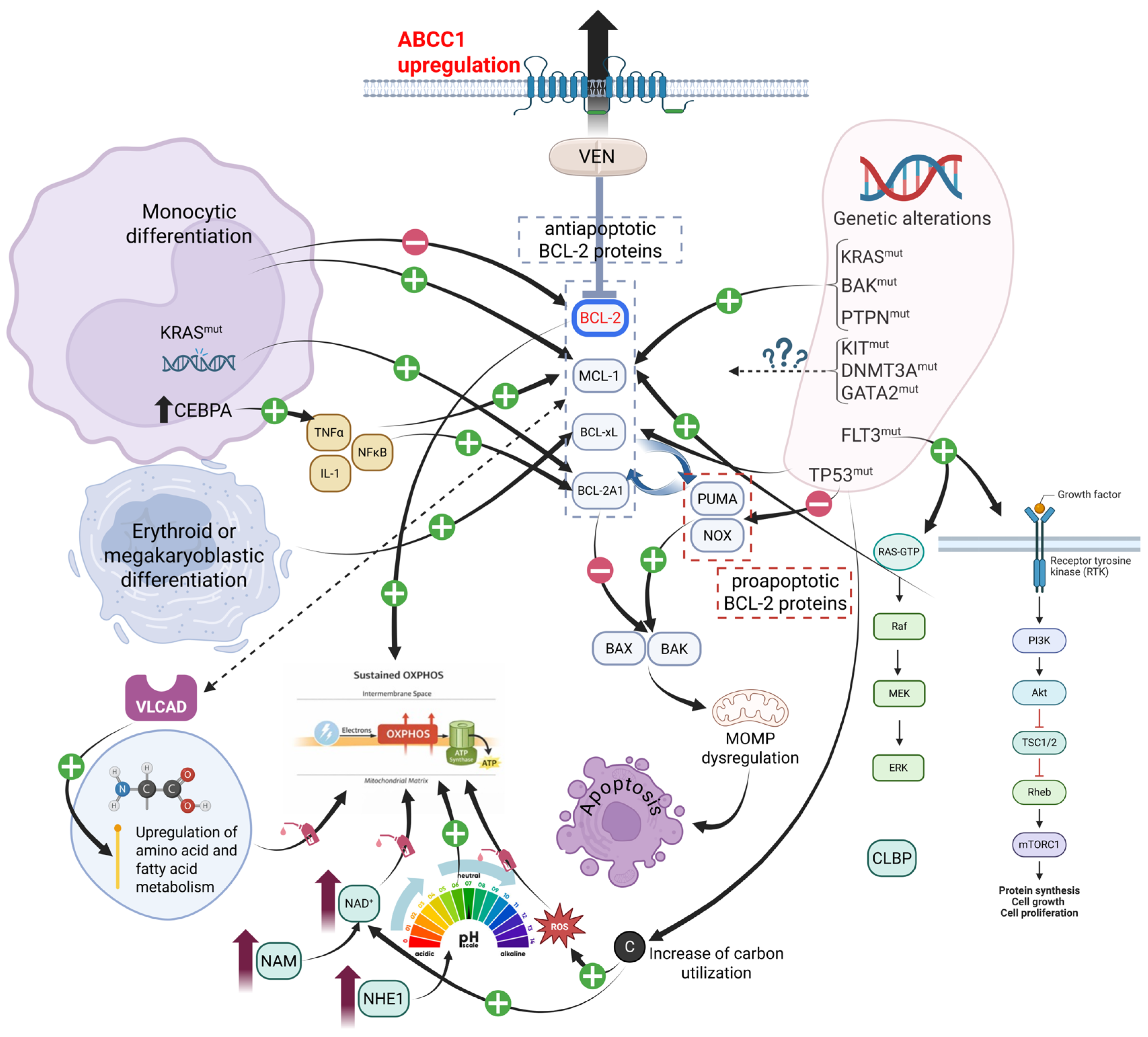
2. BCL-2 Inhibitors
2.1. Mechanisms Contributing to Resistance to BCL-2 Inhibitors
2.1.1. Shifts in Anti-Apoptotic BCL-2 Family Dependency
2.1.2. Lineage-Specific Anti-Apoptotic Dependencies
2.1.3. Metabolic Reprogramming and Mitochondrial Integrity
2.1.4. Genetic Alterations
2.2. Strategies to Overcome Venetoclax Resistance
2.2.1. Targeting MCL-1 and Other Apoptotic Proteins
- a.
- Direct MCL-1 inhibitors
- b.
- Indirect MCL-1 inhibition
2.2.2. Metabolism-Targeting Strategies
2.2.3. Targeting Genetic and Epigenetic Mechanisms

| Strategy | Agent/Combination | Study Phase or Preclinical Model | Population | Clinical Trial Identifier * | Results | Ref. |
|---|---|---|---|---|---|---|
| Strategies to overcome resistance to VEN | ||||||
| Direct MCL-1 inhibition | ||||||
| Direct MCL-1 inhibitors | S64315 (MIK655) + AZA | 1/2 | ND AML ineligible for IC R/R AML | NCT04629443 | No results posted | |
| S64315 (MIK655) + VOB560 (novel BCLi) | 1b | R/R AML | NCT04702425 | CR in 2/29 patients | [68] | |
| Tapotoclax (AMG-176) | 1 | R/R AML | NCT02675452 | Terminated | ||
| Tapotoclax (AMG-176) + VEN | 1b | R/R AML | NCT03797261 | Terminated due to increased cardiotoxicity | ||
| Murizatoclax (AMG-397) | 1 | R/R AML | NCT03465540 | Terminated | ||
| AZD5991 +/− VEN | 1/1b/2a, 3 | R/R AML | NCT03218683 | Terminated due to elevated laboratory troponin and low ORR | [71] | |
| PRT1419 | 1 | R/R AML | NCT05107856 | Terminated | ||
| PRT1419 | 1 | R/R AML | NCT04543305 | No results posted | ||
| Indirect MCL-1 inhibition | ||||||
| CDK inhibitors | Alvocidib + VEN | 1b | R/R AML | NCT03441555 | CR + CRi 11.4% | [75] |
| Dinaciclib + VEN | 1b | R/R AML | NCT03484520 | Terminated | ||
| Voruciclib + VEN | 1 | R/R AML | NCT03547115 | Unknown status | ||
| Fadraciclib + VEN | 1/2 | R/R AML | NCT05168904 | Suspended | ||
| AZD4573 | 1 | R/R AML | NCT03263637 | Completed-no results posted | ||
| RVU120 | 2 | R/R AML | NCT06191263 | Recruiting | ||
| QHRD107 + AZA + VEN | 2a | R/R AML | NCT06532058 | Recruiting | ||
| NEDD8-activating enzyme inhibitor | Pevonedistat + AZA + VEN | 1 | R/R AML | NCT04172844 | ORR: 46.7% | [77] |
| Pevonedistat + AZA + VEN | 2 | ND AML | NCT04266795 | CR: 45% cCR: 77% | [78] | |
| XPO1 inhibitor | Selinexor + VEN + DEC | NA ** | ND AML R/R AML | CR: 55.5% | [81] | |
| Selinexor + VEN | 1b | R/R AML | NCT03955783 | ORR: 21% | [82] | |
| Eltanexor + VEN | 1b | R/R AML | NCT06399640 | Recruiting | ||
| Combined MAPK/BCL-2 inhibition | Cobimetinib (MEK 1/2 inhibitor) + VEN | 1b | R/R AML | NCT02670044 | cCR:15.6% | [84] |
| Idasanutlin (MDM2 inhibitor) + VEN | 1b | R/R AML | NCT02670044 | cCR: 34.3% | [85] | |
| KRT-232 (AMG-232) + VEN + DEC | 1b | ND AML R/R AML | NCT03041688 | Active—no results posted | ||
| Anti-CD33 | 225Ac-lintuzumab + VEN | 1/2 | R/R AML | NCT03867682 | Unknown status | |
| Metabolism targeting therapies | ||||||
| STAT3 inhibitors | OPB-111077 + VEN + DEC | 1b | ND AML R/R AML | NCT03197714 | ORR: 25% | [92] |
| Danvatirsen + VEN | 1 | R/R AML | NCT05986240 | Recruiting | ||
| Ruxolitinib + VEN +/− AZA | 1 | R/R AML | NCT03874052 | CBR: 63% | [94] | |
| microRNAs | miRisten | 1 | R/R AML | NCT07025564 | Recruiting | |
| HMG-CoA inhibitors | Pitavastatin + VEN | 1 | ND AML | NCT04512105 | Completed-no results posted | |
| NAMPT inhibitors | KPT-9274 | 1 | R/R AML | NCT04512105 | Active—no results posted | |
| Metformin + VEN + cytarabine | 2 | R/R AML ND AML | NCT06537843 | cCR:83% in R/R AML cCR: 69% in ND AML | [98] | |
| Epigenetic targeting | ||||||
| DEC-C | DEC-C + VEN | 1/2 | AML not previously treated with HMA and/or VEN | NCT04657081 | Active—no results posted | |
| DEC-C + VEN | 1/2 | High risk AML | NCT04817241 | Active—no results posted | ||
| DEC-C + VEN | 2 | R/R AML | NCT04975919 | Active—no results posted | ||
| DEC-C + VEN | 2 | R/R AML ND AML | NCT04746235 | Active—no results posted | ||
| LSD1 inhibitor | Iadademstat + AZA + VEN | 1 | ND AML | NCT06514261 | Recruiting | |
| HDAC | Chidamide + AZA + VEN | ΝA ** | ND AML | NCT06386302 | Recruiting | |
| Chidamide + AZA + VEN | 2 | R/R AML | NCT05305859 | Recruiting | ||
| RAS inhibition | Trametinib + AZA + VEN | 2 | R/R AML | NCT04487106 | CR: 25% | [104] |
| Novel BCL-2 inhibitors | Navitoclax + VEN + DEC | 1 | R/R AML | NCT05222984 | CRh/CRi: 20% | |
| Lisaftoclax (APG-2575) + AZA | 1b/2 | R/R AML | NCT04964518 | ORR: 29.2% in VEN refractory AML | [64] | |
3. FLT3 Inhibitors
3.1. Mechanisms Underlying Resistance to FLT3i
3.1.1. Bone Marrow Microenvironment-Mediated Resistance
3.1.2. Transcriptional Heterogeneity and Transcription Factor-Driven Mechanisms of Resistance
3.1.3. FLT3 Mutations
3.1.4. Activation of Alternative Signaling Pathways Bypassing FLT3 Inhibition and Other Mechanisms
3.2. Strategies to Overcome FLT3 Inhibitor Resistance
3.2.1. Switching FLT3 Inhibitor Type
3.2.2. Novel FLT3i
3.2.3. Combined Approaches: Targeting Signaling Pathways and Bone Marrow Microenvironment
| Strategy | Agent/Combination | Study Phase or Preclinical Model | Population | Clinical Trial Identifier * | Results | Ref. |
|---|---|---|---|---|---|---|
| Strategies to overcome resistance to FLT3i | ||||||
| FLT3 inhibition | ||||||
| Novel FLT3i | Ningetinib | 1b | R/R FLT3mut AML | NCT03125876 | Terminated | |
| FF-10101 | 1 | R/R AML with FLT3mut patients | NCT03194685 | cCR: 10% ORR: 12.5% | [152] | |
| Combined FLT3 and signaling pathways inhibition | ||||||
| AXL inhibitors | Tamnorzatinib (ONO-7475) +/− VEN | 1/2 | R/R AML with FLT3mut patients | NCT03176277 | CRi: 7.1% in VEN-resistant cohort MLS: 7.1% in VEN-resistant cohort | [158] |
| JAK2 inhibitors | Pacritinib +
| 1 | R/R AML with FLT3mut patients | NCT02323607 | CR: 40% in cohort A CR: 0% in cohort B | [160] |
| MEK-ERK inhibitors | Trametinib | CL and PS | FLT3mut AML | ΝA | Synergistic effect with midostaurin | [162] |
| Daraxonrasib (RMC-7977) | CL | AML | ΝA | Restoration of sensitivity to FLT3i | [163] | |
| CXCR4 inhibitors | GMI-1359 | PDX | FLT3mut AML | ΝA | Enhanced antileukemia effect of sorafenib | [164] |
| MDM2 inhibitors | Milademetan + Quizartinib | 1 | ND and R/R FLT3-ITD AML | NCT03552029 | CRi: 40% | [166] |
| CDK4/6 inhibitors | Palbociclib + Sorafenib, DEC or dexamethasone | 1 | R/R AML | NCT03132454 | Active—no results posted | |
| Palbociclib + CPX-351 | 1/2 | ND and R/R AML | NCT03844997 | CR: 62.5% in R/R AML, including FLT3mut patients | [169] | |
| Multi-kinase inhibitors | Pexidartinib | 1/2 | R/R FLT3-ITD AML | NCT01349049 | cCR: 11% | [170] |
| Foretinib | Mouse model and PDX | FLT3-ITD AML | Strong efficacy including potent activity against secondary mutations of FLT3-ITD | [171] | ||
| Tuspetinib +/− VEN | 1/2 | R/R AML | NCT03850574 | ORR: 23.1% in FLT3-mutated patients with prior FLT3i treatment | [172] | |
| Luxpetinib | CL, PS | AML | Greater potency than other FLT3i, including cases with FLT3 mutations | [173] | ||
| CCT241736 | PDX and PS | FLT3-ITD and FLT3-TKD AML | Inhibition of tumor growth, including quizartinib-resistant cases | [174] | ||
| Tirbanibulin (KX2-391) | Mouse model and PS | FLT3-ITD and FLT3-TKD AML | Potent inhibitory effects in FLT3mut cells with resistant mutations | [175] | ||
| PIM inhibitors | AZD1208 | 1a/1b | R/R AML | NCT01489722 | Terminated due to lack of efficacy | [176] |
| SGI-1776 | 1 | R/R AML | NCT01239108 | Terminated due to safety issues | ||
| Epigenetic targeting | ||||||
| HDAC inhibitors | IHCH9033, compound 22, compound 25h, decursin) | CL and PDX | FLT3mut AML | Synergistic effects when combined with FLT3i | [144,177,178,179] | |
| Immunotherapeutic approaches | ||||||
| Anti-FLT3 CAR-T cells | TAA05 Cell Injection | 1 | R/R AML | NCT05445011 | Recruiting | |
| CI-135 CAR-T Cell | 1 | R/R AML | NCT06760260 | Recruiting | ||
| HG-CT-1 | 1 | R/R AML | NCT06786533 | Recruiting | ||
| anti-FLT3 × anti-CD3 BiTEs | CLN-049 | 1 | R/R AML | NCT05143996 | ORR: 57% | |
| AMG 427 | 1 | R/R AML | NCT03541369 | Terminated | ||
3.2.4. Multi-Kinase and PIM Inhibitors
3.2.5. Epigenetic Targeting
3.2.6. Immunotherapy Approaches and Other Investigational Agents
4. IDH Inhibitors
4.1. Mechanisms of Resistance to IDHi
4.1.1. Mutations in RTK Signaling Pathways
4.1.2. Mutations in WT1 Driving Resistance Though TET2 Impairment
4.1.3. Leukemia Stemness
4.1.4. Secondary Mutations and Additional Cytogenetic Lesions in Acquired Resistance
4.1.5. Isoform Switching
4.1.6. Second-Site Dimer Interface IDH Mutations That Weaken Drug Binding
4.1.7. Metabolic Rewiring as a Mechanism of Secondary Resistance
4.2. Strategies to Overcome Resistance to IDHi
4.2.1. Enhancing IDH Inhibition with Hypomethylating Agents and BCL-2 Blockade: Doublet and Triplet Therapy Approaches
4.2.2. Therapeutic Reinforcement: Integrating IDHi with Standard Chemotherapy
4.2.3. Blocking All Escape Routes: Pan-IDHi
4.2.4. Active-Site Targeting and PROTACs to Counteract Secondary Mutations
4.2.5. Targeting Adaptive Signaling Pathways
4.2.6. Targeting DNA Repair Defects with PARP Inhibitors
4.2.7. Exploiting Metabolic Vulnerabilities
| Strategy | Agent/Combination | Study Phase or Preclinical Model | Population | Clinical Trial Identifier * | Results | Ref. |
|---|---|---|---|---|---|---|
| Overcoming resistance to IDH inhibitors | ||||||
| Combination regimens | ||||||
| IDHi + HMAs | IVO + AZA | 1/2 | ND IDH1mut AML | NCT06611839 | Not yet recruiting | |
| IVO + AZA | 3b | ND IDH1mut AML | NCT05907057 | Recruiting | ||
| IVO + Gilteritinib | 1 | R/R AML with FLT3 + IDH mutations | NCT05756777 | Recruiting | ||
| IVO + AZA | 3 | ND IDH1mut AML | NCT07075016 | Recruiting | ||
| IVO + VEN +/− AZA | 1/2 | ND and R/R IDH1mut AML | NCT03471260 | cCR: 90% | [228] | |
| IVO or ENA + DEC-C | 1b/2 | R/R IDHmut AML | NCT04774393 | Recruiting | ||
| ENA + AZA | 2 | R/R IDH2mut AML | NCT03683433 | Recruiting | ||
| Olutasitenib + AZA | 2 | R/R IDH1mut AML after VEN-AZA | NCT07304011 | Recruiting | ||
| Olutasitenib + AZA + VEN | 2 | ND IDH1mut AML | NCT06782542 | Recruiting | ||
| Olutasitenib + DEC-C + VEN | 2 | ND IDH1mut AML | NCT07153497 | Not yet recruiting | ||
| IDHi + chemotherapy | IVO or ENA + IC | 1 | ND IDHmut AML | NCT02632708 | CR: 70% | [231] |
| ENA + CPX-351 | 2 | R/R IDH2mut AML | NCT03825796 | Active, not recruiting | ||
| IVO or ENA + IC | 3 | ND IDHmut AML | NCT03839771 | Active, not recruiting | ||
| IVO + FLAG | 1 | R/R IDH1mut AML | NCT04250051 | Active, not recruiting | ||
| IVO + CPX-351 | 2 | ND IDH1mut AML R/R IDH1mut AML | NCT04493164 | Recruiting | ||
| Pan-IDHi | ||||||
| Pan-IDHi | Vorasidenib | 1 | R/R IDHmut AML | NCT02492737 | MLS: 5.9% | |
| Crelosidenib (LY3410738) | 1 | R/R IDHmut AML | NCT04603001 | Active, not recruiting | ||
| Ranosidenib (HMPL-306) | 1 | R/R IDHmut AML | NCT04272957 | cCR 34.6% IDH1mut cCR 36.4% IDH2mut | [235] | |
| Ranosidenib | 3 | R/R IDHmut AML | NCT06387069 | Recruiting | ||
| Active-site targeting | ||||||
| Active-site targeting | HMS-101 | Mouse and PDX model | IDH1mut AML | NA | Induction of cellular differentiation | [236] |
| Targeting signaling pathways | ||||||
| Targeting signaling pathways | mTORC1 inhibitors (rapamycin) | CL | IDH1mut AML | NA | proliferation inhibition/ metabolic activity alteration | [239] |
| ENA + cobimetinib | 1 | R/R IDH2mut + RASmut AML | NCT05441514 | Active, not recruiting | ||
| Dapolsertib (SEL24/MEN1703) | 1/2 | ND and R/R IDHmut AML | NCT03008187 | ORR: 9% | [241] | |
| PARP-inhibitors | Olaparib | 2 | R/R IDHmut AML | NCT03953898 | Active, not recruiting. No results posted | |
| Targeting metabolic adaptations | ||||||
| Targeting metabolic adaptations | OXPHOS inhibitors | PDX and PS | IDH1mut AML | Improvement of IDHi efficacy | [220] | |
| CD44 inhibitors + IDHi | Preclinical model | IDHmut AML | Combination enhances leukemia cell elimination | [221] | ||
| ACC1 inhibitors + VEN | CL, PS | IDHmut AML | Increase in sensitivity of IDH1mut AML to VEN | [243] | ||
5. Menin Inhibitors
5.1. Mechanisms That Underlie Menin Inhibitor Resistance
5.1.1. MEN1 Mutations
5.1.2. Epigenetic and Transcriptional Reprogramming
5.1.3. Co-Occurring Mutations
5.2. Strategies to Overcome Resistance to Menin Inhibitors
5.2.1. Targeting Resistance Driven by MEN1 Mutations
5.2.2. Combination Treatment with Venetoclax and Hypomethylating Agents
5.2.3. Targeting MYC and Chromatin Remodeling
5.2.4. Epigenetic Co-Targeting and Emerging Agents
| Strategy | Agent/Combination | Study Phase or Preclinical Model | Population | Clinical Trial Identifier * | Results | Ref. |
|---|---|---|---|---|---|---|
| Overcoming resistance to MENINi | ||||||
| Novel MENINi | CHM-029 | Preclinical model | AML | Strong efficacy | [265] | |
| Combination regimens | Revumenib + VEN | 1/2 | ND NPM1mut or KMT2Ar AML | NCT06284486 | Recruiting | |
| Revumenib + AZA + VEN | 3 | ND NPM1mut or KMT2Ar AML | NCT06652438 | Recruiting | ||
| Revumenib + DEC-C + VEN | 1/2 | ND or R/R NPM1mut or KMT2Ar AML | NCT05360160 | Recruiting | ||
| Ziftomenib + AZA + VEN | 1 | R/R NPM1mut AML | NCT03013998 | cCR: 80% | [268] | |
| Ziftomenib + AZA + VEN | 3 | ND NPM1mut or KMT2Ar AML | NCT07007312 | Recruiting | ||
| MYC targeting | GT19715 + MENINi | CL | KMT2Ar AML | Highly synergistic effects | [270] | |
| Chromatin remodeling inhibition | FHD-286 + VEN or DEC | CL and PDX | NPM1mut or KMT2Ar AML | Tumor burden reduction and synergy | [271] | |
| Histone demethylases | KDM4C + MENINi | CL | KMT2Ar AML | Synergistic effects | [272] | |
| Inhibition of LSD1 | LSD1 inhibitor + MENINi | PDX | KMT2Ar AML | Marked reduction in leukemic burden | [273] | |
| IMPDH2i + MENINi | CL and PDX | KMT2Ar AML | Synergistic effects | [274] | ||
| DOT1L | Pinometostat + revumenib | CL | KMT2Ar AML | Modest responses | [275] | |
| Other agents | KAT6/KAT7 acetyltransferase inhibitors + MENINi | CL | KMT2Ar AML | Represses oncogenic transcription and overcomes resistance | [276] | |
| RARA agonists + revumenib | CL | KMT2Ar and NPM1mut AML | Synergistic induction of differentiation or apoptosis | [277] | ||
6. Conclusions
7. Future Directions
Funding
Data Availability Statement
Conflicts of Interest
References
- Döhner, H.; DiNardo, C.D.; Appelbaum, F.R.; Craddock, C.; Dombret, H.; Ebert, B.L.; Fenaux, P.; Godley, L.A.; Hasserjian, R.P.; Larson, R.A.; et al. Genetic risk classification for adults with AML receiving less-intensive therapies: The 2024 ELN recommendations. Blood 2024, 144, 2169–2173. [Google Scholar] [CrossRef] [PubMed]
- Shimony, S.; Stahl, M.; Stone, R.M. Acute Myeloid Leukemia: 2025 Update on Diagnosis, Risk-Stratification, and Management. Am. J. Hematol. 2025, 100, 860–891. [Google Scholar] [CrossRef] [PubMed]
- Stafylidis, C.; Vlachopoulou, D.; Kontandreopoulou, C.N.; Diamantopoulos, P.T. Unmet Horizons: Assessing the Challenges in the Treatment of TP53-Mutated Acute Myeloid Leukemia. J. Clin. Med. 2024, 13, 1082. [Google Scholar] [CrossRef]
- Schmalbrock, L.K.; Dolnik, A.; Cocciardi, S.; Sträng, E.; Theis, F.; Jahn, N.; Panina, E.; Blätte, T.J.; Herzig, J.; Skambraks, S.; et al. Clonal Evolution of Acute Myeloid Leukemia with FLT3-ITD Mutation Under Treatment With Midostaurin. Blood 2021, 137, 3093–3104. [Google Scholar] [CrossRef]
- Markouli, M.; Pagoni, M.N.; Diamantopoulos, P. BCL-2 inhibitors in hematological malignancies: Biomarkers that predict response and management strategies. Front. Oncol. 2025, 14, 1501950. [Google Scholar] [CrossRef]
- Qureshi, Z.; Jamil, A.; Altaf, F.; Siddique, R.M. Meta-analysis of Therapeutic Approaches in Acute Myeloid Leukemia: Unveiling Trends and Predictors of Treatment Response. Am. J. Clin. Oncol. 2025, 48, 242–256. [Google Scholar] [CrossRef]
- Thol, F.R.; Döhner, H.; Ganser, A. How I treat refractory and relapsed acute myeloid leukemia. Blood 2024, 143, 11–20. [Google Scholar] [CrossRef]
- Delbridge, A.R.; Strasser, A. The BCL-2 protein family, BH3-mimetics and cancer therapy. Cell Death Differ. 2015, 22, 1071–1080. [Google Scholar] [CrossRef]
- Singh, R.; Letai, A.; Sarosiek, K. Regulation of apoptosis in health and disease: The balancing act of BCL-2 family proteins. Nat. Rev. Mol. Cell Biol. 2019, 20, 175–193. [Google Scholar] [CrossRef]
- Tsujimoto, Y.; Finger, L.R.; Yunis, J.; Nowell, P.C.; Croce, C.M. Cloning of the chromosome breakpoint of neoplastic B cells with the t(14;18) chromosome translocation. Science 1984, 226, 1097–1099. [Google Scholar] [CrossRef]
- Pepper, C.; Hoy, T.; Bentley, P. Elevated Bcl-2/Bax are a consistent feature of apoptosis resistance in B-cell chronic lymphocytic leukaemia and are correlated with in vivo chemoresistance. Leuk. Lymphoma 1998, 28, 355–361. [Google Scholar] [CrossRef]
- Yunis, J.J.; Mayer, M.G.; Arnesen, M.A.; Aeppli, D.P.; Oken, M.M.; Frizzera, G. bcl-2 and other genomic alterations in the prognosis of large-cell lymphoma. N. Engl. J. Med. 1989, 320, 1047–1054. [Google Scholar] [CrossRef] [PubMed]
- Campos, L.; Rouault, J.P.; Sabido, O.; Oriol, P.; Roubi, N.; Vasselon, C.; Archimbaud, E.; Magaud, J.P.; Guyotat, D. High expression of bcl-2 protein in acute myeloid leukemia cells is associated with poor response to chemotherapy. Blood 1993, 81, 3091–3096. [Google Scholar] [CrossRef] [PubMed]
- Available online: https://www.fda.gov/drugs/resources-information-approved-drugs/fda-approves-venetoclax-cll-and-sll (accessed on 30 December 2025).
- Available online: https://www.fda.gov/drugs/resources-information-approved-drugs/fda-grants-regular-approval-venetoclax-combination-untreated-acute-myeloid-leukemia (accessed on 30 December 2025).
- DiNardo, C.D.; Jonas, B.A.; Pullarkat, V.; Thirman, M.J.; Garcia, J.S.; Wei, A.H.; Konopleva, M.; Döhner, H.; Letai, A.; Fenaux, P.; et al. Azacitidine and Venetoclax in Previously Untreated Acute Myeloid Leukemia. N. Engl. J. Med. 2020, 383, 617–629. [Google Scholar] [CrossRef] [PubMed]
- Pratz, K.W.; Jonas, B.A.; Pullarkat, V.; Thirman, M.J.; Garcia, J.S.; Döhner, H.; Récher, C.; Fiedler, W.; Yamamoto, K.; Wang, J.; et al. Long-term follow-up of VIALE-A: Venetoclax and azacitidine in chemotherapy-ineligible untreated acute myeloid leukemia. Am. J. Hematol. 2024, 99, 615–624. [Google Scholar] [CrossRef]
- Konopleva, M.; Pollyea, D.A.; Potluri, J.; Chyla, B.; Hogdal, L.; Busman, T.; McKeegan, E.; Salem, A.H.; Zhu, M.; Ricker, J.L.; et al. Efficacy and Biological Correlates of Response in a Phase II Study of Venetoclax Monotherapy in Patients with Acute Myelogenous Leukemia. Cancer Discov. 2016, 6, 1106–1117. [Google Scholar] [CrossRef]
- Lin, K.H.; Winter, P.S.; Xie, A.; Roth, C.; Martz, C.A.; Stein, E.M.; Anderson, G.R.; Tingley, J.P.; Wood, K.C. Targeting MCL-1/BCL-XL Forestalls the Acquisition of Resistance to ABT-199 in Acute Myeloid Leukemia. Sci. Rep. 2016, 6, 27696. [Google Scholar] [CrossRef]
- Pan, R.; Hogdal, L.J.; Benito, J.M.; Bucci, D.; Han, L.; Borthakur, G.; Cortes, J.; DeAngelo, D.J.; Debose, L.; Mu, H.; et al. Selective BCL-2 inhibition by ABT-199 causes on-target cell death in acute myeloid leukemia. Cancer Discov. 2014, 4, 362–375. [Google Scholar] [CrossRef]
- Xiang, Z.; Luo, H.; Payton, J.E.; Cain, J.; Ley, T.J.; Opferman, J.T.; Tomasson, M.H. Mcl1 haploinsufficiency protects mice from Myc-induced acute myeloid leukemia. J. Clin. Investig. 2010, 120, 2109–2118. [Google Scholar] [CrossRef]
- Glaser, S.P.; Lee, E.F.; Trounson, E.; Bouillet, P.; Wei, A.; Fairlie, W.D.; Izon, D.J.; Zuber, J.; Rappaport, A.R.; Herold, M.J.; et al. Anti-apoptotic Mcl-1 is essential for the development and sustained growth of acute myeloid leukemia. Genes. Dev. 2012, 26, 120–125. [Google Scholar] [CrossRef]
- Kuusanmäki, H.; Leppä, A.M.; Pölönen, P.; Kontro, M.; Dufva, O.; Deb, D.; Yadav, B.; Brück, O.; Kumar, A.; Everaus, H.; et al. Phenotype-based drug screening reveals association between venetoclax response and differentiation stage in acute myeloid leukemia. Haematologica 2020, 105, 708–720. [Google Scholar] [CrossRef]
- Zhang, H.; Nakauchi, Y.; Köhnke, T.; Stafford, M.; Bottomly, D.; Thomas, R.; Wilmot, B.; McWeeney, S.K.; Majeti, R.; Tyner, J.W. Integrated analysis of patient samples identifies biomarkers for venetoclax efficacy and combination strategies in acute myeloid leukemia. Nat. Cancer 2020, 1, 826–839. [Google Scholar] [CrossRef]
- Pei, S.; Pollyea, D.A.; Gustafson, A.; Stevens, B.M.; Minhajuddin, M.; Fu, R.; Riemondy, K.A.; Gillen, A.E.; Sheridan, R.M.; Kim, J.; et al. Monocytic Subclones Confer Resistance to Venetoclax-Based Therapy in Patients with Acute Myeloid Leukemia. Cancer Discov. 2020, 10, 536–551. [Google Scholar] [CrossRef]
- Allen, B.; Bottomly, D.; Köhnke, T.; Wang, A.; Lin, H.Y.; Johnson, K.; Kenna, I.; Streltsova, A.; Martin, E.; Chen, R.; et al. A CEBPB/IL-1β/TNF-α feedback loop drives drug resistance to venetoclax and MDM2 inhibitors in monocytic leukemia. Blood 2025, 145, 2488–2506. [Google Scholar] [CrossRef]
- Kuusanmäki, H.; Dufva, O.; Vähä-Koskela, M.; Leppä, A.M.; Huuhtanen, J.; Vänttinen, I.; Nygren, P.; Klievink, J.; Bouhlal, J.; Pölönen, P.; et al. Erythroid/megakaryocytic differentiation confers BCL-XL dependency and venetoclax resistance in acute myeloid leukemia. Blood 2023, 141, 1610–1625. [Google Scholar] [CrossRef] [PubMed]
- Lagadinou, E.D.; Sach, A.; Callahan, K.; Rossi, R.M.; Neering, S.J.; Minhajuddin, M.; Ashton, J.M.; Pei, S.; Grose, V.; O’Dwyer, K.M.; et al. BCL-2 inhibition targets oxidative phosphorylation and selectively eradicates quiescent human leukemia stem cells. Cell Stem Cell 2013, 12, 329–341. [Google Scholar] [CrossRef] [PubMed]
- Pollyea, D.A.; Stevens, B.M.; Jones, C.L.; Winters, A.; Pei, S.; Minhajuddin, M.; D’Alessandro, A.; Culp-Hill, R.; Riemondy, K.A.; Gillen, A.E.; et al. Venetoclax with azacitidine disrupts energy metabolism and targets leukemia stem cells in patients with acute myeloid leukemia. Nat. Med. 2018, 24, 1859–1866. [Google Scholar] [CrossRef]
- Roca-Portoles, A.; Rodriguez-Blanco, G.; Sumpton, D.; Cloix, C.; Mullin, M.; Mackay, G.M.; O’Neill, K.; Lemgruber, L.; Luo, X.; Tait, S.W.G. Venetoclax causes metabolic reprogramming independent of BCL-2 inhibition. Cell Death Dis. 2020, 11, 616. [Google Scholar] [CrossRef]
- Stevens, B.M.; Jones, C.L.; Pollyea, D.A.; Culp-Hill, R.; D’Alessandro, A.; Winters, A.; Krug, A.; Abbott, D.; Goosman, M.; Pei, S.; et al. Fatty acid metabolism underlies venetoclax resistance in acute myeloid leukemia stem cells. Nat. Cancer 2020, 1, 1176–1187. [Google Scholar] [CrossRef]
- Escudero, S.; Zaganjor, E.; Lee, S.; Mill, C.P.; Morgan, A.M.; Crawford, E.B.; Chen, J.; Wales, T.E.; Mourtada, R.; Luccarelli, J.; et al. Dynamic Regulation of Long-Chain Fatty Acid Oxidation by a Noncanonical Interaction between the MCL-1 BH3 Helix and VLCAD. Mol. Cell 2018, 69, 729–743.e7. [Google Scholar] [CrossRef]
- Jones, C.L.; Stevens, B.M.; Pollyea, D.A.; Culp-Hill, R.; Reisz, J.A.; Nemkov, T.; Gehrke, S.; Gamboni, F.; Krug, A.; Winters, A.; et al. Nicotinamide Metabolism Mediates Resistance to Venetoclax in Relapsed Acute Myeloid Leukemia Stem Cells. Cell Stem Cell 2020, 27, 748–764.e4. [Google Scholar] [CrossRef] [PubMed]
- Ebner, J.; Schmoellerl, J.; Piontek, M.; Manhart, G.; Troester, S.; Carter, B.Z.; Neubauer, H.; Moriggl, R.; Szakács, G.; Zuber, J.; et al. ABCC1 and glutathione metabolism limit the efficacy of BCL-2 inhibitors in acute myeloid leukemia. Nat. Commun. 2023, 14, 5709. [Google Scholar] [CrossRef] [PubMed]
- Zhang, Q.; Riley-Gillis, B.; Han, L.; Jia, Y.; Lodi, A.; Zhang, H.; Ganesan, S.; Pan, R.; Konoplev, S.N.; Sweeney, S.R.; et al. Activation of RAS/MAPK pathway confers MCL-1 mediated acquired resistance to BCL-2 inhibitor venetoclax in acute myeloid leukemia. Signal Transduct. Target. Ther. 2022, 7, 51. [Google Scholar] [CrossRef]
- Alkhatabi, H.A.; Zohny, S.F.; Mohammed, M.R.S.; Choudhry, H.; Rehan, M.; Ahmad, A.; Ahmed, F.; Khan, M.I. Venetoclax-Resistant MV4-11 Leukemic Cells Activate PI3K/AKT Pathway for Metabolic Reprogramming and Redox Adaptation for Survival. Antioxidants 2022, 11, 461. [Google Scholar] [CrossRef]
- Chong, S.J.F.; Lai, J.X.H.; Iskandar, K.; Leong, B.J.; Wang, C.; Wang, Y.; Guièze, R.; Raman, D.; Lim, R.H.F.; Wu, C.J.; et al. Superoxide-mediated phosphorylation and stabilization of Mcl-1 by AKT underlie venetoclax resistance in hematologic malignancies. Leukemia 2025, 39, 2477–2491. [Google Scholar] [CrossRef]
- Hyun, S.Y.; Na, E.J.; Kim, Y.R.; Min, Y.H.; Cheong, J.-W. Na+/H+ Exchanger 1 Inhibition Overcomes Venetoclax Resistance in Acute Myeloid Leukemia. Cells 2025, 14, 1759. [Google Scholar] [CrossRef]
- Guièze, R.; Liu, V.M.; Rosebrock, D.; Hernández-Sánchez, M.; Martinez Zurita, A.; Sun, J.; Ten Hacken, E.; Baranowski, K.; Thompson, P.A.; Heo, J.M.; et al. Mitochondrial Reprogramming Underlies Resistance to BCL-2 Inhibition in Lymphoid Malignancies. Cancer Cell 2019, 36, 369–384.e13. [Google Scholar] [CrossRef]
- Chen, X.; Glytsou, C.; Zhou, H.; Narang, S.; Reyna, D.E.; Lopez, A.; Sakellaropoulos, T.; Gong, Y.; Kloetgen, A.; Yap, Y.S.; et al. Targeting Mitochondrial Structure Sensitizes Acute Myeloid Leukemia to Venetoclax Treatment. Cancer Discov. 2019, 9, 890–909. [Google Scholar] [CrossRef]
- Glytsou, C.; Chen, X.; Zacharioudakis, E.; Al-Santli, W.; Zhou, H.; Nadorp, B.; Lee, S.; Lasry, A.; Sun, Z.; Papaioannou, D.; et al. Mitophagy Promotes Resistance to BH3 Mimetics in Acute Myeloid Leukemia. Cancer Discov. 2023, 13, 1656–1677. [Google Scholar] [CrossRef]
- Blombery, P.; Anderson, M.A.; Gong, J.N.; Thijssen, R.; Birkinshaw, R.W.; Thompson, E.R.; Teh, C.E.; Nguyen, T.; Xu, Z.; Flensburg, C.; et al. Acquisition of the Recurrent Gly101Val Mutation in BCL2 Confers Resistance to Venetoclax in Patients with Progressive Chronic Lymphocytic Leukemia. Cancer Discov. 2019, 9, 342–353. [Google Scholar] [CrossRef]
- Moujalled, D.M.; Brown, F.C.; Chua, C.C.; Dengler, M.A.; Pomilio, G.; Anstee, N.S.; Litalien, V.; Thompson, E.; Morley, T.; MacRaild, S.; et al. Acquired mutations in BAX confer resistance to BH3-mimetic therapy in acute myeloid leukemia. Blood 2023, 141, 634–644. [Google Scholar] [CrossRef]
- Kim, K.; Maiti, A.; Loghavi, S.; Pourebrahim, R.; Kadia, T.M.; Rausch, C.R.; Furudate, K.; Daver, N.G.; Alvarado, Y.; Ohanian, M.; et al. Outcomes of TP53-mutant acute myeloid leukemia with decitabine and venetoclax. Cancer 2021, 127, 3772–3781. [Google Scholar] [CrossRef]
- Aldoss, I.; Zhang, J.; Pillai, R.; Shouse, G.; Sanchez, J.F.; Mei, M.; Nakamura, R.; Stein, A.S.; Forman, S.J.; Marcucci, G.; et al. Venetoclax and hypomethylating agents in TP53-mutated acute myeloid leukaemia. Br. J. Haematol. 2019, 187, e45–e48. [Google Scholar] [CrossRef] [PubMed]
- DiNardo, C.D.; Tiong, I.S.; Quaglieri, A.; MacRaild, S.; Loghavi, S.; Brown, F.C.; Thijssen, R.; Pomilio, G.; Ivey, A.; Salmon, J.M.; et al. Molecular patterns of response and treatment failure after frontline venetoclax combinations in older patients with AML. Blood 2020, 135, 791–803. [Google Scholar] [CrossRef] [PubMed]
- Thijssen, R.; Diepstraten, S.T.; Moujalled, D.; Chew, E.; Flensburg, C.; Shi, M.X.; Dengler, M.A.; Litalien, V.; MacRaild, S.; Chen, M.; et al. Intact TP-53 function is essential for sustaining durable responses to BH3-mimetic drugs in leukemias. Blood 2021, 137, 2721–2735. [Google Scholar] [CrossRef]
- Nechiporuk, T.; Kurtz, S.E.; Nikolova, O.; Liu, T.; Jones, C.L.; D’Alessandro, A.; Culp-Hill, R.; d’Almeida, A.; Joshi, S.K.; Rosenberg, M.; et al. The TP53 Apoptotic Network Is a Primary Mediator of Resistance to BCL2 Inhibition in AML Cells. Cancer Discov. 2019, 9, 910–925. [Google Scholar] [CrossRef]
- Fischer, M. Census and evaluation of p53 target genes. Oncogene 2017, 36, 3943–3956. [Google Scholar] [CrossRef]
- Chyla, B.; Daver, N.; Doyle, K.; McKeegan, E.; Huang, X.; Ruvolo, V.; Wang, Z.; Chen, K.; Souers, A.; Leverson, J.; et al. Genetic Biomarkers Of Sensitivity and Resistance to Venetoclax Monotherapy in Patients With Relapsed Acute Myeloid Leukemia. Am. J. Hematol. 2018, 93, E202–E205. [Google Scholar] [CrossRef]
- Mali, R.S.; Zhang, Q.; DeFilippis, R.; Cavazos, A.; Kuruvilla, V.M.; Raman, J.; Mody, V.; Choo, E.F.; Dail, M.; Shah, N.P.; et al. Venetoclax combines synergistically with FLT3 inhibition to effectively target leukemic cells in FLT3-ITD+ acute myeloid leukemia models. Haematologica 2021, 106, 1034–1046. [Google Scholar] [CrossRef]
- Yoshimoto, G.; Miyamoto, T.; Jabbarzadeh-Tabrizi, S.; Iino, T.; Rocnik, J.L.; Kikushige, Y.; Mori, Y.; Shima, T.; Iwasaki, H.; Takenaka, K.; et al. FLT3-ITD up-regulates MCL-1 to promote survival of stem cells in acute myeloid leukemia via FLT3-ITD-specific STAT5 activation. Blood 2009, 114, 5034–5043. [Google Scholar] [CrossRef]
- Shu, W.; Yang, Q.; He, D.; Li, Y.; Le, J.; Cai, Q.; Dai, H.; Luo, L.; Chen, B.; Gong, Y.; et al. Impact of KIT mutation on efficacy of venetoclax and hypomethylating agents in newly diagnosed acute myeloid leukemia. Eur. J. Med. Res. 2025, 30, 354. [Google Scholar] [CrossRef]
- Wang, L.; Gao, H.; Fu, Q.; Jiang, Q.; Jiang, H.; Wang, Y.; Xu, L.; Zhang, X.; Huang, X.; Tang, F.; et al. Clinical and Molecular Predictors of Response and Survival Following Venetoclax Plus Hypomethylating Agents in Relapsed/Refractory Acute Myeloid Leukemia: A Single-Center Study in Chinese Patients. Cancers 2025, 17, 586. [Google Scholar] [CrossRef]
- Bewersdorf, J.P.; Shimony, S.; Shallis, R.M.; Liu, Y.; Berton, G.; Schaefer, E.J.; Zeidan, A.M.; Goldberg, A.; Stein, E.; Marcucci, G.; et al. Combination therapy with hypomethylating agents and venetoclax versus intensive induction chemotherapy in IDH1- or IDH2-mutant newly diagnosed acute myeloid leukemia-A multicenter cohort study. Am. J. Hematol. 2024, 99, 1640–1643. [Google Scholar] [CrossRef] [PubMed]
- Berton, G.; Sedaki, B.; Collomb, E.; Benachour, S.; Loschi, M.; Mohty, B.; Saillard, C.; Hicheri, Y.; Rouzaud, C.; Maisano, V.; et al. Poor prognosis of SRSF2 gene mutations in patients treated with VEN-AZA for newly diagnosed acute myeloid leukemia. Leuk. Res. 2024, 141, 107500. [Google Scholar] [CrossRef] [PubMed]
- Rahmani, N.E.; Ramachandra, N.; Sahu, S.; Gitego, N.; Lopez, A.; Pradhan, K.; Bhagat, T.D.; Gordon-Mitchell, S.; Pena, B.R.; Kazemi, M.; et al. ASXL1 mutations are associated with distinct epigenomic alterations that lead to sensitivity to venetoclax and azacytidine. Blood Cancer J. 2021, 11, 157. [Google Scholar] [CrossRef]
- Brunetti, L.; Gundry, M.C.; Sorcini, D.; Guzman, A.G.; Huang, Y.H.; Ramabadran, R.; Gionfriddo, I.; Mezzasoma, F.; Milano, F.; Nabet, B.; et al. Mutant NPM1 Maintains the Leukemic State through HOX Expression. Cancer Cell 2018, 34, 499–512.e9. [Google Scholar] [CrossRef]
- Kontro, M.; Kumar, A.; Majumder, M.M.; Eldfors, S.; Parsons, A.; Pemovska, T.; Saarela, J.; Yadav, B.; Malani, D.; Fløisand, Y.; et al. HOX gene expression predicts response to BCL-2 inhibition in acute myeloid leukemia. Leukemia 2017, 31, 301–309. [Google Scholar] [CrossRef]
- Schoenwaelder, S.M.; Jarman, K.E.; Gardiner, E.E.; Hua, M.; Qiao, J.; White, M.J.; Josefsson, E.C.; Alwis, I.; Ono, A.; Willcox, A.; et al. Bcl-xL-inhibitory BH3 mimetics can induce a transient thrombocytopathy that undermines the hemostatic function of platelets. Blood 2011, 118, 1663–1674. [Google Scholar] [CrossRef]
- Stein, A.S.; Zhang, J.; Ghoda, L.Y.; Robbins, M.; Croslin, C.; Sinaki, B.; Aribi, A.; Blackmon, D.O.A.; Pourhassan, H.; Ball, B.J.; et al. Phase 1 Trial of Navitoclax/Venetoclax/Decitabine Combination in Relapsed/Refractory (R/R) Acute Myeloid Leukemia (AML). Blood 2024, 144, 4264. [Google Scholar] [CrossRef]
- Balachander, S.B.; Criscione, S.W.; Byth, K.F.; Cidado, J.; Adam, A.; Lewis, P.; Macintyre, T.; Wen, S.; Lawson, D.; Burke, K.; et al. AZD4320, A Dual Inhibitor of Bcl-2 and Bcl-xL, Induces Tumor Regression in Hematologic Cancer Models without Dose-limiting Thrombocytopenia. Clin. Cancer Res. 2020, 26, 6535–6549. [Google Scholar] [CrossRef]
- Marconi, G.; Arslan, S.; Fleming, S.; Curti, A.; SBlachly, J.; Martinelli, G.; Giovanni Della Porta, M.; Bajel, A.; Sauer, T.; Crysandt, M.; et al. Safety and Tolerability of AZD0466 As Monotherapy for Patients with Advanced Hematologic Malignancies. Results from a Phase I/II Trial. Blood 2023, 142, 5907. [Google Scholar] [CrossRef]
- Kadia, T.; Kropf, P.; Leahy, M.; Chua, C.C.; Fleming, S.; Oliai, C.; Kwan, J.; Fong, C.Y.; Richmond, J.; Canell, P.; et al. Results of the APG2575AU101 Study of lisaftoclax (APG-2575) combined with azacitidine (AZA) in patients with newly diagnosed (ND) or prior venetoclax–exposed myeloid malignancies. Blood 2025, 146, 1641. [Google Scholar] [CrossRef]
- Kotschy, A.; Szlavik, Z.; Murray, J.; Davidson, J.; Maragno, A.L.; Le Toumelin-Braizat, G.; Chanrion, M.; Kelly, G.L.; Gong, J.N.; Moujalled, D.M.; et al. The MCL1 inhibitor S63845 is tolerable and effective in diverse cancer models. Nature 2016, 538, 477–482. [Google Scholar] [CrossRef] [PubMed]
- Brennan, M.S.; Chang, C.; Tai, L.; Lessene, G.; Strasser, A.; Dewson, G.; Kelly, G.L.; Herold, M.J. Humanized Mcl-1 mice enable accurate preclinical evaluation of MCL-1 inhibitors destined for clinical use. Blood 2018, 132, 1573–1583. [Google Scholar] [CrossRef]
- Szlavik, Z.; Csekei, M.; Paczal, A.; Szabo, Z.B.; Sipos, S.; Radics, G.; Proszenyak, A.; Balint, B.; Murray, J.; Davidson, J.; et al. Discovery of S64315, a potent and selective Mcl-1 inhibitor. J. Med. Chem. 2020, 63, 13762–13795. [Google Scholar] [CrossRef]
- Gill, H.; Moors, I.; Porkka, K.; Moshe, Y.; Yoon, S.S.; Daver, N.; Ocio, E.M.; Fukaya, M.; Sauer, T.; Mateos, M.V.; et al. A First in Human Study of VOB560 in Combination with MIK665 in Patients with Relapsed/Refractory Non-Hodgkin Lymphoma, Acute Myeloid Leukemia, or Multiple Myeloma. Blood 2024, 144, 5997. [Google Scholar] [CrossRef]
- Wang, X.; Bathina, M.; Lynch, J.; Koss, B.; Calabrese, C.; Frase, S.; Schuetz, J.D.; Rehg, J.E.; Opferman, J.T. Deletion of MCL-1 causes lethal cardiac failure and mitochondrial dysfunction. Genes Dev. 2013, 27, 1351–1364. [Google Scholar] [CrossRef]
- Tron, A.E.; Belmonte, M.A.; Adam, A.; Aquila, B.M.; Boise, L.H.; Chiarparin, E.; Cidado, J.; Embrey, K.J.; Gangl, E.; Gibbons, F.D.; et al. Discovery of Mcl-1-specific inhibitor AZD5991 and preclinical activity in multiple myeloma and acute myeloid leukemia. Nat. Commun. 2018, 9, 5341. [Google Scholar] [CrossRef]
- Desai, P.; Lonial, S.; Cashen, A.; Kamdar, M.; Flinn, I.; O’Brien, S.; Garcia, J.S.; Korde, N.; Moslehi, J.; Wey, M.; et al. A Phase 1 First-in-Human Study of the MCL-1 Inhibitor AZD5991 in Patients with Relapsed/Refractory Hematologic Malignancies. Clin. Cancer Res. 2024, 30, 4844–4855. [Google Scholar] [CrossRef]
- Jin, S.; Cojocari, D.; Purkal, J.J.; Popovic, R.; Talaty, N.N.; Xiao, Y.; Solomon, L.R.; Boghaert, E.R.; Leverson, J.D.; Phillips, D.C. 5-Azacitidine Induces NOXA to Prime AML Cells for Venetoclax-Mediated Apoptosis. Clin. Cancer Res. 2020, 26, 3371–3383. [Google Scholar] [CrossRef]
- Tibes, R.; Bogenberger, J.M. Transcriptional Silencing of MCL-1 Through Cyclin-Dependent Kinase Inhibition in Acute Myeloid Leukemia. Front. Oncol. 2019, 9, 1205. [Google Scholar] [CrossRef]
- Bogenberger, J.; Whatcott, C.; Hansen, N.; Delman, D.; Shi, C.X.; Kim, W.; Haws, H.; Soh, K.; Lee, Y.S.; Peterson, P.; et al. Combined venetoclax and alvocidib in acute myeloid leukemia. Oncotarget 2017, 8, 107206–107222. [Google Scholar] [CrossRef] [PubMed]
- Jonas, B.A.; Hou, J.; Roboz, G.J.; Alvares, C.L.; Jeyakumar, D.; Edwards, J.R.; Erba, H.P.; Kelly, R.J.; Röllig, C.; Fiedler, W.; et al. A phase 1b study of venetoclax and alvocidib in patients with relapsed/refractory acute myeloid leukemia. Hematol. Oncol. 2023, 41, 743–752. [Google Scholar] [CrossRef] [PubMed]
- Knorr, K.L.B.; Schneider, P.A.; Meng, X.W.; Dai, H.; Smith, B.D.; Hess, A.D.; Karp, J.E.; Kaufmann, S.H. MLN4924 induces Noxa upregulation in acute myelogenous leukemia and synergizes with Bcl-2 inhibitors. Cell Death Differ. 2015, 22, 2133–2142. [Google Scholar] [CrossRef]
- Murthy, G.S.G.; Saliba, A.N.; Szabo, A.; Harrington, A.; Abedin, S.; Carlson, K.; Michaelis, L.; Runaas, L.; Baim, A.; Hinman, A.; et al. A phase I study of pevonedistat, azacitidine, and venetoclax in patients with relapsed/refractory acute myeloid leukemia. Haematologica 2024, 109, 2864–2872. [Google Scholar] [CrossRef]
- Short, N.J.; Wierzbowska, A.; Cluzeau, T.; Laribi, K.; Recher, C.; Czyz, J.; Ochrem, B.; Ades, L.; Gallego-Hernanz, M.P.; Heiblig, M.; et al. Azacitidine and venetoclax with or without pevonedistat in patients with newly diagnosed acute myeloid leukemia. Leuk. Lymphoma 2025, 66, 458–468. [Google Scholar] [CrossRef]
- Luedtke, D.A.; Su, Y.; Liu, S.; Edwards, H.; Wang, Y.; Lin, H.; Taub, J.W.; Ge, Y. Inhibition of XPO1 enhances cell death induced by ABT-199 in acute myeloid leukaemia via mcl-1. J. Cell Mol. Med. 2018, 22, 6099–6111. [Google Scholar] [CrossRef]
- Xing, L.; Guo, Z.; Huang, C.; Jing, H.; Qiao, S. The Efficacy and Safety of the Combination Therapy of Decitabine, Venetoclax, and Selinexor (DVS) for Newly Diagnosed Unfit AML and MDS, and Relapsed/ Refractory AML and High-Risk MDS—A Multicenter, Single Arm, Prospective Clinical Study. Blood 2024, 144, 6057. [Google Scholar] [CrossRef]
- Ball, S.; Byrne, M.T.; Fischer, M.A.; Awan, F.T.; Tomlinson, B.K.; Stopczynski, T.; Patil, L.; Gu, C.J.; Leonardi, C.; Walsh, K.; et al. AML-117: A Phase 1b Study of Selinexor and Venetoclax in Patients With Relapsed or Refractory Acute Myeloid Leukemia. Clin. Lymphoma Myeloma Leuk. 2025, 25, S402–S403. [Google Scholar] [CrossRef]
- Han, L.; Zhang, Q.; Dail, M.; Shi, C.; Cavazos, A.; Ruvolo, V.R.; Zhao, Y.; Kim, E.; Rahmani, M.; Mak, D.; et al. Concomitant targeting of BCL2 with venetoclax and MAPK signaling with cobimetinib in acute myeloid leukemia models. Haematologica 2020, 105, 697–707. [Google Scholar] [CrossRef]
- Khurana, A.; Shafer, D.A. MDM2 antagonists as a novel treatment option for acute myeloid leukemia: Perspectives on the therapeutic potential of idasanutlin (RG7388). OncoTargets Ther. 2019, 12, 2903–2910. [Google Scholar] [CrossRef] [PubMed]
- Konopleva, M.Y.; Dail, M.; Daver, N.G.; Garcia, J.S.; Jonas, B.A.; Yee, K.W.L.; Kelly, K.R.; Vey, N.; Assouline, S.; Roboz, G.J.; et al. Venetoclax and Cobimetinib in Relapsed/Refractory AML: A Phase 1b Trial. Clin. Lymphoma Myeloma Leuk. 2024, 24, 364–374. [Google Scholar] [CrossRef] [PubMed]
- Daver, N.G.; Dail, M.; Garcia, J.S.; Jonas, B.A.; Yee, K.W.L.; Kelly, K.R.; Vey, N.; Assouline, S.; Roboz, G.J.; Paolini, S.; et al. Venetoclax and idasanutlin in relapsed/refractory AML: A nonrandomized, open-label phase 1b trial. Blood 2023, 141, 1265–1276. [Google Scholar] [CrossRef] [PubMed]
- Garg, R.; Allen, K.J.H.; Dawicki, W.; Geoghegan, E.M.; Ludwig, D.L.; Dadachova, E. 225Ac-labeled CD33-targeting antibody reverses resistance to Bcl-2 inhibitor venetoclax in acute myeloid leukemia models. Cancer Med. 2021, 10, 1128–1140. [Google Scholar] [CrossRef]
- Ureshino, H.; Ueshima, T.; Yamaguchi, T.; Takashima, M.; Sanuki, Y.; Ichinohe, T. (R)-WAC-224, a new anticancer quinolone, combined with venetoclax and azacitidine overcomes venetoclax-resistant AML through MCL-1 downregulation. Sci. Rep. 2025, 15, 16018. [Google Scholar] [CrossRef]
- Mino, T.; Ureshino, H.; Ueshima, T.; Kashimoto, N.; Yamaguchi, T.; Naka, K.; Inaba, T.; Ichinohe, T. (R)-Wac-224 Monotherapy or Combination with Cytarabine/Venetoclax Confers Promising Activities Against Acute Myeloid Leukemia. Blood 2023, 142, 5775. [Google Scholar] [CrossRef]
- Lewis, A.C.; Pope, V.S.; Tea, M.N.; Li, M.; Nwosu, G.O.; Nguyen, T.M.; Wallington-Beddoe, C.T.; Moretti, P.A.B.; Anderson, D.; Creek, D.J.; et al. Ceramide-induced integrated stress response overcomes Bcl-2 inhibitor resistance in acute myeloid leukemia. Blood 2022, 139, 3737–3751. [Google Scholar] [CrossRef]
- Sharon, D.; Cathelin, S.; Mirali, S.; Di Trani, J.M.; Yanofsky, D.J.; Keon, K.A.; Rubinstein, J.L.; Schimmer, A.D.; Ketela, T.; Chan, S.M. Inhibition of mitochondrial translation overcomes venetoclax resistance in AML through activation of the integrated stress response. Sci. Transl. Med. 2019, 11, eaax2863. [Google Scholar] [CrossRef]
- Singh, S.; Gomez, H.J.; Thakkar, S.; Singh, S.P.; Parihar, A.S. Overcoming Acquired Drug Resistance to Cancer Therapies through Targeted STAT3 Inhibition. Int. J. Mol. Sci. 2023, 24, 4722. [Google Scholar] [CrossRef]
- Martínez-López, J.; Montesinos, P.; López-Muñoz, N.; Ayala, R.; Martínez-Sánchez, P.; Gorrochategui, J.; Rojas-Rudilla, J.L.; Primo, D.; Bergua-Burgues, J.M.; Calbacho, M.; et al. Biomarker-driven phase Ib clinical trial of OPB-111077 in acute myeloid leukemia. Med. Int. 2022, 2, 7. [Google Scholar] [CrossRef]
- Shastri, A.; Goldfinger, M.; Mantzaris, I.; Garcia-Moreno, G.; Kadia, T.M.; Ning, J.; Tirone, B.; Gandhi, R.; Ravandi, F.; Pemmaraju, N.; et al. A Phase 1 Study Investigating the Safety and Efficacy of Danvatirsen As Monotherapy Followed By Combination with Venetoclax in Patients with Relapsed/Refractory MDS and AML. Blood 2024, 144, 4265.5. [Google Scholar] [CrossRef]
- Borate, U.M.; Madanat, Y.F.; Tognon, C.; Mishra, S.; Kaempf, A.; Patel, P.A.; Kurtz, S.E.; Johnson, K.; Vasu, S.; Baker, S.D.; et al. Results of a Phase 1 Trial Testing the Novel Combination Therapy of Venetoclax and Ruxolitinib in Relapsed/Refractory Acute Myeloid Leukemia Patients. Blood 2023, 142, 1515. [Google Scholar] [CrossRef]
- Zhang, L.; Kang, H.; Valerio, M.; Hoang, D.H.; Pathak, K.; Garcia-Mansfield, K.; Lu, X.; Guo, W.; Fu, Y.H.; He, X.; et al. Pharmacological Inhibition of miR-126 Enhances Venetoclax Activity in Acute Myeloid Leukemia. Blood 2025, 147, 1083–1097. [Google Scholar] [CrossRef] [PubMed]
- Buono, R.; Juarez, D.; Paul, M.; Skuli, S.J.; Wong, I.B.; Tarnekar, I.; Ying, Z.; Le, I.; Wertheim, G.; Bakayoko, A.; et al. Pitavastatin counteracts venetoclax resistance mechanisms in acute myeloid leukemia by depleting geranylgeranyl pyrophosphate. bioRxiv 2025. [Google Scholar] [CrossRef]
- Sanchez, J.R., 2nd; Liu, C.; Pawar, V.; Huang, Y.; Diaz-Rohena, D.; Singh, J.; Koppikar, P.; Lai, T.H.; St John, L.; Puduvalli, V.; et al. NAMPT inhibition uncovers therapeutic vulnerabilities to venetoclax and chemotherapy in acute myelogenous leukemia. Leuk. Lymphoma 2026, 67, 97–107. [Google Scholar] [CrossRef]
- de Lacerda, M.P.; Nunes, E.; Steffenello, G.; Carneiro, T.X.; Boettcher, I.S.; Dall’Oglio, A.C.; Martini, F.; Esmeraldino, L.; Molossi, M.; Wagner, A.O.M.; et al. Safety and Efficacy of Venetoclax, Cytarabine and Metformin for Relapsed-Refractory and Induction-Ineligible Acute Myeloid Leukemia. Blood 2024, 144, 1524. [Google Scholar] [CrossRef]
- Garcia-Manero, G.; McCloskey, J.; Griffiths, E.A.; Yee, K.W.L.; Zeidan, A.M.; Al-Kali, A.; Deeg, H.J.; Patel, P.A.; Sabloff, M.; Keating, M.M.; et al. Oral decitabine-cedazuridine versus intravenous decitabine for myelodysplastic syndromes and chronic myelomonocytic leukaemia (ASCERTAIN): A registrational, randomised, crossover, pharmacokinetics, phase 3 study. Lancet Haematol. 2024, 11, e15–e26. [Google Scholar] [CrossRef]
- Levitz, D.; Saunthararajah, Y.; Fedorov, K.; Shapiro, L.C.; Mantzaris, I.; Shastri, A.; Kornblum, N.; Sica, R.A.; Shah, N.; Konopleva, M.; et al. A Metabolically Optimized, Noncytotoxic Low-Dose Weekly Decitabine/Venetoclax in MDS and AML. Clin. Cancer Res. 2023, 29, 2774–2780. [Google Scholar] [CrossRef]
- Salamero, O.; Montesinos, P.; Willekens, C.; Pérez-Simón, J.A.; Pigneux, A.; Récher, C.; Popat, R.; Carpio, C.; Molinero, C.; Mascaró, C.; et al. First-in-Human Phase I Study of Iadademstat (ORY-1001): A First-in-Class Lysine-Specific Histone Demethylase 1A Inhibitor, in Relapsed or Refractory Acute Myeloid Leukemia. J. Clin. Oncol. 2020, 38, 4260–4273. [Google Scholar] [CrossRef]
- Maes, T.; Mascaró, C.; Tirapu, I.; Estiarte, A.; Ciceri, F.; Lunardi, S.; Guibourt, N.; Perdones, A.; Lufino, M.M.P.; Somervaille, T.C.P.; et al. ORY-1001, a Potent and Selective Covalent KDM1A Inhibitor, for the Treatment of Acute Leukemia. Cancer Cell 2018, 33, 495–511.e12. [Google Scholar] [CrossRef]
- Wang, B.R.; Wan, C.L.; Liu, S.B.; Qiu, Q.C.; Wu, T.M.; Wang, J.; Li, Y.Y.; Ge, S.S.; Qiu, Y.; Shen, X.D.; et al. A Combined Histone Deacetylases Targeting Strategy to Overcome Venetoclax Plus Azacitidine Regimen Resistance in Acute Myeloid Leukaemia: Three Case Reports. Front. Oncol. 2021, 11, 797941. [Google Scholar] [CrossRef] [PubMed]
- Desikan, S.P.; Ravandi, F.; Pemmaraju, N.; Konopleva, M.; Loghavi, S.; Jabbour, E.J.; Daver, N.; Jain, N.; Chien, K.S.; Maiti, A.; et al. A Phase II Study of Azacitidine, Venetoclax, and Trametinib in Relapsed or Refractory Acute Myeloid Leukemia Harboring RAS Pathway-Activating Mutations. Acta Haematol. 2022, 145, 529–536. [Google Scholar] [CrossRef]
- Lavagna-Sévenier, C.; Marchetto, S.; Birnbaum, D.; Rosnet, O. FLT3 signaling in hematopoietic cells involves CBL, SHC and an unknown P115 as prominent tyrosine-phosphorylated substrates. Leukemia 1998, 12, 301–310. [Google Scholar] [CrossRef] [PubMed]
- Gilliland, D.G.; Griffin, J.D. The roles of FLT3 in hematopoiesis and leukemia. Blood 2002, 100, 1532–1542. [Google Scholar] [CrossRef] [PubMed]
- Takahashi, S. Downstream molecular pathways of FLT3 in the pathogenesis of acute myeloid leukemia: Biology and therapeutic implications. J. Hematol. Oncol. 2011, 4, 13. [Google Scholar] [CrossRef]
- Yokota, S.; Kiyoi, H.; Nakao, M.; Iwai, T.; Misawa, S.; Okuda, T.; Sonoda, Y.; Abe, T.; Kahsima, K.; Matsuo, Y.; et al. Internal tandem duplication of the FLT3 gene is preferentially seen in acute myeloid leukemia and myelodysplastic syndrome among various hematological malignancies. A study on a large series of patients and cell lines. Leukemia 1997, 11, 1605–1609. [Google Scholar] [CrossRef]
- Yanada, M.; Matsuo, K.; Suzuki, T.; Kiyoi, H.; Naoe, T. Prognostic significance of FLT3 internal tandem duplication and tyrosine kinase domain mutations for acute myeloid leukemia: A meta-analysis. Leukemia 2005, 19, 1345–1349. [Google Scholar] [CrossRef]
- Song, M.K.; Park, B.B.; Uhm, J.E. Clinical Efficacies of FLT3 Inhibitors in Patients with Acute Myeloid Leukemia. Int. J. Mol. Sci. 2022, 23, 12708. [Google Scholar] [CrossRef]
- Available online: https://aml-hub.com/medical-information/quizartinib-granted-fda-approval-for-patients-with-newly-diagnosed-flt3-itd-mutated-aml (accessed on 6 January 2026).
- Stone, R.M.; Mandrekar, S.J.; Sanford, B.L.; Laumann, K.; Geyer, S.; Bloomfield, C.D.; Thiede, C.; Prior, T.W.; Döhner, K.; Marcucci, G.; et al. Midostaurin plus Chemotherapy for Acute Myeloid Leukemia with a FLT3 Mutation. N. Engl. J. Med. 2017, 377, 454–464. [Google Scholar] [CrossRef]
- Perl, A.E.; Martinelli, G.; Cortes, J.E.; Neubauer, A.; Berman, E.; Paolini, S.; Montesinos, P.; Baer, M.R.; Larson, R.A.; Ustun, C.; et al. Gilteritinib or Chemotherapy for Relapsed or Refractory FLT3-Mutated AML. N. Engl. J. Med. 2019, 381, 1728–1740. [Google Scholar] [CrossRef]
- Cortes, J.; Perl, A.E.; Döhner, H.; Kantarjian, H.; Martinelli, G.; Kovacsovics, T.; Rousselot, P.; Steffen, B.; Dombret, H.; Estey, E.; et al. Quizartinib, an FLT3 inhibitor, as monotherapy in patients with relapsed or refractory acute myeloid leukaemia: An open-label, multicentre, single-arm, phase 2 trial. Lancet Oncol. 2018, 19, 889–903. [Google Scholar] [CrossRef] [PubMed]
- Erba, H.P.; Montesinos, P.; Kim, H.J.; Patkowska, E.; Vrhovac, R.; Žák, P.; Wang, P.N.; Mitov, T.; Hanyok, J.; Kamel, Y.M.; et al. Quizartinib plus chemotherapy in newly diagnosed patients with FLT3-internal-tandem-duplication-positive acute myeloid leukaemia (QuANTUM-First): A randomised, double-blind, placebo-controlled, phase 3 trial. Lancet 2023, 401, 1571–1583. [Google Scholar] [CrossRef] [PubMed]
- Xu, Q.; He, S.; Yu, L. Clinical Benefits and Safety of FMS-Like Tyrosine Kinase 3 Inhibitors in Various Treatment Stages of Acute Myeloid Leukemia: A Systematic Review, Meta-Analysis, and Network Meta-Analysis. Front. Oncol. 2021, 11, 686013. [Google Scholar] [CrossRef] [PubMed]
- Bazinet, A.; Bataller, A.; Kadia, T.; Daver, N.; Short, N.J.; Yilmaz, M.; Sasaki, K.; DiNardo, C.D.; Borthakur, G.M.; Issa, G.; et al. A retrospective study of outcomes across time and treatment regimens in newly diagnosed, FMS-like tyrosine kinase 3 (FLT3)-mutated acute myeloid leukemia. Cancer 2025, 131, e35813. [Google Scholar] [CrossRef]
- Sato, T.; Yang, X.; Knapper, S.; White, P.; Smith, B.D.; Galkin, S.; Small, D.; Burnett, A.; Levis, M. FLT3 ligand impedes the efficacy of FLT3 inhibitors in vitro and in vivo. Blood 2011, 117, 3286–3293. [Google Scholar] [CrossRef]
- Zhou, J.; Bi, C.; Janakakumara, J.V.; Liu, S.C.; Chng, W.J.; Tay, K.G.; Poon, L.F.; Xie, Z.; Palaniyandi, S.; Yu, H.; et al. Enhanced activation of STAT pathways and overexpression of survivin confer resistance to FLT3 inhibitors and could be therapeutic targets in AML. Blood 2009, 113, 4052–4062. [Google Scholar] [CrossRef]
- Chatterjee, A.; Ghosh, J.; Ramdas, B.; Mali, R.S.; Martin, H.; Kobayashi, M.; Vemula, S.; Canela, V.H.; Waskow, E.R.; Visconte, V.; et al. Regulation of Stat5 by FAK and PAK1 in Oncogenic FLT3- and KIT-Driven Leukemogenesis. Cell Rep. 2014, 9, 1333–1348. [Google Scholar] [CrossRef]
- Traer, E.; Martinez, J.; Javidi-Sharifi, N.; Agarwal, A.; Dunlap, J.; English, I.; Kovacsovics, T.; Tyner, J.W.; Wong, M.; Druker, B.J. FGF2 from Marrow Microenvironment Promotes Resistance to FLT3 Inhibitors in Acute Myeloid Leukemia. Cancer Res. 2016, 76, 6471–6482. [Google Scholar] [CrossRef]
- Javidi-Sharifi, N.; Martinez, J.; English, I.; Joshi, S.K.; Scopim-Ribeiro, R.; Viola, S.K.; Edwards, D.K., 5th; Agarwal, A.; Lopez, C.; Jorgens, D.; et al. FGF2-FGFR1 signaling regulates release of Leukemia-Protective exosomes from bone marrow stromal cells. Elife 2019, 8, e40033. [Google Scholar] [CrossRef]
- Joshi, S.K.; Nechiporuk, T.; Bottomly, D.; Piehowski, P.D.; Reisz, J.A.; Pittsenbarger, J.; Kaempf, A.; Gosline, S.J.C.; Wang, Y.T.; Hansen, J.R.; et al. The AML microenvironment catalyzes a stepwise evolution to gilteritinib resistance. Cancer Cell 2021, 39, 999–1014.e8. [Google Scholar] [CrossRef]
- Khouqeer, A.; Cartailler, J.; Kim, C.; Dickerson, K.M.; Potts, C.R.; Gilbert, A.E.; Welner, R.S.; Ferrell, P.B. IFNγ signaling drives resistance to FLT3 inhibition in acute myeloid leukemia. iScience 2025, 28, 114079. [Google Scholar] [CrossRef] [PubMed]
- Rombouts, E.J.; Pavic, B.; Löwenberg, B.; Ploemacher, R.E. Relation between CXCR-4 expression, Flt3 mutations, and unfavorable prognosis of adult acute myeloid leukemia. Blood 2004, 104, 550–557. [Google Scholar] [CrossRef] [PubMed]
- Ladikou, E.E.; Chevassut, T.; Pepper, C.J.; Pepper, A.G. Dissecting the role of the CXCL12/CXCR4 axis in acute myeloid leukaemia. Br. J. Haematol. 2020, 189, 815–825. [Google Scholar] [CrossRef] [PubMed]
- Fukuda, S.; Broxmeyer, H.E.; Pelus, L.M. Flt3 ligand and the Flt3 receptor regulate hematopoietic cell migration by modulating the SDF-1alpha(CXCL12)/CXCR4 axis. Blood 2005, 105, 3117–3126. [Google Scholar] [CrossRef]
- Chang, Y.T.; Hernandez, D.; Alonso, S.; Gao, M.; Su, M.; Ghiaur, G.; Levis, M.J.; Jones, R.J. Role of CYP3A4 in bone marrow microenvironment-mediated protection of FLT3/ITD AML from tyrosine kinase inhibitors. Blood Adv. 2019, 3, 908–916. [Google Scholar] [CrossRef]
- Eriksson, J.; Zheng, S.; Popa, M.; Bao, J.; Dai, J.; Wang, W.; McCormack, E.; Vähärautio, A.; Tang, J. Single-Cell Lineage Tracing Uncovers Resistance Signatures and Sensitizing Strategies to FLT3 Inhibitors in Acute Myeloid Leukemia. Cancer Res 2025. [Google Scholar] [CrossRef]
- Zhou, Q.; Li, Z.; Zhao, P.; Guan, Y.; Chu, H.; Xi, Y. FLT3 inhibition upregulates OCT4/NANOG to promote maintenance and TKI resistance of FLT3-ITD+ acute myeloid leukemia. Oncogenesis 2025, 14, 7. [Google Scholar] [CrossRef]
- Smith, C.C.; Wang, Q.; Chin, C.S.; Salerno, S.; Damon, L.E.; Levis, M.J.; Perl, A.E.; Travers, K.J.; Wang, S.; Hunt, J.P.; et al. Validation of ITD mutations in FLT3 as a therapeutic target in human acute myeloid leukaemia. Nature 2012, 485, 260–263. [Google Scholar] [CrossRef]
- Smith, C.C.; Lin, K.; Stecula, A.; Sali, A.; Shah, N.P. FLT3 D835 mutations confer differential resistance to type II FLT3 inhibitors. Leukemia 2015, 29, 2390–2392. [Google Scholar] [CrossRef]
- Smith, C.C.; Paguirigan, A.; Jeschke, G.R.; Lin, K.C.; Massi, E.; Tarver, T.; Chin, C.S.; Asthana, S.; Olshen, A.; Travers, K.J.; et al. Heterogeneous resistance to quizartinib in acute myeloid leukemia revealed by single-cell analysis. Blood 2017, 130, 48–58. [Google Scholar] [CrossRef]
- Heidel, F.; Solem, F.K.; Breitenbuecher, F.; Lipka, D.B.; Kasper, S.; Thiede, M.H.; Brandts, C.; Serve, H.; Roesel, J.; Giles, F.; et al. Clinical resistance to the kinase inhibitor PKC412 in acute myeloid leukemia by mutation of Asn-676 in the FLT3 tyrosine kinase domain. Blood 2006, 107, 293–300. [Google Scholar] [CrossRef] [PubMed]
- Zhang, H.; Savage, S.; Schultz, A.R.; Bottomly, D.; White, L.; Segerdell, E.; Wilmot, B.; McWeeney, S.K.; Eide, C.A.; Nechiporuk, T.; et al. Clinical resistance to crenolanib in acute myeloid leukemia due to diverse molecular mechanisms. Nat. Commun. 2019, 10, 244. [Google Scholar] [CrossRef] [PubMed]
- Cools, J.; Mentens, N.; Furet, P.; Fabbro, D.; Clark, J.J.; Griffin, J.D.; Marynen, P.; Gilliland, G. Prediction of resistance to small molecule FLT3 inhibitors: Implications for molecularly targeted therapy of acute leukemia. Cancer Res. 2004, 64, 6385–6389. [Google Scholar] [CrossRef] [PubMed]
- Verma, S.; Singh, A.; Kumari, A.; Pandey, B.; Jamal, S.; Goyal, S.; Sinha, S.; Grover, A. Insight into the inhibitor discrimination by FLT3 F691L. Chem. Biol. Drug Des. 2018, 91, 1056–1064. [Google Scholar] [CrossRef]
- McMahon, C.M.; Canaani, J.; Rea, B.; Sargent, R.L.; Morissette, J.J.D.; Lieberman, D.B.; Watt, C.; Schwartz, G.W.; Faryabi, R.B.; Ferng, T.T.; et al. Mechanisms of Acquired Resistance to Gilteritinib Therapy in Relapsed and Refractory FLT3-Mutated Acute Myeloid Leukemia. Blood 2017, 130, 295. [Google Scholar]
- Chen, F.; Ishikawa, Y.; Akashi, A.; Naoe, T.; Kiyoi, H. Co-expression of wild-type FLT3 attenuates the inhibitory effect of FLT3 inhibitor on FLT3 mutated leukemia cells. Oncotarget 2016, 7, 47018–47032. [Google Scholar] [CrossRef]
- Rummelt, C.; Gorantla, S.P.; Meggendorfer, M.; Charlet, A.; Endres, C.; Döhner, K.; Heidel, F.H.; Fischer, T.; Haferlach, T.; Duyster, J.; et al. Activating JAK-mutations confer resistance to FLT3 kinase inhibitors in FLT3-ITD positive AML in vitro and in vivo. Leukemia 2021, 35, 2017–2029. [Google Scholar] [CrossRef]
- Chen, P.; Levis, M.; Brown, P.; Kim, K.T.; Allebach, J.; Small, D. FLT3/ITD mutation signaling includes suppression of SHP-1. J. Biol. Chem. 2005, 280, 5361–5369. [Google Scholar] [CrossRef]
- Park, I.K.; Mundy-Bosse, B.; Whitman, S.P.; Zhang, X.; Warner, S.L.; Bearss, D.J.; Blum, W.; Marcucci, G.; Caligiuri, M.A. Receptor tyrosine kinase Axl is required for resistance of leukemic cells to FLT3-targeted therapy in acute myeloid leukemia. Leukemia 2015, 29, 2382–2389. [Google Scholar] [CrossRef]
- Kapoor, S.; Natarajan, K.; Baldwin, P.R.; Doshi, K.A.; Lapidus, R.G.; Mathias, T.J.; Scarpa, M.; Trotta, R.; Davila, E.; Kraus, M.; et al. Concurrent Inhibition of Pim and FLT3 Kinases Enhances Apoptosis of FLT3-ITD Acute Myeloid Leukemia Cells through Increased Mcl-1 Proteasomal Degradation. Clin. Cancer Res. 2018, 24, 234–247. [Google Scholar] [CrossRef]
- Long, J.; Jia, M.Y.; Fang, W.Y.; Chen, X.J.; Mu, L.L.; Wang, Z.Y.; Shen, Y.; Xiang, R.F.; Wang, L.N.; Wang, L.; et al. FLT3 inhibition upregulates HDAC8 via FOXO to inactivate p53 and promote maintenance of FLT3-ITD+ acute myeloid leukemia. Blood 2020, 135, 1472–1483. [Google Scholar] [CrossRef]
- Puissant, A.; Fenouille, N.; Alexe, G.; Pikman, Y.; Bassil, C.F.; Mehta, S.; Du, J.; Kazi, J.U.; Luciano, F.; Rönnstrand, L.; et al. SYK is a critical regulator of FLT3 in acute myeloid leukemia. Cancer Cell 2014, 25, 226–242. [Google Scholar] [CrossRef]
- Man, C.H.; Lam, S.S.; Sun, M.K.; Chow, H.C.; Gill, H.; Kwong, Y.L.; Leung, A.Y. A novel tescalcin-sodium/hydrogen exchange axis underlying sorafenib resistance in FLT3-ITD+ AML. Blood 2014, 123, 2530–2539. [Google Scholar] [CrossRef] [PubMed]
- Hunter, H.M.; Pallis, M.; Seedhouse, C.H.; Grundy, M.; Gray, C.; Russell, N.H. The expression of P-glycoprotein in AML cells with FLT3 internal tandem duplications is associated with reduced apoptosis in response to FLT3 inhibitors. Br. J. Haematol. 2004, 127, 26–33. [Google Scholar] [CrossRef] [PubMed]
- Zhang, Y.; Wang, P.; Wang, Y.; Shen, Y. Sitravatinib as a potent FLT3 inhibitor can overcome gilteritinib resistance in acute myeloid leukemia. Biomark. Res. 2023, 11, 8. [Google Scholar] [CrossRef] [PubMed]
- Yang, J.; Zhang, Y.; Li, Q.; Wang, P. Sitravatinib combined with venetoclax exerts effective synergy to eliminate acute myeloid leukemia cells with FLT3-ITD mutations. Transl. Oncol. 2025, 59, 102467. [Google Scholar] [CrossRef]
- Hu, C.; Zhang, Y.; Yang, J.; Xu, Y.; Deng, T.; Li, Y.; Xu, S.; Wang, S.; Wang, P. Ningetinib, a novel FLT3 inhibitor, overcomes secondary drug resistance in acute myeloid leukemia. Cell Commun. Signal 2024, 22, 355. [Google Scholar] [CrossRef]
- Ferng, T.T.; Terada, D.; Ando, M.; Tarver, T.C.; Chaudhary, F.; Lin, K.C.; Logan, A.C.; Smith, C.C. The Irreversible FLT3 Inhibitor FF-10101 Is Active Against a Diversity of FLT3 Inhibitor Resistance Mechanisms. Mol. Cancer Ther. 2022, 21, 844–854. [Google Scholar] [CrossRef]
- Levis, M.; Perl, A.; Schiller, G.; Fathi, A.T.; Roboz, G.; Wang, E.S.; Altman, J.; Rajkhowa, T.; Ando, M.; Suzuki, T.; et al. A phase 1 study of the irreversible FLT3 inhibitor FF-10101 in relapsed or refractory acute myeloid leukemia. Blood Adv. 2024, 8, 2527–2535. [Google Scholar] [CrossRef]
- Errasti, G.; Delacroix, T.; Ghoshal, K.; Lee, R.; Ghosh, A.; Chakrabarti, R. Novel potent and selective inhibitors targeting FLT3 for AML therapy. J. Clin. Oncol. 2025, 43, 6542. [Google Scholar] [CrossRef]
- Yu, Z.; Du, J.; Hui, H.; Kan, S.; Huo, T.; Zhao, K.; Wu, T.; Guo, Q.; Lu, N. LT-171-861, a novel FLT3 inhibitor, shows excellent preclinical efficacy for the treatment of FLT3 mutant acute myeloid leukemia. Theranostics 2021, 11, 93–106. [Google Scholar] [CrossRef] [PubMed]
- Jeon, J.Y.; Buelow, D.R.; Garrison, D.A.; Niu, M.; Eisenmann, E.D.; Huang, K.M.; Zavorka Thomas, M.E.; Weber, R.H.; Whatcott, C.J.; Warner, S.L.; et al. TP-0903 is active in models of drug-resistant acute myeloid leukemia. JCI Insight 2020, 5, e140169. [Google Scholar] [CrossRef] [PubMed]
- Shi, H.; Wang, M.; Huang, J.; Quyang, Q.; Guo, J.; Wang, Y.; Mi, Y.; Wu, H. CTS2016, a novel AXL/FLT3 inhibitor for targeting AML/MDS and solid tumors. Cancer Res. 2023, 83, 4021. [Google Scholar] [CrossRef]
- Liu, Y.; Wei, J.; Liu, J.; Ma, W.; Duan, Y.; Liu, D. Novel AXL-targeted agents overcome FLT3 inhibitor resistance in FLT3-ITD+ acute myeloid leukemia cells. Oncol. Lett. 2021, 21, 397. [Google Scholar] [CrossRef]
- Kasner, M.T.; Courtenay-Luck, N.; DiNardo, C.; Post, S.M.; Baratam, P.; Magrath, G.N.; Nakamura, T.; Fujii, A.; Prados, S.; Honda, N.; et al. Anexelekto (Axl)/Mer Inhibitor Tamnorzatinib in Patients with Relapsed/Refractory Acute Myeloid Leukaemia: Results from a Phase I (Monotherapy) and Phase II (Combination with Venetoclax) Clinical Study. Acta Haematol 2025. [Google Scholar] [CrossRef]
- Xu, S.; Zhu, Y.; Meng, J.; Li, C.; Zhu, Z.; Wang, C.; Gu, Y.C.; Han, L.; Wen, J.; Tong, M.; et al. 2-Aminopyrimidine derivatives as selective dual inhibitors of JAK2 and FLT3 for the treatment of acute myeloid leukemia. Bioorg Chem. 2023, 134, 106442. [Google Scholar] [CrossRef]
- Jeon, J.Y.; Zhao, Q.; Buelow, D.R.; Phelps, M.; Walker, A.R.; Mims, A.S.; Vasu, S.; Behbehani, G.; Blachly, J.; Blum, W.; et al. Preclinical activity and a pilot phase I study of pacritinib, an oral JAK2/FLT3 inhibitor, and chemotherapy in FLT3-ITD-positive AML. Investig. New Drugs 2020, 38, 340–349. [Google Scholar] [CrossRef]
- Azhar, M.; Kincaid, Z.; Kesarwani, M.; Ahmed, A.; Wunderlich, M.; Latif, T.; Starczynowski, D.; Azam, M. Momelotinib is a highly potent inhibitor of FLT3-mutant AML. Blood Adv. 2022, 6, 1186–1192. [Google Scholar] [CrossRef]
- Morales, M.L.; Arenas, A.; Ortiz-Ruiz, A.; Leivas, A.; Rapado, I.; Rodriguez-Garcia, A.; Castro, N.; Zagorac, I.; Quintela-Fandino, M.; Gomez-Lopez, G.; et al. MEK inhibition enhances the response to tyrosine kinase inhibitors in acute myeloid leukemia. Sci. Rep. 2019, 9, 18630. [Google Scholar] [CrossRef]
- Popescu, B.; Jones, M.F.; Piao, M.; Tran, E.; Koh, A.; Lomeli, I.; Peretz, C.A.C.; Murad, N.; Abelson, S.; Morales, C.; et al. Multi-selective RAS(ON) Inhibition Targets Oncogenic RAS Mutations and Overcomes RAS/MAPK-Mediated Resistance to FLT3 and BCL2 Inhibitors in Acute Myeloid Leukemia. bioRxiv 2025. [Google Scholar] [CrossRef]
- Cho, B.S.; Zeng, Z.; Mu, H.; Wang, Z.; Konoplev, S.; McQueen, T.; Protopopova, M.; Cortes, J.; Marszalek, J.R.; Peng, S.B.; et al. Antileukemia activity of the novel peptidic CXCR4 antagonist LY2510924 as monotherapy and in combination with chemotherapy. Blood 2015, 126, 222–232. [Google Scholar] [CrossRef] [PubMed]
- Zhang, W.; Chang, K.H.; Basyal, M.; Jia, Y.; Ostermann, L.B.; Fogler, W.E.; Magnani, J.L.; Zal, M.A.; Zal, T.; Andreeff, M. Combined Blockage of E-Selectin and CXCR4 (GMI-1359) Enhances Anti-Leukemia Effect of FLT3 Inhibition (Sorafenib) and Protects Hematopoiesis in Pre-Clinical AML Models. Blood 2020, 136, 17–18. [Google Scholar] [CrossRef]
- Zhang, W.; Li, L.; Muftuoglu, M.; Basyal, M.; Togashi, N.; Iwanaga, K.; Tanzawa, F.; Numata, M.; Bixby, D.L.; Erba, H.P.; et al. Synergistic Activity of Combined FLT3-ITD and MDM2 Inhibition with Quizartinib and Milademetan in FLT3-ITD Mutant/TP53 Wild-type Acute Myeloid Leukemias. Clin. Cancer Res. 2025, 31, 3033–3047. [Google Scholar] [CrossRef]
- Uras, I.Z.; Walter, G.J.; Scheicher, R.; Bellutti, F.; Prchal-Murphy, M.; Tigan, A.S.; Valent, P.; Heidel, F.H.; Kubicek, S.; Scholl, C.; et al. Palbociclib treatment of FLT3-ITD+ AML cells uncovers a kinase-dependent transcriptional regulation of FLT3 and PIM1 by CDK6. Blood 2016, 127, 2890–2902. [Google Scholar] [CrossRef] [PubMed]
- Sun, C.Y.; Talukder, M.; Cao, D.; Chen, C.W. Gilteritinib Enhances Anti-Tumor Efficacy of CDK4/6 Inhibitor, Abemaciclib in Lung Cancer Cells. Front. Pharmacol. 2022, 13, 829759. [Google Scholar] [CrossRef]
- Peysin, C.; Nazha, A.; Wei, W.; Gerds, A.; Chen, X.; Carraway, H.; Singh, A.; Advani, A.; Ali, M.M.; Molina, J.; et al. Final results of a phase I/II trial of palbociclib and CPX-351 in patients with Acute Myeloid Leukemia. Blood 2025, 146, 3420. [Google Scholar] [CrossRef]
- Smith, C.C.; Levis, M.J.; Frankfurt, O.; Pagel, J.M.; Roboz, G.J.; Stone, R.M.; Wang, E.S.; Severson, P.L.; West, B.L.; Le, M.H.; et al. A phase 1/2 study of the oral FLT3 inhibitor pexidartinib in relapsed/refractory FLT3-ITD-mutant acute myeloid leukemia. Blood Adv. 2020, 4, 1711–1721. [Google Scholar] [CrossRef]
- Wang, P.; Zhang, Y.; Xiang, R.; Yang, J.; Xu, Y.; Deng, T.; Zhou, W.; Wang, C.; Xiao, X.; Wang, S. Foretinib Is Effective in Acute Myeloid Leukemia by Inhibiting FLT3 and Overcoming Secondary Mutations That Drive Resistance to Quizartinib and Gilteritinib. Cancer Res. 2024, 84, 905–918. [Google Scholar] [CrossRef]
- Daver, N.; Kyoo Lee, K.; Choi, Y.; Jonas, B.A.; Arellano, M.; Koller, P.B.; Jung, C.W.; Sohn, S.K.; Fathi, A.T.; Lee, J.O.; et al. Tuspetinib Myeloid Kinase Inhibitor Safety and Efficacy As Monotherapy and Combined with Venetoclax in Phase 1/2 Trial of Patients with Relapsed or Refractory (R/R) Acute Myeloid Leukemia (AML). Blood 2023, 142, 162. [Google Scholar] [CrossRef]
- Rice, W.G.; Howell, S.B.; Zhang, H.; Rastgoo, N.; Local, A.; Kurtz, S.E.; Lo, P.; Bottomly, D.; Wilmot, B.; McWeeney, S.K.; et al. Luxeptinib (CG-806) Targets FLT3 and Clusters of Kinases Operative in Acute Myeloid Leukemia. Mol. Cancer Ther. 2022, 21, 1125–1135. [Google Scholar] [CrossRef]
- Moore, A.S.; Faisal, A.; Mak, G.W.Y.; Miraki-Moud, F.; Bavetsias, V.; Valenti, M.; Box, G.; Hallsworth, A.; de Haven Brandon, A.; Xavier, C.P.R.; et al. Quizartinib-resistant FLT3-ITD acute myeloid leukemia cells are sensitive to the FLT3-Aurora kinase inhibitor CCT241736. Blood Adv. 2020, 4, 1478–1491. [Google Scholar] [CrossRef] [PubMed]
- Wang, P.; Xiao, X.; Zhang, Y.; Zhang, B.; Li, D.; Liu, M.; Xie, X.; Liu, C.; Liu, P.; Ren, R. Adual inhibitor overcomes drug-resistant FLT3-ITDacute myeloid leukemia. J. Hematol. Oncol. 2021, 14, 105. [Google Scholar] [CrossRef] [PubMed]
- Cortes, J.; Tamura, K.; DeAngelo, D.J.; de Bono, J.; Lorente, D.; Minden, M.; Uy, G.L.; Kantarjian, H.; Chen, L.S.; Gandhi, V.; et al. Phase I studies of AZD1208, a proviral integration Moloney virus kinase inhibitor in solid and haematological cancers. Br. J. Cancer 2018, 118, 1425–1433. [Google Scholar] [CrossRef] [PubMed]
- Yao, M.; Yan, W.; Wang, Y.; Zhao, Y.; Xu, X.; Chen, Y.; Yu, C.; Li, Y.; Jiang, H.; Shen, J.; et al. IHCH9033, a novel class I HDAC inhibitor, synergizes with FLT3 inhibitor and rescues quizartinib resistance in FLT3-ITD AML via enhancing DNA damage response. Exp. Hematol. Oncol. 2025, 14, 15. [Google Scholar] [CrossRef]
- Chang, Y.; Li, X.; Zhou, Y.; Yang, X.; Zhao, W.; Fang, H.; Hou, X. Simultaneous inhibition of FLT3 and HDAC by novel 6-ethylpyrazine-2-Carboxamide derivatives provides therapeutic advantages in acute myelocytic leukemia. Eur. J. Med. Chem. 2024, 279, 116847. [Google Scholar] [CrossRef]
- Zhang, T.; Li, Y.; Liao, W.; Mou, Y.; Zhan, X.; Hu, Q.; Zhao, Z.; Xiong, D. Decursin induces FLT3-ITD acute myeloid leukemia cell apoptosis by increasing the expression of the ubiquitin-conjugase UBE2L6. Cell Commun. Signal 2025, 23, 162. [Google Scholar] [CrossRef]
- Sun, X.; Li, Y.; Du, J.; Liu, F.; Wu, C.; Xiao, W.; Yu, G.; Chen, X.; Gale, R.P.; Zeng, H. Targeting ceramide transfer protein sensitizes AML to FLT3 inhibitors via a GRP78-ATF6-CHOP axis. Nat. Commun. 2025, 16, 1358. [Google Scholar] [CrossRef]
- Chatterjee, A.; Mustafa Ali, M.K.; Bailey, C.M.; Liu, Y.; Small, D.; Smith, C.C.; Traer, E.; Wang, Y.; Silvestri, G.; Baer, M.R. Sphingosine-1-phosphate receptor modulators resensitize FLT3-ITD acute myeloid leukemia cells with NRAS mutations to FLT3 inhibitors. bioRxiv 2025. [Google Scholar] [CrossRef]
- Fujii-Hanamoto, A.; Tanaka, H.; Fujimoto, K.; Haeno, T.; Miyake, Y.; Fujiwara, R.; Kumode, T.; Serizawa, K.; Morita, Y.; Hanamoto, H.; et al. Antipsychotic Chlorpromazine Suppresses STAT5 Signaling, Overcomes Resistance Mediated by the Gatekeeper Mutation FLT3-ITD/F691L, and Synergizes with Quizartinib in FLT3-ITD-Positive Cells. Curr. Issues Mol. Biol. 2025, 47, 797. [Google Scholar] [CrossRef]
- Zhang, T.; Wei, D.; Zhan, Y.; Long, Z.; Lu, T.; Zhao, P.; Gao, R.; Kang, Q.; Zhang, L.; Liu, M.; et al. Heme oxygenase 1 confers gilteritinib resistance in FLT3-ITD acute myeloid leukemia in a STAT6-dependent manner. Cancer Cell Int. 2025, 25, 129. [Google Scholar] [CrossRef]
- Sieberer, H.; Luciano, M.; Amend, D.; Blöchl, C.; Eglseer, A.; Steinkellner, A.; Rieser, S.; Andosch, A.; Steiner, P.; Hummer, L.; et al. Inhibition of NLRP3 enhances pro-apoptotic effects of FLT3 inhibition in AML. Cell Commun. Signal 2025, 23, 53. [Google Scholar] [CrossRef]
- Rohrbacher, L.; Nixdorf, D.; Stadler, H.; Brauchle, B.; Märkl, F.; Gottschlich, A.; Hoffmann, G.V.; Philipp, N.; Hänel, G.; Kirmaier, M.E.; et al. FLT3-directed BiTE Molecules versus CAR T Cells in AML: Co-stimulatory Signals Mitigate T-Cell Exhaustion. Blood Adv. 2026, 10, 1179–1193. [Google Scholar] [CrossRef] [PubMed]
- Pedersen, M.G.; Møller, B.K.; Bak, R.O. Recent Advances in the Development of Anti-FLT3 CAR T-Cell Therapies for Treatment of AML. Biomedicines 2022, 10, 2441. [Google Scholar] [CrossRef] [PubMed]
- Abdul-Hay, M.; Vale, C.; Chan, O.; Chandhok, N.; DiNardo, C.; Schiller, G.; Wang, E.; Hong, S.; Bachiashvili, K.; Chaudhry, M.; et al. Preliminary anti-leukemia activity from A phase 1 study of cln-049, a novel anti-FLT3 x anti-CD3 bispecific T-cell engager, in Relapsed/Refractory (R/R) Acute Myeloid Leukemia (AML) and myelodysplastic syndrome (MDS). Blood 2025, 146, 768. [Google Scholar] [CrossRef]
- Available online: https://www.onclive.com/view/cln-049-nets-fda-fast-track-designation-in-relapsed-refractory-aml (accessed on 10 January 2026).
- Reitman, Z.J.; Yan, H. Isocitrate dehydrogenase 1 and 2 mutations in cancer: Alterations at a crossroads of cellular metabolism. J. Natl. Cancer Inst. 2010, 102, 932–941. [Google Scholar] [CrossRef]
- Xu, W.; Yang, H.; Liu, Y.; Yang, Y.; Wang, P.; Kim, S.H.; Ito, S.; Yang, C.; Wang, P.; Xiao, M.T.; et al. Oncometabolite 2-hydroxyglutarate is a competitive inhibitor of α-ketoglutarate-dependent dioxygenases. Cancer Cell 2011, 19, 17–30. [Google Scholar] [CrossRef]
- Oh, S.; Shin, S.; Janknecht, R. The small members of the JMJD protein family: Enzymatic jewels or jinxes? Biochim. Biophys. Acta Rev. Cancer 2019, 1871, 406–418. [Google Scholar] [CrossRef]
- Paschka, P.; Schlenk, R.F.; Gaidzik, V.I.; Habdank, M.; Krönke, J.; Bullinger, L.; Späth, D.; Kayser, S.; Zucknick, M.; Götze, K.; et al. IDH1 and IDH2 mutations are frequent genetic alterations in acute myeloid leukemia and confer adverse prognosis in cytogenetically normal acute myeloid leukemia with NPM1 mutation without FLT3 internal tandem duplication. J. Clin. Oncol. 2010, 28, 3636–3643. [Google Scholar] [CrossRef]
- Marcucci, G.; Maharry, K.; Wu, Y.Z.; Radmacher, M.D.; Mrózek, K.; Margeson, D.; Holland, K.B.; Whitman, S.P.; Becker, H.; Schwind, S.; et al. IDH1 and IDH2 gene mutations identify novel molecular subsets within de novo cytogenetically normal acute myeloid leukemia: A Cancer and Leukemia Group B study. J. Clin. Oncol. 2010, 28, 2348–2355. [Google Scholar] [CrossRef]
- Messina, M.; Piciocchi, A.; Ottone, T.; Paolini, S.; Papayannidis, C.; Lessi, F.; Fracchiolla, N.S.; Forghieri, F.; Candoni, A.; Mengarelli, A.; et al. Prevalence and Prognostic Role of IDH Mutations in Acute Myeloid Leukemia: Results of the GIMEMA AML1516 Protocol. Cancers 2022, 14, 3012. [Google Scholar] [CrossRef]
- Raimondi, V.; Ciotti, G.; Gottardi, M.; Ciccarese, F. 2-Hydroxyglutarate in Acute Myeloid Leukemia: A Journey from Pathogenesis to Therapies. Biomedicines 2022, 10, 1359. [Google Scholar] [CrossRef]
- Ježek, P. 2-Hydroxyglutarate in Cancer Cells. Antioxid. Redox Signal 2020, 33, 903–926. [Google Scholar] [CrossRef] [PubMed]
- Chen, F.; Bian, K.; Tang, Q.; Fedeles, B.I.; Singh, V.; Humulock, Z.T.; Essigmann, J.M.; Li, D. Oncometabolites d- and l-2-Hydroxyglutarate Inhibit the AlkB Family DNA Repair Enzymes under Physiological Conditions. Chem. Res. Toxicol. 2017, 30, 1102–1110. [Google Scholar] [CrossRef] [PubMed]
- Desai, P.; Mencia-Trinchant, N.; Savenkov, O.; Simon, M.S.; Cheang, G.; Lee, S.; Samuel, M.; Ritchie, E.K.; Guzman, M.L.; Ballman, K.V.; et al. Somatic mutations precede acute myeloid leukemia years before diagnosis. Nat. Med. 2018, 24, 1015–1023. [Google Scholar] [CrossRef] [PubMed]
- Tuval, A.; Shlush, L.I. Evolutionary trajectory of leukemic clones and its clinical implications. Haematologica 2019, 104, 872–880. [Google Scholar] [CrossRef]
- Deng, G.; Shen, J.; Yin, M.; McManus, J.; Mathieu, M.; Gee, P.; He, T.; Shi, C.; Bedel, O.; McLean, L.R.; et al. Selective inhibition of mutant isocitrate dehydrogenase 1 (IDH1) via disruption of a metal binding network by an allosteric small molecule. J. Biol. Chem. 2015, 290, 762–774. [Google Scholar] [CrossRef]
- Stein, E.M.; DiNardo, C.D.; Pollyea, D.A.; Fathi, A.T.; Roboz, G.J.; Altman, J.K.; Stone, R.M.; DeAngelo, D.J.; Levine, R.L.; Flinn, I.W.; et al. Enasidenib in mutant IDH2 relapsed or refractory acute myeloid leukemia. Blood 2017, 130, 722–731. [Google Scholar] [CrossRef]
- Available online: https://www.fda.gov/drugs/resources-information-approved-drugs/fda-approves-ivosidenib-relapsed-or-refractory-acute-myeloid-leukemia (accessed on 10 January 2026).
- Available online: https://www.fda.gov/drugs/resources-information-approved-drugs/fda-approves-ivosidenib-combination-azacitidine-newly-diagnosed-acute-myeloid-leukemia (accessed on 10 January 2026).
- Available online: https://www.fda.gov/drugs/resources-information-approved-drugs/fda-approves-olutasidenib-relapsed-or-refractory-acute-myeloid-leukemia-susceptible-idh1-mutation (accessed on 10 January 2026).
- Available online: https://www.fda.gov/drugs/resources-information-approved-drugs/fda-granted-regular-approval-enasidenib-treatment-relapsed-or-refractory-aml (accessed on 10 January 2026).
- Chen, X.; Xing, H.; Xie, X.; Kou, L.; Li, J.; Li, Y. Efficacy and safety of FDA-approved IDH inhibitors in the treatment of IDH mutated acute myeloid leukemia: A systematic review and meta-analysis. Clin. Epigenetics 2023, 15, 113. [Google Scholar] [CrossRef]
- DiNardo, C.D.; Stein, E.M.; de Botton, S.; Roboz, G.J.; Altman, J.K.; Mims, A.S.; Swords, R.; Collins, R.H.; Mannis, G.N.; Pollyea, D.A.; et al. Durable Remissions with Ivosidenib in IDH1-Mutated Relapsed or Refractory AML. N. Engl. J. Med. 2018, 378, 2386–2398. [Google Scholar] [CrossRef]
- Choe, S.; Wang, H.; DiNardo, C.D.; Stein, E.M.; de Botton, S.; Roboz, G.J.; Altman, J.K.; Mims, A.S.; Watts, J.M.; Pollyea, D.A.; et al. Molecular mechanisms mediating relapse following ivosidenib monotherapy in IDH1-mutant relapsed or refractory AML. Blood Adv. 2020, 4, 1894–1905. [Google Scholar] [CrossRef]
- Amatangelo, M.D.; Quek, L.; Shih, A.; Stein, E.M.; Roshal, M.; David, M.D.; Marteyn, B.; Farnoud, N.R.; de Botton, S.; Bernard, O.A.; et al. Enasidenib induces acute myeloid leukemia cell differentiation to promote clinical response. Blood 2017, 130, 732–741. [Google Scholar] [CrossRef] [PubMed]
- Liu, A.; Cathelin, S.; Ayyathan, D.; Yang, Y.; Aboualizadeh, F.; Abow, A.; Basi, G.; Li, L.; Dai, D.L.; Maher, A.; et al. Single-cell proteogenomic analysis of clonal evolution in PDX models of AML treated with IDH inhibitors. Blood Neoplasia 2026, 3, 100182. [Google Scholar] [CrossRef]
- Wang, F.; Morita, K.; DiNardo, C.D.; Furudate, K.; Tanaka, T.; Yan, Y.; Patel, K.P.; MacBeth, K.J.; Wu, B.; Liu, G.; et al. Leukemia stemness and co-occurring mutations drive resistance to IDH inhibitors in acute myeloid leukemia. Nat. Commun. 2021, 12, 2607. [Google Scholar] [CrossRef] [PubMed]
- Zhan, T.; Rindtorff, N.; Boutros, M. Wnt signaling in cancer. Oncogene 2017, 36, 1461–1473. [Google Scholar] [CrossRef] [PubMed]
- Salik, B.; Yi, H.; Hassan, N.; Santiappillai, N.; Vick, B.; Connerty, P.; Duly, A.; Trahair, T.; Woo, A.J.; Beck, D.; et al. Targeting RSPO3-LGR4 Signaling for Leukemia Stem Cell Eradication in Acute Myeloid Leukemia. Cancer Cell 2020, 38, 263–278.e6. [Google Scholar] [CrossRef]
- Quek, L.; David, M.D.; Kennedy, A.; Metzner, M.; Amatangelo, M.; Shih, A.; Stoilova, B.; Quivoron, C.; Heiblig, M.; Willekens, C.; et al. Clonal heterogeneity of acute myeloid leukemia treated with the IDH2 inhibitor enasidenib. Nat. Med. 2018, 24, 1167–1177. [Google Scholar] [CrossRef]
- Harding, J.J.; Lowery, M.A.; Shih, A.H.; Schvartzman, J.M.; Hou, S.; Famulare, C.; Patel, M.; Roshal, M.; Do, R.K.; Zehir, A.; et al. Isoform Switching as a Mechanism of Acquired Resistance to Mutant Isocitrate Dehydrogenase Inhibition. Cancer Discov. 2018, 8, 1540–1547. [Google Scholar] [CrossRef]
- Intlekofer, A.M.; Shih, A.H.; Wang, B.; Nazir, A.; Rustenburg, A.S.; Albanese, S.K.; Patel, M.; Famulare, C.; Correa, F.M.; Takemoto, N.; et al. Acquired resistance to IDH inhibition through trans or cis dimer-interface mutations. Nature 2018, 559, 125–129. [Google Scholar] [CrossRef]
- Lindahl, E.; Arvidsson, E.; Friedman, R. Trans vs. cis: A computational study of enasidenib resistance due to IDH2 mutations. Phys. Chem. Chem. Phys. 2024, 26, 18989–18996. [Google Scholar] [CrossRef]
- Reinbold, R.; Hvinden, I.C.; Rabe, P.; Herold, R.A.; Finch, A.; Wood, J.; Morgan, M.; Staudt, M.; Clifton, I.J.; Armstrong, F.A.; et al. Resistance to the isocitrate dehydrogenase 1 mutant inhibitor ivosidenib can be overcome by alternative dimer-interface binding inhibitors. Nat. Commun. 2022, 13, 4785. [Google Scholar] [CrossRef]
- Avellaneda Matteo, D.; Wells, G.A.; Luna, L.A.; Grunseth, A.J.; Zagnitko, O.; Scott, D.A.; Hoang, A.; Luthra, A.; Swairjo, M.A.; Schiffer, J.M.; et al. Inhibitor potency varies widely among tumor-relevant human isocitrate dehydrogenase 1 mutants. Biochem. J. 2018, 475, 3221–3238. [Google Scholar] [CrossRef]
- Stuani, L.; Sabatier, M.; Saland, E.; Cognet, G.; Poupin, N.; Bosc, C.; Castelli, F.A.; Gales, L.; Turtoi, E.; Montersino, C.; et al. Mitochondrial metabolism supports resistance to IDH mutant inhibitors in acute myeloid leukemia. J. Exp. Med. 2021, 218, e20200924. [Google Scholar] [CrossRef]
- Lyu, J.; Liu, Y.; Liu, N.; Vu, H.S.; Cai, F.; Cao, H.; Kaphle, P.; Wu, Z.; Botten, G.A.; Zhang, Y.; et al. CD44-mediated metabolic rewiring is a targetable dependency of IDH-mutant leukemia. Blood 2025, 145, 1553–1567. [Google Scholar] [CrossRef] [PubMed]
- Montesinos, P.; Marchione, D.M.; Recher, C.; Heuser, M.; Vives, S.; Zarzycka, E.; Wang, J.; Riva, M.; Calado, R.T.; Schuh, A.C.; et al. Long-term results from the AGILE study of azacitidine plus ivosidenib vs placebo in newly diagnosed IDH1-mutated AML. Blood Adv. 2025, 9, 5177–5189. [Google Scholar] [CrossRef] [PubMed]
- DiNardo, C.D.; Schuh, A.C.; Stein, E.M.; Montesinos, P.; Wei, A.H.; de Botton, S.; Zeidan, A.M.; Fathi, A.T.; Kantarjian, H.M.; Bennett, J.M.; et al. Enasidenib plus azacitidine versus azacitidine alone in patients with newly diagnosed, mutant-IDH2 acute myeloid leukaemia (AG221-AML-005): A single-arm, phase 1b and randomised, phase 2 trial. Lancet Oncol. 2021, 22, 1597–1608. [Google Scholar] [CrossRef]
- MacBeth, K.J.; Chopra, V.S.; Tang, L.; Zheng, B.; Avanzino, B.; See, W.L.; Schwickart, M.; Figueroa, M.E.; Quek, L.; DiMartino, J.F. Combination of azacitidine and enasidenib enhances leukemic cell differentiation and cooperatively hypomethylates DNA. Exp. Hematol. 2021, 98, 47–52.e6. [Google Scholar] [CrossRef] [PubMed]
- Gruber, E.; So, J.; Lewis, A.C.; Franich, R.; Cole, R.; Martelotto, L.G.; Rogers, A.J.; Vidacs, E.; Fraser, P.; Stanley, K.; et al. Inhibition of mutant IDH1 promotes cycling of acute myeloid leukemia stem cells. Cell Rep. 2022, 40, 111182. [Google Scholar] [CrossRef]
- Chaturvedi, A.; Gupta, C.; Gabdoulline, R.; Borchert, N.M.; Goparaju, R.; Kaulfuss, S.; Görlich, K.; Schottmann, R.; Othman, B.; Welzenbach, J.; et al. Synergistic activity of IDH1 inhibitor BAY1436032 with azacitidine in IDH1 mutant acute myeloid leukemia. Haematologica 2021, 106, 565–573. [Google Scholar] [CrossRef]
- Richard-Carpentier, G.; Gupta, G.; Cameron, C.; Cathelin, S.; Bankar, A.; Davidson, M.B.; Gupta, V.; Maze, D.C.; Minden, M.D.; Murphy, T.; et al. Final Results of the Phase Ib/II Study Evaluating Enasidenib in Combination with Venetoclax in Patients with IDH2-Mutated Relapsed/Refractory Myeloid Malignancies. Blood 2023, 142, 159. [Google Scholar] [CrossRef]
- Lachowiez, C.A.; Loghavi, S.; Zeng, Z.; Tanaka, T.; Kim, Y.J.; Uryu, H.; Turkalj, S.; Jakobsen, N.A.; Luskin, M.R.; Duose, D.Y.; et al. A Phase Ib/II Study of Ivosidenib with Venetoclax ± Azacitidine in IDH1-Mutated Myeloid Malignancies. Blood Cancer Discov. 2023, 4, 276–293. [Google Scholar] [CrossRef]
- Libura, M.; Bialopiotrowicz, E.; Giebel, S.; Wierzbowska, A.; Roboz, G.J.; Piatkowska-Jakubas, B.; Pawelczyk, M.; Gorniak, P.; Borg, K.; Wojtas, M.; et al. IDH2 mutations in patients with normal karyotype AML predict favorable responses to daunorubicin, cytarabine and cladribine regimen. Sci. Rep. 2021, 11, 10017. [Google Scholar] [CrossRef] [PubMed]
- Morell, A.; Budagaga, Y.; Vagiannis, D.; Zhang, Y.; Laštovičková, L.; Novotná, E.; Haddad, A.; Haddad, M.; Portillo, R.; Hofman, J.; et al. Isocitrate dehydrogenase 2 inhibitor enasidenib synergizes daunorubicin cytotoxicity by targeting aldo-keto reductase 1C3 and ATP-binding cassette transporters. Arch. Toxicol. 2022, 96, 3265–3277. [Google Scholar] [CrossRef] [PubMed]
- Stein, E.; DiNardo, C.; Fathi, A.; Mims, A.; Pratz, K.; Savona, M.; Stein, A.S.; Stone, R.; Winer, E.; Seet, C.; et al. Updated response and safety analyses from a Phase 1 study of ivosidenib combined with intensive chemotherapy in patients with newly diagnosed (ND) Acute Myeloid Leukemia with isocitrate dehydrogenase (IDH)1 mutation. Blood 2025, 146, 992. [Google Scholar] [CrossRef]
- DiNardo, C.D.; De Botton, S.; Pollyea, D.A.; Stone, R.M.; Altman, J.K.; Fathi, A.T.; Limsakun, T.; Liang, M.; Choe, S.; Hossain, M.; et al. Safety, efficacy, and PK/PD of vorasidenib in previously treated patients with mIDH1/2 hematologic malignancies: A phase 1 study. Am. J. Hematol. 2023, 98, E233–E236. [Google Scholar] [CrossRef]
- DiNardo, C.D.; Montesinos, P.; Benajiba, L.; Triguero, A.; Recher, C.; Schuh, A.C.; Heiblig, M.; Bajel, A.; Pigneux, A.; Alonso-Domiguez, J.M.; et al. A first-in-human phase 1 study of LY3410738, a covalent inhibitor of mutant IDH, in advanced myeloid malignancies. Cancer Res. 2023, 83, CT026. [Google Scholar] [CrossRef]
- Xiao, K.; Zhang, Z.; Wu, Y.; Li, G.; Chen, J.; Ren, Y.; Yang, N.; Zhou, J.; Zhang, W.; Wang, J.; et al. Discovery of HMPL-306 (Ranosidenib), a New Potent and Selective Dual Inhibitor of Mutant IDH1 and 2 in Clinical Development for Cancer Treatment. ACS Med. Chem. Lett. 2025, 16, 454–463. [Google Scholar] [CrossRef]
- Hu, L.; Wei, X.; Zhao, W.; Hu, Y.; Li, J.; Dong, Y.; Gong, T.; Zhang, X.; Xu, Y.; Zhang, Y.; et al. HMPL-306 in relapsed or refractory IDH1- and/or IDH2-mutated acute myeloid leukemia: A phase 1 study. Med 2025, 6, 100575. [Google Scholar] [CrossRef]
- Chaturvedi, A.; Goparaju, R.; Gupta, C.; Weder, J.; Klünemann, T.; Araujo Cruz, M.M.; Kloos, A.; Goerlich, K.; Schottmann, R.; Othman, B.; et al. In vivo efficacy of mutant IDH1 inhibitor HMS-101 and structural resolution of distinct binding site. Leukemia 2020, 34, 416–426. [Google Scholar] [CrossRef]
- Li, X.; Song, Y. Proteolysis-targeting chimera (PROTAC) for targeted protein degradation and cancer therapy. J. Hematol. Oncol. 2020, 13, 50. [Google Scholar] [CrossRef]
- Dutta, H.; Jain, N. Degrading mutant IDH1 employing a PROTAC-based approach impairs STAT3 activation. Arch. Biochem. Biophys. 2025, 765, 110281. [Google Scholar] [CrossRef]
- Hujber, Z.; Petővári, G.; Szoboszlai, N.; Dankó, T.; Nagy, N.; Kriston, C.; Krencz, I.; Paku, S.; Ozohanics, O.; Drahos, L.; et al. Rapamycin (mTORC1 inhibitor) reduces the production of lactate and 2-hydroxyglutarate oncometabolites in IDH1 mutant fibrosarcoma cells. J. Exp. Clin. Cancer Res. 2017, 36, 74. [Google Scholar] [CrossRef] [PubMed]
- Ball, B.J.; Zhang, J.; Afkhami, M.; Robbins, M.; Chang, L.; Humpal, S.; Porras, V.; Liu, Y.; Synold, T.W.; Farzinkhou, S.; et al. Phase 1b Study of IDH Inhibition with Enasidenib and MEK Inhibition with Cobimetinib in Patients with Relapsed or Refractory Acute Myeloid Leukemia Who Have Co-Occurring IDH2 and RAS Signaling Gene Mutations. Blood 2024, 144, 6043. [Google Scholar] [CrossRef]
- Martinelli, G.; Solomon, S.R.; Mukherjee, S.; Santoro, A.; Strickland, S.A.; Vives, S.; Ravandi, F.; Walter, R.B.; Cook, R.J.; Lech-Maranda, E.; et al. Dual FLT3/PIM inhibitor dapolsertib in acute myeloid leukemia: Results from the phase 1/2 DIAMOND-01 trial. Blood Neoplasia 2026, 3, 100178. [Google Scholar] [CrossRef] [PubMed]
- Gbyli, R.; Song, Y.; Liu, W.; Gao, Y.; Biancon, G.; Chandhok, N.S.; Wang, X.; Fu, X.; Patel, A.; Sundaram, R.; et al. In vivo anti-tumor effect of PARP inhibition in IDH1/2 mutant MDS/AML resistant to targeted inhibitors of mutant IDH1/2. Leukemia 2022, 36, 1313–1323. [Google Scholar] [CrossRef]
- Thomas, D.; Wu, M.; Nakauchi, Y.; Zheng, M.; Thompson-Peach, C.A.L.; Lim, K.; Landberg, N.; Köhnke, T.; Robinson, N.; Kaur, S.; et al. Dysregulated Lipid Synthesis by Oncogenic IDH1 Mutation Is a Targetable Synthetic Lethal Vulnerability. Cancer Discov. 2023, 13, 496–515. [Google Scholar] [CrossRef]
- Candoni, A.; Coppola, G. A 2024 Update on Menin Inhibitors. A New Class of Target Agents against KMT2A-Rearranged and NPM1-Mutated Acute Myeloid Leukemia. Hematol. Rep. 2024, 16, 244–254. [Google Scholar] [CrossRef]
- Available online: https://www.fda.gov/drugs/resources-information-approved-drugs/fda-approves-revumenib-relapsed-or-refractory-acute-leukemia-kmt2a-translocation (accessed on 14 January 2026).
- Available online: https://www.fda.gov/drugs/resources-information-approved-drugs/fda-approves-revumenib-relapsed-or-refractory-acute-myeloid-leukemia-susceptible-npm1-mutation (accessed on 14 January 2026).
- Available online: https://www.fda.gov/drugs/resources-information-approved-drugs/fda-approves-ziftomenib-relapsed-or-refractory-acute-myeloid-leukemia-npm1-mutation (accessed on 14 January 2026).
- Döhner, H.; Schuh, A.; Recher, C.; O’Nions, J.; Aldoss, I.; Alfonso-Pierola, A.; Allred, A.; Alonso-Dominguez, J.M.; Barreyro, L.; Bories, P.; et al. Bleximenib in combination with intensive chemotherapy: A phase 1b study in newly diagnosed Acute Myeloid Leukemia with KMT2A or NPM1 alterations. Blood 2025, 146, 5199. [Google Scholar] [CrossRef]
- Zeidner, J.F.; Yuda, J.; Watts, J.M.; Levis, M.J.; Erba, H.P.; Fukushima, K.; Shima, T.; Palmisiano, N.D.; Wang, E.S.; Borate, U.; et al. Phase 1 Results: First-in-Human Phase 1/2 Study of the Menin-MLL Inhibitor Enzomenib (DSP-5336) in Patients with Relapsed or Refractory Acute Leukemia. Blood 2024, 144, 213. [Google Scholar] [CrossRef]
- Senapati, J.; Konopleva, M.; Issa, G.C.; Jabbour, E.; Kadia, T.; DiNardo, C.; Borthakur, G.; Pemmaraju, N.; Short, N.J.; Yilmaz, M.; et al. A phase 1/2 study of DS-1594 menin inhibitor in relapsed/refractory acute leukemias. J. Hematol. Oncol. 2025, 18, 108. [Google Scholar] [CrossRef]
- Arellano, M.L.; Thirman, M.J.; DiPersio, J.F.; Heiblig, M.; Stein, E.M.; Schuh, A.C.; Žučenka, A.; de Botton, S.; Grove, C.S.; Mannis, G.N.; et al. Menin inhibition with revumenib for NPM1-mutated relapsed or refractory acute myeloid leukemia: The AUGMENT-101 study. Blood 2025, 146, 1065–1077. [Google Scholar] [CrossRef]
- Issa, G.C.; Aldoss, I.; Thirman, M.J.; DiPersio, J.; Arellano, M.; Blachly, J.S.; Mannis, G.N.; Perl, A.; Dickens, D.S.; McMahon, C.M.; et al. Menin Inhibition With Revumenib for KMT2A-Rearranged Relapsed or Refractory Acute Leukemia (AUGMENT-101). J. Clin. Oncol. 2025, 43, 75–84. [Google Scholar] [CrossRef] [PubMed]
- Wang, E.S.; Issa, G.C.; Erba, H.P.; Altman, J.K.; Montesinos, P.; DeBotton, S.; Walter, R.B.; Pettit, K.; Savona, M.R.; Shah, M.V.; et al. Ziftomenib in relapsed or refractory acute myeloid leukaemia (KOMET-001): A multicentre, open-label, multi-cohort, phase 1 trial. Lancet Oncol. 2024, 25, 1310–1324. [Google Scholar] [CrossRef] [PubMed]
- Wang, E.S.; Montesinos, P.; Foran, J.; Erba, H.; Rodríguez-Arbolí, E.; Fedorov, K.; Heiblig, M.; Heidel, F.H.; Altman, J.K.; Baer, M.R.; et al. Ziftomenib in Relapsed or Refractory NPM1-Mutated AML. J. Clin. Oncol. 2025, 43, 3381–3390. [Google Scholar] [CrossRef] [PubMed]
- Perner, F.; Stein, E.M.; Wenge, D.V.; Singh, S.; Kim, J.; Apazidis, A.; Rahnamoun, H.; Anand, D.; Marinaccio, C.; Hatton, C.; et al. MEN1 mutations mediate clinical resistance to menin inhibition. Nature 2023, 615, 913–919. [Google Scholar] [CrossRef]
- Ray, J.; Clegg, B.; Grembecka, J.; Cierpicki, T. Drug-resistant menin variants retain high binding affinity and interactions with MLL1. J. Biol. Chem. 2024, 300, 107777. [Google Scholar] [CrossRef]
- Thakur, R.K.; Wang, E.S. The promise of menin inhibitors: From approval to triplet regimens. Hematol. Am. Soc. Hematol. Educ. Program. 2025, 2025, 599–606. [Google Scholar] [CrossRef]
- Zhou, X.; Zhang, L.; Aryal, S.; Veasey, V.; Tajik, A.; Restelli, C.; Moreira, S.; Zhang, P.; Zhang, Y.; Hope, K.; et al. Epigenetic regulation of noncanonical menin targets modulates menin inhibitor response in acute myeloid leukemia. Blood 2024, 144, 2018–2032. [Google Scholar] [CrossRef]
- Soto-Feliciano, Y.M.; Sánchez-Rivera, F.J.; Perner, F.; Barrows, D.W.; Kastenhuber, E.R.; Ho, Y.J.; Carroll, T.; Xiong, Y.; Anand, D.; Soshnev, A.A.; et al. A Molecular Switch between Mammalian MLL Complexes Dictates Response to Menin-MLL Inhibition. Cancer Discov. 2023, 13, 146–169. [Google Scholar] [CrossRef]
- Janssens, D.H.; Duran, M.; Otto, D.J.; Wu, W.; Xu, Y.; Kirkey, D.; Mullighan, C.G.; Yi, J.S.; Meshinchi, S.; Sarthy, J.F.; et al. KMT2A oncoproteins induce epigenetic resistance to targeted therapies. bioRxiv 2024. [Google Scholar] [CrossRef]
- Perner, F.; Rahnamoun, H.; Wenge, D.V.; Xiong, Y.; Apazidis, A.; Anand, D.; Hatton, C.; Wen, Y.; Gu, S.; Liu, X.S.; et al. Non-Genetic Resistance to Menin Inhibtion in AML is Reversible by Pertubation of KAT6A. HemaSphere 2023, 7, e6233123. [Google Scholar] [CrossRef]
- Chin, K.K.; Ball, B.J.; Abaza, Y.; Altman, J.K.; Thakur, R.K.; Ali, M.; Derkach, A.; Geyer, M.B.; Goldberg, A.D.; Haque, T.Z.; et al. Outcomes of relapsed or refractory acute myeloid leukemia after menin inhibition failure. Blood Adv. 2025, 10, 1537–1547. [Google Scholar] [CrossRef] [PubMed]
- Allen, B.; Savoy, L.; Ryabinin, P.; Bottomly, D.; Chen, R.; Goff, B.; Wang, A.; McWeeney, S.K.; Zhang, H. Upregulation of HOXA3 by isoform-specific Wilms tumour 1 drives chemotherapy resistance in acute myeloid leukaemia. Br. J. Haematol. 2024, 205, 207–219. [Google Scholar] [CrossRef] [PubMed]
- Mahdavi, L.; Alikarami, F.; Goodrow, H.; Lenard, A.; Riedel, S.S.; Libbrecht, C.; Bowser, I.; Tasian, S.K.; Falkenstein, C.D.; Manning, B.; et al. Upfront menin-inhibitor resistance in multiply pretreated leukemias. Exp. Hematol. 2026, 153, 105268. [Google Scholar] [CrossRef] [PubMed]
- Available online: https://charmtx.com/charm-therapeutics-advances-a-next-generation-menin-inhibitor-as-its-first-clinical-candidate-for-acute-myeloid-leukaemia/ (accessed on 16 January 2026).
- Ciaurro, V.; Sharlandjieva, V.; Skwarska, A.; Chahrour, C.; Baran, N.; Zeng, Z.; Ramage, C.; Daver, N.; Carter, B.Z.; Chaundhry, S.; et al. Menin inhibitor DS-1594b drives differentiation and induces synergistic lethality in combination with venetoclax in acute myeloid leukemia cells with rearranged mixed-lineage leukemia and mutated nucleophosmin-1. Haematologica 2025. [Google Scholar] [CrossRef]
- Carter, B.Z.; Tao, W.; Mak, P.Y.; Ostermann, L.B.; Mak, D.; McGeehan, G.; Ordentlich, P.; Andreeff, M. Menin inhibition decreases Bcl-2 and synergizes with venetoclax in NPM1/FLT3-mutated AML. Blood 2021, 138, 1637–1641. [Google Scholar] [CrossRef]
- Fathi, A.T.; Issa, G.C.; Wang, E.S.; Erba, H.; Altman, J.K.; Balasubramanian, S.K.; Roboz, G.J.; Schiller, G.J.; McMahon, C.M.; Palmisiano, N.D.; et al. Ziftomenib Combined with Venetoclax/Azacitidine in Relapsed/Refractory NPM1-m or KMT2A-r Acute Myeloid Leukemia: Interim Phase 1a Results from KOMET-007. Blood 2024, 144, 2880. [Google Scholar] [CrossRef]
- Zeidner, J.F.; Lin, T.L.; Welkie, R.L.; Curran, E.; Koenig, K.; Stock, W.; Madanat, Y.F.; Swords, R.; Baer, M.R.; Blum, W.; et al. Azacitidine, Venetoclax, and Revumenib for Newly Diagnosed NPM1-Mutated or KMT2A-Rearranged AML. J. Clin. Oncol. 2025, 43, 2606–2615. [Google Scholar] [CrossRef]
- Khazaei, S.; Nair, S.; Ostermann, L.; Mizuno, H.; Mak, P.Y.; Carter, B.; Boettcher, S.; Ma, L.; Garcia, M.; Cuglievan, B.; et al. Protein degradation of MYC/GSPT1 combined with menin inhibition overcomes resistance to menin inhibition in KMT2A-rearranged Acute Myeloid Leukemia. Blood 2025, 146, 1510. [Google Scholar] [CrossRef]
- Fiskus, W.; Piel, J.; Collins, M.; Hentemann, M.; Cuglievan, B.; Mill, C.P.; Birdwell, C.E.; Das, K.; Davis, J.A.; Hou, H.; et al. BRG1/BRM inhibitor targets AML stem cells and exerts superior preclinical efficacy combined with BET or menin inhibitor. Blood 2024, 143, 2059–2072. [Google Scholar] [CrossRef]
- Zhu, W.; Ding, Y.; Huang, W.; Guo, N.; Ren, Q.; Wang, N.; Ma, X. Synergistic effects of the KDM4Cinhibitor SD70 and the menin inhibitor MI-503 against MLL::AF9-driven acute myeloid leukaemia. Br. J. Haematol. 2024, 205, 568–579. [Google Scholar] [CrossRef]
- Tayari, M.M.; Dos Santos, H.G.; Beckedorff, F.; Totiger, T.; Mookhtiar, A.; Kingham, A.L.; Lavezzo, G.M.; Martin, G.M.; Huang, H.T.; Karaca, E.; et al. Co-targeting menin and LSD1 dismantles oncogenic programs and restores differentiation in MLL-rearranged AML. bioRxiv 2025. [Google Scholar] [CrossRef]
- Shi, X.; Li, M.; Liu, Z.; Tiessen, J.; Li, Y.; Zhou, J.; Zhu, Y.; Mahesula, S.; Ding, Q.; Tan, L.; et al. Guanine nucleotide biosynthesis blockade impairs MLL complex formation and sensitizes leukemias to menin inhibition. Nat. Commun. 2025, 16, 2641. [Google Scholar] [CrossRef]
- Adriaanse, F.R.S.; Schneider, P.; Arentsen-Peters, S.T.C.J.M.; Fonseca, A.M.N.D.; Stutterheim, J.; Pieters, R.; Zwaan, C.M.; Stam, R.W. Distinct Responses to Menin Inhibition and Synergy with DOT1L Inhibition in KMT2A-Rearranged Acute Lymphoblastic and Myeloid Leukemia. Int. J. Mol. Sci. 2024, 25, 6020. [Google Scholar] [CrossRef]
- Gordon, S.J.V.; Perner, F.; MacPherson, L.; Fennell, K.A.; Wenge, D.V.; Bourgeois, W.; Klaus, T.; Plenge, T.; Murat, A.; Petrovic, J.; et al. Catalytic Inhibition of KAT6/KAT7 Enhances the Efficacy and Overcomes Primary and Acquired Resistance to Menin Inhibitors in MLL Leukemia. Cancer Discov. 2025, 15, 2117–2138. [Google Scholar] [CrossRef]
- Fleischmann, M.; Bechwar, J.; Voigtländer, D.; Fischer, M.; Schnetzke, U.; Hochhaus, A.; Scholl, S. Synergistic Effects of the RARalpha Agonist Tamibarotene and the Menin Inhibitor Revumenib in Acute Myeloid Leukemia Cells with KMT2A Rearrangement or NPM1 Mutation. Cancers 2024, 16, 1311. [Google Scholar] [CrossRef]
- Available online: https://abstracts.texascancerconference.org/View/491 (accessed on 16 January 2026).

Disclaimer/Publisher’s Note: The statements, opinions and data contained in all publications are solely those of the individual author(s) and contributor(s) and not of MDPI and/or the editor(s). MDPI and/or the editor(s) disclaim responsibility for any injury to people or property resulting from any ideas, methods, instructions or products referred to in the content. |
© 2026 by the authors. Licensee MDPI, Basel, Switzerland. This article is an open access article distributed under the terms and conditions of the Creative Commons Attribution (CC BY) license.
Share and Cite
Stafylidis, C.; Diamantopoulos, P.T. Resistance to Targeted Therapy in AML: Current Challenges and Emerging Treatment Strategies. J. Clin. Med. 2026, 15, 2171. https://doi.org/10.3390/jcm15062171
Stafylidis C, Diamantopoulos PT. Resistance to Targeted Therapy in AML: Current Challenges and Emerging Treatment Strategies. Journal of Clinical Medicine. 2026; 15(6):2171. https://doi.org/10.3390/jcm15062171
Chicago/Turabian StyleStafylidis, Christos, and Panagiotis T. Diamantopoulos. 2026. "Resistance to Targeted Therapy in AML: Current Challenges and Emerging Treatment Strategies" Journal of Clinical Medicine 15, no. 6: 2171. https://doi.org/10.3390/jcm15062171
APA StyleStafylidis, C., & Diamantopoulos, P. T. (2026). Resistance to Targeted Therapy in AML: Current Challenges and Emerging Treatment Strategies. Journal of Clinical Medicine, 15(6), 2171. https://doi.org/10.3390/jcm15062171