Effects of Spinal Manipulation and Dry Needling on Headache and Migraine: A Systematic Review of Randomized Controlled Trials

 , , , ,
  ,
, 
Abstract
1. Introduction
2. Materials and Methods
2.1. Study Design
2.2. Data Sources
| Filters: [Title/Abstract] |
| #1 “Headache Disorders” [MeSH] |
| #2 “Tension-Type Headache” |
| #3 “Cervicogenic Headache” |
| #4 Headaches |
| #5 Headache |
| #6 “Migraine Disorders” [MeSH] |
| #7 Migraine |
| #8 #1 OR #2 OR #3 OR #4 OR #5 OR #6 OR #7 |
| #9 “Dry Needling” [MeSH] |
| #10 “Spinal Manipulation” [MeSH] |
| #11 “Cervical Manipulation” |
| #12 #9 OR #10 OR #11 |
| #13 #8 AND #12 |
2.3. Study Eligibility Criteria
2.4. Study Appraisal, Methodological Quality Assessment and Synthesis Methods
3. Results
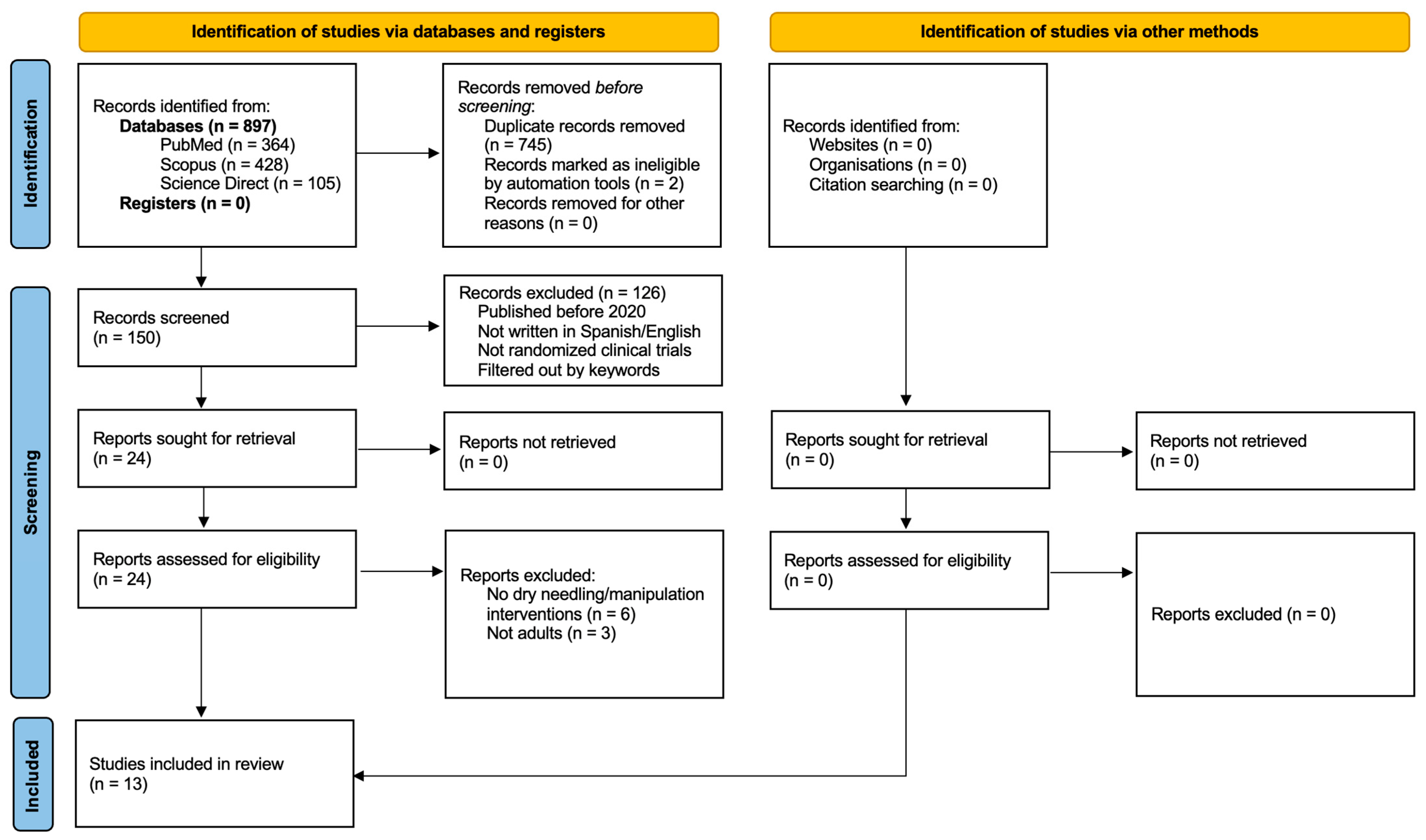
3.1. Study Selection Process
3.2. Critical Appraisal and Risk of Bias
3.3. Synthesis of Clinical Characteristics
3.4. Synthesis of Intervention Details
3.5. Qualitative Synthesis
3.5.1. Pain and Pressure Sensitivity
3.5.2. Functional Capacity and General Health
3.5.3. Other Variables
4. Discussion
4.1. Manipulations Compared to Other Physiotherapy Techniques
4.2. Dry Needling Compared to Other Physiotherapy Techniques
4.3. Manipulations vs. Dry Needling
4.4. Safety Considerations and Report of Adverse Events
4.5. Limitations
5. Conclusions
Supplementary Materials
Author Contributions
Funding
Institutional Review Board Statement
Informed Consent Statement
Data Availability Statement
Conflicts of Interest
References
- Olesen, J. The International Classification of Headache Disorders: History and future perspectives. Cephalalgia 2024, 44, 3331024231214731. [Google Scholar] [CrossRef]
- Pensato, U.; Cevoli, S.; Pierangeli, G.; Cortelli, P. The Evolutionary Meaning of Migraine. Cephalalgia 2023, 43, 03331024231209303. [Google Scholar] [CrossRef]
- Figuerola, M.L. Las Cefaleas; Editorial Medica Panamericana: Madrid, Spain, 2014. [Google Scholar]
- Steel, S.J.; Robertson, C.E.; Whealy, M.A. Current Understanding of the Pathophysiology and Approach to Tension-Type Headache. Curr. Neurol. Neurosci. Rep. 2021, 21, 56. [Google Scholar] [CrossRef]
- Piovesan, E.J.; Utiumi, M.A.T.; Grossi, D.B. Cervicogenic Headache—How to Recognize and Treat. Best Pract. Res. Clin. Rheumatol. 2024, 38, 101931. [Google Scholar] [CrossRef]
- Blanpied, P.R.; Gross, A.R.; Elliott, J.M.; Devaney, L.L.; Clewley, D.; Walton, D.M.; Sparks, C.; Robertson, E.K. Neck Pain: Revision 2017. J. Orthop. Sports Phys. Ther. 2017, 47, A1–A83. [Google Scholar] [CrossRef] [PubMed]
- Racicki, S.; Gerwin, S.; DiClaudio, S.; Reinmann, S.; Donaldson, M. Conservative Physical Therapy Management for the Treatment of Cervicogenic Headache: A Systematic Review. J. Man. Manip. Ther. 2013, 21, 113–124. [Google Scholar] [CrossRef]
- Eliasson, J.H.; Birgisdottir, B.E.; Gudmundsson, L.S. A Case of Complete Scotoma Following Intake of Conjugated Linoleic Acid Supplement. Headache 2018, 58, 761–763. [Google Scholar] [CrossRef]
- Wijeratne, T.; Oh, J.; Kim, S.; Yim, Y.; Kim, M.S.; Il Shin, J.; Oh, Y.-S.; Jung, R.; Kim, Y.S.; Smith, L.; et al. Global, Regional, and National Burden of Headache Disorders, 1990–2021, with Forecasts to 2050: A Global Burden of Disease Study 2021. Cell Rep. Med. 2025, 6, 102348. [Google Scholar] [CrossRef] [PubMed]
- Stovner, L.J.; Nichols, E.; Steiner, T.J.; Abd-Allah, F.; Abdelalim, A.; Al-Raddadi, R.M.; Ansha, M.G.; Barac, A.; Bensenor, I.M.; Doan, L.P.; et al. Global, Regional, and National Burden of Migraine and Tension-Type Headache, 1990–2016: A Systematic Analysis for the Global Burden of Disease Study 2016. Lancet Neurol. 2018, 17, 954–976. [Google Scholar] [CrossRef]
- Ashina, S.; Mitsikostas, D.D.; Lee, M.J.; Yamani, N.; Wang, S.-J.; Messina, R.; Ashina, H.; Buse, D.C.; Pozo-Rosich, P.; Jensen, R.H.; et al. Tension-Type Headache. Nat. Rev. Dis. Primers 2021, 7, 24. [Google Scholar] [CrossRef] [PubMed]
- Dong, L.; Dong, W.; Jin, Y.; Jiang, Y.; Li, Z.; Yu, D. The Global Burden of Migraine: A 30-Year Trend Review and Future Projections by Age, Sex, Country, and Region. Pain Ther. 2025, 14, 297–315. [Google Scholar] [CrossRef] [PubMed]
- Burch, R.; Rizzoli, P.; Loder, E. The Prevalence and Impact of Migraine and Severe Headache in the United States: Updated Age, Sex, and Socioeconomic-specific Estimates from Government Health Surveys. Headache J. Head Face Pain 2021, 61, 60–68. [Google Scholar] [CrossRef] [PubMed]
- Headache Classification Committee of the International Headache Society (IHS). The International Classification of Headache Disorders, 3rd Edition. Cephalalgia 2018, 38, 1–211. [Google Scholar] [CrossRef]
- Robinson, C.L.; Christensen, R.H.; Al-Khazali, H.M.; Amin, F.M.; Yang, A.; Lipton, R.B.; Ashina, S. Prevalence and Relative Frequency of Cervicogenic Headache in Population- and Clinic-Based Studies: A Systematic Review and Meta-Analysis. Cephalalgia 2025, 45, 03331024251322446. [Google Scholar] [CrossRef]
- Demarin, V.; Vuković, V.; Lovrencić-Huzjan, A.; Lusić, I.; Janculjak, D.; Wilheim, K.; Zurak, N. Evidence Based Guidelines for the Treatment of Primary Headaches. Acta Med. Croat. 2008, 62, 99–136. [Google Scholar]
- Bryans, R.; Descarreaux, M.; Duranleau, M.; Marcoux, H.; Potter, B.; Ruegg, R.; Shaw, L.; Watkin, R.; White, E. Evidence-Based Guidelines for the Chiropractic Treatment of Adults With Headache. J. Manip. Physiol. Ther. 2011, 34, 274–289. [Google Scholar] [CrossRef]
- Sarchielli, P.; Granella, F.; Prudenzano, M.P.; Pini, L.A.; Guidetti, V.; Bono, G.; Pinessi, L.; Alessandri, M.; Antonaci, F.; Fanciullacci, M.; et al. Italian Guidelines for Primary Headaches: 2012 Revised Version. J. Headache Pain 2012, 13, 31–70. [Google Scholar] [CrossRef]
- Ailani, J.; Burch, R.C.; Robbins, M.S. The American Headache Society Consensus Statement: Update on Integrating New Migraine Treatments into Clinical Practice. Headache J. Head Face Pain 2021, 61, 1021–1039. [Google Scholar] [CrossRef]
- Giacalone, A.; Febbi, M.; Magnifica, F.; Ruberti, E. The Effect of High Velocity Low Amplitude Cervical Manipulations on the Musculoskeletal System: Literature Review. Cureus 2020, 12, e7682. [Google Scholar] [CrossRef]
- Cholewicki, J.; Popovich, J.M., Jr.; Reeves, N.P.; DeStefano, L.A.; Rowan, J.J.; Francisco, T.J.; Prokop, L.L.; Zatkin, M.A.; Lee, A.S.; Sikorskii, A.; et al. The Effects of Osteopathic Manipulative Treatment on Pain and Disability in Patients with Chronic Neck Pain: A Single-blinded Randomized Controlled Trial. PM&R 2022, 14, 1417–1429. [Google Scholar] [CrossRef]
- Rabanal-Rodríguez, G.; Navarro-Santana, M.J.; Valera-Calero, J.A.; Gómez-Chiguano, G.F.; Kocot-Kępska, M.; Fernández-de-las-Peñas, C.; Plaza-Manzano, G. Neurophysiological Effects of Dry Needling: A Systematic Review and Meta-Analysis. Arch. Phys. Med. Rehabil. 2025, 107, 299–314. [Google Scholar] [CrossRef] [PubMed]
- Sánchez-Infante, J.; Navarro-Santana, M.J.; Bravo-Sánchez, A.; Jiménez-Diaz, F.; Abián-Vicén, J. Is Dry Needling Applied by Physical Therapists Effective for Pain in Musculoskeletal Conditions? A Systematic Review and Meta-Analysis. Phys. Ther. 2021, 101, pzab070. [Google Scholar] [CrossRef] [PubMed]
- Gattie, E.; Cleland, J.A.; Snodgrass, S. The Effectiveness of Trigger Point Dry Needling for Musculoskeletal Conditions by Physical Therapists: A Systematic Review and Meta-Analysis. J. Orthop. Sports Phys. Ther. 2017, 47, 133–149. [Google Scholar] [CrossRef]
- De Pauw, R.; Dewitte, V.; de Hertogh, W.; Cnockaert, E.; Chys, M.; Cagnie, B. Consensus among Musculoskeletal Experts for the Management of Patients with Headache by Physiotherapists? A Delphi Study. Musculoskelet. Sci. Pract. 2021, 52, 102325. [Google Scholar] [CrossRef]
- Vázquez-Justes, D.; Yarzábal-Rodríguez, R.; Doménech-García, V.; Herrero, P.; Bellosta-López, P. Effectiveness of Dry Needling for Headache: A Systematic Review. Neurologia 2020, 37, 806–815. [Google Scholar] [CrossRef]
- Do, T.P.; Heldarskard, G.F.; Kolding, L.T.; Hvedstrup, J.; Schytz, H.W. Myofascial Trigger Points in Migraine and Tension-Type Headache. J. Headache Pain 2018, 19, 84. [Google Scholar] [CrossRef]
- Pourahmadi, M.; Dommerholt, J.; Fernández-De-Las-Peñas, C.; Koes, B.W.; Mohseni-Bandpei, M.A.; Mansournia, M.A.; Delavari, S.; Keshtkar, A.; Bahramian, M. Dry Needling for the Treatment of Tension-Type, Cervicogenic, or Migraine Headaches: A Systematic Review and Meta-Analysis. Phys. Ther. 2021, 101, pzab068. [Google Scholar] [CrossRef]
- Istenič, S.; Jerman, A.; Pušnik, L.; Stopar Pintarič, T.; Umek, N. Transnasal Spread of Bupivacaine into the Pterygopalatine Fossa Following Endoscopically Assisted Cotton Swab Placement: A Cadaveric Study. Reg. Anesth. Pain Med. 2025, 0, 1–6. [Google Scholar] [CrossRef]
- Wirth, B.; Gassner, A.; De Bruin, E.D.; Axén, I.; Swanenburg, J.; Humphreys, B.K.; Schweinhardt, P. Neurophysiological Effects of High Velocity and Low Amplitude Spinal Manipulation in Symptomatic and Asymptomatic Humans: A Systematic Literature Review. Spine 2019, 44, E914–E926. [Google Scholar] [CrossRef] [PubMed]
- Rist, P.M.; Hernandez, A.; Bernstein, C.; Kowalski, M.; Osypiuk, K.; Vining, R.; Long, C.R.; Goertz, C.; Song, R.; Wayne, P.M. The Impact of Spinal Manipulation on Migraine Pain and Disability: A Systematic Review and Meta-Analysis. Headache J. Head Face Pain 2019, 59, 532–542. [Google Scholar] [CrossRef]
- Fernandez, M.; Moore, C.; Tan, J.; Lian, D.; Nguyen, J.; Bacon, A.; Christie, B.; Shen, I.; Waldie, T.; Simonet, D.; et al. Spinal Manipulation for the Management of Cervicogenic Headache: A Systematic Review and Meta-Analysis. Eur. J. Pain 2020, 24, 1687–1702. [Google Scholar] [CrossRef] [PubMed]
- Page, M.J.; McKenzie, J.E.; Bossuyt, P.M.; Boutron, I.; Hoffmann, T.C.; Mulrow, C.D.; Shamseer, L.; Tetzlaff, J.M.; Akl, E.A.; Brennan, S.E.; et al. The PRISMA 2020 Statement: An Updated Guideline for Reporting Systematic Reviews. BMJ 2021, 372, n71. [Google Scholar] [CrossRef] [PubMed]
- Dhammi, I.; Haq, R. How to Write Systematic Review or Metaanalysis. Indian J. Orthop. 2018, 52, 575–577. [Google Scholar] [CrossRef]
- Garner, P.; Hopewell, S.; Chandler, J.; MacLehose, H.; Schünemann, H.J.; Akl, E.A.; Beyene, J.; Chang, S.; Churchill, R.; Dearness, K.; et al. When and How to Update Systematic Reviews: Consensus and Checklist. BMJ 2016, 354, i3507. [Google Scholar] [CrossRef]
- Cristopher, M.; Catherine, S.; Robert, H.; Anne, M.; Elkins, M. Reliability of the PEDro Scale for Rating Quality of Randomized Controlled Trials. Phys. Ther. 2003, 83, 713–721. [Google Scholar] [CrossRef]
- Booth, A. “Brimful of STARLITE”: Toward Standards for Reporting Literature Searches. J. Med. Libr. Assoc. 2006, 94, 421. [Google Scholar]
- Nambi, G.; Alghadier, M.; Ebrahim, E.E.; Vellaiyan, A.; Tedla, J.S.; Reddy, R.S.; Kakaraparthi, V.N.; Aldhafian, O.R.; Alshahrani, N.N.; Saleh, A.K. Comparative Effects of Mulligan’s Mobilization, Spinal Manipulation, and Conventional Massage Therapy in Cervicogenic Headache—A Prospective, Randomized, Controlled Trial. Healthcare 2022, 11, 107. [Google Scholar] [CrossRef]
- Monti-Ballano, S.; Márquez-Gonzalvo, S.; Lucha-López, M.O.; Ferrández-Laliena, L.; Vicente-Pina, L.; Sánchez-Rodríguez, R.; Tricás-Vidal, H.J.; Tricás-Moreno, J.M. Effects of Dry Needling on Active Myofascial Trigger Points and Pain Intensity in Tension-Type Headache: A Randomized Controlled Study. J. Pers. Med. 2024, 14, 332. [Google Scholar] [CrossRef]
- Porter, M.; Griswold, D.; Gargano, F.; Ickert, E.; Learman, K. Immediate Effects of Superficial Dry Needling of the Trigeminal Nerve Innervation Field for Participants with Cervicogenic Headache. A Randomized Controlled Trial. Physiother. Theory Pract. 2024, 40, 253–261. [Google Scholar] [CrossRef] [PubMed]
- Nambi, G.; Alghadier, M.; Khanam, H.; Pakkir Mohamed, S.H.; Aldhafian, O.R.; Alshahrani, N.A.; Mani, P.; Chevidikunnan, M.F.; Khan, F.; Albarakati, A.J.A. An Additive Effect of Instrument-Assisted Soft Tissue Mobilization with Spinal Manipulation in Cervicogenic Headache: A Randomized Controlled Trial. Pain Ther. 2024, 13, 1679–1693. [Google Scholar] [CrossRef]
- Nambi, G.; Alghadier, M.; Eltayeb, M.M.; Aldhafian, O.R.; Saleh, A.K.; Alsanousi, N.; Albarakati, A.J.A.; Omar, M.A.; Ibrahim, M.N.A.; Attallah, A.A.; et al. Comparative Effectiveness of Cervical vs Thoracic Spinal-Thrust Manipulation for Care of Cervicogenic Headache: A Randomized Controlled Trial. PLoS ONE 2024, 19, e0300737. [Google Scholar] [CrossRef] [PubMed]
- Mousavi-Khatir, S.R.; Fernández-de-las-Peñas, C.; Saadat, P.; Javanshir, K.; Zohrevand, A. The Effect of Adding Dry Needling to Physical Therapy in the Treatment of Cervicogenic Headache: A Randomized Controlled Trial. Pain Med. 2022, 23, 579–589. [Google Scholar] [CrossRef]
- Dunning, J.; Butts, R.; Zacharko, N.; Fandry, K.; Young, I.; Wheeler, K.; Day, J.; Fernández-de-las-Peñas, C. Spinal Manipulation and Perineural Electrical Dry Needling in Patients with Cervicogenic Headache: A Multicenter Randomized Clinical Trial. Spine J. 2021, 21, 284–295. [Google Scholar] [CrossRef]
- Corum, M.; Aydin, T.; Medin Ceylan, C.; Kesiktas, F.N. The Comparative Effects of Spinal Manipulation, Myofascial Release and Exercise in Tension-Type Headache Patients with Neck Pain: A Randomized Controlled Trial. Complement. Ther. Clin. Pract. 2021, 43, 101319. [Google Scholar] [CrossRef]
- Lerner-Lentz, A.; O’Halloran, B.; Donaldson, M.; Cleland, J.A. Pragmatic Application of Manipulation versus Mobilization to the Upper Segments of the Cervical Spine plus Exercise for Treatment of Cervicogenic Headache: A Randomized Clinical Trial. J. Man. Manip. Ther. 2021, 29, 267–275. [Google Scholar] [CrossRef]
- Rezaeian, T.; Mosallanezhad, Z.; Nourbakhsh, M.R.; Noroozi, M.; Sajedi, F. Effects of Dry Needling Technique Into Trigger Points of the Sternocleidomastoid Muscle in Migraine Headache. Am. J. Phys. Med. Rehabil. 2020, 99, 1129–1137. [Google Scholar] [CrossRef]
- Togha, M.; Bahrpeyma, F.; Jafari, M.; Nasiri, A. A Sonographic Comparison of the Effect of Dry Needling and Ischemic Compression on the Active Trigger Point of the Sternocleidomastoid Muscle Associated with Cervicogenic Headache: A Randomized Trial. J. Back Musculoskelet. Rehabil. 2020, 33, 749–759. [Google Scholar] [CrossRef] [PubMed]
- Rist, P.M.; Bernstein, C.; Kowalski, M.; Osypiuk, K.; Connor, J.P.; Vining, R.; Long, C.R.; Macklin, E.A.; Wayne, P.M. Multimodal Chiropractic Care for Migraine: A Pilot Randomized Controlled Trial. Cephalalgia 2021, 41, 318–328. [Google Scholar] [CrossRef] [PubMed]
- McDevitt, A.W.; Cleland, J.A.; Rhon, D.I.; Altic, R.A.K.; Courtney, D.J.; Glynn, P.E.; Mintken, P.E. Thoracic Spine Thrust Manipulation for Individuals with Cervicogenic Headache: A Crossover Randomized Clinical Trial. J. Man. Manip. Ther. 2022, 30, 78–95. [Google Scholar] [CrossRef]
- Bolton, P.S.; Budgell, B.S. Spinal Manipulation and Spinal Mobilization Influence Different Axial Sensory Beds. Med. Hypotheses 2006, 66, 258–262. [Google Scholar] [CrossRef]
- Cassidy, J.D.; Lopes, A.A.; Yong-Hing, K. The Immediate Effect of Manipulation versus Mobilization on Pain and Range of Motion in the Cervical Spine: A Randomized Controlled Trial. J. Manip. Physiol. Ther. 1992, 15, 570–575. [Google Scholar]
- Cerritelli, F.; Ginevri, L.; Messi, G.; Caprari, E.; Di Vincenzo, M.; Renzetti, C.; Cozzolino, V.; Barlafante, G.; Foschi, N.; Provinciali, L. Clinical Effectiveness of Osteopathic Treatment in Chronic Migraine: 3-Armed Randomized Controlled Trial. Complement. Ther. Med. 2015, 23, 149–156. [Google Scholar] [CrossRef]
- Chaibi, A.; Benth, J.Š.; Tuchin, P.J.; Russell, M.B. Chiropractic Spinal Manipulative Therapy for Migraine: A Three-armed, Single-blinded, Placebo, Randomized Controlled Trial. Eur. J. Neurol. 2017, 24, 143–153. [Google Scholar] [CrossRef] [PubMed]
- Kietrys, D.M.; Palombaro, K.M.; Azzaretto, E.; Hubler, R.; Schaller, B.; Schlussel, J.M.; Tucker, M. Effectiveness of Dry Needling for Upper-Quarter Myofascial Pain: A Systematic Review and Meta-Analysis. J. Orthop. Sports Phys. Ther. 2013, 43, 620–634. [Google Scholar] [CrossRef] [PubMed]
- Church, E.W.; Sieg, E.P.; Zalatimo, O.; Hussain, N.S.; Glantz, M.; Harbaugh, R.E. Systematic Review and Meta-Analysis of Chiropractic Care and Cervical Artery Dissection: No Evidence for Causation. Cureus 2016, 8, e498. [Google Scholar] [CrossRef]
- Peters, R.; Hallegraeff, J.; Koes, B.; Van Trijffel, E. Recommendations for Mobilization and Manipulation Treatment and Screening for Vascular Complications in Clinical Practice Guidelines for Neck Pain: A Systematic Review. Phys. Ther. 2025, 105, pzae179. [Google Scholar] [CrossRef] [PubMed]


| Article | PEDro Scale Score (Items & Total) | |||||||||||
|---|---|---|---|---|---|---|---|---|---|---|---|---|
| 1 | 2 | 3 | 4 | 5 | 6 | 7 | 8 | 9 | 10 | 11 | Total | |
| Monti-Ballano et al. [39] | 1 | 1 | 1 | 1 | 0 | 0 | 1 | 1 | 1 | 1 | 1 | 8/10 |
| Porter et al. [40] | 1 | 1 | 1 | 1 | 0 | 0 | 1 | 1 | 1 | 1 | 1 | 8/10 |
| Nambi et al. [41] | 1 | 1 | 1 | 1 | 0 | 0 | 1 | 1 | 1 | 1 | 1 | 8/10 |
| Nambi et al. [42] | 1 | 1 | 1 | 1 | 0 | 0 | 1 | 1 | 1 | 1 | 1 | 8/10 |
| Nambi et al. [38] | 1 | 1 | 1 | 1 | 0 | 0 | 1 | 1 | 0 | 1 | 1 | 7/10 |
| McDevitt et al. [50] | 1 | 1 | 1 | 1 | 0 | 0 | 0 | 1 | 0 | 1 | 1 | 6/10 |
| Mousavi-Khatir et al. [43] | 1 | 1 | 1 | 1 | 0 | 0 | 1 | 1 | 1 | 1 | 1 | 8/10 |
| Dunning et al. [44] | 1 | 1 | 1 | 1 | 0 | 0 | 1 | 1 | 1 | 1 | 1 | 8/10 |
| Rist et al. [49] | 1 | 1 | 1 | 1 | 0 | 0 | 0 | 1 | 1 | 1 | 1 | 7/10 |
| Corum et al. [45] | 1 | 1 | 1 | 1 | 0 | 0 | 1 | 1 | 0 | 1 | 1 | 7/10 |
| Lerner-Lentz et al. [46] | 1 | 1 | 1 | 1 | 0 | 0 | 0 | 1 | 1 | 1 | 1 | 7/10 |
| Rezaeian et al. [47] | 1 | 1 | 1 | 1 | 1 | 0 | 1 | 1 | 0 | 1 | 1 | 8/10 |
| Togha et al. [48] | 1 | 1 | 1 | 1 | 0 | 0 | 1 | 1 | 0 | 1 | 1 | 7/10 |
| Reference | Participants | Interventions | Comparators | Outcomes | Results |
|---|---|---|---|---|---|
| Monti-Ballano et al. [39] Randomized controlled trial, single-blind, two parallel groups | n = 32 Profile: Adults with TTH (episodic/chronic) diagnosed by neurologist according to ICHD-3; required ≥1 active MTrP in muscles referring pain to the head/face. Mean age 39.1 ± 12.7 years; 75% women; mean headache frequency 13.4 ± 10.2 days/month. | DN (n = 16) DN of active MTrPs in craniocervical muscles associated with TTH (upper trapezius, splenius capitis/cervicis, semispinalis, rectus capitis posterior major, obliquus capitis superior/inferior, occipitofrontalis (anterior/posterior), temporalis, masseter, sternocleidomastoid, zygomaticus major, levator scapulae). Three treatment sessions; total number of active MTrPs per subject distributed across sessions (each MTrP treated only once); in-and-out pistoning in large muscle bellies without nearby dangerous structures and bidirectional rotation technique in flat muscles and those near neurovascular structures; aim to elicit local twitch responses at each MTrP. | Passive Control (n = 16) No DN or other physiotherapy intervention during study period. Participants continued their usual headache medication. | Pain intensity: VAS. Total number of active MTrPs: palpation + algometry. Perceived clinical change: GROC. Change in headache medication use. All outcomes assessed pre- and post-treatment. | DN group showed a significant reduction in total number of active MTrPs compared with its own baseline (mean pre–post difference −4.5 points; 95% CI 0.25 to 8.75; p = 0.039); no significant change in control group. For pain intensity, within-group analysis showed a significant VAS reduction only in the DN group (p = 0.008); general linear model with medication change as covariate showed a significant post-treatment between-group difference favoring DN (mean VAS difference control–DN = 23.45 mm; 95% CI 1.89 to 45.01; p = 0.034). GROC was markedly better in the DN group compared with control (mean 3.94 ± 2.08 vs. −0.38 ± 2.28; p < 0.001), indicating clinically relevant improvement. Headache medication use post-treatment was lower in the DN group than in controls (p = 0.009). No serious adverse events were reported; only mild, self-limited post-needling soreness (upper trapezius, masseter, sternocleidomastoid) resolving within 48 h without treatment. |
| Porter et al. [40] Randomized controlled trial, parallel-group, participant- and assessor-blinded | n = 30 Profile: Adults (≥18 years) with CGH; ≥1 headache per week for ≥3 months; unilateral headache pain; pain aggravated by neck movements or sustained postures; provocation by joint play C0-C4 and/or positive flexion–rotation test (FRT); headache or neck pain intensity ≥2/10. | Superficial DN (n = 17) Superficial DN targeting the innervation fields of the trigeminal nerve’s terminal branches bilaterally (supraorbital, infraorbital, mental, auriculotemporal nerves), regardless of local symptoms or tenderness. Participants in supine position; 0.18 × 15 mm needles inserted cutaneously/subcutaneously to a depth sufficient to secure the needle in the skin. Four rounds of 3–4 needle rotations per needle were applied to enhance the sensory effect. Total treatment time 5–7 min including compression/hemostasis. Single treatment session; immediate effects only were evaluated. | Sham DN (n = 13) Same set-up and standardized script as DN group (supine position, eyes closed, guide tube contact), but the needle was bent up inside the guide tube so that it did not pierce the skin. Guide tube pressure and treatment time were matched to the DN group to mimic the procedure without skin penetration. No other physiotherapy intervention was provided during the study period. | Pain intensity: NPRS. Cervical AROM of the most provocative movement: measured with a CROM device. CFRT: right and left, degrees, using a motion detection device. PPT: right and left supraorbital nerve; right and left greater occipital nerve, measured with a handheld algometer. All outcomes assessed at baseline and immediately post-treatment. | Compared with sham DN, superficial DN produced statistically and clinically meaningful immediate improvements in pain and cervical mobility. NPRS decreased more in the DN group (post 1.7 ± 1.1 vs. 3.7 ± 1.7; between-group mean difference 2.1 points; 95% CI 1.0 to 3.1; p < 0.001; d = 1.40), exceeding the MCID. AROM of the most provocative cervical movement increased more after DN (post 60.1 ± 15.3° vs. 42.2 ± 14.7°; mean difference 18.0°; 95% CI 6.9 to 25.3; p = 0.006; d = 1.17). Between-group differences for right and left FRT were not statistically significant (p = 0.137), but mean changes of about 7.0–8.8° (d = 0.57–0.70) met published MDC/MCID thresholds, suggesting potential clinical relevance. PPT values over the supraorbital and greater occipital nerves did not differ significantly between groups (p = 0.052–0.187), although effect sizes were moderate to large (d ≈ 0.53–0.88). Within the DN group, immediate pre–post improvements were significant for NPRS, FRT (right and left), and AROM; PPT did not change significantly. Sham group showed smaller, non-significant changes. Authors conclude that superficial DN of the trigeminal innervation field produces immediate, clinically meaningful improvements in pain and cervical mobility in CGH, although results are limited by small sample size and short-term follow-up. |
| Nambi et al. [41] Randomized, single-blind, active-controlled trial with two parallel groups | n = 64 Profile: Adults (>18 years) with unilateral CGH >3 months, diagnosed according to ICHD-3 (11.2.1) criteria; headache intensity ≥3/10; headache attributed to cervical spine dysfunction; reduced cervical motion on flexion–rotation test (FRT) with neck pain followed by headache; neck stiffness and movement restriction; no cervical fracture, osteoporosis, deformity or abnormalities on cervical imaging. Mean age ≈ mid-30s; 47–41% males; majority had associated neck pain (81–88%). | SMT + ISM (n = 32) Ten min hot hydrocollator pack to cervical region (base of neck and upper shoulders) and supervised neck isometric exercises three times per day (multi-directional resisted holds of 10 s × 15 repetitions), four sessions/week for 4 weeks, plus instructions to continue exercises after 4 weeks. + Cervical HVLAT per Peterson & Bergman protocol, primarily targeting upper cervical (C1–C2) segments; patient supine, therapist at head, bimanual pre-manipulative rotation 30–45°, thrust directed first away from and then toward the side of pain, within WHO safety guidelines. + Instrument-assisted soft tissue mobilization using an M2T blade: patient seated leaning forward, massage cream applied; restricted soft-tissue areas in cervical region identified; fascial release performed at ~45° angle along muscle fiber direction over levator scapulae, sternocleidomastoid, scalenes, upper trapezius (origin to insertion bilaterally, ~8 min), as well as longissimus capitis, splenius capitis, semispinalis capitis and suboccipital muscles in a centripetal direction, repeated three times; procedure stopped if adverse sensations occurred. Treatments delivered by experienced manual therapists, four sessions/week for 4 weeks. | SMT (n = 32) Same protocol of cervical HVLAT (assessment of cervical joint dysfunction each visit; manipulation directed primarily at C1-C2 with rotation away from and then toward pain in supine), same 10 min hot pack and identical neck isometric exercise program and instructions as in SMT + ISM group. No instrument-assisted soft tissue mobilization was added. Frequency and duration of treatment matched (four sessions/week for 4 weeks). Participants were asked not to receive other treatments during the study period. | CGH and neck pain frequency: number of CGH and neck pain days over 4 weeks. Pain intensity: VAS. Disability: HIT-6 and NDI. Neck pain threshold: PPT over upper trapezius trigger point using digital algometer. Health-related quality of life: EuroQol-5D. All outcomes measured at baseline, after 4 weeks, and at 6-month follow-up. | Both groups showed statistically significant improvements over time in the primary and secondary outcomes, but SMT + ISM generally produced larger and more sustained changes. For CGH frequency, SMT decreased from 15.6 ± 1.5 to 10.5 ± 1.1 days/4 weeks at 4 weeks and to 3.5 ± 0.5 at 6 months, while SMT + ISM decreased from 16.1 ± 1.4 to 6.2 ± 0.9 and to 1.8 ± 0.4, with between-group differences favoring SMT + ISM at 4 weeks and 6 months (p = 0.001). CGH pain intensity (VAS) decreased in SMT from 6.8 ± 0.9 to 4.5 ± 0.6 and 0.8 ± 0.2, and in SMT + ISM from 7.1 ± 1.1 to 3.1 ± 0.4 and 0.3 ± 0.3, again with superior reductions in SMT + ISM (p = 0.001 at 4 weeks and 6 months). CGH disability (HIT-6) improved in both groups but was lower (better) in SMT + ISM at both follow-ups (p = 0.001). Secondary neck-related outcomes (neck pain frequency and intensity, NDI, FRT, and quality of life) all improved significantly in both groups; mixed-model ANOVA showed significant group × time interactions favoring SMT + ISM for most variables, and standardized mean differences indicated greater percentage improvement in the SMT + ISM group. Neck pain threshold did not differ between groups at 4 weeks but was significantly higher (better) in SMT + ISM at 6 months (p = 0.016). No adverse events or serious complications were reported during or after the interventions. The authors conclude that adding instrument-assisted soft tissue mobilization to SM and exercise yields superior long-term outcomes compared with SM and exercise alone in unilateral CGH. |
| Nambi et al. [42] Randomized controlled trial, three parallel groups | n = 96 Profile: Adults 18–60 years with unilateral or bilateral CGH >3 months, diagnosed by physician according to ICHD-3 (11.2.1) criteria; pain intensity ≥3/10 on VAS; CGH arising from neck pain followed by headache; limited cervical range of motion, neck stiffness and cervical spine musculoskeletal disorders. Mean CGH duration ≈ 6–7 years; majority with associated neck pain (84–88%) and unilateral headache (78–84%). | Cervical SMT (n = 32) HVLAT cervical spine manipulation at C1–C2 in supine “cradle hold” position; head positioned in extension, PA shift, ipsilateral side-bend and contralateral side-shift; single HVLAT rotation thrust first toward the non-painful, then the painful side; up to two attempts per session if no cavitation; three sessions/week for 4 weeks (12 sessions). + Ten min hot hydrocollator pack to neck/upper back before treatment and a home/clinic program of neck isometric exercises (multi-directional resisted holds 10 s × 15 reps, 3/day) plus static stretching of upper trapezius, levator scapulae, scalenes and sternocleidomastoid (30 s × 3 reps); asked to continue exercises after 4 weeks. | Thoracic SMT (n = 32) HVLAT thoracic spine manipulation at T1–T2 in supine, arms folded across chest, therapist contact over transverse processes and sternum with AP thrust; up to two attempts per session; three sessions/week for 4 weeks. + Same 10 min hot pack and identical neck isometric and stretching exercise program. CPT (n = 32) Massage therapy to cervical region for 15 min (circular kneading with fingertips along C7–C1, then suboccipital and cervical paravertebral muscles bilaterally in prone), plus the same 10 min hot pack and identical neck isometric and stretching exercise program. | CGH and neck pain frequency: number of CGH and neck pain days over 4 weeks. Pain intensity: VAS. Disability: HIT-6 and NDI. PPT: algometry over upper trapezius trigger point. Cervical flexion–rotation test. Health-related quality of life: EQ-5D. All outcomes assessed at baseline, 4 weeks, 8 weeks and 6 months by a blinded assessor. | All three groups showed statistically significant improvements over time in CGH frequency, pain and disability, but cervical spine manipulation (cervical SMT) produced the largest and most sustained changes. At 6 months, CGH frequency decreased from 16.8 ± 1.8 to 2.9 ± 0.5 days/4 weeks in CSM, compared with 6.1 ± 0.7 in TSM and 10.8 ± 1.1 in CPT; between-group differences (CSM vs. TSM vs. CPT) were significant at 4 weeks, 8 weeks and 6 months (p = 0.001), with large effect sizes favoring cervical SMT. CgH pain intensity (VAS) fell to 0.8 ± 0.2 in cervical SMT vs. 1.7 ± 0.3 (TSM) and 3.7 ± 0.4 (CPT) at 6 months; HIT-6 scores decreased more in CSM (to 31.2 ± 3.8) than in TSM (39.5 ± 4.5) and CPT (48.4 ± 4.1). Neck pain frequency and intensity, CFRT right/left, NDI and EQ-5D all improved significantly in all groups, but linear mixed-model and post hoc analyses showed greater improvements and larger MCID changes in cervical SMT than TSM and CPT across all follow-ups (p < 0.001 for most comparisons). TSM was consistently superior to CPT but inferior to cervical SMT. No serious adverse events were reported. |
| Nambi et al. [38] Prospective, single-blind, parallel-group randomized controlled trial | n = 84 Profile: Adults 18–60 years with chronic CGH >3 months, diagnosed according to ICHD-3 criteria; CGH pain intensity 3–8/10; CGH attributed to cervical spine dysfunction; reduced cervical range of motion; neck pain followed by headache; neck stiffness and movement restriction. | SMT (n = 28) HVLAT cervical manipulation per Peterson & Bergmann; patient supine, therapist at head, cradle hold; pre-manipulative rotation 30–45° away from pain, then HVLAT thrust toward the side of pain; sites of dysfunction identified each visit by palpation; up to two thrust attempts per session provided no new contraindications emerged. + Five min hot pack to neck/upper back before treatment; then four sessions/week for 4 weeks (total 16 sessions), delivered by experienced manual therapists; all participants also performed daily neck isometric exercises in four directions (10 s holds ×15 reps, three times/day) and were instructed to continue after 4 weeks. | MMT (n = 28) Patient seated; therapist standing at side, using craniocervical sustained natural apophyseal glide at C2 with ventral–cranial glide (~45°) while patient actively moves into the symptomatic direction; glide maintained for 10 s, repeated 10 times (~8 min), including end-range overpressure; Mulligan’s mobilizations applied toward side of dysfunction/pain in upper cervical segments. + Same pre-treatment hot pack and same neck isometric exercise program as other groups. CMT (n = 28) Fifteen min conventional soft tissue massage of cervical region using massage cream; patient supine with head supported. Circular kneading with fingertips along cervical vertebrae C7–C1 bilaterally (distal–proximal, three repetitions per level); then with head rotated, kneading along levator scapulae, sternocleidomastoid, scalenes and upper trapezius from insertion to origin on each side; finally, kneading over longissimus capitis, splenius capitis, semispinalis capitis and suboccipital muscles in centripetal direction, repeated three times. + Same pre-treatment hot pack and same neck isometric exercise program as other groups. | CGH and neck pain frequency: number of CGH and neck pain days over 4 weeks. Pain intensity: VAS. Disability: HIT-6 and NDI. PPT: algometry over upper trapezius trigger point. Cervical flexion–rotation test. Health-related quality of life: EQ-5D. All variables assessed at baseline, 4 weeks, 8 weeks and 6 months by a blinded assessor. | All groups improved over time, but Mulligan mobilization (MMT) produced the greatest and most consistent benefits, followed by SMT, with CMT showing the smallest changes. At 6 months, CGH frequency decreased from 17.2 ± 2.1 to 3.5 ± 0.6 days/4 weeks in MMT, 18.4 ± 1.9 to 5.5 ± 0.8 in SMT and 17.8 ± 1.8 to 10.8 ± 1.5 in CMT; between-group differences were significant at 4 weeks, 8 weeks and 6 months (p < 0.001), with the largest mean difference in favor of MMT vs. CMT (MCID reached earlier in MMT at 4 weeks). CGH pain intensity (VAS) fell to 0.7 ± 0.3 in MMT, 1.9 ± 0.4 in SMT and 3.8 ± 0.4 in CMT at 6 months; CGH disability (HIT-6), neck pain frequency and intensity, FRT right/left, NDI and EQ-5D all improved significantly in all groups, with mixed-model and post hoc analyses showing greater improvements and larger standardized mean differences for MMT vs. SMT and CMT (p < 0.001 for most comparisons). Neck PPTs did not differ between groups at 4 and 8 weeks but were significantly higher (better) in MMT at 6 months compared with SMT and CMT. No adverse events or serious complications were reported. Authors conclude that Mulligan’s mobilization provides superior short- and long-term outcomes for CGH compared with SMT and conventional massage, when all are combined with heat and neck isometric exercise. |
| McDevitt et al. [50] Randomized, repeated-measures crossover clinical trial | n = 48 Profile: 18–65 years with CGH as primary complaint; unilateral or side-dominant headache associated with neck pain; headache aggravated by neck movement or sustained postures; joint tenderness and peripheralization into the head at ≥1 upper cervical joint (C0–C3); ≥1 headache/week over previous 2 months. Mean age 34.4 years; ~73% women; mean symptom duration >5 years. | TSM plus thoracic mobility exercise (n = 24) Participants attended 1–2 sessions/week for up to 4 weeks (maximum six sessions), each ~15 min. Manual therapy: prescriptive HVLAT techniques to upper, mid and lower thoracic spine and cervicothoracic junction (five standardized TSM techniques targeting T1–T12 and CT junction) performed by experienced orthopedic/manual therapists. Home program: supine thoracic mobility exercise over towel/foam roller (8–10 repetitions in up to three thoracic levels, 3–4 times/day) throughout the 4-week treatment phase and advised to continue usual activities that did not exacerbate symptoms. | Passive control (n = 24) During the initial 4 weeks, the Hold group received no manual therapy or exercise prescription for their headaches and continued their usual activities; this served as the control condition to isolate natural course of symptoms. At 4 weeks, groups crossed over: Hold group then received the same 4-week TSM + thoracic mobility program, while the original TSM group entered a 4-week no-treatment phase. For between-group comparisons, the key time point is 4 weeks. | Pain intensity: VAS. Disability: HDI and NDI. Perceived clinical change: GROC. Adverse events/side effects. Outcomes measured at baseline, 4, 8 and 12 weeks; 4-week point represents comparison of active TSM vs. Hold (no treatment), 8- and 12-week points reflect both groups having received TSM. | At 4 weeks (TSM vs. Hold), HDI between-group difference favored TSM but was not statistically significant (mean difference 7.39 points, 95% CI −4.39 to 19.18; p = 0.214). NDI showed a significant between-group difference favoring TSM (mean difference 6.90 points, 95% CI 0.05 to 13.75; p = 0.048), exceeding the MCID (5.5 points) for CGH. NPRS also favored TSM (mean difference 2.2 points, 95% CI 0.7 to 3.8; p = 0.006), exceeding MCID thresholds. Odds of achieving clinically important improvement on GRC (≥+4) were markedly higher with TSM than Hold at 4 weeks (OR ≈ 17.5, 95% CI 3.3–92.9; p < 0.001), with 62.5% responders in TSM vs. 8.3% in Hold. After crossover (by 8 and 12 weeks), when both groups had received TSM, between-group differences in HDI, NDI and NPRS were no longer significant, suggesting similar benefits regardless of treatment order. No serious adverse events or moderate/severe side effects were reported; TSM was well tolerated. Overall, six sessions of TSM plus thoracic mobility exercise improved neck-related disability, pain and perceived global change in chronic CGH, but did not significantly change headache-specific disability (HDI) compared with no treatment at 4 weeks. |
| Mousavi-Khatir et al. [43] Triple-blind randomized controlled trial with three parallel groups | n = 69 Profile: Adults 18–60 years with CGH diagnosed by neurologist using Sjaastad & Fredriksen criteria: unilateral neck-originating pain radiating to frontotemporal region, exacerbated by neck movements, restricted CROM, and tenderness at ≥1 upper cervical joint (C1–C3). Headache at least once/week for >3 months. All had active MTrPs in ipsilateral suboccipital, upper trapezius or sternocleidomastoid muscles reproducing typical headache symptoms. Groups comparable at baseline for demographics and clinical variables. | DN + CPT (n = 23) Four DN sessions (second, fifth, eighth, 12th sessions) targeting active MTrPs in ipsilateral upper trapezius, suboccipital and sternocleidomastoid muscles. For upper trapezius and suboccipital muscles patients were prone; for SCM supine. Skin disinfected, 0.25 × 30 mm filiform needle inserted with guide tube into active MTrP until LTR elicited, then repeatedly moved within the MTrP to provoke multiple LTRs until they were exhausted (typically 60–90 s per point). Pragmatic approach: only MTrPs reproducing headache symptoms at each session were needled. + Fifteen CPT sessions over 5 weeks (3/week) consisting of TENS (20 min), infrared (10 min), continuous ultrasound to cervical spine (5 min, 1 MHz), plus a neck exercise program including craniocervical flexion exercises. | Sham DN + CPT (n = 23) Four sessions of superficial needling at points away from active MTrPs in the same muscles and sessions as DN + CPT, mimicking the DN procedure (same positioning, needle type and handling) but applied superficially without eliciting LTRs; patients were unaware whether needling was real or sham. + Same 15-session CPT protocol (TENS, infrared, ultrasound, craniocervical flexion exercises). CPT (n = 23) Same 15-session CPT protocol (TENS, infrared, ultrasound, craniocervical flexion exercises). | Headache intensity: NPRS. Headache frequency: number of headache days in the past week. Disability: NDI. Deep neck flexor performance: CCFT, activation score in mmHg using pressure biofeedback. Active cervical ROM: flexion, extension, rotation to affected and unaffected sides (degrees) measured with universal goniometer in standardized seated position. All variables assessed at baseline, immediately post-treatment, and at 1-, 3-, and 6-month follow-ups by a blinded assessor. | DN + PT produced significantly greater improvements than sham DN + CPT and CPT alone in most outcomes over 6 months. Repeated-measures ANOVA showed a significant Group × Time interaction for headache intensity (F = 10.89, p < 0.001, partial η2 = 0.263): DN + CPT had larger reductions at all follow-ups (e.g., NPRS from 8.1 ± 1.3 to 1.2 ± 1.2 at 6 months) than sham (7.2 ± 1.6 to 3.0 ± 1.1) or PT alone (7.6 ± 1.3 to 3.4 ± 0.7), with between-group differences vs. sham and PT ranging from −1.4 to −2.2 points (all significant) but often below the MCID of 2.5. Headache frequency showed a small but non-significant Group × Time interaction after correction (F = 2.65, p = 0.048, η2 = 0.008), although DN + CPT consistently reduced weekly headache days more than the other groups (e.g., to 0.9 ± 0.8 vs. 2.0 ± 1.0 at 6 months). For NDI, Group × Time interaction was significant and large (F = 14.41, p < 0.001, η2 = 0.321): DN + CPT showed greater disability reductions (32.0 ± 4.0 to 6.3 ± 4.8) than sham (31.4 ± 5.4 to 12.9 ± 5.2) or CPT (33.6 ± 5.2 to 13.9 ± 5.8), with between-group differences approaching the 5.5-point MCID but with wide CIs. CCFT and all CROM measures also showed significant Group × Time interactions (p < 0.001), with DN + CPT achieving modest but statistically greater gains in deep flexor performance and flexion, extension and rotation ROM (between-group differences ~3–13°) than both comparators. No serious adverse events were reported; post-needling soreness occurred in ~40% of DN + CPT patients, lasting 48–72 h and resolving spontaneously. Overall, adding DN to multimodal CPT yielded statistically superior, but only small-to-moderate clinically relevant improvements in pain, disability, cervical ROM and deep flexor performance compared with sham DN + CPT or CPT alone in CGH with active cervical MTrPs. |
| Dunning et al. [44] Randomized, single-blind, multicenter parallel-group clinical trial | n = 142 Profile: Adults with CGH. Diagnosis according to Cervicogenic Headache International Study Group criteria: unilateral non-throbbing head pain starting in upper posterior neck/occipital region and spreading to oculofrontotemporal area; pain provoked by neck movement/sustained positions; restricted cervical ROM (≤32° rotation on flexion–rotation test); pain on palpation of ≥1 upper cervical joint (C0–C3). Mean age ≈ 40 years; symptom duration ≈ 4.5 years; moderate baseline pain and disability. | Perineural electrical DN + SMT (n = 74) Up to eight sessions over 4 weeks (1–2/week). Manual therapy: HVLAT directed primarily to upper cervical (C1–C2) and upper thoracic (T1–T2) segments using standardized techniques. + Semistandardized protocol of 8–12 needles including 6–8 occipito-cervical points (suboccipital muscles, periosteal/perineural regions around greater/lesser occipital and third occipital nerves), one distal point in ipsilateral hand, and up to five oculofrontotemporal points (supraorbital/ophthalmic branch) ± up to four upper thoracic paraspinal points. Sterile single-use needles (0.18 × 15, 0.25 × 30, 0.30 × 40 mm) inserted intramuscularly/periosteally/perineurally; after eliciting typical needling sensations (aching, tingling, heaviness), needles retained 20 min with low-frequency (2 Hz) biphasic continuous electrostimulation to up to eight needles at a “mild–moderate” intensity. | Cervical and upper thoracic non-thrust mobilization + exercise (n = 68) Same 4-week schedule (up to eight sessions). Manual therapy: non-thrust, slow oscillatory mobilization techniques directed to upper cervical (C1–C2) and upper thoracic (T1–T2) joints using Maitland-style graded mobilizations. + Supervised craniocervical flexion exercises (deep neck flexor training with pressure biofeedback) and progressive periscapular resistance exercises; dosage and progression individualized based on symptom response and tolerance (progression only if symptoms decreased and soreness did not last > a few hours). No DN or spinal thrust manipulation was applied. | Headache pain intensity: NPRS. Headache frequency: number of headache days in past week. Headache duration: total headache hours in past week categorized 0–5, 6–10, 11–15, 16–20, 21–25, ≥26 h. Disability: NDI. Perceived clinical change: GROC. Outcomes measured at baseline, 1 week, 4 weeks and 3 months after first session by blinded assessors. | Group × Time interaction was significant for headache intensity (NPRS: F = 23.464, p < 0.001), headache frequency (F = 13.407, p < 0.001) and disability (NDI: F = 10.702, p < 0.001), all favoring SMT + eDN at 3 months. At 3 months, between-group mean difference in NPRS change was −2.9 points (95% CI −3.5 to −2.3; p < 0.001), exceeding the MCID; effect size large (SMD ≈ 1.25). NDI between-group difference in change was −8.8 points (95% CI −11.4 to −6.0; p < 0.001), also exceeding the MCID and yielding a large effect (SMD ≈ 0.94). Headache frequency decreased more in SMT + eDN (mean change −3.4 vs. −1.5 days/week; between-group difference −1.8, 95% CI −2.5 to −1.4; p < 0.001; large SMD ≈ 0.97), and headache duration categories shifted to shorter time ranges compared with comparator group (p < 0.001). At 3 months, 66% of SMT + eDN patients vs. 21% of comparator group had completely stopped headache medication (χ2 = 29.889, p < 0.001). Based on GROC ≥+5, 77% in SMT + eDN vs. 15% in comparator group achieved a successful outcome (χ2 = 54.840, p < 0.001; NNT ≈ 1.6). No serious adverse events were reported; in the SMT + eDN group ~61% had transient post-needling soreness and ~24% mild bruising, resolving spontaneously within days. Authors conclude that upper cervical/thoracic thrust manipulation plus electrical DN is superior to non-thrust mobilization and exercise for short- to mid-term improvement in pain, disability, headache burden and medication use in CH. |
| Rist et al. [49] Pilot randomized controlled trial, two parallel groups | n = 61 Profile: Adult women aged 20–55 years with diagnosis of episodic migraine (with/without aura) according to ICHD-3, migraine history ≥1 year, and 4–13 migraine days during a 4-week run-in (confirmed by daily migraine logs). Mean age 36.4 years; mean migraine frequency during run-in 7.6 ± 2.2 days/month; majority with typical migraine features (unilateral, pulsating pain, photophobia/phonophobia, nausea, activity avoidance). | MCC+ EUC (n = 29) Up to 10 sessions of individualized multimodal chiropractic care over 14 weeks at an integrative medicine clinic. First visit: detailed physical examination; patients classified into diagnostic categories with pre-specified but flexible treatment algorithms. Care was tailored to patient findings and preferences and could include: SM and joint mobilization (cervical/thoracic/temporomandibular joint as indicated), soft tissue relaxation/release techniques, posture correction and spinal stabilization/strengthening exercises, stretching, relaxation techniques, ergonomic advice and education. Participants could opt out of any component (e.g., manipulation). + Usual medical care as prescribed by their physicians plus standardized migraine education materials (American Headache Society information on migraine pathophysiology, triggers, treatments and comorbidities). | EUC (n = 32) Same usual medical care as described. | Feasibility of participant recruitment. Retention and adherence to protocol. Evaluation of adverse effects. Number, intensity, and duration of migraine days. Amount of medication used. Migraine Disability Assessment: MIDAS. Disability: HIT-6. Migraine-Specific Quality of Life: MSQL. Outcomes calculated for run-in (baseline), weeks 11–14 (“initial follow-up”), and the 4-week post-intervention phase (“final follow-up”). | Feasibility: recruitment was slower than planned (61 randomized over 20 months) and only 74% completed all assessments, so prespecified feasibility criteria were not fully met, but retention at main follow-up points was good (≈84–97%) and adherence to chiropractic sessions was high (264/290 visits attended; 83% attended ≥75% of sessions). Safety: Ninety-eight non-serious adverse events (AEs) were reported (39 in EUC, 59 in MCC + EUC); no serious AEs occurred. In MCC + EUC, 15 events in four participants were “possibly related” and five in 5 participants “related” to treatment (mostly transient musculoskeletal stiffness or migraine); no related AEs in EUC alone. Clinical effects: compared with EUC, MCC + EUC produced greater reductions in migraine days from run-in to weeks 11–14 (mean change −2.90 vs. −0.98 days; between-group difference −1.92; 95% CI −3.46 to −0.37), an effect that persisted at final follow-up. MCC + EUC also showed larger improvements in migraine severity, medication use and duration (between-group differences in changes generally favored MCC + EUC but some CIs included 0). Disability and impact: greater decreases in MIDAS (between-group difference in change −5.58; 95% CI −10.44 to −0.72) and HIT-6 (−3.62; 95% CI −6.52 to −0.73) at week 14 in MCC + EUC; MSQ role-restriction and emotional function domains improved slightly more with MCC + EUC, though effect sizes were small. Responder rates (≥50% reduction in migraine days) were higher with MCC + EUC (10 vs. seven responders at initial follow-up; OR ≈ 2.17, 95% CI 0.68–6.95; similar pattern at final follow-up), but CIs were wide. |
| Corum et al. [45] Prospective randomized controlled trial, three parallel groups | n = 39 Profile: Adults 19–48 years with TTH (episodic or chronic) and neck pain, diagnosed according to ICHD-3 beta criteria (bilateral, pressing/tightening, mild–moderate intensity, no aggravation with physical activity, no nausea/vomiting/photophobia/phonophobia). Symptoms >3 months and average pain ≥3/10 on VAS in previous week; at least one upper cervical segmental dysfunction (functional and pain-provocation tests). | SMT+ exercise (n = 12) Eight sessions over 4 weeks (two/week) of segment-specific HVLAT manipulation to dysfunctional upper cervical segments. Patient seated; physician’s hypothenar on mastoid, middle finger on upper articular pillar; cervical spine placed in slight flexion and 15–20° lateral flexion without rotation; diagnostic mobilization to take up slack and exclude contraindications, then dorsal-to-ventral HVLAT thrust. + Combined with home exercise program ≥3 days/week: 20–30-min sessions including cervical ROM warm-up/cool-down, stretching of cervical/upper thoracic muscles (trapezius, levator scapulae, sternocleidomastoid), and strengthening (cervical isometrics and concentric deep cervical flexor exercises), three sets of 5–10 reps, with 30–60-s rests; adherence monitored via exercise diary and post-session checks. | Myofascial release + exercise (n = 15) Eight sessions over 4 weeks of suboccipital inhibition. Patient supine; therapist seated at head, fingers in suboccipital region applying deep, progressive inhibitory pressure perpendicular to the insertions of neck extensor muscles in the occiput while thumbs stabilize the head; pressure maintained ~10 min until reduction in muscle tone and tissue “release”. + Same exercise program. Exercise (n = 12) Same education and home exercise program as intervention groups (cervical ROM, stretching of cervical/upper thoracic muscles, deep cervical flexor and isometric strengthening; 20–30 min, ≥3 days/week, with diary monitoring). No manual therapy (no manipulation or suboccipital inhibition). | Headache frequency: number of days with headache in previous 2 weeks (days/2 weeks), recorded in a headache diary. Headache and neck pain intensity: VAS Disability: HIT-6 and NDI. PPT: temporalis anterior muscle, measured with mechanical algometer. All outcomes measured at baseline, post-treatment (≥72 h after last session) and 3-month follow-up by an assessor blinded to group allocation. | Manipulation + exercise produced significant improvements in all outcomes: headache frequency, VAS headache, VAS neck pain, HIT-6, NDI and PPT increased significantly post-treatment and at 3-month follow-up (e.g., headache frequency −3.3 ± 1.2 and −3.0 ± 2.1 days/2 weeks; VAS headache −3.8 ± 1.5 and −3.5 ± 2.1; HIT-6 −10.1 ± 6.1 and −7.4 ± 9.1; NDI −6.5 ± 4.5 and −8.3 ± 6.1; PPT +0.7 ± 0.8 and +1.0 ± 0.7; all p ≤ 0.041). Myofascial release + exercise significantly reduced headache frequency, headache and neck pain intensity, HIT-6 and NDI only immediately post-treatment, with smaller changes and partial loss of effect at 3 months; PPT did not change significantly. Control (exercise only) showed no significant changes in any outcome. Manipulation was consistently superior to control, and often to myofascial release. Compared with control, manipulation achieved greater reductions in headache frequency post-treatment and at 3 months (p < 0.001 and p = 0.001), VAS headache (p < 0.001 and p = 0.002), VAS neck pain (p = 0.001 and p = 0.014), and NDI (p < 0.001 and p = 0.007). HIT-6 improvement was significantly greater in manipulation vs. control post-treatment (p < 0.001). Compared with myofascial release, manipulation showed larger improvements in headache frequency at 3 months (p = 0.001), VAS headache at 3 months (p = 0.014), NDI post-treatment and at 3 months (p = 0.021 and p = 0.028), and PPT post-treatment and at 3 months (p = 0.003 and p = 0.002). Clinically, only the manipulation group exceeded the MCID thresholds for HIT-6 (−10.1 points post-treatment), NDI (−8.3 points at 3 months), and VAS neck pain (−2.8 to −3.0 vs. MCID 1.3). Authors conclude that upper cervical HVLA manipulation combined with exercise is more effective than suboccipital inhibition plus exercise and exercise alone in reducing headache frequency and intensity, neck pain and disability, and in increasing temporalis PPT in TTH patients with neck pain. |
| Lerner-Lentz et al. [46] Pragmatic randomized clinical trial, two parallel groups | n = 45 Profile: Adults 18–65 years with CGH (unilateral headache associated with neck pain, aggravated by neck postures/movement, and tenderness in at least one upper cervical joint C0–C3). Required ≥2 headaches in the last month, NDI ≥20% (≥10/50) and pain intensity ≥2/10 on NPRS. | SMT (n = 21) Patient prone; therapist assessed C1–C3 using central posterior–anterior (CPA) force over spinous process of C2–C3 and unilateral posterior–anterior forces over articular pillar/lamina of C2–C3 and lateral mass of C1 to identify the level reproducing the patient’s comparable sign. At the identified level, therapists applied a single high-velocity low-amplitude manipulation at end range, chosen pragmatically as either: (1) localized cervical rotation manipulation (supine, chin–jaw hold, rotation and side-bending to lock all three planes followed by HVLAT toward the symptomatic side); or (2) longitudinal cephalad C1–C2 traction manipulation (supine, mastoid hook with thrusting knuckle, cranially directed HVLAT traction). Only one manipulation was performed at the target segment per treatment session. + A standardized home exercise program (chin tucks, supine chin nods, scapular depression and retraction exercises with progressive resistance), with prescribed sets/reps several times per day and adherence logged. | Mobilization (n = 24) Same examination and identification of the most symptomatic upper cervical segment. Once the symptomatic level was identified, mobilization was applied at that segment for 30 s using smooth, rhythmical oscillations, then repeated twice more (3 × 30 s total). Mobilization directed pragmatically based on clinical findings. + Same home exercise program. | Disability: NDI and HIT-6. Pain intensity: NPRS. Active cervical range of motion (ACROM: flexion, extension, right/left side-bending, right/left rotation) measured with inclinometer and cervical ROM device. Perceived clinical change: GROC. PASS: yes/no “current state satisfactory?”. Side effects: type and duration. NDI, NPRS, HIT-6, GRC and PASS at baseline, 48 h, discharge and 1-month follow-up. | There were no significant between-group differences for the primary or secondary outcomes. Mixed-model ANOVA showed a non-significant group × time interaction for NDI (p = 0.91, partial η2 = 0.013), NPRS (p = 0.81) and HIT-6 (p = 0.89), as well as for all ACROM measures (flexion, extension, side-bending, rotation; all p > 0.65). Both groups demonstrated statistically significant within-group improvements over time in disability, pain, headache impact and ACROM (p < 0.05), with similar magnitudes of change. At 1-month follow-up, mean NDI change from baseline was −12.8 (SD 9.2) in the mobilization group and −13.9 (SD 8.0) in the manipulation group (between-group difference −1.1; 95% CI −5.6 to 3.4; p = 0.68). NPRS change was −3.4 (SD 2.6) vs. −4.5 (SD 2.2) (difference −0.98; 95% CI −2.4 to 0.45; p = 0.18). HIT-6 change was −11.9 (SD 7.9) vs. −12.6 (SD 7.3) (difference −0.67; 95% CI −5.3 to 3.9; p = 0.77). GRC scores were slightly higher in the manipulation group at 48 h, discharge and 1 month, but between-group differences were not significant after correction for multiple testing (e.g., 1-month GRC 4.9 vs. 5.8; p = 0.07). PASS success rates were high and similar between groups (discharge: 92% vs. 95%; 1 month: 87.5% vs. 100%; both p > 0.20). No adverse side effects were reported in either group. Authors conclude that, when applied pragmatically and combined with a standardized home exercise program, upper cervical manipulation and mobilization yield comparable improvements in pain, disability and headache impact in patients with CGH. |
| Rezaeian et al. [47] Randomized, placebo-controlled trial | n = 40 Profile: Adults 25–55 years with migraine diagnosed according to International Headache Society criteria, screened at a neurology clinic. All had active MTrPs in the SCM muscle reproducing their typical migraine pain (tender spot with referred pain and jump sign). Groups were comparable at baseline in age, sex, BMI and headache characteristics. | DN (n = 20) Three treatment sessions over 1 week at 48 h intervals. Patient supine with neck slightly laterally flexed toward the symptomatic side; active SCM MTrPs palpated by pincer grip after locating the carotid artery. Standard sterile acupuncture needles (0.25 × 25 mm) inserted with guide tube into the muscle belly of both sternal and clavicular heads, directed antero-posteriorly to avoid neurovascular structures. Between eight and 10 fast, deep insertions were performed into each MTrP (Hong technique) to elicit local twitch responses; after needle removal, firm compression was applied for 90 s to reduce post-needling soreness. | Sham DN (n = 20) Same patient positioning, skin preparation and MTrP identification as DN group. A blunted needle within a guide tube was pressed against the skin over the SCM MTrP to create a pricking sensation without skin penetration. The same pressure, contact time and number of “applications” (three sessions over 1 week, 48 h intervals) were used, but no actual needling of the muscle occurred. | Headache frequency: number of days with headache over the previous 2 weeks, recorded in a daily headache diary. Headache intensity: 0–5 ordinal scale (0 = no pain, 5 = maximum pain, unable to do anything). Headache duration: hours of headache per day. Drug consumption: number of pain-relieving tablets used on headache days. PPT over SCM MTrP: measured with an electronic algometer (three trials, mean value). SCM muscle thickness: measured with B-mode ultrasound at the mid-belly trigger point. Active cervical ROM: flexion, extension, right/left rotation, right/left lateral flexion, measured with a goniometer. All variables assessed at baseline (2-week run-in), immediately after the 1-week intervention, and at 1-month follow-up. | Compared with placebo, DN produced significantly greater improvements in all headache-related outcomes. In the DN group, headache frequency, intensity, duration, and drug consumption all decreased significantly immediately post-treatment and at 1-month follow-up (all p < 0.001), whereas no meaningful changes occurred in the placebo group. Between-group differences at 1 month favored DN for headache frequency (mean difference −2.05 days), intensity (−1.35 points), duration (−19.35 h), and drug consumption (−4.25 tablets) (all, p < 0.001), with large effect sizes (Cohen’s d = −2.48, −2.09, −2.25, and −4.02, respectively). PPT over the SCM MTrP also favored DN after treatment (mean difference 0.96 kg/cm2; p = 0.006) and at 1 month (2.29 kg/cm2; p < 0.001; d = 2.19), while SCM muscle thickness showed significant between-group differences favoring DN both post-treatment and at follow-up (1-month mean difference 1.77 mm; p < 0.001; d = 2.75). Active cervical ROM in all directions increased in the DN group and decreased in controls, with all between-group comparisons significant at follow-up (all p < 0.001) and very large effect sizes (d = 3.42–5.46). Overall, three sessions of DN into SCM MTrPs led to clinically and statistically significant reductions in migraine headache burden and medication use, along with increased PPT, muscle thickness, and cervical mobility, compared with placebo needling. |
| Togha et al. [48] Randomized controlled trial, three parallel groups | n = 29 Profile: Adult women with CGH originating from an active MTrP in the SCM muscle; diagnosis made by an expert neurologist according to ICHD-3 criteria. Required a single active SCM MTrP reproducing the usual headache pattern (taut band, hypersensitive spot, local twitch response, and typical referred pain). Mean age 35.3 ± 12.2 years. | DN (n = 10) Four treatment sessions within 8 days (one-day intervals). Subjects supine with neutral head; SCM taut band grasped between thumb, index and middle fingers; a 0.25 × 40 mm filiform needle repeatedly inserted in an antero–posterior direction into the active MTrP until local twitch responses were exhausted. | IC (n = 9) Four sessions within 8 days. Subjects supine with head rotated contralaterally; SCM taut band grasped between thumb and index finger; maximal tolerable digital pressure applied directly over the MTrP for 30–60 s, repeated three times with 30 s intervals; treatment stopped if headache pattern was reproduced or pain resolved. Passive control (n = 9) No therapeutic intervention during the study period. | Headache intensity: VAS. Headache frequency: number of headache days per 2-week period. Headache duration: hours of headache per day. PPT: SCM MTrP using digital algometer. MTrP elastic modulus. MTrP area (mm2) using B-mode ultrasound with stress–strain analysis (ImageJ). All variables recorded over a 2-week run-in period (baseline) and again for the 2 weeks following the final treatment session (post-treatment). | Both DN and IC groups showed significant improvements versus control in all clinical headache outcomes and PPT. Compared with baseline, DN produced significant reductions in headache intensity (−3.01; 95% CI −3.79 to −2.22), frequency (−3.00 days/2 weeks; 95% CI −3.95 to −2.04), and duration (−6.15 h/day; 95% CI −7.96 to −4.34), while IC also reduced headache intensity (−2.38; 95% CI −3.92 to −0.94), frequency (−2.22 days/2 weeks; 95% CI −3.22 to −1.22), and duration (−5.04 h/day; 95% CI −9.19 to −0.88). In contrast, the control group showed no meaningful changes. Inter-group comparisons confirmed significant differences versus control for both DN and IC, with effect direction favoring both active interventions over no treatment: for DN versus control, the between-group differences were 3.14 points for headache intensity (95% CI 2.30 to 3.96; p < 0.001), 2.90 days/2 weeks for headache frequency (95% CI 1.26 to 4.53; p < 0.001), and 6.46 h/day for headache duration (95% CI 4.52 to 8.41; p = 0.002); for IC versus control, the corresponding differences were 2.55 points (95% CI 0.80 to 4.30; p = 0.001), 2.11 days/2 weeks (95% CI 0.46 to 3.76; p = 0.007), and 5.36 h/day (95% CI 0.75 to 9.69; p = 0.015), respectively. However, no significant differences were found between DN and IC for headache intensity, frequency, or duration (all p = 1.000 or p = 0.800). PPT also improved in both intervention groups, with within-group changes of 1.74 kg/cm2 (95% CI 1.00 to 2.49) for DN and 2.32 kg/cm2 (95% CI 1.13 to 3.50) for IC; compared with control, the between-group differences were 1.05 kg/cm2 for DN (95% CI −0.27 to 2.38; p = 0.032) and 1.63 kg/cm2 for IC (95% CI 0.06 to 2.95; p = 0.039), with no significant difference between DN and IC (p = 0.661). For biomechanical ultrasound measures, MTrP elastic modulus and RIE decreased in both DN and IC, but without significant between-group differences versus control. By contrast, MTrP area decreased significantly in both intervention groups compared with control, with between-group differences of 2.67 mm2 for DN (95% CI 1.48 to 3.86; p = 0.002) and 1.87 mm2 for IC (95% CI 0.06 to 3.67; p = 0.042), again with no significant difference between DN and IC (p = 0.815). A significant positive correlation was found between headache intensity and MTrP elastic modulus (r = 0.490; p = 0.007), suggesting that stiffer MTrPs are associated with more intense headache. Overall, both DN and IC showed short-term clinically relevant improvements versus control, but neither technique was clearly superior to the other. |
Disclaimer/Publisher’s Note: The statements, opinions and data contained in all publications are solely those of the individual author(s) and contributor(s) and not of MDPI and/or the editor(s). MDPI and/or the editor(s) disclaim responsibility for any injury to people or property resulting from any ideas, methods, instructions or products referred to in the content. |
© 2026 by the authors. Licensee MDPI, Basel, Switzerland. This article is an open access article distributed under the terms and conditions of the Creative Commons Attribution (CC BY) license.
Share and Cite
Maroto-García, R.; Sánchez-Fernández, S.; Monclús-Díez, G.; Sánchez-Jorge, S.; López-Redondo, M.; Kołacz, M.; Kosson, D.; Valera-Calero, J.A. Effects of Spinal Manipulation and Dry Needling on Headache and Migraine: A Systematic Review of Randomized Controlled Trials. J. Clin. Med. 2026, 15, 2084. https://doi.org/10.3390/jcm15052084
Maroto-García R, Sánchez-Fernández S, Monclús-Díez G, Sánchez-Jorge S, López-Redondo M, Kołacz M, Kosson D, Valera-Calero JA. Effects of Spinal Manipulation and Dry Needling on Headache and Migraine: A Systematic Review of Randomized Controlled Trials. Journal of Clinical Medicine. 2026; 15(5):2084. https://doi.org/10.3390/jcm15052084
Chicago/Turabian StyleMaroto-García, Rubén, Samuel Sánchez-Fernández, Germán Monclús-Díez, Sandra Sánchez-Jorge, Mónica López-Redondo, Marcin Kołacz, Dariusz Kosson, and Juan Antonio Valera-Calero. 2026. "Effects of Spinal Manipulation and Dry Needling on Headache and Migraine: A Systematic Review of Randomized Controlled Trials" Journal of Clinical Medicine 15, no. 5: 2084. https://doi.org/10.3390/jcm15052084
APA StyleMaroto-García, R., Sánchez-Fernández, S., Monclús-Díez, G., Sánchez-Jorge, S., López-Redondo, M., Kołacz, M., Kosson, D., & Valera-Calero, J. A. (2026). Effects of Spinal Manipulation and Dry Needling on Headache and Migraine: A Systematic Review of Randomized Controlled Trials. Journal of Clinical Medicine, 15(5), 2084. https://doi.org/10.3390/jcm15052084