Real-World Outcomes of Ruxolitinib as Salvage Therapy in Steroid-Refractory Acute and Chronic Graft-Versus-Host Disease: A Multicenter Retrospective Observational Study from Turkey
 , , , , , , ,
Abstract
1. Introduction
2. Materials and Methods
2.1. Study Design
2.2. Population and Sample
2.3. Data Collection
2.4. Patient Groups
2.5. Ruxolitinib Treatment
2.6. Definitions
2.7. Statistical Analysis
3. Results
3.1. Overall Sample
3.2. aGVHD Group
3.3. cGVHD Group
3.4. oGVHD Group
3.5. Ruxolitinib Treatment Outcomes
4. Discussion
Supplementary Materials
Author Contributions
Funding
Institutional Review Board Statement
Informed Consent Statement
Data Availability Statement
Conflicts of Interest
References
- Kröger, N.; Shahnaz Syed Abd Kadir, S.; Zabelina, T.; Badbaran, A.; Christopeit, M.; Ayuk, F.; Wolschke, C. Peritransplantation Ruxolitinib Prevents Acute Graft-versus-Host Disease in Patients with Myelofibrosis Undergoing Allogenic Stem Cell Transplantation. Biol. Blood Marrow Transplant. 2018, 24, 2152–2156. [Google Scholar] [CrossRef] [PubMed]
- Zhang, X.; Zhao, X.; Chen, S.; Hao, M.; Zhang, L.; Gong, M.; Shi, Y.; Wei, J.; Zhang, P.; Feng, S.; et al. Addition of ruxolitinib to standard graft-versus-host disease prophylaxis for allogeneic stem cell transplantation in aplastic anemia patients. Bone Marrow Transplant. 2024, 59, 997–1005. [Google Scholar] [CrossRef] [PubMed]
- Javed, H.; Chaudhry, Q.; Shahbaz, N.; Khan, M.A.; Iftikhar, R.; Yousaf, M. Role of Ruxolitinib in Steroid-Refractory Graft versus Host Disease in Patients Undergoing Allogeneic Stem Cell Transplant. J. Coll. Physicians Surg. Pak. 2022, 32, 1225–1227. [Google Scholar] [CrossRef] [PubMed]
- Zhao, J.Y.; Liu, S.N.; Xu, L.P.; Zhang, X.H.; Wang, Y.; Chen, Y.H.; Liu, K.Y.; Huang, X.J.; Mo, X.D. Ruxolitinib is an effective salvage treatment for multidrug-resistant graft-versus-host disease after haploidentical allogeneic hematopoietic stem cell transplantation without posttransplant cyclophosphamide. Ann. Hematol. 2021, 100, 169–180. [Google Scholar] [CrossRef]
- Murray, A.; Linn, S.M.; Yu, B.; Novitzky-Basso, I.; Mattsson, J.; Kennah, M.; Elemary, M.; White, J.; Lemieux, C.; Jamani, K.; et al. Real-world experience with ruxolitinib therapy for steroid-refractory acute graft versus host disease. Bone Marrow Transplant. 2024, 59, 759–764. [Google Scholar] [CrossRef]
- Zeiser, R.; Burchert, A.; Lengerke, C.; Verbeek, M.; Maas-Bauer, K.; Metzelder, S.K.; Spoerl, S.; Ditschkowski, M.; Ecsedi, M.; Sockel, K.; et al. Ruxolitinib in corticosteroid-refractory graft-versus-host disease after allogeneic stem cell transplantation: A multicenter survey. Leukemia 2015, 29, 2062–2068. [Google Scholar] [CrossRef]
- Liu, J.; Fan, Z.; Xu, N.; Ye, J.; Chen, Y.; Shao, R.; Sun, Y.; Wu, Q.; Liu, Q.; Jin, H. Ruxolitinib versus basiliximab for steroid-refractory acute graft-versus-host disease: A retrospective study. Ann. Hematol. 2023, 102, 2865–2877. [Google Scholar] [CrossRef]
- Spałek, A.; Wieczorkiewicz-Kabut, A.; Zielińska, P.; Kopińska, A.; Helbig, G. Ruxolitinib is highly effective in steroid-resistant graft-versus-host disease: Real-world data from a single center. Pol. Arch. Intern. Med. 2023, 133, 16435. [Google Scholar] [CrossRef]
- Wang, Z.; Jin, X.; Zeng, J.; Xiong, Z.; Chen, X. The application of JAK inhibitors in the peri-transplantation period of hematopoietic stem cell transplantation for myelofibrosis. Ann Hematol. 2024, 103, 3293–3301. [Google Scholar] [CrossRef]
- De Togni, E.; Cole, O.; Abboud, R. Janus kinase inhibition in the treatment and prevention of graft-versus-host disease. Front. Immunol. 2024, 15, 1304065. [Google Scholar] [CrossRef]
- Cook, E.; Dong, M.; Chiang, S.C.C.; Luedeke, D.; Lake, K.E.; Hoerth, C.; Deavy, M.; Setchell, K.D.R.; Zhao, J.; Punt, N.; et al. Ruxolitinib Pharmacokinetics and Pharmacodynamics in Children with Acute and Chronic Graft-versus-Host Disease. Transplant. Cell. Ther. 2024, 30, 528.e1–528.e12. [Google Scholar] [CrossRef] [PubMed]
- Penack, O.; Marchetti, M.; Aljurf, M.; Arat, M.; Bonifazi, F.; Duarte, R.F.; Giebel, S.; Greinix, H.; Hazenberg, M.D.; Kröger, N.; et al. Prophylaxis and management of graft-versus-host disease after stem-cell transplantation for haematological malignancies: Updated consensus recommendations of the European Society for Blood and Marrow Transplantation. Lancet Haematol. 2024, 11, e147–e159. [Google Scholar] [CrossRef] [PubMed]
- Zeiser, R.; Polverelli, N.; Ram, R.; Hashmi, S.K.; Chakraverty, R.; Middeke, J.M.; Musso, M.; Giebel, S.; Uzay, A.; Langmuir, P.; et al. Ruxolitinib for Glucocorticoid-Refractory Chronic Graft-versus-Host Disease. N. Engl. J. Med. 2021, 385, 228–238. [Google Scholar] [CrossRef] [PubMed]
- Neumann, T.; Schneidewind, L.; Weigel, M.; Plis, A.; Vaizian, R.; Schmidt, C.A.; Krüger, W. Ruxolitinib for Therapy of Graft-versus-Host Disease. BioMed. Res. Int. 2019, 2019, 8163780. [Google Scholar] [CrossRef]
- Ren, J.; Lin, K.; Xu, J.; Lu, Q.; Luo, Y.; Lin, C.; Lu, J.; Weng, Y.; Zhang, Y.; Chen, Z.; et al. When is the best time and grade to start ruxolitinib in corticosteroid-refractory acute graft-versus-host-disease: A multicenter research. Clin. Transplant. 2024, 38, e15195. [Google Scholar] [CrossRef]
- Zhao, Y.; Shi, J.; Luo, Y.; Gao, F.; Tan, Y.; Lai, X.; Yu, J.; Wei, G.; Huang, H. Calcineurin Inhibitors Replacement by Ruxolitinib as Graft-versus-Host Disease Prophylaxis for Patients after Allogeneic Stem Cell Transplantation. Biol. Blood Marrow Transplant. 2020, 26, e128–e133. [Google Scholar] [CrossRef]
- Schoemans, H.M.; Lee, S.J.; Ferrara, J.L.; Wolff, D.; Levine, J.E.; Schultz, K.R.; Shaw, B.E.; Flowers, M.E.; Ruutu, T.; Greinix, H.; et al. EBMT-NIH-CIBMTR Task Force position statement on standardized terminology & guidance for graft-versus-host disease assessment. Bone Marrow Transplant. 2018, 53, 1401–1415. [Google Scholar] [CrossRef]
- Steering Committee Of The Blood And Marrow Transplant Clinical Trials Network. The Blood and Marrow Transplant Clinical Trials Network: An Effective Infrastructure for Addressing Important Issues in Hematopoietic Cell Transplantation. Biol. Blood Marrow Transplant. 2016, 22, 1747–1757. [Google Scholar] [CrossRef][Green Version]
- Zhou, F.; Pan, T.; Li, X.; Du, F.; Ma, X.; Zhang, Y.; Wu, D.; Han, Y.; Xue, S.; Miao, M.; et al. Exploration of efficacy and safety of combined therapy of basiliximab with ruxolitinib for grade 3-4 steroid-refractory acute graft-versus-host disease: A registered clinical trial (NCT05021276). Bone Marrow Transplant. 2023, 58, 959–961. [Google Scholar] [CrossRef]
- Baccelli, F.; Gottardi, F.; Muratore, E.; Leardini, D.; Grasso, A.G.; Gori, D.; Belotti, T.; Prete, A.; Masetti, R. Ruxolitinib for the treatment of acute and chronic graft-versus-host disease in children: A systematic review and individual patient data meta-analysis. Bone Marrow Transplant. 2024, 59, 765–776. [Google Scholar] [CrossRef]
- Linn, S.M.; Novitzky-Basso, I.; Abduljalil, O.; Pasic, I.; Lam, W.; Law, A.; Michelis, F.V.; Gerbitz, A.; Viswabandya, A.; Lipton, J.; et al. A Single-center, Real-world Experience of Chronic GVHD Treatment Using Ibrutinib, Imatinib, and Ruxolitinib and its Treatment Outcomes. Hematol. Oncol. Stem Cell Ther. 2023, 17, 60–71. [Google Scholar] [CrossRef]
- Socié, G.; Niederwieser, D.; von Bubnoff, N.; Mohty, M.; Szer, J.; Or, R.; Garrett, J.; Prahallad, A.; Wilke, C.; Zeiser, R. Prognostic value of blood biomarkers in steroid-refractory or steroid-dependent acute graft-versus-host disease: A REACH2 analysis. Blood 2023, 141, 2771–2779. [Google Scholar] [CrossRef]
- Abedin, S.; Rashid, N.; Schroeder, M.; Romee, R.; Nauffal, M.; Alhaj Moustafa, M.; Kharfan-Dabaja, M.A.; Palmer, J.; Hogan, W.; Hefazi, M.; et al. Ruxolitinib resistance or intolerance in steroid-refractory acute graft-versus-host disease—A real-world outcomes analysis. Br. J. Haematol. 2021, 195, 429–432. [Google Scholar] [CrossRef]
- Bonig, H.; Verbeek, M.; Herhaus, P.; Braitssch, K.; Beutel, G.; Schmid, C.; Müller, N.; Bug, G.; Döring, M.; von Stackelberg, A.; et al. Real-world data suggest effectiveness of the allogeneic mesenchymal stromal cells preparation MSC-FFM in ruxolitinib-refractory acute graft-versus-host disease. J. Transl. Med. 2023, 21, 837. [Google Scholar] [CrossRef]



| Variables | Value | |
|---|---|---|
| Age (year) | 40.63 ± 13.23 | |
| Sex ‡ | Female | 20 (25.0) |
| Male | 60 (75.0) | |
| Comorbidities ‡ | Hypertension | 10 (12.5) |
| Diabetes mellitus | 5 (6.2) | |
| Others | 9 (11.2) | |
| Diagnosis ‡ | Acute myeloid leukemia | 30 (37.5) |
| Acute lymphoblastic leukemia | 28 (35.0) | |
| Hodgkin’s lymphoma | 3 (3.8) | |
| Chronic myelogenous leukemia | 4 (5.0) | |
| Chronic myelomonocytic leukemia | 3 (3.8) | |
| Myelodysplastic syndrome | 3 (3.8) | |
| Others | 9 (11.2) | |
| Donor type ‡ | Matched related donor | 49 (61.3) |
| Matched unrelated donor | 14 (17.5) | |
| Haplo-identical donor | 5 (6.2) | |
| HLA-mismatched (related/unrelated) (9/10) | 12 (15.0) | |
| HLA match status ‡ | Full HLA match | 63 (78.8) |
| Haplo-identical donor | 5 (6.2) | |
| HLA-mismatched (HLA 9/10) | 12 (15.0) | |
| GVHD prophylaxis ‡ | Cyclosporine | 79 (98.8) |
| Steroids | 42 (52.5) | |
| Methotrexate | 36 (45.6) | |
| Posttransplant cyclophosphamide | 30 (37.5) | |
| Anti-T-lymphocyte globulin | 20 (25.0) | |
| Mycophenolate mofetil | 8 (10.0) | |
| Tacrolimus | 2 (2.5) | |
| Sirolimus | 1 (1.2) | |
| Conditioning regimens ‡ | Busulfan-based | 60 (75.0) |
| Total body irradiation-based | 12 (15.0) | |
| Treosulfan-based | 2 (2.5) | |
| Others | 6 (7.5) | |
| Regimen intensity ‡ | Myeloablative conditioning | 75 (87.5) |
| Reduced intensity | 5 (12.5) | |
| GVHD types ‡ | Acute | 39 (48.8) |
| Chronic | 68 (85.0) | |
| Overlapping | 15 (18.8) |
| Variables | n | |
|---|---|---|
| Total cohort (unique patients) | 80 | |
| Phenotypes during disease course (not mutually exclusive) | aGVHD ever | 39 |
| cGVHD ever | 68 | |
| NIH-overlap | 15 | |
| Mutually exclusive longitudinal pattern (sums to 80) | aGVHD only | 12 |
| cGVHD only | 41 | |
| NIH-overlap GVHD | 15 | |
| Sequential evolution from aGVHD to cGVHD without overlap features | 12 | |
| Variables | Value | |
|---|---|---|
| Interval between allo-HSCT and aGVHD (day) § | 55.0 [17.0–128.0] | |
| Number of treatment lines prior to ruxolitinib § | 4.0 [2.0–8.0] | |
| Ruxolitinib duration (month) § | 7.5 [2.4–68.2] | |
| Grade ‡ | Grade II | 15 (38.5) |
| Grade III | 16 (41.0) | |
| Grade IV | 8 (20.5) | |
| Organ involvement ‡ | Skin | 21 (53.8) |
| Intestine | 17 (43.6) | |
| Liver | 15 (38.5) | |
| Involved organ modalities ‡ | Skin | 10 (25.6) |
| Liver | 12 (30.8) | |
| Intestine | 5 (12.8) | |
| Skin+intestine | 9 (23.1) | |
| Skin+intestine+liver | 2 (5.1) | |
| Intestine+liver | 1 (2.6) | |
| Number of involved organs ‡ | 1 | 27 (69.2) |
| 2 | 10 (25.6) | |
| 3 | 2 (5.1) | |
| Treatment modalities for aGVHD ‡ | Steroids | 39 (100.0) |
| Cyclosporine-A | 34 (87.2) | |
| Mycophenolate mofetil | 29 (74.4) | |
| Photopheresis | 18 (46.2) | |
| Methotrexate | 7 (17.9) | |
| Mesenchymal cell | 6 (15.4) | |
| Tacrolimus | 5 (12.8) | |
| Cyclosporine | 2 (5.1) | |
| Anti-T-lymphocyte globulin | 2 (5.1) | |
| Type of response to ruxolitinib ‡ | Partial response | 17 (43.6) |
| Complete response | 17 (43.6) | |
| No response | 5 (12.8) | |
| Overall response rate | 34 (87.1) | |
| Outcome ‡ | Survived | 23 (59.0) |
| Non-survived | 16 (41.0) | |
| Variables | Value | |
|---|---|---|
| Interval between allo-HSCT and cGVHD (day) § | 124.5 [17.0–996.0] | |
| Number of treatment lines prior to ruxolitinib § | 4.0 [1.0–8.0] | |
| Ruxolitinib duration (month) § | 9.0 [2.4–68.2] | |
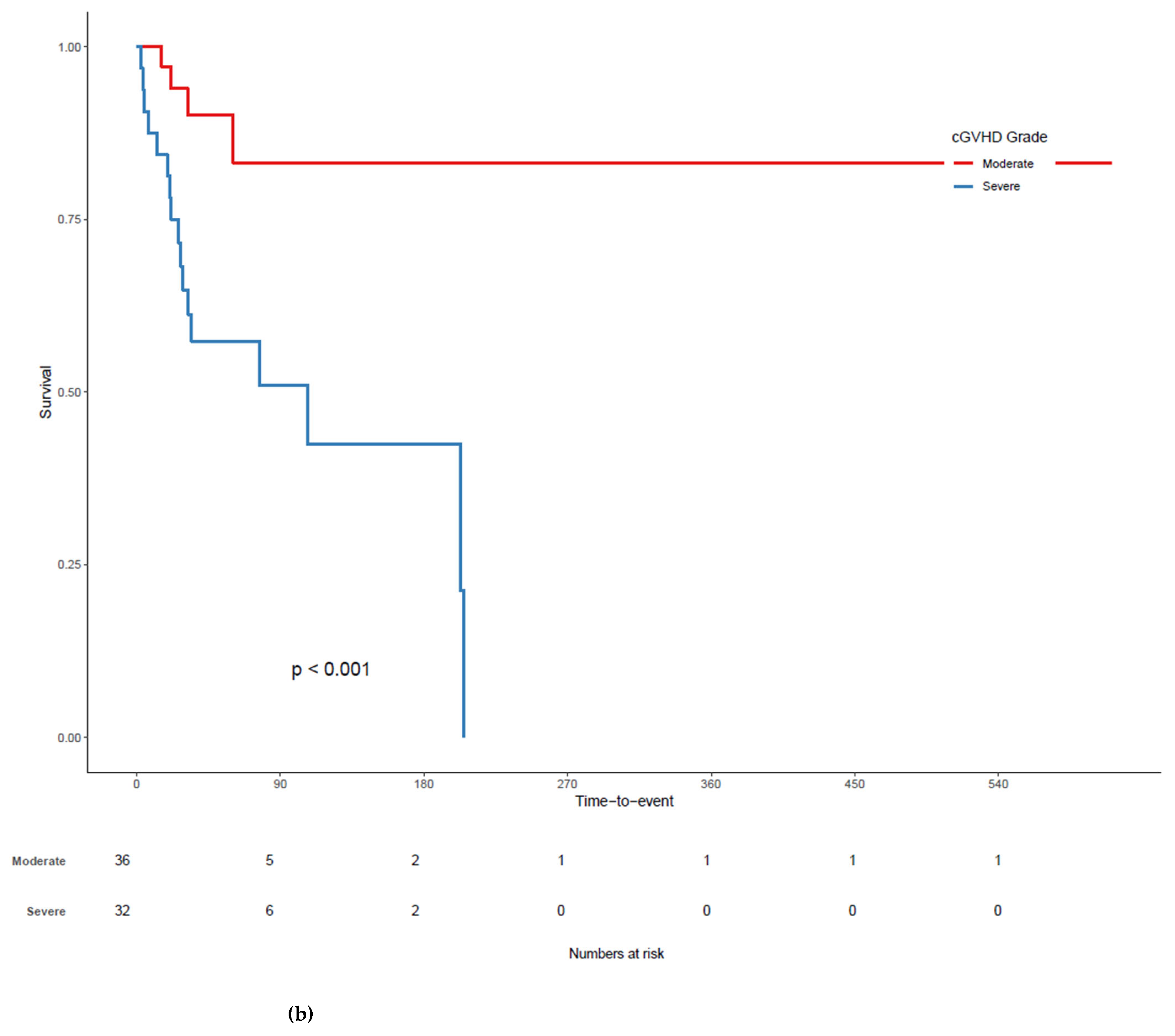
| Grade ‡ | Moderate | 36 (52.9) |
| Severe | 32 (47.1) | |
| Organ involvement ‡ | Skin | 55 (80.9) |
| Eye | 21 (30.9) | |
| Mouth | 35 (51.5) | |
| Lung | 13 (19.1) | |
| Liver | 54 (79.4) | |
| Intestine | 15 (22.1) | |
| Joints | 11 (16.1) | |
| Others (Kidney, genital organs, pericardial effusion) | 4 (5.9) | |
| Number of involved organs ‡ | 1 | 19 (27.9) |
| 2 | 3 (4.4) | |
| 3 | 25 (36.8) | |
| ≥4 | 21 (30.9) | |
| Treatment modalities for cGVHD ‡ | Steroids | 67 (98.5) |
| Cyclosporine-A | 52 (76.5) | |
| Mycophenolate mofetil | 40 (58.8) | |
| Photopheresis | 39 (57.4) | |
| Ibrutinib | 14 (20.6) | |
| Methotrexate | 13 (19.1) | |
| Rituximab | 13 (19.1) | |
| Tacrolimus | 12 (17.6) | |
| Imatinib | 10 (14.7) | |
| Bortezomib | 5 (7.4) | |
| Cyclophosphamide | 3 (4.4) | |
| Sirolimus | 3 (4.4) | |
| Mesenchymal stromal cells | 3 (4.4) | |
| Infliximab | 1 (1.5) | |
| Type of response to ruxolitinib ‡ | Partial response | 32 (47.1) |
| Complete response | 31 (45.6) | |
| No response | 5 (7.4) | |
| Overall response rate | 63 (91.3) | |
| Outcome ‡ | Survived | 47 (69.1) |
| Non-survived | 21 (30.9) | |
| Variables | Value | |
|---|---|---|
| Interval between allo-HSCT and oGVHD (day) § | 50.0 [17.0–125.0] | |
| Number of treatment lines prior to ruxolitinib § | 4.0 [2.0–5.0] | |
| Ruxolitinib duration (month) § | 7.0 [2.4–54.8] | |
| Organ involvement ‡ | Skin | 13 (86.7) |
| Eye | 6 (40.0) | |
| Mouth | 8 (53.3) | |
| Lung | 4 (26.7) | |
| Liver | 13 (86.7) | |
| Intestine | 1 (6.7) | |
| Others (Kidney, genital organs, pericardial effusion) | 1 (6.7) | |
| Number of involved organs ‡ | 1 | 3 (20.0) |
| 2 | 2 (13.3) | |
| 3 | 4 (26.7) | |
| ≥4 | 6 (40.0) | |
| Treatment modalities for oGVHD ‡ | Steroids | 15 (100.0) |
| Mycophenolate mofetil | 12 (80.0) | |
| Cyclosporine-A | 11 (73.3) | |
| Photopheresis | 11 (73.3) | |
| Tacrolimus | 5 (33.3) | |
| Ibrutinib | 5 (33.3) | |
| Rituximab | 3 (20.0) | |
| Methotrexate | 2 (13.3) | |
| Imatinib | 2 (13.3) | |
| Cyclophosphamide | 1 (6.7) | |
| Mesenchymal stromal cells | 1 (6.7) | |
| Type of response to ruxolitinib ‡ | Partial response | 7 (46.7) |
| Complete response | 6 (40.0) | |
| No response | 2 (13.3) | |
| Overall response rate | 13 (86.7) | |
| Outcome ‡ | Survived | 8 (53.3) |
| Non-survived | 7 (46.7) | |
| Variables | Values | ||
|---|---|---|---|
| Number of treatment lines prior to ruxolitinib § | 4.0 [1.0–8.0] | ||
| Roxolitinib duration (month) § | 8.0 [2.4–68.2] | ||
| Initiation dose ‡ | 5 mg once a day | 7 (8.8) | |
| 5 mg twice a day | 7 (8.8) | ||
| 10 mg once a day | 2 (2.5) | ||
| 10 mg twice a day | 62 (77.5) | ||
| Others | 2 (2.5) | ||
| Adverse effects ‡ | Cytopenia | 23 (28.7) | |
| Anemia | 18 (22.5) | ||
| Neutropenia | 19 (23.8) | ||
| Thrombocytopenia | 12 (15.0) | ||
| Infections | 40 (50.0) | ||
| Respiratory | 20 (50.0) | ||
| Gastrointestinal | 10 (25.0) | ||
| Urinary | 3 (7.5) | ||
| Soft tissue | 3 (7.5) | ||
| Others | 4 (10.0) | ||
| Virus reactivation | 24 (30.0) | ||
| CMV reactivations ‡ | 20 (25.0) | ||
| HSV reactivations ‡ | 4 (5.0) | ||
| Skin eruption | 2 (2.5) | ||
| Nausea vomiting | 5 (6.2) | ||
| Ruxolitinib withdrawal ‡ | 51 (63.7) | ||
| Reasons ‡ | Loss of clinical response under ruxolitinib | 15 (29.4) | |
| Mortality | 11 (21.6) | ||
| Clinical response | 10 (19.6) | ||
| Adverse effects | 5 (9.8) | ||
| Relapsing disease under ruxolitinib | 5 (9.8) | ||
| Lack of medication | 3 (5.9) | ||
| Secondary cancer development | 2 (3.9) | ||
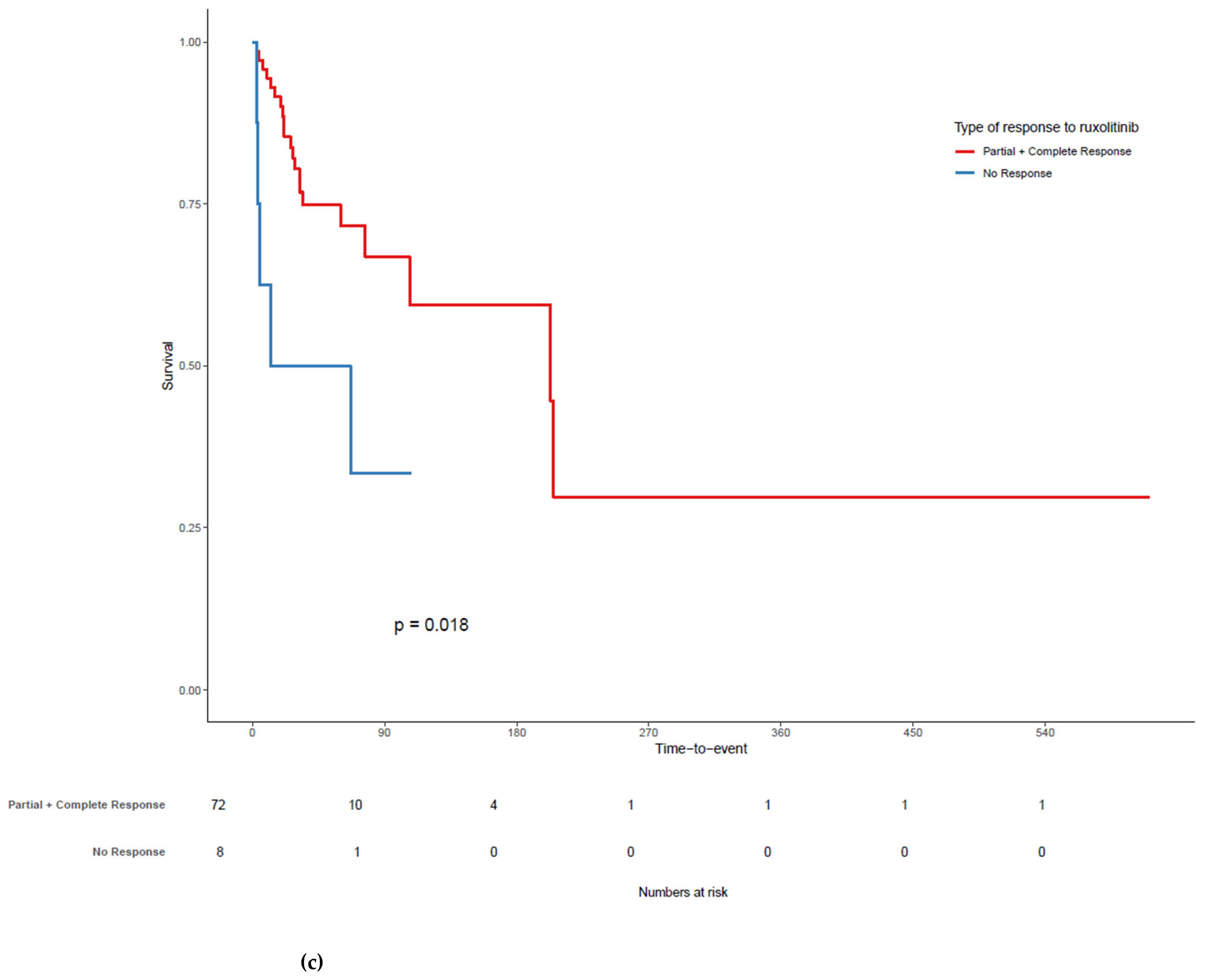
| Type of response to ruxolitinib ‡ | Partial response | 35 (43.8) | |
| Complete response | 37 (46.3) | ||
| No response | 8 (10.0) | ||
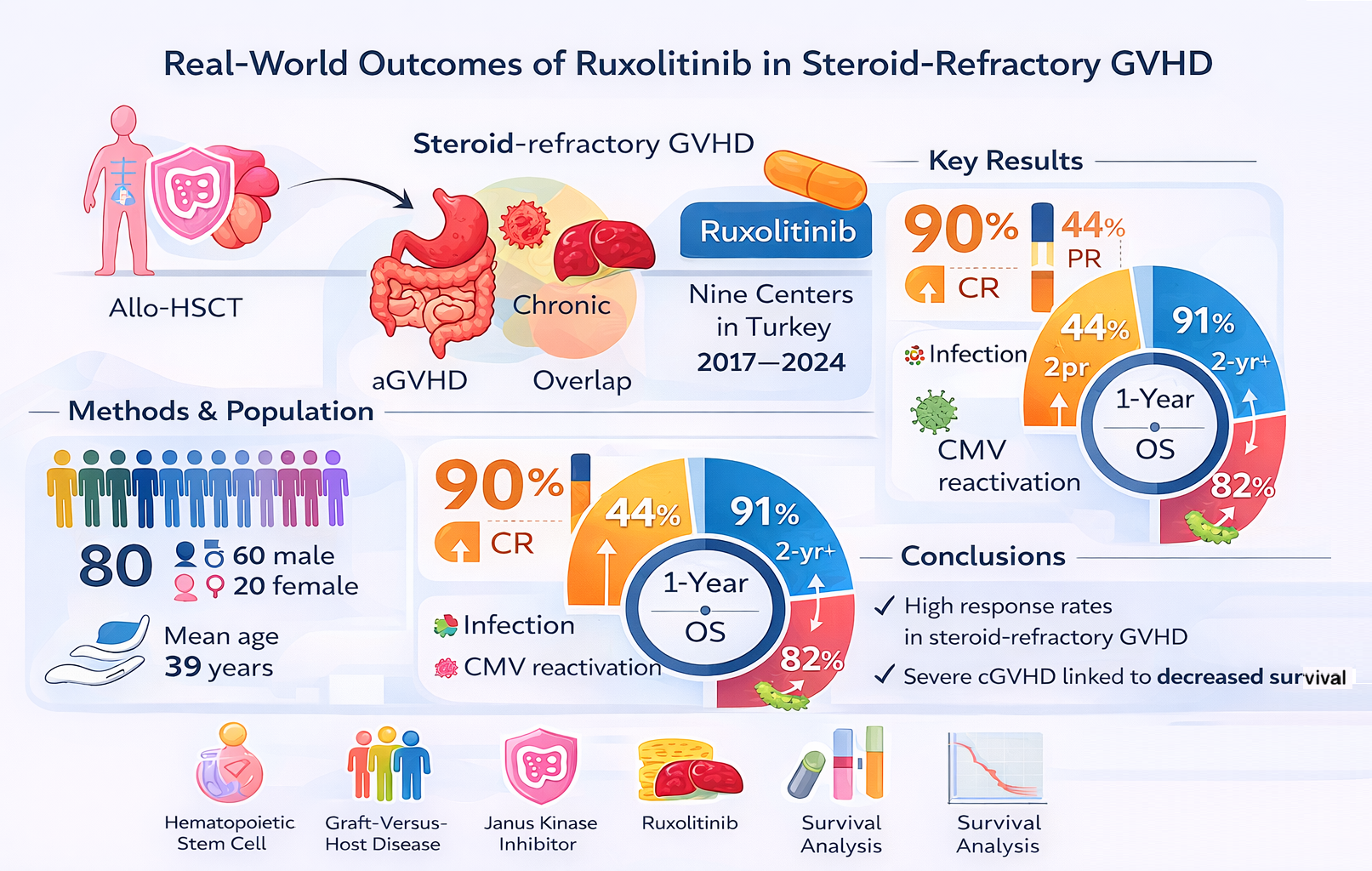
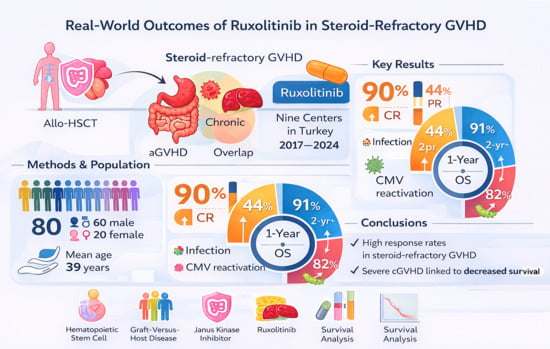
| Overall response rate | 72 (90.0) | ||
| Outcome ‡ | Survived | 54 (67.5) | |
| Non-survived | 26 (32.5) | ||
| Relapsed disease under ruxolitinib treatment ‡ | 5 (6.3) | ||
| Reason for mortality ‡ | Infections | 14 (58.3) | |
| Disease-related | 6 (25.0) | ||
| Others | 4 (16.7) | ||
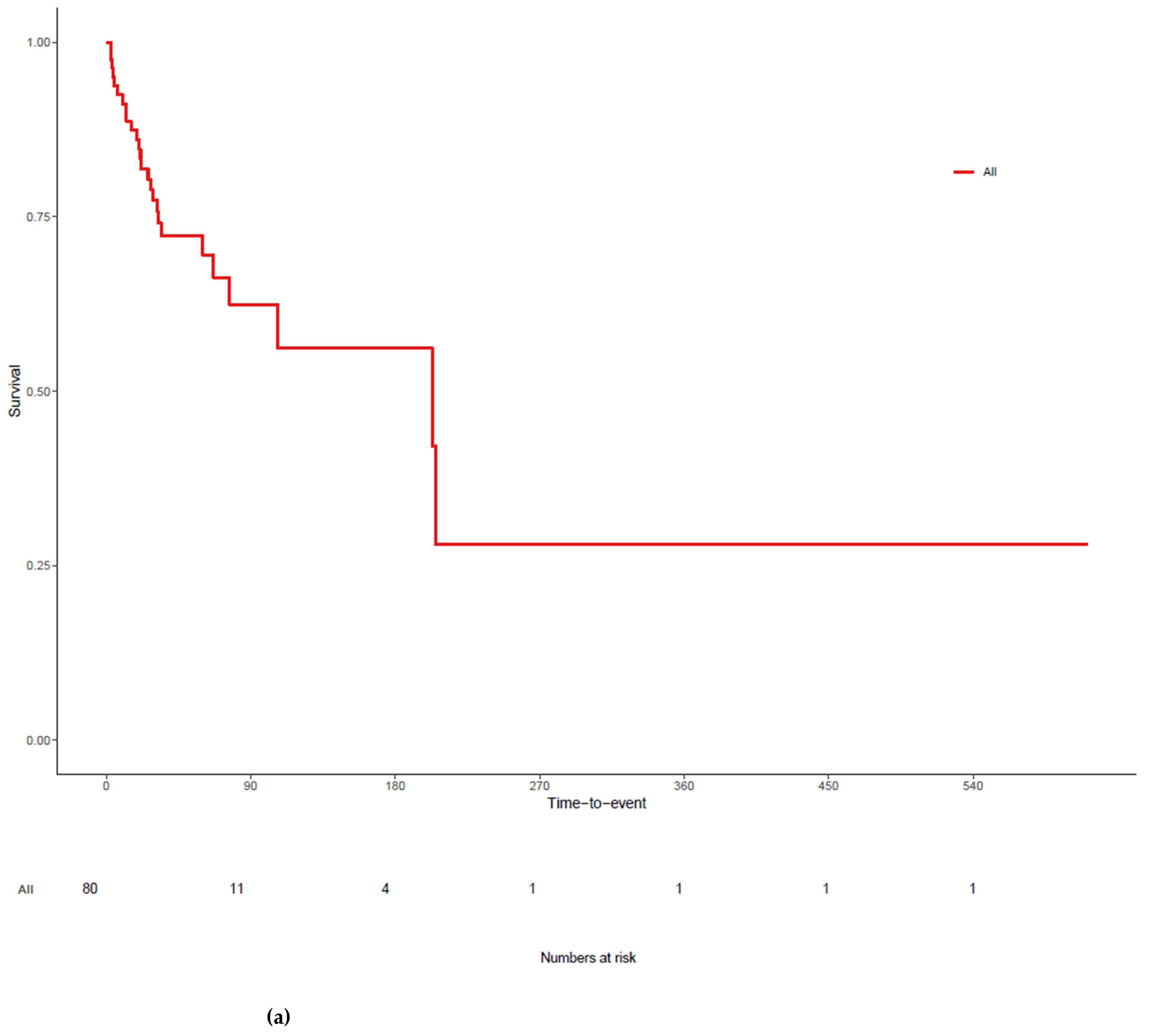
| Overall survival (month) § | 34.5 [2.7–61.1] | ||
| 1-year survival ‡ | 73 (91.3) | ||
| 2-year survival ‡ | 66 (82.5) | ||
| 5-year survival ‡ | 20 (25.0) | ||
Disclaimer/Publisher’s Note: The statements, opinions and data contained in all publications are solely those of the individual author(s) and contributor(s) and not of MDPI and/or the editor(s). MDPI and/or the editor(s) disclaim responsibility for any injury to people or property resulting from any ideas, methods, instructions or products referred to in the content. |
© 2026 by the authors. Licensee MDPI, Basel, Switzerland. This article is an open access article distributed under the terms and conditions of the Creative Commons Attribution (CC BY) license.
Share and Cite
Bakırtaş, M.; Berber, İ.; Hindilerden, İ.Y.; Dal, M.S.; İzmir Güner, Ş.; Uysal, A.; Ekinci, Ö.; Aslan Candır, B.; Eser, B.; Akpınar, S.; et al. Real-World Outcomes of Ruxolitinib as Salvage Therapy in Steroid-Refractory Acute and Chronic Graft-Versus-Host Disease: A Multicenter Retrospective Observational Study from Turkey. J. Clin. Med. 2026, 15, 2088. https://doi.org/10.3390/jcm15052088
Bakırtaş M, Berber İ, Hindilerden İY, Dal MS, İzmir Güner Ş, Uysal A, Ekinci Ö, Aslan Candır B, Eser B, Akpınar S, et al. Real-World Outcomes of Ruxolitinib as Salvage Therapy in Steroid-Refractory Acute and Chronic Graft-Versus-Host Disease: A Multicenter Retrospective Observational Study from Turkey. Journal of Clinical Medicine. 2026; 15(5):2088. https://doi.org/10.3390/jcm15052088
Chicago/Turabian StyleBakırtaş, Mehmet, İlhami Berber, İpek Yönal Hindilerden, Mehmet Sinan Dal, Şebnem İzmir Güner, Ayşe Uysal, Ömer Ekinci, Burcu Aslan Candır, Bülent Eser, Seval Akpınar, and et al. 2026. "Real-World Outcomes of Ruxolitinib as Salvage Therapy in Steroid-Refractory Acute and Chronic Graft-Versus-Host Disease: A Multicenter Retrospective Observational Study from Turkey" Journal of Clinical Medicine 15, no. 5: 2088. https://doi.org/10.3390/jcm15052088
APA StyleBakırtaş, M., Berber, İ., Hindilerden, İ. Y., Dal, M. S., İzmir Güner, Ş., Uysal, A., Ekinci, Ö., Aslan Candır, B., Eser, B., Akpınar, S., Biçim, S., Yiğenoğlu, T. N., Ulaş, T., Turgut, B., Erkurt, M. A., & Altuntaş, F. (2026). Real-World Outcomes of Ruxolitinib as Salvage Therapy in Steroid-Refractory Acute and Chronic Graft-Versus-Host Disease: A Multicenter Retrospective Observational Study from Turkey. Journal of Clinical Medicine, 15(5), 2088. https://doi.org/10.3390/jcm15052088