Development of a Triage-Level Predictive Model for Hospitalization in the Emergency Department

 , ,
, ,
Abstract
1. Introduction
2. Materials and Methods
2.1. Setting
2.2. Data Source and Study Variables
2.3. Sample Size
2.4. Statistical Analysis
3. Results
3.1. Study Population
3.2. Predictors of Hospital Admission
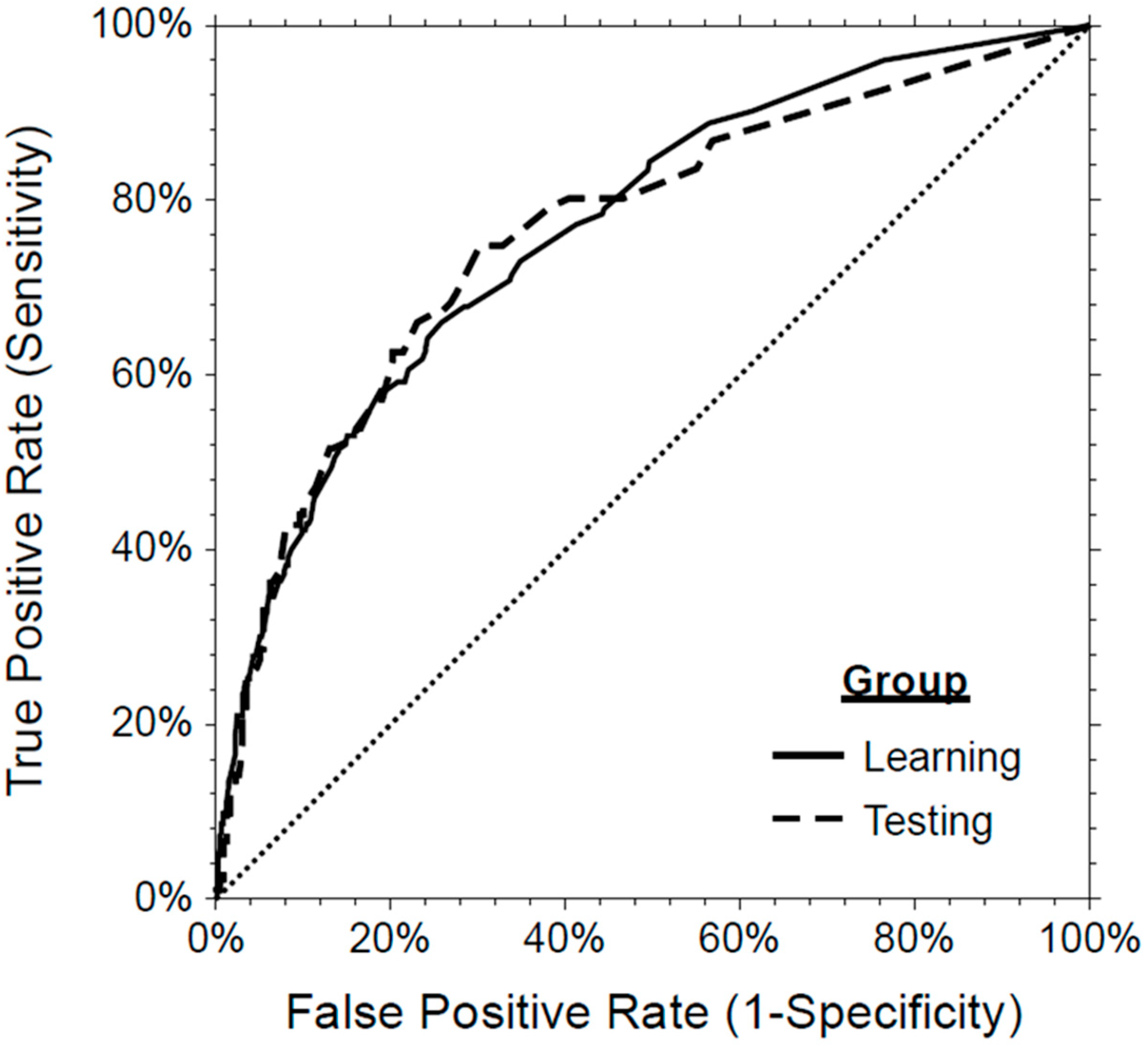
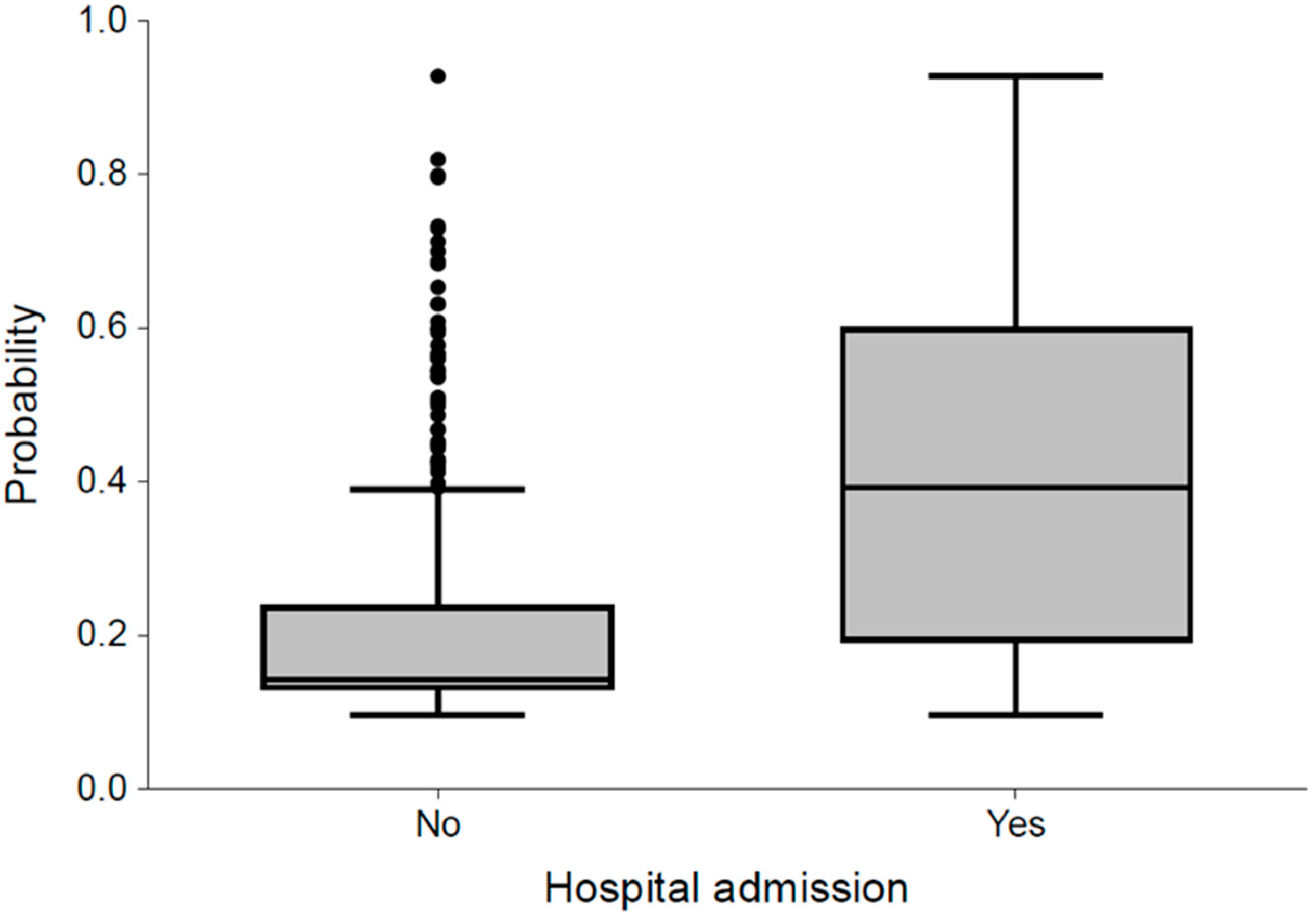
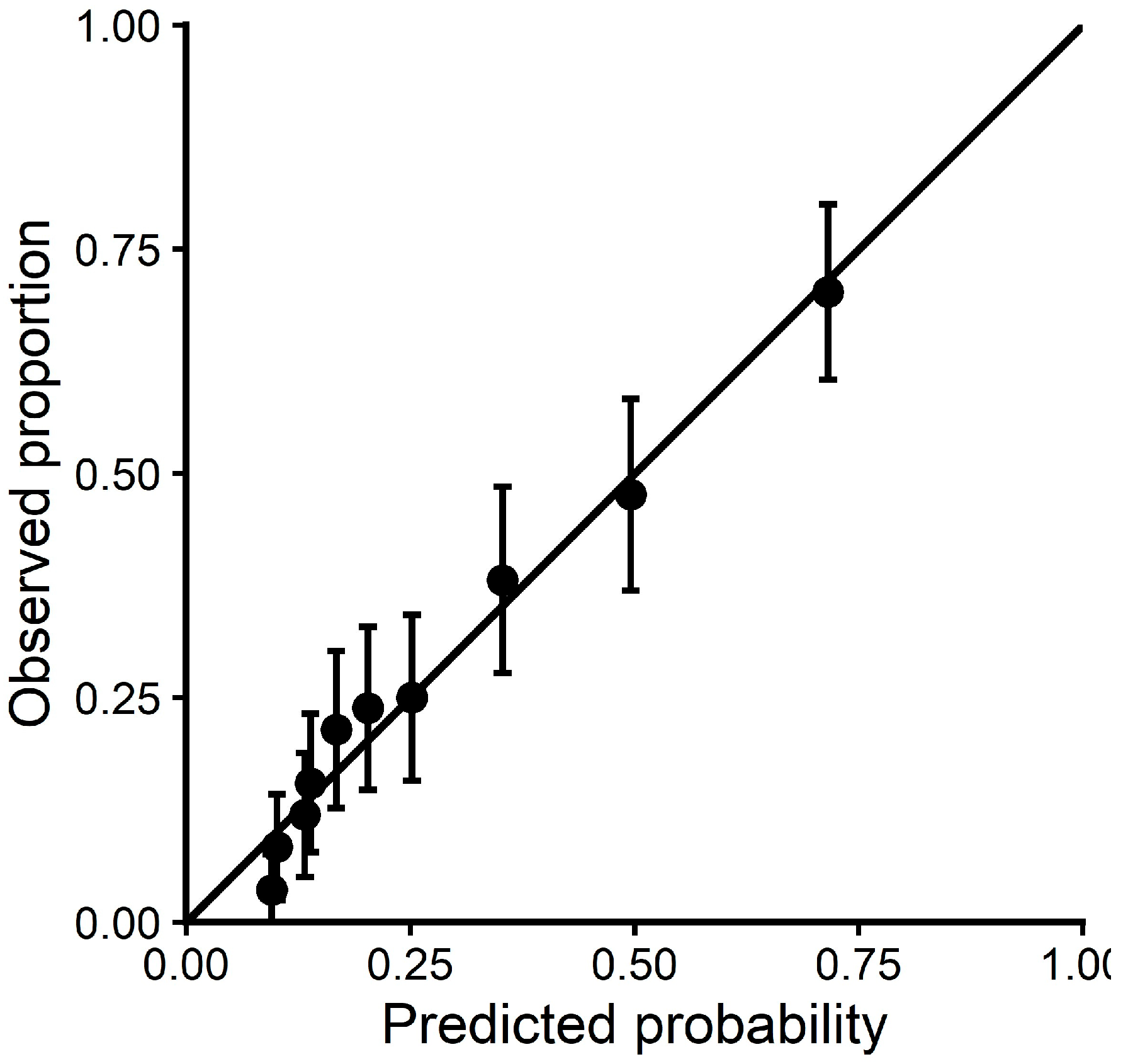
3.3. Discrimination Ability and Model Calibration
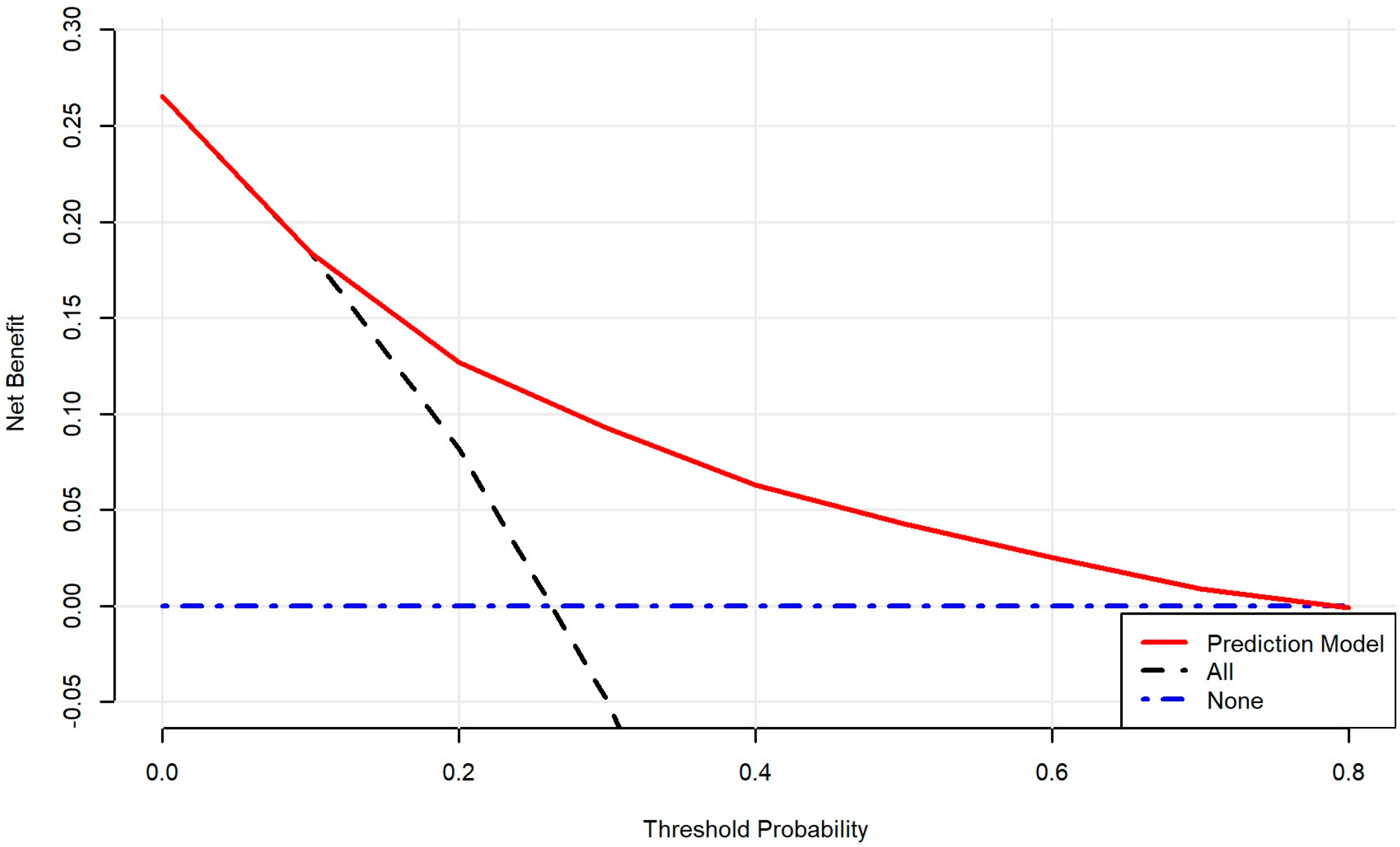
3.4. Decision Curve Analysis
3.5. Simple Prediction Tool
4. Discussion
5. Limitations
6. Conclusions
Author Contributions
Funding
Institutional Review Board Statement
Informed Consent Statement
Data Availability Statement
Conflicts of Interest
Abbreviations
| ED | Emergency department |
| MC-A | Medical center A (Tel Aviv Sourasky Medical Center) |
| MC-B | Medical center B (Shamir Medical Center) |
| AUC | Area under the (ROC) curve |
| ROC | Receiver operating characteristic |
| DS | Discrimination slope |
| IQR | Interquartile range |
| CTAS | Canadian Triage and Acuity Scale |
| BLS | Basic life support (ambulance) |
| ALS | Advanced life support (ambulance) |
| OR | Odds ratio |
| CI | Confidence interval |
| R2/pseudo R2 | Pseudo Coefficient of Determination (Nagelkerke R2) |
| SPSS | Statistical Package for the Social Sciences |
| USA | United States of America |
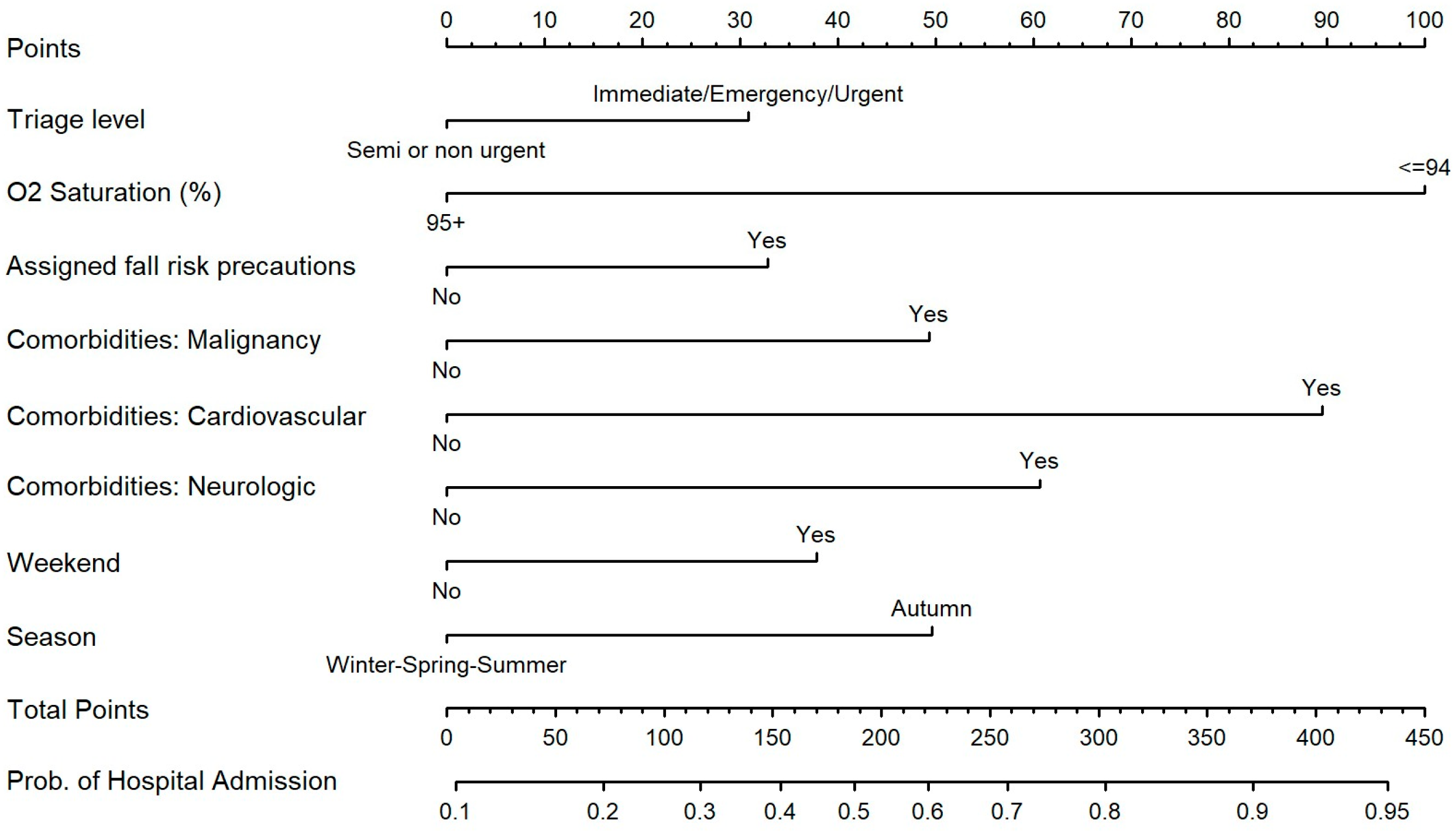
Appendix A. The Conversion of Nomograms’ Total Points to Hospitalization Probability
| Total Points | Probability |
|---|---|
| 4 | 0.1 |
| 13 | 0.11 |
| 21 | 0.12 |
| 29 | 0.13 |
| 36 | 0.14 |
| 43 | 0.15 |
| 49 | 0.16 |
| 55 | 0.17 |
| 61 | 0.18 |
| 67 | 0.19 |
| 72 | 0.2 |
| 77 | 0.21 |
| 82 | 0.22 |
| 87 | 0.23 |
| 91 | 0.24 |
| 96 | 0.25 |
| 100 | 0.26 |
| 105 | 0.27 |
| 109 | 0.28 |
| 113 | 0.29 |
| 117 | 0.3 |
| 121 | 0.31 |
| 125 | 0.32 |
| 128 | 0.33 |
| 132 | 0.34 |
| 136 | 0.35 |
| 140 | 0.36 |
| 143 | 0.37 |
| 147 | 0.38 |
| 150 | 0.39 |
| 154 | 0.4 |
| 157 | 0.41 |
| 161 | 0.42 |
| 164 | 0.43 |
| 167 | 0.44 |
| 171 | 0.45 |
| 174 | 0.46 |
| 178 | 0.47 |
| 181 | 0.48 |
| 184 | 0.49 |
| 188 | 0.5 |
| 191 | 0.51 |
| 194 | 0.52 |
| 198 | 0.53 |
| 201 | 0.54 |
| 204 | 0.55 |
| 208 | 0.56 |
| 211 | 0.57 |
| 214 | 0.58 |
| 218 | 0.59 |
| 221 | 0.6 |
| 225 | 0.61 |
| 228 | 0.62 |
| 232 | 0.63 |
| 236 | 0.64 |
| 239 | 0.65 |
| 243 | 0.66 |
| 247 | 0.67 |
| 250 | 0.68 |
| 254 | 0.69 |
| 258 | 0.7 |
| 262 | 0.71 |
| 266 | 0.72 |
| 271 | 0.73 |
| 275 | 0.74 |
| 279 | 0.75 |
| 284 | 0.76 |
| 288 | 0.77 |
| 293 | 0.78 |
| 298 | 0.79 |
| 303 | 0.8 |
| 309 | 0.81 |
| 314 | 0.82 |
| 320 | 0.83 |
| 326 | 0.84 |
| 332 | 0.85 |
| 339 | 0.86 |
| 346 | 0.87 |
| 354 | 0.88 |
| 362 | 0.89 |
| 371 | 0.9 |
| 381 | 0.91 |
| 391 | 0.92 |
| 403 | 0.93 |
| 417 | 0.94 |
| 433 | 0.95 |
References
- Pines, J.M.; Hilton, J.A.; Weber, E.J.; Alkemade, A.J.; Al Shabanah, H.; Anderson, P.D.; Bernhard, M.; Bertini, A.; Gries, A.; Ferrandiz, S.; et al. International perspectives on emergency department crowding. Acad. Emerg. Med. 2011, 18, 1358–1370. [Google Scholar] [CrossRef]
- Bernstein, S.L.; D’Onofrio, G. Public health in the emergency department: Academic Emergency Medicine consensus conference executive summary. Acad. Emerg. Med. 2009, 16, 1037–1039. [Google Scholar] [CrossRef] [PubMed]
- Horwitz, L.I.; Green, J.; Bradley, E.H. US emergency department performance on wait time and length of visit. Ann. Emerg. Med. 2010, 55, 133–141. [Google Scholar] [CrossRef] [PubMed]
- Rodi, S.W.; Grau, M.V.; Orsini, C.M. Evaluation of a fast track unit: Alignment of resources and demand results in improved satisfaction and decreased length of stay for emergency department patients. Qual. Manag. Health Care 2006, 15, 163–170. [Google Scholar] [CrossRef] [PubMed]
- Taylor, C.; Benger, J.R. Patient satisfaction in emergency medicine. Emerg. Med. J. 2004, 21, 528–532. [Google Scholar] [CrossRef]
- Spaite, D.W.; Bartholomeaux, F.; Guisto, J.; Lindberg, E.; Hull, B.; Eyherabide, A.; Lanyon, S.; Criss, E.A.; Valenzuela, T.D.; Conroy, C. Rapid process redesign in a university-based emergency department: Decreasing waiting time intervals and improving patient satisfaction. Ann. Emerg. Med. 2002, 39, 168–177. [Google Scholar] [CrossRef]
- Fernandes, C.M.; Price, A.; Christenson, J.M. Does reduced length of stay decrease the number of emergency department patients who leave without seeing a physician? J. Emerg. Med. 1997, 15, 397–399. [Google Scholar] [CrossRef]
- Goldman, R.D.; Macpherson, A.; Schuh, S.; Mulligan, C.; Pirie, J. Patients who leave the pediatric emergency department without being seen: A case-control study. Can. Med. Assoc. J. 2005, 172, 39–43. [Google Scholar] [CrossRef]
- Institute of Medicine. Hospital-Based Emergency Care: At the Breaking Point; National Academy of Sciences: Washington, DC, USA, 2007. [Google Scholar]
- Oredsson, S.; Jonsson, H.; Rognes, J.; Lind, L.; E Göransson, K.; Ehrenberg, A.; Asplund, K.; Castrén, M.; Farrohknia, N. A systematic review of triage-related interventions to improve patient flow in emergency departments. Scand. J. Trauma Resusc. Emerg. Med. 2011, 19, 43. [Google Scholar] [CrossRef]
- De Freitas, L.; Goodacre, S.; O’Hara, R.; Thokala, P.; Hariharan, S. Interventions to improve patient flow in emergency departments: An umbrella review. Emerg. Med. J. 2018, 35, 626–637. [Google Scholar] [CrossRef]
- Asplin, B.R. Measuring crowding: Time for a paradigm shift. Acad. Emerg. Med. 2006, 13, 459–461. [Google Scholar] [CrossRef] [PubMed]
- Samadbeik, M.; Staib, A.; Boyle, J.; Khanna, S.; Bosley, E.; Bodnar, D.; Lind, J.; Austin, J.A.; Tanner, S.; Meshkat, Y.; et al. Patient flow in emergency departments: A comprehensive umbrella review of solutions and challenges across the health system. BMC Health Serv. Res. 2024, 24, 274. [Google Scholar] [CrossRef] [PubMed]
- Bittencourt, R.J.; Stevanato, A.M.; Bragança, C.T.N.M.; Gottems, L.B.D.; O’Dwyer, G. Interventions in overcrowding of emergency departments: An overview of systematic reviews. Rev. Saude Publica 2020, 54, 66. [Google Scholar] [CrossRef] [PubMed]
- Conneely, M.; Leahy, S.; Dore, L.; Trépel, D.; Robinson, K.; Jordan, F.; Galvin, R. The effectiveness of interventions to reduce adverse outcomes among older adults following Emergency Department discharge: Umbrella review. BMC Geriatr. 2022, 22, 462. [Google Scholar] [CrossRef]
- Ming, T.; Lai, A.; Lau, P.M. Can team triage improve patient flow in the emergency department A systematic review and meta-analysis. Adv. Emerg. Nurs. J. 2016, 38, 233–250. [Google Scholar] [CrossRef]
- Li, Y.; Horowitz, M.A.; Liu, J.; Chew, A.; Lan, H.; Liu, Q.; Sha, D.; Yang, C. Individual-Level Fatality Prediction of COVID-19 Patients Using AI Methods. Front. Public Health 2020, 8, 587937. [Google Scholar] [CrossRef]
- Feretzakis, G.; Sakagianni, A.; Kalles, D.; Loupelis, E.; Panteris, V.; Tzelves, L.; Chatzikyriakou, R.; Trakas, N.; Kolokytha, S.; Batiani, P.; et al. Using Machine Learning for Predicting the Hospitalization of Emergency Department Patients. Adv. Inform. Manag. Technol. Healthc. 2022, 295, 405–408. [Google Scholar] [CrossRef]
- Feretzakis, G.; Karlis, G.; Loupelis, E.; Kalles, D.; Chatzikyriakou, R.; Trakas, N.; Karakou, E.; Sakagianni, A.; Tzelves, L.; Petropoulou, S.; et al. Using machine learning techniques to predict hospital admission at the emergency department. J. Crit. Care Med. 2022, 8, 107–116. [Google Scholar] [CrossRef]
- Feretzakis, G.; Sakagianni, A.; Loupelis, E.; Karlis, G.; Kalles, D.; Tzelves, L.; Chatzikyriakou, R.; Trakas, N.; Petropoulou, S.; Tika, A.; et al. Predicting Hospital Admission for Emergency Department Patients: A Machine Learning Approach. Inform. Technol. Clin. Care Public Health 2022, 289, 297–300. [Google Scholar] [CrossRef]
- Berros, N.; Filaly, Y.; El Mendili, F.; El Bouzekri El Idrissi, Y. Scalable Predictive Modeling for Hospitalization Prioritization: A Hybrid Batch–Streaming Approach. Big Data Cogn. Comput. 2025, 9, 271. [Google Scholar] [CrossRef]
- Van der Linden, M.C.; Van Loon-van Gaalen, M.; Meylaerts, S.A.G.; Quarles Van Ufford, H.M.E.; Woldhek, A.; Van Woerden, G.; Van der Linden, N. Improving emergency department flow by introducing four interventions simultaneously. A quality improvement project. Int. Emerg. Nurs. 2024, 76, 101499. [Google Scholar] [CrossRef] [PubMed]
- Kim, J.-K. Enhancing Patient Flow in Emergency Departments: A Machine Learning and Simulation-Based Resource Scheduling Approach. Appl. Sci. 2024, 14, 4264. [Google Scholar] [CrossRef]
- Ministry of Health, Israel. Emergency Department Visits and Activity Characteristics in Israel. 2022. Available online: https://www.gov.il/BlobFolder/reports/er/he/files_publications_units_info_emergency_2022.pdf (accessed on 16 July 2025).
- Kolikof, J.; Shaw, D.; Stenson, B.; Balaji, L.; Grossestreuer, A.; Chiu, D. Emergency Department Boarding, Crowding, and Error. JACEP Open 2025, 6, 100169. [Google Scholar] [CrossRef] [PubMed]
- Kelen, G.D.; Wolfe, R.; D’Onofrio, G.; Mills, A.M.; Diercks, D.; Stern, S.A.; Wadman, M.C.; Sokolove, P.E. Emergency Department Crowding: The Canary in the Health Care System. NEJM Catal. 2021, 2, 5. [Google Scholar] [CrossRef]
- Sartini, M.; Carbone, A.; Demartini, A.; Giribone, L.; Oliva, M.; Spagnolo, A.M.; Cremonesi, P.; Canale, F.; Cristina, M.L. Overcrowding in Emergency Department: Causes, Consequences, and Solutions-A Narrative Review. Healthcare 2022, 10, 1625. [Google Scholar] [CrossRef]
- Peltan, I.D.; Bledsoe, J.R.; Oniki, T.A.; Sorensen, J.; Jephson, A.R.; Allen, T.L.; Samore, M.H.; Hough, C.L.; Brown, S.M. Emergency department crowding is associated with delayed antibiotics for sepsis. Ann. Emerg. Med. 2019, 73, 345–355. [Google Scholar] [CrossRef]
- Morley, C.; Unwin, M.; Peterson, G.M.; Stankovich, J.; Kinsman, L. Emergency department crowding: A systematic review of causes, consequences and solutions. PLoS ONE 2018, 13, e020331. [Google Scholar] [CrossRef]
- Butun, A.; Kafdag, E.E.; Gunduz, H.; Zincir, V.; Batibay, M.; Ciftci, K.; Demir, D.; Bayram, R.; Yigit, E. Emergency department overcrowding: Causes and solutions. Emerg. Crit. Care Med. 2023, 3, 171–176. [Google Scholar] [CrossRef]
- Parker, C.A.; Liu, N.; Wu, S.X.; Shen, Y.; Lam, S.S.W.; Ong, M.E.H. Predicting hospital admission at the emergency department triage: A novel prediction model. Am. J. Emerg. Med. 2019, 37, 1498–1504. [Google Scholar] [CrossRef]
- Kishore, K.; Braitberg, G.; Holmes, N.E.; Bellomo, R. Early prediction of hospital admission of emergency department patients. Emerg. Med. Australas. 2023, 35, 572–588. [Google Scholar] [CrossRef]
- Flow Improvement Strategies: Provider-In-Triage (PIT). Common Sense-American Academy of Emergency Medicine. Published 2019. Available online: https://www.aaem.org/UserFiles/file/OMCArticleJanFeb19.pdf (accessed on 13 July 2020).
- PhysicianFirst Emergency Department Management Model: Decreases Walk-outs and Improves Patient Satisfaction. Available online: https://www.usacs.com/physicianfirst-program (accessed on 13 July 2020).
- Benabbas, R.; Shah, R.; Zonnoor, B.; Mehta, N.; Sinert, R. Impact of triage liaison provider on emergency department throughput: A systematic review and meta-analysis. Am. J. Emerg. Med. 2020, 38, 1662–1670. [Google Scholar] [CrossRef]
- Abdulwahid, M.A.; Booth, A.; Kuczawski, M.; Mason, S.M. The impact of senior doctor assessment at triage on emergency department performance measures: Systematic review and meta-analysis of comparative studies. Emerg. Med. J. 2016, 33, 504–513. [Google Scholar] [CrossRef]
- Jesionowski, M. Emergency department left without being seen rates and staff perceptions post-implementation of a rapid medical evaluation and a provider in triage. J. Emerg. Nurs. 2019, 45, 38–45. [Google Scholar] [CrossRef]
- Franklin, B.J.; Li, K.Y.; Somand, D.M.; Kocher, K.E.; Kronick, S.L.; Parekh, V.I.; Goralnick, E.; Nix, A.T.; Haas, N.L. Emergency department provider in triage: Assessing site-specific rationale, operational feasibility, and financial impact. J. Am. Coll. Emerg. Physicians Open 2021, 2, e12450. [Google Scholar] [CrossRef]
- Kawano, T.; Nishiyama, K.; Hayashi, H. Execution of Diagnostic Testing Has a Stronger Effect on Emergency Department Crowding than Other Common Factors: A Cross-Sectional Study. PLoS ONE 2014, 9, e108447. [Google Scholar] [CrossRef]
- Li, L.; Georgiou, A.; Vecellio, E.; Eigenstetter, A.; Toouli, G.; Wilson, R.; Westbrook, J.I. The Effect of Laboratory Testing on Emergency Department Length of Stay: A Multihospital Longitudinal Study Applying a Cross-classified Random-effect Modeling Approach. Acad. Emerg. Med. 2015, 22, 38–46. [Google Scholar] [CrossRef]



| Group | |||
|---|---|---|---|
| Learning | Testing | Validation | |
| (n = 879) | (n = 377) | (n = 180) | |
| Demography | |||
| Age (years), median (IQR) | 50 (31–71) | 47 (33–69) | 50 (29–70) |
| Female, n (%) | 434 (49.4%) | 193 (51.2%) | 94 (52.2%) |
| Urgency | |||
| Triage levels, n (%) | |||
| Immediate/emergency (1–2) | 60 (6.8%) | 22 (5.8%) | 15 (8.3%) |
| Urgent (3) | 371 (42.2%) | 164 (43.5%) | 124 (68.9%) |
| Semi- or non-urgent (4–5) | 448 (51.0%) | 191 (50.7%) | 41 (22.8%) |
| Pulse (bpm), median (IQR) | 80 (70–91) | 83 (71–94) | 80 (71–92) |
| Blood pressure (mmHg), median (IQR) | |||
| Systolic | 136 (124–153) | 136 (122–154) | 129 (115–148) |
| Diastolic | 79 (69–88) | 78 (70–88) | 78 (71–85) |
| O2 Saturation (%), median (IQR) | 98 (97–100) | 98 (97–100) | 98 (97–100) |
| Temperature (°C), median (IQR) | 36.8 (36.6–37.0) | 36.7 (36.6–37.0) | 36.7 (36.6–37.0) |
| Entry information | |||
| Initial admitting diagnosis, n (%) | |||
| Medical | 580 (66.0%) | 257 (68.2%) | 114 (63.3%) |
| Surgical/trauma | 299 (34.0%) | 120 (31.8%) | 66 (36.7%) |
| Medical referral, n (%) | 371 (42.2%) | 174 (46.2%) | 87 (48.3%) |
| Mode of transportation, n (%) | |||
| Private vehicle | 617 (70.2%) | 262 (69.5%) | 130 (72.2%) |
| BLS * Ambulance | 204 (23.2%) | 99 (26.3%) | 35 (19.4%) |
| ALS ** Ambulance | 58 (6.6%) | 16 (4.2%) | 15 (8.3%) |
| Time of arrival, n (%) | |||
| Morning (7 a.m.–3 p.m.) | 297 (33.8%) | 111 (29.4%) | 60 (33.3%) |
| Evening (3 p.m.–11 p.m.) | 276 (31.4%) | 126 (33.4%) | 60 (33.3%) |
| Night (11 p.m.–7 a.m.) | 306 (34.8%) | 140 (37.1%) | 60 (33.3%) |
| Weekend, n (%) | 260 (29.6%) | 105 (27.9%) | 41 (27.9%) |
| Season, n (%) | |||
| Autumn | 209 (23.8%) | 74 (19.6%) | 45 (25.0%) |
| Winter | 233 (26.5%) | 98 (26.0%) | 45 (25.0%) |
| Spring | 211 (24.0%) | 103 (27.3%) | 45 (25.0%) |
| Summer | 226 (25.7%) | 102 (27.1%) | 45 (25.0%) |
| Assigned fall risk precautions, n (%) | 254 (28.9%) | 102 (27.1%) | 45 (25.0%) |
| Comorbidities | |||
| Cardiovascular, n (%) | 222 (25.3%) | 81 (21.5%) | 62 (34.4%) |
| Neurologic, n (%) | 75 (8.5%) | 26 (6.9%) | 21 (11.7%) |
| Respiratory, n (%) | 67 (7.6%) | 31 (8.2%) | 21 (11.7%) |
| Malignancy, n (%) | 69 (7.8%) | 25 (6.6%) | 11 (6.1%) |
| Outcome | |||
| Hospital admission, n (%) | 231 (26.3%) | 99 (26.3%) | 51 (28.3%) |
| Hospital Admission | |||
|---|---|---|---|
| No | Yes | p | |
| (n = 648 | (n = 231) | ||
| Demography | |||
| Age (years), median (IQR) | 45 (30–67) | 65 (39–82) | <0.001 |
| Female, n (%) | 324 (50%) | 110 (47.6%) | 0.534 |
| Urgency | |||
| Triage levels, n (%) | <0.001 | ||
| Immediate/emergency (1–2) | 32 (4.9%) | 28 (12.1%) | |
| Urgent (3) | 255 (39.4%) | 116 (50.2%) | |
| Semi- or non-urgent (4–5) | 361 (55.7%) | 87 (37.7%) | |
| Pulse (bpm), median (IQR) | 80 (70–91) | 83 (72–95) | 0.038 |
| Blood pressure (mmHg), median (IQR) | |||
| Systolic | 135 (123–151) | 139.5 (125–156) | 0.045 |
| Diastolic | 79 (69.5–88) | 79 (68–88) | 0.968 |
| O2 Saturation (%), median (IQR) | 99 (97–100) | 98 (95–99) | <0.001 |
| Temperature (°C), median (IQR) | 36.8 (36.6–37) | 36.8 (36.6–37) | 0.973 |
| Entry information | |||
| Initial admitting diagnosis, n (%) | 0.380 | ||
| Medical | 433 (66.8%) | 147 (63.6%) | |
| Surgical/trauma | 215 (33.2%) | 84 (36.4%) | |
| Medical referral, n (%) | 270 (41.7%) | 101 (43.7%) | 0.587 |
| Mode of transportation, n (%) | <0.001 | ||
| Private vehicle | 485 (74.8%) | 132 (57.1%) | |
| * BLS Ambulance | 134 (20.7%) | 70 (30.3%) | |
| ** ALS Ambulance | 29 (4.5%) | 29 (12.6%) | |
| Time of arrival, n (%) | 0.869 | ||
| Morning (7:00 a.m.–3:00 p.m.) | 222 (34.3%) | 75 (32.5%) | |
| Evening (3:00 p.m.–11:00 p.m.) | 201 (31.0%) | 75 (32.5%) | |
| Night (11:00 p.m.–7:00 a.m.) | 225 (34.7%) | 81 (35.1%) | |
| Weekend, n (%) | 174 (26.9%) | 86 (37.2%) | 0.003 |
| Season, n (%) | 0.039 | ||
| Autumn | 140 (21.6%) | 69 (29.9%) | |
| Winter | 171 (26.4%) | 62 (26.8%) | |
| Spring | 167 (25.8%) | 44 (19.0%) | |
| Summer | 170 (26.2%) | 56 (24.2%) | |
| Assigned fall risk precautions, n (%) | 143 (22.1%) | 111 (48.1%) | <0.001 |
| Comorbidities | |||
| Cardiovascular, n (%) | 106 (16.4%) | 116 (50.2%) | <0.001 |
| Neurologic, n (%) | 31 (4.8%) | 44 (19.0%) | <0.001 |
| Respiratory, n (%) | 41 (6.3%) | 26 (11.3%) | 0.015 |
| Malignancy, n (%) | 31 (4.8%) | 38 (16.5%) | <0.001 |
| B | OR (95%CI) | p | |
|---|---|---|---|
| Triage level: Immediate/Emergency/Urgent | 0.369 | 1.447 (1.019–2.054) | 0.039 |
| O2 Saturation < 95% | 1.199 | 3.316 (1.886–5.832) | <0.001 |
| Assigned fall risk precautions | 0.393 | 1.482 (0.995–2.206) | 0.053 |
| Comorbidities: Malignancy | 0.592 | 1.807 (1.017–3.211) | 0.044 |
| Comorbidities: Cardiovascular | 1.073 | 2.925 (1.974–4.335) | <0.001 |
| Comorbidities: Neurologic | 0.727 | 2.069 (1.159–3.693) | 0.014 |
| Weekend | 0.453 | 1.573 (1.095–2.261) | 0.014 |
| Season: Autumn | 0.594 | 1.812 (1.230–2.669) | 0.003 |
| Constant | −2.248 |
Disclaimer/Publisher’s Note: The statements, opinions and data contained in all publications are solely those of the individual author(s) and contributor(s) and not of MDPI and/or the editor(s). MDPI and/or the editor(s) disclaim responsibility for any injury to people or property resulting from any ideas, methods, instructions or products referred to in the content. |
© 2026 by the authors. Licensee MDPI, Basel, Switzerland. This article is an open access article distributed under the terms and conditions of the Creative Commons Attribution (CC BY) license.
Share and Cite
Trotzky, D.; Preisler, Y.; Amoyal, A.; Pachys, G.; Mosery, J.; Cohen, A.; Avisar, S.; Ziv Baran, T. Development of a Triage-Level Predictive Model for Hospitalization in the Emergency Department. J. Clin. Med. 2026, 15, 1901. https://doi.org/10.3390/jcm15051901
Trotzky D, Preisler Y, Amoyal A, Pachys G, Mosery J, Cohen A, Avisar S, Ziv Baran T. Development of a Triage-Level Predictive Model for Hospitalization in the Emergency Department. Journal of Clinical Medicine. 2026; 15(5):1901. https://doi.org/10.3390/jcm15051901
Chicago/Turabian StyleTrotzky, Daniel, Yoav Preisler, Almog Amoyal, Gal Pachys, Jonathan Mosery, Aya Cohen, Shiran Avisar, and Tomer Ziv Baran. 2026. "Development of a Triage-Level Predictive Model for Hospitalization in the Emergency Department" Journal of Clinical Medicine 15, no. 5: 1901. https://doi.org/10.3390/jcm15051901
APA StyleTrotzky, D., Preisler, Y., Amoyal, A., Pachys, G., Mosery, J., Cohen, A., Avisar, S., & Ziv Baran, T. (2026). Development of a Triage-Level Predictive Model for Hospitalization in the Emergency Department. Journal of Clinical Medicine, 15(5), 1901. https://doi.org/10.3390/jcm15051901