The Importance of the “Damage Control” Strategy in Multiple Organ Injuries, Pathophysiology and Principles of Hemorrhage Control

 , , , , ,
Abstract
1. Introduction
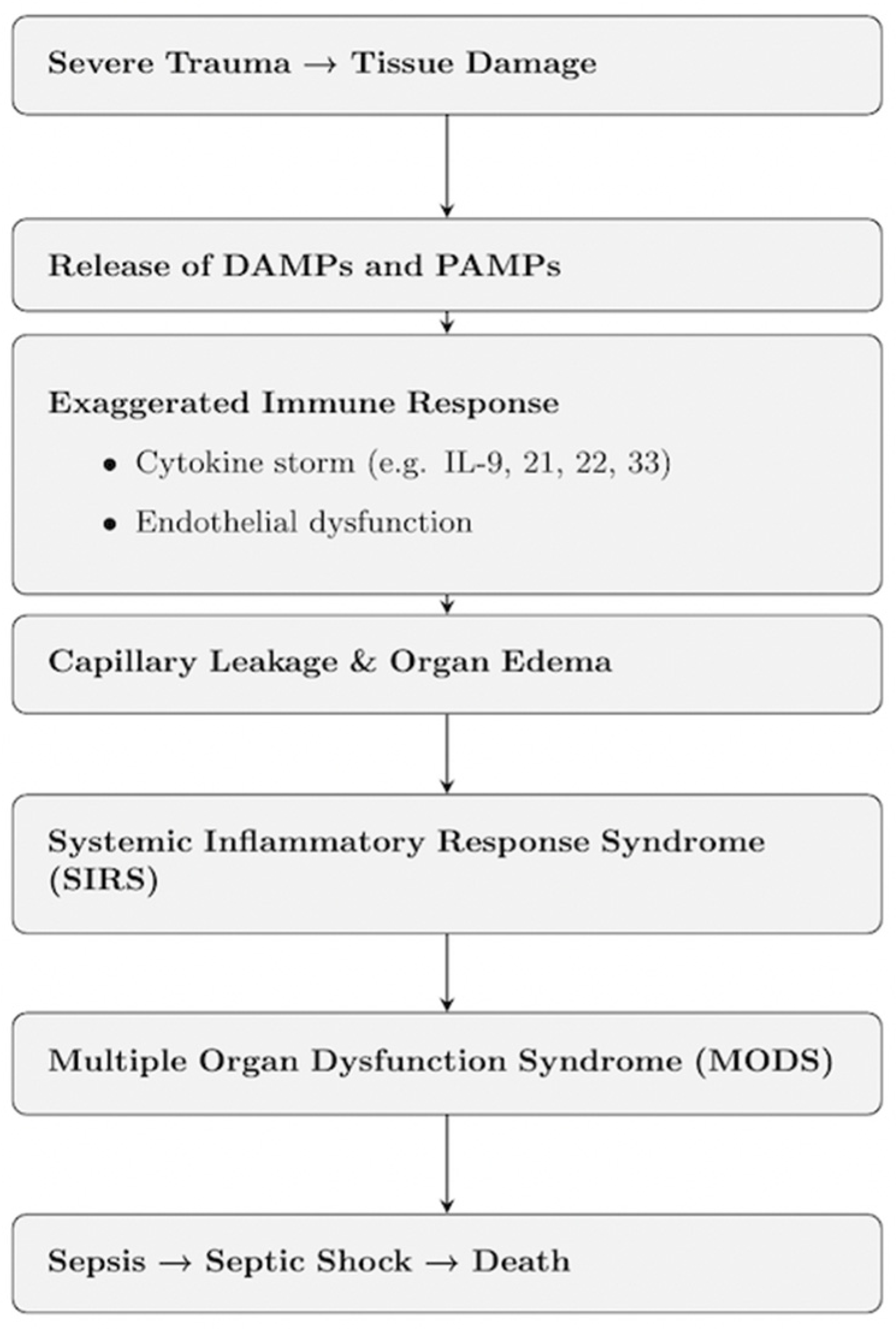
2. Pathophysiology of Multiple Trauma
2.1. Classification of Multiple Trauma—Mechanisms of Injury
2.2. Cellular-Level Mechanisms
2.3. Endothelial Dysfunction and Its Impact on Organ Function
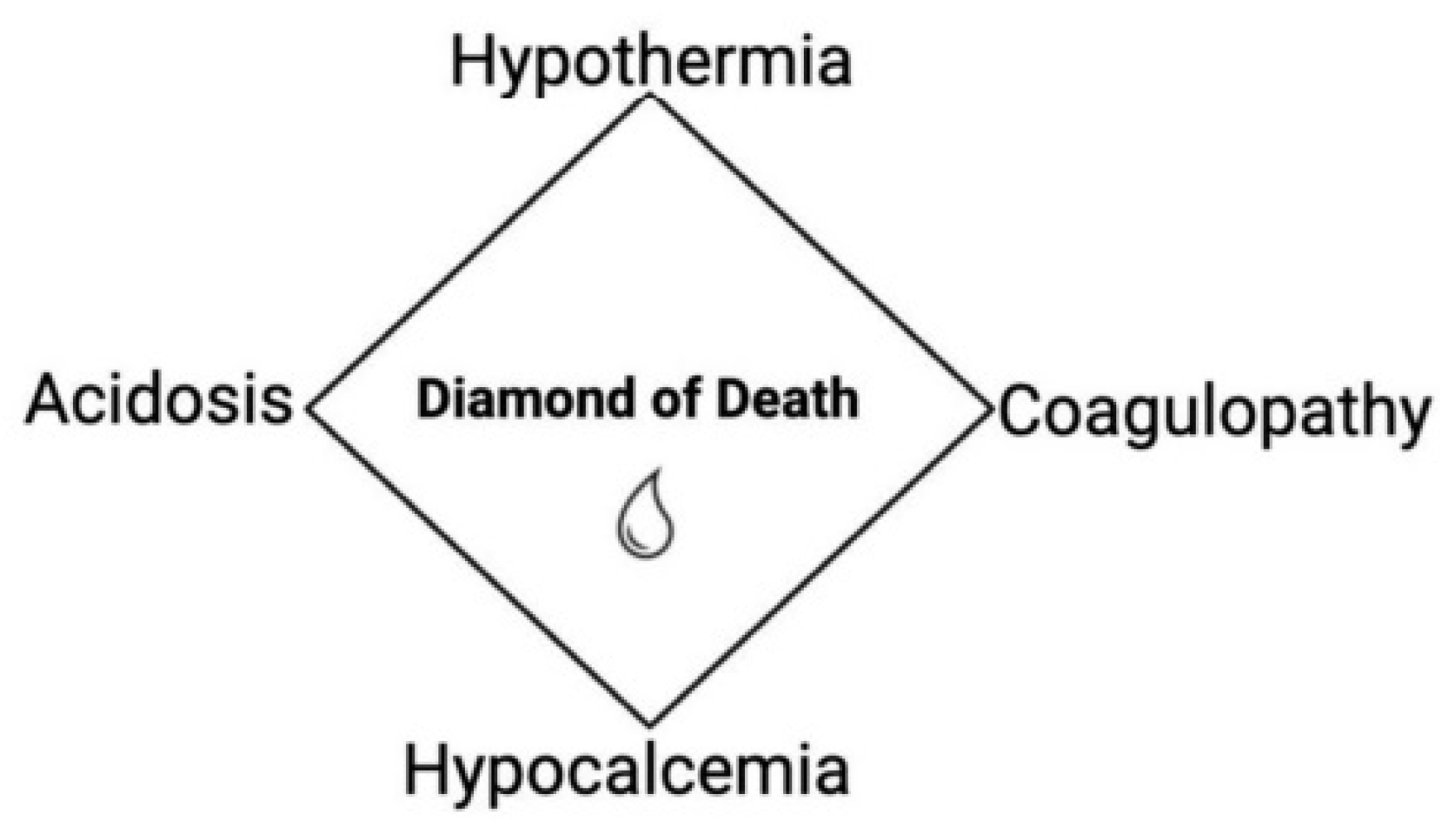
2.4. Diamond of Death—Interactions Between Components—The Impact of Blood Loss on Organ Function
2.5. Causes of Death in Multiple Trauma
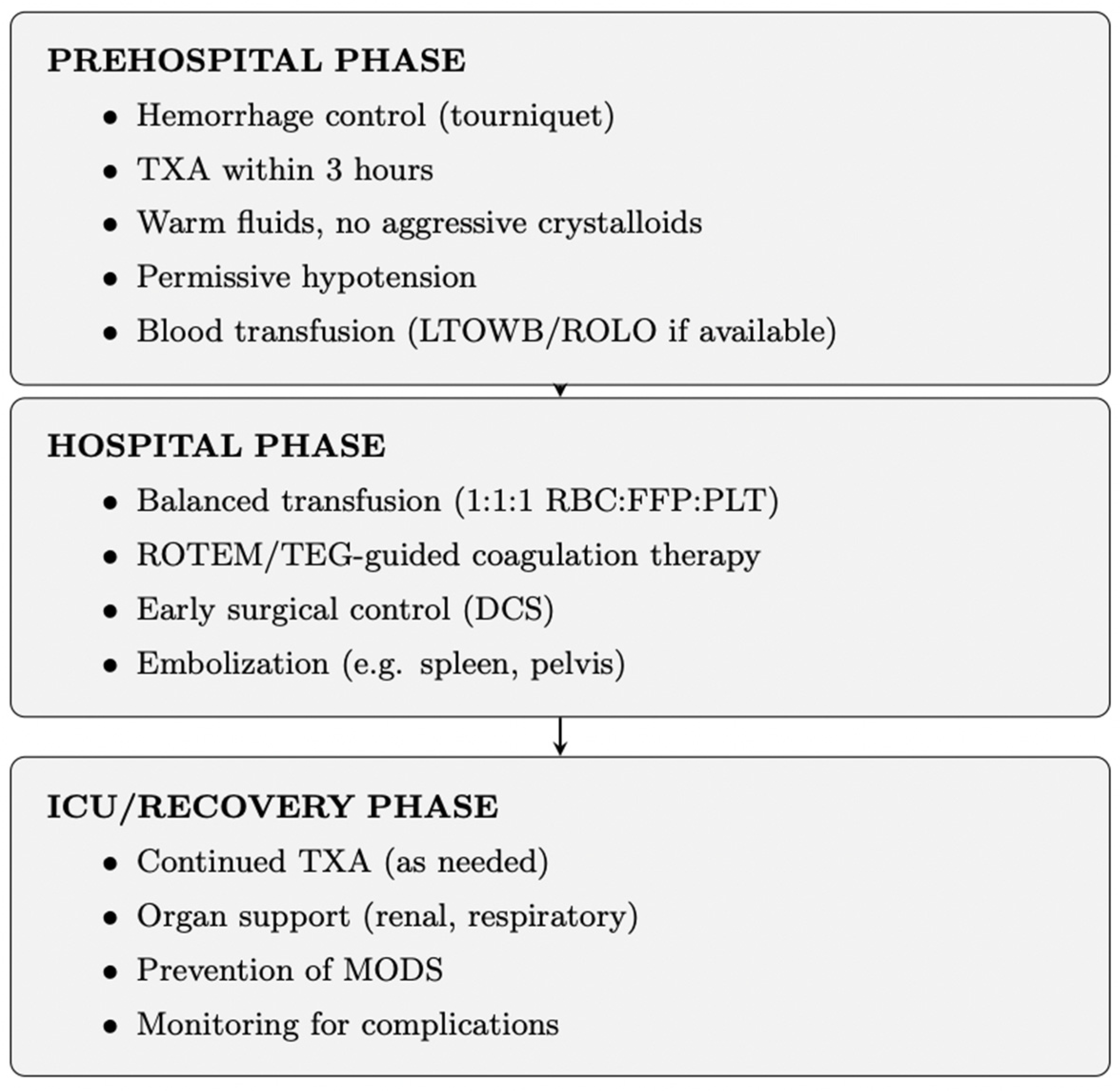
3. Main Strategies of DCR (Figure 3)
3.1. Early Blood and Blood Product Transfusion
3.2. The Role of Factor VIIa and Fibrinogen in Hemorrhage Control
3.3. Early Hemorrhage Source Control
3.4. The Importance of Early Embolization
3.5. Transport Time and Survival
3.6. Preventing the Death Triad: Hypothermia, Acidosis, Coagulopathy
3.7. TXA

4. Application of “Damage Control” in Prehospital Conditions
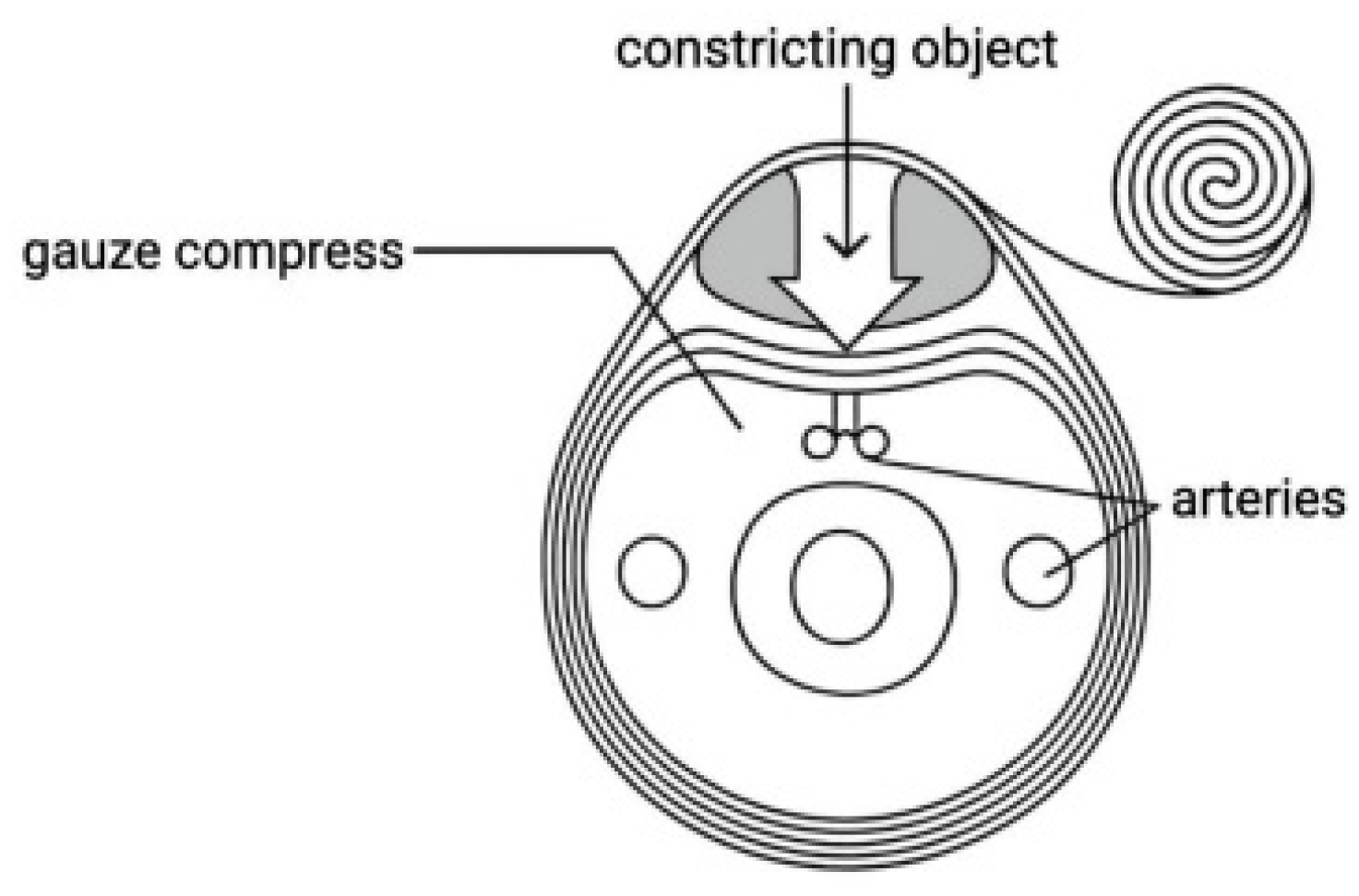
4.1. Hemorrhage Control
4.2. Blood Transfusion
4.3. Pain Management
4.4. Impact of Transport Modality and Trauma Center Level on Survival Outcomes in Severely Injured Patients: The Critical Role of HEMS in DCR
5. Review of Scientific Studies and Current Guidelines
6. Summary and Conclusions
Author Contributions
Funding
Institutional Review Board Statement
Informed Consent Statement
Data Availability Statement
Conflicts of Interest
Abbreviations
| REBOA | Resuscitative Endovascular Balloon Occlusion of the Aorta |
| AOCs/HBOCs | hemoglobin-based oxygen carriers |
| SMP | shape-memory polymer |
| SCA | Sudden cardiac arrest |
| CPR | Cardiopulmonary |
| ISS | Injury Severity Score |
| LAA | London Air Ambulance |
| PFD | Perfluorodecalin |
| RBC | Red blood cell |
| AOCs | Artificial Oxygen Carriers |
| DCR | Damage Control Resuscitation |
| ARDS | Acute Respiratory Distress Syndrome |
| AKI | Acute Kidney Injury |
| ACS | American College of Surgeons |
| ROTEM | Rotational thromboelastometry |
| TEG | Thromboelastography |
| TXA | Tranexamic Acid |
| HEMS | Helicopter Emergency Medical Services |
| AIS | Abbreviated Injury Scale |
| DAMPs | Damage-Associated Molecular Patterns |
| PAMPs | Pathogen-Associated Molecular Patterns |
| SIRS | Systemic Inflammatory Response Syndrome |
| MODS | Multiple Organ Dysfunction Syndrome |
| PTH | Parathyroid Hormone |
| MOF | Multiple Organ Failure |
| MAP | Mean Arterial Pressure |
| FFP | Fresh Frozen Plasma |
| WB | Whole Blood |
| rFVIIa | Recombinant Factor VIIa |
| GCS | Glasgow Coma Scale |
| FC | Fibrinogen Concentrate |
| PCC | Prothrombin Complex Concentrate |
| DCS | Damage Control Surgery |
| TIVS | Temporary Intravascular Shunts |
| CNS | Central Nervous System |
| LTOWB | Low-titer Group O Whole Blood |
References
- Hodgetts, T.J.; Mahoney, P.F.; Kirkman, E. Damage control resuscitation. J. R. Army Med. Corps 2007, 153, 299–300. [Google Scholar] [CrossRef]
- Duchesne, J.C.; McSwain, N.E.; Cotton, B.A.; Hunt, J.P.; Dellavolpe, J.; Lafaro, K.; Marr, A.B.; Gonzalez, E.A.; Phelan, H.A.; Bilski, T.; et al. Damage control resuscitation: The new face of damage control. J. Trauma 2010, 69, 976–990. [Google Scholar] [CrossRef]
- Dziubiński, D.; Abramczyk, U.; Kozłowski, J.; Pakulski, C.; Żyluk, A. Analysis of causes of injuries, range of injuries and treatment outcomes in patients of the Multi-Organ Trauma Center of the SPSK 1 in Szczecin in 2015. Comparison of results from 2015 and 2007. Pol. J. Surg. 2019, 91, 29–35. [Google Scholar] [CrossRef]
- Donohue, J.K.; Gruen, D.S.; Iyanna, N.; Lorence, J.M.; Brown, J.B.; Guyette, F.X.; Daley, B.J.; Eastridge, B.J.; Miller, R.S.; Nirula, R.; et al. Mechanism matters: Mortality and endothelial cell damage marker differences between blunt and penetrating traumatic injuries across three prehospital clinical trials. Sci. Rep. 2024, 14, 2747. [Google Scholar] [CrossRef] [PubMed]
- Pape, H.C.; Moore, E.E.; McKinley, T.; Sauaia, A. Pathophysiology in patients with polytrauma. Injury 2022, 53, 2400–2412. [Google Scholar] [CrossRef] [PubMed]
- Kapicibasi, H.O. Age differences in blunt chest trauma: A cross-sectional study. Kardiochir. Torakochirurgia Pol. 2020, 17, 123–126. [Google Scholar] [CrossRef]
- Long, B.; Liang, S.Y.; Gottlieb, M. Crush injury and syndrome: A review for emergency clinicians. Am. J. Emerg. Med. 2023, 69, 180–187. [Google Scholar] [CrossRef]
- McKinley, T.O.; Gaski, G.E.; Zamora, R.; Shen, L.; Sun, Q.; Namas, R.A.; Billiar, T.R.; Vodovotz, Y. Early dynamic orchestration of immunologic mediators identifies multiply injured patients who are tolerant or sensitive to hemorrhage. J. Trauma Acute Care Surg. 2021, 90, 441–450. [Google Scholar] [CrossRef]
- Madani, N.; Halayqeh, S.; Almahariq, H.; Al-Badawi, A.; Alomari, M.; Haddad, B. Prognostic role of serum interleukin-6 levels in polytrauma patients: A comprehensive narrative review. J. Trauma Inj. 2025. ahead of print. [Google Scholar] [CrossRef]
- Simovic, M.; Zhao, Q.; Yang, Z.; Cancio, L.C.; Li, Y. Development and Characterization of a Rat Model of Blast Polytrauma and Hemorrhagic Shock for Evaluating Innate Immunotherapies During Prolonged Damage Control Resuscitation. Cells 2026, 15, 250. [Google Scholar] [CrossRef]
- Wray, J.P.; Bridwell, R.E.; Schauer, S.G.; Shackelford, S.A.; Bebarta, V.S.; Wright, F.L.; Bynum, J.; Long, B. The diamond of death: Hypocalcemia in trauma and resuscitation. Am. J. Emerg. Med. 2021, 41, 104–109. [Google Scholar] [CrossRef] [PubMed]
- Ditzel, R.M., Jr.; Anderson, J.L.; Eisenhart, W.J.; Rankin, C.J.; DeFeo, D.R.; Oak, S.; Siegler, J. A review of transfusion- and trauma-induced hypocalcemia: Is it time to change the lethal triad to the lethal diamond? J. Trauma Acute Care Surg. 2020, 88, 434–439. [Google Scholar] [CrossRef] [PubMed]
- Helsloot, D.; Fitzgerald, M.; Lefering, R.; Groombridge, C.; Becaus, N.; Verelst, S.; Missant, C.; TraumaRegister DGU. Calcium supplementation during trauma resuscitation: A propensity score-matched analysis from the TraumaRegister DGU®. Crit. Care 2024, 28, 222. [Google Scholar] [CrossRef] [PubMed]
- Vasudeva, M.; Mathew, J.K.; Groombridge, C.; Tee, J.W.; Johnny, C.S.; Maini, A.; Fitzgerald, M.C. Hypocalcemia in trauma patients: A systematic review. J. Trauma Acute Care Surg. 2021, 90, 396–402. [Google Scholar] [CrossRef]
- Mehr, N.; Fong, E.; Carll, T. Citrate & Hypocalcemia in Massive Transfusion. Med. Res. Arch. 2025, 13, 6869. [Google Scholar] [CrossRef]
- Dupuy, C.; Martinez, T.; Duranteau, O.; Gauss, T.; Kapandji, N.; Pasqueron, J.; Holleville, M.; Abi Abdallah, G.; Harrois, A.; Ramonda, V.; et al. Comparison of the lethal triad and the lethal diamond in severe trauma patients: A multicenter cohort. World J. Emerg. Surg. 2025, 20, 2. [Google Scholar] [CrossRef]
- Jones, D.G.; Nantais, J.; Rezende-Neto, J.B.; Yazdani, S.; Vegas, P.; Rizoli, S. Crystalloid resuscitation in trauma patients: Deleterious effect of 5L or more in the first 24h. BMC Surg. 2018, 18, 93. [Google Scholar] [CrossRef]
- Hahn, R.G. Adverse effects of crystalloid and colloid fluids. Anaesthesiol. Intensive Ther. 2017, 49, 303–308. [Google Scholar] [CrossRef]
- Kasotakis, G.; Sideris, A.; Yang, Y.; de Moya, M.; Alam, H.; King, D.R.; Tompkins, R.; Velmahos, G. Inflammation and Host Response to Injury Investigators. Aggressive early crystalloid resuscitation adversely affects outcomes in adult blunt trauma patients: An analysis of the Glue Grant database. J. Trauma Acute Care Surg. 2013, 74, 1215–1221. [Google Scholar] [CrossRef]
- Safiejko, K.; Smereka, J.; Filipiak, K.J.; Szarpak, A.; Dabrowski, M.; Ladny, J.R.; Jaguszewski, M.J.; Szarpak, L. Effectiveness and safety of hypotension fluid resuscitation in traumatic hemorrhagic shock: A systematic review and meta-analysis of randomized controlled trials. Cardiol. J. 2022, 29, 463–471. [Google Scholar] [CrossRef]
- Woodward, L.; Alsabri, M. Permissive Hypotension vs. Conventional Resuscitation in Patients with Trauma or Hemorrhagic Shock: A Review. Cureus 2021, 13, e16487. [Google Scholar] [CrossRef] [PubMed]
- Clarke, R.; Dippenaar, E. Permissive hypotension compared to fluid therapy for the management of traumatic haemorrhage: A rapid review. Br. Paramed. J. 2022, 7, 34–43. [Google Scholar] [CrossRef] [PubMed]
- Dorken-Gallastegi, A.; Renne, A.M.; Bokenkamp, M.; Argandykov, D.; Gebran, A.; Proaño-Zamudio, J.A.; Parks, J.J.; Hwabejire, J.O.; Velmahos, G.C.; Kaafarani, H.M.A. Balanced blood component resuscitation in trauma: Does it matter equally at different transfusion volumes? Surgery 2023, 173, 1281–1288. [Google Scholar] [CrossRef] [PubMed]
- Malkin, M.; Nevo, A.; Brundage, S.I.; Schreiber, M. Effectiveness and safety of whole blood compared to balanced blood components in resuscitation of hemorrhaging trauma patients—A systematic review. Injury 2021, 52, 182–188. [Google Scholar] [CrossRef]
- Barton, C.A.; Oetken, H.J.; Hall, N.L.; Kolesnikov, M.; Levins, E.S.; Sutton, T.; Schreiber, M. Whole blood versus balanced resuscitation in massive hemorrhage: Six of one or half dozen of the other? J. Trauma Acute Care Surg. 2024, 97, 703–709. [Google Scholar] [CrossRef]
- Boffard, K.D.; Riou, B.; Warren, B.; Choong, P.I.; Rizoli, S.; Rossaint, R.; Axelsen, M.; Kluger, Y.; NovoSeven Trauma Study Group. Recombinant factor VIIa as adjunctive therapy for bleeding control in severely injured trauma patients: Two parallel randomized, placebo-controlled, double-blind clinical trials. J. Trauma 2005, 59, 8–15. [Google Scholar] [CrossRef]
- Lombardo, S.; Millar, D.; Jurkovich, G.J.; Coimbra, R.; Nirula, R. Factor VIIa administration in traumatic brain injury: An AAST-MITC propensity score analysis. Trauma Surg. Acute Care Open 2018, 3, e000134. [Google Scholar] [CrossRef]
- Itagaki, Y.; Hayakawa, M.; Takahashi, Y.; Kushimoto, S.; Sakamoto, Y.; Seki, Y.; Okamoto, K. The efficacy of coagulation factor concentrates in the management of patients with trauma-induced coagulopathy: A systematic review and meta-analysis. Shock 2024, 63, 695–705. [Google Scholar] [CrossRef]
- Voiglio, E.J.; Dubuisson, V.; Massalou, D.; Baudoin, Y.; Caillot, J.L.; Létoublon, C.; Arvieux, C. Abbreviated laparotomy or damage control laparotomy: Why, when and how to do it? J. Visc. Surg. 2016, 153, 13–24. [Google Scholar] [CrossRef]
- Martinelli, O.; Miceli, F.; Cuozzo, S.; Irace, F.G.; Avenia, S.; Iannone, I.; Clementi, I.; Sapienza, P.; Bellini, M.I. Temporary intravascular shunts and limb salvage in civilian vascular trauma. Front. Surg. 2023, 10, 1302976. [Google Scholar] [CrossRef]
- Nann, S.; Clark, M.; Kovoor, J.; Jog, S.; Aromataris, E. Prophylactic embolization vs observation for high-grade blunt trauma splenic injury: A systematic review with meta-analysis. JBI Evid. Synth. 2025, 23, 208–243. [Google Scholar] [CrossRef] [PubMed]
- Chou, C.H.; Wu, Y.T.; Fu, C.Y.; Liao, C.H.; Wang, S.Y.; Bajani, F.; Hsieh, C.H. Hemostasis as soon as possible? The role of the time to angioembolization in the management of pelvic fracture. World J. Emerg. Surg. 2019, 14, 28. [Google Scholar] [CrossRef] [PubMed]
- Harmsen, A.M.; Giannakopoulos, G.F.; Moerbeek, P.R.; Jansma, E.P.; Bonjer, H.J.; Bloemers, F.W. The influence of prehospital time on trauma patients outcome: A systematic review. Injury 2015, 46, 602–609. [Google Scholar] [CrossRef] [PubMed]
- Kim, J.; Song, K.J.; Shin, S.D.; Ro, Y.S.; Hong, K.J.; Holmes, J.F. Does Prehospital Time Influence Clinical Outcomes in Severe Trauma Patients?: A Cross Sectional Study. Prehosp. Emerg. Care 2017, 21, 466–475. [Google Scholar] [CrossRef]
- McLellan, H.; Rijnhout, T.W.H.; Peterson, L.M.; Stuhlmiller, D.F.E.; Edwards, J.; Jarrouj, A.; Samanta, D.; Tager, A.; Tan, E.C.T.H. Prehospital Active and Passive Warming in Trauma Patients. Air Med. J. 2023, 42, 252–258. [Google Scholar] [CrossRef]
- Mydske, S.; Thomassen, Ø. Is prehospital use of active external warming dangerous for patients with accidental hypothermia: A systematic review. Scand. J. Trauma Resusc. Emerg. Med. 2020, 28, 77. [Google Scholar] [CrossRef]
- Rudnick, M.R.; Blair, G.J.; Kuschner, W.G.; Barr, J. Lactic Acidosis and the Role of Sodium Bicarbonate: A Narrative Opinion. Shock 2020, 53, 528–536. [Google Scholar] [CrossRef]
- Liu, H.; Cao, Y.; Xue, X.; Bai, Z.; Wu, S. Clinical efficacy of sodium bicarbonate in treating pediatric metabolic acidosis with varying level of acid–base balance parameters: A real-world study. BMC Med. 2023, 21, 473. [Google Scholar] [CrossRef]
- Roberts, I.; Shakur, H.; Coats, T.; Hunt, B.; Balogun, E.; Barnetson, L.; Cook, L.; Kawahara, T.; Perel, P.; Prieto-Merino, D.; et al. The CRASH-2 trial: A randomised controlled trial and economic evaluation of the effects of tranexamic acid on death, vascular occlusive events and transfusion requirement in bleeding trauma patients. Health Technol. Assess. 2013, 17, 1–79. [Google Scholar] [CrossRef]
- Karl, V.; Thorn, S.; Mathes, T.; Hess, S.; Maegele, M. Association of Tranexamic Acid Administration With Mortality and Thromboembolic Events in Patients With Traumatic Injury: A Systematic Review and Meta-analysis. JAMA Netw. Open 2022, 5, e220625. [Google Scholar] [CrossRef]
- Acharya, P.; Amin, A.; Nallamotu, S.; Riaz, C.Z.; Kuruba, V.; Senthilkumar, V.; Kune, H.; Bhatti, S.S.; Sarlat, I.M.; Krishna, C.V.; et al. Prehospital tranexamic acid in trauma patients: A systematic review and meta-analysis of randomized controlled trials. Front. Med. 2023, 10, 1284016. [Google Scholar] [CrossRef] [PubMed]
- Remondelli, M.H.; Rhee, J.; Barzanji, N.K.; Wang, J.; Green, J.T.; Do, W.; Bozzay, J.D.; Walker, P.F.; Bradley, M.J. Advancements in Prehospital, En-Route, and Damage Control Casualty Care and Areas of Future Research for Large-Scale Combat Operations. Curr. Trauma Rep. 2025, 11, 7–15. [Google Scholar] [CrossRef]
- Eastridge, B.J.; Mabry, R.L.; Seguin, P.; Cantrell, J.; Tops, T.; Uribe, P.; Mallett, O.; Zubko, T.; Oetjen-Gerdes, L.; Rasmussen, T.E.; et al. Death on the battlefield (2001–2011): Implications for the future of combat casualty care. J. Trauma Acute Care Surg. 2012, 73, S431–S437. [Google Scholar] [CrossRef] [PubMed]
- Navein, J.; Coupland, R.; Dunn, R. The Tourniquet Controversy. J. Trauma 2003, 54, S219–S220. [Google Scholar] [CrossRef]
- Walters, T.J.; Mabry, R.L. Issues related to the use of tourniquets on the battlefield. Mil. Med. 2005, 170, 770–775. [Google Scholar] [CrossRef]
- Goodwin, T.; Moore, K.N.; Pasley, J.D.; Troncoso, R., Jr.; Levy, M.J.; Goolsby, C. From the battlefield to main street: Tourniquet acceptance, use, and translation from the military to civilian settings. J. Trauma Acute Care Surg. 2019, 87, S35–S39. [Google Scholar] [CrossRef]
- Meléndez-Lugo, J.J.; Caicedo, Y.; Guzmán-Rodríguez, M.; Serna, J.J.; Ordoñez, J.; Angamarca, E.; García, A.; Pino, L.F.; Quintero, L.; Parra, M.W.; et al. Prehospital Damage Control: The Management of Volume, Temperature... and Bleeding! Colomb. Med. 2020, 51, e4024486. [Google Scholar] [CrossRef]
- Schroll, R.; Smith, A.; Alabaster, K.; Schroeppel, T.J.; Stillman, Z.E.; Teicher, E.J.; Lita, E.; Ferrada, P.; Han, J.; Fullerton, R.D.; et al. AAST multicenter prospective analysis of prehospital tourniquet use for extremity trauma. J. Trauma Acute Care Surg. 2022, 92, 997–1004. [Google Scholar] [CrossRef]
- Holcomb, J.B.; Dorlac, W.C.; Drew, B.G.; Butler, F.K.; Gurney, J.M.; Montgomery, H.R.; Shackelford, S.A.; Bank, E.A.; Kerby, J.D.; Kragh, J.F.; et al. Rethinking limb tourniquet conversion in the prehospital environment. J. Trauma Acute Care Surg. 2023, 95, e54–e60. [Google Scholar] [CrossRef]
- Skovlund, J. Military Medics May Soon Carry a New Freeze-Dried Blood Plasma That’s Stable at Room Temperature. Task & Purpose. 2024. Available online: https://taskandpurpose.com/military-life/freeze-dried-plasma-eua-approved/ (accessed on 10 April 2024).
- Hiller, H.M.; Drew, B.; Fisher, A.D.; Cuthrell, M.; Spradling, J.C. The Myths of Uncontrolled Emergence Reactions and Consideration to Stop Mandatory, Protocolled Midazolam Coadministration With Ketamine. J. Spec. Oper. Med. 2022, 22, 49–54. [Google Scholar] [CrossRef]
- Lapidus, O.; Rubenson Wahlin, R.; Bäckström, D. Trauma patient transport to hospital using helicopter emergency medical services or road ambulance in Sweden: A comparison of survival and prehospital time intervals. Scand. J. Trauma Resusc. Emerg. Med. 2023, 31, 101. [Google Scholar] [CrossRef] [PubMed]
- Zadorozny, E.V.; Lin, H.S.; Luther, J.; Wisniewski, S.R.; Cotton, B.A.; Fox, E.E.; Harbrecht, B.G.; Joseph, B.A.; Moore, E.E.; Ostenmayer, D.G.; et al. Prehospital Time Following Traumatic Injury Is Independently Associated With the Need for In-Hospital Blood and Early Mortality for Specific Injury Types. Air Med. J. 2024, 43, 47–54. [Google Scholar] [CrossRef] [PubMed]
- Dinh, M.; Singh, H.; Deans, C.; Pople, G.; Bendall, J.; Sarrami, P. Prehospital times and outcomes of patients transported using an ambulance trauma transport protocol: A data linkage analysis from New South Wales Australia. Injury 2023, 54, 110988. [Google Scholar] [CrossRef] [PubMed]
- Nabeta, M.; Murotani, K.; Kannae, M.; Tashiro, K.; Hirayu, N.; Morita, T.; Uzu, H.; Takasu, O. Comparison of physician-staffed helicopter with ground-based emergency medical services for trauma patients. Am. J. Emerg. Med. 2021, 45, 75–79. [Google Scholar] [CrossRef]
- Sewalt, C.A.; Gravesteijn, B.Y.; Nieboer, D.; Steyerberg, E.W.; Den Hartog, D.; Van Klaveren, D. Identifying trauma patients with benefit from direct transportation to Level-1 trauma centers. BMC Emerg. Med. 2021, 21, 93. [Google Scholar] [CrossRef]
- Deeb, A.P.; Teng, C.Y.; Peitzman, A.B.; Billiar, T.R.; Sperry, J.L.; Lu, L.; Beiriger, J.; Brown, J.B. Direct Trauma Center Access by Helicopter Emergency Medical Services is Associated With Improved Survival After Severe Injury. Ann. Surg. 2023, 278, e840–e847. [Google Scholar] [CrossRef]
- Teixeira, P.G.R.; Brown, C.V.R.; Emigh, B.; Long, M.; Foreman, M.; Eastridge, B.; Gale, S.; Truitt, M.S.; Dissanaike, S.; Duane, T.; et al. Civilian Prehospital Tourniquet Use Is Associated with Improved Survival in Patients with Peripheral Vascular Injury. J. Am. Coll. Surg. 2018, 226, 769–776.e1. [Google Scholar] [CrossRef]
- Brill, J.B.; Brenner, M.; Duchesne, J.; Roberts, D.; Ferrada, P.; Horer, T.; Kauvar, D.; Khan, M.; Kirkpatrick, A.; Ordonez, C.; et al. The Role of TEG and ROTEM in Damage Control Resuscitation. Shock 2021, 56, 52–61. [Google Scholar] [CrossRef]
- Salamea-Molina, J.C.; Himmler, A.N.; Valencia-Angel, L.I.; Ordoñez, C.A.; Parra, M.W.; Caicedo, Y.; Guzmán-Rodríguez, M.; Orlas, C.; Granados, M.; Macia, C.; et al. Whole blood for blood loss: Hemostatic resuscitation in damage control. Colomb. Med. 2020, 51, e4044511. [Google Scholar] [CrossRef]
- Fulton, M.R., II; Schwartfeger, S. EMS Tactical Damage Control Resuscitation Protocol. In StatPearls [Internet]; StatPearls Publishing: Treasure Island, FL, USA, 2024. [Google Scholar]
- American College of Surgeons Committee on Trauma. Advanced Trauma Life Support (ATLS) Student Course Manual, 10th ed.; American College of Surgeons: Chicago, IL, USA, 2018. [Google Scholar]
- Lott, C.; Truhlář, A.; Alfonzo, A.; Barelli, A.; González-Salvado, V.; Hinkelbein, J.; Nolan, J.P.; Paal, P.; Perkins, G.D.; Thies, K.C.; et al. European Resuscitation Council Guidelines 2021: Cardiac arrest in special circumstances. Resuscitation 2021, 161, 152–219. [Google Scholar] [CrossRef]




| ISS | Mortality HEMS | Mortality GEMS | Difference (%) |
|---|---|---|---|
| 9–15 | 1.90% | 4.30% | 2.4 |
| 16–24 | 5.40% | 9.40% | 4 |
| ≥25 | 31% | 42% | 11 |
Disclaimer/Publisher’s Note: The statements, opinions and data contained in all publications are solely those of the individual author(s) and contributor(s) and not of MDPI and/or the editor(s). MDPI and/or the editor(s) disclaim responsibility for any injury to people or property resulting from any ideas, methods, instructions or products referred to in the content. |
© 2026 by the authors. Licensee MDPI, Basel, Switzerland. This article is an open access article distributed under the terms and conditions of the Creative Commons Attribution (CC BY) license.
Share and Cite
Klimek, O.; Dudek, J.; Czesyk, A.; Sierant, B.; Górecka, W.; Gogolewski, G.; Jurek, T.; Ochocka, Z.; Jankowska, A. The Importance of the “Damage Control” Strategy in Multiple Organ Injuries, Pathophysiology and Principles of Hemorrhage Control. J. Clin. Med. 2026, 15, 2549. https://doi.org/10.3390/jcm15072549
Klimek O, Dudek J, Czesyk A, Sierant B, Górecka W, Gogolewski G, Jurek T, Ochocka Z, Jankowska A. The Importance of the “Damage Control” Strategy in Multiple Organ Injuries, Pathophysiology and Principles of Hemorrhage Control. Journal of Clinical Medicine. 2026; 15(7):2549. https://doi.org/10.3390/jcm15072549
Chicago/Turabian StyleKlimek, Oliwia, Jakub Dudek, Anna Czesyk, Bartosz Sierant, Wiktoria Górecka, Grzegorz Gogolewski, Tomasz Jurek, Zuzanna Ochocka, and Amelia Jankowska. 2026. "The Importance of the “Damage Control” Strategy in Multiple Organ Injuries, Pathophysiology and Principles of Hemorrhage Control" Journal of Clinical Medicine 15, no. 7: 2549. https://doi.org/10.3390/jcm15072549
APA StyleKlimek, O., Dudek, J., Czesyk, A., Sierant, B., Górecka, W., Gogolewski, G., Jurek, T., Ochocka, Z., & Jankowska, A. (2026). The Importance of the “Damage Control” Strategy in Multiple Organ Injuries, Pathophysiology and Principles of Hemorrhage Control. Journal of Clinical Medicine, 15(7), 2549. https://doi.org/10.3390/jcm15072549