This study reports a systematic clinical phenotyping of sPTB in a large Romanian tertiary centre and a four-phenotype classification that manifests distinct maternal phenotypes and aetiological pathophysiological profiles. This classification distinguishes PPROM-related and contraction-related mechanisms as well as the inflammation level at presentation, and it allows us to identify clinically relevant subgroups with different maternal characteristics and clinical outcomes. While numerous differences emerged in the unadjusted analyses (e.g., NICU admission, length of stay > 14 days, antibiotic use), most of the associations did not persist after adjusting for gestational age and birthweight.
4.2. Maternal and Neonatal Outcomes Across Phenotypes
Distinct clinical patterns emerged in the four phenotypic groups identified in this study. Maternal comorbidities were unevenly distributed, consistent with the biological differences suggested by the clinical phenotypes. Group 1 (inflammatory PPROM) was characterised by moderate rates of metabolic and vascular comorbidities, specifically diabetes (14.1%) and thrombophilia (9.8%), as previously reported in relation to premature membrane weakening and systemic inflammation and metabolic dysfunction [
43,
44,
45]. Group 2 was characterised by the most frequent rates of diabetes (16.5%) and similar prevalence of hypertensive disease and thrombophilia, indicating a phenotype with chronic metabolic or vascular stress that might compromise extracellular matrix integrity without the overt presence of inflammation [
46,
47,
48,
49]. Group 3 had similar rates of hypertensive disease and thrombophilia (10.5% each), suggesting that both inflammatory and contractile pathways might be stimulated in women with underlying vascular vulnerability. Indeed, as reported, endothelial dysfunction and microvascular lesions of the placenta, typical of thrombophilia, instigate local hypoxia, oxidative stress, and cytokine release that stimulate prostaglandin synthesis and uterine activation [
50]. Likewise, hypertensive pregnancy disorders manifest as systemic endothelial activation and increased levels of inflammatory mediators, mechanisms implicated previously in spontaneous preterm labour independent of membrane status [
51].
Such findings are entirely in keeping with the “vascular obstetrical syndrome” model, which postulates that vascular dysfunction predisposes to a simultaneous inflammatory and uterotonic response, closely resembling the mixed phenotype apparent in phenotypic Group 3.
Group 4 had the highest prevalence of hypertensive disorders, at 16.4%, which is consistent with a mechanistic link between vascular dysfunction and uterine excitability. Hypertensive disease induces endothelial activation, oxidative stress, and altered prostaglandin metabolism-all key biological processes that enhance myometrial sensitivity and promote spontaneous uterine contractions [
52]. Also, increased oxytocin receptor expression and exaggerated myometrial calcium signalling have been reported in hypertensive pregnancies, further supporting an endocrine–vascular interaction that favours a pro-contractile uterine environment [
53].
Overall, the distribution of comorbidities across clinical phenotypes underscores the notion that PPROM and preterm labour are heterogeneous syndromes with different maternal risk profiles.
Maternal age was similar among all four groups, while gestational age at delivery, latency from admission to delivery and maternal WBC differed significantly (
p < 0.01). In keeping with the well-recognised observation that gestational age is the dominant determinant of early neonatal morbidity and mortality, even small differences of approximately 1 week between groups are likely to be clinically relevant [
54].
The inflammatory PPROM Group 1 delivered at the lowest mean gestational age and had both the longest latency from admission to delivery and the highest maternal WBC count. This pattern is consistent with data showing that intra-amniotic infection/inflammation is associated with earlier preterm delivery, prolonged latency after membrane rupture at lower gestational ages, and maternal leukocytosis as part of the clinical picture of chorioamnionitis [
54,
55,
56,
57].
By contrast, the structural/membrane-integrity group and the two contraction-related groups delivered at more advanced gestations with progressively shorter latency intervals and lower WBC values in a trajectory compatible with non-infectious mechanisms of preterm parturition dominated by mechanical membrane weakness or uterine activation rather than overt inflammation. This interpretation agrees with conceptual models that distinguish infection-driven PPROM from “uterotonic” or endocrine/neuromuscular pathways of spontaneous preterm birth [
9].
Phenotypic group differences in the proportion of monitored pregnancies and cesarian deliveries did not differ significantly, indicating that the phenotypic differences reported here are unlikely to be explained simply by variations in antenatal surveillance or obstetric management within this cohort.
Antenatal corticosteroid use was relatively similar across groups (14.0–28.2%,
p = 0.08). This pattern is consistent with current European guidelines, which recommend offering a single course of corticosteroids to all women at risk of preterm birth between about 24–34 weeks’ gestation, irrespective of the underlying etiology of preterm birth [
58]. Thus, in our cohort, steroid administration appears to have been driven mainly by gestational age and imminent risk of delivery rather than by phenotype.
Tocolysis rates were also similar across phenotypic groups, from (9.1–19.7%,
p = 0.17). Current recommendations stress that tocolytic agents are to be employed judiciously, primarily to buy 48 h to complete corticosteroid treatment and/or in-utero transfer, and that their application is clinically based on criteria of cervical change, the absence of contraindications, rather than on putative biological pathways leading to preterm labour [
59]. The absence of a significant between-group difference is thus in line with current practice recommendations.
Use of magnesium sulfate for fetal neuroprotection was low in all groups (0–2.8%,
p = 0.25). International recommendations support intravenous magnesium sulfate when early preterm birth (generally <32 weeks) is imminent, to reduce the risk of cerebral palsy and severe motor impairment in surviving infants [
60]. The low use of magnesium sulfate in our cohort most probably reflects the clinical profile of our population, as we had no cases of extreme prematurity and only a small proportion of severe preterm births—situations in which neuroprotective magnesium sulfate is usually indicated.
By contrast, there was a significant difference in maternal antibiotic use in phenotypic groups (26.2–74.6%,
p < 0.01), with Groups 1 and 2 having the highest exposure to antibiotics (74.6% and 62.0%, respectively). These results are consistent with evidence and guidelines that suggest prophylactic antibiotics should be given to women diagnosed with PPROM to prolong latency and reduce infectious morbidity of mothers and neonates [
61,
62]. Antibiotic use was significantly lower in Group 4 (uterotonic/endocrine phenotype) and Group 3 (mixed inflammatory + uterine activation) at 42.1% and 26.2%, respectively. This is consistent with recommendations that routine antibiotic therapy should be avoided in women diagnosed with idiopathic preterm labor with intact membranes, as no benefits were identified and the potential for harm in the ORACLE II study and subsequent analyses [
63,
64].
This study demonstrates that the important determinant of neonatal outcomes is more likely fetal maturity at the time of delivery rather than membership in a particular phenotypic group, as noted in a previous study [
65]. In our study, we observed no differences in neonatal inflammatory markers such as CRP and procalcitonin between the two groups, which would provide additional support to this observation. Notably, phenotypic Group 1 had the highest incidence of NICU admission (53.5%) and neonatal ventilatory support (28.2%), but no differences reached significance, which again supports the literature that gestational age is more indicative of neonatal outcomes than membership in a particular group [
66,
67,
68].
The unadjusted and adjusted odds ratios for neonatal outcomes across phenotypes identify an interesting pattern. After adjustment for gestational age and birth weight, the risk of ventilatory support was borderline significant for Group 2 (adjusted OR 3.06; 95% CI 1.00–9.37;
p = 0.05) versus Group 1 (reference). This result is counterintuitive because Group 2 is defined by a structural/membrane integrity pathway rather than overt inflammatory activation, yet it carries an approximately three-fold increased risk of neonatal ventilatory requirement. A plausible biological explanation is that although inflammation can make the uterus contract and trigger delivery, it also accelerates fetal lung maturation, which reduces the need for ventilatory support in the newborns of subjects with more inflammatory phenotypes. Both experimental and clinical studies have proven that intrauterine inflammation accelerates surfactant production and improves lung compliance, hence reducing the incidence of respiratory distress syndrome (RDS), even in preterm infants [
69,
70,
71].
This observation may further support, but does not confirm, the hypothesis that latency from membrane rupture to delivery differs between inflammatory and non-inflammatory phenotypes, as latency was significantly longer in the inflammatory phenotype compared with the non-inflammatory phenotype (mean 83.37 h vs. 24.30 h, p = 0.01), suggesting more prolonged intrauterine exposure in the presence of inflammatory activation. The shorter latency observed in the non-inflammatory group may reflect a more abrupt transition to delivery without prior inflammatory stimulation, which may be associated with relatively less advanced biological pulmonary maturation despite similar gestational age at birth. In addition, antenatal corticosteroid administration represents a potential confounder; however, in our institution, corticosteroid therapy follows a standardized protocol strictly based on gestational age (all pregnancies < 34 weeks receive dexamethasone), independent of phenotypic classification. While gestational age was included in the adjusted models, residual confounding related to the timing and completeness of antenatal corticosteroid exposure cannot be excluded, given the retrospective nature of the data.
However, given the exploratory design of the study and the multiple comparisons performed across neonatal outcomes, this association may reflect a type I error and should therefore be interpreted as hypothesis-generating, and larger cohorts are needed to confirm the finding.
4.3. Strengths and Limitations
The strengths of this study include the fact that we gathered data from only one tertiary centre with standardised therapeutic protocols, thereby ensuring that data collection and case management were uniform. The proposed phenotypic classification enabled a structured clinical characterization of preterm birth cases, providing a multidimensional descriptive framework based on established obstetric presentations. The use of comprehensive clinical, laboratory and microbiological data and rigorous statistical methods, such as multivariable logistic regression adjusted for gestational age and birthweight, facilitated assessment of the associations observed under appropriate analytic conditions. Further studies are now able to use the framework developed here, but with immediate benefit to future omics-based work by mapping genomic and proteomic signatures within a clinically focused conceptual framework.
This study also has some limitations. First of all, it was conducted in a retrospective manner, associating inherent risks specifically related to information bias and limiting causality. Some of the biomarker information collected from the patient’s blood test results, such as white blood cell (WBC) count and C-reactive protein (CRP) levels, was unavailable for a subset of patients. This led to difficulty in accurately comparing the levels of inflammation between the different groups. Furthermore, the lack of placental histopathology and cytokines in the amniotic fluid hinders providing a more detailed overview of the biological processes occurring during preterm birth. Additionally, this is a single-centre study, comprising patients with similar demographic characteristics; therefore, the results of this study may not apply to other populations.
The predominance of late preterm deliveries (34–36+6 weeks) in our cohort limits the direct extrapolation of neonatal outcome patterns to populations with higher rates of extreme prematurity. While the underlying biological pathways defining our phenotypes are likely relevant across gestational ages, their relative impact on neonatal morbidity may differ in settings where early preterm birth and neonatal mortality are more prevalent. External validation in more heterogeneous populations, including low-resource settings, is therefore warranted.
Lastly, since no samples were stored for later analysis, it was impossible to validate certain genomic or proteomic markers that may contribute to preterm birth in this population.
4.4. Clinical Implications of Phenotype-Based Classification
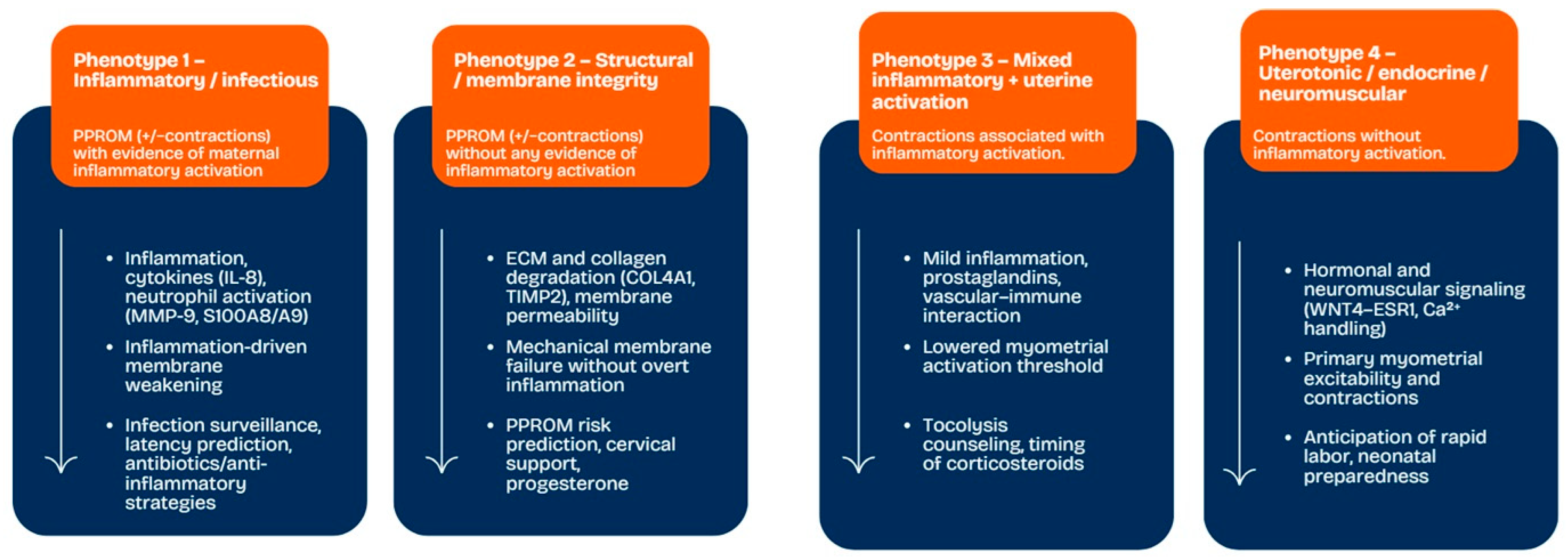
Phenotype-based classification of spontaneous preterm birth may offer practical advantages for clinical risk stratification, patient counseling, and neonatal management. By distinguishing inflammation-dominant, structural membrane–related, and contraction-driven pathways, this framework allows clinicians to better contextualize the expected clinical course, including latency to delivery and potential neonatal risks (
Figure 2).
From a preventive perspective, phenotype identification may support more personalized strategies. For example, women with inflammatory phenotypes may benefit from intensified infection surveillance and targeted antimicrobial or anti-inflammatory interventions, whereas those with structural or contraction-dominant phenotypes may be more suitable candidates for progesterone therapy, cervical support, or closer uterine activity monitoring. Similarly, recognition of contraction-driven phenotypes may guide anticipatory counseling regarding tocolysis efficacy and timing of antenatal corticosteroid administration.
At the neonatal level, phenotype-informed stratification may improve preparedness for respiratory support, infection surveillance, and NICU resource allocation, even when gestational age at delivery is similar. Overall, integrating clinical phenotyping into obstetric care pathways may represent a first step toward personalized prevention and management of preterm birth, and provides a clinically meaningful foundation for future integration with omics-based risk prediction models.
Prospective validation of this framework would ultimately depend on dedicated prospective studies incorporating standardized, multi-compartment biobanking at the time of clinical presentation. In such studies, maternal peripheral blood (for genomic, transcriptomic, and proteomic profiling), urine (metabolomics), vaginal or cervical secretions (microbiome and local inflammatory mediators), and, when clinically indicated, amniotic fluid could be collected prior to therapeutic interventions. Systematic placental tissue sampling immediately after delivery, using standardized fixation or cryopreservation protocols, would further enable exploratory correlations between clinical phenotypes and tissue-level molecular signatures. Importantly, this proposed strategy represents a conceptual roadmap for future research rather than an extension of the current retrospective dataset.
Although the pathogenic pathways underlying spontaneous preterm birth have been previously described, their operationalization into a structured, mutually exclusive clinical classification remains limited in routine obstetric practice. By applying a reproducible phenotypic framework within a well-characterized tertiary cohort, our study translates established biological concepts into a clinically usable stratification model. This approach reduces heterogeneity within preterm birth populations and provides a practical bridge between bedside clinical phenotyping and future, prospectively designed molecular studies. In this context, the value of the present work lies not in identifying a novel mechanism but in establishing a structured platform upon which subsequent genomic and proteomic investigations may be systematically built.