The Paradox of Endometriosis in Mayer-Rokitansky-Kuster-Hauser Syndrome: Applying Three Criteria to Discriminate Between Retrograde Menstruation/Implantation and Coelomic Metaplasia/Embryonic Cell Rests Theories

 , , ,
, , ,  , ,
, ,  ,
,
Abstract
1. Introduction
2. Definition of the Three MRKHSFE-Criteria and Their Application to Reports of Endometriosis in MRKHS Patients Without FE
2.1. Definition of the Three MRKHS-Criteria
2.1.1. Preoperative Imaging
2.1.2. Surgical Visualisation
2.1.3. Histological Examination
2.2. Application of the Three MRKHSFE-Criteria
3. Conceptual Analysis to Explain the Onset of Endometriosis in Mrkhs Patients
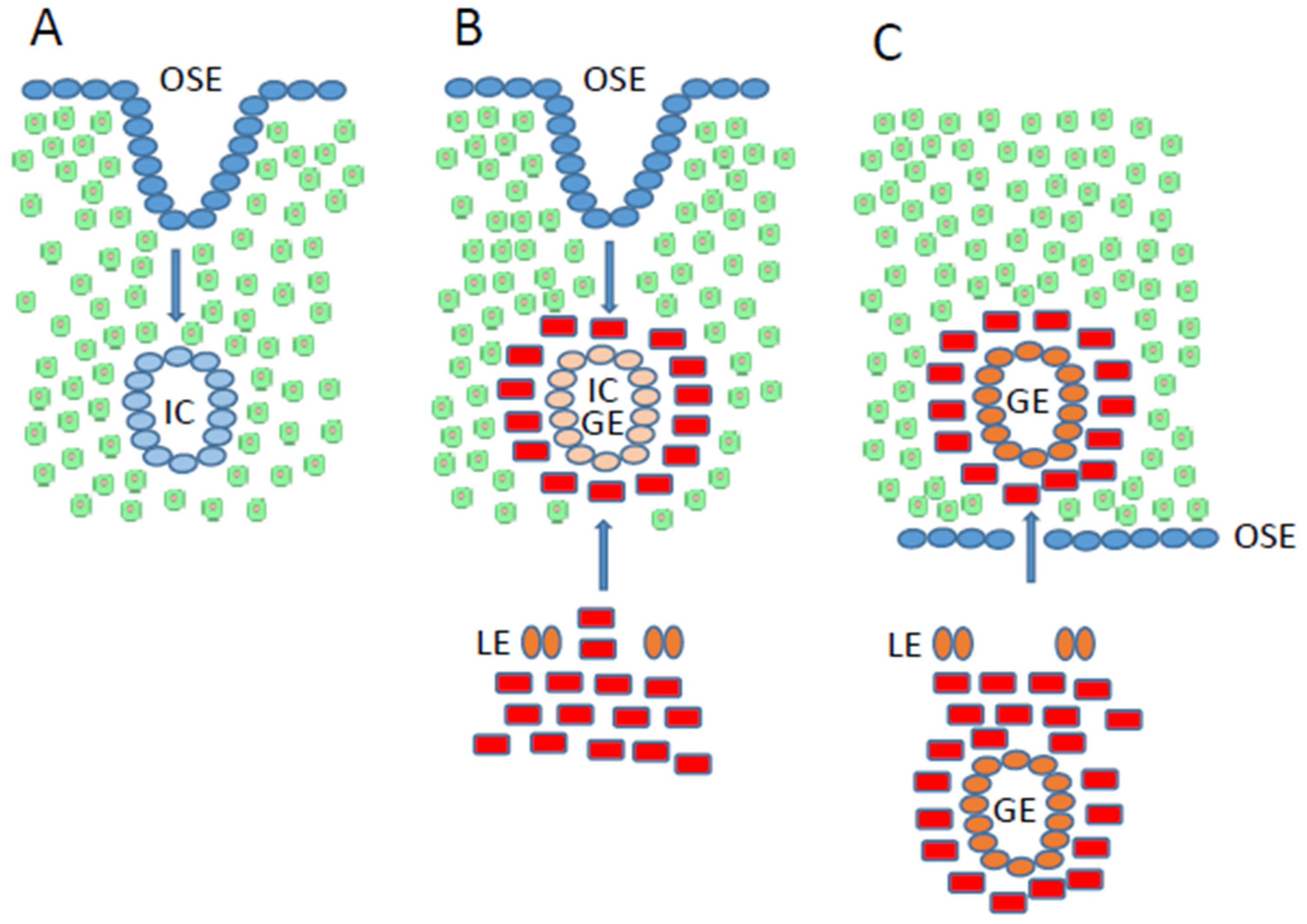
- Testability (and falsifiability): A good theory can be tested through observation and experimentation to either confirm or disprove the theory. In the latter case, the theory is ‘falsified’ and it should not be repeatedly ‘falsified’; but rather discarded, and alternative explanations considered. If we assume that metaplasia could be a cause of endometriosis, we must clarify the question to what extent superficial peritoneal cells can transform into both endometrial epithelial and stromal cells. As an example, let us take ovarian surface epithelial cells (OSE), on which most experiments have been conducted. On the one hand, these cells are not purely stromal/mesenchymal cells, but on the other hand, they also have some epithelial characteristics [68,69], thus OSE is not firmly determined as most other adult epithelia [69]. Of note, OSE in ovarian inclusion cysts express epithelial genes more strongly and stromal/mesenchymal cells more weakly. Strictly speaking, this is not metaplasia, but rather a shift to an epithelial cell type originating from a mixed stromal/epithelial cell type. But more importantly, in 10 published cases involving 92 inclusion cysts, no woman developed endometriosis in the ovary [69]. In the case of endometriosis in MRKHS, the RM/I theory has been tested but not falsified, whereas the CM/ECR theory still has to proven.
- Logical coherence (internal consistency): The various elements of the theory (assumptions, constructs, conditions, etc.) should be logically consistent with each other without contradictions. When endometriosis is observed in MRKHS patients, the RM/I theory does not violate logical rules. In contrast, the CM/ECR theory appears more elaborate and do not always easily fit within the overall construct. For example, the published data do not demonstrate the transition from mesothelial cells to epithelial and stromal endometrial cells [22] and as shown above inclusion cysts have never developed into endometrial glands [69].
- Conceptual clarity and comprehensibility: A good theory is easy to understand, which is the case for the RM/I theory, whereas the CM/ECR theory requires an adequate knowledge of embryogenesis to be understood by professionals.
- External consistency: A good theory should align with observations without contradicting facts. In the case of MRKHS, the RM/I theory aligns with current knowledge of endometriosis pathogenesis. The CM/ECR theory does not appear to reach the same degree of external consistency, as it does not align with what is known to be true in patients with obstructed menstruation in general and with obstructive Müllerian anomalies in particular [70].
- Predictive power: In MRKHS patients, the RM/I theory accurately predicts the development of endometriosis, especially in cases where FE is present within the UR. Conversely, the CM/ECR theory should have predicted the development of endometriosis in patients without FE within UR or without UR. However, based on a detailed analysis of the available data, this is not the case (Table 1).
- Parsimony: A robust theory relies on fewer variables and makes fewer assumptions to explain several phenomena than more complex alternative theories. Thus, the simpler of the theories is more likely to be correct, a philosophical principle known as ‘Ockham’s Razor’, developed by the 14th-century English monk, theologian and logician, Father William of Ockham. In MRKHS patients, the RM/I theory is undoubtedly simpler than the CM/ECR theory [22], and according to the parsimony criterion, is more likely to be true.
- Broad applicability (generalisability): A good theory should be comprehensive enough to explain a wide array of phenomena, can be generalised and applied to different populations and conditions, rather than being limited to specific cases. In this regard, the RM/I theory can be generalised also to populations without MRKHS, whereas the CM/ECR theory is restricted to cases with MRKHS and maybe ovarian endometriosis, although as argued above no definitive proof has ever been provided.
- Practical utility: A good theory should have direct applications and contribute to solving real problems. The practical utility of the RM/I theory is easily comprehensible and applicable to MRKHS patients. When the main complaint is colicky and cyclical pelvic pain, the presence of FE must be thoroughly investigated and, if detected, the UR must be removed to avoid cryptomenorrhoea and solve the problem [45,70,71,72,73,74,75]. The CM/ECR theory focuses on treatment of endometriosis, but it risks overlooking the source of endometrial cells, thereby exposing to recurrence.
- Heuristic value: A good theory should generate new hypotheses and stimulate empirical research, leading to further innovations. The RM/I theory appears generative because, if confirmed in the MRKHS model, it could form the basis of new secondary prevention strategies aimed at suppressing repetitive ovulatory menstruation in young women with severe symptoms. These approaches could be applied beyond the highly selective group of individuals with uterovaginal agenesis [18]. If a theory’s ability to generate new ideas and research were judged based exclusively on the number of reports including original data, RM/I would vastly outperform CM/ECR.
4. Conclusions
Author Contributions
Funding
Institutional Review Board Statement
Informed Consent Statement
Data Availability Statement
Acknowledgments
Conflicts of Interest
References
- Batt, R.E.; Smith, R.A.; Buck, G.M.; Severino, M.F.; Naples, J.D. Müllerianosis. Prog. Clin. Biol. Res. 1990, 323, 413–426. [Google Scholar]
- Batt, R.E.; Mitwally, M.F.M. Endometriosis from thelarche to mid-teens: Pathogenesis and prognosis, prevention, and pedagogy. J. Pediatr. Adolesc. Gynecol. 2003, 16, 337–347. [Google Scholar] [CrossRef] [Scilit]
- Batt, R.E.; Smith, R.A.; Buck Louis, G.M.; Martin, D.C.; Chapron, C.; Koninckx, P.R.; Yeh, J. Müllerianosis. Histol. Histopathol. 2007, 22, 1161–1166. [Google Scholar] [PubMed]
- Batt, R.E.; Yeh, J. Müllerianosis: Four developmental (embryonic) mullerian diseases. Reprod. Sci. 2013, 20, 1030–1037. [Google Scholar] [CrossRef] [Scilit]
- Fujii, S. Secondary müllerian system and endometriosis. Am. J. Obstet. Gynecol. 1991, 165, 219–225. [Google Scholar] [CrossRef] [Scilit]
- Garcia-Velasco, J.A.; Viganò, P.; Somigliana, E. Twenty-five years of research in endometriosis. Reprod. Biomed. Online 2025, 50, 104830. [Google Scholar] [CrossRef] [Scilit] [PubMed]
- Goodall, J.R. A Study of Endometriosis, Endosalpingiosis, Endocervicosis, and Peritoneo-Ovarian Sclerosis: A Clinical and Pathologic Study, 2nd ed.; JB Lippincott: Philadelphia, PA, USA, 1944; p. 112. [Google Scholar]
- Lauchlan, S.C. The secondary müllerian system. Obstet. Gynecol. Surv. 1972, 27, 133–140. [Google Scholar] [CrossRef] [Scilit] [PubMed]
- Lauchlan, S.C. The secondary mullerian system revisited. Int. J. Gynecol. Pathol. 1994, 13, 73–79. [Google Scholar] [CrossRef] [Scilit]
- Redwine, D.B. Mülleriosis instead of endometriosis. Am. J. Obstet. Gynecol. 1987, 156, 761. [Google Scholar] [CrossRef] [Scilit]
- Redwine, D.B. Mülleriosis. The single best-fit model of the origin of endometriosis. J. Reprod. Med. 1988, 33, 915–920. [Google Scholar]
- Redwine, D.B. Was Sampson wrong? Fertil. Steril. 2002, 78, 686–693. [Google Scholar] [CrossRef] [Scilit] [PubMed]
- Ridley, J.H. The histogenesis of endometriosis: A review of facts and fancies. Obstet. Gynecol. Surv. 1968, 23, 1. [Google Scholar] [CrossRef] [Scilit]
- Ridley, J.H. Coelomic metaplasia. Am. J. Obstet. Gynecol. 1981, 140, 233–234. [Google Scholar] [CrossRef] [Scilit]
- Suginami, H. A reappraisal of the coelomic metaplasia theory by reviewing endometriosis occurring in unusual sites and instances. Am. J. Obstet. Gynecol. 1991, 165, 214–218. [Google Scholar] [CrossRef] [Scilit]
- van der Linden, P.J. Theories on the pathogenesis of endometriosis. Hum. Reprod. 1996, 11, 53–65. [Google Scholar] [CrossRef] [Scilit]
- Endometriosis Initiative Group. A call for new theories on the pathogenesis and pathophysiology of endometriosis. J. Minim. Invasive Gynecol. 2024, 31, 371–377. [Google Scholar] [CrossRef] [Scilit] [PubMed]
- Bulun, S.E. Endometriosis and ovulatory menstruation: Beyond the Sampson principle. J. Clin. Investig. 2025, 135, e188787. [Google Scholar] [CrossRef] [Scilit]
- Gordts, S.; Koninckx, P.; Brosens, I. Pathogenesis of deep endometriosis. Fertil. Steril. 2017, 108, 872–885. [Google Scholar] [CrossRef] [Scilit]
- Koninckx, P.R.; Barlow, D.; Kennedy, S. Implantation versus infiltration: The Sampson versus the endometriotic disease theory. Gynecol. Obstet. Investig. 1999, 47, 3–9. [Google Scholar] [CrossRef] [Scilit]
- Cousins, F.L.; McKinnon, B.D.; Mortlock, S.; Fitzgerald, H.C.; Zhang, C.; Montgomery, G.W.; Gargett, C.E. New concepts on the etiology of endometriosis. J. Obstet. Gynaecol. Res. 2023, 49, 1090–1105. [Google Scholar] [CrossRef] [Scilit]
- Konrad, L.; Dietze, R.; Kudipudi, P.K.; Horné, F.; Meinhold-Heerlein, I. Endometriosis in MRKH cases as a proof for the coelomic metaplasia hypothesis? Reproduction 2019, 158, R41–R47. [Google Scholar] [CrossRef] [Scilit]
- Kruitwagen, R.F. Menstruation as the pelvic aggressor. Baillieres Clin. Obstet. Gynaecol. 1993, 7, 687–700. [Google Scholar] [CrossRef] [Scilit]
- D’Hooghe, T.M.; Debrock, S. Endometriosis, retrograde menstruation and peritoneal inflammation in women and in baboons. Hum. Reprod. Update 2002, 8, 84–88. [Google Scholar] [CrossRef] [Scilit] [PubMed]
- Viganò, P.; Caprara, F.; Giola, F.; Di Stefano, G.; Somigliana, E.; Vercellini, P. Is retrograde menstruation a universal, recurrent, physiological phenomenon? A systematic review of the evidence in humans and non-human primates. Hum. Reprod. Open 2024, 2024, hoae045. [Google Scholar] [CrossRef] [Scilit]
- Chapron, C.; Morice, P.; La Tour, M.D.; Chavet, X.; Dubuisson, J.B. Laparoscopic management of asymmetric Mayer–Rokitansky– Kuster–Hauser syndrome. Hum. Reprod. 1995, 10, 369–371. [Google Scholar] [CrossRef] [Scilit]
- Nisolle, M.; Donnez, J. Peritoneal endometriosis, ovarian endometriosis, and adenomyotic nodules of the rectovaginal septum are three different entities. Fertil. Steril. 1997, 68, 585–596. [Google Scholar] [CrossRef] [Scilit] [PubMed]
- Lamceva, J.; Uljanovs, R.; Strumfa, I. The main theories on the pathogenesis of endometriosis. Int. J. Mol. Sci. 2023, 24, 4254. [Google Scholar] [CrossRef] [Scilit] [PubMed]
- Bhamidipaty-Pelosi, S.; Kyei-Barffour, I.; Volpert, M.; O’Neill, N.; Grimshaw, A.; Eriksson, L.; Vash-Margita, A.; Pelosi, E. Müllerian anomalies and endometriosis: Associations and phenotypic variations. Reprod. Biol. Endocrinol. 2024, 22, 157. [Google Scholar] [CrossRef] [Scilit]
- Sampson, J.A. Heterotopic or misplaced endometrial tissue. Am. J. Obstet. Gynecol. 1925, 10, 649–664. [Google Scholar] [CrossRef] [Scilit]
- Meyer, R. Über den Stand der Frage der Adenomyositis und Adenomyome im allgemeinen und insbesondere über Adenomyositis seroepithelialis and Adenomyometritis sarcomatosa. Zentralbl. Gynäkol. 1919, 36, 745–751. [Google Scholar]
- Meyer, R. Zur Frage der heterotopen Epithelwucherung, insbesondere des Peritonealepithels und in die Ovarien. Virchows Arch. Path. Anat. 1924, 250, 595–610. [Google Scholar] [CrossRef] [Scilit]
- Von Recklinghausen, F. Adenomyomas and Cystadenomas of the Wall of the Uterus and Tube: Their Origin as Remnants of the Wolffian Body; Bergwald: Berlin, Germany, 1896. [Google Scholar]
- Russell, W.W. Aberrant portions of the Mullerian duct found in an ovary. Bull Johns Hopkins Hosp. 1899, 10, 10. [Google Scholar] [CrossRef] [Scilit]
- Novoa, C.C.; Leite, M.T.; Sartori, M.G. Mayer-Rokitansky-Kuster-Hauser syndrome. Rev. Bras. Ginecol. Obstet. 2025, 47, e-FPS4. [Google Scholar] [CrossRef] [Scilit]
- Benagiano, G.; Brosens, I. Who identified endometriosis? Fertil. Steril. 2011, 95, 13–16. [Google Scholar] [CrossRef] [Scilit]
- Benagiano, G.; Brosens, I.; Lippi, D. The history of endometriosis. Gynecol. Obstet. Investig. 2014, 78, 1–9. [Google Scholar] [CrossRef] [Scilit] [PubMed]
- Benagiano, G.; Brosens, I.; Lippi, D. Endometriosis: Ancient or modern disease? Indian J. Med. Res. 2015, 141, 236–238. [Google Scholar] [CrossRef] [Scilit]
- Brosens, I.; Benagiano, G. Endometriosis, a modern syndrome. Indian J. Med. Res. 2011, 133, 581–593. [Google Scholar]
- Nezhat, C.; Nezhat, F.; Nezhat, C. Endometriosis: Ancient disease, ancient treatments. Fertil. Steril. 2012, 98, S1–S62. [Google Scholar] [CrossRef] [Scilit] [PubMed]
- Grimbizis, G.F.; Gordts, S.; Di Spiezio Sardo, A.; Brucker, S.; De Angelis, C.; Gergolet, M.; Li, T.C.; Tanos, V.; Brölmann, H.; Gianaroli, L.; et al. The ESHRE/ESGE consensus on the classification of female genital tract congenital anomalies. Hum. Reprod. 2013, 28, 2032–2044. [Google Scholar] [CrossRef] [Scilit] [PubMed]
- Pfeifer, S.M.; Attaran, M.; Goldstein, J.; Lindheim, S.R.; Petrozza, J.C.; Rackow, B.W.; Siegelman, E.; Troiano, R.; Winter, T.; Zuckerman, A.; et al. ASRM müllerian anomalies classification 2021. Fertil. Steril. 2021, 116, 1238–1252. [Google Scholar] [CrossRef] [Scilit]
- Vercellini, P.; Caprara, F.; Piccini, M.; Donati, A.; Viganò, P.; Somigliana, E.; Cipriani, S. Prevalence of endometriosis in Mayer-Rokitansky-Küster-Hauser syndrome variants: A systematic review and meta-analysis. Hum. Reprod. 2025, 40, 1094–1109. [Google Scholar]
- Wang, Y.; He, Y.L.; Yuan, L.; Yu, J.C.; Xue, H.D.; Jin, Z.Y. Typical and atypical pelvic MRI characteristics of Mayer-Rokitansky-Kuster-Hauser syndrome: A comprehensive analysis of 201 patients. Eur. Radiol. 2020, 30, 4014–4022. [Google Scholar] [CrossRef] [Scilit] [PubMed]
- Cooper, N.; Al-Memar, M.; Linton-Reid, K.; Edmonds, K.; Rose, G.; Dixon, N.; McNamara, C.; Fotopoulou, C.; Ree, K.V.; Bharwani, N. Magnetic resonance imaging and clinical features of Mayer-Rokitansky-Kuster-Hauser syndrome: A 10-year review from a dedicated specialist centre. BJOG 2025, 132, 64–71. [Google Scholar] [CrossRef] [Scilit] [PubMed]
- Preibsch, H.; Rall, K.; Wietek, B.M.; Brucker, S.Y.; Staebler, A.; Claussen, C.D.; Siegmann-Luz, K.C. Clinical value of magnetic resonance imaging in patients with Mayer-Rokitansky-Küster-Hauser (MRKH) syndrome: Diagnosis of associated malformations, uterine rudiments and intrauterine endometrium. Eur. Radiol. 2014, 24, 1621–1627. [Google Scholar] [CrossRef] [Scilit] [PubMed]
- Marsh, C.A.; Will, M.A.; Smorgick, N.; Quint, E.H.; Hussain, H.; Smith, Y.R. Uterine remnants and pelvic pain in females with Mayer-Rokitansky-Küster-Hauser syndrome. J. Pediatr. Adolesc. Gynecol. 2013, 26, 199–202. [Google Scholar] [CrossRef] [Scilit]
- Rall, K.; Barresi, G.; Wallwiener, D.; Brucker, S.Y.; Staebler, A. Uterine rudiments in patients with Mayer-Rokitansky-Küster-Hauser syndrome consist of typical uterine tissue types with predominantly basalis-like endometrium. Fertil. Steril. 2013, 99, 1392–1399. [Google Scholar] [CrossRef] [Scilit]
- Choussein, S.; Nasioudis, D.; Schizas, D.; Economopoulos, K.P. Mullerian dysgenesis: A critical review of the literature. Arch. Gynecol. Obstet. 2017, 295, 1369–1381. [Google Scholar] [CrossRef] [Scilit]
- Maciel, C.; Bharwani, N.; Kubik-Huch, R.A.; Manganaro, L.; Otero-Garcia, M.; Nougaret, S.; Alt, C.D.; Cunha, T.M.; Forstner, R. MRI of female genital tract congenital anomalies: European Society of Urogenital Radiology (ESUR) guidelines. Eur. Radiol. 2020, 30, 4272–4283. [Google Scholar] [CrossRef] [Scilit]
- Acién, P. Endometriosis and genital anomalies: Some histogenetic aspects of external endometriosis. Gynecol. Obstet. Investig. 1986, 22, 102–107. [Google Scholar] [CrossRef] [Scilit]
- Acién, P.; Lloret, M.; Chehab, H. Endometriosis in a patient with Rokitansky-Kuster-Hauser syndrome. Gynecol. Obstet. Investig. 1988, 25, 70–72. [Google Scholar] [CrossRef] [Scilit]
- Pitot, M.A.; Bookwalter, C.A.; Dudiak, K.M. Müllerian duct anomalies coincident with endometriosis: A review. Abdom. Radiol. 2020, 45, 1723–1740. [Google Scholar]
- Rosenfeld, D.L.; Lecher, B.D. Endometriosis in a patient with Rokitansky-Kuster-Hauser syndrome. Am. J. Obstet. Gynecol. 1981, 139, 105. [Google Scholar] [CrossRef] [Scilit] [PubMed]
- Troncon, J.K.; Zani, A.C.; Vieira, A.D.; Poli-Neto, O.B.; Nogueira, A.A.; Rosa-E-Silva, J.C. Endometriosis in a patient with mayer-rokitansky-küster-hauser syndrome. Case Rep. Obstet. Gynecol. 2014, 2014, 376231. [Google Scholar] [CrossRef] [Scilit]
- Uğur, M.; Turan, C.; Mungan, T.; Kuşçu, E.; Senöz, S.; Ağiş, H.T.; Gökmen, O. Endometriosis in association with müllerian anomalies. Gynecol. Obstet. Investig. 1995, 40, 261–264. [Google Scholar] [CrossRef] [Scilit]
- Kaya, H.; Sezik, M.; Ozkaya, O.; Sahiner, H. Large endometrioma in an adolescent girl with Mayer–Rokitansky–Kuster–Hauser syndrome. Gynecol. Surg. 2004, 1, 241–242. [Google Scholar] [CrossRef] [Scilit]
- Balci, O.; Karatayli, R.; Capar, M. An incidental coexistence of Mayer-Rokitansky-Kuster-Hauser syndrome with pelvic ectopic kidney and perirenal endometrioma. Saudi Med. J. 2008, 29, 1340–1341. [Google Scholar]
- Cho, M.K.; Kim, C.H.; Oh, S.T. Endometriosis in a patient with Rokitansky–Kuster–Hauser syndrome. J. Obstet. Gynaecol. Res. 2009, 35, 994–996. [Google Scholar] [CrossRef] [Scilit] [PubMed]
- Mok-Lin, E.Y.; Wolfberg, A.; Hollinquist, H.; Laufer, M.R. Endometriosis in a patient with Mayer–Rokitansky–Kuster–Hauser syndrome and complete uterine agenesis: Evidence to support the theory of coelomic metaplasia. J. Pediatr. Adolesc. Gynecol. 2010, 23, e35–e37. [Google Scholar] [CrossRef] [Scilit]
- Moen, M.H.; Halvorsen, T.B. Histologic confirmation of endometriosis in different peritoneal lesions. Acta. Obstet. Gynecol. Scand. 1992, 71, 337–342. [Google Scholar] [CrossRef] [Scilit]
- Walter, A.J.; Hentz, J.G.; Magtibay, P.M.; Cornella, J.L.; Magrina, J.F. Endometriosis: Correlation between histologic and visual findings at laparoscopy. Am. J. Obstet. Gynecol. 2001, 184, 1407–1411. [Google Scholar] [CrossRef] [Scilit]
- Marchino, G.L.; Gennarelli, G.; Enria, R.; Bongioanni, F.; Lipari, G.; Massobrio, M. Diagnosis of pelvic endometriosis with use of macroscopic versus histologic findings. Fertil. Steril. 2005, 84, 12–15. [Google Scholar] [CrossRef] [Scilit]
- Kazanegra, R.; Zaritsky, E.; Lathi, R.B.; Clopton, P.; Nezhat, C. Diagnosis of stage I endometriosis: Comparing visual inspection to histologic biopsy specimen. J. Minim. Invasive Gynecol. 2008, 15, 176–180. [Google Scholar] [CrossRef] [Scilit] [PubMed]
- Fernando, S.; Soh, P.Q.; Cooper, M.; Evans, S.; Reid, G.; Tsaltas, J.; Rombauts, L. Reliability of visual diagnosis of endometriosis. J. Minim. Invasive Gynecol. 2013, 20, 783–789. [Google Scholar] [CrossRef] [Scilit] [PubMed]
- Elliott, J.E.; Abduljabar, H.; Morris, M. Presurgical management of dysmenorrhea and endometriosis in a patient with Mayer-Rokitansky-Kuster-Hauser syndrome. Fertil. Steril. 2011, 96, e86–e89. [Google Scholar] [CrossRef] [Scilit] [PubMed]
- Yan, L.; Zhao, X.; Qin, X. MRKH syndrome with endometriosis: Case report and literature review. Eur. J. Obstet. Gynecol. Reprod. Biol. 2011, 159, 231–232. [Google Scholar] [CrossRef] [Scilit]
- Zhu, Y.; Brännström, M.; Janson, P.O.; Sundfeldt, K. Differences in expression patterns of the tight junction proteins, claudin 1,3,4 and 5, in human surface ovarian surface epithelium as compared to epithelia in inclusion cysts and epithelial tumours. Int. J. Cancer 2006, 118, 1884–1891. [Google Scholar]
- Okamoto, S.; Okamoto, A.; Nikaido, T.; Saito, M.; Takao, M.; Yanaihara, N.; Takakura, S.; Ochiai, K.; Tanaka, T. Mesenchymal to epithelial transition in the human ovarian surface epithelium focusing on inclusion cysts. Oncol. Rep. 2009, 21, 1209–1214. [Google Scholar] [CrossRef] [Scilit]
- Vercellini, P.; Salmeri, N.; Somigliana, E.; Piccini, M.; Caprara, F.; Viganò, P.; De Matteis, S. Mullerian anomalies and endometriosis as potential explanatory models for the retrograde menstruation/implantation and the embryonic remnants/celomic metaplasia pathogenic theories: A systematic review and meta-analysis. Hum. Reprod. 2024, 39, 1460–1470. [Google Scholar]
- Akhtar, M.A.; Saravelos, S.H.; Li, T.C.; Jayaprakasan, K.; Royal College of Obstetricians and Gynaecologists. Reproductive implications and management of congenital uterine anomalies: Scientific impact paper No. 62. BJOG 2025, 132, e86–e97. [Google Scholar] [CrossRef] [Scilit]
- Bortoletto, P.; Romanski, P.A.; Pfeifer, S.M. Müllerian anomalies: Presentation, diagnosis, and counseling. Obstet. Gynecol. 2024, 143, 369–377. [Google Scholar]
- Buda, M.; Zajączkowska, W.; Madziar, K.; Kędzia, W.; Kapczuk, K. Symptomatic uterine rudiments in adolescents and adults with Mayer-Rokitansky-Küster-Hauser Syndrome (MRKHS): Management and outcomes. J. Clin. Med. 2024, 13, 6767. [Google Scholar] [CrossRef] [Scilit]
- Oppelt, P.; Renner, S.P.; Kellermann, A.; Brucker, S.; Hauser, G.A.; Ludwig, K.S.; Strissel, P.L.; Strick, R.; Wallwiener, D.; Beckmann, M.W. Clinical aspects of Mayer-Rokitansky-Kuester-Hauser syndrome: Recommendations for clinical diagnosis and staging. Hum. Reprod. 2006, 21, 792–797. [Google Scholar]
- Steinmacher, S.; Bösmüller, H.; Granai, M.; Koch, A.; Brucker, S.Y.; Rall, K.K. Endometriosis in patients with Mayer-Rokitansky-Kuster-Hauser-Syndrome—Histological evaluation of uterus remnants and peritoneal lesions and comparison to samples from endometriosis patients without mullerian anomaly. J. Clin. Med. 2022, 11, 6458. [Google Scholar] [CrossRef] [Scilit]
- Mariadas, H.; Chen, J.H.; Chen, K.H. The molecular and cellular mechanisms of endometriosis: From basic pathophysiology to clinical implications. Int. J. Mol. Sci. 2025, 26, 2458. [Google Scholar] [CrossRef] [Scilit]
- Zheng, W.; Li, N.; Wang, J.; Ulukus, E.G.; Ulukus, M.; Arici, A.; Liang, S.X. Initial endometriosis showing direct morphological evidence of metaplasia in the pathogenesis of ovarian endometriosis. Int. J. Gynecol. Pathol. 2005, 24, 164–172. [Google Scholar] [CrossRef] [Scilit] [PubMed]
- Mecha, E.; Makunja, R.; Maoga, J.B.; Mwaura, A.N.; Riaz, M.A.; Omwandho, C.O.A.; Meinhold-Heerlein, I.; Konrad, L. The importance of stromal endometriosis in thoracic endometriosis. Cells 2021, 10, E180. [Google Scholar] [CrossRef] [Scilit] [PubMed]
- Bandini, V.; Cipriani, S.; Pillinini, C.; Angioni, S.; Bartiromo, L.; Biasioloi, A.; Candiani, M.; Carletti, V.; D’Alterio, M.N.; Incandela, D.; et al. Lateral distribution of endometriosis lesions: The anatomical recesses hypothesis. A systematic review and meta-analysis. Hum. Reprod. Open 2025, 2026, hoaf064. [Google Scholar] [CrossRef] [Scilit]
- Skalecki, S.L.; Mn Kimble, R.; Ballard, E.L.; Baartz, D.L. Presence and laterality of endometriosis in adolescent patients with obstructed Müllerian duct anomalies, a twenty-three year retrospective cohort analysis between 2002–2025 at an Australian quaternary paediatric and adolescent gynaecology service. J. Pediatr. Adolesc. Gynecol. 2026, in press. [Google Scholar]
- Konrad, L.; Gronbach, J.; Horné, F.; Mecha, E.O.; Berkes, E.; Frank, M.; Gattenlöhner, S.; Omwandho, C.O.; Oehmke, F.; Tinneberg, H.R. Similar characteristics of the endometrial and endometriotic epithelium. Reprod. Sci. 2018, 26, 49–59. [Google Scholar] [CrossRef] [Scilit]
- Konrad, L.; Kortum, J.; Nabham, R.; Gronbach, J.; Dietze, R.; Oehmke, F.; Berkes, E.; Tinneberg, H.R. Composition of the stroma in the human endometrium and endometriosis. Reprod. Sci. 2018, 25, 1106–1115. [Google Scholar] [CrossRef] [Scilit] [PubMed]
- Vercellini, P.; Piccini, M.; Caprara, F.; Cetera, G.E.; Viganò, P.; Somigliana, E. Potential anatomical determinants of retrograde menstruation: A comprehensive narrative review. Reprod. Biomed. Online 2024, 49, 104345. [Google Scholar] [CrossRef] [Scilit] [PubMed]
- Olive, D.L.; Henderson, D.Y. Endometriosis and Müllerian anomalies. Obstet. Gynecol. 1987, 69, 412–415. [Google Scholar] [PubMed]



| Ref., Country, Patient Age | Criterion 1—Preoperative Imaging | Criterion 2—Surgical Visualisation | Criterion 3—Histological Examination | Authors Conclusions | Comment |
|---|---|---|---|---|---|
| [54], U.S.A., 23-yrs-old | – Absence of UR or FE/UR was not reported in the US. | ± OMA in the left ovary. Two years later, two OMAs were removed. | – No histology and photomicrographs were provided. | “…it is unlikely that tubal regurgitation is the only cause of endometriosis”. | No demonstration is provided of the absence of FE/UR, as UR were neither biopsied nor removed. |
| [56], Turkey, age n.r. | ± Absence of UR at US. No MRI. | ± No surgical description is reported. Stage I endometriosis was detected. | – No histology and photomicrographs were provided. | “One patient…without a uterus…, but with histologically proven endometriosis showed that this is not a universally valid dictum” | Imaging, anatomical, and histopathology details are either lacking or insufficient to validate the authors’ conclusion. |
| [57], Turkey, 14-yrs-old | ± Transabdominal sonogram showed an ovarian mass on the left side, and no UR was found. No MRI. | ± A left OMA was histologically confirmed. No UR and ‘…only remnants of rudimentary fallopian tubes’ were described. | +/– Endometrial gland and stroma with hemosiderin laden macrophages in the left ovarian cysts were described, but photomicrographs were not provided. | ‘…müllerian-derived metaplasia in the ovaries…The beginning of ovulation might also trigger the metaplasia to end with endometrioma formation.’ | The authors state ‘In our patient, menstruation was probably not possible due to the hypoplastic uterus and tubes’. This indicates that at least an UR was present and thus absence cannot be ruled out, because of the missing MRI. |
| [58], Turkey, 17-yrs-old | + Absence of uterus at preoperative US and MRI. | ± Excision of a large right perirenal cyst. “…uterus could not be detected and both tubes and the ovaries were normal”. | ± Pathology showed “endometrial tissue and hemorrhage” within the perirenal cyst. No histology and photomicrographs were provided. | The authors did not discuss whether their findings are in favour of the embryonic cell rests/coelomic metaplasia theory. | The inconsistent description of absence versus presence of the tubes at surgery, raises the doubt of misdiagnosis. Histological findings of endometriosis are provided. |
| [59], South Korea, 26-yrs-old | ± Transrectal US showed no UR. No MRI. | + A left OMA was excised. After adhesiolysis, no UR was found. | – Endometrial glands and stroma lining the cyst with hemosiderin-laden macrophages were identified. However, the photo-micrographs show hemosiderin-laden macrophages only. | ‘…we confirmed that there was no Müllerian structure in our patient. Our case cannot be adequately explained by Sampson’s theory of retrograde menstruation…Such conditions support the alternative theory of coelomic metaplasia’ | OMA was demonstrated in the absence of UR at both preoperative imaging and surgery. However, two expert pathologists and Konrad et al. [22] could not confirm the diagnosis of ovarian endometriotic cyst based on the low-quality photomicrographs (Figure 2a,b, page 995). |
| [60], U.S.A., 20-yrs-old and 25-yrs-old | ± MRI confirmed vaginal and uterine agenesis, with possible presence of uterine horn remnants. | ± Laparoscopies at the ages of 20 and 25 years detected no UR, and no fallopian tubes. Minimal superficial peritoneal endometriosis was observed on both occasions but destroyed using electrocautery. | – No histological confirmation of endometriosis is available as the superficial peritoneal implants were fulgurated without taking a biopsy. | ‘… our patient …did not develop pelvic pain until she was 20 years old. This 9-year timeperiod between onset of puberty… seems too long to justify the Müllerian rest theory, but it is quite sufficient to explain the development, and subsequent recurrence, of her endometriosis from transformation of totipotent cells’. | MRI detected the ‘possible presence of uterine horn remnants’. Therefore, ‘continuous oral contraceptive pills were initiated to minimize the risk of hematometra’. Importantly, the reliability of the visual diagnosis of superficial peritoneal (stage I) endometriosis is variable and generally limited [61,62,63,64,65]. This case lacks histological confirmation of endometriosis. |
| [66], Canada; 12-yrs-old | ± At MRI, the presence of ‘…functional endometrium in the setting of abnormal müllerian structures was suspected.’ | + After a combined oral contraceptive continuously for 7 months, the right ovary/endometrioma and fallopian tube, midline UR and the bilateral fibrous bands with uterine horns were removed. | ± ‘…a noncavitary uterine/Wolffian remnant lacking endometrium, a…fibrotic right ovary/endometrioma complex, and the right fallopian tube with a small paratubal cyst attached to a lateral uterine remnant without…discernible endometrium.’ However, histological details and photomicrographs were not provided. | In the Abstract the authors state: Patients with obstructive müllerian malformations with functional endometrium can be preoperatively managed with continuous combined low-dose monophasic oral contraceptives to control pain and treat endometriosis. | ‘The pathologic findings…repre sent COC inhibition of functional endometrium in the right rudimentary uterine horn, allowing gradual resolution of the hematometra/endometriosis.’ Some inconsistencies between imaging, surgical, and histological findings do not allow definitive conclusions. |
| [67], China; 23-yrs-old | ± A single uterine bud without FE was identified at transabdominal US. No MRI. | – No description of UR is provided. | – Endometrial glands or stromal cells of OMA cannot be identified in the poor-quality photo-micrograph (Figure 1; see comment) | At laparotomy, ‘…a purple and brown nodule measured 0.5 cm on the right ovary surface was… proved to be an ectopic endometriotic lesion. ’ | The absence of FE within UR is based on US only. The presence/absence of UR at surgery was not defined. No endometrial glands or stroma can be identified by two experts and Konrad et al. [22]. |
| [55], Brazil; 24-yrs-old | + Absent UR at MRI and US | ± ‘Two rudimentary uteruses and an endometrioma in the left ovary were observed.’ The UR were not removed. | + Pathology examination confirmed ovarian “cystic endometriosis”. However, histology and photomicrographs were not provided. | ‘…we present endometriosis in a patient with Mayer-Rokitansky-Küster-Hauser syndrome…uterus. This case reinforces the theory of coelomic metaplasia…rather than Sampson’s retrograde menstruation theory alone. ’ | Exclusion of FE within UR seems unreasonable. In fact, UR were observed at laparoscopy only, as preoperative US and MRI had incorrectly failed to detect them. However, absence of FE cannot be established at surgery/pathology, as the UR were not removed. |
| Characteristic | RM/I | CM/ECR |
|---|---|---|
| Testability (falsifiability) | + | ± |
| Logical coherence (internal consistency) | + | ± |
| Conceptual clarity and comprehensibility | + | ± |
| External consistency | + | ± |
| Empirical validity | + | ± |
| Predictive power | + | – |
| Parsimony | + | – |
| Broad applicability (generalizability) | + | ± |
| Practical utility | + | ± |
| Heuristic value | + | ± |
Disclaimer/Publisher’s Note: The statements, opinions and data contained in all publications are solely those of the individual author(s) and contributor(s) and not of MDPI and/or the editor(s). MDPI and/or the editor(s) disclaim responsibility for any injury to people or property resulting from any ideas, methods, instructions or products referred to in the content. |
© 2026 by the authors. Licensee MDPI, Basel, Switzerland. This article is an open access article distributed under the terms and conditions of the Creative Commons Attribution (CC BY) license.
Share and Cite
Konrad, L.; Riaz, M.A.; Zeppernick, F.; Zeppernick, M.; Meinhold-Heerlein, I.; Salmeri, N.; Viganò, P.; Somigliana, E.; Vercellini, P. The Paradox of Endometriosis in Mayer-Rokitansky-Kuster-Hauser Syndrome: Applying Three Criteria to Discriminate Between Retrograde Menstruation/Implantation and Coelomic Metaplasia/Embryonic Cell Rests Theories. J. Clin. Med. 2026, 15, 1599. https://doi.org/10.3390/jcm15041599
Konrad L, Riaz MA, Zeppernick F, Zeppernick M, Meinhold-Heerlein I, Salmeri N, Viganò P, Somigliana E, Vercellini P. The Paradox of Endometriosis in Mayer-Rokitansky-Kuster-Hauser Syndrome: Applying Three Criteria to Discriminate Between Retrograde Menstruation/Implantation and Coelomic Metaplasia/Embryonic Cell Rests Theories. Journal of Clinical Medicine. 2026; 15(4):1599. https://doi.org/10.3390/jcm15041599
Chicago/Turabian StyleKonrad, Lutz, Muhammad Assad Riaz, Felix Zeppernick, Magdalena Zeppernick, Ivo Meinhold-Heerlein, Noemi Salmeri, Paola Viganò, Edgardo Somigliana, and Paolo Vercellini. 2026. "The Paradox of Endometriosis in Mayer-Rokitansky-Kuster-Hauser Syndrome: Applying Three Criteria to Discriminate Between Retrograde Menstruation/Implantation and Coelomic Metaplasia/Embryonic Cell Rests Theories" Journal of Clinical Medicine 15, no. 4: 1599. https://doi.org/10.3390/jcm15041599
APA StyleKonrad, L., Riaz, M. A., Zeppernick, F., Zeppernick, M., Meinhold-Heerlein, I., Salmeri, N., Viganò, P., Somigliana, E., & Vercellini, P. (2026). The Paradox of Endometriosis in Mayer-Rokitansky-Kuster-Hauser Syndrome: Applying Three Criteria to Discriminate Between Retrograde Menstruation/Implantation and Coelomic Metaplasia/Embryonic Cell Rests Theories. Journal of Clinical Medicine, 15(4), 1599. https://doi.org/10.3390/jcm15041599