Article

Endometriosis Is Associated with Increased Serum and Peritoneal Fluid Concentrations of Chromogranin A and Its Derivatives

1
Department of Histology and Embryology, Centre of Biostructure Research, Medical University of Warsaw, 02-004 Warsaw, Poland
2
Hospital Pharmacy, National Medical Institute of the Ministry of Interior and Administration, 02-507 Warsaw, Poland
3
Department of Gynaecology and Gynaecological Oncology, Medical Centre of Postgraduate Medical Education CMKP, 01-813 Warsaw, Poland
4
Department of Obstetrics, Gynaecology and Gynaecological Oncology, Medical University of Warsaw, 03-242 Warsaw, Poland
5
Women’s Health Research Institute, Calisia University, 62-800 Kalisz, Poland
6
OVIklinika Infertility Center, 01-377 Warsaw, Poland
7
Institute of Health Sciences, Faculty of Medical and Health Sciences, University of Siedlce, 08-110 Siedlce, Poland
*
Authors to whom correspondence should be addressed.
J. Clin. Med. 2026, 15(4), 1567; https://doi.org/10.3390/jcm15041567
Submission received: 31 December 2025 / Revised: 10 February 2026 / Accepted: 12 February 2026 / Published: 16 February 2026

Abstract

Background/Objectives: Endometriosis is a prevalent gynecological illness associated with chronic pain, inflammation, and infertility, as ectopic endometrial lesions are formed. No fully effective treatment is available, and the pathogenesis of this disease is unclear. The survival of ectopic endometrial cells is facilitated by their low susceptibility to apoptosis, an immunosuppressive environment, and local angiogenesis. Chromogranin A (CgA), a glycoprotein prohormone, modulates various processes including angiogenesis and innate immunity, and its higher levels are detected in neuroendocrine tumors and inflammatory disorders. Since endometriosis may be considered an autoinflammatory disorder, this study aimed to evaluate serum and peritoneal fluid concentrations of CgA and its derivatives, catestatin and pancreastatin, and to correlate these levels with disease severity. Methods: The study was conducted on samples of serum and peritoneal fluid (PF) obtained from 65 women diagnosed with endometriosis and from 60 control individuals who underwent surgery for other reasons. The concentrations of CgA, catestatin, and pancreastatin were assessed in the collected samples by specific enzyme-linked immunosorbent assays. Results: CgA, catestatin, and pancreastatin concentrations were significantly higher in the sera and PF of endometriosis patients compared to controls. There was a correlation between their serum and PF levels, and all tested factors were correlated with each other in both serum and PF. Serum concentrations of CgA, catestatin, and pancreastatin were also associated with disease progression. Receiver operating characteristic (ROC) analysis further confirmed that endometriosis is associated with increased circulating CgA, catestatin, and pancreastatin levels, suggesting that they may be considered markers of endometriosis. Conclusions: The upregulation of CgA and its derivatives in endometriosis may indicate their role in the disease pathogenesis and implicate them as potential diagnostic markers and/or therapeutic targets.

1. Introduction

Endometriosis, a chronic disease that affects approximately 10% of women of reproductive age, is an estrogen-dependent gynecological disorder related to the persistence of endometrial-like tissue (glands and stroma) outside the uterus [1]. Endometriotic lesions predominantly localize in the peritoneal cavity and may present as ovarian endometriotic cysts, superficial peritoneal lesions, or deep infiltrating lesions, including those of the rectovaginal septum [2,3,4,5]. The persistence of active lesions is associated with chronic pelvic inflammatory disease, which may account for local fibrosis, adhesion formation, and pain [6,7]. The primary clinical symptoms include dysmenorrhea, chronic pelvic pain, and dyspareunia. It is estimated that up to 50% cases of female infertility are linked with endometriosis [8]. Pelvic pain may affect patients’ working capabilities and mental health, being responsible for anxiety and depression. Thus, endometriosis is a debilitating condition that may seriously affect the quality of life [9,10].
So far, there is no fully effective treatment for endometriosis. Therefore, the disease constitutes a significant clinical, social, and socio-economic problem.
The origin and etiopathology of endometriosis remain poorly understood. It is assumed that endometriotic cells may be relocated to the peritoneal cavity in the course of retrograde menstruation [11] and, occasionally, by the lymphatic or blood circulatory system, which may explain a distant localization of some lesions, e.g., in the thorax or brain [12]. It cannot be excluded that some forms of endometriosis may also originate from coelomic metaplasia or Müllerian system remnants [13].
The reason for the survival and growth of ectopic endometrial cells remains an unanswered question. It is plausible that this may be due to a permissive, immunosuppressive local peritoneal milieu and impaired elimination of endometriotic cells by macrophages and NK cells [14,15]. Furthermore, mechanisms facilitating the survival and implantation of endometriotic cells may include their lower susceptibility to apoptosis [16,17] and increased adhesiveness and invasiveness [17,18,19,20]. The growth and progression of endometriotic lesions appear to be stimulated by an abrogated local estrogen release [21,22]. These phenomena are also supported by the induction of local new blood vessel formation; indeed, angiogenesis seems to play a crucial role in the etiopathogenesis of endometriosis [23].
Chromogranin A (CgA), an acidic hydrophilic glycoprotein composed of 439 amino acids with a molecular mass of 49 kDa, is a key member of the granin family [24]. CgA is mainly localized in the cell cytoplasmic electron-dense chromaffin granules, primarily in the adrenal medulla and the cells of the diffuse neuroendocrine system [25]. The human CHGA gene is located on chromosome 14 (14q32.12) and consists of eight exons separated by seven intronic sequences [26,27]. CgA itself may exert some biological functions [28,29]; however, it is also a precursor for a variety of biologically active peptides. The best recognized are catestatin (CST), pancreastatin (PST), vasostatins (VSs) I and II, prochromacin, chromacin, chromofungin, WE-14, and serpinin [25,28,30].
CgA and its derivatives play a role in regulating various biological activities, including angiogenesis and endothelial permeability, myocardial contractility, glucose and calcium homeostasis, and innate immunity, and exert both adrenergic and anti-adrenergic effects [30]. Their increased concentrations were reported in neuroendocrine tumors and non-malignant conditions, including organ failure and cardiovascular disease [31,32,33].
There is growing evidence that CgA and its derivatives may also be actively involved in the pathogenesis of various autoimmune and inflammatory disorders [30]. Endometriosis is associated with chronic pelvic inflammation and increased production of various autoantibodies and, therefore, may be considered an autoimmune/autoinflammatory disorder [34,35]. Accordingly, the present study aimed to evaluate serum and peritoneal fluid concentrations of CgA and its derivatives, CST and PST, and to correlate these levels with disease severity.

2. Materials and Methods

2.1. Patients

In total, 125 women, recruited from the I and II Departments of Obstetrics and Gynaecology at the Medical University of Warsaw, Poland, were included in the study. All participants gave written consent to the study, and the study protocol was approved by the Institutional Bioethical Review Board of the Medical University of Warsaw, Poland (KB/257/2016). Patients with laparoscopically and histologically confirmed endometriosis (n = 65) were included in the endometriosis group. Disease severity has been classified according to the American Society for Reproductive Medicine (rASRM) criteria [36]. The control group (n = 60) consisted of patients with no clinical symptoms or signs of endometriosis, subjected to laparoscopic examination and/or surgery for other unrelated reasons, such as dermoid/benign ovarian cyst, or infertility. All women in the endometriosis and control groups had regular menstrual cycles and did not suffer from other chronic endocrine, autoimmune, infectious, or neoplastic disorders. They were not subjected to hormonal pharmacological treatment or any other chronic medication for a minimum of 3 months before the study. The menstrual cycle phase was determined based on the date of the last menstrual bleeding.

2.2. Collection of Serum and Peritoneal Fluid Samples

Serum and peritoneal fluid samples were acquired during the mid-proliferative phase of the patients’ menstrual cycle (8th–10th day). Whole blood samples were routinely obtained preoperatively (immediately before operation) from fasting patients’ peripheral blood. After centrifuging at 2500× g (4 °C, 10 min), the obtained serum samples were stored (−80 °C) for further evaluations. During laparoscopy performed under general anesthesia, peritoneal fluid (PF) was aspirated from the cul-de-sac, before any further procedures. Specimens contaminated with blood were excluded from studies. Samples of PF were centrifuged at 2000× g (4 °C, 10 min), and the cell-free supernatants were stored (−80 °C) for further analyses. For both serum and PF, the procedures mentioned above were performed within one hour after collection.

2.3. Evaluation of CgA and Its Derivatives in Serum and PF

Concentrations of CgA, CST, and PST in serum and PF samples were measured by the specific Human Chromogranin-A ELISA Kit (E1730Hu), Human Catestatin ELISA Kit (E4996Hu) and Human Pancreastatin ELISA Kit (E0983Hu), respectively, according to the manufacturer’s instructions, using a FLUOstar Omega microplate reader (BMG Labtech, Offenburg, Germany) and initially processed with MARS Data Analysis Software 3.32 (BMG Labtech, Ortenberg, Germany). All ELISA kits used in the study originated from Bioassay Technology Laboratory, Shanghai, China.

2.4. Statistical Analysis

GraphPad Prism 10.2.3. software (San Diego, CA, USA) was used for the statistical analyses and graphical presentations. Parametric Student’s t-test or nonparametric Mann–Whitney U-test was used to determine differences between groups, where applicable. The Kruskal–Wallis test followed by Dunn’s multiple-comparison test was used to compare more than two groups. The significance of the difference between two independent proportions was calculated using the Z-ratio. The two-tailed Spearman correlation coefficient (rs) was used for performing correlation analyses. To assess the predictive power of the tested factors, a receiver operating characteristic (ROC) curve was generated, and the area under the curve (AUC) and 95% confidence intervals (95% CIs) were calculated. The differences between groups were considered significant at p < 0.05. The results are presented as mean ± SD or median with interquartile range. Correlations are shown as scatterplots with a regression line.
Multivariable linear regression analyses were performed using the R software (version 4.1.2, GUI 1.77, High Sierra build 8007; R Foundation for Statistical Computing, Vienna, Austria) to evaluate the association of CgA concentrations with endometriosis while adjusting for potential confounders. Serum and peritoneal fluid CgA concentrations were log-transformed (natural logarithm) to improve approximation of normality. The models included endometriosis stage (rASRM, coded as integer: 0 = control, 1 = stage I–II, 2 = stage III–IV), body mass index (BMI), and infertility status as predictors. Higher rASRM values reflect more advanced disease; the variable was entered as an integer to preserve the ordinal nature rather than treating each stage as a separate category. Regression coefficients (β), 95% confidence intervals, and p-values were calculated. Patients with missing data for any variable included in the model were excluded from the respective analysis. Exponentiated coefficients (exp[β]) can be interpreted as approximate fold-change in CgA per unit change of the predictor. Multiple R2 and adjusted R2 were reported to assess model fit.

3. Results

In patients with endometriosis, laparoscopic investigations revealed the presence of ovarian endometriotic cysts and/or superficial peritoneal lesions. No deep-infiltrating lesions were reported in this group. The demographic and clinical characteristics of participants with and without endometriosis are shown in Table 1. As seen, there were no differences in the age of the investigated groups. However, some significant differences were observed between the endometriosis and control groups concerning body mass index (BMI), parity, and infertility status.
The concentrations of CgA, CST, and PST were significantly higher in both the sera and PF of patients with endometriosis compared to controls (Figure 1). The concentrations of the evaluated factors in serum were strongly and significantly correlated with those seen in the PF (CgA, rs = 0.629, p < 0.0001; CST, rs = 0.517, p = 0.0004; PST, rs = 0.646, p < 0.0001). There was also a powerful correlation between all the tested factors in both serum (CgA vs. CST, rs = 0.811, p < 0.0001; CgA vs. PST, rs = 0.619, p = 0.0013; CST vs. PST, rs = 0.847, p < 0.0001) and PF (CgA vs. CST, rs = 0.902, p < 0.0001; CgA vs. PST, rs = 0.896, p < 0.0001; CST vs. PST, rs = 0.791, p < 0.0001). There were no significant differences in the concentrations of the tested factors between serum and PF in either the control or endometriosis groups.
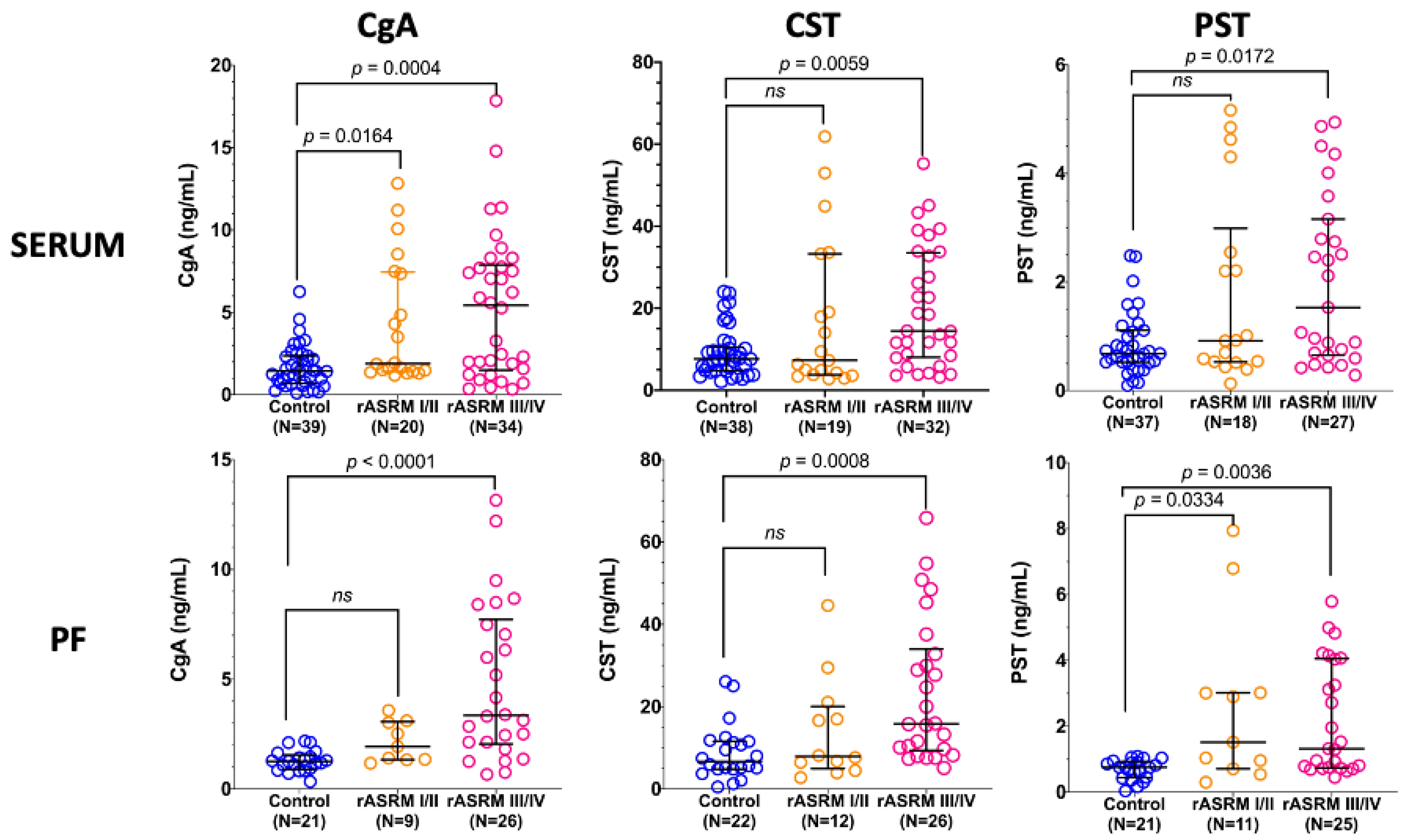
To determine whether the concentrations of the tested factors are associated with endometriosis severity, we compared their levels in serum and PF across disease stages. Significant differences were found between controls and women with advanced disease in all evaluated factors, regardless of their origin (Figure 2). In minimal/mild endometriosis, significantly higher concentrations were observed only for CgA in serum and for PST in the PF.
Spearman correlation analysis revealed a weak but significant association between the concentrations of all tested factors and the clinical stage of endometriosis, both in serum (CgA, rs = 0.391, p < 0.0001; CST, rs = 0.327, p = 0.0018; PST, rs = 0.275, p = 0.0119) and PF (CgA, rs = 0.509, p < 0.0001; CST, rs = 0.478, p = 0.0001; PST, rs = 0.423, p = 0.0011).
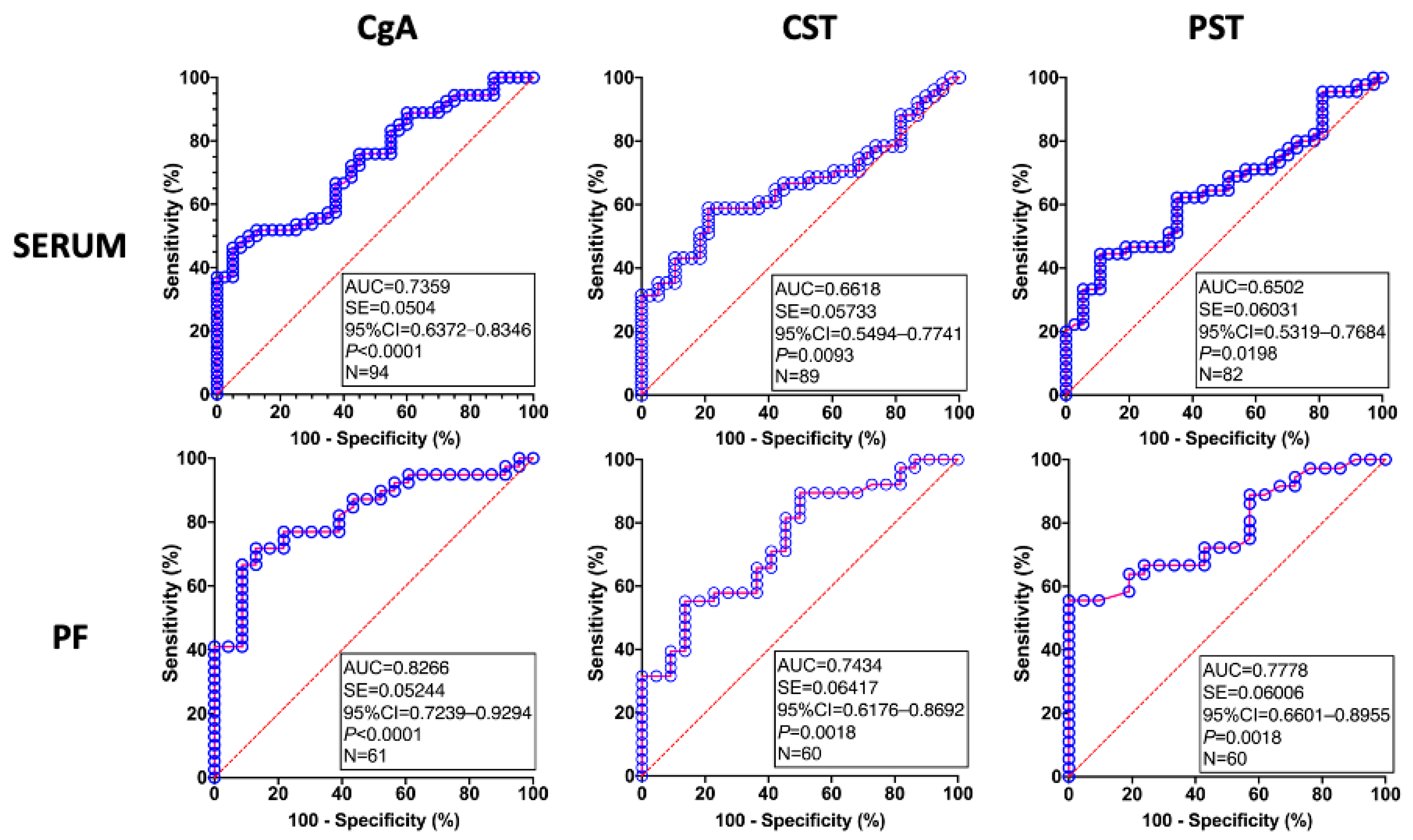
The results of ROC analysis of CgA and its derivatives in sera and PF from the combined population of women with and without endometriosis are presented in Figure 3. As seen, all analyses displayed high statistical significance, and the highest AUC values were observed for all factors in PF. As shown in Table 2, the Youden index and positive predictive value (PPV) and negative predictive value (NPV) for diagnosing endometriosis varied across the tested factors and their origins. The highest parameters were observed for PF CgA, with an AUC above 0.80, a Youden index of 58.75%, and PPV and NPV of 90.32% and 64.51%, respectively.
Furthermore, to evaluate the association of CgA concentrations with endometriosis while adjusting for BMI and infertility as potential confounders, multivariable linear regression analyses were performed as described in Materials and Methods section. The results are shown in Table 3. As can be seen, a significant positive association was found between PF CgA concentrations and the rASRM stage of endometriosis. This association was absent in the case of serum, where CgA was negatively associated with BMI. Removal of BMI from the regression model resulted in a significant association of serum CgA with both endometriosis and infertility.

4. Discussion

The results of the present study show that endometriosis is associated with increased concentrations of CgA and its derivatives, CST and PST, in serum and PF. The levels of CgA and its derivatives were predominantly elevated in endometriosis patients with moderate/severe disease, and there was a positive correlation with rASRM stage classification. This strongly argues for the role of elevated CgA and its derivatives in the pathogenesis of endometriosis.
This is a novel observation, as a relationship between endometriosis and CgA has not been reported to date. The mechanisms and clinical significance of elevated CgA and its derivatives in endometriosis remain obscure. Circulating CgA was found to be elevated in cancer [24,37], some cardiovascular disorders [28,32], and a variety of autoimmune and inflammatory disorders, including diabetes mellitus type I, rheumatoid arthritis, Crohn’s disease, giant cell arteritis, and systemic lupus erythematosus [38,39,40]. Indeed, endometriosis displays some features of an autoimmune disorder [34,35,41,42] and was reported to be associated with a variety of other autoimmune conditions [43]. It is therefore plausible that increased CgA concentrations may be related to the immune status of this disease. It is noteworthy that upregulated circulating CgA may also be associated with certain pharmacological therapies. This may be exemplified by treatment with proton-pump inhibitors (PPIs), which have been reported to increase plasma and serum CgA concentrations in patients with dyspepsia and gastroesophageal reflux [44,45]. Nevertheless, patients and control women enrolled in the present study did not have any chronic disorder. They were not receiving any chronic pharmacological therapy for a minimum of 3 months prior to the onset of the study.
The levels of circulating CgA, CST, and PST were strongly correlated. CST and PST are peptides derived from proteolytic processing of the CgA prohormone [46,47,48]. Therefore, their elevated concentrations in endometriosis are primarily due to increased CgA production. A variety of extracellular and intracellular proteases mediate proteolytic processing of CgA [46,49,50,51,52]. Interestingly, some of them, such as plasmin, were postulated to play a role in the pathogenesis of endometriosis [53].
It remains unclear whether increased concentrations of CgA and its derivatives in PF result from elevated serum levels, or vice versa. Irrespective of the origin and mechanism of increased CgA and its derivatives, they may participate in a variety of pathological processes underlying the development and persistence of endometriotic lesions. Endometriosis is related to local inflammatory reactions [54,55]. Accordingly, CgA and PST have been reported to exert a variety of pro-inflammatory effects, including the production of pro-inflammatory cytokines [30,56,57], macrophage activation [30,58], and the release of reactive oxygen species (ROS) [59], which may exacerbate the course of the disease. On the other hand, CST and other derivatives were found to exhibit immunomodulatory effects, including M2 macrophage polarization [30,60] and reduced inflammatory responses [60,61]. The latter mechanisms may facilitate the growth of endometriotic lesions and stimulate tissue repair mechanisms, leading to local fibrosis. Furthermore, CgA may modulate angiogenesis [62,63,64], a primary mechanism facilitating endometriotic lesion survival and progression [65,66]. Accordingly, it would be of interest to know whether increased concentrations of CgA and its derivatives may precede the development of the disease. However, to the best of our knowledge, there is no information on their concentrations in women at risk before puberty.
ROC analysis further confirmed that endometriosis is associated with increased circulating CgA, CST, and PST levels. Although the results of this analysis suggest that they may be considered markers of endometriosis, their use for a minimally invasive diagnosis of the disease seems to be limited and requires further investigation.
To determine whether upregulated CgA was influenced by other factors, such as BMI or infertility, we performed multivariable linear regression analysis. This analysis confirmed that increased concentrations of peritoneal CgA were associated with high-grade endometriosis. Interestingly, however, in the case of the serum CgA, this association was no longer observed, and serum CgA was found to be negatively associated with BMI. Indeed, the endometriosis group had a significantly lower BMI than the control group, consistent with previous observations that BMI may be reduced in patients with endometriosis [67,68,69,70]. The mechanism and clinical significance of this phenomenon remain unclear. CgA derivatives, CST, and PST may have an important impact on metabolism [71,72] and were also reported to be associated with lowered BMI [73]. In our opinion, this is an interesting observation that may shed new light on the association between endometriosis and energy balance and deserves further investigation.
The limitations of the present study are that body fluid concentrations of CgA and its derivatives were analyzed in the context of endometriotic lesion localization and disease severity, as judged based on rASRM classification, and did not include information regarding deep infiltrating lesions. Similarly, we were also unable to analyze the results in the context of other clinical symptoms of endometriosis, such as pain and dysmenorrhea. This information would be of interest and would support further investigations into other groups of endometriosis patients.
In conclusion, our study shows that CgA and its derivatives are upregulated in endometriosis, strongly suggesting their role in endometriosis pathogenesis. However, the origin of elevated CgA in endometriosis and the mechanisms by which CgA and its derivatives may affect the course of the disease remain unclear and require further extensive examinations.

Author Contributions

Conceptualization, J.M. and I.R.J.; methodology, A.S.-I. and I.R.J.; validation, J.M., I.R.J. and K.S.; formal analysis, A.S.-I. and M.P.; investigation, I.R.J., A.S.-I., M.O.-L., M.M. and H.R.; resources, I.R.J., P.L. and F.D.; data curation, A.S.-I., I.R.J., F.D., P.L. and M.P.; writing—original draft preparation, A.S.-I., M.O.-L., M.M. and H.R.; writing—review and editing, J.M., I.R.J., K.S., F.D. and P.L.; visualization, A.S.-I.; supervision, J.M. and I.R.J.; project administration, I.R.J. and J.M.; funding acquisition, I.R.J. and M.O.-L. All authors have read and agreed to the published version of the manuscript.

Funding

This research was funded by the Polish Ministry of Science and Higher Education, grant number “SKN/SP/601455/2024”.

Institutional Review Board Statement

The study was conducted in accordance with the Declaration of Helsinki and approved by the Bioethical Review Board of the Warsaw Medical University (KB/257/2016, 13 December 2016).

Informed Consent Statement

Informed consent was obtained from all subjects involved in the study.

Data Availability Statement

The raw data supporting the conclusions of this article will be made available by the authors on request.

Conflicts of Interest

The authors declare no conflicts of interest. The funders had no role in the design of the study, in the collection, analysis, or interpretation of data, in the writing of the manuscript, or in the decision to publish the results.

Abbreviations

The following abbreviations are used in this manuscript:
AUCArea under the curve
CgAChromogranin A
CSTCatestatin
ELISAEnzyme-linked immunosorbent assay
NPVNegative predictive value
PFPeritoneal fluid
PPVPositive predictive value
ROCReceiver operating characteristic
rsCorrelation coefficient
SDStandard deviation
SEStandard error
PSTPancreastatin
VSVasostatin

References

  1. Benagiano, G.; Brosens, I.; Lippi, D. The history of endometriosis. Gynecol. Obs. Investig. 2014, 78, 1–9. [Google Scholar] [CrossRef]
  2. Broi, M.G.D.; Ferriani, R.A.; Navarro, P.A. Ethiopathogenic mechanisms of endometriosis-related infertility. JBRA Assist. Reprod. 2019, 23, 273–280. [Google Scholar] [CrossRef]
  3. Giudice, L.C.; Kao, L.C. Endometriosis. Lancet 2004, 364, 1789–1799. [Google Scholar] [CrossRef] [PubMed]
  4. Vercellini, P.; Viganò, P.; Somigliana, E.; Fedele, L. Endometriosis: Pathogenesis and treatment. Nat. Rev. Endocrinol. 2014, 10, 261–275. [Google Scholar] [CrossRef] [PubMed]
  5. Zondervan, K.T.; Becker, C.M.; Koga, K.; Missmer, S.A.; Taylor, R.N.; Viganò, P. Endometriosis. Nat. Rev. Dis. Primers 2018, 4, 9. [Google Scholar] [CrossRef] [PubMed]
  6. Farquhar, C.M. Endometriosis. BMJ 2000, 320, 1449–1452. [Google Scholar] [CrossRef]
  7. Gruber, T.M.; Mechsner, S. Pathogenesis of Endometriosis: The Origin of Pain and Subfertility. Cells 2021, 10, 1381. [Google Scholar] [CrossRef]
  8. Shafrir, A.L.; Farland, L.V.; Shah, D.K.; Harris, H.R.; Kvaskoff, M.; Zondervan, K.; Missmer, S.A. Risk for and consequences of endometriosis: A critical epidemiologic review. Best Pract. Res. Clin. Obs. Gynaecol. 2018, 51, 1–15. [Google Scholar] [CrossRef]
  9. Della Corte, L.; Di Filippo, C.; Gabrielli, O.; Reppuccia, S.; La Rosa, V.L.; Ragusa, R.; Fichera, M.; Commodari, E.; Bifulco, G.; Giampaolino, P. The Burden of Endometriosis on Women’s Lifespan: A Narrative Overview on Quality of Life and Psychosocial Wellbeing. Int. J. Environ. Res. Public Health 2020, 17, 4683. [Google Scholar] [CrossRef]
  10. Dubernard, G.; Piketty, M.; Rouzier, R.; Houry, S.; Bazot, M.; Darai, E. Quality of life after laparoscopic colorectal resection for endometriosis. Hum. Reprod. 2006, 21, 1243–1247. [Google Scholar] [CrossRef]
  11. Bulun, S.E. Endometriosis caused by retrograde menstruation: Now demonstrated by DNA evidence. Fertil. Steril. 2022, 118, 535–536. [Google Scholar] [CrossRef] [PubMed]
  12. Chen, L.H.; Lo, W.C.; Huang, H.Y.; Wu, H.M. A Lifelong Impact on Endometriosis: Pathophysiology and Pharmacological Treatment. Int. J. Mol. Sci. 2023, 24, 7503. [Google Scholar] [CrossRef] [PubMed]
  13. Tsamantioti, E.S.; Mahdy, H. Endometriosis. In StatPearls; StatPearls Publishing LLC.: Treasure Island, FL, USA, 2025. [Google Scholar]
  14. Ścieżyńska, A.; Komorowski, M.; Soszyńska, M.; Malejczyk, J. NK Cells as Potential Targets for Immunotherapy in Endometriosis. J. Clin. Med. 2019, 8, 1468. [Google Scholar] [CrossRef] [PubMed]
  15. Shifon, S.; Tyrinova, T.; Veretelnikova, T.; Pasman, N.; Chernykh, E. Endometriosis as an immune-mediated disease: Pathogenetic mechanisms and therapeutic strategies. Front. Immunol. 2025, 16, 1727183. [Google Scholar] [CrossRef]
  16. Garcia-Velasco, J.A.; Arici, A. Apoptosis and the pathogenesis of endometriosis. Semin. Reprod. Med. 2003, 21, 165–172. [Google Scholar] [CrossRef]
  17. Reis, F.M.; Petraglia, F.; Taylor, R.N. Endometriosis: Hormone regulation and clinical consequences of chemotaxis and apoptosis. Hum. Reprod. Update 2013, 19, 406–418. [Google Scholar] [CrossRef]
  18. Bałkowiec, M.; Maksym, R.B.; Włodarski, P.K. The bimodal role of matrix metalloproteinases and their inhibitors in etiology and pathogenesis of endometriosis (Review). Mol. Med. Rep. 2018, 18, 3123–3136. [Google Scholar] [CrossRef]
  19. Witz, C.A. Cell adhesion molecules and endometriosis. Semin. Reprod. Med. 2003, 21, 173–182. [Google Scholar] [CrossRef]
  20. Chen, G.T.; Tai, C.T.; Yeh, L.S.; Yang, T.C.; Tsai, H.D. Identification of the cadherin subtypes present in the human peritoneum and endometriotic lesions: Potential role for P-cadherin in the development of endometriosis. Mol. Reprod. Dev. 2002, 62, 289–294. [Google Scholar] [CrossRef]
  21. Greaves, E.; Temp, J.; Esnal-Zufiurre, A.; Mechsner, S.; Horne, A.W.; Saunders, P.T. Estradiol is a critical mediator of macrophage-nerve cross talk in peritoneal endometriosis. Am. J. Pathol. 2015, 185, 2286–2297. [Google Scholar] [CrossRef]
  22. Greygoose, E.; Metharom, P.; Kula, H.; Seckin, T.K.; Seckin, T.A.; Ayhan, A.; Yu, Y. The Estrogen-Immune Interface in Endometriosis. Cells 2025, 14, 58. [Google Scholar] [CrossRef]
  23. Bo, C.; Wang, Y. Angiogenesis signaling in endometriosis: Molecules, diagnosis and treatment (Review). Mol. Med. Rep. 2024, 29, 43. [Google Scholar] [CrossRef] [PubMed]
  24. Bartolomucci, A.; Possenti, R.; Mahata, S.K.; Fischer-Colbrie, R.; Loh, Y.P.; Salton, S.R. The extended granin family: Structure, function, and biomedical implications. Endocr. Rev. 2011, 32, 755–797. [Google Scholar] [CrossRef] [PubMed]
  25. Taupenot, L.; Harper, K.L.; O’Connor, D.T. The chromogranin-secretogranin family. N. Engl. J. Med. 2003, 348, 1134–1149. [Google Scholar] [CrossRef] [PubMed]
  26. Montero-Hadjadje, M.; Vaingankar, S.; Elias, S.; Tostivint, H.; Mahata, S.K.; Anouar, Y. Chromogranins A and B and secretogranin II: Evolutionary and functional aspects. Acta Physiol. 2008, 192, 309–324. [Google Scholar] [CrossRef]
  27. Konecki, D.S.; Benedum, U.M.; Gerdes, H.H.; Huttner, W.B. The primary structure of human chromogranin A and pancreastatin. J. Biol. Chem. 1987, 262, 17026–17030. [Google Scholar] [CrossRef]
  28. Mahata, S.K.; Corti, A. Chromogranin A and its fragments in cardiovascular, immunometabolic, and cancer regulation. Ann. N. Y. Acad. Sci. 2019, 1455, 34–58. [Google Scholar] [CrossRef]
  29. Helle, K.B.; Metz-Boutigue, M.H.; Cerra, M.C.; Angelone, T. Chromogranins: From discovery to current times. Pflügers Arch. 2018, 470, 143–154. [Google Scholar] [CrossRef]
  30. Maj, M.; Hernik, K.; Tyszkiewicz, K.; Owe-Larsson, M.; Sztokfisz-Ignasiak, A.; Malejczyk, J.; Janiuk, I. A complex role of chromogranin A and its peptides in inflammation, autoimmunity, and infections. Front. Immunol. 2025, 16, 1567874. [Google Scholar] [CrossRef]
  31. Romano, E.; Rinzivillo, M.; Lamberti, G.; Marasco, M.; Esposito, G.; Campana, D.; Panzuto, F. Rethinking chromogranin A: Unveiling gastrointestinal factors beyond neuroendocrine neoplasms—A narrative review. Transl. Gastroenterol. Hepatol. 2025, 10, 57. [Google Scholar] [CrossRef]
  32. Goetze, J.P.; Alehagen, U.; Flyvbjerg, A.; Rehfeld, J.F. Chromogranin A as a biomarker in cardiovascular disease. Biomark. Med. 2014, 8, 133–140. [Google Scholar] [CrossRef] [PubMed]
  33. Tang, X.; Liu, Z.; Song, L.; Zhu, H.; Su, S.; Wang, D. Prognostic value of circulating Chromogranin A in prostate cancer: A systematic review and meta-analysis. Front. Oncol. 2025, 15, 1521558. [Google Scholar] [CrossRef] [PubMed]
  34. Zhang, T.; De Carolis, C.; Man, G.C.W.; Wang, C.C. The link between immunity, autoimmunity and endometriosis: A literature update. Autoimmun. Rev. 2018, 17, 945–955. [Google Scholar] [CrossRef] [PubMed]
  35. Riccio, L.; Santulli, P.; Marcellin, L.; Abrão, M.S.; Batteux, F.; Chapron, C. Immunology of endometriosis. Best Pract. Res. Clin. Obs. Gynaecol. 2018, 50, 39–49. [Google Scholar] [CrossRef]
  36. Canis, M.; Donnez, J.G.; Guzick, D.S.; Halme, J.K.; Rock, J.A.; Schenken, R.S.; Vernon, M.W. Revised American Society for Reproductive Medicine classification of endometriosis: 1996. Fertil. Steril. 1997, 67, 817–821. [Google Scholar] [CrossRef]
  37. Corti, A.; Marcucci, F.; Bachetti, T. Circulating chromogranin A and its fragments as diagnostic and prognostic disease markers. Pflügers Arch. 2018, 470, 199–210. [Google Scholar] [CrossRef]
  38. Herold, Z.; Herold, M.; Nagy, P.; Patocs, A.; Doleschall, M.; Somogyi, A. Serum chromogranin A level continuously rises with the progression of type 1 diabetes, and indicates the presence of both enterochromaffin-like cell hyperplasia and autoimmune gastritis. J. Diabetes Investig. 2020, 11, 865–873. [Google Scholar] [CrossRef]
  39. Capellino, S.; Lowin, T.; Angele, P.; Falk, W.; Grifka, J.; Straub, R.H. Increased chromogranin A levels indicate sympathetic hyperactivity in patients with rheumatoid arthritis and systemic lupus erythematosus. J. Rheumatol. 2008, 35, 91–99. [Google Scholar]
  40. Glinicki, P.; Jeske, W. Chromogranin A (CgA)—The influence of various factors in vivo and in vitro, and existing disorders on it’s concentration in blood. Endokrynol. Pol. 2010, 61, 384–387. [Google Scholar]
  41. Matarese, G.; De Placido, G.; Nikas, Y.; Alviggi, C. Pathogenesis of endometriosis: Natural immunity dysfunction or autoimmune disease? Trends Mol. Med. 2003, 9, 223–228. [Google Scholar] [CrossRef]
  42. Eisenberg, V.H.; Zolti, M.; Soriano, D. Is there an association between autoimmunity and endometriosis? Autoimmun. Rev. 2012, 11, 806–814. [Google Scholar] [CrossRef] [PubMed]
  43. Blanco, L.P.; Salmeri, N.; Temkin, S.M.; Shanmugam, V.K.; Stratton, P. Endometriosis and autoimmunity. Autoimmun. Rev. 2025, 24, 103752. [Google Scholar] [CrossRef] [PubMed]
  44. Pregun, I.; Herszényi, L.; Juhász, M.; Miheller, P.; Hritz, I.; Patócs, A.; Rácz, K.; Tulassay, Z. Effect of proton-pump inhibitor therapy on serum chromogranin a level. Digestion 2011, 84, 22–28. [Google Scholar] [CrossRef] [PubMed]
  45. Sanduleanu, S.; Stridsberg, M.; Jonkers, D.; Hameeteman, W.; Biemond, I.; Lundqvist, G.; Lamers, C.; Stockbrügger, R.W. Serum gastrin and chromogranin A during medium- and long-term acid suppressive therapy: A case-control study. Aliment. Pharmacol. Ther. 1999, 13, 145–153. [Google Scholar] [CrossRef]
  46. Lee, J.C.; Taylor, C.V.; Gaucher, S.P.; Toneff, T.; Taupenot, L.; Yasothornsrikul, S.; Mahata, S.K.; Sei, C.; Parmer, R.J.; Neveu, J.M.; et al. Primary sequence characterization of catestatin intermediates and peptides defines proteolytic cleavage sites utilized for converting chromogranin a into active catestatin secreted from neuroendocrine chromaffin cells. Biochemistry 2003, 42, 6938–6946. [Google Scholar] [CrossRef]
  47. Muntjewerff, E.M.; Epremidze, D.; Nezhyva, M.; Kal, S.; Rohm, T.V.; Tang, K.; Singh, K.; Espes, D.; Jati, S.; Bootsma, M.; et al. Chromogranin A and catestatin regulate pancreatic islet homeostasis, endocrine function, and neurotransmitter signaling. Commun. Biol. 2025, 8, 1684. [Google Scholar] [CrossRef]
  48. Troger, J.; Theurl, M.; Kirchmair, R.; Pasqua, T.; Tota, B.; Angelone, T.; Cerra, M.C.; Nowosielski, Y.; Mätzler, R.; Troger, J.; et al. Granin-derived peptides. Prog. Neurobiol. 2017, 154, 37–61. [Google Scholar] [CrossRef]
  49. Biswas, N.; Rodriguez-Flores, J.L.; Courel, M.; Gayen, J.R.; Vaingankar, S.M.; Mahata, M.; Torpey, J.W.; Taupenot, L.; O’Connor, D.T.; Mahata, S.K. Cathepsin L colocalizes with chromogranin a in chromaffin vesicles to generate active peptides. Endocrinology 2009, 150, 3547–3557. [Google Scholar] [CrossRef]
  50. Parmer, R.J.; Mahata, M.; Gong, Y.; Mahata, S.K.; Jiang, Q.; O’Connor, D.T.; Xi, X.P.; Miles, L.A. Processing of chromogranin A by plasmin provides a novel mechanism for regulating catecholamine secretion. J. Clin. Investig. 2000, 106, 907–915. [Google Scholar] [CrossRef]
  51. Crippa, L.; Bianco, M.; Colombo, B.; Gasparri, A.M.; Ferrero, E.; Loh, Y.P.; Curnis, F.; Corti, A. A new chromogranin A-dependent angiogenic switch activated by thrombin. Blood 2013, 121, 392–402. [Google Scholar] [CrossRef]
  52. Lee, J.C.; Hook, V. Proteolytic fragments of chromogranins A and B represent major soluble components of chromaffin granules, illustrated by two-dimensional proteomics with NH2-terminal Edman peptide sequencing and MALDI-TOF MS. Biochemistry 2009, 48, 5254–5262. [Google Scholar] [CrossRef] [PubMed][Green Version]
  53. Zorio, E.; Gilabert-Estellés, J.; España, F.; Ramón, L.A.; Cosín, R.; Estellés, A. Fibrinolysis: The key to new pathogenetic mechanisms. Curr. Med. Chem. 2008, 15, 923–929. [Google Scholar] [CrossRef] [PubMed]
  54. Olkowska-Truchanowicz, J.; Białoszewska, A.; Zwierzchowska, A.; Sztokfisz-Ignasiak, A.; Janiuk, I.; Dąbrowski, F.; Korczak-Kowalska, G.; Barcz, E.; Bocian, K.; Malejczyk, J. Peritoneal Fluid from Patients with Ovarian Endometriosis Displays Immunosuppressive Potential and Stimulates Th2 Response. Int. J. Mol. Sci. 2021, 22, 8134. [Google Scholar] [CrossRef] [PubMed]
  55. Gawron, I.; Derbisz, K.; Jach, R.; Trojnarska, D.; Milian-Ciesielska, K.; Pietrus, M. Pelvic peritoneal endometriosis is linked to the endometrial inflammatory profile: A prospective cohort study. BMC Women’s Health 2025, 25, 94. [Google Scholar] [CrossRef]
  56. Garg, R.; Agarwal, A.; Katekar, R.; Dadge, S.; Yadav, S.; Gayen, J.R. Chromogranin A-derived peptides pancreastatin and catestatin: Emerging therapeutic target for diabetes. Amino Acids 2023, 55, 549–561. [Google Scholar] [CrossRef]
  57. Ioannidis, M.; van Dijk, H.; Muntjewerff, E.M.; Chirasani, V.R.; Warner, H.; van den Dool, W.; Grijpstra, P.; Bianchi, F.; Mahata, S.K.; van den Bogaart, G. Inflammation Promotes Proteolytic Processing of the Prohormone Chromogranin A by Macrophages. J. Endocr. Soc. 2025, 9, bvaf090. [Google Scholar] [CrossRef]
  58. Eissa, N.; Hussein, H.; Kermarrec, L.; Ali, A.Y.; Marshall, A.; Metz-Boutigue, M.H.; Hendy, G.N.; Bernstein, C.N.; Ghia, J.E. Chromogranin-A Regulates Macrophage Function and the Apoptotic Pathway in Murine DSS colitis. J. Mol. Med. 2018, 96, 183–198. [Google Scholar] [CrossRef]
  59. Garg, R.; Gupta, A.P.; Katekar, R.; Verma, S.; Goand, U.K.; Dadge, S.; Gayen, J.R. Pancreastatin inhibitor PSTi8 prevents free fatty acid-induced oxidative stress and insulin resistance by modulating JNK pathway: In vitro and in vivo findings. Life Sci. 2022, 289, 120221. [Google Scholar] [CrossRef]
  60. Muntjewerff, E.M.; Dunkel, G.; Nicolasen, M.J.T.; Mahata, S.K.; van den Bogaart, G. Catestatin as a Target for Treatment of Inflammatory Diseases. Front. Immunol. 2018, 9, 2199. [Google Scholar] [CrossRef]
  61. Muntjewerff, E.M.; Christoffersson, G.; Mahata, S.K.; van den Bogaart, G. Putative regulation of macrophage-mediated inflammation by catestatin. Trends Immunol. 2022, 43, 41–50. [Google Scholar] [CrossRef]
  62. Helle, K.B.; Corti, A. Chromogranin A: A paradoxical player in angiogenesis and vascular biology. Cell Mol. Life Sci. 2015, 72, 339–348. [Google Scholar] [CrossRef] [PubMed]
  63. Bianco, M.; Gasparri, A.M.; Colombo, B.; Curnis, F.; Girlanda, S.; Ponzoni, M.; Bertilaccio, M.T.; Calcinotto, A.; Sacchi, A.; Ferrero, E.; et al. Chromogranin A Is Preferentially Cleaved into Proangiogenic Peptides in the Bone Marrow of Multiple Myeloma Patients. Cancer Res. 2016, 76, 1781–1791. [Google Scholar] [CrossRef] [PubMed]
  64. Curnis, F.; Dallatomasina, A.; Bianco, M.; Gasparri, A.; Sacchi, A.; Colombo, B.; Fiocchi, M.; Perani, L.; Venturini, M.; Tacchetti, C.; et al. Regulation of tumor growth by circulating full-length chromogranin A. Oncotarget 2016, 7, 72716–72732. [Google Scholar] [CrossRef] [PubMed]
  65. Laganà, A.S.; Garzon, S.; Götte, M.; Viganò, P.; Franchi, M.; Ghezzi, F.; Martin, D.C. The Pathogenesis of Endometriosis: Molecular and Cell Biology Insights. Int. J. Mol. Sci. 2019, 20, 5615. [Google Scholar] [CrossRef]
  66. Dziunycz, P.; Milewski, Ł.; Radomski, D.; Barcz, E.; Kamiński, P.; Roszkowski, P.I.; Malejczyk, J. Elevated ghrelin levels in the peritoneal fluid of patients with endometriosis: Associations with vascular endothelial growth factor (VEGF) and inflammatory cytokines. Fertil. Steril. 2009, 92, 1844–1849. [Google Scholar] [CrossRef]
  67. Hong, J.; Yi, K.W. What is the link between endometriosis and adiposity? Obs. Gynecol. Sci. 2022, 65, 227–233. [Google Scholar] [CrossRef]
  68. Piriyev, E.; Mennicken, C.; Schiermeier, S.; Römer, T. Does BMI Have an Impact on Endometriosis Symptoms and Endometriosis Types According to the #ENZIAN Classification? J. Clin. Med. 2025, 14, 4040. [Google Scholar] [CrossRef]
  69. Liu, Y.; Zhang, W. Association between body mass index and endometriosis risk: A meta-analysis. Oncotarget 2017, 8, 46928–46936. [Google Scholar] [CrossRef]
  70. Pantelis, A.; Machairiotis, N.; Lapatsanis, D.P. The Formidable yet Unresolved Interplay between Endometriosis and Obesity. Sci. World J. 2021, 2021, 6653677. [Google Scholar] [CrossRef]
  71. Sánchez-Margalet, V.; González-Yanes, C.; Najib, S.; Santos-Alvarez, J. Metabolic effects and mechanism of action of the chromogranin A-derived peptide pancreastatin. Regul. Pept. 2010, 161, 8–14. [Google Scholar] [CrossRef]
  72. Ying, W.; Mahata, S.; Bandyopadhyay, G.K.; Zhou, Z.; Wollam, J.; Vu, J.; Mayoral, R.; Chi, N.W.; Webster, N.J.G.; Corti, A.; et al. Catestatin Inhibits Obesity-Induced Macrophage Infiltration and Inflammation in the Liver and Suppresses Hepatic Glucose Production, Leading to Improved Insulin Sensitivity. Diabetes 2018, 67, 841–848. [Google Scholar] [CrossRef]
  73. Simunovic, M.; Supe-Domic, D.; Karin, Z.; Degoricija, M.; Paradzik, M.; Bozic, J.; Unic, I.; Skrabic, V. Serum catestatin concentrations are decreased in obese children and adolescents. Pediatr. Diabetes 2019, 20, 549–555. [Google Scholar] [CrossRef]
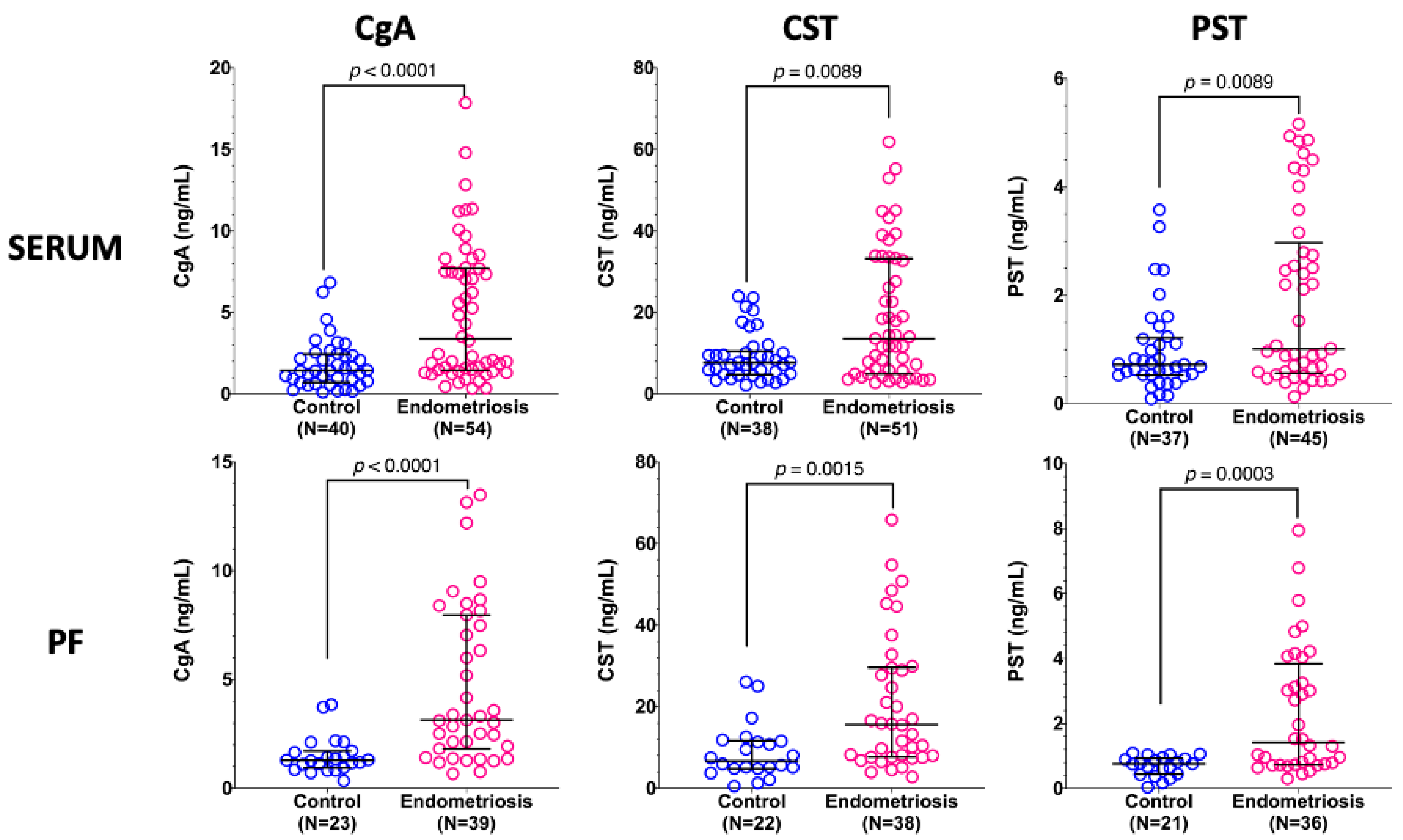
Figure 1. Serum and peritoneal fluid (PF) concentrations of chromogranin A (CgA), catestatin (CST), and pancreastatin (PST) in the control group and patients with endometriosis. The results are shown as medians and interquartile ranges, and p-values for differences between control and endometriosis groups were calculated by the Mann–Whitney U-test. N, number of samples.
Jcm 15 01567 g001
Figure 2. Association of the concentrations of chromogranin A (CgA), catestatin (CST), and pancreastatin (PST) in serum and peritoneal fluid (PF) with the rASRM stage of endometriosis. Results are shown as medians and interquartile ranges, and the Kruskal–Wallis test followed by Dunn’s multiple-comparison test was used to calculate p-values for pairwise comparisons. N, number of samples; ns, not statistically significant.
Jcm 15 01567 g002
Figure 3. ROC analysis of chromogranin A (CgA), catestatin (CST), and pancreastatin (PST) in serum and peritoneal fluid (PF) of patients with endometriosis and control women. The area under the curve (AUC), standard error (SE), 95% confidence interval (95% CI), p-value, and the total number of analyzed samples (N) are given in an inset.
Jcm 15 01567 g003
Table 1. Characteristics of patients with endometriosis and control subjects.
CharacteristicsControlEndometriosisp-Value *
Number of cases (N)6065
Age, years (mean ± SD)33.19 ± 8.0332.92 ± 5.740.8301
BMI, kg/m2 (mean ± SD)24.61 ± 5.3322.38 ± 3.660.0220
rASRMI (minimal)/II (mild)-25 (38.5%)-
III (moderate)/IV (severe)-40 (61.5%)-
Lesion localizationOvarian-20 (30.8%)-
Peritoneal-25 (38.5%)-
Both-20 (30.8%)-
Parity (mean ± SD)1.25 ± 1.150.23 ± 0.440.0161
Infertility20 (33.3%)54 (83.3%)<0.0001
* p-values for differences between mean values were calculated by Student-t test, whereas z-ratio was used for the calculation of the significance of the difference between two independent proportions.
Table 2. Diagnostic value of chromogranin A (CgA), catestatin (CST), and pancreastatin (PST) concentrations in serum and peritoneal fluid (PF) to predict endometriosis.
Investigated FactorSample OriginYouden Index (%)PPV (%)NPV (%)
CgAserum41.392.5956.72
PF58.7590.3264.51
CSTserum37.7778.9558.82
PF41.6287.552.77
PSTserum33.6383.3356.89
PF55.5610056.76
Table 3. Multivariable linear regression models for log-transformed CgA concentrations in serum and peritoneal fluid (PF).
VariableSerum log [CgA]PF log [CgA]
βp-Value95% CIβp-Value95% CI
rASRM0.1720.2047−0.096–0.4410.4020.01350.088–0.715
BMI−0.0610.0143−0.1102–−0.0127−0.0050.8874−0.069–0.060
Infertility0.1960.3869−0.2537–0.64650.0620.8252−0.508–0.633
N71 37
Multiple R2/Adjusted R20.131/0.092 0.171/0.096
Multivariate linear regression was performed as described in the Materials and Methods section. CI, confidence interval. N, number of cases.
Disclaimer/Publisher’s Note: The statements, opinions and data contained in all publications are solely those of the individual author(s) and contributor(s) and not of MDPI and/or the editor(s). MDPI and/or the editor(s) disclaim responsibility for any injury to people or property resulting from any ideas, methods, instructions or products referred to in the content.