Contemporary Challenges in Venous Thromboembolism: Evolving Populations and Implications for Management and Risk Stratification


Abstract
1. Introduction
2. Methodology
3. Epidemiology—Trends and Emerging Risks
3.1. Rising VTE Incidence
3.2. Cancer
3.3. Obesity
3.4. New Considerations
4. Treatment—Present Approaches and Future Considerations
4.1. The DOAC Era—Current Practices and Unresolved Issues
4.2. Beyond DOACs–Novel Factor Inhibitors
4.3. Endovascular Approaches
4.4. Outpatient Management Models
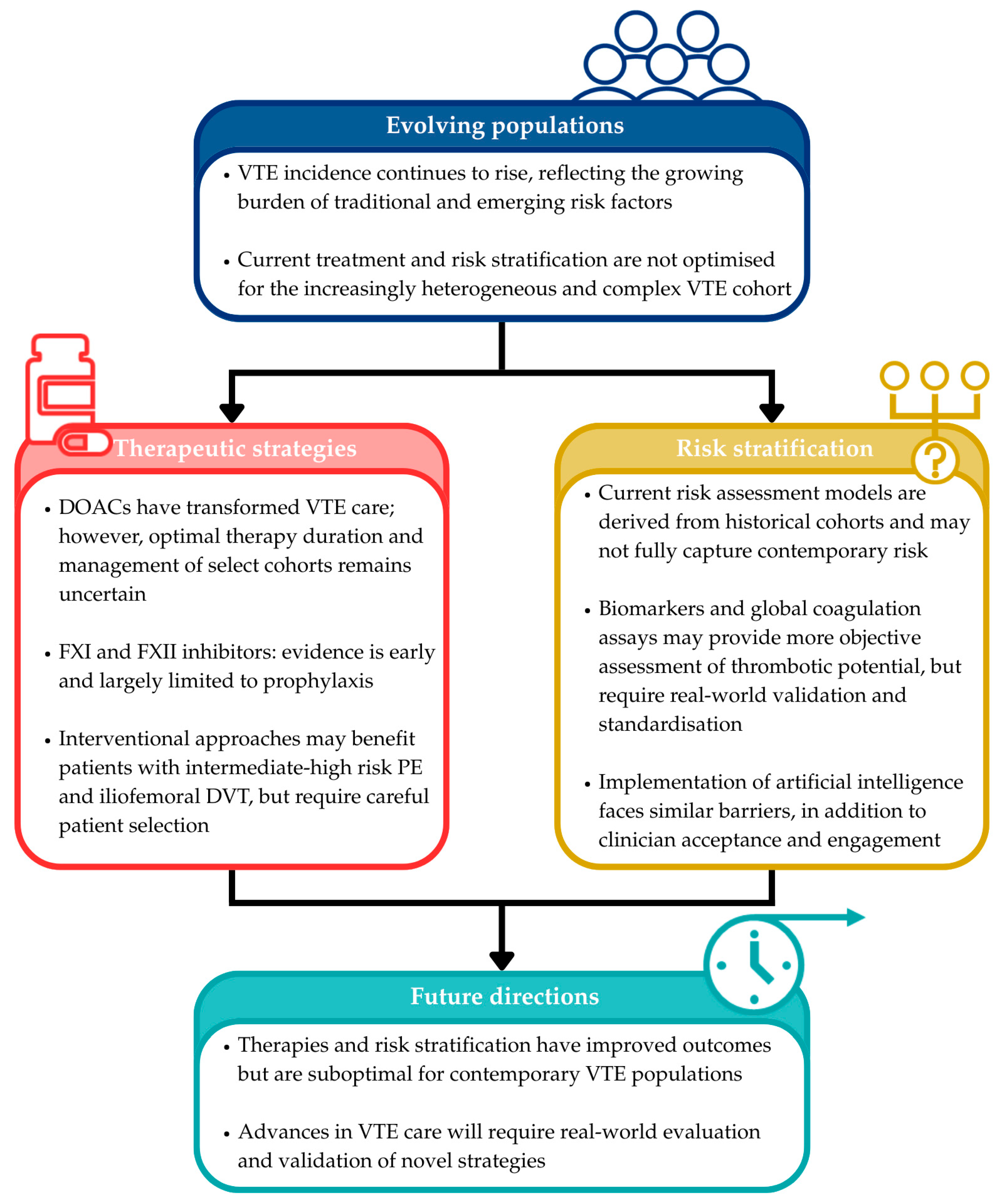
- While DOACs have transformed VTE management, uncertainty remains regarding the optimal treatment of complex patient cohorts, highlighting the limitations of current guidelines and the need for nuanced risk stratification.
- Novel FXI inhibitors aim to mitigate the limitations of anticoagulation in high bleeding risk cohorts; however, evidence remains early and largely untested in real-world settings.
- Interventional approaches can enable rapid thrombus removal, but current evidence only supports use in carefully selected intermediate-high risk PE and iliofemoral DVT patients.
- Outpatient management of low-risk PE is feasible, though its practice remains limited.
5. Risk Stratification—Current Tools and Emerging Needs
5.1. Current Limitations
5.2. Biomarkers and Novel Assays
5.3. The Role of Artificial Intelligence
- Current RAMs are based on historical cohorts with minimal biomarker integration and may not accurately assess risk in contemporary populations.
- Novel biomarkers, such as FVIII, p-selectin and TF-MP, as well as global coagulation assays may provide more objective assessments of thrombotic risk, but require standardisation and real-world validation.
- AI and ML models represent another tool to improve VTE risk stratification, but face technical, ethical and clinician acceptance barriers.
6. Conclusions
Supplementary Materials
Author Contributions
Funding
Institutional Review Board Statement
Informed Consent Statement
Data Availability Statement
Conflicts of Interest
References
- Raskob, G.E.; Angchaisuksiri, P.; Blanco, A.N.; Buller, H.; Gallus, A.; Hunt, B.J.; Hylek, E.M.; Kakkar, A.; Konstantinides, S.V.; McCumber, M.; et al. Thrombosis: A major contributor to global disease burden. Arterioscler. Thromb. Vasc. Biol. 2014, 34, 2363–2371. [Google Scholar] [CrossRef]
- Fernandez, M.M.; Hogue, S.; Preblick, R.; Kwong, W.J. Review of the cost of venous thromboembolism. Clin. Outcomes Res. 2015, 7, 451–462. [Google Scholar] [CrossRef] [PubMed]
- Seemann, K.; Silas, U.; Bosworth Smith, A.; Münch, T.; Saunders, S.J.; Veloz, A.; Saunders, R. The burden of venous thromboembolism in ten countries: A cost-of-illness Markov model on surgical and ICU patients. J. Med. Econ. 2025, 28, 1–12. [Google Scholar] [CrossRef] [PubMed]
- Brækkan, S.K.; Hansen, J.-B. VTE epidemiology and challenges for VTE prevention at the population level. Thromb. Updat. 2023, 10, 100132. [Google Scholar] [CrossRef]
- Wang, R.C.; Miglioretti, D.L.; Marlow, E.C.; Kwan, M.L.; Theis, M.K.; Bowles, E.J.A.; Greenlee, R.T.; Rahm, A.K.; Stout, N.K.; Weinmann, S.; et al. Trends in Imaging for Suspected Pulmonary Embolism Across US Health Care Systems, 2004 to 2016. JAMA Netw. Open. 2020, 3, e2026930. [Google Scholar] [CrossRef]
- Arshad, N.; Isaksen, T.; Hansen, J.B.; Brækkan, S.K. Time trends in incidence rates of venous thromboembolism in a large cohort recruited from the general population. Eur. J. Epidemiol. 2017, 32, 299–305. [Google Scholar] [CrossRef]
- Sussman, T.A.; Giobbie-Hurder, A.; Dryg, I.D.; Manos, M.; Weirather, J.L.; LeBoeuf, N.R.; Hodi, F.S.; Connors, J.M. Immune checkpoint inhibitor-associated risk for venous thromboembolism: A comprehensive analysis. J. Immunother. Cancer 2025, 13, e010761. [Google Scholar] [CrossRef] [PubMed]
- Hashmi, H.; Mirza, A.S.; Darwin, A.; Logothetis, C.; Garcia, F.; Kommalapati, A.; Mhaskar, R.S.; Bachmeier, C.; Chavez, J.C.; Shah, B.; et al. Venous thromboembolism associated with CD19-directed CAR T-cell therapy in large B-cell lymphoma. Blood Adv. 2020, 4, 4086–4090. [Google Scholar] [CrossRef]
- Franco-Moreno, A.; Ryan, P.; Muñoz-Rivas, N.; Valencia, J.; Torres-Macho, J.; Bacete-Cebrián, S. Risk of venous thromboembolism in the transgender population on hormone therapy: A systematic review. Med. Clin. 2025, 164, 106921. [Google Scholar] [CrossRef]
- Hokusai-VTE Investigators; Büller, H.R.; Décousus, H.; Grosso, M.A.; Mercuri, M.; Middeldorp, S.; Prins, M.H.; Raskob, G.E.; Schellong, S.M.; Schwocho, L.; et al. Edoxaban versus warfarin for the treatment of symptomatic venous thromboembolism. N. Engl. J. Med. 2013, 369, 1406–1415. [Google Scholar]
- Agnelli, G.; Buller, H.R.; Cohen, A.; Curto, M.; Gallus, A.S.; Johnson, M.; Masiukiewicz, U.; Pak, R.; Thompson, J.; Raskob, G.E.; et al. Oral apixaban for the treatment of acute venous thromboembolism. N. Engl. J. Med. 2013, 369, 799–808. [Google Scholar] [CrossRef] [PubMed]
- EINSTEIN Investigators; Bauersachs, R.; Berkowitz, S.D.; Brenner, B.; Buller, H.R.; Decousus, H.; Gallus, A.S.; Lensing, A.W.; Misselwitz, F.; Prins, M.H.; et al. Oral rivaroxaban for symptomatic venous thromboembolism. N. Engl. J. Med. 2010, 363, 2499–2510. [Google Scholar]
- EINSTEIN–PE Investigators; Büller, H.R.; Prins, M.H.; Lensin, A.W.; Decousus, H.; Jacobson, B.F.; Minar, E.; Chlumsky, J.; Verhamme, P.; Wells, P.; et al. Oral rivaroxaban for the treatment of symptomatic pulmonary embolism. N. Engl. J. Med. 2012, 366, 1287–1297. [Google Scholar] [CrossRef]
- Schulman, S.; Kakkar, A.K.; Goldhaber, S.Z.; Schellong, S.; Eriksson, H.; Mismetti, P.; Christiansen, A.V.; Friedman, J.; Le Maulf, F.; Peter, N.; et al. Treatment of acute venous thromboembolism with dabigatran or warfarin and pooled analysis. Circulation 2014, 129, 764–772. [Google Scholar] [CrossRef]
- Verhamme, P.; Yi, B.A.; Segers, A.; Salter, J.; Bloomfield, D.; Büller, H.R.; Raskob, G.E.; Weitz, J.I.; ANT-005 TKA Investigators. Abelacimab for Prevention of Venous Thromboembolism. N. Engl. J. Med. 2021, 385, 609–617. [Google Scholar] [CrossRef] [PubMed]
- Weitz, J.I.; Tankó, L.B.; Floege, J.; Fox, K.A.A.; Bhatt, D.L.; Thadhani, R.; Hung, J.; Pap, Á.F.; Kubitza, D.; Winkelmayer, W.C.; et al. Anticoagulation with osocimab in patients with kidney failure undergoing hemodialysis: A randomized phase 2 trial. Nat. Med. 2024, 30, 435–442. [Google Scholar] [CrossRef]
- Jaber, W.A.; Gonsalves, C.F.; Stortecky, S.; Horr, S.; Pappas, O.; Gandhi, R.T.; Pereira, K.; Giri, J.; Khandhar, S.J.; Ammar, K.A.; et al. Large-Bore Mechanical Thrombectomy Versus Catheter-Directed Thrombolysis in the Management of Intermediate-Risk Pulmonary Embolism: Primary Results of the PEERLESS Randomized Controlled Trial. Circulation 2025, 151, 260–273. [Google Scholar] [CrossRef] [PubMed]
- Plotnik, A.N.; Haber, Z.; Kee, S. Current Evidence for Endovascular Therapies in the Management of Acute Deep Vein Thrombosis. Cardiovasc. Interv. Radiol. 2024, 47, 1571–1579. [Google Scholar] [CrossRef] [PubMed]
- Roy, P.M.; Penaloza, A.; Hugli, O.; Klok, F.A.; Arnoux, A.; Elias, A.; Couturaud, F.; Joly, L.M.; Lopez, R.; Faber, L.M.; et al. Triaging acute pulmonary embolism for home treatment by Hestia or simplified PESI criteria: The HOME-PE randomized trial. Eur. Heart J. 2021, 42, 3146–3157. [Google Scholar] [CrossRef] [PubMed]
- Khorana, A.A.; Kuderer, N.M.; Culakova, E.; Lyman, G.H.; Francis, C.W. Development and validation of a predictive model for chemotherapy-associated thrombosis. Blood 2008, 111, 4902–4907. [Google Scholar] [CrossRef]
- Rodger, M.A.; Kahn, S.R.; Wells, P.S.; Anderson, D.A.; Chagnon, I.; Le Gal, G.; Solymoss, S.; Crowther, M.; Perrier, A.; White, R.; et al. Identifying unprovoked thromboembolism patients at low risk for recurrence who can discontinue anticoagulant therapy. Can. Med. Assoc. J. 2008, 179, 417–426. [Google Scholar] [CrossRef] [PubMed]
- de Winter, M.A.; Büller, H.R.; Carrier, M.; Cohen, A.T.; Hansen, J.B.; Kaasjager, K.A.H.; Kakkar, A.K.; Middeldorp, S.; Raskob, G.E.; Sørensen, H.T.; et al. Recurrent venous thromboembolism and bleeding with extended anticoagulation: The VTE-PREDICT risk score. Eur. Heart J. 2023, 44, 1231–1244. [Google Scholar] [CrossRef]
- Naess, I.A.; Christiansen, S.C.; Romundstad, P.; Cannegieter, S.C.; Rosendaal, F.R.; Hammerstrøm, J. Incidence and mortality of venous thrombosis: A population-based study. J. Thromb. Haemost. 2007, 5, 692–699. [Google Scholar] [CrossRef]
- Li, J.; Han, X.; Zhang, X.; Wang, S. Spatiotemporal evolution of global population ageing from 1960 to 2017. BMC Public Health 2019, 19, 127. [Google Scholar] [CrossRef] [PubMed]
- Navaneetham, K.; Arunachalam, D. Global population aging, 1950–2050. In Handbook of Aging, Health, and Public Policy; Uhlenberg, P., Ed.; Springer: Singapore, 2023; pp. 1–18. [Google Scholar]
- Arnesen, C.A.L.; Veres, K.; Horváth-Puhó, E.; Hansen, J.B.; Sørensen, H.T.; Brækkan, S.K. Estimated lifetime risk of venous thromboembolism in men and women in a Danish nationwide cohort: Impact of competing risk of death. Eur. J. Epidemiol. 2022, 37, 195–203. [Google Scholar] [CrossRef]
- Huang, W.; Goldberg, R.J.; Anderson, F.A.; Kiefe, C.I.; Spencer, F.A. Secular trends in occurrence of acute venous thromboembolism: The Worcester VTE study (1985–2009). Am. J. Med. 2014, 127, 829–839.e5. [Google Scholar] [CrossRef]
- Caraballo, C.; Herrin, J.; Mahajan, S.; Massey, D.; Lu, Y.; Ndumele, C.D.; Drye, E.E.; Krumholz, H.M. Temporal Trends in Racial and Ethnic Disparities in Multimorbidity Prevalence in the United States, 1999–2018. Am. J. Med. 2022, 135, 1083–1092.e14. [Google Scholar] [CrossRef] [PubMed]
- Chowdhury, S.R.; Chandra Das, D.; Sunna, T.C.; Beyene, J.; Hossain, A. Global and regional prevalence of multimorbidity in the adult population in community settings: A systematic review and meta-analysis. EClinicalMedicine 2023, 57, 101860. [Google Scholar] [CrossRef] [PubMed]
- Permanyer, I.; Gumà, J.; Trias-Llimós, S.; Solé-Auró, A. Multimorbidity trends in Catalonia, 2010–2021: A population-based cohort study. Int. J. Epidemiol. 2026, 55, dyaf218. [Google Scholar] [CrossRef]
- Rosenberg, P.S.; Miranda-Filho, A. Cancer Incidence Trends in Successive Social Generations in the US. JAMA Netw. Open. 2024, 7, e2415731. [Google Scholar] [CrossRef] [PubMed]
- Wu, Z.; Xia, F.; Lin, R. Global burden of cancer and associated risk factors in 204 countries and territories, 1980–2021: A systematic analysis for the GBD 2021. J. Hematol. Oncol. 2024, 17, 119. [Google Scholar] [CrossRef]
- Bizuayehu, H.M.; Ahmed, K.Y.; Kibret, G.D.; Dadi, A.F.; Belachew, S.A.; Bagade, T.; Tegegne, T.K.; Venchiarutti, R.L.; Kibret, K.T.; Hailegebireal, A.H.; et al. Global Disparities of Cancer and Its Projected Burden in 2050. JAMA Netw. Open 2024, 7, e2443198. [Google Scholar] [CrossRef] [PubMed]
- Hughes, T.; Harper, A.; Gupta, S.; Frazier, A.L.; van der Graaf, W.T.A.; Moreno, F.; Joseph, A.; Fidler-Benaoudia, M.M. The current and future global burden of cancer among adolescents and young adults: A population-based study. Lancet Oncol. 2024, 25, 1614–1624. [Google Scholar] [CrossRef]
- Mulder, F.I.; Horváth-Puhó, E.; van Es, N.; van Laarhoven, H.W.M.; Pedersen, L.; Moik, F.; Ay, C.; Büller, H.R.; Sørensen, H.T. Venous thromboembolism in cancer patients: A population-based cohort study. Blood 2021, 137, 1959–1969. [Google Scholar] [CrossRef]
- Mahajan, A.; Brunson, A.; Adesina, O.; Keegan, T.H.M.; Wun, T. The incidence of cancer-associated thrombosis is increasing over time. Blood Adv. 2022, 6, 307–320. [Google Scholar] [CrossRef] [PubMed]
- Covut, F.; Sanfilippo, K.M. Mitigating the risk of venous thromboembolism in patients with multiple myeloma receiving immunomodulatory-based therapy. Hematology 2022, 2022, 363–367. [Google Scholar] [CrossRef]
- Xu, X.; Chlebowski, R.T.; Shi, J.; Barac, A.; Haque, R. Aromatase inhibitor and tamoxifen use and the risk of venous thromboembolism in breast cancer survivors. Breast Cancer Res. Treat. 2019, 174, 785–794. [Google Scholar] [CrossRef] [PubMed]
- Roopkumar, J.; Swaidani, S.; Kim, A.S.; Thapa, B.; Gervaso, L.; Hobbs, B.P.; Wei, W.; Alban, T.J.; Funchain, P.; Kundu, S.; et al. Increased Incidence of Venous Thromboembolism with Cancer Immunotherapy. Med 2021, 2, 423–434. [Google Scholar] [CrossRef]
- Bindal, P.; Patell, R.; Chiasakul, T.; Lauw, M.N.; Ko, A.; Wang, T.F.; Zwicker, J.I. A meta-analysis to assess the risk of bleeding and thrombosis following chimeric antigen receptor T-cell therapy: Communication from the ISTH SSC Subcommittee on Hemostasis and Malignancy. J. Thromb. Haemost. 2024, 22, 2071–2080. [Google Scholar] [CrossRef]
- Chitkara, A.; Sreenivasan, S.; Yin, Y.; Rai, M.; Sadashiv, S. Venous Thromboembolism Risk in Hematological Malignancies Post-Chimeric Antigen Receptor T-Cell (CAR-T) Therapy: A Meta-Analysis of Phase 2 and Phase 3 Clinical Trials. Curr. Oncol. 2024, 31, 4338–4345. [Google Scholar] [CrossRef]
- GBD 2021 Adult BMI Collaborators. Global, regional, and national prevalence of adult overweight and obesity, 1990–2021, with forecasts to 2050: A forecasting study for the Global Burden of Disease Study 2021. Lancet 2025, 405, 813–838. [Google Scholar] [CrossRef]
- Napoleone, E.; DISanto, A.; Amore, C.; Baccante, G.; di Febbo, C.; Porreca, E.; de Gaetano, G.; Donati, M.B.; Lorenzet, R. Leptin induces tissue factor expression in human peripheral blood mononuclear cells: A possible link between obesity and cardiovascular risk? J. Thromb. Haemost. 2007, 5, 1462–1468. [Google Scholar] [CrossRef]
- Petrini, S.; Neri, T.; Lombardi, S.; Cordazzo, C.; Balìa, C.; Scalise, V.; Paggiaro, P.; Pedrinelli, R.; Celi, A. Leptin induces the generation of procoagulant, tissue factor bearing microparticles by human peripheral blood mononuclear cells. Biochim. Biophys. Acta 2016, 1860, 1354–1361. [Google Scholar] [CrossRef]
- Frischmuth, T.; Hindberg, K.; Aukrust, P.; Ueland, T.; Braekkan, S.K.; Hansen, J.B.; Morelli, V.M. Elevated plasma levels of plasminogen activator inhibitor-1 are associated with risk of future incident venous thromboembolism. J. Thromb. Haemost. 2022, 20, 1618–1626. [Google Scholar] [CrossRef]
- Ageno, W.; Becattini, C.; Brighton, T.; Selby, R.; Kamphuisen, P.W. Cardiovascular risk factors and venous thromboembolism: A meta-analysis. Circulation 2008, 117, 93–102. [Google Scholar] [CrossRef]
- Horvei, L.D.; Brækkan, S.K.; Hansen, J.B. Weight Change and Risk of Venous Thromboembolism: The Tromsø Study. PLoS ONE 2016, 11, e0168878. [Google Scholar] [CrossRef] [PubMed]
- Totaro, M.; Palazzi, S.; Castellini, C.; Parisi, A.; D’Amato, F.; Tienforti, D.; Baroni, M.G.; Francavilla, S.; Barbonetti, A. Risk of Venous Thromboembolism in Transgender People Undergoing Hormone Feminizing Therapy: A Prevalence Meta-Analysis and Meta-Regression Study. Front. Endocrinol. 2021, 12, 741866. [Google Scholar] [CrossRef] [PubMed]
- Kort, D.; van Rein, N.; van der Meer, F.J.M.; Vermaas, H.W.; Wiersma, N.; Cannegieter, S.C.; Lijfering, W.M. Relationship between neighborhood socioeconomic status and venous thromboembolism: Results from a population-based study. J. Thromb. Haemost. 2017, 15, 2352–2360. [Google Scholar] [CrossRef] [PubMed]
- Jørgensen, H.; Horváth-Puhó, E.; Laugesen, K.; Braekkan, S.; Hansen, J.B.; Sørensen, H.T. Socioeconomic status and risk of incident venous thromboembolism. J. Thromb. Haemost. 2021, 19, 3051–3061. [Google Scholar] [CrossRef]
- Swan, D.; Turner, R.; Franchini, M.; Mannucci, P.M.; Thachil, J. Air pollution and venous thromboembolism: Current knowledge and future perspectives. Lancet Haematol. 2025, 12, e68–e82. [Google Scholar] [CrossRef]
- Lutsey, P.L.; Misialek, J.R.; Young, M.T.; Berman, J.; Leiser, C.L.; Pope, Z.C.; Cushman, M.; Folsom, A.R.; Kaufman, J.D. Air pollution is associated with increased risk of venous thromboembolism: The Multi-Ethnic Study of Atherosclerosis. Blood 2025, 145, 1089–1096. [Google Scholar] [CrossRef] [PubMed]
- Woller, S.C.; Steven, S.M.; Bledsoe, J.R.; Bride, D.; Lloyd, J.F.; Butler, A.; Fazili, M.; Horne, B.D. Risk of venous thromboembolism associated with short-term exposure to fine particulate matter (PM2.5) and ozone air pollution. Res. Pract. Thromb. Haemost. 2025, 9, 103226. [Google Scholar] [CrossRef]
- Rose, D.K.; Bar, B. Direct Oral Anticoagulant Agents: Pharmacologic Profile, Indications, Coagulation Monitoring, and Reversal Agents. J. Stroke Cerebrovasc. Dis. 2018, 27, 2049–2058. [Google Scholar] [CrossRef]
- Jun, M.; Lix, L.M.; Durand, M.; Dahl, M.; Paterson, J.M.; Dormuth, C.R.; Ernst, P.; Yao, S.; Renoux, C.; Tamim, H.; et al. Comparative safety of direct oral anticoagulants and warfarin in venous thromboembolism: Multicentre, population based, observational study. BMJ 2017, 359, j4323. [Google Scholar] [CrossRef]
- Kang, H.R.; Dietrich, E.A.; Huang, P.L.; Lo-Ciganic, W.H.; DeRemer, C.E.; Park, H. Comparative effectiveness and safety of direct oral anticoagulants versus warfarin among patients with recurrent venous thromboembolism. Clin. Transl. Sci. 2023, 16, 946–954. [Google Scholar] [CrossRef] [PubMed]
- Fang, M.C.; Reynolds, K.; Fan, D.; Prasad, P.A.; Sung, S.H.; Portugal, C.; Garcia, E.; Go, A.S. Clinical Outcomes of Direct Oral Anticoagulants vs Warfarin for Extended Treatment of Venous Thromboembolism. JAMA Netw. Open 2023, 6, e2328033. [Google Scholar] [CrossRef]
- Lui, B.; Wee, B.; Lai, J.; Khattak, Z.; Kwok, A.; Donarelli, C.; Ho, P.; Lim, H.Y. A ten-year review of the impact of the transition from warfarin to direct oral anticoagulant—Has venous thromboembolism treatment become safer? Thromb. Res. 2022, 219, 112–120. [Google Scholar] [CrossRef]
- Khorana, A.A.; Noble, S.; Lee, A.Y.Y.; Soff, G.; Meyer, G.; O’Connell, C.; Carrier, M. Role of direct oral anticoagulants in the treatment of cancer-associated venous thromboembolism: Guidance from the SSC of the ISTH. J. Thromb. Haemost. 2018, 16, 1891–1894. [Google Scholar] [CrossRef]
- Martin, K.A.; Beyer-Westendorf, J.; Davidson, B.L.; Huisman, M.V.; Sandset, P.M.; Moll, S. Use of direct oral anticoagulants in patients with obesity for treatment and prevention of venous thromboembolism: Updated communication from the ISTH SSC Subcommittee on Control of Anticoagulation. J. Thromb. Haemost. 2021, 19, 1874–1882. [Google Scholar] [CrossRef] [PubMed]
- Stevens, S.M.; Woller, S.C.; Kreuziger, L.B.; Bounameaux, H.; Doerschug, K.; Geersing, G.J.; Huisman, M.V.; Kearon, C.; King, C.S.; Knighton, A.J.; et al. Antithrombotic Therapy for VTE Disease: Second Update of the CHEST Guideline and Expert Panel Report. Chest 2021, 160, e545–e608. [Google Scholar] [CrossRef]
- Kearon, C.; Kahn, S.R. Long-term treatment of venous thromboembolism. Blood 2020, 135, 317–325. [Google Scholar] [CrossRef]
- Khan, F.; Tritschler, T.; Kimpton, M.; Wells, P.S.; Kearon, C.; Weitz, J.I.; Büller, H.R.; Raskob, G.E.; Ageno, W.; Couturaud, F.; et al. Long-term risk of recurrent venous thromboembolism among patients receiving extended oral anticoagulant therapy for first unprovoked venous thromboembolism: A systematic review and meta-analysis. J. Thromb. Haemost. 2021, 19, 2801–2813. [Google Scholar] [CrossRef]
- Lim, H.Y.; Nandurkar, H.; Ho, P. Direct Oral Anticoagulants and the Paradigm Shift in the Management of Venous Thromboembolism. Semin. Thromb. Hemost. 2018, 44, 261–266. [Google Scholar] [CrossRef] [PubMed]
- Ebraheem, M.; Alzahrani, I.; Crowther, M.; Rochwerg, B.; Almakadi, M. Extended DOAC therapy in patients with VTE and potential risk of recurrence: A systematic review and meta-analysis. J. Thromb. Haemost. 2020, 18, 2308–2317. [Google Scholar] [CrossRef] [PubMed]
- Kearon, C. Balancing risks and benefits of extended anticoagulant therapy for idiopathic venous thrombosis. J. Thromb. Haemost. 2009, 7, 296–300. [Google Scholar] [CrossRef] [PubMed]
- Ortel, T.L.; Neumann, I.; Ageno, W.; Beyth, R.; Clark, N.P.; Cuker, A.; Hutten, B.A.; Jaff, M.R.; Manja, V.; Schulman, S.; et al. American Society of Hematology 2020 guidelines for management of venous thromboembolism: Treatment of deep vein thrombosis and pulmonary embolism. Blood Adv. 2020, 4, 4693–4738. [Google Scholar] [CrossRef]
- Piazza, G.; Bikdeli, B.; Pandey, A.K.; Krishnathasan, D.; Khairani, C.D.; Bejjani, A.; Morrison, R.H.; Hogan, H.; Rashedi, S.; Pfeferman, M.; et al. Apixaban for Extended Treatment of Provoked Venous Thromboembolism. N. Engl. J. Med. 2025, 393, 1166–1176. [Google Scholar] [CrossRef]
- Chua, C.C.; Lim, H.Y.; Tacey, M.; Nandurkar, H.; Ho, P. Retrospective evaluation of venous thromboembolism: Are all transient provoking events the same? Eur. J. Haematol. 2017, 99, 18–26. [Google Scholar] [CrossRef]
- Upreti, V.V.; Wang, J.; Barrett, Y.C.; Byon, W.; Boyd, R.A.; Pursley, J.; LaCreta, F.P.; Frost, C.E. Effect of extremes of body weight on the pharmacokinetics, pharmacodynamics, safety and tolerability of apixaban in healthy subjects. Br. J. Clin. Pharmacol. 2013, 76, 908–916. [Google Scholar] [CrossRef]
- Piran, S.; Traquair, H.; Chan, N.; Bhagirath, V.; Schulman, S. Peak plasma concentration of direct oral anticoagulants in obese patients weighing over 120 kilograms: A retrospective study. Res. Pract. Thromb. Haemost. 2018, 2, 684–688. [Google Scholar] [CrossRef]
- Kubitza, D.; Becka, M.; Zuehlsdorf, M.; Mueck, W. Body weight has limited influence on the safety, tolerability, pharmacokinetics, or pharmacodynamics of rivaroxaban (BAY 59-7939) in healthy subjects. J. Clin. Pharmacol. 2007, 47, 218–226. [Google Scholar] [CrossRef]
- Rottenstreich, A.; Barkai, A.; Arad, A.; Raccah, B.H.; Kalish, Y. The effect of bariatric surgery on direct-acting oral anticoagulant drug levels. Thromb. Res. 2018, 163, 190–195. [Google Scholar] [CrossRef]
- Gunka, B.; Mackenzie, D.; Hughes, T.; Sardo, L.; Bayadinova, J.; Siegal, D.M.; Tseng, E.K.; Doumouras, A.G.; Mithoowani, S. Pharmacokinetics of direct oral anticoagulants after bariatric surgery: A retrospective cohort study. Thromb. Res. 2024, 235, 15–17. [Google Scholar] [CrossRef] [PubMed]
- U.S. Food and Drug Administration. Eliquis (Apixaban) Tablets Prescribing Information. 2025. Available online: https://www.accessdata.fda.gov/drugsatfda_docs/label/2025/202155s039s040lbl.pdf (accessed on 29 January 2026).
- European Medicines Agency. Eliquis (Apixaban) Summary of Product Characteristics. 2025. Available online: https://www.ema.europa.eu/en/documents/product-information/eliquis-epar-product-information_en.pdf (accessed on 29 January 2026).
- Connolly, S.J.; Crowther, M.; Eikelboom, J.W.; Gibson, C.M.; Curnutte, J.T.; Lawrence, J.H.; Yue, P.; Bronson, M.D.; Lu, G.; Conley, P.B.; et al. Full Study Report of Andexanet Alfa for Bleeding Associated with Factor Xa Inhibitors. N. Engl. J. Med. 2019, 380, 1326–1335. [Google Scholar] [CrossRef] [PubMed]
- U.S. Food and Drug Administration. Update on the Safety of Andexxa by AstraZeneca: FDA Safety Communication [Internet]. 19 December 2025. Available online: https://www.fda.gov/safety/medical-product-safety-information/update-safety-andexxa-astrazeneca-fda-safety-communication (accessed on 26 January 2026).
- Löwenberg, E.C.; Meijers, J.C.; Monia, B.P.; Levi, M. Coagulation factor XI as a novel target for antithrombotic treatment. J. Thromb. Haemost. 2010, 8, 2349–2357. [Google Scholar] [CrossRef] [PubMed]
- Salomon, O.; Steinberg, D.M.; Zucker, M.; Varon, D.; Zivelin, A.; Seligsohn, U. Patients with severe factor XI deficiency have a reduced incidence of deep-vein thrombosis. Thromb. Haemost. 2011, 105, 269–273. [Google Scholar] [CrossRef]
- Preis, M.; Hirsch, J.; Kotler, A.; Zoabi, A.; Stein, N.; Rennert, G.; Saliba, W. Factor XI deficiency is associated with lower risk for cardiovascular and venous thromboembolism events. Blood 2017, 129, 1210–1215. [Google Scholar] [CrossRef]
- Steiner, D.; Kraemmer, D.; Nopp, S.; Königsbrügge, O.; Ay, C. A Systematic Review of Safety and Efficacy of Factor XI/XIa Inhibitors in Patients with ESKD on Hemodialysis. Kidney Int. Rep. 2024, 10, 145–156. [Google Scholar] [CrossRef]
- Gailani, D.; Gruber, A. Targeting factor XI and factor XIa to prevent thrombosis. Blood 2024, 143, 1465–1475. [Google Scholar] [CrossRef]
- Anthos Therapeutics. A Multicenter, Randomized, Open-Label, Blinded Endpoint Evaluation, Phase 3 Study Comparing the Effect of Abelacimab Relative to Apixaban on Venous Thromboembolism (VTE) Recurrence and Bleeding in Patients with Cancer-Associated VTE (ASTER). ClinicalTrials.gov: NCT05171049. Available online: https://clinicaltrials.gov/study/NCT05171049 (accessed on 18 September 2025).
- Anthos Therapeutics. A Multicenter, Randomized, Open-Label, Blinded Endpoint Evaluation, Phase 3 Study Comparing the Effect of Abelacimab Relative to Dalteparin on Venous Thromboembolism (VTE) Recurrence and Bleeding in Patients with Gastrointestinal (GI)/Genitourinary (GU) Cancer-Associated VTE (MAGNOLIA). ClinicalTrials.gov: NCT05171075. Available online: https://clinicaltrials.gov/study/NCT05171075 (accessed on 18 September 2025).
- Ruff, C.T.; Patel, S.M.; Giugliano, R.P.; Morrow, D.A.; Hug, B.; Kuder, J.F.; Goodrich, E.L.; Chen, S.A.; Goodman, S.G.; Joung, B.; et al. Abelacimab versus Rivaroxaban in Patients with Atrial Fibrillation. N. Engl. J. Med. 2025, 392, 361–371. [Google Scholar] [CrossRef]
- Prajapathi, S.; Pradhan, A.; Mohta, A.; Sethi, R. The third-generation anticoagulants: Factors XI, XII, and XIII inhibitors. Egypt. Heart J. 2024, 76, 137. [Google Scholar] [CrossRef] [PubMed]
- Konstantinides, S.V.; Meyer, G.; Becattini, C.; Bueno, H.; Geersing, G.J.; Harjola, V.P.; Huisman, M.V.; Humbert, M.; Jennings, C.S.; Jiménez, D.; et al. 2019 ESC Guidelines for the diagnosis and management of acute pulmonary embolism developed in collaboration with the European Respiratory Society (ERS). Eur. Heart J. 2020, 41, 543–603. [Google Scholar] [CrossRef]
- Leidi, A.; Bex, S.; Righini, M.; Berner, A.; Grosgurin, O.; Marti, C. Risk Stratification in Patients with Acute Pulmonary Embolism: Current Evidence and Perspectives. J. Clin. Med. 2022, 11, 2533. [Google Scholar] [CrossRef] [PubMed]
- Weekes, A.J.; Fraga, D.N.; Belyshev, V.; Bost, W.; Gardner, C.A.; O’Connell, N.S. Intermediate-risk pulmonary embolism: Echocardiography predictors of clinical deterioration. Crit. Care 2022, 26, 160. [Google Scholar] [CrossRef]
- Meyer, G.; Vicaut, E.; Danays, T.; Agnelli, G.; Becattini, C.; Beyer-Westendorf, J.; Bluhmki, E.; Bouvaist, H.; Brenner, B.; Couturaud, F.; et al. Fibrinolysis for patients with intermediate-risk pulmonary embolism. N. Engl. J. Med. 2014, 370, 1402–1411. [Google Scholar] [CrossRef]
- Mirambeaux, R.; León, F.; Bikdeli, B.; Morillo, R.; Barrios, D.; Mercedes, E.; Moores, L.; Tapson, V.; Yusen, R.D.; Jiménez, D. Intermediate-High Risk Pulmonary Embolism. TH Open 2019, 3, e356–e363. [Google Scholar] [CrossRef]
- Lauder, L.; Pérez Navarro, P.; Götzinger, F.; Ewen, S.; Al Ghorani, H.; Haring, B.; Lepper, P.M.; Kulenthiran, S.; Böhm, M.; Link, A.; et al. Mechanical thrombectomy in intermediate- and high-risk acute pulmonary embolism: Hemodynamic outcomes at three months. Respir. Res. 2023, 24, 257. [Google Scholar] [CrossRef]
- Lookstein, R.A.; Konstantinides, S.V.; Weinberg, I.; Dohad, S.Y.; Rosol, Z.; Kopeć, G.; Moriarty, J.M.; Parikh, S.A.; Holden, A.; Channick, R.N.; et al. Randomized Controlled Trial of Mechanical Thrombectomy with Anticoagulation Versus Anticoagulation Alone for Acute Intermediate-High Risk Pulmonary Embolism: Primary Outcomes from the STORM-PE Trial. Circulation 2026, 153, 21–34. [Google Scholar] [CrossRef]
- Giri, J.; Mahfoud, F.; Gebauer, B.; Andersen, A.; Friedman, O.; Gandhi, R.T.; Jaber, W.A.; Pereira, K.; West, F.M. PEERLESS II: A Randomized Controlled Trial of Large-Bore Thrombectomy Versus Anticoagulation in Intermediate-Risk Pulmonary Embolism. J. Soc. Cardiovasc. Angiogr. Interv. 2024, 3, 101982. [Google Scholar] [CrossRef] [PubMed]
- Klok, F.A.; Piazza, G.; Sharp, A.S.P.; Ní Ainle, F.; Jaff, M.R.; Chauhan, N.; Patel, B.; Barco, S.; Goldhaber, S.Z.; Kucher, N.; et al. Ultrasound-facilitated, catheter-directed thrombolysis vs. anticoagulation alone for acute intermediate-high-risk pulmonary embolism: Rationale and design of the HI-PEITHO study. Am. Heart J. 2022, 251, 43–53. [Google Scholar] [CrossRef]
- Sista, A.K.; Troxel, A.B.; Tarpey, T.; Parpia, S.; Goldhaber, S.Z.; Stringer, W.W.; Magnuson, E.A.; Cohen, D.J.; Kahn, S.R.; Rao, S.V.; et al. Rationale and design of the PE-TRACT trial: A multicenter randomized trial to evaluate catheter-directed therapy for the treatment of intermediate-risk pulmonary embolism. Am. Heart J. 2025, 281, 112–122. [Google Scholar] [CrossRef] [PubMed]
- Tick, L.W.; Doggen, C.J.; Rosendaal, F.R.; Faber, W.R.; Bousema, M.T.; Mackaay, A.J.; VANBalen, P.; Kramer, M.H. Predictors of the post-thrombotic syndrome with non-invasive venous examinations in patients 6 weeks after a first episode of deep vein thrombosis. J. Thromb. Haemost. 2010, 8, 2685–2692. [Google Scholar] [CrossRef] [PubMed]
- Enden, T.; Kløw, N.E.; Sandvik, L.; Slagsvold, C.E.; Ghanima, W.; Hafsahl, G.; Holme, P.A.; Holmen, L.O.; Njaastad, A.M.; Sandbaek, G.; et al. Catheter-directed thrombolysis vs. anticoagulant therapy alone in deep vein thrombosis: Results of an open randomized, controlled trial reporting on short-term patency. J. Thromb. Haemost. 2009, 7, 1268–1275. [Google Scholar] [CrossRef]
- Haig, Y.; Enden, T.; Grøtta, O.; Kløw, N.E.; Slagsvold, C.E.; Ghanima, W.; Sandvik, L.; Hafsahl, G.; Holme, P.A.; Holmen, L.O.; et al. Post-thrombotic syndrome after catheter-directed thrombolysis for deep vein thrombosis (CaVenT): 5-year follow-up results of an open-label, randomised controlled trial. Lancet Haematol. 2016, 3, e64–e71. [Google Scholar] [CrossRef]
- Vedantham, S.; Goldhaber, S.Z.; Julian, J.A.; Kahn, S.R.; Jaff, M.R.; Cohen, D.J.; Magnuson, E.; Razavi, M.K.; Comerota, A.J.; Gornik, H.L.; et al. Pharmacomechanical Catheter-Directed Thrombolysis for Deep-Vein Thrombosis. N. Engl. J. Med. 2017, 377, 2240–2252. [Google Scholar] [CrossRef] [PubMed]
- Notten, P.; Ten Cate-Hoek, A.J.; Arnoldussen, C.W.K.P.; Strijkers, R.H.W.; de Smet, A.A.E.A.; Tick, L.W.; van de Poel, M.H.W.; Wikkeling, O.R.M.; Vleming, L.J.; Koster, A.; et al. Ultrasound-accelerated catheter-directed thrombolysis versus anticoagulation for the prevention of post-thrombotic syndrome (CAVA): A single-blind, multicentre, randomised trial. Lancet Haematol. 2020, 7, e40–e49. [Google Scholar] [CrossRef]
- Notten, P.; de Smet, A.A.E.A.; Tick, L.W.; van de Poel, M.H.W.; Wikkeling, O.R.M.; Vleming, L.J.; Koster, A.; Jie, K.G.; Jacobs, E.M.G.; Ebben, H.P.; et al. CAVA (Ultrasound-Accelerated Catheter-Directed Thrombolysis on Preventing Post-Thrombotic Syndrome) Trial: Long-Term Follow-Up Results. J. Am. Heart Assoc. 2021, 10, e018973. [Google Scholar] [CrossRef]
- Comerota, A.J.; Kearon, C.; Gu, C.S.; Julian, J.A.; Goldhaber, S.Z.; Kahn, S.R.; Jaff, M.R.; Razavi, M.K.; Kindzelski, A.L.; Bashir, R.; et al. Endovascular Thrombus Removal for Acute Iliofemoral Deep Vein Thrombosis. Circulation 2019, 139, 1162–1173. [Google Scholar] [CrossRef]
- Kearon, C.; Gu, C.S.; Julian, J.A.; Goldhaber, S.Z.; Comerota, A.J.; Gornik, H.L.; Murphy, T.P.; Lewis, L.; Kahn, S.R.; Kindzelski, A.L.; et al. Pharmacomechanical Catheter-Directed Thrombolysis in Acute Femoral-Popliteal Deep Vein Thrombosis: Analysis from a Stratified Randomized Trial. Thromb. Haemost. 2019, 119, 633–644. [Google Scholar] [CrossRef]
- Shaikh, A.; Zybulewski, A.; Paulisin, J.; Bisharat, M.; Mouawad, N.J.; Raskin, A.; Ichinose, E.; Abramowitz, S.; Lindquist, J.; Azene, E.; et al. Six-Month Outcomes of Mechanical Thrombectomy for Treating Deep Vein Thrombosis: Analysis from the 500-Patient CLOUT Registry. Cardiovasc. Intervent Radiol. 2023, 46, 1571–1580. [Google Scholar] [CrossRef]
- Bisharat, M.B.; Ichinose, E.J.; Veerina, K.K.; Khetarpaul, V.; Azene, E.M.; Plotnik, A.N.; Hnath, J.; Trestman, E.; Harlin, S.A.; Bhat, A.; et al. One-Year Clinical Outcomes Following Mechanical Thrombectomy for Deep Vein Thrombosis: A CLOUT Registry Analysis. J. Soc. Cardiovasc. Angiogr. Interv. 2024, 3, 101307. [Google Scholar] [CrossRef]
- Abramowitz, S.; Shaikh, A.; Mojibian, H.; Mouawad, N.J.; Bunte, M.C.; Skripochnik, E.; Lindquist, J.; Elmasri, F.; Khalsa, B.; Bhat, A.; et al. Comparison of anticoagulation vs mechanical thrombectomy for the treatment of iliofemoral deep vein thrombosis. J. Vasc. Surg. Venous Lymphat. Disord. 2024, 12, 101825. [Google Scholar] [CrossRef]
- Abramowitz, S.D.; Marko, X.; D’Souza, D.; Noor, S.; Pereira, K.; Silver, M.J.; Rosenberg, S.P.; Markovitz, C.D.; Tu, T.; Weinberg, I.; et al. Rationale and design of the DEFIANCE study: A randomized controlled trial of mechanical thrombectomy versus anticoagulation alone for iliofemoral deep vein thrombosis. Am. Heart J. 2025, 281, 92–102. [Google Scholar] [CrossRef]
- Schulman, S.; Konstantinides, S.; Hu, Y.; Tang, L.V. Venous Thromboembolic Diseases: Diagnosis, Management and Thrombophilia Testing: Observations on NICE Guideline [NG158]. Thromb. Haemost. 2020, 120, 1143–1146. [Google Scholar] [CrossRef]
- Kline, J.A.; Adler, D.H.; Alanis, N.; Bledsoe, J.R.; Courtney, D.M.; d’Etienne, J.P.; Diercks, D.B.; Garrett, J.S.; Jones, A.E.; Mackenzie, D.C.; et al. Monotherapy Anticoagulation to Expedite Home Treatment of Patients Diagnosed with Venous Thromboembolism in the Emergency Department: A Pragmatic Effectiveness Trial. Circ. Cardiovasc. Qual. Outcomes 2021, 14, e007600. [Google Scholar] [CrossRef]
- Bledsoe, J.R.; Woller, S.C.; Stevens, S.M.; Aston, V.; Patten, R.; Allen, T.; Horne, B.D.; Dong, L.; Lloyd, J.; Snow, G.; et al. Management of Low-Risk Pulmonary Embolism Patients Without Hospitalization: The Low-Risk Pulmonary Embolism Prospective Management Study. Chest 2018, 154, 249–256. [Google Scholar] [CrossRef] [PubMed]
- Barco, S.; Schmidtmann, I.; Ageno, W.; Bauersachs, R.M.; Becattini, C.; Bernardi, E.; Beyer-Westendorf, J.; Bonacchini, L.; Brachmann, J.; Christ, M.; et al. Early discharge and home treatment of patients with low-risk pulmonary embolism with the oral factor Xa inhibitor rivaroxaban: An international multicentre single-arm clinical trial. Eur. Heart J. 2020, 41, 509–518. [Google Scholar] [CrossRef] [PubMed]
- Servent, M.; Casey, S.D.; Stubblefield, W.B.; Douillet, D.; Germini, F.; Penaloza, A.; Kabrhel, C.; Huisman, M.V.; Vinson, D.R.; Roy, P.M.; et al. Criteria for home treatment of patients with acute pulmonary embolism (the Emergency Advisory and Research international board on Thrombosis and Hemostasis EARTH—Rule): An international Delphi consensus study. J. Thromb. Haemost. 2025, 23, 1758–1766. [Google Scholar] [CrossRef]
- Wolf, S.J.; McCubbin, T.R.; Feldhaus, K.M.; Faragher, J.P.; Adcock, D.M. Prospective validation of Wells Criteria in the evaluation of patients with suspected pulmonary embolism. Ann. Emerg. Med. 2004, 44, 503–510. [Google Scholar] [CrossRef] [PubMed]
- Scarvelis, D.; Wells, P.S. Diagnosis and treatment of deep-vein thrombosis. Can. Med Assoc. J. 2006, 175, 1087–1092. [Google Scholar] [CrossRef]
- Kahn, S.R. Measurement properties of the Villalta scale to define and classify the severity of the post-thrombotic syndrome. J. Thromb. Haemost. 2009, 7, 884–888. [Google Scholar] [CrossRef]
- Dewar, C.; Corretge, M. Interrater reliability of the Wells score as part of the assessment of DVT in the emergency department: Agreement between consultant and nurse practitioner. Emerg. Med. J. 2008, 25, 407–410. [Google Scholar] [CrossRef]
- Milan, M.; Sarolo, L.; Callegari, E.; Vedovetto, V.; Villalta, S.; Prandoni, P. High rate of inter-observer agreement between professional-rated scores of the Villalta scale for the assessment of the post-thrombotic syndrome. Thromb Res. 2016, 144, 182–183. [Google Scholar] [CrossRef]
- Zondag, W.; Vingerhoets, L.M.; Durian, M.F.; Dolsma, A.; Faber, L.M.; Hiddinga, B.I.; Hofstee, H.M.; Hoogerbrugge, A.D.; Hovens, M.M.; Labots, G.; et al. Hestia criteria can safely select patients with pulmonary embolism for outpatient treatment irrespective of right ventricular function. J. Thromb. Haemost. 2013, 11, 686–692. [Google Scholar] [CrossRef]
- Mulder, F.I.; Candeloro, M.; Kamphuisen, P.W.; Di Nisio, M.; Bossuyt, P.M.; Guman, N.; Smit, K.; Büller, H.R.; van Es, N.; CAT-Prediction Collaborators. The Khorana score for prediction of venous thromboembolism in cancer patients: A systematic review and meta-analysis. Haematologica 2019, 104, 1277–1287. [Google Scholar] [CrossRef] [PubMed]
- Ensor, J.; Riley, R.D.; Moore, D.; Snell, K.I.; Bayliss, S.; Fitzmaurice, D. Systematic review of prognostic models for recurrent venous thromboembolism (VTE) post-treatment of first unprovoked VTE. BMJ Open 2016, 6, e011190. [Google Scholar] [CrossRef] [PubMed]
- Brotman, D.J.; Segal, J.B.; Jani, J.T.; Petty, B.G.; Kickler, T.S. Limitations of D-dimer testing in unselected inpatients with suspected venous thromboembolism. Am. J. Med. 2003, 114, 276–282. [Google Scholar] [CrossRef] [PubMed]
- Fan, B.E.; Lippi, G.; Favaloro, E.J. D-dimer Levels for the exclusion of pulmonary embolism: Making sense of international guideline recommendations. J. Thromb. Haemost. 2024, 22, 604–608. [Google Scholar] [CrossRef]
- Shaw, J.R.; Kumar, V.; Mallick, R.; Carrier, M.; Ilich, A.; Key, N.S.; Wells, P. Biomarker-enhanced VTE risk stratification in ambulatory patients with cancer. Thromb. Res. 2020, 196, 437–443. [Google Scholar] [CrossRef]
- van der Meer, F.J.; Koster, T.; Vandenbroucke, J.P.; Briët, E.; Rosendaal, F.R. The Leiden Thrombophilia Study (LETS). Thromb. Haemost. 1997, 78, 631–635. [Google Scholar]
- Teymoori, S.; Dezfouli, M.; Feizi, A.; Hashemi, H.; Shirzadi, M. Association between elevated plasma levels of factor VIII and risk of recurrent venous thromboembolism: A systematic review and meta-analysis. J. Thromb. Thrombolysis 2025, 59, 95–109. [Google Scholar] [CrossRef]
- Bosch, A.; Uleryk, E.; Avila, L. Role of factor VIII, IX, and XI in venous thrombosis recurrence risk in adults and children: A systematic review. Res. Pract. Thromb. Haemost. 2023, 7, 100064. [Google Scholar] [CrossRef]
- Tichelaar, V.; Mulder, A.; Kluin-Nelemans, H.; Meijer, K. The acute phase reaction explains only a part of initially elevated factor VIII:C levels: A prospective cohort study in patients with venous thrombosis. Thromb. Res. 2012, 129, 183–186. [Google Scholar] [CrossRef] [PubMed]
- Biguzzi, E.; Castelli, F.; Lijfering, W.M.; Cannegieter, S.C.; Eikenboom, J.; Rosendaal, F.R.; van Hylckama Vlieg, A. Rise of levels of von Willebrand factor and factor VIII with age: Role of genetic and acquired risk factors. Thromb. Res. 2021, 197, 172–178. [Google Scholar] [CrossRef] [PubMed]
- Kawabata, K.; Nagake, Y.; Shikata, K.; Fukuda, S.; Nakazono, H.; Takahashi, M.; Ichikawa, H.; Makino, H. Soluble P-selectin is released from activated platelets in vivo during hemodialysis. Nephron 1998, 78, 148–155. [Google Scholar] [CrossRef] [PubMed]
- Purdy, M.; Obi, A.; Myers, D.; Wakefield, T. P- and E- selectin in venous thrombosis and non-venous pathologies. J. Thromb. Haemost. 2022, 20, 1056–1066. [Google Scholar] [CrossRef]
- Antonopoulos, C.N.; Sfyroeras, G.S.; Kakisis, J.D.; Moulakakis, K.G.; Liapis, C.D. The role of soluble P selectin in the diagnosis of venous thromboembolism. Thromb. Res. 2014, 133, 17–24. [Google Scholar] [CrossRef] [PubMed]
- Kyrle, P.A.; Hron, G.; Eichinger, S.; Wagner, O. Circulating P-selectin and the risk of recurrent venous thromboembolism. Thromb. Haemost. 2007, 97, 880–883. [Google Scholar] [CrossRef]
- Ay, C.; Simanek, R.; Vormittag, R.; Dunkler, D.; Alguel, G.; Koder, S.; Kornek, G.; Marosi, C.; Wagner, O.; Zielinski, C.; et al. High plasma levels of soluble P-selectin are predictive of venous thromboembolism in cancer patients: Results from the Vienna Cancer and Thrombosis Study (CATS). Blood 2008, 112, 2703–2708. [Google Scholar] [CrossRef]
- van Es, N.; Louzada, M.; Carrier, M.; Tagalakis, V.; Gross, P.L.; Shivakumar, S.; Rodger, M.A.; Wells, P.S. Predicting the risk of recurrent venous thromboembolism in patients with cancer: A prospective cohort study. Thromb. Res. 2018, 163, 41–46. [Google Scholar] [CrossRef]
- Swamy, S.; Ueland, T.; Hansen, J.B.; Snir, O.; Brækkan, S.K. Plasma levels of P-selectin and future risk of incident venous thromboembolism. J. Thromb. Haemost. 2023, 21, 2451–2460. [Google Scholar] [CrossRef]
- Hron, G.; Kollars, M.; Weber, H.; Sagaster, V.; Quehenberger, P.; Eichinger, S.; Kyrle, P.A.; Weltermann, A. Tissue factor-positive microparticles: Cellular origin and association with coagulation activation in patients with colorectal cancer. Thromb. Haemost. 2007, 97, 119–123. [Google Scholar] [CrossRef]
- Tesselaar, M.E.; Romijn, F.P.; Van Der Linden, I.K.; Prins, F.A.; Bertina, R.M.; Osanto, S. Microparticle-associated tissue factor activity: A link between cancer and thrombosis? J. Thromb. Haemost. 2007, 5, 520–527. [Google Scholar] [CrossRef] [PubMed]
- Cui, C.J.; Wang, G.J.; Yang, S.; Huang, S.K.; Qiao, R.; Cui, W. Tissue Factor-bearing MPs and the risk of venous thrombosis in cancer patients: A meta-analysis. Sci. Rep. 2018, 8, 1675. [Google Scholar] [CrossRef]
- Ay, C.; Freyssinet, J.M.; Sailer, T.; Vormittag, R.; Pabinger, I. Circulating procoagulant microparticles in patients with venous thromboembolism. Thromb. Res. 2009, 123, 724–726. [Google Scholar] [CrossRef]
- Bal, L.; Ederhy, S.; Di Angelantonio, E.; Toti, F.; Zobairi, F.; Dufaitre, G.; Meuleman, C.; Mallat, Z.; Boccara, F.; Tedgui, A.; et al. Factors influencing the level of circulating procoagulant microparticles in acute pulmonary embolism. Arch. Cardiovasc. Dis. 2010, 103, 394–403. [Google Scholar] [CrossRef] [PubMed]
- Ye, R.; Ye, C.; Huang, Y.; Liu, L.; Wang, S. Circulating tissue factor positive microparticles in patients with acute recurrent deep venous thrombosis. Thromb. Res. 2012, 130, 253–258. [Google Scholar] [CrossRef]
- Hisada, Y.; Alexander, W.; Kasthuri, R.; Voorhees, P.; Mobarrez, F.; Taylor, A.; McNamara, C.; Wallen, H.; Witkowski, M.; Key, N.S.; et al. Measurement of microparticle tissue factor activity in clinical samples: A summary of two tissue factor-dependent FXa generation assays. Thromb. Res. 2016, 139, 90–97. [Google Scholar] [CrossRef] [PubMed]
- He, S.; Antovic, A. A simple and rapid laboratory method for determination of haemostasis potential in plasma: II. Modifications for use in routine laboratories and research work. Thromb. Res. 2001, 103, 355–361. [Google Scholar] [CrossRef]
- Eichinger, S.; Hron, G.; Kollars, M.; Kyrle, P.A. Prediction of recurrent venous thromboembolism by endogenous thrombin potential and D-dimer. Clin. Chem. 2008, 54, 2042–2048. [Google Scholar] [CrossRef]
- Tripodi, A.; Legnani, C.; Chantarangkul, V.; Cosmi, B.; Palareti, G.; Mannucci, P.M. High thrombin generation measured in the presence of thrombomodulin is associated with an increased risk of recurrent venous thromboembolism. J. Thromb. Haemost. 2008, 6, 1327–1333. [Google Scholar] [CrossRef]
- van Hylckama Vlieg, A.; Christiansen, S.C.; Luddington, R.; Cannegieter, S.C.; Rosendaal, F.R.; Baglin, T.P. Elevated endogenous thrombin potential is associated with an increased risk of a first deep venous thrombosis but not with the risk of recurrence. Br. J. Haematol. 2007, 138, 769–774. [Google Scholar] [CrossRef] [PubMed]
- van Hylckama Vlieg, A.; Baglin, C.A.; Luddington, R.; MacDonald, S.; Rosendaal, F.R.; Baglin, T.P. The risk of a first and a recurrent venous thrombosis associated with an elevated D-dimer level and an elevated thrombin potential: Results of the THE-VTE study. J. Thromb. Haemost. 2015, 13, 1642–1652. [Google Scholar] [CrossRef]
- Wang, J.; Lim, H.Y.; Brook, R.; Lai, J.; Nandurkar, H.; Ho, P. Overall haemostatic potential (OHP) assay can risk stratify for venous thromboembolism recurrence in anticoagulated patients. J. Thromb. Thrombolysis 2023, 55, 32–41. [Google Scholar] [CrossRef]
- McLeod, B.; Lim, H.Y.; Nandurkar, H.; Ho, P.; Wang, J. Overall Hemostatic Potential Assay Detects Risk of Progression to Post-Thrombotic Syndrome in Anticoagulated Patients following Deep Vein Thrombosis. Diagnostics 2022, 12, 3165. [Google Scholar] [CrossRef] [PubMed]
- Mullier, F.; Bailly, N.; Chatelain, C.; Chatelain, B.; Dogné, J.M. Pre-analytical issues in the measurement of circulating microparticles: Current recommendations and pending questions. J. Thromb. Haemost. 2013, 11, 693–696. [Google Scholar] [CrossRef]
- Feng, F.; Thompson, M.P.; Thomas, B.E.; Duffy, E.R.; Kim, J.; Kurosawa, S.; Tashjian, J.Y.; Wei, Y.; Andry, C.; Stearns-Kurosawa, D.J. A computational solution to improve biomarker reproducibility during long-term projects. PLoS ONE 2019, 14, e0209060. [Google Scholar] [CrossRef]
- Mudrik, A.; Efros, O. Artificial Intelligence and Venous Thromboembolism: A Narrative Review of Applications, Benefits, and Limitations. Acta Haematol. 2025, 148, 556–565. [Google Scholar] [CrossRef] [PubMed]
- Chiasakul, T.; Lam, B.D.; McNichol, M.; Robertson, W.; Rosovsky, R.P.; Lake, L.; Vlachos, I.S.; Adamski, A.; Reyes, N.; Abe, K.; et al. Artificial intelligence in the prediction of venous thromboembolism: A systematic review and pooled analysis. Eur. J. Haematol. 2023, 111, 951–962. [Google Scholar] [CrossRef]
- Ma, R.; Yu, W.; Tian, J.; Tang, Y.; Fang, H.; Ming, X.; Liu, H. Machine Learning in the Prediction of Venous Thromboembolism: Systematic Review and Meta-Analysis. J. Med. Internet Res. 2025, 27, e77339. [Google Scholar] [CrossRef]
- Yang, Y.J.; Yan, H.B.; Liu, W.T.; Yang, Z.C.; Wang, X.H.; Liu, C.; Zhang, Y.N.; Wang, J.; Yao, J.P.; He, H. Application of machine learning to predict the occurrence of venous thromboembolism in patients hospitalized for coronary artery disease: A single-center retrospective study. Front. Cardiovasc. Med. 2025, 12, 1610938. [Google Scholar] [CrossRef] [PubMed]
- Meng, L.; Wei, T.; Fan, R.; Su, H.; Liu, J.; Wang, L.; Huang, X.; Qi, Y.; Li, X. Development and validation of a machine learning model to predict venous thromboembolism among hospitalized cancer patients. Asia Pac. J. Oncol. Nurs. 2022, 9, 100128. [Google Scholar] [CrossRef] [PubMed]
- Chen, C.; Hu, Z.; Xu, Q.; Yuan, L.; Yuan, Y.; Zheng, X.; Lei, H. Development and validation of machine learning models for assessing the risk of postoperative venous thromboembolism in cervical cancer patients. Sci. Rep. 2025, 15, 45561. [Google Scholar] [CrossRef] [PubMed]
- Al Raizah, A.; Alrizah, M. Artificial intelligence in thrombosis: Transformative potential and emerging challenges. Thromb. J. 2025, 23, 2. [Google Scholar] [CrossRef]
- Lam, B.D.; Dodge, L.E.; Zerbey, S.; Robertson, W.; Rosovsky, R.P.; Lake, L.; Datta, S.; Elavakanar, P.; Adamski, A.; Reyes, N.; et al. The potential use of artificial intelligence for venous thromboembolism prophylaxis and management: Clinician and healthcare informatician perspectives. Sci. Rep. 2024, 14, 12010. [Google Scholar] [CrossRef]


| Clinical Trial (Drug) | Cohort and Indication | Control | Thromboembolism Incidence |
|---|---|---|---|
| FXI-ASO TKA (Ionis FXIRx) | TKA, prophylaxis | Enoxaparin | Non-inferior (200 mg) Superior (300 mg) * |
| FOXTROT (Osocimab) | TKA, prophylaxis | Enoxaparin Apixaban | Non-inferior † (post-operative 0.6, 1.2, 1.8 mg/kg) Superior † (pre-operative 1.8 mg/kg) * |
| ANT-005 TKA (Abelacimab) | TKA, prophylaxis | Enoxaparin | Non-inferior (30 mg) Superior (75 mg, 150 mg) * |
| AXIOMATIC-TKR (Milvexian) | TKA, prophylaxis | Enoxaparin | Superior (200 mg daily; 50 mg, 100 mg, 200 mg bd) * |
| Lorentz et al. (Gruticibart) | HD, prophylaxis | Placebo | – § |
| CS4 (Ionis FXIRx) | HD, prophylaxis | Placebo | – § |
| CONVERT (Osocimab) | HD, prophylaxis | Placebo | No significant difference ¶ |
| RE-THINC (Fesomersen) | HD, prophylaxis | Placebo | No significant difference ¶ |
| EMERALD (Ionis FXIRx) | HD, prophylaxis | Placebo | – ^ |
| ASTER (Abelacimab) | CAT, therapeutic | Apixaban | – ^ |
| MAGNOLIA (Abelacimab) | CAT, therapeutic | Dalteparin | – ^ |
| Study | Cohort | Outcomes |
|---|---|---|
| CaVenT (CDT) | Iliofemoral DVT, including proximal femoral DVT Symptom onset ≤ 21 days | Reduced PTS at 24 months (ARR 14.4%, 95% CI 0.2–27.9; p = 0.047) Reduced PTS at 5 years (ARR 28%, 95% CI 14–42; p < 0.0001) 3 major bleeding events vs. 0 in control arm * |
| ATTRACT (CDT) | Iliofemoral and femoropopliteal DVT Symptom onset ≤ 14 days | Between 6–24 months Reduced moderate/severe PTS (RR 0.73, 95% CI 0.54–0.98; p = 0.04) No reduction in PTS overall (RR 0.96, 95% CI 0.82–1.11; p = 0.56) Increased major bleeding at 10 days (1.7% vs. 0.3%; p = 0.049) |
| CAVA (UA-CDT ± angioplasty/ stenting) | Iliofemoral DVT Symptom onset ≤ 14 days | No reduction in PTS at 12 months (OR 0.75, 95% CI 0.38–1.50; p = 0.42) Reduced PTS at 39 months † (OR 0.40, 95% CI 0.19–0.84; p = 0.01) 17 episodes of recurrent DVT (including 12 in-stent thromboses) vs. 7 episodes in control arm 4 major bleeding events vs. 0 in control arm (OR 9.25, 95% CI 0.49–174.7) |
| CLOUT registry (LBMT) | Iliofemoral and femoropopliteal DVT Any symptom duration | Improvement in PTS at 12 months Villalta score, 9 (IQR 5–14) to 1 (IQR 0–4; p < 0.001) No major bleeding events reported |
Disclaimer/Publisher’s Note: The statements, opinions and data contained in all publications are solely those of the individual author(s) and contributor(s) and not of MDPI and/or the editor(s). MDPI and/or the editor(s) disclaim responsibility for any injury to people or property resulting from any ideas, methods, instructions or products referred to in the content. |
© 2026 by the authors. Licensee MDPI, Basel, Switzerland. This article is an open access article distributed under the terms and conditions of the Creative Commons Attribution (CC BY) license.
Share and Cite
Leung, P.; Ho, P.; Lim, H.Y. Contemporary Challenges in Venous Thromboembolism: Evolving Populations and Implications for Management and Risk Stratification. J. Clin. Med. 2026, 15, 1509. https://doi.org/10.3390/jcm15041509
Leung P, Ho P, Lim HY. Contemporary Challenges in Venous Thromboembolism: Evolving Populations and Implications for Management and Risk Stratification. Journal of Clinical Medicine. 2026; 15(4):1509. https://doi.org/10.3390/jcm15041509
Chicago/Turabian StyleLeung, Patrick, Prahlad Ho, and Hui Yin Lim. 2026. "Contemporary Challenges in Venous Thromboembolism: Evolving Populations and Implications for Management and Risk Stratification" Journal of Clinical Medicine 15, no. 4: 1509. https://doi.org/10.3390/jcm15041509
APA StyleLeung, P., Ho, P., & Lim, H. Y. (2026). Contemporary Challenges in Venous Thromboembolism: Evolving Populations and Implications for Management and Risk Stratification. Journal of Clinical Medicine, 15(4), 1509. https://doi.org/10.3390/jcm15041509