Video and Wearable Sensor Technologies for Early Detection of Cerebral Palsy in Infants: A Scoping Review

 , , ,
, , ,
Abstract
1. Introduction
2. Methods
2.1. Search Strategy
2.2. Eligibility Criteria
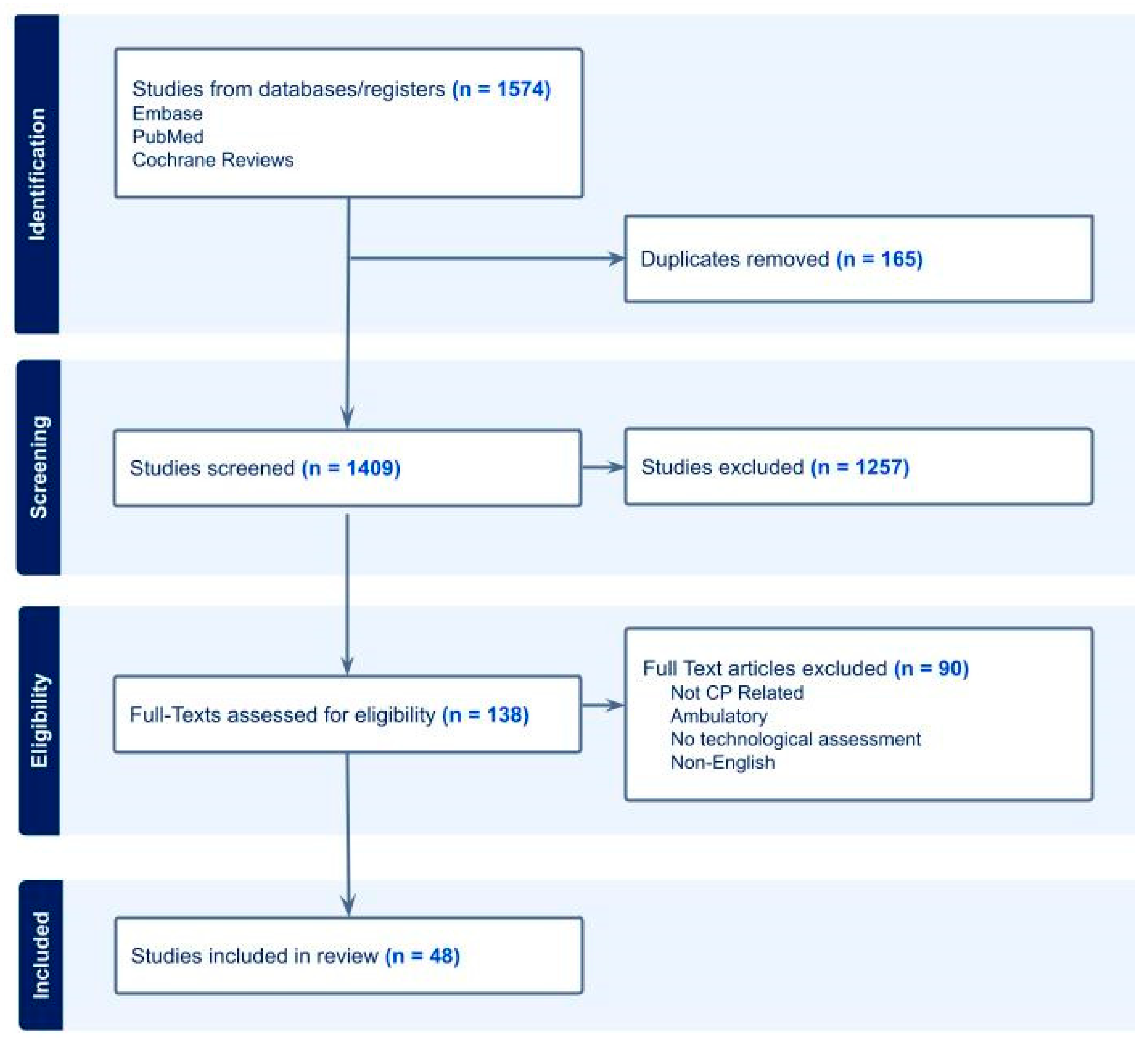
2.3. Screening and Data Extraction
2.4. Validation and Risk of Bias Appraisal Approach
3. Results
3.1. Study Characteristics and Modalities
3.2. Diagnostic Performance Relative to Clinical Standards
3.3. Technological Validation and Interpretability
3.4. Feasibility and Scalability in Real-World Settings
3.5. Clinical Role of Sensor- and Video-Based Technologies
3.6. Risk of Bias and Validation Appraisal
3.7. Applications Beyond Cerebral Palsy
3.7.1. General NDD and Developmental Motor Profiling Studies
3.7.2. Specific Diagnoses Studies (ASD, SMA)
4. Discussion
4.1. Diagnostic Precision and Validation Gaps
4.2. Clinical Role: Screening and Triage Rather than Diagnostic Confirmation
4.3. Technological Modalities, Feasibility, and Scalability Considerations
4.4. Implications of Artificial Intelligence, Machine-Learning Algorithms, Dataset Bias, and Equity Implications
4.5. Implications of Digital Motor Assessment Beyond Cerebral Palsy
5. Future Directions
6. Limitations
7. Conclusions
Supplementary Materials
Author Contributions
Funding
Data Availability Statement
Conflicts of Interest
Abbreviations
| CP | Cerebral Palsy |
| GM | General Movements |
| GMA | General Movements Assessment |
| NDD | Neurodevelopmental Disorder |
| ASD | Autism Spectrum Disorder |
| FM | Fidgety Movements |
| SMA | Spinal Muscular Atrophy |
References
- Novak, I.; Morgan, C.; Adde, L.; Blackman, J.; Boyd, R.N.; Brunstrom-Hernandez, J.; Cioni, G.; Damiano, D.; Darrah, J.; Eliasson, A.-C.; et al. Early, Accurate Diagnosis and Early Intervention in Cerebral Palsy: Advances in Diagnosis and Treatment. JAMA Pediatr. 2017, 171, 897. [Google Scholar] [CrossRef]
- Einspieler, C.; Prechtl, H.F.R.; Ferrari, F.; Cioni, G.; Bos, A.F. The Qualitative Assessment of General Movements in Preterm, Term and Young Infants—Review of the Methodology. Early Hum. Dev. 1997, 50, 47–60. [Google Scholar] [CrossRef]
- Spittle, A.J.; Marschik, P.B.; Adde, L.; Badawi, N.; Byrne, R.; Bos, A.F.; Chatelin, A.; Coughlan, J.; Fedeli, F.; Guzzetta, A.; et al. Towards Universal Early Screening for Cerebral Palsy: A Roadmap for Automated General Movements Assessment. eClinicalMedicine 2025, 86, 103379. [Google Scholar] [CrossRef]
- Airaksinen, M.; Räsänen, O.; Ilén, E.; Häyrinen, T.; Kivi, A.; Marchi, V.; Gallen, A.; Blom, S.; Varhe, A.; Kaartinen, N.; et al. Automatic Posture and Movement Tracking of Infants with Wearable Movement Sensors. Sci. Rep. 2020, 10, 169. [Google Scholar] [CrossRef]
- Groos, D.; Adde, L.; Aubert, S.; Boswell, L.; De Regnier, R.-A.; Fjørtoft, T.; Gaebler-Spira, D.; Haukeland, A.; Loennecken, M.; Msall, M.; et al. Development and Validation of a Deep Learning Method to Predict Cerebral Palsy From Spontaneous Movements in Infants at High Risk. JAMA Netw. Open 2022, 5, e2221325. [Google Scholar] [CrossRef]
- Wilson, R.B.; Vangala, S.; Reetzke, R.; Piergies, A.; Ozonoff, S.; Miller, M. Objective Measurement of Movement Variability Using Wearable Sensors Predicts ASD Outcomes in Infants at High Likelihood for ASD and ADHD. Autism Res. 2024, 17, 1094–1105. [Google Scholar] [CrossRef]
- Reich, S.; Zhang, D.; Kulvicius, T.; Bölte, S.; Nielsen-Saines, K.; Pokorny, F.B.; Peharz, R.; Poustka, L.; Wörgötter, F.; Einspieler, C.; et al. Novel AI Driven Approach to Classify Infant Motor Functions. Sci. Rep. 2021, 11, 9888. [Google Scholar] [CrossRef] [PubMed]
- Page, M.J.; McKenzie, J.E.; Bossuyt, P.M.; Boutron, I.; Hoffmann, T.C.; Mulrow, C.D.; Shamseer, L.; Tetzlaff, J.M.; Akl, E.A.; Brennan, S.E.; et al. The PRISMA 2020 Statement: An Updated Guideline for Reporting Systematic Reviews. BMJ 2021, 372, n71. [Google Scholar] [CrossRef]
- Whiting, P.; Rutjes, A.W.; Reitsma, J.B.; Bossuyt, P.M.; Kleijnen, J. The Development of QUADAS: A Tool for the Quality Assessment of Studies of Diagnostic Accuracy Included in Systematic Reviews. BMC Med. Res. Methodol. 2003, 3, 25. [Google Scholar] [CrossRef] [PubMed]
- Meinecke, L.; Breitbach-Faller, N.; Bartz, C.; Damen, R.; Rau, G.; Disselhorst-Klug, C. Movement Analysis in the Early Detection of Newborns at Risk for Developing Spasticity Due to Infantile Cerebral Palsy. Hum. Mov. Sci. 2006, 25, 125–144. [Google Scholar] [CrossRef] [PubMed]
- Adde, L.; Helbostad, J.L.; Jensenius, A.R.; Taraldsen, G.; Støen, R. Using Computer-Based Video Analysis in the Study of Fidgety Movements. Early Hum. Dev. 2009, 85, 541–547. [Google Scholar] [CrossRef] [PubMed]
- Adde, L.; Helbostad, J.L.; Jensenius, A.R.; Taraldsen, G.; Grunewaldt, K.H.; Støen, R. Early Prediction of Cerebral Palsy by Computer-based Video Analysis of General Movements: A Feasibility Study. Dev. Med. Child. Neuro. 2010, 52, 773–778. [Google Scholar] [CrossRef]
- Adde, L.; Helbostad, J.; Jensenius, A.R.; Langaas, M.; Støen, R. Identification of Fidgety Movements and Prediction of CP by the Use of Computer-Based Video Analysis Is More Accurate When Based on Two Video Recordings. Physiother. Theory Pract. 2013, 29, 469–475. [Google Scholar] [CrossRef]
- Philippi, H.; Karch, D.; Kang, K.; Wochner, K.; Pietz, J.; Dickhaus, H.; Hadders-Algra, M. Computer-based Analysis of General Movements Reveals Stereotypies Predicting Cerebral Palsy. Dev. Med. Child. Neuro. 2014, 56, 960–967. [Google Scholar] [CrossRef]
- Rahmati, H.; Aamo, O.M.; Stavdahl, O.; Dragon, R.; Adde, L. Video-Based Early Cerebral Palsy Prediction Using Motion Segmentation. In Proceedings of the 2014 36th Annual International Conference of the IEEE Engineering in Medicine and Biology Society, Chicago, IL, USA, 26–30 August 2014; IEEE: Chicago, IL, USA, 2014; pp. 3779–3783. [Google Scholar]
- Valle, S.C.; Støen, R.; Sæther, R.; Jensenius, A.R.; Adde, L. Test–Retest Reliability of Computer-Based Video Analysis of General Movements in Healthy Term-Born Infants. Early Hum. Dev. 2015, 91, 555–558. [Google Scholar] [CrossRef]
- Støen, R.; Songstad, N.T.; Silberg, I.E.; Fjørtoft, T.; Jensenius, A.R.; Adde, L.; on behalf of the CIMA Norway Study Group. Computer-Based Video Analysis Identifies Infants with Absence of Fidgety Movements. Pediatr. Res. 2017, 82, 665–670. [Google Scholar] [CrossRef]
- Adde, L.; Yang, H.; Sæther, R.; Jensenius, A.R.; Ihlen, E.; Cao, J.; Støen, R. Characteristics of General Movements in Preterm Infants Assessed by Computer-Based Video Analysis. Physiother. Theory Pract. 2018, 34, 286–292. [Google Scholar] [CrossRef] [PubMed]
- Khan, M.H.; Schneider, M.; Farid, M.S.; Grzegorzek, M. Detection of Infantile Movement Disorders in Video Data Using Deformable Part-Based Model. Sensors 2018, 18, 3202. [Google Scholar] [CrossRef]
- Orlandi, S.; Raghuram, K.; Smith, C.R.; Mansueto, D.; Church, P.; Shah, V.; Luther, M.; Chau, T. Detection of Atypical and Typical Infant Movements Using Computer-Based Video Analysis. In Proceedings of the 2018 40th Annual International Conference of the IEEE Engineering in Medicine and Biology Society (EMBC), Honolulu, HI, USA, 17–21 July 2018; IEEE: New York, NY, USA, 2018; pp. 3598–3601. [Google Scholar]
- Berger, S.E.; Harbourne, R.T.; Guallpa Lliguichuzhca, C.L. Sit Still and Pay Attention! Trunk Movement and Attentional Resources in Infants with Typical and Delayed Development. Phys. Occup. Ther. Pediatr. 2019, 39, 48–59. [Google Scholar] [CrossRef] [PubMed]
- Ihlen, E.A.F.; Støen, R.; Boswell, L.; De Regnier, R.-A.; Fjørtoft, T.; Gaebler-Spira, D.; Labori, C.; Loennecken, M.C.; Msall, M.E.; Möinichen, U.I.; et al. Machine Learning of Infant Spontaneous Movements for the Early Prediction of Cerebral Palsy: A Multi-Site Cohort Study. JCM 2019, 9, 5. [Google Scholar] [CrossRef]
- Raghuram, K.; Orlandi, S.; Shah, V.; Chau, T.; Luther, M.; Banihani, R.; Church, P. Automated Movement Analysis to Predict Motor Impairment in Preterm Infants: A Retrospective Study. J. Perinatol. 2019, 39, 1362–1369. [Google Scholar] [CrossRef]
- Baccinelli, W.; Bulgheroni, M.; Simonetti, V.; Fulceri, F.; Caruso, A.; Gila, L.; Scattoni, M.L. Movidea: A Software Package for Automatic Video Analysis of Movements in Infants at Risk for Neurodevelopmental Disorders. Brain Sci. 2020, 10, 203. [Google Scholar] [CrossRef] [PubMed]
- Caruso, A.; Gila, L.; Fulceri, F.; Salvitti, T.; Micai, M.; Baccinelli, W.; Bulgheroni, M.; Scattoni, M.L. Early Motor Development Predicts Clinical Outcomes of Siblings at High-Risk for Autism: Insight from an Innovative Motion-Tracking Technology. Brain Sci. 2020, 10, 379. [Google Scholar] [CrossRef]
- Passmore, E.; Kwong, A.; Olsen, J.; Eeles, A.; Cheong, J.; Spittle, A.; Ball, G. Deep Learning for Automated Pose Estimation of Infants at Home from Smart Phone Videos. Gait Posture 2020, 81, 261–262. [Google Scholar] [CrossRef]
- Schroeder, A.S.; Hesse, N.; Weinberger, R.; Tacke, U.; Gerstl, L.; Hilgendorff, A.; Heinen, F.; Arens, M.; Dijkstra, L.J.; Pujades Rocamora, S.; et al. General Movement Assessment from Videos of Computed 3D Infant Body Models Is Equally Effective Compared to Conventional RGB Video Rating. Early Hum. Dev. 2020, 144, 104967. [Google Scholar] [CrossRef]
- Tsuji, T.; Nakashima, S.; Hayashi, H.; Soh, Z.; Furui, A.; Shibanoki, T.; Shima, K.; Shimatani, K. Markerless Measurement and Evaluation of General Movements in Infants. Sci. Rep. 2020, 10, 1422. [Google Scholar] [CrossRef]
- Nguyen-Thai, B.; Le, V.; Morgan, C.; Badawi, N.; Tran, T.; Venkatesh, S. A Spatio-Temporal Attention-Based Model for Infant Movement Assessment From Videos. IEEE J. Biomed. Health Inform. 2021, 25, 3911–3920. [Google Scholar] [CrossRef]
- Balta, D.; Kuo, H.; Wang, J.; Porco, I.G.; Morozova, O.; Schladen, M.M.; Cereatti, A.; Lum, P.S.; Della Croce, U. Characterization of Infants’ General Movements Using a Commercial RGB-Depth Sensor and a Deep Neural Network Tracking Processing Tool: An Exploratory Study. Sensors 2022, 22, 7426. [Google Scholar] [CrossRef]
- Blaschek, A.; Hesse, N.; Warken, B.; Vill, K.; Well, T.; Hodek, C.; Heinen, F.; Müller-Felber, W.; Schroeder, A.S. Quantitative Motion Measurements Based on Markerless 3D Full-Body Tracking in Children with SMA Highly Correlate with Standardized Motor Assessments. JND 2022, 9, 121–128. [Google Scholar] [CrossRef]
- Doi, H.; Iijima, N.; Furui, A.; Soh, Z.; Yonei, R.; Shinohara, K.; Iriguchi, M.; Shimatani, K.; Tsuji, T. Prediction of Autistic Tendencies at 18 Months of Age via Markerless Video Analysis of Spontaneous Body Movements in 4-Month-Old Infants. Sci. Rep. 2022, 12, 18045. [Google Scholar] [CrossRef] [PubMed]
- Moro, M.; Pastore, V.P.; Tacchino, C.; Durand, P.; Blanchi, I.; Moretti, P.; Odone, F.; Casadio, M. A Markerless Pipeline to Analyze Spontaneous Movements of Preterm Infants. Comput. Methods Programs Biomed. 2022, 226, 107119. [Google Scholar] [CrossRef] [PubMed]
- Prosser, L.A.; Aguirre, M.O.; Zhao, S.; Bogen, D.K.; Pierce, S.R.; Nilan, K.A.; Zhang, H.; Shofer, F.S.; Johnson, M.J. Infants at Risk for Physical Disability May Be Identified by Measures of Postural Control in Supine. Pediatr. Res. 2022, 91, 1215–1221. [Google Scholar] [CrossRef] [PubMed]
- Raghuram, K.; Orlandi, S.; Church, P.; Luther, M.; Kiss, A.; Shah, V. Automated Movement Analysis to Predict Cerebral Palsy in Very Preterm Infants: An Ambispective Cohort Study. Children 2022, 9, 843. [Google Scholar] [CrossRef]
- Celik, H.I.; Yildiz, A.; Yildiz, R.; Mutlu, A.; Soylu, R.; Gucuyener, K.; Duyan-Camurdan, A.; Koc, E.; Onal, E.E.; Elbasan, B. Using the Center of Pressure Movement Analysis in Evaluating Spontaneous Movements in Infants: A Comparative Study with General Movements Assessment. Ital. J. Pediatr. 2023, 49, 165. [Google Scholar] [CrossRef]
- Passmore, E.; Kwong, A.K.L.; Olsen, J.E.; Eeles, A.L.; Cheong, J.L.Y.; Spittle, A.J.; Ball, G. Quantifying Spontaneous Infant Movements Using State-Space Models. Sci. Rep. 2024, 14, 28598. [Google Scholar] [CrossRef]
- Passmore, E.; Kwong, A.L.; Greenstein, S.; Olsen, J.E.; Eeles, A.L.; Cheong, J.L.Y.; Spittle, A.J.; Ball, G. Automated Identification of Abnormal Infant Movements from Smart Phone Videos. PLoS Digit. Health 2024, 3, e0000432. [Google Scholar] [CrossRef] [PubMed]
- Turner, A.; Sharkey, D. Enhanced Infant Movement Analysis Using Transformer-Based Fusion of Diverse Video Features for Neurodevelopmental Monitoring. Sensors 2024, 24, 6619. [Google Scholar] [CrossRef]
- Abbasi, H.; Mollet, S.R.; Williams, S.A.; Battin, M.R.; Besier, T.F.; McMorland, A.J.C. Deep-learning-based Markerless Tracking of Distal Anatomical Landmarks in Clinically Recorded Videos for Assessing Infant Movement Patterns Associated with Neurodevelopmental Status. J. R. Soc. N. Zeal. 2025, 55, 223–240. [Google Scholar] [CrossRef]
- Karch, D.; Kim, K.-S.; Wochner, K.; Pietz, J.; Dickhaus, H.; Philippi, H. Quantification of the Segmental Kinematics of Spontaneous Infant Movements. J. Biomech. 2008, 41, 2860–2867. [Google Scholar] [CrossRef]
- Ohgi, S.; Morita, S.; Loo, K.K.; Mizuike, C. Time Series Analysis of Spontaneous Upper-Extremity Movements of Premature Infants With Brain Injuries. Phys. Ther. 2008, 88, 1022–1033. [Google Scholar] [CrossRef]
- Karch, D.; Kang, K.-S.; Wochner, K.; Philippi, H.; Hadders-Algra, M.; Pietz, J.; Dickhaus, H. Kinematic Assessment of Stereotypy in Spontaneous Movements in Infants. Gait Posture 2012, 36, 307–311. [Google Scholar] [CrossRef]
- Rahmati, H.; Martens, H.; Aamo, O.M.; Stavdahl, O.; Stoen, R.; Adde, L. Frequency Analysis and Feature Reduction Method for Prediction of Cerebral Palsy in Young Infants. IEEE Trans. Neural Syst. Rehabil. Eng. 2016, 24, 1225–1234. [Google Scholar] [CrossRef]
- Abrishami, M.S.; Nocera, L.; Mert, M.; Trujillo-Priego, I.A.; Purushotham, S.; Shahabi, C.; Smith, B.A. Identification of Developmental Delay in Infants Using Wearable Sensors: Full-Day Leg Movement Statistical Feature Analysis. IEEE J. Transl. Eng. Health Med. 2019, 7, 1–7. [Google Scholar] [CrossRef]
- Fontana, C.; Ottaviani, V.; Veneroni, C.; Sforza, S.E.; Pesenti, N.; Mosca, F.; Picciolini, O.; Fumagalli, M.; Dellacà, R.L. An Automated Approach for General Movement Assessment: A Pilot Study. Front. Pediatr. 2021, 9, 720502. [Google Scholar] [CrossRef]
- Wilson, R.B.; Vangala, S.; Elashoff, D.; Safari, T.; Smith, B.A. Using Wearable Sensor Technology to Measure Motion Complexity in Infants at High Familial Risk for Autism Spectrum Disorder. Sensors 2021, 21, 616. [Google Scholar] [CrossRef]
- Kuo, H.; Wang, J.; Schladen, M.M.; Chang, T.; Morozova, O.M.; Croce, U.D.; Kukke, S.N.; Lum, P.S. Hand Use and Grasp Sensor System in Monitoring Infant Fine Motor Development. Arch. Rehabil. Res. Clin. Transl. 2022, 4, 100203. [Google Scholar] [CrossRef] [PubMed]
- Airaksinen, M.; Taylor, E.; Gallen, A.; Ilén, E.; Saari, A.; Sankilampi, U.; Räsänen, O.; Haataja, L.M.; Vanhatalo, S. Charting Infants’ Motor Development at Home Using a Wearable System: Validation and Comparison to Physical Growth Charts. eBioMedicine 2023, 92, 104591. [Google Scholar] [CrossRef] [PubMed]
- Bard-Pondarré, R.; Al-Abiad, N.; Verdun, S.; Naaïm, A.; Agopyan, H.; Chaléat-Valayer, E.; Vuillerot, C. Does Accelerometry Reflect Hand Function in Infants at Risk of Unilateral Cerebral Palsy? A Secondary Analysis of BB-Bim Results. Res. Dev. Disabil. 2023, 139, 104549. [Google Scholar] [CrossRef] [PubMed]
- Franchi De’ Cavalieri, M.; Filogna, S.; Martini, G.; Beani, E.; Maselli, M.; Cianchetti, M.; Dubbini, N.; Cioni, G.; Sgandurra, G.; The CareToy-R Consortium; et al. Wearable Accelerometers for Measuring and Monitoring the Motor Behaviour of Infants with Brain Damage during CareToy-Revised Training. J. Neuroeng. Rehabil. 2023, 20, 62. [Google Scholar] [CrossRef]
- Von Gunten, M.; Botros, A.; Tobler-Ammann, B.; Nef, T.; Grunt, S. Action Observation Training to Improve Upper Limb Function in Infants with Unilateral Brain Lesion—A Feasibility Study. Dev. Neurorehabilit. 2023, 26, 234–243. [Google Scholar] [CrossRef]
- Barrois, R.; Tervil, B.; Cacioppo, M.; Barnerias, C.; Deladrière, E.; Leloup-Germa, V.; Hervé, A.; Oudre, L.; Ricard, D.; Vidal, P.P.; et al. Acceptability, Validity and Responsiveness of Inertial Measurement Units for Assessing Motor Recovery after Gene Therapy in Infants with Early Onset Spinal Muscular Atrophy: A Prospective Cohort Study. J. Neuroeng. Rehabil. 2024, 21, 183. [Google Scholar] [CrossRef] [PubMed]
- Verhage, C.H.; Gorter, J.W.; Takken, T.; Benders, M.J.N.L.; De Vries, L.S.; Van Der Aa, N.E.; Wagenaar, N. Detecting Asymmetry of Upper Limb Activity with Accelerometry in Infants at Risk for Unilateral Spastic Cerebral Palsy. Phys. Occup. Ther. Pediatr. 2024, 44, 1–15. [Google Scholar] [CrossRef] [PubMed]
- Norori, N.; Hu, Q.; Aellen, F.M.; Faraci, F.D.; Tzovara, A. Addressing Bias in Big Data and AI for Health Care: A Call for Open Science. Patterns 2021, 2, 100347. [Google Scholar] [CrossRef] [PubMed]


| Author/Year | Country | Study Design | Population | N | Age | Modality | Reference Standard | Clinical Task | Follow-Up |
|---|---|---|---|---|---|---|---|---|---|
| Adde 2009 [11] | Norway | Prospective | Full-term + Preterm | 82 | 10–18 wks | Video | GMA (expert) | FM Classification | No follow-up |
| Adde 2010 [12] | Norway | Prospective | Preterm | 30 | 10–15 wks | Video | CP Diagnosis | CP Risk Stratification | 5 yrs |
| Adde 2013 [13] | Norway | Prospective | Full-term + Preterm | 52 | 9–17 wks | Video | CP Diagnosis | FM Classification + CP Prediction | 2 yrs |
| Berger 2019 [21] | United States | Prospective | Full-term + Preterm | 31 | 6–8.5 mos | Video | Motor Assessment | CP vs. TD Posture | No follow-up |
| Adde 2018 [18] | Norway | Prospective | Preterm | 27 | 3–15 wks | Video | GMA (expert) | FM Classification | No follow-up |
| Groos 2022 [5] | Norway | RCT | Not Reported | 557 | 9–18 wks | Video | CP Diagnosis | CP Prediction | 1 year |
| Ihlen 2019 [22] | Norway | Prospective | Preterm | 377 | 9–15 wks | Video | CP Diagnosis | CP Prediction | 3.7 yrs |
| Karch 2012 [43] | Germany | Prospective | Not Reported | 75 | 3 mos | Wearable | CP Diagnosis | Neurodeficit Prediction | 2 yrs |
| Meinecke 2006 [10] | Germany | Prospective | Full-term + Preterm | 22 | Not Reported | Video | CP Diagnosis | CP Risk Stratification | 2 yrs |
| Nguyen-Thai 2021 [29] | Australia | Retrospective | Not Reported | 235 | 14–15 wks | Video | GMA (expert) | FM Classification | No follow-up |
| Orlandi 2018 [20] | Canada | Retrospective | Preterm | 127 | 3–5 mos | Video | CP Diagnosis | CP Prediction | No follow-up |
| Passmore 2024 [38] | Australia | Prospective | Full-term + Preterm | 341 | Not Reported | Video | GMA (expert) | FM Classification | 2 yrs |
| Philippi 2014 [14] | Germany | Prospective | Full-term + Preterm | 67 | 2.5–3.5 mos * | Video | CP Diagnosis | CP & NDI prediction | 2 yrs |
| Passmore 2020 [26] | Australia | Retrospective | Full-term + Preterm | 510 | Not Reported | Video | GMA (expert) | FM Classification | No follow-up |
| Prosser 2022 [34] | United States | Prospective | Full-term + Preterm | 15 | 4–6.5 mos | Video | Motor Outcome at FU | Motor Impairment | 2 yrs |
| Raghuram 2019 [23] | Canada | Retrospective | Preterm | 152 | IQR 24.4–27.7 wks | Video | Motor Outcome at FU | Motor Impairment | No follow-up |
| Raghuram 2022 [35] | Canada | Prospective | Preterm | 252 | 26–29 wks | Video | CP Diagnosis | CP Prediction | 2 yrs |
| Rahmati 2014 [15] | Norway | Retrospective | Not Reported | 78 | Not Reported | Video | CP Diagnosis | CP Prediction | 2 to 5 yrs |
| Rahmati 2016 [44] | Norway | Prospective | Not Reported | 78 | 10–18 wks | IMU | CP Diagnosis | CP Prediction | Up to 5 yrs |
| Schroeder 2020 [27] | Germany | Prospective | Preterm | 29 | 14.8 ± 0.7 wks * | Video | GMA (expert) | FM Classification | 1–2.6 years |
| Støen 2017 [17] | Norway | Prospective | Preterm | 150 | 24–32.1 wks | Video | CP Diagnosis | CP Prediction | No follow-up |
| Verhage 2024 [54] | Netherlands | Prospective | Full-term + Preterm | 50 | 3–12 mos | Wearable | Early Motor Assessment | Motor Asymmetry Detection | No follow-up |
| Von Gunten 2023 [52] | Switzerland | Prospective | Full-term + Preterm | 8 | 9–12 mos | Wearable | Early Motor Assessment | CP Risk Stratification | 6 weeks |
| Author/Year | Reference Standard | Outcome Target | Outcome Type | Sensitivity | Specificity | Other Metrics | Follow-Up |
|---|---|---|---|---|---|---|---|
| Groos 2022 [5] | CP Diagnosis | CP Prediction | Binary | 71.4% | 94.1% | Accuracy 90.6% | 1 year |
| Meinecke 2006 [10] | CP Diagnosis | CP Risk Stratification | Probabilistic risk score | - | - | Accuracy 73% | 2 years |
| Adde 2009 [11] | GMA (Expert) | FM Classification | Ordinal (FM grade) | 81.5% | 70% | - | No follow-up |
| Adde 2010 [12] | CP Diagnosis | CP Risk Stratification | Probabilistic → Binary | 85% | 71% | - | Up to 5 years |
| Rahmati 2014 [15] | CP Diagnosis | CP Prediction | Binary | 86% | 92% | Accuracy 91% | Up to 5 years |
| Støen 2017 [17] | CP Diagnosis | CP Prediction | Binary/Probabilistic | 90% | 80% | - | No follow-up |
| Orlandi 2018 [20] | CP Diagnosis | CP Prediction | Risk Prediction | - | - | Accuracy 92% | No follow-up |
| Ihlen 2019 [22] | CP Diagnosis | CP Prediction | Binary | 92.7% | 81.6% | - | 3.7 years |
| Raghuram 2019 [23] | Motor Outcome | Motor Impairment | Binary/ Multi-class | 79% * | 63% | Accuracy 66% | No follow-up |
| Schroeder 2020 [27] | GMA (Expert) | FM Classification | Agreement Metrics | - | - | κ = 0.78, ICC = 0.926 | 12 to 31 months |
| Nguyen-Thai 2021 [29] | GMA (Expert) | FM Classification | Ordinal (FM grade) | - | - | AUC 81.87% | No follow-up |
| Raghuram 2022 [35] | CP Diagnosis | CP Prediction | Binary | 55% * | 80% | - | 2 years |
| Passmore 2024 [38] | GMA (Expert) | FM Classification | Ordinal (FM grade) | 76 ± 15% * | - | - | 2 years |
| Karch 2012 [43] | CP Diagnosis | Neurodeficit Prediction | Binary | 90% | 96% | - | 2 years |
| Rahmati 2016 [44] | CP Diagnosis | CP Prediction | Binary | 85% | 92% | Accuracy 91% | Up to 5 years |
| Verhage 2024 [54] | Early Motor Assessment | Motor Asymmetry Detection | Continuous Motor Metric | - | - | AUC 0.88 –0.96 | No follow-up |
| Video-Based | Wearable Sensor | |
|---|---|---|
| Primary Data Source | 2D/3D visual motion (RGB, RGB-D, skeletal pose) | Accelerometry, gyroscope, EMG, IMU angular velocity |
| Common Use Cases in CP | FM classification, GM quantification, CP risk prediction | Motor feature quantification, coordination metrics, and spatiotemporal analysis |
| Hardware Burden | Low (consumer camera or smartphone) | Moderate–High (multi-sensor systems, calibration equipment) |
| Environmental Sensitivity (Data Capture) | Sensitive to lighting, occlusion, framing, and distractions | Sensitive to motion artifacts, placement and attachment |
| Privacy & Data Requirements | Requires PHI-secure video storage; HIPAA compliance | Less identifiable data; fewer PHI concerns; device management protocols |
| Workflow & Training Requirements | Minimal for data capture (parent/clinician recorded) | Requires trained personnel for placement, calibration, and syncing |
| Infant Interaction & Tolerance | Passive, no hardware; preserves spontaneous movement | Device attachment may alter natural movements; potential discomfort or distraction |
| Scalability Potential | High; compatible with telemedicine and home capture | Moderate; limited by device cost, calibration, hygiene, and replacement |
| Interpretability | Whole-body kinematics when pose estimation is used | Fine-grained motion metrics; less intuitive without biomechanical models |
| Algorithmic Pathways | Pose estimation/optical flow → kinematic feature extraction → ML/DL classifier | Raw IMU/accelerometry signals → feature engineering → ML/DL sequence models |
| Validation Focus | More CP outcome-based validation and FM → CP prediction studies | Primarily, feasibility and motor quantification; Fewer CP outcome-based studies |
| External Validation | Limited but emerging multi-site datasets | Rare external validation; heavy reliance on internal cross-validation |
| Cost Considerations | Low hardware cost; software/compute main expense | Moderate-High hardware cost; recurring device/maintenance needs |
| Equity & Accessibility Considerations | Potential to reduce disparities via smartphone access & telehealth | May increase disparities without subsidy; device access varies |
| Best Contexts of Use | Remote screening, triage, FM detection, longitudinal follow-up | Controlled clinic/lab settings, detailed biomechanics, specific motor domain quantification |
| Key Practical Constraints | Video quality variance, occlusion, caregiver training, privacy regulations | Calibration, hardware malfunction, placement reproducibility, hygiene |
| Current Clinical Role | Augments early screening and risk stratification; complements observational GMA | Objective quantification of motor domains; complementary biomechanical assessment |
| Translational Readiness | Advancing toward clinical piloting in remote/telehealth contexts; requires regulatory evaluation | Early-stage research; limited clinical deployment; primarily prototyping and feasibility testing |
| Author/Year | Validation Setting | External Validation | Sample Size | Reference Standard Quality | Cohort Representativeness | Follow-Up Duration | Blinding/Reviewer Independence |
|---|---|---|---|---|---|---|---|
| Adde 2009 [11] | Prospective; Internal | No | Small | Moderate | Mixed | None | Not Reported |
| Adde 2010 [12] | Prospective; Internal | No | Pilot | High | High-Risk Only | Long | Not Reported |
| Adde 2013 [13] | Prospective; Internal | No | Small | High | Mixed | Standard | Not Reported |
| Berger 2019 [21] | Prospective; Internal | No | Small | Moderate | Mixed | None | Not Reported |
| Adde 2018 [18] | Prospective; Internal | No | Pilot | Moderate | High-Risk Only | None | Not Reported |
| Groos 2022 [5] | RCT | Yes (multi-site) | Adequate | High | Mixed | Short | Reported |
| Ihlen 2019 [22] | Prospective; Internal | No | Adequate | High | High-Risk Only | Standard | Reported |
| Karch 2012 [43] | Prospective; Internal | No | Small | High | Unknown | Standard | Not Reported |
| Meinecke 2006 [10] | Prospective; Internal | No | Pilot | High | Mixed | Standard | Not Reported |
| Nguyen-Thai 2021 [29] | Retrospective; Internal | No | Adequate | Moderate | Unknown | None | Reported |
| Orlandi 2018 [20] | Retrospective; Internal | No | Limited | High | High-Risk Only | None | Reported |
| Passmore 2024 [38] | Prospective; Internal | No | Adequate | Moderate | Mixed | Standard | Reported |
| Philippi 2014 [14] | Prospective; Internal | No | Small | High | Mixed | Standard | Not Reported |
| Passmore 2020 [26] | Retrospective; Internal | No | Adequate | Moderate | Mixed | None | Reported |
| Prosser 2022 [34] | Prospective; Internal | No | Pilot | Moderate | Mixed | Standard | Reported |
| Raghuram 2019 [23] | Prospective; Internal | No | Limited | Moderate | High-Risk Only | None | Reported |
| Raghuram 2022 [35] | Prospective; Internal | No | Adequate | High | High-Risk Only | Standard | Reported |
| Rahmati 2014 [15] | Prospective; Internal | No | Small | High | Unknown | Long | Reported |
| Rahmati 2016 [44] | Prospective; Internal | No | Small | High | Unknown | Long | Reported |
| Schroeder 2020 [27] | Prospective; Internal | No | Pilot | Moderate | High-Risk Only | Standard | Reported |
| Støen 2017 [17] | Prospective; Internal | No | Limited | High | High-Risk Only | None | Reported |
| Verhage 2024 [54] | Prospective; Internal | No | Small | Moderate | High-Risk Only | None | Reported |
| Von Gunten 2023 [52] | Prospective; Internal | No | Pilot | Moderate | High-Risk Only | Short | Reported |
Disclaimer/Publisher’s Note: The statements, opinions and data contained in all publications are solely those of the individual author(s) and contributor(s) and not of MDPI and/or the editor(s). MDPI and/or the editor(s) disclaim responsibility for any injury to people or property resulting from any ideas, methods, instructions or products referred to in the content. |
© 2026 by the authors. Licensee MDPI, Basel, Switzerland. This article is an open access article distributed under the terms and conditions of the Creative Commons Attribution (CC BY) license.
Share and Cite
Wahle, C.F.; Elias, A.M.; Galoustian, N.A.; Tee, T.M.; Juels, M.L.; Amacker, C.; Waters, H.; Thompson, R.M. Video and Wearable Sensor Technologies for Early Detection of Cerebral Palsy in Infants: A Scoping Review. J. Clin. Med. 2026, 15, 1510. https://doi.org/10.3390/jcm15041510
Wahle CF, Elias AM, Galoustian NA, Tee TM, Juels ML, Amacker C, Waters H, Thompson RM. Video and Wearable Sensor Technologies for Early Detection of Cerebral Palsy in Infants: A Scoping Review. Journal of Clinical Medicine. 2026; 15(4):1510. https://doi.org/10.3390/jcm15041510
Chicago/Turabian StyleWahle, Charlotte F., Aura M. Elias, Nora A. Galoustian, Teana M. Tee, Michaela L. Juels, Christine Amacker, Heather Waters, and Rachel M. Thompson. 2026. "Video and Wearable Sensor Technologies for Early Detection of Cerebral Palsy in Infants: A Scoping Review" Journal of Clinical Medicine 15, no. 4: 1510. https://doi.org/10.3390/jcm15041510
APA StyleWahle, C. F., Elias, A. M., Galoustian, N. A., Tee, T. M., Juels, M. L., Amacker, C., Waters, H., & Thompson, R. M. (2026). Video and Wearable Sensor Technologies for Early Detection of Cerebral Palsy in Infants: A Scoping Review. Journal of Clinical Medicine, 15(4), 1510. https://doi.org/10.3390/jcm15041510