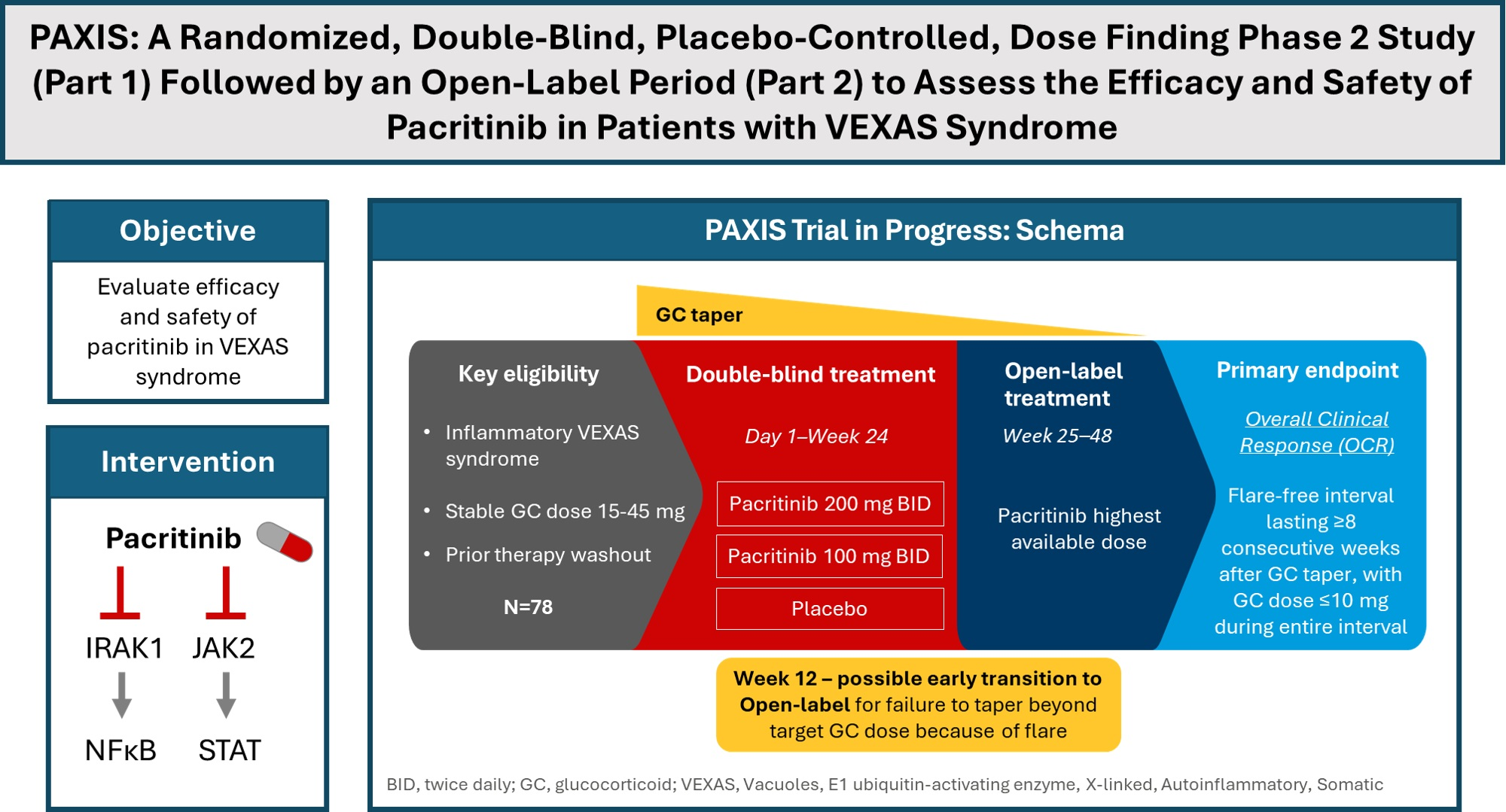
PAXIS: A Randomized, Double-Blind, Placebo-Controlled, Dose-Finding Phase 2 Study (Part 1) Followed by an Open-Label Period (Part 2) to Assess the Efficacy and Safety of Pacritinib in Patients with VEXAS Syndrome

 , , , , , , , , , , , , and
Abstract
1. Introduction
1.1. Rationale and Hypothesis
1.2. Objectives
2. Materials and Methods
2.1. Patient Population
2.2. Study Design
2.3. Study Endpoints and Outcomes Measures
2.4. Statistical Plan
2.5. Efficacy Analysis
2.6. Safety Plan and Analysis
3. Conclusions
Author Contributions
Funding
Institutional Review Board Statement
Informed Consent Statement
Data Availability Statement
Acknowledgments
Conflicts of Interest
References
- Beck, D.B.; Ferrada, M.A.; Sikora, K.A.; Ombrello, A.K.; Collins, J.C.; Pei, W.; Balanda, N.; Ross, D.L.; Cardona, D.O.; Wu, Z.; et al. Somatic mutations in UBA1 and severe adult-onset autoinflammatory disease. N. Engl. J. Med. 2020, 383, 2628–2638. [Google Scholar] [CrossRef]
- Georgin-Lavialle, S.; Terrier, B.; Guedon, A.F.; Heiblig, M.; Comont, T.; Lazro, E.; Lacombe, V.; Terriou, L.; Ardois, S.; Bouaziz, J.-D.; et al. Further characterization of clinical and laboratory features in VEXAS syndrome: Large-scale analysis of a multicentre case series of 116 French patients. Br. J. Dermatol. 2022, 186, 564–574. [Google Scholar] [CrossRef]
- de Valence, B.; Delaune, M.; Nguyen, Y.; Jachiet, Y.; Heiblig, M.; Jean, A.; Tuczkiewicz, S.R.; Henneton, P.; Guilpain, P.; Schleinitz, N.; et al. Serious infections in patients with VEXAS syndrome: Data from the French VEXAS registry. Ann. Rheum. Dis. 2024, 83, 372–381. [Google Scholar] [CrossRef]
- Ferrada, M.A.; Savic, S.; Cardona, D.O.; Collins, J.C.; Alessi, H.; Gutierrez-Rodrigues, F.; Kumar, D.B.U.; Wilson, L.; Goodspeed, W.; Topilow, J.S.; et al. Translation of cytoplasmic UBA1 contributes to VEXAS syndrome pathogenesis. Blood 2022, 140, 1496–1506. [Google Scholar] [CrossRef]
- Grayson, P.C.; Patel, B.A.; Young, N.S. VEXAS syndrome. Blood 2021, 137, 3591–3594. [Google Scholar] [CrossRef] [PubMed]
- Gutierrez-Rodrigues, F.; Kusne, Y.; Fernandez, J.; Lasho, T.; Shalhoub, R.; Ma, X.; Alessi, H.; Finke, C.; Koster, M.J.; Mangaonkar, A.; et al. Spectrum of clonal hematopoiesis in VEXAS syndrome. Blood 2023, 142, 244–259. [Google Scholar] [CrossRef]
- Mekinian, A.M.; Georgin-Lavaille, S.; Ferrada, M.A.; Savic, S.; Koster, M.J.; Kosmider, O.; Comont, T.; Heilblig, M.; Arostegui, J.I.; Bosco, A.; et al. American College of Rheumatology guidance statement for diagnosis and management of VEXAS developed by the International VEXAS Working Group Expert Panel. Arthritis Rheumatol. 2025. Epub ahead of printing. [Google Scholar] [CrossRef] [PubMed]
- Groarke, E.M.; Turturice, B.; Patel, B.A.; Quinn, K.A.; Fike, A.; Grayson, P.C. VEXAS syndrome: A comprehensive review of pathogenesis, clinical spectrum, and therapeutic strategies. Lancet 2026, 407, 637–648. [Google Scholar] [CrossRef]
- Kosmider, O.; Possémé, C.; Templé, M.; Corneau, A.; Carbone, F.; Duroyon, E.; Breillat, P.; Chirayath, T.-W.; Oules, B.; Sohier, P.; et al. VEXAS syndrome is characterized by inflammasome activation and monocyte dysregulation. Nat. Commun. 2024, 15, 910. [Google Scholar] [CrossRef] [PubMed]
- Mizumaki, H.; Gao, S.; Wu, Z.; Gutierrez-Rodrigues, F.; Bissa, M.; Feng, X.; Groarke, E.M.; Li, H.; Alemu, L.; Raffo, D.Q.; et al. In depth transcriptomic profiling defines a landscape of dysfunctional immune responses in patients with VEXAS syndrome. Nat. Commun. 2025, 16, 4690. [Google Scholar] [CrossRef]
- Dong, G.; Liu, J.; Jin, W.; Zhou, H.; Wen, Y.; Wang, S.; Xia, K.; Zhang, J.; Ma, L.; Ma, Y.; et al. UBA1-depleted neutrophils disrupt immune homeostasis and induce VEXAS-like autoinflammatory disease in mice. J. Clin. Investig. 2025, 135, e193011. [Google Scholar] [CrossRef] [PubMed]
- Molteni, R.; Fiumara, M.; Campochiaro, M.; Alfieri, R.; Pacini, G.; Licari, E.; Tomelleri, A.; Diral, E.; Varesi, A.; Weber, A.; et al. Mechanisms of hematopoietic clonal dominance in VEXAS syndrome. Nat. Med. 2025, 31, 1911–1924. [Google Scholar] [CrossRef]
- Breillat, P.; Carbone, F.; Lereclus, E.; Riller, Q.; d’Izarny-Gargas, T.; Posseme, C.; Templé, M.; Zhao, L.-P.; Luka, M.; Lazaro, E.; et al. Impaired cytotoxic function and exhausted phenotype of natural killer cells in VEXAS syndrome. Blood 2025, 146, 1950–1963. [Google Scholar] [CrossRef]
- Smith, J.A. Regulation of cytokine production by the unfolded protein response; implications for infection and autoimmunity. Front. Immunol. 2018, 9, 422. [Google Scholar] [CrossRef]
- Kirino, Y.; Maeda, A.; Asano, T.; Migita, K.; Hidaka, Y.; Ida, H.; Kobayashi, D.; Oda, N.; Rokutanda, R.; Fujieda, Y.; et al. Low remission rates and high incidence of adverse events in a prospective VEXAS syndrome registry. Rheumatology 2025, 64, 3872–3878. [Google Scholar] [CrossRef]
- Ali, S.B.; Gurnari, C. Allogenic haematopoietic stem cell transplantation in VEXAS: A review of 33 patients. Clin. Rheumatol. 2024, 43, 3565–3575. [Google Scholar] [CrossRef] [PubMed]
- Koster, M.J.; Kourelis, T.; Reichard, K.K.; Kermain, T.A.; Beck, D.B.; Cardona, D.O.; Samec, M.J.; Mangaonkar, A.A.; Begna, K.H.; Hook, C.C.; et al. Clinical heterogeneity of the VEXAS syndrome: A case series. Mayo Clin. Proc. 2021, 96, 2653–2659. [Google Scholar] [CrossRef] [PubMed]
- Oray, M.; Abu Samra, K.; Ebrahimiadib, N.; Meese, H.; Foster, C.S. Long-term side effects of glucocorticoids. Expert Opin. Drug. Saf. 2016, 15, 457–465. [Google Scholar] [CrossRef]
- Stone, J.H.; McDowell, P.J.; Jayne, D.R.W.; Merkel, P.A.; Robson, J.; Patel, N.J.; Zhang, Y.; Yue, H.; Bekker, P.; Heaney, L.G. The glucocorticoid toxicity index: Measuring change in glucocorticoid toxicity over time. Semin. Arthritis Rheum. 2022, 55, 152010. [Google Scholar] [CrossRef]
- Wasko, M.C.; Dasgupta, A.; Sears, G.I.; Fries, J.F.; Ward, M.M. Prednisone use and risk of mortality in patients with rheumatoid arthritis: Moderation by use of disease-modifying antirheumatic drugs. Arthritis Care Res. 2016, 68, 706–710. [Google Scholar] [CrossRef]
- del Rincon, I.; Battafarano, D.F.; Restrepo, J.F.; Erikson, J.M.; Escalante, A. Glucocorticoid dose thresholds associated with all-cause and cardiovascular mortality in rheumatoid arthritis. Arthritis Rheumatol. 2014, 66, 264–272. [Google Scholar] [CrossRef]
- Bourbon, E.; Heiblig, M.; Valentin, M.G.; Durel, C.A.; Lega, J.C.; Barraco, F.; Sève, P.; Jamilloux, Y.; Sujobert, P. Therapeutic options in VEXAS syndrome: Insights from a retrospective series. Blood 2021, 137, 3682–3684. [Google Scholar] [CrossRef]
- Hadjadj, J.; Nguyen, Y.; Mouloudj, D.; Bourguiba, R.; Heiblig, M.; Aloui, H.; McAvoy, C.; Lacombe, V.; Ardois, S.; Campochiaro, C.; et al. Efficacy and safety of targeted therapies in VEXAS syndrome: Retrospective study from the FRENVEX. Ann. Rheum. Dis. 2024, 83, 1358–1367. [Google Scholar] [CrossRef] [PubMed]
- Kirino, Y.; Takase-Minegishi, K.; Tsuchida, N.; Hirahara, L.; Kunishita, K.; Yoshimi, Y.; Nakajima, H. Tocilizumab in VEXAS relapsing polychondritis: A single-center pilot study in Japan. Ann. Rheum. Dis. 2021, 80, 1501–1502. [Google Scholar] [CrossRef] [PubMed]
- Singer, J.W.; Al-Fayoumi, S.; Ma, H.; Komrokji, R.S.; Mesa, R.; Verstovsek, S. Comprehensive kinase profile of pacritinib, a nonmyelosuppressive Janus kinase 2 inhibitor. J. Exp. Pharmacol. 2016, 8, 11–19. [Google Scholar] [CrossRef]
- Oh, S.T.; Mesa, R.A.; Harrison, C.N.; Bose, P.; Gerds, A.T.; Gupta, V.; Scott, B.L.; Kiladjian, J.-J.; Lucchesi, A.; Kong, T.; et al. Pacritinib is a potent ACVR1 inhibitor with significant anemia benefit in patients with myelofibrosis. Blood Adv. 2023, 7, 5835–5842. [Google Scholar] [CrossRef] [PubMed]
- Rollings, C.M.; Sinclair, L.V.; Brady, H.J.M.; Cantrell, D.A.; Ross, S.H. Interleukin-2 shapes the cytotoxic T cell proteome and immune environment-sensing programs. Sci. Signal. 2018, 11, eaap8112. [Google Scholar] [CrossRef]
- Singer, J.W.; Al-Fayoumi, S.; Taylor, J.; Velichko, S.; O’Mahony, A. Comparative phenotypic profiling of the JAK2 inhibitors ruxolitinib, fedratinib, momelotinib, and pacritinib reveals distinct mechanistic signatures. PLoS ONE 2019, 14, e0222944. [Google Scholar] [CrossRef]
- Weeks, L.D.; Hammond, D.; Savic, S.; Heiblig, M.; Chowdhury, O.; Mekinian, A.; Gurnari, C.; Ramchandren, R.; Georgin-Lavialle, S.; Ferrada, M.A.; et al. Establishing a consensus definition of VEXAS flare for clinical research. Rheumatology 2025. Epub ahead of printing. [Google Scholar] [CrossRef]
- Byram, K.; Mann, H.; Hammond, D.; Savic, S.; Kirino, Y.; Gurnari, C.; Heiblig, M.; Comont, T.; Mekinian, A.; Patnaik, M.; et al. Development of a disease activity index for the assessment of VEXAS syndrome (VEXAS-DAI). Ann. Rheum. Dis. 2025, 84 Suppl. 1, 625–626. [Google Scholar] [CrossRef]


| Inclusion Criteria | Exclusion Criteria |
|---|---|
|
|
| Endpoint Definition | Flare-Free Interval | GC Daily Dose | CRP | |
|---|---|---|---|---|
| Overall clinical response (primary endpoint) | Stringent clinical biochemical response | ≥8 consecutive weeks | ≤5 mg | ≤10 mg/L |
| Clinical biochemical response | ≥8 consecutive weeks | ≤10 mg | ≤10 mg/L or ≥50% reduced from baseline and a value ≤20 mg/L | |
| Clinical response | ≥8 consecutive weeks | ≤10 mg | ||
| Partial clinical response | ≥8 consecutive weeks | ≥50% reduced from baseline | ||
| Stable disease | ≥8 consecutive weeks | ≤baseline | ||
| Non-response | Not meeting other response criteria | |||
Disclaimer/Publisher’s Note: The statements, opinions and data contained in all publications are solely those of the individual author(s) and contributor(s) and not of MDPI and/or the editor(s). MDPI and/or the editor(s) disclaim responsibility for any injury to people or property resulting from any ideas, methods, instructions or products referred to in the content. |
© 2026 by the authors. Licensee MDPI, Basel, Switzerland. This article is an open access article distributed under the terms and conditions of the Creative Commons Attribution (CC BY) license.
Share and Cite
Beck, D.B.; Heiblig, M.; Savic, S.; Ferrada, M.A.; Mekinian, A.; Chowdhury, O.; Hammond, D.; Weeks, L.D.; Gurnari, C.; Kirino, Y.; et al. PAXIS: A Randomized, Double-Blind, Placebo-Controlled, Dose-Finding Phase 2 Study (Part 1) Followed by an Open-Label Period (Part 2) to Assess the Efficacy and Safety of Pacritinib in Patients with VEXAS Syndrome. J. Clin. Med. 2026, 15, 1426. https://doi.org/10.3390/jcm15041426
Beck DB, Heiblig M, Savic S, Ferrada MA, Mekinian A, Chowdhury O, Hammond D, Weeks LD, Gurnari C, Kirino Y, et al. PAXIS: A Randomized, Double-Blind, Placebo-Controlled, Dose-Finding Phase 2 Study (Part 1) Followed by an Open-Label Period (Part 2) to Assess the Efficacy and Safety of Pacritinib in Patients with VEXAS Syndrome. Journal of Clinical Medicine. 2026; 15(4):1426. https://doi.org/10.3390/jcm15041426
Chicago/Turabian StyleBeck, David B., Maël Heiblig, Sinisa Savic, Marcela A. Ferrada, Arsène Mekinian, Onima Chowdhury, Danielle Hammond, Lachelle D. Weeks, Carmelo Gurnari, Yohei Kirino, and et al. 2026. "PAXIS: A Randomized, Double-Blind, Placebo-Controlled, Dose-Finding Phase 2 Study (Part 1) Followed by an Open-Label Period (Part 2) to Assess the Efficacy and Safety of Pacritinib in Patients with VEXAS Syndrome" Journal of Clinical Medicine 15, no. 4: 1426. https://doi.org/10.3390/jcm15041426
APA StyleBeck, D. B., Heiblig, M., Savic, S., Ferrada, M. A., Mekinian, A., Chowdhury, O., Hammond, D., Weeks, L. D., Gurnari, C., Kirino, Y., Georgin-Lavialle, S., Buckley, S. A., Garcha, R., Harder, B. G., & Koster, M. J. (2026). PAXIS: A Randomized, Double-Blind, Placebo-Controlled, Dose-Finding Phase 2 Study (Part 1) Followed by an Open-Label Period (Part 2) to Assess the Efficacy and Safety of Pacritinib in Patients with VEXAS Syndrome. Journal of Clinical Medicine, 15(4), 1426. https://doi.org/10.3390/jcm15041426