Incentive Spirometer in COVID-19: A Systematic Review

 , and
, and
Abstract
1. Introduction
2. Materials and Methods
2.1. Protocol Registration and Guidelines
2.2. Sources and Search Strategy
2.3. Study Selection
2.4. Eligibility Criteria and Research Question
- Participants (P): Adults (≥18 years) with a confirmed COVID-19 infection, including both acute and Post-COVID-19 phases.
- Intervention (I): Incentive spirometer, used alone or with other physiotherapy interventions.
- Comparison (C): Standard care or alternative physiotherapy interventions.
- Outcomes (O): Pulmonary function, respiratory symptoms (such as dyspnea), functional capacity, psychological outcomes and quality of life.
- Study Design (S): Interventional studies, including randomized controlled trials, clinical trials, cohort studies, case studies and observational studies.
- Language: English or Greek.
2.5. Data Extraction
2.6. Risk of Bias Assessment
3. Results
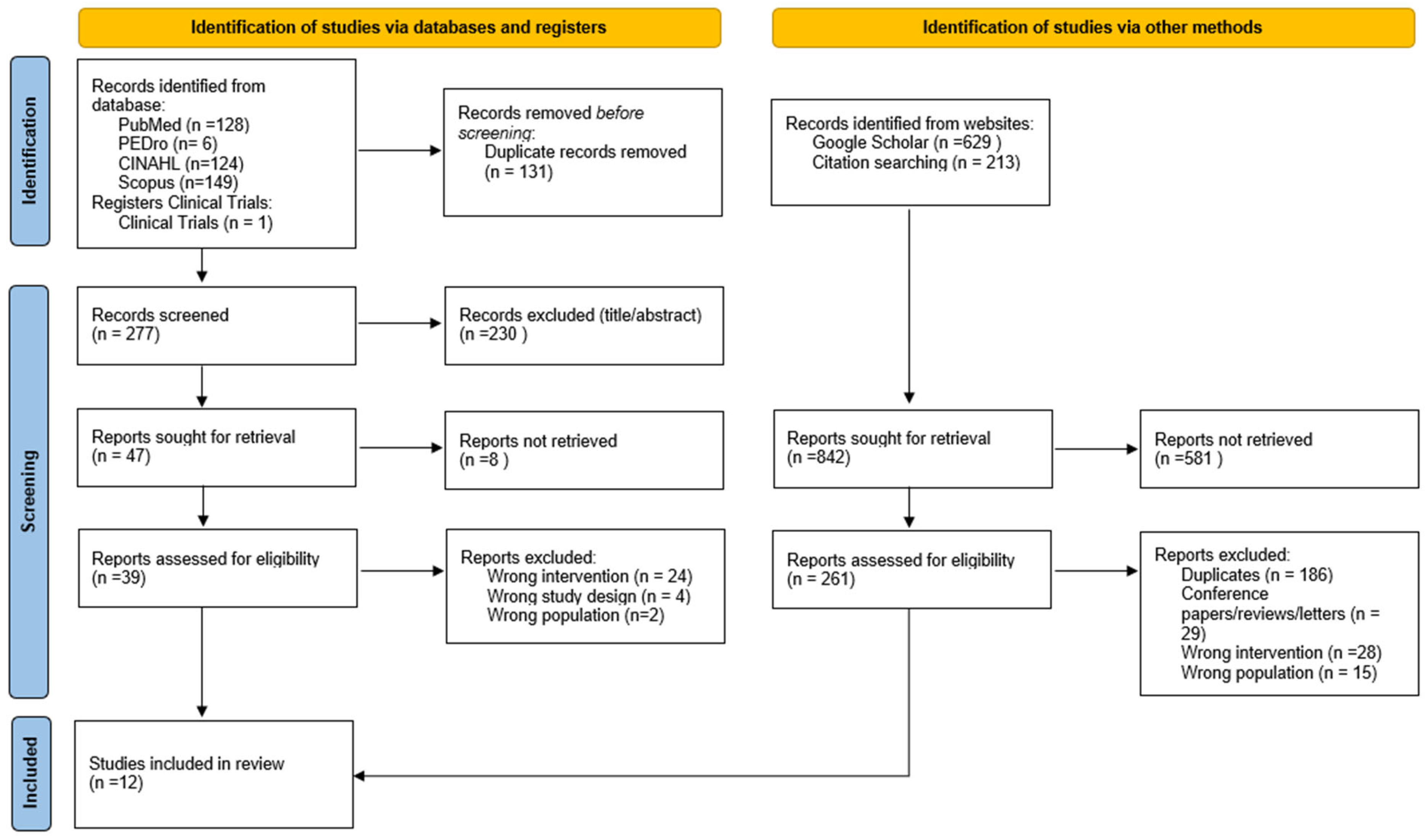
3.1. Study Selection and Characteristics
3.2. Intervention and Comparators
3.3. Effects of Incentive Spirometer
3.3.1. Primary Outcomes: Cardiopulmonary Function and Dyspnea
3.3.2. Secondary Outcomes: Functional Performance, Quality of Life, Anxiety and Depression
3.3.3. Outcomes According to COVID-19 Disease Phase
3.3.4. Incentive Spirometer Compared with Comparator Interventions
3.3.5. Risk of Bias of Included Studies
3.3.6. Certainty of Evidence
4. Discussion
4.1. Cardiopulmonary Outcomes and Dyspnea
4.2. Functional Performance, Quality of Life, Anxiety and Depression
4.3. Other Outcomes
4.4. Incentive Spirometer as a Single or Multimodal Intervention
4.5. Sources of Heterogeneity and Inconsistent Findings
4.6. Feasibility and Compliance
4.7. Comparison with Previous Reviews
4.8. Risk of Bias in Included Studies
4.9. Limitations and Future Research
5. Conclusions
Supplementary Materials
Author Contributions
Funding
Institutional Review Board Statement
Informed Consent Statement
Data Availability Statement
Conflicts of Interest
Abbreviations
| COVID-19 | Coronavirus 2019 |
| SARS-CoV-2 | Severe Acute Respiratory Syndrome Coronavirus 2 |
| PHEIC | Public Health Emergency of International Concerns |
| ARDS | Acute Respiratory Distress Syndrome |
| PCS | Post-COVID-19 Syndrome |
| PRISMA | Preferred Reporting Items for Systematic Reviews and Meta-Analyses |
| SWiM | Synthesis without Meta-analysis |
| RCT | Randomized Controlled Trials |
| FVC | Forced Vital Capacity |
| FEV1 | Forced Expiratory Volume in 1 s |
| DLCO | Diffusing Lung Capacity for Carbon Monoxide |
| SVC | Slow Vital Capacity |
| MVV | Maximal Voluntary Ventilation |
| PFT | Pulmonary Function Test |
| WHOOQOL-Bref | World Health Organization Quality of Life Instrument Short Form |
| mMRC | Modified Medical Research Council dyspnea scale |
| VBG parameters | Venous Blood Gas Analysis |
| MBS dyspnea | Modified Borg Scale for Dyspnea |
| HRV | Heart Rate Variability |
| RMSSD | Root Mean Square of Successive differences between normal Heartbeats |
| SDNN | Standard Deviation of N-N Intervals |
| LF/HF | Low Frequency/High frequency ratio of Heart rate variability |
| 6MWT | 6 Minutes Walk Test |
| 6MST | 6 Minutes Step Test |
| 4MGT | 4 Minutes Gait Time Test |
| 30sSTS | 30 s Sit To Stand test |
| ICU | Intensive Care Unit |
| pCO2 | Mixed Venous Carbon Dioxide Pressure |
| SpO2 | Blood Oxygen Saturation |
| RR | Respiratory Rate |
| PEF | Peak Expiratory Flow |
| PCF | Peak Cough Flow |
| GAD-7 | Generalized Anxiety Disorder-7 Questionnaire |
| HARS | Hamilton Anxiety Rating Scale |
| BAI | Beck Anxiety Inventory |
| PHQ-9 | Patient Health Questionnaire for Depression |
| QoL | Quality of Life |
| EQ-5D-5L | EuroQuality-5 Dimensions-3 Levels questionnaire for quality of life |
| DSI | Dyspnea Severity Index |
| LoS | Length of Hospital Stay |
| MR | One-month Mortality Rate |
| IR | Intubation Rate |
| IS | Incentive Spirometer |
| NI | No Information |
References
- WHO. Therapeutics and COVID-19: Living Guideline. 10 November 2023. Available online: https://www.who.int/publications/i/item/B09540 (accessed on 24 January 2025).
- Gattinoni, L.; Gattarello, S.; Steinberg, I.; Busana, M.; Palermo, P.; Lazzari, S.; Romitti, F.; Quintel, M.; Meissner, K.; Marini, J.J.; et al. COVID-19 pneumonia: Pathophysiology and management. Eur. Respir. Rev. 2021, 30, 210138–210151. [Google Scholar] [CrossRef] [PubMed]
- Panahi, Y.; Gorabi, A.M.; Talaei, S.; Beiraghdar, F.; Akbarzadeh, A.; Tarhriz, V.; Mellatyar, H. An overview on the treatments and prevention against COVID-19. Virol. J. 2023, 20, 23–51. [Google Scholar] [CrossRef] [PubMed]
- Guler, S.A.; Ebner, L.; Aubry-Beigelman, C.; Bridevaux, P.O.; Brutsche, M.; Clarenbach, C.; Garzoni, C.; Geiser, T.K.; Lenoir, A.; Mancinetti, M.; et al. Pulmonary function and radiological features 4 months after COVID-19: First results from the national prospective observational Swiss COVID-19 lung study. Eur. Respir. J. 2021, 57, 2003690. [Google Scholar] [CrossRef] [PubMed]
- Zhang, S.; Bai, W.; Yue, J.; Qin, L.; Zhang, C.; Xu, S.; Liu, X.; Ni, W.; Xie, M. Eight months follow-up study on pulmonary function, lung radiographic, and related physiological characteristics in COVID-19 survivors. Sci. Rep. 2021, 11, 13854–13867. [Google Scholar] [CrossRef]
- Wu, X.; Liu, X.; Zhou, Y.; Yu, H.; Li, R.; Zhan, Q.; Ni, F.; Fang, S.; Ding, X.; Liu, H.; et al. 3-month, 6-month, 9-month, and 12-month respiratory outcomes in patients following COVID-19-related hospitalisation: A prospective study. Lancet Respir. Med. 2021, 9, 747–754. [Google Scholar] [CrossRef]
- Van Willigen, H.D.G.; Wynberg, E.; Verveen, A.; Dijkstra, M.; Verkaik, B.J.; Figaroa, O.J.A.; de Jong, M.C.; van der Veen, A.L.I.P.; Makowska, A.; Koedoot, N.; et al. One-fourth of COVID-19 patients have an impaired pulmonary function after 12 months of disease onset. PLoS ONE 2023, 18, e0290893. [Google Scholar] [CrossRef]
- Chaiwong, W.; Deesomchok, A.; Pothirat, C.; Liwsrisakun, C.; Duangjit, P.; Bumroongkit, C.; Theerakittikul, T.; Limsukon, A.; Tajarernmuang, P.; Trongtrakul, K.; et al. The long-term impact of COVID-19 pneumonia on pulmonary function and exercise capacity. J. Thorac. Dis. 2023, 15, 4725–4735. [Google Scholar] [CrossRef]
- Sonnweber, T.; Sahanic, S.; Pizzini, A.; Luger, A.; Schwabl, C.; Sonnweber, B.; Kurz, K.; Koppelstatter, S.; Haschka, D.; Petzer, V.; et al. Cardiopulmonary recovery after COVID-19: An observational prospective multicentre trial. Eur. Respir. J. 2021, 57, 2003481. [Google Scholar] [CrossRef]
- Han, X.; Fan, Y.; Alwalid, O.; Li, N.; Jia, X.; Yuan, M.; Li, Y.; Cao, Y.; Gu, J.; Wu, H.; et al. Six-Month Follow-up Chest CT findings after Severe COVID-19 Pneumonia. Radiology 2021, 299, 177–186. [Google Scholar] [CrossRef]
- Vargas Centanaro, G.; Calle Rubio, M.; Álvarez-Sala Walther, J.L.; Martinez-Sagasti, F.; Albuja Hidalgo, A.; Herranz Hernández, R.; Rodriguez Hermosa, J.L. Long-term Outcomes and Recovery of Patients who Survived COVID-19: LUNG INJURY COVID-19 Study. Open Forum Infect. Dis. 2022, 9, ofac098. [Google Scholar] [CrossRef]
- Mandal, S.; Barnett, J.; Brill, S.E.; Brown, J.S.; Denneny, E.K.; Hare, S.S.; Heigtman, M.; Hillman, T.E.; Jacob, J.; Jarvis, H.; et al. A cross-sectional study of persisting symptoms, biomarker and imaging abnormalities following hospitalisation for COVID-19. Thorax 2021, 76, 396–398. [Google Scholar] [CrossRef] [PubMed]
- Gattinoni, L.; Chiumello, D.; Rossi, S. COVID-19 pneumonia: ARDS or not? Crit. Care 2020, 24, 154–156. [Google Scholar] [CrossRef] [PubMed]
- Carfì, A.; Bernabei, R.; Landi, F. for the Gemelli Against COVID-19 Post-Acute Care Study Group. Persistent Symptoms in Patients After Acute COVID-19. JAMA 2020, 324, 603–605. [Google Scholar] [CrossRef] [PubMed]
- Sk Abd Razak, R.; Ismail, A.; Abdul Aziz, A.F.; Suddin, L.S.; Azzeri, A.; Sha’ari, N.I. Post-COVID syndrome prevalence: A systematic review and meta-analysis. BMC Public Health 2024, 24, 1785. [Google Scholar] [CrossRef]
- WHO. Clinical Management of COVID-19: Living Guideline. 18 August 2023. Available online: https://www.who.int/publications/i/item/WHO-2019-nCoV-clinical-2023.2 (accessed on 23 July 2023).
- Scharf, R.E.; Anaya, J.M. Post-COVID Syndrome in Adults-An Overview. Viruses 2023, 15, 675–691. [Google Scholar] [CrossRef]
- Chippa, V.; Aleem, A.; Anjum, F. Postacute Coronavirus (COVID-19) Syndrome. In StatPearls; StatPearls Publishing: Treasure Island, FL, USA, 2023. Available online: https://www.ncbi.nlm.nih.gov/books/NBK570608/ (accessed on 29 November 2024).
- Jimeno-Almazán, A.; Pallarés, J.G.; Buendía-Romero, Á.; Martínez-Cava, A.; Franco-López, F.; Sánchez-Alcaraz Martínez, B.J.; Bernal-Morel, E.; Courel-Ibanez, J. Post-COVID-19 Syndrome and the Potential Benefits of Exercise. Int. J. Environ. Res. Public Health 2021, 18, 5329–5340. [Google Scholar] [CrossRef]
- Rahmati, M.; Udeh, R.; Yon, D.K.; Lee, S.W.; Dolja-Gore, X.; McEVoy, M.; Kenna, T.; Jacob, L.; Lopez Sanchez, G.F.; Koyanagi, A.; et al. A systematic review and meta-analysis of long-term sequelae of COVID-19 2-year after SARS-CoV-2 infection: A call to action for neurological, physical, and psychological sciences. J. Med. Virol. 2023, 95, e28852. [Google Scholar] [CrossRef]
- Alkodaymi, M.S.; Omrani, O.A.; Fawzy, N.A.; Shaar, B.A.; Almamlouk, R.; Riaz, M.; Obeidat, M.; Obeidat, Y.; Gerberi, D.; Taha, R.M.; et al. Prevalence of post-acute COVID-19 syndrome symptoms at different follow-up periods: A systematic review and meta-analysis. Clin. Microbiol. Infect. 2022, 28, 657–666. [Google Scholar] [CrossRef]
- Christopher, D.J.; Isaac, B.T.J.; John, F.B.; Shankar, D.; Samuel, P.; Gupta, R.; Thangakunam, B. Impact of post-COVID-19 lung damage on pulmonary function, exercise tolerance and quality of life in Indian subjects. PLoS Glob. Public Health 2024, 4, e0002884. [Google Scholar] [CrossRef]
- Van der Brugge, V.D.S.S.; Talman, S.; Boonman-de Winter, L.; de Mol, M.; Hoefman, E.; van Etten, R.W.; De Backer, I.C. Pulmonary function and health-related quality of life after COVID-19 pneumonia. Respir. Med. 2021, 176, 106272–106276. [Google Scholar] [CrossRef]
- Amdal, C.D.; Pe, M.; Falk, R.S.; Piccinin, C.; Bottomley, A.; Arraras, J.I.; Darlington, A.S.; Hofso, K.; Holzner, B.; Jorgensen, N.M.H.; et al. Health-related quality of life issues, including symptoms, in patients with active COVID-19 or post COVID-19; a systematic literature review. Qual. Life Res. 2021, 30, 3367–3381. [Google Scholar] [CrossRef]
- Malik, P.; Patel, K.; Pinto, C.; Jaiswal, R.; Tirupathi, R.; Pillai, S.; Patel, U. Post-acute COVID-19 syndrome (PCS) and health-related quality of life (HRQoL)—A systematic review and meta-analysis. J. Med. Virol. 2022, 94, 253–262. [Google Scholar] [CrossRef] [PubMed]
- Natarajan, A.; Shetty, A.; Delanerolle, G.; Zeng, Y.; Zhang, Y.; Raymont, V.; Rathod, S.; Halabi, S.; Elliot, K.; Shi, J.Q.; et al. A systematic review and meta-analysis of long COVID symptoms. Syst. Rev. 2023, 12, 88–107. [Google Scholar] [CrossRef] [PubMed]
- Ashmore, P.; Sherwood, E. An overview of COVID-19 global epidemiology and discussion of potential drivers of variable global pandemic impacts. J. Antimicrob. Chemother. 2023, 78, ii2–ii11. [Google Scholar] [CrossRef] [PubMed]
- Koumpias, A.M.; Schwartzman, D.; Fleming, O. Long-haul COVID: Healthcare utilization and medical expenditures 6 months post-diagnosis. BMC Health Serv. Res. 2022, 22, 1010–1024. [Google Scholar] [CrossRef]
- Maya, S.; Kahn, J.G.; Lin, T.K.; Jacobs, L.M.; Schmidt, L.A.; Burrough, W.B.; Ghasemzadeh, R.; Mousli, L.; Allan, M.; Donovan, M.; et al. Indirect COVID-19 health effects and potential mitigating interventions: Cost-effectiveness framework. PLoS ONE 2022, 17, e0271523. [Google Scholar] [CrossRef]
- Thomas, P.; Baldwin, C.; Beach, L.; Bissett, B.; Boden, I.; Gosselink, R.; Granger, C.L.; Hodgson, C.; Holland, A.E.; Jones, A.Y.; et al. Physiotherapy management for COVID-19 in the acute hospital setting and beyond: An update to clinical practice recommendations. J. Physiother. 2022, 68, 8–25. [Google Scholar] [CrossRef]
- Yelin, D.; Moschopoulos, C.D.; Margalit, I.; Gkrania-Klotsas, E.; Landi, F.; Stahl, J.P.; Yahav, D. ESCMID rapid guidelines for assessment and management of long COVID. Clin. Microbiol. Infect. 2022, 28, 955–972. [Google Scholar] [CrossRef]
- Barker-Davies, R.M.; O’Sullivan, O.; Senaratne, K.P.P.; Baker, P.; Cranley, M.; Dharm-Datta, S.; Ellis, H.; Goodall, D.; Gough, M.; Lewis, S.; et al. The Stanford Hall consensus statement for post-COVID-19 rehabilitation. Br. J. Sports Med. 2020, 54, 949–959. [Google Scholar] [CrossRef]
- Nopp, S.; Moik, F.; Klok, F.A.; Gattinger, D.; Petrovic, M.; Vonbank, K.; Koczulla, A.R.; Ay, C.; Zwick, R.H. Outpatient Pulmonary Rehabilitation in Patients with Long COVID Improves Exercise Capacity, Functional Status, Dyspnea, Fatigue, and Quality of Life. Respiration 2022, 101, 593–601. [Google Scholar] [CrossRef]
- Ghodge, S.; Tilaye, P.; Deshpande, S.; Nerkar, S.; Kothary, K.; Manwadkar, S. Effect of Pulmonary Telerehabilitation on Functional Capacity in COVID Survivors; An Initial Evidence. Int. J. Health Sci. Res. 2020, 10, 123–129. [Google Scholar]
- McNarry, M.A.; Berg, R.M.G.; Shelley, J.; Hudson, J.; Saynor, Z.L.; Duckers, J.; Lewis, K.; Davies, G.A.; Mackintosh, K.A. Inspiratory muscle training enhances recovery post-COVID-19: A randomised controlled trial. Eur. Respir. J. 2022, 60, 2103101. [Google Scholar] [CrossRef]
- Gale, G.D.; Sanders, D.E. The Bartlett-Edwards incentive spirometer: A preliminary assessment of its use in the prevention of atelectasis after cardio-pulmonary bypass. Can. Anaesth. Soc. J. 1977, 24, 408–416. [Google Scholar] [CrossRef]
- Franklin, E.; Anjum, F. Incentive spirometer and inspiratory muscle training. In StatPearls; StatPearls Publishing: Treasure Island, FL, USA, 2022. Available online: https://www.ncbi.nlm.nih.gov/books/NBK572114/ (accessed on 17 March 2024).
- Bartlett, R.H.; Krop, P.; Hanson, E.L.; Moore, F.D. Physiology of yawning and its application to postoperative care. Surg. Forum 1970, 21, 222–224. [Google Scholar] [PubMed]
- El-Koa, A.A.; Eid, H.A.; Abd Elrahman, S.R.; El Kalashy, M.M. Value of incentive spirometry in routine management of COPD patients and its effect on diaphragmatic function. Egypt. J. Bronchol. 2023, 17, 8. [Google Scholar] [CrossRef]
- Basoglu, O.K.; Atasever, A.; Bacakoglu, F. The efficacy of incentive spirometry in patients with COPD. Respirology 2005, 10, 349–353. [Google Scholar] [CrossRef] [PubMed]
- Hosseini, S.H.A.; Farzad, M.; Heydari, A. Comparing the Effect of Resistive Inspiratory Muscle Training and Incentive Spirometry on Respiratory Pattern of COPD patients. Evid. Based Care J. 2016, 6, 45–54. [Google Scholar]
- Indah, K.; Yanti, S.; Maryulis. The influence of incentive spirometry on the frequency of attacks for asthma patients at the inpatient health center for women in Rumbaipekanbaru district, Riau. In Proceedings of the Payung Negeri International Health Conference, Pekanbaru, Indonesia, 25–26 October 2023; Volume 2, pp. 345–354. [Google Scholar]
- Sweity, E.M.; Alkaissi, A.A.; Othman, W.; Salahat, A. Preoperative incentive spirometry for preventing postoperative pulmonary complications in patients undergoing coronary artery bypass graft surgery: A prospective, randomized controlled trial. J. Cardiothorac. Surg. 2021, 16, 241–252. [Google Scholar] [CrossRef]
- Lazzeri, M.; Lanza, A.; Bellini, R.; Bellofiore, A.; Cecchetto, S.; Colombo, A.; D’Absosca, F.; Del Monaco, C.; Gaudiello, G.; Paneroni, M.; et al. Respiratory physiotherapy in patients with COVID-19 infection in acute setting: A Position paper of the Italian association of respiratory physiotherapists (ARIR). Monaldi Arch. Chest Dis. 2020, 90, 163–168. [Google Scholar] [CrossRef]
- Jiandani, M.P.; Agarwal, B.; Baxi, G.; Kale, S.; Pol, T.; Bhise, A.; Pandit, U.; Shetye, J.; Diwate, A.; Damke, U.; et al. Evidence-based National Consensus: Recommendations for Physiotherapy Management in COVID-19 in Acute Care Indian Setup. Indian J. Crit. Care Med. 2020, 24, 905–913. [Google Scholar] [CrossRef]
- Aytür, Y.K.; Köseoglu, B.F.; Taşkıran, O.O.; Gökkaya, N.K.; Delialioğlu, S.U.; Tur, B.S.; Sarikaya, S.; Sirzai, H.; Tiftik, T.T.; Alemdaroglu, E.; et al. Pulmonary rehabilitation principles in SARS-COV-2 infection (COVID-19): The revised guideline for the acute, subacute and post-covid-19 rehabilitation. Turk. J. Phys. Med. Rehabil. 2021, 67, 129–145. [Google Scholar] [CrossRef] [PubMed]
- Eltorai, A.E.M.; Baird, G.L.; Pangborn, J.; Eltorai, A.S.; Antoci, V., Jr.; Paquette, K.; Connors, K.; Barbaria, J.; Smeals, K.J.; Riley, B.; et al. Financial Impact of Incentive Spirometry. INQUIRY J. Health Care Organ. Provis. Financ. 2018, 55, 46958018794993. [Google Scholar] [CrossRef] [PubMed]
- Rethlefsen, M.L.; Kirtley, S.; Waffenschmidt, S.; Ayala, A.P.; Moher, D.; Page, M.J.; Koffel, J.B.; PRISMA-S Group. PRISMA-S: An extension to the PRISMA Statement for Reporting Literature Searches in Systematic Reviews. Syst. Rev. 2021, 10, 39–58. [Google Scholar] [CrossRef] [PubMed]
- Campbell, M.; McKenzie, J.E.; Sowden, A.; Katikireddi, S.V.; Brennan, S.E.; Ellis, S.; Hartmann-Boyce, J.; Ryan, R.; Shepperd, S.; Thomas, J.; et al. Synthesis without meta-analysis (SWiM) in systematic reviews: Reporting guideline. BMJ 2020, 368, l6890. [Google Scholar] [CrossRef]
- Sterne, J.A.C.; Savović, J.; Page, M.J.; Elbers, R.G.; Blencowe, N.S.; Boutron, I.; Cates, C.J.; Cheng, H.Y.; Corbett, M.S.; Eldidge, S.M.; et al. RoB 2: A revised tool for assessing risk of bias in randomised trials. BMJ 2019, 366, l4898. [Google Scholar] [CrossRef]
- Sterne, J.A.C.; Hernán, M.A.; Reeves, B.C.; Savović, J.; Berkman, N.D.; Viswanathan, M.; Henry, D.; Altman, D.G.; Ansari, M.; Boutron, I.; et al. ROBINS-I: A tool for assessing risk of bias in non-randomized studies of interventions. BMJ 2016, 355, i4919. [Google Scholar] [CrossRef]
- Higgins, J.P.T.; Sterne, J.A.C.; Savović, J.; Page, M.J.; Hróbjartsson, A.; Boutron, I.; Reeves, B.; Eldridge, S. A revised tool for assessing risk of bias in randomized trials. Cochrane Database Syst. Rev. 2016, 10, 29–31. [Google Scholar]
- Öner Cengiz, H.; Ayhan, M.; Güner, R. Effect of deep breathing exercise with Triflo on dyspnoea, anxiety and quality of life in patients receiving covid-19 treatment: A randomized controlled trial. J. Clin. Nurs. 2022, 31, 3439–3453. [Google Scholar] [CrossRef]
- Bargahi, M.; Alavi-Moghaddam, M.; Karimi, M.; Azizan, Z.; Jafarzadeh, F.; Javaherian, M.; Soleimantabar, H.; Mirbehbahani, S.H. Safety and Efficacy of Incentive Spirometer in Covid-19 Pneumonia; a Randomized Clinical Trial. Arch. Acad. Emerg. Med. 2024, 12, e51. [Google Scholar] [CrossRef]
- Suharti, A.; Hidayati, E.R.N.; Yusviani, H.A. Comparative effect of incentive spirometry and diaphragm breathing to functional capacity in COVID-19 patients in an isolated ward. Bali Med. J. 2022, 11, 1415–1419. [Google Scholar] [CrossRef]
- Aydin, Y.Y.; Sönmez, B.M.; Yurtseven, A.; Ensarioglu, K.; Kurt, B. Effect of respiratory exerciser on pulmonary functions of COVID-19 patients: A prospective, observational study. Indian J. Respir. Care 2022, 11, 234–239. [Google Scholar] [CrossRef]
- Loganathan, D.; Malavika, D.; Anandhi, D.; Shirly, M.; Pugazhendhi, S.; Nalini Jayanthi, N. Effect of incentive spirometry on pulmonary function test in post COVID19 pneumonia patients. Fizjoterapia Pol. 2022, 22, 122–128. [Google Scholar] [CrossRef]
- Kusumawardani, R.I.; Tinduh, D.; Andriati; Poerwandari, D.; Marhana, I.A.; Melaniani, S. The effectiveness of incentive spirometry exercise on pulmonary function in COVID-19 survivors: A randomized controlled trial study. Bali Med. J. 2023, 12, 539–544. [Google Scholar] [CrossRef]
- Gudivada, K.K.; Tikka, S.K.; Bonthala, Y.; Miryala, S.K.; Ch, R.P.; Garre, S. Association Between Post-COVID Pulmonary Dysfunction and New-Onset Anxiety and Depression and the Impact of Incentive Spirometer-Based Exercises. Prim. Care Companion CNS Disord. 2023, 25, 23m03490. [Google Scholar] [CrossRef] [PubMed]
- Abo Elyazed, T.I.; Abd El-Hakim, A.A.E.M.; Saleh, O.I.; Sonbol, M.M.F.; Eid, H.A.; Moazen, E.; Alhassoon, M.H.; Elfeky, S.E.F. Diaphragmatic strengthening exercises for patients with post COVID-19 condition after mild-to-moderate acute COVID-19 infection: A randomized controlled study. J. Rehabil. Med. 2024, 56, jrm25491. [Google Scholar] [CrossRef]
- Harisuddin, H.; Subadi, I.; Sulistiawati, N.N.; Andriati; Melaniani, S. The effect of exercise using incentive spirometry on heart rate variability in patients after COVID-19 infection. Bali Med. J. 2023, 12, 483–489. [Google Scholar] [CrossRef]
- Tengker, I.J.; Mogi, T.I.; Damopolii, C.A. Comparison of the effects of incentive spirometry exercises and diaphragm breathing exercises on peak cough flow values Corona virus disease-19. J. Med. Dan. Rehabil. 2022, 4, 9–21. [Google Scholar]
- Rantung, Y.; Mogi, T.I.; Gessal, J. Comparison of functional capacity between incentive spirometry exercise and diaphragmatic breathing in post-covid-19 patients. J. Med. Dan. Rehabil. 2022, 4, 62–68. [Google Scholar]
- Zagoto, D.Y.; Sengkey, L.S.; Mogi, T.I. Effect of incentive spirometry and diaphragmatic breathing exercises on improving post-covid-19 functional capacity. J. Med. Dan. Rehabil. 2022, 4, 1–8. [Google Scholar]
- Overend, T.J.; Anderson, C.M.; Lucy, S.D.; Bhatia, C.; Jonsson, B.I.; Timmermans, C. The effect of incentive spirometry on postoperative pulmonary complications. Chest 2001, 120, 971–978. [Google Scholar] [CrossRef]
- Freitas, E.R.; Soares, B.G.; Cardoso, J.R.; Atallah, Á.N. Incentive spirometry for preventing pulmonary complications after coronary artery bypass graft. Cochrane Database Syst. Rev. 2012, 12, CD004466. [Google Scholar] [CrossRef]
- Zeng, P.; Lin, Y.; Chen, Y.; Tan, G. Effects of incentive spirometry respiratory trainer device on lung recruitment in non-intubated mechanical ventilation moderate ARDS patients: A retrospective study. Heliyon 2023, 9, e16073. [Google Scholar] [CrossRef] [PubMed]
- Kulkarni, S.R.; Fletcher, E.; McConnell, A.K.; Poskitt, K.R.; Whyman, M.R. Pre-operative inspiratory muscle training preserves postoperative inspiratory muscle strength following major abdominal surgery—A randomised pilot study. Ann. R. Coll. Surg. Engl. 2010, 92, 700–707. [Google Scholar] [CrossRef] [PubMed]
- Gugnani, A. Effects of breathing exercises and incentive spirometry in improving lung capacity on individuals with lung fibrosis. Eur. J. Mol. Clin. Med. 2020, 7, 1407–1435. [Google Scholar]
- Toor, H.; Kashyap, S.; Yau, A.; Simoni, M.; Farr, S.; Savla, P.; Kounang, R.; Miulli, D.E. Efficacy of Incentive Spirometer in Increasing Maximum Inspiratory Volume in an Out-Patient Setting. Cureus 2021, 13, e18483. [Google Scholar] [CrossRef]
- Sum, S.K.; Peng, Y.C.; Yin, S.Y.; Huang, P.F.; Wang, Y.C.; Chen, T.P.; Tung, H.H.; Yeh, C.H. Using an incentive spirometer reduces pulmonary complications in patients with traumatic rib fractures: A randomized controlled trial. Trials 2019, 20, 797. [Google Scholar] [CrossRef]
- Brown, R.P.; Gerbarg, P.L. Sudarshan Kriya yogic breathing in the treatment of stress, anxiety, and depression. Part II- clinical applications and guidelines. J. Altern. Complement. Med. 2005, 11, 711–717. [Google Scholar] [CrossRef]
- Livermore, N.; Sharpe, L.; McKenzie, D. Panic attacks and panic disorder in chronic obstructive pulmonary disease: A cognitive behavioural perspective. Respir. Med. 2010, 104, 1246–1253. [Google Scholar] [CrossRef]
- Premkumar, P.; Heym, N.; Myers, J.A.C.; Formby, P.; Battersby, S.; Sumich, A.L.; Brown, D.J. Augmenting self-guided virtual-reality exposure therapy for social anxiety with biofeedback: A randomized controlled trial. Front. Psychiatry 2024, 15, 1467141. [Google Scholar] [CrossRef]
- Rezaie, L.; Norouzi, E.; Bratty, A.J.; Khazaie, H. Better sleep quality and higher physical activity levels predict lower emotion dysregulation among persons with major depression disorder. BMC Psychol. 2023, 11, 171. [Google Scholar] [CrossRef]
- Jones, P.W. Health status measurement in chronic obstructive pulmonary disease. Thorax 2001, 56, 880–887. [Google Scholar] [CrossRef] [PubMed]
- Sánchez Riera, H.; Montemayor Rubio, T.; Ortega Ruiz, F.; Cejudo Ramos, P.; Del Castillo Otero, D.; Elias Hernandez, T.; Castillo Gomez, J. Inspiratory muscle training in patients with COPD: Effect on dyspnea, exercise performance, and quality of life. Chest 2001, 120, 748–756. [Google Scholar] [CrossRef] [PubMed]
- Tsai, H.J.; Kuo, T.B.J.; Lee, G.S.; Yang, C.C.H. Efficacy of paced breathing for insomnia: Enhances vagal activity and improves sleep quality. Psychophysiology 2015, 52, 388–396. [Google Scholar] [CrossRef] [PubMed]
- Kotani, T.; Akazawa, T.; Sakuma, T.; Nagaya, S.; Sonoda, M.; Tanaka, Y.; Katogi, T.; Nemoto, T.; Minami, S. Effects of Incentive Spirometry on Respiratory Motion in Healthy Subjects Using Cine Breathing Magnetic Resonance Imaging. Ann. Rehabil. Med. 2015, 39, 360–365. [Google Scholar] [CrossRef]
- Kumar, A.S.; Alaparthi, G.K.; Augustine, A.J.; Pazhyaottayil, Z.C.; Ramakrishna, A.; Krishnakumar, S.K. Comparison of flow and volume incentive spirometry on pulmonary function and exercise tolerance in open abdominal surgery: A randomized clinical trial. J. Clin. Diagn. Res. 2016, 10, KC01–KC06. [Google Scholar] [CrossRef]
- Deldar, K.; Khodabandeloo, F.; Kargar, N.; Basiri, R.; Froutan, R.; Mazlom, S.R. Effect of Respiratory Telerehabilitation on Pulmonary Function Parameters and Quality of Life in Patients with COVID-19: A Randomized Controlled Trial. J. Nurs. Midwifery Sci. 2024, 11, e144234. [Google Scholar] [CrossRef]
- Javaherian, M.; Shadmehr, A.; Keshtkar, A.; Beigmohammadi, M.T.; Dabbaghipour, N.; Syed, A.; Moghadam, B.A. Safety and efficacy of pulmonary physiotherapy in hospitalized patients with severe COVID-19 pneumonia (PPTCOVID study): A prospective, randomised, single-blind, controlled trial. PLoS ONE 2023, 18, e0268428. [Google Scholar] [CrossRef]
- Dos Santos Pascotini, F.; de Castro Ramos, M.; da Silva, A.M.V.; Trevisan, M.E. Incentive spirometry volume-oriented versus flow-oriented on respiratory parameters in elderly people. Fisioter. Pesqui. 2013, 20, 355–360. [Google Scholar]
- Lunardi, A.C.; Porras, D.C.; Barbosa, R.C.; Paisani, D.M.; Marques da Silva, C.C.; Tanaka, C.; Carvalho, C.R.F. Effect of volume-oriented versus flow-oriented incentive spirometry on chest wall volumes, inspiratory muscle activity, and thoracoabdominal synchrony in the elderly. Respir. Care 2014, 59, 420–426. [Google Scholar] [CrossRef]
- Dos Santos Yamaguti, W.P.; Sakamoto, E.T.; Panazzolo, D.; da Cunha Peixoto, C.; Cerri, G.G.; Albuquerque, A.L.P. Diaphragmatic mobility in healthy subjects during incentive spirometry with a flow-oriented device and with a volume-oriented device. J. Bras. Pneumol. 2010, 36, 738–745. [Google Scholar]
- De Moraes Paisani, M.; Lunardi, A.C.; da Silva, C.C.B.M.; Porras, D.C.; Tanaka, C.; Carvalho, C.R.F. Volume Rather Than Flow Incentive Spirometry Is Effective in Improving Chest Wall Expansion and Abdominal Displacement Using Optoelectronic Plethysmography. Respir. Care 2013, 58, 1360–1366. [Google Scholar] [CrossRef]
- Parreira, V.F.; Tomich, G.M.; Britto, R.R.; Sampaio, R.F. Assessment of tidal volume and thoracoabdominal motion using volume and flow-oriented incentive spirometers in healthy subjects. Braz. J. Med. Biol. Res. 2005, 38, 1105–1112. [Google Scholar] [CrossRef]
- So, M.W.; Heo, H.M.; Koo, B.S.; Kim, Y.G.; Lee, C.K.; Yoo, B. Efficacy of Incentive Spirometer Exercise on Pulmonary Functions of Patients with Ankylosing Spondylitis Stabilized by Tumor Necrosis Factor Inhibitor Therapy. J. Rheumatol. 2012, 39, 1854–1858. [Google Scholar] [CrossRef]
- Choi, J.Y.; Rha, D.; Park, E.S. Change in Pulmonary Function after Incentive Spirometer Exercise in Children with Spastic Cerebral Palsy: A Randomized Controlled Study. Yonsei Med. J. 2016, 57, 769–775. [Google Scholar] [CrossRef]
- Eltorai, A.E.M.; Baird, G.L.; Eltorai, A.S.; Pangborn, J.; Antoci, V., Jr.; Cullen, H.A.; Paquette, K.; Connors, K.; Barbaria, J.; Smeals, K.J.; et al. Incentive spirometry adherence: A National Survey of provider perspectives. Respir. Care 2018, 63, 532–537. [Google Scholar] [CrossRef]
- Arzayus- Patiño, L.; Perez-Hortua, V.; Aguilar-Zambrano, J.; Ascencio-Santofimio, H.; Wilches-Luna, E.C. Effectiveness of incentive spirometry on lung function in adult COVID-19 in the acute and post-COVID-19 phase: Exploratory Review. Curr. Respir. Med. Rev. 2023, 19, 218–227. [Google Scholar] [CrossRef]
- Chen, Y.H.; Hsieh, Y.S. A narrative review of impact of incentive spirometer respiratory training in Long COVID. Int. J. Gen. Med. 2024, 17, 5233–5246. [Google Scholar] [CrossRef]


| Sources | Search Strategy | Filters |
|---|---|---|
| PubMed | ((“COVID-19” [Title/Abstract] OR “Post-COVID” [Title/Abstract] OR “Post-acute COVID-19 syndrome” [Title/Abstract] OR “long COVID” [Title/Abstract] OR “SARS-Cov-2” [Title/Abstract] OR (“SARS-Cov-2” [MeSH Terms] OR “COVID-19” [MeSH Terms])) AND (“incentive spiromet *” [Title/Abstract] OR “breathing exercise *” [Title/Abstract] OR “incentive spiromet * exercise*” [Title/Abstract] OR “Triflo” [Title/Abstract] OR (“respiratory exerciser” [Title/Abstract])) AND ((fft[Filter]) AND (english[Filter] OR greekmodern[Filter])) | Full text Language: English or Greek |
| Scopus | TITLE-ABS-KEY (COVID-19 OR COVID-19 pandemic OR COVID OR “post acute COVID-19 syndrome” OR “post COVID syndrome” OR sars AND Cov-2 OR “post COVID-19 syndrome”) AND TITLE-ABS-KEY (“incentive spirometer” OR “incentive spirometry” OR “breathing exercise” OR triflo OR “respiratory exerciser”) | Exclude: review, letter, editorial. Note, book chapter Language: English |
| CINAHL | AB (“incentive spirometer” OR “incentive spiroemetry” OR “breathing exercise” OR triflo OR “respiratory exerciser”) AND AB (“COVID-19” OR “COVID-19 pandemic” OR COVID-OR “post acute COVID-19 syndrome” OR “post COVID syndrome” OR SARS Cov-2 OR “post COVID-19 syndrome”) | Full text Language: English and Greek Exclude: electronic resources, reports and dissertations/Theses |
| PEDro | Abstract & Title (COVID-19 AND incentive spirometer) Abstract & Title (COVID-19 AND triflo) Abstract & Title (COVID-19 AND incentive spirometry) | Clinical Trial |
| Clinical Trials | (COVID-19 AND incentive spirometer) (COVID-19 AND incentive spirometry) (Post-COVID-19 Syndrome and Incentive spirometry) (Post-COVID-19 Syndrome and Incentive spirometer device) (Post COVID-19 Condition AND incentive spirometry) | With results |
| Google Scholar | COVID-19 (with exact phrase) AND “incentive spirometer” (with all of the words) Spirometry, post COVID-19 (with at least one of the words) | Anywhere in the article |
| Author/ Year/ Country | Type of Study | Sample Size | Mean Age (SD) | COVID-19 Stage | Comparison Groups | Treatment Regimen | Outcomes |
|---|---|---|---|---|---|---|---|
| Kusumawardani et al., Indonesia, 2023 [58] | RCT | 20 | 44.3 ± 6.8 48.1 ± 9.8 | PCS | E: Incentive spirometer C: Diaphragmatic breathing exercise | E: 10 repetitions, 5× daily for 4 weeks C: 10 repetitions, 5× daily for 4 weeks | PEF |
| Gudivada et al., India, 2023 [59] | RCT | 100 | 30.6 ± 6.2 31.9 ± 9.2 | PCS | E: Incentive spirometer C: standard care (pharmacotherapy and behavioural therapy) | E: 10–15 repetitions every second awake hour C: not given | GAD-7 HARS PHQ-9 PFT |
| Oner Cengiz et al., Turkey, 2021 [53] | RCT | 50 | 51.6 ± 14.2 | Acute COVID with mild or moderate dyspnoea | E: incentive spirometer and standard care C: standard care | E: 5–10 repetitions per awake hour | SpO2 RR Dyspnoea-12 Questionnaire Beck anxiety inventory WHOQOL-Bref Number of hospitalisation days |
| Loganathan et al., India, 2022 [57] | RCT | 24 | 37.3 ± 8.1 36.6 ± 10.2 | PCS Mild to moderate symptoms | E: incentive spirometer and pharmacotherapy C: pharmacotherapy | E: 3 sets of 5 repetitions, every two awake hours, for 4 weeks | FVC FEV1 FEV1/FVC DLCO |
| Abo Elyazed et al., Egypt, 2024 [60] | RCT | 60 | 39.8 ± 4.7 38.7 ± 4.2 40.4 ± 5.4 | PCS with diaphragmatic dysfunction after mild to moderate infection | E1: incentive spirometer and standard care C: standard care | E1: 10–15 min, 2× daily for 8 weeks | mMRC dyspnoea scale 6MWT SVC FEV1/FVC MVV SpO2 Diaphragmatic thickness Diaphragmatic excursion |
| Bargahi et al., Iran, 2024 [54] | RCT | 160 | 49.6 ± 12.2 47.7 ± 9.8 | Acute COVID-19 | E: Incentive spirometer and usual treatment C: usual treatment | E: 5 repetitions, 3 sets daily for 5 days to be continued for another 3 months | SpO2 VBG parameters MBS for dyspnoea LOS RR Mortality rate IR ICU admission rate |
| Harisuddin et al., Indonesia, 2023 [61] | Clinical trial (pre-post test control group design) | 20 | 44.3 ± 6.8 48.1 ± 9.8 | PCS | E: incentive spirometer C: Diaphragmatic breathing | E: 5 sets of 10 repetitions daily for 4 weeks C: 5 sets of 10 repetitions daily for 4 weeks | HRV RMSSD SDNN LF/HF ratio |
| Suharti et al., Indonesia, 2022 [55] | Clinical trial | 45 | 47.2 ± 12.8 | Acute COVID-19 Moderate to severe | E: incentive spirometer C: Diaphragmatic breathing | E: 10 repetitions, twice per day for at least 5 days C: 30 min per day for at least 5 days | 4MGT 30STS |
| Tengker et al., Indonesia, 2022 [62] | Clinical trial (pre-post test control group design) | 24 | 53.8 ± 6.1 | PCS Mild to moderate symptoms | E: incentive spirometer C: Diaphragmatic breathing | E: 20 repetitions, twice daily, for 4 weeks C: 6 breath cycles, twice daily, for 4 weeks | PCF |
| Rantung et al., Indonesia, 2022 [63] | RCT | 24 | N/I (range: 40–65) | PCS Moderate symptoms | E: incentive spirometer C: Diaphragmatic breathing | E: 20 repetitions, twice daily, for 4 weeks C: 6 breath cycles, twice daily, for 4 weeks | 6MWT |
| Zagoto et al., Indonesia, 2022 [64] | Clinical trial (pre-post test control group design) | 11 | N/I | PCS | E: incentive spirometer and diaphragmatic breathing C: Diaphragmatic breathing | E: 2 sets of 20 repetitions daily for 4 weeks and 3 sets, each of 5 min duration with 6 cycles per minute, twice per day for 4 weeks C: 3 sets, each of 5 min duration with 6 cycles per minute, twice daily for 4 weeks | 6MST |
| Aydin et al., Turkey, 2022 [56] | Observational study | 35 | N/I (range: 39–75) | Acute COVID-19 | E: incentive spirometer C: routine care | E: at least 4 times per day, 10 min per session | PEF |
| Author/ Year | Flow/Volume Oriented | Position | Hold of Inspiration | Overall Duration | Sets and Repetitions | Location |
|---|---|---|---|---|---|---|
| Kusumawardani et al., 2023 [58] | Flow oriented (TriFlo, Respiometer) | Sitting | 3–5 s | 4 weeks | 5 sets of 10 repetitions, daily | Home |
| Gudivada et al., 2023 [59] | Flow oriented (Triflo, Teleflex Medical, Mexico) | NI | Not given | 4 weeks | 10–15 repetitions every second awake hour | Home |
| Oner Cengiz et al., 2021 [53] | Flow oriented (Triflo) | NI | NI | 2–5 days | 5–10 times every awake hour | Hospital |
| Loganathan et al., 2022 [57] | Flow oriented | Side lying | 5 s | 4 weeks | 3 sets of 5 repetitions for every 2 awake hours, daily | Hospital |
| Abo Elyazed et al., 2024 [60] | Flow oriented (UNA01, Unicare, China) | NI | NI | 8 weeks | 10–15 min twice daily | Home |
| Bargahi et al., 2024 [54] | NI | Sitting or Semi-fowler | 1 s | 5 days | 3 sets of 5 repetitions, daily | Hospital |
| Harisuddin et al., 2023 [61] | NI | NI | NI | 4 weeks | 5 sets of 10 repetitions per day | Home |
| Suharti et al., 2022 [55] | NI | NI | 5 s | 5 days | 10 breaths, twice daily | Hospital |
| Tengker et al., 2022 [62] | Volume oriented | Sitting | 5 s | 4 weeks | 20 repetitions twice daily | Home |
| Rantung et al., 2022 [63] | Volume oriented | Sitting | 5 s | 4 weeks | 20 repetitions twice daily | Home |
| Zagoto et al., 2022 [64] | Volume oriented | NI | NI | 4 weeks | 20 repetitions twice daily | Home |
| Aydin et al., 2022 [56] | Flow oriented | NI | 3 s | 4 weeks | Session lasting no longer than 10 min, 4 times daily | Hospital |
| Author (Year) | Outcome | Baseline | Post-Intervention | Effect Size | p-Value * | Comparator | Baseline (Mean ± SD) | Post-Intervention | Effect Size | p-Value * | p-Value † |
|---|---|---|---|---|---|---|---|---|---|---|---|
| Kusumawardani et al. (2023) [58] | PEF (L/min) | 394.00 ± 130.29 | 556.00 ± 152.25 | d = 1.14 | 0.000 | Diaphragmatic breathing exercise | 450.50 ± 120.47 | 562.50 ± 130.06 | d = 0.89 | 0.001 | 0.198 |
| Aydin et al. (2022) [56] | PEF (mL/min) | Both groups were evaluated together, median discharge PEF was 225 (180–285) and the median follow-up PEF was 465 (312–512) with a difference of 175 (85–250). | Standard Care | - | - | 0.304 | |||||
| Tengker et al. (2022) [62] | PCF | 239.17 ± 48.70 | 362.50 ± 52.94 | - | 0.001 | Diaphragmatic breathing exercise | 219.17 ± 43.58 | 280.83 ± 55.83 | - | 0.001 | <0.001 |
| Rantung et al. (2022) [63] | 6MWT | 370 (350–410) | 475.44 (455–525) | - | <0.001 | Diaphragmatic breathing exercise | 359.36 (320–405) | 397.77 (370–475) | - | <0.001 | <0.001 |
| Zagoto et al. (2022) [64] | 6MST | 97.78 ± 15.39 | 134.11 ± 16.62 | - | <0.001 | Diaphragmatic Breathing exercise | 92.73 ± 10,30 | 114.55 ± 19.94 | - | 0.002 | 0.009 |
| Harisuddin et al., 2023 [61] | RMSSD (ms) | 18.16 ± 12.85 | 18.56 ± 15.44 | d = 0.09 | 0.781 | Diaphragmatic breathing exercise | 14.71 ± 5.58 | 16.58 ± 5.64 | d = 0.67 | 0.060 | 0.379 |
| SDNN (ms) | 28.79 ± 22.34 | 34.49 ± 27.89 | d = 0.51 | 0.138 | 27.42 ± 8.09 | 28.30 ± 4.74 | d = 0.12 | 0.722 | 0.269 | ||
| LF/HF ratio | 2.80 ± 2.19 | 2.15 ± 1.96 | d = 0.61 | 0.085 | 3.88 ± 1.75 | 3.77 ± 1.96 | d = 0.10 | 0.750 | 0.272 | ||
| Suharti et al. (2022) [55] | 30STS | 8.81 ± 0.56 | 13.52 ± 0.54 | - | 0.000 | Diaphragmatic breathing exercise | 12.14 ± 0.82 | 16.76 ± 1.21 | - | 0.000 | 0.0028 |
| 4MGT | 5.51 ± 0.47 | 3.45 ± 0.10 | - | 0.000 | 3.57 ± 0.46 | 2.65 ± 0.25 | - | 0.001 | 0.021 | ||
| Loganathan et al. (2022) [57] | FVC (L%) | 69.58 ± 4.27 | 80.25 ± 3.14 | - | 0.001 | Standard Care | 67.83 ± 5.65 | 71.75 ± 5.34 | - | 0.001 | 0.001 |
| FEV1 (L%) | 71.50 ± 4.77 | 85.00 ± 5.06 | - | 0.001 | 70.67 ± 5.91 | 75.00 ± 6.01 | - | 0.001 | 0.001 | ||
| FEV1/FVC | 102. 42 ± 1.31 | 105.42 ± 3.32 | - | 0.003 | 103.83 ± 2.66 | 104.08 ± 3.02 | - | 0.809 | 0.315 | ||
| DLCO (mL/min/mmHg%) | 45.75 ± 7.02 | 60.25 ± 8.07 | - | 0.001 | 46.00 ± 4.37 | 50.00 ± 3.86 | - | 0.001 | 0.001 | ||
| Gudivada et al. (2023) [59] | GAD-7 | 2.25 (0–3.5) | 0 (0–0.5) | - | 0.006 | Standard Care | 2 (0–3) | 1 (0–2) | - | 0.25 | - |
| HARS | 2.5 (0.5–5.5) | 0 (0–0.5) | - | 0.013 | 2 (0–3) | 2 (0–3) | - | 0.10 | - | ||
| PHQ-9 | 2 (1–4) | 0 (0–0.5) | - | 0.006 | 1 (0–2) | 0 (0–2) | - | 0.12 | - | ||
| Öner-Cengiz et al. (2021) [53] | BAI | 25.32 ± 12.36 | 14.50 ± 7.41 | - | <0.0001 | Standard Care | 26.05 ± 10.30 | 19.95 ± 13.02 | - | 0.003 | 0.285 |
| QoL | 74.05 ± 7.42 | 77.82 ± 6.77 | - | <0.0001 | 62.50 ± 15.97 | 65.95 ± 14.54 | - | 0.003 | 0.002 | ||
| LoS | - | 3.04 ± 0.65 | - | - | - | 3.63 ± 0.90 | - | - | 0.014 | ||
| SpO2 (%) | 92.77 ± 2.02 | 97.05 ± 1.46 | - | <0.0001 | 92.23 ± 2.00 | 95.23 ± 1.11 | - | <0.0001 | <0.0001 | ||
| RR (per minute) | 21.73 ± 2.49 | 18.09 ± 3.18 | - | <0.0001 | 22.27 ± 3.17 | 19.36 ± 1.89 | - | <0.0001 | 0.062 | ||
| Dyspnoea | 21.32 ± 6.91 | 10.77 ± 4.52 | - | <0.0001 | 22.82 ± 9.20 | 10.14 ± 5.61 | - | <0.0001 | 0.07 | ||
| Bargahi et al. (2024) [54] | SpO2 | - | 90.11 ± 5.9 | - | - | Standard Care | - | 90.10 ± 6.9 | - | - | <0.001 |
| RR (per minute) | - | 25.83 ± 6.58 | - | - | - | 24.55 ± 7.54 | - | - | 0.07 | ||
| Dyspnoea | - | 1.46 ± 2.42 | - | - | - | 1.75 ± 2.89 | - | - | <0.001 | ||
| LoS | - | 6.5 ± 5.34 | - | - | - | 7.01 ± 4.84 | - | - | 0.001 | ||
| MR | - | 3 (3.7) | - | 0.47 | - | 5 (6.3) | - | - | 0.05 | ||
| IR | - | 3 (3.7) | - | 0.47 | - | 5 (6.3) | - | - | 0.06 | ||
| ICU rate | - | 6 (7.5) | - | 0.20 | - | 11 (13.8) | - | - | 0.48 | ||
| Abo Elyazed et al. (2024) [60] | SPO2 | 94.8 ± 0.8 | 97.9 ± 0.8 | - | <0.001 | Standard Care | 94.7 ± 0.9 | 94.9 ± 0.8 | - | 0.29 | <0.001 |
| Dyspnoea | 1.9 ± 0.8 | 0.7 ± 0.7 | - | <0.001 | 1.9 ± 0.7 | 1.7 ± 0.8 | - | 0.1 | <0.001 | ||
| FEV1/FVC | 80.4 ± 1.2 | 83.8 ± 2.9 | - | <0.001 | 80.2 ± 1.9 | 80.8 ± 3.1 | - | 0.47 | 0.001 | ||
| SVC | 75.1 ± 2.4 | 89.1 ± 3.1 | - | <0.001 | 76.3 ± 2.1 | 83.1 ± 3.1 | - | 0.39 | <0.001 | ||
| MVV | 49.0 ± 4.5 | 51.1 ± 3.8 | - | 0.013 | 47.0 ± 4.9 | 47.7 ± 4.1 | - | 0.41 | 0.037 | ||
| Diaphragm Thickness | 0.52 ± 0.11 | 1.04 ± 0.24 | - | <0.001 | 0.56 ± 0.1 | 0.6 ± 0.27 | - | 0.62 | <0.001 | ||
| Diaphragm Excursion | 2.96 ± 0.18 | 4.53 ± 0.67 | - | <0.001 | 2.93 ± 0.17 | 2.98 ± 0.61 | - | 0.71 | <0.001 | ||
| 6MWT | 216.2 ± 46.8 | 396.9 ± 30.8 | - | <0.001 | 202.6 ± 44.0 | 217.9 ± 30.4 | - | 0.22 | <0.001 | ||
Disclaimer/Publisher’s Note: The statements, opinions and data contained in all publications are solely those of the individual author(s) and contributor(s) and not of MDPI and/or the editor(s). MDPI and/or the editor(s) disclaim responsibility for any injury to people or property resulting from any ideas, methods, instructions or products referred to in the content. |
© 2026 by the authors. Licensee MDPI, Basel, Switzerland. This article is an open access article distributed under the terms and conditions of the Creative Commons Attribution (CC BY) license.
Share and Cite
Kloni, M.; Heraclides, A.; Panteli, T.; Klonis, A.; Rentzias, P.; Karagiannis, C. Incentive Spirometer in COVID-19: A Systematic Review. J. Clin. Med. 2026, 15, 1425. https://doi.org/10.3390/jcm15041425
Kloni M, Heraclides A, Panteli T, Klonis A, Rentzias P, Karagiannis C. Incentive Spirometer in COVID-19: A Systematic Review. Journal of Clinical Medicine. 2026; 15(4):1425. https://doi.org/10.3390/jcm15041425
Chicago/Turabian StyleKloni, Marina, Alexandros Heraclides, Theognosia Panteli, Alexios Klonis, Panagiotis Rentzias, and Christos Karagiannis. 2026. "Incentive Spirometer in COVID-19: A Systematic Review" Journal of Clinical Medicine 15, no. 4: 1425. https://doi.org/10.3390/jcm15041425
APA StyleKloni, M., Heraclides, A., Panteli, T., Klonis, A., Rentzias, P., & Karagiannis, C. (2026). Incentive Spirometer in COVID-19: A Systematic Review. Journal of Clinical Medicine, 15(4), 1425. https://doi.org/10.3390/jcm15041425