1. Introduction
Type 2 Diabetes Mellitus (T2D) has attained epidemic status on a global scale, with the International Diabetes Federation reporting that over 537 million adults were affected by diabetes in 2021 [
1]. This figure is anticipated to increase to 783 million by 2045 [
2]. A significant issue within this epidemiological crisis is the phenomenon of the “missing millions”—individuals who remain undiagnosed with diabetes mellitus and, as a result, are untreated and at elevated risk for both microvascular and macrovascular complications [
3].
The COVID-19 pandemic introduced significant complexity to chronic disease surveillance. During 2020–2022, disruptions in routine healthcare access, altered dietary behaviors, and decreased physical activity during lockdowns likely influenced metabolic health population-wide [
4]. Furthermore, data collection for major surveillance systems, such as the National Health and Nutrition Examination Survey (NHANES), was suspended or methodologically altered during the height of the pandemic. Consequently, prevalence estimates derived from the mid-pandemic period may reflect transient environmental stressors or selection biases due to limited healthcare utilization. Establishing a robust baseline using pre-pandemic data (up to March 2020) is therefore essential to accurately understand the structural prevalence of undiagnosed diabetes before the systemic disruptions of COVID-19.
The pathophysiology of T2D is classically linked to excess adiposity, with Body Mass Index (BMI) serving as the primary clinical surrogate for risk. However, BMI is a measure of excess weight, not excess body fat or distribution. A distinct sub-population exists that possesses a normal BMI (18.5–24.9 kg/m
2) but exhibits a clustering of metabolic abnormalities typically associated with obesity—a condition termed “Metabolically Unhealthy Normal Weight” (MUNW) [
3,
5,
6]. In a modern, multidimensiona and multidisciplinary organizational context, reliance on BMI alone fails to address the complexities of patient management and preventive care, where accurate risk stratification is vital for early intervention [
7,
8,
9].
“Metabolically unhealthy” in this context refers to a state of insulin resistance characterized by specific biomarkers, including dyslipidemia (high triglycerides, low HDL-C), hypertension, and central adiposity (increased visceral fat deposits despite normal overall weight) [
6,
10].
Mechanisms proposed for the MUNW phenotype include genetic susceptibility, low birth weight, and sarcopenia (low muscle mass), which limits glucose disposal capacity [
11,
12,
13,
14].
Since screening guidelines often prioritize individuals who are overweight or obese (BMI ≥ 25 kg/m
2) [
15], those with a metabolically unhealthy normal weight (MUNW) might be overlooked in primary care surveillance [
4]. The primary objectives were to estimate the prevalence of undiagnosed diabetes specifically among normal-weight US adults, categorized by metabolic health, while the secondary objectives were to identify sociodemographic predictors that could assist clinicians in recocnizing high-rik normal-weight patients.
2. Materials and Methods
2.1. Data Source and Study Population
We utilized data from the NHANES 2017–March 2020 cycle (P_dataset) [
4]. NHANES is a cross-sectional survey conducted by the National Center for Health Statistics (NCHS) using a complex, multistage probability design to represent the civilian, non-institutionalized US population. This specific cycle combines data from 2017–2018 and the partial 2019–2020 cycle, which ended in March 2020 due to the COVID-19 pandemic. This study was conductd in accordance with the Strengthening the Reporting of Observational Studies in Epidemiology (STROBE) guidelines [
16]. A completed STROBE checklist is provided in the
Supplementary Materials.
Participants were included if they aged at least 20 years, classified as “Normal Weight” (BMI ≥ 18.5 and <25 kg/m
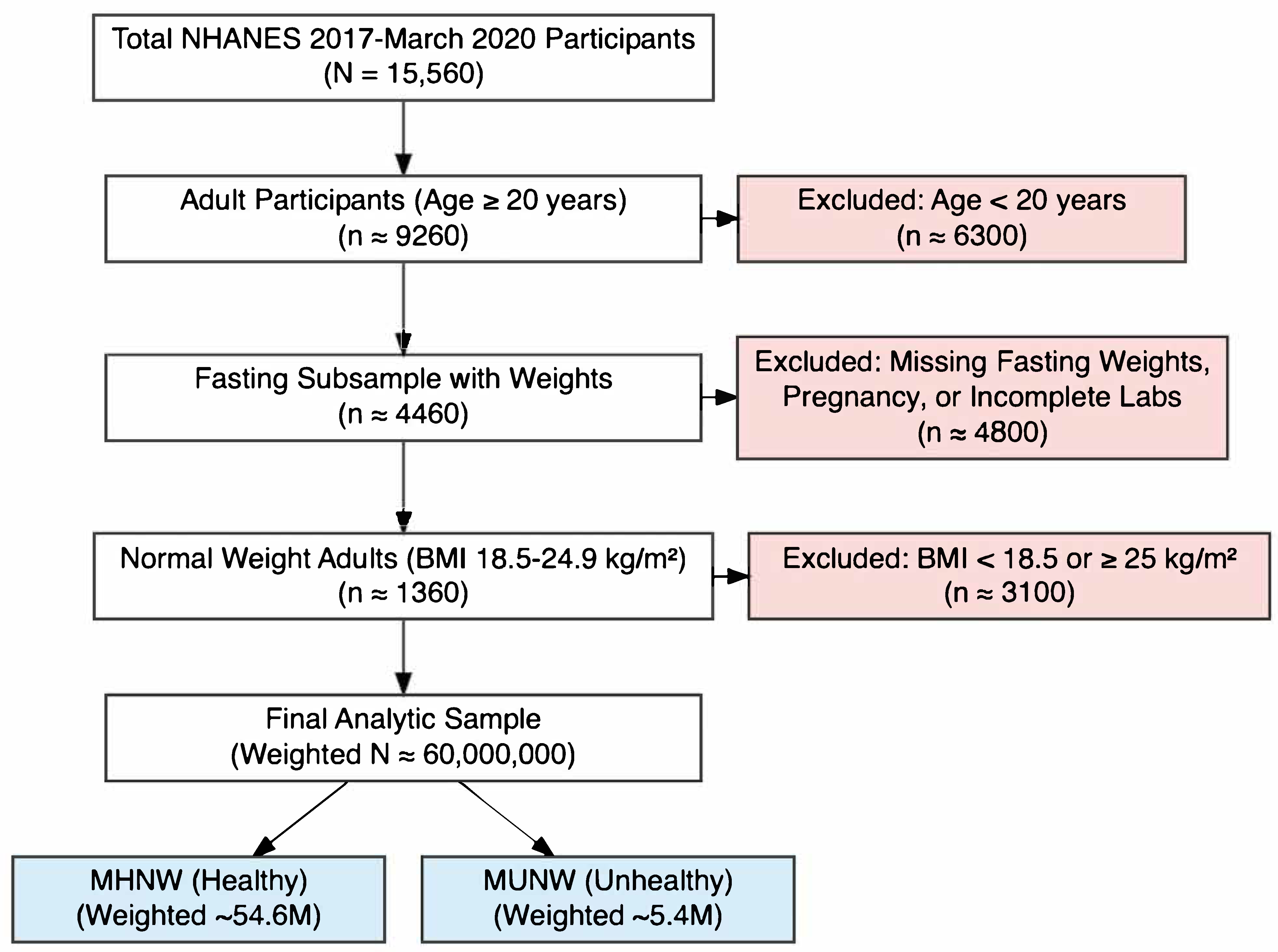
2) and had complete data for diabetes diagnosis questions, HbA1c, fasting plasma glucose, and components of metabolic syndrome. Exclusion criteria contained missing weights for the fasting subsample, pregnancy at the time of the examination and incomplete data regarding the primary outcome ariables defined below. The case selection flow-diagram is represented in
Figure 1.
2.2. Definition of Metabolic Phenotypes
Metabolic health was defined using a harmonized definition derived from the NCEP ATP III criteria. Individuals were classified as Metabolically Unhealthy Normal Weight (MUNW) if they possessed two or more of the following risk factors (excluding hyperglycemia, which was the study outcome): elevated triglycerides (≥150 mg/dL), reduced HDL cholesterol (<40 mg/dL for men or <50 mg/dL for women), elevated blood pressure (systolic ≥ 130 mmHg OR Diastolic ≥ 85 mmHg) and presented central adiposity (Waist Circumference) (>102 cm for men or >88 cm for women). The cutoff of ≥2 abnormalities was selected to balance sensitivity and specificity while excluding the outcome variable prevent false statistical results. Individuals with 0 or 1 risk factor were classified as Metabolically Healthy Normal Weight (MHNW).
2.3. Defining Diabetes Status
The determination of diabetes status was conducted through a sequential algorithm. Individuals were classified as having diagnosed diabetes if they responded affirmatively to the query, “Have you ever been told by a doctor or health professional that you have diabetes?” These individuals were subsequently excluded from the analysis of “undiagnosed” diabetes (or coded as 0, contingent upon the specific model target). Undiagnosed diabetes encompassed participants who reported no prior diagnosis but met clinical criteria for diabetes, such as Hemoglobin A1c (HbA1c) ≥ 6.5% or Fasting Plasma Glucose (FPG) ≥ 126 mg/dL. Discordant cases (elevated HbA1c with normal FPG) were classified as undiagnosed diabetes capturing the full spectrum of glycemia-related disorders.
2.4. Statistical Analysis
All statistical analyses accounted for the complex survey design of NHANES. The fasting subsample weights (WTSAFPRP) were used to account for the subset of participants who underwent fasting blood draws (glucose/triglycerides). Variance estimation used the Taylor series linearization method (also known as delta method) via the masked variance units (SDMVPSU and SDMVSTRA). Baseline characteristics between MHNW and MUNW groups using design-adjusted Chi-square tests (Rao & Scott adjustment) were performed. Weighted prevalence estimates with 95% Confidence Intervals (CI) were calculated for undiagnosed diabetes within each phenotype. A survey-weighted multivariable logistic regression model (quasibinomial family) was constructed to assess the association between phenotype and undiagnosed diabetes, adjusting for potential confounders: Age (20–39, 40–59, 60+), Gender, Race/Ethnicity, Family History of Diabetes, Smoking Status, Income to Poverty Ratio (PIR), and Education level.
All analyses were performed using R statistical software (R Core Team, Vienna, Austria) (version 4.5.1) (using survey, tidyverse, and gtsummary packages). Statistical significance was set at p < 0.05.
3. Results
The weighted analytic sample represented approximately 60 million normal-weight US adults. Within this population, the majority (approx. 54.5 million) were classified as Metabolically Healthy (MHNW), while a significant subset (approx. 5.3 million) met the criteria for Metabolically Unhealthy (MUNW).
As detailed in
Table 1, the MUNW population differed significantly from the healthy group in age and education.
The MUNW group was significantly older; 49% of the MUNW group was aged 60+, compared to only 22% in the MHNW group. Educational attainment also differed significantly, with a lower proportion of college graduates in the MUNW group (51%) compared to the MHNW group (68%).
The prevalence of undiagnosed diabetes varied starkly by metabolic health status. The prevalence of undiagnosed diabetes in the MHNW group was 1.28% (95% CI: −0.01% to 2.57%). We found a diabetes prevalence of 4.84% (95% CI: 1.20% to 8.47%) in the MUNW group, therefore, normal-weight adults with metabolic clustering were nearly four times more likely to harbor undiagnosed diabetes than their healthy counterparts.
In the fully adjusted logistic regression model (
Table 2), we examined independent predictors of undiagnosed diabetes.
The MUNW phenotype showed an Odds Ratio (OR) of 2.35 (95% CI: 0.57–9.68). While clinically substantial, this did not reach statistical significance (p = 0.2), likely due to the strong confounding effect of age and wide confidence intervals inherent in the small sub-population of undiagnosed cases.
Age was the most powerful predictor. Compared to adults aged 20–39, those aged 40–59 had an OR of 20.9 (p = 0.010), and those aged 60+ had an OR of 11.8 (p = 0.024).
Non-Hispanic Asian adults exhibited a markedly elevated risk. Compared to Non-Hispanic White adults, Asian adults had an OR of 6.10 (95% CI: 1.32–28.2, p = 0.026). Hwever, the wide confidence intervals observed in ethnicity-specific analyses indicate limited statistical power in certain subgroups.
Individuals with “Some College” education had higher odds (OR 4.28) compared to college graduates (p = 0.039).
4. Discussion
This study identifies a critical gap in diabetes surveillance: nearly 5% of normal-weight adults with metabolic abnormalities have undiagnosed diabetes. While 5% may appear low compared to obese populations, applied to the US population, this represents hundreds of thousands of individuals who are unlikely to be screened under traditional BMI-centric protocols. The contrast with the 1.28% prevalence in the healthy phenotype confirms that BMI is an insufficient filter for metabolic risk assessment.
Our results highlight that “normal weight” has different meaning when considering patient demographics. In this study, the strongest driver of undiagnosed diabetes was age. This suggests that in older adults, BMI becomes a less reliable indicator of metabolic health, likely due to the age-related redistribution of fat from subcutaneous to visceral depots and due to continuous loss of muscle mass (sarcopenia) [
17,
18]. These phenomena are also accompanied by leptin and insulin resistance and many other metabolic changes, leading to cardiometabolic dysfunctions and increased risk of morbidity and mortality [
18,
19].
The strikingly high Odds Ratio (OR: 6.10) observed for Asian adults in this study reinforces the concept that this population generally has a lower personal fat threshold. Asian individuals may develop insulin resistance and T2D at much lower BMI levels than Caucasians. Due to ethnic differences in body composition, fat distribution, inflammation, and genetic factors, Asian populations develop insulin resistance and T2D at lower BMI levels than Caucasians. This necessitates ethnicity-specific BMI cutoffs and earlier metabolic screening in Asians to enable timely prevention and intervention for diabetes and related metabolic diseases [
20,
21,
22,
23,
24,
25]. The American Diabetes Association’s recommendation to screen Asian Americans at a BMI of ≥23 kg/m
2, rather than the standard ≥ 25 kg/m
2, is also supported by these findings [
26]. Current USPSTF (United States Preventive Services Task Force) guidelines recommend screening for prediabetes and diabetes in adults aged 35 to 70 years who have overweight or obesity [
27]. During clinical practice a transition from a purely weight-centric screening model to one that incorporates metabolic health and patient history, particularly in preventive care settings would enable a much more efficient diabetes mellitus screening.
Thus, in a modern healthcare environment, the management of patients with MUNW requires a multidisciplinary approach. Implementing standardized care pathways and clinical networks can help achieve quadruple aim goals–improving patient experience, population health, and provider well-being while reducing costs–by ensuring that these high-risk individuals are not overlooked [
7,
8,
9].
Clinicians should assess metabolic changes beyond BMI to detect metabolically unhealthy normal-weight (MUNW) adults during check-ups. Key indicators include hypertriglyceridemia (≥150 mg/dL) and elevated blood pressure (≥130/85 mmHg). These findings should prompt HbA1c testing to identify dysglycemia risk. Waist circumference is crucial for detecting abnormal fat distribution in MUNW individuals, as it signifies visceral adiposity associated with metabolic abnormalities despite normal BMI. Evidence-based recommendations suggest that in the absence of elevated BMI, the presence of at least two components of metabolic syndrome should trigger screening for diabetes mellitus.
Bioelectrical impedance shows increased adiposity and decreased muscle mass link to unfavorable metabolic traits in normal-weight adults. Molecular and genetic markers differ between metabolically healthy and unhealthy phenotypes independent of BMI. Altered expression of microRNAs, inflammatory markers, and pathways in lipid and glucose metabolism characterize MUNW individuals. Genetic studies have identified loci associated with metabolically unhealthy phenotypes in normal-weight subjects. The cardiometabolic index (CMI) shows promising accuracy in identifying MUNW individuals, outperforming BMI alone. Detecting MUNW adults requires assessment of metabolic profiles, including lipids, blood pressure, HbA1c, and waist circumference, enabling early intervention for at-risk individuals [
28,
29,
30,
31,
32]. The high OR in the 40–59 age group supports lowering the universal screening age to 35 (as recently updated by the ADA), regardless of weight, to also capture these cases, still receiving less attention [
33].
For the MUNW population, standard advices aiming body mass reduction may be counterproductive or confusing, as they are already within the normal weight range. Interventions should focus on body composition rather than weight loss. Resistance training is crucial to combat sarcopenia and improve insulin sensitivity in skeletal muscle [
34,
35,
36]. Emphasis should shift to reducing refined carbohydrates and saturated fats that contribute to visceral fat deposition, even in the absence of caloric surplus.
Strengths and Limitations
Strengths of this study include the use of the high-quality, pre-pandemic NHANES dataset, which provides a clean baseline unaffected by COVID-19 disruptions. However, the reliance on BMI as a primary selection criterion for “normal weight” inherently carries limitations, as it does not differentiate between lean mass and fat mass, potentially misclassifying individuals with sarcopenic obesity, but may also include individuals with increased muscle mass into the group with high BMI. Furthermore, the relatively small sample size of undiagnosed cases within the normal-weight strata resulted in wide confidence intervals, limiting the statistical power to detect significant differences in smaller subgroups, and restricting generalizability. Finally, sensitivity analyses using alternative definitions of metabolic health were not conducted, which is also a limiting factor.
5. Conclusions
Normal weight is not a guarantee of healthy metabolic status. A specific subset of the population—older adults, those of Asian descent, and those with clustered metabolic risk factors—face a significantly elevated risk of undiagnosed diabetes despite having a normal BMI. Therefore, clinical practice should evolve from a weight-centric view to a lipocentric and metabolic view. Early identification of the MUNW phenotype through expanded screening criteria is essential to preventing the long-term complications of untreated diabetes in this overlooked population.
Author Contributions
Conceptualization, S.P. and A.S.; methodology, S.P. and A.S.; software, S.P.; validation, S.P. and A.S.; formal analysis, S.P.; investigation, S.P.; resources, A.S.; data curation, S.P.; writing—original draft preparation, S.P.; writing—review and editing, S.P. and A.S.; visualization, S.P.; supervision, A.S.; project administration, A.S. All authors have read and agreed to the published version of the manuscript.
Funding
This research received no external funding.
Institutional Review Board Statement
This study reuses the NHANES database between 2017–2020, which is publicly available. Therefore, the authors of this manuscript were not able and did not need to obtain Regional Institutional Review Board approval for this study.
Informed Consent Statement
This study reuses the NHANES database between 2017–2020, which is publicly available. Therefore, the authors of this manuscript were not able and did not need to obtain informed consent from the subjects included in the analysis.
Data Availability Statement
Conflicts of Interest
The authors declare no conflicts of interest.
Abbreviations
The following abbreviations are used in this manuscript:
| ADA | American Diabetes Association |
| BMI | Body Mass Index |
| CI | Confidence Interval |
| CMI | Cardiometabolic Index |
| COVID-19 | Coronavirus Disease 2019 |
| FPG | Fasting Plasma Glucose |
| HbA1c | Hemoglobin A1c |
| HDL | High-Density Lipoprotein |
| HDL-C | High-Density Lipoprotein Cholesterol |
| MHNW | Metabolically Healthy Normal Weight |
| MUNW | Metabolically Unhealthy Normal Weight |
| NCEP ATP III | National Cholesterol Education Program Adult Treatment Panel III |
| NCHS | National Center for Health Statistics |
| NHANES | National Health and Nutrition Examination Survey |
| OR | Odds Ratio |
| PIR | Poverty Income Ratio |
| T2D | Type 2 Diabetes Mellitus |
| USPSTF | United States Preventive Services Task Force |
References
- Cousin, E.; Khubchandani, J.; Radfar, A.; Filip, I.; Landires, I.; Shafaat, O.; Kimokoti, R.W.; Silva, D.A.S.; Hashemian, M.; Shabani, M.; et al. Burden of Diabetes and Hyperglycaemia in Adults in the Americas, 1990–2019: A Systematic Analysis for the Global Burden of Disease Study 2019. Lancet Diabetes Endocrinol. 2022, 10, 655–667. [Google Scholar] [CrossRef] [PubMed]
- Ong, K.; Ismail, N.E.; Roustazadeh, A.; Cousin, E.; Khanal, S.; Asmelash, D.; Berhie, A.Y.; Pereira, M.; Demisse, F.W.; Ahmad, A.; et al. Global, Regional, and National Burden of Diabetes from 1990 to 2021, with Projections of Prevalence to 2050: A Systematic Analysis for the Global Burden of Disease Study 2021. Lancet 2023, 402, 203–234. [Google Scholar] [CrossRef] [PubMed]
- Aung, K.; Hinojosa, M.A.; Haffner, S.M.; Lorenzo, C. Risk of Developing Diabetes and Cardiovascular Disease in Metabolically Unhealthy Normal-Weight and Metabolically Healthy Obese Individuals. J. Clin. Endocrinol. Metab. 2013, 99, 462–468. [Google Scholar] [CrossRef]
- Akinbam, L.; Davy, O.; Mohadjer, L.; Riddles, M.; Chen, T.-C.; Ogden, C.; Fink, S.; Clark, J. National Health and Nutrition Examination Survey, 2017–March 2020 Prepandemic File: Sample Design, Estimation, and Analytic Guidelines. Natl. Cent. Health Stat. 2022, 2, 190. [Google Scholar]
- Stefan, N.; Schick, F.; Häring, H.-U. Causes, Characteristics, and Consequences of Metabolically Unhealthy Normal Weight in Humans. Cell Metab. 2017, 26, 292–300. [Google Scholar] [CrossRef]
- Eckel, N.; Mühlenbruch, K.; Meidtner, K.; Boeing, H.; Stefan, N.; Schulze, M.B. Characterization of Metabolically Unhealthy Normal-Weight Individuals: Risk Factors and Their Associations with Type 2 Diabetes. Metabolism 2015, 64, 862–871. [Google Scholar] [CrossRef]
- D’Alleva, A.; Leigheb, F.; Rinaldi, C.; Di Stanislao, F.; Vanhaecht, K.; de Ridder, D.; Bruyneel, L.; Cangelosi, G.; Panella, M. Achieving quadruple aim goals through clinical networks: A systematic review. J. Healthc. Qual. Res. 2019, 34, 29–39. [Google Scholar] [CrossRef]
- Pugh-Bernard, A.; Nickels, S.; Melendez, J.; Shawkat, J.; Rolison, E.; Swanson, A.; Bajaj, L.; Hyman, D.; Bakel, L.A. A Strategy for the Renovation of a Clinical Pathways Program. Pediatr. Qual. Saf. 2019, 4, e178. [Google Scholar] [CrossRef]
- Lancaster, E.; Wick, E. Standardized Care Pathways as a Means to Improve Patient Safety. Surg. Clin. N. Am. 2021, 101, 49–56. [Google Scholar] [CrossRef]
- Suliga, E.; Kozieł, D.; Głuszek, S. Prevalence of Metabolic Syndrome in Normal Weight Individuals. Ann. Agric. Environ. Med. 2016, 23, 631–635. [Google Scholar] [CrossRef]
- Lee, M.J.; Kim, H.; Bae, S.; Kim, E.; Choe, J.; Lee, W.J.; Jung, C.H. Protective Role of Skeletal Muscle Mass against Progression from Metabolically Healthy to Unhealthy Phenotype. Clin. Endocrinol. 2018, 90, 102–113. [Google Scholar] [CrossRef]
- Kim, H.; Bae, S.; Lee, M.J.; Kim, K.W.; Kim, E.H.; Kim, C. Comparison of Muscle Mass and Quality between Metabolically Healthy and Unhealthy Phenotypes. Obesity 2021, 29, 1375–1386. [Google Scholar] [CrossRef]
- Carvalho, C.J.D.; Segheto, K.J.; Longo, G.Z.; Pereira, P.F.; Juvanhol, L.L.; Kakehasi, A.M.; Ribeiro, A.Q. Skeletal Mass Indices Are Inversely Associated with Metabolically Unhealthy Phenotype in Overweight/Obese and Normal-Weight Men: A Population-Based Cross-Sectional Study. Br. J. Nutr. 2020, 126, 501–509. [Google Scholar] [CrossRef]
- Beauchamp, B.; Al-Dirbashi, O.Y.; Quizi, J.; Patti, M.-E.; Antoun, G.; Mcintosh, N.; Thrush, A.B.; Harper, M.-E. Undernutrition during Pregnancy in Mice Leads to Dysfunctional Cardiac Muscle Respiration in Adult Offspring. Biosci. Rep. 2015, 35, e00200. [Google Scholar] [CrossRef]
- Viitasalo, A.; Pahkala, K.; Lehtimäki, T.; Viikari, J.; Tammelin, T.; Raitakari, O.; Kilpeläinen, T. Changes in BMI and Physical Activity from Youth to Adulthood Distinguish Normal-Weight, Metabolically Obese Adults from Those Who Remain Healthy. Front. Endocrinol. 2022, 13, 923327. [Google Scholar] [CrossRef] [PubMed]
- Vandenbroucke, J.P.; Egger, M.; Pocock, S.J.; Gøtzsche, P.C.; Von Elm, E.; Altman, D.G.; Poole, C.; Mulrow, C.D.; Schlesselman, J.J. Strengthening the Reporting of Observational Studies in Epidemiology (STROBE). Epidemiology 2007, 18, 805–835. [Google Scholar] [CrossRef] [PubMed]
- Hwang, J.; Lee, J.-K. Factors Influencing Age-Related Loss of Skeletal Muscle Mass in Young Korean Men. J. Korean Soc. Phys. Med. 2023, 18, 67–75. [Google Scholar] [CrossRef]
- Picard, F.; Carter, S.; Caron, A.; Richard, D. Role of Leptin Resistance in the Development of Obesity in Older Patients. Clin. Interv. Aging 2013, 8, 829–844. [Google Scholar] [CrossRef]
- Ahmed, B.; Farb, M.G.; Gokce, N. Cardiometabolic Implications of Adipose Tissue Aging. Obes. Rev. 2024, 25, e13806. [Google Scholar] [CrossRef]
- Mehta, L.S.; Velarde, G.P.; Lewey, J.; Sharma, G.; Bond, R.M.; Navas-Acien, A.; Fretts, A.M.; Magwood, G.S.; Yang, E.; Blumenthal, R.S.; et al. Cardiovascular Disease Risk Factors in Women: The Impact of Race and Ethnicity: A Scientific Statement From the American Heart Association. Circulation 2023, 147, 1471–1487. [Google Scholar] [CrossRef]
- US Preventive Services Task Force. Screening for Prediabetes and Type 2 Diabetes: US Preventive Services Task Force Recommendation Statement. JAMA 2021, 326, 736–743. [Google Scholar] [CrossRef] [PubMed]
- Vicks, W.S.; Lo, J.C.; Guo, L.; Rana, J.S.; Zhang, S.; Ramalingam, N.D.; Gordon, N.P. Prevalence of prediabetes and diabetes vary by ethnicity among U.S. Asian adults at healthy weight, overweight, and obesity ranges: An electronic health record study. BMC Public Health 2022, 22, 1954. [Google Scholar] [CrossRef] [PubMed]
- Kwan, T.W.; Kanaya, A.M.; Wong, S.S.; Hayman, L.L.; Hong, Y.; Palaniappan, L.P.; Shah, S.H.; Khan, S.S.; Khaliq, A.; Welty, F.K.; et al. Epidemiology of Diabetes and Atherosclerotic Cardiovascular Disease Among Asian American Adults: Implications, Management, and Future Directions: A Scientific Statement From the American Heart Association. Circulation 2023, 148, 74–94. [Google Scholar] [CrossRef]
- Li, Z.; Daniel, S.; Fujioka, K.; Umashanker, D. Obesity among Asian American people in the United States: A review. Obesity 2023, 31, 316–328. [Google Scholar] [CrossRef] [PubMed]
- Caleyachetty, R.; Barber, T.M.; Mohammed, N.I.; Cappuccio, F.P.; Hardy, R.; Mathur, R.; Banerjee, A.; Gill, P. Ethnicity-specific BMI cutoffs for obesity based on type 2 diabetes risk in England: A population-based cohort study. Lancet Diabetes Endocrinol. 2021, 9, 419–426. [Google Scholar] [CrossRef] [PubMed]
- Araneta, M.R.G.; Onishi, Y.; Leonetti, D.L.; Hayashi, T.; Boyko, E.J.; Fujimoto, W.Y.; Mcneely, M.J.; Sato, K.K.; Kanaya, A.M.; Chang, H.K.; et al. Optimum BMI Cut Points to Screen Asian Americans for Type 2 Diabetes. Diabetes Care 2015, 38, 814–820. [Google Scholar] [CrossRef]
- American Diabetes Association Professional Practice Committee. Diagnosis and Classification of Diabetes: Standards of Care in Diabetes—2025. Diabetes Care 2025, 48, S27–S49. [Google Scholar] [CrossRef]
- Méndez-Mancilla, A.; Turiján-Espinoza, E.; Vega-Cárdenas, M.; Hernández-Hernández, G.E.; Uresti-Rivera, E.E.; Vargas-Morales, J.M.; Portales-Pérez, D.P. miR-21, miR-221, miR-29 and miR-34 Are Distinguishable Molecular Features of a Metabolically Unhealthy Phenotype in Young Adults. PLoS ONE 2024, 19, e0300420. [Google Scholar] [CrossRef]
- Xia, L.; Dong, F.; Gong, H.; Xu, G.; Wang, K.; Liu, F.; Pan, L.; Zhang, L.; Yan, Y.; Gaisano, H.; et al. Association between Indices of Body Composition and Abnormal Metabolic Phenotype in Normal-Weight Chinese Adults. Int. J. Environ. Res. Public Health 2017, 14, 391. [Google Scholar] [CrossRef]
- Liu, X.; Wu, Q.; Chen, Z.; Yuan, H.; Lu, Y.; Yan, G.; Bragazzi, N.L.; Duan, J.; Yang, P. Cardiometabolic Index: A New Tool for Screening the Metabolically Obese Normal Weight Phenotype. J. Endocrinol. Investig. 2020, 44, 1253–1261. [Google Scholar] [CrossRef]
- Park, J.-M.; Song, Y.; Park, D.-H.; Kim, S.-J.; Kwon, Y.-J.; Kim, J.O.; Choi, J.-E.; Hong, K.-W.; Lee, J.-W. Understanding the Genetic Architecture of the Metabolically Unhealthy Normal Weight and Metabolically Healthy Obese Phenotypes in a Korean Population. Sci. Rep. 2021, 11, 2279. [Google Scholar] [CrossRef]
- Schulze, M.B. Metabolic Health in Normal-Weight and Obese Individuals. Diabetologia 2018, 62, 558–566. [Google Scholar] [CrossRef] [PubMed]
- Taylor, R.; Clark, L.; Hollingsworth, K.G.; Irvine, K.M.; Solovyova, A.S.; Koulman, A.; Barnes, A.C.; Holman, R.R.; Romeres, D.; Cobelli, C.; et al. Aetiology of Type 2 Diabetes in People with a ‘Normal’ Body Mass Index: Testing the Personal Fat Threshold Hypothesis. Clin. Sci. 2023, 137, 1333–1346. [Google Scholar] [CrossRef]
- Funai, K.; Yin, L.; Song, H.; Lodhi, I.J.; Klein, S.; Semenkovich, C.F.; Spears, L.D. Skeletal Muscle Phospholipid Metabolism Regulates Insulin Sensitivity and Contractile Function. Diabetes 2015, 65, 358–370. [Google Scholar] [CrossRef]
- Endo, Y.; Sinha, I.; Nourmahnad, A. Optimizing Skeletal Muscle Anabolic Response to Resistance Training in Aging. Front. Physiol. 2020, 11, 874. [Google Scholar] [CrossRef] [PubMed]
- Dela, F.; Kjaer, M. Resistance Training, Insulin Sensitivity and Muscle Function in the Elderly. Essays Biochem. 2006, 42, 75–88. [Google Scholar] [CrossRef]
| Disclaimer/Publisher’s Note: The statements, opinions and data contained in all publications are solely those of the individual author(s) and contributor(s) and not of MDPI and/or the editor(s). MDPI and/or the editor(s) disclaim responsibility for any injury to people or property resulting from any ideas, methods, instructions or products referred to in the content. |