Article

Clinical Outcomes of Injectable Porcine Collagen in Diabetic Patients with Achilles Tendinopathy: A Retrospective Study

by
Giacomo Placella
*,
Niccolò Biavardi
,
Mattia Alessio Mazzola
and
Vincenzo Salini
San Raffaele University, 20132 Milan, Italy
*
Author to whom correspondence should be addressed.
J. Clin. Med. 2026, 15(4), 1381; https://doi.org/10.3390/jcm15041381
Submission received: 18 December 2025 / Revised: 30 January 2026 / Accepted: 4 February 2026 / Published: 10 February 2026

Abstract

Background/Objective: Achilles tendinopathy (AT) is a disabling condition, and treatment options are limited in patients in whom corticosteroid injections are discouraged or contraindicated, including individuals with diabetes. Porcine collagen injections have been proposed as a conservative option; however, clinical evidence in diabetic populations remains limited. This study aims to describe pain and functional outcomes after peritendinous collagen injections in diabetic patients with chronic Achilles tendinopathy. Methods: Twenty-two diabetic patients with ultrasound-confirmed degenerative Achilles tendinopathy refractory to conservative management were retrospectively included and split into two groups according to AT type: insertional (IAT) and non-insertional/midportion (NIAT). All patients received five weekly ultrasound-guided peritendinous collagen injections. Outcomes included VAS assessed at baseline, after the second injection, at 1 month, and at 6 months; VISA-A at baseline and 6 months; return-to-work (RTW) time; and adverse events. Baseline variables included BMI, HbA1c, symptom duration, and previous treatments. Analyses were based on descriptive statistics and within-group comparisons over time. Results: All patients completed the treatment protocol, and no adverse events were recorded. Pain significantly improved over follow-up in both subgroups. Mean VAS decreased from baseline to 6 months (mean ΔVAS: 5.1 in IAT and 4.4 in NIAT; p = 0.001 for within-group change). VISA-A also improved at 6 months (mean ΔVISA-A: 32.78 in IAT and 38.97 in NIAT; p < 0.0001). Median RTW was 37 days in IAT and 35 days in NIAT (p > 0.05). No significant between-group differences were observed for VAS or VISA-A changes (p > 0.05). Conclusions: In this uncontrolled retrospective case series, peritendinous collagen injections were feasible and well-tolerated in diabetic patients with Achilles tendinopathy and were associated with clinically relevant improvements in pain and functional outcomes at 6 months. These findings are hypothesis-generating and warrant confirmation in prospective controlled studies.

1. Introduction

The Achilles tendon in medicine is also known as the “triceps surae”. It is the strongest and thickest tendon in the entire human body [1]. This tendon connects with the aponeuroses of the gastrocnemius, soleus, and plantaris muscles and joints them to the calcaneus bone [2]. The outer sheath of the tendon is a sheath-like structure made up of a single layer of cells; it is not a true synovial sheath, but rather a “false sheath” called the paratenon [2,3,4]. The paratenon significantly contributes to providing blood supply to the tendon [4]. The Achilles tendon is essential for allowing the calf muscles to exert force on the heel; this function becomes crucial for walking and running correctly [5,6,7]. The Achilles tendon can be affected by various pathological conditions such as insertional [2,8] and non-insertional tendinitis [9,10], paratenonitis [11,12] and tendon rupture [13,14]. Tendinopathy is one of the most common conditions affecting the Achilles tendon. The factors and causes triggering Achilles tendinopathy (AT) are divided into two main groups: intrinsic factors and extrinsic factors [5,6,7]:
  • Intrinsic factors:
    These include anatomic factors, age, sex, metabolic dysfunction [15] foot cavity, dysmetria, muscle weakness, imbalance, gastrocnemius dysfunction [16], anatomical variation in the plantaris muscle [17], tendon vascularization [18] and torsion of the Achilles tendons [19].
  • Extrinsic factors:
    These include mechanical overload, constant effort [20], diabetes and obesity [21,22,23,24,25,26] medications (corticosteroids, anabolic steroids, fluoroquinolones) [27,28,29,30], hard training surfaces and direct trauma to the lower leg [31].
The pathophysiology of AT, described as the anatomical abnormality of the tendon, is characterized by a reduction in parallel type I collagen fibers, associated with infiltration of adipose tissue and proliferation of vascular tissue. These changes manifest as a thickening of the tendon, visible through conventional imaging diagnostics [2,32]. Furthermore, the Achilles tendon histopathology showed its composition of 95% type I collagen fibers; these fibers provide strength and flexibility to the Achilles tendon. A decrease in this type of fiber can also occur with the normal aging process or as result of injuries. In tendinopathy, which includes both tendinosis and tendinitis, the amounts of proteoglycans, water content, and disorganized type III collagen, unlike type I, increase [32]. Notably, it has been shown that an increase in advanced glycation end-products (AGEs) in association with diabetes pathology impacted the functionality of the Achilles tendon [33]. The changes concerning the properties and the content of collagen fibers have been associated with diabetes [23,24,25]. These morphological changes observed in tendons can also be present in the early stages of type 2 diabetes (T2DM). Since the diagnosis of T2DM is often made when some patients already show evidence of chronic complications, this implies that the effects of hyperglycemia would have already been exerted for some time on tendon structures [34,35]. Alterations in the fibrillar organization of the Achilles tendon, the presence of hypoechoic areas found on ultrasound imaging, and calcific formations within the tendon are common degenerative abnormalities [35,36].
ATs can be categorized into two groups [5]: Insertional (AT-I) [22,24] and non-insertional (AT-NI) [6]. Achilles tendinopathies are pathological metabolic conditions frequently found in T2DM patients [22,33,34]. These pathologies are characterized by the onset of chronic pain, which leads to progressive motor disability both in normal daily activities and during sports activities. Therefore, therapeutic effectiveness in relieving pain and improving functionality is the desired goal for both patients and specialists in this field. The scenario concerning the management of AT is very broad and complex. Physic-kinesis-therapy (FKT) always constitutes an initial starting point for AT treatment [35]. However, clinicians, responsible for selecting the best clinical treatment for the patient, often must choose between an interventional approach (surgery) and a non-interventional approach (conservative therapy). The choice of a non-surgical approach is always preferred over a surgical one, which is generally considered only in cases of Achilles tendon rupture or in instances where conservative treatment has failed. Fortunately, beneficial effects have been reported for the treatment of AT and tendinopathies in general through various conservative approaches, including the use of platelet-rich plasm [36,37], shockwaves [38,39,40], and porcine collagen. This type of treatment has been successfully tested in various pathological conditions of the musculoskeletal system [41], such as greater trochanteric pain syndrome (GTPS) [42,43], knee osteoarthritis (K-OA) [44,45,46], hip tendinitis [47,48,49] and tendinopathies of the rotator cuff of the shoulder [47]. Nonetheless, it has been shown that collagen injection collaborates with tenocytes, demonstrating its relationship with mechanical stimuli [42,43]. Although diabetes is associated with glycation-related collagen cross-linking and structural disorganization within tendon tissue, collagen injections should not be interpreted as a direct reversal of established AGE-mediated changes. The rationale for peritendinous collagen supplementation is instead based on biological plausibility: diabetes impairs tendon homeostasis and collagen turnover, with altered extracellular matrix remodeling and tenocyte function. Providing exogenous collagen in the peritendinous environment may act as a supportive extracellular matrix substrate and modulate the local microenvironment, potentially facilitating reparative processes and symptom improvement. However, direct mechanistic evidence supporting these pathways in diabetic Achilles tendinopathy remains limited and warrants dedicated experimental investigation.
Having said all that, the aim of this study is to evaluate the effectiveness of collagen infiltration in Achilles tendons in diabetic subjects for the improvement in pain symptoms and functionality.

2. Materials and Methods

2.1. Study Design, Data Collection, and Eligibility Criteria

This study is a single-center, uncontrolled retrospective case series including diabetic patients treated for Achilles tendinopathy during 2024. Clinical and demographic data were retrospectively collected by two authors (G.P. and M.B.) and entered into a dedicated anonymized database. For confidentiality, each patient was assigned an encrypted alphanumeric code and all identifiable information was removed before analysis (during the first part of 2025).
  • Inclusion Criteria
Patients were eligible if they met all of the following criteria:
Age ≥ 18 years;
Pre-existing diagnosis of diabetes mellitus documented in medical records, with ongoing treatment when applicable;
Baseline metabolic status documented by HbA1c level when available (collected as a descriptive variable, not as a diagnostic criterion);
Symptomatic degenerative Achilles tendinopathy confirmed by clinical assessment and ultrasound examination;
Persistence of pain and functional impairment for ≥6 months despite conservative management;
Regular physical activity and/or recreational sport participation documented in clinical history (when available);
Continuous pain and functional limitation affecting daily activities and/or sports participation;
No previous surgical treatment for Achilles tendinopathy.
  • Diabetes Type
Diabetes type (type 1 vs. type 2) was retrieved from clinical records when available. The cohort consisted predominantly of patients with type 2 diabetes.
  • Exclusion Criteria
Patients were excluded in cases of:
Partial or complete Achilles tendon rupture;
Previous surgical treatment of the Achilles tendon;
Previous infiltrative or regenerative treatments for Achilles tendinopathy;
Prior corticosteroid injections for Achilles tendinopathy;
Known hypersensitivity or declared allergy to collagen or related derivatives.

2.2. Ultrasound Assessment and Definition of Tendinopathy Subtypes

All patients underwent musculoskeletal ultrasound as part of routine clinical assessment to confirm the diagnosis of degenerative Achilles tendinopathy and to guide the injection procedure. Ultrasound was used to localize the affected tendon segment and the area of maximal structural alteration, typically characterized by tendon thickening and focal loss of the normal fibrillar echotexture, with or without peritendinous changes.
For analytical purposes, Achilles tendinopathy was classified by anatomical location based on clinical and ultrasound findings:
Insertional Achilles tendinopathy (IAT): pain and sonographic alterations located within 0–2 cm from the calcaneal insertion;
Non-insertional (midportion) Achilles tendinopathy (NIAT): involvement of the tendon portion located 2–7 cm proximal to the insertion.

2.3. Treatment Protocol and Injection Technique

All patients received a standardized treatment protocol consisting of five weekly peritendinous porcine collagen injections (MD-Tissue, Medical Device, Guna spa, Milan, Italy). Each injection session consisted of 2 mL of collagen, for a total cumulative dose of 10 mL (5 vials).
All procedures were performed under ultrasound guidance using a 22G needle (23 mm length), to ensure accurate peritendinous placement and to avoid intratendinous injection. The target area was disinfected using alcohol-based antiseptic solution (or equivalent), and the procedure was conducted under sterile conditions. The collagen was injected around the tendon at the level of the symptomatic region (insertional site and/or proximal course), distributing the injectate within the peritendinous/periparatenon space under real-time ultrasound monitoring. Local anesthetic was not routinely administered.

2.4. Post-Injection Management and Concomitant Treatments

Given the retrospective design, post-injection management and concomitant interventions were extracted from clinical charts. Patients were generally advised to follow activity modification after injection and to avoid additional infiltrative procedures during the treatment period.
To address potential confounding, the presence of co-interventions during follow-up was documented when available, including physiotherapy, structured loading/exercise programs, footwear modification/orthoses, use of NSAIDs or analgesics, extracorporeal shockwave therapy, and any relevant changes in diabetes management. These variables were collected to improve interpretability of outcomes in the absence of a control group.

2.5. Endpoints and Safety Monitoring

The primary objective of this study was to evaluate the clinical evolution of pain and function at 6 months after treatment completion. The secondary objective was to monitor safety and tolerability of collagen injections.
Adverse events potentially attributable to collagen were recorded from clinical documentation. Events of interest included persistent post-procedural pain, skin rash, swelling/edema, and allergic reactions.

2.6. Clinical Outcome Measures

Pain intensity was assessed using the Visual Analog Scale (VAS), ranging from 0 (“no pain”) to 10 (“worst pain imaginable”). Functional status was assessed using the Victorian Institute of Sport Assessment–Achilles questionnaire (VISA-A), a validated patient-reported outcome measure for Achilles tendinopathy assessing pain, function in daily life, and sport activity. VISA-A scores range from 0 to 100, with 100 indicating absence of symptoms and full function.
VAS and VISA-A were collected at baseline (T0, before the start of treatment) and at follow-up (T1, 6 months after the end of the treatment cycle). Return-to-work (RTW) and return-to-sport (RTS) timings were recorded when available. The RTW was defined as the time elapsed from the start of treatment (T0; first injection) to the first documented date of resumption of the patient’s usual work activity. Time was recorded in days/weeks based on clinical documentation and follow-up reports.

2.7. Statistical Analysis

Continuous variables were summarized using mean ± standard deviation (SD) or median (minimum–maximum), as appropriate. Categorical variables were reported as counts and percentages based on the non-missing sample size.
Normality was assessed using the Shapiro–Wilk test. Changes between baseline (T0) and follow-up (T1) were assessed using paired Student’s t-test for normally distributed data. Subgroup analyses between insertional and non-insertional tendinopathy were performed using ANOVA on delta (change) VAS and VISA-A outcomes.
Time-to-event analysis for RTW was evaluated using Kaplan–Meier survival curves with log-rank testing and hazard ratio (HR) estimates with 95% confidence intervals (CI), when applicable. Statistical significance was set at p < 0.05.
Statistical analyses were performed using GraphPad Prism (version 10.0, San Diego, CA, USA). Data were recorded in a dedicated spreadsheet (e.g., Microsoft Excel), and original rows of anonymized data can be made available upon reasonable request.

3. Results

3.1. Demographic and Clinical Data

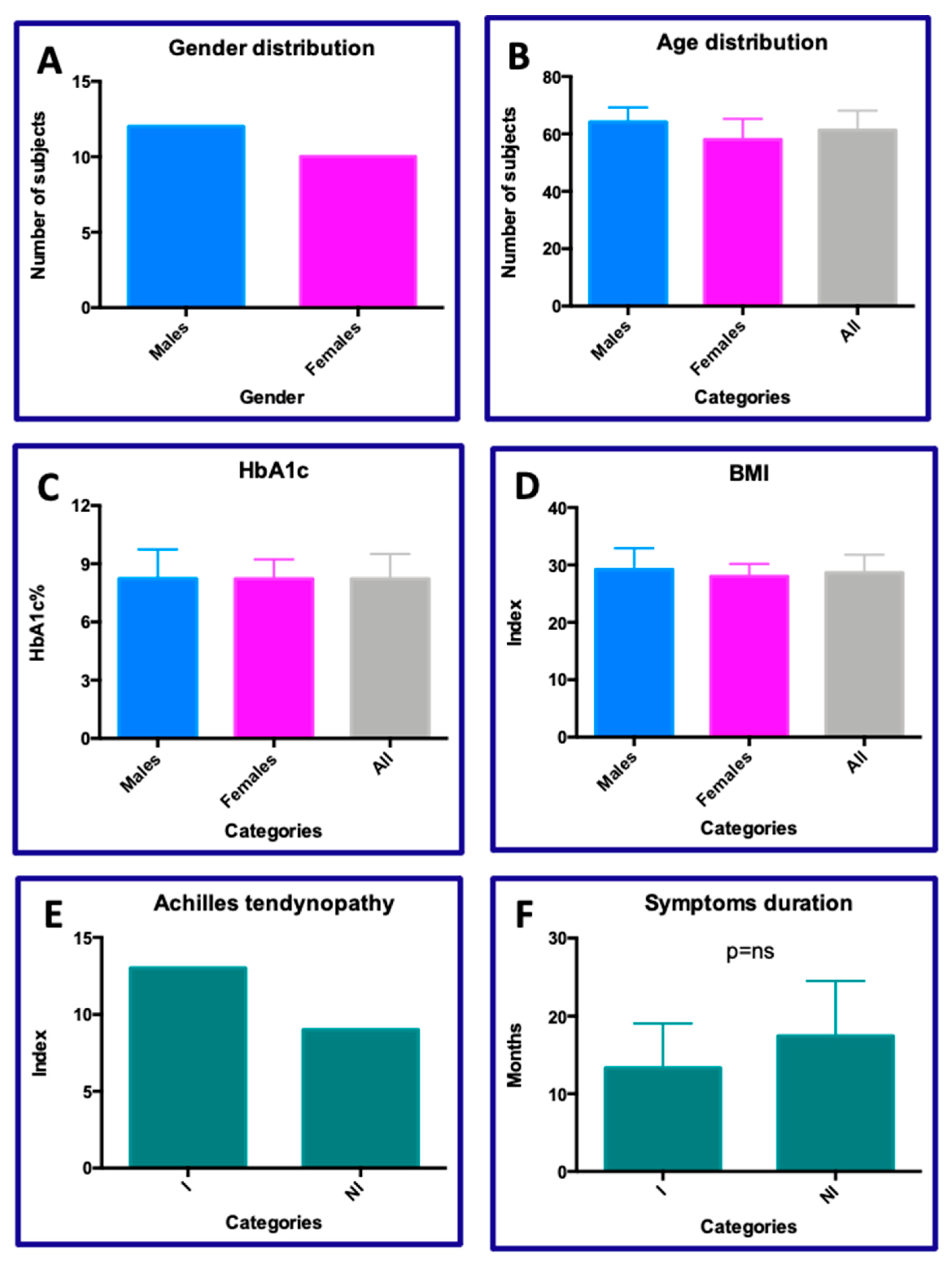
The demographic and clinical data of the 22 patients included in the study are reported in Figure 1. No statistically significant differences were observed regarding the distribution of gender (12 M vs. 10 F; Figure 1A) and age (64.1 ± 5.1 M vs. 58.0 ± 7.2 F vs. 61.3 ± 6.7 All; Figure 1B) among the enrolled subjects. All subjects were classified as diabetic patients based on the distribution of glycated hemoglobin values (8.2 ± 1.5 M vs. 8.2 ± 0.9 F vs. 8.2 ± 1.2 All; Figure 1C; p = 0.9911) and body mass index (BMI) values (29.1 ± 3.7 M vs. 28.1 ± 2.1 F vs. 28.6 ± 3.1 All; Figure 1D; p = 0.8004). From a clinical perspective, patients were divided based on the type of Achilles tendinopathy (ATs; Figure 1E) into two groups: insertional (I; n = 13) and non-insertional (NI; n = 9). The duration of symptoms was recorded for each patient and no statistically significant differences were found between subjects with AT-I and those with AT-NI (13.3 vs. 17.4; Figure 1F; p = 0.1477). Collagen treatment was applied equally to both groups, which were shown to have homogeneous characteristics.

3.2. VAS Results

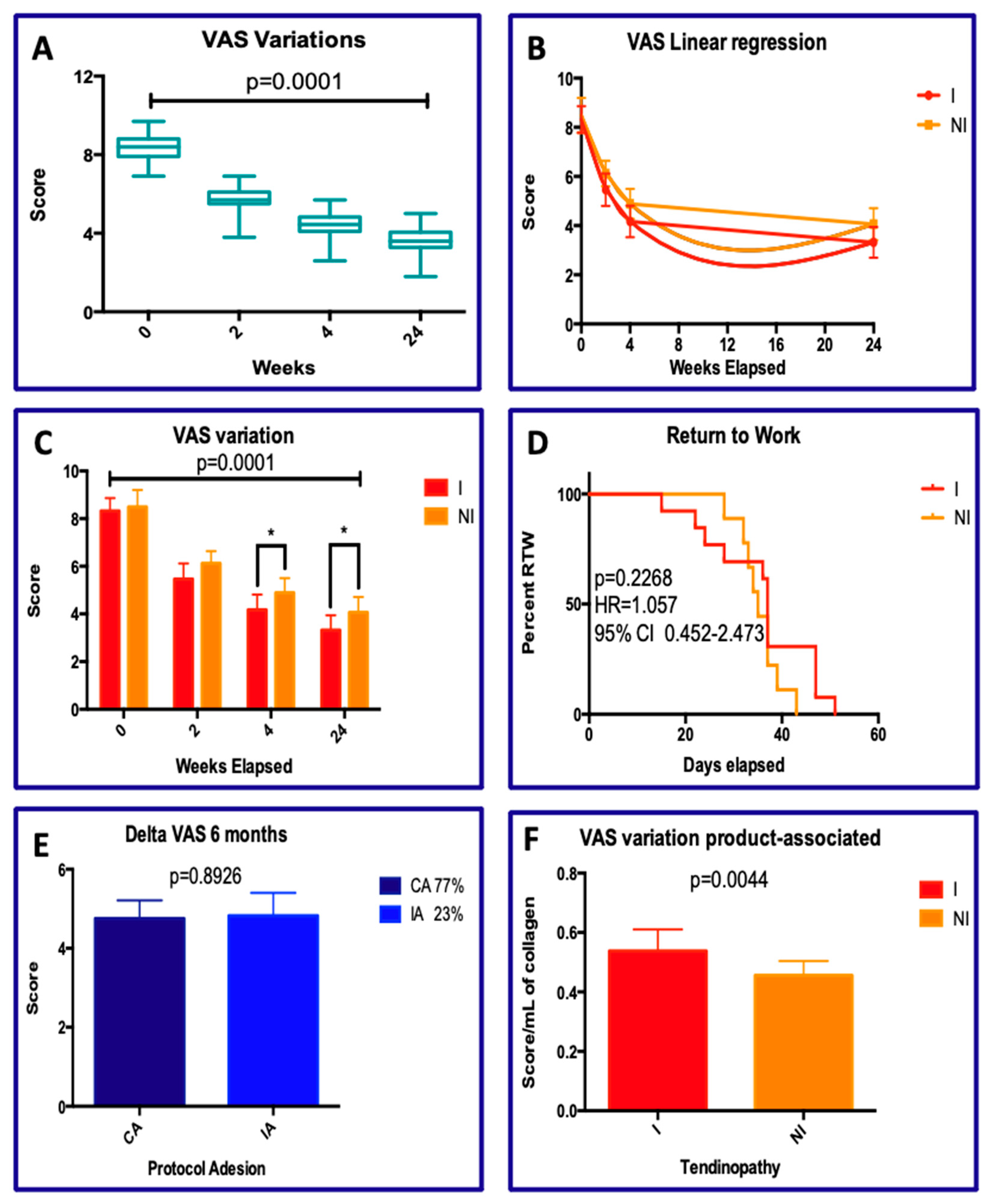
The positive changes in VAS (Figure 2) were observed as early as two weeks and increases up to the twenty-fourth week (Figure 2A; p < 0.0001). The pattern of VAS change follows a consistent hyperbolic trend, both for patients with TA-I and for those with TA-NI. The curves are parallel to each other, with a slight predominance in the TA-I patient group (Figure 2B). These differences remain consistent between the two curves throughout the treatment period and the differences at each step (2, 4, and 24 weeks) are statistically significant for both groups over time (Figure 2C; p < 0.0001).
This is in agreement with the treatment revealing similar clinical results between the two groups regarding the return-to-work interval (RTW; Figure 1D), where no statistically significant differences were observed between TA-I and TA-NI groups. The average differences (measured in days for RTW) were, respectively, 35 vs. 37 days (p = 0.2268; HR = 1.057). The protocol provided the administration of five doses of porcine collagen, each 2 ml (A total of 10 mL, MD-Tissue). The compliance with the protocol was complete in 77% of cases (complete adherence CA; 5 doses), while incomplete adherence (IA; 4 doses) was observed in 23% of cases. However, the change in VAS at six months was not statistically significant between the two groups (Figure 2E; p = ns). Even with four doses, the treatment’s efficacy was demonstrated. Finally, the improvement in VAS in terms of score points per ml of collagen applied was a little better in patients with TA-I vs. TA-NI (Figure 2F; p = 0.0044), although the average infiltrated volumes were identical (9.38 vs. 9.78).

3.3. VISA-A Results

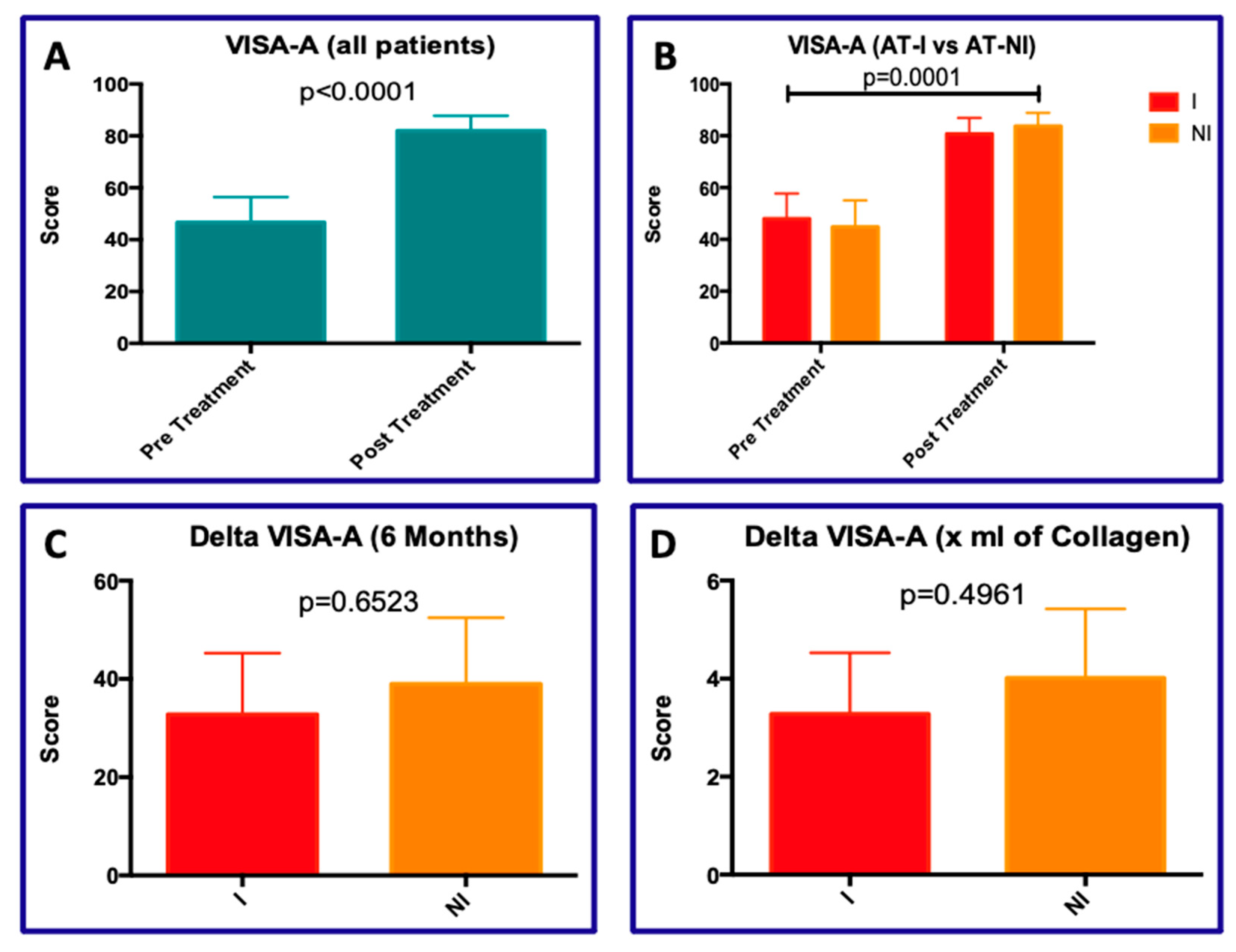
The statistical analysis concerning the VISA-A score (Figure 3) revealed a significant variation in mean values comparing pre- vs. post-treatment in all patients (45.50 vs. 82.70, p < 0.00001; Figure 3A). Indeed, ANOVA analysis looking for the VISA-A variation in TA-I vs. AT-NI pre- and post-treatment showed significant difference for the treatment (p < 0.0001; Figure 3B), while no statistically significant differences were observed between the two types of tendinopathies (p = 0.2222; Figure 3B). The delta VISA-A scores (at a 6-month follow-up) were equal to 32.78 vs. 38.97 for AT-I and AT-NI, respectively (p = 0.6523; Figure 3C). Numerical change of VISA-A per unit of collagen injected in the two types of ATs (I vs. NI) were 3.28 vs. 4.01, respectively (p = 0.4961; Figure 3D). Although in this last analysis the differences are not statistically significant, AT-NI patients seem to benefit more from collagen treatment.

3.4. Adverse Events (AEs)

Throughout the duration of this study, no adverse events associated with collagen administration were reported, among those included and reported in the Section 2.

4. Discussion

Achilles tendinopathy is associated with external mechanical factors such as prolonged or repetitive loading; however, systemic comorbidities may also contribute to tendon vulnerability by altering collagen composition and microstructure [7,50]. Intrinsic factors—including body mass index (BMI), diet, metabolic disorders, and foot morphology (e.g., cavus foot)—have been reported as risk factors for tendinopathies, including Achilles tendinopathy [6,51]. Diabetes, in particular, has been linked to tendinopathy through metabolic and structural mechanisms, including altered cellular metabolism, increased intracellular water content and edema, reduced tolerance to ischemic stress, and accumulation of advanced glycation end-products that increase collagen cross-linking and modify tissue architecture [6,33,51]. Tendon microstructural disorganization may also be influenced by dyslipidemia or hypercholesterolemia, potentially leading to lipid deposition and xanthoma formation [7]. In diabetic patients, Achilles tendinopathy may therefore represent a chronic condition with variable clinical course and long-term morbidity.
Initial management of Achilles tendinopathy is generally conservative, and many patients show satisfactory outcomes with non-operative approaches [6,7]. Physiotherapy and structured loading/kinesitherapy are typically considered first-line conservative strategies, while surgery is reserved for refractory cases [8,52,53]. Several local conservative treatments have also been investigated, including platelet-rich plasma [36,37], extracorporeal shockwave therapy [38,39,40], and collagen-based injections [41,42,48,49,54]. Although collagen formulations have been explored in other tendinopathies, their use in both insertional and non-insertional Achilles tendinopathy remains relatively limited.
In the present uncontrolled retrospective case series, collagen injections were associated with an improvement in pain and function over follow-up in diabetic patients affected by both insertional and non-insertional Achilles tendinopathy, as documented by VAS (Figure 2) and VISA-A (Figure 3). From a mechanistic standpoint, collagen supplementation may be biologically plausible in diabetic tendinopathy, given the altered collagen metabolism and structural changes induced by glycation [6,7,33,55]. Moreover, in vitro evidence suggests that collagen may modulate tenocyte regenerative and morpho-functional activities [56,57]. Nevertheless, due to the absence of a control group, the observed clinical improvements cannot be attributed exclusively to collagen treatment, and may partially reflect natural history, regression to the mean, or other non-specific effects.
The magnitude and temporal pattern of improvement observed in this cohort appear broadly consistent with prior reports of conservative approaches such as platelet-rich plasma [36] and extracorporeal shockwave therapy [40]. Collagen injections may therefore represent a feasible conservative option in selected diabetic patients, particularly in clinical contexts where corticosteroid injections are discouraged or contraindicated [6,28,29,58], despite isolated reports of steroid efficacy [59]. Other pharmacological approaches (e.g., antibiotics) are not recommended for tendinopathy management, even in non-diabetic patients [10,27,30,37,60,61].
Key observations from the present case series
Based on longitudinal outcomes, we observed the following clinically relevant patterns:
A reduction in pain (VAS) was already detectable at 2 weeks and continued to improve up to 24 weeks.
Improvements were observed in both insertional and non-insertional Achilles tendinopathy subgroups.
A small subset of patients received four injections instead of five. Although improvement was also noted in this subgroup, the sample size was limited and the study was not designed or powered to evaluate dose–response relationships. Therefore, no conclusion can be drawn regarding a minimum clinically effective dose, and this finding should be considered exploratory.
Patients with insertional Achilles tendinopathy showed a trend toward greater pain improvement; however, functional outcomes (VISA-A) did not differ significantly between subgroups.
Overall, this retrospective case series supports the feasibility and safety of infiltrative collagen treatment in diabetic patients with Achilles tendinopathy, with a signal of improvement in pain and function over follow-up. However, several limitations must be considered: (1) the small sample size reduces statistical power and limits subgroup comparisons; (2) outcomes were assessed up to six months, and longer follow-up would help determine durability of response; and (3) imaging-based evaluation of tendon remodeling was not systematically used to correlate clinical improvement with structural changes. Despite these limitations, high adherence to the protocol and consistent outcome tracking strengthen the descriptive value of these findings and support future prospective controlled investigations.

5. Conclusions

Porcine collagen injections were feasible and well-tolerated in patients with diabetes affected by Achilles tendinopathy. In this uncontrolled retrospective case series, patients showed a clinically relevant improvement over follow-up, including reduced pain and enhanced functional outcomes, both in insertional and non-insertional presentations. Although diabetes-related alterations in tendon collagen metabolism provide a biological rationale for supplementation with exogenous collagen, the present study design does not allow causal inference or assessment of comparative effectiveness, and the observed improvements may also reflect natural history, regression to the mean, and non-specific effects. Therefore, collagen injections (MD-Tissue) may represent a promising conservative option, particularly in settings where corticosteroids are discouraged or contraindicated. Prospective controlled multicenter studies are warranted to confirm these findings, define the optimal dosing schedule, and investigate factors associated with treatment response.

Author Contributions

Conceptualization, G.P. and V.S.; methodology, N.B. and M.A.M.; software, N.B.; validation, G.P., V.S. and M.A.M.; formal analysis, N.B.; investigation, M.A.M.; resources, V.S.; data curation, G.P. and N.B.; writing—original draft preparation, G.P. and N.B.; writing—review and editing, M.A.M. and V.S.; visualization, N.B.; supervision, G.P.; project administration, G.P.; funding acquisition, V.S. All authors have read and agreed to the published version of the manuscript.

Funding

This research received no external funding.

Institutional Review Board Statement

Ethical review and approval were waived for this study because it represents a retrospective analysis of anonymized clinical data collected during routine care, with no additional intervention or patient contact, in accordance with institutional and national regulations.

Informed Consent Statement

Patient consent for research participation was waived because this study was a retrospective analysis of routinely collected clinical data, fully anonymized prior to analysis, with no impact on patient care and no identifiable information included.

Data Availability Statement

The raw data from the study will be made available upon request from the corresponding author of this study: Giacomo Placella.

Conflicts of Interest

The authors declare no conflicts of interest.

Correction Statement

This article has been republished with a minor correction to resolve spelling and grammatical errors. This change does not affect the scientific content of the article.

References

  1. O’Brien, M. The Anatomy of the Achilles Tendon. Foot Ankle Clin. 2005, 10, 225–238. [Google Scholar] [CrossRef] [PubMed]
  2. Chimenti, R.L.; Cychosz, C.C.; Hall, M.M.; Phisitkul, P. Current Concepts Review Update: Insertional Achilles Tendinopathy. Foot Ankle Int. 2017, 38, 1160–1169. [Google Scholar] [CrossRef] [PubMed]
  3. Weinfeld, S.B. Achilles Tendon Disorders. Med. Clin. N. Am. 2014, 98, 331–338. [Google Scholar] [CrossRef]
  4. Ahmed, I.M.; Lagopoulos, M.; McConnell, P.; Soames, R.W.; Sefton, G.K. Blood Supply of the Achilles Tendon. J. Orthop. Res. 1998, 16, 591–596. [Google Scholar] [CrossRef]
  5. Leiß, F.; Spörrer, J.-F.; Grifka, J.; Schwarz, T. Achillessehnenpathologien. Orthopädie 2023, 52, 857–866. [Google Scholar] [CrossRef]
  6. Medina Pabón, M.A.; Naqvi, U. Achilles Tendinopathy. In StatPearls; StatPearls Publishing: Treasure Island, FL, USA, 2025. [Google Scholar]
  7. Tarantino, D.; Mottola, R.; Resta, G.; Gnasso, R.; Palermi, S.; Corrado, B.; Sirico, F.; Ruosi, C.; Aicale, R. Achilles Tendinopathy Pathogenesis and Management: A Narrative Review. Int. J. Environ. Res. Public Health 2023, 20, 6681. [Google Scholar] [CrossRef] [PubMed]
  8. Chen, P.; Tzeng, I.; Yang, K.; Wang, C. Endoscopic versus Open Surgery for Insertional Achilles Tendinopathy: A Systematic Review and Meta-Analysis of Comparative Outcomes. J. Exp. Orthop. 2025, 12, e70374. [Google Scholar] [CrossRef]
  9. Pearce, C.J.; Tan, A. Non-Insertional Achilles Tendinopathy. EFORT Open Rev. 2016, 1, 383–390. [Google Scholar] [CrossRef]
  10. Thermann, H.; Fischer, R.; Gougoulias, N.; Cipollaro, L.; Maffulli, N. Endoscopic Debridement for Non-Insertional Achilles Tendinopathy with and without Platelet-Rich Plasma. J. Sport Health Sci. 2023, 12, 275–280. [Google Scholar] [CrossRef]
  11. Yan, X.; Yue, J.; Zeng, X.; Xu, T.; Zhang, Y.; Wang, W.; Zhao, G.; Mi, J.; Rui, Y.; Liu, S.; et al. Minimum 24-Month Outcomes of Minimally Invasive Paratenon Protection Repair vs Open Giftbox Repair of Ruptured Achilles Tendon. Foot Ankle Int. 2025, 46, 200–209. [Google Scholar] [CrossRef]
  12. Micheroli, R.; Ricci, V.; Naňka, O.; Tamborrini, G. Paratenon Effusion of the Achilles Tendon: A Rare Finding. Reumatismo 2025, 77, 1845. [Google Scholar] [CrossRef] [PubMed]
  13. Lee, J.H.; Ku, K.; Kang, C.M.; D’Lima, D.D.; Baek, J.H. Safety of One-Stage Reconstruction of Achilles Tendon and Soft Tissue Defects Resulting from Infection After Achilles Tendon Repair Using Flexor Hallucis Longus Tendon Transfer and Reverse Sural Artery Flap. Handchir. Mikrochir. Plast. Chir. 2025, 5, a-2681-8656. [Google Scholar] [CrossRef] [PubMed]
  14. Buddecke, D. Acute Achilles Tendon Ruptures. Clin. Podiatr. Med. Surg. 2021, 38, 201–226. [Google Scholar] [CrossRef]
  15. Abate, M.; Salini, V. Mid-Portion Achilles Tendinopathy in Runners with Metabolic Disorders. Eur. J. Orthop. Surg. Traumatol. 2019, 29, 697–703. [Google Scholar] [CrossRef]
  16. Zhao, H.; Ren, Y.; Roth, E.J.; Harvey, R.L.; Zhang, L.-Q. Concurrent Deficits of Soleus and Gastrocnemius Muscle Fascicles and Achilles Tendon Post Stroke. J. Appl. Physiol. 2015, 118, 863–871. [Google Scholar] [CrossRef]
  17. Olewnik, Ł.; Wysiadecki, G.; Podgórski, M.; Polguj, M.; Topol, M. The Plantaris Muscle Tendon and Its Relationship with the Achilles Tendinopathy. BioMed Res. Int. 2018, 2018, 1–9. [Google Scholar] [CrossRef]
  18. Yang, X.; Coleman, D.P.; Pugh, N.D.; Nokes, L.D.M. The Volume of the Neovascularity and Its Clinical Implications in Achilles Tendinopathy. Ultrasound Med. Biol. 2012, 38, 1887–1895. [Google Scholar] [CrossRef]
  19. Slane, L.C.; Dandois, F.; Bogaerts, S.; Vandenneucker, H.; Scheys, L. Non-Uniformity in the Healthy Patellar Tendon Is Greater in Males and Similar in Different Age Groups. J. Biomech. 2018, 80, 16–22. [Google Scholar] [CrossRef]
  20. Federer, A.E.; Steele, J.R.; Dekker, T.J.; Liles, J.L.; Adams, S.B. Tendonitis and Tendinopathy. Foot Ankle Clin. 2017, 22, 665–676. [Google Scholar] [CrossRef] [PubMed]
  21. Moon, J.L.; Moon, K.M.; Carlisle, D.M. Obesity-Related Foot Pain. Clin. Podiatr. Med. Surg. 2019, 36, 141–151. [Google Scholar] [CrossRef]
  22. Abate, M.; Salini, V.; Schiavone, C. Achilles Tendinopathy in Elderly Subjects with Type II Diabetes: The Role of Sport Activities. Aging Clin. Exp. Res. 2016, 28, 355–358. [Google Scholar] [CrossRef] [PubMed]
  23. Afolabi, B.I.; Idowu, B.M.; Onigbinde, S.O. Achilles Tendon Degeneration on Ultrasound in Type 2 Diabetic Patients. J. Ultrason. 2020, 20, 291–299. [Google Scholar] [CrossRef]
  24. Huang, X.; Chen, X.; Chen, X.; Chi, P.; Wang, P.; Zhan, X.; Zou, C.; Wang, L.; Dong, Y. Sound Touch Elastography of Achilles Tendons in Patients with Type 2 Diabetes Mellitus versus Healthy Adults. Diabetol. Metab. Syndr. 2023, 15, 174. [Google Scholar] [CrossRef]
  25. Łazarz, D.P.; Jasińska, M.; Dubrowski, A.; Moskała, A.; Możdżeń, K.; Malinowski, K.; Zamojska, I.; Walocha, J.A.; Lis, G.J.; Pękala, P.A. Histological Study of the Achilles Tendon in Diabetic and Non-Diabetic Individuals: Comprehensive Comparison. Folia Morphol. 2025, 107641. [Google Scholar] [CrossRef]
  26. Lui, P.P.Y. Tendinopathy in Diabetes Mellitus Patients—Epidemiology, Pathogenesis, and Management. Scand. Med. Sci. Sports 2017, 27, 776–787. [Google Scholar] [CrossRef]
  27. Ileri, S. Levofloxacin-Induced Gastrocnemius Tendon Rupture: A Case Report. J. Med. Case Rep. 2025, 19, 228. [Google Scholar] [CrossRef] [PubMed]
  28. Bolon, B. Mini-Review: Toxic Tendinopathy. Toxicol. Pathol 2017, 45, 834–837. [Google Scholar] [CrossRef]
  29. Alušík, Š.; Paluch, Z. Drug induced tendon injury. Vnitr. Lek. 2018, 63, 967–971. [Google Scholar] [CrossRef] [PubMed]
  30. Godoy-Santos, A.L.; Bruschini, H.; Cury, J.; Srougi, M.; De Cesar-Netto, C.; Fonseca, L.F.; Maffulli, N. Fluoroquinolones and the Risk of Achilles Tendon Disorders: Update on a Neglected Complication. Urology 2018, 113, 20–25. [Google Scholar] [CrossRef]
  31. Almekinders, L.C.; Engle, C.R. Common and Uncommon Injuries in Ultra-Endurance Sports. Sports Med. Arthrosc. Rev. 2019, 27, 25–30. [Google Scholar] [CrossRef]
  32. Pirozzi, K.M. Histophysiology of Fibrocartilage. Clin. Podiatr. Med. Surg. 2022, 39, 363–370. [Google Scholar] [CrossRef] [PubMed]
  33. Zellers, J.A.; Eekhoff, J.D.; Walk, R.E.; Hastings, M.K.; Tang, S.Y.; Lake, S.P. Human Achilles Tendon Mechanical Behavior Is More Strongly Related to Collagen Disorganization than Advanced Glycation End-Products Content. Sci. Rep. 2021, 11, 24147. [Google Scholar] [CrossRef]
  34. Giai Via, A.; Oliva, F.; Padulo, J.; Oliva, G.; Maffulli, N. Insertional Calcific Tendinopathy of the Achilles Tendon and Dysmetabolic Diseases: An Epidemiological Survey. Clin. J. Sport Med. 2022, 32, e68–e73. [Google Scholar] [CrossRef] [PubMed]
  35. Karapınar, M.; Smitheman, H.P.; Cone, S.G.; Silbernagel, K.G. Effects of an Exercise Program on Calf Muscle Characteristics in Patients with Achilles Tendinopathy. Phys. Ther. Sport 2025, 76, 127–133. [Google Scholar] [CrossRef]
  36. Abate, M.; Paganelli, R.; Pellegrino, R.; Di Iorio, A.; Salini, V. Platelet Rich Plasma Therapy in Achilles and Patellar Tendinopathies: Outcomes in Subjects with Diabetes (A Retrospective Case-Control Study). J. Clin. Med. 2024, 13, 5443. [Google Scholar] [CrossRef]
  37. Pallikkara Kuttyadan, N.; Samad, S.; Shahzad, M.; Sanaullah, K.; Gillani, S.H.M.; Mushtaq, H.; Butt, S.B.; Hayat, S.K.; Raif, M.; Ali, S.M.; et al. Effectiveness of Platelet-Rich Plasma Injection for Chronic Achilles Tendinopathy: An Umbrella Systematic Review. Cureus 2025, 17, 92652. [Google Scholar] [CrossRef]
  38. Charles, R.; Fang, L.; Zhu, R.; Wang, J. The Effectiveness of Shockwave Therapy on Patellar Tendinopathy, Achilles Tendinopathy, and Plantar Fasciitis: A Systematic Review and Meta-Analysis. Front. Immunol. 2023, 14, 1193835. [Google Scholar] [CrossRef] [PubMed]
  39. Saxena, A.; Bondi, E.; Gerdesmeyer, L.; Tenforde, A.S. Extracorporeal Shock Wave Therapy (ESWT) and Radial Pressure Waves (RPW) May Improve Post-Operative Recovery Following Insertional Achilles Tendon Surgeries: A Case-Control Pilot Study. J. Orthop. Surg. Res. 2025, 20, 751. [Google Scholar] [CrossRef]
  40. Stania, M.; Juras, G.; Chmielewska, D.; Polak, A.; Kucio, C.; Król, P. Extracorporeal Shock Wave Therapy for Achilles Tendinopathy. BioMed Res. Int. 2019, 2019, 3086910. [Google Scholar] [CrossRef]
  41. De Lucia, O.; Giarda, F.; Bernetti, A.; Ceccarelli, C.; Mauro, G.L.; Gervasoni, F.; Berti, L.; Robecchi Majnardi, A. Injectable Porcine Collagen in Musculoskeletal Disorders: A Delphi Consensus. J. Clin. Med. 2025, 14, 6058. [Google Scholar] [CrossRef]
  42. Randelli, F.; Fioruzzi, A.; Mazzoleni, M.G.; Radaelli, A.; Rahali, L.; Verga, L.; Menon, A. Efficacy of Ultrasound-Guided Injections of Type I Collagen-Based Medical Device for Greater Trochanteric Pain Syndrome: A Pilot Study. Life 2025, 15, 366. [Google Scholar] [CrossRef]
  43. Koszela, K.; Woldańska-Okońska, M.; Słupiński, M.; Gasik, R. The Role of Injection Collagen Therapy in Greater Trochanter Pain Syndrome. A New Therapeutic Approach? Reumatologia 2025, 63, 131. [Google Scholar] [CrossRef]
  44. Tarantino, D.; Mottola, R.; Palermi, S.; Sirico, F.; Corrado, B.; Gnasso, R. Intra-Articular Collagen Injections for Osteoarthritis: A Narrative Review. Int. J. Environ. Res. Public Health 2023, 20, 4390. [Google Scholar] [CrossRef] [PubMed]
  45. Borja-Flores, A.; Macías-Hernández, S.I.; Hernández-Molina, G.; Perez-Ortiz, A.; Reyes-Martínez, E.; Belzazar-Castillo De La Torre, J.; Ávila-Jiménez, L.; Vázquez-Bello, M.C.; León-Mazón, M.A.; Furuzawa-Carballeda, J.; et al. Long-Term Effectiveness of Polymerized-Type I Collagen Intra-Articular Injections in Patients with Symptomatic Knee Osteoarthritis: Clinical and Radiographic Evaluation in a Cohort Study. Adv. Orthop. 2020, 2020, 9398274. [Google Scholar] [CrossRef]
  46. Lee, H.S.; Oh, K.J.; Moon, Y.W.; In, Y.; Lee, H.J.; Kwon, S.Y. Intra-Articular Injection of Type I Atelocollagen to Alleviate Knee Pain: A Double-Blind, Randomized Controlled Trial. Cartilage 2021, 13, 342S–350S. [Google Scholar] [CrossRef] [PubMed]
  47. Aicale, R.; Savarese, E.; Mottola, R.; Corrado, B.; Sirico, F.; Pellegrino, R.; Donati, D.; Tedeschi, R.; Ruosi, L.; Tarantino, D. Collagen Injections for Rotator Cuff Diseases: A Systematic Review. Clin. Pract. 2025, 15, 28. [Google Scholar] [CrossRef] [PubMed]
  48. Corrado, B.; Bonini, I.; Chirico, V.A.; Filippini, E.; Liguori, L.; Magliulo, G.; Mazzuoccolo, G.; Rosano, N.; Gisonni, P. Ultrasound-Guided Collagen Injections in the Treatment of Supraspinatus Tendinopathy: A Case Series Pilot Study. J. Biol. Regul. Homeost. Agents 2020, 34, 33–39. [Google Scholar]
  49. Corrado, B.; Bonini, I.; Alessio Chirico, V.; Rosano, N.; Gisonni, P. Use of Injectable Collagen in Partial-Thickness Tears of the Supraspinatus Tendon: A Case Report. Oxf. Med. Case Rep. 2020, 2020, omaa103. [Google Scholar] [CrossRef]
  50. Uhthoff, H.K. Calcifying Tendinitis, an Active Cell-Mediated Calcification. Virchows Arch. A Pathol. Anat. Histol. 1975, 366, 51–58. [Google Scholar] [CrossRef]
  51. De Luca, P.; Grieco, G.; Bargeri, S.; Colombo, C.; Guida, S.; Taiana, M.M.; De Girolamo, L. The Interplay between Metabolic Disorders and Tendinopathies: Systematic Review and Meta-analysis. J. Exp. Orthop. 2025, 12, e70429. [Google Scholar] [CrossRef]
  52. Kipp, J.A.; Blazek, C.D. Current Concepts in the Nonoperative Management of Achilles Tendon Pathologies: A Scoping Review. J. Clin. Med. 2025, 14, 4736. [Google Scholar] [CrossRef]
  53. Lee, W.; Jagasia, A. Comparison of Early Postoperative Outcomes and Reimbursement Metrics in Obese Versus Nonobese Patients Undergoing Secondary Reconstruction for Achilles Tendinopathy. J. Am. Acad. Orthop. Surg. 2025. online ahead of print. [Google Scholar] [CrossRef]
  54. Corrado, B.; Mazzuoccolo, G.; Liguori, L.; Chirico, V.A.; Costanzo, M.; Bonini, I.; Bove, G.; Curci, L. Treatment of Lateral Epicondylitis with Collagen Injections: A Pilot Study. Muscle Ligaments Tendons J. 2019, 9, 584. [Google Scholar] [CrossRef]
  55. Connizzo, B.K.; Bhatt, P.R.; Liechty, K.W.; Soslowsky, L.J. Diabetes Alters Mechanical Properties and Collagen Fiber Re-Alignment in Multiple Mouse Tendons. Ann. Biomed. Eng. 2014, 42, 1880–1888. [Google Scholar] [CrossRef]
  56. Randelli, F.; Sartori, P.; Carlomagno, C.; Bedoni, M.; Menon, A.; Vezzoli, E.; Sommariva, M.; Gagliano, N. The Collagen-Based Medical Device MD-Tissue Acts as a Mechanical Scaffold Influencing Morpho-Functional Properties of Cultured Human Tenocytes. Cells 2020, 9, 2641. [Google Scholar] [CrossRef]
  57. Randelli, F.; Menon, A.; Giai Via, A.; Mazzoleni, M.; Sciancalepore, F.; Brioschi, M.; Gagliano, N. Effect of a Collagen-Based Compound on Morpho-Functional Properties of Cultured Human Tenocytes. Cells 2018, 7, 246. [Google Scholar] [CrossRef] [PubMed]
  58. Barboni, B.; Russo, V.; Gatta, V.; Bernabò, N.; Berardinelli, P.; Mauro, A.; Martelli, A.; Valbonetti, L.; Muttini, A.; Di Giacinto, O.; et al. Therapeutic Potential of hAECs for Early Achilles Tendon Defect Repair Through Regeneration. J. Tissue Eng. Regen. Med. 2018, 12, e1594–e1608. [Google Scholar] [CrossRef]
  59. Huang, J.; Chen, Q. Bilateral Achilles Tendinopathy of Unknown Origin Responsive to Corticosteroids: Case Report. Medicine 2025, 104, e45436. [Google Scholar] [CrossRef] [PubMed]
  60. Caravaggio, F.; Depalmi, F.; Antonelli, M. Treatment of Achilles Tendon Partial Injuries with Injection of Peripheral Blood Mononuclear Cells (PB-MNCs): A Case Series. Eur. J. Transl. Myol. 2022, 32, 10768. [Google Scholar] [CrossRef]
  61. Gervasi, M.; Barbieri, E.; Capparucci, I.; Annibalini, G.; Sisti, D.; Amatori, S.; Carrabs, V.; Valli, G.; Donati Zeppa, S.; Rocchi, M.B.L.; et al. Treatment of Achilles Tendinopathy in Recreational Runners with Peritendinous Hyaluronic Acid Injections: A Viscoelastometric, Functional, and Biochemical Pilot Study. J. Clin. Med. 2021, 10, 1397. [Google Scholar] [CrossRef]
Figure 1. Demographic and clinical data. No statistical different distributions were observed according to the following sets: (A) gender; (B) age; (C) HbA1c; (D) BMI; (E) type of tendinopathy—insertional (I) and non-insertional (NI); (F) symptom duration (months).
Jcm 15 01381 g001
Figure 2. VAS analyses. (A) Mean VAS values including all patients during the time; (B) VAS linear regression according to the type of AT—insertional (I) and non-insertional (NI); (C) ANOVA test concerning the VAS variation in AT-I and AT-NI groups; (D) log-rank test for the RTW time calculation; (E) delta VAS according to the compliance of protocol; (F) delta VAS variation associated for mL of collagen injected. The asterisk symbol “*”, indicates statistical significance (p < 0.05) between the signed groups.
Jcm 15 01381 g002
Figure 3. VISA-A analyses. (A) VISA_A mean scores in all AT patients pre- and post-treatment; (B) VISA-A variation in the AT-I and AT-NI; (C) delta VISA-A variation after six months; (D) delta VISA-A variation for ml of collagen administered.
Jcm 15 01381 g003
Disclaimer/Publisher’s Note: The statements, opinions and data contained in all publications are solely those of the individual author(s) and contributor(s) and not of MDPI and/or the editor(s). MDPI and/or the editor(s) disclaim responsibility for any injury to people or property resulting from any ideas, methods, instructions or products referred to in the content.