The Role of Ultrasound in the Diagnosis and Treatment of Cellulite: A Systematic Review


Abstract
1. Introduction
2. Materials and Methods
2.1. Inclusion and Exclusion Criteria
2.2. Information Sources
2.3. Search Strategy
2.4. Selection Process
2.5. Data Collection Process
2.6. Outcomes and Additional Data
2.7. Risk of Bias Assessment
2.8. Synthesis Methods
3. Results
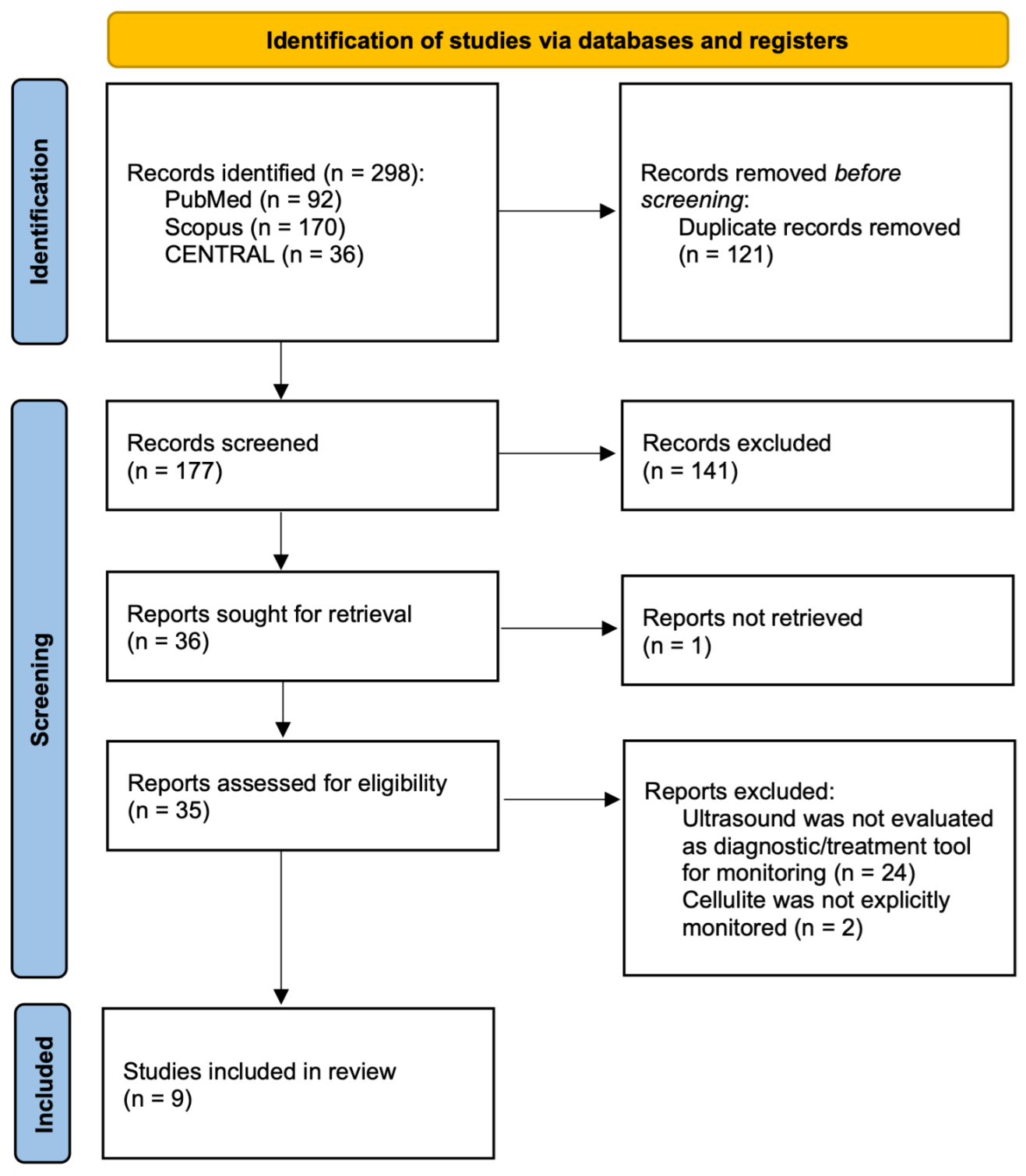
3.1. Study Selection
3.2. Study Characteristics
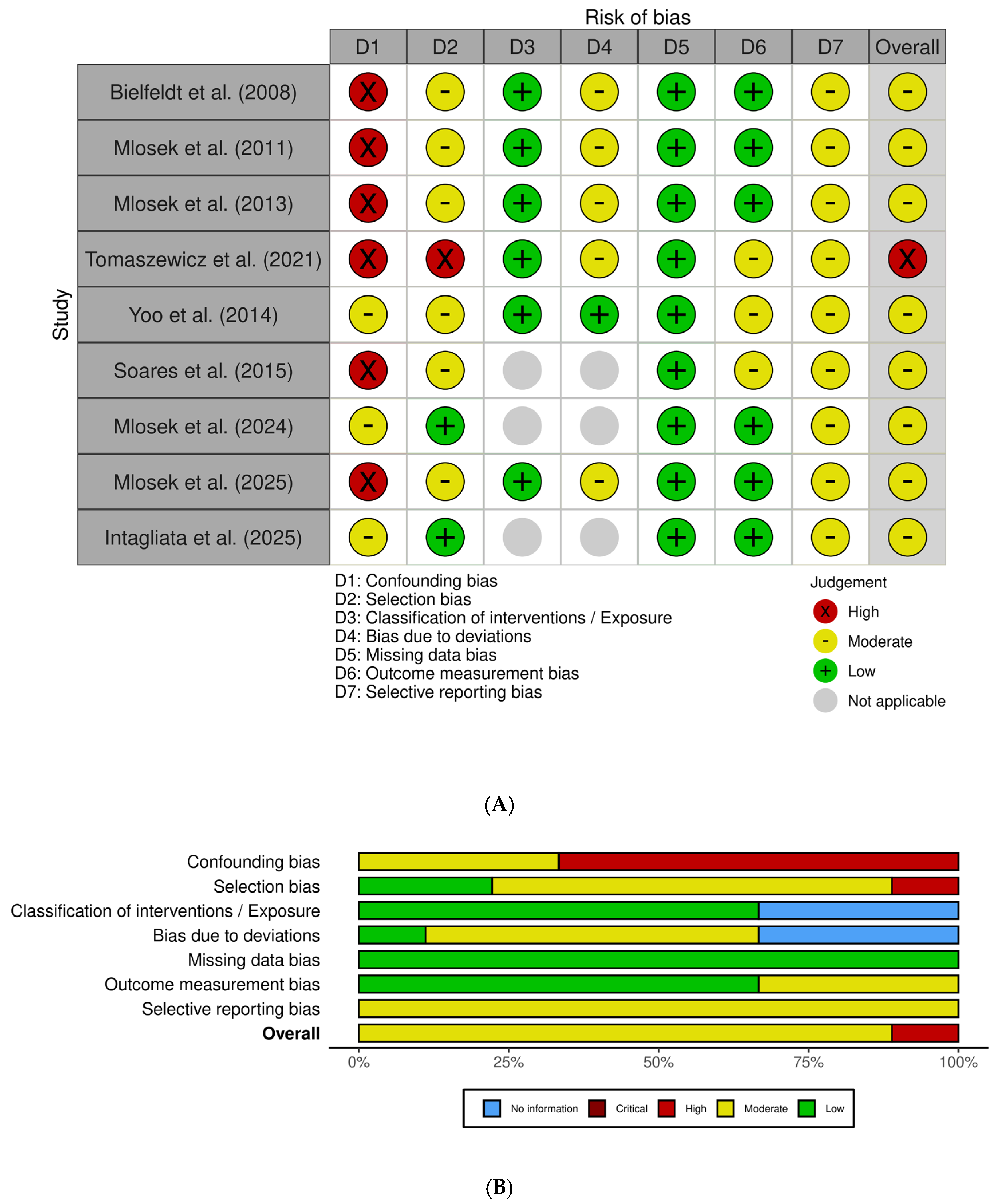
3.3. Risk of Bias
3.4. Results of Individual Studies
3.4.1. Diagnostic Applications of Ultrasound
3.4.2. Ultrasound for Treatment Monitoring
3.5. Results of Syntheses
4. Discussion
5. Conclusions
Supplementary Materials
Author Contributions
Funding
Institutional Review Board Statement
Informed Consent Statement
Data Availability Statement
Conflicts of Interest
Abbreviations
| AI | Artificial Intelligence |
| BMI | Body Mass Index |
| CENTRAL | Cochrane Central Register of Controlled Trials |
| HFUS | High-Frequency Ultrasound |
| MRI | Magnetic Resonance Imaging |
| NOS | Newcastle-Ottawa Scale |
| PRISMA | Preferred Reporting Items for Systematic Reviews and Meta-Analyses |
| PROSPERO | International Prospective Register of Systematic Reviews |
| ROBINS-I | Risk Of Bias In Non-randomized Studies of Interventions |
| US | Ultrasound |
References
- Ferzli, G.; Sadick, N.S. A Review of Current Modalities to Treat Cellulite Effectively. Dermatol. Rev. 2020, 1, 123–127. [Google Scholar] [CrossRef]
- Emanuele, E.; Minoretti, P.; Altabas, V.; Gaeta, E. Adiponectin Expression in Subcutaneous Adipose Tissue Is Reduced in Women With Cellulite. Int. J. Dermatol. 2011, 50, 412–416. [Google Scholar] [CrossRef]
- Whipple, L.A.; Fournier, C.; Heiman, A.J.; Awad, A.N.; Roth, M.Z.; Cotofana, S.; Ricci, J.A. The Anatomical Basis of Cellulite Dimple Formation: An Ultrasound-Based Examination. Plast. Reconstr. Surg. 2021, 148, 375e–381e. [Google Scholar] [CrossRef]
- Almeida, M.d.l.C.; Suárez-Serrano, C.; Roldán, J.R.; Jiménez-Rejano, J.J. Cellulite’s Aetiology: A Review. J. Eur. Acad. Dermatol. Venereol. 2012, 27, 273–278. [Google Scholar] [CrossRef]
- Green, J.B.; Cohen, J.L.; Kaufman, J.; Metelitsa, A.I.; Kaminer, M.S. Therapeutic Approaches to Cellulite. Semin. Cutan. Med. Surg. 2015, 34, 140–143. [Google Scholar] [CrossRef]
- Sadick, N.S. Treatment for Cellulite. Int. J. Women’s Dermatol. 2019, 5, 68–72. [Google Scholar] [CrossRef]
- Davis, D.S.; Boen, M.; Fabi, S.G. Cellulite: Patient Selection and Combination Treatments for Optimal Results—A Review and Our Experience. Dermatol. Surg. 2019, 45, 1171–1184. [Google Scholar] [CrossRef]
- Kruglikov, I.L.; Scherer, P.E. Pathophysiology of Cellulite: Possible Involvement of Selective Endotoxemia. Obes. Rev. 2022, 24, e13517. [Google Scholar] [CrossRef]
- Scarano, A.; Petrini, M.; Sbarbati, A.; Amore, R.; Iorio, E.L.; Marchetti, M.; Amuso, D. Pilot Study of Histology Aspect of Cellulite in Seventy Patients Who Differ in BMI and Cellulite Grading. J. Cosmet. Dermatol. 2021, 20, 4024–4031. [Google Scholar] [CrossRef]
- Zerini, I.; Sisti, A.; Cuomo, R.; Ciappi, S.; Russo, F.; Brandi, C.; D’Aniello, C.; Nisi, G. Cellulite Treatment: A Comprehensive Literature Review. J. Cosmet. Dermatol. 2015, 14, 224–240. [Google Scholar] [CrossRef]
- Bass, L.S.; Kaminer, M.S. Insights Into the Pathophysiology of Cellulite: A Review. Dermatol. Surg. 2020, 46, S77–S85. [Google Scholar] [CrossRef]
- Ponto, T.; Benson, H.A.E.; Wright, A. Reliability of a Standardized Tool for Evaluating Severity of Cellulite in the Female Posterior Thigh. J. Cosmet. Dermatol. 2022, 22, 890–896. [Google Scholar] [CrossRef]
- Soares, J.L.; Miot, H.A.; Sanudo, A.; Bagatin, E. Cellulite: Poor correlation between instrumental methods and photograph evaluation for severity classification. Int. J. Cosmet. Sci. 2015, 37, 134–140. [Google Scholar] [CrossRef]
- LaTowsky, B.; Jacob, C.; Hibler, B.P.; Lorenc, P.; Petraki, C.; Palm, M.D. Cellulite: Current Treatments, New Technology, and Clinical Management. Dermatol. Surg. 2023, 49, S8–S14. [Google Scholar] [CrossRef]
- Mlosek, K.; Malinowska, S. High-Frequency Ultrasound in the Assessment of Cellulite—Correlation Between Ultrasound-Derived Measurements, Clinical Assessment, and Nürnberger–Müller Scale Scores. Diagnostics 2024, 14, 1878. [Google Scholar] [CrossRef] [PubMed]
- Rao, J.; Gold, M.H.; Goldman, M.P. A Two-center, Double-blinded, Randomized Trial Testing the Tolerability and Efficacy of a Novel Therapeutic Agent for Cellulite Reduction. J. Cosmet. Dermatol. 2005, 4, 93–102. [Google Scholar] [CrossRef]
- Intagliata, D.; Priolo, M.; Molinari, P. High-Frequency Ultrasound Imaging for Stage III Cellulite: A Three-Subtype Structural Classification from an Observational Cohort Study. Dermatol. Ther. 2025, 15, 2865–2878. [Google Scholar] [CrossRef]
- Mlosek, R.K.; Malinowska, S.; Dębowska, R.; Lewandowski, M.; Nowicki, A. The High Frequency (HF) Ultrasound as a Useful Imaging Technique for the Efficacy Assessment of Different Anti-Cellulite Treatments. J. Cosmet. Dermatol. Sci. Appl. 2013, 3, 90–98. [Google Scholar] [CrossRef]
- Goldberg, D.J.; Fazeli, A.; Berlin, A.L. Clinical, Laboratory, and MRI Analysis of Cellulite Treatment With a Unipolar Radiofrequency Device. Dermatol. Surg. 2007, 34, 204–209. [Google Scholar] [CrossRef]
- Guardo, A.D.; Solito, C.; Cantisani, V.; Rega, F.; Gargano, L.; Rossi, G.; Musolff, N.; Azzella, G.; Paolino, G.; Losco, L.; et al. Clinical and Ultrasound Efficacy of Topical Hypertonic Cream (Jovita Osmocell®) in the Treatment of Cellulite: A Prospective, Monocentric, Double-Blind, Placebo-Controlled Study. Medicina 2024, 60, 781. [Google Scholar] [CrossRef] [PubMed]
- Sun, C.; Hu, X.; Li-qing, H. Intestinal Obstruction Due to Congenital Bands From Vitelline Remnants. J. Ultrasound Med. 2012, 31, 2035–2038. [Google Scholar] [CrossRef] [PubMed]
- Rostom, E.H.; Salama, A. Vodder Manual Lymphatic Drainage Technique Versus Casley-Smith Manual Lymphatic Drainage Technique for Cellulite After Thigh Liposuction. Adv. Dermatol. Allergol. 2022, 39, 362–367. [Google Scholar] [CrossRef]
- Troia, S.; Moreira, A.M.; Pisco, D.; Noites, A.; Vale, A.L.; Carvalho, P.; Vilarinho, R. Effect of Shock Wave Therapy Associated With Aerobic Exercise on Cellulite: A Randomized Controlled Trial. J. Cosmet. Dermatol. 2020, 20, 1732–1742. [Google Scholar] [CrossRef]
- Page, M.J.; McKenzie, J.E.; Bossuyt, P.M.; Boutron, I.; Hoffmann, T.C.; Mulrow, C.D.; Shamseer, L.; Tetzlaff, J.M.; Akl, E.A.; Brennan, S.E.; et al. The PRISMA 2020 statement: An updated guideline for reporting systematic reviews. BMJ 2021, 372, n71. [Google Scholar] [CrossRef]
- Bielfeldt, S.; Buttgereit, P.; Brandt, M.; Springmann, G.; Wilhelm, K.P. Non-invasive evaluation techniques to quantify the efficacy of cosmetic anti-cellulite products. Ski. Res. Technol. 2008, 14, 336–346. [Google Scholar] [CrossRef]
- Mlosek, R.K.; Debowska, R.M.; Lewandowski, M.; Malinowska, S.; Nowicki, A.; Eris, I. Imaging of the skin and subcutaneous tissue using classical and high-frequency ultrasonographies in anti-cellulite therapy. Ski. Res. Technol. 2011, 17, 461–468. [Google Scholar] [CrossRef]
- Yoo, M.A.; Seo, Y.K.; Ryu, J.H.; Back, J.H.; Koh, J.S. A validation study to find highly correlated parameters with visual assessment for clinical evaluation of cosmetic anti-cellulite products. Ski. Res. Technol. 2014, 20, 200–207. [Google Scholar] [CrossRef]
- Tomaszewicz, V.; Bach, A.M.; Tafil-Klawe, M.; Klawe, J.J. Non-invasive evaluation techniques to efficacy of anti-cellulite treatment: The high frequency (HF) ultrasound as a useful imaging technique of the skin and subcutaneous tissue. J. Cosmet. Laser Ther. 2021, 23, 72–80. [Google Scholar] [CrossRef]
- Mlosek, R.K.; Malinowska, S.P. Using High Frequency Ultrasound to Assess the Efficacy of Anti-Cellulite Treatments. Clin. Cosmet. Investig. Dermatol. 2025, 18, 2869–2885. [Google Scholar] [CrossRef] [PubMed]
- Chervinskaya, I.; Kuprina, N.I.; Kruglikov, I. A Retrospective Pragmatic Longitudinal Case-Series Clinical Study to Evaluate the Clinical Outcome of Triple-Frequency Ultrasound in Treatment of Cellulite. Clin. Cosmet. Investig. Dermatol. 2024, 17, 2779–2794. [Google Scholar] [CrossRef] [PubMed]
- Levy, J.; Barrett, D.L.; Harris, N.; Jeong, J.J.; Yang, X.; Chen, S.C. High-frequency ultrasound in clinical dermatology: A review. Ultrasound J. 2021, 13, 24. [Google Scholar] [CrossRef]
- Vergilio, M.M.; Monteiro e Silva, S.A.; Jales, R.M.; Leonardi, G.R. High-frequency ultrasound as a scientific tool for skin imaging analysis. Exp. Dermatol. 2021, 30, 897–910. [Google Scholar] [CrossRef]
- Amore, R.; Amuso, D.; Leonardi, V.; Sbarbati, A.; Conti, G.; Albini, M.; Leva, F.D.; Terranova, F.; Guida, A.; Gkritzalas, K.; et al. Treatment of Dimpling From Cellulite. Plast. Reconstr. Surg. Glob. Open 2018, 6, e1771. [Google Scholar] [CrossRef]
- Hexsel, D.; Abreu, M.R.D.; Rodrigues, T.d.C.; Soirefmann, M.; Prado, D.Z.D.; Gamboa, M.M.L. Side-by-Side Comparison of Areas With and Without Cellulite Depressions Using Magnetic Resonance Imaging. Dermatol. Surg. 2009, 35, 1471–1477. [Google Scholar] [CrossRef] [PubMed]
- Nobile, V.; Cestone, E.; Puoci, F.; Ponti, I.D.; Pisati, M.; Michelotti, A. In Vitro and in Vivo Study on Humans of Natural Compound Synergy as a Multifunctional Approach to Cellulite-Derived Skin Imperfections. Cosmetics 2020, 7, 48. [Google Scholar] [CrossRef]
- Perciun, R.-E.; Telcian, A. A Diabetic Woman With Soft Tissue Complex Pathology. Int. J. Case Rep. Images 2016, 7, 65. [Google Scholar] [CrossRef]
- Cisoń, H.; Jankowska-Konsur, A.; Białynicki-Birula, R. The Evaluation of Skin Infiltration in Mycosis Fungoides/Sézary Syndrome Using the High-Frequency Ultrasonography. J. Clin. Med. 2025, 14, 7143. [Google Scholar] [CrossRef]



| Author | Country | Study Design | Main Aim | Follow-Up | Sample Size | Anatomical Site | Cellulite Severity |
|---|---|---|---|---|---|---|---|
| Bielfeldt et al. (2008) [25] | Germany | Two cosmetic intervention studies with methodological ultrasound analysis | To standardize non-invasive methods (macrophotography, HF ultrasound) for evaluating efficacy of anti-cellulite products | Study 1: 3 months; Study 2: 4 weeks | Study 1: 36; Study 2: 34 | Posterior and lateral thigh | Light to moderate (visual 0–9 scale) |
| Mlosek et al. (2011) [26] | Poland | Prospective study with treatment vs. placebo groups | To demonstrate applications of classic and high-frequency ultrasonographies in monitoring anti-cellulite therapies | 30 days | 61 (45 treatment, 16 placebo) | Thighs and buttocks | Cellulite diagnosed clinically; grade not detailed |
| Mlosek et al. (2013) [18] | Poland | Prospective interventional study with multiple treatment groups and placebo | To assess usefulness of high-frequency ultrasound for monitoring anti-cellulite treatments | 30 days (baseline and post-treatment) | 84 (66 treatment, 18 placebo) | Posterior thigh | Mean Nürnberger–Müller score 2.89 in treatment group |
| Yoo et al. (2014) [27] | South Korea | Validation study with two tests (cross-sectional + interventional) | To identify objective parameters highly correlated with visual assessment for evaluating cosmetic anti-cellulite products | 6 weeks for Test 2 (measurements at baseline, 2, 4 and 6 weeks) | 52 total (Test 1: 20; Test 2: 32, with 28 completing product evaluation) | Thighs (regions with cellulite) | DERMAPRO photonumeric scale grades 1–9 (mild to moderate) |
| Soares et al. (2015) [13] | Brazil | Cross-sectional diagnostic correlation study | To correlate non-invasive instrumental measures with standardized photographic cellulite severity evaluation | Single visit | 26 | Buttocks | Grades I–III (Nürnberger–Müller) and photonumeric scale (mild, moderate, severe) |
| Tomaszewicz et al. (2021) [28] | Poland | Prospective interventional study, pre–post anti-cellulite treatment | To evaluate effectiveness of classic and high-frequency ultrasound in monitoring anti-cellulite therapy | 1 month | 144 | Thigh (widest point) | Grades I–III by Nürnberger–Müller scale (subgroups by severity) |
| Mlosek and Malinowska (2024) [15] | Poland | Cross-sectional observational correlation study | To determine whether high-frequency ultrasound can aid cellulite assessment and correlate with clinical scores | None (retrospective analysis of single assessment) | 114 | Posterior thighs | Grades I–III by Nürnberger–Müller scale |
| Mlosek and Malinowska (2025) [29] | Poland | Prospective comparative effectiveness study with three treatment groups | To assess usefulness of high-frequency ultrasound in evaluating efficacy of three different anti-cellulite treatments | Measurements 14–18 days after completion of therapy series | 84 (Group 1: 24; Group 2: 29; Group 3: 31) | Posterior thighs | Grades I–III by Nürnberger–Müller scale at baseline |
| Intagliata et al. (2025) [17] | Italy | Observational cohort study | To develop and validate an ultrasound-based subclassification of stage III cellulite | None | 150 | Subgluteal and trochanteric (lateral thigh) regions | Stage III (clinical) classified into ultrasound phenotypes 3A, 3B, Mixed |
| Study | Ultrasound Method | Frequency/Device | Main Ultrasound Parameters | Key Quantitative Findings | Comparators/Correlations |
|---|---|---|---|---|---|
| Bielfeldt et al. (2008) [25] | HFUS + 3D ultrasound | 20 MHz; 22 MHz (DUB plus D4W) | Dermis–subcutis roughness (Ram), adipose protrusion depth, borderline length | Ram correlated with cellulite severity (r = 0.64, R2 ≈ 0.41) | Moderate correlation with Smalls 0–9 scale; HFUS captured structural irregularities matching clinical grading |
| Yoo et al. (2014) [27] | B-mode ultrasound | Not specified | Subcutaneous thickness, dermo-subcutaneous interface length, dermal thickness | Baseline correlations: thickness vs. clinical score r = 0.502; interface length vs. severity r = 0.355; post-treatment correlations: r = 0.31 and r = 0.275 | Moderate correlation with photonumeric visual scale; intra-subject active vs. placebo comparison |
| Soares et al. (2015) [13] | HFUS | 20 MHz (DermaScan C) | Dermal thickness, dermal density, interface length, fat herniation | Positive relation between interface length and cellulite severity; dermal density decreased with higher severity | Modest correlation with clinical grading (N–M I–III); strong inter-rater agreement for photographic grading |
| Mlosek and Malinowska (2024) [15] | HFUS + elastography | 18 MHz (Philips Epiq 5); 20–100 MHz (DermaMed) | Subcutaneous thickness, fat protrusion area, epidermis/dermis thickness, elastographic strain ratio | Correlations with severity: subcutaneous thickness r = 0.63; fat protrusions r = 0.64; strain ratio r = 0.51; thigh circumference vs. hypodermis r = 0.48 | Among strongest HFUS–clinical correlations reported; good diagnostic consistency |
| Intagliata et al. (2025) [17] | HFUS + Doppler | 20 MHz (Clarius L20 HD3) | Superficial/deep fat thickness, septa density/thickness, edema, vascularity | Diagnostic agreement: 79.2%; Gwet’s AC1 = 0.444; κ = 0.286; α = 0.203; threshold of ~7 mm superficial fat differentiated 3A vs. 3B | Moderate alignment with Nürnberger–Müller scale; HFUS identified “Mixed” phenotype undetected clinically |
| Study | Ultrasound Method | Frequency/Device | Main Ultrasound Parameters | Key Quantitative Findings | Comparators/Correlations |
|---|---|---|---|---|---|
| Mlosek et al. (2011) [26] | HFUS + classic ultrasound | 35 MHz (mScan); 18 MHz (Aplio) | Dermis thickness, subcutaneous thickness, area/length of hypodermal fascicles, edema | Significant reductions in fascicle length and area; decreased hypodermal thickness in treatment group; no change in placebo | HFUS changes aligned with clinical palpation; no numerical correlation provided |
| Mlosek et al. (2013) [18] | HFUS | 35 MHz mechanical | Epidermis and dermis thickness, dermis echogenicity, length/area of subcutaneous bands, edema | Epidermis 0.16 → 0.14 mm; Dermis 1.68 → 1.41 mm; Bands 0.83 → 0.48 mm; Area 0.82 → 0.45 mm2; Edema 0.77 → 0.55; Thigh circumference −2.08 cm | Clinical Nürnberger–Müller grade 2.89 → 1.36; ultrasound changes paralleled clinical improvement |
| Tomaszewicz et al. (2021) [28] | Classic US + HFUS + elastography | 12 MHz; HFUS (not specified) | Epidermis/dermis thickness, subcutaneous band length, strain elastography | Elasticity decreased 0.05 units (p = 0.032); Thigh circumference −0.76 cm | No control group; ultrasound changes consistent with clinical trends but causality weak |
| Mlosek and Malinowska (2025) [29] | HFUS + classic US | 18 MHz; HF skin scanner (20–100 MHz) | Dermal thickness, echogenicity, subcutaneous thickness, fat protrusion area | Significant reductions in all groups; dermal thickness improved only in body-wrap and Endermologie groups | No explicit correlations; ultrasound strongly responsive to treatment differences |
Disclaimer/Publisher’s Note: The statements, opinions and data contained in all publications are solely those of the individual author(s) and contributor(s) and not of MDPI and/or the editor(s). MDPI and/or the editor(s) disclaim responsibility for any injury to people or property resulting from any ideas, methods, instructions or products referred to in the content. |
© 2026 by the authors. Licensee MDPI, Basel, Switzerland. This article is an open access article distributed under the terms and conditions of the Creative Commons Attribution (CC BY) license.
Share and Cite
Intagliata, D.; Garo, M.L. The Role of Ultrasound in the Diagnosis and Treatment of Cellulite: A Systematic Review. J. Clin. Med. 2026, 15, 943. https://doi.org/10.3390/jcm15030943
Intagliata D, Garo ML. The Role of Ultrasound in the Diagnosis and Treatment of Cellulite: A Systematic Review. Journal of Clinical Medicine. 2026; 15(3):943. https://doi.org/10.3390/jcm15030943
Chicago/Turabian StyleIntagliata, Dora, and Maria Luisa Garo. 2026. "The Role of Ultrasound in the Diagnosis and Treatment of Cellulite: A Systematic Review" Journal of Clinical Medicine 15, no. 3: 943. https://doi.org/10.3390/jcm15030943
APA StyleIntagliata, D., & Garo, M. L. (2026). The Role of Ultrasound in the Diagnosis and Treatment of Cellulite: A Systematic Review. Journal of Clinical Medicine, 15(3), 943. https://doi.org/10.3390/jcm15030943