Prevalence and Radiographic Patterns of Impacted Third Molars in a Portuguese Population: A Retrospective Orthopantomography (OPG) and Cone-Beam Computed Tomography (CBCT) Study

 , ,
, ,  ,
,  and
and 
Abstract
1. Introduction
2. Materials and Methods
2.1. Study and Sample Characteristic
2.2. Inclusion and Exclusion Criteria
2.3. Image Acquisition and Processing
2.4. Radiographic Evaluation
- (1)
- identify the previously defined eruption categories (absent, developing, fully erupted, impacted);
- (2)
- classify third molar angulation and depth according to Winter’s Classification [10], as Mesioangular, Distoangular, horizontal, vertical or other, and Pell & Gregory’s Classification [9], which considers the tooth’s position in relation to the occlusal plane (Positions A, B, or C) and to the mandibular ramus (Classes I, II, or III), respectively;
- (3)
- identify radiographic signs suggestive of proximity to the inferior alveolar canal (IAC) following the diagnostic criteria proposed by Rood and Shehab [28]. These include darkening, narrowing, or deflection of the root, bifid apices, interruption of the cortical outline of the canal, narrowing of the canal, and canal diversion, which have been associated with an increased risk of inferior alveolar nerve (IAN) exposure or injury during third molar extraction [28,29,30].
- (4)
- identify pathologies associated with the third molars such as pericoronitis, caries (in the third or second molars), periodontal pockets, root resorption, and enlarged pericoronal space.
- (1)
- (2)
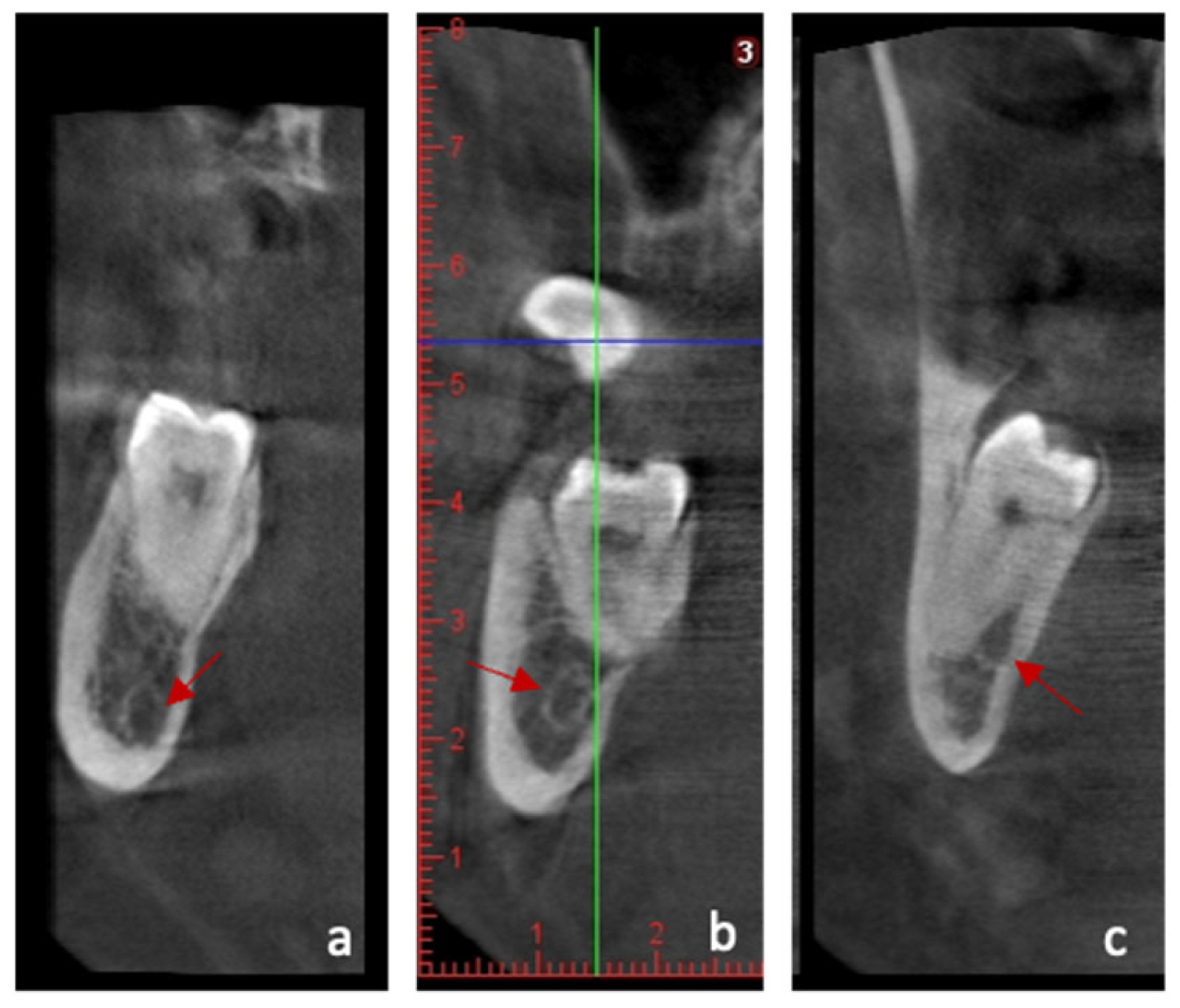
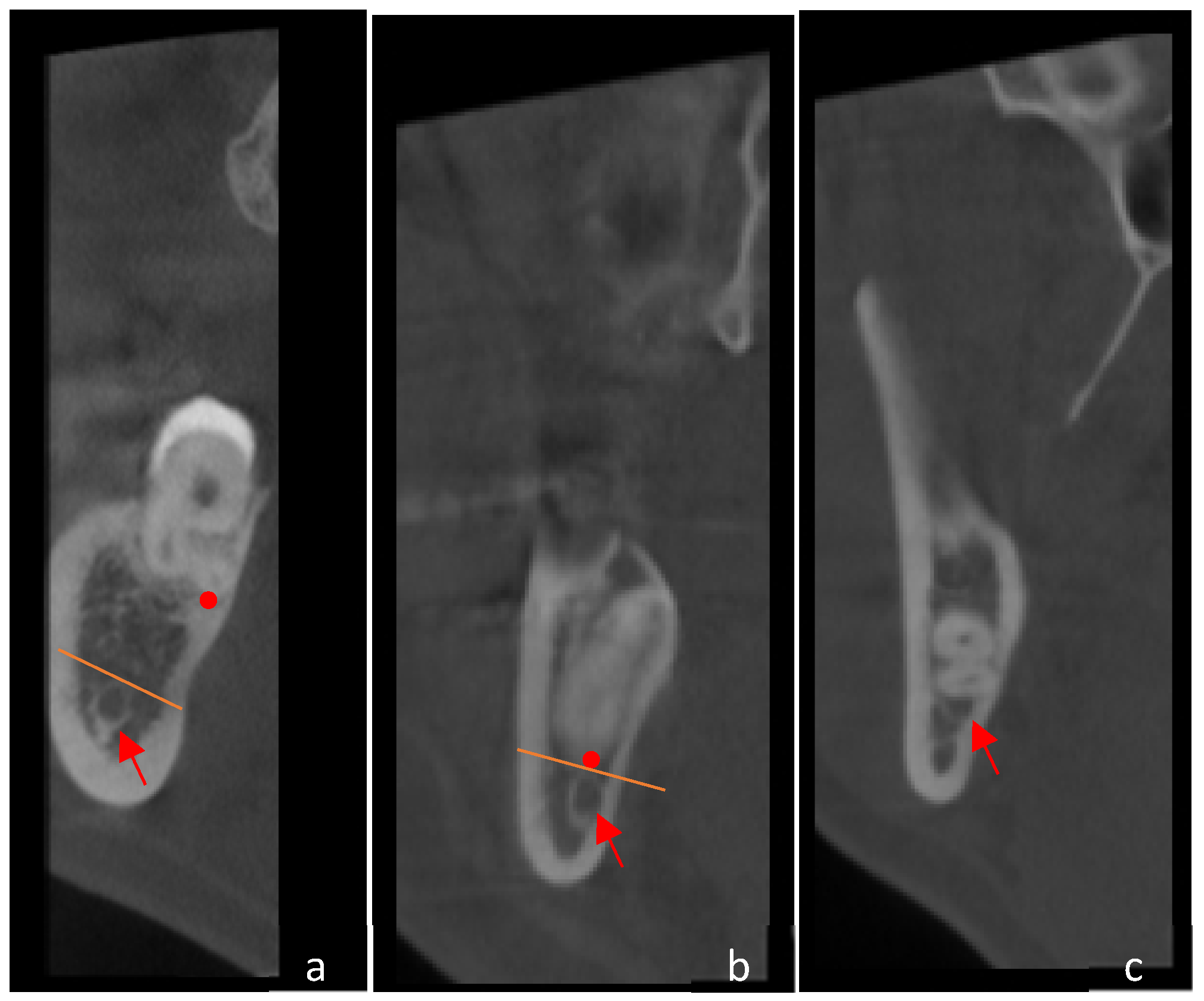
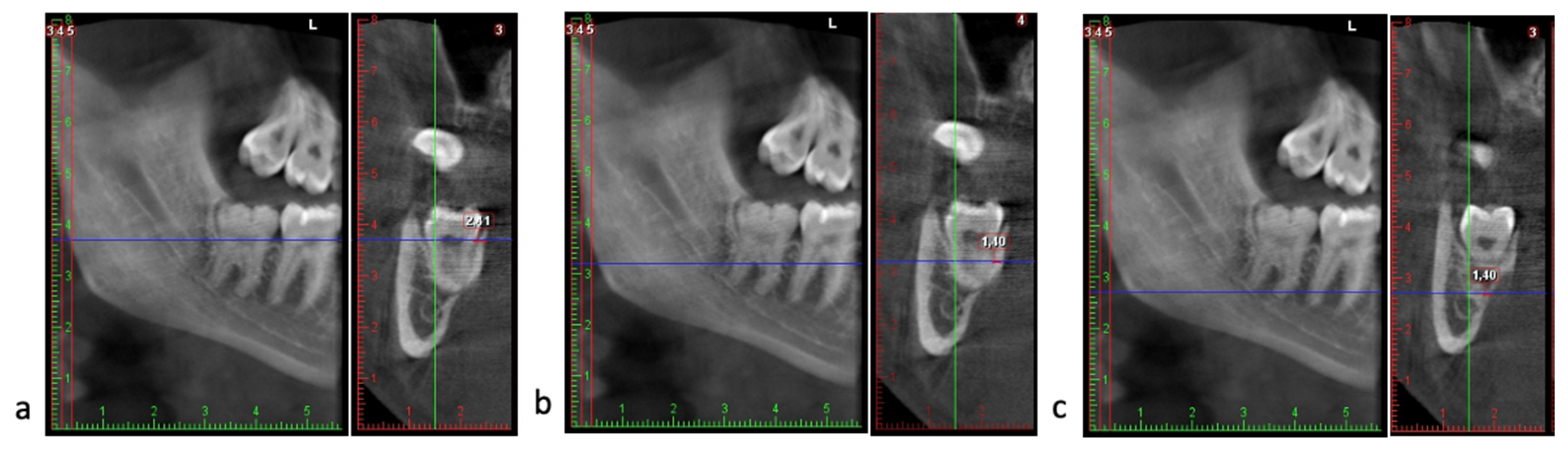
- The distance between the M3M roots and the IAC is determined through the evaluation of the smallest distance between the M3M roots and the tangential line to the superior limit of IAC (Figure 2). Unlike previous studies in which contact was defined solely by the absence of a cortical boundary, the present study classified contact whenever the tooth root showed anatomical continuity with the mandibular canal, irrespective of the presence of cortical bone [32,33]. Accordingly, three categories were used to describe the spatial relationship between third molar roots and the mandibular canal: no contact, contact with cortical bone, and contact without cortical bone (Figure 3). This classification was adopted to address situations in which a very thin cortical layer was visible but fell below the voxel-dependent threshold for reliable distance measurement, thereby limiting accurate quantification. This method allowed a more refined assessment of the three-dimensional relationship between the tooth and the IAC [24,25,26,27]. The minimum measurable distance between structures depended on the voxel size of each scan. In scans with a 0.4 mm voxel size, the smallest measurable interval was approximately 1.6 mm, whereas in those with a 0.2 mm voxel size, it was about 0.8 mm. This limitation reflects the dependence of spatial resolution on voxel dimensions, since accurate differentiation requires several consecutive voxels to delineate anatomical boundaries [24,25,26,27].
- (3)
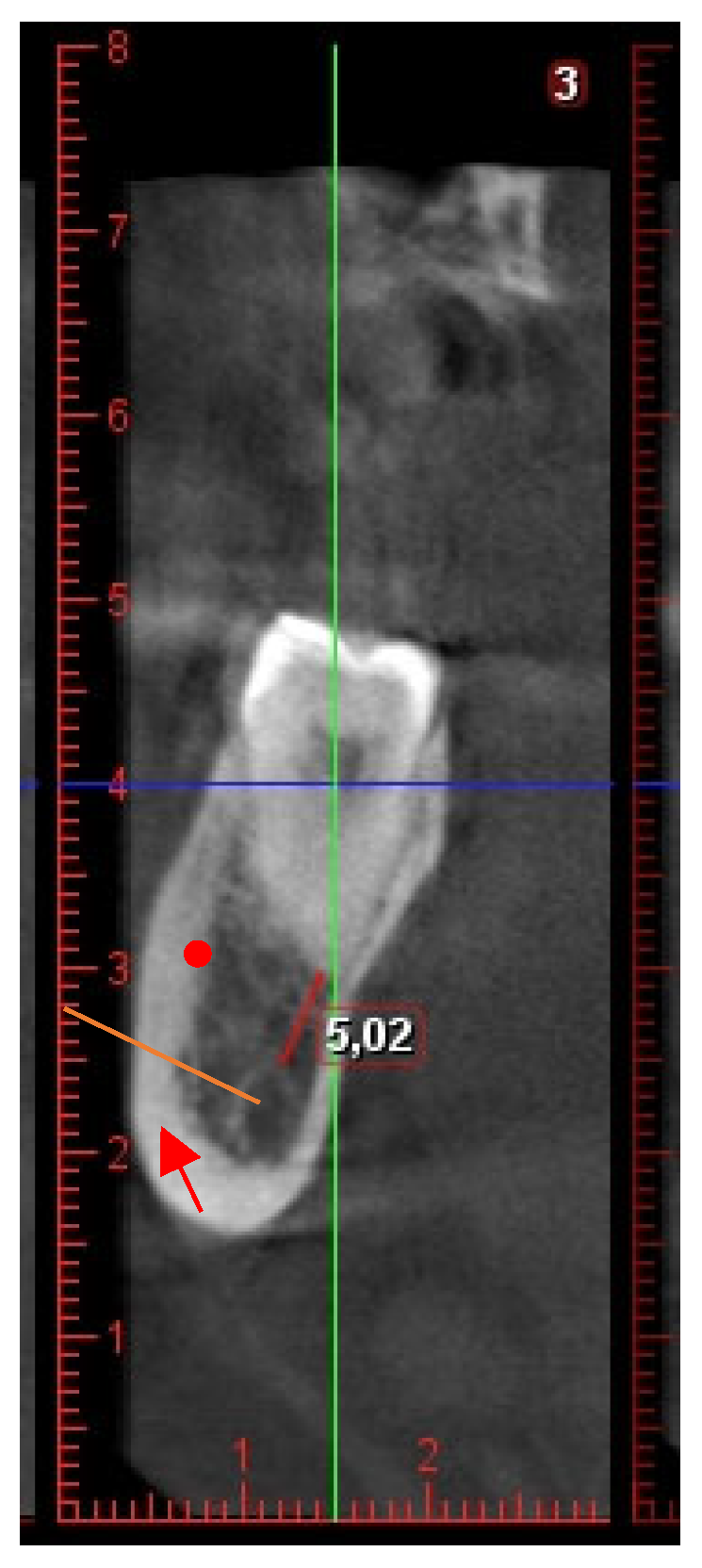
- The thickness of the lingual plate assessed in parasagittal slices at three anatomical levels: (a) at the cementoenamel junction (CEJ) of the mandibular second molar in its most distal portion (closest to the third molar); (b) at mid-root closest to the lingual cortical plate of the third molar, and (c) at the apex of the distal root of the third molar (Figure 4) [34,35].
- (4)
- The relationship between the apex of the third molar root and lingual plate was assessed in parasagittal slices, as they are possible risk factors for lingual nerve (LN) damage, and classified as: (a) type A: presence of bone between the root and the lingual cortex; (b) type B: the root is in contact with the lingual cortex but doesn’t perforate it and (c) the root perforates the lingual cortex [36]. Cases showing lingual cortical perforation or cortical thickness below 1 mm were documented as potential risk indicators for LN injury.
- (5)
- Presence of radiographic signs detected in OPG and the IAC position in relation to the M3M evaluated in CBCT images.
2.5. Statistical Analysis
3. Results
4. Discussion
5. Conclusions
Author Contributions
Funding
Institutional Review Board Statement
Informed Consent Statement
Data Availability Statement
Conflicts of Interest
Abbreviations
| CBCT | Cone-beam computed tomography |
| IAC | Inferior alveolar canal |
| IAN | Inferior alveolar nerve |
| LN | Lingual Nerve |
| M3M | Mandibular third molar |
| Mx3M | Maxillary third molar |
| OPG | Orthopantomography |
References
- Ahlqwist, M.; Grondahl, H.-G. Prevalence of Impacted Teeth and Associated Pathology in Middle-Aged and Older Swedish Women. Community Dent. Oral Epidemiol. 1991, 19, 116–119. [Google Scholar] [CrossRef]
- Gisakis, I.G.; Palamidakis, F.D.; Farmakis, E.T.R.; Kamberos, G.; Kamberos, S. Prevalence of Impacted Teeth in a Greek Population. J. Investig. Clin. Dent. 2011, 2, 102–109. [Google Scholar] [CrossRef]
- Idris, A.M.; Al-Mashraqi, A.A.; Abidi, N.H.; Vani, N.V.; Elamin, E.I.; Khubrani, Y.H.; Alhazmi, A.S.; Alamir, A.H.; Fageeh, H.N.; Meshni, A.A.; et al. Third Molar Impaction in the Jazan Region: Evaluation of the Prevalence and Clinical Presentation. Saudi Dent. J. 2021, 33, 194–200. [Google Scholar] [CrossRef] [PubMed]
- Tetay-Salgado, S.; Arriola-Guillén, L.E.; Ruíz-Mora, G.A.; Castillo, A.A.D.; Rodríguez-Cárdenas, Y.A. Prevalence of Impacted Teeth and Supernumerary Teeth by Radiographic Evaluation in Three Latin American Countries: A Cross-Sectional Study. J. Clin. Exp. Dent. 2021, 13, e363–e368. [Google Scholar] [CrossRef] [PubMed]
- Topkara, A.; Sari, Z. Investigation of Third Molar Impaction in Turkish Orthodontic Patients: Prevalence, Depth and Angular Positions. Eur. J. Dent. 2013, 7, S094–S098. [Google Scholar] [CrossRef] [PubMed]
- Pinto, A.C.; Francisco, H.; Marques, D.; Martins, J.N.R.; Caramês, J. Worldwide Prevalence and Demographic Predictors of Impacted Third Molars—Systematic Review with Meta-Analysis. J. Clin. Med. 2024, 13, 7533. [Google Scholar] [CrossRef]
- Carter, K.; Worthington, S. Predictors of Third Molar Impaction. J. Dent. Res. 2016, 95, 267–276. [Google Scholar] [CrossRef]
- Tsai, H.-H. Factors Associated with Mandibular Third Molar Eruption and Impaction. J. Clin. Pediatr. Dent. 2005, 30, 109–113. [Google Scholar] [CrossRef]
- Pell, G.; Gregory, G. Impacted Mandibular Third Molars: Classification and Modified Technique for Removal. Dent. Dig. 1933, 39, 330–338. [Google Scholar]
- Winter, G. Impacted Mandibular Third Molars; American Medical Book Co.: St. Louis, MO, USA, 1926. [Google Scholar]
- de Toledo Telles-Araújo, G.; Peralta-Mamani, M.; Caminha, R.D.G.; de Fatima Moraes-da-Silva, A.; Rubira, C.M.F.; Honório, H.M.; Rubira-Bullen, I.R.F. CBCT Does Not Reduce Neurosensory Disturbances after Third Molar Removal Compared to Panoramic Radiography: A Systematic Review and Meta-Analysis. Clin. Oral Investig. 2020, 24, 1137–1149. [Google Scholar] [CrossRef]
- Del Lhano, N.C.; Ribeiro, R.A.; Martins, C.C.; Picorelli Assis, N.M.S.; Devito, K.L. Panoramic versus CBct Used to Reduce Inferior Alveolar Nerve Paresthesia after Third Molar Extractions: A Systematic Review and Meta-Analysis. Dentomaxillofacial Radiol. 2020, 49, 20190265. [Google Scholar] [CrossRef] [PubMed]
- Reia, V.C.B.; de Toledo Telles-Araujo, G.; Peralta-Mamani, M.; Biancardi, M.R.; Rubira, C.M.F.; Rubira-Bullen, I.R.F. Diagnostic Accuracy of CBCT Compared to Panoramic Radiography in Predicting IAN Exposure: A Systematic Review and Meta-Analysis. Clin. Oral Investig. 2021, 25, 4721–4733. [Google Scholar] [CrossRef] [PubMed]
- Khojastepour, L.; Khaghaninejad, M.S.; Hasanshahi, R.; Forghani, M.; Ahrari, F. Does the Winter or Pell and Gregory Classification System Indicate the Apical Position of Impacted Mandibular Third Molars? J. Oral Maxillofac. Surg. 2019, 77, 2222.e1–2222.e9. [Google Scholar] [CrossRef] [PubMed]
- Barril, V. Taxa de Prevalência Do Terceiro Molar Incluso Numa População Da U.F.P. Bachelor’s Thesis, Universidade Fernando Pessoa, Porto, Portugal, 2010. [Google Scholar]
- Inácio, E. Prevalência de Retenções Dos Terceiros Molares Numa População Adulta Da Clínica Universitária Da Universidade Católica Portuguesa. Master’s Thesis, Universidade Católica Portuguesa, Lisbon, Portugal, 2018. [Google Scholar]
- Pereira, R.J.; Ferreira, F. Study of the Third Molars in a Population for Clinical Consultation in Gandra. Rev. Port. Estomatol. Med. Dent. E Cir. Maxilofac. 2008, 49, 87–92. [Google Scholar] [CrossRef][Green Version]
- Carvalho, J.F.C. Terceiro Molar—Estudo Da Prevalência e Das Repercussões Da Inclusão Numa População Portuguesa. Diploma Thesis, Universidade do Porto, Porto, Portugal, 1993. [Google Scholar]
- Maia, M.M. Estudo de Prevalência de Terceiros Molares Inclusos e Impactados Numa População Da UFP. Master’s Thesis, Universidade Fernando Pessoa, Porto, Portugal, 2014. [Google Scholar]
- Evidence-Based Medicine Working Group. Evidence-Based Medicine. A New Approach to Teaching the Practice of Medicine. JAMA 1992, 268, 2420–2425. [Google Scholar] [CrossRef]
- Sackett, D.; Rosenberg, W.; Gray, J.; Haynes, R.; Richardson, W. Evidence Based Medicine: What It Is and What It Isn’t. BMJ 1996, 312, 71–72. [Google Scholar]
- Buitrago-Garcia, D.; Salanti, G.; Low, N. Studies of Prevalence: How a Basic Epidemiology Concept Has Gained Recognition in the COVID-19 Pandemic. BMJ Open 2022, 12, e061497. [Google Scholar] [CrossRef]
- Yasa, Y.; Altynbekov, K.; Kalafatoğlu, B.S.; Meiramkul, S.; Alhusain, M.; Altynbekov, C. Prevalence and Radiographic Patterns of Third Molar Impaction and Agenesis in the Kazakh Population. Int. Dent. J. 2025, 75, 100897. [Google Scholar] [CrossRef]
- Van Leeuwen, B.; Dijkstra, P.; Verbeek, H.; Kuijpers-Jagtman, A.M.; Ren, Y. Effect of Voxel Size in Cone—Beam Computed Tomography on Surface Area Measurements of Dehiscences and Fenestrations in the Lower Anterior Buccal Region. Clin. Oral Investig. 2022, 26, 5663–5672. [Google Scholar] [CrossRef]
- Ozdede, M.; Akay, G.; Atas, O.K.; Koc, E.K.; Yalcin, O. Repeatability and Effect of Different Voxel Sizes on Linear and Volumetric Tooth and Pulp Measurements Using Cone-Beam Computed Tomography. BMC Oral Health 2024, 24, 1472. [Google Scholar] [CrossRef]
- Ozdede, M.; Akay, G. Influence of CBCT Device, Voxel Size, and Segmentation Software on the Accuracy of Tooth Volume Measurements. BMC Oral Health 2025, 25, 1063. [Google Scholar] [CrossRef] [PubMed]
- Schulze, R.K.W. Spatial Resolution in CBCT Machines for Dental/Maxillofacial Applications—What Do We Know Today? Dentomaxillofacial Radiol. 2015, 44, 20140204. [Google Scholar] [CrossRef] [PubMed]
- Rood, J.P.; Nooraldeen Shehab, B.A.A. The Radiological Prediction of Inferior Alveolar Nerve Injury during Third Molar Surgery. Br. J. Oral Maxillofac. Surg. 1990, 28, 20–25. [Google Scholar] [CrossRef] [PubMed]
- Kim, Y.S.; Park, Y.M.; Cosola, S.; Riad, A.; Giammarinaro, E.; Covani, U.; Marconcini, S. Retrospective Analysis on Inferior Third Molar Position by Means of Orthopantomography or CBCT: Periapical Band-like Radiolucent Sign. Appl. Sci. 2021, 11, 6389. [Google Scholar] [CrossRef]
- Patel, P.; Shah, J.; Dudhia, B.; Butala, P.; Jani, Y.; MacWan, R. Comparison of Panoramic Radiograph and Cone Beam Computed Tomography Findings for Impacted Mandibular Third Molar Root and Inferior Alveolar Nerve Canal Relation. Indian J. Dent. Res. 2020, 31, 91–102. [Google Scholar] [CrossRef]
- Ghaeminia, H.; Meijer, G.J.; Soehardi, A.; Borstlap, W.A.; Mulder, J.; Bergé, S.J. Position of the Impacted Third Molar in Relation to the Mandibular Canal. Diagnostic Accuracy of Cone Beam Computed Tomography Compared with Panoramic Radiography. Int. J. Oral Maxillofac. Surg. 2009, 38, 964–971. [Google Scholar] [CrossRef]
- Gu, L.; Zhu, C.; Chen, K.; Liu, X.; Tang, Z. Anatomic Study of the Position of the Mandibular Canal and Corresponding Mandibular Third Molar on Cone-Beam Computed Tomography Images. Surg. Radiol. Anat. 2018, 40, 609–614. [Google Scholar] [CrossRef]
- Maglione, M.; Costantinides, F.; Bazzocchi, G. Classification of Impacted Mandibular Third Molars on Cone-Beam CT Images. J. Clin. Exp. Dent. 2015, 7, e224–e231. [Google Scholar] [CrossRef]
- Menziletoglu, D.; Tassoker, M.; Kubilay-Isik, B.; Esen, A. The Assesment of Relationship between the Angulation of Impacted Mandibular Third Molar Teeth and the Thickness of Lingual Bone: A Prospective Clinical Study. Med. Oral Patol. Oral Cir. Bucal 2019, 24, e130–e135. [Google Scholar] [CrossRef]
- Tolstunov, L.; Brickeen, M.; Kamanin, V.; Susarla, S.M. Is the Angulation of Mandibular Third Molars Associated with the Thickness of Lingual Bone? Br. J. Oral Maxillofac. Surg. 2016, 54, 914–919. [Google Scholar] [CrossRef]
- Emes, Y.; Öncu, B.; Aybar, B.; Al-Badri, N.; Işsever, H.; Atalay, B.; Yalçin, S. Measurement of the Lingual Position of the Lower Third Molar Roots Using Cone-Beam Computed Tomography. J. Oral Maxillofac. Surg. 2015, 73, 13–17. [Google Scholar] [CrossRef] [PubMed]
- Landis, J.R.; Koch, G.G. The Measurement of Observer Agreement for Categorical Data. Biometrics 1977, 33, 159–174. [Google Scholar] [CrossRef] [PubMed]
- Hassan, A.H. Pattern of Third Molar Impaction in a Saudi Population. Clin. Cosmet. Investig. Dent. 2010, 2, 109–113. [Google Scholar] [CrossRef] [PubMed][Green Version]
- Al-Anqudi, S.; Al-Sudairy, S.; Al-Hosni, A.; Al-Maniri, A. Prevalence and Pattern of Third Molars Impaction: A Retrospective Study of Radiographs in Oman. Sultan. Qaboos. Univ. Med. J. 2014, 14, e338–e392. [Google Scholar] [CrossRef]
- Bjork, A.; Jensen, E.; Palling, M. Mandibular Growth and Third Molar Impaction. Acta Odontol. Scand. 1956, 14, 231–272. [Google Scholar] [CrossRef]
- Ryalat, S.; Alryalat, S.A.; Kassob, Z.; Hassona, Y.; Al-shayyab, M.H. Impaction of Lower Third Molars and Their Association with Age: Radiological Perspectives. BMC Oral Health 2018, 18, 58. [Google Scholar] [CrossRef]
- Al-Dajani, M.; Abouonq, A.O.; Almohammadi, T.A.; Alruwaili, M.K.; Alswilem, R.O.; Alzoubi, I.A. A Cohort Study of the Patterns of Third Molar Impaction in Panoramic Radiographs in Saudi Population. Open Dent. J. 2017, 11, 648–660. [Google Scholar] [CrossRef]
- Modi, J.D.; Gala, S.A.; Dave, H.A.; Gupte, S.H.; Singh, S. The Assessment of the Prevalence of Impacted Third Molars, Its Relation to Space Available for Eruption, and Its Effect on the Adjacent Second Molar in Adults From 18 to 65 Years of Age Using Orthopantomograms: A Retrospective Cross-Sectional Study. Cureus 2025, 17, 78608. [Google Scholar] [CrossRef]
- Poszytek, D.; Górski, B. Relationship between the Status of Third Molars and the Occurrence of Dental and Periodontal Lesions in Adjacent Second Molars in the Polish Population: A Radiological Retrospective Observational Study. J. Clin. Med. 2024, 13, 20. [Google Scholar] [CrossRef]
- Ahmad, P.; Vian, T.; Chaudhary, F.; Chaudhary, A.; Haseeb, A.; Yaqoob, M.; Asif, J. Pattern of Third Molar Impactions in North-Eastern Peninsular Malaysia: A 10-Year Retrospective Study. Niger. J. Clin. Pract. 2021, 24, 1028–1036. [Google Scholar] [CrossRef]
- Alsaegh, M.A.; Abushweme, D.A.; Ahmed, K.O.; Ahmed, S.O. The Pattern of Mandibular Third Molar Impaction and Its Relationship with the Development of Distal Caries in Adjacent Second Molars among Emiratis: A Retrospective Study. BMC Oral Health 2022, 22, 306. [Google Scholar] [CrossRef]
- Lacerda-santos, J.T.; Granja, G.; Catão, M.H.; Araújo, F.; Freitas, G.; Araújo-Filho, J.; Freire, J.; Dias-Ribeiro, E.; Santos, J. Signs of the Proximity of Third Molar Roots to the Mandibular Canal: An Observational Study in Panoramic Radiographs. Gen. Dent. 2020, 68, 30–35. [Google Scholar] [PubMed]
- Issrani, R.; Prabhu, N.; Sghaireen, M.; Alshubrmi, H.R.; Alanazi, A.M.; Alkhalaf, Z.A.; Alnusayri, M.O.; Aljohani, F.M.; Khan, Z.A. Comparison of Digital Opg and Cbct in Assessment of Risk Factors Associated with Inferior Nerve Injury during Mandibular Third Molar Surgery. Diagnostics 2021, 11, 2282. [Google Scholar] [CrossRef] [PubMed]
- Leung, Y.Y.; Hung, K.F.; Li, D.T.S.; Yeung, A.W.K. Application of Cone Beam Computed Tomography in Risk Assessment of Lower Third Molar Surgery. Diagnostics 2023, 13, 919. [Google Scholar] [CrossRef] [PubMed]
- Robbins, J.; Smalley, K.R.; Ray, P.; Ali, K. Does the Addition of Cone-Beam CT to Panoral Imaging Reduce Inferior Dental Nerve Injuries Resulting from Third Molar Surgery? A Systematic Review. BMC Oral Health 2022, 22, 466. [Google Scholar] [CrossRef]
- Ruiz-roca, J.A.; Rodríguez-molinero, J.A.; Javaloyes-vicente, P.; Pereira-lopes, O. Use of CBCT and Panoramic Radiography in the Prediction of Alterations in Sensivity of the Inferior Alveolar Nerve in Third Molars: A Retrospective Cross-Sectional Study. Saudi Dent. J. 2024, 36, 1105–1110. [Google Scholar] [CrossRef]
- Peker, I.; Sarikir, C.; Alkurt, M.T.; Zor, Z.F. Panoramic Radiography and Cone-Beam Computed Tomography Findings in Preoperative Examination of Impacted Mandibular Third Molars. BMC Oral Health 2014, 14, 71. [Google Scholar] [CrossRef]
- Rodriguez y Baena, R.; Beltrami, R.; Tagliabo, A.; Rizzo, S.; Lupi, S. Differences between Panoramic and Cone Beam-CT in the Surgical Evaluation of Lower Third Molars. J. Clin. Exp. Dent. 2017, 9, e259–e265. [Google Scholar] [CrossRef]
- Jun, S.H.; Kim, C.H.; Ahn, J.S.; Padwa, B.L.; Anatomical, J.J.K. Anatomical Differences in Lower Third Molars Visualized by 2D and 3D X-Ray Imaging: Clinical Outcomes after Extraction. Int. J. Oral Maxillofac. Surg. 2013, 42, 489–496. [Google Scholar] [CrossRef]
- Xu, G.; Yang, C.; Fan, X.; Yu, C.; Cai, X.; Wang, Y. Anatomic Relationship between Impacted Third Mandibular Molar and the Mandibular Canal as the Risk Factor of Inferior Alveolar Nerve Injury . Br. J. Oral Maxillofac. Surg. 2013, 51, e215–e219. [Google Scholar] [CrossRef]
- Wang, D.; Lin, T.; Wang, Y.; Sun, C.; Yang, L.; Jiang, H.; Cheng, J. Radiographic Features of Anatomic Relationship between Impacted Third Molar and Inferior Alveolar Canal on Coronal CBCT Images: Risk Factors for Nerve Injury after Tooth Extraction. Arch. Med Sci. 2018, 14, 532–540. [Google Scholar] [CrossRef]
- Cardoso, R.; Vieira, C.; Pereira, D.; Oliveira, G.; Barbosa, G. Lingual Plate Thickness Influences Cortical Bone Injury during Lower Third Molar Extraction: A Cone Beam Computed Tomography Study. Oral Maxillofac. Surg. 2025, 29, 88. [Google Scholar] [CrossRef]
- Borgonovo, A.; Rigaldo, F.; Maiorana, C. CBCT Evaluation of the Tridimensional Relationship between Impacted Lower Third Molar and the Inferior Alveolar Nerve Position. Minerva Dent. Oral Sci. 2017, 66, 9–19. [Google Scholar] [CrossRef]
- Matsuda, S.; Yoshimura, H. Lingual Bone Thickness in the Apical Region of the Horizontal Mandibular Third Molar: A Cross-Sectional Study in Young Japanese. PLoS ONE 2022, 17, e0263094. [Google Scholar] [CrossRef]
- Renton, T. Summary of: Experience in Third Molar Surgery: An Update. Br. Dent. J. 2010, 209, 36–37. [Google Scholar] [CrossRef] [PubMed][Green Version]
- Jerjes, W.; El-Maaytah, M.; Swinson, B.; Banu, B.; Upile, T.; D’Sa, S.; Al-Khawalde, M.; Chaib, B.; Hopper, C. Experience versus Complication Rate in Third Molar Surgery. Head Face Med. 2006, 2, 14. [Google Scholar] [CrossRef] [PubMed]
- Leung, Y.; Cheung, L. Risk Factors of Neurosensory Deficits in Lower Third Molar Surgery: A Literature Review of Prospective Studies. Int. J. Oral Maxillofac. Surg 2011, 40, 1–10. [Google Scholar] [CrossRef]
- Pogrel, M.A. The Results of Microneurosurgery of the Inferior Alveolar and Lingual Nerve. J. Oral Maxillofac. Surg. 2002, 60, 485–489. [Google Scholar] [CrossRef]




| Tooth | 18 | 28 | |||||||
|---|---|---|---|---|---|---|---|---|---|
| Ab | FE | D | I | Ab | FE | D | I | ||
| Sex | Female | 391 (62.3%) | 154 (54%) | 15 (50%) | 59 (49.6%) | 386 (62.1%) | 160 (54.2%) | 14 (50%) | 59 (50.9%) |
| Male | 237 (37.7%) | 131 (46%) | 15 (50%) | 60 (50.4%) | 236 (37.9%) | 135 (45.8%) | 14 (50%) | 57 (49.1%) | |
| Total | 628 (100%) | 285 (100%) | 30 (100%) | 119 (100%) | 622 (100%) | 295 (100%) | 28 (100%) | 116 (100%) | |
| Age (years) | 17–20 | 4 (0.6%) | 5 (1.8%) | 26 (86.7%) | 19 (16%) | 2 (0.3%) | 8 (2.7%) | 25 (89.3%) | 19 (16.4%) |
| 21–25 | 11 (1.8%) | 17 (6%) | 2 (6.7%) | 28 (23.5%) | 16 (2.6%) | 16 (5.4%) | 1 (3.5%) | 25 (21.6%) | |
| 26–30 | 28 (4.5%) | 24 (8.4%) | 0 (0%) | 11 (9.2%) | 26 (4.2%) | 28 (9.5%) | 0 (0%) | 9 (7.8%) | |
| 31–35 | 48 (7.6%) | 32 11.2%) | 0 (0%) | 14 (11.8%) | 42 (6.8%) | 36 (12.2%) | 0 (0%) | 16 (13.8%) | |
| ≥36 | 537 (85.5%) | 207 (72.6%) | 2 (6.7%) | 47 (39.5%) | 536 (86.2%) | 207 (70.2%) | 2 (7.1%) | 47 (40.5%) | |
| Tooth | 48 | 38 | |||||||
|---|---|---|---|---|---|---|---|---|---|
| Ab | FE | D | I | Ab | FE | D | I | ||
| Sex | Female | 370 (61.9%) | 136 (55.7%) | 12 (52.2%) | 101 (51.3%) | 370 (62.9%) | 137 (54.2%) | 10 (47.6%) | 102 (51%) |
| Male | 228 (38.1%) | 108 (44.3%) | 11 (47.8%) | 96 (48.7%) | 218 (37.1%) | 116 (45.8%) | 11 (52.4%) | 98 (49%) | |
| Total | 598 (100%) | 244 (100%) | 23 (100%) | 197 (100%) | 588 (100%) | 253 (100%) | 21 (100%) | 200 (100%) | |
| Age (years) | 17–20 | 6 (1%) | 2 (0.8%) | 22 (95.7%) | 24 (12.2%) | 5 (0.9%) | 2 (0.8%) | 21 (100%) | 26 (13%) |
| 21–25 | 13 (2.2%) | 4 (1.6%) | 1 (4.3%) | 40 (20.3%) | 15 (2.6%) | 5 (2%) | 0 (0%) | 38 (19%) | |
| 26–30 | 26 (4.3%) | 12 (4.9%) | 0 (0%) | 25 (12.7%) | 24 (4.1%) | 9 (3.6%) | 0 (0%) | 30 (15%) | |
| 31–35 | 48 (8%) | 22 (9%) | 0 (0%) | 24 (12.2%) | 45 (7.7%) | 19 (7.5%) | 0 (0%) | 30 (15%) | |
| ≥36 | 505 (84.4%) | 204 (83.6%) | 0 (0%) | 84 (42.6%) | 499 (84.9%) | 218 (86.2%) | 0 (0%) | 76 (38%) | |
| Tooth | 18 | 28 | 38 | 48 | |
|---|---|---|---|---|---|
| Winter Classification | Vertical | 54 (46.2%) | 51 (44.3%) | 82 (42.1%) | 84 (42.9%) |
| Mesioangular | 26 (22.2%) | 19 (16.5%) | 51 (26.2%) | 51 (26%) | |
| Distoangular | 23 (19.7%) | 28 (24.3%) | 36 (18.5%) | 34 (17.3%) | |
| Horizontal | 3 (2.6%) | 1 (0.9%) | 18 (9.2%) | 20 (10.2%) | |
| Other | 11 (9.4%) | 16 (13.9%) | 8 (4.1%) | 7 (3.6%) | |
| Total | 117 (100%) | 115 (100%) | 195 (100%) | 196 (100%) | |
| Tooth | 18 | 28 | |
|---|---|---|---|
| Pell and Gregory Classification | Level A | 2 (1.7%) | 2 (1.7%) |
| Level B | 26 (22.2%) | 28 (24.3%) | |
| Level C | 89 (76.1%) | 85 (73.9%) | |
| Total | 117 (100%) | 115 (100%) | |
| Tooth | 48 | 38 | |
|---|---|---|---|
| Pell and Gregory Classification | Level A, Class I | 3 (1.5%) | 5 (2.6%) |
| Level A, Class II | 68 (34.7%) | 69 (35.4%) | |
| Level A, Class III | 1 (0.5%) | 3 (1.5%) | |
| Level B, Class I | 8 (4.1%) | 8 (4.1%) | |
| Level B, Class II | 60 (30.6%) | 57 (29%) | |
| Level B, Class III | 12 (6.1%) | 12 (6.2%) | |
| Level C, Class I | 5 (2.6%) | 4 (2.1%) | |
| Level C, Class II | 25 (12.8%) | 21 (10.8%) | |
| Level C, Class III | 14 (7.1%) | 16 (8.2%) | |
| Total | 196 (100%) | 195 (100%) | |
| Tooth | 18 | 28 | 38 | 48 | Total | |
|---|---|---|---|---|---|---|
| Pathology | Second Molar Carie | 21 (19.3%) | 24 (22%) | 36 (33%) | 38 (34.9%) | 109 (100%) |
| Third Molar Carie | 35 (28.2%) | 33 (26.6%) | 32 (25.8%) | 24 (19.4% | 124 (100%) | |
| Root resorption of second molars | 8 (30.8%) | 6 (23.1%) | 7 (26.9%) | 5 (19.2%) | 26 (100%) | |
| Pericoronal radiolucency | 6 (7.7%) | 6 (7.7%) | 31 (39.7%) | 35 (44.9%) | 78 (100%) | |
| Supernumerary | 2 (66.7%) | 1 (33.3%) | - | - | 3 (100%) | |
| Extrusion | 17 (48.6%) | 11 (31.4%) | 3 (8.6%) | 4 (11.4%) | 35 (100%) | |
| Periodontal Pocket | 36 (33%) | 28 (25.7%) | 21 (19.2%) | 24 (22%) | 109 (100%) | |
| Periapical Lesion | - | - | 3 (75%) | 1 (25%) | 4 (100%) | |
| Second Molar Carie | Third Molar Carie | Total | |
|---|---|---|---|
| Fully Erupted | 55 (5.1%) | 98 (9.1%) | 1077 |
| Impacted | 54 (8.5%) | 26 (4.1%) | 632 |
| OPG Proximity Signs | IAC Contact | Total | ||
|---|---|---|---|---|
| No | Yes with Cortical | Yes Without Cortical | ||
| None | 70 (66%) | 5 (20%) | 12 (16.2%) | 87 (42.4%) |
| Narrowing canal | 5 (4.7%) | 4 (16%) | 6 (8.1%) | 15 (7.3%) |
| Narrowing roots | 2 (1.9%) | 1 (4%) | 3 (4.1%) | 6 (2.9%) |
| Darkening roots | 13 (12.3%) | 8 (32%) | 21 (28.4%) | 42 (20.5%) |
| Canal deviation | 1 (0.9%) | 1 (4%) | 0 (0%) | 2 (1%) |
| Cortical interruption | 14 (13.2%) | 5 (20%) | 27 (36.5%) | 46 (22.4%) |
| Root deflection | 1 (0.9%) | 1 (4%) | 5 (6.8%) | 7 (3.4%) |
| Total | 106 (100%) | 25 (100%) | 74 (100%) | 205 (100%) |
| 48 | IAC Position | Total | ||||
|---|---|---|---|---|---|---|
| Apical | Buccal | Lingual | Interradicular | |||
| IAC Contact | Yes with cortical | 10 (9.5%) | 2 (1.9%) | 3 (2.9%) | - | 15 |
| Yes without cortical | 27 (25.7%) | 4 (3.8%) | 8 (7.6%) | 1 (1%) | 40 | |
| No | 40 (38.1%) | 9 (8.6%) | 1 (1%) | - | 50 | |
| Total | 77 | 15 | 12 | 1 | 105 | |
| 38 | IAC Position | Total | ||||
| Apical | Buccal | Lingual | Interradicular | |||
| IAC Contact | Yes with cortical | 9 (9%) | 1 (1%) | - | - | 10 |
| Yes without cortical | 18 (18%) | 2 (2%) | 12 (12%) | 2 (2%) | 34 | |
| No | 51 (51%) | 3 (3%) | 2 (2%) | - | 56 | |
| Total | 78 | 6 | 14 | 2 | 100 | |
| Variable | Tooth 38 (Mean ± SD) | Tooth 48 (Mean ± SD) | p-Value | Cohen’s d | Effect Size |
|---|---|---|---|---|---|
| Minimal distance root–IAC (mm) | 2.01 ± 2.27 | 1.58 ± 2.08 | 0.156 | 0.20 | Small |
| Lingual cortical thickness at CEJ (mm) | 2.42 ± 0.91 | 2.38 ± 0.78 | 0.704 | 0.05 | Negligible |
| Lingual cortical thickness at mid-root (mm) | 2.05 ± 1.14 | 1.94 ± 0.98 | 0.469 | 0.10 | Negligible |
| Lingual cortical thickness at root apex (mm) | 1.92 ± 1.51 | 1.99 ± 1.41 | 0.705 | 0.05 | Negligible |
Disclaimer/Publisher’s Note: The statements, opinions and data contained in all publications are solely those of the individual author(s) and contributor(s) and not of MDPI and/or the editor(s). MDPI and/or the editor(s) disclaim responsibility for any injury to people or property resulting from any ideas, methods, instructions or products referred to in the content. |
© 2026 by the authors. Licensee MDPI, Basel, Switzerland. This article is an open access article distributed under the terms and conditions of the Creative Commons Attribution (CC BY) license.
Share and Cite
Pinto, A.C.; Francisco, H.; Charro, M.I.; Marques, D.; Martins, J.N.R.; Caramês, J. Prevalence and Radiographic Patterns of Impacted Third Molars in a Portuguese Population: A Retrospective Orthopantomography (OPG) and Cone-Beam Computed Tomography (CBCT) Study. J. Clin. Med. 2026, 15, 1160. https://doi.org/10.3390/jcm15031160
Pinto AC, Francisco H, Charro MI, Marques D, Martins JNR, Caramês J. Prevalence and Radiographic Patterns of Impacted Third Molars in a Portuguese Population: A Retrospective Orthopantomography (OPG) and Cone-Beam Computed Tomography (CBCT) Study. Journal of Clinical Medicine. 2026; 15(3):1160. https://doi.org/10.3390/jcm15031160
Chicago/Turabian StylePinto, Ana Catarina, Helena Francisco, Maria Inês Charro, Duarte Marques, Jorge N. R. Martins, and João Caramês. 2026. "Prevalence and Radiographic Patterns of Impacted Third Molars in a Portuguese Population: A Retrospective Orthopantomography (OPG) and Cone-Beam Computed Tomography (CBCT) Study" Journal of Clinical Medicine 15, no. 3: 1160. https://doi.org/10.3390/jcm15031160
APA StylePinto, A. C., Francisco, H., Charro, M. I., Marques, D., Martins, J. N. R., & Caramês, J. (2026). Prevalence and Radiographic Patterns of Impacted Third Molars in a Portuguese Population: A Retrospective Orthopantomography (OPG) and Cone-Beam Computed Tomography (CBCT) Study. Journal of Clinical Medicine, 15(3), 1160. https://doi.org/10.3390/jcm15031160