Single-Shot Ultrasound-Guided Transversus Abdominis Plane Block Versus Intravenous Patient-Controlled Analgesia for Early Recovery After Laparoscopic Cholecystectomy: A Retrospective Cohort Study

Abstract
1. Introduction
2. Materials and Methods
2.1. Study Design and Ethics
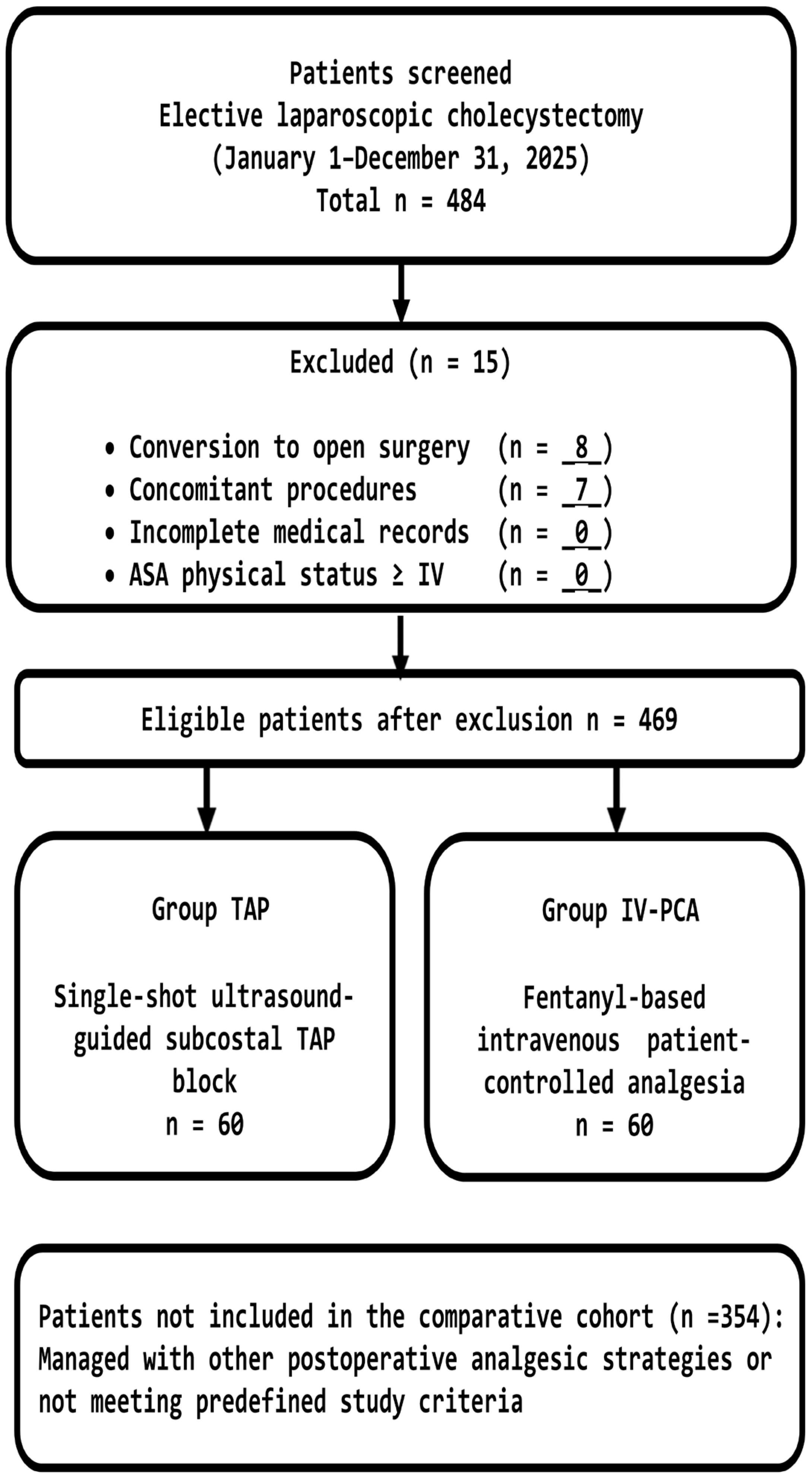
2.2. Patient Selection and Group Allocation
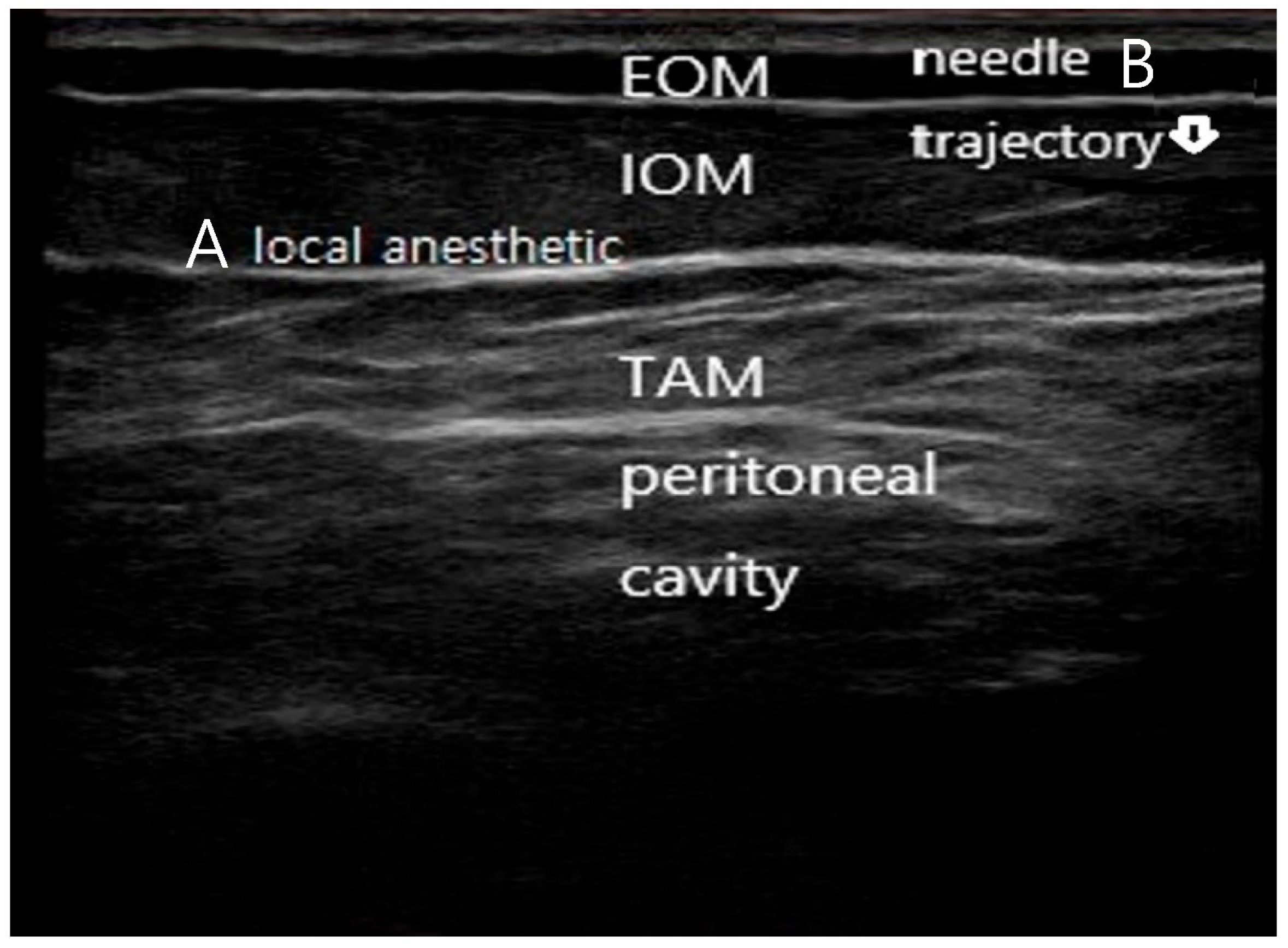
- Group TAP (n = 60): Patients who received a single-shot, ultrasound-guided transversus abdominis plane (TAP) block as part of a multimodal analgesia protocol.
- Group IV-PCA (n = 60): Patients who received conventional systemic postoperative analgesia via intravenous patient-controlled analgesia (IV-PCA).
2.3. Anesthesia and Analgesia Protocols
2.3.1. Group TAP (ERAS-Compliant Multimodal Analgesia)
2.3.2. Group IV-PCA (Conventional Analgesia)
2.4. Postoperative Management and Outcome Measures
2.4.1. Primary Outcome
2.4.2. Secondary Outcomes
- (1)
- Time to first rescue analgesic, defined as the interval from Time A to the first administration of supplementary analgesia other than scheduled oral medication.
- (2)
- Opioid-induced side effects (OISEs) and analgesic discontinuation including nausea, vomiting, delayed passage of flatus, and failure of spontaneous voiding requiring bladder catheterization. Discontinuation of IV-PCA was defined as cessation of PCA delivery due to intolerable opioid-related adverse effects, as documented in the medical record.
- (3)
- Functional recovery markers, including time to tolerance of a soft or regular diet, time to first flatus, and the proportion of patients meeting discharge criteria by POD 2.
2.4.3. Outcome Definitions
2.5. Statistical Analysis
2.6. Artificial Intelligence Statement
3. Results
3.1. Patient Characteristics
3.2. Functional Recovery Outcomes
3.3. Opioid-Related Adverse Events and PCA Management
3.4. Dose Stratification and Temporal Pattern of Adverse Events
3.5. Summary of Comparative Outcomes
4. Discussion
Supplementary Materials
Funding
Institutional Review Board Statement
Informed Consent Statement
Data Availability Statement
Acknowledgments
Conflicts of Interest
References
- Ljungqvist, O.; Scott, M.; Fearon, K.C. Enhanced recovery after surgery: A review. JAMA Surg. 2017, 152, 292–298. [Google Scholar] [CrossRef]
- Yeh, A.; Butler, G.; Strotmeyer, S.; Austin, K.; Visoiu, M.; Cladis, F.; Malek, M. ERAS protocol for pediatric laparoscopic cholecystectomy promotes safe and early discharge. J. Pediatr. Surg. 2020, 55, 96–100. [Google Scholar] [CrossRef]
- Istrate, A.M.; Serban, D.; Dumitrescu, D.; Tudor, C.; Simion, L.; Constantin, V.D.; Tanasescu, C.; Bratu, D.G.; Cristea, B.M.; Grigorescu, C.C.; et al. Postoperative pain management in the enhanced recovery after surgery (ERAS) for emergency laparoscopic cholecystectomy. J. Mind Med. Sci. 2024, 11, 396–401. [Google Scholar] [CrossRef]
- Choi, Y.M.; Byeon, G.J.; Park, S.J.; Ok, Y.M.; Shin, S.W.; Yang, K. Postoperative analgesic efficacy of single-shot and continuous transversus abdominis plane block after laparoscopic cholecystectomy: A randomized controlled clinical trial. J. Clin. Anesth. 2017, 39, 146–151. [Google Scholar] [CrossRef] [PubMed]
- El-Boghdadly, K.; Jack, J.M.; Heaney, A.; Black, N.D.; Englesakis, M.F.; Kehlet, H.; Chan, V.W.S. Role of regional anesthesia and analgesia in enhanced recovery after colorectal surgery: A systematic review of randomized controlled trials. Reg. Anesth. Pain Med. 2022, 47, 282–292. [Google Scholar] [CrossRef]
- El-Dawlatly, A.A.; Turkistani, A.; Kettner, S.C.; Machata, A.-M.; Delvi, M.B.; Thallaj, A.; Kapral, S.; Marhofer, P. Ultrasound-guided transversus abdominis plane block: Description of a new technique and comparison with conventional systemic analgesia during laparoscopic cholecystectomy. Br. J. Anaesth. 2009, 102, 763–767. [Google Scholar] [CrossRef]
- Ra, Y.S.; Kim, C.H.; Lee, G.Y.; Han, J.I. The analgesic effect of ultrasound-guided transversus abdominis plane block after laparoscopic cholecystectomy. Korean J. Anesthesiol. 2010, 58, 362–368. [Google Scholar] [CrossRef]
- Petersen, P.L.; Stjernholm, P.; Kristiansen, V.B.; Torup, H.; Hansen, E.G.; Mitchell, A.U.; Möller, A.; Rosenberg, J.; Dahl, J.B.; Mathiesen, O. The beneficial effect of transversus abdominis plane block after laparoscopic cholecystectomy in day-case surgery: A randomized clinical trial. Anesth. Analg. 2012, 115, 527–533. [Google Scholar] [CrossRef]
- Wu, Y.; Liu, F.; Tang, H.; Wang, Q.; Chen, L.; Wu, H.; Zhang, X.; Miao, J.; Zhu, M.; Hu, C.; et al. The analgesic efficacy of subcostal transversus abdominis plane block compared with thoracic epidural analgesia and intravenous opioid analgesia after radical gastrectomy. Anesth. Analg. 2013, 117, 507–513. [Google Scholar] [CrossRef]
- Baral, B.; Poudel, P.R. Comparison of analgesic efficacy of ultrasound guided subcostal transversus abdominis plane block with port site infiltration following laparoscopic cholecystectomy. J. Nepal Health Res. Counc. 2019, 16, 457–461. [Google Scholar] [CrossRef] [PubMed]
- Carney, J.; Finnerty, O.; Rauf, J.; Curley, G.; McDonnell, J.G.; Laffey, J.G. Ipsilateral transversus abdominis plane block provides effective analgesia after appendectomy in children: A randomized controlled trial. Anesth. Analg. 2010, 111, 998–1003. [Google Scholar] [CrossRef] [PubMed]
- Wang, W.; Wang, L.; Gao, Y. A meta-analysis of randomized controlled trials concerning the efficacy of transversus abdominis plane block for pain control after laparoscopic cholecystectomy. Front. Surg. 2021, 8, 700318. [Google Scholar] [CrossRef]
- Dai, L.; Ling, X.; Qian, Y. Effect of ultrasound-guided transversus abdominis plane block combined with patient-controlled intravenous analgesia on postoperative analgesia after laparoscopic cholecystectomy: A double-blind, randomized controlled trial. J. Gastrointest. Surg. 2022, 26, 2542–2550. [Google Scholar] [CrossRef] [PubMed]
- Zhu, M.; Sun, W. Analgesic Effects of Ropivacaine Combined with Dexmedetomidine in Transversus Abdominis Plane Block in Patients Undergoing Laparoscopic Cholecystectomy: A Systematic Review and Meta-Analysis. J. Perianesth. Nurs. 2023, 38, 493–503. [Google Scholar] [CrossRef]
- Bisgaard, T.; Klarskov, B.; Rosenberg, J.; Kehlet, H. Characteristics and prediction of early pain after laparoscopic cholecystectomy. Pain 2001, 90, 261–269. [Google Scholar] [CrossRef]
- Joris, J.; Thierry, E.; Paris, P.; Weirtz, J.; Rami, M. Pain after laparoscopic cholecystectomy: Characteristics and effects of intraperitoneal bupivacaine. Anesth. Analg. 1995, 81, 379–384. [Google Scholar]
- Bisgaard, T. Analgesic treatment after laparoscopic cholecystectomy: A critical assessment of the evidence. Anesthesiology 2006, 104, 835–846. [Google Scholar] [CrossRef]
- Lee, T.H.W.; Barrington, M.J.; Tran, T.M.N.; Wong, D.; Hebbard, P.D. Comparison of extent of sensory block following posterior and subcostal approaches to ultrasound-guided transversus abdominis plane block. Anaesth. Intensive Care 2010, 38, 452–460. [Google Scholar] [CrossRef]
- Tolchard, S.; Davies, R.; Martindale, S. Efficacy of the subcostal transversus abdominis plane block in laparoscopic cholecystectomy: Comparison with conventional port-site infiltration. J. Anaesthesiol. Clin. Pharmacol. 2012, 28, 339–343. [Google Scholar] [CrossRef] [PubMed]
- Shin, H.-J.; Oh, A.-Y.; Baik, J.-S.; Kim, J.-H.; Han, S.-H.; Hwang, J.-W. Ultrasound-guided oblique subcostal transversus abdominis plane block for analgesia after laparoscopic cholecystectomy: A randomized, controlled, observer-blinded study. Minerva Anestesiol. 2014, 80, 185–193. [Google Scholar]
- Breazu, C.M.; Ciobanu, L.; Hadade, A.; Bartos, A.; Mitre, C.; Mircea, P.A.; Ionescu, D. The efficacy of oblique subcostal transversus abdominis plane block in laparoscopic cholecystectomy: A prospective, placebo controlled study. Rom. J. Anaesth. Intensive Care 2016, 23, 12–18. [Google Scholar]
- Istenič, S.; Pušnik, L.; Ugwoke, C.K.; Pintarič, T.S.; Umek, N. Mechanistic insights into bupivacaine spread through anisotropic tissue planes and fascial barriers: Experimental evidence for interfascial block dynamics. Reg. Anesth. Pain Med. 2026. Online ahead of print. [Google Scholar] [CrossRef]
- Kehlet, H.; Wilmore, D.W. Evidence-based surgical care and the evolution of fast-track surgery. Ann. Surg. 2008, 248, 189–198. [Google Scholar] [CrossRef] [PubMed]
- Simpson, J.C.; Bao, X.; Agarwala, A. Pain management in enhanced recovery after surgery (ERAS) protocols. Clin. Colon Rectal Surg. 2019, 32, 121–128. [Google Scholar] [CrossRef]
- de Boer, H.D.; Detriche, O.; Forget, P. Opioid-related side effects: Postoperative ileus, urinary retention, nausea and vomiting, and shivering. a review of the literature. Best Pract. Res. Clin. Anaesthesiol. 2017, 31, 499–504. [Google Scholar] [CrossRef]
- Shafi, S.; Collinsworth, A.W.; Copeland, L.A.; Ogola, G.O.; Qiu, T.; Kouznetsova, M.; Liao, I.C.; Mears, N.; Pham, A.T.; Wan, G.J.; et al. Association of opioid-related adverse drug events with clinical and cost outcomes among surgical patients in a large integrated health care delivery system. JAMA Surg. 2018, 153, 757–763. [Google Scholar] [CrossRef] [PubMed]
- Koh, J.C.; Song, Y.; Kim, S.Y.; Park, S.; Ko, S.H. Postoperative pain and intravenous patient-controlled analgesia-related adverse effects in young and elderly patients: A retrospective analysis of 10,575 patients. Medicine 2015, 94, e2008. [Google Scholar] [CrossRef] [PubMed]
- Choi, J.B.; Shim, Y.H.; Lee, Y.W.; Lee, J.S.; Choi, J.R.; Chang, C.H. Incidence and risk factors of postoperative nausea and vomiting in patients with fentanyl-based intravenous patient-controlled analgesia and single antiemetic prophylaxis. Yonsei Med. J. 2014, 55, 1430–1435. [Google Scholar] [CrossRef]
- Kim, S.H.; Shin, Y.S.; Oh, Y.J.; Lee, J.R.; Chung, S.C.; Choi, Y.S. Risk assessment of postoperative nausea and vomiting in the intravenous patient-controlled analgesia environment: Predictive values of the Apfel’s simplified risk score for identification of high-risk patients. Yonsei Med. J. 2013, 54, 1273–1281. [Google Scholar] [CrossRef]
- Sun, N.; Wang, S.; Ma, P.; Liu, S.; Shao, A.; Xiong, L. Postoperative analgesia by a transversus abdominis plane block using different concentrations of ropivacaine for abdominal surgery: A meta-analysis. Clin. J. Pain 2017, 33, 853–863. [Google Scholar] [CrossRef]
- Rouholamin, S.; Ghahiri, A.; Dehghan Khalili, B. The efficacy of ropivacaine 0.5% in transversus abdominis plane block to relieve the postoperative pain of female laparoscopic surgery grade II. Adv. Biomed. Res. 2022, 11, 12. [Google Scholar] [CrossRef]
- Qazi, N.; Ahmed, R.; Khan, F.; Chakraborty, S.; Hassan, A.; Rizvi, M. Postoperative analgesic efficacy of bilateral transversus abdominis plane block in patients undergoing midline colorectal surgeries using ropivacaine: A randomized, double-blind, placebo-controlled trial. Anesth. Essays Res. 2017, 11, 767–772. [Google Scholar]
- De Cassai, A.; Sella, N.; Geraldini, F.; Tulgar, S.; Ahiskalioglu, A.; Dost, B.; Manfrin, S.; Karapinar, Y.E.; Paganini, G.; Beldagli, M.; et al. Single-shot regional anesthesia for laparoscopic cholecystectomies: A systematic review and network meta-analysis. Korean J. Anesthesiol. 2023, 76, 34–46. [Google Scholar] [CrossRef]
- Tikuisis, R.; Miliauskas, P.; Lukoseviciene, V.; Samalavicius, N.; Dulskas, A.; Zabuliene, L.; Zabulis, V.; Urboniene, J. Transversus abdominis plane block for postoperative pain relief after hand-assisted laparoscopic colon surgery: A randomized, placebo-controlled clinical trial. Tech. Coloproctol. 2016, 20, 835–844. [Google Scholar] [CrossRef]
- Mansoor, A.; Ellwood, S.; Hoffman, G.; Scholer, A.; Gore, A.; Grech, D.; Patrick, B.; Sifri, Z. The efficacy and safety of transversus abdominis plane blocks after open cholecystectomy in low- and middle-income countries. J. Surg. Res. 2020, 256, 136–142. [Google Scholar] [CrossRef]
- Watcha, M.F.; White, P.F. Postoperative nausea and vomiting: Its etiology, treatment, and prevention. Anesthesiology 1992, 77, 162–184. [Google Scholar] [CrossRef]
- Apfel, C.C.; Läärä, E.; Koivuranta, M.; Greim, C.A.; Roewer, N. A simplified risk score for predicting postoperative nausea and vomiting: Conclusions from cross-validations between two centers. Anesthesiology 1999, 91, 693–700. [Google Scholar] [CrossRef] [PubMed]
- Apfel, C.C.; Kranke, P.; Katz, M.H.; Goepfert, C.; Papenfuss, T.; Rauch, S.; Heineck, R.; Greim, C.A.; Roewer, N. Volatile anaesthetics may be the main cause of early but not delayed postoperative vomiting: A randomized controlled trial of factorial design. Br. J. Anaesth. 2002, 88, 659–668. [Google Scholar] [CrossRef] [PubMed]
- Casillas, R.A.; Yegiyants, S.; Collins, J.C. Early laparoscopic cholecystectomy is the preferred management of acute cholecystitis. Arch. Surg. 2008, 143, 533–537. [Google Scholar] [CrossRef] [PubMed]
- Poprom, N.; Suragul, W.; Muangkaew, P.; Vassanasiri, W.; Rungsakulkij, N.; Mingphruedhi, S.; Tangtawee, P. Timing of laparoscopic cholecystectomy after endoscopic retrograde cholangiopancreatography in cholelithiasis patients: A systematic review and meta-analysis. Ann. Hepatobiliary Pancreat. Surg. 2023, 27, 20–27. [Google Scholar] [CrossRef]
- Büyükkasap, Ç.; Algan, D.; Balakji, N.; Metindoğan, O.; Karataş, A.; Yavuz, A.; Göbüt, H.; Dikmen, K.; Kekilli, M.; Bostancı, H. Early cholecystectomy after endoscopic retrograde cholangiopancreatography is feasible and safe. Healthcare 2024, 12, 1407. [Google Scholar] [CrossRef]
- Gao, M.-J.; Jiang, Z.-L. Effects of the timing of laparoscopic cholecystectomy after endoscopic retrograde cholangiopancreatography on liver, bile, and inflammatory indices and cholecysto-choledocholithiasis patient prognoses. Clinics 2021, 76, e2189. [Google Scholar] [CrossRef] [PubMed]
- Lo, C.M.; Liu, C.L.; Fan, S.T.; Lai, E.C.S.; Wong, J. Prospective randomized study of early versus delayed laparoscopic cholecystectomy for acute cholecystitis. Ann. Surg. 1998, 227, 461–467. [Google Scholar] [CrossRef] [PubMed]
- Gustafsson, U.O.; Scott, M.J.; Hubner, M.; Nygren, J.; Demartines, N.; Francis, N.; Rockall, T.A.; Young-Fadok, T.M.; Hill, A.G.; Soop, M.; et al. Guidelines for perioperative care in elective colorectal surgery: Enhanced Recovery After Surgery (ERAS) Society recommendations: 2018. World J. Surg. 2019, 43, 659–695. [Google Scholar] [CrossRef] [PubMed]


| Variable | Total (n = 120) | Group TAP (n = 60) | Group IV-PCA (n = 60) | p-Value | SMD |
|---|---|---|---|---|---|
| Age (years) | 52.70 ± 12.43 | 51.75 ± 12.73 | 53.65 ± 12.16 | 0.405 | 0.153 |
| Sex | 0.175 | – | |||
| Male | 40 (33.3%) | 24 (40.0%) | 16 (26.7%) | −0.283 | |
| Female | 80 (66.7%) | 36 (60.0%) | 44 (73.3%) | ||
| Height (cm) | 161.43 ± 8.53 | 162.83 ± 8.54 | 160.03 ± 8.35 | 0.071 | −0.332 |
| Weight (kg) | 64.45 ± 11.68 | 66.29 ± 12.38 | 62.61 ± 10.73 | 0.084 | −0.318 |
| BMI (kg/m2) | 24.62 ± 3.21 | 24.81 ± 2.84 | 24.42 ± 3.56 | 0.507 | −0.121 |
| ASA physical status | 0.460 | −0.211 | |||
| ASA I | 9 (7.5%) | 4 (6.7%) | 5 (8.3%) | ||
| ASA II | 79 (65.8%) | 37 (61.7%) | 42 (70.0%) | ||
| ASA III | 32 (26.7%) | 19 (31.7%) | 13 (21.7%) | ||
| Severity of cholecystitis | 0.566 | −0.139 | |||
| Grade 1 | 31 (25.8%) | 13 (21.7%) | 18 (30.0%) | ||
| Grade 2 | 75 (62.5%) | 40 (66.7%) | 35 (58.3%) | ||
| Grade 3 | 14 (11.7%) | 7 (11.7%) | 7 (11.7%) | ||
| Preoperative baseline SBP (mmHg) | 133.42 ± 15.11 | 130.30 ± 12.78 | 136.53 ± 16.66 | 0.023 | 0.420 |
| Preoperative baseline DBP (mmHg) | 81.38 ± 13.89 | 76.65 ± 13.48 | 86.10 ± 12.72 | <0.001 | 0.721 |
| Preoperative baseline heart rate (beats/min) | 79.78 ± 18.51 | 77.70 ± 20.89 | 81.85 ± 15.67 | 0.221 | 0.225 |
| History of PONV | <0.001 | −1.206 | |||
| Yes | 32 (26.7%) | 32 (53.3%) | 0 (0%) | ||
| No | 88 (73.3%) | 28 (46.7%) | 60 (100%) | ||
| Chronic opioid use | 0.420 | −0.196 | |||
| Yes | 16 (13.3%) | 10 (16.7%) | 6 (10.0%) | ||
| No | 104 (86.7%) | 50 (83.3%) | 54 (90.0%) |
| Outcome Variation Data | TAP (n = 60) Mean ± SD or n (%) | IV-PCA (n = 60) Mean ± SD or n (%) | p-Value/Effect Size |
|---|---|---|---|
| Time to first ambulation (h) | 3.5 ± 1.2 | 12.7 ± 4.5 | <0.001 (Cohen’s d = 2.83) |
| Oral intake tolerance time (h) | 5.8 ± 2.1 | 16.3 ± 5.5 | <0.001 (d = 2.39) |
| NRS pain score at 24 h | 2.2 ± 1.1 | 5.8 ± 1.5 | <0.001 (d = 2.74) |
| Rescue analgesic use (0–24 h) | 0/60 (0%) | 45/60 (75%) | <0.001 (RR = 0.09) |
| Type of analgesic on POD 1 | Acetaminophen 650 mg PO TID only (100%) | Acetaminophen 650 mg PO TID ± NSAID (variable) | — |
| Discharge within POD 2 | 60 (100%) | 19 (32%) | <0.001 (RR = 3.15) |
| Length of stay (days) | 2.0 (IQR 2, 2) | 5.0 (IQR 4, 5) | <0.001 (d = 2.87) |
| Outcome Variable | IV-PCA (n = 60) n (%) | TAP (n = 60) n (%) | p-Value |
|---|---|---|---|
| Any opioid-related adverse event (OISE) | 36 (60.0) | 0 (0.0) | <0.001 |
| Headache | 14 (23.3) | 0 (0.0) | <0.001 |
| Nausea/Vomiting | 13 (21.7) | 0 (0.0) | <0.001 |
| Dizziness | 11 (18.3) | 0 (0.0) | <0.001 |
| Additional symptoms (≥2 symptoms) | 21 (35.0) | 0 (0.0) | <0.001 |
| Any PCA-related intervention required | 32 (53.3) | 0 (0.0) | <0.001 |
| Temporary PCA clamping (≥1) | 32 (53.3) | 0 (0.0) | <0.001 |
| Recurrent adverse events | 15 (25.0) | 0 (0.0) | <0.001 |
| Clinical Event | n (%) or Mean ± SD |
|---|---|
| PCA clamping on day of surgery (POD 0) | 32 (53.3%) |
| Rescue medication required on POD 0 | 32 (53.3%) |
| Antiemetics administered | 26 (43.3%) |
| Non-opioid rescue analgesics * | 19 (31.7%) |
| Recurrent PCA interruption (≥2 events) | 15 (25.0%) |
| PCA permanently discontinued within 48 h | 42 (70.0%) |
| Time from PCA start to first clamping (h) | 11.6 ± 4.2 |
| Time from PCA start to declamping/cessation (h) | 12.3 ± 5.1 |
| Time from PCA start to final PCA termination (h) | 39.4 ± 11.8 |
Disclaimer/Publisher’s Note: The statements, opinions and data contained in all publications are solely those of the individual author(s) and contributor(s) and not of MDPI and/or the editor(s). MDPI and/or the editor(s) disclaim responsibility for any injury to people or property resulting from any ideas, methods, instructions or products referred to in the content. |
© 2026 by the author. Licensee MDPI, Basel, Switzerland. This article is an open access article distributed under the terms and conditions of the Creative Commons Attribution (CC BY) license.
Share and Cite
Park, Y. Single-Shot Ultrasound-Guided Transversus Abdominis Plane Block Versus Intravenous Patient-Controlled Analgesia for Early Recovery After Laparoscopic Cholecystectomy: A Retrospective Cohort Study. J. Clin. Med. 2026, 15, 1120. https://doi.org/10.3390/jcm15031120
Park Y. Single-Shot Ultrasound-Guided Transversus Abdominis Plane Block Versus Intravenous Patient-Controlled Analgesia for Early Recovery After Laparoscopic Cholecystectomy: A Retrospective Cohort Study. Journal of Clinical Medicine. 2026; 15(3):1120. https://doi.org/10.3390/jcm15031120
Chicago/Turabian StylePark, Youngjoo. 2026. "Single-Shot Ultrasound-Guided Transversus Abdominis Plane Block Versus Intravenous Patient-Controlled Analgesia for Early Recovery After Laparoscopic Cholecystectomy: A Retrospective Cohort Study" Journal of Clinical Medicine 15, no. 3: 1120. https://doi.org/10.3390/jcm15031120
APA StylePark, Y. (2026). Single-Shot Ultrasound-Guided Transversus Abdominis Plane Block Versus Intravenous Patient-Controlled Analgesia for Early Recovery After Laparoscopic Cholecystectomy: A Retrospective Cohort Study. Journal of Clinical Medicine, 15(3), 1120. https://doi.org/10.3390/jcm15031120