High-Risk Prostate Cancer Treated with Radiation Therapy: Favorable Outcomes in Men with PSA > 20 as the Sole High-Risk Factor

Abstract
1. Introduction
2. Materials and Methods
3. Results
3.1. Patient and Treatment Characteristics
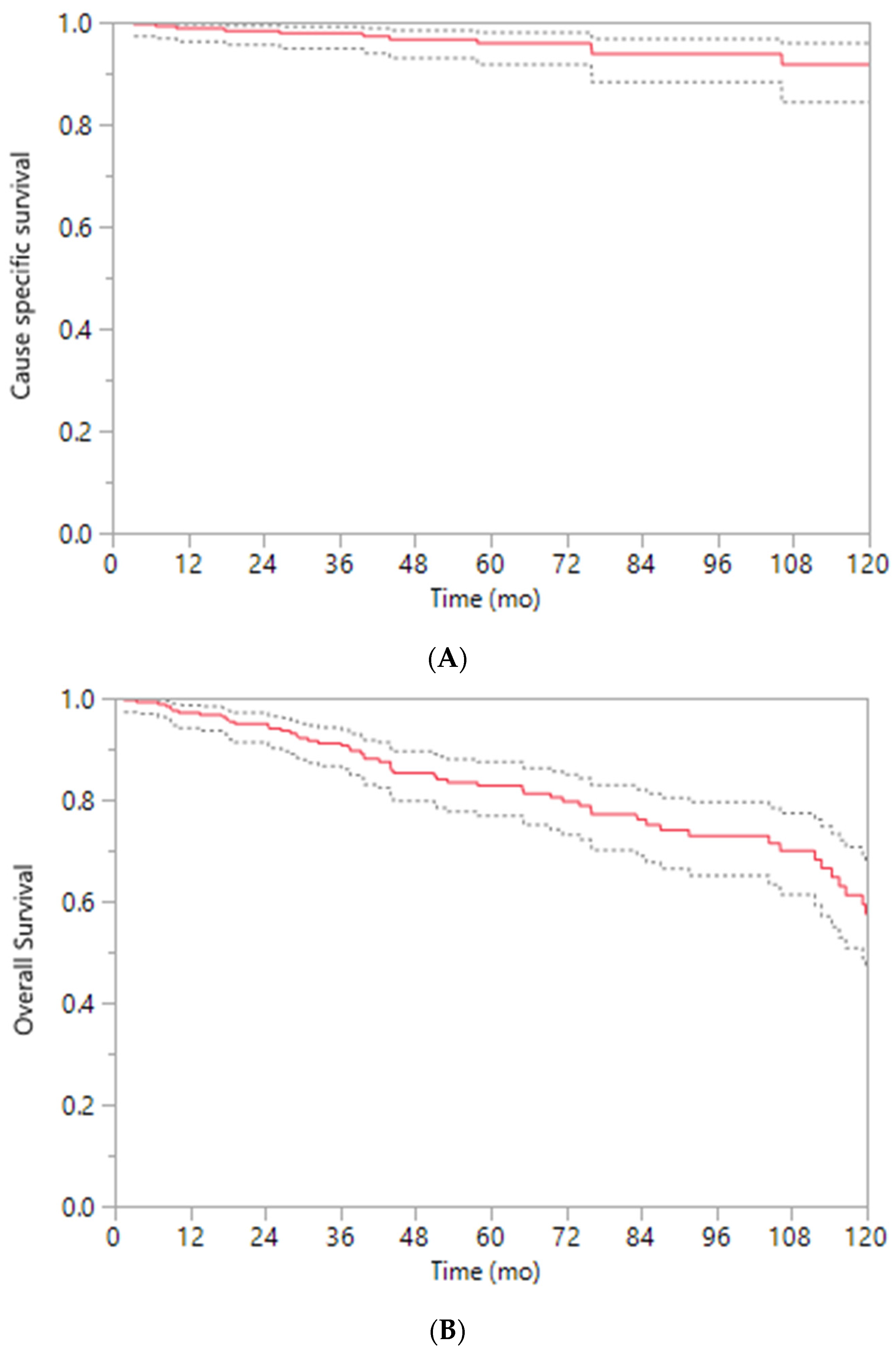
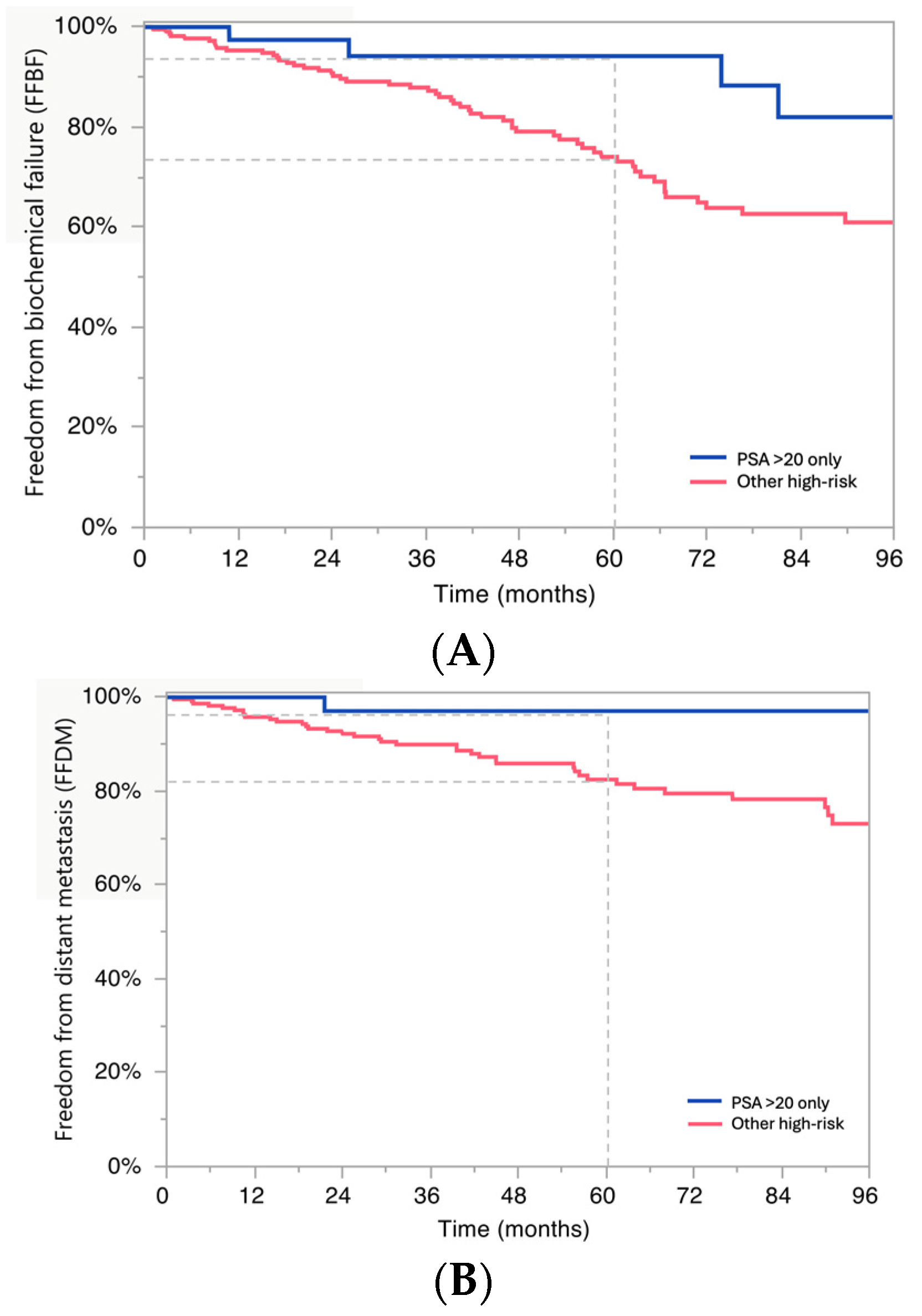
3.2. Freedom from Biochemical Failure (FFBF) and Freedom from Distant Metastasis (FFDM)
3.3. Multivariable Predictors of Biochemical Failure
4. Discussion
5. Conclusions
Author Contributions
Funding
Institutional Review Board Statement
Informed Consent Statement
Data Availability Statement
Conflicts of Interest
Abbreviations
| NCCN | National Comprehensive Cancer Network |
| ADT | Androgen Deprivation Therapy |
| FFBF | Freedom From Biochemical Failure |
| FFDM | Freedom From Distant Metastasis |
| PSA | Prostate Specific Antigen |
| HR | High Risk |
| VHR | Very High Risk |
| IMRT | Intensity Modulated Radiation Therapy |
| GnRH | Gonadotropin Releasing Hormone |
| RT | Radiation Therapy |
References
- Reese, A.C.; Pierorazio, P.M.; Han, M.; Partin, A.W. Contemporary evaluation of the National Comprehensive Cancer Network prostate cancer risk classification system. Urology 2012, 80, 1075–1079. [Google Scholar] [CrossRef] [PubMed]
- D’Amico, A.V.; Whittington, R.; Malkowicz, S.B.; Schultz, D.; Blank, K.; Broderick, G.A.; Tomaszewski, J.E.; Renshaw, A.A.; Kaplan, I.; Beard, C.J.; et al. Biochemical outcome after radical prostatectomy, external beam radiation therapy, or interstitial radiation therapy for clinically localized prostate cancer. JAMA 1998, 280, 969–974. [Google Scholar] [CrossRef]
- Zumsteg, Z.S.; Spratt, D.E.; Pei, I.; Zhang, Z.; Yamada, Y.; Kollmeier, M.; Zelefsky, M.J. A new risk classification system for therapeutic decision making with intermediate-risk prostate cancer patients undergoing dose-escalated external-beam radiation therapy. Eur. Urol. 2013, 64, 895–902. [Google Scholar] [CrossRef]
- Sundi, D.; Wang, V.M.; Pierorazio, P.M.; Han, M.; Bivalacqua, T.J.; Ball, M.W.; Antonarakis, E.S.; Partin, A.W.; Schaeffer, E.M.; Ross, A.E. Very-high-risk localized prostate cancer: Definition and outcomes. Prostate Cancer Prostatic Dis. 2013, 17, 57–63. [Google Scholar] [CrossRef]
- Garg, H.; Seth, A.; Kumar, R. Raised prostate-specific antigen alone may not be a true predictor in high-risk prostate cancer: A retrospective cohort analysis. Indian J. Urol. 2022, 38, 22–28. [Google Scholar] [CrossRef]
- Butler, S.S.; Dee, E.C.; Lamba, N.; Sha, S.T.; Mahal, B.A.; Whitbeck, A.; Makkar, R.; Wangoe, J.; Mouw, K.W.; Nguyen, P.L.; et al. Validation of a subclassification for high-risk prostate cancer in a prospective cohort. Cancer 2020, 126, 2132–2138. [Google Scholar] [CrossRef] [PubMed]
- Son, C.H.; Hamstra, D.A.; Feng, F.Y.; Liauw, S.L. High-risk Prostate Cancer Treated with Dose-escalated RT: An Analysis of Hormonal Therapy Use and Duration, and Prognostic Implications of PSA Nadir ≤ 0.2 to Select Men for Short-term Hormonal Therapy. Am. J. Clin. Oncol. 2017, 40, 348–352. [Google Scholar] [CrossRef]
- Bolla, M.; Van Tienhoven, G.; Warde, P.; Dubois, J.B.; Mirimanoff, R.-O.; Storme, G.; Bernier, J.; Kuten, A.; Sternberg, C.; Billiet, I.; et al. External irradiation with or without long-term androgen suppression for prostate cancer with high metastatic risk: 10-year results of an EORTC randomised study. Lancet Oncol. 2010, 11, 1066–1073. [Google Scholar] [CrossRef]
- Pilepich, M.V.; Winter, K.; Lawton, C.A.; Krisch, R.E.; Wolkov, H.B.; Movsas, B.; Hug, E.B.; Asbell, S.O.; Grignon, D. Androgen suppression adjuvant to definitive radiotherapy in prostate carcinoma--long-term results of phase III RTOG 85-31. Int. J. Radiat. Oncol. 2005, 61, 1285–1290. [Google Scholar] [CrossRef]
- Roach, M., 3rd; Bae, K.; Speight, J.; Wolkov, H.B.; Rubin, P.; Lee, R.J.; Lawton, C.; Valicenti, R.; Grignon, D.; Pilepich, M.V. Short-term neoadjuvant androgen deprivation therapy and external-beam radiotherapy for locally advanced prostate cancer: Long-term results of RTOG 8610. J. Clin. Oncol. 2008, 26, 585–591. [Google Scholar] [CrossRef] [PubMed]
- Schaeffer, E.M.; Srinivas, S.; Adra, N.; An, Y.; Barocas, D.; Bitting, R.; Bryce, A.; Chapin, B.; Cheng, H.H.; D’aMico, A.V.; et al. Prostate Cancer, Version 4.2023, NCCN Clinical Practice Guidelines in Oncology. J. Natl. Compr. Cancer Netw. 2023, 21, 1067–1096. [Google Scholar] [CrossRef] [PubMed]
- Nguyen, P.L.; Alibhai, S.M.H.; Basaria, S.; D’Amico, A.V.; Kantoff, P.W.; Keating, N.L.; Penson, D.F.; Rosario, D.J.; Tombal, B.; Smith, M.R. Adverse effects of androgen deprivation therapy and strategies to mitigate them. Eur. Urol. 2015, 67, 825–836. [Google Scholar] [CrossRef]
- Kishan, A.U.; Sun, Y.; Hartman, H.; Pisansky, T.M.; Bolla, M.; Neven, A.; Steigler, A.; Denham, J.W.; Feng, F.Y.; Zapatero, A.; et al. Androgen deprivation therapy use and duration with definitive radiotherapy for localised prostate cancer: An individual patient data meta-analysis. Lancet Oncol. 2022, 23, 304–316. [Google Scholar] [CrossRef]
- Patel, M.; Turchan, W.T.; Morris, C.G.; Augustine, D.; Wu, T.; Oto, A.; Zagaja, G.P.; Liauw, S.L. A Contemporary Report of Low-Dose-Rate Brachytherapy for Prostate Cancer Using MRI for Risk Stratification: Disease Outcomes and Patient-Reported Quality of Life. Cancers 2023, 15, 1336. [Google Scholar] [CrossRef]
- Schaeffer, E.; Srinivas, S.; Antonarakis, E.S.; Armstrong, A.J.; Bekelman, J.E.; Cheng, H.; D’aMico, A.V.; Davis, B.J.; Desai, N.; Dorff, T.; et al. NCCN Guidelines(R) Insights: Prostate Cancer, Version 3.2024. J. Natl. Compr. Cancer Netw. 2024, 22, 140–150. [Google Scholar] [CrossRef]
- Chennupati, S.K.; Pelizzari, C.A.; Kunnavakkam, R.; Liauw, S.L. Late toxicity and quality of life after definitive treatment of prostate cancer: Redefining optimal rectal sparing constraints for intensity-modulated radiation therapy. Cancer Med. 2014, 3, 954–961. [Google Scholar] [CrossRef] [PubMed]
- Roach, M., 3rd; Hanks, G.; Thames, H., Jr.; Schellhammer, P.; Shipley, W.U.; Sokol, G.H.; Sandler, H. Defining biochemical failure following radiotherapy with or without hormonal therapy in men with clinically localized prostate cancer: Recommendations of the RTOG-ASTRO Phoenix Consensus Conference. Int. J. Radiat. Oncol. Biol. Phys. 2006, 65, 965–974. [Google Scholar] [CrossRef] [PubMed]
- Song, P.; Wang, J.; Shu, M.; Di, X.; Li, Y.; Qing, Y.; Dong, Q. Prognosis of men with high-risk prostate cancer stratified by risk factors: A population-based retrospective cohort study. Transl. Cancer Res. 2020, 9, 6013–6025. [Google Scholar] [CrossRef]
- Muralidhar, V.; Chen, M.-H.; Reznor, G.; Moran, B.J.; Braccioforte, M.H.; Beard, C.J.; Feng, F.Y.; Hoffman, K.E.; Choueiri, T.K.; Martin, N.E.; et al. Definition and Validation of “Favorable High-Risk Prostate Cancer”: Implications for Personalizing Treatment of Radiation-Managed Patients. Int. J. Radiat. Oncol. 2015, 93, 828–835. [Google Scholar] [CrossRef][Green Version]
- Muralidhar, V.; Zhang, J.; Wang, Q.; Mahal, B.A.; Butler, S.S.; Spratt, D.E.; Davicioni, E.; Sartor, O.; Feng, F.Y.; Mouw, K.W.; et al. Genomic Validation of 3-Tiered Clinical Subclassification of High-Risk Prostate Cancer. Int. J. Radiat. Oncol. Biol. Phys. 2019, 105, 621–627. [Google Scholar] [CrossRef]
- Muralidhar, V.; Xiang, M.; Orio PF3rd Martin, N.E.; Beard, C.J.; Feng, F.Y.; Hoffman, K.E.; Nguyen, P.L. Brachytherapy boost and cancer-specific mortality in favorable high-risk versus other high-risk prostate cancer. J. Contemp. Brachytherapy 2016, 8, 1–6. [Google Scholar] [CrossRef]
- Sakai, I.; Harada, K.; Hara, I.; Eto, H.; Miyake, H. A comparison of the biological features between prostate cancers arising in the transition and peripheral zones. BJU Int. 2005, 96, 528–532. [Google Scholar] [CrossRef] [PubMed]
- Noguchi, M.; Stamey, T.A.; McNeal, J.E.; Yemoto, C.M. Relationship between systematic biopsies and histological features of 222 radical prostatectomy specimens: Lack of prediction of tumor significance for men with nonpalpable prostate cancer. J. Urol. 2001, 166, 104–110. [Google Scholar] [CrossRef]
- Mahal, B.A.; Yang, D.D.; Wang, N.Q.; Alshalalfa, M.; Davicioni, E.; Choeurng, V.; Schaeffer, E.M.; Ross, A.E.; Spratt, D.E.; Den, R.B.; et al. Clinical and Genomic Characterization of Low-Prostate-specific Antigen, High-grade Prostate Cancer. Eur. Urol. 2018, 74, 146–154. [Google Scholar] [CrossRef] [PubMed]
- Liauw, S.L.; Stadler, W.M.; Correa, D.; Weichselbaum, R.R.; Jani, A.B. Dose-escalated radiotherapy for high-risk prostate cancer: Outcomes in modern era with short-term androgen deprivation therapy. Int. J. Radiat. Oncol. Biol. Phys. 2010, 77, 125–130. [Google Scholar] [CrossRef]
- Spratt, D.E.; Yousefi, K.; Deheshi, S.; Ross, A.E.; Den, R.B.; Schaeffer, E.M.; Trock, B.J.; Zhang, J.; Glass, A.G.; Dicker, A.P.; et al. Individual Patient-Level Meta-Analysis of the Performance of the Decipher Genomic Classifier in High-Risk Men After Prostatectomy to Predict Development of Metastatic Disease. J. Clin. Oncol. 2017, 35, 1991–1998. [Google Scholar] [CrossRef]
- Armstrong, A.J.; Liu, V.Y.; Selvaraju, R.R.; Chen, E.; Simko, J.P.; DeVries, S.; Sartor, O.; Sandler, H.M.; Mohamad, O.; Huang, H.-C.; et al. Development and Validation of an Artificial Intelligence Digital Pathology Biomarker to Predict Benefit of Long-Term Hormonal Therapy and Radiotherapy in Men with High-Risk Prostate Cancer Across Multiple Phase III Trials. J. Clin. Oncol. 2025, 43, 3494–3504. [Google Scholar] [CrossRef]
- Onderdonk, B.E.; Dorn, P.L.; Martinez, C.; Arif, F.; Cloutier, D.; Antic, T.; Golden, D.W.; Karrison, T.; Pitroda, S.P.; Szmulewitz, R.Z.; et al. A prospective clinical and transcriptomic feasibility study of oral-only hormonal therapy with radiation for unfavorable prostate cancer in men 70 years of age and older or with comorbidity. Cancer 2021, 127, 2631–2640. [Google Scholar] [CrossRef]
- Kumar, R.J.; Barqawi, A.; Crawford, E.D. Adverse events associated with hormonal therapy for prostate cancer. Rev. Urol. 2005, 7, S37–S43. [Google Scholar]
- Kauffmann, G.; Liauw, S.L. The use of Hormonal Therapy to Augment Radiation Therapy in Prostate Cancer: An Update. Curr. Urol. Rep. 2017, 18, 50. [Google Scholar] [CrossRef]
- Jani, A.B.; Johnstone, P.A.; Liauw, S.L.; Master, V.A.; Brawley, O.W. Age and grade trends in prostate cancer (1974–2003): A Surveillance, Epidemiology, and End Results Registry analysis. Am. J. Clin. Oncol. 2008, 31, 375–378. [Google Scholar] [CrossRef] [PubMed]
- McKay, R.R.; Sarkar, R.R.; Kumar, A.; Einck, J.P.; Garraway, I.P.; Lynch, J.A.; Mundt, A.J.; Murphy, J.D.; Stewart, T.F.; Yamoah, K.; et al. Outcomes of Black men with prostate cancer treated with radiation therapy in the Veterans Health Administration. Cancer 2021, 127, 403–411. [Google Scholar] [CrossRef] [PubMed]
- Morgan, K.M.; Riviere, P.; Nelson, T.J.; Guram, K.; Deshler, L.N.; Minarim, D.S.; Duran, E.A.; Banegas, M.P.; Rose, B.S. Androgen Deprivation Therapy and Outcomes After Radiation Therapy in Black Patients with Prostate Cancer. JAMA Netw. Open 2024, 7, e2415911. [Google Scholar] [CrossRef] [PubMed]


| All Patients (n = 282) | NCCN 1 High Risk, PSA > 20 Only (n = 49) | NCCN 1 High Risk, Other (n = 233) | p | |
|---|---|---|---|---|
| Age, median (years) (IQR) | 68 (63–74) | 67 (63–72) | 69 (63–75) | 0.51 |
| Race | ||||
| White | 87 (31%) | 6 (13%) | 81 (35%) | |
| Black | 185 (66%) | 42 (88%) | 143 (62%) | 0.006 |
| Asian | 5 (2%) | 0 | 5 (2%) | |
| Hispanic | 1 (0%) | 0 | 1 (0%) | |
| Other | 1 (0%) | 0 | 1 (0%) | |
| T stage | 1 (2%) | 2 (1%) | <0.0001 | |
| Tx | 3 (1%) | 32 (65%) | 89 (38% | |
| T1–T2a | 121 (43%) | 15 (31%) | 28 (12) | |
| T2b–T2c | 43 (15%) | 1 (2%) | 114 (9%) | |
| T3–4 | 115 (41%) | |||
| Gleason Score, | <0.0001 | |||
| 6 | 12 (4%) | 7 (14%) | 5 (2%) | |
| 7 | 74 (26%) | 42 (86%) | 32 (14%) | |
| 8 | 99 (35%) | 0 | 99 (42%) | |
| 9 | 91 (32%) | 0 | 91 (39%) | |
| 10 | 6 (2%) | 0 | 6 (3%) | |
| Median PSA 2 (ng/mL), (IQR) | 19 (9.5–37.7) | 30.2 (23.8–37.1) | 13.2 (7.9–37.8) | 0.78 |
| Median dose (Gy 3) | 78 | 78 | 79.2 | 0.67 |
| Pelvic nodal radiation | 161 (57%) | 20 (41%) | 141 (61%) | <0.01 |
| Brachytherapy boost | 19 (6%) | 2 (4%) | 17 (7%) | 0.39 |
| ADT 4 administered | 262 (94%) | 41 (84%) | 221 (96% | 0.03 |
| Median time (IQR) (months) | 21 (19–28) | 10 (6–21) | 24 (11–28) | |
| Follow up, median (IQR) (months) | 53 (25–88) | 41 (18–81) | 54 (30–90) | 0.09 |
| Risk Group | 5-Year FFBF 1 (%) | 5-Year FFDM 2 (%) | 10-Year CSS 3 (%) | p (All) |
|---|---|---|---|---|
| Low (n = 107) | 91 (96–83) | 100 | 100 | <0.0001 |
| Favorable Intermediate (n = 103) | 94 (98–86) | 98 (100–89) | 100 | |
| Unfavorable Intermediate (n = 220) | 90 (94–84) | 98 (99–83) | 95 (99–78) | |
| High Risk (n = 146) | 83 (89–73) | 89 (94–80) | 92 (98–75) | |
| Very High Risk (n = 136) | 72 (80–62) | 80 (87–71) | 90 (95–80) |
| Variable | 5-Year FFBF | p | 5-Year FFDM | p |
|---|---|---|---|---|
| Gleason score | ||||
| 6 | 100% | 0.0381 | 100% | 0.0298 |
| 7 | 83% | 87% | ||
| 8 | 79% | 88% | ||
| 9–10 | 68% | 78% | ||
| PSA | ||||
| >20 vs. <20 | 75% vs. 77% | 0.1714 | 85% vs. 82% | 0.9801 |
| T-stage | ||||
| T1–T2a | 86% | 0.0001 | 90% | 0.0004 |
| T2b–T2c | 86% | 93% | ||
| T3–4 | 62% | 74% | ||
| Race | ||||
| Black | 83% | 0.0212 | 78% | 0.0776 |
| White/other | 68% | 89% | ||
| Age | ||||
| >68 vs. <68 | 71% vs. 79% | 0.2105 | 82% vs. 87% | 0.5250 |
| Hormonal therapy | 77% vs. 78% | 0.8561 | 85% vs. 83% | 0.9924 |
| Yes vs. No | ||||
| Brachytherapy | 90% vs. 76% | 0.1138 | 100% vs. 84% | 0.1143 |
| Yes vs. No |
| Number of High-Risk Factors | n (%) | 5-Year FFBF (%) | 5-Year FFDM (%) | 10-Year CSS (%) |
|---|---|---|---|---|
| 1 | 157 (56%) | 83% (89–75) | 89% (94–81) | 94% (98–80) |
| 2 | 84 (30%) | 80% (89–68) | 84% (91–72) | 88% (96–72) |
| 3 | 41 (15%) | 45% (64–27) | 69% (83–51) | 90% (97–72) |
| p value | <0.01 | <0.01 | 0.29 |
| (A) | ||||
| FFBF | FFDM | |||
| Risk Ratio | p | Risk Ratio | p | |
| T Stage T2b+ vs. T1c–2a | 2.51 (1.33–4.72) | 0.0024 | 2.24 (1.02–4.91) | 0.0439 |
| Gleason score | 0.0551 | 0.4126 | ||
| Gleason 8 vs. 7 | 1.25 (0.63–2.49) | 0.84 (0.38–2.13) | ||
| Gleason 9–10 vs. 7 | 1.52 (0.80–2.86) | 1.60 (0.74–3.50) | ||
| Race Black vs. White/other | 0.75 (0.44–1.28) | 0.2961 | 0.77 (0.39–1.50) | 0.4373 |
| PSA (continuous) | 1.00 (0.99–1.00) | 0.6320 | 1.00 (1.00–1.00) | 0.6963 |
| (B) | ||||
| FFBF | FFDM | |||
| Risk Ratio | p | Risk Ratio | p | |
| T Stage T2b+ vs. T1c–2a | 2.32 (1.53–3.53) | <0.001 | 3.43 (1.76–6.69) | 0.003 |
| Gleason score | 0.0238 | 0.0532 | ||
| Gleason 8 vs. 7 | 1.71 (1.10–2.66) | 2.21 (1.13–4.19) | ||
| Gleason 9–10 vs. 7 | 2.09 (1.11–3.92) | NA (NA) | ||
| Race Black vs. White/other | 0.88 (0.59–1.31) | 0.5435 | 0.72 (0.40–1.31) | 0.2803 |
| PSA (continuous) | 1.00 (1.00–1.00) | 0.5287 | 1.00 (1.00–1.00) | 0.5136 |
Disclaimer/Publisher’s Note: The statements, opinions and data contained in all publications are solely those of the individual author(s) and contributor(s) and not of MDPI and/or the editor(s). MDPI and/or the editor(s) disclaim responsibility for any injury to people or property resulting from any ideas, methods, instructions or products referred to in the content. |
© 2026 by the authors. Licensee MDPI, Basel, Switzerland. This article is an open access article distributed under the terms and conditions of the Creative Commons Attribution (CC BY) license.
Share and Cite
Shimomura, A.; Kawakibi, A.R.; Arshad, M.; Liauw, S.L. High-Risk Prostate Cancer Treated with Radiation Therapy: Favorable Outcomes in Men with PSA > 20 as the Sole High-Risk Factor. J. Clin. Med. 2026, 15, 1119. https://doi.org/10.3390/jcm15031119
Shimomura A, Kawakibi AR, Arshad M, Liauw SL. High-Risk Prostate Cancer Treated with Radiation Therapy: Favorable Outcomes in Men with PSA > 20 as the Sole High-Risk Factor. Journal of Clinical Medicine. 2026; 15(3):1119. https://doi.org/10.3390/jcm15031119
Chicago/Turabian StyleShimomura, Aoi, Abed R. Kawakibi, Muzamil Arshad, and Stanley L. Liauw. 2026. "High-Risk Prostate Cancer Treated with Radiation Therapy: Favorable Outcomes in Men with PSA > 20 as the Sole High-Risk Factor" Journal of Clinical Medicine 15, no. 3: 1119. https://doi.org/10.3390/jcm15031119
APA StyleShimomura, A., Kawakibi, A. R., Arshad, M., & Liauw, S. L. (2026). High-Risk Prostate Cancer Treated with Radiation Therapy: Favorable Outcomes in Men with PSA > 20 as the Sole High-Risk Factor. Journal of Clinical Medicine, 15(3), 1119. https://doi.org/10.3390/jcm15031119