Rewiring Attention: Virtual Reality and Brain–Computer Interfaces in the Rehabilitation of Unilateral Spatial Neglect


Abstract
1. Introduction
2. Unilateral Spatial Neglect
2.1. Definition and Characteristics
2.1.1. Clinical Scope
2.1.2. Hemispheric Asymmetries and Neuroanatomical Mechanisms of Attention
2.2. Current Rehabilitation Strategies and Limitations
3. VR for USN Rehabilitation
3.1. What Is VR?
3.2. Interest of VR for Neurorehabilitation
3.3. VR-Based Interventions for USN Rehabilitation
3.4. Limitations
4. BCI for USN Rehabilitation
4.1. What Is a BCI?
4.2. Neuroplasticity Promotion
4.3. Choosing the Right Neuroimaging Technique for a BCI
4.4. Relevant EEG Biomarkers in USN for BCI Applications
4.5. BCI for the Rehabilitation of USN
4.6. Current Limitations and Prospects
4.6.1. Limitations for BCI Integration
4.6.2. Underexplored BCI Paradigms for the Rehabilitation of USN
5. Technological Combinations in USN Rehabilitation
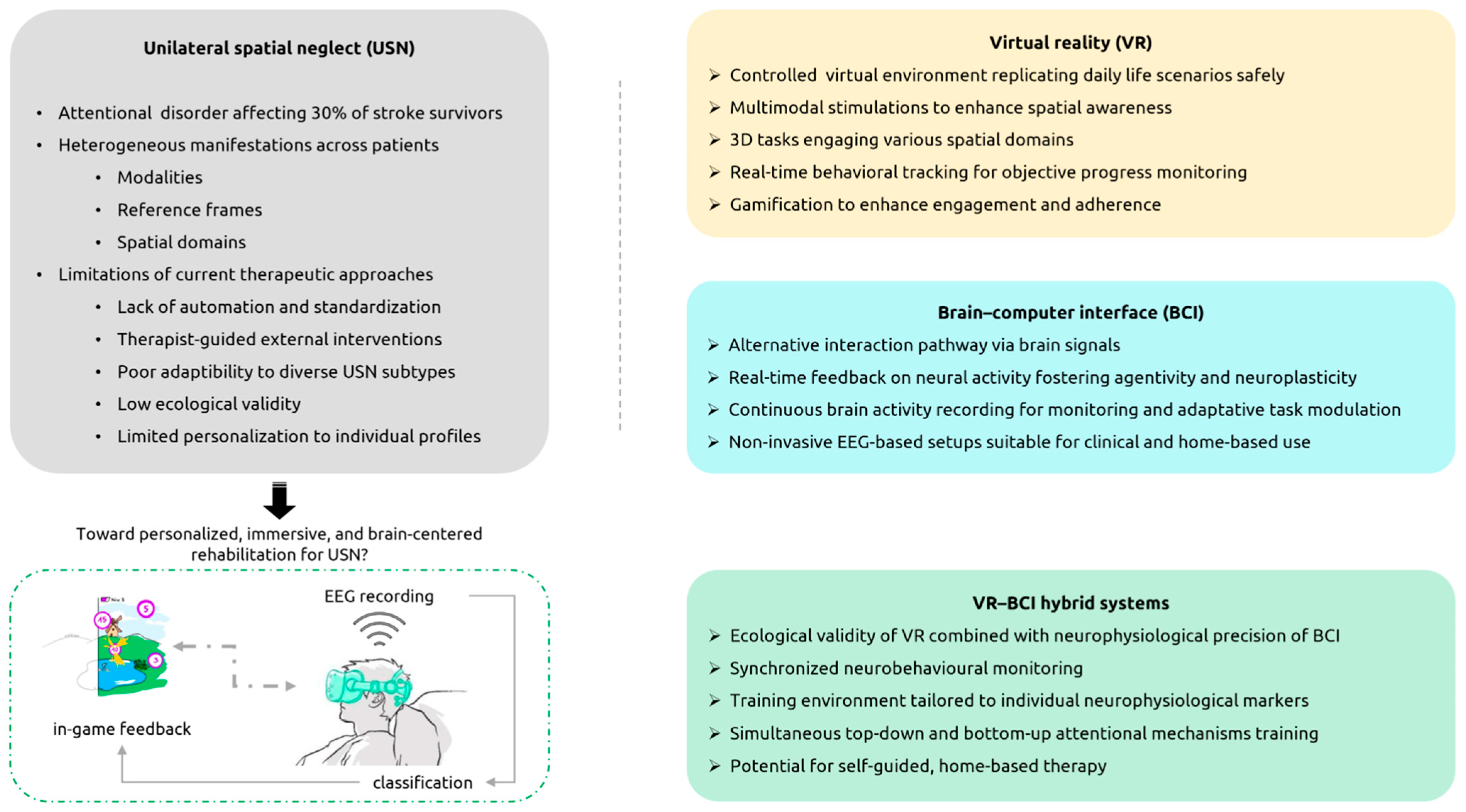
5.1. Rationale for VR-BCI Integration
5.2. Future of USN Rehabilitation: An Immersive BCI?
5.2.1. Increased VR and BCI-like Systems in USN Detection
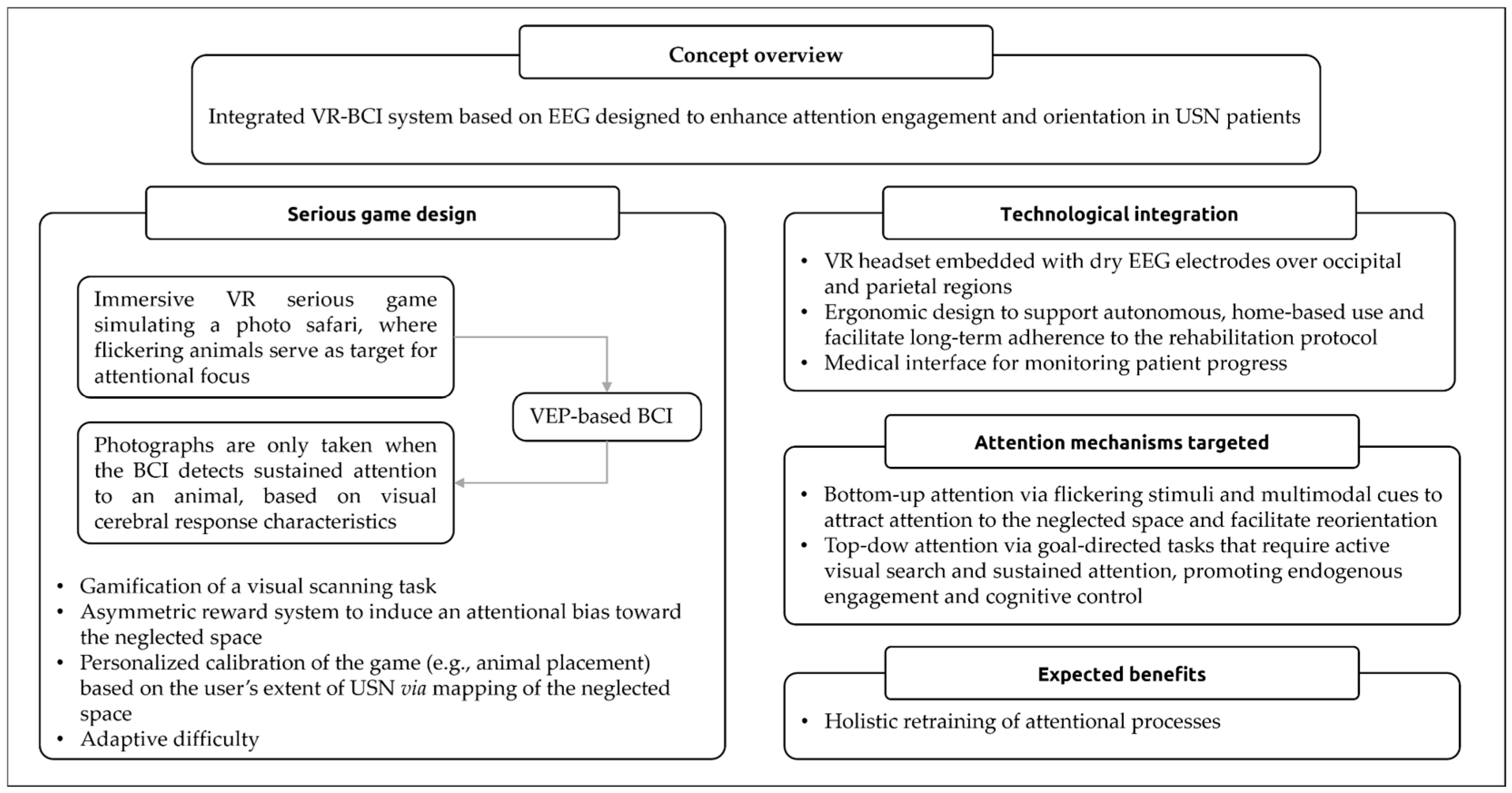
5.2.2. Actual Design Proposition—Integrated VR-BCI Approach for the Rehabilitation of USN
5.2.3. Limitations of VR-BCI Systems
6. Conclusions
7. Methodological Statement
Author Contributions
Funding
Institutional Review Board Statement
Informed Consent Statement
Data Availability Statement
Acknowledgments
Conflicts of Interest
Abbreviations
| AI | Artificial intelligence |
| AR | Augmented reality |
| BCI | Brain–computer interface |
| CVSA | Covert visuo-spatial attention |
| DAN | Dorsal attention network |
| EEG | Electroencephalography |
| ERP | Event-related potential |
| MI | Motor imagery |
| NF | Neurofeedback |
| USN | Unilateral spatial neglect |
| VAN | Ventral attention network |
| VEP | Visual evoked potential |
| VR | Virtual reality |
| VR-BCI | Virtual reality-based brain–computer interface |
Appendix A
Appendix A.1

| References | Study Type | Participants | Intervention | Assessment Methods | Main Outcomes | Follow-Up | Control Group |
|---|---|---|---|---|---|---|---|
| [22] | Multiple-baseline single-arm intervention | 15 USN patients after RHS | VR visual scanning task with multisensory stimulation and visuomotor activation of the contralesional hand. 3 sessions/week (1 h each) for 5 weeks. | VR neglect test battery (SCT, BTT, LB, EXT, Posner cueing task); CBS; 3 baseline sessions, post-interventions and CBS at 6-month follow-up. | Significant improvements on all tests; sustained effect at 6-month follow-up (CBS). | Yes (6-month) | No (single-arm multiple-baseline design) |
| [53] | Proof-of-concept/Methodological validation | 10 healthy participants | Immersive VR PA task; comparison of virtual and real prisms across three test modalities (real, mixed, virtual) with pointing tasks. 3 sessions per participant (one per modality). | Deviation angle in pointing tasks. | Virtual prisms induced aftereffects comparable to real prisms (leftward deviation); no retention effect at 2 h; VR system validated as a potential rehabilitation tool. | No (retention tested at 2 h post-exposure) | No (within subject comparison) |
| [56] | Pilot/case–control study | 19 USN patients after RHS divided into two groups: VR-group n = 11, Control group n = 8 | VR group: non-immersive virtual street-crossing training; Control group: standard computer-based visual scanning task. 12 sessions over 4 weeks. | Pen-and-paper tests, ADL checklist; performance on a virtual street-crossing task; real-world street-crossing performance. Pre-/post-intervention. | VR and Control groups improved equally on standard USN measures. VR group outperformed controls on the VR test and some real-world street-crossing. | No | Yes |
| [60] | Feasibility study | 15 healthy controls (Phase 1); 7 stroke patients with/without USN (Phase 2–3) | Immersive VR game; gamified visual discrimination tasks in naturalistic scenes with patient-tailored multisensory cues. Phase 1–2: stroke patients and healthy controls, single session; Phase 3: USN patients, 6 sessions over 6 days. | Simulator sickness questionnaire; user experience ratings; behavioral inattention test, pen-and-paper/computerized cancellation task, figure copy; in-game performance metrics. | VR game feasible and well tolerated; USN symptoms accurately detected in VR tasks; multisensory cues improved contralesional target detection in USN patients. | No | No (within-subject comparisons; placebo game in some Phase) |
| [65] | Experimental controlled study | 30 healthy participants divided into 3 groups (10 participants each): control, little interaction group, high interaction group. | Immersive VR PA pointing task; participants performed 0 (control), 5 (little interaction group) or 35 (high interaction group) pointing movements in adaptation phase depending on their group. Single session. | Deviation angle in pointing tasks (baseline, adaptation, readaptation phases); magnitude and persistence of aftereffect measured post-adaptation. | Results consistent with conventional PA studies; dose-dependent adaptation aftereffect in magnitude and persistence from 5 pointing movements during adaptation phase | No | Yes |
| [66] | Sham-controlled experimental study | 45 healthy participants divided into 3 groups: rightward PA (n = 16), leftward PA (n = 14), sham (n = 14) | Immersive VR PA; gamified catching tasks with visuomotor rotation (rightward, leftward, or sham). Single session. | Behavioral aftereffects measures; fMRI connectivity pre/post adaptation (resting-state and naturalistic video viewing). | VR PA induced sensorimotor rightward/leftward; upregulation of parieto-occipital activity during naturalistic viewing after rightward PA; neural changes correlated with behavioral changes. | No (retention tested at 40 min post-adaptation) | Yes |
| [68] | Double-blind, within-subject study | 15 patients with left USN after RHS | Immersive VR PA; pointing task with gradual rightward shift (0°, 15°, 30°) of controller image. Each patient completed one session per condition in randomized order. | Pointing deviation angle; LB, target cancellation pre/post adaptation; awareness questionnaire. | Dose-dependent adaptation effects in pointing deviation (greater leftward after-effect at 30°); no significant transfer to USN measures. | No | No (within-subject design: 0° deviation as control) |
| [70] | Randomized controlled trial | 11 USN patients after RHS divided into 2 groups: training with VR visual exploration therapy then waiting without this training (TW, n = 5) or vice versa (WT, n = 6) | VR visual exploration task; patients had to detect targets among distractors, arranged in three-dimensional spherical spaces around them. Waiting: 4 weeks; training: 5 session/day over 4 weeks; similar conventional rehabilitation throughout the intervention period. | Clinical USN measurements (LB, SCT, CBS); VR-based metrics (field of perception and field of regard: response time, success rate, head movement). | Significant improvements on clinical tests performance; enhanced detection and response speed, particularly for affected hemispace. | No | No (waiting period) |
| [69] | Feasibility/case-series study | 3 left-sided USN patients after stroke | Immersive VR reaching task with gradual visuomotor misalignment (prism adaptation inspired mechanisms). 5 sessions within 10 days. | BIT at 3 baselines; immediately post-intervention, and 2-week follow-up; user experience-related questionnaires. | Immediate improvement in test accuracy for all participants; sustained improvement at 2 weeks for 2 participants; good user experience. | Yes (2-week follow-up assessment) | No (multi-baseline design) |
| [72] | Usability study | 10 USN patients after stroke, 5 clinicians | Development and iterative testing of immersive VR game-like tasks targeting neglected space (e.g., arm-reaching task with virtual visuomotor misalignment, head-turning and combined head/arm movements). | User experience-related questionnaires and interviews. | Patients reported good usability, comfort, and preference for VR over conventional therapy; no cybersickness; clinicians satisfied with interface. No USN outcome data. | NA | NA |
| [73] | Placebo-controlled longitudinal study | 6 USN patients after RHS (2 completed full protocol) | Immersive VR game with multisensory stimulation; gamified visual discrimination tasks in naturalistic scenes; active condition with contralesional bias in target locations vs. placebo with central targets. 10 daily 1 h sessions per condition. | Posner cueing task; cancellation tests, LB, CBS, sustained attention task; in-game metrics; user experience and cybersickness metrics. 1-week follow-up. | Active VR training condition improved detection of left-sided targets within VR; no consistent transfer to non-VR tasks; minimal cybersickness. | Yes (1-week follow-up assessment) | Yes |
| [74] | Feasibility/case–control study | 27 patients with RHS divided into 2 groups: USN+ (with USN, n = 12), USN− (without USN, n = 15); 9 healthy controls | VR visual search and detection of items while navigating a virtual grocery store, either in a simple or cluttered scene. Single session. | Standard USN assessment (LB, SCT, apples test); detection and navigation task metrics (detection time, maximal mediolateral deviation from ideal trajectory, navigation time to target). | Worse performance in USN+ vs. USN− on neglect measures, with longer detection times, larger mediolateral deviations, and slower navigation, particularly in cluttered scene; no difference between healthy controls and USN−; VR system detected deficits missed by conventional tests. | No | Yes |
| [75] | Pilot/case–control study | 15 RHS patients divided into 2 groups: Neglect (with USN, n = 10) and No-Neglect (without USN, n = 5); 35 healthy controls | VR cancellation task of targets, among distractors, arranged in a three-dimensional space around the patient. | Pen-and-paper/VR cancellation tasks. | Neglect performed worse than No-Neglect and healthy controls on both tasks; similar performance in USN detection for VR and pen-and-paper tasks; good usability and acceptance of the VR task. | NA | Yes |
| [76] | Case report | 1 acute USN patient after RHS | VR balloon detection in eight spatial quadrants; treatment involved repeated practice under tilted background condition. | Clinical USN assessment (CBS, conventional pen-and-paper tests); VR evaluation (reaction time to target appearance in left/right, upper/lower, proximal/distal spaces). | VR detected mild neglect missed by conventional tests; reaction time significantly slower for left and proximal space pre-treatment; improved awareness of left space post-treatment; upper space awareness improved. | No | No |
| [77] | Feasibility study | 39 healthy participants | Immersive VR tasks assessing near and far space neglect in ecological environments. | VR metrics: exploration time, omissions, time-to-reach, reaction time, head/gaze/hand tracking; comparison with pen-and-paper tests. | VR tasks well tolerated; high usability and presence; very low omission rates; left/right asymmetries in exploration and reaction time. | No | No |
| [78] | Pilot/case-series study | 10 USN patients after RHS | Immersive VR visual search task for far space, reaching task for near space; moving slit to promote leftward attention shift. Single session. | Line cancellation, SCT, letter cancellation, LB tests for near and far space pre/post session. | Significant improvement in far space and cancellation tasks; near space and LB unchanged. | No | No |
| [79] | Proof-of concept study | 21 USN patients after RHS divided into 2 groups: Experiment I (n = 9), Experiment II (n = 12) | Auditory stimulation using preferred music with spatial cueing (moving right to left) vs. without cueing. Randomized single-blind cross-over design. Experiment I: 5 patients started with cueing condition; 1 session per condition on separate days. Experiment II: 7 patients started with cueing condition; 1 session per condition on separate days. | Standard USN assessment tests (letter cancellation, LB, CBS). Experiment I: letter cancellation pre/post auditory stimulation; Experiment II: free visual exploration with video-oculography before and 1 h/3 h post stimulation. | Auditory spatial cueing improved neglect vs. no cueing, with stronger and longer-lasting effects. Experiment I: cueing improved immediate letter cancellation score vs. no cue. Experiment II: cueing only led to leftward gaze shift at 3 h post-intervention; increased exploration area at both 1 h and 3 h post-intervention, mainly in contralesional space. | No | No |
| [80] | Pilot study | 12 USN patients after RHS; 5 with somatosensory impairment, 7 without. | Immersive VR visual search task, patients had to search for birds located at 4 different angles around them; 4 conditions: no cue, auditory cue, tactile cue, combined audio-tactile cue. 1 session per condition, over 2 consecutive days. | Task performance metrics; early orientation; system usability scale; simulator sickness questionnaire | Cueing significantly improved performance vs. no cue, especially for contralesional targets; all cue types triggered better early orientation; no additive benefit of combined cues. | No | No (within-subject comparison) |
| [81] | Experimental study | 41 healthy participants divided into 2 groups: high reward on left, high reward on right. | Immersive VR exploration using CAVE system; navigation with detection tasks followed by exploration task; asymmetric reward contingencies (high reward for targets on one side, low reward on the other). Single session. | Eye-tracking (gaze orientation); exploration trajectories; spatial choices at path trifurcation. | Reward learning in VR biased visual attention and eye movements toward high-rewarded side; left-side high rewards increased leftward gaze fixations and modest bias during exploration; no generalization to spatial choices. | No | No (group comparison, no sham condition) |
| [82] | Experimental study (within-subject design) | 20 RHS patients divided into 2 groups: with USN (n = 10), without USN (n = 10) | Computerized visual search task with spatial cueing and reward learning: targets preceded by valid/invalid cues, distractors associated with high or low reward during training. Single session. | Reaction times to detect targets; effects of cue validity, target side, and distractor reward history; voxel-based lesion-symptom mapping. | Rewarded distractors strongly interfered with reorienting to left targets after invalid cues in USN group, especially when both were contralesional; effect correlated with USN severity; stronger reward bias linked to right angular gyrus and occipito-temporal lesions. | No | Yes |
| [84] | 13 chronic USN patients after RHS | Immersive VR gamified scanning training (RehAtt) with multisensory stimulation and contralesional hand activation via haptic feedback. 5-week training. | Behavioral tests (Posner cueing task, SCT, EXT, BTT, CBS) pre/post training; resting-state fMRI connectivity pre/post training. | Improved neglect symptoms and increased interhemispheric functional connectivity within the DAN; DAN showed greater spatial remapping than other networks. | No | No | |
| [86] | Proof-of-concept study | 21 young healthy participants, 23 elderly healthy participants, 11 USN patients after RHS | Immersive VR visual search task in 360° naturalistic environment; moving targets tagged with handheld controller; adaptive difficulty scaling based on performance; patient version simplified (fewer distractors, slower targets). Single session. | Usability questionnaires; in-game behavioral metrics: mean search time, controller position, spatial exploration; USN test (cancellation task). | High usability across groups. USN patients showed typical rightward bias and prolonged search for left targets, correlated with severity; effective capture of neglect patterns. | No | No (healthy participants served as reference for usability, not as experimental controls) |
| [87] | Pilot study | 13 brain injury patients including 3 with USN, 9 clinician controls | Immersive VR visual search and detection tasks; six levels with increasing complexity; normative modeling to detect visuospatial atypicality. Single session. | Standard USN assessment tests (CLOX, single letter cancellation, Albert’s test); VR metrics: accuracy, reaction time, headset/controller orientation; usability and motion sickness questionnaires. | VR task well tolerated in all groups; atypicality in VR metrics enabled identification of all patients with USN identified by standard tests as well as additional cases under-detected by conventional assessment. | No | Yes |
Appendix A.2
| References | Study Type | Participants | Intervention | Assessment Methods | Main Outcomes | Follow-Up | Control Group |
|---|---|---|---|---|---|---|---|
| [39] | Feasibility study/case series | 3 chronic USN patients after RHS | EEG-based BCI control via covert attention shifting toward neglected hemispace; patients maintained fixation and pressed a button at target selection by the BCI. 6 sessions over 2 weeks. | Reaction time and EEG markers (alpha power, connectivity). | Improved reaction time for 2 patients; increased ipsilesional alpha power; reduced inter-hemispheric imbalance in parieto-occipital regions; enhanced functional connectivity in affected hemisphere. | No | No |
| [108] | Feasibility study/case series | 5 USN patients after RHS | EEG-based neurofeedback task targeting alpha rhythm downregulation at right posterior parietal cortex with visual feedback. 6 daily sessions over 1 week after 1-week baseline. | Alpha amplitude and variability; line bisection and bell cancellation tasks pre/post sessions. | Normalization of alpha variability post treatment; reduced omissions in neglected space; correlation between EEG changes and behavioral improvement. | No | No active control group (normative EEG comparison only) |
| [109] | Feasibility study/case series | 4 acute USN patients after RHS | EEG-based neurofeedback task; patients trained to downregulate alpha rhythm at right posterior parietal cortex via game-like visual feedback. Single 30 min session. | Line bisection, bell cancellation, scene copying before, after, and 1 week post session. | Reduced alpha amplitude during neurofeedback task; improved neglect score immediately and at 1 week but no significant difference between baseline and 1 week. | Yes (1 week) | No active control group (normative EEG comparison only) |
| [110] | Perspective with preliminary case-series results | fMRI: 7 chronic USN patients; EEG: USN patients, 4 acute and small chronic group | fMRI: neurofeedback task to upregulate right occipital cortex activity (3 sessions over 3 weeks); EEG: neurofeedback task to downregulate alpha rhythm over right parietal cortex (acute: 1 session; chronic: 5 sessions over 1 week). | Line bisection, bell cancellation, scene copying; EEG/fMRI markers. | fMRI: reduction in USN severity after 3 sessions. EEG: acute group, immediate improvement but not sustained; chronic group, moderate improvement in cancellation tasks correlated with alpha variability normalization. | No | No active control group (normative EEG comparison only) |
Appendix A.3
| References | Study Type | Participants | Intervention | Assessment Methods | Main Outcomes | Follow-Up | Control Group |
|---|---|---|---|---|---|---|---|
| [118] | Methodological validation/Proof-of-concept (model development and validation) | 21 stroke participants divided into 2 groups: with USN (n = 11), without USN (n = 10) | AR starry night task with concomitant EEG; evaluation of ESTNet deep learning model for mapping neglect severity across patient-specific field of view (post-session analysis). | Accuracy, sensitivity, specificity; saliency maps | High accuracy, sensitivity and specificity of the introduced model for detecting USN; potential as an effective tool for generalized USN assessment. | NA | |
| [128] | Proof-of-concept study | 9 healthy participants | Visual detection task in VR; 2 conditions: control vs. simulated USN (Left Occlusion); integrated eye-tracking; concomitant EEG. Single session. Study exploring multimodal mapping of spatial attention. | Reaction time, eye-gaze, head and controller movements; EEG band power and ERP analysis. | Worse behavioral performance in Left Occlusion condition (longer reaction time and rightward gaze bias); differences in neural activity between the two conditions; the system could be used as a diagnostic virtual reality tool for USN. | No | No (within subject only) |
| [132] | Feasibility/case–control study | 10 stroke participants divided into 2 groups: with USN (n = 5), without USN (n = 5). | AR starry night task with concomitant EEG (AREEN system); target detection among distractors. Single session. Study evaluating AREEN for USN detection capabilities (post hoc analysis). | Field of view mapping; EEG bandpower ratios; reaction time. | Accurate USN detection; accurate neglected target prediction in USN group based on EEG features. | NA | Yes |
| [137] | Conceptual design | NA | VR serious game integrating an EEG-based VEP BCI; visual scanning and detection task with gamified feedback; target capture via attention decoding. Adaptive interface/game to the patient profile. | Game performance metrics; neglected space mapping; EEG markers analysis. | Not yet tested. | NA | NA |
References
- Vos, T.; Lim, S.S.; Abbafati, C.; Abbas, K.M.; Abbasi, M.; Abbasifard, M.; Abbasi-Kangevari, M.; Abbastabar, H.; Abd-Allah, F.; Abdelalim, A.; et al. Global Burden of 369 Diseases and Injuries in 204 Countries and Territories, 1990–2019: A Systematic Analysis for the Global Burden of Disease Study 2019. Lancet 2020, 396, 1204–1222. [Google Scholar] [CrossRef]
- Feigin, V.L.; Brainin, M.; Norrving, B.; Martins, S.; Sacco, R.L.; Hacke, W.; Fisher, M.; Pandian, J.; Lindsay, P. World Stroke Organization (WSO): Global Stroke Fact Sheet 2022. Int. J. Stroke 2022, 17, 18–29. [Google Scholar] [CrossRef]
- Salvalaggio, A.; De Filippo De Grazia, M.; Zorzi, M.; Thiebaut de Schotten, M.; Corbetta, M. Post-Stroke Deficit Prediction from Lesion and Indirect Structural and Functional Disconnection. Brain 2020, 143, 2173–2188. [Google Scholar] [CrossRef] [PubMed]
- Li, X.; He, Y.; Wang, D.; Rezaei, M.J. Stroke Rehabilitation: From Diagnosis to Therapy. Front. Neurol. 2024, 15, 1402729. [Google Scholar] [CrossRef] [PubMed]
- Esposito, E.; Shekhtman, G.; Chen, P. Prevalence of Spatial Neglect Post-Stroke: A Systematic Review. Ann. Phys. Rehabil. Med. 2021, 64, 101459. [Google Scholar] [CrossRef] [PubMed]
- Heilman, K.M.; Valenstein, E. Mechanisms Underlying Hemispatial Neglect. Ann. Neurol. 1979, 5, 166–170. [Google Scholar] [CrossRef]
- Pedersen, P.M.; Jørgensen, H.S.; Nakayama, H.; Raaschou, H.O.; Olsen, T.S. Hemineglect in Acute Stroke-Incidence and Prognostic Implications. The Copenhagen Stroke Study. Am. J. Phys. Med. Rehabil. 1997, 76, 122–127. [Google Scholar] [CrossRef]
- Chen, P.; Hreha, K.; Kong, Y.; Barrett, A.M. Impact of Spatial Neglect in Stroke Rehabilitation: Evidence from the Setting of an Inpatient Rehabilitation Facility. Arch. Phys. Med. Rehabil. 2015, 96, 1458–1466. [Google Scholar] [CrossRef]
- Corbetta, M.; Shulman, G.L. Control of Goal-Directed and Stimulus-Driven Attention in the Brain. Nat. Rev. Neurosci. 2002, 3, 201–215. [Google Scholar] [CrossRef]
- Azouvi, P.; Jacquin-Courtois, S.; Luauté, J. Rehabilitation of Unilateral Neglect: Evidence-Based Medicine. Ann. Phys. Rehabil. Med. 2017, 60, 191–197. [Google Scholar] [CrossRef]
- Marín-Medina, D.S.; Arenas-Vargas, P.A.; Arias-Botero, J.C.; Gómez-Vásquez, M.; Jaramillo-López, M.F.; Gaspar-Toro, J.M. New Approaches to Recovery after Stroke. Neurol. Sci. 2023, 45, 55–63. [Google Scholar] [CrossRef]
- Morone, G.; Spitoni, G.F.; De Bartolo, D.; Ghanbari Ghooshchy, S.; Di Iulio, F.; Paolucci, S.; Zoccolotti, P.; Iosa, M. Rehabilitative Devices for a Top-down Approach. Expert Rev. Med. Devices 2019, 16, 187–195. [Google Scholar] [CrossRef]
- Mane, R.; Chouhan, T.; Guan, C. BCI for Stroke Rehabilitation: Motor and Beyond. J. Neural Eng. 2020, 17, 041001. [Google Scholar] [CrossRef] [PubMed]
- Mullick, A.A.; Subramanian, S.K.; Levin, M.F. Emerging Evidence of the Association between Cognitive Deficits and Arm Motor Recovery after Stroke: A Meta-Analysis. Restor. Neurol. Neurosci. 2015, 33, 389–403. [Google Scholar] [CrossRef] [PubMed]
- Cicerone, K.D.; Goldin, Y.; Ganci, K.; Rosenbaum, A.; Wethe, J.V.; Langenbahn, D.M.; Malec, J.F.; Bergquist, T.F.; Kingsley, K.; Nagele, D.; et al. Evidence-Based Cognitive Rehabilitation: Systematic Review of the Literature From 2009 Through 2014. Arch. Phys. Med. Rehabil. 2019, 100, 1515–1533. [Google Scholar] [CrossRef]
- Mane, R.; Chew, E.; Phua, K.S.; Ang, K.K.; Robinson, N.; Vinod, A.P.; Guan, C. Prognostic and Monitory EEG-Biomarkers for BCI Upper-Limb Stroke Rehabilitation. IEEE Trans. Neural Syst. Rehabil. Eng. 2019, 27, 1654–1664. [Google Scholar] [CrossRef]
- Bronte-Stewart, H.M.; Petrucci, M.N.; O’Day, J.J.; Afzal, M.F.; Parker, J.E.; Kehnemouyi, Y.M.; Wilkins, K.B.; Orthlieb, G.C.; Hoffman, S.L. Perspective: Evolution of Control Variables and Policies for Closed-Loop Deep Brain Stimulation for Parkinson’s Disease Using Bidirectional Deep-Brain-Computer Interfaces. Front. Hum. Neurosci. 2020, 14, 353. [Google Scholar] [CrossRef]
- Ma, Y.; Gong, A.; Nan, W.; Ding, P.; Wang, F.; Fu, Y. Personalized Brain-Computer Interface and Its Applications. J. Pers. Med. 2022, 13, 46. [Google Scholar] [CrossRef] [PubMed]
- Khan, A.; Imam, Y.Z.; Muneer, M.; Al Jerdi, S.; Gill, S.K. Virtual Reality in Stroke Recovery: A Meta-Review of Systematic Reviews. Bioelectron. Med. 2024, 10, 23. [Google Scholar] [CrossRef]
- Gamito, P.; Oliveira, J.; Coelho, C.; Morais, D.; Lopes, P.; Pacheco, J.; Brito, R.; Soares, F.; Santos, N.; Barata, A.F. Cognitive Training on Stroke Patients via Virtual Reality-Based Serious Games. Disabil. Rehabil. 2017, 39, 385–388. [Google Scholar] [CrossRef]
- Huang, Q.; Jiang, X.; Jin, Y.; Wu, B.; Vigotsky, A.D.; Fan, L.; Gu, P.; Tu, W.; Huang, L.; Jiang, S. Immersive Virtual Reality-Based Rehabilitation for Subacute Stroke: A Randomized Controlled Trial. J. Neurol. 2024, 271, 1256–1266. [Google Scholar] [CrossRef]
- Fordell, H.; Bodin, K.; Eklund, A.; Malm, J. RehAtt—Scanning Training for Neglect Enhanced by Multi-Sensory Stimulation in Virtual Reality. Top. Stroke Rehabil. 2016, 23, 191–199. [Google Scholar] [CrossRef] [PubMed]
- Chen, C.-H.; Kreidler, T.; Ochsenfahrt, A. Rehago—A Home-Based Training App Using Virtual Reality to Improve Functional Performance of Stroke Patients with Mirror Therapy and Gamification Concept: A Pilot Study. Stud. Health Technol. Inform. 2022, 292, 91–95. [Google Scholar] [CrossRef] [PubMed]
- Arpaia, P.; Coyle, D.; Esposito, A.; Natalizio, A.; Parvis, M.; Pesola, M.; Vallefuoco, E. Paving the Way for Motor Imagery-Based Tele-Rehabilitation through a Fully Wearable BCI System. Sensors 2023, 23, 5836. [Google Scholar] [CrossRef]
- Gebreheat, G.; Goman, A.; Porter-Armstrong, A. The Use of Home-Based Digital Technology to Support Post-Stroke Upper Limb Rehabilitation: A Scoping Review. Clin. Rehabil. 2024, 38, 60–71. [Google Scholar] [CrossRef]
- Angulo Medina, A.S.; Aguilar Bonilla, M.I.; Rodríguez Giraldo, I.D.; Montenegro Palacios, J.F.; Cáceres Gutiérrez, D.A.; Liscano, Y. Electroencephalography-Based Brain-Computer Interfaces in Rehabilitation: A Bibliometric Analysis (2013–2023). Sensors 2024, 24, 7125. [Google Scholar] [CrossRef] [PubMed]
- Vourvopoulos, A.; Fleury, M.; Blanco-Mora, D.A.; Fernandes, J.-C.; Figueiredo, P.; Bermúdez i Badia, S. Brain Imaging and Clinical Outcome of Embodied VR-BCI Training in Chronic Stroke Patients: A Longitudinal Pilot Study. Brain-Comput. Interfaces 2024, 11, 193–209. [Google Scholar] [CrossRef]
- Barker-Collo, S.L.; Feigin, V.L.; Lawes, C.M.M.; Parag, V.; Senior, H. Attention Deficits after Incident Stroke in the Acute Period: Frequency across Types of Attention and Relationships to Patient Characteristics and Functional Outcomes. Top. Stroke Rehabil. 2010, 17, 463–476. [Google Scholar] [CrossRef]
- Renjen, P.N.; Gauba, C.; Chaudhari, D. Cognitive Impairment After Stroke. Cureus 2015, 7, e335. [Google Scholar] [CrossRef]
- Bartolomeo, P.; Chokron, S. Orienting of Attention in Left Unilateral Neglect. Neurosci. Biobehav. Rev. 2002, 26, 217–234. [Google Scholar] [CrossRef]
- Rode, G.; Fourtassi, M.; Pagliari, C.; Pisella, L.; Rossetti, Y. Complexity vs. Unity in Unilateral Spatial Neglect. Rev. Neurol. 2017, 173, 440–450. [Google Scholar] [CrossRef] [PubMed]
- Buxbaum, L.J.; Ferraro, M.K.; Veramonti, T.; Farne, A.; Whyte, J.; Ladavas, E.; Frassinetti, F.; Coslett, H.B. Hemispatial Neglect: Subtypes, Neuroanatomy, and Disability. Neurology 2004, 62, 749–756. [Google Scholar] [CrossRef]
- Ten Brink, A.F.; Verwer, J.H.; Biesbroek, J.M.; Visser-Meily, J.M.A.; Nijboer, T.C.W. Differences between Left- and Right-Sided Neglect Revisited: A Large Cohort Study across Multiple Domains. J. Clin. Exp. Neuropsychol. 2017, 39, 707–723. [Google Scholar] [CrossRef]
- Beis, J.-M.; Keller, C.; Morin, N.; Bartolomeo, P.; Bernati, T.; Chokron, S.; Leclercq, M.; Louis-Dreyfus, A.; Marchal, F.; Martin, Y.; et al. Right Spatial Neglect after Left Hemisphere Stroke: Qualitative and Quantitative Study. Neurology 2004, 63, 1600–1605. [Google Scholar] [CrossRef] [PubMed]
- Shulman, G.L.; Pope, D.L.W.; Astafiev, S.V.; McAvoy, M.P.; Snyder, A.Z.; Corbetta, M. Right Hemisphere Dominance during Spatial Selective Attention and Target Detection Occurs Outside the Dorsal Frontoparietal Network. J. Neurosci. 2010, 30, 3640–3651. [Google Scholar] [CrossRef]
- Corbetta, M.; Kincade, M.J.; Lewis, C.; Snyder, A.Z.; Sapir, A. Neural Basis and Recovery of Spatial Attention Deficits in Spatial Neglect. Nat. Neurosci. 2005, 8, 1603–1610. [Google Scholar] [CrossRef]
- Umarova, R.M.; Nitschke, K.; Kaller, C.P.; Klöppel, S.; Beume, L.; Mader, I.; Martin, M.; Hennig, J.; Weiller, C. Predictors and Signatures of Recovery from Neglect in Acute Stroke. Ann. Neurol. 2016, 79, 673–686. [Google Scholar] [CrossRef]
- Pascual-Leone, A.; Amedi, A.; Fregni, F.; Merabet, L.B. The Plastic Human Brain Cortex. Annu. Rev. Neurosci. 2005, 28, 377–401. [Google Scholar] [CrossRef]
- Tonin, L.; Pitteri, M.; Leeb, R.; Zhang, H.; Menegatti, E.; Piccione, F.; Millán, J.d.R. Behavioral and Cortical Effects during Attention Driven Brain-Computer Interface Operations in Spatial Neglect: A Feasibility Case Study. Front. Hum. Neurosci. 2017, 11, 336. [Google Scholar] [CrossRef]
- Ueda, M.; Yuri, T.; Ueno, K.; Ishii, R.; Naito, Y. The Neurophysiological Features Associated with Unilateral Spatial Neglect Recovery: A Scoping Review. Brain Topogr. 2023, 36, 631–643. [Google Scholar] [CrossRef] [PubMed]
- Durfee, A.Z.; Hillis, A.E. Unilateral Spatial Neglect Recovery Poststroke. Stroke 2023, 54, 10–19. [Google Scholar] [CrossRef]
- Nijboer, T.C.W.; Kollen, B.J.; Kwakkel, G. Time Course of Visuospatial Neglect Early after Stroke: A Longitudinal Cohort Study. Cortex J. Devoted Study Nerv. Syst. Behav. 2013, 49, 2021–2027. [Google Scholar] [CrossRef] [PubMed]
- Vaes, N.; Nys, G.; Lafosse, C.; Dereymaeker, L.; Oostra, K.; Hemelsoet, D.; Vingerhoets, G. Rehabilitation of Visuospatial Neglect by Prism Adaptation: Effects of a Mild Treatment Regime. A Randomised Controlled Trial. Neuropsychol. Rehabil. 2018, 28, 899–918. [Google Scholar] [CrossRef] [PubMed]
- Gammeri, R.; Schintu, S.; Salatino, A.; Vigna, F.; Mazza, A.; Gindri, P.; Barba, S.; Ricci, R. Effects of Prism Adaptation and Visual Scanning Training on Perceptual and Response Bias in Unilateral Spatial Neglect. Neuropsychol. Rehabil. 2023, 34, 155–180. [Google Scholar] [CrossRef]
- Priftis, K.; Passarini, L.; Pilosio, C.; Meneghello, F.; Pitteri, M. Visual Scanning Training, Limb Activation Treatment, and Prism Adaptation for Rehabilitating Left Neglect: Who Is the Winner? Front. Hum. Neurosci. 2013, 7, 360. [Google Scholar] [CrossRef]
- Pitzalis, S.; Spinelli, D.; Vallar, G.; Di Russo, F. Transcutaneous Electrical Nerve Stimulation Effects on Neglect: A Visual-Evoked Potential Study. Front. Hum. Neurosci. 2013, 7, 111. [Google Scholar] [CrossRef]
- Frassinetti, F.; Rossi, M.; Làdavas, E. Passive Limb Movements Improve Visual Neglect. Neuropsychol. 2001, 39, 725–733. [Google Scholar] [CrossRef]
- Welfringer, A.; Leifert-Fiebach, G.; Babinsky, R.; Brandt, T. Visuomotor Imagery as a New Tool in the Rehabilitation of Neglect: A Randomised Controlled Study of Feasibility and Efficacy. Disabil. Rehabil. 2011, 33, 2033–2043. [Google Scholar] [CrossRef] [PubMed]
- Singh, N.R.; Leff, A.P. Advances in the Rehabilitation of Hemispatial Inattention. Curr. Neurol. Neurosci. Rep. 2023, 23, 33–48. [Google Scholar] [CrossRef]
- Guilbert, A. Clinical Assessment of Unilateral Spatial Neglect Dissociations and Heterogeneities: A Narrative Synthesis. Neuropsychology 2023, 37, 450–462. [Google Scholar] [CrossRef]
- Meidian, A.C.; Wahyuddin; Amimoto, K. Rehabilitation Interventions of Unilateral Spatial Neglect Based on the Functional Outcome Measure: A Systematic Review and Meta-Analysis. Neuropsychol. Rehabil. 2022, 32, 814–843. [Google Scholar] [CrossRef]
- Gammeri, R.; Iacono, C.; Ricci, R.; Salatino, A. Unilateral Spatial Neglect after Stroke: Current Insights. Neuropsychiatr. Dis. Treat. 2020, 16, 131–152. [Google Scholar] [CrossRef]
- Faity, G.; Sidahmed, Y.; Laffont, I.; Froger, J. Quantification and Rehabilitation of Unilateral Spatial Neglect in Immersive Virtual Reality: A Validation Study in Healthy Subjects. Sensors 2023, 23, 3481. [Google Scholar] [CrossRef] [PubMed]
- Rizzo, A.A.; Schultheis, M.; Kerns, K.A.; Mateer, C. Analysis of Assets for Virtual Reality Applications in Neuropsychology. Neuropsychol. Rehabil. 2004, 14, 207–239. [Google Scholar] [CrossRef]
- Salatino, A.; Zavattaro, C.; Gammeri, R.; Cirillo, E.; Piatti, M.L.; Pyasik, M.; Serra, H.; Pia, L.; Geminiani, G.; Ricci, R. Virtual Reality Rehabilitation for Unilateral Spatial Neglect: A Systematic Review of Immersive, Semi-Immersive and Non-Immersive Techniques. Neurosci. Biobehav. Rev. 2023, 152, 105248. [Google Scholar] [CrossRef] [PubMed]
- Katz, N.; Ring, H.; Naveh, Y.; Kizony, R.; Feintuch, U.; Weiss, P.L. Interactive Virtual Environment Training for Safe Street Crossing of Right Hemisphere Stroke Patients with Unilateral Spatial Neglect. Disabil. Rehabil. 2005, 27, 1235–1243. [Google Scholar] [CrossRef]
- Slater, M.; Perez-Marcos, D.; Ehrsson, H.H.; Sanchez-Vives, M.V. Towards a Digital Body: The Virtual Arm Illusion. Front. Hum. Neurosci. 2008, 2, 181. [Google Scholar] [CrossRef]
- Tieri, G.; Morone, G.; Paolucci, S.; Iosa, M. Virtual Reality in Cognitive and Motor Rehabilitation: Facts, Fiction and Fallacies. Expert Rev. Med. Devices 2018, 15, 107–117. [Google Scholar] [CrossRef]
- Richter, G.; Raban, D.; Rafaeli, S. Studying Gamification: The Effect of Rewards and Incentives on Motivation. In Gamification in Education and Business; Springer: Cham, Switzerland, 2015; pp. 21–46. ISBN 978-3-319-10207-8. [Google Scholar]
- Huygelier, H.; Schraepen, B.; Lafosse, C.; Vaes, N.; Schillebeeckx, F.; Michiels, K.; Note, E.; Vanden Abeele, V.; van Ee, R.; Gillebert, C.R. An Immersive Virtual Reality Game to Train Spatial Attention Orientation after Stroke: A Feasibility Study. Appl. Neuropsychol. Adult 2022, 29, 915–935. [Google Scholar] [CrossRef]
- Wiley, E.; Khattab, S.; Tang, A. Examining the Effect of Virtual Reality Therapy on Cognition Post-Stroke: A Systematic Review and Meta-Analysis. Disabil. Rehabil. Assist. Technol. 2022, 17, 50–60. [Google Scholar] [CrossRef]
- Bowen, A.; Hazelton, C.; Pollock, A.; Lincoln, N.B. Cognitive Rehabilitation for Spatial Neglect Following Stroke. Cochrane Database Syst. Rev. 2013, 7, CD003586. [Google Scholar] [CrossRef] [PubMed]
- Cavedoni, S.; Cipresso, P.; Mancuso, V.; Bruni, F.; Pedroli, E. Virtual Reality for the Assessment and Rehabilitation of Neglect: Where Are We Now? A 6-Year Review Update. Virtual Real. 2022, 26, 1663–1704. [Google Scholar] [CrossRef] [PubMed]
- Martino Cinnera, A.; Bisirri, A.; Chioccia, I.; Leone, E.; Ciancarelli, I.; Iosa, M.; Morone, G.; Verna, V. Exploring the Potential of Immersive Virtual Reality in the Treatment of Unilateral Spatial Neglect Due to Stroke: A Comprehensive Systematic Review. Brain Sci. 2022, 12, 1589. [Google Scholar] [CrossRef] [PubMed]
- Wähnert, S.; Gerhards, A. Sensorimotor Adaptation in VR: Magnitude and Persistence of the Aftereffect Increase with the Number of Interactions. Virtual Real. 2022, 26, 1217–1225. [Google Scholar] [CrossRef]
- Wilf, M.; Dupuis, C.; Nardo, D.; Huber, D.; Sander, S.; Al-Kaar, J.; Haroud, M.; Perrin, H.; Fornari, E.; Crottaz-Herbette, S.; et al. Virtual Reality-Based Sensorimotor Adaptation Shapes Subsequent Spontaneous and Naturalistic Stimulus-Driven Brain Activity. Cereb. Cortex 2023, 33, 5163–5180. [Google Scholar] [CrossRef]
- Culicetto, L.; Giustiniani, A.; Lo Buono, V.; Cazzato, V.; Falzone, A.; Vicario, C.M.; Quartarone, A.; Marino, S. From Real to Virtual Prism Adaptation Therapy: A Systematic Review on Benefits and Challenges of a New Potential Rehabilitation Approach. Front. Psychol. 2024, 15, 1391711. [Google Scholar] [CrossRef]
- Bourgeois, A.; Turri, F.; Schnider, A.; Ptak, R. Virtual Prism Adaptation for Spatial Neglect: A Double-Blind Study. Neuropsychol. Rehabil. 2022, 32, 1033–1047. [Google Scholar] [CrossRef]
- Chen, P.; Boukrina, O.; Krch, D. Visuomotor Misalignment Induced through Immersive Virtual Reality to Improve Spatial Neglect: A Case-Series Study. Neurocase 2022, 28, 393–402. [Google Scholar] [CrossRef]
- Shin, J.-H.; Kim, M.; Lee, J.-Y.; Kim, M.-Y.; Jeon, Y.-J.; Kim, K. Feasibility of Hemispatial Neglect Rehabilitation with Virtual Reality-Based Visual Exploration Therapy among Patients with Stroke: Randomised Controlled Trial. Front. Neurosci. 2023, 17, 1142663. [Google Scholar] [CrossRef]
- Bousché, E.; Bakker, M.D.J.; Holstege, M.S.; Huygelier, H.; Nijboer, T.C.W. Virtual and Augmented Reality Gamification of Visuospatial Neglect Treatment: Therapists’ User Experience. BMC Digit. Health 2024, 2, 9. [Google Scholar] [CrossRef]
- Chen, P.; Krch, D. Immersive Virtual Reality Treatment for Spatial Neglect: An Agile, User-Centered Development Process. Ann. Phys. Rehabil. Med. 2022, 65, 101592. [Google Scholar] [CrossRef]
- Huygelier, H.; Tuts, N.; Michiels, K.; Note, E.; Schillebeeckx, F.; Tournoy, J.; Vanden Abeele, V.; van Ee, R.; Gillebert, C.R. The Efficacy and Feasibility of an Immersive Virtual Reality Game to Train Spatial Attention Orientation after Stroke: A Stage 2 Report. J. Neuropsychol. 2025, 19, 338–389. [Google Scholar] [CrossRef]
- Numao, T.; Amimoto, K.; Shimada, T. Examination and Treatment of Unilateral Spatial Neglect Using Virtual Reality in Three-Dimensional Space. Neurocase 2021, 27, 447–451. [Google Scholar] [CrossRef]
- Ogourtsova, T.; Archambault, P.; Sangani, S.; Lamontagne, A. Ecological Virtual Reality Evaluation of Neglect Symptoms (EVENS): Effects of Virtual Scene Complexity in the Assessment of Poststroke Unilateral Spatial Neglect. Neurorehabil. Neural Repair 2018, 32, 46–61. [Google Scholar] [CrossRef] [PubMed]
- Knobel, S.E.J.; Kaufmann, B.C.; Gerber, S.M.; Cazzoli, D.; Müri, R.M.; Nyffeler, T.; Nef, T. Immersive 3D Virtual Reality Cancellation Task for Visual Neglect Assessment: A Pilot Study. Front. Hum. Neurosci. 2020, 14, 180. [Google Scholar] [CrossRef] [PubMed]
- Perez-Marcos, D.; Ronchi, R.; Giroux, A.; Brenet, F.; Serino, A.; Tadi, T.; Blanke, O. An Immersive Virtual Reality System for Ecological Assessment of Peripersonal and Extrapersonal Unilateral Spatial Neglect. J. Neuroeng. Rehabil. 2023, 20, 33. [Google Scholar] [CrossRef] [PubMed]
- Yasuda, K.; Muroi, D.; Ohira, M.; Iwata, H. Validation of an Immersive Virtual Reality System for Training Near and Far Space Neglect in Individuals with Stroke: A Pilot Study. Top. Stroke Rehabil. 2017, 24, 533–538. [Google Scholar] [CrossRef]
- Kaufmann, B.C.; Cazzoli, D.; Bartolomeo, P.; Frey, J.; Pflugshaupt, T.; Knobel, S.E.J.; Nef, T.; Müri, R.M.; Nyffeler, T. Auditory Spatial Cueing Reduces Neglect after Right-Hemispheric Stroke: A Proof of Concept Study. Cortex 2022, 148, 152–167. [Google Scholar] [CrossRef]
- Knobel, S.E.J.; Kaufmann, B.C.; Geiser, N.; Gerber, S.M.; Müri, R.M.; Nef, T.; Nyffeler, T.; Cazzoli, D. Effects of Virtual Reality–Based Multimodal Audio-Tactile Cueing in Patients With Spatial Attention Deficits: Pilot Usability Study. JMIR Serious Games 2022, 10, e34884. [Google Scholar] [CrossRef]
- Bourgeois, A.; Badier, E.; Baron, N.; Carruzzo, F.; Vuilleumier, P. Influence of Reward Learning on Visual Attention and Eye Movements in a Naturalistic Environment: A Virtual Reality Study. PLoS ONE 2018, 13, e0207990. [Google Scholar] [CrossRef]
- Bourgeois, A.; Saj, A.; Vuilleumier, P. Value-Driven Attentional Capture in Neglect. Cortex 2018, 109, 260–271. [Google Scholar] [CrossRef]
- Drigas, A.; Sideraki, A. Brain Neuroplasticity Leveraging Virtual Reality and Brain–Computer Interface Technologies. Sensors 2024, 24, 5725. [Google Scholar] [CrossRef]
- Wåhlin, A.; Fordell, H.; Ekman, U.; Lenfeldt, N.; Malm, J. Rehabilitation in Chronic Spatial Neglect Strengthens Resting-State Connectivity. Acta Neurol. Scand. 2019, 139, 254–259. [Google Scholar] [CrossRef] [PubMed]
- Li, X.; Luh, D.-B.; Xu, R.-H.; An, Y. Considering the Consequences of Cybersickness in Immersive Virtual Reality Rehabilitation: A Systematic Review and Meta-Analysis. Appl. Sci. 2023, 13, 5159. [Google Scholar] [CrossRef]
- Knobel, S.E.J.; Kaufmann, B.C.; Gerber, S.M.; Urwyler, P.; Cazzoli, D.; Müri, R.M.; Nef, T.; Nyffeler, T. Development of a Search Task Using Immersive Virtual Reality: Proof-of-Concept Study. JMIR Serious Games 2021, 9, e29182. [Google Scholar] [CrossRef]
- Painter, D.R.; Norwood, M.F.; Marsh, C.H.; Hine, T.; Harvie, D.; Libera, M.; Bernhardt, J.; Gan, L.; Zeeman, H. Immersive Virtual Reality Gameplay Detects Visuospatial Atypicality, Including Unilateral Spatial Neglect, Following Brain Injury: A Pilot Study. J. Neuroeng. Rehabil. 2023, 20, 161. [Google Scholar] [CrossRef] [PubMed]
- Chaudhary, U.; Birbaumer, N.; Ramos-Murguialday, A. Brain–Computer Interfaces for Communication and Rehabilitation. Nat. Rev. Neurol. 2016, 12, 513–525. [Google Scholar] [CrossRef]
- Daly, J.J.; Wolpaw, J.R. Brain–Computer Interfaces in Neurological Rehabilitation. Lancet Neurol. 2008, 7, 1032–1043. [Google Scholar] [CrossRef] [PubMed]
- Rao, R.P.N. Brain-Computer Interfacing: An Introduction, 1st ed.; Cambridge University Press: Cambridge, UK, 2019; ISBN 978-1-108-70801-2. [Google Scholar]
- Gramann, K.; Gwin, J.T.; Ferris, D.P.; Oie, K.; Jung, T.-P.; Lin, C.-T.; Liao, L.-D.; Makeig, S. Cognition in Action: Imaging Brain/Body Dynamics in Mobile Humans. Rev. Neurosci. 2011, 22, 593–608. [Google Scholar] [CrossRef]
- Jin, W.; Zhu, X.; Qian, L.; Wu, C.; Yang, F.; Zhan, D.; Kang, Z.; Luo, K.; Meng, D.; Xu, G. Electroencephalogram-Based Adaptive Closed-Loop Brain-Computer Interface in Neurorehabilitation: A Review. Front. Comput. Neurosci. 2024, 18, 1431815. [Google Scholar] [CrossRef]
- Nicolas-Alonso, L.F.; Gomez-Gil, J. Brain Computer Interfaces, a Review. Sensors 2012, 12, 1211–1279. [Google Scholar] [CrossRef] [PubMed]
- Mellinger, J.; Schalk, G.; Braun, C.; Preissl, H.; Rosenstiel, W.; Birbaumer, N.; Kübler, A. An MEG-Based Brain–Computer Interface (BCI). NeuroImage 2007, 36, 581–593. [Google Scholar] [CrossRef] [PubMed]
- Lee, J.-H.; Ryu, J.; Jolesz, F.A.; Cho, Z.-H.; Yoo, S.-S. Brain–Machine Interface via Real-Time fMRI: Preliminary Study on Thought-Controlled Robotic Arm. Neurosci. Lett. 2009, 450, 1–6. [Google Scholar] [CrossRef]
- Abiri, R.; Borhani, S.; Sellers, E.W.; Jiang, Y.; Zhao, X. A Comprehensive Review of EEG-Based Brain–Computer Interface Paradigms. J. Neural Eng. 2019, 16, 011001. [Google Scholar] [CrossRef]
- Mane, R.; Wu, Z.; Wang, D. Poststroke Motor, Cognitive and Speech Rehabilitation with Brain–Computer Interface: A Perspective Review. Stroke Vasc. Neurol. 2022, 7, 541–549. [Google Scholar] [CrossRef] [PubMed]
- Yao, Z.; Shan, G.; Song, W.; Ye, L. Electrophysiological Measures of Patients with Unilateral Spatial Neglect after Brain Disease: A Systematic Review. Brain Res. 2024, 1845, 149260. [Google Scholar] [CrossRef]
- Lasaponara, S.; Pinto, M.; Aiello, M.; Tomaiuolo, F.; Doricchi, F. The Hemispheric Distribution of α-Band EEG Activity During Orienting of Attention in Patients with Reduced Awareness of the Left Side of Space (Spatial Neglect). J. Neurosci. 2019, 39, 4332–4343. [Google Scholar] [CrossRef]
- Zhang, Y.; Ye, L.; Cao, L.; Song, W. Resting-State Electroencephalography Changes in Poststroke Patients with Visuospatial Neglect. Front. Neurosci. 2022, 16, 974712. [Google Scholar] [CrossRef]
- Ros, T.; Michela, A.; Mayer, A.; Bellmann, A.; Vuadens, P.; Zermatten, V.; Saj, A.; Vuilleumier, P. Disruption of Large-Scale Electrophysiological Networks in Stroke Patients with Visuospatial Neglect. Netw. Neurosci. 2022, 6, 69–89. [Google Scholar] [CrossRef]
- Di Russo, F.; Aprile, T.; Spitoni, G.; Spinelli, D. Impaired Visual Processing of Contralesional Stimuli in Neglect Patients: A Visual-Evoked Potential Study. Brain 2008, 131, 842–854. [Google Scholar] [CrossRef]
- Spinelli, D.; Burr, D.C.; Morrone, M.C. Spatial Neglect Is Associated with Increased Latencies of Visual Evoked Potentials. Vis. Neurosci. 1994, 11, 909–918. [Google Scholar] [CrossRef]
- Angelelli, P.; De Luca, M.; Spinelli, D. Early Visual Processing in Neglect Patients: A Study with Steady-State VEPs. Neuropsychologia 1996, 34, 1151–1157. [Google Scholar] [CrossRef] [PubMed]
- Morgan, S.T.; Hansen, J.C.; Hillyard, S.A. Selective Attention to Stimulus Location Modulates the Steady-State Visual Evoked Potential. Proc. Natl. Acad. Sci. USA 1996, 93, 4770–4774. [Google Scholar] [CrossRef]
- Kashiwase, Y.; Matsumiya, K.; Kuriki, I.; Shioiri, S. Time Courses of Attentional Modulation in Neural Amplification and Synchronization Measured with Steady-State Visual-Evoked Potentials. J. Cogn. Neurosci. 2012, 24, 1779–1793. [Google Scholar] [CrossRef]
- Di Russo, F.; Bozzacchi, C.; Matano, A.; Spinelli, D. Hemispheric Differences in VEPs to Lateralised Stimuli Are a Marker of Recovery from Neglect. Cortex 2013, 49, 931–939. [Google Scholar] [CrossRef]
- Ros, T.; Michela, A.; Bellman, A.; Vuadens, P.; Saj, A.; Vuilleumier, P. Increased Alpha-Rhythm Dynamic Range Promotes Recovery from Visuospatial Neglect: A Neurofeedback Study. Neural Plast. 2017, 2017, 7407241. [Google Scholar] [CrossRef]
- Saj, A.; Ros, T.; Michela, A.; Vuilleumier, P. Effect of a Single Early EEG Neurofeedback Training on Remediation of Spatial Neglect in the Acute Phase. Ann. Phys. Rehabil. Med. 2018, 61, 111–112. [Google Scholar] [CrossRef]
- Saj, A.; Pierce, J.E.; Ronchi, R.; Ros, T.; Thomasson, M.; Bernati, T.; Van De Ville, D.; Serino, A.; Vuilleumier, P. Real-Time fMRI and EEG Neurofeedback: A Perspective on Applications for the Rehabilitation of Spatial Neglect. Ann. Phys. Rehabil. Med. 2021, 64, 101561. [Google Scholar] [CrossRef] [PubMed]
- Merzenich, M.M.; Van Vleet, T.M.; Nahum, M. Brain Plasticity-Based Therapeutics. Front. Hum. Neurosci. 2014, 8, 385. [Google Scholar] [CrossRef] [PubMed]
- Thompson, M.C. Critiquing the Concept of BCI Illiteracy. Sci. Eng. Ethics 2019, 25, 1217–1233. [Google Scholar] [CrossRef]
- Myrden, A.; Chau, T. Effects of User Mental State on EEG-BCI Performance. Front. Hum. Neurosci. 2015, 9, 308. [Google Scholar] [CrossRef] [PubMed]
- Lotte, F.; Bougrain, L.; Cichocki, A.; Clerc, M.; Congedo, M.; Rakotomamonjy, A.; Yger, F. A Review of Classification Algorithms for EEG-Based Brain–Computer Interfaces: A 10 Year Update. J. Neural Eng. 2018, 15, 031005. [Google Scholar] [CrossRef] [PubMed]
- Lawhern, V.J.; Solon, A.J.; Waytowich, N.R.; Gordon, S.M.; Hung, C.P.; Lance, B.J. EEGNet: A Compact Convolutional Network for EEG-Based Brain-Computer Interfaces. J. Neural Eng. 2018, 15, 056013. [Google Scholar] [CrossRef] [PubMed]
- Cabrera Castillos, K.; Ladouce, S.; Darmet, L.; Dehais, F. Burst C-VEP Based BCI: Optimizing Stimulus Design for Enhanced Classification with Minimal Calibration Data and Improved User Experience. NeuroImage 2023, 284, 120446. [Google Scholar] [CrossRef]
- Awuah, W.A.; Ahluwalia, A.; Darko, K.; Sanker, V.; Tan, J.K.; Tenkorang, P.O.; Ben-Jaafar, A.; Ranganathan, S.; Aderinto, N.; Mehta, A.; et al. Bridging Minds and Machines: The Recent Advances of Brain-Computer Interfaces in Neurological and Neurosurgical Applications. World Neurosurg. 2024, 189, 138–153. [Google Scholar] [CrossRef]
- Kocanaogullari, D.; Gall, R.; Mak, J.; Huang, X.; Mullen, K.; Ostadabbas, S.; Wittenberg, G.F.; Grattan, E.S.; Akcakaya, M. Patient-Specific Visual Neglect Severity Estimation for Stroke Patients with Neglect Using EEG. J. Neural Eng. 2024, 21, 066014. [Google Scholar] [CrossRef]
- He, J.; Yuan, Z.; Quan, L.; Xi, H.; Guo, J.; Zhu, D.; Chen, M.; Yang, B.; Cui, Z.; Zhu, S.; et al. Multimodal Assessment of a BCI System for Stroke Rehabilitation Integrating Motor Imagery and Motor Attempts: A Randomized Controlled Trial. J. Neuroeng. Rehabil. 2025, 22, 185. [Google Scholar] [CrossRef]
- Wan, C.; Zhang, Q.; Qiu, Y.; Zhang, W.; Nie, Y.; Zeng, S.; Wang, J.; Shen, X.; Yu, C.; Wu, X.; et al. Effects of Dual-Task Mode Brain-Computer Interface Based on Motor Imagery and Virtual Reality on Balance and Attention in Patients with Stroke: A Randomized Controlled Pilot Trial. J. Neuroeng. Rehabil. 2025, 22, 187. [Google Scholar] [CrossRef]
- Volosyak, I.; Rezeika, A.; Benda, M.; Gembler, F.; Stawicki, P. Towards Solving of the Illiteracy Phenomenon for VEP-Based Brain-Computer Interfaces. Biomed. Phys. Eng. Express 2020, 6, 035034. [Google Scholar] [CrossRef]
- Dreyer, A.M.; Herrmann, C.S.; Rieger, J.W. Tradeoff between User Experience and BCI Classification Accuracy with Frequency Modulated Steady-State Visual Evoked Potentials. Front. Hum. Neurosci. 2017, 11, 391. [Google Scholar] [CrossRef]
- Auda, J.; Gruenefeld, U.; Kosch, T.; Schneegaß, S. The Butterfly Effect: Novel Opportunities for Steady-State Visually-Evoked Potential Stimuli in Virtual Reality. In Proceedings of the Augmented Humans International Conference 2022, Kashiwa, Japan, 13–15 March 2022. [Google Scholar]
- Ladouce, S.; Darmet, L.; Torre Tresols, J.J.; Velut, S.; Ferraro, G.; Dehais, F. Improving User Experience of SSVEP BCI through Low Amplitude Depth and High Frequency Stimuli Design. Sci. Rep. 2022, 12, 8865. [Google Scholar] [CrossRef] [PubMed]
- Dehais, F.; Cabrera Castillos, K.; Ladouce, S.; Clisson, P. Leveraging Textured Flickers: A Leap toward Practical, Visually Comfortable, and High-Performance Dry EEG Code-VEP BCI. J. Neural Eng. 2024, 21, 066023. [Google Scholar] [CrossRef]
- Reitelbach, C.; Oyibo, K. Optimal Stimulus Properties for Steady-State Visually Evoked Potential Brain–Computer Interfaces: A Scoping Review. Multimodal Technol. Interact. 2024, 8, 6. [Google Scholar] [CrossRef]
- Thielen, J. Addressing BCI Inefficiency in C-VEP-Based BCIs: A Comprehensive Study of Neurophysiological Predictors, Binary Stimulus Sequences, and User Comfort. Biomed. Phys. Eng. Express 2025, 11, 045017. [Google Scholar] [CrossRef] [PubMed]
- Eudave, L.; Vourvopoulos, A. Multimodal Mapping of Spatial Attention for Unilateral Spatial Neglect in VR: A Proof of Concept Study Using Eye-Tracking and Mobile EEG. Virtual Real. 2025, 29, 24. [Google Scholar] [CrossRef]
- Leeb, R.; Pérez-Marcos, D. Chapter 14—Brain-Computer Interfaces and Virtual Reality for Neurorehabilitation. In Handbook of Clinical Neurology; Ramsey, N.F., Millán, J.d.R., Eds.; Brain-Computer Interfaces; Elsevier: Amsterdam, The Netherlands, 2020; Volume 168, pp. 183–197. [Google Scholar]
- Blanco-Mora, D.A.; Aldridge, A.; Jorge, C.; Vourvopoulos, A.; Figueiredo, P.; Bermúdez i Badia, S. Impact of Age, VR, Immersion, and Spatial Resolution on Classifier Performance for a MI-Based BCI. Brain-Comput. Interfaces 2022, 9, 169–178. [Google Scholar] [CrossRef]
- Nunes, J.D.; Vourvopoulos, A.; Blanco-Mora, D.A.; Jorge, C.; Fernandes, J.-C.; Bermúdez i Badia, S.; Figueiredo, P. Brain Activation by a VR-Based Motor Imagery and Observation Task: An fMRI Study. PLoS ONE 2023, 18, e0291528. [Google Scholar] [CrossRef]
- Mak, J.; Kocanaogullari, D.; Huang, X.; Kersey, J.; Shih, M.; Grattan, E.S.; Skidmore, E.R.; Wittenberg, G.F.; Ostadabbas, S.; Akcakaya, M. Detection of Stroke-Induced Visual Neglect and Target Response Prediction Using Augmented Reality and Electroencephalography. IEEE Trans. Neural Syst. Rehabil. Eng. 2022, 30, 1840–1850. [Google Scholar] [CrossRef]
- Berger, L.M.; Wood, G.; Kober, S.E. Effects of Virtual Reality-Based Feedback on Neurofeedback Training Performance—A Sham-Controlled Study. Front. Hum. Neurosci. 2022, 16, 952261. [Google Scholar] [CrossRef]
- Guo, N.; Wang, X.; Duanmu, D.; Huang, X.; Li, X.; Fan, Y.; Li, H.; Liu, Y.; Yeung, E.H.K.; To, M.K.T.; et al. SSVEP-Based Brain Computer Interface Controlled Soft Robotic Glove for Post-Stroke Hand Function Rehabilitation. IEEE Trans. Neural Syst. Rehabil. Eng. 2022, 30, 1737–1744. [Google Scholar] [CrossRef]
- Ferrero, L.; Quiles, V.; Ortiz, M.; Iáñez, E.; Gil-Agudo, Á.; Azorín, J.M. Brain-Computer Interface Enhanced by Virtual Reality Training for Controlling a Lower Limb Exoskeleton. iScience 2023, 26, 106675. [Google Scholar] [CrossRef]
- Kober, S.E.; Wood, G.; Berger, L.M. Controlling Virtual Reality with Brain Signals: State of the Art of Using VR-Based Feedback in Neurofeedback Applications. Appl. Psychophysiol. Biofeedback 2024, 50, 593–612. [Google Scholar] [CrossRef]
- Delaux, A.; Gouret, A.; Carponcy, J.; Porssut, T.; Rouzé, S.; Waszak, F.; Chokron, S.; Bars, S.L. In Search of Lost Attention: A BCI-Based Therapeutical Safari Tour in VR. In Proceedings of the 2024 IEEE International Conference on Metrology for eXtended Reality, Artificial Intelligence and Neural Engineering (MetroXRAINE), St. Albans, UK, 21–23 October 2024; pp. 1112–1117. [Google Scholar]
- Alimardani, M.; Nishio, S.; Ishiguro, H. Effect of Biased Feedback on Motor Imagery Learning in BCI-Teleoperation System. Front. Syst. Neurosci. 2014, 8, 52. [Google Scholar] [CrossRef] [PubMed]
- Piszcz, A.; Rojek, I.; Mikołajewski, D. Impact of Virtual Reality on Brain–Computer Interface Performance in IoT Control—Review of Current State of Knowledge. Appl. Sci. 2024, 14, 10541. [Google Scholar] [CrossRef]
- Mannan, M.M.N.; Kamran, M.A.; Kang, S.; Choi, H.S.; Jeong, M.Y. A Hybrid Speller Design Using Eye Tracking and Ssvep Brain-Computer Interface. Sensors 2020, 20, 891. [Google Scholar] [CrossRef]
- Ha, J.; Park, S.; Im, C.-H. Novel Hybrid Brain-Computer Interface for Virtual Reality Applications Using Steady-State Visual-Evoked Potential-Based Brain–Computer Interface and Electrooculogram-Based Eye Tracking for Increased Information Transfer Rate. Front. Neuroinformatics 2022, 16, 758537. [Google Scholar] [CrossRef] [PubMed]


Disclaimer/Publisher’s Note: The statements, opinions and data contained in all publications are solely those of the individual author(s) and contributor(s) and not of MDPI and/or the editor(s). MDPI and/or the editor(s) disclaim responsibility for any injury to people or property resulting from any ideas, methods, instructions or products referred to in the content. |
© 2026 by the authors. Licensee MDPI, Basel, Switzerland. This article is an open access article distributed under the terms and conditions of the Creative Commons Attribution (CC BY) license.
Share and Cite
Gouret, A.; Delaux, A.; Le Bars, S.; Chokron, S. Rewiring Attention: Virtual Reality and Brain–Computer Interfaces in the Rehabilitation of Unilateral Spatial Neglect. J. Clin. Med. 2026, 15, 1036. https://doi.org/10.3390/jcm15031036
Gouret A, Delaux A, Le Bars S, Chokron S. Rewiring Attention: Virtual Reality and Brain–Computer Interfaces in the Rehabilitation of Unilateral Spatial Neglect. Journal of Clinical Medicine. 2026; 15(3):1036. https://doi.org/10.3390/jcm15031036
Chicago/Turabian StyleGouret, Alix, Alexandre Delaux, Solène Le Bars, and Sylvie Chokron. 2026. "Rewiring Attention: Virtual Reality and Brain–Computer Interfaces in the Rehabilitation of Unilateral Spatial Neglect" Journal of Clinical Medicine 15, no. 3: 1036. https://doi.org/10.3390/jcm15031036
APA StyleGouret, A., Delaux, A., Le Bars, S., & Chokron, S. (2026). Rewiring Attention: Virtual Reality and Brain–Computer Interfaces in the Rehabilitation of Unilateral Spatial Neglect. Journal of Clinical Medicine, 15(3), 1036. https://doi.org/10.3390/jcm15031036