Through Massage to the Brain—Neuronal and Neuroplastic Mechanisms of Massage Based on Various Neuroimaging Techniques (EEG, fMRI, and fNIRS)

Abstract
1. Introduction
- Map acute neural effects of massage within each modality (e.g., EEG spectral power/connectivity, fMRI task/rest BOLD activation and functional connectivity, fNIRS hemodynamic responses);
- Identify convergent mechanistic patterns across modalities and populations (healthy participants and clinical cohorts);
- Evaluate signals consistent with neuroplasticity, including longitudinal changes after multi-session programs, developmental maturation effects, or persistent network alterations at follow-up;
- Highlight methodological gaps (intervention heterogeneity, controls, outcome harmonization) and propose priorities for future multimodal, longitudinal studies.
2. Materials and Methods
2.1. Data Sources and Search Strategy
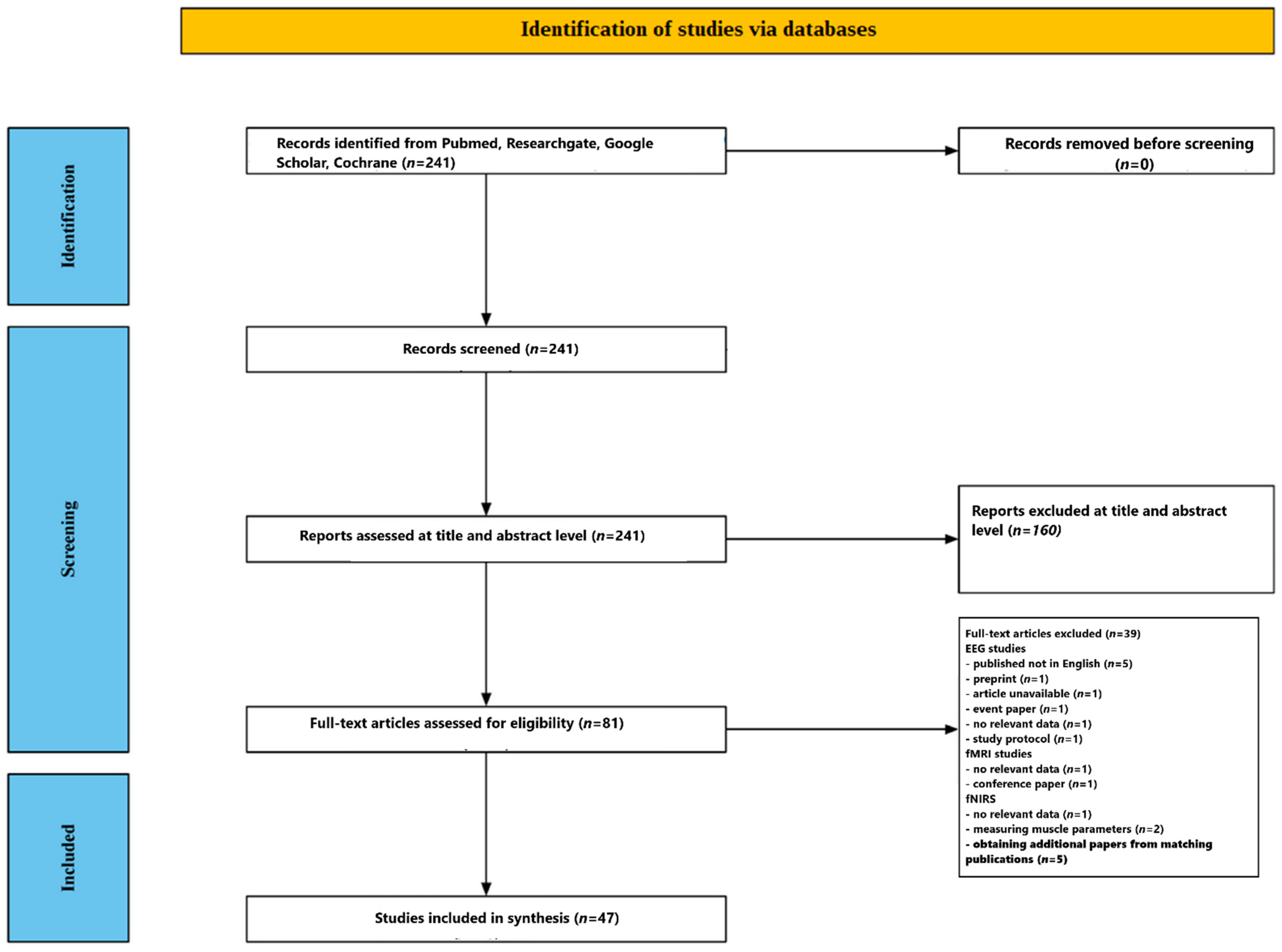
2.2. Study Selection Criteria
- Evaluated a massage intervention (e.g., Swedish, Thai, shiatsu, tui na/tuina, reflexology, myofascial release, or other practitioner-delivered manual massage);
- Measured brain activity with EEG, fMRI, or fNIRS either pre/post-intervention or between groups.
2.3. Screening Process
2.3.1. Title and Abstract Screening
2.3.2. Full-Text Assessment
2.4. Data Extraction and Synthesis
2.5. Operational Definitions and Scope
2.6. Critical Appraisal and Risk of Bias
3. Results
3.1. EEG Studies
3.1.1. Participants’ Characteristics
3.1.2. Types of Massage Interventions
3.1.3. Types of EEG Measurements
3.1.4. Massage Parameters (Site, Duration, Frequency, and Delivery Mode)
3.1.5. Pressure/Intensity Reporting and Evidence of Intensity-Dependence
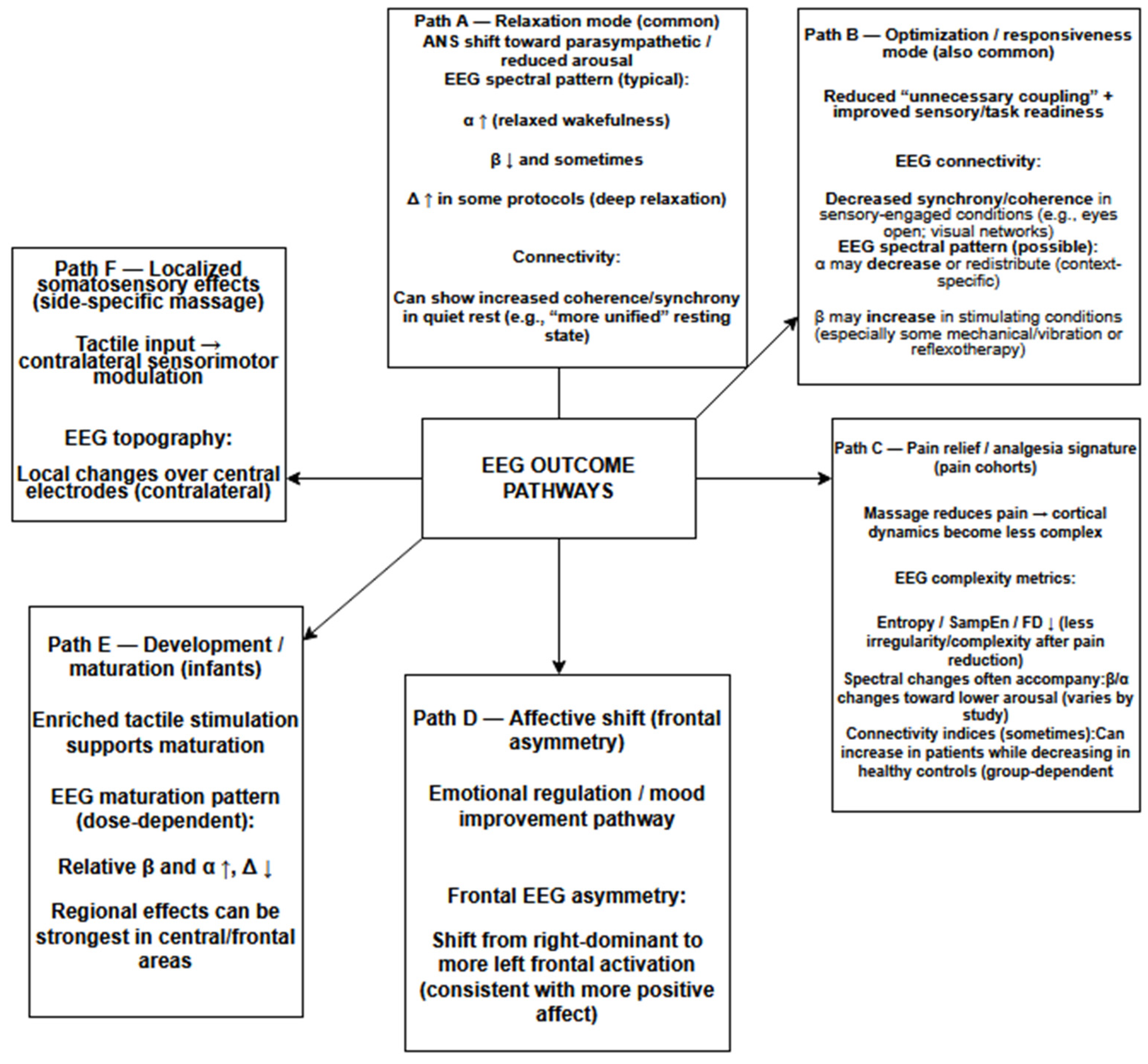
3.1.6. EEG Spectral Power in the Efferent State and During Massage
3.1.7. Functional Connectivity, Coherence, and Context Dependence
Cross-Correlation Synchronicity Reveals State-Dependent Network Reconfiguration (Eyes Closed vs. Eyes Open)
Coherence Outcomes Differ Markedly by Delivery Mode and Evolve Across Massage Stages
Inter-Hemispheric Coherence Changes Accompany Relaxation-Related Spectral Shifts in Facial Massage
Connectivity-Sensitive Complexity Metrics (PDI) Show Clinical-State-Dependent Coupling Changes After Massage
Synchronization Metrics in Resting-State EEG Further Indicate Region-Specific Network Modulation
3.1.8. Regional and Lateralized Effects (Somatosensory Mapping, Frontal Asymmetry)
Somatosensory Mapping: Contralateral Sensorimotor Modulation During Unilateral Stimulation
Frontal EEG Asymmetry: Affect-Related Lateralization Shifts After Tactile Interventions
Regional Specificity from Source-Localized Alpha Activity: Insula, ACC, and PCC
Developmental Regional Effects: Central Lead Sensitivity and Maturation-Linked Topography in Preterm Infants
3.1.9. Source-Localized EEG and DMN-Adjacent Hubs (Posterior Cingulate Cortex and Anterior Cingulate Cortex)
Hand Versus Foot Massage in Elderly Long-Term Care: PCC Recruitment Differs by Massage Site
Manual Versus Machine Massage for Occupational Leg Swelling: ACC Alpha Increase Is Specific to Hand Massage
3.1.10. Source-Localized EEG and DMN-Adjacent Hubs (PCC/ACC)
3.1.11. Entropy/Complexity-Based EEG Outcomes in Pain and Motor Paradigms
Skeletal Muscle Pain with Motor Imagery/Execution: Broad Post-Massage Reductions in Alpha-Band Complexity Across Task States
Lumbar Disc Herniation Versus Healthy Controls: Rhythm- and Group-Dependent Entropy Changes After Chinese Massage
Specific Low Back Pain: Decreased Signal Complexity After Massage Using ApEn and HHT-Based Spectrum Entropy
3.1.12. Evidence Relevant to Dose–Response Relationships
Preterm/Infant Cohorts: Cumulative Tactile Exposure Correlates with Electrophysiological Maturation Indices
Adult Repeated-Session Programs: Attenuation of Acute EEG Responses Across Time Despite Stable Baselines
Dose as “Effective Stimulation”: Modality Composition and Delivery Mode as Determinants of Dose-Equivalent Outcomes
3.2. fMRI Studies
3.2.1. Participant Characteristics
3.2.2. Types of Massage Interventions
3.2.3. Types of fMRI Measurements
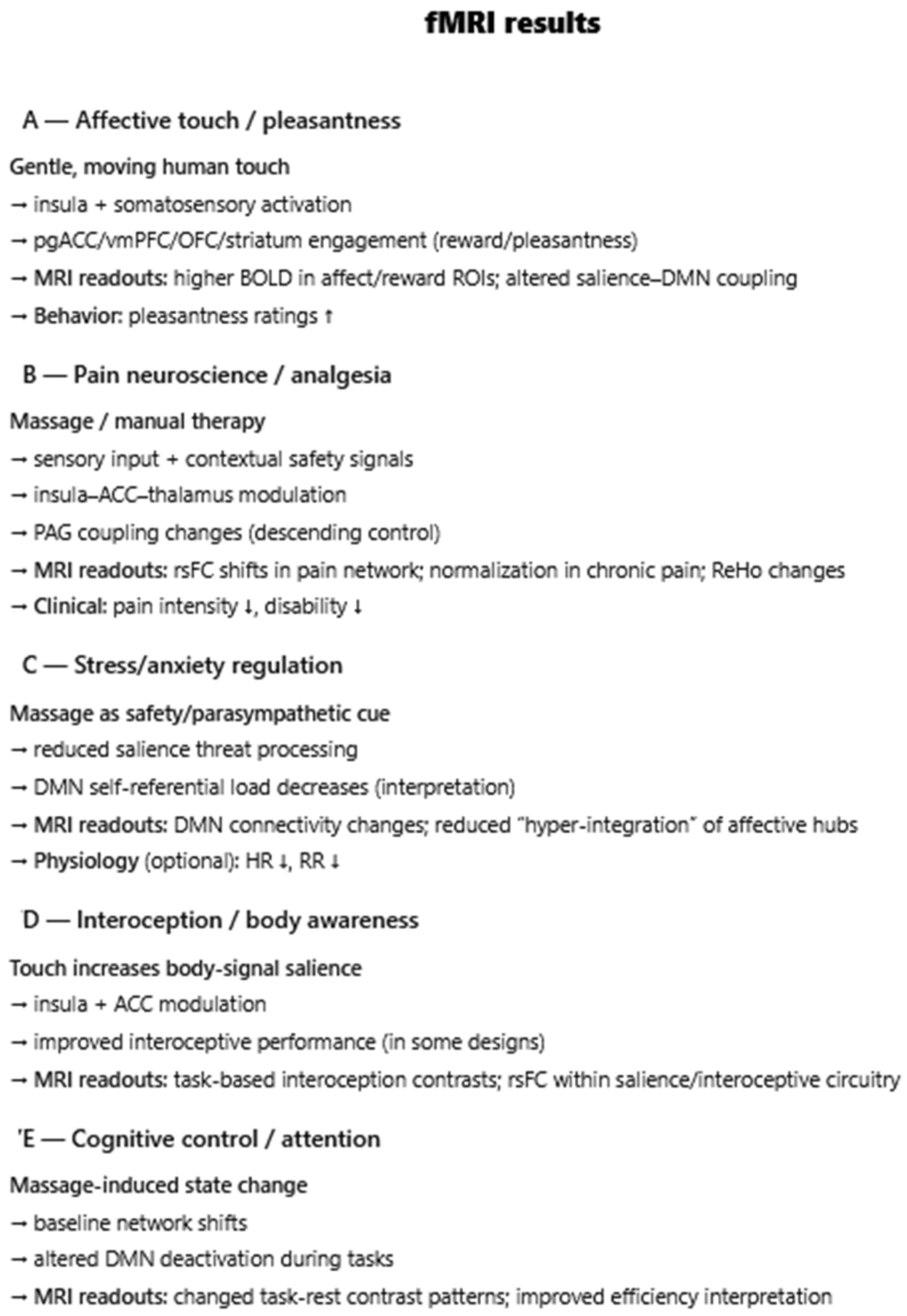
3.2.4. fMRI Results
Default-Mode-Related Effects of Massage and Touch
Somatosensory Cortex and Somatotopy Under Reflexology
Affective Touch, Reward, and Salience Circuitry
Resting-State Connectivity and Graph-Theory After a Brief Massage
Pain-Related Networks and Manual/Osteopathic Therapies
Reflexology vs. Sham and Nonspecific Tactile Effects
Integrative Summary
3.3. fNIRS Outcomes
3.3.1. Participant Characteristics
3.3.2. Types of Massage Interventions
3.3.3. Types of fNIRS Measurements
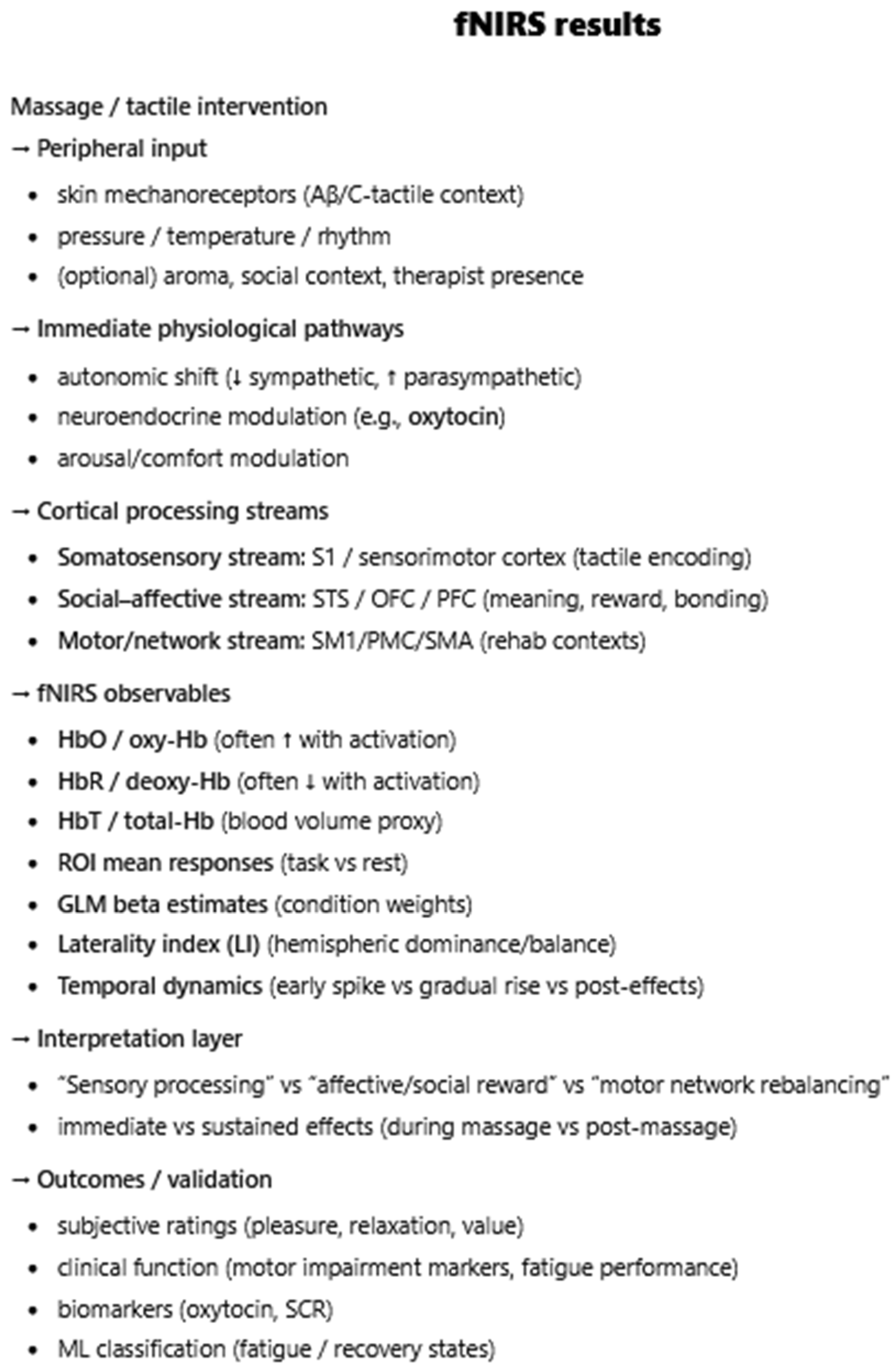
3.3.4. fNIRS Results
Social-Reward Circuitry During Manual vs. Mechanical Foot Massage
Aromatherapy Foot Care vs. Standard Massage in Older Adults
Sensorimotor Lateralization During Tui Na at Hegu in Stroke vs. Controls
Infant Cortical Dynamics: Massage vs. Reflex Locomotion Therapy (Vojta)
Prefrontal Oxygenation and Fatigue Recovery with Mechanical Massage + Binaural Beats
Cross-Study Synthesis
4. Discussion
4.1. EEG-Based Massage Mechanisms
4.1.1. Affective Touch, Interoception, and Psychological Effects
4.1.2. Mechanotransduction and Cellular Signaling
- (a)
- Frequency-following (SSSEP): Rhythmic vibrotactile input to glabrous skin elicits steady-state somatosensory evoked potentials in scalp EEG that track the stimulus frequency (≈20–30 Hz), with clear peaks over contralateral sensorimotor cortex; responses scale with attention and remain stable for ≥40 min when delivered pneumatically (i.e., purely mechanical input) [86,87,88].
- (b)
- Sensorimotor mu/β modulation (ERD/ERS): Brief tactile pulses produce a canonical β (15–30 Hz) suppression ~300 ms post-stimulus followed by a β rebound ~700–800 ms, indexing transient disinhibition and subsequent re-inhibition of thalamocortical sensorimotor loops; mu (∼10 Hz) shows concurrent desynchronization during processing. These effects are robust across EEG/MEG and sensitive to alertness/attention [89,90,91,92].
- (c)
- Gamma entrainment by mechanical input: Whole-body or focal vibrotactile stimulation at 40 Hz can entrain cortical gamma (primary somatosensory/motor) and has emerging therapeutic applications (e.g., gamma-entrainment trials for neurodegeneration), demonstrating that purely mechanical drive can organize fast cortical oscillations system-wide [93,94].
4.1.3. Neuroendocrine and Neurotransmitter Changes
4.2. fMRI-Based Massage Mechanisms
4.2.1. Why “Dose–Response” Cannot Yet Be Derived from the Existing MRI Literature
Massage “Dose” Is Multidimensional, but Most Dimensions Are Not Measured in Objective Units
The Literature Rarely Uses Parametric Dosing Designs (No Systematic Manipulation of Intensity × Duration)
“Dose” Is Strongly Confounded with Stimulation Site, Technique, and Social/Affective Context
Acute Paradigms and Repeated-Course Interventions Measure Different Biological Phenomena
Outcome Measures Differ Across Studies and Are Not Interchangeable as “Effect Size”
4.2.2. What the Current MRI Evidence Can Support: Bounded, Defensible Inferences
4.2.3. Peripheral Afferents → Cortical Targets: Fast Aβ Touch and Slow CT–Affective Touch
4.2.4. Affective Valuation and Reward: OFC–Striatal Coding of Pleasant Touch (And Oxytocin as a Gain Control)
4.2.5. Interoception and Salience: Insula–ACC as a Hub for Body-State Regulation
4.2.6. Default-Mode Network (DMN) Rebalancing Under Relaxation and Safety Signals
4.2.7. Descending Pain Control: rACC/vmPFC–PAG Axis and Context/Expectancy
4.2.8. Thalamocortical Hubs (Pulvinar/Mediodorsal) and Large-Scale Network Configuration
4.2.9. Specificity vs. Non-Specificity: Expectation, Context, and Social Modulation
4.3. fNIRS-Based Massage Mechanisms
4.3.1. Autonomic Pathways: Vagal Tone, HRV, and Prefrontal Control
4.3.2. Aromas During Foot Care: Olfactory–Reward Contributions
4.3.3. Pain Relief and Motor Circuits: Descending Control and Lateralization
4.4. Integrative Neuroimaging Synthesis: How EEG, fMRI, and fNIRS Jointly Describe Massage Effects on the Brain
4.4.1. A Shared Mechanistic Backbone Across Modalities
4.4.2. Linking EEG Rhythms/Connectivity to fMRI/fNIRS Networks: Convergence and “Apparent Contradictions”
4.4.3. Where fNIRS Adds Unique Integrative Value (Beyond “Cortical Oxygenation”)
5. Neuroplasticity and Longitudinal Effects of Massage Therapy
5.1. Neuroplasticity in the Context of Manual Therapies
5.2. Immediate vs. Long-Term Neural Responses to Massage
5.3. Neuroplastic Changes Evidenced by Longitudinal Massage Studies
5.3.1. Longitudinal Brain Changes in Clinical Populations
5.3.2. Developmental and Lifespan Considerations
5.4. Clinical and Translational Implications
5.4.1. Rehabilitation and Motor Recovery
5.4.2. Chronic Pain and Pain Management
5.4.3. Mental Health and Stress Regulation
5.4.4. Neurodevelopment and Pediatrics
5.4.5. Wellness and Healthy Aging
5.5. Methodological Challenges and Future Research Directions
5.5.1. Diversity of Massage Intervention Protocols
5.5.2. Controls and Placebo Effects
5.5.3. Longitudinal Study Design
5.5.4. Multimodal and Convergent Measures
5.5.5. Targeting Specific Populations and Windows
5.5.6. Technological Innovations
6. Methodological Considerations and Future Directions
6.1. Heterogeneity of Massage Interventions
6.2. Variability in Outcome Measures
6.3. Sample Sizes and Study Design Limitations
6.4. Longitudinal and Cumulative Effects
6.5. Multimodal Approaches and Convergent Validation
6.6. Toward Defining Biomarkers and Personalized Protocols
7. Conclusions
Author Contributions
Funding
Institutional Review Board Statement
Informed Consent Statement
Data Availability Statement
Conflicts of Interest
References
- Kennedy, A.B.; Cambron, J.A.; Sharpe, P.A.; Travillian, R.S.; Saunders, R.P. Clarifying Definitions for the Massage Therapy Profession: The Results of the Best Practices Symposium. Int. J. Ther. Massage Bodyw. 2016, 9, 15–26. [Google Scholar]
- Kellogg, J.H. The Art of Massage: A Practical Manual for the Student, the Nurse and the Practitioner; Good Health Publishing Company: Battle Creek, MI, USA, 1895. [Google Scholar]
- Waters-Banker, C.; Dupont-Versteegden, E.E.; Kitzman, P.H.; Butterfield, T.A. Investigating the mechanisms of massage efficacy: The role of mechanical immunomodulation. J. Athl. Train. 2014, 49, 266–273. [Google Scholar] [CrossRef]
- Van Pelt, D.W.; Lawrence, M.M.; Miller, B.F.; Butterfield, T.A.; Dupont-Versteegden, E.E. Massage as a Mechanotherapy for Skeletal Muscle. Exerc. Sport. Sci. Rev. 2021, 49, 107–114. [Google Scholar] [CrossRef]
- Field, T. Massage therapy research review. Complement. Ther. Clin. Pract. 2016, 24, 19–31. [Google Scholar] [CrossRef]
- McGlone, F.; Uvnäs Moberg, K.; Norholt, H.; Eggart, M.; Müller-Oerlinghausen, B. Touch medicine: Bridging the gap between recent insights from touch research and clinical medicine and its special significance for the treatment of affective disorders. Front. Psychiatry 2024, 15, 1390673. [Google Scholar] [CrossRef]
- Weerapong, P.; Hume, P.A.; Kolt, G.S. The mechanisms of massage and effects on performance, muscle recovery, and injury prevention. Sports Med. 2005, 35, 235–256. [Google Scholar] [CrossRef]
- Li, Y.H.; Wang, F.Y.; Feng, C.Q.; Yang, X.F.; Sun, Y.H. Massage therapy for fibromyalgia: A systematic review and meta-analysis of randomized controlled trials. PLoS ONE 2014, 9, e89304. [Google Scholar] [CrossRef]
- Yang, J.; Zhou, X.; Ma, Q.; Woods, J.T.; Mohabbat, A.B.; Do, A.; Brault, J.S.; Jensen, M.A.; Shin, K.M.; Shen, L.; et al. Efficacy and safety of Tuina for chronic nonspecific low back pain: A PRISMA-compliant systematic review and meta-analysis. Medicine 2023, 102, e33018. [Google Scholar] [CrossRef]
- Cheng, Y.H.; Huang, G.C. Efficacy of massage therapy on pain and dysfunction in patients with neck pain: A systematic review and meta-analysis. Evid. Based Complement. Alternat Med. 2014, 2014, 204360. [Google Scholar] [CrossRef]
- Kong, L.J.; Zhan, H.S.; Cheng, Y.W.; Yuan, W.A.; Chen, B.; Fang, M. Massage therapy for neck and shoulder pain: A systematic review and meta-analysis. Evid. Based Complement. Alternat Med. 2013, 2013, 613279. [Google Scholar]
- Chaibi, A.; Tuchin, P.J.; Russell, M.B. Manual therapies for migraine: A systematic review. J. Headache Pain. 2011, 12, 127–133. [Google Scholar] [CrossRef]
- Liu, C.; Chen, X.; Wu, S. The effect of massage therapy on pain after surgery: A comprehensive meta-analysis. Complement. Ther. Med. 2022, 71, 102892. [Google Scholar] [CrossRef]
- Zhang, Y.; Wang, S.; Ma, X.; Yuan, Y.; Cheng, H.; Lin, L.; Tian, L. Massage therapy can effectively relieve cancer pain: A meta-analysis. Medicine 2023, 102, e33939. [Google Scholar] [CrossRef]
- Guo, P.P.; Fan, S.L.; Li, P.; Zhang, X.H.; Liu, N.; Wang, J.; Chen, D.D.; Sun, W.J.; Yu, L.; Yang, S.; et al. The effectiveness of massage on peri-operative anxiety in adults: A meta-analysis of randomized controlled trials and controlled clinical trials. Complement. Ther. Clin. Pract. 2020, 41, 101240. [Google Scholar] [CrossRef]
- Hou, W.H.; Chiang, P.T.; Hsu, T.Y.; Chiu, S.Y.; Yen, Y.C. Treatment effects of massage therapy in depressed people: A meta-analysis. J. Clin. Psychiatry 2010, 71, 894–901. [Google Scholar] [CrossRef]
- Kang, Z.; Xing, H.; Lin, Q.; Meng, F.; Gong, L. Effectiveness of therapeutic massage for improving motor symptoms in Parkinson’s disease: A systematic review and meta-analysis. Front. Neurol. 2022, 13, 915232. [Google Scholar] [CrossRef]
- Wu, J.; Yang, X.W.; Zhang, M. Massage Therapy in Children with Asthma: A Systematic Review and Meta-Analysis. Evid. Based Complement. Alternat Med. 2017, 2017, 5620568. [Google Scholar]
- Liao, I.C.; Chen, S.L.; Wang, M.Y.; Tsai, P.S. Effects of Massage on Blood Pressure in Patients with Hypertension and Prehypertension: A Meta-analysis of Randomized Controlled Trials. J. Cardiovasc. Nurs. 2016, 31, 73–83. [Google Scholar] [CrossRef]
- Kulbayeva, M.; Shvetsova, Y.; Abdreshov, S.; Mustafin, M.; Datkhabayeva, G. Influence of neck and back massage on the synchronicity of electrical brain activity. BIO Web Conf. 2024, 100, 01024. [Google Scholar] [CrossRef]
- Sato, M.; Koshu, Y.; Sugimoto, M. Effect of aromatic massage on brain waves and physiological indices of older adults. Psychogeriatrics 2024, 24, 950–958. [Google Scholar] [CrossRef]
- Kaewcum, N.; Siripornpanich, V. The effects of unilateral Swedish massage on the neural activities measured by quantitative electroencephalography (EEG). J. Health Res. 2018, 32, 36–46. [Google Scholar] [CrossRef]
- Shim, J.M.; Kim, S.J. Effects of manual lymph drainage of the neck on EEG in subjects with psychological stress. J. Phys. Ther. Sci. 2014, 26, 127–129. [Google Scholar] [CrossRef]
- Shim, J.M.; Yeun, Y.R.; Kim, H.Y.; Kim, S.J. Effects of manual lymph drainage for abdomen on the brain activity of subjects with psychological stress. J. Phys. Ther. Sci. 2017, 29, 491–494. [Google Scholar] [CrossRef]
- Shim, J.M.; Kim, S.J. Manual lymph drainage attenuates frontal EEG asymmetry in subjects with psychological stress: A preliminary study. J. Phys. Ther. Sci. 2014, 26, 529–531. [Google Scholar] [CrossRef][Green Version]
- Chang, K.M.; Luo, S.Y.; Chen, S.H.; Wang, T.P.; Ching, C.T. Body massage performance investigation by brain activity analysis. Evid. Based Complement. Altern. Med. 2012, 2012, 252163. [Google Scholar] [CrossRef]
- Jodo, E.; Yamada, Y.; Hatayama, T.; Abe, T.; Maruyama, K. Effects of facial massage on the spontaneous EEG. Tohoku Psychol. Folia 1988, 47, 8–15. [Google Scholar]
- Field, T.; Ironson, G.; Scafidi, F.; Nawrocki, T.; Goncalves, A.; Burman, I.; Pickens, J.; Fox, N.; Schanberg, S.; Kuhn, C. Massage therapy reduces anxiety and enhances EEG pattern of alertness and math computations. Int. J. Neurosci. 1996, 86, 197–205. [Google Scholar] [CrossRef]
- Wu, J.J.; Cui, Y.; Yang, Y.S.; Kang, M.S.; Jung, S.C.; Park, H.K.; Yeun, H.Y.; Jang, W.J.; Lee, S.; Kwak, Y.S.; et al. Modulatory effects of aromatherapy massage intervention on electroencephalogram, psychological assessments, salivary cortisol and plasma brain-derived neurotrophic factor. Complement. Ther. Med. 2014, 22, 456–462. [Google Scholar] [CrossRef]
- Diego, M.A.; Field, T.; Sanders, C.; Hernandez-Reif, M. Massage therapy of moderate and light pressure and vibrator effects on EEG and heart rate. Int. J. Neurosci. 2004, 114, 31–44. [Google Scholar] [CrossRef] [PubMed]
- Unal, C.; Welcome, M.O.; Salako, M.; Abdullahi, F.; Abubakar, N.M.; Pereverzev, V.A.; Hartiningsih, S.S.; Dane, S. The effect of foot reflexotherapy on the dynamics of cortical oscillatory waves in healthy humans: An EEG study. Complement. Ther. Med. 2018, 38, 42–47. [Google Scholar] [CrossRef]
- Dhuri, K.D.; Bodhe, P.V.; Vaidya, A.B. Shirodhara: A psycho-physiological profile in healthy volunteers. J. Ayurveda Integr. Med. 2013, 4, 40–44. [Google Scholar] [CrossRef]
- Kerautret, Y.; Guillot, A.; Daligault, S.; Di Rienzo, F. Foam Rolling Elicits Neuronal Relaxation Patterns Distinct from Manual Massage: A Randomized Controlled Trial. Brain Sci. 2021, 11, 818. [Google Scholar] [CrossRef] [PubMed]
- Lai, M.; D’Acunto, G.; Guzzetta, A.; Finnigan, S.; Ngenda, N.; Ware, R.S.; Boyd, R.N.; Colditz, P.B. Infant massage and brain maturation measured using EEG: A randomised controlled trial. Early Hum. Dev. 2022, 172, 105632. [Google Scholar] [CrossRef] [PubMed]
- Guzzetta, A.; D’Acunto, M.G.; Carotenuto, M.; Berardi, N.; Bancale, A.; Biagioni, E.; Boldrini, A.; Ghirri, P.; Maffei, L.; Cioni, G. The effects of preterm infant massage on brain electrical activity. Dev. Med. Child. Neurol. 2011, 53, 46–51. [Google Scholar] [CrossRef]
- Li, H.; Fan, K.; Ma, J.; Wang, B.; Qiao, X.; Yan, Y.; Du, W.; Wang, L. Massage Therapy’s Effectiveness on the Decoding EEG Rhythms of Left/Right Motor Imagery and Motion Execution in Patients with Skeletal Muscle Pain. IEEE J. Transl. Eng. Health Med. 2021, 9, 2100320. [Google Scholar] [CrossRef] [PubMed]
- Li, H.; Du, W.; Fan, K.; Ma, J.; Ivanov, K.; Wang, L. The Effectiveness Assessment of Massage Therapy Using Entropy-Based EEG Features Among Lumbar Disc Herniation Patients Comparing with Healthy Controls. IEEE Access 2020, 8, 7758–7775. [Google Scholar] [CrossRef]
- Rattanawan, T.; Lookhanumanchao, S.; Sittiprapaporn, P. Electroencephalographic study of shoulder massage. In Proceedings of the 14th International Conference on Electrical Engineering/Electronics, Computer, Telecommunications and Information Technology (ECTI-CON), Phuket, Thailand, 27–30 June 2017; pp. 46–49. [Google Scholar]
- Nakano, H.; Kodama, T.; Ueda, T.; Mori, I.; Tani, T.; Murata, S. Effect of Hand and Foot Massage Therapy on Psychological Factors and EEG Activity in Elderly People Requiring Long-Term Care: A Randomized Cross-Over Study. Brain Sci. 2019, 9, 54. [Google Scholar] [CrossRef]
- Luo, R.C.; Hsu, C.-W.; Chen, S.-Y. Electroencephalogram signal analysis as basis for effective evaluation of robotic therapeutic massage. In Proceedings of the 2016 IEEE/RSJ International Conference on Intelligent Robots and Systems (IROS), Daejeon, Republic of Korea, 9–14 October 2016; pp. 2940–2945. [Google Scholar]
- Lim, J.H.; Kim, H.; Jeon, C.; Cho, S. The effects on mental fatigue and the cognitive function of mechanical massage and binaural beats (brain massage) provided by massage chairs. Complement. Ther. Clin. Pract. 2018, 32, 32–38. [Google Scholar] [CrossRef]
- Dydenkova, E.A.; Zhukova, E.V.; Khairulina, G.M.; Mayorova, L.A.; Portnova, G.V. Impact of the Type of Playful Massage Movements on the Perception of Tactile Stimulation in Children: An EEG Study. Neurosci. Behav. Phys. 2025, 55, 153–164. [Google Scholar] [CrossRef]
- Walter, N.; Hinterberger, T. Neurophysiological Effects of a Singing Bowl Massage. Medicina 2022, 58, 594. [Google Scholar] [CrossRef]
- Buttagat, V.; Eungpinichpong, W.; Kaber, D.; Chatchawan, U.; Arayawichanon, P. Acute effects of traditional Thai massage on electroencephalogram in patients with scapulocostal syndrome. Complement. Ther. Med. 2012, 20, 167–174. [Google Scholar] [CrossRef] [PubMed]
- Nair Chaitanya, M.; Jayakkumar, S.; Chong, E.; Yeow, C.H. A wearable, EEG-based massage headband for anxiety alleviation. In Proceedings of the 2017 39th Annual International Conference of the IEEE Engineering in Medicine and Biology Society (EMBC), Jeju Island, Republic of Korea, 11–15 July 2017; pp. 3557–3560. [Google Scholar]
- Sun, X.; Li, H.; Du, W.; Chen, W.; Zhou, F.; Wang, L. Analysis of Electroencephalogram of patients with specific low back pain with the massage treatment. Annu. Int. Conf. IEEE Eng. Med. Biol. Soc. 2017, 2017, 479–483. [Google Scholar]
- Nakano, H.; Kodama, T.; Sakamoto, M.; Ueda, T.; Tani, T.; Mori, I.; Murata, S. Effect of Hand Massage on Occupational Leg Swelling and Resting-state Electroencephalographic Activity: A Randomized Cross-over Study. Int. J. Clin. Res. Trials. 2018, 3, 125. [Google Scholar] [CrossRef]
- Jones, N.A.; Field, T.; Davalos, M. Massage therapy attenuates right frontal EEG asymmetry in one-month-old infants of depressed mothers. Infant. Behav. Dev. 1998, 21, 527–530. [Google Scholar] [CrossRef]
- Massaro, A.N.; El-Dib, M. Amplitude integrated EEG in very low birth weight infants exposed to preterm infant massage. J. Neonatal-Perinat. Med. 2009, 2, 41–47. [Google Scholar] [CrossRef]
- Sliz, D.; Smith, A.; Wiebking, C.; Northoff, G.; Hayley, S. Neural correlates of a single-session massage treatment. Brain Imaging Behav. 2012, 6, 77–87. [Google Scholar] [CrossRef][Green Version]
- Miura, N.; Akitsuki, Y.; Sekiguchi, A.; Kawashima, R. Activity in the primary somatosensory cortex induced by reflexological stimulation is unaffected by pseudo-information: A functional magnetic resonance imaging study. BMC Complement. Altern. Med. 2013, 13, 114. [Google Scholar] [CrossRef] [PubMed]
- Nakamaru, T.; Miura, N.; Fukushima, A.; Kawashima, R. Somatotopical relationships between cortical activity and reflex areas in reflexology: A functional magnetic resonance imaging study. Neurosci. Lett. 2008, 448, 6–9. [Google Scholar] [CrossRef]
- Lindgren, L.; Westling, G.; Brulin, C.; Lehtipalo, S.; Andersson, M.; Nyberg, L. Pleasant human touch is represented in pregenual anterior cingulate cortex. Neuroimage 2012, 59, 3427–3432. [Google Scholar] [CrossRef]
- Khorev, V.; Kurkin, S.; Mayorova, L.; Portnova, G.; Kushnir, A.; Hramov, A. Neural Correlates of Social Touch Processing: An fMRI Study on Brain Functional Connectivity. J. Integr. Neurosci. 2025, 24, 26280. [Google Scholar] [CrossRef]
- Descamps, E.; Boussac, M.; Joineau, K.; Payoux, P. Changes of cerebral functional connectivity induced by foot reflexology in a RCT. Sci. Rep. 2023, 13, 17139. [Google Scholar] [CrossRef]
- Wattanaruangkowit, P.; Muengtaweepongsa, S.; Kengganpanich, M.; Kengganpanich, T. The Effects of Foot Reflexology for Smoking Cessation on Brain Activities with Functional Magnetic Resonance Imaging (fMRI): A Pilot Study. Evid. Based Complement. Alternat Med. 2022, 2022, 1727479. [Google Scholar] [CrossRef]
- Chen, Y.; Li, Q.; Zhang, Q.; Kou, J.; Zhang, Y.; Cui, H.; Wernicke, J.; Montag, C.; Becker, B.; Kendrick, K.M.; et al. The Effects of Intranasal Oxytocin on Neural and Behavioral Responses to Social Touch in the Form of Massage. Front. Neurosci. 2020, 14, 589878. [Google Scholar] [CrossRef]
- Song, S.; Fang, Y.; Wan, X.; Shen, L.; Hu, Y.; Lu, C.; Yue, T.; Chen, L.; Chen, J.; Xue, M. Changes of regional brain activity following Tuina therapy for patients with painful cervical spondylosis: A resting-state fMRI study. Front. Neurol. 2024, 15, 1399487. [Google Scholar] [CrossRef]
- Chen, X.M.; Wen, Y.; Chen, S.; Jin, X.; Liu, C.; Wang, W.; Kong, N.; Ling, D.Y.; Huang, Q.; Chai, J.E.; et al. Traditional Chinese Manual Therapy (Tuina) reshape the function of default mode network in patients with lumbar disc herniation. Front. Neurosci. 2023, 17, 1125677. [Google Scholar] [CrossRef] [PubMed]
- Gay, C.W.; Robinson, M.E.; George, S.Z.; Perlstein, W.M.; Bishop, M.D. Immediate changes after manual therapy in resting-state functional connectivity as measured by functional magnetic resonance imaging in participants with induced low back pain. J. Manipulative Physiol. Ther. 2014, 37, 614–627. [Google Scholar] [CrossRef] [PubMed]
- Cerritelli, F.; Chiacchiaretta, P.; Gambi, F.; Perrucci, M.G.; Barassi, G.; Visciano, C.; Bellomo, R.G.; Saggini, R.; Ferretti, A. Effect of manual approaches with osteopathic modality on brain correlates of interoception: An fMRI study. Sci. Rep. 2020, 10, 3214. [Google Scholar] [CrossRef] [PubMed]
- Li, Q.; Becker, B.; Wernicke, J.; Chen, Y.; Zhang, Y.; Li, R.; Le, J.; Kou, J.; Zhao, W.; Kendrick, K.M. Foot massage evokes oxytocin release and activation of orbitofrontal cortex and superior temporal sulcus. Psychoneuroendocrinology 2019, 101, 193–203. [Google Scholar] [CrossRef]
- Eto, K.; Yamazaki, A.; Mukuda, M.; Kabasawa, Y.; Yoshida, H.; Ito, K.; Ogiwara, M. Analysis of Effects of Aroma Foot Care Using Functional Near-infrared Spectroscopy. Procedia Comput. Sci. 2014, 35, 1539–1546. [Google Scholar] [CrossRef][Green Version]
- Chen, Y.-F.; Mao, M.-C.; Zhu, G.-Y.; Sun, C.-C.; Zhao, J.-W.; He, H.-X.; Chen, Y.-H.; Xu, D.-S. The changes of neuroactivity of Tui Na (Chinese massage) at Hegu acupoint on sensorimotor cortex in stroke patients with upper limb motor dysfunction: A fNIRS study. BMC Complement. Med. Ther. 2023, 23, 334. [Google Scholar] [CrossRef]
- Llamas-Ramos, R.; Sánchez-González, J.L.; Alvarado-Omenat, J.J.; Sanz-Esteban, I.; Serrano, J.I.; Llamas-Ramos, I. fNIRS Feasibility to Measure Brain Oxygenation Patterns of the Motor Cortex in Relation to Massage and Reflex Locomotion Therapy in Babies. J. Clin. Med. 2025, 14, 3818. [Google Scholar] [CrossRef] [PubMed]
- Haroon, N.; Jabbar, H.; Shahbaz Khan, U.; Jeong, T.; Naseer, N. Mental Fatigue Classification Aided by Machine Learning-Driven Model Under the Influence of Foot and Auditory Binaural Beats Brain Massages via fNIRS. IEEE Access 2024, 12, 187160–187191. [Google Scholar] [CrossRef]
- Schirmer, A.; Lai, O.; McGlone, F.; Cham, C.; Lau, D. Gentle stroking elicits somatosensory ERP that differentiates between hairy and glabrous skin. Soc. Cogn. Affect. Neurosci. 2022, 17, 864–875. [Google Scholar] [CrossRef] [PubMed]
- von Mohr, M.; Crowley, M.J.; Walthall, J.; Mayes, L.C.; Pelphrey, K.A.; Rutherford, H.J.V. EEG captures affective touch: CT-optimal touch and neural oscillations. Cogn. Affect. Behav. Neurosci. 2018, 18, 155–166. [Google Scholar] [CrossRef]
- Schirmer, A.; McGlone, F. A touching Sight: EEG/ERP correlates for the vicarious processing of affectionate touch. Cortex 2019, 111, 1–15. [Google Scholar] [CrossRef] [PubMed]
- Tanaka, Y.; Ito, Y.; Shibata, M.; Terasawa, Y.; Umeda, S. Heartbeat evoked potentials reflect interoceptive awareness during an emotional situation. Sci. Rep. 2025, 15, 8072. [Google Scholar] [CrossRef]
- Zaccaro, A.; Della Penna, F.; Mussini, E.; Parrotta, E.; Perrucci, M.G.; Costantini, M.; Ferri, F. Attention to cardiac sensations enhances the heartbeat-evoked potential during exhalation. iScience 2024, 27, 109586. [Google Scholar] [CrossRef]
- Coll, M.P.; Hobson, H.; Bird, G.; Murphy, J. Systematic review and meta-analysis of the relationship between the heartbeat-evoked potential and interoception. Neurosci. Biobehav. Rev. 2021, 122, 190–200. [Google Scholar] [CrossRef]
- Strohman, A.; Isaac, G.; Payne, B.; Verdonk, C.; Khalsa, S.S.; Legon, W. Low-intensity focused ultrasound to the human insular cortex differentially modulates the heartbeat-evoked potential: A proof-of-concept study. bioRxiv 2024. Update in Clin. Neurophysiol. 2024, 167, 267–281. [Google Scholar] [CrossRef]
- Gentsch, A.; Sel, A.; Marshall, A.C.; Schütz-Bosbach, S. Affective interoceptive inference: Evidence from heart-beat evoked brain potentials. Hum. Brain Mapp. 2019, 40, 20–33. [Google Scholar] [CrossRef]
- Kelley, N.J.; Hortensius, R.; Schutter, D.J.L.G.; Harmon-Jones, E. The relationship of approach/avoidance motivation and asymmetric frontal cortical activity: A review of studies manipulating frontal asymmetry. Int. J. Psychophysiol. 2017, 119, 19–30. [Google Scholar] [CrossRef]
- Handlin, L.; Novembre, G.; Lindholm, H.; Kämpe, R.; Paul, E.; Morrison, I. Human endogenous oxytocin and its neural correlates show adaptive responses to social touch based on recent social context. eLife 2023, 12, e81197. [Google Scholar] [CrossRef]
- Soriano, J.R.; Daniels, N.; Prinsen, J.; Alaerts, K. Intranasal oxytocin enhances approach-related EEG frontal alpha asymmetry during engagement of direct eye contact. Brain Commun. 2020, 2, fcaa093. [Google Scholar] [CrossRef]
- Field, T. Massage therapy research review. Complement. Ther. Clin. Pract. 2014, 20, 224–229. [Google Scholar] [CrossRef]
- Goldstein, P.; Weissman-Fogel, I.; Dumas, G.; Shamay-Tsoory, S.G. Brain-to-brain coupling during handholding is associated with pain reduction. Proc. Natl. Acad. Sci. USA 2018, 115, E2528–E2537. [Google Scholar] [CrossRef]
- Park, W.; Jamil, M.H.; Eid, M. Alpha interbrain synchrony during mediated interpersonal touch. PLoS ONE 2024, 19, e0300128. [Google Scholar] [CrossRef]
- Szczot, M.; Nickolls, A.R.; Lam, R.M.; Chesler, A.T. The Form and Function of PIEZO2. Annu. Rev. Biochem. 2021, 90, 507–534. [Google Scholar] [CrossRef] [PubMed]
- Logan, D.R.; Hall, J.; Bianchi, L. A helping hand: Roles for accessory cells in the sense of touch across species. Front. Cell Neurosci. 2024, 18, 1367476. [Google Scholar] [CrossRef] [PubMed]
- Bataille, A.; Le Gall, C.; Misery, L.; Talagas, M. Merkel Cells Are Multimodal Sensory Cells: A Review of Study Methods. Cells 2022, 11, 3827. [Google Scholar] [CrossRef] [PubMed]
- Mao, F.; Yang, W. How Merkel cells transduce mechanical stimuli: A biophysical model of Merkel cells. PLoS Comput. Biol. 2023, 19, e1011720. [Google Scholar] [CrossRef]
- Mirzoev, T.M. Skeletal Muscle Recovery from Disuse Atrophy: Protein Turnover Signaling and Strategies for Accelerating Muscle Regrowth. Int. J. Mol. Sci. 2020, 21, 7940. [Google Scholar] [CrossRef]
- Brickwedde, M.; Schmidt, M.D.; Krüger, M.C.; Dinse, H.R. 20 Hz Steady-State Response in Somatosensory Cortex During Induction of Tactile Perceptual Learning Through LTP-Like Sensory Stimulation. Front. Hum. Neurosci. 2020, 14, 257. [Google Scholar] [CrossRef]
- Colon, E.; Legrain, V.; Huang, G.; Mouraux, A. Frequency tagging of steady-state evoked potentials to explore the crossmodal links in spatial attention between vision and touch. Psychophysiology 2015, 52, 1498–1510. [Google Scholar] [CrossRef] [PubMed]
- Ahn, S.; Kim, K.; Jun, S.C. Steady-State Somatosensory Evoked Potential for Brain-Computer Interface-Present and Future. Front. Hum. Neurosci. 2016, 9, 716. [Google Scholar] [CrossRef]
- Cardellicchio, P.; Hilt, P.M.; Dolfini, E.; Fadiga, L.; D’Ausilio, A. Beta Rebound as an Index of Temporal Integration of Somatosensory and Motor Signals. Front. Syst. Neurosci. 2020, 14, 63. [Google Scholar] [CrossRef] [PubMed]
- Saltuklaroglu, T.; Bowers, A.; Harkrider, A.W.; Casenhiser, D.; Reilly, K.J.; Jenson, D.E.; Thornton, D. EEG mu rhythms: Rich sources of sensorimotor information in speech processing. Brain Lang. 2018, 187, 41–61. [Google Scholar] [CrossRef] [PubMed]
- Illman, M.; Laaksonen, K.; Liljeström, M.; Jousmäki, V.; Piitulainen, H.; Forss, N. Comparing MEG and EEG in detecting the ~20-Hz rhythm modulation to tactile and proprioceptive stimulation. Neuroimage 2020, 215, 116804. [Google Scholar] [CrossRef]
- Illman, M.; Laaksonen, K.; Liljeström, M.; Piitulainen, H.; Forss, N. The effect of alertness and attention on the modulation of the beta rhythm to tactile stimulation. Physiol. Rep. 2021, 9, e14818. [Google Scholar] [CrossRef]
- Deng, Q.; Wu, C.; Parker, E.; Zhu, J.; Liu, T.C.; Duan, R.; Yang, L. Mystery of gamma wave stimulation in brain disorders. Mol. Neurodegener. 2024, 19, 96. [Google Scholar] [CrossRef]
- Suk, H.J.; Buie, N.; Xu, G.; Banerjee, A.; Boyden, E.S.; Tsai, L.H. Vibrotactile stimulation at gamma frequency mitigates pathology related to neurodegeneration and improves motor function. Front. Aging Neurosci. 2023, 15, 1129510. [Google Scholar] [CrossRef]
- Diego, M.A.; Field, T. Moderate pressure massage elicits a parasympathetic nervous system response. Int. J. Neurosci. 2009, 119, 630–638. [Google Scholar] [CrossRef]
- van Peer, J.M.; Roelofs, K.; Spinhoven, P. Cortisol administration enhances the coupling of midfrontal delta and beta oscillations. Int. J. Psychophysiol. 2008, 67, 144–150. [Google Scholar] [CrossRef]
- Anaya, B.; Vallorani, A.M.; Pérez-Edgar, K. Individual dynamics of delta-beta coupling: Using a multilevel framework to examine inter- and intraindividual differences in relation to social anxiety and behavioral inhibition. J. Child. Psychol. Psychiatry 2021, 62, 771–779. [Google Scholar] [CrossRef]
- Poppelaars, E.S.; Harrewijn, A.; Westenberg, P.M.; van der Molen, M.J.W. Frontal delta-beta cross-frequency coupling in high and low social anxiety: An index of stress regulation? Cogn. Affect. Behav. Neurosci. 2018, 18, 764–777. [Google Scholar] [CrossRef]
- Poppelaars, E.S.; Klackl, J.; Pletzer, B.; Jonas, E. Delta-beta cross-frequency coupling as an index of stress regulation during social-evaluative threat. Biol. Psychol. 2021, 160, 108043. [Google Scholar] [CrossRef]
- Sharpley, C.F.; Evans, I.D.; Bitsika, V.; Arnold, W.M.; Jesulola, E.; Agnew, L.L. Frontal Alpha Asymmetry Argues for the Heterogeneity of Psychological Resilience. Brain Sci. 2023, 13, 1354. [Google Scholar] [CrossRef]
- Quaedflieg, C.W.; Meyer, T.; Smulders, F.T.; Smeets, T. The functional role of individual-alpha based frontal asymmetry in stress responding. Biol. Psychol. 2015, 104, 75–81. [Google Scholar] [CrossRef]
- Glier, S.; Campbell, A.; Corr, R.; Pelletier-Baldelli, A.; Belger, A. Individual differences in frontal alpha asymmetry moderate the relationship between acute stress responsivity and state and trait anxiety in adolescents. Biol. Psychol. 2022, 172, 108357. [Google Scholar] [CrossRef]
- Walker, S.C.; Trotter, P.D.; Swaney, W.T.; Marshall, A.; Mcglone, F.P. C-tactile afferents: Cutaneous mediators of oxytocin release during affiliative tactile interactions? Neuropeptides 2017, 64, 27–38. [Google Scholar] [CrossRef]
- Olausson, H.W.; Cole, J.; Vallbo, A.; McGlone, F.; Elam, M.; Krämer, H.H.; Rylander, K.; Wessberg, J.; Bushnell, M.C. Unmyelinated tactile afferents have opposite effects on insular and somatosensory cortical processing. Neurosci. Lett. 2008, 436, 128–132. [Google Scholar] [CrossRef]
- Olausson, H.; Lamarre, Y.; Backlund, H.; Morin, C.; Wallin, B.G.; Starck, G.; Ekholm, S.; Strigo, I.; Worsley, K.; Vallbo, A.B.; et al. Unmyelinated tactile afferents signal touch and project to insular cortex. Nat. Neurosci. 2002, 5, 900–904. [Google Scholar] [CrossRef]
- Gordon, I.; Voos, A.C.; Bennett, R.H.; Bolling, D.Z.; Pelphrey, K.A.; Kaiser, M.D. Brain mechanisms for processing affective touch. Hum. Brain Mapp. 2013, 34, 914–922. [Google Scholar] [CrossRef]
- Schiller, B.; Sperl, M.F.J.; Kleinert, T.; Nash, K.; Gianotti, L.R.R. EEG Microstates in Social and Affective Neuroscience. Brain Topogr. 2024, 37, 479–495. [Google Scholar] [CrossRef] [PubMed]
- Schiller, B.; Koenig, T.; Heinrichs, M. Oxytocin modulates the temporal dynamics of resting EEG networks. Sci. Rep. 2019, 9, 13418. [Google Scholar] [CrossRef] [PubMed]
- Tomescu, M.I.; Van der Donck, S.; Perisanu, E.M.; Berceanu, A.I.; Alaerts, K.; Boets, B.; Carcea, I. Social functioning predicts individual changes in EEG microstates following intranasal oxytocin administration: A double-blind, cross-over randomized clinical trial. Psychophysiology 2024, 61, e14581. [Google Scholar] [CrossRef]
- Rutherford, H.J.V.; Guo, X.M.; Wu, J.; Graber, K.M.; Hayes, N.J.; Pelphrey, K.A.; Mayes, L.C. Intranasal oxytocin decreases cross-frequency coupling of neural oscillations at rest. Int. J. Psychophysiol. 2018, 123, 143–151. [Google Scholar] [CrossRef] [PubMed]
- Alaerts, K.; Taillieu, A.; Prinsen, J.; Daniels, N. Tracking transient changes in the intrinsic neural frequency architecture: Oxytocin facilitates non-harmonic relationships between alpha and theta rhythms in the resting brain. Psychoneuroendocrinology 2021, 133, 105397. [Google Scholar] [CrossRef]
- Alaerts, K.; Moerkerke, M.; Daniels, N.; Zhang, Q.; Grazia, R.; Steyaert, J.; Prinsen, J.; Boets, B. Chronic oxytocin improves neural decoupling at rest in children with autism: An exploratory RCT. J. Child. Psychol. Psychiatry 2024, 65, 1311–1326. [Google Scholar] [CrossRef]
- Rapaport, M.H.; Schettler, P.J.; Larson, E.R.; Carroll, D.; Sharenko, M.; Nettles, J.; Kinkead, B. Massage Therapy for Psychiatric Disorders. Focus 2018, 16, 24–31. [Google Scholar] [CrossRef]
- Le, G.H.; Wong, S.; Lu, A.; Vasudeva, S.; Gill, H.; Badulescu, S.; Portelles, D.R.; Zheng, Y.J.; Teopiz, K.M.; Meshkat, S.; et al. Electroencephalography (EEG) spectral signatures of selective serotonin reuptake inhibitors (SSRIs), selective norepinephrine reuptake inhibitors (SNRIs) and vortioxetine in major depressive disorder: A systematic review. J. Affect. Disord. 2025, 368, 798–819. [Google Scholar] [CrossRef]
- Bruder, G.E.; Sedoruk, J.P.; Stewart, J.W.; McGrath, P.J.; Quitkin, F.M.; Tenke, C.E. Electroencephalographic alpha measures predict therapeutic response to a selective serotonin reuptake inhibitor antidepressant: Pre- and post-treatment findings. Biol. Psychiatry 2008, 63, 1171–1177. [Google Scholar] [CrossRef]
- Ross, J.A.; Van Bockstaele, E.J. The Locus Coeruleus- Norepinephrine System in Stress and Arousal: Unraveling Historical, Current, and Future Perspectives. Front. Psychiatry 2021, 11, 601519. [Google Scholar] [CrossRef] [PubMed]
- Noei, S.; Zouridis, I.S.; Logothetis, N.K.; Panzeri, S.; Totah, N.K. Distinct ensembles in the noradrenergic locus coeruleus are associated with diverse cortical states. Proc. Natl. Acad. Sci. USA 2022, 119, e2116507119. [Google Scholar] [CrossRef] [PubMed]
- Ramaswamy, S.M.; Weerink, M.A.S.; Struys, M.M.R.F.; Nagaraj, S.B. Dexmedetomidine-induced deep sedation mimics non-rapid eye movement stage 3 sleep: Large-scale validation using machine learning. Sleep 2021, 44, zsaa167. [Google Scholar] [CrossRef]
- Akselrod, M.; Martuzzi, R.; Serino, A.; van der Zwaag, W.; Gassert, R.; Blanke, O. Anatomical and functional properties of the foot and leg representation in areas 3b, 1 and 2 of primary somatosensory cortex in humans: A 7T fMRI study. Neuroimage 2017, 159, 473–487. [Google Scholar] [CrossRef]
- Kolasinski, J.; Makin, T.R.; Jbabdi, S.; Clare, S.; Stagg, C.J.; Johansen-Berg, H. Investigating the Stability of Fine-Grain Digit Somatotopy in Individual Human Participants. J. Neurosci. 2016, 36, 1113–1127. [Google Scholar] [CrossRef]
- Al-Chalabi, M.; Reddy, V.; Alsalman, I. Neuroanatomy, Posterior Column (Dorsal Column). In StatPearls [Internet]; StatPearls Publishing: Treasure Island, FL, USA, 2025. Available online: https://www.ncbi.nlm.nih.gov/books/NBK507888/?utm_source=chatgpt.com (accessed on 20 November 2025).
- Martuzzi, R.; van der Zwaag, W.; Farthouat, J.; Gruetter, R.; Blanke, O. Human finger somatotopy in areas 3b, 1, and 2: A 7T fMRI study using a natural stimulus. Hum. Brain Mapp. 2014, 35, 213–226. [Google Scholar] [CrossRef]
- Abraira, V.E.; Ginty, D.D. The sensory neurons of touch. Neuron 2013, 79, 618–639. [Google Scholar] [CrossRef]
- Ackerley, R.; Saar, K.; McGlone, F.; Backlund Wasling, H. Quantifying the sensory and emotional perception of touch: Differences between glabrous and hairy skin. Front. Behav. Neurosci. 2014, 8, 34. [Google Scholar] [CrossRef] [PubMed]
- Olausson, H.; Wessberg, J.; Morrison, I.; McGlone, F.; Vallbo, A. The neurophysiology of unmyelinated tactile afferents. Neurosci. Biobehav. Rev. 2010, 34, 185–191. [Google Scholar] [CrossRef]
- Ackerley, R.; Backlund Wasling, H.; Liljencrantz, J.; Olausson, H.; Johnson, R.D.; Wessberg, J. Human C-tactile afferents are tuned to the temperature of a skin-stroking caress. J. Neurosci. 2014, 34, 2879–2883. [Google Scholar] [CrossRef]
- Löken, L.S.; Wessberg, J.; Morrison, I.; McGlone, F.; Olausson, H. Coding of pleasant touch by unmyelinated afferents in humans. Nat. Neurosci. 2009, 12, 547–548. [Google Scholar] [CrossRef]
- Perini, I.; Gustafsson, P.A.; Igelström, K.; Jasiunaite-Jokubaviciene, B.; Kämpe, R.; Mayo, L.M.; Molander, J.; Olausson, H.; Zetterqvist, M.; Heilig, M. Altered relationship between subjective perception and central representation of touch hedonics in adolescents with autism-spectrum disorder. Transl. Psychiatry 2021, 11, 224. [Google Scholar] [CrossRef]
- Kirsch, L.P.; Besharati, S.; Papadaki, C.; Crucianelli, L.; Bertagnoli, S.; Ward, N.; Moro, V.; Jenkinson, P.M.; Fotopoulou, A. Damage to the right insula disrupts the perception of affective touch. eLife 2020, 9, e47895. [Google Scholar] [CrossRef]
- Morrison, I.; Björnsdotter, M.; Olausson, H. Vicarious responses to social touch in posterior insular cortex are tuned to pleasant caressing speeds. J. Neurosci. 2011, 31, 9554–9562. [Google Scholar] [CrossRef] [PubMed]
- Björnsdotter, M.; Löken, L.; Olausson, H.; Vallbo, A.; Wessberg, J. Somatotopic organization of gentle touch processing in the posterior insular cortex. J. Neurosci. 2009, 29, 9314–9320. [Google Scholar] [CrossRef] [PubMed]
- Marshall, A.G.; Sharma, M.L.; Marley, K.; Olausson, H.; McGlone, F.P. Spinal signalling of C-fiber mediated pleasant touch in humans. eLife 2019, 8, e51642. [Google Scholar] [CrossRef]
- Willis, W.D., Jr.; Zhang, X.; Honda, C.N.; Giesler, G.J., Jr. A critical review of the role of the proposed VMpo nucleus in pain. J. Pain 2002, 3, 79–94. [Google Scholar] [CrossRef]
- Case, L.K.; Liljencrantz, J.; McCall, M.V.; Bradson, M.; Necaise, A.; Tubbs, J.; Olausson, H.; Wang, B.; Bushnell, M.C. Pleasant Deep Pressure: Expanding the Social Touch Hypothesis. Neuroscience 2021, 464, 3–11. [Google Scholar] [CrossRef]
- Case, L.K.; Madian, N.; McCall, M.V.; Bradson, M.L.; Liljencrantz, J.; Goldstein, B.; Alasha, V.J.; Zimmerman, M.S. Aβ-CT Affective Touch: Touch Pleasantness Ratings for Gentle Stroking and Deep Pressure Exhibit Dependence on A-Fibers. ENeuro 2023, 10, ENEURO.0504-22.2023. [Google Scholar] [CrossRef] [PubMed]
- Rolls, E.T.; O’Doherty, J.; Kringelbach, M.L.; Francis, S.; Bowtell, R.; McGlone, F. Representations of pleasant and painful touch in the human orbitofrontal and cingulate cortices. Cereb. Cortex 2003, 13, 308–317. [Google Scholar] [CrossRef]
- Francis, S.; Rolls, E.T.; Bowtell, R.; McGlone, F.; O’Doherty, J.; Browning, A.; Clare, S.; Smith, E. The representation of pleasant touch in the brain and its relationship with taste and olfactory areas. Neuroreport 1999, 10, 453–459. [Google Scholar] [CrossRef]
- Rolls, E.T.; Cheng, W.; Feng, J. The orbitofrontal cortex: Reward, emotion and depression. Brain Commun. 2020, 2, fcaa196. [Google Scholar] [CrossRef]
- Rolls, E.T. The orbitofrontal cortex and reward. Cereb. Cortex 2000, 10, 284–294. [Google Scholar] [CrossRef] [PubMed]
- Ebisch, S.J.; Ferri, F.; Gallese, V. Touching moments: Desire modulates the neural anticipation of active romantic caress. Front. Behav. Neurosci. 2014, 8, 60. [Google Scholar] [CrossRef]
- Rademacher, L.; Salama, A.; Gründer, G.; Spreckelmeyer, K.N. Differential patterns of nucleus accumbens activation during anticipation of monetary and social reward in young and older adults. Soc. Cogn. Affect. Neurosci. 2014, 9, 825–831. [Google Scholar] [CrossRef] [PubMed]
- Gazzola, V.; Spezio, M.L.; Etzel, J.A.; Castelli, F.; Adolphs, R.; Keysers, C. Primary somatosensory cortex discriminates affective significance in social touch. Proc. Natl. Acad. Sci. USA 2012, 109, E1657–E1666. [Google Scholar] [CrossRef] [PubMed]
- Perini, I.; Olausson, H.; Morrison, I. Seeking pleasant touch: Neural correlates of behavioral preferences for skin stroking. Front. Behav. Neurosci. 2015, 9, 8. [Google Scholar] [CrossRef]
- Scheele, D.; Kendrick, K.M.; Khouri, C.; Kretzer, E.; Schläpfer, T.E.; Stoffel-Wagner, B.; Güntürkün, O.; Maier, W.; Hurlemann, R. An oxytocin-induced facilitation of neural and emotional responses to social touch correlates inversely with autism traits. Neuropsychopharmacology 2014, 39, 2078–2085. [Google Scholar] [CrossRef]
- Gordon, I.; Jack, A.; Pretzsch, C.M.; Vander Wyk, B.; Leckman, J.F.; Feldman, R.; Pelphrey, K.A. Intranasal Oxytocin Enhances Connectivity in the Neural Circuitry Supporting Social Motivation and Social Perception in Children with Autism. Sci. Rep. 2016, 6, 35054. [Google Scholar] [CrossRef]
- Chen, Y.; Becker, B.; Zhang, Y.; Cui, H.; Du, J.; Wernicke, J.; Montag, C.; Kendrick, K.M.; Yao, S. Oxytocin increases the pleasantness of affective touch and orbitofrontal cortex activity independent of valence. Eur. Neuropsychopharmacol. 2020, 39, 99–110. [Google Scholar] [CrossRef]
- Hung, L.W.; Neuner, S.; Polepalli, J.S.; Beier, K.T.; Wright, M.; Walsh, J.J.; Lewis, E.M.; Luo, L.; Deisseroth, K.; Dölen, G.; et al. Gating of social reward by oxytocin in the ventral tegmental area. Science 2017, 357, 1406–1411. [Google Scholar] [CrossRef]
- Dölen, G.; Darvishzadeh, A.; Huang, K.W.; Malenka, R.C. Social reward requires coordinated activity of nucleus accumbens oxytocin and serotonin. Nature 2013, 501, 179–184. [Google Scholar] [CrossRef]
- Kraus, J.; Výborová, E.; Silani, G. The effect of intranasal oxytocin on social reward processing in humans: A systematic review. Front. Psychiatry 2023, 14, 1244027. [Google Scholar] [CrossRef]
- Mielacher, C.; Scheele, D.; Kiebs, M.; Schmitt, L.; Dellert, T.; Philipsen, A.; Lamm, C.; Hurlemann, R. Altered reward network responses to social touch in major depression. Psychol. Med. 2024, 54, 308–316. [Google Scholar] [CrossRef]
- Critchley, H.D.; Wiens, S.; Rotshtein, P.; Ohman, A.; Dolan, R.J. Neural systems supporting interoceptive awareness. Nat. Neurosci. 2004, 7, 189–195. [Google Scholar] [CrossRef] [PubMed]
- Sridharan, D.; Levitin, D.J.; Menon, V. A critical role for the right fronto-insular cortex in switching between central-executive and default-mode networks. Proc. Natl. Acad. Sci. USA 2008, 105, 12569–12574. [Google Scholar] [CrossRef]
- Seeley, W.W.; Menon, V.; Schatzberg, A.F.; Keller, J.; Glover, G.H.; Kenna, H.; Reiss, A.L.; Greicius, M.D. Dissociable intrinsic connectivity networks for salience processing and executive control. J. Neurosci. 2007, 27, 2349–2356. [Google Scholar] [CrossRef] [PubMed]
- Beissner, F.; Meissner, K.; Bär, K.J.; Napadow, V. The autonomic brain: An activation likelihood estimation meta-analysis for central processing of autonomic function. J. Neurosci. 2013, 33, 10503–10511. [Google Scholar] [CrossRef] [PubMed]
- Benarroch, E.E. The central autonomic network: Functional organization, dysfunction, and perspective. Mayo Clin. Proc. 1993, 68, 988–1001. [Google Scholar] [CrossRef]
- Barrett, L.F.; Simmons, W.K. Interoceptive predictions in the brain. Nat. Rev. Neurosci. 2015, 16, 419–429. [Google Scholar] [CrossRef]
- Napadow, V.; Dhond, R.; Conti, G.; Makris, N.; Brown, E.N.; Barbieri, R. Brain correlates of autonomic modulation: Combining heart rate variability with fMRI. Neuroimage 2008, 42, 169–177. [Google Scholar] [CrossRef] [PubMed]
- Chang, C.; Metzger, C.D.; Glover, G.H.; Duyn, J.H.; Heinze, H.J.; Walter, M. Association between heart rate variability and fluctuations in resting-state functional connectivity. Neuroimage 2013, 68, 93–104. [Google Scholar] [CrossRef]
- Menon, V. 20 years of the default mode network: A review and synthesis. Neuron 2023, 111, 2469–2487. [Google Scholar] [CrossRef]
- Coan, J.A.; Schaefer, H.S.; Davidson, R.J. Lending a hand: Social regulation of the neural response to threat. Psychol. Sci. 2006, 17, 1032–1039. [Google Scholar] [CrossRef]
- Farb, N.A.; Segal, Z.V.; Anderson, A.K. Mindfulness meditation training alters cortical representations of interoceptive attention. Soc. Cogn. Affect. Neurosci. 2013, 8, 15–26. [Google Scholar] [CrossRef] [PubMed]
- Haase, L.; Thom, N.J.; Shukla, A.; Davenport, P.W.; Simmons, A.N.; Stanley, E.A.; Paulus, M.P.; Johnson, D.C. Mindfulness-based training attenuates insula response to an aversive interoceptive challenge. Soc. Cogn. Affect. Neurosci. 2016, 11, 182–190. [Google Scholar] [CrossRef]
- Kleckner, I.R.; Zhang, J.; Touroutoglou, A.; Chanes, L.; Xia, C.; Simmons, W.K.; Quigley, K.S.; Dickerson, B.C.; Barrett, L.F. Evidence for a Large-Scale Brain System Supporting Allostasis and Interoception in Humans. Nat. Hum. Behav. 2017, 1, 0069. [Google Scholar] [CrossRef]
- Panda, R.; Bharath, R.D.; Upadhyay, N.; Mangalore, S.; Chennu, S.; Rao, S.L. Temporal Dynamics of the Default Mode Network Characterize Meditation-Induced Alterations in Consciousness. Front. Hum. Neurosci. 2016, 10, 372. [Google Scholar] [CrossRef]
- Zhang, J.; Raya, J.; Morfini, F.; Urban, Z.; Pagliaccio, D.; Yendiki, A.; Auerbach, R.P.; Bauer, C.C.C.; Whitfield-Gabrieli, S. Reducing default mode network connectivity with mindfulness-based fMRI neurofeedback: A pilot study among adolescents with affective disorder history. Mol. Psychiatry 2023, 28, 2540–2548. [Google Scholar] [CrossRef] [PubMed]
- Garrison, K.A.; Zeffiro, T.A.; Scheinost, D.; Constable, R.T.; Brewer, J.A. Meditation leads to reduced default mode network activity beyond an active task. Cogn. Affect. Behav. Neurosci. 2015, 15, 712–720. [Google Scholar] [CrossRef] [PubMed]
- Brewer, J.A.; Worhunsky, P.D.; Gray, J.R.; Tang, Y.Y.; Weber, J.; Kober, H. Meditation experience is associated with differences in default mode network activity and connectivity. Proc. Natl. Acad. Sci. USA 2011, 108, 20254–20259. [Google Scholar] [CrossRef]
- Nogueira, M.; Magalhães, J.D.S.; Sampaio, A.; Sousa, S.; Coutinho, J.F. Examining Insula-Default Mode Network Functional Connectivity and Its Relationship with Heart Rate Variability. Brain Sci. 2025, 15, 37. [Google Scholar] [CrossRef]
- Birn, R.M.; Murphy, K.; Bandettini, P.A. The effect of respiration variations on independent component analysis results of resting state functional connectivity. Hum. Brain Mapp. 2008, 29, 740–750. [Google Scholar] [CrossRef]
- Gerritsen, R.J.S.; Band, G.P.H. Breath of Life: The Respiratory Vagal Stimulation Model of Contemplative Activity. Front. Hum. Neurosci. 2018, 12, 397. [Google Scholar] [CrossRef]
- Matusik, P.S.; Zhong, C.; Matusik, P.T.; Alomar, O.; Stein, P.K. Neuroimaging Studies of the Neural Correlates of Heart Rate Variability: A Systematic Review. J. Clin. Med. 2023, 12, 1016. [Google Scholar] [CrossRef]
- He, J.K.; Jia, B.H.; Wang, Y.; Li, S.Y.; Zhao, B.; Zhou, Z.G.; Bi, Y.Z.; Wu, M.Z.; Li, L.; Zhang, J.L.; et al. Transcutaneous Auricular Vagus Nerve Stimulation Modulates the Prefrontal Cortex in Chronic Insomnia Patients: fMRI Study in the First Session. Front. Neurol. 2022, 13, 827749. [Google Scholar] [CrossRef]
- Fang, J.; Rong, P.; Hong, Y.; Fan, Y.; Liu, J.; Wang, H.; Zhang, G.; Chen, X.; Shi, S.; Wang, L.; et al. Transcutaneous Vagus Nerve Stimulation Modulates Default Mode Network in Major Depressive Disorder. Biol. Psychiatry 2016, 79, 266–273. [Google Scholar] [CrossRef]
- Al Zoubi, O.; Misaki, M.; Bodurka, J.; Kuplicki, R.; Wohlrab, C.; Schoenhals, W.A.; Refai, H.H.; Khalsa, S.S.; Stein, M.B.; Paulus, M.P.; et al. Taking the body off the mind: Decreased functional connectivity between somatomotor and default-mode networks following Floatation-REST. Hum. Brain Mapp. 2021, 42, 3216–3227. [Google Scholar] [CrossRef] [PubMed]
- Kucyi, A.; Salomons, T.V.; Davis, K.D. Mind wandering away from pain dynamically engages antinociceptive and default mode brain networks. Proc. Natl. Acad. Sci. USA 2013, 110, 18692–18697. [Google Scholar] [CrossRef] [PubMed]
- Li, J.; Curley, W.H.; Guerin, B.; Dougherty, D.D.; Dalca, A.V.; Fischl, B.; Horn, A.; Edlow, B.L. Mapping the subcortical connectivity of the human default mode network. Neuroimage 2021, 245, 118758. [Google Scholar] [CrossRef]
- Guedj, C.; Vuilleumier, P. Functional connectivity fingerprints of the human pulvinar: Decoding its role in cognition. Neuroimage 2020, 221, 117162. [Google Scholar] [CrossRef] [PubMed]
- Hwang, K.; Bertolero, M.A.; Liu, W.B.; D’Esposito, M. The Human Thalamus Is an Integrative Hub for Functional Brain Networks. J. Neurosci. 2017, 37, 5594–5607. [Google Scholar] [CrossRef]
- Wager, T.D.; Rilling, J.K.; Smith, E.E.; Sokolik, A.; Casey, K.L.; Davidson, R.J.; Kosslyn, S.M.; Rose, R.M.; Cohen, J.D. Placebo-induced changes in FMRI in the anticipation and experience of pain. Science 2004, 303, 1162–1167. [Google Scholar] [CrossRef]
- Petrovic, P.; Kalso, E.; Petersson, K.M.; Ingvar, M. Placebo and opioid analgesia-- imaging a shared neuronal network. Science 2002, 295, 1737–1740. [Google Scholar] [CrossRef]
- Eippert, F.; Bingel, U.; Schoell, E.D.; Yacubian, J.; Klinger, R.; Lorenz, J.; Büchel, C. Activation of the opioidergic descending pain control system underlies placebo analgesia. Neuron 2009, 63, 533–543. [Google Scholar] [CrossRef]
- Eippert, F.; Finsterbusch, J.; Bingel, U.; Büchel, C. Direct evidence for spinal cord involvement in placebo analgesia. Science 2009, 326, 404. [Google Scholar] [CrossRef]
- Crawford, L.S.; Mills, E.P.; Hanson, T.; Macey, P.M.; Glarin, R.; Macefield, V.G.; Keay, K.A.; Henderson, L.A. Brainstem Mechanisms of Pain Modulation: A within-Subjects 7T fMRI Study of Placebo Analgesic and Nocebo Hyperalgesic Responses. J. Neurosci. 2021, 41, 9794–9806. [Google Scholar] [CrossRef]
- Linnman, C.; Moulton, E.A.; Barmettler, G.; Becerra, L.; Borsook, D. Neuroimaging of the periaqueductal gray: State of the field. Neuroimage 2012, 60, 505–522. [Google Scholar] [CrossRef] [PubMed]
- Yu, R.; Gollub, R.L.; Spaeth, R.; Napadow, V.; Wasan, A.; Kong, J. Disrupted functional connectivity of the periaqueductal gray in chronic low back pain. Neuroimage Clin. 2014, 6, 100–108. [Google Scholar] [CrossRef] [PubMed]
- Ossipov, M.H.; Dussor, G.O.; Porreca, F. Central modulation of pain. J. Clin. Investig. 2010, 120, 3779–3787. [Google Scholar] [CrossRef] [PubMed]
- Tinnermann, A.; Geuter, S.; Sprenger, C.; Finsterbusch, J.; Büchel, C. Interactions between brain and spinal cord mediate value effects in nocebo hyperalgesia. Science 2017, 358, 105–108. [Google Scholar] [CrossRef]
- Büchel, C.; Geuter, S.; Sprenger, C.; Eippert, F. Placebo analgesia: A predictive coding perspective. Neuron 2014, 81, 1223–1239. [Google Scholar] [CrossRef]
- Savallampi, M.; Maallo, A.M.S.; Shaikh, S.; McGlone, F.; Bariguian-Revel, F.J.; Olausson, H.; Boehme, R. Social Touch Reduces Pain Perception-An fMRI Study of Cortical Mechanisms. Brain Sci. 2023, 13, 393. [Google Scholar] [CrossRef]
- Tracey, I.; Mantyh, P.W. The cerebral signature for pain perception and its modulation. Neuron 2007, 55, 377–391. [Google Scholar] [CrossRef]
- Hwang, K.; Shine, J.M.; Bruss, J.; Tranel, D.; Boes, A. Neuropsychological evidence of multi-domain network hubs in the human thalamus. eLife 2021, 10, e69480. [Google Scholar] [CrossRef]
- Barron, D.S.; Eickhoff, S.B.; Clos, M.; Fox, P.T. Human pulvinar functional organization and connectivity. Hum. Brain Mapp. 2015, 36, 2417–2431. [Google Scholar] [CrossRef] [PubMed]
- Saalmann, Y.B.; Pinsk, M.A.; Wang, L.; Li, X.; Kastner, S. The pulvinar regulates information transmission between cortical areas based on attention demands. Science 2012, 337, 753–756. [Google Scholar] [CrossRef]
- Pergola, G.; Danet, L.; Pitel, A.L.; Carlesimo, G.A.; Segobin, S.; Pariente, J.; Suchan, B.; Mitchell, A.S.; Barbeau, E.J. The Regulatory Role of the Human Mediodorsal Thalamus. Trends Cogn. Sci. 2018, 22, 1011–1025. [Google Scholar] [CrossRef]
- Griffiths, B.J.; Zaehle, T.; Repplinger, S.; Schmitt, F.C.; Voges, J.; Hanslmayr, S.; Staudigl, T. Rhythmic interactions between the mediodorsal thalamus and prefrontal cortex precede human visual perception. Nat. Commun. 2022, 13, 3736. [Google Scholar] [CrossRef] [PubMed]
- Hummos, A.; Wang, B.A.; Drammis, S.; Halassa, M.M.; Pleger, B. Thalamic regulation of frontal interactions in human cognitive flexibility. PLoS Comput. Biol. 2022, 18, e1010500. [Google Scholar] [CrossRef]
- Seoane, S.; van den Heuvel, M.; Acebes, Á.; Janssen, N. The subcortical default mode network and Alzheimer’s disease: A systematic review and meta-analysis. Brain Commun. 2024, 6, fcae128. [Google Scholar] [CrossRef] [PubMed]
- Aguilar, D.D.; McNally, J.M. Subcortical control of the default mode network: Role of the basal forebrain and implications for neuropsychiatric disorders. Brain Res. Bull. 2022, 185, 129–139. [Google Scholar] [CrossRef]
- Harrison, B.J.; Davey, C.G.; Savage, H.S.; Jamieson, A.J.; Leonards, C.A.; Moffat, B.A.; Glarin, R.K.; Steward, T. Dynamic subcortical modulators of human default mode network function. Cereb. Cortex 2022, 32, 4345–4355. [Google Scholar] [CrossRef]
- Dahl, M.J.; Mather, M.; Werkle-Bergner, M. Noradrenergic modulation of rhythmic neural activity shapes selective attention. Trends Cogn. Sci. 2022, 26, 38–52. [Google Scholar] [CrossRef]
- Stitt, I.; Zhou, Z.C.; Radtke-Schuller, S.; Fröhlich, F. Arousal dependent modulation of thalamo-cortical functional interaction. Nat. Commun. 2018, 9, 2455. [Google Scholar] [CrossRef] [PubMed]
- Devilbiss, D.M.; Page, M.E.; Waterhouse, B.D. Locus ceruleus regulates sensory encoding by neurons and networks in waking animals. J. Neurosci. 2006, 26, 9860–9872. [Google Scholar] [CrossRef]
- Rodenkirch, C.; Liu, Y.; Schriver, B.J.; Wang, Q. Locus coeruleus activation enhances thalamic feature selectivity via norepinephrine regulation of intrathalamic circuit dynamics. Nat. Neurosci. 2019, 22, 120–133. [Google Scholar] [CrossRef]
- Finniss, D.G.; Nicholas, M.K.; Benedetti, F. Placebo Analgesia—Understanding the Mechanisms and Implications for Clinical Practice. Rev. Pain 2009, 3, 15–19. [Google Scholar] [CrossRef] [PubMed]
- Zunhammer, M.; Spisák, T.; Wager, T.D.; Bingel, U.; Placebo Imaging Consortium. Meta-analysis of neural systems underlying placebo analgesia from individual participant fMRI data. Nat. Commun. 2021, 12, 1391. [Google Scholar] [CrossRef]
- Bieniek, H.; Bąbel, P. Placebo hypoalgesia induced by operant conditioning: A comparative study on the effects of verbal, token-based, and social rewards and punishers. Sci. Rep. 2023, 13, 20346. [Google Scholar] [CrossRef]
- Colloca, L.; Benedetti, F. Placebo analgesia induced by social observational learning. Pain 2009, 144, 28–34. [Google Scholar] [CrossRef]
- Schafer, S.M.; Colloca, L.; Wager, T.D. Conditioned placebo analgesia persists when subjects know they are receiving a placebo. J. Pain 2015, 16, 412–420. [Google Scholar] [CrossRef]
- Bajcar, E.A.; Wiercioch-Kuzianik, K.; Farley, D.; Buglewicz, E.; Paulewicz, B.; Bąbel, P. Order does matter: The combined effects of classical conditioning and verbal suggestions on placebo hypoalgesia and nocebo hyperalgesia. Pain 2021, 162, 2237–2245. [Google Scholar] [CrossRef]
- Bartels, D.J.; van Laarhoven, A.I.; Haverkamp, E.A.; Wilder-Smith, O.H.; Donders, A.R.; van Middendorp, H.; van de Kerkhof, P.C.; Evers, A.W. Role of conditioning and verbal suggestion in placebo and nocebo effects on itch. PLoS ONE 2014, 9, e91727. [Google Scholar] [CrossRef] [PubMed]
- Barnes, K.; Wang, R.; Faasse, K. Practitioner warmth and empathy attenuates the nocebo effect and enhances the placebo effect. Appl. Psychol. Health Well Being 2024, 16, 421–441. [Google Scholar] [CrossRef]
- Howe, L.C.; Goyer, J.P.; Crum, A.J. Harnessing the placebo effect: Exploring the influence of physician characteristics on placebo response. Health Psychol. 2017, 36, 1074–1082. [Google Scholar] [CrossRef]
- Kelley, J.M.; Lembo, A.J.; Ablon, J.S.; Villanueva, J.J.; Conboy, L.A.; Levy, R.; Marci, C.D.; Kerr, C.E.; Kirsch, I.; Jacobson, E.E.; et al. Patient and practitioner influences on the placebo effect in irritable bowel syndrome. Psychosom. Med. 2009, 71, 789–797. [Google Scholar] [CrossRef] [PubMed]
- Kaptchuk, T.J.; Kelley, J.M.; Conboy, L.A.; Davis, R.B.; Kerr, C.E.; Jacobson, E.E.; Kirsch, I.; Schyner, R.N.; Nam, B.H.; Nguyen, L.T.; et al. Components of placebo effect: Randomised controlled trial in patients with irritable bowel syndrome. BMJ 2008, 336, 999–1003. [Google Scholar] [CrossRef] [PubMed]
- Ellingsen, D.M.; Isenburg, K.; Jung, C.; Lee, J.; Gerber, J.; Mawla, I.; Sclocco, R.; Jensen, K.B.; Edwards, R.R.; Kelley, J.M.; et al. Dynamic brain-to-brain concordance and behavioral mirroring as a mechanism of the patient-clinician interaction. Sci. Adv. 2020, 6, eabc1304. [Google Scholar] [CrossRef]
- Geuter, S.; Koban, L.; Wager, T.D. The Cognitive Neuroscience of Placebo Effects: Concepts, Predictions, and Physiology. Annu. Rev. Neurosci. 2017, 40, 167–188. [Google Scholar] [CrossRef]
- Colloca, L.; Klinger, R.; Flor, H.; Bingel, U. Placebo analgesia: Psychological and neurobiological mechanisms. Pain 2013, 154, 511–514. [Google Scholar] [CrossRef]
- Geissler, C.F.; Schneider, J.; Frings, C. Shedding light on the prefrontal correlates of mental workload in simulated driving: A functional near-infrared spectroscopy study. Sci. Rep. 2021, 11, 705. [Google Scholar] [CrossRef]
- Sattayakhom, A.; Wichit, S.; Koomhin, P. The Effects of Essential Oils on the Nervous System: A Scoping Review. Molecules 2023, 28, 3771. [Google Scholar] [CrossRef]
- Thayer, J.F.; Hansen, A.L.; Saus-Rose, E.; Johnsen, B.H. Heart rate variability, prefrontal neural function, and cognitive performance: The neurovisceral integration perspective on self-regulation, adaptation, and health. Ann. Behav. Med. 2009, 37, 141–153. [Google Scholar] [CrossRef]
- Lin, P.H.; Lin, Y.P.; Chen, K.L.; Yang, S.Y.; Shih, Y.H.; Wang, P.Y. Effect of aromatherapy on autonomic nervous system regulation with treadmill exercise-induced stress among adolescents. PLoS ONE 2021, 16, e0249795. [Google Scholar] [CrossRef]
- Kepler, V.F.; Seet, M.S.; Hamano, J.; Saba, M.; Thakor, N.V.; Dimitriadis, S.I.; Dragomir, A. Odor Pleasantness Modulates Functional Connectivity in the Olfactory Hedonic Processing Network. Brain Sci. 2022, 12, 1408. [Google Scholar] [CrossRef] [PubMed]
- Ossipov, M.H.; Morimura, K.; Porreca, F. Descending pain modulation and chronification of pain. Curr. Opin. Support. Palliat. Care 2014, 8, 143–151. [Google Scholar] [CrossRef] [PubMed]
- Tracey, I.; Ploghaus, A.; Gati, J.S.; Clare, S.; Smith, S.; Menon, R.S.; Matthews, P.M. Imaging attentional modulation of pain in the periaqueductal gray in humans. J. Neurosci. 2002, 22, 2748–2752. [Google Scholar] [CrossRef] [PubMed]
- Ying, S.W.; Futter, M.; Rosenblum, K.; Webber, M.J.; Hunt, S.P.; Bliss, T.V.; Bramham, C.R. Brain-derived neurotrophic factor induces long-term potentiation in intact adult hippocampus: Requirement for ERK activation coupled to CREB and upregulation of Arc synthesis. J. Neurosci. 2002, 22, 1532–1540. [Google Scholar] [CrossRef]
- Kang, H.; Schuman, E.M. Long-lasting neurotrophin-induced enhancement of synaptic transmission in the adult hippocampus. Science 1995, 267, 1658–1662. [Google Scholar] [CrossRef] [PubMed]
- Jin, X.; Hu, H.; Mathers, P.H.; Agmon, A. Brain-derived neurotrophic factor mediates activity-dependent dendritic growth in nonpyramidal neocortical interneurons in developing organotypic cultures. J. Neurosci. 2003, 23, 5662–5673. [Google Scholar] [CrossRef]
- McAllister, A.K.; Katz, L.C.; Lo, D.C. Neurotrophin regulation of cortical dendritic growth requires activity. Neuron 1996, 17, 1057–1064. [Google Scholar] [CrossRef]
- Cohen, E.; Wong, F.Y.; Wallace, E.M.; Mockler, J.C.; Odoi, A.; Hollis, S.; Horne, R.S.C.; Yiallourou, S.R. EEG power spectrum maturation in preterm fetal growth restricted infants. Brain Res. 2018, 1678, 180–186. [Google Scholar] [CrossRef]
- Jennekens, W.; Niemarkt, H.J.; Engels, M.; Pasman, J.W.; van Pul, C.; Andriessen, P. Topography of maturational changes in EEG burst spectral power of the preterm infant with a normal follow-up at 2 years of age. Clin. Neurophysiol. 2012, 123, 2130–2138. [Google Scholar] [CrossRef]
- Okumura, A.; Kubota, T.; Toyota, N.; Kidokoro, H.; Maruyama, K.; Kato, T.; Hayakawa, F.; Watanabe, K. Amplitude spectral analysis of maturational changes of delta waves in preterm infants. Brain Dev. 2003, 25, 406–410. [Google Scholar] [CrossRef] [PubMed]
- Niemarkt, H.J.; Jennekens, W.; Pasman, J.W.; Katgert, T.; Van Pul, C.; Gavilanes, A.W.; Kramer, B.W.; Zimmermann, L.J.; Bambang Oetomo, S.; Andriessen, P. Maturational changes in automated EEG spectral power analysis in preterm infants. Pediatr. Res. 2011, 70, 529–534. [Google Scholar] [CrossRef]
- Burke, S.N.; Barnes, C.A. Neural plasticity in the ageing brain. Nat. Rev. Neurosci. 2006, 7, 30–40. [Google Scholar] [CrossRef] [PubMed]
- Jiang, Y.; Yabluchanskiy, A.; Deng, J.; Amil, F.A.; Po, S.S.; Dasari, T.W. The role of age-associated autonomic dysfunction in inflammation and endothelial dysfunction. Geroscience 2022, 44, 2655–2670. [Google Scholar] [CrossRef]
- Monahan, K.D. Effect of aging on baroreflex function in humans. Am. J. Physiol. Regul. Integr. Comp. Physiol. 2007, 293, R3–R12. [Google Scholar] [CrossRef]
- Li, J.; Vitiello, M.V.; Gooneratne, N.S. Sleep in Normal Aging. Sleep. Med. Clin. 2018, 13, 161–171. [Google Scholar] [CrossRef] [PubMed]
- Ohayon, M.M.; Carskadon, M.A.; Guilleminault, C.; Vitiello, M.V. Meta-analysis of quantitative sleep parameters from childhood to old age in healthy individuals: Developing normative sleep values across the human lifespan. Sleep 2004, 27, 1255–1273. [Google Scholar] [CrossRef] [PubMed]
- Mander, B.A.; Winer, J.R.; Walker, M.P. Sleep and Human Aging. Neuron 2017, 94, 19–36. [Google Scholar] [CrossRef] [PubMed]
- Liu, X.; Zang, L.; Lu, Q.; Zhang, Y.; Meng, Q. Effect of Massage and Touch on Agitation in Dementia: A Meta-Analysis. J. Clin. Nurs. 2025, 34, 1948–1964. [Google Scholar] [CrossRef]
- Sharpe, P.A.; Williams, H.G.; Granner, M.L.; Hussey, J.R. A randomised study of the effects of massage therapy compared to guided relaxation on well-being and stress perception among older adults. Complement. Ther. Med. 2007, 15, 157–163. [Google Scholar] [CrossRef]
- Harris, M.; Richards, K.C.; Grando, V.T. The effects of slow-stroke back massage on minutes of nighttime sleep in persons with dementia and sleep disturbances in the nursing home: A pilot study. J. Holist. Nurs. 2012, 30, 255–263. [Google Scholar] [CrossRef]
- Kuner, R.; Flor, H. Structural plasticity and reorganisation in chronic pain. Nat. Rev. Neurosci. 2016, 18, 20–30, Erratum in: Kuner, R.; Flor, H. Erratum: Structural plasticity and reorganisation in chronic pain. Nat. Rev. Neurosci. 2017, 18, 113. https://doi.org/10.1038/nrn.2017.5. [Google Scholar] [CrossRef]
- Latremoliere, A.; Woolf, C.J. Central sensitization: A generator of pain hypersensitivity by central neural plasticity. J. Pain 2009, 10, 895–926. [Google Scholar] [CrossRef]
- Woolf, C.J. Central sensitization: Implications for the diagnosis and treatment of pain. Pain 2011, 152, S2–S15. [Google Scholar] [CrossRef]
- Lewis, G.N.; Rice, D.A.; McNair, P.J. Conditioned pain modulation in populations with chronic pain: A systematic review and meta-analysis. J. Pain 2012, 13, 936–944. [Google Scholar] [CrossRef]
- Field, T.; Diego, M.; Gonzalez, G.; Funk, C.G. Knee arthritis pain is reduced and range of motion is increased following moderate pressure massage therapy. Complement. Ther. Clin. Pract. 2015, 21, 233–237. [Google Scholar] [CrossRef] [PubMed]
- Perlman, A.I.; Sabina, A.; Williams, A.L.; Njike, V.Y.; Katz, D.L. Massage therapy for osteoarthritis of the knee: A randomized controlled trial. Arch. Intern. Med. 2006, 166, 2533–2538. [Google Scholar] [CrossRef] [PubMed]
- Field, T.; Hernandez-Reif, M.; Diego, M.; Fraser, M. Lower back pain and sleep disturbance are reduced following massage therapy. J. Bodyw. Mov. Ther. 2007, 11, 141–145. [Google Scholar] [CrossRef]
- Cherkin, D.C.; Sherman, K.J.; Kahn, J.; Wellman, R.; Cook, A.J.; Johnson, E.; Erro, J.; Delaney, K.; Deyo, R.A. A comparison of the effects of 2 types of massage and usual care on chronic low back pain: A randomized, controlled trial. Ann. Intern. Med. 2011, 155, 1–9. [Google Scholar] [CrossRef]
- Yuan, S.L.; Matsutani, L.A.; Marques, A.P. Effectiveness of different styles of massage therapy in fibromyalgia: A systematic review and meta-analysis. Man. Ther. 2015, 20, 257–264. [Google Scholar] [CrossRef]
- Field, T.; Diego, M.; Cullen, C.; Hernandez-Reif, M.; Sunshine, W.; Douglas, S. Fibromyalgia pain and substance P decrease and sleep improves after massage therapy. J. Clin. Rheumatol. 2002, 8, 72–76. [Google Scholar] [CrossRef]
- Xie, Y.H.; Zhang, Y.M.; Fan, F.F.; Song, X.Y.; Liu, L. Functional role of frontal electroencephalogram alpha asymmetry in the resting state in patients with depression: A review. World J. Clin. Cases 2023, 11, 1903–1917. [Google Scholar] [CrossRef]
- Allen, J.J.B.; Keune, P.M.; Schönenberg, M.; Nusslock, R. Frontal EEG alpha asymmetry and emotion: From neural underpinnings and methodological considerations to psychopathology and social cognition. Psychophysiology 2018, 55, e13028. [Google Scholar] [CrossRef]
- Coan, J.A.; Allen, J.J. Frontal EEG asymmetry as a moderator and mediator of emotion. Biol. Psychol. 2004, 67, 7–49. [Google Scholar] [CrossRef]
- Thibodeau, R.; Jorgensen, R.S.; Kim, S. Depression, anxiety, and resting frontal EEG asymmetry: A meta-analytic review. J. Abnorm. Psychol. 2006, 115, 715–729. [Google Scholar] [CrossRef] [PubMed]
- Kang, J.I.; Lee, E.H.; Kim, H.Y. Effects of Aroma Foot Massage on Sleep Quality and Constipation Relief among the Older Adults Living in Residential Nursing Facilities. Int. J. Environ. Res. Public Health 2022, 19, 5567. [Google Scholar] [CrossRef]
- Moyer, C.A.; Rounds, J.; Hannum, J.W. A meta-analysis of massage therapy research. Psychol. Bull. 2004, 130, 3–18. [Google Scholar] [CrossRef]
- von Mohr, M.; Kirsch, L.P.; Fotopoulou, A. Social touch deprivation during COVID-19: Effects on psychological wellbeing and craving interpersonal touch. R. Soc. Open Sci. 2021, 8, 210287. [Google Scholar] [CrossRef] [PubMed]
- Heatley Tejada, A.; Dunbar, R.I.M.; Montero, M. Physical Contact and Loneliness: Being Touched Reduces Perceptions of Loneliness. Adapt. Human. Behav. Physiol. 2020, 6, 292–306. [Google Scholar] [CrossRef] [PubMed]
- Field, T.; Diego, M.; Hernandez-Reif, M. Potential underlying mechanisms for greater weight gain in massaged preterm infants. Infant Behav. Dev. 2011, 34, 383–389. [Google Scholar] [CrossRef]
- Field, T.; Diego, M.; Hernandez-Reif, M. Preterm infant massage therapy research: A review. Infant Behav. Dev. 2010, 33, 115–124. [Google Scholar] [CrossRef]
- Niemi, A.K. Review of Randomized Controlled Trials of Massage in Preterm Infants. Children 2017, 4, 21. [Google Scholar] [CrossRef]
- Chen, S.C.; Yu, B.Y.; Suen, L.K.; Yu, J.; Ho, F.Y.; Yang, J.J.; Yeung, W.F. Massage therapy for the treatment of attention deficit/hyperactivity disorder (ADHD) in children and adolescents: A systematic review and meta-analysis. Complement. Ther. Med. 2019, 42, 389–399. [Google Scholar] [CrossRef] [PubMed]
- Hillebrand, S.; Gast, K.B.; de Mutsert, R.; Swenne, C.A.; Jukema, J.W.; Middeldorp, S.; Rosendaal, F.R.; Dekkers, O.M. Heart rate variability and first cardiovascular event in populations without known cardiovascular disease: Meta-analysis and dose-response meta-regression. Europace 2013, 15, 742–749. [Google Scholar] [CrossRef]
- Magnon, V.; Vallet, G.T.; Benson, A.; Mermillod, M.; Chausse, P.; Lacroix, A.; Bouillon-Minois, J.B.; Dutheil, F. Does heart rate variability predict better executive functioning? A systematic review and meta-analysis. Cortex 2022, 155, 218–236. [Google Scholar] [CrossRef]



| Adult and General Population | ||||||
|---|---|---|---|---|---|---|
| Other Notable Outcomes/Notes | Main EEG Effects (Post-Intervention) | EEG Metrics | Design and Dose | N (Groups) and Sample | Modality/Site | Study |
| No sex/hemisphere effects; context-dependent modulation (relaxed EC; flexible EO) | EC: ↑ synchronicity F–C (LH); EO: ↓ synchronicity C–O (RH) | 21-ch; cross-correlation (synchronicity) | Within-subject; 20 min; EC and EO | 40 healthy (20–25 y) | Combined general + point massage, cervical-collar | [20] |
| s-IgA ↔; pulse ↓ (esp. G2, oil); SpO2 slight ↓ (relaxation) | α: ↑ in G1–G2 (aroma); β: ↑ in G1 (oil and aroma-oil); θ: ↑ esp. G3 (aroma/oil) | α, β, θ power; ratios | Multiple sessions × 5 min each; pre/post | 28 (G1 adults; G2 older no care; G3 older with care) | Oil massage, aromatherapy (lavender inhalation), aroma-oil massage | [21] |
| Local contralateral inhibition → generalized relaxed wakefulness | δ, θ: ↓ (bilateral F/FC/C); α: ↑ (same regions); β: ↓ at C4 during left-arm massage | δ, θ, α, β absolute power | Within-subject; 25 min/side | 18 healthy | Unilateral Swedish massage (arm/face/neck) | [22] |
| Supports parasympathetic shift/relaxation | α: ↑; δ: ↑ (vs baseline and control) | Absolute and relative δ, θ, α, β | RCT vs. rest; 15 min | 26 stressed students | Manual lymph drainage (MLD), neck | [23] |
| MLD produced a stronger calming effect | Both: α ↑, β/γ ↓; MLD > AM for α ↑ and γ ↓ | α, β, γ (abs/rel) | Parallel groups; 20 min | 28 stressed | MLD abdomen vs. conventional abdominal massage | [24] |
| Suggests a more positive effect | Shift toward left-frontal activation; F7–F8 significant (p = 0.032) | Alpha asymmetry (Fp1–Fp2, F3–F4, F7–F8) | Pre/post; 15 min | 13 stressed females | MLD, neck (frontal asymmetry) | [25] |
| Manual more relaxing/stable connectivity; mechanical more stimulating | Hands-on: δ/θ ↑; Mechanical: δ/θ ↓, β ↑; α ↓ esp. mechanical; Mechanical ↓ coherence (α/β) | 32-ch power (δ–β), coherence, α asymmetry | Between-groups: 3 min/point × 4 | 24 healthy | Hands-on vs. mechanical massage at acupoints | [26] |
| Interpreted as cortical deactivation/rest; specific vs. controls | After facial massage: α ↓ (attenuation), β ↓, slight θ ↑; O1–O2 α-coherence ↓ | Fz, O1, O2; α, θ, β; coherence | 20 min; 3-arm | 24 females (19–21 y) | Facial (esthetic) massage vs. autogenic training vs. rest | [27] |
| Math speed/accuracy ↑; anxiety ↓ (massage only); cortisol ↓ after first session | Both: frontal δ ↑; Massage only: α ↓, β ↓ | Frontal δ, θ, α, β-low, β-high | RCT; 2×/wk × 5 wks | 50 adults | Chair massage vs. guided relaxation (5-wk) | [28] |
| Anxiety/depression/stress ↓; salivary cortisol ↓ acutely; plasma BDNF ↑ over 4 wks | Single session: α ↑ (17%→25%), δ ↓; acute EEG effects attenuated by session 8; no baseline shift | α, δ (acute pre/post each session) | 40 min, 2×/wk × 4 wks | 25 mothers of children with ADHD | Aromatherapy massage (lavender + geranium) | [29] |
| HR ↓ (moderate), HR ↑ (light/vibratory); stress/anxiety ↓ most with moderate | Moderate: δ ↑, α/β ↓, left-frontal shift; Light: δ ↓, θ/β ↑; Vibratory: θ/α/β ↑ | δ, θ, α, β-low, β-high; frontal asymmetry | 10 min, 3 arms | 36 adults | Moderate- vs. light-pressure massage vs. vibratory | [30] |
| Indicates alert cortical activation | β and γ (31–80 Hz) ↑; δ ↓; left-frontal emphasis | Frontal δ–β; γ1–γ3 | Pre/post; ~10 min total | 7 healthy males | Foot reflexotherapy | [31] |
| HR, RR ↓; mood ↑; cortisol/catecholamines ↔ | α ↑ (relaxed alertness) | α power | Single 45 min session | 16 adults (30–60 y) | Shirodhara (after full-body Abhyanga) | [32] |
| FR ↓ skin conductance; MM > FR for pain/muscle relaxation; ROM ↑ (toe-touch best with MM) | FR and MM: ↑ α/β sync (FR frontal; MM parietal); AT: desynchronization | Resting α and β synchronization | RCT; single bout | 65 adults | Foam rolling (FR) vs. manual massage (MM) vs. autogenic training | [33] |
| Suggests reduced pain/altered connectivity; ML models classified states well | Alpha-band complexity (SampEn, PermuEn) ↓ across channels; PDI changes (β) | SampEn, PermuEn; CSP; PDI | Pre/post; 30 min | 71 patients (mean 54 y) | Clinical massage in skeletal muscle pain (EEG complexity) | [36] |
| LDH: relaxation/analgesia; Healthy: relaxed-alert; PDI ↑ (LDH), ↓ (healthy) | LDH: δ entropy ↓ & δ energy ↑ (LH); θ/α energy ↓; Healthy: δ entropy ↑; α/β complexity ↓ | Entropy (ApEn, SampEn, WaveEn, PE, FuzzyEn, IFE), energy | Pre/post; 15 min | 26 LDH; 24 healthy | Chinese massage in LDH patients vs. healthy | [37] |
| Small pilot; suggests relaxation | α ↑ significantly (μV 1.60→2.47); other bands ↔ | NeuroSky bands | Pre/post; 30 min | 5 adults | Machine-assisted shoulder massage | [38] |
| Both rated pleasant/relaxing/refreshing | Hand: ↑ α in left insula; Foot: ↑ α in bilateral PCC | eLORETA α sources | 15 min each; 1-week washout | 12 (mean ~82 y), crossover | Hand vs. foot massage in elderly LTC | [39] |
| Confirms robot can elicit “massage-like” brain responses | δ ↑; α ↓ (F3/F4) | δ, α, β (14-ch) | Baseline → 10 min massage → post | 7 adults | Dual-arm robotic massage (press/rub/stroke) | [40] |
| Attention benefits sustained; verbal STM and LTM ↑ only with Massage + BB | Only Massage + BB: ↓ θ/β & ↓ (θ + α)/β across sites | Prefrontal θ, α, β; fatigue ratios θ/β, (θ + α)/β | 20 min conditions A/B/C | 25 adults; crossover | Massage chair ± binaural beats (“brain massage”) vs. rest | [41] |
| HR ↓; respiration ↑; HRV ↔; strong positive subjective effects | Global power ↓ during/after; largest ↓ in β2 and γ | Global PSD: δ–γ | 20 min; before/during/after | 34 adults | Singing bowl (“sound”) massage | [43] |
| Anxiety and pain ↓ more with TTM; EEG changes track symptom relief | TTM: δ ↑; θ/α/β ↓; PT: minimal change | δ–β power | Single 30 min session | 40 patients | Traditional Thai massage vs. PT (SCS pain) | [44] |
| COVI anxiety improved in responders | In high-β users, massage ↓ β amplitude (3/4 responders) | Frontal β amplitude | Two-stage test; real-time | 10 adults | EEG-triggered massage headband (prototype) | [45] |
| Interpreted as reduced cortical complexity with pain relief | Overall entropy ↓; δ and α ApEn ↓; β HHTMSEn ↓ | ApEn, HHTMSEn; δ–β bands | Pre/post; 25 min | 26 SLBP patients | Massage in specific low back pain (EEG entropy) | [46] |
| Both reduced leg swelling; hand rated more pleasant/relaxing | Hand: ↑ α in left ACC; Machine: no α source change | eLORETA α sources | 15 min; 2-week washout | 18 women; crossover | Hand vs. machine leg massage (occupational swelling) | [47] |
| Pediatric and Neonatal Populations | ||||||
| Spectra closer to term-born profiles with higher dose | Primary β GRP ↔; ↑ central α RP; dose–response: more sessions → ↑ β/α/θ RP, ↓ δ RP; per-protocol: β and α GRP ↑ | EEG GRP (β primary), α, θ, δ | From 34 wks GA to term; 15 min, 2×/day | 60 VPT; RCT | Maternal–infant massage (very preterm) | [34] |
| Suggests preservation/enhancement of neurophysiologic activity | Massage group avoided global decline; ↑ δ and θ (central), ↓ temporal δ/α; time × group effects for global δ, central δ/β | Spectral δ, θ, α, β; regional | Randomized; 3×/day × 10 days | 20 preterm | Infant massage (preterm) | [35] |
| HR ↓; novelty/dynamic patterns evoked stronger calming | School-age: PAF ↓ (relaxation); Preschool: FD ↓ during some stories | Spectral power, Peak Alpha Frequency (PAF), fractal dimension; HR | Within-subject | Preschool (~5.5 y) and school-age (~8.7 y) | Playful back “story” massages (children) | [42] |
| No parietal change; aligns with improved affect risk profile | Right-frontal asymmetry ↓ during and after (toward balance/left) | Frontal/parietal (3–13 Hz) asymmetry | Within-session pre/during/post; 10 min | 25~1.2-mo infants | Infant massage (infants of depressed mothers) | [48] |
| Feasible aEEG neuromonitoring for tactile interventions | More continuous backgrounds in the massage group; fewer delayed maturation scores | aEEG continuity; Burdjalov maturation | RCT subset; twice-daily; 12 h aEEG at 34 PMA | 26 VLBW infants | NICU massage (VLBW), aEEG maturity | [49] |
| Key Takeaway | Behavioral/Clinical | Main Neural Findings | Primary ROIs/Network | Analysis | fMRI Paradigm | Control/Comparator | Intervention/Touch | Population | Study |
|---|---|---|---|---|---|---|---|---|---|
| Human touch (Swedish) most strongly modulated DMN at rest; task engagement reduces sACC effect. | Small ↑ well-being across groups (ns); baseline positive affect higher in Swedish (covaried) | Swedish ↑ BOLD in sACC and RSC/PCC at rest; the sACC effect vanished during the task. Reflexology mainly ↑ RSC/PCC at rest; object ↑ RSC/PCC during task. | DMN: sACC, RSC/PCC | SPM8 GLM; whole-brain; ROI sACC, RSC/PCC; FWE-corrected | Rest + Go/No-Go task; right-foot-stimulated | Rest; wooden object vs. human touch | Swedish massage; Reflexology; Wooden object (tactile control); Rest | 40 healthy (mean 32.3), 4 arms; right-handed | [50] |
| Somatosensory responses to reflexology are robust to cognitive expectation; unusual left-lateralized face-area activation. | - | Consistent activation of left middle postcentral gyrus (face/eye) and contralateral foot SI; unaffected by pseudo-info. | SI (postcentral gyrus) face/eye area; foot area | SPM8; 2 × 2 RM-ANOVA; SI mask; FWE-corrected | Reflex-area stimulation (toes) during fMRI | Misinformation manipulation | Reflexology to the eye reflex area; correct vs. pseudo-information | 32 healthy Japanese (mean 22.2) | [51] |
| Reflex-area stimulation evokes somatotopically plausible SI patterns; partial support for reflexology mapping. | - | Eye → left mid postcentral (face/eye); SI → left superior postcentral (trunk). Shoulder: trend in right postcentral (ns). Common foot-related SI activation. | SI somatotopy (postcentral gyrus) | SPM2; subtraction contrasts; AAL mask; FWE-corrected | Block stimulation of reflex areas | Within-subject contrasts | Left-foot reflex areas: eye, shoulder, small intestine (SI); wooden stick | 25 healthy (mean 22), right-handed | [52] |
| Skin-to-skin dynamic touch uniquely recruits pgACC (reward/affect) beyond generic tactile processing. | Pleasantness: Human moving > Human static > Glove moving > Glove static | Moving touch → bilateral insula and S1/S2; Human + moving uniquely → pgACC. | Insula, S1/S2, pgACC | SPM; whole-brain | During-touch BOLD; pleasantness ratings | Rubber glove; stationary | Forearm touch: human vs. rubber glove × moving vs. stationary (2.5 N; 1.5 cm/s) | 16 healthy (mean 30.2) | [53] |
| Brief lower-limb massage alters RS network topology—trend toward hypo-integration consistent with relaxation. | - | Post-massage: experimental group showed reduced integration vs. controls in subnetwork incl. ant pulvinar thalamus and pgACC. | Thalamus (ant pulvinar), pgACC; broader network | SPM12; AAL3 ROI network metrics (NS, BC, EC, CC, efficiency) | Pre/post resting-state | Rest (no massage) | 5 min calf-and-foot massage | 27 massage; 11 rest controls | [54] |
| Tactile foot stimulation modulates intrinsic networks via nonspecific touch/relaxation effects; proposed pain-related NNCP. | HR ↓; well-being ↑ similarly for FR and SM; no adverse events | Both FR and SM: ↓ DMN PCC/precuneus connectivity; ↑ SMN connectivity; NNCP mixed modulations; no FR > SM specificity. | DMN (PCC/precuneus), SMN, SN, ECN, NNCP | CONN toolbox; ROI-to-ROI in DMN, SMN, SN, ECN; NNCP (23 ROIs) | Pre/post rs-fMRI; physiological and well-being | Within-subject FR vs. SM; double-blind | Foot Reflexology (FR) vs. Sham Massage (SM), 10 min (left foot) | 30 healthy (~30 y), crossover | [55] |
| Reflexology robustly engages primary sensorimotor cortices; broader activations may relate to relaxation/stress pathways. | No cessation outcomes tested | Consistent contralateral pre/postcentral activation; variable extra-cortical activations; no major smoker vs. non-smoker differences. | Motor (precentral) and sensory (postcentral); thalamus | GLM; whole-brain | Task fMRI during reflexology | Smoker vs. non-smoker groups | Foot reflexology at three hallux points (45 s each; alternating feet) | 20 males (15 smokers, 5 nonsmokers) | [56] |
| Oxytocin amplifies hedonic and social-reward processing of human-delivered touch; imagery evokes similar but motor-sparser patterns. | Pleasantness ↑ with OT (manual only); gender of masseur has no effect | OT ↑ pleasantness & ↑ activation for manual massage across reward, salience, social, DMN; minimal effect for machine. | Reward (OFC, striatum, VTA), Salience (amygdala, ACC, insula), Social (STS, IPL), DMN (mPFC, PCC, precuneus) | SPM12; whole-brain; FDR-corrected | Task fMRI during massage/imagery; pleasantness ratings | Placebo; machine; imagined | Intranasal oxytocin vs. placebo; manual vs. machine foot massage; real and imagined | 46 healthy males (mean 21.2), within-subject | [57] |
| Tuina modulates regional synchrony in pain/DMN regions alongside clinical improvement in cervical spondylosis. | Pain and disability ↓; ReHo changes correlated with symptoms | Pre: abnormal ReHo (↑ ACC/PCC/thalamus; ↓ right gyrus rectus). Post: ReHo shifts incl. ↑ left inf occipital; persistent ↓ right rectus. | DMN nodes (ACC/PCC), thalamus, temporal, inferior parietal; right gyrus rectus | DPARSF; ReHo (KCC); correlations with symptoms | rs-fMRI; ReHo; symptom scales (VAS, NDI) | HC baseline; pre vs. post within CS | Tuina (6 sessions/2 weeks) | 27 CS patients (mean 37.3) + 27 HCs | [58] |
| Tuina appears to restore DMN-related dysfunction in LDH; rs-fMRI metrics track symptom relief. | Pain and disability ↓; neural changes correlated with clinical gains | Pre: ↓ ReHo in LO-MFG; abnormal dFC variance. Post tuina: ↑ ReHo LO-MFG; dFC variances normalized toward HCs. | DMN (LO-MFG/mPFC, precuneus), fusiform, IFG | RESTplus; seeds from ReHo; sFC and dFC (sliding window) | rs-fMRI; ReHo + static and dynamic FC; symptoms (VAS, C-SFODI) | HC baseline; pre vs. post within LDH | Tuina (6 sessions/2 weeks) | 27 LDH patients + 28 HCs | [59] |
| Different MTs rapidly reconfigure pain-related FC, with some modality-specific signatures despite similar pain relief. | Pain ↓ across all; PPT ns; weak brain–behavior correlations | Shared: PCC–aINS shift to +FC; pINS–PAG ↑; SI(R)–pINS(L) ↓. Technique-specific FC changes (e.g., SMT ↑ SI–aINS). | Pain-processing network; descending modulation (PAG) | SPM12 + CONN; 16 ROIs (SI/SII, THA, ACC/PCC, aINS/pINS, PAG) | Pre/post rs-fMRI; ROI-to-ROI FC; pain and PPT | Between-technique comparison | Spinal manipulation (SMT), mobilization (MOB), therapeutic touch (TT) | 24 healthy (exercise-induced myalgia) → SMT n = 6, MOB n = 8, TT n = 10 | [60] |
| OMT selectively tunes interoceptive networks and improves interoceptive accuracy in CLBP. | Improved heartbeat tracking in OMT; EA unchanged | After first session: slight ↑ activation (except rMFG ↓); by T2: marked ↓ activation vs. baseline and sham—suggesting efficiency gains. | Insula (bilat), ACC, left striatum, right MFG; salience/interoceptive circuits | AFNI GLM; MVM; independent ROI analysis | Tasks: Interoception (heartbeat) and exteroception (sound); fMRI at T0, T1, T2; heartbeat tracking | Randomized, placebo-controlled | Osteopathic manipulative treatment (4 weekly) vs. sham | 29 CLBP (OMT n = 15; Sham n = 14) | [61] |
| Behavioral/Physiological Outcomes | Main Neural Effects | Other Measures | fNIRS Setup (Device • Channels/ROIs) | Protocol/Design | Interventions | Sample | Study |
|---|---|---|---|---|---|---|---|
| OXT ↑ both: +51.8% hand vs. +18.2% machine; hand rated more pleasurable and higher WTP; intensity/arousal ≈; OXT (baseline and post-hand) negatively correlated with AQ/STQ; mlOFC activation positively correlated with AQ; pSTS/mlOFC ↔ pleasure and WTP | Hand massage ↑ pSTS and mlOFC; machine showed ↓ mlOFC; no S1 difference; mediation: S1 influences mlOFC via pSTS | Plasma oxytocin pre/post; SCR; ratings (pleasure, intensity, arousal, willingness-to-pay); AQ, STQ | Techen CW6; 27 optodes (12 sources/15 detectors), 3.0 cm spacing; 690/830 nm; ROIs: bilateral OFC (lOFC, mlOFC, mOFC), medial S1, bilateral aSTS/pSTS | GLM on 20 s massage blocks with 10 s rests; ROI-based analyses; Bonferroni-corrected; mediation (S1→STS→OFC) | 10 min hand vs. machine foot massage (within-subject; order counterbalanced; blindfolded) | 40 healthy Chinese males (mean 21.78); 36 analyzed | [62] |
| Both comfortable; aroma scent clear/pleasant (3/4); relaxation generally greater with aroma | PFC (esp. ch13) ↑ oxy-Hb/total-Hb, deoxy-Hb ↓ for both massages; with aroma: sharper early ↑ then decline; PFC ch8–9 showed wider fluctuations; S1 ch33/35 differed by condition | Perceived strength, comfort, relaxation, scent (5-point Likert) | Shimadzu FOIRE-3000; 46 channels; ROIs: prefrontal (1–22) and somatosensory (23–46) | Alternating R/L foot; 60 s task/20 s rest, ×3 cycles; post-session questionnaires | Footbath; standard massage; footbath + aroma; aroma oil massage (lavender, tea tree, ravensara, palmarosa, chamomile) | 4 elderly females (≥65 y) | [63] |
| fNIRS reveals disrupted sensorimotor lateralization aligned with motor dysfunction; supports neurofunctional specificity of Hegu for rehab monitoring | Less-affected arm in patients: contralesional SM1 dominance (like controls); affected arm: contralateral dominance absent; LI differed (affected vs. less-affected) | - | NirScan-8000A; 11 sources/10 detectors; 730/850 nm; 32 channels; ROIs: SM1 (ipsi/contra), PMC (ipsi/contra), SMA, SAC | Rest 20 s → Tui Na 20 s → Rest 30 s, ×6; GLM; lateralization index (LI) | Tui Na (“one-finger Zen”, ~120/min) at Hegu on both hands | 10 unilateral ischemic stroke pts (mean 58 y) + 8 healthy controls (mean 49.25 y), right-handed | [64] |
| Both feasible; time × intervention effects significant; massage = more gradual/sustained engagement; RLT = rapid/transient activation | Massage: bilateral HbO ↓ (min 1) → ↑ (min 2); L hemi sustained ↑ (min 3); pattern varies through min 5; post: ↑ right and ventral left motor. RLT: sharp bilateral ↑ (min 1) → ↓ (min 2; L > R); rebounds then drops; distinct temporal signatures | - | Cortivision photoncap C20 (Baby kit); bilateral motor cortex coverage; HbO tracked continuously | 5 min baseline, intervention (~5 min sequence), 5 min post; mixed ANOVA; Homer3 preprocessing; AtlasViewer mapping | Massage (1 min strokes across body) vs. Reflex Locomotion Therapy (pectoral pressure) | 20 full-term infants (pilot n = 2) | [65] |
| Fewer post-therapy errors; Random Forest top individual (≈94.6%); ensemble best overall; 90% reported improved focus/relaxation | Post-intervention: HbO2 ↑, HbR ↓ across PFC → enhanced activation | Behavioral errors; ML metrics (accuracy, precision, recall, F1, AUC) | NIRSport 2; 20 PFC channels (dlPFC, OFC, vmPFC); band-pass 0.05–0.3 Hz; HbO2/HbR via MBLL | Pre/post battery: picture recognition, digit span, Stroop, SART, N-back; fNIRS over PFC; ML classification (10 models + ensemble voting) | Heated mechanical foot reflexology (35 °C) + binaural beats (256/240 Hz → 16 Hz beta) | 10 healthy adults (5F/5M, 18–30 y) | [66] |
Disclaimer/Publisher’s Note: The statements, opinions and data contained in all publications are solely those of the individual author(s) and contributor(s) and not of MDPI and/or the editor(s). MDPI and/or the editor(s) disclaim responsibility for any injury to people or property resulting from any ideas, methods, instructions or products referred to in the content. |
© 2026 by the authors. Licensee MDPI, Basel, Switzerland. This article is an open access article distributed under the terms and conditions of the Creative Commons Attribution (CC BY) license.
Share and Cite
Chmiel, J.; Kurpas, D. Through Massage to the Brain—Neuronal and Neuroplastic Mechanisms of Massage Based on Various Neuroimaging Techniques (EEG, fMRI, and fNIRS). J. Clin. Med. 2026, 15, 909. https://doi.org/10.3390/jcm15020909
Chmiel J, Kurpas D. Through Massage to the Brain—Neuronal and Neuroplastic Mechanisms of Massage Based on Various Neuroimaging Techniques (EEG, fMRI, and fNIRS). Journal of Clinical Medicine. 2026; 15(2):909. https://doi.org/10.3390/jcm15020909
Chicago/Turabian StyleChmiel, James, and Donata Kurpas. 2026. "Through Massage to the Brain—Neuronal and Neuroplastic Mechanisms of Massage Based on Various Neuroimaging Techniques (EEG, fMRI, and fNIRS)" Journal of Clinical Medicine 15, no. 2: 909. https://doi.org/10.3390/jcm15020909
APA StyleChmiel, J., & Kurpas, D. (2026). Through Massage to the Brain—Neuronal and Neuroplastic Mechanisms of Massage Based on Various Neuroimaging Techniques (EEG, fMRI, and fNIRS). Journal of Clinical Medicine, 15(2), 909. https://doi.org/10.3390/jcm15020909