Aortic Arch and Frozen Elephant Trunk Surgery: Anesthetic Challenges and Strategies for Organ Protection



Abstract
1. Introduction
2. Materials and Methods
3. Key Domains of Perioperative Anesthetic Management in FET Surgery
3.1. Surgical and Physiologic Considerations in FET Procedures
3.1.1. Cannulation Strategies and Their Hemodynamic Implications
3.1.2. Cardiopulmonary Bypass and Perfusion Configurations
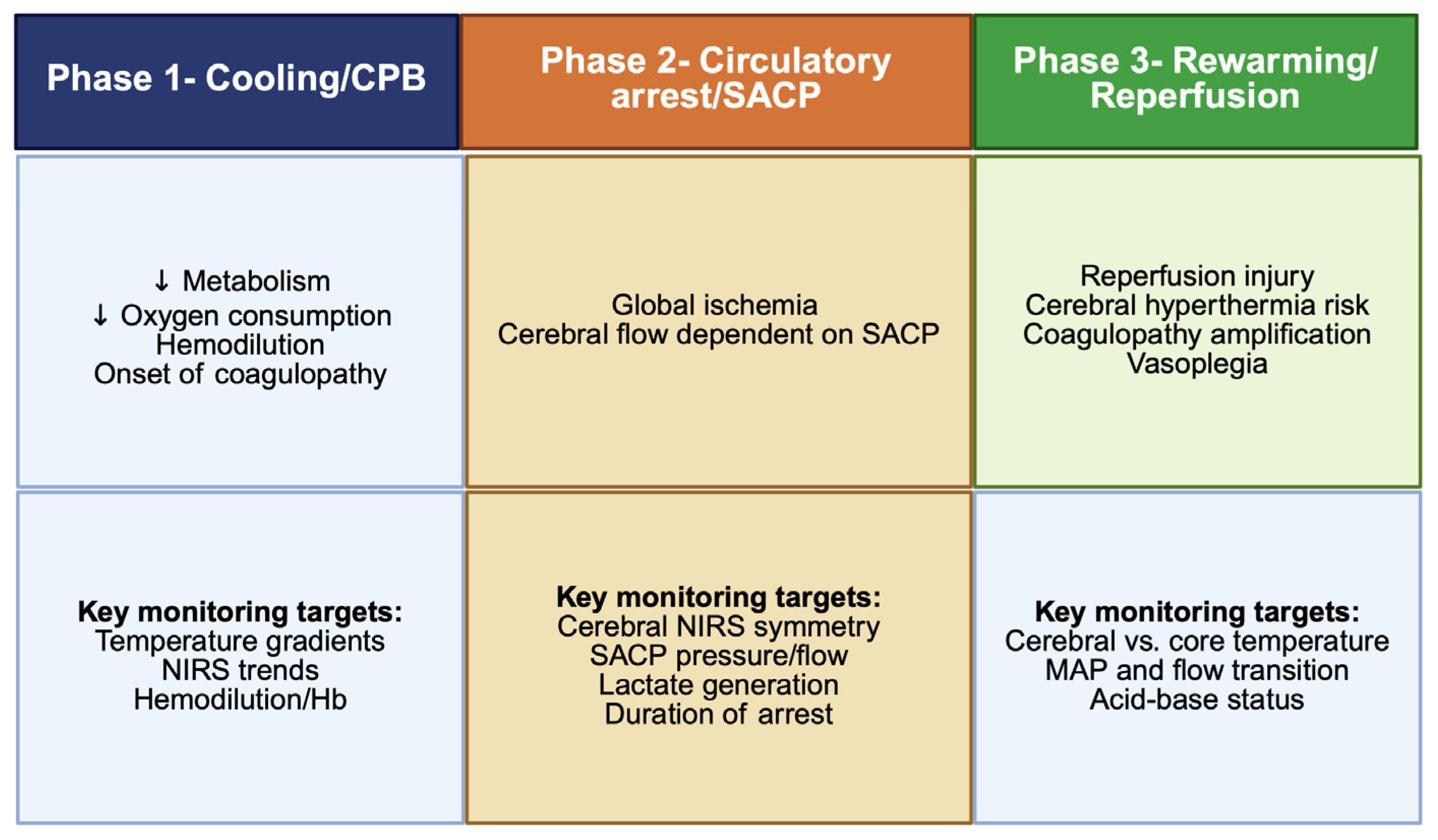
3.1.3. Physiological Transitions: Cooling, Arrest, Reperfusion, Rewarming
3.2. Temperature Management in Aortic Arch and FET Surgery
3.2.1. Rationale for Hypothermia
3.2.2. From Deep to Mild Hypothermia: Evidence and Outcomes
3.2.3. Temperature Targets, Gradients and Safety Parameters
- 24–28 °C for most FET procedures performed with bilateral or robust unilateral SACP [61];
- 20–22 °C in selected cases requiring extended arrest or when cerebral perfusion pathways are uncertain [62];
- In high-volume centers, mild hypothermia (28–30 °C) is selectively employed for shorter circulatory arrest intervals when SACP flow, neuromonitoring integrity and perfusion pressures are consistently reliable, thereby reducing overall physiological burden and CPB duration while maintaining uniform cerebral and systemic thermal profile [63,64].
3.2.4. Rewarming Strategies and Reperfusion Injury Prevention
- Limit rewarming rates to ≤0.5 °C/min [44];
- Maintaining a core-perfusate gradient ≤ 4 °C [44];
- Avoiding arterial outlet temperatures > 37 °C to prevent cortical overheating [44];
- Titrating vasopressors judiciously to counteract hypothermia-related vasoconstriction followed by vasodilatory rebound [69];
- Preventing hyperoxia and correcting metabolic derangements before full reperfusion [70].
3.2.5. Acid-Base Management (Alpha-Stat vs. pH-Stat)
3.3. Cerebral Protection and Neuromonitoring
3.3.1. Selective Antegrade Cerebral Perfusion (SACP) Techniques
3.3.2. Monitoring Cerebral Perfusion: NIRS, EEG, TCD
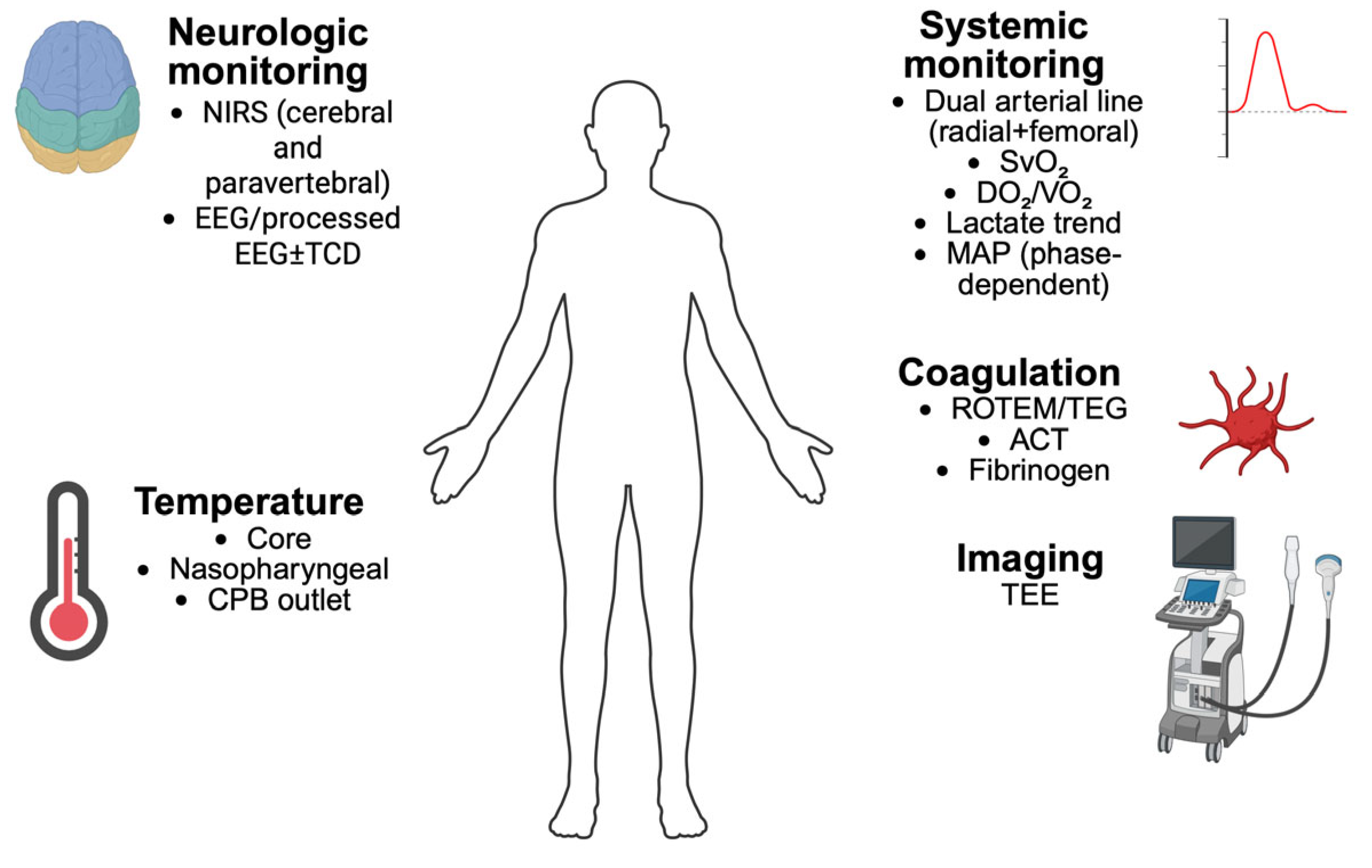
- NIRS: near-infrared spectroscopy provides continuous, non-invasive assessment of regional cerebral oxygen saturation (rSO2) by measuring the relative balance of oxygenated and deoxygenated hemoglobin within the frontal cortex. Because rSO2 reflects both cerebral blood flow and metabolic demand, NIRS is highly sensitive to perfusion changes during circulatory arrest and SACP. Typical intervention thresholds include a 20–25% decrease from baseline or absolute values falling below 50%. Decreases in rSO2 may indicate insufficient SACP flow or pressure, impaired cerebral autoregulation, asymmetric perfusion during unilateral SACP or embolic obstruction. Conversely, abrupt increases, especially during rewarming, may signal loss of autoregulation or early hyper-perfusion. While NIRS is limited to superficial cortical territories and can be influenced by extracranial factors, its rapid responsiveness makes it indispensable for real-time titration of perfusion and ventilatory parameters [83,84].
- Electroencephalography (EEG) and processed EEG: offers complementary insight into cortical electrical activity, anesthetic depth and metabolic suppression. During controlled cooling, EEG progressively transitions through reduced amplitude, burst suppression and eventually electrocerebral silence, which confirms adequate metabolic depression before circulatory arrest. Asymmetric EEG suppression or re-emerge of electrical activity during arrest may indicate malperfusion or warming artifacts. Intraoperative seizures, although uncommon, may also be identified. Processed EEG modalities, such as bispectral index or spectral edge frequency, provide simplified, continuous indices that reflect global cortical activity. Although less detailed than a full montage, they can reliably indicate inadequate metabolic suppression, excessive anesthetic depth or ischemic changes, particularly when paired with NIRS [85,86,87].
- Trans-cranial Doppler (TCD): allows real-time evaluation of blood flow velocity in intracranial vessels, typically the middle cerebral artery. During SACP, TCD can verify antegrade flow delivery, detect perfusion asymmetries and identify transient drops in velocity consistent with ischemia or vessel obstruction. One of the unique strengths of TCD is its ability to detect high-intensity transient signals (HITSs), which indicate gaseous or particulate microemboli. This is particularly relevant during manipulation of the arch branches, deployment of the stented graft and initiation of bypass, when embolic load may be highest. Although TCD is operator dependent and its feasibility is limited by acoustic windows, its capability to detect embolic phenomena and flow directionality provides information not obtainable from NIRS or EEG [83,88,89].
3.3.3. Prevention of Embolic and Hypoperfusion Injury
3.3.4. Pharmacologic Neuroprotection
3.4. Spinal Cord, Renal and Visceral Protection
3.4.1. Risk of Spinal Cord Ischemia in FET and Strategies to Maintain Spinal Cord Perfusion
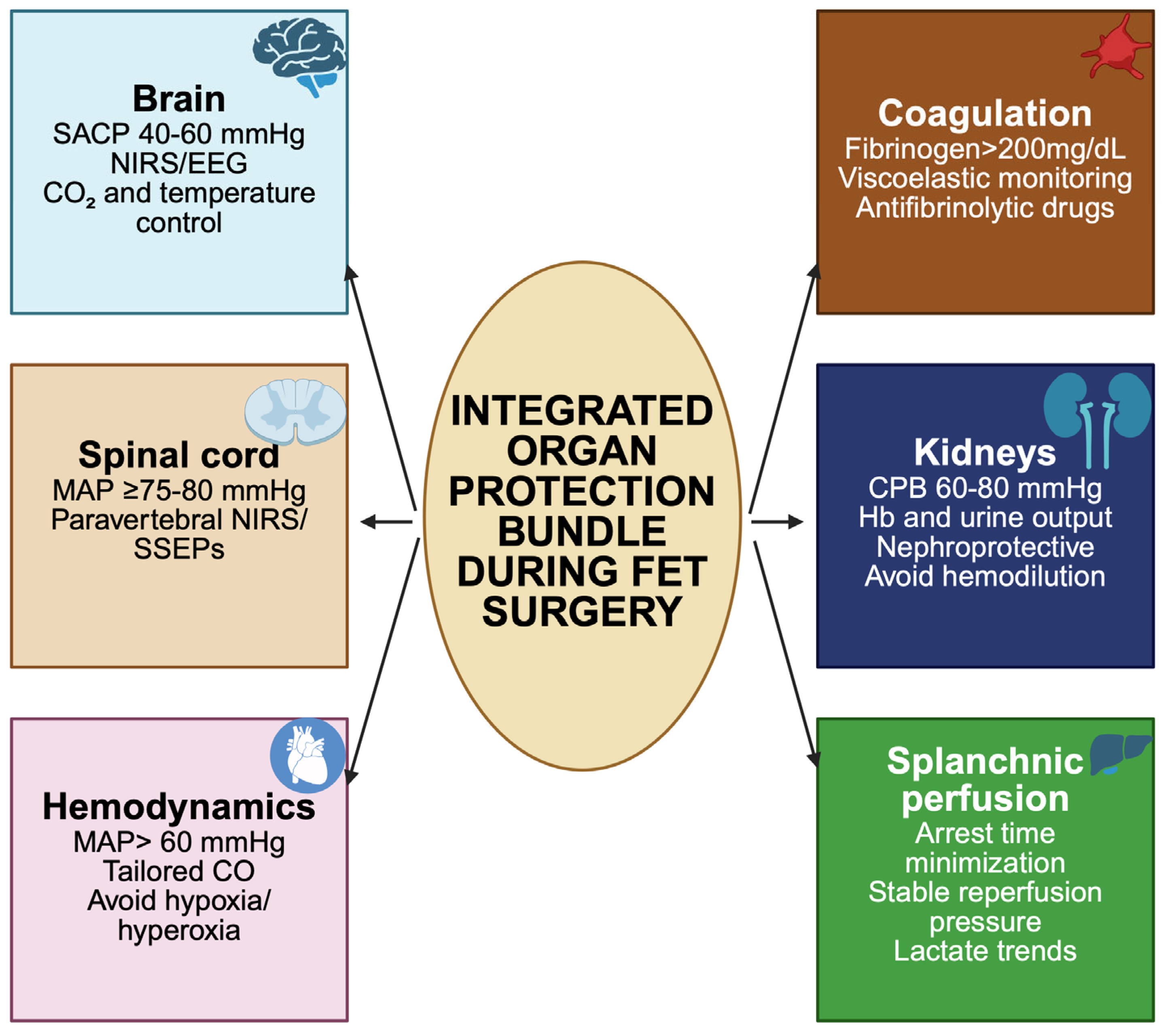
- Maintaining adequate MAP targets, particularly during rewarming and early reperfusion, when autoregulation in unstable. Pressures ≥ 70–80 mmHg are commonly targeted once systemic flow is restored [104].
- Somatic or paravertebral NIRS monitoring, placed over the thoracic paraspinal regions, extends the utility of NIRS beyond the brain by providing a surrogate indicator of spinal cord perfusion. Declines in paravertebral rSO2 can precede clinical or hemodynamic signs of spinal hypoperfusion and correlate with reduced flow within the intercostal and segmental arterial network, an important consideration during FET deployment, when the endovascular component may compromise spinal cord blood flow supply. These sensors assist in detecting early malperfusion, guiding interventions such as MAP augmentation, hemoglobin optimization, cerebrospinal fluid drainage or modification of distal perfusion strategies [14,84,106].
- Ensuring controlled rewarming, preventing vasodilation-induced hypotension that may reduce spinal cord perfusion pressure.
3.4.2. Renal Protection Strategies
- Optimizing renal perfusion pressure, particularly during rewarming, where systemic vasodilation can reduce renal blood flow [109].
- Avoiding excessive hemodilution, maintaining hemoglobin levels adequate for oxygen delivery [110].
- Restricting crystalloid administration, limiting interstitial edema and renal congestion [111].
- Preventing hyperglicemia, acidosis and large temperature shifts, all of which can potentiate renal injury [112].
- Reducing nephrotoxic exposures, including careful avoidance of excessive vasoconstriction or nephrotoxic medications during vulnerable phases [113].
3.4.3. Splanchnic and Visceral Perfusion During Circulatory Arrest
- Ensuring adequate systemic perfusion before arrest, optimizing oxygen delivery and acid-base status.
- Minimizing the duration of circulatory arrest, especially in patients with impaired mesenteric vascular reserve.
- Maintaining stable perfusion pressures during early reperfusion, avoiding underfilling or vasodilatory hypotension.
- Controlling rewarming, since rapid thermal shifts can promote intestinal microcirculatory dysfunction.
- Preventing hyperoxia and excessive lactate accumulation, which may intensify oxidative injury during reperfusion.
3.5. Hemodynamic Management and Advanced Monitoring
3.5.1. Invasive Monitoring and Arterial Pressure Interpretation
3.5.2. Perfusion Metrics: SvO2, Lactate, DO2/VO2
- Mixed venous oxygen saturation (SvO2) and central venous oxygen saturation (ScvO2) reflect global balance between oxygen delivery and consumption, particularly during reduced flow states and early reperfusion [125].
- Oxygen delivery and consumption (DO2/VO2): the DO2/VO2 relationship offers a sensitive metric of systemic perfusion adequacy. When DO2 falls below the critical threshold, common during low-flow SACP, circulatory arrest transitions or early reperfusion, VO2 becomes supply-dependent, leading to increased extraction and falling SvO2/ScvO2. Rising VO2/DO2 ratios help identify occult hypoperfusion despite apparently adequate MAP, prompting adjustments in pump flow, hemoglobin or vasopressor therapy [125].
3.5.3. Role of Transesophageal Echocardiography (TEE)
3.6. Anesthetic Techniques and Pharmacologic Management
3.6.1. TIVA vs. Volatile-Based Strategies
3.6.2. Perioperative Management of Vasoplegia
3.7. Coagulation and Hemostasis Management
3.7.1. Mechanisms of Coagulopathy During FET Surgery
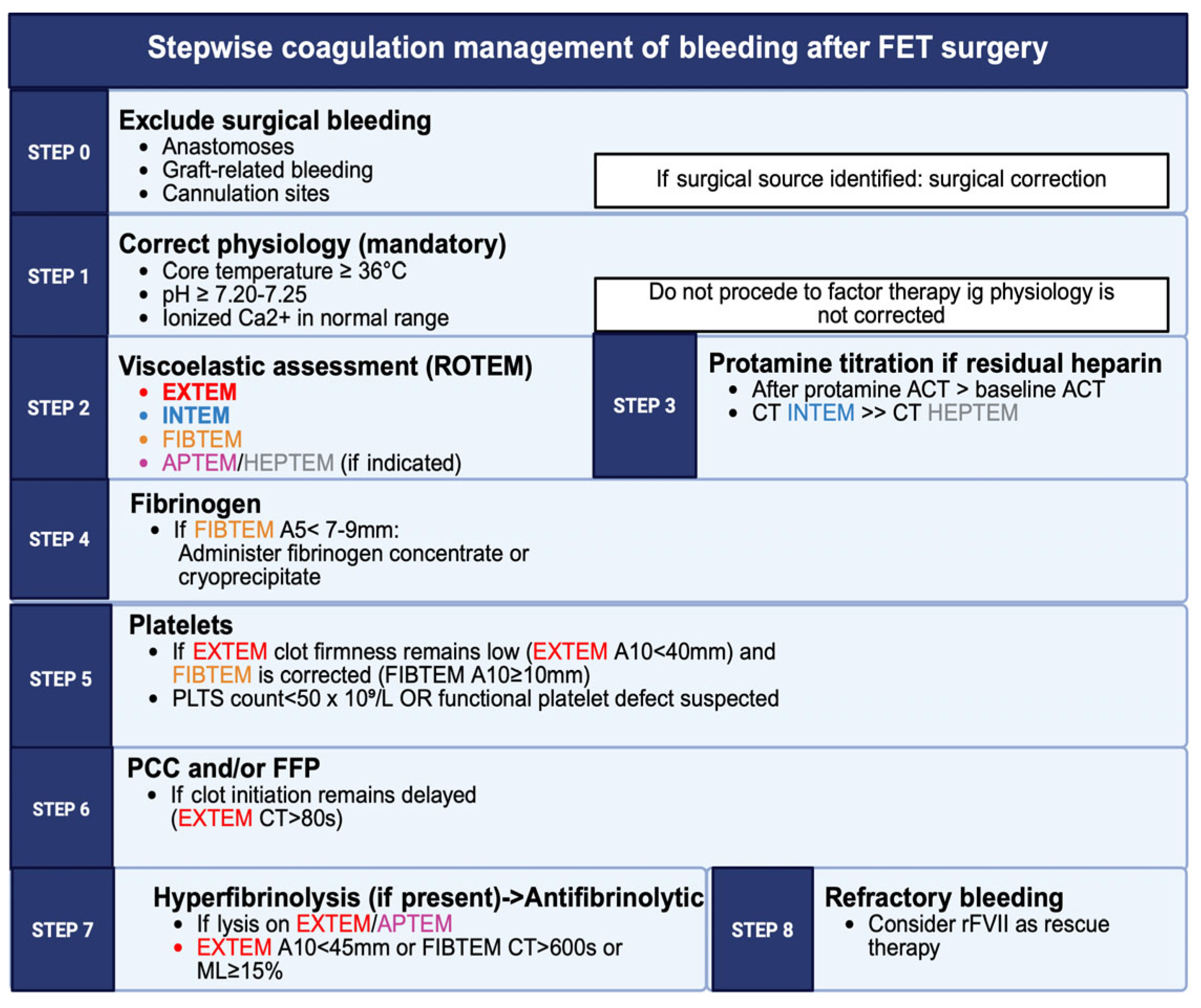
3.7.2. Role of Viscoelastic Testing (ROTEM/TEG)
3.7.3. Fibrinogen Management and Platelet Optimization
3.7.4. Antifibrinolytic Therapy
3.7.5. Blood Sparing Strategies
3.8. Postoperative Management
3.8.1. Neurologic Surveillance
3.8.2. Renal and Hemodynamic Monitoring
3.8.3. Ventilation and Oxygenation Strategies
3.8.4. Coagulation Reassessment and Bleeding Control
3.8.5. Pain Management and Early Mobilization
3.9. Outcomes
3.9.1. Neurologic Outcomes
3.9.2. Mortality and Major Morbidities
- Acute kidney injury, which develops in up to one-third of patients and is strongly associated with distal ischemia time, reperfusion injury and systemic inflammation [169].
- Respiratory complications, including prolonged ventilation and pneumonia, particularly in older or frail patients [170].
- Coagulopathy and significant bleeding, often requiring transfusion or re-exploration [171].
4. Discussion
5. Conclusions
6. Future Directions
Author Contributions
Funding
Institutional Review Board Statement
Informed Consent Statement
Data Availability Statement
Conflicts of Interest
Abbreviations
| FET | Frozen elephant trunk |
| NIRS | Near-infrared spectroscopy |
| SACP | Selective antegrade cerebral perfusion |
| AKI | Acute kidney injury |
| SCI | Spinal cord injury |
| CPB | Cardiopulmonary bypass |
References
- Acharya, M.; Sherzad, H.; Bashir, M.; Mariscalco, G. The frozen elephant trunk procedure: Indications, outcomes and future directions. Cardiovasc. Diagn. Ther. 2022, 12, 708–721. [Google Scholar] [CrossRef] [PubMed] [PubMed Central]
- Kato, M.; Ohnishi, K.; Kaneko, M.; Ueda, T.; Kishi, D.; Mizushima, T.; Matsuda, H. New graft-implanting method for thoracic aortic aneurysm or dissection with a stented graft. Circulation 1996, 94, II188–II193. [Google Scholar] [PubMed]
- Shrestha, M.; Bachet, J.; Bavaria, J.; Carrel, T.P.; De Paulis, R.; Di Bartolomeo, R.; Etz, C.D.; Grabenwöger, M.; Grimm, M.; Haverich, A.; et al. Current status and recommendations for use of the frozen elephant trunk technique: A position paper by the Vascular Domain of EACTS. Eur. J. Cardiothorac. Surg. 2015, 47, 759–769. [Google Scholar] [CrossRef] [PubMed]
- Jubouri, M.; Kayali, F.; Agbobu, T.; Tahhan, O.; Moothathamby, T.; Abdulwahab, E.R.; Velayudhan, B.; Mohammed, I.; Bashir, M. Thoraflex Hybrid Prosthesis (THP): The profile. Expert Rev. Med. Devices 2024, 21, 165–177. [Google Scholar] [CrossRef] [PubMed]
- Harky, A.; Fok, M.; Bashir, M. Which is the Optimal Frozen Elephant Trunk? A Systematic Review and Meta-Analysis of Outcomes in 2161 Patients Undergoing Thoracic Aortic Aneurysm Surgery Using E-vita OPEN PLUS Hybrid Stent Graft versus ThoraflexTM Hybrid Prosthesis. Braz. J. Cardiovasc. Surg. 2020, 35, 427–436. [Google Scholar] [CrossRef] [PubMed] [PubMed Central]
- Jakob, H.; Mourad, F. NEO E-vita-NEO era! Indian J. Thorac. Cardiovasc. Surg. 2022, 38, 83–90. [Google Scholar] [CrossRef] [PubMed] [PubMed Central]
- Baudo, M.; D’Alonzo, M.; Muneretto, C.; Benussi, S.; Di Bacco, L.; Rosati, F. Unilateral vs. Bilateral Selective Cerebral Perfusion for Acute Type A Aortic Dissection with Frozen Elephant Trunk: Systematic Review and Meta-Analysis. J. Clin. Med. 2025, 14, 6392. [Google Scholar] [CrossRef] [PubMed] [PubMed Central]
- Cui, Y.; Liu, X.; Xiong, J.; Tan, Z.; Du, L.; Lin, J. Cardiopulmonary bypass for total aortic arch replacement surgery: A review of three techniques. Front. Cardiovasc. Med. 2023, 10, 1109401. [Google Scholar] [CrossRef] [PubMed] [PubMed Central]
- Keeling, W.B.; Tian, D.H.; Leshnower, B.G.; Numata, S.; Hughes, G.C.; Matalanis, G.; Okita, Y.; Yan, T.D.; Kouchoukos, N.; Chen, E.P. Safety of Moderate Hypothermia with Antegrade Cerebral Perfusion in Total Aortic Arch Replacement. Ann. Thorac. Surg. 2018, 105, 54–61. [Google Scholar] [CrossRef] [PubMed]
- Pacini, D.; Di Marco, L.; Leone, A.; Di Bartolomeo, R.; Sodeck, G.; Englberger, L.; Carrel, T.; Czerny, M. Antegrade selective cerebral perfusion and moderate hypothermia in aortic arch surgery: Clinical outcomes in elderly patients. Eur. J. Cardiothorac. Surg. 2012, 42, 249–253; discussion 253. [Google Scholar] [CrossRef] [PubMed]
- Kozlov, B.N.; Panfilov, D.S.; Ponomarenko, I.V.; Miroshnichenko, A.G.; Nenakhova, A.A.; Maksimov, A.I.; Shipulin, V.M. The risk of spinal cord injury during the frozen elephant trunk procedure in acute aortic dissection. Interact. Cardiovasc. Thorac. Surg. 2018, 26, 972–976. [Google Scholar] [CrossRef] [PubMed]
- Hori, D.; Kusadokoro, S.; Adachi, K.; Kimura, N.; Yuri, K.; Matsumoto, H.; Yamaguchi, A. Risk factors for spinal cord injury in patients undergoing frozen elephant trunk technique for acute aortic dissection. Gen. Thorac. Cardiovasc. Surg. 2020, 68, 328–334. [Google Scholar] [CrossRef] [PubMed]
- Chen, P.; Chen, M.; Chen, L.; Ding, R.; Chen, Z.; Wang, L. Risk factors for severe acute kidney injury post complication after total arch replacement combined with frozen elephant trunk, in acute type A aortic dissection. Cardiovasc. Diagn. Ther. 2022, 12, 880–891. [Google Scholar] [CrossRef] [PubMed] [PubMed Central]
- Torre, D.E.; Pirri, C. Spinal cord protection in open and endovascular aortic surgery: Current strategies, controversies and future directions. Front. Cardiovasc. Med. 2025, 12, 1671350. [Google Scholar] [CrossRef] [PubMed] [PubMed Central]
- Meco, M.; Montisci, A.; Giustiniano, E.; Greco, M.; Pappalardo, F.; Mammana, L.; Panisi, P.; Roscitano, C.; Cirri, S.; Donatelli, F.; et al. Viscoelastic Blood Tests Use in Adult Cardiac Surgery: Meta-Analysis, Meta-Regression, and Trial Sequential Analysis. J. Cardiothorac. Vasc. Anesth. 2020, 34, 119–127. [Google Scholar] [CrossRef] [PubMed]
- Dias, J.D.; Levy, J.H.; Tanaka, K.A.; Zacharowski, K.; Hartmann, J. Viscoelastic haemostatic assays to guide therapy in elective surgery: An updated systematic review and meta-analysis. Anaesthesia 2025, 80, 95–103. [Google Scholar] [CrossRef] [PubMed] [PubMed Central]
- Bashir, M.; Mohammed, I.; Al-Tawil, M.; Jubouri, M.; Agbobu, T.; Chen, E.P. Frozen elephant trunk: The gold standard. Cardiovasc. Diagn. Ther. 2023, 13, 623–627. [Google Scholar] [CrossRef] [PubMed] [PubMed Central]
- Kayali, F.; Chikhal, R.; Agbobu, T.; Jubouri, M.; Patel, R.; Chen, E.P.; Mohammed, I.; Bashir, M. Evidence-based frozen elephant trunk practice: A narrative review. Cardiovasc. Diagn. Ther. 2023, 13, 1104–1117. [Google Scholar] [CrossRef] [PubMed] [PubMed Central]
- Rahman, I.; Ali, J.; De Silva, R. Cannulation Strategies for Aortic Arch Surgery. J. Cardiovasc. Dev. Dis. 2025, 12, 360. [Google Scholar] [CrossRef] [PubMed] [PubMed Central]
- Kim, J.H.; Lee, S.H.; Lee, S.; Youn, Y.N.; Yoo, K.J.; Joo, H.C. Axillary artery cannulation reduces early embolic stroke and mortality after open arch repair with circulatory arrest. J. Thorac. Cardiovasc. Surg. 2020, 159, 772–778.e4. [Google Scholar] [CrossRef] [PubMed]
- Yilik, L.; Emrecan, B.; Kestelli, M.; Ozsoyler, I.; Lafci, B.; Yakut, N.; Ozbek, C.; Gurbuz, A. Direct versus side-graft cannulation of the right axillary artery for antegrade cerebral perfusion. Tex. Heart Inst. J. 2006, 33, 310–315. [Google Scholar] [PubMed] [PubMed Central]
- Huang, F.J.; Wu, Q.; Ren, C.W.; Lai, Y.Q.; Yang, S.; Rui, Q.J.; Xu, S.D. Cannulation of the innominate artery with a side graft in arch surgery. Ann. Thorac. Surg. 2010, 89, 800–803. [Google Scholar] [CrossRef] [PubMed]
- Uchino, G.; Yunoki, K.; Sakoda, N.; Saiki, M.; Hisamochi, K.; Yoshida, H. Innominate artery cannulation for arterial perfusion during aortic arch surgery. J. Card. Surg. 2017, 32, 110–113. [Google Scholar] [CrossRef] [PubMed]
- Sun, Y.X.; Meng, M.L.; Li, G.; Guo, H.W. Left axillary cannulation for acute type A aortic dissection. J. Cardiothorac. Surg. 2022, 17, 188. [Google Scholar] [CrossRef] [PubMed] [PubMed Central]
- Kiziltepe, U.; Ince, I.; Senkal, M.; Surer, S.; Duvan, I.; Ersoy, O.; Delibalta, O.; Mavi, O.; Sahin, E. Total aortic arch replacement without deep hypothermic circulatory arrest in type A aortic dissection: Left axillar artery for arterial cannulation. JTCVS Tech. 2023, 22, 120–131. [Google Scholar] [CrossRef] [PubMed] [PubMed Central]
- Suzuki, R.; Kurazumi, H.; Nawata, R.; Yokoyama, T.; Matsunaga, K.; Tsubone, S.; Matsuno, Y.; Tomisada, K.; Shirasawa, B.; Mikamo, A.; et al. Validity of direct bilateral axillary arterial cannulation in emergency surgery for acute type A aortic dissection. J. Card. Surg. 2022, 37, 5027–5033. [Google Scholar] [CrossRef] [PubMed]
- Tong, G.; Zhuang, D.L.; Sun, Z.C.; Chen, Z.R.; Fan, R.X.; Sun, T.C. Femoral artery cannulation as a safe alternative for aortic dissection arch repair in the era of axillary artery cannulation. J. Thorac. Dis. 2021, 13, 671–680, Erratum in J. Thorac. Dis. 2021, 13, 5362. https://doi.org/10.21037/jtd-2021-34. PMID: 33717540; PMCID: PMC7947520. [Google Scholar] [CrossRef]
- Benedetto, U.; Mohamed, H.; Vitulli, P.; Petrou, M. Axillary versus femoral arterial cannulation in type A acute aortic dissection: Evidence from a meta-analysis of comparative studies and adjusted risk estimates. Eur. J. Cardiothorac. Surg. 2015, 48, 953–959. [Google Scholar] [CrossRef] [PubMed]
- Chung, M.M.; Filtz, K.; Simpson, M.; Nemeth, S.; Kosuri, Y.; Kurlansky, P.; Patel, V.; Takayama, H. Central aortic versus axillary artery cannulation for aortic arch surgery. JTCVS Open 2023, 14, 14–25. [Google Scholar] [CrossRef] [PubMed] [PubMed Central]
- Reece, T.B.; Tribble, C.G.; Smith, R.L.; Singh, R.R.; Stiles, B.M.; Peeler, B.B.; Kern, J.A.; Kron, I.L. Central cannulation is safe in acute aortic dissection repair. J. Thorac. Cardiovasc. Surg. 2007, 133, 428–434. [Google Scholar] [CrossRef] [PubMed]
- Yamashita, Y.; Sicouri, S.; Dokollari, A.; Ridwan, K.; Clarke, N.; Rodriguez, R.; Goldman, S.; Ramlawi, B. Double arterial vs. single axillary cannulation in acute type A aortic dissections: A meta-analysis. Future Cardiol. 2024, 20, 305–316. [Google Scholar] [CrossRef] [PubMed] [PubMed Central]
- Lee, J.H.; Chung, C.H.; Kang, J.K.; Choo, S.J.; Song, H.; Lee, J.W. Unilateral antegrade selective cerebral perfusion in aortic surgery: Clinical outcomes at different levels of hypothermia. J. Korean Med. Sci. 2009, 24, 807–811. [Google Scholar] [CrossRef] [PubMed] [PubMed Central]
- Maier, S.; Kari, F.; Rylski, B.; Siepe, M.; Benk, C.; Beyersdorf, F. Selective Heart, Brain and Body Perfusion in Open Aortic Arch Replacement. J. Extra Corpor. Technol. 2016, 48, 122–128. [Google Scholar] [CrossRef] [PubMed] [PubMed Central]
- Bouchard-Dechêne, V.; Kontar, L.; Couture, P.; Pérusse, P.; Levesque, S.; Lamarche, Y.; Denault, A.Y.; Montreal Heart Institute Research Team. Radial-to-femoral pressure gradient quantification in cardiac surgery. JTCVS Open 2021, 8, 446–460. [Google Scholar] [CrossRef] [PubMed] [PubMed Central]
- Spielvogel, D.; Tang, G.H. Selective cerebral perfusion for cerebral protection: What we do know. Ann. Cardiothorac. Surg. 2013, 2, 326–330. [Google Scholar] [CrossRef] [PubMed] [PubMed Central]
- Friess, J.O.; Beeler, M.; Yildiz, M.; Guensch, D.P.; Levis, A.; Gerber, D.; Wollborn, J.; Jenni, H.; Huber, M.; Schönhoff, F.; et al. Determination of selective antegrade perfusion flow rate in aortic arch surgery to restore baseline cerebral near-infrared spectroscopy values: A single-centre observational study. Eur. J. Cardiothorac. Surg. 2023, 63, ezad047. [Google Scholar] [CrossRef] [PubMed]
- Ziya Apaydın, A. Antegrade cerebral perfusion: A review of its current application. Turk. J. Thorac. Cardiovasc. Surg. 2021, 29, 1–4. [Google Scholar] [CrossRef] [PubMed] [PubMed Central]
- Harrer, M.; Waldenberger, F.R.; Weiss, G.; Folkmann, S.; Gorlitzer, M.; Moidl, R.; Grabenwoeger, M. Aortic arch surgery using bilateral antegrade selective cerebral perfusion in combination with near-infrared spectroscopy. Eur. J. Cardiothorac. Surg. 2010, 38, 561–567. [Google Scholar] [CrossRef] [PubMed][Green Version]
- Haldenwang, P.L.; Häuser, L.; Prochnow, N.; Ziebura, D.; Baumann, A.; Sikole, M.; Schlömicher, M.; Schmitz, I.; Christ, H.; Strauch, J.T. Low-flow lower body perfusion for spinal protection in a frozen elephant trunk simulation model. Eur. J. Cardiothorac. Surg. 2016, 50, 963–970. [Google Scholar] [CrossRef] [PubMed]
- Zhou, H.; Yang, L.; Wang, G.; Zhang, C.; Fang, Z.; Lei, G.; Shi, S.; Li, J. Remote Ischemic Preconditioning Prevents Postoperative Acute Kidney Injury After Open Total Aortic Arch Replacement: A Double-Blind, Randomized, Sham-Controlled Trial. Anesth. Analg. 2019, 129, 287–293. [Google Scholar] [CrossRef] [PubMed]
- Otto, K.A. Therapeutic hypothermia applicable to cardiac surgery. Vet. Anaesth. Analg. 2015, 42, 559–569. [Google Scholar] [CrossRef] [PubMed]
- Maxwell, S.R.; Lip, G.Y. Reperfusion injury: A review of the pathophysiology, clinical manifestations and therapeutic options. Int. J. Cardiol. 1997, 58, 95–117. [Google Scholar] [CrossRef] [PubMed]
- Alsadder, L.; Hamadah, A. Cardiac Ischaemia-Reperfusion Injury: Pathophysiology, Therapeutic Targets and Future Interventions. Biomedicines 2025, 13, 2084. [Google Scholar] [CrossRef] [PubMed] [PubMed Central]
- Engelman, R.; Baker, R.; Likosky, D.S.; Grigore, A.; Dickinson, T.A.; Shore-Lesserson, L.; Hammon, J.W. The Society of Thoracic Surgeons, The Society of Cardiovascular Anesthesiologists, and The American Society of ExtraCorporeal Technology: Clinical Practice Guidelines for Cardiopulmonary Bypass--Temperature Management during Cardiopulmonary Bypass. J. Extra Corpor. Technol. 2015, 47, 145–154. [Google Scholar] [CrossRef] [PubMed] [PubMed Central]
- Sato, H.; Iba, Y.; Kawaharada, N.; Fukada, J.; Iwashiro, Y.; Tsushima, S.; Hosaka, I.; Okawa, A.; Shibata, T.; Nakazawa, J.; et al. Temperature analysis of aortic repair with hypothermic circulatory arrest to quantify the injury by cooling. Interdiscip. Cardiovasc. Thorac. Surg. 2023, 36, ivac282. [Google Scholar] [CrossRef] [PubMed] [PubMed Central]
- Tian, D.H.; Weller, J.; Hasmat, S.; Preventza, O.; Forrest, P.; Kiat, H.; Yan, T.D. Temperature Selection in Antegrade Cerebral Perfusion for Aortic Arch Surgery: A Meta-Analysis. Ann. Thorac. Surg. 2019, 108, 283–291. [Google Scholar] [CrossRef] [PubMed]
- McCullough, J.N.; Zhang, N.; Reich, D.L.; Juvonen, T.S.; Klein, J.J.; Spielvogel, D.; Ergin, M.A.; Griepp, R.B. Cerebral metabolic suppression during hypothermic circulatory arrest in humans. Ann. Thorac. Surg. 1999, 67, 1895–1899; discussion 1919–1921. [Google Scholar] [CrossRef] [PubMed]
- Yan, T.D.; Bannon, P.G.; Bavaria, J.; Coselli, J.S.; Elefteriades, J.A.; Griepp, R.B.; Hughes, G.C.; LeMaire, S.A.; Kazui, T.; Kouchoukos, N.T.; et al. Consensus on hypothermia in aortic arch surgery. Ann. Cardiothorac. Surg. 2013, 2, 163–168. [Google Scholar] [CrossRef] [PubMed] [PubMed Central]
- Qu, J.Z.; Kao, L.W.; Smith, J.E.; Kuo, A.; Xue, A.; Iyer, M.H.; Essandoh, M.K.; Dalia, A.A. Brain Protection in Aortic Arch Surgery: An Evolving Field. J. Cardiothorac. Vasc. Anesth. 2021, 35, 1176–1188. [Google Scholar] [CrossRef] [PubMed]
- Liu, L.; Yenari, M.A. Therapeutic hypothermia: Neuroprotective mechanisms. Front. Biosci. 2007, 12, 816–825. [Google Scholar] [CrossRef] [PubMed]
- Luehr, M.; Bachet, J.; Mohr, F.W.; Etz, C.D. Modern temperature management in aortic arch surgery: The dilemma of moderate hypothermia. Eur. J. Cardiothorac. Surg. 2014, 45, 27–39. [Google Scholar] [CrossRef] [PubMed]
- Gocoł, R.; Hudziak, D.; Bis, J.; Mendrala, K.; Morkisz, Ł.; Podsiadło, P.; Kosiński, S.; Piątek, J.; Darocha, T. The Role of Deep Hypothermia in Cardiac Surgery. Int. J. Environ. Res. Public Health 2021, 18, 7061. [Google Scholar] [CrossRef] [PubMed] [PubMed Central]
- Patel, P.M.; Chen, E.P. Optimal brain protection in aortic arch surgery. Indian J. Thorac. Cardiovasc. Surg. 2022, 38, 36–43. [Google Scholar] [CrossRef] [PubMed] [PubMed Central]
- Ise, H.; Kitahara, H.; Oyama, K.; Takahashi, K.; Kanda, H.; Fujii, S.; Kunisawa, T.; Kamiya, H. Hypothermic circulatory arrest induced coagulopathy: Rotational thromboelastometry analysis. Gen. Thorac. Cardiovasc. Surg. 2020, 68, 754–761, Erratum in Gen. Thorac. Cardiovasc. Surg. 2020, 68, 1224. https://doi.org/10.1007/s11748-020-01416-0. PMID: 32507998; PMCID: PMC7378042. [Google Scholar] [CrossRef] [PubMed]
- Leshnower, B.G.; Myung, R.J.; Chen, E.P. Aortic arch surgery using moderate hypothermia and unilateral selective antegrade cerebral perfusion. Ann. Cardiothorac. Surg. 2013, 2, 288–295. [Google Scholar] [CrossRef] [PubMed] [PubMed Central]
- Werner, P.; Winter, M.; Mahr, S.; Stelzmueller, M.E.; Zimpfer, D.; Ehrlich, M. Cerebral Protection Strategies in Aortic Arch Surgery-Past Developments, Current Evidence, and Future Innovation. Bioengineering 2024, 11, 775. [Google Scholar] [CrossRef] [PubMed] [PubMed Central]
- Besola, L.; Biasci, L.; Mangifesta, C.; Giorgi, F.; Ruggiero, D.; Ravenni, G.; Celiento, M.; Levantino, M.; Mazzola, M.; Colli, A. Warming up the frozen elephant trunk for aortic arch pathology. Ann. Cardiothorac. Surg. 2025, 14, 369–376. [Google Scholar] [CrossRef] [PubMed] [PubMed Central]
- Shen, K.; Tan, L.; Tang, H.; Zhou, X.; Xiao, J.; Xie, D.; Li, J.; Chen, Y. Total Arch Replacement with Frozen Elephant Trunk Using a NEW “Brain-Heart-First” Strategy for Acute DeBakey Type I Aortic Dissection Can Be Performed Under Mild Hypothermia (≥30 °C) with Satisfactory Outcomes. Front. Cardiovasc. Med. 2022, 9, 806822. [Google Scholar] [CrossRef] [PubMed] [PubMed Central]
- Li, Z.; Tang, H.; Deng, C.; Shen, K.; Li, J.; Tian, S.; Zhan, W.; Tan, L. Impact of mild hypothermic circulatory arrest on surgical outcomes in acute type a aortic dissection patients: A single-centre study. BMC Cardiovasc. Disord. 2025, 25, 32. [Google Scholar] [CrossRef] [PubMed] [PubMed Central]
- Berretta, P.; D’Alessio, S.; Malvindi, P.G.; D’Alfonso, A.; Cefarelli, M.; Galeazzi, M.; Bifulco, O.; Giusti, M.; Vento, V.; Spagnolo, F.; et al. Frozen elephant trunk in normothermia without circulatory arrest: Initial experience. Ann. Cardiothorac. Surg. 2025, 14, 291–302. [Google Scholar] [CrossRef] [PubMed] [PubMed Central]
- Hohri, Y.; Rajesh, K.; Murana, G.; Castagnini, S.; Bianco, E.; Zhao, Y.; Kurlansky, P.; Pacini, D.; Takayama, H. Safety of prolonged bilateral antegrade cerebral perfusion in aortic arch surgery with moderate hypothermia. Eur. J. Cardiothorac. Surg. 2024, 67, ezae459. [Google Scholar] [CrossRef] [PubMed]
- Llerena-Velastegui, J.; Velastegui-Zurita, S.; Zumbana-Podaneva, K.; Mejia-Mora, M.; Jesus, A.C.F.S.; Coelho, P.M. Optimization of Hypothermic Protocols for Neurocognitive Preservation in Aortic Arch Surgery: A Literature Review. J. Cardiovasc. Dev. Dis. 2024, 11, 238. [Google Scholar] [CrossRef] [PubMed] [PubMed Central]
- Zheng, H.J.; Liu, X.; He, P.; Li, J.; Zhang, X.P.; Cheng, Y.B.; Lin, D.Q.; Yan, C.J.; Yu, S.J.; Cheng, W. Early outcome of simplified total arch reconstruction under mild hypothermia (30–32 °C) with distal aortic perfusion. J. Cardiothorac. Surg. 2023, 18, 323. [Google Scholar] [CrossRef] [PubMed] [PubMed Central]
- Risteski, P.; Radacki, I.; Zierer, A.; Lenos, A.; Moritz, A.; Urbanski, P.P. Reoperative Aortic Arch Surgery under Mild Systemic Hypothermia: Two-Center Experience. Aorta 2021, 9, 60–66. [Google Scholar] [CrossRef] [PubMed] [PubMed Central]
- Harrington, D.K.; Fragomeni, F.; Bonser, R.S. Cerebral perfusion. Ann. Thorac. Surg. 2007, 83, S799–S804; discussion S824–S831. [Google Scholar] [CrossRef] [PubMed]
- Undar, A. Effect of hypothermic cardiopulmonary bypass on blood viscoelasticity in pediatric cardiac patients. ASAIO J. 2005, 51, 522–524. [Google Scholar] [CrossRef] [PubMed]
- Nathan, H.J.; Munson, J.; Wells, G.; Mundi, C.; Balaa, F.; Wynands, J.E. The management of temperature during cardiopulmonary bypass: Effect on neuropsychological outcome. J. Card. Surg. 1995, 10, 481–487. [Google Scholar] [CrossRef] [PubMed]
- Luyten, C.R.; van Overveld, F.J.; De Backer, L.A.; Sadowska, A.M.; Rodrigus, I.E.; De Hert, S.G.; De Backer, W.A. Antioxidant defence during cardiopulmonary bypass surgery. Eur. J. Cardiothorac. Surg. 2005, 27, 611–616. [Google Scholar] [CrossRef] [PubMed]
- Ueda, T.; Mizuguchi, K.; Tsuji, T.; Tabayashi, N.; Abe, T.; Naito, H.; Takewa, Y.; Taniguchi, S. Regulation of perfusion pressure during cardiopulmonary bypass using sevoflurane. Int. J. Artif. Organs 2001, 24, 30–33. [Google Scholar] [CrossRef] [PubMed]
- Abou-Arab, O.; Huette, P.; Martineau, L.; Beauvalot, C.; Beyls, C.; Josse, E.; Touati, G.; Bouchot, O.; Bouhemad, B.; Diouf, M.; et al. Hyperoxia during cardiopulmonary bypass does not decrease cardiovascular complications following cardiac surgery: The CARDIOX randomized clinical trial. Intensive Care Med. 2019, 45, 1413–1421. [Google Scholar] [CrossRef] [PubMed]
- Kouchoukos, N.T. Alpha-stat versus pH stat acid base balance for aortic arch surgery: The debate continues. J. Thorac. Cardiovasc. Surg. 2018, 156, 967–968. [Google Scholar] [CrossRef] [PubMed]
- Chatzopoulou, G.; Voucharas, C.; Kougkouli, I.; Stathoulopoulos, S.; Linardatou, V. Comparison of Clinical Outcomes Between Alpha-Stat and pH-Stat Strategies During Hypothermic Circulatory Arrest: A Systematic Review. Cureus 2025, 17, e87279. [Google Scholar] [CrossRef] [PubMed] [PubMed Central]
- Myers, A.; Nita, C.; Martinez, G. Cerebral and Spinal Cord Protection Strategies in Aortic Arch Surgery. J. Cardiovasc. Dev. Dis. 2025, 12, 130. [Google Scholar] [CrossRef] [PubMed] [PubMed Central]
- Montisci, A.; Maj, G.; Cavozza, C.; Audo, A.; Benussi, S.; Rosati, F.; Cattaneo, S.; Di Bacco, L.; Pappalardo, F. Cerebral Perfusion and Neuromonitoring during Complex Aortic Arch Surgery: A Narrative Review. J. Clin. Med. 2023, 12, 3470. [Google Scholar] [CrossRef] [PubMed] [PubMed Central]
- Di Marco, L.; Berardi, M.; Murana, G.; Leone, A.; Botta, L.; Amodio, C.; Bacchi Reggiani, M.L.; Di Bartolomeo, R.; Pacini, D. Early outcome and mid-term survival after open arch repair using selective antegrade cerebral perfusion. Asian Cardiovasc. Thorac. Ann. 2022, 30, 425–432. [Google Scholar] [CrossRef] [PubMed]
- Bessho, R. Neuroprotection during Open Aortic Arch Surgery: Cerebral Perfusion Methods and Temperature. J. Nippon. Med. Sch. 2023, 90, 11–19. [Google Scholar] [CrossRef] [PubMed]
- Song, S.J.; Kim, W.K.; Kim, T.H.; Song, S.W. Unilateral versus bilateral antegrade cerebral perfusion during surgical repair for patients with acute type A aortic dissection. JTCVS Open 2022, 11, 37–48. [Google Scholar] [CrossRef] [PubMed] [PubMed Central]
- Santos, K.; Velasco, E.M.; Mawasi, M.; Płonek, T. Unilateral Versus Bilateral Antegrade Cerebral Perfusion in Aortic Arch Surgery: Systematic Review and Meta-Analysis of Randomised Controlled Trials and Propensity-Matched Studies. Heart Lung Circ. 2025, 34, 1218–1227. [Google Scholar] [CrossRef] [PubMed]
- Vikström, A.; Eklund, A.; Johannesdottir, M.; Wåhlin, A.; Zarrinkoob, L.; Malm, J.; Appelblad, M.; Hellström, J.; Holmlund, P. Non-invasive assessment of cerebral perfusion pressure: Applied towards preoperative planning of aortic arch surgery with selective antegrade cerebral perfusion. J. Biomech. 2025, 179, 112459. [Google Scholar] [CrossRef] [PubMed]
- Pitts, L.; Kofler, M.; Montagner, M.; Heck, R.; Iske, J.; Buz, S.; Kurz, S.D.; Starck, C.; Falk, V.; Kempfert, J. Cerebral Protection Strategies and Stroke in Surgery for Acute Type A Aortic Dissection. J. Clin. Med. 2023, 12, 2271. [Google Scholar] [CrossRef] [PubMed] [PubMed Central]
- Quarti, A.; Nardone, S.; Manfrini, F.; D’Orfeo, F.; Genova, S.; Silvano, R.; Pozzi, M. Effect of the adjunct of carbon dioxide during cardiopulmonary bypass on cerebral oxygenation. Perfusion 2013, 28, 152–155. [Google Scholar] [CrossRef] [PubMed]
- Di Bartolomeo, R.; Pilato, E.; Pacini, D.; Savini, C.; Di Eusanio, M. Cerebral protection during surgery of the aortic arch. Multimed. Man. Cardiothorac. Surg. 2011, 2011, mmcts.2010.004457. [Google Scholar] [CrossRef] [PubMed]
- Wang, X.; Ji, B.; Yang, B.; Liu, G.; Miao, N.; Yang, J.; Liu, J.; Long, C. Real-time continuous neuromonitoring combines transcranial cerebral Doppler with near-infrared spectroscopy cerebral oxygen saturation during total aortic arch replacement procedure: A pilot study. ASAIO J. 2012, 58, 122–126. [Google Scholar] [CrossRef] [PubMed]
- Torre, D.E.; Pirri, C. Enhancing Neuroprotection in Cardiac and Aortic Surgeries: A Narrative Review. Anesth. Res. 2024, 1, 91–109. [Google Scholar] [CrossRef]
- Sultan, I.; Brown, J.A.; Serna-Gallegos, D.; Thirumala, P.D.; Balzer, J.R.; Paras, S.; Fleseriu, C.; Crammond, D.J.; Anetakis, K.M.; Kilic, A.; et al. Intraoperative neurophysiologic monitoring during aortic arch surgery. J. Thorac. Cardiovasc. Surg. 2023, 165, 1971–1981.e2. [Google Scholar] [CrossRef] [PubMed]
- Stecker, M.M.; Cheung, A.T.; Pochettino, A.; Kent, G.P.; Patterson, T.; Weiss, S.J.; Bavaria, J.E. Deep hypothermic circulatory arrest: I. Effects of cooling on electroencephalogram and evoked potentials. Ann. Thorac. Surg. 2001, 71, 14–21. [Google Scholar] [CrossRef] [PubMed]
- Keenan, J.E.; Benrashid, E.; Kale, E.; Nicoara, A.; Husain, A.M.; Hughes, G.C. Neurophysiological Intraoperative Monitoring During Aortic Arch Surgery. Semin. Cardiothorac. Vasc. Anesth. 2016, 20, 273–282. [Google Scholar] [CrossRef] [PubMed]
- Catena, E.; Tasca, G.; Fracasso, G.; Toscano, A.; Bonacina, M.; Narang, T.; Galanti, A.; Triggiani, M.; Lorenzi, G.; Gamba, A. Usefulness of transcranial color Doppler ultrasonography in aortic arch surgery. J. Cardiovasc. Med. 2013, 14, 597–602. [Google Scholar] [CrossRef] [PubMed]
- Polito, A.; Ricci, Z.; Di Chiara, L.; Giorni, C.; Iacoella, C.; Sanders, S.P.; Picardo, S. Cerebral blood flow during cardiopulmonary bypass in pediatric cardiac surgery: The role of transcranial Doppler—A systematic review of the literature. Cardiovasc. Ultrasound 2006, 4, 47. [Google Scholar] [CrossRef] [PubMed] [PubMed Central]
- Fearn, S.J.; Pole, R.; Burgess, M.; Ray, S.G.; Hooper, T.L.; McCollum, C.N. Cerebral embolisation during modern cardiopulmonary bypass. Eur. J. Cardiothorac. Surg. 2001, 20, 1163–1167. [Google Scholar] [CrossRef] [PubMed][Green Version]
- Mackensen, G.B.; Ti, L.K.; Phillips-Bute, B.G.; Mathew, J.P.; Newman, M.F.; Grocott, H.P. Neurologic Outcome Research Group (NORG). Cerebral embolization during cardiac surgery: Impact of aortic atheroma burden. Br. J. Anaesth. 2003, 91, 656–661. [Google Scholar] [CrossRef] [PubMed]
- Urbanski, P.P.; Sabik, J.F.; Bachet, J.E. Cannulation of an arch artery for hostile aorta. Eur. J. Cardiothorac. Surg. 2017, 51, 2–9. [Google Scholar] [CrossRef] [PubMed]
- Reinsfelt, B.; Westerlind, A.; Ioanes, D.; Zetterberg, H.; Fredén-Lindqvist, J.; Ricksten, S.E. Transcranial Doppler microembolic signals and serum marker evidence of brain injury during transcatheter aortic valve implantation. Acta Anaesthesiol. Scand. 2012, 56, 240–247. [Google Scholar] [CrossRef] [PubMed]
- Van der Linden, J.; Casimir-Ahn, H. When do cerebral emboli appear during open heart operations? A transcranial Doppler study. Ann. Thorac. Surg. 1991, 51, 237–241. [Google Scholar] [CrossRef] [PubMed]
- Murzi, M.; Cerillo, A.G.; Miceli, A.; Bevilacqua, S.; Kallushi, E.; Farneti, P.; Solinas, M.; Glauber, M. Antegrade and retrograde arterial perfusion strategy in minimally invasive mitral-valve surgery: A propensity score analysis on 1280 patients. Eur. J. Cardiothorac. Surg. 2013, 43, e167–e172. [Google Scholar] [CrossRef]
- Martens, S.; Neumann, K.; Sodemann, C.; Deschka, H.; Wimmer-Greinecker, G.; Moritz, A. Carbon dioxide field flooding reduces neurologic impairment after open heart surgery. Ann. Thorac. Surg. 2008, 85, 543–547. [Google Scholar] [CrossRef] [PubMed]
- Grocott, H.P. Pharmacologic neuroprotection: The search continues. J. Extra Corpor. Technol. 2007, 39, 296–301. [Google Scholar] [CrossRef] [PubMed] [PubMed Central]
- Fan, W.; Zhu, X.; Wu, L.; Wu, Z.; Li, D.; Huang, F.; He, H. Propofol: An anesthetic possessing neuroprotective effects. Eur. Rev. Med. Pharmacol. Sci. 2015, 19, 1520–1529. [Google Scholar] [PubMed]
- Zwerus, R.; Absalom, A. Update on anesthetic neuroprotection. Curr. Opin. Anaesthesiol. 2015, 28, 424–430. [Google Scholar] [CrossRef] [PubMed]
- Motshabi-Chakane, P.; Mogane, P.; Moutlana, J.; Leballo-Mothibi, G.; Dingezweni, S.; Mpanya, D.; Tsabedze, N. Contemporary Neuroprotection Strategies during Cardiac Surgery: State of the Art Review. Int. J. Environ. Res. Public Health. 2021, 18, 12747. [Google Scholar] [CrossRef] [PubMed] [PubMed Central]
- Pacini, D.; Pantaleo, A.; Di Marco, L.; Leone, A.; Barberio, G.; Murana, G.; Castrovinci, S.; Sottili, S.; Di Bartolomeo, R. Visceral organ protection in aortic arch surgery: Safety of moderate hypothermia. Eur. J. Cardiothorac. Surg. 2014, 46, 438–443. [Google Scholar] [CrossRef] [PubMed]
- Katayama, K.; Uchida, N.; Katayama, A.; Takahashi, S.; Takasaki, T.; Kurosaki, T.; Imai, K.; Sueda, T. Multiple factors predict the risk of spinal cord injury after the frozen elephant trunk technique for extended thoracic aortic disease. Eur. J. Cardiothorac. Surg. 2015, 47, 616–620. [Google Scholar] [CrossRef] [PubMed]
- Sandhu, H.K.; Evans, J.D.; Tanaka, A.; Atay, S.; Afifi, R.O.; Charlton-Ouw, K.M.; Azizzadeh, A.; Miller, C.C., III; Safi, H.J.; Estrera, A.L. Fluctuations in Spinal Cord Perfusion Pressure: A Harbinger of Delayed Paraplegia After Thoracoabdominal Aortic Repair. Semin. Thorac. Cardiovasc. Surg. 2017, 29, 451–459. [Google Scholar] [CrossRef] [PubMed]
- Rinaldi, E.; Loschi, D.; Favia, N.; Santoro, A.; Chiesa, R.; Melissano, G. Spinal Cord Ischemia in Open and Endovascular Aortic Repair. Aorta 2022, 10, 194–200. [Google Scholar] [CrossRef] [PubMed] [PubMed Central]
- Kim, J.; Hwang, J.; Huh, J.; Nahm, S.F.; Lim, C.; Park, S.; Hahn, S. Acute normovolemic hemodilution can aggravate neurological injury after spinal cord ischemia in rats. Anesth. Analg. 2012, 114, 1285–1291. [Google Scholar] [CrossRef] [PubMed]
- Von Aspern, K.; Sgouropoulou, S.; Davierwala, P.; Borger, M.A.; Etz, C.D. Spinal cord monitoring using collateral network near-infrared spectroscopy during extended aortic arch surgery with a frozen elephant trunk. J. Surg. Case Rep. 2021, 2021, rjab174. [Google Scholar] [CrossRef] [PubMed] [PubMed Central]
- Vendramin, I.; de Manna, N.D.; Sponga, S.; Lechiancole, A.; Sponza, M.; Auci, E.; Bortolotti, U.; Livi, U. Early awaking of patients following FET allows early recognition of paraplegia with prospects for complete recovery using prompt spinal drainage. Indian J. Thorac. Cardiovasc. Surg. 2022, 38, 207–210. [Google Scholar] [CrossRef] [PubMed] [PubMed Central]
- Nishio, H.; Sakakibara, Y.; Ikuno, T.; Seki, Y.; Nishimura, K. Impact of Recovery from Acute Kidney Injury After Aortic Arch Repair. Ann. Thorac. Surg. 2023, 116, 1205–1212. [Google Scholar] [CrossRef] [PubMed]
- Lannemyr, L.; Bragadottir, G.; Hjärpe, A.; Redfors, B.; Ricksten, S.E. Impact of Cardiopulmonary Bypass Flow on Renal Oxygenation in Patients Undergoing Cardiac Operations. Ann. Thorac. Surg. 2019, 107, 505–511. [Google Scholar] [CrossRef] [PubMed]
- Ranucci, M.; Aloisio, T.; Carboni, G.; Ballotta, A.; Pistuddi, V.; Menicanti, L.; Frigiola, A. Surgical and Clinical Outcome REsearch (SCORE) Group. Acute Kidney Injury and Hemodilution During Cardiopulmonary Bypass: A Changing Scenario. Ann. Thorac. Surg. 2015, 100, 95–100. [Google Scholar] [CrossRef] [PubMed]
- Vaara, S.T.; Ostermann, M.; Bitker, L.; Schneider, A.; Poli, E.; Hoste, E.; Fierens, J.; Joannidis, M.; Zarbock, A.; van Haren, F.; et al. Restrictive fluid management versus usual care in acute kidney injury (REVERSE-AKI): A pilot randomized controlled feasibility trial. Intensive Care Med. 2021, 47, 665–673. [Google Scholar] [CrossRef] [PubMed] [PubMed Central]
- Lecomte, P.; Van Vlem, B.; Coddens, J.; Cammu, G.; Nollet, G.; Nobels, F.; Vanermen, H.; Foubert, L. Tight perioperative glucose control is associated with a reduction in renal impairment and renal failure in non-diabetic cardiac surgical patients. Crit. Care 2008, 12, R154. [Google Scholar] [CrossRef] [PubMed] [PubMed Central]
- Perazella, M.A.; Rosner, M.H. Drug-Induced Acute Kidney Injury. Clin. J. Am. Soc. Nephrol. 2022, 17, 1220–1233. [Google Scholar] [CrossRef] [PubMed] [PubMed Central]
- Whitlock, R.S.; Coselli, J.S. Review: Perspectives on renal and visceral protection during thoracoabdominal aortic aneurysm repair. Indian J. Thorac. Cardiovasc. Surg. 2019, 35, 179–185. [Google Scholar] [CrossRef] [PubMed] [PubMed Central]
- Kalder, J.; Keschenau, P.; Hanssen, S.J.; Greiner, A.; Vermeulen Windsant, I.C.; Kennes, L.N.; Tolba, R.; Prinzen, F.W.; Buurman, W.A.; Jacobs, M.J.; et al. The impact of selective visceral perfusion on intestinal macrohemodynamics and microhemodynamics in a porcine model of thoracic aortic cross-clamping. J. Vasc. Surg. 2012, 56, 149–158. [Google Scholar] [CrossRef] [PubMed]
- Behem, C.R.; Graessler, M.F.; Pinnschmidt, H.O.; Duprée, A.; Sandhu, H.K.; Debus, E.S.; Wipper, S.H.; Trepte, C.J.C. Volume Based Resuscitation and Intestinal Microcirculation after Ischaemia/Reperfusion Injury: Results of an Exploratory Aortic Clamping Study in Pigs. Eur. J. Vasc. Endovasc. Surg. 2019, 57, 284–291. [Google Scholar] [CrossRef] [PubMed]
- Dorweiler, B.; Pruefer, D.; Andrasi, T.B.; Maksan, S.M.; Schmiedt, W.; Neufang, A.; Vahl, C.F. Ischemia-Reperfusion Injury: Pathophysiology and Clinical Implications. Eur. J. Trauma. Emerg. Surg. 2007, 33, 600–612. [Google Scholar] [CrossRef] [PubMed]
- Ahmad, R.A.; Ahmad, S.; Naveed, A.; Baig, M.A.R. Peripheral arterial blood pressure versus central crterial blood pressure monitoring in critically ill patients after Cardio-pulmonary Bypass. Pak. J. Med. Sci. 2017, 33, 310–314. [Google Scholar] [CrossRef] [PubMed] [PubMed Central]
- Manecke, G.R., Jr.; Parimucha, M.; Stratmann, G.; Wilson, W.C.; Roth, D.M.; Auger, W.R.; Kerr, K.M.; Jamieson, S.W.; Kapelanski, D.P.; Mitchell, M.M. Deep hypothermic circulatory arrest and the femoral-to-radial arterial pressure gradient. J. Cardiothorac. Vasc. Anesth. 2004, 18, 175–179. [Google Scholar] [CrossRef] [PubMed]
- Nakamura, Y.; Emmanuel, S.; Shikata, F.; Shirai, C.; Ito, Y.; Kuroda, M. Pressure difference between radial and femoral artery pressure in minimally invasive cardiac surgery using retrograde perfusion. Int. J. Artif. Organs. 2018, 41, 635–643. [Google Scholar] [CrossRef] [PubMed]
- Nappi, G.; Maresca, L.; Torella, M.; Cotrufo, M. Body perfusion in surgery of the aortic arch. Tex. Heart Inst. J. 2007, 34, 23–29. [Google Scholar] [PubMed] [PubMed Central]
- Guo, J.; Wang, Y.; Zhu, J.; Cao, J.; Chen, Z.; Li, Z.; Qian, X. Right axillary and femoral artery perfusion with mild hypothermia for aortic arch replacement. J. Cardiothorac. Surg. 2014, 9, 94. [Google Scholar] [CrossRef] [PubMed] [PubMed Central]
- Thudium, M.; Kornilov, E.; Hilbert, T.; Coburn, M.; Gestrich, C. Extended neuromonitoring in aortic arch surgery: A case series. Anaesthesist 2021, 70, 68–73. [Google Scholar] [CrossRef] [PubMed] [PubMed Central]
- Beydoun, H.A.; Beydoun, M.A.; Eid, S.M.; Zonderman, A.B. Association of pulmonary artery catheter with in-hospital outcomes after cardiac surgery in the United States: National Inpatient Sample 1999–2019. Sci. Rep. 2023, 13, 13541. [Google Scholar] [CrossRef] [PubMed] [PubMed Central]
- Peng, Q.; Cai, M.; Chen, X.; Lin, T.; Meng, W.; Guan, L.; Zhu, P.; Zheng, S.; Lu, J.; Zhou, P. Nadir oxygen delivery during cardiopulmonary bypass in acute type A aortic dissection repair. J. Thorac. Dis. 2023, 15, 4859–4868. [Google Scholar] [CrossRef] [PubMed] [PubMed Central]
- Wang, D.; Yang, C.; Wang, H.; Ye, M.; Xue, C.; Wang, W.; Yu, B.; Ren, K.; Jin, Z.; Yu, S.; et al. High perioperative lactate levels as a potential predictor for severe acute kidney injury following aortic arch surgery. Front. Med. 2025, 11, 1495502. [Google Scholar] [CrossRef] [PubMed] [PubMed Central]
- Lyu, Y.; Liu, Y.; Xiao, X.; Yang, Z.; Ge, Y.; Jiang, H. High level of intraoperative lactate might predict acute kidney injury in aortic arch surgery via minimally invasive approach in patients with type A dissection. Front. Cardiovasc. Med. 2023, 10, 1188393. [Google Scholar] [CrossRef] [PubMed] [PubMed Central]
- Kelava, M.; Alfirevic, A.; Geube, M.; Bauer, A.; Skubas, N.J.; Zakaria, L.; Roselli, E.E.; Vargo, P.R.; Bakaeen, F.G.; Lou, X.; et al. Intraoperative Transesophageal Echocardiography in Acute Type A Aortic Dissection: Contemporary Approach. J. Am. Soc. Echocardiogr. 2025, 38, 498–508. [Google Scholar] [CrossRef] [PubMed]
- Lomivorotov, V.V.; Moroz, G.; Abubakirov, M.; Osinsky, R.; Landoni, G. Volatile and Intravenous Anesthetics for Brain Protection in Cardiac Surgery: Does the Choice of Anesthesia Matter? J. Cardiothorac. Vasc. Anesth. 2022, 36, 567–576. [Google Scholar] [CrossRef] [PubMed]
- He, L.L.; Li, X.F.; Jiang, J.L.; Yu, H.; Dai, S.H.; Jing, W.W.; Yu, H. Effect of Volatile Anesthesia Versus Total Intravenous Anesthesia on Postoperative Pulmonary Complications in Patients Undergoing Cardiac Surgery: A Randomized Clinical Trial. J. Cardiothorac. Vasc. Anesth. 2022, 36, 3758–3765. [Google Scholar] [CrossRef] [PubMed]
- Landoni, G.; Lomivorotov, V.V.; Nigro Neto, C.; Monaco, F.; Pasyuga, V.V.; Bradic, N.; Lembo, R.; Gazivoda, G.; Likhvantsev, V.V.; Lei, C.; et al. Volatile Anesthetics versus Total Intravenous Anesthesia for Cardiac Surgery. N. Engl. J. Med. 2019, 380, 1214–1225. [Google Scholar] [CrossRef] [PubMed]
- Keenan, J.E.; Wang, H.; Ganapathi, A.M.; Englum, B.R.; Kale, E.; Mathew, J.P.; Husain, A.M.; Hughes, G.C. Electroencephalography During Hemiarch Replacement with Moderate Hypothermic Circulatory Arrest. Ann. Thorac. Surg. 2016, 101, 631–637. [Google Scholar] [CrossRef] [PubMed] [PubMed Central][Green Version]
- Van Allen, N.R.; Krafft, P.R.; Leitzke, A.S.; Applegate, R.L., II; Tang, J.; Zhang, J.H. The role of Volatile Anesthetics in Cardioprotection: A systematic review. Med. Gas Res. 2012, 2, 22. [Google Scholar] [CrossRef] [PubMed] [PubMed Central]
- Slupe, A.M.; Kirsch, J.R. Effects of anesthesia on cerebral blood flow, metabolism, and neuroprotection. J. Cereb. Blood Flow. Metab. 2018, 38, 2192–2208. [Google Scholar] [CrossRef] [PubMed] [PubMed Central]
- Ltaief, Z.; Ben-Hamouda, N.; Rancati, V.; Gunga, Z.; Marcucci, C.; Kirsch, M.; Liaudet, L. Vasoplegic Syndrome after Cardiopulmonary Bypass in Cardiovascular Surgery: Pathophysiology and Management in Critical Care. J. Clin. Med. 2022, 11, 6407. [Google Scholar] [CrossRef] [PubMed] [PubMed Central]
- Datt, V.; Wadhhwa, R.; Sharma, V.; Virmani, S.; Minhas, H.S.; Malik, S. Vasoplegic syndrome after cardiovascular surgery: A review of pathophysiology and outcome-oriented therapeutic management. J. Card. Surg. 2021, 36, 3749–3760. [Google Scholar] [CrossRef] [PubMed]
- Wieruszewski, P.M.; Bellomo, R.; Busse, L.W.; Ham, K.R.; Zarbock, A.; Khanna, A.K.; Deane, A.M.; Ostermann, M.; Wunderink, R.G.; Boldt, D.W.; et al. Initiating angiotensin II at lower vasopressor doses in vasodilatory shock: An exploratory post-hoc analysis of the ATHOS-3 clinical trial. Crit. Care 2023, 27, 175. [Google Scholar] [CrossRef] [PubMed] [PubMed Central]
- Liu, Y.; Han, L.; Li, J.; Gong, M.; Zhang, H.; Guan, X. Consumption coagulopathy in acute aortic dissection: Principles of management. J. Cardiothorac. Surg. 2017, 12, 50. [Google Scholar] [CrossRef] [PubMed] [PubMed Central]
- Erdoes, G.; Ahmed, A.; Kurz, S.D.; Gerber, D.; Bolliger, D. Perioperative hemostatic management of patients with type A aortic dissection. Front. Cardiovasc. Med. 2023, 10, 1294505. [Google Scholar] [CrossRef] [PubMed] [PubMed Central]
- Serraino, G.F.; Murphy, G.J. Routine use of viscoelastic blood tests for diagnosis and treatment of coagulopathic bleeding in cardiac surgery: Updated systematic review and meta-analysis. Br. J. Anaesth. 2017, 118, 823–833. [Google Scholar] [CrossRef] [PubMed]
- Ranucci, M.; Pistuddi, V.; Baryshnikova, E.; Colella, D.; Bianchi, P. Fibrinogen Levels After Cardiac Surgical Procedures: Association with Postoperative Bleeding, Trigger Values, and Target Values. Ann. Thorac. Surg. 2016, 102, 78–85. [Google Scholar] [CrossRef] [PubMed]
- Waldén, K.; Jeppsson, A.; Nasic, S.; Karlsson, M. Fibrinogen Concentrate to Cardiac Surgery Patients with Ongoing Bleeding does not Increase the Risk of Thromboembolic Complications or Death. Thromb. Haemost. 2020, 120, 384–391. [Google Scholar] [CrossRef] [PubMed]
- Karkouti, K.; Callum, J.; Wijeysundera, D.N.; Rao, V.; Crowther, M.; Grocott, H.P.; Pinto, R.; Scales, D.C.; TACS Investigators. Point-of-Care Hemostatic Testing in Cardiac Surgery: A Stepped-Wedge Clustered Randomized Controlled Trial. Circulation 2016, 134, 1152–1162. [Google Scholar] [CrossRef] [PubMed]
- Orlov, D.; McCluskey, S.A.; Selby, R.; Yip, P.; Pendergrast, J.; Karkouti, K. Platelet dysfunction as measured by a point-of-care monitor is an independent predictor of high blood loss in cardiac surgery. Anesth. Analg. 2014, 118, 257–263. [Google Scholar] [CrossRef] [PubMed]
- Welsby, I.J.; Schroeder, D.R.; Ghadimi, K.; Nuttall, G.A.; Smith, M.M. Thrombin generation after prothrombin complex concentrate or plasma transfusion during cardiac surgery. J. Thromb. Thrombolysis 2025, 58, 309–318. [Google Scholar] [CrossRef] [PubMed]
- Bartoszko, J.; Karkouti, K. Managing the coagulopathy associated with cardiopulmonary bypass. J. Thromb. Haemost. 2021, 19, 617–632. [Google Scholar] [CrossRef] [PubMed]
- Chung, J.; Kim, I.J.; Ju, J.W.; Hong, C.H.; Cho, Y.J.; Jeon, Y.; Nam, K. Effectiveness and safety of low-dose intraoperative tranexamic acid in cardiac surgery: A retrospective before-and-after study. BMC Anesthesiol. 2025, 25, 550. [Google Scholar] [CrossRef] [PubMed] [PubMed Central]
- Zhang, B.; He, L.X.; Yao, Y.T. Evidence in Cardiovascular Anesthesia (EICA) Group. Intravenous Tranexamic Acid Reduces Post-Operative Bleeding and Blood Transfusion in Patients Undergoing Aortic Surgery: A PRISMA-Compliant Systematic Review and Meta-Analysis. Rev. Cardiovasc. Med. 2023, 24, 120. [Google Scholar] [CrossRef] [PubMed] [PubMed Central]
- Atasever, A.G.; Eerens, M.; Van den Eynde, R.; Faraoni, D.; Rex, S. Efficacy and safety of aprotinin in paediatric cardiac surgery: A systematic review and meta-analysis. Eur. J. Anaesthesiol. 2022, 39, 352–367. [Google Scholar] [CrossRef] [PubMed]
- Mumford, A.D.; Harris, J.; Plummer, Z.; Lee, K.; Verheyden, V.; Reeves, B.C.; Rogers, C.A.; Angelini, G.D.; Murphy, G.J. Near-patient coagulation testing to predict bleeding after cardiac surgery: A cohort study. Res. Pract. Thromb. Haemost. 2017, 1, 242–251. [Google Scholar] [CrossRef] [PubMed] [PubMed Central]
- Hartmann, J.; Hermelin, D.; Levy, J.H. Viscoelastic testing: An illustrated review of technology and clinical applications. Res. Pract. Thromb. Haemost. 2022, 7, 100031. [Google Scholar] [CrossRef] [PubMed] [PubMed Central]
- Chu, M.W.; Losenno, K.L.; Moore, K.; Berta, D.; Hewitt, J.; Ralley, F. Blood conservation strategies reduce the need for transfusions in ascending and aortic arch surgery. Perfusion 2013, 28, 315–321. [Google Scholar] [CrossRef] [PubMed]
- Williams, H.C.; Schiller, W.; Mellert, F.; Fimmers, R.; Welz, A.; Probst, C. Retrograde autologous priming in surgery of thoracic aortic aneurysm. Interact. Cardiovasc. Thorac. Surg. 2019, 28, 876–883. [Google Scholar] [CrossRef] [PubMed]
- Kiser, K.A.; Tanaka, A.; Sandhu, H.K.; Miller, C.C., 3rd; Leonard, S.D.; Safi, H.J.; Estrera, A.L. Extensive cell salvage and postoperative outcomes following thoracoabdominal and descending aortic repair. J. Thorac. Cardiovasc. Surg. 2022, 163, 914–921.e1. [Google Scholar] [CrossRef] [PubMed]
- Papalexopoulou, N.; Attia, R.Q.; Bapat, V.N. Successful surgical repair of acute type A aortic dissection without the use of blood products. Ann. R. Coll. Surg. Engl. 2013, 95, 127–129. [Google Scholar] [CrossRef] [PubMed] [PubMed Central]
- Lee, J.; Lee, D.K.; Kwon, W.K.; Lee, S.; Oh, C.S.; Görlinger, K.; Kim, T.Y. Effect of ultrafiltration on whole blood coagulation profile during cardiopulmonary bypass in cardiac surgery: A retrospective analysis. Korean J. Anesthesiol. 2024, 77, 236–245. [Google Scholar] [CrossRef] [PubMed] [PubMed Central]
- McDonald, M.B.; McMillan, J. Predicting blood usage in cardiac surgery--the transfusion predictor product. J. Extra Corpor. Technol. 2005, 37, 157–160. [Google Scholar] [CrossRef] [PubMed] [PubMed Central]
- Cefarelli, M.; Murana, G.; Surace, G.G.; Castrovinci, S.; Jafrancesco, G.; Kelder, J.C.; Klein, P.; Sonker, U.; Morshuis, W.J.; Heijmen, R.H. Elective Aortic Arch Repair: Factors Influencing Neurologic Outcome in 791 Patients. Ann. Thorac. Surg. 2017, 104, 2016–2023. [Google Scholar] [CrossRef] [PubMed]
- Kemp, C.; Ghincea, C.V.; Feng, Z.; Gergen, A.K.; Cleveland, J.C.; Rove, J.Y.; Aftab, M.; Fullerton, D.; Reece, T.B. Evaluating the risk of spinal cord ischemia in zone 2 frozen elephant trunk replacement. Am. J. Surg. 2022, 224, 1057–1061. [Google Scholar] [CrossRef] [PubMed]
- Nota, H.; Asai, T.; Suzuki, T.; Kinoshita, T.; Ikegami, H.; Takashima, N. Risk factors for acute kidney injury in aortic arch surgery with selective cerebral perfusion and mild hypothermic lower body circulatory arrest. Interact. Cardiovasc. Thorac. Surg. 2014, 19, 955–961. [Google Scholar] [CrossRef] [PubMed]
- Lellouche, F.; Delorme, M.; Bussières, J.; Ouattara, A. Perioperative ventilatory strategies in cardiac surgery. Best Pract. Res. Clin. Anaesthesiol. 2015, 29, 381–395. [Google Scholar] [CrossRef] [PubMed] [PubMed Central]
- Silvetti, S.; Paternoster, G.; Abelardo, D.; Ajello, V.; Aloisio, T.; Baiocchi, M.; Capuano, P.; Caruso, A.; Del Sarto, P.A.; Guarracino, F.; et al. Recommendations for fast-track extubation in adult cardiac surgery patients: A consensus statement. Minerva Anestesiol. 2024, 90, 957–968. [Google Scholar] [CrossRef] [PubMed]
- Barr, L.F.; Boss, M.J.; Mazzeffi, M.A.; Taylor, B.S.; Salenger, R. Postoperative Multimodal Analgesia in Cardiac Surgery. Crit. Care Clin. 2020, 36, 631–651. [Google Scholar] [CrossRef] [PubMed]
- Grant, M.C.; Crisafi, C.; Alvarez, A.; Arora, R.C.; Brindle, M.E.; Chatterjee, S.; Ender, J.; Fletcher, N.; Gregory, A.J.; Gunaydin, S.; et al. Perioperative Care in Cardiac Surgery: A Joint Consensus Statement by the Enhanced Recovery After Surgery (ERAS) Cardiac Society, ERAS International Society, and The Society of Thoracic Surgeons (STS). Ann. Thorac. Surg. 2024, 117, 669–689, Erratum in Ann. Thorac. Surg. 2024, 118, 524–525. https://doi.org/10.1016/j.athoracsur.2024.06.006. PMID: 38284956.. [Google Scholar] [CrossRef]
- Shrestha, M.; Beckmann, E.; Krueger, H.; Fleissner, F.; Kaufeld, T.; Koigeldiyev, N.; Umminger, J.; Ius, F.; Haverich, A.; Martens, A. The elephant trunk is freezing: The Hannover experience. J. Thorac. Cardiovasc. Surg. 2015, 149, 1286–1293. [Google Scholar] [CrossRef] [PubMed]
- Liu, Z.; Pang, X.; Zhang, X.; Cao, G.; Fang, C.; Wu, S. Incidence and Risk Factors of Delirium in Patients After Type-A Aortic Dissection Surgery. J. Cardiothorac. Vasc. Anesth. 2017, 31, 1996–1999. [Google Scholar] [CrossRef] [PubMed]
- Murana, G.; Campanini, F.; Orioli, V.; Pagano, V.; Santamaria, V.; Di Marco, L.; Di Bartolomeo, R.; Pacini, D. Frozen elephant trunk in acute aortic dissection: A literature review. Indian J. Thorac. Cardiovasc. Surg. 2023, 39, 315–324. [Google Scholar] [CrossRef] [PubMed] [PubMed Central]
- Tsagakis, K.; Pacini, D.; Grabenwöger, M.; Borger, M.A.; Goebel, N.; Hemmer, W.; Laranjeira Santos, A.; Sioris, T.; Widenka, K.; Risteski, P.; et al. Results of frozen elephant trunk from the international E-vita Open registry. Ann. Cardiothorac. Surg. 2020, 9, 178–188. [Google Scholar] [CrossRef] [PubMed] [PubMed Central]
- Ghincea, C.V.; Reece, T.B.; Eldeiry, M.; Roda, G.F.; Bronsert, M.R.; Jarrett, M.J.; Pal, J.D.; Cleveland, J.C., Jr.; Fullerton, D.A.; Aftab, M. Predictors of Acute Kidney Injury Following Aortic Arch Surgery. J. Surg. Res. 2019, 242, 40–46. [Google Scholar] [CrossRef] [PubMed]
- Zhang, C.H.; Ge, Y.P.; Zhong, Y.L.; Hu, H.O.; Qiao, Z.Y.; Li, C.N.; Zhu, J.M. Massive Bleeding After Surgical Repair in Acute Type A Aortic Dissection Patients: Risk Factors, Outcomes, and the Predicting Model. Front. Cardiovasc. Med. 2022, 9, 892696. [Google Scholar] [CrossRef] [PubMed] [PubMed Central]
- Tanaka, Y.; Mikamo, A.; Suzuki, R.; Kurazumi, H.; Kudo, T.; Takahashi, M.; Ikenaga, S.; Shirasawa, B.; Hamano, K. Mortality and morbidity after total aortic arch replacement. Ann. Thorac. Surg. 2014, 97, 1569–1575. [Google Scholar] [CrossRef] [PubMed]
- Flick, M.; Duranteau, J.; Scheeren, T.W.L.; Saugel, B. Monitoring of the Sublingual Microcirculation During Cardiac Surgery: Current Knowledge and Future Directions. J. Cardiothorac. Vasc. Anesth. 2020, 34, 2754–2765. [Google Scholar] [CrossRef] [PubMed]
- Xie, L.F.; Xie, Y.L.; Wu, Q.S.; He, J.; Lin, X.F.; Qiu, Z.H.; Chen, L.W. A predictive model for postoperative adverse outcomes following surgical treatment of acute type A aortic dissection based on machine learning. J. Clin. Hypertens. 2024, 26, 251–261. [Google Scholar] [CrossRef] [PubMed] [PubMed Central]
- Ayhan, C.; Mekhaeil, M.; Channawi, R.; Ozcan, A.E.; Akargul, E.; Deger, A.; Cayan, I.; Abdalla, A.; Chan, C.; Mahon, R.; et al. Applications of Artificial Intelligence as a Prognostic Tool in the Management of Acute Aortic Syndrome and Aneurysm: A Comprehensive Review. J. Clin. Med. 2025, 14, 8420. [Google Scholar] [CrossRef] [PubMed] [PubMed Central]
- Weiss, G.; Arnold, Z.; Folkmann, S.; Aschacher, T.; Tauber, S.; Harrer, M.L.; Winkler, B.; Stabernak, J.; Gorlitzer, M.; Grabenwöger, M. From back table innovation to contemporary application: A review of the frozen elephant trunk technique. Ann. Cardiothorac. Surg. 2025, 14, 335–342. [Google Scholar] [CrossRef] [PubMed] [PubMed Central]
- Bozso, S.J.; El-Andari, R.; Nedadur, R.; Loshusan, B.; Smith, H.; Chung, J.C.Y.; Hong, J.; Dagenais, F.; Ibrahim, M.; Moon, M.C.; et al. State-of-the-Art Review of Aortic Arch Reconstruction with the Frozen Elephant Trunk. Innovations 2025, 20, 235–243. [Google Scholar] [CrossRef] [PubMed] [PubMed Central]



| Cannulation Site | Flow Direction | Cerebral Perfusion Characteristics | Lower Body Perfusion | Main Advantages | Risks | Typical Indications |
|---|---|---|---|---|---|---|
| Right axillary artery [20,21,22,23] | Antegrade | Reliable antegrade cerebral perfusion; supports unilateral SACP; depends on circle of Willis competence | Limited during circulatory arrest | Reduced embolic risk; physiological flow direction; facilitates SACP | Risk of local vascular injury; potential flow limitation at high CPB flows | Standard approach in elective and emergency arch/FET surgery |
| Innominate artery [19] | Antegrade | Direct bilateral cerebral perfusion when SACP is established primarily | Limited during circulatory arrest | Central, high-flow access; effective cerebral protection | Surgical exposure required; not feasible in all anatomies | Total arch replacement with proximal vessel control |
| Left axillary artery [24,25] | Antegrade | Preferential left hemispheric perfusion; dependent on collateral circulation | Limited during circulatory arrest | Alternative when right-sided access is not feasible | Risk of left arm ischemia; reliance on circle of Willis | Right-sided vascular disease or dissection |
| Bilateral axillary arteries [26] | Antegrade | Symmetric bilateral cerebral perfusion; minimizes hemispheric flow asymmetry | Limited unless combined with distal cannulation | Enhanced cerebral homogeneity during prolonged SACP | Increased technical complexity; higher risk of local complications | High-risk patients; prolonged circulatory arrest; incomplete Willis |
| Femoral artery [27,28] | Retrograde | Indirect cerebral perfusion; higher embolic potential | Effective lower body perfusion | Rapid access, high-flow capability | Retrograde embolization; false lumen perfusion in dissection | Rescue or adjunctive cannulation; pre-existing malperfusion |
| Central aortic cannulation [29,30] | Antegrade | Physiological antegrade flow | Effective lower body perfusion | Direct central access; good flow dynamics | Limited feasibility in arch pathology; surgical constraints | Selected elective cases |
| Dual arterial cannulation [31] | Antegrade + retrograde | Stable cerebral perfusion via axillary inflow | Preserved distal organ perfusion | Balanced cerebral and systemic perfusion | Increased stroke and renal risk; complex management | Preoperative malperfusion; prolonged arrest |
Disclaimer/Publisher’s Note: The statements, opinions and data contained in all publications are solely those of the individual author(s) and contributor(s) and not of MDPI and/or the editor(s). MDPI and/or the editor(s) disclaim responsibility for any injury to people or property resulting from any ideas, methods, instructions or products referred to in the content. |
© 2026 by the authors. Licensee MDPI, Basel, Switzerland. This article is an open access article distributed under the terms and conditions of the Creative Commons Attribution (CC BY) license.
Share and Cite
Torre, D.E.; Pirri, C. Aortic Arch and Frozen Elephant Trunk Surgery: Anesthetic Challenges and Strategies for Organ Protection. J. Clin. Med. 2026, 15, 877. https://doi.org/10.3390/jcm15020877
Torre DE, Pirri C. Aortic Arch and Frozen Elephant Trunk Surgery: Anesthetic Challenges and Strategies for Organ Protection. Journal of Clinical Medicine. 2026; 15(2):877. https://doi.org/10.3390/jcm15020877
Chicago/Turabian StyleTorre, Debora Emanuela, and Carmelo Pirri. 2026. "Aortic Arch and Frozen Elephant Trunk Surgery: Anesthetic Challenges and Strategies for Organ Protection" Journal of Clinical Medicine 15, no. 2: 877. https://doi.org/10.3390/jcm15020877
APA StyleTorre, D. E., & Pirri, C. (2026). Aortic Arch and Frozen Elephant Trunk Surgery: Anesthetic Challenges and Strategies for Organ Protection. Journal of Clinical Medicine, 15(2), 877. https://doi.org/10.3390/jcm15020877