Hospital-Wide Sepsis Detection: A Machine Learning Model Based on Prospectively Expert-Validated Cohort
 , , , , ,
  and
and 
Abstract
1. Introduction
2. Materials and Methods
2.1. Study Design and Setting
2.2. Ethical Considerations
2.3. Endpoints
- Comparison between ML models and traditional rule-based systems
- Performance across various clinical settings (ED, ICU, wards)
- Impact of natural language processing (NLP)-based integration of unstructured data on diagnostic accuracy
- Reduction in false-positive rates compared to conventional approaches
2.4. Sepsis Case Identification and Validation
2.5. Data Sources and Feature Extraction
2.5.1. Electronic Health Record Integration
2.5.2. Feature Extraction and Engineering
2.5.3. Temporal Windowing
2.6. Variable Selection and Preprocessing
2.6.1. Statistical Variable Selection
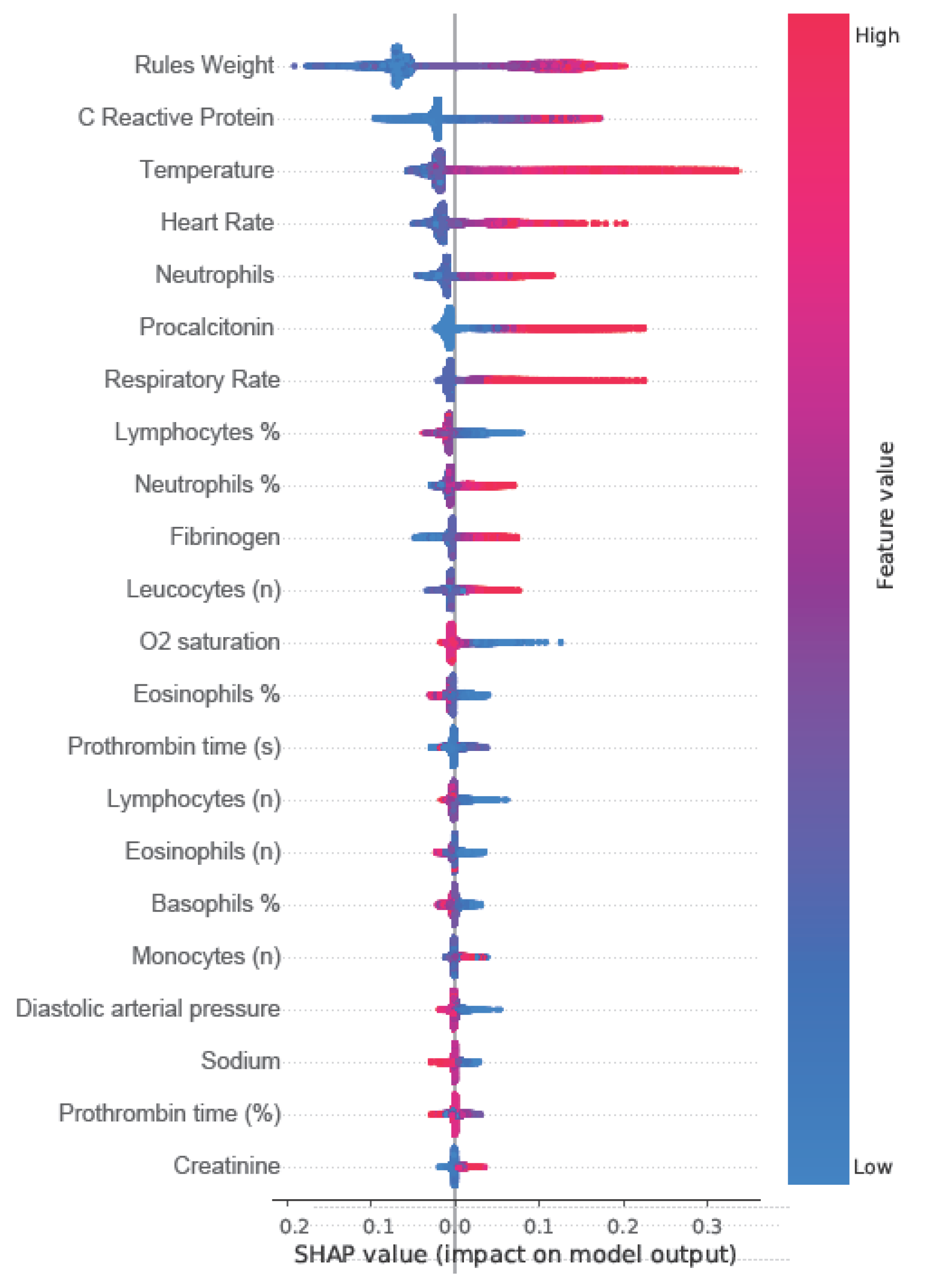
2.6.2. Machine Learning-Based Feature Selection
2.6.3. Data Preprocessing
- Missing Data Handling: The primary algorithms used in this study (random forests and gradient boosting models) can handle missing values natively through surrogate splits and by treating missingness as informative. For algorithms that require complete data (such as support vector machines and certain neural network implementations), missing values were imputed using reference normal values derived from the distribution of non-septic patients. The percentage of episodes with available measurements for each variable is reported in Supplementary Table S1.
- Outlier Management: Extreme outliers were identified and reviewed by the clinical team. Physiologically implausible values due to measurement or recording errors were corrected or excluded. Legitimate extreme values (e.g., very high lactate in septic shock) were retained.
- Normalisation: For the 61 continuous structured variables, Z-score normalisation was applied to standardise the scale across different measurement units. The mean and standard deviation were calculated from the training set only and then applied to both training and test sets to prevent data leakage. Z-score transformation centres the mean at zero, with values above the original mean becoming positive and values below becoming negative. This normalisation ensures that variables with different units (e.g., heart rate vs. creatinine) contribute equally to distance-based algorithms such as support vector machines.
- Text Preprocessing: For NLP variables, standard text processing steps included tokenisation, removal of stopwords, and extraction of clinically meaningful terms using the Dunning test. Categorical variables derived from text (e.g., presence of specific symptoms or anatomical sites) were binary encoded.
2.7. Machine Learning Model Development
2.7.1. Software and Implementation
2.7.2. Algorithms Evaluated
- Random Forest (RF): An ensemble of decision trees that reduces overfitting through bootstrap aggregation and random feature selection at each split. Random forests are robust to missing data and can capture complex non-linear interactions.
- Support Vector Machines (SVM): A classification algorithm that finds the optimal hyperplane separating classes in a high-dimensional feature space. SVMs are effective in high-dimensional settings and can model non-linear relationships through kernel functions.
- Neural Networks (NN): Multi-layer perceptrons with non-linear activation functions capable of learning complex hierarchical representations of data.
- Gradient Boosting (GB): An ensemble technique that sequentially builds decision trees, with each tree correcting errors made by previous trees. Gradient boosting often achieves high predictive accuracy but requires careful tuning to avoid overfitting.
2.7.3. Ensemble Learning Strategy
2.8. Model Categories and Ensemble Strategy
2.8.1. Category 1: Rule-Based Clinical Scoring Systems
- Sepsis-2: SIRS criteria (≥2 of: temperature > 38 °C or <36 °C, heart rate > 90 bpm, respiratory rate > 20/min, WBC > 12,000 or <4000/μL) plus suspected or confirmed infection [13].
- Sepsis-3 (SOFA): Sequential Organ Failure Assessment score ≥ 2 points in the presence of infection, according to the Third International Consensus Definitions for Sepsis and Septic Shock [1].
- qSOFA: Quick SOFA score ≥ 2 points (systolic BP ≤ 100 mmHg, respiratory rate ≥ 22/min, altered mentation).
- Sepsis-2 + qSOFA: Combined criteria requiring both Sepsis-2 and qSOFA positivity.
- Local ADS Model: The hospital’s pre-existing Automated Sepsis Detection System using 15 fixed clinical and biochemical variables.
2.8.2. Category 2: Pure Machine Learning Models
- Individual Random Forest models with varying hyperparameters
- Individual Support Vector Machine models
- Individual Neural Network architectures
- Individual Gradient Boosting models
- Ensemble combinations of the above using majority voting
2.8.3. Category 3: Hybrid Models (ML + Rule-Based Ensembles)
- BiAlert Sepsis (formerly BISEPRO): ML-IIC + Sepsis-2 criteria
- ML-IIC + Sepsis-3 (SOFA)
- ML-IIC + qSOFA
- ML-IIC + Sepsis-2 + qSOFA
- Additional combinations with local ADS scores
2.8.4. Category 4: Alternative Ensemble Configurations
2.9. Model Training and Validation
2.9.1. Dataset Partitioning
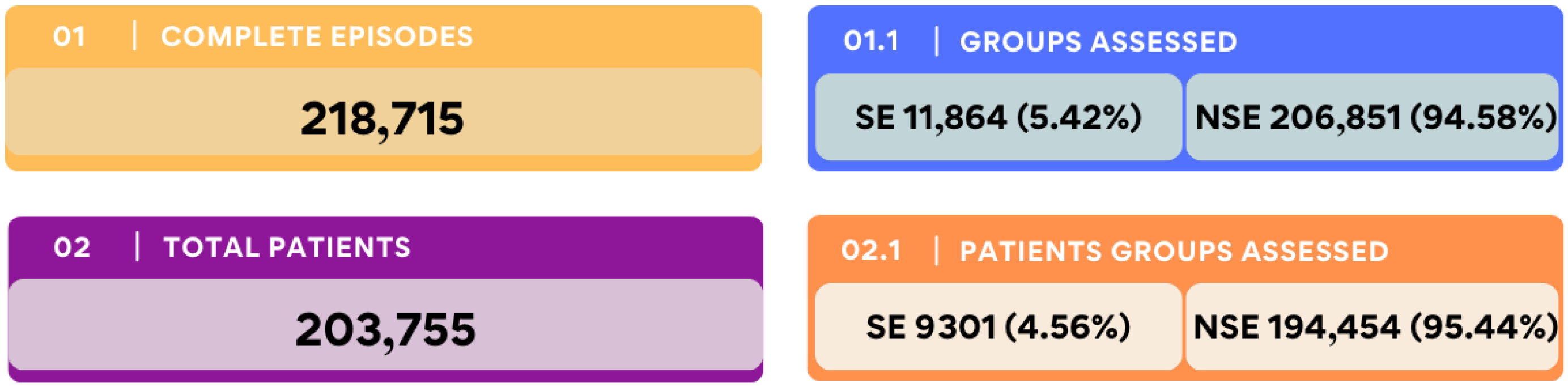
- Training Set: 5/7 of episodes (n = 145,539 episodes, approximately 71.4%)
- Test Set: 2/7 of episodes (n = 58,216 episodes, approximately 28.6% remaining, with final totals accounting for 14,960 excluded episodes)
2.9.2. Cross-Validation During Training
2.9.3. Model Selection and Final Evaluation
2.10. Statistical Analysis and Performance Metrics
2.10.1. Performance Metrics
2.10.2. Statistical Comparisons
2.10.3. Reproducibility
2.10.4. Model Calibration
2.11. Artificial Intelligence Use Statement
3. Results
3.1. Patient Cohort and Episode Distribution
3.2. Data Sources and Variable Selection
3.3. Predictive Model Performance
4. Discussion
5. Conclusions
Supplementary Materials
Author Contributions
Funding
Institutional Review Board Statement
Informed Consent Statement
Data Availability Statement
Acknowledgments
Conflicts of Interest
Abbreviations
| AI | Artificial Intelligence |
| ADS | Automated Sepsis Detection System |
| aPTT | Activated Partial Thromboplastin Time |
| AUC-ROC | Area Under the Receiver Operating Characteristic Curve |
| BP | Blood Pressure |
| CEIC-Ib | Ethics and Health Research Committee of the Balearic Community |
| ED | Emergency Department |
| EHR | Electronic Health Record |
| EMA | European Medicines Agency |
| EPS | Electronic Sepsis Protocol |
| FN | False Negative |
| FP | False Positive |
| GB | Gradient Boosting |
| GCS | Glasgow Coma Scale |
| HUSLL | Hospital Universitario Son Llàtzer |
| ICD-10 | International Classification of Diseases, 10th Revision |
| ICU | Intensive Care Unit |
| IIC | Instituto de Ingeniería del Conocimiento |
| LDH | Lactate Dehydrogenase |
| MAP | Mean Arterial Pressure |
| ML | Machine Learning |
| ML-IIC | Machine Learning—Instituto de Ingeniería del Conocimiento |
| ML-RF | Machine Learning—Random Forest |
| MSU | Multidisciplinary Sepsis Unit |
| NLP | Natural Language Processing |
| NPV | Negative Predictive Value |
| NSE | Non-Septic Episodes |
| OR | Odds Ratio |
| PPV | Positive Predictive Value |
| PT | Prothrombin Time |
| qSOFA | Quick Sequential Organ Failure Assessment |
| RF | Random Forest |
| SE | Sepsis Episodes |
| SHAP | Shapley Additive Explanations |
| SIRS | Systemic Inflammatory Response Syndrome |
| SINOMED CT | Systematised Nomenclature of Medicine Clinical Terms |
| SOFA | Sequential Organ Failure Assessment |
| SVM | Support Vector Machines |
| TN | True Negative |
| TP | True Positive |
| WBC | White Blood Cell |
References
- Singer, M.; Deutschman, C.S.; Seymour, C.; Shankar-Hari, M.; Annane, D.; Bauer, M.; Bellomo, R.; Bernard, G.R.; Chiche, J.D.; Coopersmith, C.M.; et al. The Third International Consensus Definitions for Sepsis and Septic Shock (Sepsis-3). JAMA 2016, 315, 801–810. [Google Scholar] [CrossRef] [Scilit]
- Angus, D.C.; van der Poll, T. Severe Sepsis and Septic Shock. N. Engl. J. Med. 2013, 369, 840–851. [Google Scholar] [CrossRef] [Scilit] [PubMed]
- Seymour, C.W.; Liu, V.X.; Iwashyna, T.J.; Brunkhorst, F.M.; Rea, T.D.; Scherag, A.; Rubenfeld, G.; Kahn, J.M.; Shankar-Hari, M.; Singer, M.; et al. Assessment of Clinical Criteria for Sepsis: For the Third International Consensus Definitions for Sepsis and Septic Shock (Sepsis-3). JAMA 2016, 315, 762–774. [Google Scholar] [CrossRef] [Scilit]
- Martin-Loeches, I.; Singer, M.; Leone, M. Sepsis: Key Insights, Future Directions, and Immediate Goals. A Review and Expert Opinion. Intensive Care Med. 2024, 50, 2043–2049. [Google Scholar] [CrossRef] [Scilit] [PubMed]
- Johnson, A.E.W.; Aboab, J.; Raffa, J.D.; Pollard, T.J.; Deliberato, R.O.; Celi, L.A.; Stone, D.J. A Comparative Analysis of Sepsis Identification Methods in an Electronic Database. Crit. Care Med. 2018, 46, 494–499. [Google Scholar] [CrossRef] [Scilit] [PubMed] [PubMed Central]
- Camacho-Cogollo, J.E.; Bonet, I.; Gil, B.; Iadanza, E. Machine Learning Models for Early Prediction of Sepsis on Large Healthcare Datasets. Electronics 2022, 11, 1507. [Google Scholar] [CrossRef] [Scilit]
- Zhou, L.; Shao, M.; Wang, C.; Wang, Y. An Early Sepsis Prediction Model Utilizing Machine Learning and Unbalanced Data Processing in a Clinical Context. Prev. Med. Rep. 2024, 45, 102841. [Google Scholar] [CrossRef] [Scilit]
- Goh, K.H.; Wang, L.; Yeow, A.Y.K.; Poh, H.; Li, K.; Yeow, J.J.L.; Tan, G.Y.H. Artificial Intelligence in Sepsis Early Prediction and Diagnosis Using Unstructured Data in Healthcare. Nat. Commun. 2021, 12, 711. [Google Scholar] [CrossRef] [Scilit] [PubMed]
- Futoma, J.; Simons, M.; Panch, T.; Doshi-Velez, F.; Celi, L.A. The Myth of Generalisability in Clinical Research and Machine Learning in Health Care. Lancet Digit. Health 2020, 2, e489–e492. [Google Scholar] [CrossRef] [Scilit]
- Bedoya, A.D.; Futoma, J.; Clement, M.E.; Corey, K.; Brajer, N.; Lin, A.; Simons, M.G.; Gao, M.; Nichols, M.; Balu, S.; et al. Machine Learning for Early Detection of Sepsis: An Internal and Temporal Validation Study. JAMIA Open 2020, 3, 252–260. [Google Scholar] [CrossRef] [Scilit]
- Dellinger, R.P.; Levy, M.; Rhodes, A.; Annane, D.; Gerlach, H.; Opal, S.M.; Sevransky, J.E.; Sprung, C.L.; Douglas, I.S.; Jaeschke, R.; et al. Surviving Sepsis Campaign: International Guidelines for Management of Severe Sepsis and Septic Shock: 2012. Crit. Care Med. 2013, 41, 580–637. [Google Scholar] [CrossRef]
- Borges-Sa, M.; Giglio, A.; Aranda, M.; Socias, A.; del Castillo, A.; Mena, J.; Franco, S.; Ortega, M.; Nieto, Y.; Estrada, V.; et al. Decoding Sepsis: A 16-Year Retrospective Analysis of Activation Patterns, Mortality Predictors, and Outcomes from a Hospital-Wide Sepsis Protocol. J. Clin. Med. 2025, 14, 5759. [Google Scholar] [CrossRef] [Scilit]
- Levy, M.M.; Fink, M.P.; Marshall, J.C.; Abraham, E.; Angus, D.; Cook, D.; Cohen, J.; Opal, S.M.; Vincent, J.L.; Ramsay, G. 2001 SCCM/ESICM/ACCP/ATS/SIS International Sepsis Definitions Conference. Crit. Care Med. 2003, 31, 1250–1256. [Google Scholar] [CrossRef] [Scilit]
- Garland, A.; Li, N.; Sligl, W.; Lane, A.; Thavorn, K.; Wilcox, M.E.; Rochwerg, B.; Keenan, S.; Marrie, T.J.; Kumar, A.; et al. Adjudication of Codes for Identifying Sepsis in Hospital Administrative Data by Expert Consensus. Crit. Care Med. 2024, 52, 1845–1855. [Google Scholar] [CrossRef] [Scilit]
- Jolley, R.J.; Sawka, K.J.; Yergens, D.W.; Quan, H.; Jetté, N.; Doig, C.J. Validity of Administrative Data in Recording Sepsis: A Systematic Review. Crit. Care 2015, 19, 139. [Google Scholar] [CrossRef] [Scilit]
- Fleuren, L.M.; Klausch, T.L.T.; Zwager, C.L.; Schoonmade, L.J.; Guo, T.; Roggeveen, L.F.; Swart, E.L.; Girbes, A.R.J.; Thoral, P.; Ercole, A.; et al. Machine Learning for the Prediction of Sepsis: A Systematic Review and Meta-Analysis of Diagnostic Test Accuracy. Intensive Care Med. 2020, 46, 383–400. [Google Scholar] [CrossRef] [Scilit]
- Islam, K.R.; Prithula, J.; Kumar, J.; Tan, T.L.; Reaz, M.B.I.; Sumon, M.S.I.; Chowdhury, M.E.H. Machine Learning-Based Early Prediction of Sepsis Using Electronic Health Records: A Systematic Review. J. Clin. Med. 2023, 12, 5658. [Google Scholar] [CrossRef] [Scilit] [PubMed]
- Bignami, E.G.; Berdini, M.; Panizzi, M.; Domenichetti, T.; Bezzi, F.; Allai, S.; Damiano, T.; Bellini, V. Artificial Intelligence in Sepsis Management: An Overview for Clinicians. J. Clin. Med. 2025, 14, 286. [Google Scholar] [CrossRef] [Scilit] [PubMed]
- Yang, Z.; Cui, X.; Song, Z. Predicting Sepsis Onset in ICU Using Machine Learning Models: A Systematic Review and Meta-Analysis. BMC Infect Dis. 2023, 23, 635. [Google Scholar] [CrossRef] [Scilit]
- Horng, S.; Sontag, D.A.; Halpern, Y.; Jernite, Y.; Shapiro, N.I.; Nathanson, L.A. Creating an Automated Trigger for Sepsis Clinical Decision Support at Emergency Department Triage Using Machine Learning. PLoS ONE 2017, 12, e0174708. [Google Scholar] [CrossRef] [Scilit] [PubMed]
- Shashikumar, S.P.; Mohammadi, S.; Krishnamoorthy, R.; Patel, A.; Wardi, G.; Ahn, J.C.; Singh, K.; Aronoff-Spencer, E.; Nemati, S. Development and Prospective Implementation of a Large Language Model Based System for Early Sepsis Prediction. NPJ Digit. Med. 2025, 8, 290. [Google Scholar] [CrossRef] [Scilit] [PubMed]
- Zubair, M.; Din, I.; Sarwar, N.; Elov, B.; Makhmudov, S.; Trabelsi, Z. Revolutionizing Sepsis Diagnosis Using Machine Learning and Deep Learning Models: A Systematic Literature Review. BMC Infect Dis. 2025, 25, 1396. [Google Scholar] [CrossRef] [Scilit]



| Variables | Sepsis Patients | Non-Septic Patients | ||||||||
|---|---|---|---|---|---|---|---|---|---|---|
| Mean | Median | St. Desv | Episodes (%) | IC 99% | Mean | Median | St. Desv | Episodes (%) | IC 99% | |
| Clinical Variables | ||||||||||
| Age (years) | 68.48 | 72 | 17.19 | 11,864 (100%) | 68.07–68.89 | 47.82 | 44 | 20.27 | 206,851 (100%) | 47.71–47.94 |
| Heart Rate | 98.75 | 101 | 23.29 | 11,075 (93.35%) | 98.18–99.32 | 82.85 | 80 | 17.83 | 182,306 (88.13%) | 82.74–82.96 |
| Respiratory Rate | 20.68 | 20 | 6.07 | 7336 (61.83%) | 20.49–20.86 | 16.91 | 16 | 3.36 | 101,852 (49.24%) | 16.89–16.94 |
| GCS (value) | 14.92 | 15 | 0.75 | 1708 (14.4%) | 14.87–14.97 | 14.97 | 15 | 0.44 | 18,443 (8.92%) | 14.96–14.97 |
| FiO2 (%) | 36.32 | 28 | 21.14 | 3034 (25.57%) | 35.33–37.31 | 26.37 | 21 | 15.11 | 14,857 (7.18%) | 26.05–26.69 |
| MAP (mmHg) | 58.62 | 59.33 | 5.24 | 3233 (27.25%) | 58.38–58.86 | 60.17 | 61.67 | 4.62 | 7955 (3.85%) | 60.04–60.31 |
| Temperature (°C) | 37.15 | 36.9 | 1.23 | 10,989 (92.62%) | 37.1–37.18 | 36.3 | 36.2 | 0.64 | 165,872 (80.19%) | 36.3–36.31 |
| Biochemical Variables | ||||||||||
| Metabolic | ||||||||||
| Albumin (g/dL) | 2.99 | 3 | 0.63 | 2290 (19.3%) | 2.95–3.02 | 3.56 | 3.56 | 0.6 | 9049 (4.37%) | 3.55–3.58 |
| Bicarbonate (mEq/L) | 24.67 | 24.4 | 6.47 | 1269 (10.7%) | 24.2–25.14 | 25.75 | 25.9 | 5.91 | 2363 (1.14%) | 25.44–26.06 |
| Cholesterol (mg/dL) | 128.64 | 122 | 53.01 | 1190 (10.03%) | 124.6–132.6 | 171.05 | 166 | 52.73 | 7772 (3.76%) | 169.5–172.59 |
| Blood glucose (mg/dL) | 150.78 | 127 | 83.79 | 10,537 (88.81%) | 148.6–152.89 | 113.91 | 101 | 48.45 | 98,372 (47.56%) | 113.5–114.3 |
| LDH (U/L) | 318.35 | 227 | 687.57 | 3498 (29,48%) | 288.4–348.3 | 214.16 | 189 | 166.37 | 17,293 (8.36%) | 210.9–217.42 |
| Total Proteins (g/dL) | 5.71 | 5.7 | 0.99 | 1800 (15.17%) | 5.65–5.77 | 6.4 | 6.4 | 0.78 | 8649 (4.18%) | 6.38–6.42 |
| Biomarkers | ||||||||||
| Lactate (mmol/L) | 2.32 | 1.7 | 1.94 | 1077 (9.08%) | 2.16–2.47 | 1.77 | 1.29 | 1.53 | 771 (0.37%) | 1.63–1.91 |
| Procalcitonin (ng/mL) | 12.22 | 1.37 | 120.85 | 4737 (39.93%) | 7.7–16.75 | 0.72 | 0.1 | 3.22 | 1646 (0.8%) | 0.52–0.92 |
| C Reactive Protein (mg/L) | 157.53 | 147.6 | 100.68 | 10,095 (85.09%) | 154.95–160.1 | 32.37 | 7.5 | 56.52 | 54,988 (26.58%) | 31.74–32.99 |
| Renal | ||||||||||
| Creatinine (mg/dL) | 1.43 | 1.11 | 1.11 | 10,886 (91.76%) | 1.41–1.46 | 0.93 | 0.81 | 0.56 | 99,953 (48.32%) | 0.92–0.93 |
| Sodium (mEq/L) | 137.47 | 137.7 | 5.55 | 10,811 (91.12%) | 137.3–137.6 | 139.32 | 139.6 | 3.36 | 99,393 (48.05%) | 139.3–139.35 |
| Urea (mg/dL) | 61.83 | 49 | 43.19 | 10,837 (91.34%) | 60.76–62.9 | 36.72 | 32 | 22.69 | 99,137 (47.93%) | 36.53–36.9 |
| Hepatic Profile | ||||||||||
| Direct Bilirubin (mg/dL) | 2.03 | 1.04 | 2.68 | 1975 (16.65%) | 1.87–2.18 | 1.34 | 0.66 | 2.27 | 4989 (2.41%) | 1.26–1.43 |
| Haematological Variables | ||||||||||
| Blood Count | ||||||||||
| Leukocytes (×109/L) | 14.38 | 13.6 | 9.33 | 10,927 (92.1%) | 14.15–14.61 | 9.74 | 9.04 | 4.22 | 105,469 (50.99%) | 9.71–9.77 |
| Neutrophils (×109/L) | 11.66 | 10.9 | 7.17 | 10,848 (91.44%) | 11.49–11.84 | 6.59 | 5.79 | 3.57 | 105,394 (50.95%) | 6.56–6.62 |
| Lymphocytes (×109/L) | 1.41 | 1.05 | 4.91 | 10,848 (91.44%) | 1.29–1.53 | 2.1 | 1.96 | 1.85 | 105,395 (50.95%) | 2.09–2.12 |
| Eosinophils (%) | 0.82 | 0.32 | 1.59 | 10,856 (91.5%) | 0.78–0.86 | 1.83 | 1.3 | 1.99 | 105,398 (50.95%) | 1.82–1.85 |
| Platelets (×109/L) | 238.26 | 218 | 127.43 | 10,865 (91.58%) | 235.1–241.41 | 244.67 | 236 | 80.2 | 105,420 (50.96%) | 244.04–245.3 |
| Haemoglobin (g/dL) | 11.89 | 12 | 2.28 | 10,857 (91.51%) | 11.83–11.94 | 13.43 | 13.6 | 1.93 | 105,419 (50.96%) | 13.42–13.45 |
| Haematocrit (%) | 36.68 | 36.9 | 7.02 | 10,855 (91.5%) | 36.51–36.85 | 40.56 | 41 | 5.72 | 105,419 (50.96%) | 40.52–40.61 |
| Coagulation | ||||||||||
| PT act (%) | 65.99 | 68 | 20.72 | 9473 (79.85%) | 65.44–66.54 | 87.12 | 90 | 19.78 | 76,107 (36.79%) | 86.94–87.3 |
| aPTT (Seg) | 33 | 31.5 | 8.16 | 8350 (70.38%) | 32.77–33.23 | 31.86 | 31.1 | 5.94 | 68,729 (33.23%) | 31.8–31.92 |
| Fibrinogen (mg/dL) | 685.14 | 674 | 216.3 | 8053 (67.88%) | 678.9–691.35 | 472.99 | 444 | 150.85 | 64,737 (31.3%) | 471.47–474.52 |
| Origin/Sources | Number | % of Total | Relevant Variables | % Variables Associated SE |
|---|---|---|---|---|
| Sepsis Code | 15 | 0.50% | 15 | 100% |
| Vital signs | 54 | 1.91% | 6 | 11.11% |
| Analytical variables | 1326 | 46.87% | 45 | 3.39% |
| Triage | 754 | 26.65% | 112 | 14.85% |
| Pharmacy data | 643 | 22.72% | 14 | 2.17% |
| ED Reports | 37 | 1.30% | 37 | 100% |
| TOTAL | 2829 | 100% | 229 | 8.09% |
| Sepsis-2 | Sepsis-3 (SOFA) | Sepsis-2 + qSOFA | ML-IIC | ML-IIC + Sepsis-2 + qSOFA | ML-ICC + Sepsis-2 (BiAlert Sepsis) | |
|---|---|---|---|---|---|---|
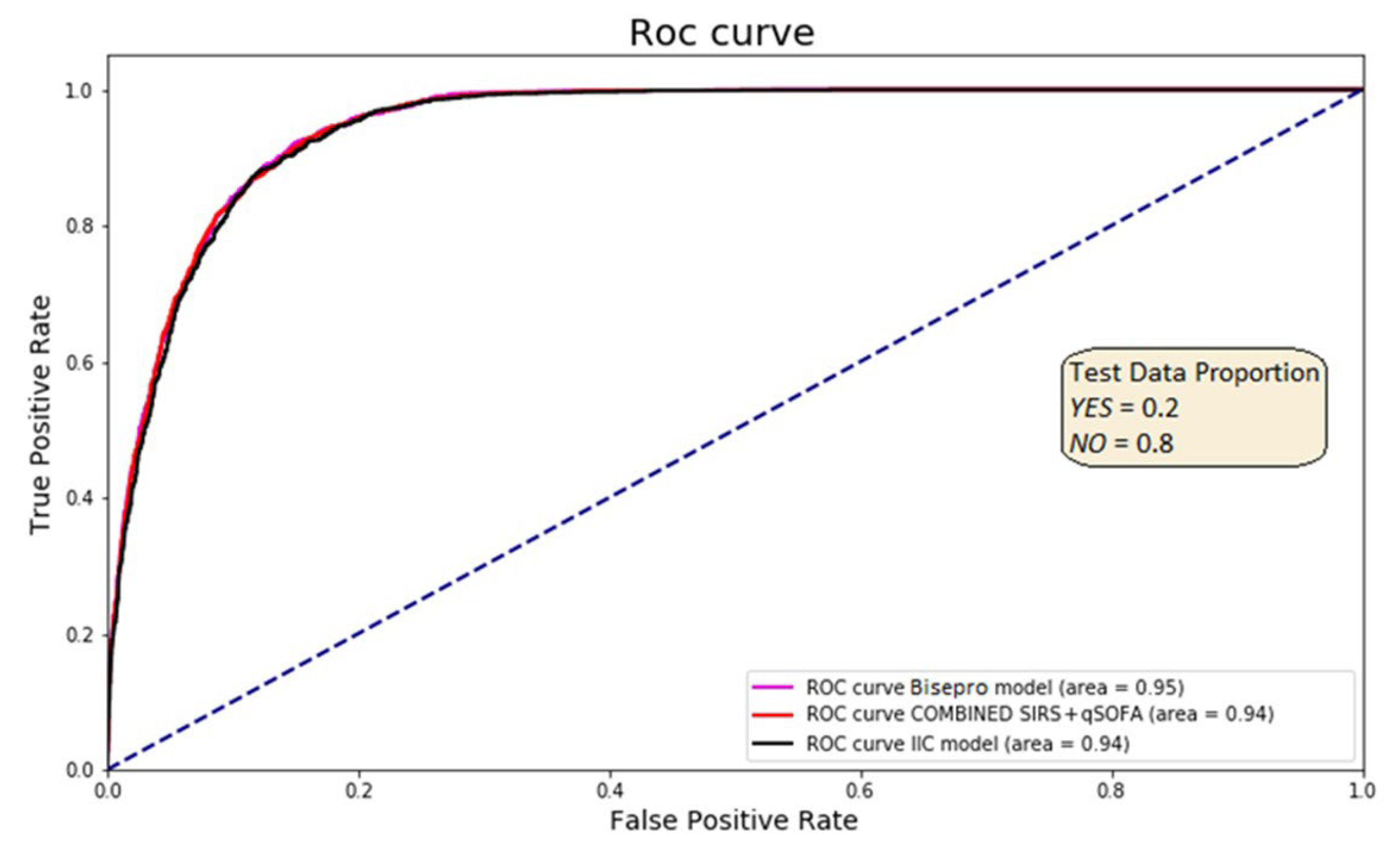
| AUC | 0.89 | 0.85 | 0.90 | 0.94 | 0.94 | 0.95 |
| SENSIB | 0.88 | 0.81 | 0.93 | 0.93 | 0.93 | 0.93 |
| SPECIF | 0.77 | 0.80 | 0.73 | 0.83 | 0.83 | 0.84 |
| TP (%) | 17.60 | 17.10 | 18.60 | 18.70 | 18.60 | 18.70 |
| TN (%) | 61.60 | 59.20 | 58.20 | 66.20 | 66.40 | 66.80 |
| FP (%) | 18.40 | 20.80 | 21.70 | 13.70 | 13.60 | 13.10 |
| FN (%) | 2.40 | 2.90 | 1.50 | 1.40 | 1.40 | 1.40 |
Disclaimer/Publisher’s Note: The statements, opinions and data contained in all publications are solely those of the individual author(s) and contributor(s) and not of MDPI and/or the editor(s). MDPI and/or the editor(s) disclaim responsibility for any injury to people or property resulting from any ideas, methods, instructions or products referred to in the content. |
© 2026 by the authors. Licensee MDPI, Basel, Switzerland. This article is an open access article distributed under the terms and conditions of the Creative Commons Attribution (CC BY) license.
Share and Cite
Borges-Sa, M.; Giglio, A.; Aranda, M.; Socias, A.; del Castillo, A.; Pruenza, C.; Hernández, G.; Cerdá, S.; Socias, L.; Estrada, V.; et al. Hospital-Wide Sepsis Detection: A Machine Learning Model Based on Prospectively Expert-Validated Cohort. J. Clin. Med. 2026, 15, 855. https://doi.org/10.3390/jcm15020855
Borges-Sa M, Giglio A, Aranda M, Socias A, del Castillo A, Pruenza C, Hernández G, Cerdá S, Socias L, Estrada V, et al. Hospital-Wide Sepsis Detection: A Machine Learning Model Based on Prospectively Expert-Validated Cohort. Journal of Clinical Medicine. 2026; 15(2):855. https://doi.org/10.3390/jcm15020855
Chicago/Turabian StyleBorges-Sa, Marcio, Andres Giglio, Maria Aranda, Antonia Socias, Alberto del Castillo, Cristina Pruenza, Gonzalo Hernández, Sofía Cerdá, Lorenzo Socias, Victor Estrada, and et al. 2026. "Hospital-Wide Sepsis Detection: A Machine Learning Model Based on Prospectively Expert-Validated Cohort" Journal of Clinical Medicine 15, no. 2: 855. https://doi.org/10.3390/jcm15020855
APA StyleBorges-Sa, M., Giglio, A., Aranda, M., Socias, A., del Castillo, A., Pruenza, C., Hernández, G., Cerdá, S., Socias, L., Estrada, V., de la Rica, R., Martin, E., & Martin-Loeches, I. (2026). Hospital-Wide Sepsis Detection: A Machine Learning Model Based on Prospectively Expert-Validated Cohort. Journal of Clinical Medicine, 15(2), 855. https://doi.org/10.3390/jcm15020855