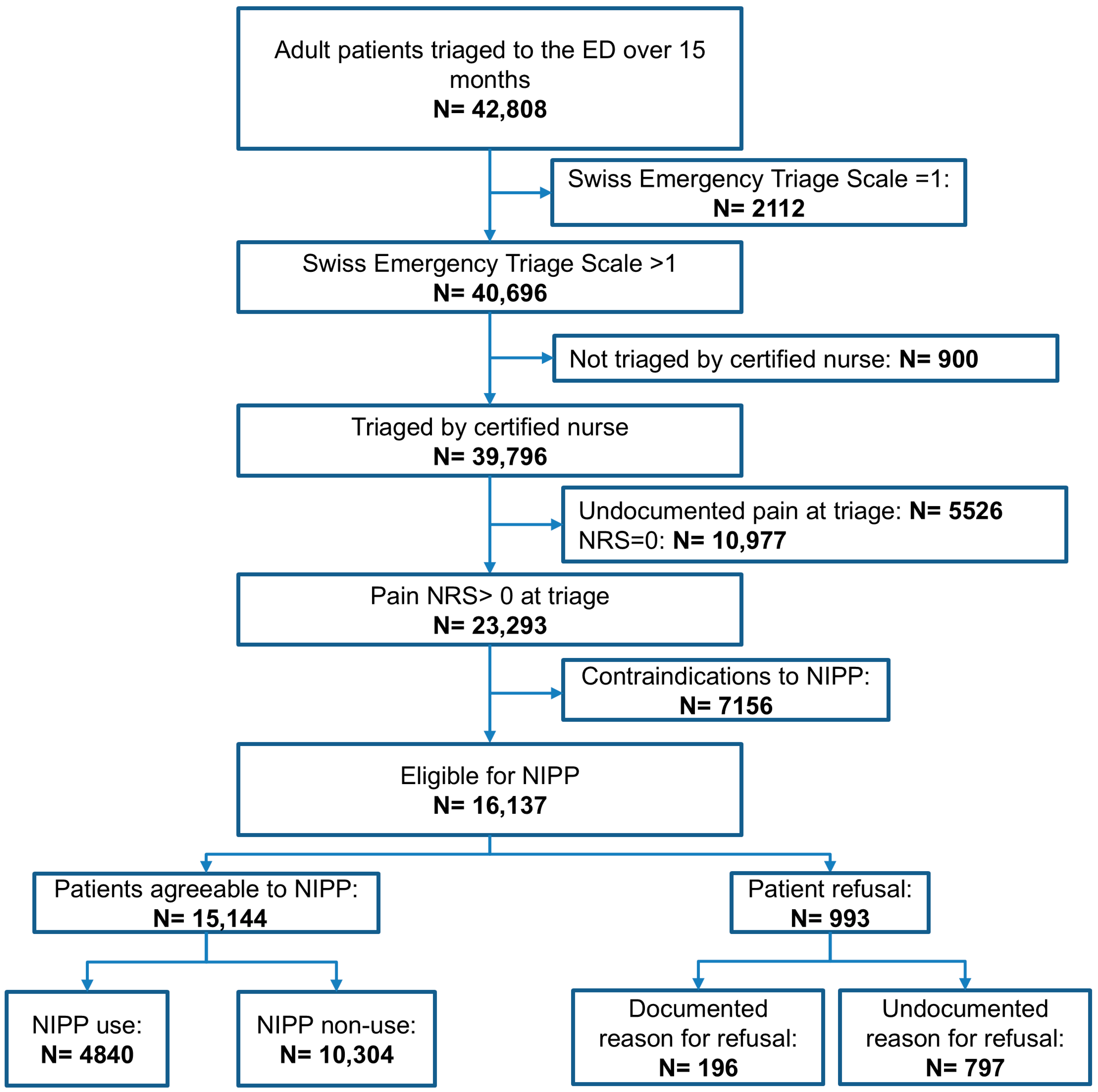
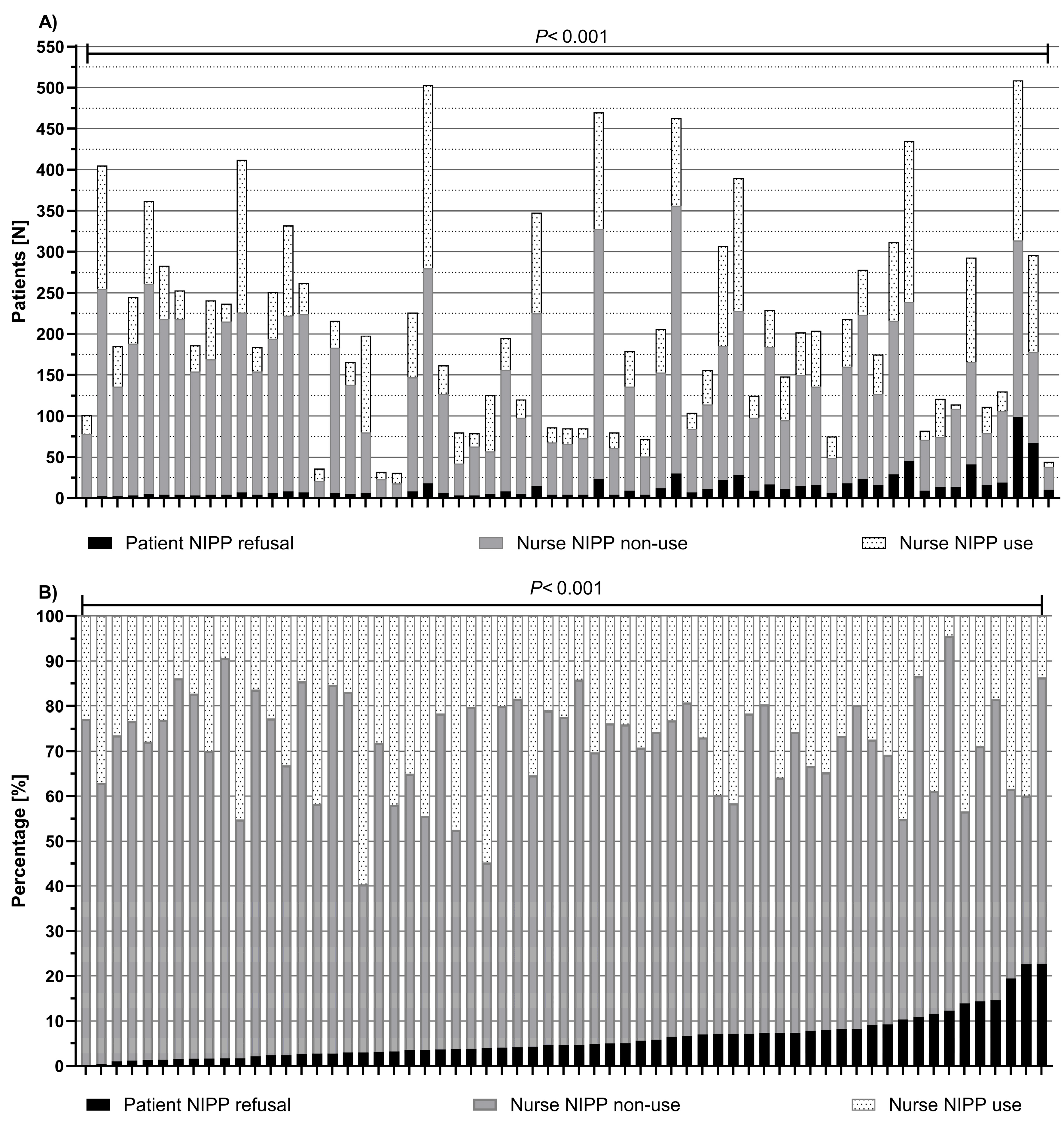
Impact of Patients, Nurses, and Workload on the Use of a Nurse-Initiated Pain Protocol at Triage in the Emergency Department: A Single-Center Retrospective Observational Study

Abstract
1. Introduction
2. Methods
2.1. Study Design
2.2. Sample and Population
2.3. Data Collection, Variables, and Measures
2.4. Outcomes
2.5. Statistical Analysis
2.6. Artificial Intelligence
3. Results
3.1. Patient Characteristics (Table 1)

| Variable | All Patients N = 16,137 | Refusal of NIPP N = 993 | Use of NIPP N = 4840 | No Use of NIPP N = 10,304 | p-Value |
|---|---|---|---|---|---|
| Gender, n (%) | 0.338 | ||||
| Male | 8606 (53.7) | 555 (55.9) | 2585 (53.4) | 5517 (53.5) | |
| Female | 7425 (46.3) | 438 (44.1) | 2255(46.6) | 4787 (46.5) | |
| Median age, years (IQR) | 40 (27–59) | 36 (25–53) | 35 (25–49) | 44 (29–66) | <0.001 |
| Admission route, n (%) | <0.001 | ||||
| Ambulance | 2646 (16.4) | 87 (8.8) | 242 (5.0) | 2317 (22.5) | |
| Outpatient | 13,491 (83.6) | 906 (91.2) | 4598 (95.0) | 7987 (77.5) | |
| Triage category SETS, n (%) | 0.05 | ||||
| 2 | 2090 (13.0) | 54 (5.4) | 325 (6.7) | 1711 (16.6) | |
| 3 | 11,129 (69.0) | 728 (73.3) | 3695 (76.3) | 6706 (65.1) | |
| 4 | 2918 (18.0) | 211 (21.3) | 820 (17.0) | 1887 (18.3) | |
| Triage time, minute (IQR) | 5 (4–8) | 5 (3–7) | 6 (4–8) | 5 (4–7) | <0.001 |
| Patients in waiting room, n (IQR) | 6 (4–10) | 6 (4–10) | 6 (4–10) | 6 (3–9) | 0.001 |
| NRS pain score, unit (SD) | 5.3 (2.5) | 5.0 (2.1) | 6.9 (2.0) | 4.5 (2.4) | <0.001 |
| ED orientation after triage, n (%) | <0.001 | ||||
| Major medical/trauma | 2848 (17.7) | 50 (5.0) | 292 (6.0) | 2506 (24.3) | |
| Minor medical/trauma | 13,289 (82.3) | 943 (95.0) | 4548 (94.0) | 7798 (75.7) |
3.2. Nurse Characteristics (Table 3)
| Characteristics (N = 63) | |
|---|---|
| Age, year [SD] | 34.8 (7.0) |
| Female, n (%) | 45 (71.4) |
| Full-time equivalent *, % [SD] | 91.4 [15.9] |
| Place of training, n (%) | |
| Switzerland | 25 (39.7) |
| European Union | 28 (44.4) |
| Canada | 10 (15.9) |
| Certification in emergency care, n (%) | 11 (17.5) |
| Years since graduation, years (IQR) | 9 (6–12) |
| ED experience, years (IQR) | 6 (4–9) |
| Specific pain management training **, n (%) | 38 (61.3) |
| Personal experience of severe pain, n (%) | 50 (79.4) |
| Cause of severe pain, n (%): | |
| Traumatic | 27 (54.0) |
| Low-back | 23 (50.0) |
| Headache | 22 (47.8) |
| Abdominal | 19 (41.3) |
| Childbirth | 15 (32.6) |
| Renal colic | 10 (21.3) |
| Neuropathic | 5 (10.9) |
| Number of different causes of severe pain, n (IQR) | 2 (1–3) |
| Risk-Taking Scale score, points [SD] | 15.7 [2.7] |
| Stress from Uncertainty Scale, points [SD] | 19.8 [5.3] |
| Burden of prescribing NIPP experienced as heavy, n (%) | 11 (17.7) |
| Experience with NIPP; | |
| Previous experience with another NIPP, n (%) | 15 (24.2) |
| Duration of NIPP use, days [SD] | 233 [64] |
| Number of triages per nurse during the study period, n (IQR) | 195 (111–283) |
| Percentage use of the NIPP, % (IQR): | |
| Estimated | 75 (50–80) |
| Actual | 26.5 (19.8–35.8) |
| Fear to administer analgesia, n (%): | |
| Acetaminophen | 3 (4.8) |
| Ibuprofen | 4 (6.4) |
| Tramadol | 7 (11.1) |
| Patient NIPP refusal | |
| n (IQR) | 7 (4–16) |
| % (IQR) | 4.7 (2.8–7.8) |
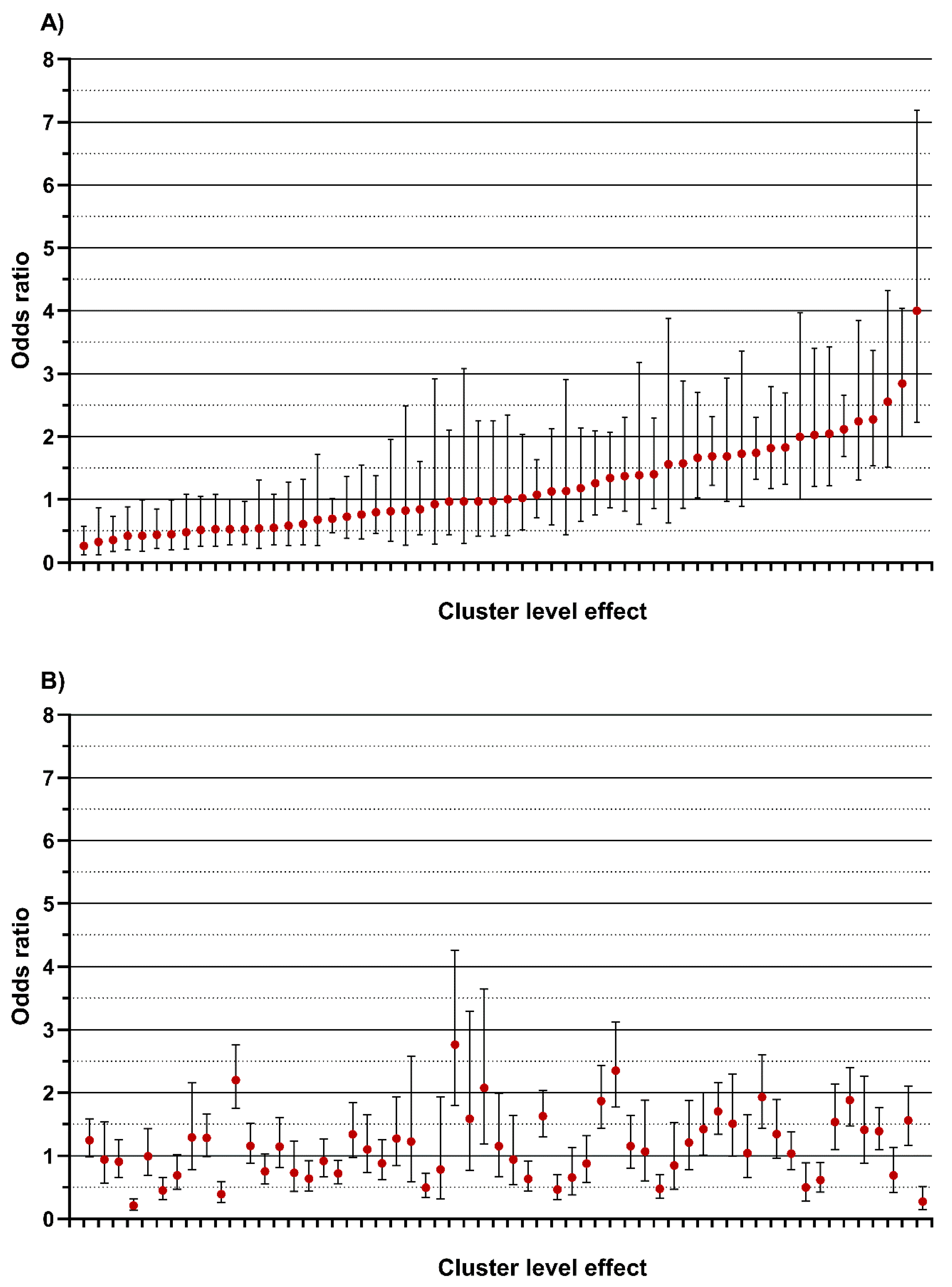
3.3. Multi-Level Logistic Regression
4. Discussion
4.1. Patient Characteristics
4.2. External Factors and System Barriers
4.3. Triage Nurse Characteristics
4.4. Strength and Limitations
4.5. Implications for Practice
5. Conclusions
Supplementary Materials
Author Contributions
Funding
Institutional Review Board Statement
Informed Consent Statement
Data Availability Statement
Acknowledgments
Conflicts of Interest
References
- Decosterd, I.; Hugli, O.; Tamchès, E.; Blanc, C.; Mouhsine, E.; Givel, J.-C.; Yersin, B.; Buclin, T. Oligoanalgesia in the emergency department: Short-term beneficial effects of an education program on acute pain. Ann. Emerg. Med. 2007, 50, 462–471. [Google Scholar] [CrossRef]
- Gueant, S.; Taleb, A.; Borel-Kuhner, J.; Cauterman, M.; Raphael, M.; Nathan, G.; Ricard-Hibon, A. Quality of pain management in the emergency department: Results of a multicentre prospective study. Eur. J. Anaesthesiol. 2011, 28, 97–105. [Google Scholar] [CrossRef]
- Patrick, P.A.; Rosenthal, B.M.; Iezzi, C.A.; Brand, D.A. Timely pain management in the emergency department. J. Emerg. Med. 2015, 48, 267–273. [Google Scholar] [CrossRef]
- Varndell, W.; Fry, M.; Elliott, D. Quality and impact of nurse-initiated analgesia in the emergency department: A systematic review. Int. Emerg. Nurs. 2018, 40, 46–53. [Google Scholar] [CrossRef] [PubMed]
- Corradi-Dell’Acqua, C.; Foerster, M.; Sharvit, G.; Trueb, L.; Foucault, E.; Fournier, Y.; Vuilleumier, P.; Hugli, O. Pain management decisions in emergency hospitals are predicted by brain activity during empathy and error monitoring. Br. J. Anaesth. 2019, 123, e284–e292. [Google Scholar] [CrossRef] [PubMed]
- Pretorius, A.; Searle, J.; Marshall, B. Barriers and enablers to emergency department nurses’ management of patients’ pain. Pain Manag. Nurs. 2015, 16, 372–379. [Google Scholar] [CrossRef] [PubMed]
- Shaban, R.Z.; Holzhauser, K.; Gillespie, K.; Huckson, S.; Bennetts, S. Characteristics of effective interventions supporting quality pain management in Australian emergency departments: An exploratory study. Australas. Emerg. Nurs. J. 2012, 15, 23–30. [Google Scholar] [CrossRef] [PubMed]
- Vuille, M.; Foerster, M.; Foucault, E.; Hugli, O. Pain assessment by emergency nurses at triage in the emergency department: A qualitative study. J. Clin. Nurs. 2018, 27, 669–676. [Google Scholar] [CrossRef] [PubMed]
- Kant, J.; Dombagolla, M.; Lai, F.; Hendarto, A.; Taylor, D.M. Analgesia in the emergency department: Why is it not administered? Emerg. Med. J. 2019, 36, 12–17. [Google Scholar] [CrossRef]
- Pierik, J.G.; Berben, S.A.; MJ, I.J.; Gaakeer, M.I.; van Eenennaam, F.L.; van Vugt, A.B.; Doggen, C.J. A nurse-initiated pain protocol in the ED improves pain treatment in patients with acute musculoskeletal pain. Int. Emerg. Nurs. 2016, 27, 3–10. [Google Scholar] [CrossRef]
- van Dijk, J.F.; Vervoort, S.C.; van Wijck, A.J.; Kalkman, C.J.; Schuurmans, M.J. Postoperative patients’ perspectives on rating pain: A qualitative study. Int. J. Nurs. Stud. 2016, 53, 260–269. [Google Scholar] [CrossRef] [PubMed]
- Koban, L.; Wager, T.D. Beyond conformity: Social influences on pain reports and physiology. Emotion 2016, 16, 24–32. [Google Scholar] [CrossRef]
- Levine, F.M.; Lee De Simone, L. The effects of experimenter gender on pain report in male and female subjects. Pain 1991, 44, 69–72. [Google Scholar] [CrossRef]
- Losin, E.A.R.; Anderson, S.R.; Wager, T.D. Feelings of clinician-patient similarity and trust influence pain: Evidence from simulated clinical interactions. J. Pain 2017, 18, 787–799. [Google Scholar] [CrossRef]
- Mills, A.M.; Shofer, F.S.; Chen, E.H.; Hollander, J.E.; Pines, J.M. The association between emergency department crowding and analgesia administration in acute abdominal pain patients. Acad. Emerg. Med. 2009, 16, 603–608. [Google Scholar] [CrossRef]
- Proctor, E.; Silmere, H.; Raghavan, R.; Hovmand, P.; Aarons, G.; Bunger, A.; Griffey, R.; Hensley, M. Outcomes for implementation research: Conceptual distinctions, measurement challenges, and research agenda. Adm. Policy Ment. Health 2011, 38, 65–76. [Google Scholar] [CrossRef]
- Ridderikhof, M.L.; Lodder, D.V.; Van Dieren, S.; Lirk, P.; Goddijn, H.; Goslings, J.C.; Hollmann, M.W. The relationship between patient factors and the refusal of analgesics in adult Emergency Department patients with extremity injuries, a case-control study. Scand. J. Pain 2019, 20, 87–94. [Google Scholar] [CrossRef]
- Stephan, F.; Nickel, C.; Martin, J.; Grether, D.; Delport-Lehnen, K.; Bingisser, R. Pain in the emergency department: Adherence to an implemented treatment protocol. Swiss Med. Wkly. 2010, 140, 341–347. [Google Scholar] [CrossRef] [PubMed]
- Taylor, D.M.; Chen, J.; Khan, M.; Lee, M.; Rajee, M.; Yeoh, M.; Richardson, J.R.; Ugoni, A.M. Variables associated with administration of analgesia, nurse-initiated analgesia and early analgesia in the emergency department. Emerg. Med. J. 2017, 34, 13–19. [Google Scholar] [CrossRef]
- Rutschmann, O.T.; Hugli, O.W.; Marti, C.; Grosgurin, O.; Geissbuhler, A.; Kossovsky, M.; Simon, J.; Sarasin, F.P. Reliability of the revised Swiss Emergency Triage Scale: A computer simulation study. Eur. J. Emerg. Med. 2018, 25, 264–269. [Google Scholar] [CrossRef] [PubMed]
- Gerrity, M.S.; White, K.P.; DeVellis, R.F.; Dittus, R.S. Physicians’ Reactions to Uncertainty: Refining the constructs and scales. Motiv. Emot. 1995, 19, 175–191. [Google Scholar] [CrossRef]
- Pearson, S.D.; Goldman, L.; Orav, E.J.; Guadagnoli, E.; Garcia, T.B.; Johnson, P.A.; Lee, T.H. Triage decisions for emergency department patients with chest pain: Do physicians’ risk attitudes make the difference? J. Gen. Intern. Med. 1995, 10, 557–564. [Google Scholar] [CrossRef] [PubMed]
- Moerbeek, M.; van Breukelen, G.J.; Berger, M.P. A comparison between traditional methods and multilevel regression for the analysis of multicenter intervention studies. J. Clin. Epidemiol. 2003, 56, 341–350. [Google Scholar] [CrossRef]
- Sullivan, L.M.; Dukes, K.A.; Losina, E. Tutorial in biostatistics. An introduction to hierarchical linear modelling. Stat. Med. 1999, 18, 855–888. [Google Scholar] [CrossRef]
- Begg, M.D.; Parides, M.K. Separation of individual-level and cluster-level covariate effects in regression analysis of correlated data. Stat. Med. 2003, 22, 2591–2602. [Google Scholar] [CrossRef] [PubMed]
- Larsen, K.; Petersen, J.H.; Budtz-Jorgensen, E.; Endahl, L. Interpreting parameters in the logistic regression model with random effects. Biometrics 2000, 56, 909–914. [Google Scholar] [CrossRef]
- Larsen, K.; Merlo, J. Appropriate assessment of neighborhood effects on individual health: Integrating random and fixed effects in multilevel logistic regression. Am. J. Epidemiol. 2005, 161, 81–88. [Google Scholar] [CrossRef]
- Yarnell, C.; Pinto, R.; Fowler, R. Measuring variability between clusters by subgroup: An extension of the median odds ratio. Stat. Med. 2019, 38, 4253–4263. [Google Scholar] [CrossRef]
- Merlo, J.; Chaix, B.; Ohlsson, H.; Beckman, A.; Johnell, K.; Hjerpe, P.; Rastam, L.; Larsen, K. A brief conceptual tutorial of multilevel analysis in social epidemiology: Using measures of clustering in multilevel logistic regression to investigate contextual phenomena. J. Epidemiol. Community Health 2006, 60, 290–297. [Google Scholar] [CrossRef]
- Allione, A.; Melchio, R.; Martini, G.; Dutto, L.; Ricca, M.; Bernardi, E.; Pomero, F.; Menardo, V.; Tartaglino, B. Factors influencing desired and received analgesia in emergency department. Intern. Emerg. Med. 2011, 6, 69–78. [Google Scholar] [CrossRef]
- Lecomte, F.; Huet, S.; Audureau, E.; Guyerdet, V.; Pourriat, J.L.; Claessens, Y.E. Patients in pain that refuse acetaminophen at triage. Am. J. Emerg. Med. 2014, 32, 388–389. [Google Scholar] [CrossRef]
- Butti, L.; Bierti, O.; Lanfrit, R.; Bertolini, R.; Chittaro, S.; Delli Compagni, S.; Del Russo, D.; Mancusi, R.L.; Pertoldi, F. Evaluation of the effectiveness and efficiency of the triage emergency department nursing protocol for the management of pain. J. Pain Res. 2017, 10, 2479–2488. [Google Scholar] [CrossRef] [PubMed]
- Fosnocht, D.E.; Hollifield, M.B.; Swanson, E.R. Patient preference for route of pain medication delivery. J. Emerg. Med. 2004, 26, 7–11. [Google Scholar] [CrossRef] [PubMed]
- Shani, A.; Granot, M.; Mochalov, G.; Raviv, B.; Rahamimov, N. Matching actual treatment with patient administration-route-preference improves analgesic response among acute low back pain patients-a randomized prospective trial. J. Orthop. Surg. Res. 2020, 15, 85. [Google Scholar] [CrossRef]
- Holland, W.C.; Hunold, K.M.; Mangipudi, S.A.; Rittenberg, A.M.; Yosipovitch, N.; Platts-Mills, T.F. A Prospective Evaluation of Shared Decision-making Regarding Analgesics Selection for Older Emergency Department Patients With Acute Musculoskeletal Pain. Acad. Emerg. Med. 2016, 23, 306–314. [Google Scholar] [CrossRef]
- Gorawara-Bhat, R.; Wong, A.; Dale, W.; Hogan, T. Nurses’ perceptions of pain management for older-patients in the Emergency Department: A qualitative study. Patient Educ. Couns. 2017, 100, 231–241. [Google Scholar] [CrossRef] [PubMed]
- Pavlova, A.; Paine, S.J.; Cavadino, A.; O’Callaghan, A.; Consedine, N.S. Do I care for you more when you really need help? An experimental test of the effect of clinical urgency on compassion in health care. Br. J. Health Psychol. 2024, 29, 59–79. [Google Scholar] [CrossRef]
- Thompson, T.; Stathi, S.; Buckley, F.; Shin, J.I.; Liang, C.S. Trends in racial inequalities in the administration of opioid and non-opioid pain medication in US emergency departments across 1999–2020. J. Gen. Intern. Med. 2024, 39, 214–221. [Google Scholar] [CrossRef]
- Peitzman, C.; Carreras Tartak, J.A.; Samuels-Kalow, M.; Raja, A.; Macias-Konstantopoulos, W.L. Racial differences in triage for emergency department patients with subjective chief complaints. West. J. Emerg. Med. 2023, 24, 888–893. [Google Scholar] [CrossRef]
- Hughes, J.A.; Alexander, K.E.; Spencer, L.; Yates, P. Factors associated with time to first analgesic medication in the emergency department. J. Clin. Nurs. 2021, 30, 1973–1989. [Google Scholar] [CrossRef]
- Shavit, I.; Hecht-Sagie, L.; Allon, R.; Leiba, R.; Barbi, E.; Poonai, N.; Shavit, D.; Feldman, O. Variables associated with administration of nurse-initiated analgesia in pediatric triage. Clin. J. Pain 2020, 36, 365–370. [Google Scholar] [CrossRef] [PubMed]
- Pines, J.M.; Shofer, F.S.; Isserman, J.A.; Abbuhl, S.B.; Mills, A.M. The effect of emergency department crowding on analgesia in patients with back pain in two hospitals. Acad. Emerg. Med. 2010, 17, 276–283. [Google Scholar] [CrossRef]
- Duncan, K.; Pozehl, B. Effects of individual performance feedback on nurses’ adherence to pain management clinical guidelines. Outcomes Manag. Nurs. Pract. 2001, 5, 57–62. [Google Scholar] [PubMed]
- Ivers, N.; Jamtvedt, G.; Flottorp, S.; Young, J.M.; Odgaard-Jensen, J.; French, S.D.; O’Brien, M.A.; Johansen, M.; Grimshaw, J.; Oxman, A.D. Audit and feedback: Effects on professional practice and healthcare outcomes. Cochrane Database Syst. Rev. 2012, 2012, CD000259. [Google Scholar] [CrossRef]
- Hadorn, F.; Comte, P.; Foucault, E.; Morin, D.; Hugli, O. Task-shifting using a pain management protocol in an emergency care service: Nurses’ perception through the eye of the rogers’s diffusion of innovation theory. Pain Manag. Nurs. 2016, 17, 80–87. [Google Scholar] [CrossRef]
- Enskär, K.; Ljusegren, G.; Berglund, G.; Eaton, N.; Harding, R.; Mokoena, J.; Chauke, M.; Moleki, M. Attitudes to and knowledge about pain and pain management, of nurses working with children with cancer: A comparative study between UK, South Africa and Sweden. J. Res. Nurs. 2007, 12, 501–515. [Google Scholar] [CrossRef]
- McCaffery, M.; Ferrell, B.R. Nurses’ knowledge about cancer pain: A survey of five countries. J. Pain Sympt. Manag. 1995, 10, 356–369. [Google Scholar] [CrossRef] [PubMed]
- McCaffery, M.; Ferrell, B.R.; Pasero, C. Nurses’ personal opinions about patients’ pain and their effect on recorded assessments and titration of opioid doses. Pain Manag. Nurs. 2000, 1, 79–87. [Google Scholar] [CrossRef]
- Prkachin, K.; Solomon, P.; Ross, J. Underestimation of pain by health-care providers: Towards a model of the process of inferring pain in others. Can. J. Nurs. Res. Arch. 2007, 39, 88–106. [Google Scholar]
- Gorick, H.; McGee, M.; Smith, T.O. Assessments under pressure: Interviews with triage nurses in emergency departments: An exploratory descriptive qualitative study. J. Adv. Nurs. 2025. [Google Scholar] [CrossRef]
- Soola, A.H.; Mehri, S.; Azizpour, I. Evaluation of the factors affecting triage decision-making among emergency department nurses and emergency medical technicians in Iran: A study based on Benner’s theory. BMC Emerg. Med. 2022, 22, 174. [Google Scholar] [CrossRef] [PubMed]
- Ruben, M.A.; Hall, J.A. “I know your pain”: Proximal and distal predictors of pain detection accuracy. Personal. Soc. Psychol. Bull. 2013, 39, 1346–1358. [Google Scholar] [CrossRef] [PubMed]
- Andersson, A.K.; Omberg, M.; Svedlund, M. Triage in the emergency department—A qualitative study of the factors which nurses consider when making decisions. Nurs. Crit. Care 2006, 11, 136–145. [Google Scholar] [CrossRef] [PubMed]
- Sedgwick, P.; Greenwood, N. Understanding the Hawthorne effect. BMJ 2015, 351, h4672. [Google Scholar] [CrossRef]
- Chauny, J.M.; Marquis, M.; Paquet, J.; Lavigne, G.; Cournoyer, A.; Manzini, C.; Daoust, R. The simple query “Do you want more pain medication?” is not a reliable way to assess acute pain relief in patients in the emergency department. Can. J. Emerg. Med. 2018, 20, 21–27. [Google Scholar] [CrossRef]
- Bertrand, S.; Meynet, G.; Taffé, P.; Della Santa, V.; Fishman, D.; Fournier, Y.; Frochaux, V.; Ribordy, V.; Rutschmann, O.T.; Hugli, O. Opiophobia in emergency department healthcare providers: A survey in western Switzerland. J. Clin. Med. 2021, 10, 1353. [Google Scholar] [CrossRef]
- Walker, A.; Tan, L.; George, S. Impact of culture on pain management: An Australian nursing perspective. Holist. Nurs. Pract. 1995, 9, 48–57. [Google Scholar] [CrossRef]


| Reasons Reported by Patients (N = 199) | Frequency, n (%) |
|---|---|
| Bearable pain | 87 (43.7) |
| Waiting for medical consultation and diagnosis | 35 (17.6) |
| Fear of side effects, drug interactions, or intolerance | 15 (7.5) |
| Refusal of the specific medication | 14 (7) |
| Inefficacy of the proposed analgesic | 10 (5.1) |
| Refusal of oral administration | 9 (4.5) |
| Other reasons | 29 (14.6) |
| Variables, OR # (95% CI) | Null Model | Model with Level 1 Variables, OR (95% CI) | Model with Level 1 and Level 2 Variables, OR (95% CI) |
|---|---|---|---|
| Fixed-effects variables, varying within cluster | |||
| Patient characteristics | |||
| Gender Male Female | Reference 1.005 (0.860–1.174) | Reference 1.005 (0.860–1.175) | |
| Age, year | 0.997 (0.979–1.001) | 0.997 (0.992–1.001) | |
| Mode of transportation: Self-referral By ambulance | Reference 0.505 (0.379–0.673) ** | Reference 0.504 (0.378–0.672) ** | |
| Triage severity scale: | |||
| 2 | Reference | Reference | |
| 3 | 2.743 (1.885–3.992) ** | 2.738 (1.881–3.985) ** | |
| 4 | 3.072 (2.035–4.638) ** | 3.068 (2.032–4.631) ** | |
| Pain by numeric rating scale, unit | 0.937 (0.908–0.967) ** | 0.937 (0.908–0.967) ** | |
| Triage process and crowding | |||
| Triage duration in minutes | 0.924 (0.908–0.967) ** | 0.923 (0.894–0.953) ** | |
| Patients in waiting room, n | 1.007 (0.990–1.025) | 1.007 (0.989–1.025) | |
| Nurse characteristics | |||
| Gender Male Female | Reference 1.173 (0.713–1.932) | ||
| Age, year | 1.012 (0.936–1.093) | ||
| Postgraduate experience | 0.950 (0.841–1.073) | ||
| ED experience | 1.001 (0.897–3.134) | ||
| Country of training Switzerland/Canada European Union | Reference 1.751 (1.057–2.902) * | ||
| Risk-taking scale, point | 1.067 (0.974–1.166) | ||
| Stress from Uncertainty Scale, points | 0.961 (0.916–1.008) | ||
| Burden of prescribing responsibility No Yes | Reference 2.003 (1.109–3.616) * | ||
| Number of different causes of severe pain, n (range, 0–6) | 1.047 (0.886–1.238) | ||
| Fixed-effects variables, constant within cluster, IOR Φ (95%CI) | |||
| Nurse gender Male Female | Reference 0.331–4.165 | ||
| Nurses’ age | 0.285–3.591 | ||
| Certification in emergency care No Yes | Reference 0.464–5.852 | ||
| Country of training Switzerland/Canada European Union | Reference 0.493–6.216 | ||
| Postgraduate experience | 0.268–3.371 | ||
| ED experience | 0.300–3.784 | ||
| Risk-Taking Scale | 0.276–3.943 | ||
| Stress from Uncertainty Scale | 0.271–3.411 | ||
| Burden of prescribing responsibility No Yes | Reference 0.564–7.110 | ||
| Number of painful body areas | 0.295–3.717 | ||
| Random effects Nurse’s MOR Σ | 2.15 | 2.15 | 1.95 |
| Log likelihood | −2632.2 | −5237.8 | −2546.8 |
| N | 11,978 ¶ | 11,978 ¶ | 11,978 ¶ |
| Likelihood-ratio test | - | <0.001 | <0.001 |
| Variables, OR # (95% CI) | Null Model | Model with Level 1 Variables, OR (95% CI) | Model with Level 1 and Level 2 Variables, OR (95% CI) |
|---|---|---|---|
| Fixed-effects variables, varying within cluster | |||
| Patients’ characteristics (Level 1 variables) | |||
| Gender Male Female | Reference 0.957 (0.869–1.053) | Reference 0.958 (0.870–1.055) | |
| Age, year | 0.981 (0.979–0.984) ** | 0.981 (0.979–0.984) ** | |
| Mode of transportation: Self-referral By ambulance | Reference 0.347 (0.287–0.420) ** | Reference 0.345 (0.285–0.418) ** | |
| Triage severity scale | |||
| 2 | Reference | Reference | |
| 3 | 4.515 (3.772–5.404) ** | 4.508 (3.766–5.397) ** | |
| 4 | 4.156 (3.347–5.136) ** | 4.141 (3.342–5.132) ** | |
| Pain by numeric rating scale, unit | 1.521 (1.488–1.554) ** | 1.521 (1.488–1.554) ** | |
| Triage process and crowding | |||
| Triage duration in minutes | 1.083 (1.065–1.102) ** | 1.082 (1.064–1.101) ** | |
| Patients in waiting room, n | 1.023 (1.012–1.035) ** | 1.023 (1.012–1.035) ** | |
| Nurses’ characteristics (Level 2 variables) | |||
| Gender Male Female | Reference 1.111 (0.763–1.617) | ||
| Age, year | 1.000 (0.943–1.061) | ||
| Postgraduate experience, year | 1.050 (0.959–1.148) | ||
| ED experience, year | 0.934 (0.857–1.019) | ||
| Certification in emergency care No Yes | Reference 1.004 (0.620–1.625) | ||
| Risk-Taking Scale, points | 1.068 (0.999–1.143) | ||
| Stress from Uncertainty Scale, points | 1.023 (0.987–1.060) | ||
| Country of training Switzerland/Canada European Union | Reference 1.524 (1.038–2.237) * | ||
| Burden of prescribing responsibility No Yes | Reference 1.104 (0.703–1.736) | ||
| Number of different causes of severe pain, n (range, 0–6) | 0.967 (0.852–1.096) | ||
| Fixed-effects variables, constant within cluster, IOR Φ (95% CI) | |||
| Nurse gender Male Female | Reference 0.402–3.067 | ||
| Nurses’ age | 0.362–2.762 | ||
| Certification in emergency care | 0.364–2.771 | ||
| Country of training, Switzerland/Canada European Union | Reference 0.552–4.207 | ||
| Postgraduate experience | 0.380–2.898 | ||
| ED experience | 0.338–2.579 | ||
| Risk-Taking Scale | 0.387–2.950 | ||
| Stress from Uncertainty Scale | 0.370–2.824 | ||
| Burden of prescribing responsibility No Yes | Reference 0.400–3.049 | ||
| Number of painful body areas | 0.350–2.668 | ||
| Random effects Nurse’s MOR Σ | 1.71 | 1.83 | 1.71 |
| Log likelihood | −9055.6 | −5231.8 | |
| N | 11,228 | 11,228 | 11,228 |
| Likelihood-ratio test | - | <0.001 | <0.001 |
Disclaimer/Publisher’s Note: The statements, opinions and data contained in all publications are solely those of the individual author(s) and contributor(s) and not of MDPI and/or the editor(s). MDPI and/or the editor(s) disclaim responsibility for any injury to people or property resulting from any ideas, methods, instructions or products referred to in the content. |
© 2026 by the authors. Licensee MDPI, Basel, Switzerland. This article is an open access article distributed under the terms and conditions of the Creative Commons Attribution (CC BY) license.
Share and Cite
Fournier, Y.; Taffe, P.; Corradi-Dell’Acqua, C.; Hugli, O. Impact of Patients, Nurses, and Workload on the Use of a Nurse-Initiated Pain Protocol at Triage in the Emergency Department: A Single-Center Retrospective Observational Study. J. Clin. Med. 2026, 15, 782. https://doi.org/10.3390/jcm15020782
Fournier Y, Taffe P, Corradi-Dell’Acqua C, Hugli O. Impact of Patients, Nurses, and Workload on the Use of a Nurse-Initiated Pain Protocol at Triage in the Emergency Department: A Single-Center Retrospective Observational Study. Journal of Clinical Medicine. 2026; 15(2):782. https://doi.org/10.3390/jcm15020782
Chicago/Turabian StyleFournier, Yvan, Patrick Taffe, Corrado Corradi-Dell’Acqua, and Olivier Hugli. 2026. "Impact of Patients, Nurses, and Workload on the Use of a Nurse-Initiated Pain Protocol at Triage in the Emergency Department: A Single-Center Retrospective Observational Study" Journal of Clinical Medicine 15, no. 2: 782. https://doi.org/10.3390/jcm15020782
APA StyleFournier, Y., Taffe, P., Corradi-Dell’Acqua, C., & Hugli, O. (2026). Impact of Patients, Nurses, and Workload on the Use of a Nurse-Initiated Pain Protocol at Triage in the Emergency Department: A Single-Center Retrospective Observational Study. Journal of Clinical Medicine, 15(2), 782. https://doi.org/10.3390/jcm15020782