Comparing the Effect of Spinal Versus General Anesthesia on Postoperative Opioid Use in Minimally Invasive Transforaminal Lumbar Interbody Fusion: A Patient Matched Study
 , , ,
, , ,
Abstract
1. Introduction
2. Materials and Methods
2.1. Total Morphine Milligram Equivalent (MME) Variable
2.2. Statistical Analysis
3. Results
3.1. Spinal Anesthesia (SA) Versus General Anesthesia (GA) Cohorts Before PSM
3.2. Comparing SA Versus GA After PSM
3.3. Regression Analysis
3.3.1. Total MME
3.3.2. Days of Opioid Use
3.3.3. Number of Opioid Prescriptions
3.3.4. Length of Stay (LOS) in Hours
4. Discussion
4.1. Opioid Use and Pain Management
4.2. Procedure Time and Discharge
4.3. Body Mass Index (BMI) and Postoperative Opioid Use
4.4. Clinical Advances and Future Directions
4.5. Limitations
5. Conclusions
Author Contributions
Funding
Institutional Review Board Statement
Informed Consent Statement
Data Availability Statement
Acknowledgments
Conflicts of Interest
Abbreviations
| MIS | Minimally invasive |
| TLIF | Transforaminal lumbar interbody fusion |
| SA | Spinal anesthesia |
| GA | General anesthesia |
| PSM | Propensity score matching |
| OR | Operating room |
| MME | Morphine milligram equivalent |
| CI | Confidence interval |
| EMRs | Electronic medical records |
| LOS | Length of stay |
| BMI | Body mass index |
References
- Holly, L.T.; Schwender, J.D.; Rouben, D.P.; Foley, K.T. Minimally invasive transforaminal lumbar interbody fusion: Indications, technique, and complications. Neurosurg. Focus 2006, 20, E6. [Google Scholar] [CrossRef]
- Martin, B.I.; Mirza, S.K.; Spina, N.; Spiker, W.R.; Lawrence, B.; Brodke, D.S. Trends in Lumbar Fusion Procedure Rates and Associated Hospital Costs for Degenerative Spinal Diseases in the United States, 2004 to 2015. Spine 2019, 44, 369–376. [Google Scholar] [CrossRef]
- Goz, V.; Weinreb, J.H.; Schwab, F.; Lafage, V.; Errico, T.J. Comparison of complications, costs, and length of stay of three different lumbar interbody fusion techniques: An analysis of the Nationwide Inpatient Sample database. Spine J. 2014, 14, 2019–2027. [Google Scholar] [CrossRef]
- Reyes, A.M.; Katz, J.N.; Schoenfeld, A.J.; Kang, J.D.; Losina, E.; Chang, Y. National utilization and inpatient safety measures of lumbar spinal fusion methods by race/ethnicity. Spine J. 2021, 21, 785–794. [Google Scholar] [CrossRef] [PubMed]
- Weiss, H.; Garcia, R.M.; Hopkins, B.; Shlobin, N.; Dahdaleh, N.S. A Systematic Review of Complications Following Minimally Invasive Spine Surgery Including Transforaminal Lumbar Interbody Fusion. Curr. Rev. Musculoskelet. Med. 2019, 12, 328–339. [Google Scholar] [CrossRef] [PubMed]
- Horn, R.; Hendrix, J.M.; Kramer, J. Postoperative Pain Control. In StatPearls; StatPearls Publishing LLC: Treasure Island, FL, USA, 2025. [Google Scholar]
- Connolly, J., 3rd; Javed, Z.; Raji, M.A.; Chan, W.; Kuo, Y.F.; Baillargeon, J. Predictors of Long-term Opioid Use Following Lumbar Fusion Surgery. Spine 2017, 42, 1405–1411. [Google Scholar] [CrossRef] [PubMed]
- Kuo, C.C.; Soliman, M.A.R.; Iskander, J.; Rho, K.; Khan, A.; Jowdy, P.K.; Pollina, J.; Mullin, J.P. Prolonged Opioid Use After Lumbar Fusion Surgery: A Meta-Analysis of Prevalence and Risk Factors. World Neurosurg. 2022, 168, e132–e149. [Google Scholar] [CrossRef]
- Cook, D.J.; Kaskovich, S.; Pirkle, S.; Ho, A.; Conti Mica, M.; Shi, L.; Lee, M. Benchmarks of Duration and Magnitude of Opioid Consumption After Common Spinal Procedures: A Database Analysis of 47,823 Patients. Spine 2019, 44, 1668–1675. [Google Scholar] [CrossRef]
- Raymaekers, V.; Roosen, G.; Put, E.; Achahbar, S.E.; Meeuws, S.; Wissels, M.; Bamps, S.; Vanvolsem, S.; Ridder, D.; Menovsky, T.; et al. Prolonged opioid use after single-level lumbar spinal fusion surgery in a Belgian population: A multicentric observational study. Eur. Spine J. 2024, 33, 3559–3566. [Google Scholar] [CrossRef]
- Debono, B.; Wainwright, T.W.; Wang, M.Y.; Sigmundsson, F.G.; Yang, M.M.H.; Smid-Nanninga, H.; Bonnal, A.; Le Huec, J.-C.; Fawcett, W.J.; Ljungqvist, O.; et al. Consensus statement for perioperative care in lumbar spinal fusion: Enhanced Recovery After Surgery (ERAS®) Society recommendations. Spine J. 2021, 21, 729–752. [Google Scholar] [CrossRef]
- Berardino, K.; Carroll, A.H.; Kaneb, A.; Civilette, M.D.; Sherman, W.F.; Kaye, A.D. An Update on Postoperative Opioid Use and Alternative Pain Control Following Spine Surgery. Orthop. Rev. 2021, 13, 24978. [Google Scholar] [CrossRef]
- Elsarrag, M.; Soldozy, S.; Patel, P.; Norat, P.; Sokolowski, J.D.; Park, M.S.; Tvrdik, P.; Kalani, M.Y.S. Enhanced recovery after spine surgery: A systematic review. Neurosurg. Focus 2019, 46, E3. [Google Scholar] [CrossRef] [PubMed]
- Prabhu, M.C.; Jacob, K.C.; Patel, M.R.; Pawlowski, H.; Vanjani, N.N.; Singh, K. History and Evolution of the Minimally Invasive Transforaminal Lumbar Interbody Fusion. Neurospine 2022, 19, 479–491. [Google Scholar] [CrossRef] [PubMed]
- Miller, L.E.; Bhattacharyya, S.; Pracyk, J. Minimally Invasive Versus Open Transforaminal Lumbar Interbody Fusion for Single-Level Degenerative Disease: A Systematic Review and Meta-Analysis of Randomized Controlled Trials. World Neurosurg. 2020, 133, 358–365.e354. [Google Scholar] [CrossRef] [PubMed]
- Band, I.C.; Yenicay, A.O.; Montemurno, T.D.; Chan, J.S.; Ogden, A.T. Enhanced Recovery After Surgery Protocol in Minimally Invasive Lumbar Fusion Surgery Reduces Length of Hospital Stay and Inpatient Narcotic Use. World Neurosurg. X 2022, 14, 100120. [Google Scholar] [CrossRef]
- Monk, S.H.; Rossi, V.J.; Atkins, T.G.; Karimian, B.; Pfortmiller, D.; Kim, P.K.; Adamson, T.E.; Smith, M.D.; McGirt, M.J.; Holland, C.M.; et al. Minimally Invasive Transforaminal Lumbar Interbody Fusion in the Ambulatory Setting with an Enhanced Recovery After Surgery Protocol. World Neurosurg. 2023, 171, e471–e477. [Google Scholar] [CrossRef]
- Wang, M.Y.; Chang, H.K.; Grossman, J. Reduced Acute Care Costs with the ERAS® Minimally Invasive Transforaminal Lumbar Interbody Fusion Compared with Conventional Minimally Invasive Transforaminal Lumbar Interbody Fusion. Neurosurgery 2018, 83, 827–834. [Google Scholar] [CrossRef]
- Feng, C.; Zhang, Y.; Chong, F.; Yang, M.; Liu, C.; Liu, L.; Huang, C.; Huang, C.; Feng, X.; Wang, X.; et al. Establishment and Implementation of an Enhanced Recovery After Surgery (ERAS) Pathway Tailored for Minimally Invasive Transforaminal Lumbar Interbody Fusion Surgery. World Neurosurg. 2019, 129, e317–e323. [Google Scholar] [CrossRef]
- De Biase, G.; Gruenbaum, S.E.; West, J.L.; Chen, S.; Bojaxhi, E.; Kryzanski, J.; Quiñones-Hinojosa, A.; Abode-Iyamah, K. Spinal versus general anesthesia for minimally invasive transforaminal lumbar interbody fusion: Implications on operating room time, pain, and ambulation. Neurosurg. Focus 2021, 51, E3. [Google Scholar] [CrossRef]
- De Biase, G.; Chen, S.; Akinduro, O.; Quinones-Hinojosa, A.; Abode-Iyamah, K. Awake Robotic Minimally Invasive L4-5 Transforaminal Lumbar Interbody Fusion. World Neurosurg. 2021, 148, 93. [Google Scholar] [CrossRef]
- Rajjoub, R.; Ghaith, A.K.; El-Hajj, V.G.; Rios-Zermano, J.; De Biase, G.; Atallah, E.; Tfaily, A.; Saad, H.; Akinduro, O.O.; Elmi-Terander, A.; et al. Comparative outcomes of awake spine surgery under spinal versus general anesthesia: A comprehensive systematic review and meta-analysis. Eur. Spine J. 2024, 33, 985–1000. [Google Scholar] [CrossRef] [PubMed]
- Letchuman, V.; Agarwal, N.; Mummaneni, V.P.; Wang, M.Y.; Shabani, S.; Patel, A.; Rivera, J.; Haddad, A.F.; Le, V.; Chang, J.M.; et al. Awake spinal surgery: Simplifying the learning curve with a patient selection algorithm. Neurosurg. Focus 2021, 51, E2. [Google Scholar] [CrossRef] [PubMed]
- Wang, M.Y.; Grossman, J. Endoscopic minimally invasive transforaminal interbody fusion without general anesthesia: Initial clinical experience with 1-year follow-up. Neurosurg. Focus 2016, 40, E13. [Google Scholar] [CrossRef] [PubMed]
- De Biase, G.; Gruenbaum, S.E.; Quiñones-Hinojosa, A.; Abode-Iyamah, K.O. Spine Surgery Under Spinal vs General Anesthesia: Prospective Analysis of Quality of Life, Fatigue, and Cognition. Neurosurgery 2022, 90, 186–191. [Google Scholar] [CrossRef]
- De Biase, G.; Carter, R.E.; Otamendi-Lopez, A.; Garcia, D.; Chen, S.; Bojaxhi, E.; Quinones-Hinojosa, A.; Abode-Iyamah, K. Assessment of surgeons’ attitude towards awake spine surgery under spinal anesthesia. J. Clin. Neurosci. 2023, 107, 48–53. [Google Scholar] [CrossRef]
- Sykes, D.A.W.; Tabarestani, T.Q.; Chaudhry, N.S.; Salven, D.S.; Shaffrey, C.I.; Bullock, W.M.; Guinn, N.R.; Gadsden, J.; Berger, M.; Abd-El-Barr, M.M. Awake Spinal Fusion Is Associated with Reduced Length of Stay, Opioid Use, and Time to Ambulation Compared to General Anesthesia: A Matched Cohort Study. World Neurosurg. 2023, 176, e91–e100. [Google Scholar] [CrossRef]
- Navarro-Garcia de Llano, J.P.; Fuentes-Fernandez Cueto, M.; Roberts, A.P.; Sanchez-Garavito, J.E.; Shah, S.; De Biase, G.; Iyer, H.; Ariwodo, O.; Michaelides, L.; Patterson, J.S.; et al. Spinal Anesthesia for Multilevel Awake Minimally Invasive Transforaminal Lumbar Interbody Fusion: Single-Center Experience. Oper. Neurosurg. 2024, 28, 855–861. [Google Scholar] [CrossRef]
- Navarro-Garcia de Llano, J.P.; Rios-Zermeno, J.; Roberts, A.P.; Iyer, H.G.; Sanchez-Garavito, J.E.; Safa, A.; Martin del Campo, I.; Graepel, S.; Patterson, J.S.; White, K.E.; et al. Spinal versus general anesthesia in robotic minimally invasive transforaminal lumbar interbody fusion: A comparative study on surgical outcomes. J. Neurosurg. Spine 2025, 44, 99–107. [Google Scholar] [CrossRef]
- Dowell, D.; Ragan, K.R.; Jones, C.M.; Baldwin, G.T.; Chou, R. CDC Clinical Practice Guideline for Prescribing Opioids for Pain —United States, 2022. MMWR Recomm. Rep. 2022, 71, 1–95. [Google Scholar] [CrossRef]
- Calkins, T.E.; Johnson, E.P.; Eason, R.R.; Mihalko, W.M.; Ford, M.C. Spinal Versus General Anesthesia for Outpatient Total Hip and Knee Arthroplasty in the Ambulatory Surgery Center: A Matched-Cohort Study. J. Arthroplast. 2024, 39, 1463–1467. [Google Scholar] [CrossRef]
- De Biase, G.; Akinduro, O.O.; Garcia, D.; Bojaxhi, E.; Buchanan, I.A.; Gruenbaum, S.E.; Forcht Dagi, T.; Quinones-Hinojosa, A.; Abode-Iyamah, K. Awake Robotic Minimally Invasive Transforaminal Lumbar Interbody Fusion Under Spinal Anesthesia: A Prospective Study with 1-Year Follow-up. World Neurosurg. 2024, 189, e941–e947. [Google Scholar] [CrossRef] [PubMed]
- Hyland, S.J.; Brockhaus, K.K.; Vincent, W.R.; Spence, N.Z.; Lucki, M.M.; Howkins, M.J.; Cleary, R.K. Perioperative Pain Management and Opioid Stewardship: A Practical Guide. Healthcare 2021, 9, 333. [Google Scholar] [CrossRef] [PubMed]
- Brummett, C.M.; Waljee, J.F.; Goesling, J.; Moser, S.; Lin, P.; Englesbe, M.J.; Bohnert, A.S.B.; Kheterpal, S.; Nallamothu, B.K. New Persistent Opioid Use After Minor and Major Surgical Procedures in US Adults. JAMA Surg. 2017, 152, e170504. [Google Scholar] [CrossRef] [PubMed]
- Hofstad, J.K.; Klaksvik, J.; Wik, T.S. Intraoperatively local infiltration anesthesia in hemiarthroplasty patients reduces the needs of opioids: A randomized, double-blind, placebo-controlled trial with 96 patients in a fast-track hip fracture setting. Acta Orthop. 2022, 93, 111–116. [Google Scholar] [CrossRef]
- Yap, E.; Wei, J.; Webb, C.; Ng, K.; Behrends, M. Neuraxial and general anesthesia for outpatient total joint arthroplasty result in similarly low rates of major perioperative complications: A multicentered cohort study. Reg. Anesth. Pain Med. 2022, 47, 294–300. [Google Scholar] [CrossRef]
- Abode-Iyamah, K.; Ghaith, A.K.; Bhandarkar, A.R.; De Biase, G.; Rajjoub, R.; Chen, S.G.; Quiñones-Hinojosa, A.; Bydon, M. Single-level awake transforaminal lumbar interbody fusion: A Mayo Clinic institutional experience and national analysis. Neurosurg. Focus 2021, 51, E4. [Google Scholar] [CrossRef]
- Pugely, A.J.; Martin, C.T.; Gao, Y.; Mendoza-Lattes, S.; Callaghan, J.J. Differences in Short-Term Complications Between Spinal and General Anesthesia for Primary Total Knee Arthroplasty. J. Bone Jt. Surg. 2013, 95, 193–199. [Google Scholar] [CrossRef]
- Eghrari, N.B.; Chen, M.; Kim, C.H. Impact of Body Mass Index on Opioid Prescriptions After Lumbar Spine Surgery. Am. J. Phys. Med. Rehabil. 2025, 104, 335–340. [Google Scholar] [CrossRef]
- LeRoy, T.E.; Moon, A.S.; Gedman, M.; Aidlen, J.P.; Rogerson, A. Impact of body mass index on opioid consumption in lumbar spine fusion surgery. N. Am. Spine Soc. J. 2021, 6, 100060. [Google Scholar] [CrossRef]
- Krüger, M.T.; Naseri, Y.; Hohenhaus, M.; Hubbe, U.; Scholz, C.; Klingler, J.H. Impact of morbid obesity (BMI > 40 kg/m2) on complication rate and outcome following minimally invasive transforaminal lumbar interbody fusion (MIS TLIF). Clin. Neurol. Neurosurg. 2019, 178, 82–85. [Google Scholar] [CrossRef]
- Line, B.; Bess, S.; Gum, J.L.; Hostin, R.; Kebaish, K.; Ames, C.; Burton, D.; Mundis, G.; Eastlack, R.; Gupta, M.; et al. Opioid use prior to surgery is associated with worse preoperative and postoperative patient reported quality of life and decreased surgical cost effectiveness for symptomatic adult spine deformity; A matched cohort analysis. N. Am. Spine Soc. J. (NASSJ) 2022, 9, 100096. [Google Scholar] [CrossRef]
- Lentine, B.; Beesley, H.; Dicken, Q.; Niu, R.; Freccero, D.M.; Smith, E.L. Reduced Narcotic Utilization in Total Joint Arthroplasty Patients in an Urban Tertiary Care Center. Arthroplast. Today 2022, 18, 125–129. [Google Scholar] [CrossRef]
- Toci, G.R.; Lambrechts, M.J.; Heard, J.C.; Karamian, B.A.; Siegel, N.M.; Carter, M.V.; Curran, J.G.; Canseco, J.A.; Kaye, I.D.; Woods, B.I.; et al. Postoperative Opioid Use Following Single-Level Transforaminal Lumbar Interbody Fusion Compared with Posterolateral Lumbar Fusion. World Neurosurg. 2022, 165, e546–e554. [Google Scholar] [CrossRef]



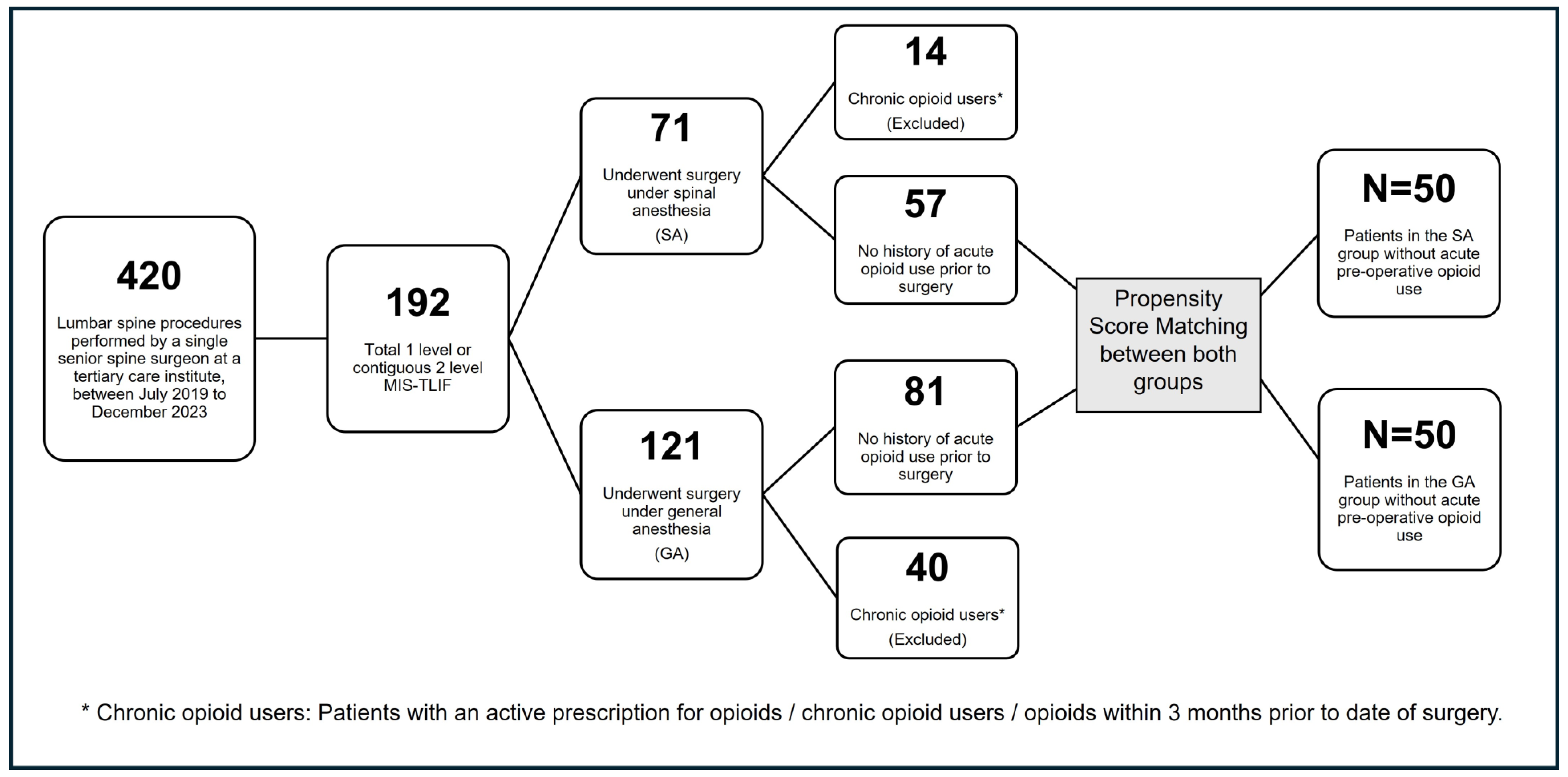
| Preoperative Variables | Spinal Anesthesia [SA] (n = 57) | General Anesthesia [GA] (n = 81) | p Value |
|---|---|---|---|
| Demographics | |||
| Age (years) (mean) | 63.5 ± 10.8 | 64.3 ± 10.9 | 0.68 †† |
| BMI (mean) | 29.5 ± 4.9 | 29.8 ± 5.6 | 0.78 † |
| Sex | 0.95 ^ | ||
| Females | 30 (52.6%) | 41 (50.6%) | |
| Males | 27 (47.4%) | 40 (49.4%) | |
| Race | 0.24 ^ | ||
| Caucasian | 45 (78.9%) | 71 (87.6%) | |
| African American | 5 (8.8%) | 5 (6.2%) | |
| Hispanic | 5 (8.8%) | 2 (2.5%) | |
| Asian | 0 (0%) | 2 (2.5%) | |
| Other | 2 (3.5%) | 1 (1.2%) | |
| Number of Levels Fused | <0.01 ^* | ||
| 1-level MIS-TLIF | 49 (86%) | 46 (56.8%) | |
| 2-level MIS-TLIF | 8 (14%) | 35 (43.2%) | |
| Comorbidities | |||
| Coronary artery disease (CAD) | 12 (21.1%) | 15 (18.5%) | 0.87 ^ |
| Congestive heart failure (CHF) | 1 (1.8%) | 4 (4.9%) | 0.60 ^ |
| Atrial fibrillation | 2 (3.5%) | 8 (9.8%) | 0.27 ^ |
| Stroke | 3 (5.3%) | 5 (6.2%) | 1 ^ |
| Type II diabetes mellitus | 12 (21.1%) | 12 (14.8%) | 0.46 ^ |
| Chronic obstructive pulmonary disease (COPD) | 0 (0%) | 4 (4.9%) | 0.24 ^ |
| Hypertension | 24 (42.1%) | 46 (56.8%) | 0.12 ^ |
| Obesity | 29 (50.9%) | 37 (45.7%) | 0.66 ^ |
| Patients on anticoagulants | 2 (3.5%) | 7 (8.6%) | 0.31 ^ |
| Deep vein thrombosis | 2 (3.5%) | 0 (0%) | 0.32 ^ |
| Sleep apnea | 9 (15.8%) | 13 (16%) | 1 ^ |
| Pulmonary embolism | 1 (1.8%) | 5 (6.2%) | 0.40 ^ |
| Preoperative Symptoms at Presentation | |||
| Motor deficit | 13 (22.8%) | 26 (32.1%) | 0.31 ^ |
| Sensory deficit | 57 (100%) | 81 (100%) | 1 ^ |
| Pain | 56 (98.2%) | 81 (100%) | 0.85 ^ |
| Postoperative Outcomes | |||
| Mean total OR time in minutes (anesthesia + procedure time) | 162.5 ± 26.9 | 199.6 ± 40.3 | <0.01 †* |
| Mean total TLIF procedure time (minutes) | 121.8 ± 28.6 | 144.3 ± 38.6 | <0.01 †* |
| Mean length of stay (LOS) (days) | 0.81 ± 1.1 | 1.88 ± 2.2 | <0.01 †* |
| Discharge status | 0.23 ^ | ||
| Home | 57 (100%) | 77 (95%) | |
| Rehabilitation | 0 (0%) | 3 (3.7%) | |
| Nursing facility | 0 (0%) | 1 (1.3%) | |
| Opioids required during hospital stay | 56 (98.2%) | 75 (92.6%) | 0.27 ^ |
| Opioids used for >7 days | 28 (49.1%) | 48 (59.3%) | 0.22 ^ |
| Median total MME (range) | 630 (135–2940) | 720 (30–3570) | 0.13 † |
| Median number of prescriptions (range) | 1 (1–5) | 2 (1–8) | 0.07 † |
| Median total days of opioid use (range) | 7 (3–35) | 14 (3–56) | 0.08 †† |
| Median average MME/day (range) | 60 (25–90) | 60 (10–135) | 1 †† |
| Preoperative Variables Post Matching | Spinal Anesthesia [SA] (n = 50) | General Anesthesia [GA] (n = 50) | p Value |
|---|---|---|---|
| Demographics | |||
| Age (mean) | 63.5 ± 11.3 | 62.5 ± 11.9 | 0.84 †† |
| BMI (mean) | 29.4 ± 5.1 | 28.2 ± 4.9 | 0.30 † |
| Sex | 0.84 ^ | ||
| Female | 26 (52%) | 24 (48%) | |
| Male | 24 (48%) | 26 (52%) | |
| Race (Caucasian) | 42 (84%) | 42 (84%) | 0.61 ^ |
| Number of Levels Fused | 0.78 ^ | ||
| 1-level MIS-TLIF | 43 (86%) | 41 (82%) | |
| 2-level MIS-TLIF | 7 (14%) | 9 (18%) | |
| Comorbidities | |||
| CAD | 10 (20%) | 7 (14%) | 0.59 ^ |
| CHF | 0 (0%) | 2 (4%) | 0.47 ^ |
| Atrial fibrillation | 1 (2%) | 4 (8%) | 0.35 ^ |
| Stroke | 3 (6%) | 2 (4%) | 1 ^ |
| Type II diabetes mellitus | 10 (20%) | 6 (12%) | 0.41 ^ |
| COPD | 0 (0%) | 3 (6%) | 0.24 ^ |
| HTN | 17 (34%) | 32 (64%) | <0.05 ^* |
| Obesity | 26 (52%) | 22 (44%) | 0.54 ^ |
| Anticoagulants | 1 (2%) | 5 (10%) | 0.20 ^ |
| DVT | 2 (4%) | 0 (0%) | 0.47 ^ |
| Sleep apnea | 7 (14%) | 6 (12%) | 1 ^ |
| Pulmonary embolism | 1 (2%) | 3 (6%) | 0.60 ^ |
| Preoperative Symptoms at Presentation | |||
| Motor deficit | 13 (26%) | 17 (34%) | 0.51 ^ |
| Sensory deficit | 0 (0%) | 0 | 1 ^ |
| Pain | 49 (98%) | 50 (100%) | 1 ^ |
| Outcome Variable Post Matching: | SA | GA | p Value |
|---|---|---|---|
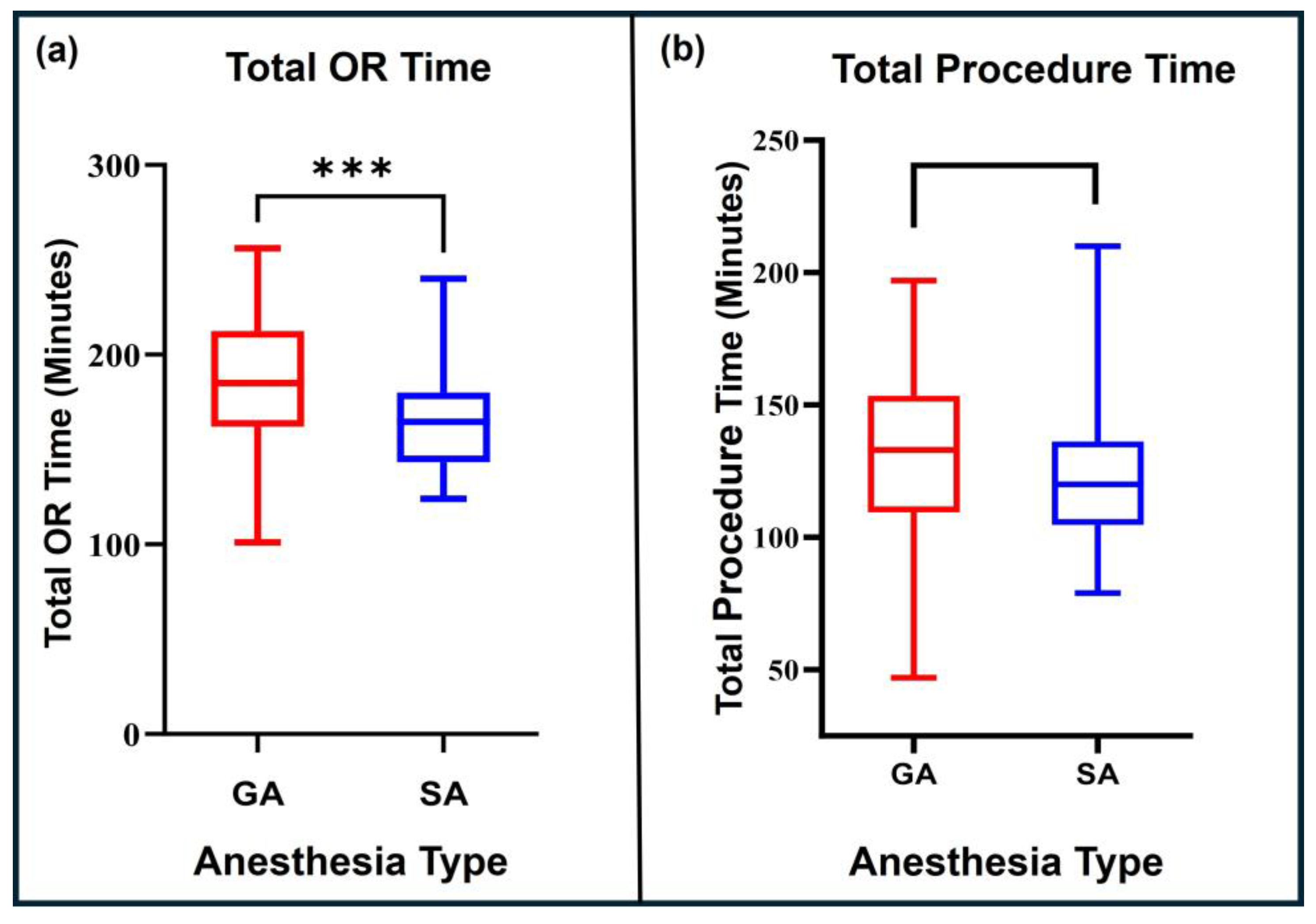
| Mean Total OR time (min) | 162.7 ± 27.6 | 186.7 ± 35.8 | <0.01 †* |
| Median procedure time (min) (range) | 116.5 (79–210) | 133 (47–197) | 0.06 †† |
| Median EBL in cc (range) | 30 (1–250) | 50 (3–200) | 0.17 †† |
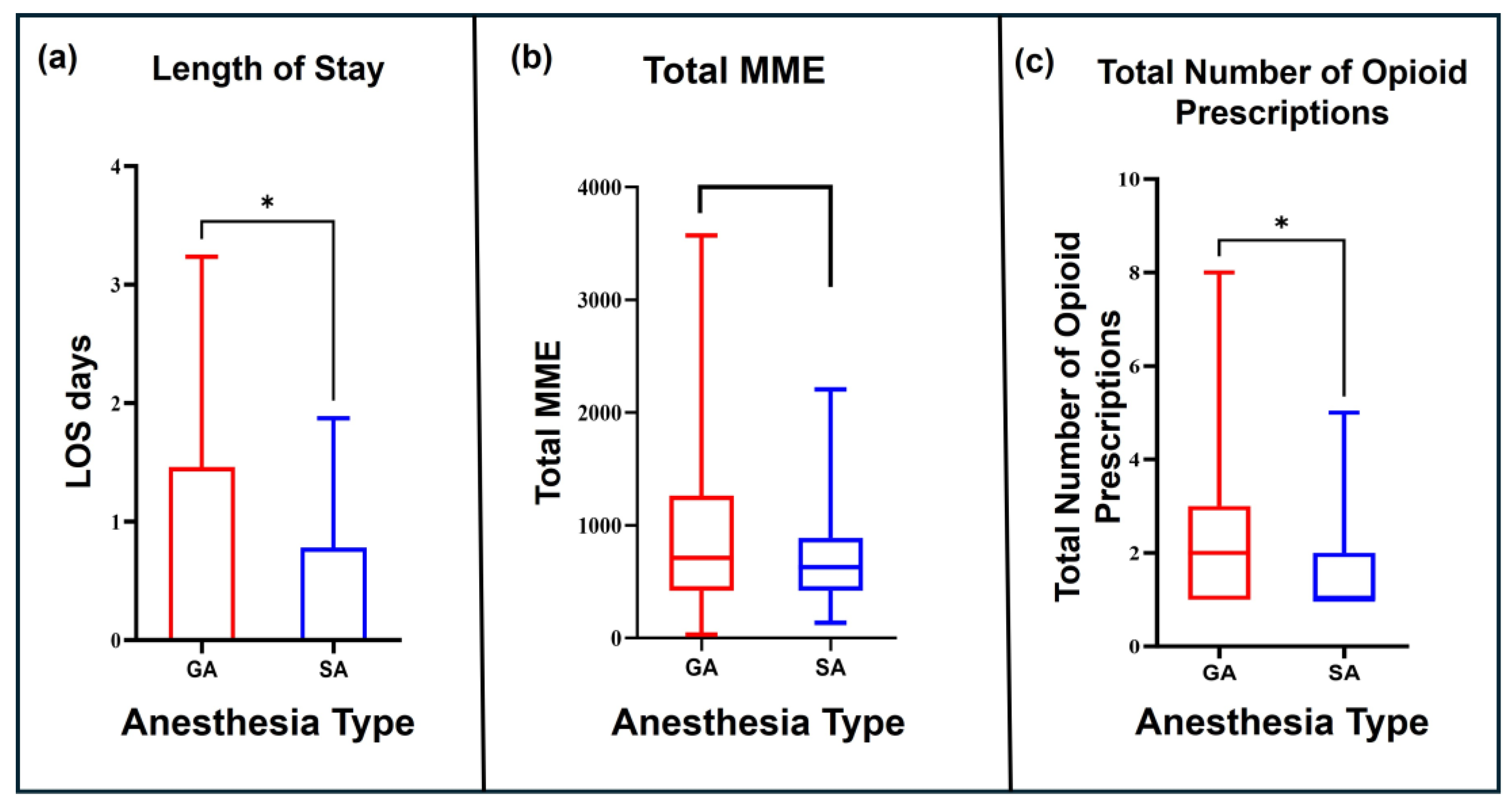
| Median LOS in days (range) | 0 (0–5) | 1 (0–7) | 0.03 ††* |
| Median LOS in hours (range) | 16.5 (0–120) | 24.0 (0–168) | 0.07 †† |
| Discharge status | 0.47 ^ | ||
| Home | 50 (100%) | 48 (96%) | |
| Rehab | 0 | 2 (4%) | |
| Complications | 0 (0%) | 1 (2%) | 1 ^ |
| Opioids required during hospitalization | 50 (100%) | 46 (92%) | 0.12 ^ |
| PO fatigue | 2 (4%) | 0 (0%) | 0.47 ^ |
| Opioid PACU | 42 (84%) | 39 (78%) | 0.61 ^ |
| Mean total MME | 679.5 ± 407.4 | 885.4 ± 692.1 | 0.07 † |
| Mean total number of opioid prescriptions | 1.66 ± 0.9 | 2.24 ± 1.6 | 0.03 †* |
| Median days opioid use (range) | 7 (3–35) | 14 (3–56) | 0.15 †† |
| Median average MME/day (range) | 60 (25–180) | 60 (10–105) | 0.15 †† |
| >7 days of opioid | 22 | 29 | 0.23 ^ |
| Outcomes of Interest | Coefficient (95% CI) | p Value |
|---|---|---|
| Linear Regression | ||
| Total MME | ||
| SA versus GA | 216.5 (0.7–432.2) | 0.049 * |
| 2-level versus 1-level TLIF (SA + GA) | 418.3 (123.9 to 712.6) | 0.006 * |
| BMI | 27.6 (4.7–50.5) | 0.019 * |
| Total Days of Opioids Use | ||
| SA versus GA | 3.8 (0.5–7.1) | 0.025 * |
| 2-level versus 1-level TLIF (SA + GA) | 5.9 (1.4–10.4) | 0.011 * |
| BMI | 0.5 (0.2–0.9) | 0.004 * |
| Number of Opioid Prescriptions | ||
| SA versus GA | 0.6 (0.1–1.1) | 0.02 * |
| 2-level versus 1-level TLIF (SA + GA) | 0.9 (0.4–1.5) | 0.015 * |
| BMI | 0.07 (0.02–0.12) | 0.012 * |
| LOS (Hours) | ||
| SA versus GA | 14.1 (0.6–27.7) | 0.042 * |
| 2-level versus 1-level TLIF (SA + GA) | 7.7 (1.4–13.2) | 0.009 * |
| CAD | 14.9 (2.4–27.4) | 0.019 * |
| Outcome of Interest | OR (95% CI) | p value |
| Logistic Regression | ||
| >7 Days of Opioid Use | ||
| BMI | 0.15 (0.05–0.25) | 0.002 * |
Disclaimer/Publisher’s Note: The statements, opinions and data contained in all publications are solely those of the individual author(s) and contributor(s) and not of MDPI and/or the editor(s). MDPI and/or the editor(s) disclaim responsibility for any injury to people or property resulting from any ideas, methods, instructions or products referred to in the content. |
© 2026 by the authors. Licensee MDPI, Basel, Switzerland. This article is an open access article distributed under the terms and conditions of the Creative Commons Attribution (CC BY) license.
Share and Cite
Iyer, H.G.; Sanchez-Garavito, J.E.; Rios-Zermeno, J.; Roberts, A.P.; Navarro Garcia de Llano, J.P.; Michaelides, L.; Gonzalez-Salido, J.; Gruenbaum, B.F.; Bojaxhi, E.; Akinduro, O.O.; et al. Comparing the Effect of Spinal Versus General Anesthesia on Postoperative Opioid Use in Minimally Invasive Transforaminal Lumbar Interbody Fusion: A Patient Matched Study. J. Clin. Med. 2026, 15, 781. https://doi.org/10.3390/jcm15020781
Iyer HG, Sanchez-Garavito JE, Rios-Zermeno J, Roberts AP, Navarro Garcia de Llano JP, Michaelides L, Gonzalez-Salido J, Gruenbaum BF, Bojaxhi E, Akinduro OO, et al. Comparing the Effect of Spinal Versus General Anesthesia on Postoperative Opioid Use in Minimally Invasive Transforaminal Lumbar Interbody Fusion: A Patient Matched Study. Journal of Clinical Medicine. 2026; 15(2):781. https://doi.org/10.3390/jcm15020781
Chicago/Turabian StyleIyer, Harshvardhan G., Jesus E. Sanchez-Garavito, Jorge Rios-Zermeno, Andrew P. Roberts, Juan P. Navarro Garcia de Llano, Loizos Michaelides, Jimena Gonzalez-Salido, Benjamin F. Gruenbaum, Elird Bojaxhi, Oluwaseun O. Akinduro, and et al. 2026. "Comparing the Effect of Spinal Versus General Anesthesia on Postoperative Opioid Use in Minimally Invasive Transforaminal Lumbar Interbody Fusion: A Patient Matched Study" Journal of Clinical Medicine 15, no. 2: 781. https://doi.org/10.3390/jcm15020781
APA StyleIyer, H. G., Sanchez-Garavito, J. E., Rios-Zermeno, J., Roberts, A. P., Navarro Garcia de Llano, J. P., Michaelides, L., Gonzalez-Salido, J., Gruenbaum, B. F., Bojaxhi, E., Akinduro, O. O., Buchanan, I. A., & Abode-Iyamah, K. O. (2026). Comparing the Effect of Spinal Versus General Anesthesia on Postoperative Opioid Use in Minimally Invasive Transforaminal Lumbar Interbody Fusion: A Patient Matched Study. Journal of Clinical Medicine, 15(2), 781. https://doi.org/10.3390/jcm15020781