1. Introduction
Aging of the European population is a long-term process which affects all the countries in the European Union (EU). The actual EU’s population structure (according to Eurostat data) shows the signs of not only the aging, but the progressive aging of the older population as well. Between 2019 and 2050, the elderly population (aged 65 years or more) in the EU will increase significantly, rising from 90.5 million to reach 129.8 million [
1,
2].
Age is a significant factor influencing both the incidence and outcomes of cardiac arrest. The risk of cardiac arrest increases with age. Elderly patients accounted for more than 80% of all out-of-hospital cardiac arrest (OHCA) cases [
3,
4]. Based on epidemiology data, the proportion of elderly OHCA patient population will increase higher in the near future [
5].
Older age is consistently associated with lower survival rate and poorer neurological outcome after OHCA. Younger patients have higher rates of return of spontaneous circulation (ROSC), survival to hospital discharge, and good neurological outcomes compared to older patients. Survival after OHCA drops from 16.7% (under 20 years) to 1.7% (aged 95–99), with a similar trend for good neurological outcomes [
6,
7,
8].
In everyday practice, without knowing the patients’ medical history and the circumstances of sudden cardiac death, one may decide to stop resuscitation or to do the intensity of any post-resuscitation intensive care efforts based on the patient’s age only. Older patients often receive less intensive resuscitation and post-arrest care, which may contribute to lower survival rates [
9,
10]. Age alone should not be the sole criterion for treatment decisions. While outcomes worsen with age, there is no specific age cutoff at which recovery becomes impossible. By the knowledge from the literature so far some elderly patients, especially those with favorable initial rhythms, still achieve meaningful recovery [
11,
12,
13].
Even papers and guidelines do not support decision-making based on only a single factor such as age. As some elderly survivors achieve good outcomes, this kind of decision is not ethically justifiable [
7,
14].
Multiple comorbidities are generally associated with poorer survival and neurological recovery after cardiac arrest. However, the quality of resuscitation can play an even more critical role, and, sometimes, outweigh the negative impact of comorbidities on neurological outcomes [
15,
16,
17].
Outcomes after OHCA remain poor and are driven largely by prehospital determinants of ROSC and survival to hospital admission. During the first COVID-19 wave, an individual patient data meta-analysis reported more arrests occurring at home, fewer shockable rhythms, reduced ratio of bystander CPR in high-burden regions, and an independent decrease in survival to hospital admission (with higher risk of prehospital death) [
18].
The impact of adrenaline in prehospital resuscitation also remains contentious, as higher cumulative doses—often a surrogate of prolonged resuscitation—have been associated with a higher admission rate but same or worse mortality [
19].
Using the Hungarian National Ambulance Service (HNAS) registry, we aimed to quantify age-stratified survival to hospital admission (and ROSC) among adult (≥18 years) out-of-hospital cardiac arrest patients in whom EMS initiated or continued resuscitation. We further sought to identify independent prehospital predictors (including age × treatment effect modification) and to develop and internally validate an EMS-based prognostic model for early risk stratification.
2. Materials and Methods
2.1. Study Design and Setting
We conducted a retrospective cohort study using the Hungarian National Ambulance Service (Budapest, Hungary) registry, analyzing all OHCA cases from 1 November 2018 to 28 February 2025. Hungary’s centralized HNAS system provides comprehensive coverage with standardized protocols and mandatory reporting, ensuring a low rate of data loss. The study was approved by the National Ethics Committee of Hungary (Budapest, Hungary). Ethical approval was granted for the collection and analysis of data related to OHCA cases, integral to our observational assessment of OHCA epidemiology, regional variations, and mortality rates in Hungary. The study was assigned ethical approval numbers (Reference Numbers: IV/3043/2021/EKU and IV/3043-3/2021/EKU). All procedures and data handling adhered strictly to established ethical standards and regulations and were conducted in accordance with the Declaration of Helsinki [
20].
2.2. Study Population and Data Selection
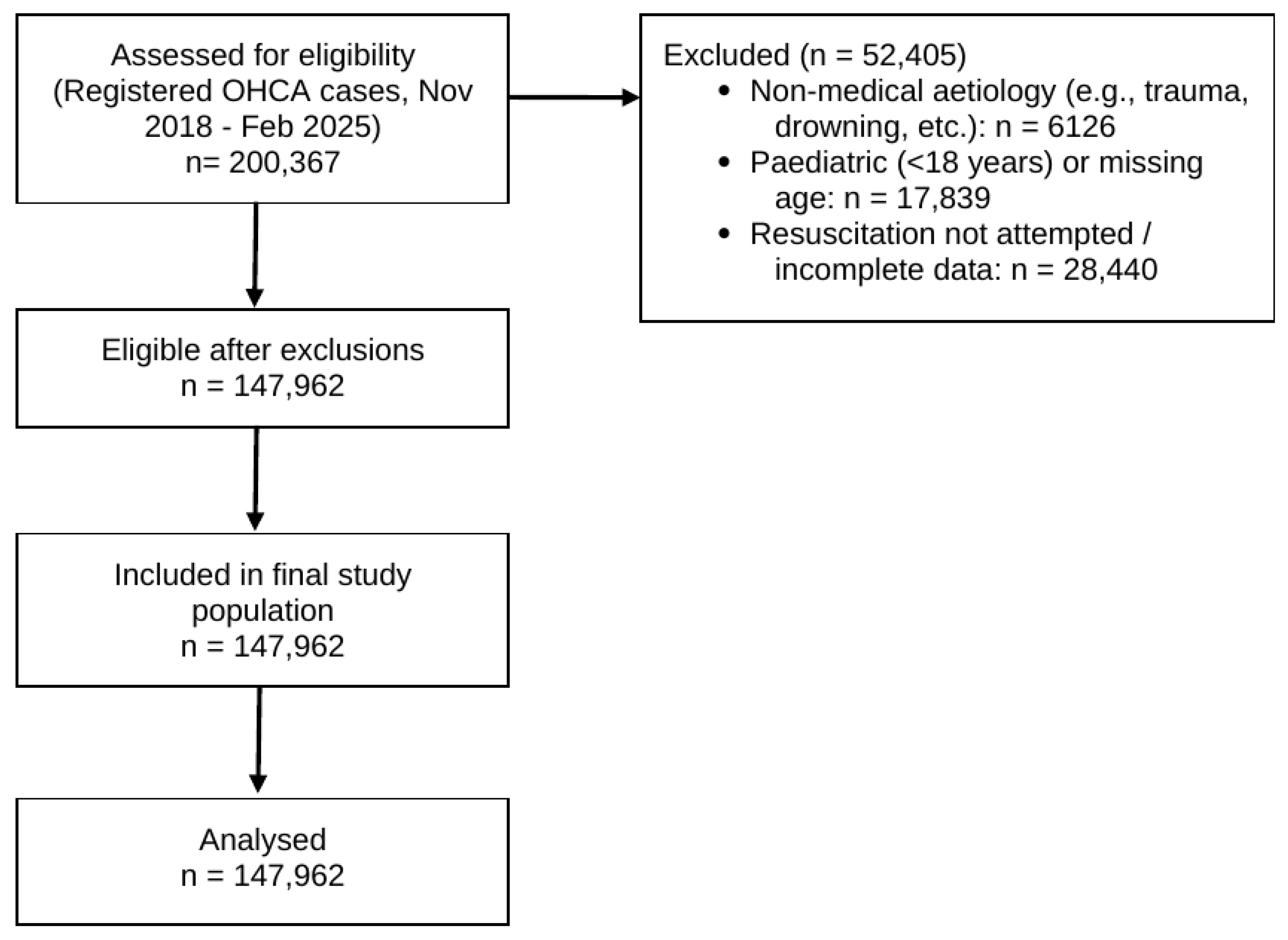
During the study period from 1 November 2018 to 28 February 2025, the Hungarian National Ambulance Service registered a total of 200,367 cases. From this initial dataset, we excluded 6126 cases due to non-medical etiologies (including trauma, drowning, electrocution, and gynecological causes) and 17,839 cases involving pediatric patients (<18 years) or those with missing age data. A further 28,440 cases were excluded where resuscitation was not attempted by EMS personnel or essential clinical data were incomplete. The final study population comprised 147,962 adult OHCA cases where resuscitation was attempted (
Figure 1).
2.3. Age Stratification and Variable Definitions
Patients were stratified using a 65-year threshold, consistent with geriatric medicine definitions and previous OHCA publication [
21]. We analyzed age both as a continuous variable and categorically (elderly: >65 years vs. non-elderly: ≤65 years).
Clinical variables included initial cardiac rhythm (ventricular fibrillation/ventricular tachycardia [VF/VT], pulseless electrical activity [PEA], asystole, bradycardia), witness status (medical personnel, non-medical bystander, unwitnessed), location (home, public, other), and sex. HNAS interventions included shock delivery (automated external defibrillator [AED] or manual defibrillation), mechanical chest compression, and HNAS response times. We distinguished between AED equipment availability and actual shock delivery, as equipment presence does not guarantee its clinical use.
2.4. Statistical Analysis
We compared baseline characteristics between elderly and non-elderly patients using chi-square tests for categorical variables and t-tests for continuous variables. Individual associations with survival were assessed using logistic regression, reporting odds ratios (OR) with 95% confidence intervals (CI). We developed a final logistic regression model including clinically relevant predictors. Variable selection was based on clinical importance and statistical significance (p < 0.05). Model discrimination was assessed using the area under the receiver operating characteristic curve (AUC). Model calibration was evaluated using the Brier score and calibration plots. Clinical utility was quantified using number needed to treat (NNT) calculations. Analyses were performed using Python 3.8 (Python Software Foundation, Wilmington, DE, USA) with stats models and scikit-learn libraries. Statistical significance was set at p < 0.05.
2.5. Age-Specific Treatment Effectiveness
We specifically tested whether treatment effects differed by age by including age × treatment interaction terms in the model. We tested interactions for: (1) sex and age, (2) initial rhythm and age, and (3) shock delivery and age. Only interactions with p < 0.05 after multiple testing correction are reported.
For each significant interaction, we calculated age-stratified effect sizes and confidence intervals. We report both the interaction odds ratio (how much the treatment effect changes with age) and the clinical interpretation (treatment effectiveness in elderly vs. non-elderly patients).
3. Results
3.1. Study Population and Baseline Characteristics
During the study period, 147,962 adult out-of-hospital cardiac arrest patients with attempted resuscitation were included in the analysis. The overall survival to hospital discharge rate was 8.8% (n = 12,975). Patients ranged in age from 18 to 107 years (mean: 69.6 ± 14.4 years), with 99,576 (67.3%) classified as elderly (>65 years).
Table 1 presents baseline characteristics stratified by age group. In the elderly population, male sex was more common than female (52.2% vs. 47.8%,
p < 0.001), they suffered cardiac arrest at home, and more likely presented with non-shockable rhythms. The prevalence of ventricular fibrillation/ventricular tachycardia (VF/VT) was significantly lower in elderly patients (10.6% overall with predominance in younger patients), while asystole was more common for the elderly (70.8% overall,
p < 0.001). Emergency medical service response times and AED equipment availability were similar between groups.
3.2. Age-Stratified Survival Outcomes
The primary analysis revealed a pronounced age–survival relationship with significant clinical implications for geriatric emergency medicine.
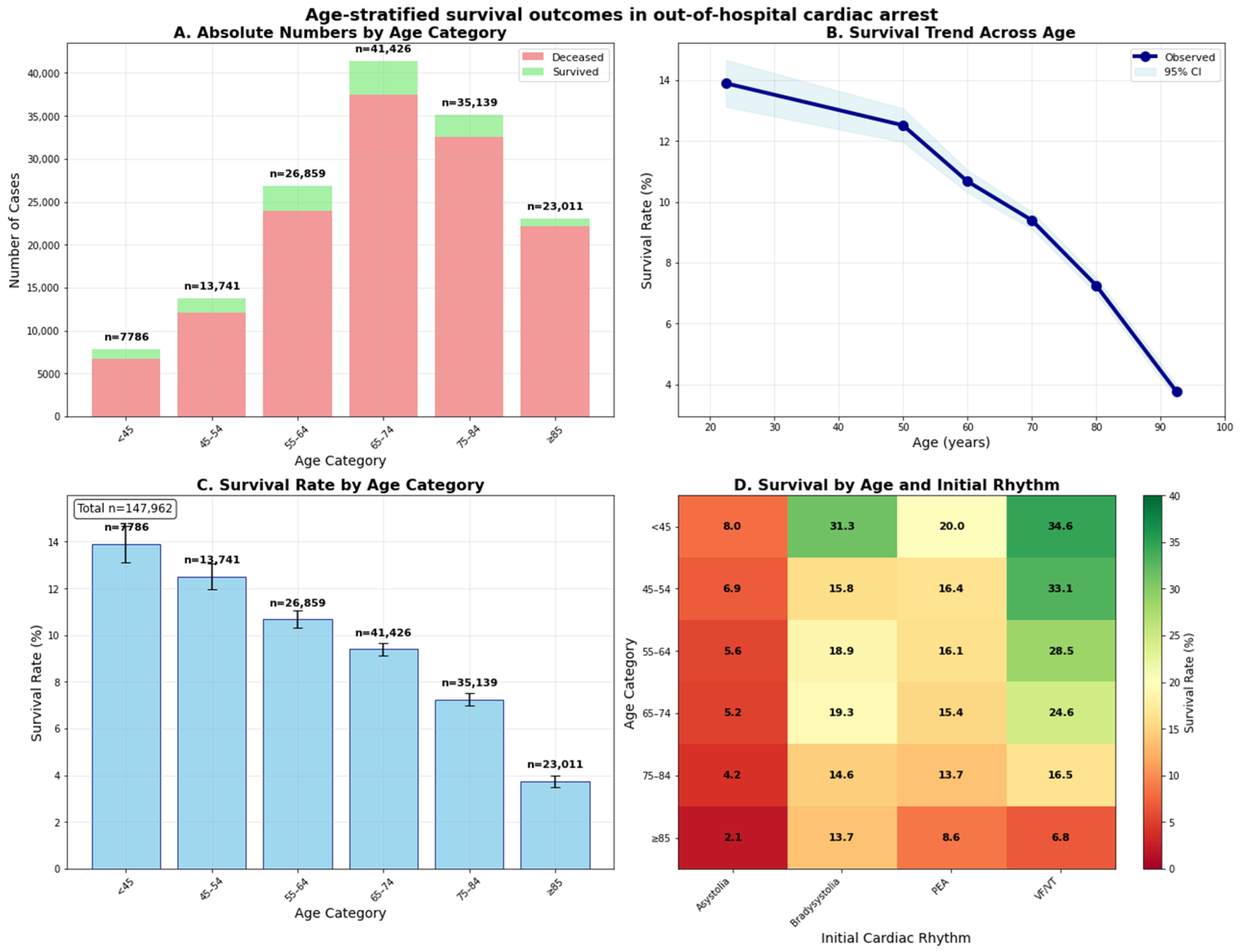
Figure 2 demonstrates the comprehensive age-stratified survival pattern across multiple analytical perspectives: overall survival decreased progressively with advancing age, demonstrating a nearly linear decline from younger to older age groups.
The clinically relevant 65-year threshold revealed a substantial survival disparity: elderly patients (≥65 years) achieved 7.3% survival compared to 11.7% in non-elderly patients (<65 years). This survival disadvantage, concerning any sort of initial cardiac rhythms and clinical presentations, establishes age as a fundamental prognostic factor independent of arrest characteristics.
3.3. Individual Predictors of Survival: Univariate Analysis
Prior to multivariate adjustment, univariate analysis identified significant associations between survival and key clinical variables (
Table 2). The strongest individual predictors included shockable cardiac rhythms demonstrating the highest survival association compared to asystole (reference category). Witness status by medical personnel conferred substantial survival benefit, while advanced interventions showed varying effects.
AED shock delivery demonstrated remarkable individual impact, reflecting both patient selection (shockable rhythms) and therapeutic effectiveness.
Each additional year of age decreased survival odds by 2%, while notable variations emerged across clinical presentations and emergency response characteristics.
3.4. Multivariate Model: Independent Predictors of Survival
After adjustment for confounding variables, the final multivariate model included 14 clinically relevant predictors and demonstrated good discrimination (AUC = 0.784, 95% CI: 0.0780–0.788) with good calibration (Brier score = 0.0705).
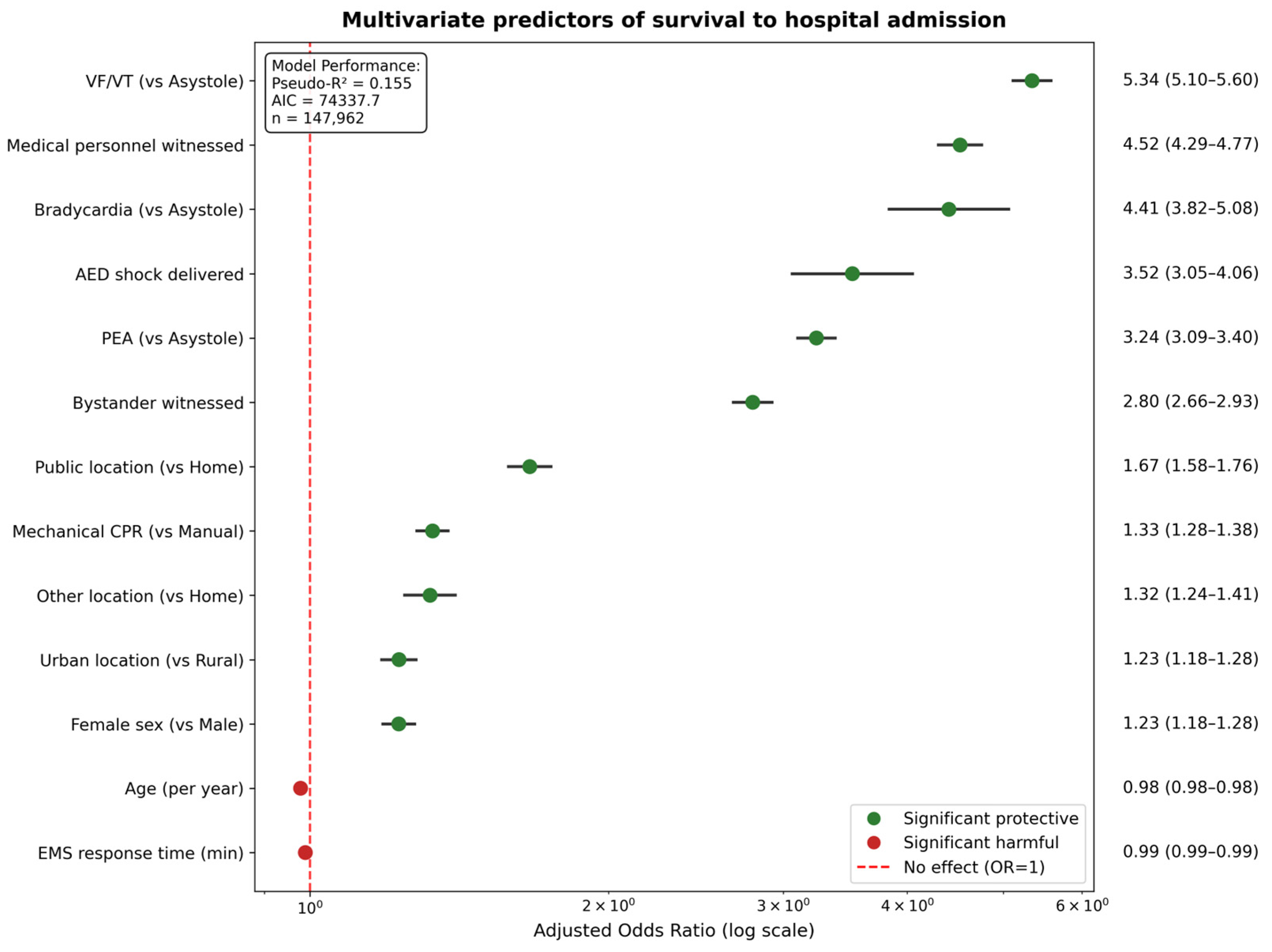
Figure 3 presents the forest plot visualization of adjusted odds ratios, while
Table 3 provides detailed effect estimates.
The adjusted analysis confirmed VF/VT rhythm as the strongest independent predictor (adjusted OR 5.34, 95% CI: 5.10–5.60), followed by witness by medical personnel (OR 4.52, 95% CI: 4.29–4.77), bradycardia (OR 4.41, 95% CI: 3.82–5.08) and AED shock delivery (OR 3.52, 95% CI: 3.05–4.06). Age remained a significant independent predictor, with each additional year associated with 2% decreased survival odds (OR 0.98, 95% CI: 0.98–0.98).
3.5. Age Interaction Analysis: Treatment Effect Modification
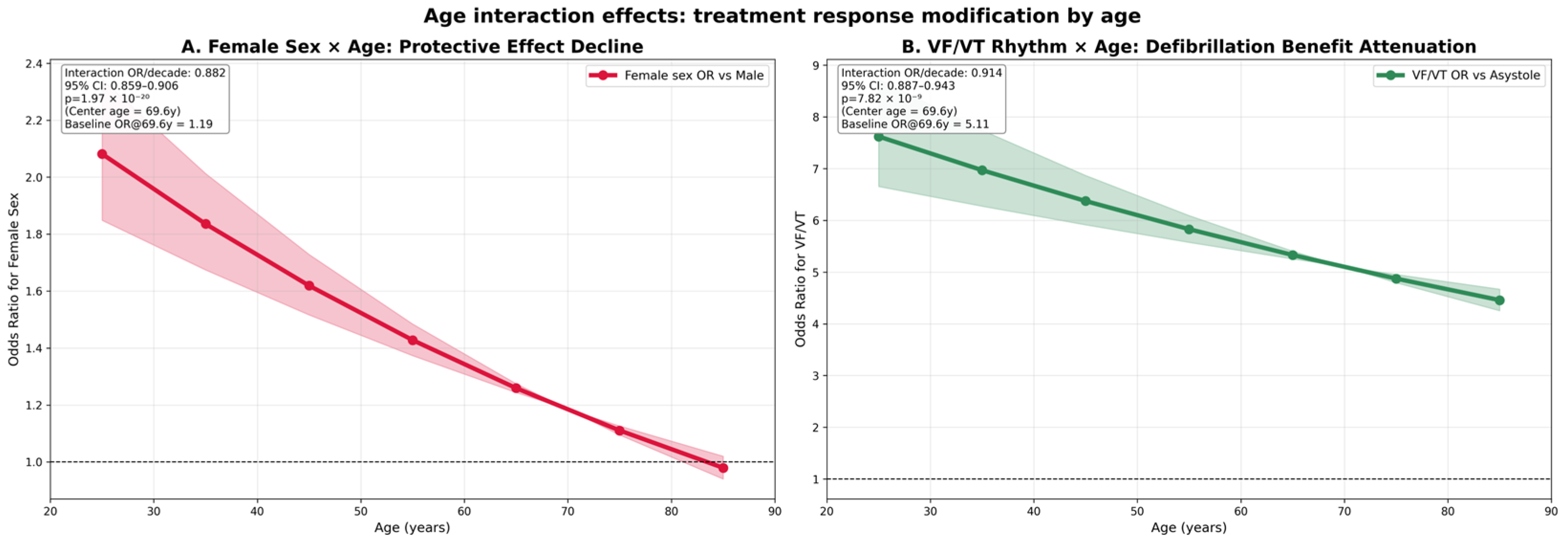
A critical novel finding emerged from systematic testing of age-treatment interactions using advanced statistical methodology. After correction for multiple testing using the false discovery rate (FDR) method, three significant interactions demonstrated that treatment effectiveness varies substantially by patient age (
Table 4 and
Figure 4).
The most clinically relevant interaction involved female sex and age (interaction OR 0.882, 95% CI: 0.859–0.906, p < 0.001 after FDR correction).
The VF/VT rhythm–age interaction (OR 0.914, 95% CI: 0.887–0.0943, p < 0.001 after FDR correction) revealed that while shockable rhythms remained the strongest predictor across all age groups, the survival benefit was attenuated in elderly patients.
3.6. Clinical Impact and Model Performance
The final model demonstrated robust predictive performance with clinical utility across probability thresholds.
Table 5 presents comprehensive performance metrics demonstrating good discrimination and calibration. Five-fold cross-validation confirmed model stability, indicating good generalizability without overfitting.
Clinical impact analysis revealed substantial treatment effects quantified through number needed to treat (NNT) calculations. AED shock delivery demonstrated remarkable effectiveness (NNT = 3). A medical personnel witness showed strong impact (NNT = 10), while having a non-medical bystander witness remained clinically beneficial (NNT = 26).
The age-stratified analysis revealed that while overall survival decreased with age, the relative effectiveness of key interventions remained substantial across age groups.
4. Discussion
This nationwide Hungarian registry-based analysis provides one of the largest and most detailed evaluations of age-specific survival patterns, independent predictors, and treatment–age interactions in out-of-hospital cardiac arrest (OHCA) to date. The analysis of 147,962 adult OHCA cases confirms a strong and progressive association between increasing age and reduced survival, with each additional year lowering survival odds by approximately 2%. This decline was consistent across the age spectrum and reflects the multifactorial vulnerability of elderly patients. While age independently predicts survival, our results show that treatment effectiveness also varies by age in clinically meaningful ways.
The markedly lower prevalence of VF/VT among elderly patients, alongside the predominance of asystole, has direct clinical implications. VF/VT carried the strongest survival association in our adjusted models, yet its reduced incidence in older patients inherently limits the proportion who can benefit from defibrillation. This finding underscores the importance of early recognition, rapid EMS activation, and targeted preventive measures—such as remote monitoring technologies—in older populations, where delays and comorbidities may allow initially shockable rhythms to deteriorate into non-shockable states or even to initiate cardiac arrest with PEA.
Female sex was independently associated with improved survival overall; however, this benefit diminished with advancing age, indicating that demographic predictors should be interpreted in an age-specific context.
Despite these attenuations, several interventions retained high absolute benefit across all age groups. AED shock delivery had the lowest number needed to treat (NNT = 3), with negligible difference between elderly (3.2) and non-elderly (2.8) patients. This finding supports maintaining universal public-access defibrillation programs emphasizing no age limitations. Similarly, presence of a medical person as a witness has a substantial survival benefit (NNT = 10), while a non-medical bystander witness still produced a meaningful improvement (NNT = 26). These results highlight the importance of rapid intervention at all stages of the chain of survival, regardless of patient age.
Our identification of significant age–treatment interactions provides a basis for developing geriatric-tailored resuscitation approaches, while confirming that core interventions such as defibrillation remain highly effective across the age spectrum. The high performance of our predictive model supports its potential integration into clinical decision-support systems, enabling real-time, age-adjusted prognostication.
4.1. Ethical and Implementation Implications
From an ethical and systems perspective, our findings support the European Resuscitation Council position that chronological age alone should not determine resuscitation intensity, because older patients in our cohort still derived meaningful benefit from core evidence-based interventions (notably early defibrillation). At the same time, real-world practice may deviate from this principle: in a case–control analysis, older OHCA patients received shorter and less intensive out-of-hospital care, suggesting that age-related treatment attenuation may contribute to poorer outcomes [
10]. These considerations underscore the need for transparent, protocol-driven decision-making and quality-assurance processes that explicitly guard against age-based therapeutic nihilism.
Implementation efforts should also account for where many elderly arrests occur—at home and within municipal/home-care contexts. Qualitative evidence indicates that a lack of organizational support, limited care alternatives, and insufficiently structured collaboration between municipal care personnel and EMS can jeopardize outcomes and reduce older persons’ ability to influence care during emergencies; conversely, care personnel acting as the patient’s representative can strengthen patient agency and facilitate effective EMS engagement [
22].
In practical terms, this supports strengthening the “first links” of the chain of survival in older populations through:
- (i)
targeted AED placement and rapid AED access in high-risk elderly communities;
- (ii)
tailored training and clear role definitions for home-care/municipal staff to accelerate recognition, calling, CPR/AED initiation, and handover to EMS; and;
- (iii)
audit/feedback focusing on equitable delivery of time-critical interventions across age strata.
4.2. Limitation
This study has several limitations inherent to its retrospective, registry-based design. First, the primary endpoint was survival to hospital admission; while this avoids confounding by in-hospital variations in care, it does not capture long-term survival or neurological status, which are critical patient-centered outcomes. Finally, our multivariate analysis was limited to variables reliably recorded in the HNAS database. Information regarding patient comorbidities and pre-arrest functional status was not systematically available in the EMS registry. Additionally, we excluded certain intra-arrest interventions (such as drug administration) from the primary prediction model to avoid resuscitation time bias, as these interventions are often proxies for longer resuscitation efforts rather than independent predictors of outcomes in the early phase. System-level disruptions (e.g., pandemic effects) may have influenced case-mix and outcomes.
4.3. Future Perspectives
Future work should link EMS records to in-hospital and long-term follow up to evaluate neurologically intact survival and functional outcomes and to better partition prehospital versus in-hospital contributors to age-related differences. Enriching registries with frailty/functional measures may improve age-stratified risk estimation and reduce unmeasured confounding. Before clinical implementation, the prediction model should undergo external validation and recalibration in independent EMS systems, consistent with evidence that performance and calibration can vary substantially across cohorts.
5. Conclusions
In this nationwide EMS registry of 147,962 adult OHCAs, increasing age independently and progressively reduced survival to hospital admission. However, key time-critical interventions—especially early defibrillation—remained strongly beneficial across all ages, supporting resuscitation decisions based on clinical factors rather than age alone. Age-related effect modification highlights the need for geriatric-informed systems focused on rapid recognition and early shock delivery. Based on the performance of the prediction model, a real-time, age-adjusted risk stratification tool could yield promising result after external validation.
Author Contributions
Conceptualization: B.K., Á.P.-J. and E.Z.; methodology: B.K. and Á.P.-J.; validation: B.K. and Á.P.-J.; formal analysis: Á.P.-J.; investigation: B.K., Á.P.-J. and E.Z.; resources: G.C., B.M. and E.Z.; data curation: B.K. and Á.P.-J.; writing—original draft: B.K. and Á.P.-J.; writing—review and editing: B.N., G.K., G.C., G.P., B.M. and E.Z.; visualization: B.K. and Á.P.-J.; supervision: E.Z.; project administration: B.K. and E.Z.; funding acquisition: B.M. All authors have read and agreed to the published version of the manuscript.
Funding
Boldizsar Kiss was supported by the EKÖP-2024-206 New National Excellence Program of the Ministry for Culture and Innovation from the source of National Research, Development and Innovation Fund. Project realized within the National Multidisciplinary Laboratory for Climate RRF-2.3.1-21-2022-00014.
Institutional Review Board Statement
The study was approved by the National Ethics Committee of Hungary. Ethical approval was granted for the collection and analysis of data related to OHCA cases, integral to our observational assessment of OHCA epidemiology, regional variations, and mortality rates in Hungary. The study was assigned ethical approval numbers (Reference Numbers: IV/3043/2021/EKU and IV/3043-3/2021/EKU). All procedures and data handling adhered strictly to established ethical standards and regulations and were conducted in accordance with the Declaration of Helsinki.
Informed Consent Statement
This study discusses a retrospective non-interventional trial based on a nationwide registry. According to the local and international ethical regulations, informed consent procedure is not necessary.
Data Availability Statement
The raw data supporting the conclusions of this article will be made available by the authors on request.
Conflicts of Interest
The funders had no role in the design of the study; in the collection, analyses, or interpretation of data; in the writing of the manuscript; or in the decision to publish the results.
Abbreviations
The following abbreviations are used in this manuscript:
| AED | Automated external defibrillator |
| AUC | Area under curve |
| CI | Confidence interval |
| EMS | Emergency medical services |
| EU | European Union |
| FDR | False discovery rate |
| HNAS | Hungarian National Ambulance Service |
| NNT | Number needed to treat |
| OHCA | Out-of-hospital cardiac arrest |
| OR | Odds ratio |
| PEA | Pulseless electrical activity |
| ROSC | Return of spontaneous circulation |
| VF/VT | Ventricular fibrillation/ventricular tachycardia |
References
- Eurostat. Ageing Europe—Statistics on Population Developments. Statistics Explained. 2025. Available online: https://ec.europa.eu/eurostat/statistics-explained/SEPDF/cache/80393.pdf (accessed on 25 June 2025).
- World Health Organization, Data Platform. Ageing—Demographics; World Health Organization: Geneva, Switzerland, 2025; Available online: https://platform.who.int/data/maternal-newborn-child-adolescent-ageing/ageing-data/ (accessed on 25 June 2025).
- Matsuyama, T.; Kitamura, T.; Kiyohara, K.; Kiguchi, T.; Kobayashi, D.; Nishiyama, C.; Iwami, T.; Ohta, B. Assessment of the 11-year nationwide trend of out-of-hospital cardiac arrest cases among elderly patients in Japan (2005–2015). Resuscitation 2018, 129, 29–36. [Google Scholar] [CrossRef] [Scilit] [PubMed]
- Tarras, S.L.; Napolitano, L.M. Critical care epidemiology and outcomes/resource use in the elderly. In Geriatric Trauma and Critical Care; Luchette, F.A., Yelon, J.A., Eds.; Springer: Cham, Switzerland, 2017; pp. 355–366. [Google Scholar]
- Tagami, T.; Tanaka, H.; Shin, S.D.; Ma, M.H.; Ko, P.C.; Karim, S.; Khruekarnchana, P.; Naroo, G.Y.; Ong, M.E.H. Impact of population aging on the presentation of out-of-hospital cardiac arrest in the Pan Asian Resuscitation Outcomes Study. Acute Med. Surg. 2019, 6, 136–144. [Google Scholar] [CrossRef] [Scilit] [PubMed]
- Sulzgruber, P.; Sterz, F.; Poppe, M.; Schober, A.; Lobmeyr, E.; Datler, P.; Keferböck, M.; Zeiner, S.; Nürnberger, A.; Hubner, P.; et al. Age-specific prognostication after out-of-hospital cardiac arrest—The ethical dilemma between life-sustaining treatment and the right to die in the elderly. Eur. Heart J. Acute Cardiovasc. Care 2017, 6, 112–120. [Google Scholar] [CrossRef] [Scilit] [PubMed]
- Zanders, R.; Druwé, P.; Van Den Noortgate, N.; Piers, R. The outcome of in- and out-hospital cardiopulmonary arrest in the older population: A scoping review. Eur. Geriatr. Med. 2021, 12, 695–723. [Google Scholar] [CrossRef] [Scilit] [PubMed]
- Chen, C.; Fan, C.; Chen, I.; Chen, Y.-C.; Cheng, M.-T.; Chiang, W.; Huang, C.-H.; Sung, C.-W.; Huang, E.P.-C. The interaction of sex and age on outcomes in emergency medical services-treated out-of-hospital cardiac arrest: A 5-year multicenter retrospective analysis. Resusc. Plus 2024, 18, 100552. [Google Scholar] [CrossRef] [Scilit] [PubMed]
- Hirlekar, G.; Karlsson, T.; Aune, S.; Ravn-Fischer, A.; Albertsson, P.; Herlitz, J.; Libungan, B. Survival and neurological outcome in the elderly after in-hospital cardiac arrest. Resuscitation 2017, 118, 101–106. [Google Scholar] [CrossRef] [Scilit] [PubMed]
- Wiel, E.; Di Pompéo, C.; Segal, N.; Luc, G.; Marc, J.-B.; Vanderstraeten, C.; El Khoury, C.; Escutnaire, J.; Tazarourte, K.; Gueugniaud, P.-Y.; et al. Age discrimination in out-of-hospital cardiac arrest care: A case-control study. Eur. J. Cardiovasc. Nurs. 2018, 17, 505–512. [Google Scholar] [CrossRef] [Scilit] [PubMed]
- Andersen, L.; Bivens, M.; Giberson, T.; Giberson, B.; Mottley, J.L.; Gautam, S.; Salciccioli, J.D.; Cocchi, M.N.; McNally, B.; Donnino, M.W. The relationship between age and outcome in out-of-hospital cardiac arrest patients. Resuscitation 2015, 94, 49–54. [Google Scholar] [CrossRef] [Scilit] [PubMed]
- Kwon, H.; Kim, S.; Kim, J.; Kim, Y.-J.; Kim, W.Y. Advanced age and neurological recovery in elderly patients with out-of-hospital cardiac arrest treated with targeted temperature management: A nationwide population-based registry study 2016–2020. Intern. Emerg. Med. 2024, 19, 1213–1224. [Google Scholar] [CrossRef] [Scilit] [PubMed]
- Kwon, H.; Kim, S.; Kim, Y.; Kim, W.Y. Abstract 146: Advanced age and neurological recovery in elderly patients with out-of-hospital cardiac arrest treated with targeted temperature management: A nationwide population-based registry study. Circulation 2023, 148, 146. [Google Scholar] [CrossRef] [Scilit]
- Kovács, E.; Pilecky, D.; Szakál-Tóth, Z.; Fekete-Győr, A.; Gyarmathy, V.; Gellér, L.; Hauser, B.; Gál, J.; Merkely, B.; Zima, E. The role of age in post-cardiac arrest therapy in an elderly patient population. Physiol. Int. 2020, 107, 152–160. [Google Scholar] [CrossRef] [Scilit] [PubMed]
- Majewski, D.; Ball, S.; Finn, J. Systematic review of the relationship between comorbidity and out-of-hospital cardiac arrest outcomes. BMJ Open 2019, 9, e031655. [Google Scholar] [CrossRef] [Scilit] [PubMed]
- Beesems, S.; Blom, M.; van der Pas, M.H.; Hulleman, M.; van de Glind, E.M.; van Munster, B.C.; Tijssen, J.; Tan, H.L.; van Delden, J.J.; Koster, R.W. Comorbidity and favorable neurologic outcome after out-of-hospital cardiac arrest in patients of 70 years and older. Resuscitation 2015, 94, 33–39. [Google Scholar] [CrossRef] [Scilit] [PubMed]
- Huang, W.; Teo, G.; Tan, J.; Ahmad, N.S.; Koh, H.H.; Ong, M.E.H. Influence of comorbidities and clinical prediction model on neurological prognostication post out-of-hospital cardiac arrest. Heart Asia 2018, 10, e011016. [Google Scholar] [CrossRef] [Scilit] [PubMed]
- Baldi, E.; Klersy, C.; Chan, P.; Elmer, J.; Ball, J.; Counts, C.R.; Rosell Ortiz, F.; Fothergill, R.; Auricchio, A.; Paoli, A.; et al. The impact of COVID-19 pandemic on out-of-hospital cardiac arrest: An individual patient data meta-analysis. Resuscitation 2024, 194, 110043. [Google Scholar] [CrossRef] [Scilit] [PubMed]
- Ichim, C.; Pavel, V.; Mester, P.; Schmid, S.; Todor, S.B.; Stoia, O.; Anderco, P.; Kandulski, A.; Müller, M.; Heumann, P.; et al. Assessing Key Factors Influencing Successful Resuscitation Outcomes in Out-of-Hospital Cardiac Arrest (OHCA). J. Clin. Med. 2024, 13, 7399. [Google Scholar] [CrossRef] [Scilit] [PubMed]
- World Medical Association. World Medical Association Declaration of Helsinki: Ethical principles for medical research involving human subjects. JAMA 2013, 310, 2191–2194. [Google Scholar] [CrossRef] [Scilit] [PubMed]
- World Health Organization. Definition of an Older or Elderly Person; WHO: Geneva, Switzerland, 2010. [Google Scholar]
- Hjalmarsson, A.; Östlund, G.; Asp, M.; Kerstis, B.; Holmberg, M. A matter of participation? A critical incident study of municipal care personnel in situations involving care-dependent older persons and emergency medical services. Int. J. Qual. Stud. Health Well-Being 2022, 17, 2082062. [Google Scholar] [CrossRef] [Scilit] [PubMed]
Figure 1.
Flowchart of study population selection.
Figure 1.
Flowchart of study population selection.
Figure 2.
Age-stratified survival outcomes in out-of-hospital cardiac arrest. Comprehensive visualization of patient outcomes and survival patterns across age groups. (A) displays absolute patient counts and outcomes by age category, illustrating the increasing burden of mortality with advancing age. (B) shows the continuous relationship between age and survival probability with 95% confidence intervals, confirming a progressive decline in outcomes. (C) presents survival rates by age group with confidence intervals, highlighting consistent disadvantage among elderly patients. (D) depicts survival rates stratified simultaneously by age group and initial cardiac rhythm, demonstrating that survival reductions with age persist across rhythm subtypes, including VF/VT, PEA, and asystole. Together, these analyses underscore a clinically significant age-related survival disadvantage, with implications for tailoring resuscitation strategies and prioritizing elderly specific emergency protocols. CI = confidence interval; PEA = pulseless electrical activity; VF/VT = ventricular fibrillation/ventricular tachycardia.
Figure 2.
Age-stratified survival outcomes in out-of-hospital cardiac arrest. Comprehensive visualization of patient outcomes and survival patterns across age groups. (A) displays absolute patient counts and outcomes by age category, illustrating the increasing burden of mortality with advancing age. (B) shows the continuous relationship between age and survival probability with 95% confidence intervals, confirming a progressive decline in outcomes. (C) presents survival rates by age group with confidence intervals, highlighting consistent disadvantage among elderly patients. (D) depicts survival rates stratified simultaneously by age group and initial cardiac rhythm, demonstrating that survival reductions with age persist across rhythm subtypes, including VF/VT, PEA, and asystole. Together, these analyses underscore a clinically significant age-related survival disadvantage, with implications for tailoring resuscitation strategies and prioritizing elderly specific emergency protocols. CI = confidence interval; PEA = pulseless electrical activity; VF/VT = ventricular fibrillation/ventricular tachycardia.

Figure 3.
Multivariate predictors of survival to hospital admission. Forest plot displaying adjusted odds ratios and 95% confidence intervals for independent predictors of survival in the final multivariate logistic regression model. Variables are ordered by effect magnitude, with protective factors (OR > 1, green points) and risk factors (OR < 1, red points) clearly distinguished. The model demonstrates strong discrimination and includes clinically relevant variables with clear temporal relationships to outcome. Advanced airway management was excluded due to confounding by indication. The analysis confirms VF/VT rhythm, medical witness, and AED shock delivery as the strongest independent predictors, while demonstrating persistent age-related survival disadvantage even after adjustment for clinical factors. Results support evidence-based emergency protocols while identifying opportunities for targeted interventions. AED = automated external defibrillator; CPR = cardiopulmonary resuscitation; EMS = emergency medical services; OR = odds ratio; PEA = pulseless electrical activity; VF/VT = ventricular fibrillation/ventricular tachycardia.
Figure 3.
Multivariate predictors of survival to hospital admission. Forest plot displaying adjusted odds ratios and 95% confidence intervals for independent predictors of survival in the final multivariate logistic regression model. Variables are ordered by effect magnitude, with protective factors (OR > 1, green points) and risk factors (OR < 1, red points) clearly distinguished. The model demonstrates strong discrimination and includes clinically relevant variables with clear temporal relationships to outcome. Advanced airway management was excluded due to confounding by indication. The analysis confirms VF/VT rhythm, medical witness, and AED shock delivery as the strongest independent predictors, while demonstrating persistent age-related survival disadvantage even after adjustment for clinical factors. Results support evidence-based emergency protocols while identifying opportunities for targeted interventions. AED = automated external defibrillator; CPR = cardiopulmonary resuscitation; EMS = emergency medical services; OR = odds ratio; PEA = pulseless electrical activity; VF/VT = ventricular fibrillation/ventricular tachycardia.

Figure 4.
Age interaction effects: treatment response modification by age. Comprehensive visualization of significant age–treatment interactions demonstrates how clinical intervention effectiveness varies across the age spectrum. (A) shows the protective effect of female sex progressively declining with advancing age, with odds ratios decreasing from a clear survival advantage in younger patients to near-null effect in elderly patients. (B) illustrates the attenuation of the VF/VT rhythm survival benefit with age, though defibrillation remains the strongest independent predictor across all age groups. These findings highlight clinically relevant effect modification, suggesting that demographic and rhythm-related predictors exert differential impacts across the lifespan. Results are derived from multivariable logistic regression models with continuous age interaction terms, centered at the mean population age (69.6 years) and scaled per decade.
Figure 4.
Age interaction effects: treatment response modification by age. Comprehensive visualization of significant age–treatment interactions demonstrates how clinical intervention effectiveness varies across the age spectrum. (A) shows the protective effect of female sex progressively declining with advancing age, with odds ratios decreasing from a clear survival advantage in younger patients to near-null effect in elderly patients. (B) illustrates the attenuation of the VF/VT rhythm survival benefit with age, though defibrillation remains the strongest independent predictor across all age groups. These findings highlight clinically relevant effect modification, suggesting that demographic and rhythm-related predictors exert differential impacts across the lifespan. Results are derived from multivariable logistic regression models with continuous age interaction terms, centered at the mean population age (69.6 years) and scaled per decade.
Table 1.
Baseline characteristics and clinical variables by survival status.
Table 1.
Baseline characteristics and clinical variables by survival status.
| Characteristic | Overall (N = 147,962) | Non-Elderly < 65 (N = 48,386) | Elderly ≥ 65 (N = 99,576) | p-Value |
|---|
| Demographics |
| Survived to admission, n (%) | 12,975 (8.8%) | 5669 (11.7%) | 7306 (7.3%) | <0.001 |
| Age, mean ± SD (years) | 69.6 ± 14.4 | 53.4 ± 9.6 | 77.5 ± 8.4 | <0.001 |
| Male sex, n (%) | 86,858 (58.7%) | 34,850 (72.0%) | 52,008 (52.2%) | <0.001 |
| Initial Cardiac Rhythm |
| VF/VT, n (%) | 17,576 (11.9%) | 7003 (14.5%) | 10,573 (10.6%) | <0.001 |
| PEA, n (%) | 25,260 (17.1%) | 7867 (16.3%) | 17,393 (17.5%) | <0.001 |
| Asystole, n (%) | 103,590 (70.0%) | 33,043 (68.3%) | 70,547 (70.8%) | <0.001 |
| Bradycardia, n (%) | 1536 (1.0%) | 473 (1.0%) | 1063 (1.1%) | <0.001 |
| AED Equipment and Usage |
| AED equipment available, n (%) | 118,067 (79.8%) | 38,615 (79.8%) | 79,452 (79.8%) | 0.943 |
| AED rhythm analyzed, n (%) | 3339 (2.3%) | 1281 (2.6%) | 2058 (2.1%) | <0.001 |
| Shock delivered, n (%) | 972 (0.7%) | 474 (1.0%) | 498 (0.5%) | <0.001 |
Table 2.
Univariate predictors of survival to hospital admission.
Table 2.
Univariate predictors of survival to hospital admission.
| Variable | OR | 95% CI | p-Value | Clinical Context |
|---|
| Age (per year) | 0.98 | 0.979–0.981 | <0.001 | 2% survival decrease per one year increase |
| Female sex (vs. Male) | 1.21 | 1.16–1.26 | <0.001 | Protective effect across ages |
| VF/VT (vs. Asystole) | 4.18 | 4.01–4.36 | <0.001 | Strongest individual predictor |
| PEA (vs. Asystole) | 2.31 | 2.17–2.46 | <0.001 | Intermediate prognosis |
| Bradycardia (vs. Asystole) | 2.22 | 1.95–2.54 | <0.001 | Better than asystole |
| Medical personnel witness (vs. None) | 2.74 | 2.63–2.85 | <0.001 | Professional early intervention |
| Non-medical bystander witness (vs. None) | 1.55 | 1.47–1.63 | <0.001 | Early recognition and CPR |
| AED shock delivered (vs. No shock) | 9.9 | 8.72–11.24 | <0.001 | Combined selection and treatment effect |
| Urban location (vs. Rural) | 1.33 | 1.26–1.40 | <0.001 | Healthcare access advantage |
| Public location (vs. Home) | 2.12 | 2.02–2.22 | <0.001 | Rapid recognition and EMS access |
| EMS response time (per min) | 0.99 | 0.990–0.991 | <0.001 | Time-dependent morbidity |
Table 3.
Multivariate model: independent predictors of survival to hospital admission.
Table 3.
Multivariate model: independent predictors of survival to hospital admission.
| Variable | Adjusted OR | 95% CI | p-Value | Clinical Interpretation |
|---|
| Initial Cardiac Rhythm (vs. Asystole) |
| VF/VT (vs. Asystole) | 5.34 | 5.10–5.60 | <0.001 | Strongest predictor—shockable rhythm |
| Bradycardia (vs. Asystole) | 4.41 | 3.82–5.08 | <0.001 | Intermediate prognosis rhythm |
| PEA (vs. Asystole) | 3.24 | 3.09–3.40 | <0.001 | Better than asystole, worse than VF/VT |
| Witness and Early Intervention |
| Medical personnel witness | 4.52 | 4.29–4.77 | <0.001 | Professional early intervention |
| AED shock delivered | 3.52 | 3.05–4.06 | <0.001 | Definitive defibrillation therapy |
| Non-medical bystander witness | 2.8 | 2.66–2.93 | <0.001 | Early recognition and CPR/BLS |
| Location and Demographics |
| Urban location (vs. Rural) | 1.23 | 1.18–1.28 | <0.001 | Healthcare access advantage |
| Public location (vs. Home) | 1.67 | 1.58–1.76 | <0.001 | Rapid recognition and EMS access |
| Other location (vs. Home) | 1.32 | 1.24–1.41 | <0.001 | Non-home environment advantage |
| Female sex (vs. Male) | 1.23 | 1.18–1.28 | <0.001 | Persistent protective effect |
| Mechanical CPR (vs. Manual) | 1.33 | 1.28–1.38 | <0.001 | Modest benefit for prolonged cases |
| Time-Dependent Factors |
| EMS response time (per min) | 0.99 | 0.99–0.99 | <0.001 | Time-dependent mortality |
| Risk Factors |
| Age (per year) | 0.98 | 0.98–0.98 | <0.001 | Progressive survival decline |
Table 4.
Age interaction analysis: treatment effect modification by age.
Table 4.
Age interaction analysis: treatment effect modification by age.
| Interaction | Interaction OR | 95% CI | p-Value | FDR-Corrected p | Clinical Interpretation |
|---|
| Female Sex × Age | 0.882 | 0.859–0.906 | <0.001 | <0.001 | Protective effect of female sex diminishes with advancing age |
| VF/VT Rhythm × Age | 0.914 | 0.887–0.943 | <0.001 | <0.001 | Defibrillation survival benefit attenuated with increasing age |
Table 5.
Model performance and population impact metrics.
Table 5.
Model performance and population impact metrics.
| Performance Metric | Value | 95% CI | Clinical Interpretation |
|---|
| Discrimination |
| AUC | 0.784 | 0.780–0.788 | Overall discrimination |
| Cross-validation AUC | 0.784 | 0.781–0.787 | 5-fold stratified CV |
| Calibration |
| Brier Score | 0.0705 | 0.0702–0.0709 | Overall calibration (lower is better) |
| Hosmer–Lemeshow p-value | 0.082 | | Goodness-of-fit (higher suggests no lack of fit) |
| Clinical Utility (at optimal threshold) |
| Sensitivity | 73.9% | 73.2–74.6% | Case detection |
| Specificity | 68.6% | 68.4–68.9% | Rule-out performance |
| PPV | 18.4% | 18.2–18.7% | Positive predictive value |
| NPV | 96.5% | 96.4–96.6% | Negative predictive value |
| Population Impact (adjusted ARD & PIF) |
| AED shock delivered—Adjusted ARD (pp) | 13.09 | 13.05–13.13 | Adjusted absolute survival gain (percentage points) if universally applied vs. none |
| AED shock delivered—PIF (universal, %) | 147.5 | 147.0–148.0 | Projected relative increase in overall survival with universal exposure |
| Medical personnel witness —Adjusted ARD (pp) | 14.66 | 14.62–14.70 | Adjusted absolute survival gain (percentage points) if universally applied vs. none |
| Medical personnel witness—PIF (universal, %) | 145.2 | 144.3–146.0 | Projected relative increase in overall survival with universal exposure |
| Non-medical bystander witness—Adjusted ARD (pp) | 7.77 | 7.74–7.80 | Adjusted absolute survival gain (percentage points) if universally applied vs. none |
| Non-medical bystander witness—PIF (universal, %) | 61.1 | 60.7–61.5 | Projected relative increase in overall survival with universal exposure |
| Disclaimer/Publisher’s Note: The statements, opinions and data contained in all publications are solely those of the individual author(s) and contributor(s) and not of MDPI and/or the editor(s). MDPI and/or the editor(s) disclaim responsibility for any injury to people or property resulting from any ideas, methods, instructions or products referred to in the content. |




 ,
,