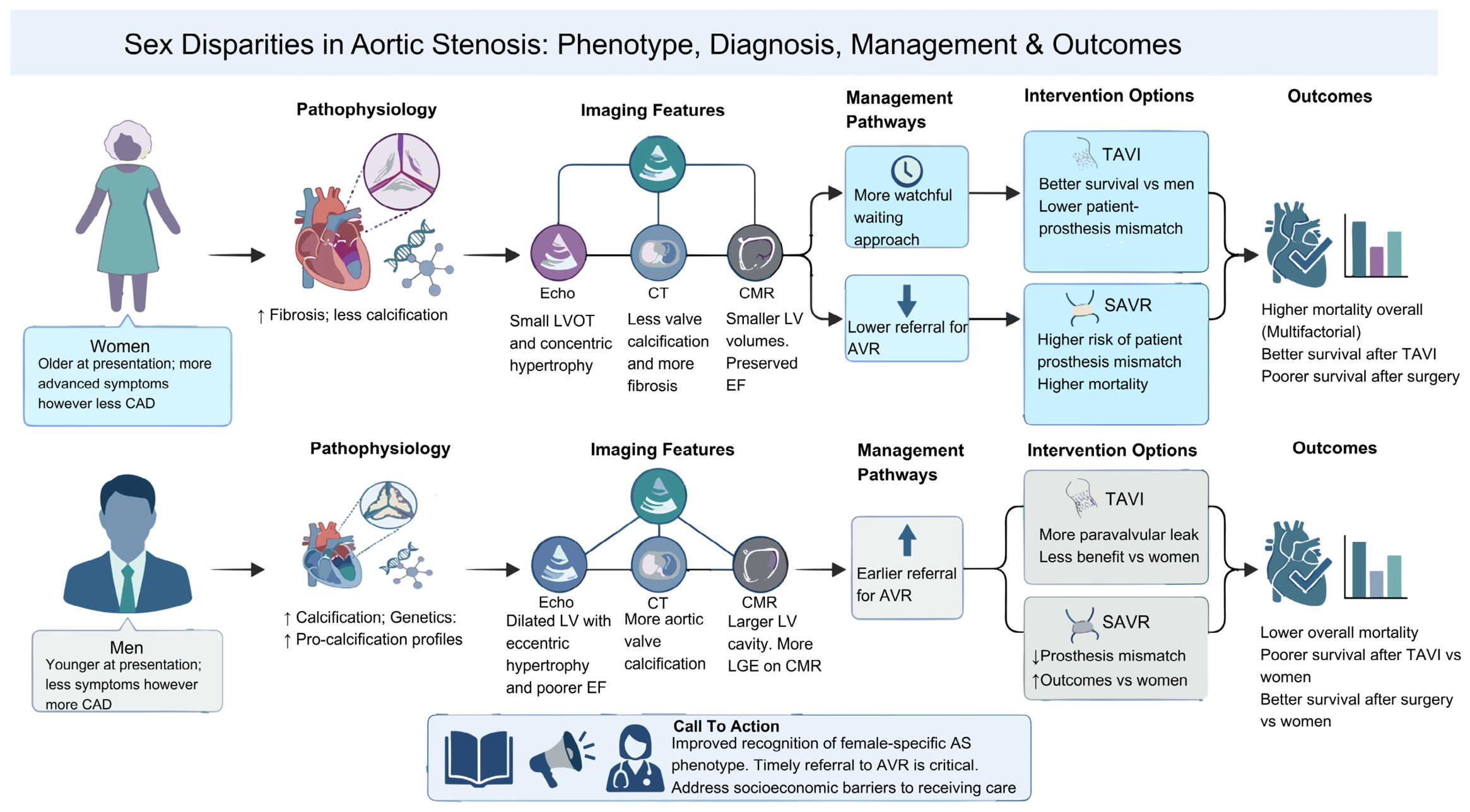
A Review of Sex Differences in Patients with Aortic Stenosis: A Focus on Diagnostic and Treatment Differences, a Narrative Review

Abstract
1. Introduction
1.1. Overview of Aortic Stenosis
1.2. Epidemiological Differences Between Men and Women in Aortic Stenosis
1.3. Pathophysiological Differences by Sex in Aortic Stenosis
2. Methods
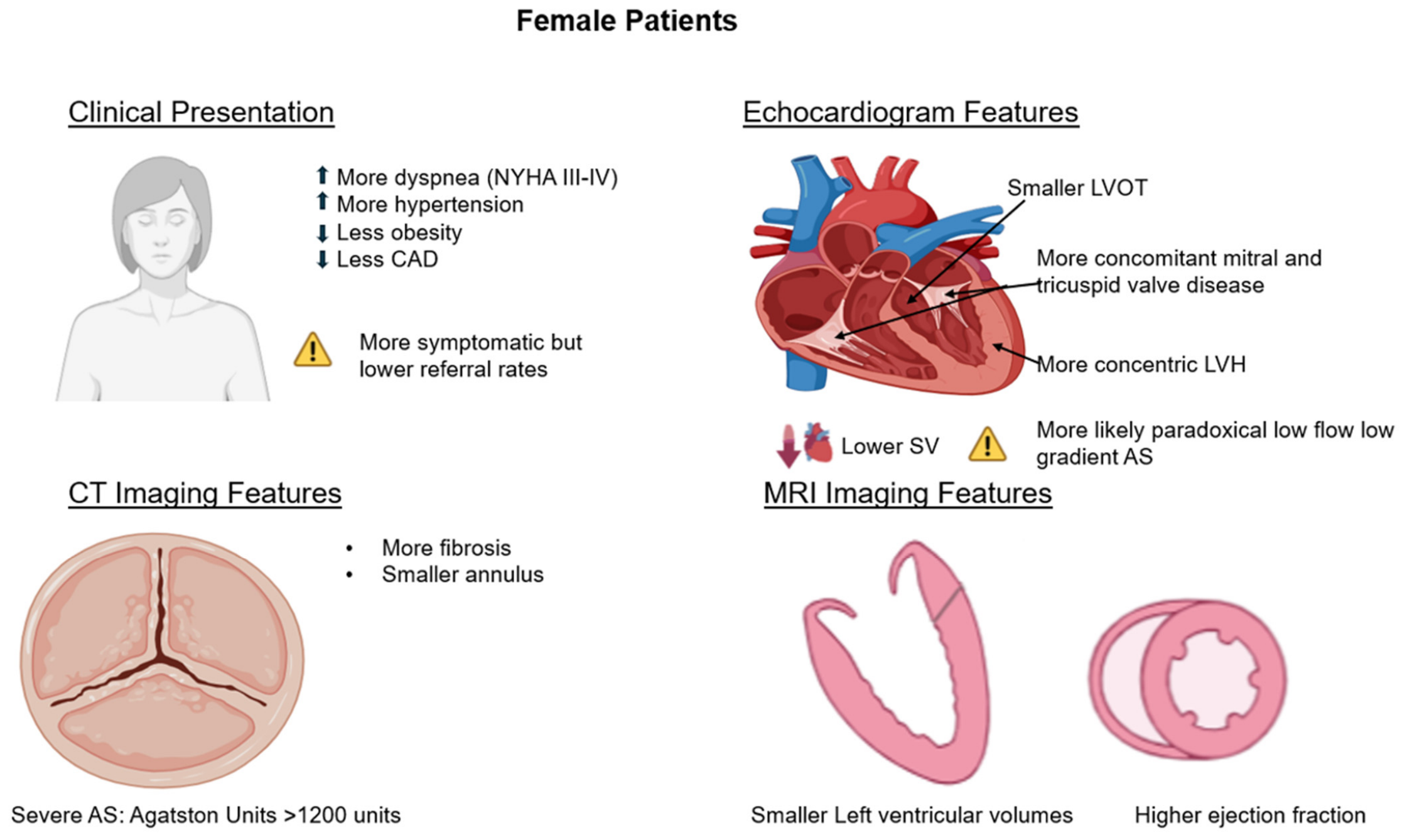
3. Clinical Presentation and Imaging Variation Between the Sexes in Aortic Stenosis
3.1. Clinical Presentation
3.2. Echocardiographic Variation
3.3. Computed Tomography Imaging Differences
3.4. Cardiac Magnetic Resonance Imaging Differences
4. Management and Outcome Variation Between the Sexes in Aortic Stenosis
4.1. Conservative Management
4.2. Transcatheter Aortic Valve Implantation
4.3. Surgical Aortic Valve Replacement
5. Discussion and Future Directions
5.1. Access to TAVI
5.2. Socioeconomic Influences on Accessing Care
5.3. Prognosis
5.4. Future Directions
6. Conclusions
Author Contributions
Funding
Data Availability Statement
Conflicts of Interest
References
- Wang, B.; Mei, Z.; Yang, H.; Gao, W.; Ma, L.; An, G. Global, regional, and national burden of nonrheumatic calcific aortic valve disease based on GBD study 2021. Sci. Rep. 2025, 15, 29464. [Google Scholar] [CrossRef] [Scilit] [PubMed]
- Aluru, J.S.; Barsouk, A.; Saginala, K.; Rawla, P.; Barsouk, A. Valvular Heart Disease Epidemiology. Med. Sci. 2022, 10, 32. [Google Scholar] [CrossRef] [Scilit] [PubMed]
- Eltchaninoff, H.; Lloyd, C.; Prendergast, B. The past, present and future of aortic stenosis treatment. Br. J. Cardiol. 2023, 30, S5–S11. [Google Scholar] [CrossRef] [Scilit]
- Généreux, P.; Sharma, R.P.; Cubeddu, R.J.; Aaron, L.; Abdelfattah, O.M.; Koulogiannis, K.P.; Marcoff, L.; Naguib, M.; Kapadia, S.R.; Makkar, R.R.; et al. The Mortality Burden of Untreated Aortic Stenosis. J. Am. Coll. Cardiol. 2023, 82, 2101–2109. [Google Scholar] [CrossRef] [Scilit] [PubMed]
- Zelis, J.M.; van ’t Veer, M.; Houterman, S.; Pijls, N.H.J.; Tonino, P.A.L. Survival and quality of life after transcatheter aortic valve implantation relative to the general population. IJC Heart Vasc. 2020, 28, 100536. [Google Scholar] [CrossRef] [Scilit] [PubMed]
- Boakye, E.; Dardari, Z.; Obisesan, O.H.; Osei, A.D.; Wang, F.M.; Honda, Y.; Dzaye, O.; Osuji, N.; Carr, J.J.; Howard-Claudio, C.M.; et al. Sex-and Race-Specific Burden of Aortic Valve Calcification Among Older Adults Without Overt Coronary Heart Disease: The Atherosclerosis Risk in Communities Study. Atherosclerosis 2022, 355, 68. [Google Scholar] [CrossRef] [Scilit] [PubMed]
- Adeli, A.; Swahn, E.; Lind, L.; Soderberg, S.; Blomberg, A.; Engström, G.; Östgren, C.J.; Jernberg, T.; Bergström, G.; Settergren, M.; et al. Sex differences in the prevalence and risk factors for aortic valve calcification in the general population. Heart 2026. [Google Scholar] [CrossRef] [Scilit] [PubMed]
- Toyofuku, M.; Taniguchi, T.; Morimoto, T.; Yamaji, K.; Furukawa, Y.; Takahashi, K.; Tamura, T.; Shiomi, H.; Ando, K.; Kanamori, N.; et al. Sex Differences in Severe Aortic Stenosis―Clinical Presentation and Mortality. Circ. J. 2017, 81, 1213–1221. [Google Scholar] [CrossRef] [Scilit] [PubMed]
- Crousillat, D.; Shariff, D.; Duan, R.; Tanguturi, V.; Elmariah, S. Sex Differences in the Clinical Recognition of Significant Aortic Stenosis. JACC Adv. 2025, 4, 102370. [Google Scholar] [CrossRef] [Scilit] [PubMed]
- Iribarren, A.C.; AlBadri, A.; Wei, J.; Nelson, M.D.; Li, D.; Makkar, R.; Merz, C.N.B. Sex differences in aortic stenosis: Identification of knowledge gaps for sex-specific personalized medicine. Am. Heart J. Plus Cardiol. Res. Pract. 2022, 21, 100197. [Google Scholar] [CrossRef] [Scilit] [PubMed]
- Simard, L.; Côté, N.; Dagenais, F.; Mathieu, P.; Couture, C.; Trahan, S.; Bossé, Y.; Mohammadi, S.; Pagé, S.; Joubert, P.; et al. Sex-related discordance between aortic valve calcification and hemodynamic severity of aortic stenosis. Circ. Res. 2017, 120, 681–691. [Google Scholar] [CrossRef] [Scilit] [PubMed]
- Sarajlic, P.; Plunde, O.; Franco-Cereceda, A.; Bäck, M. Artificial Intelligence Models Reveal Sex-Specific Gene Expression in Aortic Valve Calcification. JACC Basic Transl. Sci. 2021, 6, 403. [Google Scholar] [CrossRef] [Scilit] [PubMed]
- Parra-Izquierdo, I.; Castaños-Mollor, I.; López, J.; Gómez, C.; Román, J.A.S.; Crespo, M.S.; García-Rodríguez, C. Calcification Induced by Type i Interferon in Human Aortic Valve Interstitial Cells Is Larger in Males and Blunted by a Janus Kinase Inhibitor. Arter. Thromb. Vasc. Biol. 2018, 38, 2148–2159. [Google Scholar] [CrossRef] [Scilit] [PubMed]
- Capoulade, R.; Clavel, M.A.; Le Ven, F.; Dahou, A.; Thébault, C.; Tastet, L.; Shen, M.; Arsenault, M.; Bédard, É.; Beaudoin, J.; et al. Impact of left ventricular remodelling patterns on outcomes in patients with aortic stenosis. Eur. Heart J. Cardiovasc. Imaging 2017, 18, 1378. [Google Scholar] [CrossRef] [Scilit] [PubMed]
- Treibel, T.A.; Kozor, R.; Fontana, M.; Torlasco, C.; Reant, P.; Badiani, S.; Espinoza, M.; Yap, J.; Diez, J.; Hughes, A.D.; et al. Sex Dimorphism in the Myocardial Response to Aortic Stenosis. JACC Cardiovasc. Imaging 2018, 11, 962. [Google Scholar] [CrossRef] [Scilit] [PubMed]
- Singh, A.; Chan, D.C.S.; Greenwood, J.P.; Dawson, D.K.; Sonecki, P.; Hogrefe, K.; Kelly, D.J.; Dhakshinamurthy, V.; Lang, C.C.; Khoo, J.P.; et al. Symptom Onset in Aortic Stenosis: Relation to Sex Differences in Left Ventricular Remodeling. JACC Cardiovasc. Imaging 2019, 12, 96–105. [Google Scholar] [PubMed]
- Elboudwarej, O.; Wei, J.; Darouian, N.; Cook-Wiens, G.; Li, Q.; Thomson, L.E.J.; Petersen, J.W.; Anderson, R.D.; Mehta, P.; Shufelt, C.; et al. Maladaptive Left Ventricular Remodeling in Women: An Analysis from the Women’s Ischemia Syndrome Evaluation—Coronary Vascular Dysfunction Study. Int. J. Cardiol. 2018, 268, 230. [Google Scholar] [CrossRef] [Scilit] [PubMed]
- Park, S.M.; Wei, J.; Cook-Wiens, G.; Nelson, M.D.; Thomson, L.; Berman, D.; Handberg, E.; Petersen, J.; Anderson, D.; Pepine, C.J.; et al. Left ventricular concentric remodelling and functional impairment in women with ischaemia with no obstructive coronary artery disease and intermediate coronary flow reserve: A report from the WISE-CVD study. Eur. Heart J. Cardiovasc. Imaging 2019, 20, 875. [Google Scholar] [CrossRef] [Scilit] [PubMed]
- Nickenig, G.; Strehlow, K.; Wassmann, S.; Bäumer, A.T.; Albory, K.; Sauer, H.; Böhm, M. Differential effects of estrogen and progesterone on AT1 receptor gene expression in vascular smooth muscle cells. Circulation 2000, 102, 1828–1833. [Google Scholar] [CrossRef] [Scilit] [PubMed]
- Généreux, P.; Stone, G.W.; O’Gara, P.T.; Marquis-Gravel, G.; Redfors, B.; Giustino, G.; Pibarot, P.; Bax, J.J.; Bonow, R.O.; Leon, M.B. Natural History, Diagnostic Approaches, and Therapeutic Strategies for Patients with Asymptomatic Severe Aortic Stenosis. J. Am. Coll. Cardiol. 2016, 67, 2263–2288. [Google Scholar] [CrossRef] [Scilit] [PubMed]
- Tribouilloy, C.; Bohbot, Y.; Rusinaru, D.; Belkhir, K.; Diouf, M.; Altes, A.; Delpierre, Q.; Serbout, S.; Kubala, M.; Levy, F.; et al. Excess Mortality and Undertreatment of Women With Severe Aortic Stenosis. J. Am. Heart Assoc. Cardiovasc. Cerebrovasc. Dis. 2020, 10, e018816. [Google Scholar] [CrossRef] [Scilit] [PubMed]
- Larsson, S.C.; Wolk, A.; Hakansson, N.; Back, M. Overall and abdominal obesity and incident aortic valve stenosis: Two prospective cohort studies. Eur. Heart J. 2017, 38, 2192. [Google Scholar] [CrossRef] [Scilit] [PubMed]
- Bienjonetti-Boudreau, D.; Fleury, M.A.; Voisine, M.; Paquin, A.; Chouinard, I.; Tailleur, M.; Duval, R.; Magnan, P.O.; Beaudoin, J.; Salaun, E.; et al. Impact of sex on the management and outcome of aortic stenosis patients. Eur. Heart J. 2021, 42, 2683–2691. [Google Scholar] [CrossRef] [Scilit] [PubMed]
- Chandrasekhar, J.; Dangas, G.; Mehran, R. Valvular Heart Disease in Women, Differential Remodeling, and Response to New Therapies. Curr. Treat. Options Cardiovasc. Med. 2017, 19, 74. [Google Scholar] [CrossRef] [Scilit] [PubMed]
- Steeds, R.P.; Messika-Zeitoun, D.; Thambyrajah, J.; Serra, A.; Schulz, E.; Maly, J.; Aiello, M.; Rudolph, T.K.; Lloyd, G.; Bortone, A.S.; et al. IMPULSE: The impact of gender on the presentation and management of aortic stenosis across Europe. Open Heart 2021, 8, e001443. [Google Scholar] [CrossRef] [Scilit] [PubMed]
- Cramariuc, D.; Bahlmann, E.; Gerdts, E. Grading of Aortic Stenosis: Is it More Complicated in Women? Eur. Cardiol. Rev. 2022, 17, e21. [Google Scholar] [CrossRef] [Scilit] [PubMed]
- Pibarot, P.; Dumesnil, J.G. Low-flow, low-gradient aortic stenosis with normal and depressed left ventricular ejection fraction. J. Am. Coll. Cardiol. 2012, 60, 1845–1853. [Google Scholar] [CrossRef] [Scilit] [PubMed]
- Poulin, F.; Yingchoncharoen, T.; Wilson, W.M.; Horlick, E.M.; Généreux, P.; Tuzcu, E.M.; Stewart, W.; Osten, M.D.; Woo, A.; Thavendiranathan, P. Impact of Prosthesis-Patient Mismatch on Left Ventricular Myocardial Mechanics After Transcatheter Aortic Valve Replacement. J. Am. Heart Assoc. 2016, 5, e002866. [Google Scholar] [CrossRef] [Scilit] [PubMed]
- Mihos, C.G.; Klassen, S.L.; Yucel, E. Sex-Specific Considerations in Women with Aortic Stenosis and Outcomes After Transcatheter Aortic Valve Replacement. Curr. Treat. Options Cardiovasc. Med. 2018, 20, 52. [Google Scholar] [CrossRef] [Scilit] [PubMed]
- Buellesfeld, L.; Stortecky, S.; Kalesan, B.; Gloekler, S.; Khattab, A.A.; Nietlispach, F.; Delfine, V.; Huber, C.; Eberle, B.; Meier, B.; et al. Aortic root dimensions among patients with severe aortic stenosis undergoing transcatheter aortic valve replacement. JACC Cardiovasc. Interv. 2013, 6, 72–83. [Google Scholar] [CrossRef] [Scilit] [PubMed]
- Taniguchi, T.; Morimoto, T.; Takeji, Y.; Shirai, S.; Ando, K.; Tabata, H.; Yamamoto, K.; Murai, R.; Osakada, K.; Sakamoto, H.; et al. Low-Gradient Severe Aortic Stenosis: Insights From the CURRENT AS Registry-2. JACC Cardiovasc. Interv. 2025, 18, 471–487. [Google Scholar] [PubMed]
- Praz, F.; Borger, M.A.; Lanz, J.; Marin-Cuartas, M.; Abreu, A.; Adamo, M.; Ajmone Marsan, N.; Barili, F.; Bonaros, N.; Cosyns, B.; et al. 2025 ESC/EACTS Guidelines for the management of valvular heart disease: Developed by the task force for the management of valvular heart disease of the European Society of Cardiology (ESC) and the European Association for Cardio-Thoracic Surgery (EACTS). Eur. Heart J. 2025, 1, xwag001. [Google Scholar]
- Hachicha, Z.; Dumesnil, J.G.; Bogaty, P.; Pibarot, P. Paradoxical low-flow, low-gradient severe aortic stenosis despite preserved ejection fraction is associated with higher afterload and reduced survival. Circulation 2007, 115, 2856–2864. [Google Scholar] [CrossRef] [Scilit] [PubMed]
- Clavel, M.A.; Dumesnil, J.G.; Capoulade, R.; Mathieu, P.; Sénéchal, M.; Pibarot, P. Outcome of patients with aortic stenosis, small valve area, and low-flow, low-gradient despite preserved left ventricular ejection fraction. J. Am. Coll. Cardiol. 2012, 60, 1259–1267. [Google Scholar] [CrossRef] [Scilit] [PubMed]
- Desjardin, J.T.; Chikwe, J.; Hahn, R.T.; Hung, J.W.; Delling, F.N. Sex Differences and Similarities in Valvular Heart Disease. Circ. Res. 2022, 130, 455–473. [Google Scholar] [CrossRef] [Scilit] [PubMed]
- Guzzetti, E.; Poulin, A.; Annabi, M.S.; Zhang, B.; Kalavrouziotis, D.; Couture, C.; Dagenais, F.; Pibarot, P.; Clavel, M.A. Transvalvular Flow, Sex, and Survival After Valve Replacement Surgery in Patients With Severe Aortic Stenosis. J. Am. Coll. Cardiol. 2020, 75, 1897–1909. [Google Scholar] [CrossRef] [Scilit] [PubMed]
- Garbi, M.; MacCarthy, P.; Shah, A.M.; Chambers, J.B. Classical and Paradoxical Low-Flow Low-Gradient Aortic Stenosis: A Heart Failure Perspective. Struct. Heart 2018, 2, 3–9. [Google Scholar] [CrossRef] [Scilit]
- Rosenhek, R.; Binder, T.; Porenta, G.; Lang, I.; Christ, G.; Schemper, M.; Maurer, G.; Baumgartner, H. Predictors of Outcome in Severe, Asymptomatic Aortic Stenosis. N. Engl. J. Med. 2000, 343, 611–617. [Google Scholar] [CrossRef] [Scilit] [PubMed]
- Appleby, C.; Bleiziffer, S.; Bramlage, P.; Delgado, V.; Eltchaninoff, H.; Gebhard, C.; Hengstenberg, C.; Kurucova, J.; Marx, P.; Rudolph, T.K.; et al. Sex-related disparities in aortic stenosis from disease awareness to treatment: A state-of-the-art review. J. Thorac. Dis. 2024, 16, 6308–6319. [Google Scholar] [CrossRef] [Scilit] [PubMed]
- Zimmerli, A.; Liabot, Q.; Tzimas, G.; Akodad, M.; Salihu, A.; Weerts, V.; Antiochos, P.; Sellers, S.L.; Monney, P.; Muller, O.; et al. Aortic Stenosis: Time for a Sex-Based Approach? J. Clin. Med. 2025, 14, 2691. [Google Scholar] [CrossRef] [Scilit] [PubMed]
- Shan, Y.; Pellikka, P.A. Aortic stenosis in women. Heart 2020, 106, 970–976. [Google Scholar] [CrossRef] [Scilit] [PubMed]
- Vahanian, A.; Beyersdorf, F.; Praz, F.; Milojevic, M.; Baldus, S.; Bauersachs, J.; Capodanno, D.; Conradi, L.; De Bonis, M.; De Paulis, R.; et al. 2021 ESC/EACTS Guidelines for the management of valvular heart disease: Developed by the Task Force for the management of valvular heart disease of the European Society of Cardiology (ESC) and the European Association for Cardio-Thoracic Surgery (EACTS). Eur. Heart J. 2022, 43, 561–632. [Google Scholar] [CrossRef] [Scilit] [PubMed]
- Clavel, M.A.; Messika-Zeitoun, D.; Pibarot, P.; Aggarwal, S.R.; Malouf, J.; Araoz, P.A.; Michelena, H.I.; Cueff, C.; Larose, E.; Capoulade, R.; et al. The complex nature of discordant severe calcified aortic valve disease grading: New insights from combined Doppler echocardiographic and computed tomographic study. J. Am. Coll. Cardiol. 2013, 62, 2329–2338. [Google Scholar] [PubMed]
- Singh, G.K.; Delgado, V. Multimodality Imaging to Explore Sex Differences in Aortic Stenosis. Eur. Cardiol. Rev. 2022, 17, e26. [Google Scholar] [CrossRef] [Scilit] [PubMed]
- Gil Llopis, C.; Valls Serral, A.; Roldán Torres, I.; Contreras Tornero, M.B.; Cuevas Vilaplana, A.; Sorribes Alonso, A.; Escribano Escribano, P.; Gimeno Tio, P.; Galiana Talavera, E.; Geraldo Martínez, J.; et al. Does Gender Influence the Indication of Treatment and Long-Term Prognosis in Severe Aortic Stenosis? J. Cardiovasc. Dev. Dis. 2023, 10, 38. [Google Scholar] [CrossRef] [Scilit] [PubMed]
- Lauten, A.; Figulla, H.R.; Möllmann, H.; Holzhey, D.; Kötting, J.; Beckmann, A.; Veit, C.; Cremer, J.; Kuck, K.H.; Lange, R.; et al. TAVI for low-flow, low-gradient severe aortic stenosis with preserved or reduced ejection fraction: A subgroup analysis from the German Aortic Valve Registry (GARY). EuroIntervention 2014, 10, 850–859. [Google Scholar] [CrossRef] [Scilit] [PubMed]
- Wöhrle, J.; Gilard, M.; Didier, R.; Kini, A.; Tavenier, A.H.; Tijssen, J.G.P.; Sartori, S.; Snyder, C.; Nicolas, J.; Seeger, J.; et al. Outcomes After Transcatheter Aortic Valve Implantation in Men Versus Women. Am. J. Cardiol. 2022, 180, 108–115. [Google Scholar] [CrossRef] [Scilit] [PubMed]
- Rice, C.T.; Barnett, S.; O’Connell, S.P.; Akowuah, E.; Appleby, C.E.; Chambers, J.B.; Shah, B.N.; Blackman, D.J. Impact of gender, ethnicity and social deprivation on access to surgical or transcatheter aortic valve replacement in aortic stenosis: A retrospective database study in England. Open Heart 2023, 10, e002373. [Google Scholar] [CrossRef] [Scilit] [PubMed]
- Szerlip, M.; Gualano, S.; Holper, E.; Squiers, J.J.; White, J.M.; Doshi, D.; Williams, M.R.; Hahn, R.T.; Webb, J.G.; Svensson, L.G.; et al. Sex-Specific Outcomes of Transcatheter Aortic Valve Replacement With the SAPIEN 3 Valve: Insights From the PARTNER II S3 High-Risk and Intermediate-Risk Cohorts. JACC Cardiovasc. Interv. 2018, 11, 13–20. [Google Scholar] [CrossRef] [Scilit]
- Denegri, A.; Romano, M.; Petronio, A.S.; Angelillis, M.; Giannini, C.; Fiorina, C.; Branca, L.; Barbanti, M.; Costa, G.; Brambilla, N.; et al. Gender differences after transcatheter aortic valve replacement (TAVR): Insights from the italian clinical service project. J. Cardiovasc. Dev. Dis. 2021, 8, 114. [Google Scholar] [CrossRef] [Scilit] [PubMed]
- Bière, L.; Launay, M.; Pinaud, F.; Hamel, J.F.; Eltchaninoff, H.; Iung, B.; Laskar, M.; Leguerrier, A.; Gilard, M.; Furber, A. Influence of Sex on Mortality and Perioperative Outcomes in Patients Undergoing TAVR: Insights From the FRANCE 2 Registry. J. Am. Coll. Cardiol. 2015, 65, 755–757. [Google Scholar] [PubMed]
- van Bergeijk, K.H.; van Ginkel, D.J.; Brouwer, J.; Nijenhuis, V.J.; van der Werf, H.W.; van den Heuvel, A.F.M.; Voors, A.A.; Wykrzykowska, J.J.; tenBerg, J.M. Sex Differences in Outcomes After Transcatheter Aortic Valve Replacement: A POPular TAVI Subanalysis. JACC Cardiovasc. Interv. 2023, 16, 1095–1102. [Google Scholar] [PubMed]
- Kodali, S.; Williams, M.R.; Doshi, D.; Hahn, R.T.; Humphries, K.H.; Nkomo, V.T.; Cohen, D.J.; Douglas, P.S.; Mack, M.; Xu, K.; et al. Sex-Specific Differences at Presentation and Outcomes Among Patients Undergoing Transcatheter Aortic Valve Replacement. Ann. Intern. Med. 2016, 164, 377–384. [Google Scholar] [CrossRef] [Scilit] [PubMed]
- Forrest, J.K.; Adams, D.H.; Popma, J.J.; Reardon, M.J.; Deeb, G.M.; Yakubov, S.J.; Hermiller, J.B.; Huang, J.; Skelding, K.A.; Lansky, A. Transcatheter Aortic Valve Replacement in Women Versus Men (from the US CoreValve Trials). Am. J. Cardiol. 2016, 118, 396–402. [Google Scholar] [CrossRef] [Scilit] [PubMed]
- D’Ascenzo, F.; Gonella, A.; Moretti, C.; Omede, P.; Salizzoni, S.; La Torre, M.; Giordana, F.; Barbanti, M.; Ussia, G.P.; Brambilla, N.; et al. Gender differences in patients undergoing TAVI: A multicentre study. EuroIntervention 2013, 9, 367–372. [Google Scholar] [CrossRef] [Scilit] [PubMed]
- Chandrasekhar, J.; Dangas, G.; Yu, J.; Vemulapalli, S.; Suchindran, S.; Vora, A.N.; Baber, U.; Mehran, R. Sex-Based Differences in Outcomes With Transcatheter Aortic Valve Therapy: TVT Registry From 2011 to 2014. J. Am. Coll. Cardiol. 2016, 68, 2733–2744. [Google Scholar] [PubMed]
- Tchetche, D.; Pibarot, P.; Bax, J.J.; Bonaros, N.; Windecker, S.; Dumonteil, N.; Nietlispach, F.; Messika-Zeitoun, D.; Pocock, S.J.; Berthoumieu, P.; et al. Transcatheter vs. surgical aortic valve replacement in women: The RHEIA trial. Eur. Heart J. 2025, 46, 2079–2088. [Google Scholar] [CrossRef] [Scilit] [PubMed]
- Panoulas, V.F.; Francis, D.P.; Ruparelia, N.; Malik, I.S.; Chukwuemeka, A.; Sen, S.; Anderson, J.; Nihoyannopoulos, P.; Sutaria, N.; Hannan, E.L.; et al. Female-specific survival advantage from transcatheter aortic valve implantation over surgical aortic valve replacement: Meta-analysis of the gender subgroups of randomised controlled trials including 3758 patients. Int. J. Cardiol. 2018, 250, 66–72. [Google Scholar] [CrossRef] [Scilit] [PubMed]
- Reardon, M.J.; Van Mieghem, N.M.; Popma, J.J.; Kleiman, N.S.; Søndergaard, L.; Mumtaz, M.; Adams, D.H.; Deeb, G.M.; Maini, B.; Gada, H.; et al. Surgical or Transcatheter Aortic-Valve Replacement in Intermediate-Risk Patients. N. Engl. J. Med. 2017, 376, 1321–1331. [Google Scholar] [CrossRef] [Scilit] [PubMed]
- Van Mieghem, N.M.; Reardon, M.J.; Yakubov, S.J.; Heiser, J.; Merhi, W.; Windecker, S.; Makkar, R.; Cheng, W.; Robbins, M.; Fail, P.; et al. Clinical outcomes of TAVI or SAVR in men and women with aortic stenosis at intermediate operative risk: A post hoc analysis of the randomised SURTAVI trial. EuroIntervention 2020, 16, 833–841. [Google Scholar] [CrossRef] [Scilit] [PubMed]
- Williams, M.; Kodali, S.K.; Hahn, R.T.; Humphries, K.H.; Nkomo, V.T.; Cohen, D.J.; Douglas, P.S.; Mack, M.; McAndrew, T.C.; Svensson, L.; et al. Sex-related differences in outcomes after transcatheter or surgical aortic valve replacement in patients with severe aortic stenosis: Insights from the partner trial (placement of aortic transcatheter valve). J. Am. Coll. Cardiol. 2014, 63, 1522–1528. [Google Scholar] [PubMed]
- Vlastra, W.; Chandrasekhar, J.; García Del Blanco, B.; Tchétché, D.; de Brito, F.S.; Barbanti, M.; Kornowski, R.; Latib, A.; D’Onofrio, A.; Ribichini, F.; et al. Sex Differences in Transfemoral Transcatheter Aortic Valve Replacement. J. Am. Coll. Cardiol. 2019, 74, 2758–2767. [Google Scholar] [CrossRef] [Scilit] [PubMed]
- Otto, C.M.; Nishimura, R.A.; Bonow, R.O.; Carabello, B.A.; Erwin, J.P.; Gentile, F.; Jneid, H.; Krieger Eric, V.; Mack, M.; McLeod, C.; et al. 2020 ACC/AHA Guideline for the Management of Patients With Valvular Heart Disease: A Report of the American College of Cardiology/American Heart Association Joint Committee on Clinical Practice Guidelines. Circulation 2021, 143, e72–e227. [Google Scholar] [CrossRef] [Scilit] [PubMed]
- Samman, B.; Peterson, D.; Chung, J.C.Y.; Ouzounian, M. Aortic Stenosis in Women: Contemporary Perspectives and Lifetime Considerations. J. Heart Valve Soc. 2026, 3, 45–56. [Google Scholar] [CrossRef] [Scilit]
- Jawoosh, M.; Zayat, R.; Dogan, L.; Shieba, Y.; Moza, A.; Tewarie, L.; Lotfi, S.; Khattab, M.A.; Abugameh, A.; Mohammed, A.F.A. Sex-related differences in prosthesis-patient mismatch following aortic valve replacement with the edwards intuity valve system. Front. Cardiovasc. Med. 2025, 12, 1666443. [Google Scholar] [CrossRef] [Scilit] [PubMed]
- Chieffo, A.; Petronio, A.S.; Mehilli, J.; Chandrasekhar, J.; Sartori, S.; Lefèvre, T.; Presbitero, P.; Capranzano, P.; Tchetche, D.; Iadanza, A.; et al. 1-Year Clinical Outcomes in Women After Transcatheter Aortic Valve Replacement: Results From the First WIN-TAVI Registry. JACC Cardiovasc. Interv. 2018, 11, 1–12. [Google Scholar] [PubMed]
- O’Connor, S.A.; Morice, M.C.; Gilard, M.; Leon, M.B.; Webb, J.G.; Dvir, D.; Rodés-Cabau, J.; Tamburino, C.; Capodanno, D.; D’Ascenzo, F.; et al. Revisiting Sex Equality with Transcatheter Aortic Valve Replacement Outcomes A Collaborative, Patient-Level Meta-Analysis of 11,310 Patients. J. Am. Coll. Cardiol. 2015, 66, 221–228. [Google Scholar] [PubMed]
- Sá, M.P.; Jacquemyn, X.; Van den Eynde, J.; Tasoudis, P.; Dokollari, A.; Torregrossa, G.; Sicouri, S.; Clavel, M.A.; Pibarot, P.; Ramlawi, B. Impact of Prosthesis-Patient Mismatch After Transcatheter Aortic Valve Replacement: Meta-Analysis of Kaplan-Meier–Derived Individual Patient Data. JACC Cardiovasc. Imaging 2023, 16, 298–310. [Google Scholar] [PubMed]
- Barbanti, M.; Yang, T.H.; Rodès Cabau, J.; Tamburino, C.; Wood, D.A.; Jilaihawi, H.; Blanke, P.; Makkar, R.R.; Latib, A.; Colombo, A.; et al. Anatomical and procedural features associated with aortic root rupture during balloon-expandable transcatheter aortic valve replacement. Circulation 2013, 128, 244–253. [Google Scholar] [CrossRef] [Scilit] [PubMed]
- Masiero, G.; Paradies, V.; Franzone, A.; Bellini, B.; De Biase, C.; Karam, N.; Sanguineti, F.; Mamas, M.A.; Eltchaninoff, H.; Fraccaro, C.; et al. Sex-Specific Considerations in Degenerative Aortic Stenosis for Female-Tailored Transfemoral Aortic Valve Implantation Management. J. Am. Heart Assoc. Cardiovasc. Cerebrovasc. Dis. 2022, 11, e025944. [Google Scholar] [CrossRef] [Scilit] [PubMed]
- Pasic, M.; Unbehaun, A.; Buz, S.; Drews, T.; Hetzer, R. Annular rupture during transcatheter aortic valve replacement: Classification, pathophysiology, diagnostics, treatment approaches, and prevention. JACC Cardiovasc. Interv. 2015, 8, 1–9. [Google Scholar] [PubMed]
- Hamdan, A.; Barbash, I.; Schwammenthal, E.; Segev, A.; Kornowski, R.; Assali, A.; Shaviv, E.; Fefer, P.; Goitein, O.; Konen, E.; et al. Sex differences in aortic root and vascular anatomy in patients undergoing transcatheter aortic valve implantation: A computed-tomographic study. J. Cardiovasc. Comput. Tomogr. 2017, 11, 87–96. [Google Scholar] [CrossRef] [Scilit] [PubMed]
- Andrei, A.C.; Yadlapati, A.; Malaisrie, S.C.; Puthumana, J.J.; Li, Z.; Rigolin, V.H.; Mendelson, M.; Clennon, C.; Kruse, J.; Fedak, P.W.M.; et al. Comparison of Outcomes and Presentation in Men-Versus-Women With Bicuspid Aortic Valves Undergoing Aortic Valve Replacement. Am. J. Cardiol. 2015, 116, 250–255. [Google Scholar] [CrossRef] [Scilit] [PubMed]
- Chang, F.C.; Chen, S.W.; Chan, Y.H.; Lin, C.P.; Wu, V.C.C.; Cheng, Y.T.; Chen, D.Y.; Hung, K.C.; Chu, P.H.; Chou, A.H. Sex differences in risks of in-hospital and late outcomes after cardiac surgery: A nationwide population-based cohort study. BMJ Open 2022, 12, e058538. [Google Scholar] [CrossRef] [Scilit] [PubMed]
- Fialka, N.M.; EL-Andari, R.; Kang, J.; Hong, Y.; Bozso, S.J.; Moon, M.C.; Nagendran, J.; Nagendran, J. Impact of Sex on Long-Term Outcomes Following Surgical Aortic Valve Replacement. Heart Lung Circ. 2024, 33, 1331–1339. [Google Scholar] [CrossRef] [Scilit] [PubMed]
- Myllykangas, M.E.; Aittokallio, J.; Gunn, J.; Sipilä, J.; Rautava, P.; Kytö, V. Sex Differences in Long-Term Outcomes After Surgical Aortic Valve Replacement: A Nationwide Propensity-matched Study. J. Cardiothorac. Vasc. Anesth. 2020, 34, 932–939. [Google Scholar] [CrossRef] [Scilit] [PubMed]
- Pawlik, A.; Litwinowicz, R.; Kowalewski, M.; Suwalski, P.; Deja, M.; Widenka, K.; Tobota, Z.; Maruszewski, B.; Rzeszutko, Ł.; Januszek, R.; et al. The impact of sex on in-hospital and long-term mortality rates in patients undergoing surgical aortic valve replacement: The SAVR and SEX study. Pol. Heart J. (Kardiol. Pol.) 2023, 81, 754–762. [Google Scholar] [CrossRef] [Scilit] [PubMed]
- Zierer, A.; De Paulis, R.; Bakhtiary, F.; Ahmad, A.E.S.; Andreas, M.; Autschbach, R.; Benedikt, P.; Binder, K.; Bonaros, N.; Borger, M.; et al. Sex-related differences among patients undergoing surgical aortic valve replacement—A propensity score matched study. Interdiscip. Cardiovasc. Thorac. Surg. 2024, 39, ivae140. [Google Scholar] [CrossRef] [Scilit] [PubMed]
- Hernandez-Vaquero, D.; Rodriguez-Caulo, E.; Vigil-Escalera, C.; Blanco-Herrera, O.; Berastegui, E.; Arias-Dachary, J.; Souaf, S.; Parody, G.; Laguna, G.; Adsuar, A.; et al. Differences in life expectancy between men and women after aortic valve replacement. Eur. J. Cardio-Thorac. Surg. 2021, 60, 681–688. [Google Scholar] [CrossRef] [Scilit] [PubMed]
- Dayan, V.; Vignolo, G.; Soca, G.; Paganini, J.J.; Brusich, D.; Pibarot, P. Predictors and Outcomes of Prosthesis-Patient Mismatch After Aortic Valve Replacement. JACC Cardiovasc. Imaging 2016, 9, 924–933. [Google Scholar] [CrossRef] [Scilit] [PubMed]
- Khan, H.; Ibrahem, A.; Farag, M. Aortic Valve Interventions in Asymptomatic Severe Aortic Stenosis: Who, Why, and When? J. Clin. Med. 2026, 15, 1007. [Google Scholar] [CrossRef] [Scilit] [PubMed]
- Leon, M.B.; Mack, M.J.; Pibarot, P.; Hahn, R.T.; Thourani, V.H.; Kodali, S.H.; Généreux, P.; Kapadia, S.R.; Cohen, D.J.; Pocock, S.J.; et al. Transcatheter or Surgical Aortic-Valve Replacement in Low-Risk Patients at 7 Years. N. Engl. J. Med. 2025, 394, 773–783. [Google Scholar] [CrossRef] [Scilit] [PubMed]
- Dargan, J.; Rees, O.; Bijman, L.; Doyle, N.; Bryan, L.; Khan, F.; Firoozi, S.; Tome Esteban, M.T.; Brecker, S. Comparing access to, and outcomes following, TAVI by biological sex. Open Heart 2025, 12, 3599. [Google Scholar] [CrossRef] [Scilit] [PubMed]
- Ram, C.; Yousef, S.; Ma, W.G.; Vallabhajosyula, I.; Singh, S.; Agarwal, R.; Milewski, R.K.; Assi, R.; Patel, P.A.; Williams, M.; et al. Living in disadvantaged neighborhoods linked to less intervention for severe aortic stenosis. Sci. Rep. 2024, 14, 4952. [Google Scholar] [CrossRef] [Scilit] [PubMed]
- Al Hamid, A.; Beckett, R.; Wilson, M.; Jalal, Z.; Cheema, E.; Obe, D.A.-J.; Coombs, T.; Ralebitso-Senior, K.; Assi, S. Gender Bias in Diagnosis, Prevention, and Treatment of Cardiovascular Diseases: A Systematic Review. Cureus 2024, 16, e54264. [Google Scholar] [CrossRef] [Scilit] [PubMed]
- Rivera, F.B.; Magalong, J.V.; Bantayan, N.R.B.; Tesoro, N.; Milan, M.J.; Purewal, V.; Pine, P.L.S.; Tsai, C.M.; Navar, A.M.; Mulvagh, S.L.; et al. Participation of Women in Cardiovascular Trials From 2017 to 2023: A Systematic Review. JAMA Netw. Open 2025, 8, e2529104. [Google Scholar] [CrossRef] [Scilit] [PubMed]


| Study | Numbers | Study Design | Statistical Adjustment | Age (Years) | Mean Aortic Pressure Gradient (mmHg) | Aortic Annulus Size (cm) | Vascular Complications | All-Cause Mortality at 1 Year | Paravalvular Leak | Mean Post Procedure Aortic Gradients (mmHg) | Mean Post Procedure Aortic Valve Area (cm2) |
|---|---|---|---|---|---|---|---|---|---|---|---|
| PARTNER 2 trial [49] | Women 657 Men 1004 | RCT (post-hoc) | Adjustment for baseline covariates | 82.5 ± 7.2 82.0 ± 7.1 | 47.8 ± 13.8 44.6 ± 12.8 | 2.1 ± 0.2 2.3 ± 0.2 | 7.2% 4.2% | 9.4% 10.4% | 4.2% 3.0% | 12.89 10.43 | 1.49 1.81 |
| Denegri et al. [50] | Women 2149 Men 1672 | Observational | Propensity score matching | 83 ± 6 81 ± 6 | 52.4 ± 15.3 47.3 ± 12.8 | NR NR | 13.7% 10.9% | 11.5% 15.0% | 10.3% 16.1% | 8.0 ± 4.2 8.1 ± 4.1 | NR NR |
| FRANCE 2 [51] | Women 1967 Men 2005 | Observational | Adjustment for baseline covariates | 84.0 ± 6.6 81.6 ± 7.5 | 51.0 ± 17.7 45.4 ± 14.8 | NR NR | 4.6% 1.9% | 19.3% 23.7% | 11.8% 17.1% | NR NR | 1.1 1.0 |
| POPULAR trial [52] | Women 466 Men 512 | RCT | None | 81.24 ± 5.46 79.39 ± 6.70 | NR NR | NR NR | NR NR | 8.2% 9.2% | NR NR | NR NR | NR NR |
| GALILEO [47] | Women 813 Men 831 | RCT (post-hoc) | Adjustment for baseline covariates | 81.12 ± 6.16 80.04 ± 6.93 | NR NR | NR NR | NR NR | 3.0% 6.1% | NR NR | 9.9 ± 4.55 10.2 ± 4.73 | 1.76 1.94 |
| PARTNER [53] | Women 1220 Men 1339 | Observational | Adjustment for baseline covariates | 84.9 ± 6.9 84.1 ± 7.3 | 46.1 ± 14.7 42.0 ± 13.7 | 1.83 ± 0.25 1.99 ± 0.27 | 17.3% 10.0% | 6.48% 5.9% | 6.0% 14.3% | 9.76 8.91 | 1.57 1.83 |
| Forrest et al. [54] | Women 1708 Men 1979 | Observational | None | 84.0 ± 7.6 82.7 ± 7.9 | NR NR | NR NR | 9.7% 4.9% | 21.3% 24.1% | 3.5% 4.8% | NR NR | NR NR |
| D’Ascenzo et al. [55] | Women 216 Men 161 | Observational | Multivariable cox regression | 82.9 ± 5.45 81.7 ± 5.32 | 56.4 ± 18.2 48.6 ± 13.9 | NR NR | 12.9% 9.8% | 22.8% 30.8% | 0.5% 1.3% | 10.5 ± 6.6 10.3 ± 4.2 | NR NR |
| Chandrasekar et al. [56] | Women 11,808 Men 11,844 | Observational | Multivariable cox regression | 82.28 ± 8.52 81.67 ± 8.63 | NR NR | NR NR | 8.27% 4.39% | 21.3% 24.5% | 3.1% 3.4% | 5 6 | 1.8 2.0 |
| Study | Numbers | Study Design | Statistical Adjustment | Age (Years) | Mean Aortic Valve Pressure Gradient (mmHg) | Aortic Valve Size (cm) | Major Bleeding | All-Cause Mortality at 1 Year |
|---|---|---|---|---|---|---|---|---|
| Andrei et al. [73] | Women 150 Men 478 | Observational | PSM | 60.7 ± 13.8 56.3 ± 13.6 | 43.4 ± 22.6 34.2 ± 21.3 | 44% ≤ 21 mm 2% ≤ 21 mm | NR NR | 6.0% 3.2% |
| Chang et al. [74] | Women 18,720 Men 18,720 | Observational | PSM and Bonferroni correction | 64.4 ± 12.8 64.1 ± 12.8 | NR NR | NR NR | NR NR | 28.6% 31.2% |
| Fialka et al. [75] | Women 1272 Men 1272 | Observational | PSM | 67.3 ± 12.9 66.8 ± 13.4 | NR NR | 36.9% ≤ 21 mm 3.2% ≤ 21 mm | 0.4% 0.4% | 4.0% 4.0% |
| Myllykangas et al. [76] | Women 2814 Men 2814 | Observational | PSM | 72.2 ± 9.4 71.8 ± 9.1 | NR NR | NR NR | 1.4% 3.0% | 7.1% 5.6% |
| Pawlik et al. [77] | Women 763 Men 763 | Observational | PSM | 67 (60–73) 67 (58–74) | NR NR | NR NR | NR NR | 3.4% 3.5% |
| Zierer et al. [78] | Women 243 Men 433 | Observational | PSM | 59.8 ± 9.5 59.0 ± 9.7 | 46 ± 21 45 ± 18 | 43.2% ≤ 21 mm 7.4% ≤ 21 mm | 11.9% 9.9% | 1.8% at 2 years 1.4% at 2 years |
| Hernandez-Vaquero et al. [79] | Women 1618 Men 1618 | Observational | PSM | 59.9 ± 4.2 59.8 ± 4.1 | NR NR | NR NR | NR NR | 7.9% at 5 years 5.2% at 5 years |
| Factor Influencing Diagnosis and Treatment of Aortic Stenosis in Women | Biological Sex Difference or Gender-Related Healthcare Disparity |
|---|---|
| Less aortic valve calcification | Biological sex difference |
| More aortic valve fibrosis | Biological sex difference |
| Smaller left ventricle size and left ventricular outflow tract | Biological sex difference |
| Concentric remodelling | Biological sex difference |
| More paradoxical low flow low gradient aortic stenosis | Biological sex difference |
| Smaller annular size | Biological sex difference |
| Lack of randomised control trials involving women and underrepresentation of women in previous trials. | Gender-related healthcare disparity |
| Lower referral rates for aortic valve replacement | Gender-related healthcare disparity |
| Most common clinical presentation dyspnoea as opposed to chest pain in men | Biological sex difference |
| Preserved ejection fraction | Biological sex difference |
| Reduced stroke volume | Biological sex difference |
| Healthcare access and socioeconomic status | Gender-related healthcare disparity |
| Risk of patient prosthesis mismatch | Biological sex difference |
Disclaimer/Publisher’s Note: The statements, opinions and data contained in all publications are solely those of the individual author(s) and contributor(s) and not of MDPI and/or the editor(s). MDPI and/or the editor(s) disclaim responsibility for any injury to people or property resulting from any ideas, methods, instructions or products referred to in the content. |
© 2026 by the authors. Licensee MDPI, Basel, Switzerland. This article is an open access article distributed under the terms and conditions of the Creative Commons Attribution (CC BY) license.
Share and Cite
Khan, H.; Das, S.; Das, R. A Review of Sex Differences in Patients with Aortic Stenosis: A Focus on Diagnostic and Treatment Differences, a Narrative Review. J. Clin. Med. 2026, 15, 6362. https://doi.org/10.3390/jcm15166362
Khan H, Das S, Das R. A Review of Sex Differences in Patients with Aortic Stenosis: A Focus on Diagnostic and Treatment Differences, a Narrative Review. Journal of Clinical Medicine. 2026; 15(16):6362. https://doi.org/10.3390/jcm15166362
Chicago/Turabian StyleKhan, Hilal, Sophia Das, and Rajiv Das. 2026. "A Review of Sex Differences in Patients with Aortic Stenosis: A Focus on Diagnostic and Treatment Differences, a Narrative Review" Journal of Clinical Medicine 15, no. 16: 6362. https://doi.org/10.3390/jcm15166362
APA StyleKhan, H., Das, S., & Das, R. (2026). A Review of Sex Differences in Patients with Aortic Stenosis: A Focus on Diagnostic and Treatment Differences, a Narrative Review. Journal of Clinical Medicine, 15(16), 6362. https://doi.org/10.3390/jcm15166362