Occupational Contact Dermatitis in the Post-COVID Era: From Barrier Dysfunction and Microbiome Dysbiosis to Prevention and Precision Management

 , , ,
, , , 
Abstract
1. Introduction
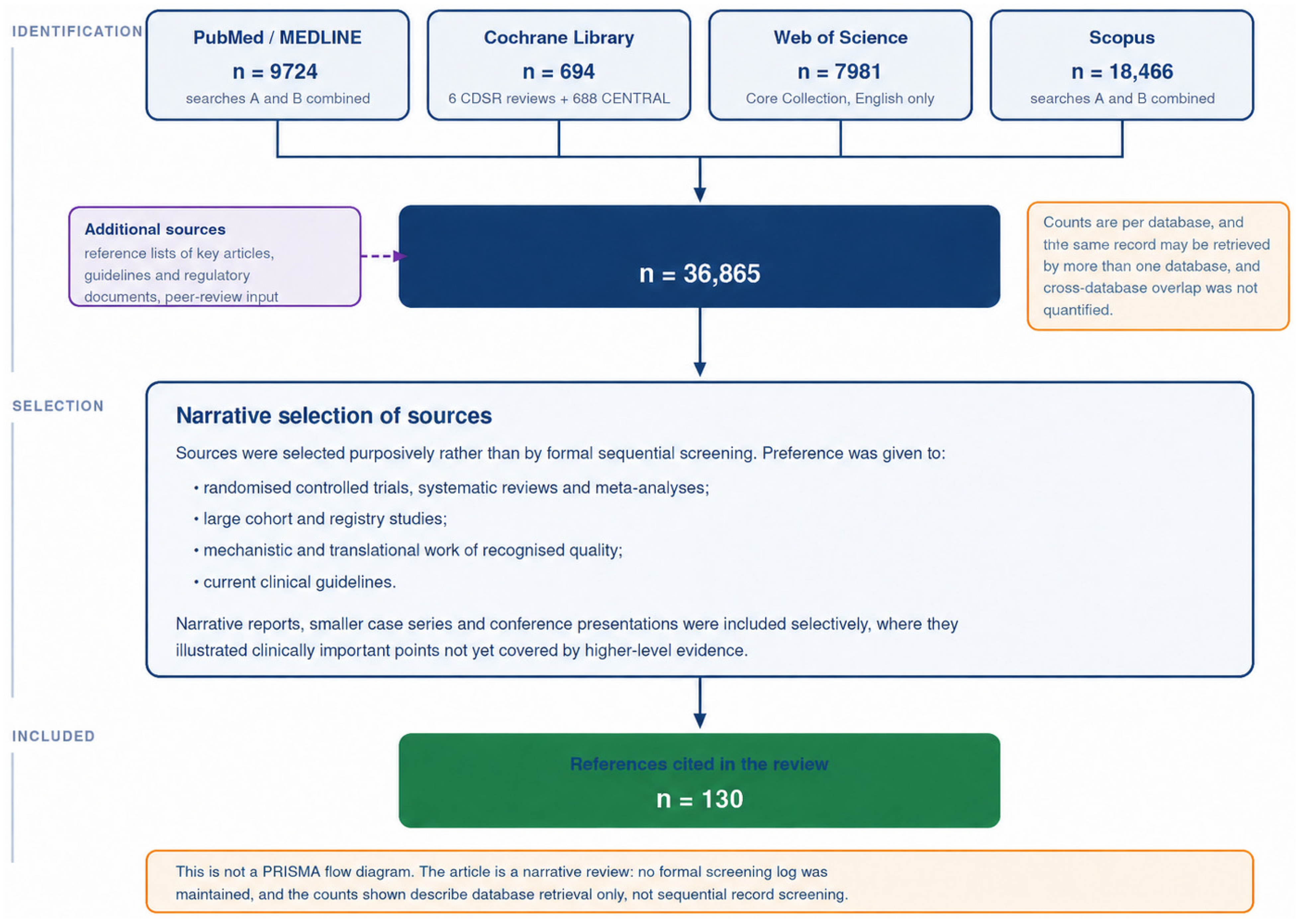
2. Materials and Methods
3. Epidemiology and High-Risk Occupations
Glove-Related Dermatitis After COVID-19
4. Pathophysiology
4.1. Skin Barrier Dysfunction
4.2. The Skin Microbiome and Dysbiosis
4.3. Innate Immunity and Antimicrobial Peptides
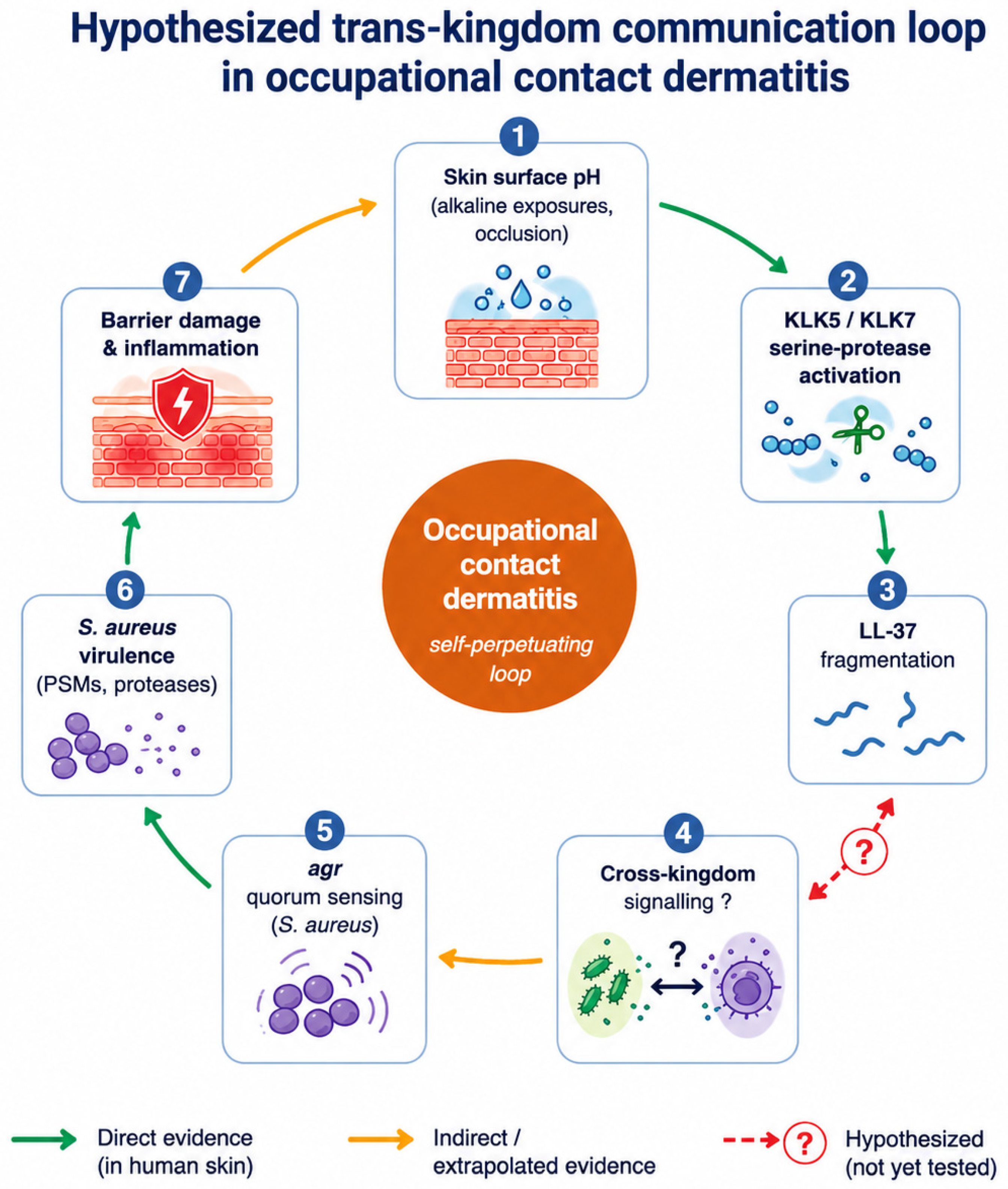
4.4. A Conceptual “Trans-Kingdom Dialogue” Model Linking Host Antimicrobial Peptides and Staphylococcal Quorum Sensing
4.5. The Immunology of Irritant Versus Allergic Contact Dermatitis
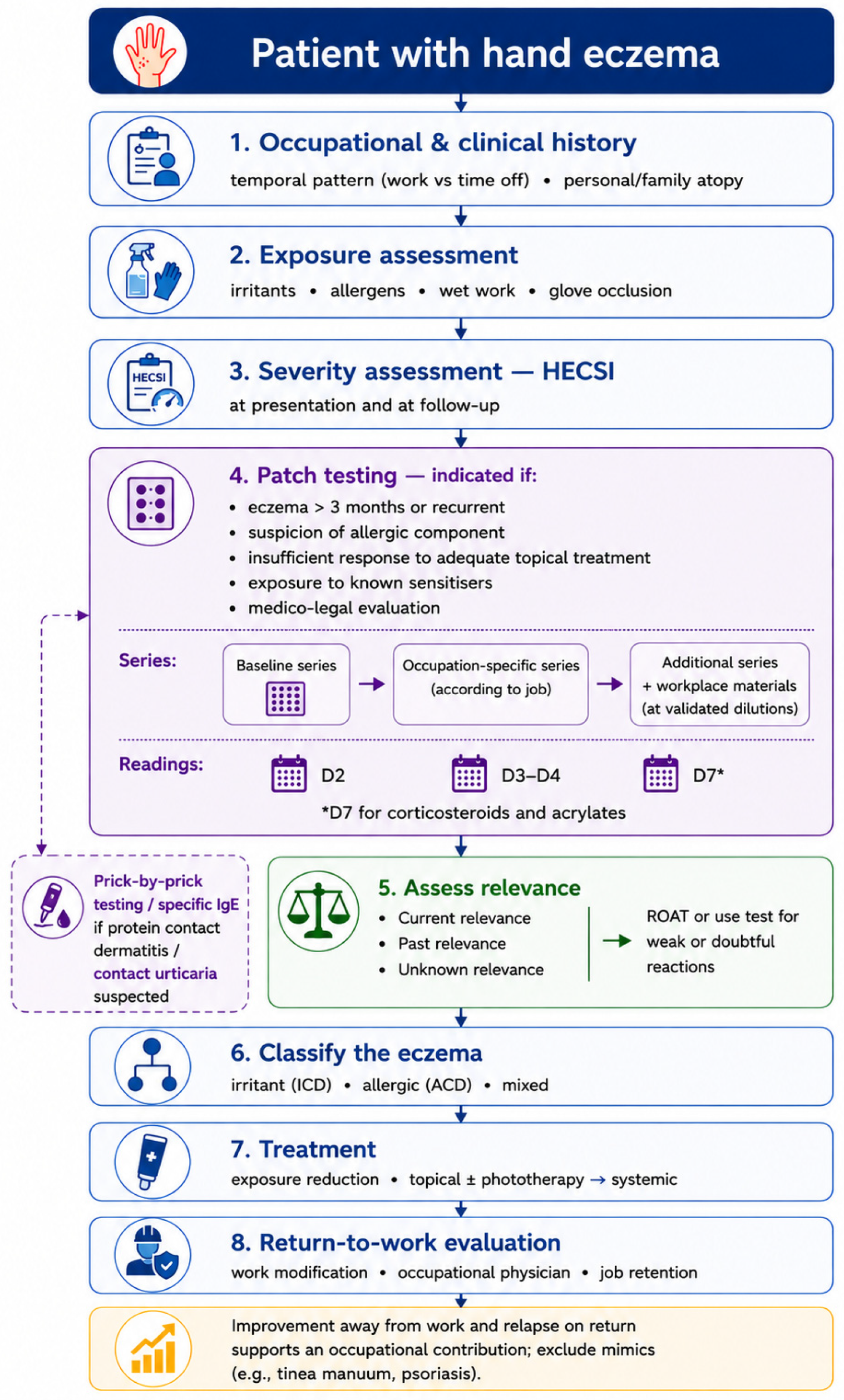
5. Diagnosis
6. Prevention
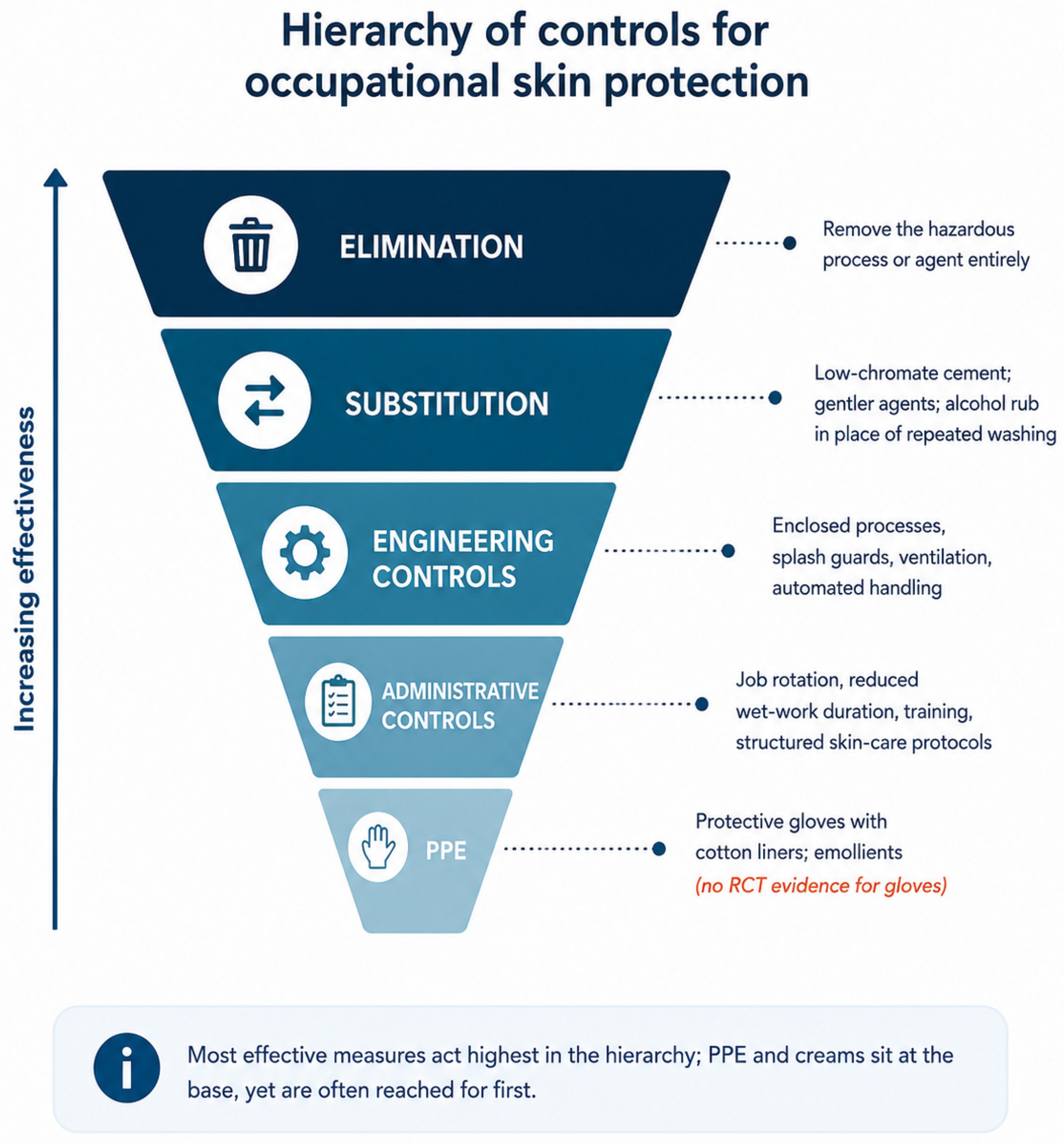
6.1. The Hierarchy of Controls
6.2. Primary Prevention and the Limits of the Evidence
6.3. Secondary and Tertiary Prevention
6.4. Barrier-Repair Formulations

| Therapy | Mechanism | Evidence | Status (Hand Eczema) |
|---|---|---|---|
| Topical corticosteroids | Broad anti-inflammatory | High | First-line/standard of care |
| Topical calcineurin inhibitors (tacrolimus, pimecrolimus) | Calcineurin inhibition; steroid-sparing | Moderate | Off-label; widely used |
| Phototherapy (NB-UVB, PUVA, hand UVA) | Immunomodulation | Moderate | Established second-line |
| Delgocitinib (topical) | Pan-Janus kinase inhibition | High | Approved (EU 2024, US 2025) |
| Alitretinoin (oral) | Retinoid (9-cis-retinoic acid) | High | Approved for severe CHE; teratogenic |
| Dupilumab | Anti–IL-4Rα (blocks IL-4/IL-13) | Moderate | Off-label |
| Upadacitinib/abrocitinib (oral) | JAK1 inhibition | Low | Off-label |
7. Management
7.1. Topical Therapy and Phototherapy
7.2. Systemic Therapy
7.3. Protein Contact Dermatitis and Contact Urticaria
7.4. Return to Work
8. Gaps and Future Directions
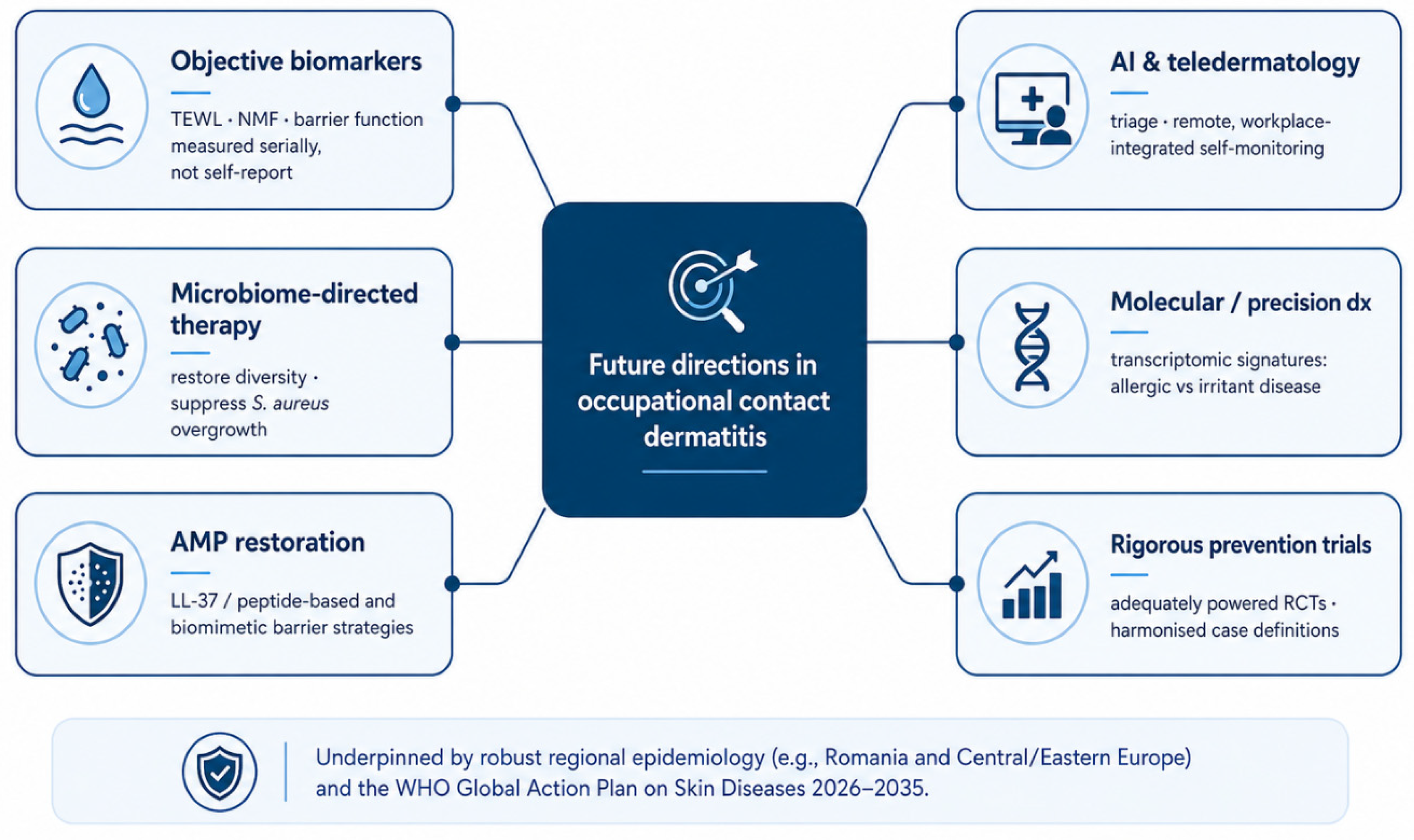
8.1. Emerging Therapeutic and Monitoring Strategies
8.2. Risk Prediction and Precision Occupational Dermatology
9. Conclusions
- Occupational contact dermatitis is the commonest work-related skin disease, and its burden was intensified by COVID-19.
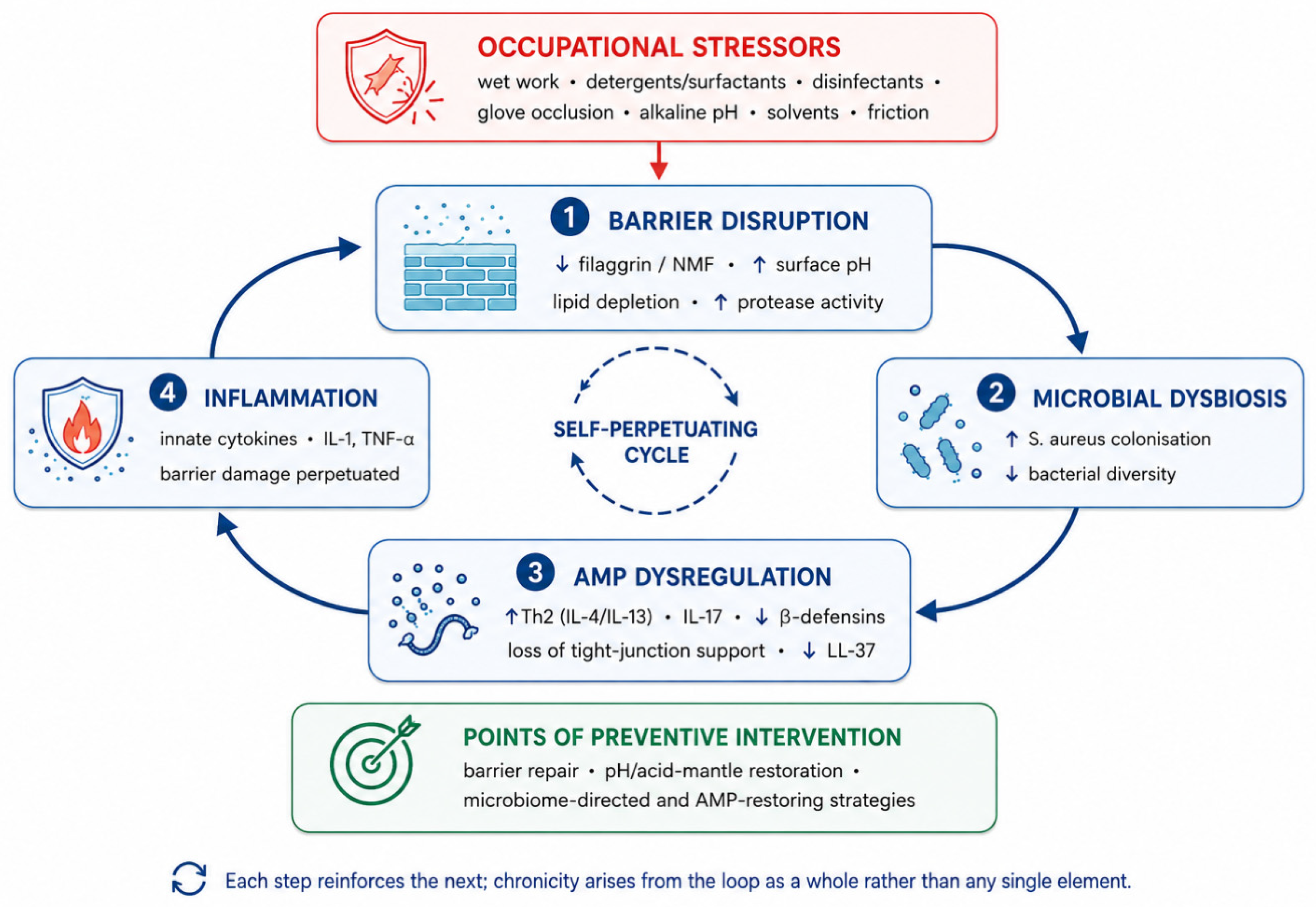
- A self-perpetuating barrier–dysbiosis–antimicrobial-peptide–inflammation cycle drives the disease toward chronicity.
- Primary-prevention evidence is weak: key randomised trials are null, and gloves remain untested in an RCT.
- Topical delgocitinib, superior to oral alitretinoin, is the first major therapeutic advance in decades.
- Future prevention should target barrier, microbiome, and immunity, guided by biomarkers and stronger regional data.
Supplementary Materials
Author Contributions
Funding
Institutional Review Board Statement
Informed Consent Statement
Data Availability Statement
Acknowledgments
Conflicts of Interest
References
- Keegel, T.G.; Moyle, M.; Dharmage, S.; Frowen, K.; Nixon, R. The Epidemiology of Occupational Contact Dermatitis (1990–2007): A Systematic Review. Int. J. Dermatol. 2009, 48, 571–578. [Google Scholar] [CrossRef] [Scilit] [PubMed]
- Diepgen, T.L.; Coenraads, P.J. The Epidemiology of Occupational Contact Dermatitis. Int. Arch. Occup. Environ. Health 1999, 72, 496–506. [Google Scholar] [CrossRef] [Scilit] [PubMed]
- Armstrong, A.; Hahn-Pedersen, J.; Bartlett, C.; Glanville, J.; Thyssen, J.P. Economic Burden of Chronic Hand Eczema: A Review. Am. J. Clin. Dermatol. 2022, 23, 287–300. [Google Scholar] [CrossRef] [Scilit] [PubMed]
- World Health Organization. Skin Diseases as a Global Public Health Priority. In Proceedings of the Seventy-Eighth World Health Assembly, Geneva, Switzerland, 27 May 2025; Resolution WHA78.15; WHO: Geneva, Switzerland, 2025. [Google Scholar]
- Fang, J.; Chen, G.; Wu, M.; Shi, Y.; Yuan, C.; Liu, W. Trends and Projections of Dermatitis Burden (1990–2040): A 2021 Global Burden of Disease Analysis. Front. Med. 2026, 13, 1696683. [Google Scholar] [CrossRef] [Scilit] [PubMed]
- Larese Filon, F.; Pesce, M.; Paulo, M.S.; Loney, T.; Modenese, A.; John, S.M.; Kezic, S.; Macan, J. Incidence of Occupational Contact Dermatitis in Healthcare Workers: A Systematic Review. J. Eur. Acad. Dermatol. Venereol. 2021, 35, 1285–1289. [Google Scholar] [CrossRef] [Scilit] [PubMed]
- Yüksel, Y.T.; Symanzik, C.; Christensen, M.O.; Olesen, C.M.; Thyssen, J.P.; Skudlik, C.; John, S.M.; Brans, R.; Agner, T. Prevalence and Incidence of Hand Eczema in Healthcare Workers: A Systematic Review and Meta-Analysis. Contact Dermat. 2024, 90, 331–342. [Google Scholar] [CrossRef] [Scilit] [PubMed]
- Quaade, A.S.; Simonsen, A.B.; Halling, A.-S.; Thyssen, J.P.; Johansen, J.D. Prevalence, Incidence, and Severity of Hand Eczema in the General Population: A Systematic Review and Meta-Analysis. Contact Dermat. 2021, 84, 361–374. [Google Scholar] [CrossRef] [Scilit] [PubMed]
- Loh, E.D.W.; Yew, Y.W. Hand Hygiene and Hand Eczema: A Systematic Review and Meta-Analysis. Contact Dermat. 2022, 87, 303–314. [Google Scholar] [CrossRef] [Scilit] [PubMed]
- Tatu, A.L.; Nadasdy, T.; Bujoreanu, F.C. Familial Clustering of COVID-19 Skin Manifestations. Dermatol. Ther. 2020, 33, e14181. [Google Scholar] [CrossRef] [Scilit] [PubMed]
- Ma, C.; Sun, J.; Liu, Z.; Zhang, C.; Chen, Y.; Ma, J.; Ma, Q. Skin Manifestations of Primary COVID-19 Infection with the Omicron Variant. PLoS ONE 2026, 21, e0352201. [Google Scholar] [CrossRef] [Scilit] [PubMed]
- Nguyen, B.L.; Cheng, Y.J.; Chua, S.Y.I.; Oh, C.C. Trends in Dermatological Presentations at the Emergency Department of a Tertiary Hospital in Singapore: A 4-Year Analysis Pre- and during COVID-19. Int. J. Emerg. Med. 2025, 18, 174. [Google Scholar] [CrossRef] [Scilit] [PubMed]
- Rudd, E.; Walsh, S. Mask-Related Acne (“Maskne”) and Other Facial Dermatoses. BMJ 2021, 373, n1304. [Google Scholar] [CrossRef] [Scilit] [PubMed]
- Yu, J.; Chen, J.K.; Mowad, C.M.; Reeder, M.; Hylwa, S.; Chisolm, S.; Dunnick, C.A.; Goldminz, A.M.; Jacon, S.E.; Wu, P.A.; et al. Occupational Dermatitis to Facial Personal Protective Equipment in Health Care Workers: A Systematic Review. J. Am. Acad. Dermatol. 2021, 84, 486–494. [Google Scholar] [CrossRef] [Scilit] [PubMed]
- Bauer, A.; Rönsch, H.; Elsner, P.; Dittmar, D.; Bennett, C.; Schuttelaar, M.L.A.; Lukács, J.; John, S.M.; Williams, H.C. Interventions for Preventing Occupational Irritant Hand Dermatitis. Cochrane Database Syst. Rev. 2018, 4, CD004414. [Google Scholar] [CrossRef] [Scilit] [PubMed]
- Soltanipoor, M.; Kezic, S.; Sluiter, J.K.; de Wit, F.; Bosma, A.L.; van Asperen, R.; Rustemeyer, T. Effectiveness of a Skin Care Programme for the Prevention of Contact Dermatitis in Healthcare Workers (the Healthy Hands Project): A Single-Centre, Cluster Randomized Controlled Trial. Contact Dermat. 2019, 80, 365–373. [Google Scholar] [CrossRef] [Scilit] [PubMed]
- Fisker, M.H.; Ebbehøj, N.E.; Vejlstrup, S.G.; Lindschou, J.; Gluud, C.; Winkel, P.; Bonde, J.P.; Agner, T. Prevention of Hand Eczema: Effect of an Educational Program versus Treatment as Usual—Results of the Randomized Clinical PREVEX Trial. Scand. J. Work Environ. Health 2018, 44, 212–218. [Google Scholar] [CrossRef] [Scilit] [PubMed]
- Johansen, J.D.; Bonefeld, C.M.; Schwensen, J.F.B.; Thyssen, J.P.; Uter, W. Novel Insights into Contact Dermatitis. J. Allergy Clin. Immunol. 2022, 149, 1162–1171. [Google Scholar] [CrossRef] [Scilit] [PubMed]
- Lysdal, S.H.; Søsted, H.; Andersen, K.E.; Johansen, J.D. Hand Eczema in Hairdressers: A Danish Register-Based Study of the Prevalence of Hand Eczema and Its Career Consequences. Contact Dermat. 2011, 65, 151–158. [Google Scholar] [CrossRef] [Scilit] [PubMed]
- Polecka, A.; Awchimkow, A.; Owsianko, N.; Baran, A.; Hermanowicz, J.M.; Flisiak, I. Hand Eczema in the Polish Female Population. J. Clin. Med. 2023, 12, 6102. [Google Scholar] [CrossRef] [Scilit] [PubMed]
- Brans, R.; Skudlik, C.; Weisshaar, E.; Scheidt, R.; Ofenloch, R.; Elsner, P.; Wulfhorst, B.; Schonfeld, M.; John, S.M.; Diepgen, T.L.; et al. Multicentre Cohort Study ‘Rehabilitation of Occupational Skin Diseases—Optimization and Quality Assurance of Inpatient Management (ROQ)’: Results from a 3-Year Follow-Up. Contact Dermat. 2016, 75, 205–212. [Google Scholar] [CrossRef] [Scilit] [PubMed]
- Ahlström, M.G.; Dietz, J.B.; Wilke, A.; Johansen, J.D.; John, S.M.; Brans, R. Evaluation of the Secondary and Tertiary Prevention Strategies against Occupational Contact Dermatitis in Germany: A Systematic Review. Contact Dermat. 2022, 87, 142–153. [Google Scholar] [CrossRef] [Scilit] [PubMed]
- Bissonnette, R.; Warren, R.B.; Pinter, A.; Agner, T.; Gooderham, M.; Schuttelaar, M.L.A.; Crépy, M.N.; Stingeni, L.; Serra-Baldrich, E.; Baranowski, K.; et al. Efficacy and Safety of Delgocitinib Cream in Adults with Moderate to Severe Chronic Hand Eczema (DELTA 1 and DELTA 2): Results from Multicentre, Randomised, Controlled, Double-Blind, Phase 3 Trials. Lancet 2024, 404, 461–473. [Google Scholar] [CrossRef] [Scilit] [PubMed]
- Gooderham, M.; Molin, S.; Bissonnette, R.; Worm, M.; Crepy, M.-N.; Stingeni, L.; Warren, R.B.; Schliemann, S.; Schuttelaar, M.-L.; Ferrussi, S.; et al. Long-Term Safety and Efficacy of Delgocitinib Cream for up to 52 Weeks in Adults with Chronic Hand Eczema: Results of the Phase 3 Open-Label Extension DELTA 3 Trial following the DELTA 1 and 2 trials. J. Am. Acad. Dermatol. 2025, 93, 95–103. [Google Scholar] [CrossRef] [Scilit] [PubMed]
- Giménez-Arnau, A.M.; Pinter, A.; Sondermann, W.; Reguiai, Z.; Woolf, R.; Lynde, C.; Legat, F.J.; Costanzo, A.; Silvestre, J.; Mellerup, N.; et al. Efficacy and Safety of Topical Delgocitinib Cream versus Oral Alitretinoin Capsules in Adults with Severe Chronic Hand Eczema (DELTA FORCE): A 24-Week, Randomised, Head-to-Head, Phase 3 Trial. Lancet 2025, 405, 1676–1688. [Google Scholar] [CrossRef] [Scilit] [PubMed]
- Ruzicka, T.; Lynde, C.W.; Jemec, G.B.E.; Diepgen, T.; Berth-Jones, J.; Coenraads, P.J.; Kaszuba, A.; Bissonnette, R.; Varjonen, E.; Hollo, P.; et al. Efficacy and Safety of Oral Alitretinoin (9-cis Retinoic Acid) in Patients with Severe Chronic Hand Eczema Refractory to Topical Corticosteroids: Results of a Randomized, Double-Blind, Placebo-Controlled, Multicentre Trial. Br. J. Dermatol. 2008, 158, 808–817. [Google Scholar] [CrossRef] [Scilit] [PubMed]
- Simpson, E.L.; Silverberg, J.I.; Worm, M.; Honari, G.; Masuda, K.; Syguła, E.; Schuttelaar, M.L.A.; Mortensen, E.; Laws, E.; Akinlade, B.; et al. Dupilumab Treatment Improves Signs, Symptoms, Quality of Life, and Work Productivity in Patients with Atopic Hand and Foot Dermatitis: Results from a Phase 3, Randomized, Double-Blind, Placebo-Controlled Trial. J. Am. Acad. Dermatol. 2024, 90, 1190–1199. [Google Scholar] [CrossRef] [Scilit] [PubMed]
- Pesqué, D.; Andrades, E.; Berenguer-Molins, P.; Perera-Bel, J.; Clarós, M.; Bódalo-Torruella, M.; González-Farré, M.; Gallardo, F.; Pujol, R.M.; Giménez-Arnau, A.M. Transcriptomic Analysis of Allergic Patch Test Reactions in Non-Atopic Patients: A Comparative Study Across Multiple Allergens. Allergy 2025, 80, 3043–3054. [Google Scholar] [CrossRef] [Scilit] [PubMed]
- Alinaghi, F.; Havmose, M.; Thyssen, J.P.; Zachariae, C.; Johansen, J.D. Contact Allergy to Metals in Metalworkers: A Systematic Review and Meta-Analysis. Contact Dermat. 2023, 88, 1–9. [Google Scholar] [CrossRef] [Scilit] [PubMed]
- Sedeh, F.B.; Michaelsdóttir, T.E.; Jemec, G.B.E.; Mortensen, O.S.; Ibler, K.S. Prevalence, Risk Factors, and Prevention of Occupational Contact Dermatitis among Professional Cleaners: A Systematic Review. Int. Arch. Occup. Environ. Health 2023, 96, 345–354. [Google Scholar] [CrossRef] [Scilit] [PubMed]
- Kridin, K.; Bergman, R.; Khamaisi, M.; Zelber-Sagi, S.; Weltfriend, S. Cement-Induced Chromate Occupational Allergic Contact Dermatitis. Dermatitis 2016, 27, 208–214. [Google Scholar] [CrossRef] [Scilit] [PubMed]
- Jamil, W.; Svensson, Å.; Josefson, A.; Lindberg, M.; von Kobyletzki, L. Incidence Rate of Hand Eczema in Different Occupations: A Systematic Review and Meta-Analysis. Acta Derm.-Venereol. 2022, 102, adv00681. [Google Scholar] [CrossRef] [Scilit] [PubMed]
- Chiriac, A.E.; Azoicai, D.; Chiriac, A.; Naznean, A.; Larese Filon, F.; Georgescu, S.R.; Foia, L.; Podoleanu, C.; Stolnicu, S. Romanian Questionnaire to Assess the Prevalence of Occupational Hand Eczema among Healthcare Providers. J. Interdiscip. Med. 2016, 1, 280–281. [Google Scholar] [CrossRef] [Scilit]
- Moldovan, H.R.; Voidazan, S.T.; John, S.M.; Weinert, P.; Moldovan, G.; Vlasiu, M.A.; Szasz, Z.A.; Tiplica, G.S.; Szasz, S.; Marin, A.C.; et al. The Eastern European Experience on Occupational Skin Diseases. Make Underreporting an Issue? J. Eur. Acad. Dermatol. Venereol. 2017, 31, 5–11. [Google Scholar] [CrossRef] [Scilit] [PubMed]
- Isufi, D.; Kursawe Larsen, C.; Jensen, M.B.; Karimian, K.; Zachariae, C.; Schwensen, J.F.B.; Alinaghi, F.; Johansen, J.D. Prevalence of Contact Allergy to Rubber Accelerators from the European Baseline Series in Dermatitis Patients: A Systematic Review and Meta-Analysis. Contact Dermat. 2025, 93, 439–463. [Google Scholar] [CrossRef] [Scilit] [PubMed]
- Bauer, A.; Brans, R.; Brehler, R.; Büttner, M.; Elsner, P.; Fartasch, M.; Herzog, C.; John, S.-M.; Kollner, A.; Maul, J.-T.; et al. S2k Guideline: Diagnosis, Prevention, and Therapy of Hand Eczema. J. Dtsch. Dermatol. Ges. 2023, 21, 1054–1074. [Google Scholar] [CrossRef] [Scilit] [PubMed]
- Kezic, S.; O’Regan, G.M.; Yau, N.; Sandilands, A.; Chen, H.; Campbell, L.E.; Kroboth, K.; Watson, R.; Rowland, M.; McLean, W.H.I.; et al. Levels of Filaggrin Degradation Products Are Influenced by Both Filaggrin Genotype and Atopic Dermatitis Severity. Allergy 2011, 66, 934–940. [Google Scholar] [CrossRef] [Scilit] [PubMed]
- Palmer, C.N.A.; Irvine, A.D.; Terron-Kwiatkowski, A.; Zhao, Y.W.; Liao, H.H.; Lee, S.P.; Goudie, D.R.; Sandilands, A.; Campbell, L.E.; Smith, F.J.D.; et al. Common Loss-of-Function Variants of the Epidermal Barrier Protein Filaggrin Are a Major Predisposing Factor for Atopic Dermatitis. Nat. Genet. 2006, 38, 441–446. [Google Scholar] [CrossRef] [Scilit] [PubMed]
- de Jongh, C.M.; Khrenova, L.; Verberk, M.M.; Calkoen, F.; Van Dijk, F.J.H.; Voss, H.; John, S.M.; Kezic, S. Loss-of-Function Polymorphisms in the Filaggrin Gene Are Associated with an Increased Susceptibility to Chronic Irritant Contact Dermatitis: A Case–Control Study. Br. J. Dermatol. 2008, 159, 621–627. [Google Scholar] [CrossRef] [Scilit] [PubMed]
- Visser, M.J.; Landeck, L.; Campbell, L.E.; McLean, W.H.I.; Weidinger, S.; Calkoen, F.; John, S.M.; Kezic, S. Impact of Atopic Dermatitis and Loss-of-Function Mutations in the Filaggrin Gene on the Development of Occupational Irritant Contact Dermatitis. Br. J. Dermatol. 2013, 168, 326–332. [Google Scholar] [CrossRef] [Scilit] [PubMed]
- Timmerman, J.G.; Heederik, D.; Spee, T.; van Rooy, F.G.; Krop, E.J.M.; Koppelman, G.H.; Rustemeyer, T.; Smit, L.A.M. Contact Dermatitis in the Construction Industry: The Role of Filaggrin Loss-of-Function Mutations. Br. J. Dermatol. 2016, 174, 348–355. [Google Scholar] [CrossRef] [Scilit] [PubMed]
- Bandier, J.; Ross-Hansen, K.; Carlsen, B.C.; Menné, T.; Linneberg, A.; Stender, S.; Szecsi, P.B.; Meldgaard, M.; Thyssen, J.P.; Johansen, J.D. Carriers of Filaggrin Gene (FLG) Mutations Avoid Professional Exposure to Irritants in Adulthood. Contact Dermat. 2013, 69, 355–362. [Google Scholar] [CrossRef] [Scilit] [PubMed]
- Janssens, M.; van Smeden, J.; Gooris, G.S.; Bras, W.; Portale, G.; Caspers, P.J.; Vreeken, R.J.; Hankemeier, T.; Kezic, S.; Wolterbeek, R.; et al. Increase in Short-Chain Ceramides Correlates with an Altered Lipid Organization and Decreased Barrier Function in Atopic Eczema Patients. J. Lipid Res. 2012, 53, 2755–2766. [Google Scholar] [CrossRef] [Scilit] [PubMed]
- Andrew, P.V.; Williams, S.F.; Brown, K.; Chittock, J.; Pinnock, A.; Poyner, A.; Cork, M.J.; Danby, S.G. Topical Supplementation with Physiological Lipids Rebalances the Stratum Corneum Ceramide Profile and Strengthens Skin Barrier Function in Adults Predisposed to Atopic Dermatitis. Br. J. Dermatol. 2025, 193, 729–740. [Google Scholar] [CrossRef] [Scilit] [PubMed]
- Deraison, C.; Bonnart, C.; Lopez, F.; Besson, C.; Robinson, R.; Jayakumar, A.; Wagberg, F.; Brattsand, M.; Hachem, J.P.; Leonardsson, G.; et al. LEKTI Fragments Specifically Inhibit KLK5, KLK7, and KLK14 and Control Desquamation through a pH-Dependent Interaction. Mol. Biol. Cell 2007, 18, 3607–3619. [Google Scholar] [CrossRef] [Scilit] [PubMed]
- Chavanas, S.; Bodemer, C.; Rochat, A.; Hamel-Teillac, D.; Ali, M.; Irvine, A.D.; Bonafe, J.-L.; Wilkinson, J.; Taieb, A.; Barrandon, Y.; et al. Mutations in SPINK5, Encoding a Serine Protease Inhibitor, Cause Netherton Syndrome. Nat. Genet. 2000, 25, 141–142. [Google Scholar] [CrossRef] [Scilit] [PubMed]
- De Benedetto, A.; Rafaels, N.M.; McGirt, L.Y.; Ivanon, A.I.; Georas, S.N.; Cheadle, C.; Berger, A.E.; Zhang, K.; Vidyasagar, S.; Yoshida, T.; et al. Tight Junction Defects in Patients with Atopic Dermatitis. J. Allergy Clin. Immunol. 2011, 127, 773–786.e7. [Google Scholar] [CrossRef] [Scilit] [PubMed]
- Koppes, S.A.; Ljubojević Hadžavdić, S.; Jakasa, I.; Franceschi, N.; Riethmüller, C.; Jurakić Tončić, R.; Marinović, B.; Raj, N.; Rawlings, A.V.; Voegeli, R.; et al. Effect of Allergens and Irritants on Levels of Natural Moisturizing Factor and Corneocyte Morphology. Contact Dermat. 2017, 76, 287–295. [Google Scholar] [CrossRef] [Scilit] [PubMed]
- Schmid, K.; Broding, H.C.; Uter, W.; Drexler, H. Transepidermal Water Loss and Incidence of Hand Dermatitis in a Prospectively Followed Cohort of Apprentice Nurses. Contact Dermat. 2005, 52, 247–253. [Google Scholar] [CrossRef] [Scilit] [PubMed]
- Byrd, A.L.; Belkaid, Y.; Segre, J.A. The Human Skin Microbiome. Nat. Rev. Microbiol. 2018, 16, 143–155. [Google Scholar] [CrossRef] [Scilit] [PubMed]
- Nørreslet, L.B.; Edslev, S.M.; Andersen, P.S.; Plum, F.; Holt, J.; Kjerulf, A.; Ebbehøj, N.E.; Clausen, M.L.; Flachs, E.M.; Agner, T. Colonization with Staphylococcus aureus in Patients with Hand Eczema: Prevalence and Association with Severity, Atopic Dermatitis, Subtype and Nasal Colonization. Contact Dermat. 2020, 83, 442–449. [Google Scholar] [CrossRef] [Scilit] [PubMed]
- Nørreslet, L.B.; Edslev, S.M.; Clausen, M.L.; Flachs, E.M.; Ebbehøj, N.E.; Andersen, P.S.; Agner, T. Hand Eczema and Temporal Variation of Staphylococcus aureus Clonal Complexes: A Prospective Observational Study. J. Am. Acad. Dermatol. 2022, 87, 1006–1013. [Google Scholar] [CrossRef] [Scilit] [PubMed]
- Nørreslet, L.B.; Lilje, B.; Ingham, A.C.; Edslev, S.M.; Clausen, M.L.; Plum, F.; Andersen, P.S.; Agner, T. Skin Microbiome in Patients with Hand Eczema and Healthy Controls: A Three-Week Prospective Study. Acta Derm. Venereol. 2022, 102, adv00633. [Google Scholar] [CrossRef] [Scilit] [PubMed]
- Vindenes, H.K.; Drengenes, C.; Amin, H.; Irgens-Hansen, K.; Svanes, C.; Bertelsen, R.J. Longitudinal Analysis of the Skin Microbiome in Association with Hand Eczema, Hand Hygiene Practices and Moisturizer Use. J. Eur. Acad. Dermatol. Venereol. 2024, 38, 2118–2129. [Google Scholar] [CrossRef] [Scilit] [PubMed]
- Miajlovic, H.; Fallon, P.G.; Irvine, A.D.; Foster, T.J. Effect of Filaggrin Breakdown Products on Growth of and Protein Expression by Staphylococcus aureus. J. Allergy Clin. Immunol. 2010, 126, 1184–1190.e3. [Google Scholar] [CrossRef] [Scilit] [PubMed]
- Nørreslet, L.B.; Ingham, A.C.; Agner, T.; Olesen, C.M.; Bregnhøj, A.; Sommerlund, M.; Andersen, P.S.; Stegger, M.; Mørtz, C.G.; Edslev, S.M. Hand Eczema and Changes in the Skin Microbiome after 2 Weeks of Topical Corticosteroid Treatment. J. Eur. Acad. Dermatol. Venereol. 2025, 39, 1118–1125. [Google Scholar] [CrossRef] [Scilit] [PubMed]
- Watanabe, H.; Gaide, O.; Pétrilli, V.; Martinon, F.; Contassot, E.; Roques, S.; Kummer, J.A.; Tschopp, J.; French, L.E. Activation of the IL-1β-Processing Inflammasome Is Involved in Contact Hypersensitivity. J. Investig. Dermatol. 2007, 127, 1956–1963. [Google Scholar] [CrossRef] [Scilit] [PubMed]
- Weber, F.C.; Esser, P.R.; Müller, T.; Ganesan, J.; Pellegatti, P.; Simon, M.M.; Zeiser, R.; Idzko, M.; Jakob, T.; Martin, S.F. Lack of the Purinergic Receptor P2X7 Results in Resistance to Contact Hypersensitivity. J. Exp. Med. 2010, 207, 2609–2619. [Google Scholar] [CrossRef] [Scilit] [PubMed]
- Akiyama, T.; Niyonsaba, F.; Kiatsurayanon, C.; Nguyen, T.T.; Ushio, H.; Fujimura, T.; Ueno, T.; Okumura, K.; Ogawa, H.; Ikeda, S. The Human Cathelicidin LL-37 Host Defense Peptide Upregulates Tight Junction-Related Proteins and Increases Human Epidermal Keratinocyte Barrier Function. J. Innate Immun. 2014, 6, 739–753. [Google Scholar] [CrossRef] [Scilit] [PubMed]
- Harder, J.; Schröder, J.M.; Gläser, R. The Skin Surface as Antimicrobial Barrier: Present Concepts and Future Outlooks. Exp. Dermatol. 2013, 22, 1–5. [Google Scholar] [CrossRef] [Scilit] [PubMed]
- Ong, P.Y.; Ohtake, T.; Brandt, C.; Strickland, I.; Boguniewicz, M.; Ganz, T.; Gallo, R.L.; Leung, D.Y.M. Endogenous Antimicrobial Peptides and Skin Infections in Atopic Dermatitis. N. Engl. J. Med. 2002, 347, 1151–1160. [Google Scholar] [CrossRef] [Scilit] [PubMed]
- Nomura, I.; Goleva, E.; Howell, M.D.; Hamid, Q.A.; Ong, P.Y.; Hall, C.F.; Darst, M.A.; Gao, B.; Boguniewicz, M.; Travers, J.B.; et al. Cytokine Milieu of Atopic Dermatitis, as Compared to Psoriasis, Skin Prevents Induction of Innate Immune Response Genes. J. Immunol. 2003, 171, 3262–3269. [Google Scholar] [CrossRef] [Scilit] [PubMed]
- Williams, M.R.; Costa, S.K.; Zaramela, L.S.; Khalil, S.; Todd, D.A.; Winter, H.L.; Sanford, J.A.; O’Neill, A.M.; Liggins, M.C.; Nakatsuji, T.; et al. Quorum Sensing between Bacterial Species on the Skin Protects against Epidermal Injury in Atopic Dermatitis. Sci. Transl. Med. 2019, 11, eaat8329. [Google Scholar] [CrossRef] [Scilit] [PubMed]
- Yamasaki, K.; Di Nardo, A.; Bardan, A.; Murakami, M.; Ohtake, T.; Coda, A.; Dorschner, R.A.; Bonnart, C.; Descargues, P.; Hovnanian, A.; et al. Increased Serine Protease Activity and Cathelicidin Promotes Skin Inflammation in Rosacea. Nat. Med. 2007, 13, 975–980. [Google Scholar] [CrossRef] [Scilit] [PubMed]
- Rippke, F.; Schreiner, V.; Doering, T.; Maibach, H.I. Stratum Corneum pH in Atopic Dermatitis: Impact on Skin Barrier Function and Colonization with Staphylococcus aureus. Am. J. Clin. Dermatol. 2004, 5, 217–223. [Google Scholar] [CrossRef] [Scilit] [PubMed]
- Williams, M.R.; Nakatsuji, T.; Sanford, J.A.; Vrbanac, A.F.; Gallo, R.L. Staphylococcus aureus Induces Increased Serine Protease Activity in Keratinocytes. J. Investig. Dermatol. 2017, 137, 377–384. [Google Scholar] [CrossRef] [Scilit] [PubMed]
- Gryllos, I.; Tran-Winkler, H.J.; Cheng, M.-F.; Chung, H.; Bolcome, R., III; Lu, W.; Lehrer, R.I.; Wessels, M.R. Induction of Group A Streptococcus Virulence by a Human Antimicrobial Peptide. Proc. Natl. Acad. Sci. USA 2008, 105, 16755–16760. [Google Scholar] [CrossRef] [Scilit] [PubMed]
- Velarde, J.J.; Ashbaugh, M.; Wessels, M.R. The Human Antimicrobial Peptide LL-37 Binds Directly to CsrS, a Sensor Histidine Kinase of Group A Streptococcus, to Activate Expression of Virulence Factors. J. Biol. Chem. 2014, 289, 36315–36324. [Google Scholar] [CrossRef] [Scilit] [PubMed]
- Demirci, M.; Yigin, A.; Demir, C. Efficacy of Antimicrobial Peptide LL-37 against Biofilm-Forming Staphylococcus aureus Strains Obtained from Chronic Wound Infections. Microb. Pathog. 2022, 162, 105368. [Google Scholar] [CrossRef] [Scilit] [PubMed]
- Sonesson, A.; Przybyszewska, K.; Eriksson, S.; Mörgelin, M.; Kjellström, S.; Davies, J.; Potempa, J.; Schmidtchen, A. Identification of Bacterial Biofilm and the Staphylococcus aureus-Derived Protease, Staphopain, on the Skin Surface of Patients with Atopic Dermatitis. Sci. Rep. 2017, 7, 8689. [Google Scholar] [CrossRef] [Scilit] [PubMed]
- Otto, M. Critical Assessment of the Prospects of Quorum-Quenching Therapy for Staphylococcus aureus Infection. Int. J. Mol. Sci. 2023, 24, 4025. [Google Scholar] [CrossRef] [Scilit] [PubMed]
- Yamaguchi, H.L.; Yamaguchi, Y.; Peeva, E. Role of Innate Immunity in Allergic Contact Dermatitis: An Update. Int. J. Mol. Sci. 2023, 24, 12975. [Google Scholar] [CrossRef] [Scilit] [PubMed]
- Kaplan, D.H.; Igyártó, B.Z.; Gaspari, A.A. Early Immune Events in the Induction of Allergic Contact Dermatitis. Nat. Rev. Immunol. 2012, 12, 114–124. [Google Scholar] [CrossRef] [Scilit] [PubMed]
- Vocanson, M.; Hennino, A.; Rozières, A.; Poyet, G.; Nicolas, J.F. Effector and Regulatory Mechanisms in Allergic Contact Dermatitis. Allergy 2009, 64, 1699–1714. [Google Scholar] [CrossRef] [Scilit] [PubMed]
- Kehren, J.; Desvignes, C.; Krasteva, M.; Ducluzeau, M.T.; Assossou, O.; Horand, F.; Hahne, M.; Kägi, D.; Kaiserlian, D.; Nicolas, J.F. Cytotoxicity Is Mandatory for CD8+ T Cell-Mediated Contact Hypersensitivity. J. Exp. Med. 1999, 189, 779–786. [Google Scholar] [CrossRef] [Scilit] [PubMed]
- Ring, S.; Oliver, S.J.; Cronstein, B.N.; Enk, A.H.; Mahnke, K. CD4+CD25+ Regulatory T Cells Suppress Contact Hypersensitivity Reactions through a CD39, Adenosine-Dependent Mechanism. J. Allergy Clin. Immunol. 2009, 123, 1287–1296.e2. [Google Scholar] [CrossRef] [Scilit] [PubMed]
- Frisoli, M.L.; Ko, W.C.C.; Martinez, N.; Afshari, K.; Wang, Y.; Garber, M.; Harris, J.E. Single-Cell RNA Sequencing Reveals Molecular Signatures That Distinguish Allergic from Irritant Contact Dermatitis. J. Investig. Dermatol. 2025, 145, 1117–1126.e14. [Google Scholar] [CrossRef] [Scilit] [PubMed]
- Fortino, V.; Wisgrill, L.; Werner, P.; Suomela, S.; Linder, N.; Jalonen, E.; Suomalainen, A.; Marwah, V.; Kero, M.; Pesonen, M.; et al. Machine-Learning-Driven Biomarker Discovery for the Discrimination between Allergic and Irritant Contact Dermatitis. Proc. Natl. Acad. Sci. USA 2020, 117, 33474–33485. [Google Scholar] [CrossRef] [Scilit] [PubMed]
- Lefevre, M.-A.; Nosbaum, A.; Mosnier, A.; Lenief, V.; Salque, S.; Pichot, M.; Maheux, L.; Bertolotti, L.; Hacard, F.; Graveriau, C.; et al. Gene Profiling in Active Dermatitis Lesions Strengthens the Diagnosis of Allergic Contact Dermatitis. J. Am. Acad. Dermatol. 2024, 90, 953–962. [Google Scholar] [CrossRef] [Scilit] [PubMed]
- Schmidt, M.; Raghavan, B.; Müller, V.; Vogl, T.; Fejer, G.; Tchaptchet, S.; Keck, S.; Kalis, C.; Nielsen, P.J.; Galanos, C.; et al. Crucial Role for Human Toll-like Receptor 4 in the Development of Contact Allergy to Nickel. Nat. Immunol. 2010, 11, 814–819. [Google Scholar] [CrossRef] [Scilit] [PubMed]
- Adam, C.; Wohlfarth, J.; Haußmann, M.; Sennefelder, H.; Rodin, A.; Maler, M.; Martin, S.F.; Goebeler, M.; Schmidt, M. Allergy-Inducing Chromium Compounds Trigger Potent Innate Immune Stimulation via ROS-Dependent Inflammasome Activation. J. Investig. Dermatol. 2017, 137, 367–376. [Google Scholar] [CrossRef] [Scilit] [PubMed]
- Aeby, P.; Sieber, T.; Beck, H.; Gerberick, G.F.; Goebel, C. Skin Sensitization to p-Phenylenediamine: The Diverging Roles of Oxidation and N-Acetylation for Dendritic Cell Activation and the Immune Response. J. Investig. Dermatol. 2009, 129, 99–109. [Google Scholar] [CrossRef] [Scilit] [PubMed]
- Alvarez-Sánchez, R.; Basketter, D.; Pease, C.; Lepoittevin, J.-P. Studies of Chemical Selectivity of Hapten, Reactivity, and Skin Sensitization Potency. 3. Synthesis and Studies on the Reactivity toward Model Nucleophiles of the 13C-Labeled Skin Sensitizers 5-Chloro-2-methylisothiazol-3-one and 2-Methylisothiazol-3-one. Chem. Res. Toxicol. 2003, 16, 627–636. [Google Scholar] [CrossRef] [Scilit] [PubMed]
- Aleksic, M.; Meng, X. Protein Haptenation and Its Role in Allergy. Chem. Res. Toxicol. 2024, 37, 850–872. [Google Scholar] [CrossRef] [Scilit] [PubMed]
- Held, E.; Skoet, R.; Johansen, J.D.; Agner, T. The Hand Eczema Severity Index (HECSI): A Scoring System for Clinical Assessment of Hand Eczema. A Study of Inter- and Intraobserver Reliability. Br. J. Dermatol. 2005, 152, 302–307. [Google Scholar] [CrossRef] [Scilit] [PubMed]
- Astner, S.; González, S.; Gonzalez, E. Noninvasive Evaluation of Allergic and Irritant Contact Dermatitis by In Vivo Reflectance Confocal Microscopy. Dermatitis 2006, 17, 182–191. [Google Scholar] [CrossRef] [Scilit] [PubMed]
- Boone, M.A.L.M.; Jemec, G.B.E.; Del Marmol, V. Differentiating Allergic and Irritant Contact Dermatitis by High-Definition Optical Coherence Tomography: A Pilot Study. Arch. Dermatol. Res. 2015, 307, 11–22. [Google Scholar] [CrossRef] [Scilit] [PubMed]
- Ruini, C.; Hartmann, D.; Rahimi, F.; Fiocco, Z.; French, L.E.; Oppel, E.; Sattler, E. Optical Coherence Tomography for Patch Test Grading: A Prospective Study on Its Use for Noninvasive Diagnosis of Allergic Contact Dermatitis. Contact Dermat. 2021, 84, 183–191. [Google Scholar] [CrossRef] [Scilit] [PubMed]
- Stocks, S.J.; McNamee, R.; Turner, S.; Carder, M.; Agius, R.M. Has European Union Legislation to Reduce Exposure to Chromate in Cement Been Effective in Reducing the Incidence of Allergic Contact Dermatitis Attributed to Chromate in the UK? Occup. Environ. Med. 2012, 69, 150–152. [Google Scholar] [CrossRef] [Scilit] [PubMed]
- Bensefa-Colas, L.; Stocks, S.J.; McNamee, R.; Faye, S.; Pontin, F.; Agius, R.M.; Lasfargues, G.; Telle-Lamberton, M.; Momas, I. Effectiveness of the European Chromium(VI) Directive for Cement Implementation on Occupational Allergic Contact Dermatitis Occurrence: Assessment in France and the U.K. Br. J. Dermatol. 2017, 177, 873–876. [Google Scholar] [CrossRef] [Scilit] [PubMed]
- Loi, A.S.T.; Aribou, Z.M.; Fong, Y.T. Improving Recovery of Irritant Hand Dermatitis in Healthcare Workers with Workplace Interventions during the COVID-19 Pandemic. Front. Public Health 2022, 10, 844269. [Google Scholar] [CrossRef] [Scilit] [PubMed]
- Andrew, P.V.; Pinnock, A.; Poyner, A.; Brown, K.; Chittock, J.; Kay, L.J.; Cork, M.J.; Danby, S.G. Maintenance of an Acidic Skin Surface with a Novel Zinc Lactobionate Emollient Preparation Improves Skin Barrier Function in Patients with Atopic Dermatitis. Dermatol. Ther. 2024, 14, 391–408. [Google Scholar] [CrossRef] [Scilit] [PubMed]
- Svendsen, S.V.; Bach, R.O.; Mortz, C.G. Prevalence of Contact Allergy to Corticosteroids in a Danish Patient Population. Contact Dermat. 2022, 87, 273–279. [Google Scholar] [CrossRef] [Scilit] [PubMed]
- European Medicines Agency. Anzupgo: EPAR—Product Information; European Medicines Agency: Amsterdam, The Netherlands, 2024; Available online: https://www.ema.europa.eu/en/medicines/human/EPAR/anzupgo (accessed on 24 June 2026).
- U.S. Food and Drug Administration. ANZUPGO (Delgocitinib) Cream: Prescribing Information; U.S. Food and Drug Administration: Silver Spring, MD, USA, 2025. Available online: https://www.accessdata.fda.gov/drugsatfda_docs/label/2025/219155s000lbl.pdf (accessed on 24 June 2026).
- Molin, S.; Baselga, E.; Navarro-Triviño, F.J.; Reguiai, Z.; De Schepper, S.; Halpern, J.; Marcoux, D.; Su, J.C.; Brzewski, P.; Antonsen, S.D.; et al. Delgocitinib Cream for Adolescents with Moderate to Severe Chronic Hand Eczema (DELTA TEEN): A Multicentre, Double-Blind, Phase 3 Randomised Controlled Trial. Lancet Child Adolesc. Health 2026, 10, 552–561. [Google Scholar] [CrossRef] [Scilit] [PubMed]
- Brans, R. Promising Results for Treatment of Severe Chronic Hand Eczema with Dupilumab. Br. J. Dermatol. 2023, 189, 360–361. [Google Scholar] [CrossRef] [Scilit] [PubMed]
- Voorberg, A.N.; Kamphuis, E.; Christoffers, W.A.; Schuttelaar, M.L.A. Efficacy and Safety of Dupilumab in Patients with Severe Chronic Hand Eczema with Inadequate Response or Intolerance to Alitretinoin: A Randomized, Double-Blind, Placebo-Controlled Phase IIb Proof-of-Concept Study. Br. J. Dermatol. 2023, 189, 400–409. [Google Scholar] [CrossRef] [Scilit] [PubMed]
- Simpson, E.L.; Rahawi, K.; Hu, X.; Chu, A.D.; Nduaka, C.; Jazayeri, S.; Lio, P.; Lynde, C.; Schuttelaar, M.L.A. Effect of Upadacitinib on Atopic Hand Eczema in Patients with Moderate-to-Severe Atopic Dermatitis: Results from Two Randomized Phase 3 Trials. J. Eur. Acad. Dermatol. Venereol. 2023, 37, 1863–1870. [Google Scholar] [CrossRef] [Scilit] [PubMed]
- Gooderham, M.J.; Forman, S.B.; Bissonnette, R.; Beebe, J.S.; Zhang, W.; Banfield, C.; Zhu, L.; Papacharalambous, J.; Vincent, M.S.; Peeva, E. Efficacy and Safety of Oral Janus Kinase 1 Inhibitor Abrocitinib for Patients with Atopic Dermatitis: A Phase 2 Randomized Clinical Trial. JAMA Dermatol. 2019, 155, 1371–1379. [Google Scholar] [CrossRef] [Scilit] [PubMed]
- Rocha, J.; Pereira, T.; Basto, A.S.; Brito, C. Occupational Protein Contact Dermatitis: Two Case Reports. Case Rep. Med. 2010, 2010, 489627. [Google Scholar] [CrossRef] [Scilit] [PubMed]
- Mahler, V. Occupational Contact Dermatitis: Chefs and Food Handlers. In Contact Dermatitis; Johansen, J.D., Mahler, V., Lepoittevin, J.-P., Frosch, P.J., Eds.; Springer: Cham, Switzerland, 2020; pp. 453–470. [Google Scholar] [CrossRef] [Scilit]
- Barbaud, A.; Poreaux, C.; Penven, E.; Waton, J. Occupational Protein Contact Dermatitis. Eur. J. Dermatol. 2015, 25, 527–534. [Google Scholar] [CrossRef] [Scilit] [PubMed]
- Barbaud, A. Mechanism and Diagnosis of Protein Contact Dermatitis. Curr. Opin. Allergy Clin. Immunol. 2020, 20, 117–121. [Google Scholar] [CrossRef] [Scilit] [PubMed]
- Kumar, A.; Freeman, S. Protein Contact Dermatitis in Food Workers: Case Report of a Meat Sorter and Summary of Seven Other Cases. Australas. J. Dermatol. 1999, 40, 138–140. [Google Scholar] [CrossRef] [Scilit] [PubMed]
- Levin, C.; Warshaw, E. Protein Contact Dermatitis: Allergens, Pathogenesis, and Management. Dermatitis 2008, 19, 241–251. [Google Scholar] [CrossRef] [Scilit]
- Vester, L.; Thyssen, J.P.; Menné, T.; Johansen, J.D. Consequences of Occupational Food-Related Hand Dermatoses with a Focus on Protein Contact Dermatitis. Contact Dermat. 2012, 67, 328–333. [Google Scholar] [CrossRef] [Scilit] [PubMed]
- Nakatsuji, T.; Chen, T.H.; Narala, S.; Chun, K.A.; Two, A.; Yun, T.; Shafiq, F.; Kotol, P.F.; Bouslimani, A.; Melnik, A.V.; et al. Antimicrobials from Human Skin Commensal Bacteria Protect against Staphylococcus aureus and Are Deficient in Atopic Dermatitis. Sci. Transl. Med. 2017, 9, eaah4680. [Google Scholar] [CrossRef] [Scilit] [PubMed]
- Jain, A.; Way, D.; Gupta, V.; Gao, Y.; de Oliveira Marinho, G.; Hartford, J.; Sayres, R.; Kanada, K.; Eng, C.; Nagpal, K.; et al. Development and Assessment of an Artificial Intelligence-Based Tool for Skin Condition Diagnosis by Primary Care Physicians and Nurse Practitioners in Teledermatology Practices. JAMA Netw. Open 2021, 4, e217249. [Google Scholar] [CrossRef] [Scilit] [PubMed]
- Nakatsuji, T.; Hata, T.R.; Tong, Y.; Cheng, J.Y.; Shafiq, F.; Butcher, A.M.; Salem, S.S.; Brinton, S.L.; Rudman Spergel, A.K.; Johnson, K.; et al. Development of a Human Skin Commensal Microbe for Bacteriotherapy of Atopic Dermatitis and Use in a Phase 1 Randomized Clinical Trial. Nat. Med. 2021, 27, 700–709. [Google Scholar] [CrossRef] [Scilit] [PubMed]
- Lebeer, S.; Oerlemans, E.; Claes, I.; Henkes, T.; Delanghe, L.; Wuyts, S.; Spacova, I.; van den Broek, M.F.L.; Tuyaerts, I.; Wittouck, S.; et al. Selective Targeting of Skin Pathobionts and Inflammation with Topically Applied Lactobacilli. Cell Rep. Med. 2022, 3, 100521. [Google Scholar] [CrossRef] [Scilit] [PubMed]
- Khan, Y.; Todorov, A.; Torah, R.; Beeby, S.; Ardern-Jones, M.R. Skin Sensing and Wearable Technology as Tools to Measure Atopic Dermatitis Severity. Ski. Health Dis. 2024, 4, e449. [Google Scholar] [CrossRef] [Scilit] [PubMed]
- Matsui, N.; Ohnishi, A.; Uyama, A.; Sugino, T.; Terada, T.; Tsukamoto, M. Wearable System for Continuous Estimation of Transepidermal Water Loss. Electronics 2024, 13, 4779. [Google Scholar] [CrossRef] [Scilit]
- Yuan, Y.; Zhong, B.; Qin, X.; Xu, H.; Li, Z.; Li, L.; Wang, X.; Zhang, W.; Lou, Z.; Fan, Y.; et al. An Epidermal Serine Sensing System for Skin Healthcare. Nat. Commun. 2025, 16, 2681. [Google Scholar] [CrossRef] [Scilit] [PubMed]
- Weidinger, S.; Novak, N. Hand Eczema. Lancet 2024, 404, 2476–2486. [Google Scholar] [CrossRef] [Scilit] [PubMed]
- Karagounis, T.K.; Cohen, D.E. Occupational Hand Dermatitis. Curr. Allergy Asthma Rep. 2023, 23, 201–212. [Google Scholar] [CrossRef] [Scilit] [PubMed]
- Quaade, A.S.; Litman, T.; Wang, X.; Becker, C.; McCauley, B.D.; Sølberg, J.B.K.; Thyssen, J.P.; Johansen, J.D. Transcriptomic Profiling of Chronic Hand Eczema Skin Reveals Shared Immune Pathways and Molecular Drivers across Subtypes. J. Allergy Clin. Immunol. 2025, 155, 1250–1263. [Google Scholar] [CrossRef] [Scilit] [PubMed]
- Tauber, M.; Vocanson, M. Biomarkers for Chronic Hand Eczema: Could Etiological and Clinical Subtypes Truly Be the Starting Point? An Open Question. J. Eur. Acad. Dermatol. Venereol. 2024, 38, 997–998. [Google Scholar] [CrossRef] [Scilit] [PubMed]
- Renert-Yuval, Y.; Thyssen, J.P.; Bissonnette, R.; Bieber, T.; Kabashima, K.; Hijnen, D.; Guttman-Yassky, E. Biomarkers in Atopic Dermatitis—A Review on Behalf of the International Eczema Council. J. Allergy Clin. Immunol. 2021, 147, 1174–1190.e1. [Google Scholar] [CrossRef] [Scilit] [PubMed]
- Chiricozzi, A.; Levi, A.; Palladino, C.; Girolomoni, G. Enabling Precision Medicine with Biomarkers of Response to Treatment in Atopic Dermatitis: Where Are We Now? A Narrative Review. Front. Med. 2025, 12, 1574697. [Google Scholar] [CrossRef] [Scilit] [PubMed]
- Bieber, T. The Paradigm Shift in Drug Development for Atopic Dermatitis. Ann. Allergy Asthma Immunol. 2025, 134, 144–150. [Google Scholar] [CrossRef] [Scilit] [PubMed]
- Beaulieu, V.; Mosnier, A.; Rimet, H.; Garreau, A.-C.; Jaulent-Darmaisin, C.; Jaulent, L.; Fathallah, R.; Berard, F.; Hacard, F.; Nicolas, J.-F.; et al. Skin’s Molecular Signature May Help Guide Treatment of Complex Inflammatory Skin Diseases. J. Eur. Acad. Dermatol. Venereol. 2026, 40, 495–498. [Google Scholar] [CrossRef] [Scilit] [PubMed]
- Tang, A.S.; Wei, M.L.; Haemel, A.; La, C.; Sirota, M.; Lee, E.Y. Artificial Intelligence-Enabled Precision Medicine for Inflammatory Skin Diseases. J. Investig. Dermatol. 2026, 146, 1195–1209.e4. [Google Scholar] [CrossRef] [Scilit] [PubMed]
- Yan, S.; Yu, Z.; Primiero, C.; Vico-Alonso, C.; Wang, Z.; Yang, L.; Tschandl, P.; Hu, M.; Ju, G.; Tan, G.; et al. A Multimodal Vision Foundation Model for Clinical Dermatology. Nat. Med. 2025, 31, 2691–2702. [Google Scholar] [CrossRef] [Scilit] [PubMed]
- Groh, M.; Badri, O.; Daneshjou, R.; Koochek, A.; Harris, C.; Soenksen, L.R.; Doraiswamy, P.M.; Picard, R. Deep Learning-Aided Decision Support for Diagnosis of Skin Disease across Skin Tones. Nat. Med. 2024, 30, 573–583. [Google Scholar] [CrossRef] [Scilit] [PubMed]
- Riva, H.R.; Yoon, T.; Hendricks, A.J.; Malick, H.; Chisholm, C.D.; Housewright, C.D.; Singh, V.; Guevara, A. Dupilumab for Chronic Hand Eczema: A Systematic Review and Meta-Analysis. Dermatitis 2026, 37, 20–41. [Google Scholar] [CrossRef] [Scilit] [PubMed]
- Negrut, R.L.; Cote, A.; Feder, B.; Bodog, F.D.; Maghiar, A.M. Comparative Prognostic Role of PLR and NLR in Colon Cancer: A Retrospective Analysis of Preoperative Inflammatory Markers. Medicina 2025, 61, 1580. [Google Scholar] [CrossRef] [Scilit] [PubMed]
- Buhaș, C.L.; Mihalache, G.C.; Judea-Pusta, C.T.; Daina, L.G.; Muțiu, G.; Buhaș, B.A.; Popa, A.R.; Jurcă, M.C.; Nicoară, N.D.; Maghiar, A.M. The Importance of the Histopathological Examination in Establishing the Diagnosis of Delayed Splenic Rupture. Report of a Case and Literature Review. Rom. J. Morphol. Embryol. 2019, 60, 281–286. [Google Scholar] [PubMed]
- Cote, A.; Negrut, R.L.; Feder, B.; Antal, I.A.; Horgos, M.S.; Tomescu, E.; Maghiar, A.M. Barriers to Seeking Medical Care for Hemorrhoidal Symptoms: A Cross-Sectional Observational Study. J. Clin. Med. 2025, 14, 5361. [Google Scholar] [CrossRef] [Scilit] [PubMed]
- Rat, L.A.; Ghitea, T.C.; Maghiar, A.M. Effectiveness of a Self-Esteem Enhancement Intervention Integrated into Standard CBT Protocol for Improving Quality of Life in Patients with Colorectal Cancer. Eur. J. Investig. Health Psychol. Educ. 2025, 15, 42. [Google Scholar] [CrossRef] [Scilit] [PubMed]



| Domain | Study (First Author, Year) | Design | Population/Sample | Key Finding |
|---|---|---|---|---|
| Epidemiology | Global Burden of Disease 2021 [5] | Global burden-of-disease modelling | Worldwide population | 241 million prevalent dermatitis cases in 2021 (+38.8% vs. 1990); contact dermatitis the leading subtype (~253 million new cases per year). |
| Epidemiology | Larese Filon et al. [6] | Systematic review | Healthcare workers | Registry incidence 0.6–6.7 vs. cohort incidence 15.9–780.0 per 10,000 person-years—marked under-reporting, highest in apprentice nurses and dental staff. |
| Epidemiology | Lysdal et al. [19] | Register-based cohort | >5000 Danish hairdresser graduates | 44.3% had left the trade after ~8 years; chronic hand eczema was more common among those who left. |
| Epidemiology | Polecka et al. [20] | Cross-sectional study | Polish working population | One-year hand-eczema prevalence 11.5% (women) and 6.7% (men); exacerbations linked to pandemic-era disinfectant use. |
| Prevention | Bauer et al., Cochrane review [15] | Systematic review of 9 RCTs (n = 2888) | Workers without hand dermatitis at baseline | Barrier creams and moisturisers may reduce incident irritant hand dermatitis; certainty low (GRADE). |
| Prevention | Skin-protection and secondary-prevention programmes [17,21,22] | RCT and multicentre cohort studies | Workers at risk of, or with, established occupational hand eczema | Structured education and tertiary rehabilitation improve disease course and occupational retention. |
| Treatment | Bissonnette et al., DELTA 1 & 2 [23] | Phase 3 vehicle-controlled RCTs | Adults, moderate-to-severe CHE | Topical delgocitinib: IGA-CHE treatment success at week 16 ~20% vs. 10% (DELTA 1) and 29% vs. 7% (DELTA 2). |
| Treatment | Gooderham et al., DELTA 3 [24] | Phase 3 open-label extension | Adults, CHE | Responses maintained over up to 52 weeks of as-needed use, with a reassuring safety profile. |
| Treatment | Giménez-Arnau et al., DELTA FORCE [25] | Head-to-head phase 3 RCT (n = 513) | Adults, severe CHE | Delgocitinib superior to oral alitretinoin: HECSI change at week 12 −67.6 vs. −51.5; fewer adverse events (49% vs. 76%). |
| Treatment | Ruzicka et al. [26] | Pivotal phase 3 RCT | Severe CHE refractory to topical corticosteroids | Oral alitretinoin produced clear/almost-clear hands in up to ~48% of patients vs. 17% on placebo. |
| Treatment | Simpson et al. [27] | Phase 3 RCT | Atopic hand and foot dermatitis | Dupilumab improved signs, symptoms, quality of life, and work productivity. |
| Occupation | Main Irritants | Main Allergens |
|---|---|---|
| Healthcare workers | Wet work, soaps and detergents, frequent handwashing, disinfectants, glove occlusion | Rubber accelerators (thiurams, carbamates), preservatives |
| Hairdressers | Shampoos, surfactants, bleaches, wet work | p-Phenylenediamine (PPD), persulphates, fragrances, nickel |
| Food handlers/catering | Wet work, friction, cleaning agents | Food proteins (immediate-type); spices, rubber additives |
| Construction/cement workers | Wet (alkaline) cement, abrasion | Chromate, cobalt, epoxy resins |
| Metalworkers | Cutting fluids, solvents, oils | Nickel, cobalt, biocides in metalworking fluids |
| Cleaners | Detergents, disinfectants, water, occlusive gloves | Isothiazolinones, fragrances, rubber accelerators |
| AMP | Source | Main Function | Role in Occupational Contact Dermatitis |
|---|---|---|---|
| LL-37 (cathelicidin) | Keratinocytes, neutrophils, eccrine glands | Broad-spectrum antimicrobial; chemotaxis; upregulates tight-junction proteins | Suppressed by Th2 cytokines, coupling barrier failure to S. aureus overgrowth; central node of the self-perpetuating loop |
| hBD-1 | Keratinocytes (constitutive) | Constitutive baseline antimicrobial defence | Provides steady-state barrier immunity; relatively reduced in barrier-disrupted skin |
| hBD-2 | Keratinocytes (inducible by IL-17/IL-22 and microbial signals) | Inducible antimicrobial, notably against Gram-negative bacteria and Candida | Induction blunted in the Th2-skewed milieu, impairing defence against colonisation |
| hBD-3 | Keratinocytes (inducible) | Potent activity against S. aureus, including meticillin-resistant strains | Relative deficiency contributes to S. aureus susceptibility in eczematous skin |
| RNase 7 | Keratinocytes, eccrine glands | Broad-spectrum constitutive antimicrobial ribonuclease | Key constituent of constitutive surface defence on frequently exposed skin |
| Psoriasin (S100A7) | Keratinocytes (high at exposed sites) | Antimicrobial, especially against E. coli; chemotactic | Surface defence on the hands; expression altered in inflamed, colonised skin |
| Dermcidin | Eccrine sweat glands | Constitutive, anionic sweat-derived antimicrobial | Contributes to sweat and acid-mantle defence; reduced output leaves fewer surface defences |
| Intervention | Study/Design/Size | Population | Effect | Certainty |
|---|---|---|---|---|
| Barrier creams & moisturisers (primary prevention) | Cochrane systematic review 2018; 9 RCTs; n = 2888 | Workers without irritant hand dermatitis at baseline | May reduce incident irritant hand dermatitis | Low (formal GRADE assessment) |
| Protective gloves | No randomised trials identified | — | Unknown—universally recommended yet never tested in an RCT | No evidence identified |
| Skin-care programme (Healthy Hands) | Cluster RCT; 19 wards; ~500 nurses | Hospital nurses | HECSI −6.2 vs. −4.2; not significant on primary outcome (significant only in mild-disease subgroup) | Low |
| Group educational programme (PREVEX) | Individually randomised RCT; n = 756 | Newly notified occupational hand eczema | All three co-primary outcomes null; possible harm in healthcare-worker subgroup | Moderate |
| Inpatient multidisciplinary rehabilitation (ROQ) | Prospective cohort; n = 1410 | Severe occupational skin disease; job at risk | 82.7% job retention at 3 years; sustained reduction in severity | Very low |
| Secondary/tertiary prevention (Germany) | Systematic review; 19 studies; >5000 patients | Occupational skin disease | Consistently high job-retention rates | Very low |
| Hand-hygiene modality | Systematic review & meta-analysis | Workers/healthcare workers | Washing ≥8–10×/day: RR 1.51 (1.35–1.68); alcohol-based rub: not significant | Moderate |
| Ceramide-dominant/biomimetic emollients | Mechanistic + experimental/atopic data | Barrier-disrupted skin | Accelerate barrier repair; not tested for occupational prevention | Very low (rationale only) |
| Biomarker | Category | Measurement/Sample | Potential Clinical Use and Relevance |
|---|---|---|---|
| Filaggrin loss-of-function variants | Genetic susceptibility | Genotyping (blood or saliva) | Risk stratification—strongest known genetic risk factor for irritant susceptibility and chronicity; a research variable at present, and not recommended for pre-employment screening (Section 8.2) |
| Transepidermal water loss (TEWL) | Barrier function | Evaporimetry; emerging wearable sensors | Early detection—quantifies barrier integrity and rises before visible dermatitis; an objective, continuous outcome measure |
| Natural moisturising factor (NMF) | Barrier/corneocyte | Tape strips; Raman or IR spectroscopy | Barrier monitoring—reflects filaggrin breakdown products; reduced in barrier-impaired and filaggrin-deficient skin |
| Skin-surface pH | Barrier/acid mantle | Surface pH probe; emerging wearable sensors | Modifiable prevention target—elevated pH activates serine proteases and favours S. aureus |
| S. aureus load and microbiome diversity | Microbiological | Culture, qPCR, 16S or shotgun sequencing | Targeted prevention—overgrowth and reduced diversity track with disease severity; basis for microbiome-directed strategies |
| Antimicrobial peptides (LL-37, β-defensins) | Innate immunity | Tape strips or biopsy; immunoassay | Mechanistic and therapeutic target—suppressed in Th2-skewed skin, coupling barrier failure to colonisation |
| Lesional transcriptomic signature | Molecular/inflammatory | Skin biopsy; RNA sequencing | ICD vs. ACD discrimination—distinguishes irritant, allergic, and atopic subtypes; basis for endotype-driven therapy |
| Circulating cytokine and immune profile | Systemic inflammatory | Serum or plasma immunoassay | Non-invasive monitoring—associated with disease severity in chronic hand eczema |
| Blood eosinophils and total IgE | Atopic/type 2 | Routine blood test | Endotype and response—mark the atopic endotype; may predict response to type-2-targeted therapy |
Disclaimer/Publisher’s Note: The statements, opinions and data contained in all publications are solely those of the individual author(s) and contributor(s) and not of MDPI and/or the editor(s). MDPI and/or the editor(s) disclaim responsibility for any injury to people or property resulting from any ideas, methods, instructions or products referred to in the content. |
© 2026 by the authors. Licensee MDPI, Basel, Switzerland. This article is an open access article distributed under the terms and conditions of the Creative Commons Attribution (CC BY) license.
Share and Cite
Maghiar, L.; Iftode, A.; Maghiar, T.-A.; Chioibas, R.; Grecu, T.; Neamțu, C.; Ioan, S.M.; Dehelean, C.-A.; Dumitrescu, C.; Neamțu, A.-A. Occupational Contact Dermatitis in the Post-COVID Era: From Barrier Dysfunction and Microbiome Dysbiosis to Prevention and Precision Management. J. Clin. Med. 2026, 15, 6353. https://doi.org/10.3390/jcm15166353
Maghiar L, Iftode A, Maghiar T-A, Chioibas R, Grecu T, Neamțu C, Ioan SM, Dehelean C-A, Dumitrescu C, Neamțu A-A. Occupational Contact Dermatitis in the Post-COVID Era: From Barrier Dysfunction and Microbiome Dysbiosis to Prevention and Precision Management. Journal of Clinical Medicine. 2026; 15(16):6353. https://doi.org/10.3390/jcm15166353
Chicago/Turabian StyleMaghiar, Laura, Andrada Iftode, Teodor-Andrei Maghiar, Raul Chioibas, Titus Grecu, Carmen Neamțu, Sandor Mircea Ioan, Cristina-Adriana Dehelean, Cristina Dumitrescu, and Andreea-Adriana Neamțu. 2026. "Occupational Contact Dermatitis in the Post-COVID Era: From Barrier Dysfunction and Microbiome Dysbiosis to Prevention and Precision Management" Journal of Clinical Medicine 15, no. 16: 6353. https://doi.org/10.3390/jcm15166353
APA StyleMaghiar, L., Iftode, A., Maghiar, T.-A., Chioibas, R., Grecu, T., Neamțu, C., Ioan, S. M., Dehelean, C.-A., Dumitrescu, C., & Neamțu, A.-A. (2026). Occupational Contact Dermatitis in the Post-COVID Era: From Barrier Dysfunction and Microbiome Dysbiosis to Prevention and Precision Management. Journal of Clinical Medicine, 15(16), 6353. https://doi.org/10.3390/jcm15166353