Case Report

Giant Sinus of Valsalva Aneurysm: A Clinical Case and Literature Review

Institute of Clinical Medicine, I.M. Sechenov First Moscow State Medical University (Sechenov University), 119991 Moscow, Russia
*
Author to whom correspondence should be addressed.
J. Clin. Med. 2026, 15(13), 4956; https://doi.org/10.3390/jcm15134956 (registering DOI)
Submission received: 25 April 2026 / Revised: 28 May 2026 / Accepted: 23 June 2026 / Published: 25 June 2026
(This article belongs to the Section Cardiology)

Abstract

Introduction: Giant sinus of Valsalva aneurysms (SVA) represent a rare cardiovascular pathology that may remain asymptomatic for an extended period. However, they are associated with a high risk of life-threatening complications, including compression of adjacent structures and aneurysm rupture. Case presentation: We report a clinical case of a 71-year-old female patient with a long-standing history of arterial hypertension and cardiac arrhythmias, in which echocardiography revealed aneurysmal dilatation of the right coronary sinus. Cardiac computed tomography (CT) confirmed the presence of a giant aneurysm of the right sinus of Valsalva measuring 70 × 51 × 49 mm, compressing the outflow tracts of both ventricles (right—up to 7 mm, left—up to 8 mm) and the left inferior pulmonary vein (up to 3 mm), which clinically manifested as dyspnoea, lower-extremity oedema, and rhythm disturbances. The patient successfully underwent complex reconstructive surgery, including aortic root replacement and valve repair. Despite the technical success of the operation, the patient died from pneumonia three months postoperatively. Discussion: This observation underscores the critical role of imaging modalities (echocardiography and CT) in verifying this pathology. The use of multimodal imaging facilitated both a timely diagnosis and a detailed three-dimensional evaluation of the aneurysm’s relationship with adjacent structures. This information, in turn, guided personalised surgical planning. Conclusions: This case highlights the necessity of considering giant SVA in the differential diagnostic workup of patients who present with unexplained symptoms of heart failure.

1. Introduction

Sinus of Valsalva aneurysm (SVA) is a rare cardiovascular disorder, the primary cause of which is congenital weakness of the aortic wall at the level of the valvular annulus, resulting from elastic tissue deficiency and leading to dilation of the aortic root between the valve and the sinotubular junction [1,2].
The true prevalence of this pathology remains unknown; however, according to various estimates, SVA occurs in approximately 0.09% of the general population and accounts for 0.1–3.5% of all congenital heart defects. Furthermore, aneurysms are more frequently detected in males, with a male-to-female ratio of 4:1 [3,4]. Statistical data indicate a higher prevalence of SVA among Eastern populations in comparison to Western countries [5]. SVAs are classified as congenital and acquired. The development of aneurysms during life is most commonly associated with trauma, degenerative changes, and infectious or inflammatory processes, such as infective endocarditis, syphilis, and tuberculosis [6]. The peak incidence of SVA diagnosis occurs between the ages of 30 and 45 years [7].
In the vast majority of cases, SVAs are solitary, with the right coronary sinus being the most prevalent site of involvement, accounting for up to 94% of cases. Conversely, noncoronary and left coronary sinus involvement occur substantially less frequently, at 5% and 1% of cases, respectively [2,6].
Frequently, sinus of Valsalva aneurysms remain asymptomatic and are discovered incidentally on transthoracic echocardiography (TTE) or cardiac computed tomography (CT) performed for other indications. Clinical manifestation (development of heart failure signs, arrhythmias, and myocardial ischemia symptoms) results from compression of adjacent structures or aneurysm rupture, the frequency of which may reach 64% according to the literature [2,8,9].
The accurate diagnosis of an aneurysm, its characterisation, the assessment of its relationship with adjacent anatomical structures, the evaluation of growth dynamics, and the detection of concomitant cardiac anomalies and complications require the use of reliable imaging modalities, such as TTE and cardiac CT [2,10].
The challenge with giant sinus of Valsalva aneurysms lies in the paradox between high potential mortality (due to aneurysm rupture) and the often vague, nonspecific clinical presentation that hinders early diagnosis of this pathology [9]. The description and analysis of such cases is of critical importance for the development of more effective approaches to diagnosis and treatment. The present clinical case report describes a patient with a giant aneurysm of the right sinus of Valsalva, causing compression of the outflow tracts of both ventricles and impingement of the left inferior pulmonary vein. This serves as a vivid illustration of the aforementioned paradox and underscores the necessity of including this pathology in the differential diagnostic considerations for unexplained symptoms of heart failure.

2. Case Presentation

A 71-year-old female patient was admitted to the Vinogradov Faculty Therapeutic Clinic (FTC; Sechenov University) in April 2025. She presented with dyspnoea on minimal exertion, labile blood pressure with maximum elevations up to 190/90 mmHg, paroxysms of tachyarrhythmia, unproductive cough, and general weakness.

2.1. Social and Family History

There was no family history of cardiovascular disease. However, the patient had a significant allergic history. She reported developing rhinorrhea, lacrimation, and dry cough upon exposure to cat-related hazards, household dust, and household chemicals.

2.2. Medical History

The patient had a long-standing history of arterial hypertension, with blood pressure elevations up to 200/100 mmHg. She had previously taken various antihypertensive medications, which had controlled her blood pressure adequately. Since 2019, she had experienced paroxysms of tachyarrhythmia, with a heart rate of 130–160 bpm. In winter 2021, she experienced constricting retrosternal pain that radiated to her left arm during moderate exertion. The pain subsided with rest. During a routine examination in the summer of 2021, a prior myocardial infarction was suspected; however, coronary angiography was not performed.
In February 2022, the patient’s condition worsened, with new-onset unexplained weakness, prolonged episodes of tachyarrhythmia, and constricting retrosternal pain radiating to the left arm. She was admitted to a city hospital. On admission, electrocardiography (ECG) showed atrial flutter with a ventricular rate of 150 bpm. TTE revealed an aneurysm of the right sinus of Valsalva causing obstruction of the right ventricular outflow tract (RVOT), akinesis of the basal and mid segments of the right ventricle, and marked right heart chamber dilatation with relative left heart chamber underfilling. CT of the chest confirmed a coronary sinus aneurysm and revealed a pericardial effusion (up to 20 mm) and bilateral pleural effusions (up to 8 mm). After transoesophageal echocardiography excluded left atrial appendage (LAA) thrombosis, pharmacological cardioversion with amiodarone was performed, successfully restoring sinus rhythm. The patient’s status had stabilized following cardioversion. She was prescribed amiodarone, valsartan, spironolactone, statins, and anticoagulants.
The patient was assessed by a cardiac surgeon of the local city hospital. Surgical treatment was declined due to the technical complexity of the procedure and the high risk of perioperative complications. She then remained clinically stable on medical therapy for nearly two years, undergoing regular echocardiographic monitoring. Consequently, the patient did not seek consultation with cardiac surgeons at expert centers for a second opinion regarding the indications for surgical treatment and risk assessment.
The patient’s condition had deteriorated since December 2024, when she developed worsening dyspnoea and oedema in her lower extremities. She also complained of a dry cough, which she had experienced for the previous three years. She was admitted to the Cardiology Department of the Vinogradov Faculty Therapeutic Clinic for further evaluation and management.

2.3. Physical Examination

On examination: height 150 cm, weight 65 kg, BMI 28.8. Skin color was normal. The patient had moderate bilateral lower-extremity oedema. Fine crackles were heard at both lung bases. Respiratory rate was 19 breaths/min. Cardiac auscultation revealed a harsh systolic murmur heard throughout the precordium, loudest at the left sternal border in the second intercostal space. Heart rate was 68 bpm and regular, with occasional extrasystoles. Blood pressure was 135/80 mmHg.

2.4. Laboratory Tests

Complete blood count was within normal limits. Biochemical analysis revealed mildly elevated potassium (5.6 mmol/L), creatinine (129 μmol/L; eGFR: 34.38 mL/min/1.73 m2), and urea (9.63 mmol/L). Coagulation tests were consistent with therapeutic anticoagulation, showing elevated INR, prolonged prothrombin time, and a reduced prothrombin index.

2.5. Instrumental Tests

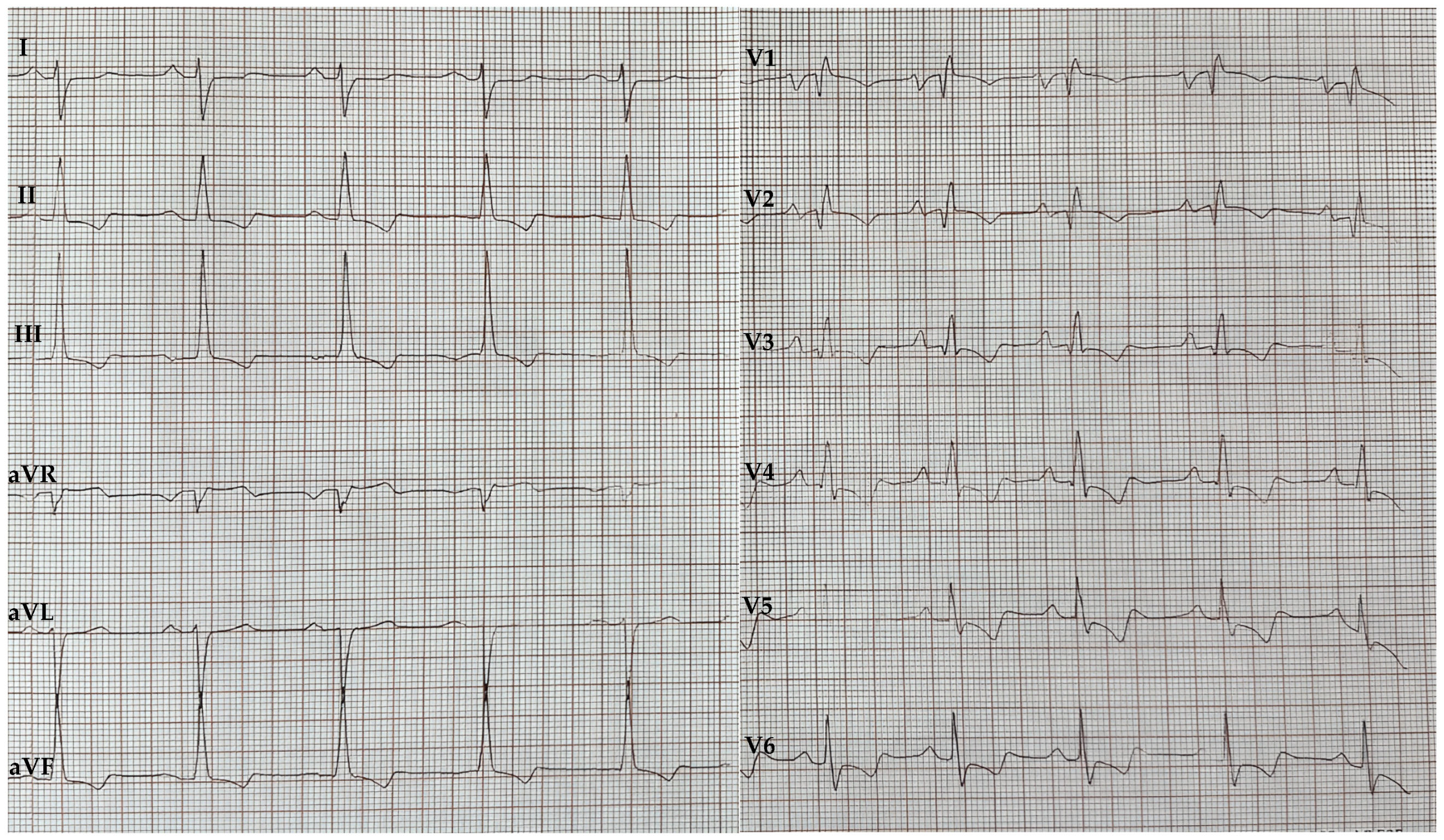
The ECG revealed right axis deviation, incomplete right bundle branch block, negative T waves in leads II, III, aVF, and V1–V5, first-degree atrioventricular block (PR interval, 204 ms), and QT prolongation (QTc, 501 ms) while the patient was on amiodarone 200 mg daily (Figure 1). 24 h Holter monitoring showed persistent first-degree AV block with a maximal PR interval of 240 ms and 1960 premature ventricular contractions (PVCs). ST-segment depression (up to 2 mm) was present in leads I and V4–V6, along with negative T waves in leads II, III, aVF, and V1–V6.
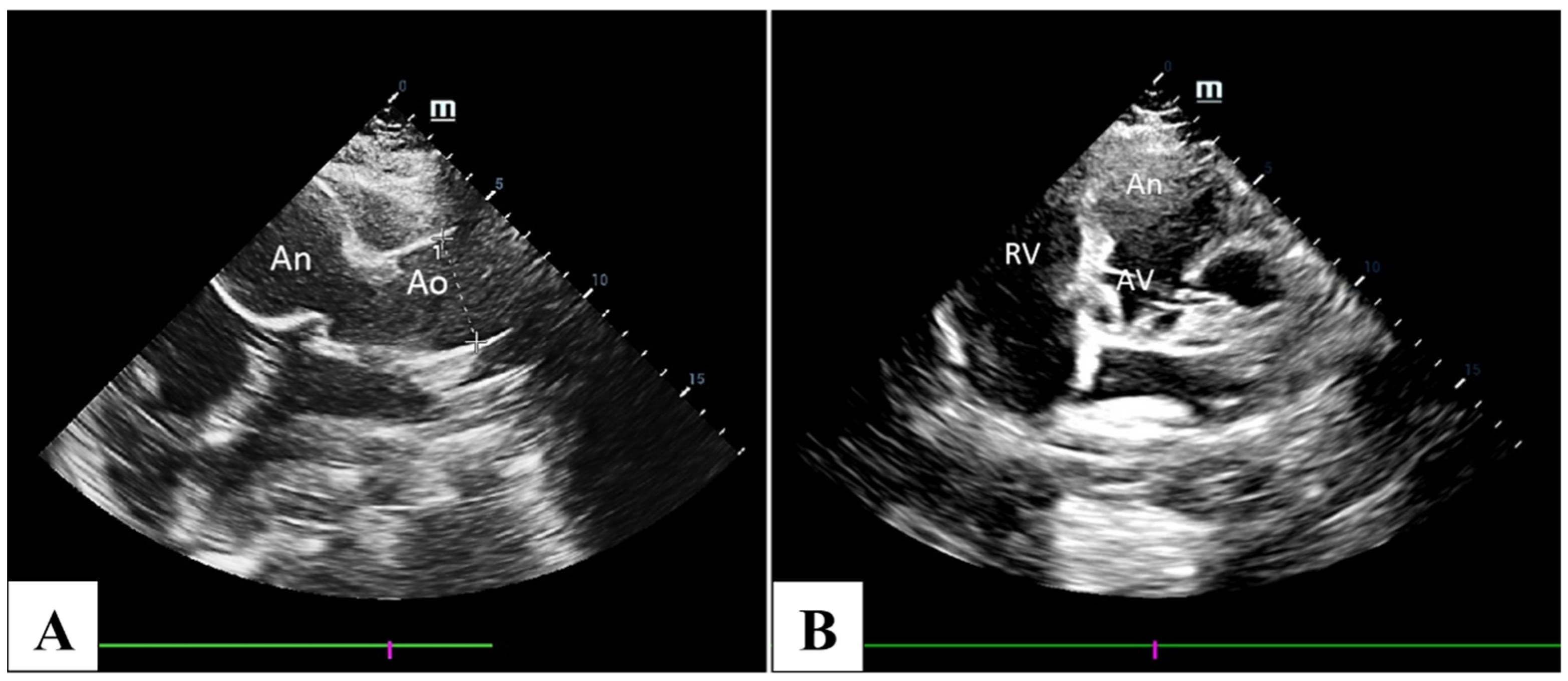
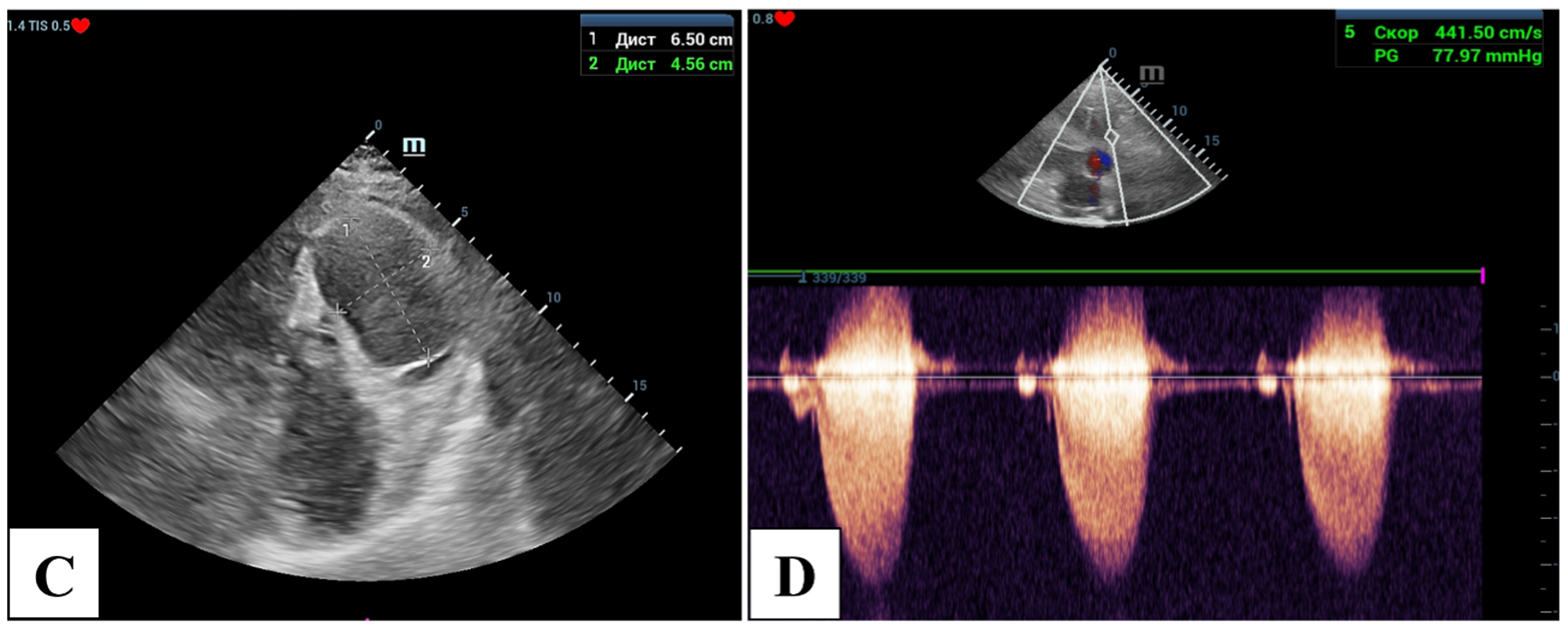
Comprehensive TTE (Figure 2A–D) revealed an aneurysm of the right sinus of Valsalva measuring 6 × 4 cm, causing obstruction of the RVOT with accelerated flow (peak velocity 441 cm/s; peak gradient 77 mmHg). There was marked dilatation of the right heart chambers (right atrial volume 143 mL; right ventricle basal diameter 6 cm) with secondary tricuspid regurgitation (grade 2–3) and reduced RV systolic function (TAPSE 1.2 cm). Moreover, there were signs of pulmonary hypertension (PASP 73 mmHg). Left ventricular systolic function was preserved (LVEF 57%), and diastolic dysfunction was noted. A minimal pericardial effusion was also observed.
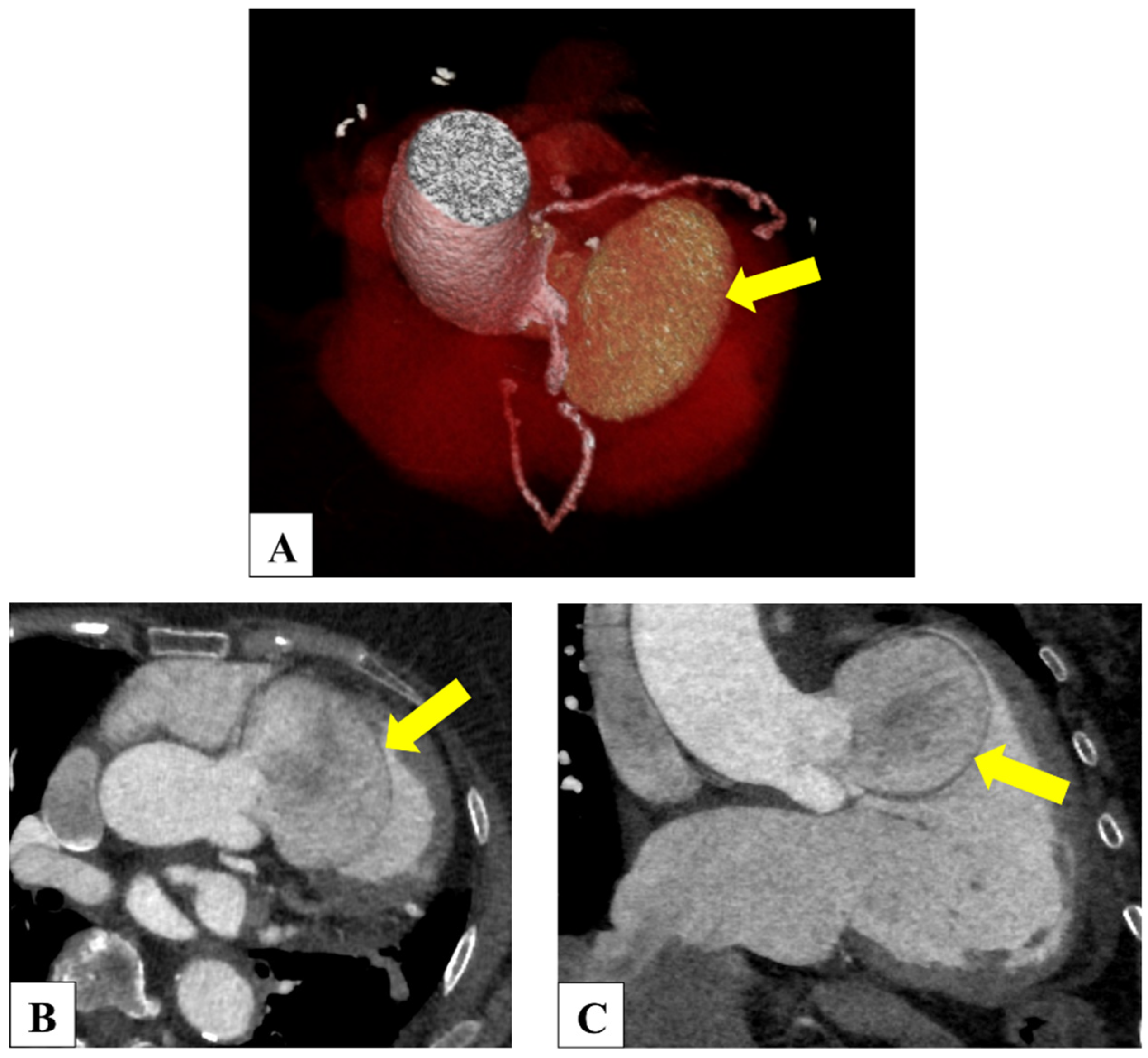
Cardiac CT (Figure 3) revealed no haemodynamically significant coronary artery stenosis. It confirmed a giant aneurysm of the right sinus of Valsalva (70 × 51 × 49 mm; neck 27 mm) with a thin wall, markedly turbulent flow, and no evidence of thrombosis (yellow arrows). The aneurysm caused compression of the RVOT (to 7 mm), the LV outflow tract (to 8 mm), and the left inferior pulmonary vein (to 3 mm). The LV and LA were compressed by the dilated right chambers: LVEDD was 26 mm; the RV was markedly dilated (61 mm) with myocardial hypertrophy; the RA was also dilated (73 × 74 mm). There was also a pericardial effusion of up to 15 mm.
Given the patient’s allergic history and unproductive cough, spirometry with bronchodilator reversibility testing was performed. It revealed mild bronchial obstruction: initial forced expiratory volume in the first second (FEV1) was 75% of predicted, forced vital capacity (FVC) was within normal limits, and the FEV1/FVC ratio was 81%. She showed a positive response to salbutamol 400 mcg, with an increase in FEV1 of 37% (460 mL). Thus, bronchial asthma was confirmed, contributing to the dyspnoea related to heart failure.

2.6. Follow-Up and Treatment

The patient was prescribed an antihypertensive therapy consisting of valsartan (160 mg) and amlodipine (5 mg). She continued antiarrhythmic (amiodarone 200 mg), anticoagulant (apixaban 10 mg), and statin therapy (atorvastatin 20 mg) as well as spironolactone (25 mg). Heart failure therapy was enhanced with dapagliflozin (10 mg) and furosemide (40 mg). For asthma control, she was also prescribed budesonide/formoterol 160/4.5 μg, one inhalation twice daily. The treatment led to significant clinical improvement, with marked reduction in dyspnoea and enhanced overall well-being.
Due to the thinning of the giant right sinus of Valsalva aneurysm wall, indicating a high risk of rupture, compression of both ventricular outflow tracts, and marked right heart chamber dilatation from haemodynamic overload. So, the patient was referred for surgery. She successfully underwent replacement of the right sinus of Valsalva, the ascending aorta, and the hemiarch under cardiopulmonary bypass with preserved distal perfusion. Aortic valve repair included decalcification of the non-coronary cusp, annulus reduction at the NC-RC commissure (El Khoury procedure), central plication of the right coronary cusp, and shaving of the left coronary cusp. Tricuspid annuloplasty (Batista technique), aortic root remodelling (Bahnson technique), radiofrequency ablation of the pulmonary vein ostia, left atrial appendage ligation, and drainage of the right sinus of Valsalva aneurysm cavity were also performed. However, the patient died from pneumonia three months postoperatively.

3. Discussion

Giant SVA is a rare condition for which there is no universally accepted size criterion. The term is generally reserved for aneurysms that substantially exceed average dimensions or pose a high risk of complications. Although SVAs may remain asymptomatic for extended periods, they can develop clinical manifestations, including chest pain, arrhythmias, and syncope, secondary to compression of adjacent structures [11]. Rupture can also precipitate life-threatening conditions, such as ST-segment elevation myocardial infarction and cardiogenic shock, which necessitate emergent surgical intervention [12,13].
A review of the literature (Table 1) confirms that surgical repair is the predominant strategy with favorable outcomes in most cases. Conservative management is rarely selected and is typically reserved for elderly patients. In the present case, severe dyspnoea improved after optimizing heart failure and asthma treatment. However, the high rupture risk and compression of both ventricular outflow tracts and the left inferior pulmonary vein made surgical correction necessary. Despite technical success, the patient died from pneumonia three months postoperatively—an outcome likely caused by chronic pulmonary congestion, preexisting asthma, and postoperative mechanical ventilation.
Accurate imaging modalities play a pivotal role in the diagnosis and verification of SVAs. TTE is the preferred method for primary diagnosis due to its non-invasiveness, wide clinical availability, ability to provide real-time data, and high accuracy in assessing aortic root anatomy and intracardiac haemodynamics. TTE facilitates the timely detection of this pathology and plays a vital role in the early verification of life-threatening complications, primarily when perforation or rupture of the aneurysm is suspected, which is critically important for determining emergency management strategies [24,25]. CT angiography is the most widely used radiological imaging modality for confirming SVAs and planning surgical intervention. The combination of high spatial resolution and sophisticated post-processing algorithms, encompassing multiplanar reformations and 3D reconstructions, facilitates a comprehensive evaluation of the topographic and anatomical relationships between the aneurysmal sac and the surrounding structures, including the ventricular outflow tracts, the aortic valve annulus, and the proximal coronary artery segments. This is of paramount importance for the thorough diagnostic characterisation of the lesion and the subsequent risk stratification [10,26,27].
While cardiac CT provided excellent spatial resolution for the 3D reconstruction in this case, cardiac magnetic resonance imaging (CMR) is increasingly recognized as a complementary modality for assessing SVAs. CMR offers superior tissue characterisation and precise quantification of ventricular volumes and function without radiation exposure. It also provides high-quality, whole-heart imaging that can be integrated into surgical planning platforms [28]. Although CMR was not performed in our patient due to logistical constraints and the urgency of surgical planning, following clinical deterioration, it should be included in the diagnostic algorithm, particularly for younger patients or those with contraindications to iodinated contrast, to refine anatomical assessment and myocardial viability analysis prior to complex aortic root reconstruction.
The present case illustrates the clinical dilemma of timing surgical intervention for unruptured giant SVA. Our patient was initially managed conservatively in 2022 after haemodynamic stabilization. However, progressive dilation of the right heart chambers and clinical deterioration over two years highlight the substantial risk of conservative management in giant SVA with documented outflow tract obstruction.
Surgical intervention is frequently necessary when a SVA significantly enlarges, its wall becomes thin, or complications such as rupture of the aneurysm or compression of adjacent anatomical structures occur. A variety of surgical treatment methods are employed, including aortic root remodelling and sinus of Valsalva reconstruction, using patches to repair the aneurysmal defect [29,30].
Despite considerable progress in the development of surgical techniques and radiological imaging modalities, the issue of early detection of asymptomatic and oligosymptomatic SVAs remains pertinent. Young patients with mesenchymal dysplasia syndrome constitute a high-risk group in which screening and dynamic follow-up are essential [31,32,33]. TTE is an optimal method for primary diagnosis in this patient cohort. It facilitates the timely detection of pathological dilatation of the sinuses of Valsalva and the initiation of preventive therapeutic measures prior to the onset of life-threatening complications, such as rupture or dissection of the aneurysm [34,35].

4. Conclusions

Giant sinus of Valsalva aneurysm is a rare but life-threatening condition requiring a high level of suspicion in patients presenting with symptoms such as unexplained heart failure, dyspnoea, or arrhythmias. This case shows that giant aneurysms can cause severe haemodynamic compromise by compressing the ventricular outflow tracts and pulmonary veins. Multimodal imaging, including TTE and cardiac CT with 3D reconstruction, is essential for accurate diagnosis, anatomical mapping, and surgical planning. In the presented clinical case, despite successful surgical treatment, the patient died of pneumonia three months after the operation. This highlights the importance of comprehensive perioperative care, particularly for elderly patients with preexisting pulmonary congestion and chronic respiratory diseases. Early diagnosis and timely surgical referral, once symptomatic giant SVA is confirmed, are essential for reducing the risk of adverse outcomes.

Author Contributions

Conceptualization: Y.L. and O.B.; methodology: Y.L., V.S., O.P., N.G. and O.B.; data curation: A.N. and V.N.; writing—original draft preparation: Y.L., V.N., O.P. and A.N.; review and editing: O.B. and V.S.; visualization: O.P., N.G., V.N. and V.S.; supervision: Y.L. and O.B. All authors have read and agreed to the published version of the manuscript.

Funding

This research received no external funding.

Institutional Review Board Statement

Ethical review and approval were waived for this study due to its nature as a single-patient case report, which does not require formal ethics committee approval according to local institutional guidelines.

Informed Consent Statement

Written informed consent was obtained from the patient for publication of this case report and any accompanying images.

Data Availability Statement

The data presented in this study are available on request from the corresponding author.

Acknowledgments

The authors wish to thank the patient for the consent to use her case for the scientific and educational purposes of this paper. The authors declare that they employed artificial intelligence tools solely for linguistic assistance in preparing this manuscript. The DeepL service was used to translate selected text segments from Russian to English, and the DeepL Write tool was used to refine the phrasing and enhance the grammatical accuracy of the English text.

Conflicts of Interest

The authors declare no conflicts of interest.

Abbreviations

The following abbreviations are used in this manuscript:
3Dthree-dimensional
Ananeurysm
Aoaorta
AVatrioventricular
bpmbeats per minute
cmcentimeters
CTcomputed tomography
TTEtransthoracic echocardiography
ECGelectrocardiography
eGFRestimated glomerular filtration rate
FEV1forced expiratory volume in the first second
FVCforced vital capacity
INRinternational normalized ratio
LAleft atrium
LVleft ventricle
LVEDDleft ventricular end-diastolic dimension
LVEFleft ventricular ejection fraction
mLmilliliters
mmmillimeters
mmHgmillimeters of mercury
NC-RCnon-coronary—right coronary (commissure)
PASPpulmonary artery systolic pressure
PLAXparasternal long-axis (view)
PSAXparasternal short-axis (view)
PVCspremature ventricular contractions
RAright atrium
RVright ventricle
RVOTright ventricular outflow tract
SVAsinus of Valsalva aneurysm
TAPSEtricuspid annular plane systolic excursion

References

  1. Kumar, V.; Jose, J.; Joseph, G. Rupture of sinus of Valsalva aneurysm into the left ventricle after dissecting through the interventricular septum mimicking aortic regurgitation. Clin. Res. Cardiol. 2016, 105, 560–562. [Google Scholar] [CrossRef] [PubMed]
  2. Nguyen, Q.; Vervoort, D.; Phan, K.; Luc, J.G.Y. Surgical management for unruptured sinus of Valsalva aneurysms: A narrative review of the literature. J. Thorac. Dis. 2021, 13, 1833–1850. [Google Scholar] [CrossRef] [PubMed] [PubMed Central]
  3. Weinreich, M.; Yu, P.J.; Trost, B. Sinus of valsalva aneurysms: Review of the literature and an update on management. Clin. Cardiol. 2015, 38, 185–189. [Google Scholar] [CrossRef] [PubMed] [PubMed Central]
  4. Wingo, M.; de Angelis, P.; Worku, B.M.; Leonard, J.R.; Khan, F.M.; Hameed, I.; Lau, C.; Gaudino, M.; Girardi, L.N. Sinus of Valsalva aneurysm repairs: Operative technique and lessons learned. J. Card. Surg. 2019, 34, 400–403. [Google Scholar] [CrossRef] [PubMed]
  5. Hartlage, G.R.; Consolini, M.A.; Pernetz, M.A.; Williams, B.R., 3rd; Clements, S.D.; Chen, E.P.; Rab, S.T. Bad company: Supracristal VSD presenting with ruptured sinus of valsalva aneurysm. A case presentation with echocardiographic depiction and an analysis of contemporary literature. Echocardiography 2015, 32, 575–583. [Google Scholar] [CrossRef] [PubMed]
  6. Falconieri, F.; Rubens, M.; Petrou, M. Large aneurysm of left coronary sinus of Valsalva presenting with effort-related ventricular fibrillation. Interact. Cardiovasc. Thorac. Surg. 2013, 16, 217–218. [Google Scholar] [CrossRef] [PubMed]
  7. Lee, J.H.; Yang, J.H.; Park, P.W.; Song, J.; Huh, J.; Kang, I.S.; Jun, T.G. Surgical Repair of a Sinus of Valsalva Aneurysm: A 22-Year Single-Center Experience. Thorac. Cardiovasc. Surg. 2021, 69, 26–33. [Google Scholar] [CrossRef] [PubMed]
  8. Mi, J.; Cao, X.; Zhou, J. Hidden behind the mask: Misdiagnosis of a ruptured sinus of Valsalva aneurysm in a young male patient-a case report and review of literature. J. Med. Case Rep. 2025, 19, 163. [Google Scholar] [CrossRef] [PubMed] [PubMed Central]
  9. Vural, K.M.; Sener, E.; Taşdemir, O.; Bayazit, K. Approach to sinus of Valsalva aneurysms: A review of 53 cases. Eur. J. Cardiothorac. Surg. 2001, 20, 71–76. [Google Scholar] [CrossRef] [PubMed]
  10. Jiang, K.; Chen, J.; Zhu, X.; Xiao, H.; Ran, T.; Tang, Y.; Ji, X. Rupture of sinus of Valsalva aneurysm: A case report in a child. BMC Cardiovasc. Disord. 2022, 22, 158. [Google Scholar] [CrossRef]
  11. He, J.; Dong, L.; Ma, X. Myocardial ischemia from giant aneurysm of the sinus of valsalva: A distinct etiology of chest pain in young adults. Acta Cardiol. 2025, 80, 911–912. [Google Scholar] [CrossRef] [PubMed]
  12. Pacholewicz, J.; Żych, A.; Olędzki, S.; Płońska-Gościniak, E. Hematoma of the interatrial septum after surgery for a giant aneurysm of the sinus of Valsalva. Kardiol. Pol. 2024, 82, 109–110. [Google Scholar] [CrossRef] [PubMed]
  13. Suchodolski, A.; Głowacki, J.; Szulik, M. Subtle symptoms, massive lesion in computed tomography: Giant aneurysm of the right sinus of Valsalva. Coron. Artery Dis. 2023, 34, 223–224. [Google Scholar] [CrossRef] [PubMed]
  14. Ozawa, K.; Kuwaki, K.; Furuya, H.; Yamaguchi, M.; Yamamoto, A. Surgical Management of Giant Unruptured Left Sinus of Valsalva Aneurysm with Severe Aortic Regurgitation. Tex. Heart Inst. J. 2023, 50, e238134. [Google Scholar] [CrossRef] [PubMed] [PubMed Central]
  15. Hu, P.; Wan, Z.; Sun, Q.; Teng, P.; Ma, L. Giant unruptured sinus of Valsalva aneurysms causing angina pectoris. J. Cardiothorac. Surg. 2024, 19, 251. [Google Scholar] [CrossRef] [PubMed] [PubMed Central]
  16. Lee, J.; Ushioda, R.; Akamatsu, H.; Kawarabayashi, T.; Inoue, A.; Shimizu, K.; Shirakura, K.; Setogawa, Y.; Okubo, R.; Miyamoto, H.; et al. Bentall procedure for giant unruptured right sinus of Valsalva aneurysm treated. J. Surg. Case Rep. 2026, 2026, rjag038. [Google Scholar] [CrossRef] [PubMed] [PubMed Central]
  17. Ma, L.; Yang, J.; Liu, Y.; Wang, F.; Liu, T.; Wang, Y.; Sun, H.; Zhang, C.; Zhang, Y. Case report: Acute ST-elevation myocardial infarction and cardiogenic shock caused by a giant right sinus of Valsalva aneurysm and right coronary artery compression. Front. Cardiovasc. Med. 2022, 9, 1013044. [Google Scholar] [CrossRef] [PubMed] [PubMed Central]
  18. Ferreira, A.C.; de Marchena, E.; Mayor, M.; Bolooki, H. Sinus of Valsalva aneurysm presenting as myocardial infarction during dobutamine stress test. Cathet. Cardiovasc. Diagn. 1996, 39, 400–402. [Google Scholar] [CrossRef] [PubMed]
  19. Thomas, V.V.; Thomas, J.M.; Iyadurai, R. Cardioembolic Stroke in Sinus of Valsalva Aneurysm, A Case Report. Neurol. India 2023, 71, 998–1001. [Google Scholar] [CrossRef] [PubMed]
  20. Mekhryakov, S.A.; Kulesh, A.A.; Syromyatnikova, L.I.; Krapivin, S. Ischemic stroke on the background of thrombosis of sinus of Valsalva aneurysm. Russ. Neurol. J. 2025, 30, 49–52. (In Russian) [Google Scholar] [CrossRef]
  21. Presidiana, B.; Ratri, A.K.; Ramli, R.; Andrianto; Hakim, A.R. Retractable congestive heart failure due to sinus valsalva rupture with coexisting gerbode defect: A rare case report. J. Pak. Med. Assoc. 2024, 74, S65–S68. [Google Scholar] [CrossRef] [PubMed]
  22. Wi, J.H.; Seo, J.S. Surgery following Extracorporeal Cardiopulmonary Resuscitation in a Patient with an Extracardiac Rupture of Valsalva Sinus Aneurysm. Heart Surg. Forum 2019, 22, E287–E288. [Google Scholar] [CrossRef] [PubMed]
  23. Dong, W.; Li, Y.; Li, W. Giant aneurysm of the sinus of Valsalva with pulmonary embolism: A case report. Asian J. Surg. 2024. Epub ahead of print. [Google Scholar] [CrossRef] [PubMed]
  24. Zanganehfar, M.E.; Shahandashti, F.J.; Shriati, A.; Tayebi, A.; Saedi, S. A giant aneurysm of sinus of Valsalva presenting with frequent syncopal attacks. Asian Cardiovasc. Thorac. Ann. 2022, 30, 1023–1024. [Google Scholar] [CrossRef] [PubMed]
  25. Liu, X.P.; Wang, H.J.; Gao, J.L.; Ma, G.L.; Xu, X.Y.; Ji, L.N.; He, R.X.; Qi, B.Y.; Wang, L.C.; Li, C.Q.; et al. Secondary coronary artery ostial lesions: Three case reports. World J. Clin. Cases 2022, 10, 7045–7053. [Google Scholar] [CrossRef] [PubMed] [PubMed Central]
  26. Agwar, F.D.; Gemechu, T.W.; Tadesse, K.D.; Degu, W.A. Left Ventricular Giant Aneurysm Caused by Congenital Syphilis Causing Severe Outflow Tract Obstruction. Ann. Thorac. Surg. 2023, 115, e1–e3. [Google Scholar] [CrossRef] [PubMed]
  27. Upchurch, G.R., Jr.; Escobar, G.A.; Azizzadeh, A.; Beck, A.W.; Conrad, M.F.; Matsumura, J.S.; Murad, M.H.; Perry, R.J.; Singh, M.J.; Veeraswamy, R.K.; et al. Society for Vascular Surgery clinical practice guidelines of thoracic endovascular aortic repair for descending thoracic aortic aneurysms. J. Vasc. Surg. 2021, 73, 55S–83S. [Google Scholar] [CrossRef] [PubMed]
  28. Xu, B.; Kocyigit, D.; Betancor, J.; Tan, C.; Rodriguez, E.R.; Schoenhagen, P.; Flamm, S.D.; Rodriguez, L.L.; Svensson, L.G.; Griffin, B.P. Sinus of Valsalva Aneurysms: A State-of-the-Art Imaging Review. J. Am. Soc. Echocardiogr. 2020, 33, 295–312. [Google Scholar] [CrossRef] [PubMed]
  29. Murayama, D.; Ohtsu, Y.; Tsunemoto, H. Giant Aneurysm of Sinus of Valsalva; Report of a Case. Kyobu Geka 2019, 72, 935–938. (In Japanese) [Google Scholar] [PubMed]
  30. Ugurlucan, M.; Yildiz, Y.; Guler, E.; Ulukan, M.O.; Oztas, D.M.; Ata, E.C.; Kahraman, A.; Erkanli, K.; Turkoglu, H. Giant Aneurysm of The Non-Coronary Sinus of Valsalva. Braz. J. Cardiovasc. Surg. 2020, 35, 589–592. [Google Scholar] [CrossRef] [PubMed] [PubMed Central]
  31. Zughaib, M.T.; Patel, K.; Assaf, A.D.; Zughaib, M.E. Incidental Finding of an Aneurysm of the Sinus of Valsalva in a Young Woman: A Management Dilemma. Cureus 2026, 18, e102199. [Google Scholar] [CrossRef] [PubMed]
  32. Tinkle, B.T.; Author, P.C.; Burke, L.W.; THE COUNCIL ON GENETICS. Health Supervision for Children and Adolescents with Marfan Syndrome. Pediatrics 2023, 151, e2023061450. [Google Scholar] [CrossRef]
  33. De Luca, C.; Di Daniele, A.; Marziali, S.; Picone, S.; Salvatore, M.; Folino, G.; Fortugno, P.; De Paulis, R.; Brancati, F. Sinus of Valsalva Aneurysm Is a Major Feature of FLNA (Filamin A) Loss-of-Function Variants. JACC Case Rep. 2025, 30, 103022. [Google Scholar] [CrossRef] [PubMed]
  34. Miura, Y.; Koakutsu, T.; Kawaguchi, S.; Miyano, Y.; Goto, S.; Terai, Y.; Nakai, M.; Mitsuoka, H.; Yamazaki, F. Aortic Valve-preserving Root Remodeling in a Patient with Bicuspid Aortic Valve and Severe Annulo-aortic Ectasia. Kyobu Geka 2019, 72, 422–426. (In Japanese) [Google Scholar] [PubMed]
  35. Wierda, E.; Koolbergen, D.R.; de Mol, B.A.J.M.; Bouma, B.J. Rupture of a giant aneurysm of the sinus of Valsalva leading to acute heart failure: A case report demonstrating the excellence of echocardiography. Eur. Heart J. Case Rep. 2018, 2, yty090. [Google Scholar] [CrossRef] [PubMed] [PubMed Central]
Figure 1. ECG of patient B. Paper speed 25 mm/sec, heart rate 66 beats per minute. More details can be found in the text.
Jcm 15 04956 g001
Figure 2. Aneurysm of the right coronary sinus (An). Ao—aorta; RV—right ventricle; AV—aortic valve. (A) Parasternal window PLAX view. (B) Parasternal window PSAX view. (C) Expansion of the right coronary sinus 6.0 × 4.0 cm. (D) Accelerated blood flow with a diameter of 7 mm and Vmax 441 cm/s, Pmax 77 mm Hg in the outflow tract of the right ventricle.
Jcm 15 04956 g002aJcm 15 04956 g002b
Figure 3. Cardiac CT, (A) 3D reconstruction; (B) axial plane, soft-tissue window; (C) coronal reconstruction, soft-tissue window. Yellow arrows shows giant aneurysm of the right sinus of Valsalva. Description in the text.
Jcm 15 04956 g003
Table 1. Clinical cases of giant sinus of Valsalva aneurysms.
Author, Year of PublicationAneurysm Location, SizePatient Age, SexClinical FeaturesTreatmentOutcome
Ozawa K et al., 2023 [14]Left coronary sinus, 77 mm49, womanSevere aortic regurgitation Surgical treatment Favorable
Hu P et al., 2024
[15]
Left coronary sinus (64 × 45 mm) + noncoronary sinus (28 × 18 mm) 64, woman Dyspnoea on exertion, angina pectoris Surgical treatment Favorable
Lee J et al. 2026
[16]
Right coronary sinus, 25 mm72, womanSevere aortic regurgitation Surgical treatment Favorable
Ma L et al., 2022
[17]
Right coronary sinus (65 × 70 mm)51, manRupture of a giant SVAEmergent surgical treatmentAdverse, cause of death—ventricular tachycardia.
Ferreira AC et al., 1996
[18]
Left coronary sinus (8 × 20 mm)50, womanMyocardial infarction during stress testing due to compression of the circumflex coronary artery Surgical treatment Favorable
Thomas VV et al., 2023
[19]
Left coronary sinus,
Size not reported
73, manCardioembolic stroke due to thrombosis of the aneurysm cavity Surgical treatment Favorable
Mekhryakov S.A. et al., 2025
[20]
Noncoronary sinus, Size not reported19, manIschemic stroke, thrombectomy of the right middle cerebral artery. During the diagnostic workup, a thrombosed aneurysm of the noncoronary SVA was identified Conservative Management + Surgical treatment Favorable
Presidiana B. et al. 2024
[21]
Right coronary sinus, Size not reported33, womanSevere heart failure due to rupture of an aneurysm of the right SVA and an associated Gerbode defect Surgical treatment Favorable
Wi JH et al., 2019
[22]
Noncoronary sinus (up to 70 mm)52, manSudden chest pain, dizziness Surgical treatment Favorable
Dong W. et al., 2024
[23]
Sinus of Valsalva, not otherwise specified (diameter 103 mm)89, manDyspnoea on exertion; Severe pulmonary hypertension;
CT: bilateral multiple pulmonary artery thromboembolism in combination with a sinus of Valsalva aneurysm
Conservative Management Favorable
Disclaimer/Publisher’s Note: The statements, opinions and data contained in all publications are solely those of the individual author(s) and contributor(s) and not of MDPI and/or the editor(s). MDPI and/or the editor(s) disclaim responsibility for any injury to people or property resulting from any ideas, methods, instructions or products referred to in the content.