Safety and Efficacy of Contrast Media Administration via Selected Vascular Access Devices in Computed Tomography

 ,
,  ,
,  and
and 
Abstract
1. Introduction
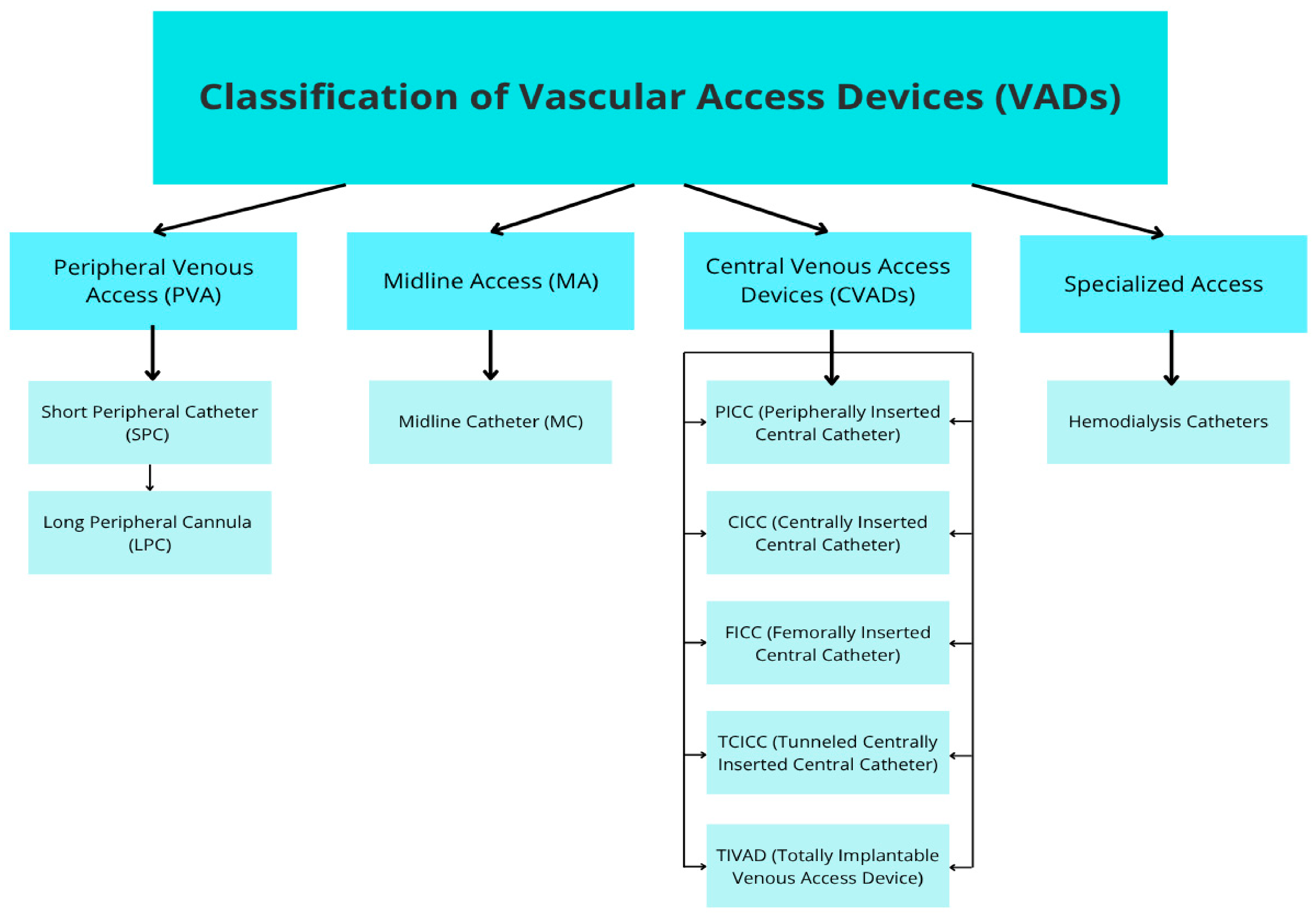
1.1. Background
1.2. Aim
- Q1: How do the caliber and specific design features of peripheral intravenous cannulas (e.g., diffuser technology) influence flow performance and the frequency of high-pressure alarms during automated contrast delivery?
- Q2: What is the clinical safety profile of utilizing central venous catheters (CVCs) and vascular ports for high-pressure contrast media injection, specifically regarding device integrity and patency?
- Q3: What are the primary clinical and procedural risk factors associated with contrast medium extravasation, and which protective factors or protocols are most effective in mitigating this complication?
2. Materials and Methods
2.1. Study Design and Guidelines
2.2. Search Strategy and Screening Process
2.3. Data Extraction
2.4. Data Synthesis
2.5. Quality Assessment
3. Results
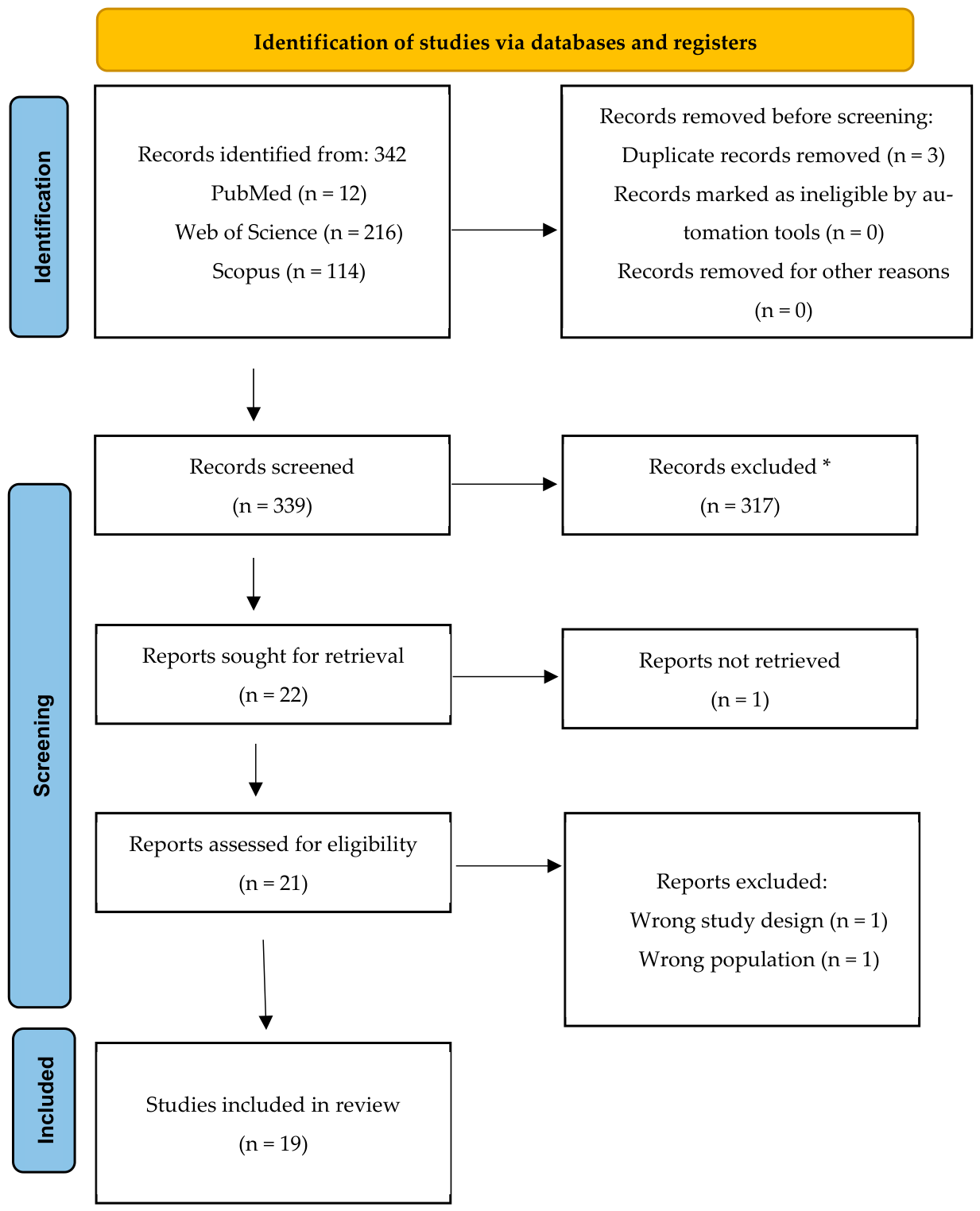
3.1. Study Selection
3.2. Characteristics of the Included Studies
3.3. Flow Performance in Relation to Peripheral Cannula Caliber and Design
3.4. Safety Profiles of Central Venous Catheters (CVCs) and Vascular Ports
3.5. Risk Factors and Extravasation Prevention
4. Discussion
4.1. Summary of Main Findings
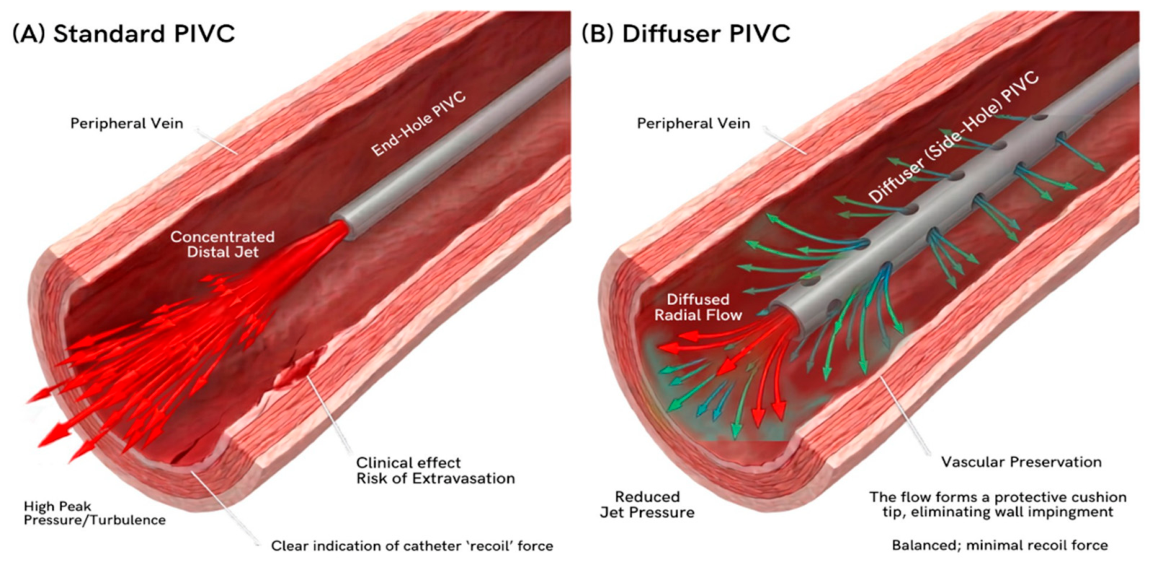
4.2. Flow Performance in Relation to Peripheral Cannula Caliber and Design
4.3. Safety Profile of Central Venous Catheters (CVCs) and Vascular Ports
4.4. Risk of Extravasation and Protective Factors
5. Study Limitations and Methodological Heterogeneity
6. Conclusions and Directions for Future Research
7. Implications for Practice
- Individualized Assessment: The choice of vascular access should be based on an individual evaluation of the patient’s venous status, rather than historical standard routines.
- Consideration of Newer Designs: When using peripheral access, the implementation of fenestrated or diffuser-type cannulas may be considered as a means to potentially reduce local vascular pressure and contrast extravasation risks.
- Verification of Central Device Ratings: Prior to utilizing central venous lines or totally implantable ports, verifying the manufacturer’s pressure and flow rate specifications is essential to support mechanical safety.
- Protocol Adherence: For non-power-injectable central lines, adhering strictly to modified pressure-gated protocols (e.g., reducing pressure limits and flow rates) represents an important safety measure when peripheral access is unavailable.
8. Key Recommendations for Clinical Practice Include
- Revision of Peripheral Cannula Selection Criteria
- Standardization of Vascular Port and Central Venous Catheter Management
- -
- The use of totally implantable venous access ports (TIVAPs) and central venous catheters (CVCs) for automated power injections necessitates the strict implementation of rigorous verification protocols. The imaging team must:
- -
- Always confirm (based on patient records, implant cards, or radiopaque markers) that the specific port and catheter are certified as power-injectable.
- -
- Exclusively use dedicated, power-injectable Huber needles (in the case of ports).
- -
- Consistently assess system patency prior to connecting the automated injector by performing blood aspiration and dynamic flushing with 0.9% NaCl, which rules out mechanical catheter occlusion.
- Optimization of Automated Injector Settings
- Standardization of Medical Staff Training
- Early Response Protocol for Extravasation
Supplementary Materials
Author Contributions
Funding
Institutional Review Board Statement
Data Availability Statement
Acknowledgments
Conflicts of Interest
References
- Buijs, S.B.; Barentsz, M.W.; Smits, M.L.J.; Gratama, J.W.C.; Spronk, P.E. Systematic review of the safety and efficacy of contrast injection via venous catheters for contrast-enhanced computed tomography. Eur. J. Radiol. Open 2017, 4, 118–122. [Google Scholar] [CrossRef] [PubMed]
- Sanelli, P.C.; Deshmukh, M.; Ougorets, I.; Caiati, R.; Heier, L.A. Safety and feasibility of using a central venous catheter for rapid contrast injection rates. AJR Am. J. Roentgenol. 2004, 183, 1829–1834. [Google Scholar] [CrossRef] [PubMed]
- Sinan, T.; Al-Khawari, H.; Chishti, F.A.; Al Saeed, O.M.; Sheikh, M. Contrast media extravasation: Manual versus power injector. Med. Princ. Pract. 2005, 14, 107–110. [Google Scholar] [CrossRef] [PubMed]
- Basharat, N.F.; Ranganathan, K.; Kang, P.T.; Gridley, D.G.; Roh, A.T. Effect of extrinsic warming of low-osmolality CT contrast media (Iohexol 350) on extravasations and patient reaction rates: A retrospective study. AJR Am. J. Roentgenol. 2022, 218, 174–179. [Google Scholar] [CrossRef] [PubMed]
- Papatheodorou, N.; Keskinis, A.; Georgoulas, P.; Tilkeridis, K.; Botaitis, S.; Perente, S.; Kougioumtzi, I. Hand compartment syndrome due to extravasation of contrast medium. A technical error. A report of a case and review of the literature. J. Surg. Case Rep. 2022, 2022, rjac054. [Google Scholar] [CrossRef] [PubMed]
- van Rens, M.; van der Lee, R.; Spencer, T.R.; van Boxtel, T.; Barone, G.; Crocoli, A.; Pinelli, F.; Pittiruti, M. The NAVIGATE project: A GloVANet–WoCoVA position statement on the nomenclature for vascular access devices. J. Vasc. Access 2025, 26, 1439–1446. [Google Scholar] [CrossRef] [PubMed]
- Page, M.J.; McKenzie, J.E.; Bossuyt, P.M.; Boutron, I.; Hoffmann, T.C.; Mulrow, C.D.; Shamseer, L.; Tetzlaff, J.M.; Akl, E.A.; Brennan, S.E.; et al. The PRISMA 2020 statement: An updated guideline for reporting systematic reviews. BMJ 2021, 372, n71. [Google Scholar] [CrossRef] [PubMed]
- Ding, S.; Meystre, N.R.; Campeanu, C.; Gullo, G. Contrast media extravasations in patients undergoing computerized tomography scanning: A systematic review and meta-analysis of risk factors and interventions. JBI Database Syst. Rev. Implement. Rep. 2018, 16, 87–116. [Google Scholar] [CrossRef] [PubMed]
- Behzadi, A.H.; Farooq, Z.; Newhouse, J.H.; Prince, M.R. MRI and CT contrast media extravasation: A systematic review. Medicine 2018, 97, e0046. [Google Scholar] [CrossRef] [PubMed]
- Joanna Briggs Institute. JBI Critical Appraisal Checklist for Randomized Controlled Trials; Joanna Briggs Institute: Adelaide, Australia, 2020. [Google Scholar]
- Herts, B.R.; O’Malley, C.M.; Wirth, S.L.; Lieber, M.L.; Pohlman, B. Power injection of contrast media using central venous catheters: Feasibility, safety, and efficacy. AJR Am. J. Roentgenol. 2001, 176, 447–453. [Google Scholar] [PubMed]
- Johnson, P.T.; Christensen, G.M.; Fishman, E.K. IV contrast administration with dual source 128-MDCT: A randomized controlled study comparing 18-gauge nonfenestrated and 20-gauge fenestrated catheters for catheter placement success, infusion rate, image quality, and complications. AJR Am. J. Roentgenol. 2014, 202, 1166–1170. [Google Scholar] [CrossRef] [PubMed]
- Tamura, A.; Kato, K.; Kamata, M.; Suzuki, T.; Suzuki, M.; Nakayama, M.; Tomabechi, M.; Nakasato, T.; Ehara, S. Selection of peripheral intravenous catheters with 24-gauge side-holes versus those with 22-gauge end-hole for MDCT: A prospective randomized study. Eur. J. Radiol. 2017, 87, 8–12. [Google Scholar] [PubMed]
- Kim, J.J.; Kim, E.J.; Hur, J.H.; Ham, J.O.; Kim, Y.K.; Choi, S.I. The usefulness of fenestrated intravenous catheters compared with nonfenestrated catheter for cardiac multidetector computed tomography. J. Comput. Assist. Tomogr. 2019, 43, 439–443. [Google Scholar] [CrossRef] [PubMed]
- Gavin, N.C.; Wignall, E.; Marsh, N.; Marquart, L.; Dobeli, K.L.; O’Brien, C.; Verderosa, A.D.; Totsika, M.; Keogh, S. Perforated intravenous catheter design is acceptable for the administration of contrast-enhanced computed tomography administration in cancer patients: Results of a pilot randomised controlled trial. J. Vasc. Access. 2024, 25, 1519–1527. [Google Scholar] [CrossRef] [PubMed]
- Joanna Briggs Institute. JBI Critical Appraisal Checklist for Cohort Studies; Joanna Briggs Institute: Adelaide, Australia, 2017. [Google Scholar]
- Plumhans, C.; Ocklenburg, C.; Verburg, F.A.; Günther, R.W.; Behrendt, F.F. High pressure versus standard port system: Comparison of implantation and complications. J. Med. Imaging Radiat. Oncol. 2012, 56, 532–537. [Google Scholar] [CrossRef] [PubMed]
- Washio, H.; Kashimoto, K.; Sakashita, N.; Ohira, S.; Tanaka, J.; Maeda, N.; Shimada, M.; Kawamata, M.; Yoneda, A.; Nakanishi, K. Practical use of the central venous access port for contrast-enhanced CT: Comparison with peripheral intravenous access regarding enhancement and safety. Clin. Radiol. 2024, 79, 213–220. [Google Scholar] [CrossRef] [PubMed]
- Goltz, J.P.; Noack, C.; Petritsch, B.; Kirchner, J.; Hahn, D.; Kickuth, R. Totally implantable venous power ports of the forearm and the chest: Initial clinical experience with port devices approved for high-pressure injections. Br. J. Radiol. 2012, 85, e966–e972. [Google Scholar] [CrossRef] [PubMed]
- Goltz, J.P.; Machann, W.; Noack, C.; Hahn, D.; Kickuth, R. Feasibility of power contrast injections and bolus triggering during CT scans in oncologic patients with totally implantable venous access ports of the forearm. Acta Radiol. 2011, 52, 41–47. [Google Scholar] [CrossRef] [PubMed]
- Kingston, R.J.; Young, N.; Sindhusake, D.P.; Truong, M. Study of patients with intravenous contrast extravasation on CT studies, with radiology staff and ward staff cannulations. J. Med. Imaging Radiat. Oncol. 2012, 56, 163–167. [Google Scholar] [CrossRef] [PubMed]
- Joanna Briggs Institute. JBI Critical Appraisal Checklist for Systematic Reviews and Research Syntheses; Joanna Briggs Institute: Adelaide, Australia, 2017. [Google Scholar]
- Joanna Briggs Institute. JBI Critical Appraisal Checklist for Case Series; Joanna Briggs Institute: Adelaide, Australia, 2017. [Google Scholar]
- Son, R.S.; Song, Y.G.; Jo, J.; Park, B.H.; Jung, G.S.; Yun, J.H. Power contrast injections through a totally implantable venous power port: A retrospective multicenter study. Phlebology 2020, 35, 268–272. [Google Scholar] [CrossRef] [PubMed]
- Sosa Lozano, L.A.; Marn, C.; Goodman, L.R. Power injectable peripherally inserted central venous catheter lines frequently flip after power injection of contrast. J. Comput. Assist. Tomogr. 2012, 36, 427–430. [Google Scholar] [CrossRef] [PubMed]
- Teichgräber, U.K.; Nagel, S.N.; Kausche, S.; Enzweiler, C. Clinical benefit of power-injectable port systems: A prospective observational study. Eur. J. Radiol. 2012, 81, 528–533. [Google Scholar] [CrossRef] [PubMed]
- Johnson, P.T.; Christensen, G.; Lai, H.; Eng, J.; Fishman, E.K. Catheter insertion for intravenous (IV) contrast infusion in multidetector-row computed tomography (MDCT): Defining how catheter caliber selection affects procedure of catheter insertion, IV contrast infusion rate, complication rate, and MDCT image quality. J. Comput. Assist. Tomogr. 2014, 38, 281–284. [Google Scholar] [CrossRef] [PubMed]
- Joanna Briggs Institute. JBI Critical Appraisal Tools—Checklist for Quasi-Experimental Studies; Joanna Briggs Institute: Adelaide, Australia, 2020. [Google Scholar]
- Son, B.G.; Kim, M.J.; Park, M.H.; Kim, K.; Kim, J.; Kim, S.Y.; Lee, K.J.; Choi, S.H.; Kim, A.Y.; Park, S.H. Two Small Intravenous Catheters for High-Rate Contrast Medium Injection for Computed Tomography in Patients Lacking Superficial Veins to Accommodate a Large Catheter. Korean J. Radiol. 2018, 19, 489–497. [Google Scholar] [CrossRef] [PubMed]
- Laukamp, K.R.; Zopfs, D.; Wagner, A.; Lennartz, S.; Pennig, L.; Borggrefe, J.; Ramaiya, N.; Hokamp, N.G. CT artifacts from port systems: Virtual monoenergetic reconstructions from spectral-detector CT reduce artifacts and improve depiction of surrounding tissue. Eur. J. Radiol. 2019, 121, 108733. [Google Scholar] [CrossRef] [PubMed]
- Martin, O.; Boos, J.; Aissa, J.; Vay, C.; Heusch, P.; Gaspers, S.; Antke, C.; Sedlmair, M.; Antoch, G.; Schaarschmidt, B.M. Impact of different iterative metal artifact reduction (iMAR) algorithms on PET/CT attenuation correction after port implementation. Eur. J. Radiol. 2020, 129, 109065. [Google Scholar] [CrossRef] [PubMed]
- Powers, M.L.E.; Lublin, D.; Eby, C.; Leitman, S.F.; Dynis, M.; Despotis, G.J. Safety concerns related to use of unapproved needles for accessing implantable venous access devices. Transfusion 2009, 49, 2008–2009. [Google Scholar] [CrossRef] [PubMed]
- Plumb, A.A.O.; Murphy, G. The use of central venous catheters for intravenous contrast injection for CT examinations. Br. J. Radiol. 2011, 84, 197–203. [Google Scholar] [CrossRef] [PubMed]
- Wienbeck, S.; Fischbach, R.; Kloska, S.P.; Seidensticker, P.; Osada, N.; Heindel, W.; Juergens, K.U. Prospective Study of Access Site Complications of Automated Contrast Injection with Peripheral Venous Access in MDCT. AJR Am. J. Roentgenol. 2010, 195, 825–829. [Google Scholar] [CrossRef] [PubMed]



| Databases | Search Strategy |
|---|---|
| PubMed | (“contrast media”[MeSH Terms] OR “contrast media”[TiAb] OR “power injection”[TiAb]) AND (“vascular access devices”[MeSH Terms] OR “catheters”[MeSH Terms] OR “peripheral intravenous catheter”[TiAb] OR “midline”[TiAb] OR “PICC”[TiAb] OR “central venous catheter”[TiAb] OR “implantable port”[TiAb] OR “diffuser”[TiAb]) AND (“safety”[TiAb] OR “extravasation”[TiAb] OR “complications”[TiAb] OR “pressure alarm”[TiAb] OR “catheter displacement”[TiAb] OR “catheter rupture”[TiAb]) Limit: Filters applied: Year 2000–2026, Polish and English Language, article types (Randomized Controlled Trial, Clinical Controlled Trial, Review, and Systematic Review), text availability (Full text), and age group (Adult: 19+ years) Results: 12 |
| Web of Science | TS = ((“contrast media” OR “contrast agent” OR “power injection”) AND (“vascular access” OR catheter* OR cannula* OR midline OR PICC OR port*) AND (safety OR extravasation OR complication* OR “high pressure” OR rupture)) Limit: Filters applied: Year 2000–2026, Polish and English Language Results: 216 |
| Scopus | TITLE-ABS-KEY ((“contrast media” OR “contrast agent” OR “power inject*”) AND (“vascular access” OR catheter* OR cannula* OR midline OR PICC OR port) AND (“computed tomography” OR ct OR angiography) AND (“pressure alarm*” OR “flow rate” OR “pressure limit” OR fenestrated OR diffuser OR extravasation)) Limit: Filters applied: Year 2000–2026, Polish and English Language Results: 114 |
| Inclusion Criteria | |
|---|---|
| Population (P) | Adult patients (inpatients and outpatients) requiring a computed tomography (CT) examination with the use of an intravenous contrast medium. |
| Intervention (I) | Automated high-pressure infusion of contrast medium (utilizing an automated power injector). Administration of the medium as a continuous bolus at high flow rates for diagnostic purposes (CT angiography, multiphase imaging). |
| Comparison (C) | Comparison of various types of vascular access devices (VADs):
|
| Outcome (O) | Safety and efficacy of infusion:
|
| Inclusion Criteria | Exclusion Criteria | |
|---|---|---|
| Publication type | Primary studies (prospective, retrospective, observational), RCTs, systematic reviews, and meta-analyses. | Case reports, letters to the editor, editorials, and conference abstracts. |
| Population | Adult patients undergoing CT examinations (angiography, multiphase imaging). | Studies on animal models or phantoms. |
| Intervention | Administration of contrast medium using an automated power injector (high-pressure). | Exclusively manual contrast administration (with the exception of comparison groups). |
| Type of access | Peripheral cannulas (standard and diffuser types), PICCs, Midline catheters, CVCs, and vascular ports (power-injectable). | Vascular access devices lacking high-pressure certification (unless this is the subject of the complication analysis). |
| Outcomes | Extravasations, high-pressure alarms, catheter displacement or damage, line patency. | Allergic reactions, contrast-induced nephropathy (unrelated to the vascular access placement technique). |
| Databases | PubMed, CINAHL, Web of Science, Scopus | Other databases, Gray literature, |
| Language | Polish and English | Publications in languages other than Polish or English. |
| Timeframe | Publications from 2000 to 2026. | Published before the year 2000. |
| Author, Year | Q1 | Q2 | Q3 | Q4 | Q5 | Q6 | Q7 | Q8 | Q9 | Q10 | Q11 | Q12 | Q13 | Total |
|---|---|---|---|---|---|---|---|---|---|---|---|---|---|---|
| Herts et al., 2001 [11] | Y | U | Y | N | N | Y | Y | U | N | Y | Y | Y | Y | 8/13 |
| Johnson et al. (2014) [12] | Y | Y | Y | N | N | Y | Y | Y | Y | Y | Y | Y | Y | 11/13 |
| Tamuta et al. 2017 [13] | U | N | Y | N | N | U | Y | Y | Y | Y | Y | Y | Y | 8/13 |
| Kim et al. 2019 [14] | Y | U | Y | N | N | Y | Y | Y | Y | Y | Y | Y | Y | 10/13 |
| Gavina et al. (2024) [15] | Y | Y | Y | N | N | Y | Y | Y | Y | Y | Y | Y | Y | 11/13 |
| Author, Year | Q1 | Q2 | Q3 | Q4 | Q5 | Q6 | Q7 | Q8 | Q9 | Q10 | Q11 | Total |
|---|---|---|---|---|---|---|---|---|---|---|---|---|
| Plumhans et al. (2012) [17] | Y | Y | Y | Y | Y | Y | Y | Y | U | U | Y | 9/11 |
| Washio et al. 2024 [18] | Y | Y | Y | Y | Y | Y | Y | Y | Y | U | Y | 10/11 |
| Goltz et al. 2012 [19] | Y | Y | Y | N | N | Y | Y | Y | Y | U | Y | 8/11 |
| Goltz et al. 2011 [20] | U | Y | Y | N | Y | Y | Y | Y | Y | U | Y | 8/11 |
| Kingston et al. 2012 [21] | Y | Y | Y | U | N | Y | Y | Y | Y | N | Y | 8/11 |
| Author, Year | Q1 | Q2 | Q3 | Q4 | Q5 | Q6 | Q7 | Q8 | Q9 | Q10 | Q11 | Total |
|---|---|---|---|---|---|---|---|---|---|---|---|---|
| Buijs et al. (2017) [1] | Y | Y | Y | N | Y | Y | Y | Y | N | Y | Y | 9/11 |
| Ding et al. (2018) [8] | Y | Y | Y | Y | Y | Y | Y | Y | U | Y | Y | 10/11 |
| Behzadi et al., 2018 [9] | Y | Y | Y | Y | Y | Y | Y | Y | U | Y | U | 9/11 |
| Author, Year | Q1 | Q2 | Q3 | Q4 | Q5 | Q6 | Q7 | Q8 | Q9 | Q10 | Total |
|---|---|---|---|---|---|---|---|---|---|---|---|
| Son et al. 2020 [24] | Y | Y | Y | Y | Y | Y | Y | Y | N | Y | 9/10 |
| Sosa Lozano et al., 2012 [25] | Y | Y | Y | Y | Y | Y | Y | Y | U | Y | 9/10 |
| Sanelli et al. 2004 [2] | Y | Y | Y | Y | Y | Y | Y | Y | U | Y | 9/10 |
| Teichgräber et al. 2012 [26] | Y | Y | Y | Y | Y | Y | Y | Y | U | Y | 9/10 |
| Johnson et al., 2014 [27] | Y | Y | Y | Y | Y | Y | Y | Y | Y | Y | 10/10 |
| Author, Year | Q1 | Q2 | Q3 | Q4 | Q5 | Q6 | Q7 | Q8 | Q9 | Total |
|---|---|---|---|---|---|---|---|---|---|---|
| Son et al. (2018) [29] | Y | N | Y | N | Y | Y | Y | Y | Y | 7/9 |
| First Author, Year | Study Design | Study Group (n) | Country | VAD Type | Size (G/Fr) | Injection Rate (mL/s) | Injection Pressure | Outcomes |
|---|---|---|---|---|---|---|---|---|
| Buijs S.B. et al., 2017 [1] | Systematic Review | n = 7 studies included (Totaling over 1000+ contrast injections via CVCs) | The Netherlands | Central Venous Catheters (CVCs) | Various (Standard clinical CVC sizes used in the included studies) | 1.5–3.3 mL/s | Limits: 50–190 psi | No catheter ruptures reported across all 7 studies. Catheter dislocation rate: 2.2–15.4%. Contrast enhancement was sufficient for diagnostic purposes, though sometimes lower in pulmonary arteries compared to PIV. |
| Herts B.R. et al., 2001 [11] | Prospective observational study | n = 225 patients (295 CT scans total); Study group: 174 (CVC), Control: 51 (PIV) | USA | CVCs: Implantable ports (Bardport), Hickman (triple-lumen), Leonard (double-lumen), Arrow (triple-lumen) | Ports/Leonard: 9.6 Fr; Hickman: 10 Fr; Arrow: 7 Fr (16 G/18 G lumens); Huber needles: 19 G | 1.5–2.5 mL/s (CVC group); 2.0–3.0 mL/s (PIV group) | Limit: 100 psi (for CVC); 300 psi (for PIV). Manufacturers’ rating: 15–25 psi | Feasibility: 94%. Safety: No catheter ruptures/malfunctions. Efficacy: Slightly lower hepatic/aortic enhancement vs. PIV due to flow rate limits. |
| Plumhans C. et al., 2012 [17] | Prospective cohort study | n = 94 oncology patients (High-pressure port group: 49; Standard port group: 45) | Germany | Totally implantable access ports: Power-injectable (Xcela, Navilyst Medical) vs. Standard (Vortex, AngioDynamics | 8 Fr | Up to 5.0 mL/s | Limit: 300 psi | No significant difference in implantation success or complication rates (thrombosis, infection, catheter tip migration) between high-pressure and standard ports. High-pressure ports are safe and reliable for CT follow-up. |
| Johnson P.T. et al., 2014 [12] | Prospective Randomized Controlled Trial | n = 200 patients (Randomized study: 100 with 18 G standard vs. 100 with 20 G fenestrated) | USA | Peripheral IV catheters (PIV): Standard nonfenestrated vs. Fenestrated (diffuser tip—BD Nexiva Diffusics) | 18 G (Standard) vs. 20 G (Fenestrated/Diffuser) | 5.0 mL/s | Peak pressure recorded; Limit set for high-flow MDCT (Dual Source 128-MDCT) | 20 G fenestrated catheters achieved 5 mL/s flow as reliably as 18 G standard. Reduced peak pressure and significantly higher first-attempt success rate for 20 G. No extravasations in either group. |
| Son B.G. et al., 2018 [29] | Prospective clinical study | n = 68 patients | South Korea | Two small peripheral IV catheters | 22 G and 24 G | 3.0–4.0 mL/s | Limit: 300 psi | Feasibility: 100%. Successful high-rate injection in all patients. No extravasation or catheter-related complications. Image quality (hepatic enhancement) was comparable to standard protocols with large-bore catheters. |
| Ding S. et al., 2018 [8] | Systematic Review and Meta-analysis | n = 25 studies included | Switzerland | Peripheral IV catheters | 18 G to 22 G | Various; analyzed as a risk factor for extravasation | High-pressure power injection protocols | Overall extravasation rate: 0.1% to 0.9%. Risk factors identified: use of automated power injectors, female sex, and non-radiology staff performing cannulation. |
| Behzadi A.H. et al., 2017 [9] | Systematic Review | n = 1,104,872 patients (Meta-analysis of 17 studies; 2191 extravasations) | USA | Peripheral IV catheters | Various | High flow rates identified as a risk factor for extravasation | Use of automated power injectors | Extravasation rate: 0.26% for CT (6× higher than for MRI). Key risk factors: female gender, older age, in-patients, existing IV lines (instead of new), and failure to warm contrast media to body temperature. |
| Washio H. et al., 2024 [18] | Retrospective cohort study | n = 217 patients (CV delay: 72, CV routine: 74, Peripheral Access: 71) | Japan | Central Venous (CV) Ports vs. Peripheral Intravenous Access (PA) | Ports: Power-injectable; Peripheral: 20 G or 22 G catheters | 1.3–2.5 mL/s | Limit set to 300 psi for power-injectable ports | No extravasation or catheter-related complications in any group. Enhancement in the portal venous phase was comparable between CV ports and peripheral access, provided that a short delay (approx. 4 s) was added for ports to account for the longer travel time of contrast. |
| Son R.S. et al., 2020 [24] | Retrospective multicenter study | n = 417 oncology patients | South Korea | Totally implantable venous power ports | Power-injectable Huber needles (size not specified, standard for power ports) | High-rate injection | Power injection mode | Success rate: 98.9% (534/540 scans). No major complications (no ruptures, no serious extravasations). Catheter failure was significantly associated with using high-concentration contrast media (>350 mg I/mL). |
| Goltz J.P. et al., 2012 [19] | Retrospective study | n = 204 patients | Germany | Totally Implantable Venous Power Ports | 5.8 Fr to 8 Fr (Catheter sizes); Huber needles: 19 G | 2.0–5.0 mL/s | Limit: 300 psi | Technical success: 100%. High-pressure injection was successful in all 74 performed CT scans. No catheter tip migration (displacement) was observed after power injection. Complication rate was low and comparable for both sites. |
| Sosa Lozano L.A. et al., 2012 [25] | Prospective observational study | n = 67 patients | USA | Power Injectable PICC | 4 Fr (single lumen) and 5 Fr (double lumen) | Mean: 3.6 mL/s (Range: 0.8–5 mL/s) | Power injection mode | Displacement (flip) rate: 15.4% (12/78 cases). Catheters located above the tracheobronchial angle (TBA) flipped in 62.5% of cases. Catheters below TBA flipped only in 10%. No clinical complications (no venous wall injuries). |
| Tamura A. et al., 2017 [13] | Prospective Randomized Study | n = 180 patients | Japan | Peripheral IV catheters: 24 G with side-holes vs. 22 G standard end-hole | 24 G (Side-hole) vs. 22 G (Standard) | 2.0 mL/s | Significantly lower mean pressure in 24 G side-hole group (61.5 psi) vs. 22 G group (78.3 psi) | 24 G side-hole catheters generated significantly lower injection pressure than larger 22 G catheters. No extravasations in either group. Contrast enhancement (HU) was identical in both groups. |
| Sanelli P.C. et al., 2004 [2] | Prospective Study | n = 15 neuro-ICU patients | USA | Standard CVC: Triple-lumen 7 Fr | 7 Fr | Up to 4.0 mL/s | 84–115 psi | No catheter ruptures or failures in both phases. Safe use of standard CVC for high-rate (4 mL/s) CT angiography. Successful diagnostic enhancement achieved in all cases. |
| Kim J. et al., 2019 [14] | Prospective Randomized Study | n = 300 patients (Group 1: 20 G standard; Group 2: 20 G fenestrated; Group 3: 22 G fenestrated) | South Korea | Peripheral IV catheters | 20 G (Standard) vs. 20 G (Fenestrated) vs. 22 G (Fenestrated) | High-flow for Cardiac MDCT | Significantly lower in 20 G fenestrated (208.3 PSI) vs. 20 G standard (216.9 PSI), p = 0.006 | Fenestrated catheters (20 G) provided significantly higher vascular attenuation (HU) in coronary arteries and aorta compared to standard 20 G. Zero extravasations in all 300 cases. |
| Teichgräber U.K. et al., 2012 [26] | Prospective observational study | n = 98 patients | Germany | Power-injectable central venous port systems | 8 Fr and needle 19 G | 2.0–4.0 mL/s | Mean peak pressure: 153.2 psi (Range: 105–216 psi) | Technical success: 100%. No complications (rupture, displacement, extravasation) during 207 power injections. High patient satisfaction (8.8/10). No occlusion or infection related to power injection use. |
| Johnson P.T. et al., 2010 [27] | Prospective observational study | n = 1000 | USA | Peripheral IV catheters | Range: 18 G to 24 G (Most common: 20 G—56%, 22 G—34%) | Mean rates: 18 G (3.6 mL/s), 20 G (2.9 mL/s), 22 G (2.1 mL/s), 24 G (1.5 mL/s) | Recorded during clinical CT protocols | Success rate: 98%. Average of 1.2 attempts per patient. Extravasation rate: 0.3% (3/1000). Catheter gauge significantly limited the achieved flow rate, but 22 G was sufficient for most routine non-CTA scans. |
| Goltz J.P. et al., 2011 [20] | Retrospective study | n = 141 | Germany | Conventional TIVAPs | Forearm ports (various standard gauges for upper extremity) | 1.5 mL/s | Limit: 150 psi | Technical success: 100%. No catheter ruptures, failures, or extravasations. Adequate diagnostic image quality achieved. No catheter tip migration observed. |
| Kingston R.J. et al., 2012 [21] | Prospective observational study | n = 31,101 | Australia | Peripheral IV catheters | Various (Standard hospital range: 18 G to 22 G) | High-rate power injection (standard CT protocols) | Recorded via automated power injectors | Overall extravasation rate: 0.12% (38/31,101). Risk was significantly higher for ward staff cannulations (0.23%) compared to radiology staff cannulations (0.09%). Most extravasations occurred in the hand or wrist rather than the antecubital fossa. |
| Gavin N.C. et al., 2024 [15] | Randomized Controlled Trial | n = 101 | Australia | Peripheral: Standard vs. Perforated (Nexiva Diffusics) | 20 G & 22 G | High-rate (≥3 mL/s) | N/A (protocol) | 1 failure (extravasation) in intervention group. Comparable enhancement & satisfaction. |
Disclaimer/Publisher’s Note: The statements, opinions and data contained in all publications are solely those of the individual author(s) and contributor(s) and not of MDPI and/or the editor(s). MDPI and/or the editor(s) disclaim responsibility for any injury to people or property resulting from any ideas, methods, instructions or products referred to in the content. |
© 2026 by the authors. Licensee MDPI, Basel, Switzerland. This article is an open access article distributed under the terms and conditions of the Creative Commons Attribution (CC BY) license.
Share and Cite
Romańczuk, D.; Lange, S.; Mędrzycka-Dąbrowska, W.; Cichowlas, G. Safety and Efficacy of Contrast Media Administration via Selected Vascular Access Devices in Computed Tomography. J. Clin. Med. 2026, 15, 4958. https://doi.org/10.3390/jcm15134958
Romańczuk D, Lange S, Mędrzycka-Dąbrowska W, Cichowlas G. Safety and Efficacy of Contrast Media Administration via Selected Vascular Access Devices in Computed Tomography. Journal of Clinical Medicine. 2026; 15(13):4958. https://doi.org/10.3390/jcm15134958
Chicago/Turabian StyleRomańczuk, Damian, Sandra Lange, Wioletta Mędrzycka-Dąbrowska, and Grzegorz Cichowlas. 2026. "Safety and Efficacy of Contrast Media Administration via Selected Vascular Access Devices in Computed Tomography" Journal of Clinical Medicine 15, no. 13: 4958. https://doi.org/10.3390/jcm15134958
APA StyleRomańczuk, D., Lange, S., Mędrzycka-Dąbrowska, W., & Cichowlas, G. (2026). Safety and Efficacy of Contrast Media Administration via Selected Vascular Access Devices in Computed Tomography. Journal of Clinical Medicine, 15(13), 4958. https://doi.org/10.3390/jcm15134958