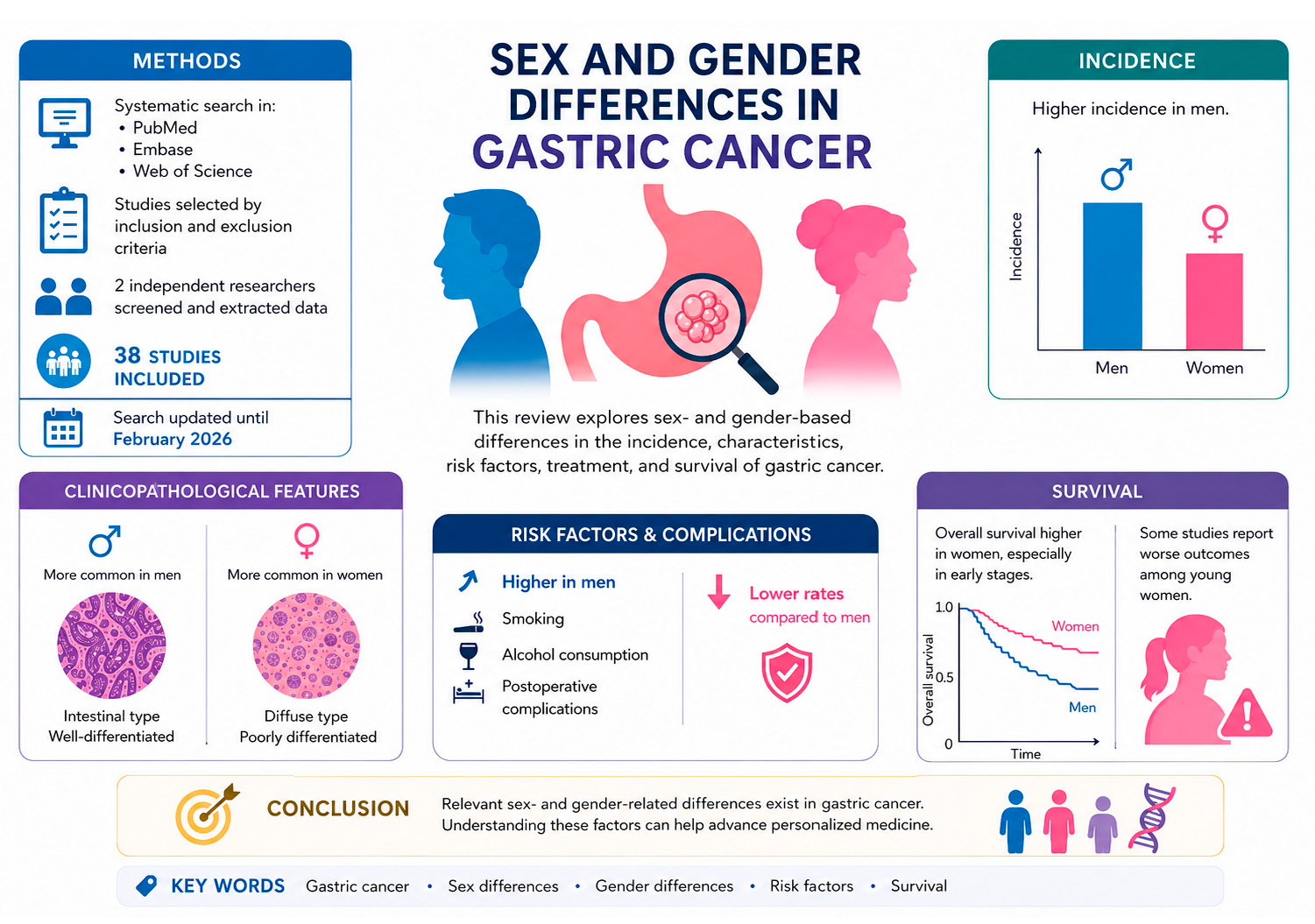
Sex and Gender Differences in Patients with Gastric Cancer: A Systematic Review
 and
and
Abstract
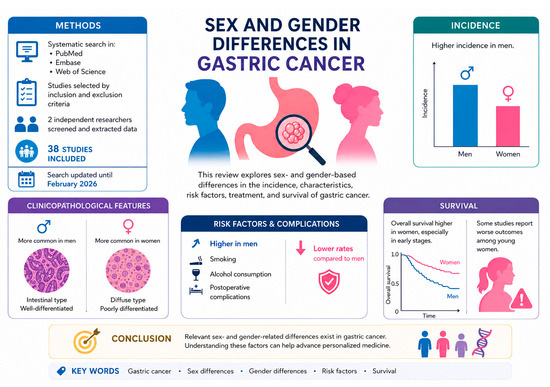
1. Introduction
2. Methods
2.1. Search Strategy
2.2. Inclusion Criteria
2.3. Exclusion Criteria
2.4. Data Synthesis
3. Results
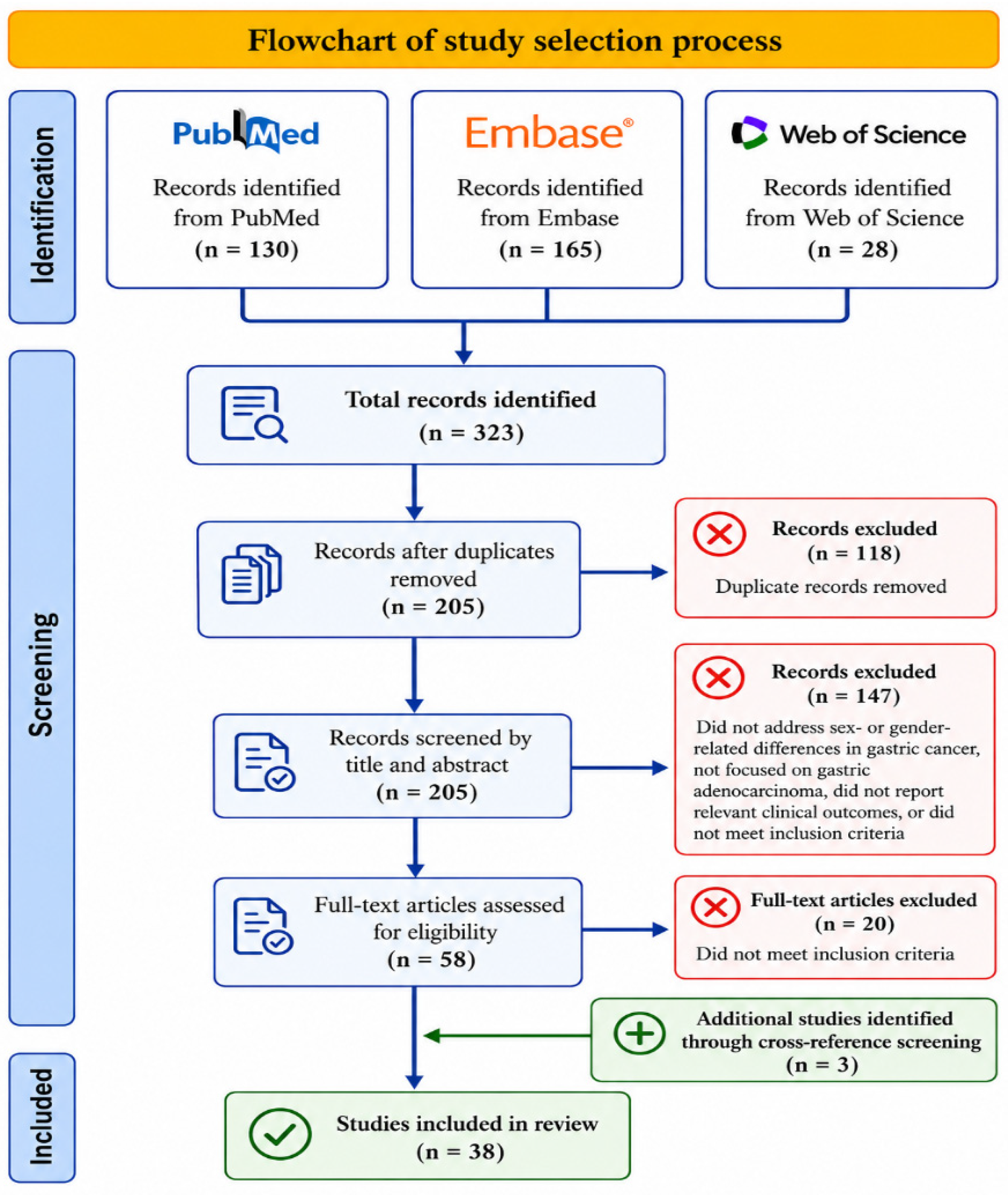
3.1. Study Selection
3.2. Sex- and Gender-Related Differences in Incidence Rates
3.3. Baseline Clinicopathological Characteristics Based on Sex and Gender
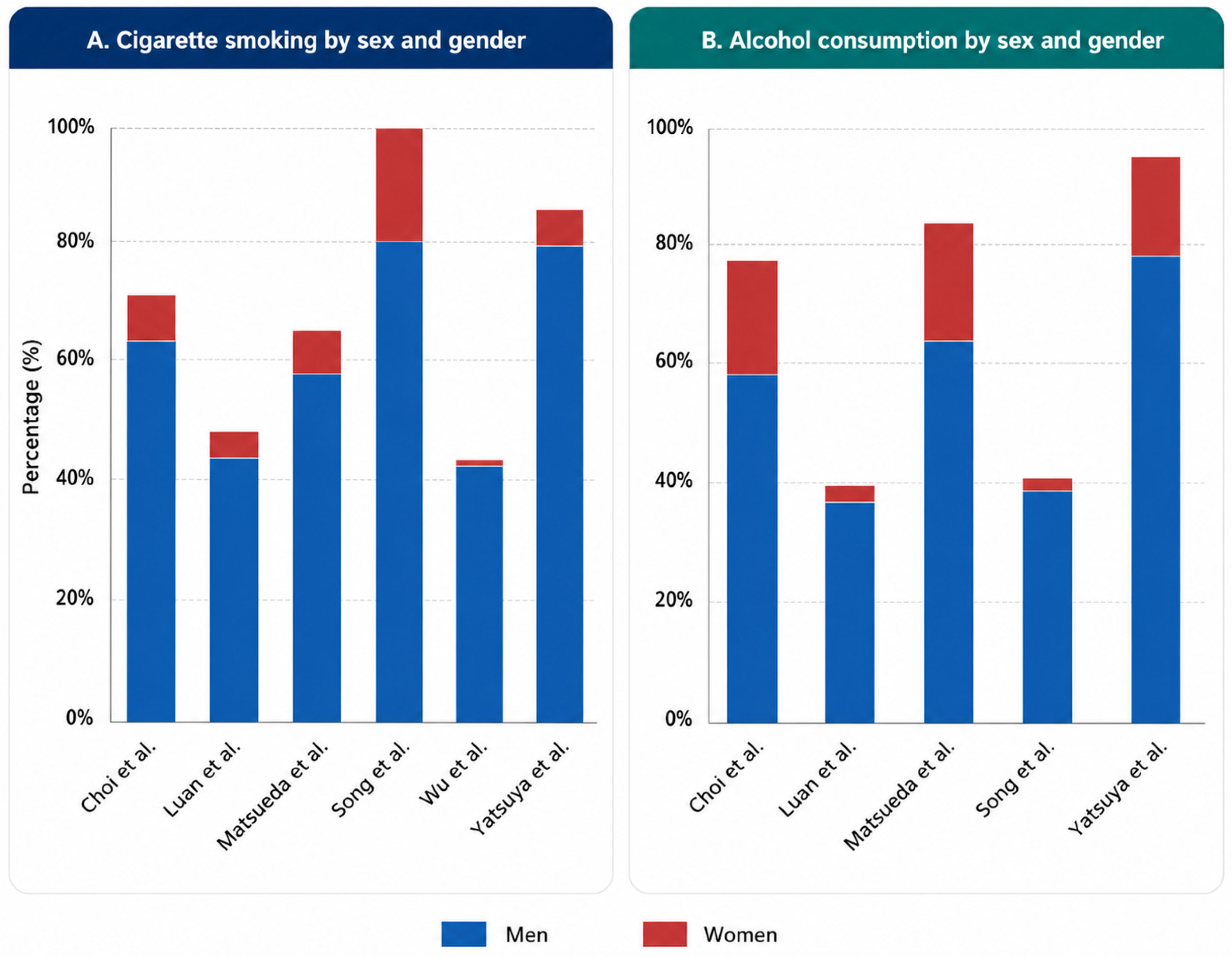
3.4. Risk Factors for Gastric Cancer Based on Sex and Gender
3.5. Treatment Selection and Postoperative Complications
3.6. Overall Survival
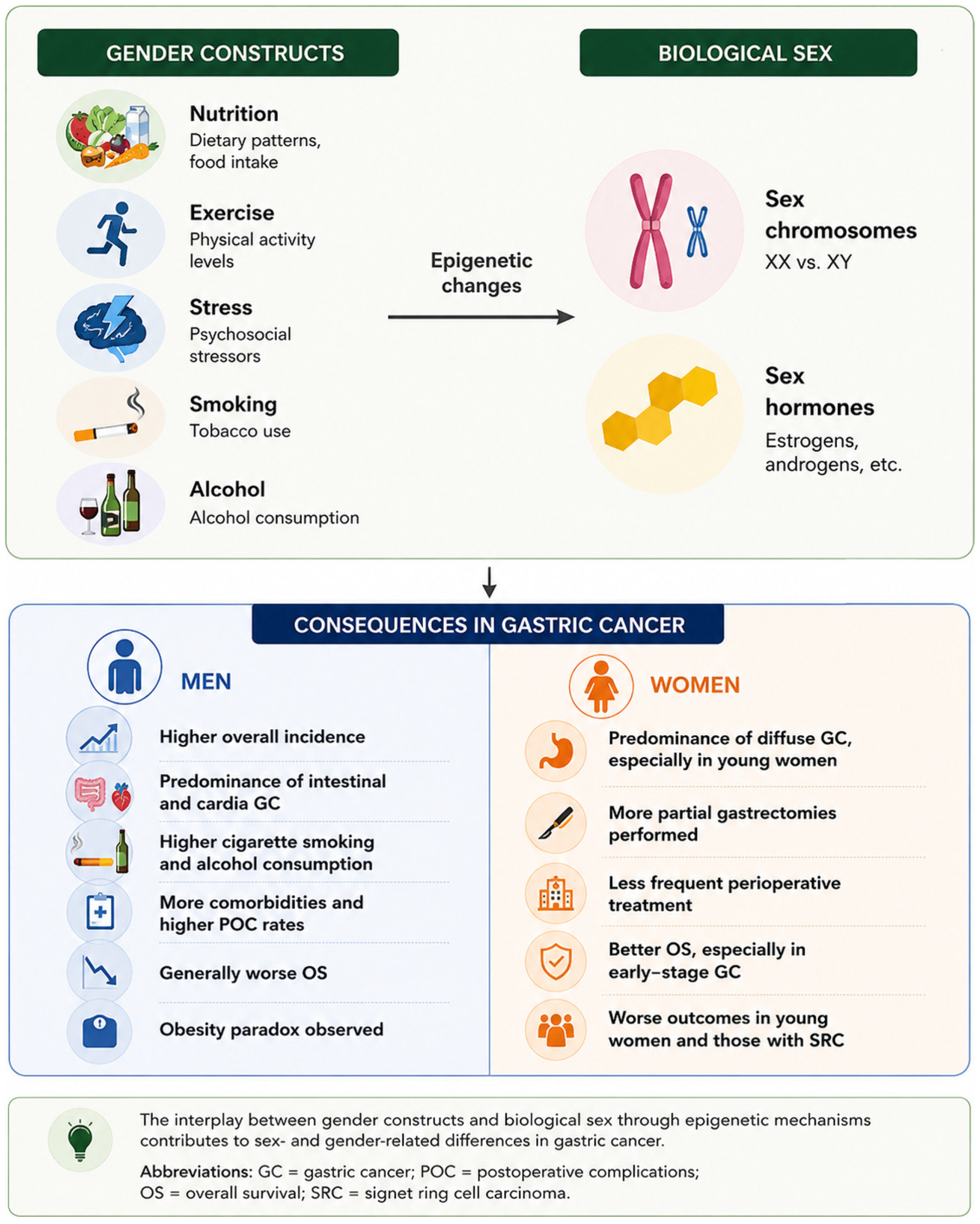
4. Discussion
5. Conclusions
Supplementary Materials
Author Contributions
Funding
Institutional Review Board Statement
Informed Consent Statement
Data Availability Statement
Conflicts of Interest
References
- Bray, F.; Laversanne, M.; Sung, H.; Ferlay, J.; Siegel, R.L.; Soerjomataram, I.; Jemal, A. Global cancer statistics 2022: GLOBOCAN estimates of incidence and mortality worldwide for 36 cancers in 185 countries. CA Cancer J. Clin. 2024, 74, 229–263. [Google Scholar] [CrossRef] [PubMed]
- Cayuela, L.; Villalba, C.P.; Flox-Benítez, G.; Cayuela, A. Divergent trends in gastric cancer incidence by sex and age in Spain (1990–2019). Rev. Esp. Enferm. Dig. 2025, 117, 68–75. [Google Scholar] [PubMed]
- Smyth, E.C.; Nilsson, M.; Grabsch, H.I.; van Grieken, N.C.; Lordick, F. Gastric cancer. Lancet 2020, 396, 635–648. [Google Scholar] [CrossRef] [PubMed]
- Choi, Y.; Kim, N.; Kim, K.W.; Jo, H.H.; Park, J.; Yoon, H.; Shin, C.M.; Park, Y.S.; Lee, D.H.; Oh, H.J.; et al. Sex-based differences in histology, staging, and prognosis among 2983 gastric cancer surgery patients. World J. Gastroenterol. 2022, 28, 933–947. [Google Scholar] [CrossRef] [PubMed]
- Solans-Domènech, M.; Saborit, S.; Grup de la Carta d’Hipàtia d’Alexandria. Eina per Incorporar la Perspectiva de Sexe i Gènere en els Continguts de Recerca; Agència de Qualitat i Avaluació Sanitàries de Catalunya: Barcelona, Spain, 2022. [Google Scholar]
- Mauvais-Jarvis, F.; Merz, N.B.; Barnes, P.J.; Brinton, R.D.; Carrero, J.-J.; DeMeo, D.L.; De Vries, G.J.; Epperson, C.N.; Govindan, R.; Klein, S.L.; et al. Sex and gender: Modifiers of health, disease, and medicine. Lancet 2020, 396, 565–582. [Google Scholar] [CrossRef] [PubMed]
- Luan, X.; Niu, P.; Wang, W.; Zhao, L.; Zhang, X.; Zhao, D.; Chen, Y. Sex disparity in patients with gastric cancer: A systematic review and meta-analysis. J. Oncol. 2022, 2022, 1269435. [Google Scholar] [CrossRef] [PubMed]
- Tannenbaum, C.; Ellis, R.P.; Eyssel, F.; Zou, J.; Schiebinger, L. Sex and gender analysis improves science and engineering. Nature 2019, 575, 137–146. [Google Scholar] [CrossRef] [PubMed]
- Plazas, J.G.; Arias-Martinez, A.; Lecumberri, A.; de Castro, E.M.; Custodio, A.; Cano, J.; Hernandez, R.; Montes, A.; Macias, I.; Pieras-Lopez, A.; et al. Sex and gender disparities in patients with advanced gastroesophageal adenocarcinoma: Data from the AGAMENON-SEOM registry. ESMO Open 2022, 7, 100514. [Google Scholar] [CrossRef] [PubMed]
- Athauda, A.; Nankivell, M.; Langley, R.E.; Alderson, D.; Allum, W.; Grabsch, H.I.; Starling, N.; Chau, I.; Cunningham, D.C. Impact of sex and age on chemotherapy efficacy, toxicity and survival in localised oesophagogastric cancer. Eur. J. Cancer 2020, 137, 45–56. [Google Scholar] [CrossRef] [PubMed]
- Page, M.J.; McKenzie, J.E.; Bossuyt, P.M.; Boutron, I.; Hoffmann, T.C.; Mulrow, C.D.; Shamseer, L.; Tetzlaff, J.M.; Akl, E.A.; Brennan, S.E.; et al. The PRISMA 2020 statement: An updated guideline for reporting systematic reviews. BMJ 2021, 372, n71. [Google Scholar] [CrossRef] [PubMed]
- Song, M.M.; Simonsen, C.K.; Wilson, J.D.; Jenkins, M.R. Development of a PubMed-based search tool for identifying sex- and gender-specific health literature. J. Womens Health 2016, 25, 181–187. [Google Scholar] [CrossRef] [PubMed]
- Aguilar, I.; Compés, L.; Feja, C.; Rabanaque, M.J.; Martos, C. Gastric cancer incidence and geographical variations. Gastric Cancer 2013, 16, 245–253. [Google Scholar] [CrossRef]
- Arakawa, H.; Komatsu, S.; Kamiya, H.; Nishibeppu, K.; Ohashi, T.; Konishi, H.; Shiozaki, A.; Kubota, T.; Fujiwara, H.; Otsuji, E. Differences of clinical features and outcomes between male and female elderly patients in gastric cancer. Sci. Rep. 2023, 13, 17192. [Google Scholar] [CrossRef] [PubMed]
- Bando, E.; Kojima, N.; Kawamura, T.; Takahashi, S.; Fukushima, N.; Yonemura, Y. Prognostic value of age and sex in early gastric cancer. Br. J. Surg. 2004, 91, 1197–1201. [Google Scholar] [CrossRef] [PubMed]
- Choi, Y.; Kim, N.; Kim, J.H.; Jo, H.H.; Oh, H.J.; Lee, H.S.; Jun, Y.K.; Yoon, H.; Shin, C.M.; Lee, D.H.; et al. Survival Rates of Patients with Gastric Cancer According to Age and Sex: A Large-Scale Study Using Data from 14,739 Patients. Cancer Res. Treat. 2026, 58, 252–263. [Google Scholar] [CrossRef] [PubMed]
- Corso, G.; Santucci, C.; Toffolutti, F.; Pisa, E.; La Vecchia, C.; Serraino, D. Trends in diffuse type of gastric cancer: Focus on younger women. Eur. J. Cancer Prev. 2024, 33, 541–544. [Google Scholar] [CrossRef] [PubMed]
- García-Esquinas, E.; Pérez-Gómez, B.; Pollán, M.; Boldo, E.; Fernández-Navarro, P.; Lope, V.; Vidal, E.; López-Abente, G.; Aragonés, N. Gastric cancer mortality trends in Spain. BMC Cancer 2009, 9, 346. [Google Scholar] [CrossRef] [PubMed]
- Griffith, G.W. The sex ratio in gastric cancer and hypothetical considerations relative to aetiology. Br. J. Cancer 1968, 22, 163–172. [Google Scholar] [CrossRef] [PubMed][Green Version]
- Hashimoto, I.; Komori, K.; Onuma, S.; Watanabe, H.; Suematsu, H.; Nagasawa, S.; Kano, K.; Kawabe, T.; Aoyama, T.; Hayashi, T.; et al. Preoperative visceral-to-subcutaneous fat ratio by sex. Anticancer Res. 2024, 44, 3515–3524. [Google Scholar] [CrossRef] [PubMed]
- Kalff, M.C.; Wagner, A.D.; Verhoeven, R.H.A.; Lemmens, V.E.P.P.; van Laarhoven, H.W.M.; Gisbertz, S.S.; van Berge Henegouwen, M.I. Sex differences in tumor characteristics, treatment, and outcomes of gastric and esophageal cancer surgery. Gastric Cancer 2022, 25, 22–32. [Google Scholar] [PubMed]
- Kim, J.-H.; Boo, Y.-J.; Park, J.-M.; Park, S.-S.; Kim, C.-S.; Mok, Y.-J. Incidence and long-term outcome of young patients with gastric carcinoma. Arch. Surg. 2008, 143, 1062–1067. [Google Scholar] [CrossRef] [PubMed]
- Kim, H.W.; Kim, J.H.; Lim, B.J.; Kim, H.; Kim, H.; Park, J.J.; Youn, Y.H.; Park, H.; Noh, N.H.; Kim, J.W.; et al. Sex disparity in gastric cancer: Female sex is a poor prognostic factor. Ann. Surg. Oncol. 2016, 23, 4344–4351. [Google Scholar] [CrossRef] [PubMed]
- Li, H.; Wei, Z.; Wang, C.; Chen, W.; He, Y.; Zhang, C. Gender Differences in Gastric Cancer Survival: 99,922 Cases Based on the SEER Database. J. Gastrointest. Surg. 2020, 24, 1747–1757. [Google Scholar] [CrossRef] [PubMed]
- Lou, L.; Wang, L.; Zhang, Y.; Chen, G.; Lin, L.; Jin, X.; Huang, Y.; Chen, J. Sex difference in incidence of gastric cancer. BMJ Open 2020, 10, e033323. [Google Scholar] [CrossRef] [PubMed]
- Luan, X.; Zhao, L.; Zhang, F.; Wang, W.; Jiao, F.; Zhou, X.; Niu, P.; Han, X.; Zhang, X.; Zhao, D.; et al. Sex disparity, prediagnosis lifestyle factors, and long-term survival of gastric cancer. BMC Cancer 2024, 24, 1149. [Google Scholar] [CrossRef] [PubMed]
- Maehara, Y.; Watanabe, A.; Kakeji, Y.; Emi, Y.; Moriguchi, S.; Anai, H.; Sugimachi, K. Prognosis for surgically treated gastric cancer patients is poorer for women than men. Br. J. Cancer 1992, 65, 417–420. [Google Scholar] [CrossRef] [PubMed][Green Version]
- Maguire, A.; Porta, M.; Sanz-Anquela, J.; Ruano, I.; Malats, N.; Piñol, J. Sex as a prognostic factor in gastric cancer. Eur. J. Cancer 1996, 32A, 1303–1309. [Google Scholar] [CrossRef] [PubMed]
- Matsueda, K.; Manabe, N.; Watanabe, T.; Sato, Y.; Mizuno, M.; Haruma, K. Adenocarcinoma of the esophagogastric junction. BMC Gastroenterol. 2024, 24, 342. [Google Scholar] [CrossRef] [PubMed]
- Nam, S.Y.; Jeon, S.W.; Kwon, Y.H.; Kwon, O.K. Sex difference of mortality by age and body mass index in gastric cancer. Dig. Liver Dis. 2021, 53, 1185–1191. [Google Scholar] [CrossRef] [PubMed]
- Nam, S.Y.; Jeong, J.; Lee, W.K.; Jeon, S.W. Sex-specific effect of body mass index and fasting glucose. Int. J. Obes. 2022, 46, 1644–1651. [Google Scholar] [CrossRef] [PubMed]
- Sah, B.; Zhu, Z.; Wang, X.; Yang, Q.; Chen, M.; Xiang, M.; Chen, J.; Yan, M. Post-operative complications of gastric cancer surgery. Eur. J. Cancer Care 2009, 18, 202–208. [Google Scholar] [CrossRef] [PubMed][Green Version]
- Sandler, R.S.; Holland, K.L. Trends in gastric cancer sex ratio in the United States. Cancer 1987, 59, 1032–1035. [Google Scholar] [CrossRef] [PubMed]
- Sato, N.; Ito, Y.; Ioka, A.; Tanaka, M.; Tsukuma, H. Gender differences in stomach cancer survival in Osaka Japan. Jpn. J. Clin. Oncol. 2009, 39, 690–694. [Google Scholar] [CrossRef] [PubMed]
- Schildberg, C.; Weber, U.; Dietrich, N.; Seeland, U.; Mantke, R. Sex and Age Differences in Clinicopathological Characteristics of Gastric Cancer. J. Clin. Med. 2025, 14, 7894. [Google Scholar] [CrossRef] [PubMed]
- Sipponen, P.; Correa, P. Delayed rise in incidence of gastric cancer in females results in unique sex ratio pattern. Gastric Cancer 2002, 5, 213–219. [Google Scholar] [CrossRef] [PubMed]
- Song, H.J.; Kim, H.J.; Choi, N.-K.; Hahn, S.; Cho, Y.-J.; Park, B.-J. Gender differences in gastric cancer incidence in elderly former drinkers. Alcohol 2008, 42, 363–368. [Google Scholar] [CrossRef] [PubMed]
- Song, A.; Huang, Z.; Chen, J.; Gong, H.; Yang, C.; Zhang, Y.; Jiang, X.; Zhu, Z. Baseline and early changes in CT body composition can predict recurrence-free survival after radical gastrectomy: A sex-specific study. Eur. J. Radiol. 2025, 183, 111935. [Google Scholar] [CrossRef] [PubMed]
- Song, M.; Kang, D.; Yang, J.J.; Choi, J.-Y.; Sung, H.; Lee, Y.; Yoon, H.-S.; Choi, Y.; Kong, S.-H.; Lee, H.-J.; et al. Age and sex interactions in gastric cancer incidence and mortality trends in Korea. Gastric Cancer 2015, 18, 580–589. [Google Scholar] [PubMed]
- Sun, J.; Misumi, J.; Shimaoka, A.; Aoki, K.; Esaki, F. Stomach cancer-related mortality in young Japanese women. Public Health 2002, 116, 39–44. [Google Scholar] [CrossRef]
- Sun, F.; Sun, H.; Mo, X.; Tang, J.; Liao, Y.; Wang, S.; Su, Y.; Ma, H. Increased survival rates in gastric cancer. J. Gastroenterol. Hepatol. 2018, 33, 837–846. [Google Scholar] [CrossRef] [PubMed]
- Suryawala, K.; Soliman, D.; Mutyala, M.; Nageeb, S.; Boktor, M.; Seth, A.; Aravantagi, A.; Sheth, A.; Morris, J.; Jordan, P.; et al. Gastric cancer in women. World J. Gastroenterol. 2015, 21, 7805–7813. [Google Scholar] [CrossRef] [PubMed]
- Wu, J.; Tian, S.; Xu, J.; Cheng, N.; Chen, X.; Yin, J.; Nie, Z. Association of high-risk comorbidity with overall survival among patients with gastric cancer. BMC Cancer 2023, 23, 916. [Google Scholar] [CrossRef] [PubMed]
- Xing, Y.; Hosaka, H.; Moki, F.; Tomaru, S.; Itoi, Y.; Sato, K.; Hashimoto, Y.; Tanaka, H.; Kuribayashi, S.; Takeuchi, Y.; et al. Gender differences in patients with gastric adenocarcinoma. J. Clin. Med. 2024, 13, 2524. [Google Scholar] [CrossRef] [PubMed]
- Yao, Q.; Qi, X.; Xie, S.H. Sex difference in the incidence of cardia and non-cardia gastric cancer in the United States. BMC Gastroenterol. 2020, 20, 418. [Google Scholar] [CrossRef] [PubMed]
- Yatsuya, H.; Toyoshima, H.; Mizoue, T.; Kondo, T.; Tamakoshi, K.; Hori, Y.; Tokui, N.; Hoshiyama, Y.; Kikuchi, S.; Sakata, K.; et al. Family history the risk of stomach cancer death. Int. J. Cancer 2002, 97, 688–694. [Google Scholar] [PubMed]
- Yu, J.; Li, Z. The sex ratio and age of onset features of gastric cancer patients in hereditary diffuse gastric cancer families. Fam. Cancer 2011, 10, 573–579. [Google Scholar] [CrossRef] [PubMed]
- Camargo, M.C.; Goto, Y.; Zabaleta, J.; Morgan, D.R.; Correa, P.; Rabkin, C.S. Sex hormones and gastric cancer risk. Cancer Epidemiol. Biomark. Prev. 2012, 21, 20–38. [Google Scholar] [CrossRef] [PubMed]
- Gan, X.; Dai, G.; Li, Y.; Xu, L.; Liu, G. Roles of estrogen and estrogen receptors in digestive system cancers. Cancer Biol. Med. 2024, 21, 898–915. [Google Scholar] [CrossRef] [PubMed]
- Iyer, P.; Moslim, M.; Farma, J.M.; Denlinger, C.S. Diffuse gastric cancer. Transl. Gastroenterol. Hepatol. 2020, 5, 52. [Google Scholar] [CrossRef] [PubMed]
- Satala, C.B.; Jung, I.; Kovacs, Z.; Stefan-Van Staden, R.I.; Molnar, C.; Bara, T.; Patrichi, A.I.; Gurzu, S. V-set and immunoglobulin domain containing 1 (VSIG1) as an emerging target for epithelial-mesenchymal transition of gastric cancer. Sci. Rep. 2022, 12, 16241. [Google Scholar] [CrossRef] [PubMed]
- Satala, C.B.; Jung, I.; Gurzu, S. Mucin-Phenotype and Expression of the Protein V-Set and Immunoglobulin Domain Containing 1 (VSIG1): New Insights into Gastric Carcinogenesis. Int. J. Mol. Sci. 2023, 24, 8697. [Google Scholar] [CrossRef] [PubMed]
- Clayton, J.A. Studying both sexes: A guiding principle for biomedicine. FASEB J. 2016, 30, 519–524. [Google Scholar] [PubMed]
- Sugranyes, G.; Sebastià, M.C.; García-Delgar, B.; Forcadell, E.; Coll-Vinent, B. Considerations regarding the use of the sex/gender variable in research. Emergencias 2023, 35, 303–305. [Google Scholar] [PubMed]



| Author | Year | Country | Sample | Study Design | Analyzed Aspects | Summary of Main Results |
|---|---|---|---|---|---|---|
| Aguilar et al. [13] | 2013 | Spain | - | Ecological study | Incidence, risk factors | From 1993 to 2002, men living in the most deprived areas had twice the risk of GC, while SES had no effect on women. In contrast, rurality was linked to higher GC risk only in women, particularly in the most rural areas. |
| Arakawa et al. [14] | 2023 | Japan | 295 | Retrospective cohort study | Survival | In elderly patients, males had more upper gastric tumors, more POC, and worse OS than females. Male sex was independently associated with poorer prognosis, indicating that limited surgery may benefit high-risk elderly men. |
| Bando et al. [15] | 2004 | Japan | 4231 | Retrospective cohort study | Survival | In early GC, cancer-specific survival remained high, but OS declined with age, especially in patients over age 80. Age was the strongest prognostic factor, with non-cancer-related mortality increasing with age, while tumor recurrence rates remained unaffected. |
| Cayuela et al. [2] | 2025 | Spain | - | Ecological study | Incidence | From 1990 to 2019, GC cases in Spain rose slightly, but ASIR declined by 1.8% annually for both sexes, with men maintaining a higher burden than women. Incidence recently increased in young men (age 25–34), suggesting emerging sex-related differences. |
| Choi et al. [4] | 2022 | South Korea | 2983 | Retrospective cohort study | Risk factors, survival | Females were younger and had more diffuse-type tumors, while males had more intestinal-type and non-GC-related deaths. Females had better OS, but cancer-specific survival was similar, except in advanced stages, where females showed worse outcomes. |
| Choi et al. [16] | 2025 | South Korea | 14,739 | Retrospective cohort study | Survival | Survival differences according to sex were influenced by age, with younger women showing less favorable outcomes despite the overall female survival advantage. |
| Corso et al. [17] | 2024 | Italy | 1094 | Retrospective observational study | Incidence | From 1995 to 2021, diffuse GC made up 10.2% of cases, and was more common in individuals under age 45, particularly in women (34.0% vs. 25.7%). While overall incidence declined in the last decade, the percentage of diffuse GC increased, especially among young women. |
| García-E. et al. [18] | 2009 | Spain | - | Ecological study | Risk factors, survival | From 1976 to 2005, GC mortality declined more in women than in men (3.65% vs. 2.90%). This sex difference was especially evident in certain inland and northern regions of Spain, and a change in the rate of decline was observed for both sexes in the early 1980s. |
| Griffith et al. [19] | 1968 | UK | - | Ecological study | Survival | From 1958 to 1963, GC mortality showed a consistent “low–high–low” male-to-female ratio across ages, being approximately equal in young adults, peaking around ages 50–59, and then declining in older age. This pattern is likely to be explained by incidence data. |
| Hashimoto et al. [20] | 2024 | Japan | 459 | Prospective cohort study | Risk factors, survival | In males, a low VSR was associated with significantly worse OS and RFS and was an independent predictor of poor prognosis. Among females, a high VSR was linked to significantly lower RFS and predicted worse outcomes, with no difference observed in OS. |
| Kalff et al. [21] | 2022 | Netherlands | 2072 | Retrospective cohort study | Treatment, survival | Females undergoing surgery for GC had lower postoperative morbidity and fewer re-interventions compared to males. However, despite these advantages, females had significantly worse 5-year relative OS. |
| Kim et al. [22] | 2008 | Korea | 1299 | Retrospective cohort study | Treatment, survival | In males, younger patients had more undifferentiated tumors but better 10-year OS, while in females, tumor differentiation and surgical approaches varied by age, with older women showing slightly better OS. Tumor stage and sex were independent predictors of OS. |
| Kim et al. [23] | 2016 | South Korea | 4722 | Retrospective cohort study | Survival | Females were younger and had more poorly differentiated adenocarcinoma and SRC. They also had poorer OS, particularly in advanced cases under age 45, with SRC worsening outcomes and showing distinct ER-β expression patterns by sex. |
| Li et al. [24] | 2020 | USA | 99.922 | Population-based retrospective cohort study | Survival | Female patients showed better cancer-specific survival overall, although survival differences varied according to age and tumor stage. |
| Lou et al. [25] | 2020 | Global | - | Ecological study | Incidence, risk factors | From 1990 to 2017, global GC incidence declined in both sexes, but the male-to-female ratio of ASIR increased from 1.86 to 2.20, with the largest relative difference observed in the 65–69 age group. Sex differences in ASIRs were associated with higher HDI levels. |
| Luan et al. [26] | 2024 | China | 29,779 | Prospective cohort study | Risk factors, survival | Females showed better OS than males, though smoking history worsened prognosis among women. In men, heavy tobacco use significantly worsened OS, and an obesity paradox was noted, with a higher BMI associated with better survival outcomes. |
| Maehara et al. [27] | 1992 | Japan | 1031 | Retrospective cohort study | Survival | Women under age 50 had lower 10-year OS than men, with key prognostic factors (operative curability, lymph node metastasis, depth of invasion, and tumor size) differing between sexes. Early detection and postoperative CTX may benefit those with advanced disease. |
| Maguire et al. [28] | 1996 | Spain | 851 | Retrospective cohort study | Survival | Women showed better OS after adjusting for tumor stage and age, especially in Barcelona at the local stage, but this survival advantage varied by location (Mataró and Soria), suggesting the sex-based survival benefit may be influenced by tumor stage. |
| Matsueda et al. [29] | 2024 | Japan | 188 | Mixed cohort study | Incidence, risk factors | The incidence of adenocarcinoma of the GEJ remained stable among female and young adult patients. These groups of patients without associated risk factors had higher rates of undifferentiated tumors compared to patients with risk factors or older age groups. |
| Nam et al. [30] | 2021 | South Korea | 5961 | Retrospective cohort study | Risk factors, survival | Overall mortality was lower in women, especially over age 60, with a BMI below 25 kg/m2 and at stage I disease. In men, mortality rose with age and a low BMI, while in women, it was higher at extreme ages (<40 and ≥70 years) but lower with a BMI ≥30 kg/m2. |
| Nam et al. [31] | 2022 | South Korea | 29,775 | Prospective cohort study | Risk factors, survival | A low BMI significantly increased the risk of GC and all-cause mortality, with risk thresholds at 23 kg/m2 in men and 18.5 kg/m2 in women. High fasting glucose was associated with increased gastric cancer risk only in women. |
| Plazas et al. [9] | 2022 | Spain | 2993 * | Retrospective cohort study | Treatment, survival | Women with advanced disease had tumors more often HER2-negative, grade 3, diffuse, and SRC histology, with peritoneal rather than liver spread, and higher toxicity during CTX. Despite these differences, there were no significant sex-based differences in PFS or OS. |
| Sah et al. [32] | 2009 | China | 357 | Retrospective cohort study | Treatment | Females experienced higher rates and severity of POC, as well as longer hospital stays, after GC surgery. Gender was identified as an independent risk factor for early POC, highlighting its influence on surgical outcomes. |
| Sandler et al. [33] | 1987 | USA | - | Ecological study | Survival | From 1950 to 1979, age-adjusted sex-specific mortality rates for GC in white Americans showed an increasing male-to-female ratio, rising from 1.8 to 2.1, despite a decline in crude ratios. The overall decline in GC mortality affected both sexes equally. |
| Sato et al. [34] | 2009 | Japan | 72,789 | Retrospective cohort study | Survival | Women showed worse OS, but after adjusting for disease stage, histological type, detection method, and treatment, women actually had slightly better OS. The observed lower OS in women was mainly due to their cancers being diagnosed at more advanced stages. |
| Schildberg et al. [35] | 2025 | Germany | - | Retrospective observational study | Incidence, clinicopathological characteristics | Male patients showed higher GC incidence and more intestinal-type tumors, whereas women more frequently presented diffuse and poorly differentiated histology, particularly at younger ages. |
| Sipponen et al. [36] | 2002 | Finland | - | Ecological study | Incidence | From 1955 to 1990, GC incidence followed a “low–high–low” pattern, peaking around age 60 due to a delayed onset of intestinal-type GC in females. This consistent global pattern has remained stable over decades despite declining overall GC incidence. |
| Song et al. [37] | 2008 | Korea | 13,396 | Prospective cohort study | Risk factors | Alcohol consumption increased GC risk in women, particularly among former heavy drinkers. No significant association was observed in men, suggesting a sex-specific relationship between alcohol and GC that may persist in women even after ceasing consumption. |
| Song et al. [38] | 2025 | China | 287 | Retrospective cohort study | Survival | Males had more muscle and less subcutaneous fat, with different RFS predictors by sex: visceral fat, lymphocyte count, and T stage were key in men, while subcutaneous fat loss, albumin, and CEA levels were important in women (muscle mass and POC in both). |
| Song et al. [39] | 2015 | South Korea | - | Ecological study | Incidence | From 1999 to 2010, overall age-standardized GC incidence declined slightly in both males and females, while mortality rates dropped significantly. However, age-specific analysis revealed a concerning flat or rising incidence trend among females aged 40–54. |
| Sun et al. [40] | 2002 | Japan | - | Ecological study | Survival | From 1957 to 1997, eliminating GC deaths increased life expectancy more in men, indicating their higher overall mortality rates. However, young women exhibited a higher risk of GC death, with a stable or slightly decreasing sex ratio over four decades. |
| Sun et al. [41] | 2018 | China | 87,242 | Retrospective observational study | Incidence, risk factors, survival | From 1984 to 2013, females initially had higher 12-month OS, but this advantage reversed later. Cox regression analysis confirmed this shift, showing that females had a better prognosis in the first decade, but males had better survival in the following two decades. |
| Suryawala et al. [42] | 2015 | USA | 285 | Retrospective cohort study | Incidence | Men and women within each ethnic group had similar annual rates of GC diagnosis, contrasting with national trends where females typically had lower risks than males. African American males had higher healthcare utilization than African American females and white patients. |
| Wu et al. [43] | 2023 | China | 376 | Retrospective cohort study | Risk factors, survival | Comorbidities assessed by the ACCI significantly predicted lower OS in GC patients, whereas the standard CCI did not. This association between high-risk ACCI scores and increased mortality was observed in male patients but not in females. |
| Xing et al. [44] | 2024 | Japan | 18,436 | Retrospective cohort study | Survival | Males had more differentiated tumors and were often diagnosed through medical checkups, while females showed better OS, particularly in early-stage disease, with multivariate analysis confirming lower mortality risk. |
| Yao et al. [45] | 2020 | USA | 57,534 | Ecological study | Incidence | From 1992 to 2014, sex differences varied by cancer subtype, with the male-to-female ratio for cardia GC peaking at ages 55–69 and that for non-cardia GC stabilizing after age 60. Differences in non-cardia GC decreased in most races, but cardia GC remained more stable. |
| Yatsuya et al. [46] | 2002 | Japan | 110,573 | Prospective cohort study | Risk factors | A positive family history of GC increased the risk of death from the disease in both men and women, especially among individuals aged 40–59. Women showed a particularly high risk when multiple family members were affected or when their mother or sister had GC. |
| Yu et al. [47] | 2011 | China | 192 | Cross-sectional study | Risk factors | In HDGC, females were more common and diagnosed younger, with a lower male-to-female ratio than in general GC. There were generational and regional differences: parents were older than offspring at diagnosis, and Asian patients were older and more often male. |
| Study | Sex | Sample | Age (Years) | BMI (kg/m2) | Stage | Tumor Location | Histological Type |
|---|---|---|---|---|---|---|---|
| Arakawa et al. [14] | Men | 181 (61.4%) | <85: 160 (88%) ≥85: 21 (12%) | <25: 146 (81%) ≥25: 35 (19%) | - | Upper: 61 (34%) Middle and lower: 120 (66%) | Differentiated: 125 (69%) Undifferentiated: 56 (31%) |
| Women | 114 (38.6%) | <85: 101 (89%) ≥85: 13 (11%) | <25: 90 (79%) ≥25: 24 (21%) | - | Upper: 19 (17%) Middle and lower: 95 (83%) | Differentiated: 59 (52%) Undifferentiated: 55 (48%) | |
| Bando et al. [15] | Men | 2852 (67.4%) | ≤70: 2186 71–80: 596 >80: 70 | - | 100% early stage | - | - |
| Women | 1379 (32.6%) | ≤75: 1224 76–80: 110 >80: 45 | - | 100% early stage | - | - | |
| Choi et al. [4] | Men | 2005 (67.2%) | Mean: 61.66 ± 11.63 | - | I: 1569 (78.3%) II: 254 (12.7%) III: 143 (7.1%) IV: 39 (1.9%) | Upper: 58 (2.9%) Middle: 835 (41.6%) Lower: 1112 (55.5%) | Intestinal: 1396 (69.6%) Diffuse: 520 (25.9%) Mixed: 89 (4.5%) |
| Women | 978 (32.8%) | Mean: 59.36 ± 13.47 | - | I: 743 (76%) II: 151 (15.4%) III: 69 (7.1%) IV: 15 (1.5%) | Upper: 19 (2%) Middle: 497 (50.8%) Lower: 462 (47.2%) | Intestinal: 447 (45.7%) Diffuse: 494 (50.5%) Mixed: 37 (3.8%) | |
| Hashimoto et al. [20] | Men | 300 (65.4%) | <65: 88 ≥65: 212 | <18.5: 12 18.5–24.9: 211 ≥25: 77 | I: 207 II/III: 93 | - | Well/moderately differentiated: 171 Poorly differentiated: 129 |
| Women | 159 (34.6%) | <65: 52 ≥65: 107 | <18.5: 35 18.5–24.9: 100 ≥25: 24 | I: 109 II/III: 50 | - | Well/moderately differentiated: 55 Poorly differentiated: 104 | |
| Kalff et al. [21] | Men | 1304 (62.9%) | Mean: 68.6 <55: 158 (12.1%) | Mean: 25.3 | - | Fundus: 136 (10.9%) Corpus: 389 (31.2%) Antrum: 468 (37.5%) Pylorus: 104 (8.3%) Entire stomach: 73 (5.8%) Gastric remnant: 78 (6.3%) | Intestinal: 515 (57.7%) Diffuse: 311 (34.9%) Mixed: 66 (7.4%) |
| Women | 768 (37.1%) | Mean: 67.7 <55: 146 (19.0%) | Mean: 25.1 | - | Fundus: 37 (5.0%) Corpus: 232 (31.7%) Antrum: 342 (46.7%) Pylorus: 64 (8.7%) Entire stomach: 53 (7.2%) Gastric remnant: 5 (0.7%) | Intestinal: 239 (45.0%) Diffuse: 258 (48.6%) Mixed: 34 (6.4%) | |
| Kim et al. * [22] | Men | 865 (66.6%) | Mean: 47 ± 6.4 | - | I: 321 II: 104 III: 230 IV: 210 | Upper third: 100 Middle third: 265 Lower third: 489 Entire: 11 | Well differentiated: 495 Undifferentiated: 370 |
| Women | 434 (33.4%) | Mean: 46.5 ± 7.2 | - | I: 197 II: 61 III: 123 IV: 53 | Upper third: 39 Middle third: 166 Lower third: 218 Entire: 11 | Well differentiated: 155 Undifferentiated: 279 | |
| Kim et al. [23] | Men | 3136 (66.4%) | Mean: 57.9 ± 11.2 ≤45: 431 (13.7%) >45: 2705 (86.3%) | - | I: 1858 (59.2%) II: 119 (3.8%) III: 1159 (37%) | - | Intestinal: 758 (59.5%) Diffuse: 416 (32.6%) Mixed: 101 (7.9%) |
| Women | 1586 (33.6%) | Mean: 55 ± 13 ≤45: 382 (24.1%) >45: 1204 (75.9%) | - | I: 897 (56.6%) II: 65 (4.1%) III: 623 (39.3%) | - | Intestinal: 245 (39.9%) Diffuse: 295 (48%) Mixed: 74 (12.1%) | |
| Luan et al. [26] | Men | 22,120 (74.3%) | 18–34: 410 (1.9%) 35–50: 3446 (15.6%) 51–64: 11,000 (49.7%) ≥65: 7264 (32.8%) | <18.5: 1532 (7.7%) 18.5–22.9: 8400 (42.1%) 23–27.4: 7893 (39.6%) ≥27.5: 2123(10.6%) | 0: 126 (0.7%) I: 3573 (20.9%) II: 3636 (21.2%) III: 7757 (45.3%) IV: 2036 (11.9%) | Proximal: 7516 (36.4%) Distal: 11,923 (57.7%) Total: 1224 (5.9%) | Intestinal: 3572 (21.5%) Diffuse: 2710 (16.3%) Mixed: 2403 (14.5%) Unknown: 7912 (47.7%) |
| Women | 7659 (25.7%) | 18–34: 474 (6.2%) 35–50: 1836 (24.0%) 51–64: 3259 (42.6%) ≥65: 2090 (27.3%) | <18.5: 787 (11.4%) 18.5–22.9: 3182 (46.3%) 23–27.4: 2286 (33.2%) ≥27.5: 624 (9.1%) | 0: 37 (0.6%) I: 1293 (21.6%) II: 1210 (20.2%) III: 2591 (43.2%) IV: 863 (14.4%) | Proximal: 1490 (20.9%) Distal: 5232 (73.5%) Total: 398 (5.6%) | Intestinal: 755 (13.1%) Diffuse: 1570 (27.2%) Mixed: 656 (11.4%) Unknown: 2792 (48.4%) | |
| Maehara et al. [27] | Men | 689 (66.8%) | Mean: 58.9 ± 11.4 ≤50: 140 (20.3%) 51–70: 450 (65.3%) ≥71: 99 (14.4%) | - | - | Upper: 207 (30%) Middle: 176 (25.5%) Lower: 306 (44.5%) | Differentiated: 347 (50.4%) Undifferentiated: 342 (49.6%) |
| Women | 342 (33.2%) | Mean: 55.5 ± 13.9 ≤50: 122 (35.7%) 51–70: 175 (51.1%) ≥71: 45 (13.2%) | - | - | Upper: 86 (25.1%) Middle: 118 (34.5%) Lower: 138 (40.4%) | Differentiated: 110 (32.2%) Undifferentiated: 232 (67.8%) | |
| Maguire et al. * [28] | Men | 547 (64.3%) | Mean: 66.4 | - | Local: 28.9% Regional: 32.4% Disseminated: 28.7% Missing: 9.9% | Cardia: 8.1% Non-cardia: 91.9% | Diffuse: 10.2% Intestinal: 35.9% Others: 53.6% |
| Women | 304 (35.7%) | Mean: 69.9 | - | Local: 21.9% Regional: 38% Disseminated: 29.7% Missing: 10.4% | Cardia: 4.5% Non-cardia: 95.5% | Diffuse: 9.5% Intestinal: 31.8% Others: 58% | |
| Matsueda et al. [29] | Men | 152 (80.9%) | Mean: 68 ± 12.2 | <25: 101 (66%) ≥25: 51 (34%) | - | 100% GEJ | Differentiated: 107 (70%) Undifferentiated: 45 (30%) |
| Women | 36 (19.1%) | Mean: 69.6 ± 14.0 | <25: 28 (78%) ≥25: 51 (34%) | - | 100% GEJ | Differentiated: 20 (56%) Undifferentiated: 16 (44%) | |
| Nam et al. [30] | Men | 3969 (66.6%) | Mean: 61.3 <40: 117 (3.0%) 40–49: 445 (12.1%) 50–59: 1067 (26.9%) 60–69: 1344 (33.9%) ≥70: 996 (25.1%) | Mean: 23.3 <18.5: 220 (5.6%) 18.5–22.9: 1569 (40.2%) 23–24.9: 1038 (26.6%) 25–29.9: 1013 (26.0%) ≥30: 62 (1.6%) | I: 2828 (71.5%) II: 357 (9.0%) III: 300 (7.6%) IV: 468 (11.8%) | Upper: 622 (15.7%) Middle: 1600 (40.38%) Distal: 1740 (43.9%) | Differentiated: 2239 (56.6%) Undifferentiated: 1717 (43.4%) |
| Women | 1992 (33.4%) | Mean: 59.6 <40: 159 (8.0%) 40–49: 313 (15.7%) 50–59: 430 (21.6%) 60–69: 529 (26.6%) ≥70: 561 (28.1%) | Mean: 23.3 <18.5: 117 (5.9%) 18.5–22.9: 807 41.0%) 23–24.9: 471 (23.9%) 25–29.9: 516 (26.2%) ≥30: 56 (2.9%) | I: 1452 (73.1%) II: 163 (8.2%) III: 148 (7.5%) IV: 222 (11.2%) | Upper: 260 (13.1%) Middle: 860 (43.2%) Distal: 870 (43.7%) | Differentiated: 769 (38.6%) Undifferentiated: 1222 (61.4%) | |
| Nam et al. [31] | Men | 18,241 (61.3%) | 40–49: 3128 (10.5%) 50–59: 7505 (25.2%) 60–69: 11,065 (37.2%) ≥70: 8077 (27.1%) | <18.5: 807 18.5–22.9: 7187 23–24.9: 4716 25–29.9: 5212 ≥30: 314 | - | - | - |
| Women | 11,534 (38.7%) | <18.5: 400 18.5–22.9: 4025 23–24.9: 2936 25–29.9: 3732 ≥30: 438 | - | - | - | ||
| Plazas et al. * [9] | Men | 2313 (70.6%) | Mean: 65 Range: 20–89 | Mean: 25 Range: 13–48 | 100% advanced stage | Esophagus: 258 (11.2%) Stomach: 1690 (73.1%) GEJ: 365 (15.8%) | Intestinal: 1063 (46.9%) Diffuse: 635 (26.5%) Mixed: 101 (4.4%) Unknown: 514 (22.2%) |
| Women | 961 (29.4%) | Mean: 63 Range: 20–89 | Mean 24 Range 13–48 | 100% advanced stage | Esophagus: 23 (2.4%) Stomach: 862 (89.7%) GEJ: 76 (7.9%) | Intestinal: 302 (31.4%) Diffuse: 416 (43.3%) Mixed: 51 (5.3%) Unknown: 192 (20.0%) | |
| Sah et al. [32] | Men | 252 (70.4%) | Median: 59 | - | - | - | - |
| Women | 105 (29.4%) | Median: 58 | - | - | - | - | |
| Sato et al. [34] | Men | 47,535 (65.3%) | 0–44: 3548 (7.5%) 45–54: 8161 (17.2%) 55–64: 13,656 (28.7%) 65–74: 13,878 (29.2%) ≥75: 8292 (17.4%) | - | Localized: 17,602 (37%) Regional: 16,378 (34.5%) Distant: 8418 (17.7%) Unknown: 5137 (10.8%) | - | Intestinal: 19,493 (41%) Diffuse: 14,362 (30.2%) Others/unknown: 13,680 (28.8%) |
| Women | 25,254 (34.7%) | 0–44: 3406 (13.5%) 45–54: 4085 (16.2%) 55–64: 5341 (21.1%) 65–74: 6561 (26%) ≥75: 5861 (23.2%) | - | Localized: 8325 (33%) Regional: 9014 (35.7%) Distant: 4814 (19.1%) Unknown: 3101 (12.3%) | - | Intestinal: 6864 (27.2%) Diffuse: 10,401 (41.2%) Others/unknown: 7989 (31.6%) | |
| Song et al. [37] | Men | 4264 (31.8%) | Mean: 69 ± 5 | - | - | Cardia: 6 (0.1%) Non-cardia: 4258 (99.9%) | - |
| Women | 9132 (68.2%) | Mean: 70 ± 5.7 | - | - | Cardia: 0 (0%) Non-cardia: 9132 (100%) | ||
| Song et al. [38] | Men | 185 (64.5%) | Mean: 66.12 ± 9.1 | - | - | - | Intestinal: 84 (45.4%) Diffuse: 89 (48.1%) Mixed: 12 (6.5%) |
| Women | 102 (35.5%) | Mean: 62.84 ± 11.16 | - | - | - | Intestinal: 37 (36.3%) Diffuse: 58 (56.9%) Mixed: 7 (6.8%) | |
| Suryawala et al. [42] | Men | 143 (50.2%) | Mean: 69 <50: 71 ≥50: 214 | - | - | - | - |
| Women | 142 (49.8%) | - | - | - | - | ||
| Wu et al. [43] | Men | 270 (71.8%) | Mean: 65.66 ± 9.59 | - | I: 61 (22.59%) II: 49 (18.15%) III: 140 (51.85%) IV: 20 (7.41%) | Lower: 152 (56.3%) Middle: 88 (32.59%) Upper: 17 (6.3%) Mixed: 13 (4.81%) | Well differentiated: 15 (5.56%) Moderately differentiated: 112 (41.48%) Poor differentiated: 143 (52.96%) |
| Women | 106 (28.2%) | Mean: 67.63 ± 12.59 | - | I: 29 (27.36%) II: 16 (15.09%) III: 58 (54.72%) IV: 3 (2.83%) | Lower: 66 (62.26%) Middle: 35 (33.02%) Upper: 4 (3.77%) Mixed: 1 (0.94%) | Well differentiated: 5 (4.72%) Moderately differentiated: 32 (30.19%) Poor differentiated: 69 (65.09%) | |
| Xing et al. [44] | Men | 13,093 (71%) | Mean: 71.8 ± 10.1 | - | Localized without LNM: 7151 (54.6%) Localized with LNM: 1389 (10.6%) Adjacent organ invasion: 1342 (10.2%) Distant metastasis: 2273 (17.4%) Unknown: 938 (7.2%) | Cardia: 1359 (10.4%) Fundus: 586 (4.5%) Body: 5803 (44.3%) Antrum: 4171 (31.9%) Unknown: 1174 (9%) | Differentiated: 8681 (66.3%) Undifferentiated: 3449 (26.3%) Unknown: 963 (7.4%) |
| Women | 5343 (29%) | Mean: 72.6 ± 12.5 | - | Localized without LNM: 2827 (52.9%) Localized with LNM: 531 (9.9%) Adjacent organ invasion: 671 (12.6%) Distant metastasis: 903 (16.9%) Unknown: 411 (7.7%) | Cardia: 374 (7%) Fundus: 190 (3.6%) Body: 2362 (44.2%) Antrum: 1962 (36.7%) Unknown: 455 (8.5%) | Differentiated: 2802 (52.4%) Undifferentiated: 2113 (39.5%) Unknown: 428 (8%) | |
| Yatsuya et al. * [46] | Men | 46,318 (41.9%) | Mean: 58.2 40–49: 22.8% 50–59: 30.6% 60–69:31.8% 70–79: 14.9% | - | - | - | - |
| Women | 64,255 (58.1%) | Mean: 58.2 40–49: 22.2% 50–59: 31.6% 60–69: 32.1% 70–79: 14.2% | - | - | - | - | |
| Yu et al. [47] | Men | 83 (43.5%) | Mean: 48.9 ± 14.6 Range: 15–79 | - | - | - | 100% diffuse |
| Women | 108 (56.5%) | Mean: 43.1 ± 13.1 Range: 18–79 | - | - | - | 100% diffuse |
Disclaimer/Publisher’s Note: The statements, opinions and data contained in all publications are solely those of the individual author(s) and contributor(s) and not of MDPI and/or the editor(s). MDPI and/or the editor(s) disclaim responsibility for any injury to people or property resulting from any ideas, methods, instructions or products referred to in the content. |
© 2026 by the authors. Licensee MDPI, Basel, Switzerland. This article is an open access article distributed under the terms and conditions of the Creative Commons Attribution (CC BY) license.
Share and Cite
Escandell Marí, N.; Sánchez-Ric, M.; Velez, M.; Carballal, S.; Moreira, L. Sex and Gender Differences in Patients with Gastric Cancer: A Systematic Review. J. Clin. Med. 2026, 15, 4788. https://doi.org/10.3390/jcm15124788
Escandell Marí N, Sánchez-Ric M, Velez M, Carballal S, Moreira L. Sex and Gender Differences in Patients with Gastric Cancer: A Systematic Review. Journal of Clinical Medicine. 2026; 15(12):4788. https://doi.org/10.3390/jcm15124788
Chicago/Turabian StyleEscandell Marí, Nerea, Marta Sánchez-Ric, Marina Velez, Sabela Carballal, and Leticia Moreira. 2026. "Sex and Gender Differences in Patients with Gastric Cancer: A Systematic Review" Journal of Clinical Medicine 15, no. 12: 4788. https://doi.org/10.3390/jcm15124788
APA StyleEscandell Marí, N., Sánchez-Ric, M., Velez, M., Carballal, S., & Moreira, L. (2026). Sex and Gender Differences in Patients with Gastric Cancer: A Systematic Review. Journal of Clinical Medicine, 15(12), 4788. https://doi.org/10.3390/jcm15124788