Perioperative Immunonutritional Status and Functional Recovery After Gastrectomy for Gastric Cancer: A Prospective Cohort Study of Sex-Related Differences

 ,
,  ,
,  ,
, 
Abstract
1. Introduction
2. Materials and Methods
2.1. Study Design and Setting
2.2. Ethical Approval and Informed Consent
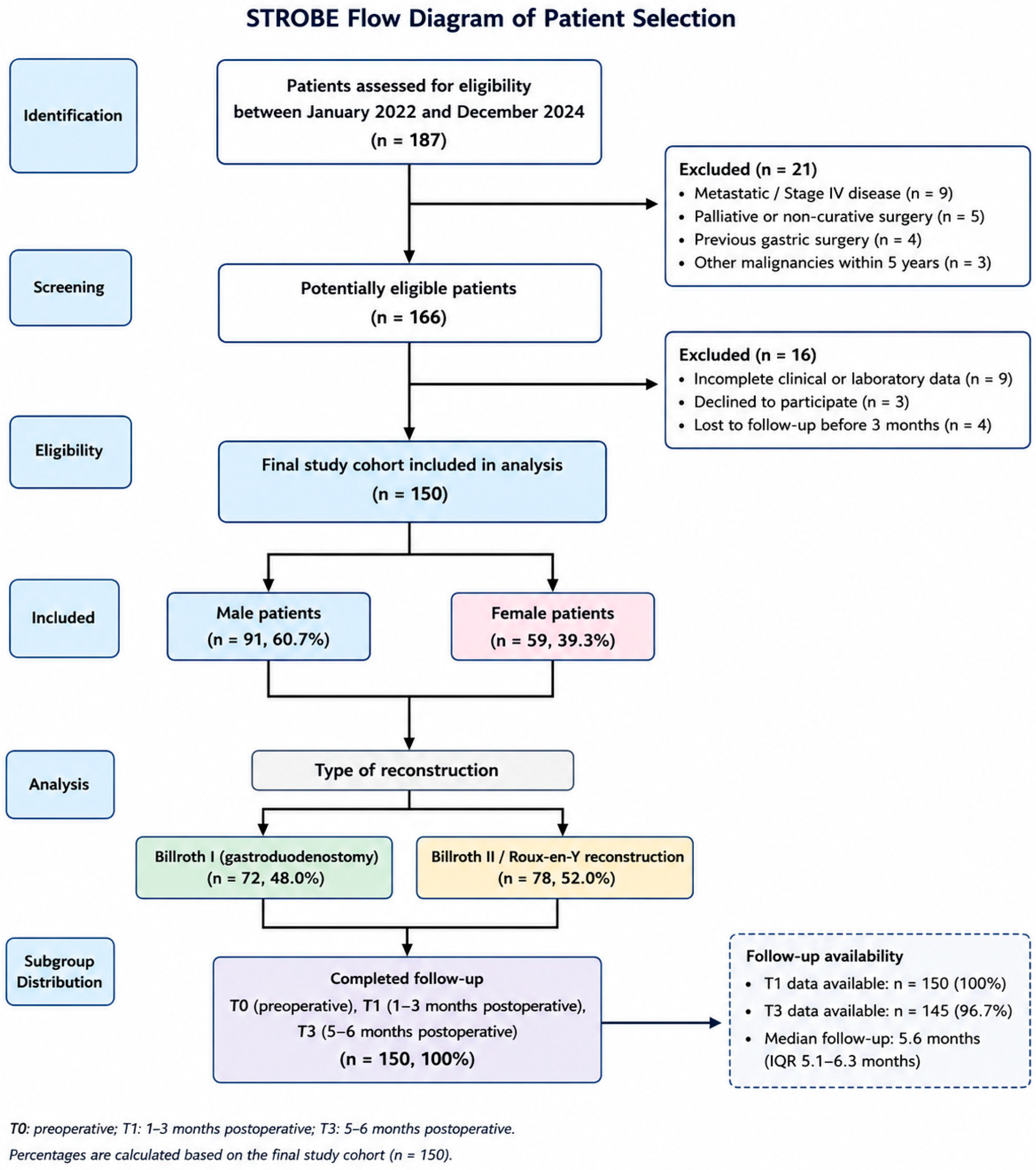
2.3. Patient Selection
- Metastatic disease at diagnosis or intraoperative evidence of unresectable disease;
- Palliative surgical procedures;
- Previous gastrectomy or prior surgery significantly altering gastrointestinal continuity;
- Severe hepatic or renal dysfunction;
- Active infection, chronic inflammatory, or autoimmune disease;
- Major psychiatric disorders impairing consent or follow-up;
- Incomplete laboratory data precluding calculation of the Controlling Nutritional Status (CONUT) score at predefined timepoints.
2.4. Surgical Procedure and Perioperative Management
2.5. Nutritional and Immunological Assessment
- T0 (preoperative): Within seven days before surgery.
- T1 (early postoperative): At postoperative day 7 ± 2 or at hospital discharge, whichever occurred first. T1 assessment was intentionally scheduled at postoperative day 7 (±2 days) or at hospital discharge because this timepoint corresponds to the early postoperative recovery phase, during which the acute metabolic and inflammatory response to surgery remains clinically relevant while immediate perioperative fluid shifts have largely stabilized. Earlier postoperative measurements (e.g., postoperative days 1–3) were not selected because they may be substantially influenced by transient hemodynamic changes, perioperative fluid administration, and acute surgical stress. The selected timepoint is consistent with previous studies evaluating perioperative immunonutritional changes following major gastrointestinal surgery.
- T3 (follow-up): Three months after surgery during routine outpatient evaluation.
2.6. Functional Recovery and Clinical Outcomes
- Time to restoration of gastrointestinal function;
- Length of postoperative hospital stay;
- Postoperative complications occurring within 30 days, classified according to the Clavien–Dindo grading system;
- Thirty-day readmission rate;
- Thirty-day postoperative mortality.
2.7. Statistical Analysis
3. Results
3.1. Baseline Clinicopathological Characteristics
3.2. Perioperative and Short-Term Postoperative Outcomes
3.3. Longitudinal Evolution of Immunonutritional Parameters
3.4. Functional and Mid-Term Recovery Outcomes
3.5. Independent Predictors of Delayed Functional Recovery
4. Discussion
5. Conclusions
Supplementary Materials
Author Contributions
Funding
Institutional Review Board Statement
Informed Consent Statement
Data Availability Statement
Acknowledgments
Conflicts of Interest
Abbreviations
| ASA | American Society of Anesthesiologists |
| BMI | Body Mass Index |
| CI | Confidence Interval |
| CONUT | Controlling Nutritional Status |
| ERAS | Enhanced Recovery After Surgery |
| JGCA | Japanese Gastric Cancer Association |
| LOS | Length of Stay |
| OR | Odds Ratio |
| PPI | Proton Pump Inhibitor |
| R0 | Microscopically Margin-Negative Resection |
| T0 | Preoperative Timepoint |
| T1 | Early Postoperative Timepoint |
| T3 | Three-Month Follow-Up Timepoint |
References
- Sung, H.; Ferlay, J.; Siegel, R.L.; Laversanne, M.; Soerjomataram, I.; Jemal, A.; Bray, F. Global cancer statistics 2020: GLOBOCAN estimates of incidence and mortality worldwide for 36 cancers in 185 countries. CA Cancer J. Clin. 2021, 71, 209–249. [Google Scholar] [CrossRef]
- Qin, N.; Fan, Y.; Yang, T.; Yang, Z.; Fan, D. The burden of Gastric Cancer and possible risk factors from 1990 to 2021, and projections until 2035: Findings from the Global Burden of Disease Study 2021. Biomark. Res. 2025, 13, 5. [Google Scholar] [CrossRef]
- Inoue, M. Epidemiology of gastric cancer—Changing trends and global disparities. Cancers 2024, 16, 2948. [Google Scholar] [CrossRef]
- Japanese Gastric Cancer Association. Japanese gastric cancer treatment guidelines 2021 (6th edition). Gastric Cancer 2023, 26, 1–25. [Google Scholar] [CrossRef]
- Xing, Y.; Hosaka, H.; Moki, F.; Tomaru, S.; Itoi, Y.; Sato, K.; Hashimoto, Y.; Tanaka, H.; Kuribayashi, S.; Takeuchi, Y.; et al. Gender Differences in Patients with Gastric Adenocarcinoma. J. Clin. Med. 2024, 13, 2524. [Google Scholar] [CrossRef]
- Smyth, E.C.; Nilsson, M.; Grabsch, H.I.; van Grieken, N.C.; Lordick, F. Gastric cancer. Lancet 2020, 396, 635–648. [Google Scholar] [CrossRef]
- Van Cutsem, E.; Sagaert, X.; Topal, B.; Haustermans, K.; Prenen, H. Gastric cancer. Lancet 2016, 388, 2654–2664. [Google Scholar] [CrossRef]
- Mocan, L. Surgical management of gastric cancer: A systematic review. J. Clin. Med. 2021, 10, 2557. [Google Scholar] [CrossRef]
- Tsekrekos, A.; Okumura, Y.; Rouvelas, I.; Nilsson, M. Gastric cancer surgery: Balancing oncological efficacy against postoperative morbidity and function detriment. Cancers 2024, 16, 1741. [Google Scholar] [CrossRef]
- Kalff, M.C.; Dijksterhuis, W.P.; Wagner, A.D.; Oertelt-Prigione, S.; Verhoeven, R.H.; Lemmens, V.E.; van Laarhoven, H.W.M.; Gisbertz, S.S.; van Berge Henegouwen, M.I. Sex differences in treatment allocation and survival of potentially curable gastroesophageal cancer: A population-based study. Eur. J. Cancer 2023, 187, 114–123. [Google Scholar] [CrossRef]
- Arakawa, H.; Komatsu, S.; Kamiya, H.; Nishibeppu, K.; Ohashi, T.; Konishi, H.; Shiozaki, A.; Kubota, T.; Fujiwara, H.; Otsuji, E. Differences of clinical features and outcomes between male and female elderly patients in gastric cancer. Sci. Rep. 2023, 13, 17192. [Google Scholar] [CrossRef]
- Sah, B.K.; Zhu, Z.G.; Wang, X.Y.; Yang, Q.M.; Chen, M.M.; Xiang, M.; Chen, J.; Yan, M. Post-operative complications of gastric cancer surgery: Female gender at high risk. Eur. J. Cancer Care 2009, 18, 202–208. [Google Scholar] [CrossRef][Green Version]
- Kuroda, D.; Sawayama, H.; Kurashige, J.; Iwatsuki, M.; Eto, T.; Tokunaga, R.; Kitano, Y.; Yamamura, K.; Ouchi, M.; Nakamura, K.; et al. Controlling Nutritional Status (CONUT) score is a prognostic marker for gastric cancer patients after curative resection. Gastric Cancer 2018, 21, 204–212. [Google Scholar] [CrossRef]
- Takagi, K.; Domagala, P.; Polak, W.G.; Buettner, S.; Wijnhoven, B.P.; Ijzermans, J.N. Prognostic significance of the controlling nutritional status (CONUT) score in patients undergoing gastrectomy for gastric cancer: A systematic review and meta-analysis. BMC Surg. 2019, 19, 129. [Google Scholar] [CrossRef]
- Liu, H.; Yang, X.C.; Liu, D.C.; Tong, C.; Wen, W.; Chen, R.H. Clinical significance of the controlling nutritional status (CONUT) score in gastric cancer patients: A meta-analysis of 9,764 participants. Front. Nutr. 2023, 10, 1156006. [Google Scholar] [CrossRef]
- Sun, F.; Zhang, C.; Liu, Z.; Ai, S.; Guan, W.; Liu, S. Controlling Nutritional Status (CONUT) score as a predictive marker for short-term complications following gastrectomy of gastric cancer: A retrospective study. BMC Gastroenterol. 2021, 21, 107. [Google Scholar] [CrossRef]
- Cosma, C.; Butiurca, V.O.; Nicolescu, C.; Russu, P.C.; Botoncea, M.; Molnar, C. Comparative analysis of nutritional and immune status using the CONUT score in patients undergoing Billroth I and Billroth II/Roux-en-Y reconstruction. Chirurgia 2025, 120, 566–574. [Google Scholar] [CrossRef]
- Qian, Y.; Liu, H.; Pan, J.; Yu, W.; Lv, J.; Yan, J.; Gao, J.; Wang, X.; Ge, X.; Zhou, W. Preoperative Controlling Nutritional Status (CONUT) score predicts short-term outcomes of patients with gastric cancer after laparoscopy-assisted radical gastrectomy. World J. Surg. Oncol. 2021, 19, 25. [Google Scholar] [CrossRef]
- Aoyama, T.; Komori, K.; Nakazano, M.; Hara, K.; Tamagawa, H.; Kazama, K.; Hashimoto, I.; Yamada, T.; Maezawa, Y.; Segami, K.; et al. The Clinical Influence of the CONUT Score on Survival of Patients With Gastric Cancer Receiving Curative Treatment. In Vivo 2022, 36, 942–948. [Google Scholar] [CrossRef]
- Esashi, R.; Aoyama, T.; Yamamoto, S.; Maezawa, Y.; Hashimoto, I.; Kazama, K.; Morita, J.; Kawahara, S.; Otani, K.; Komori, K.; et al. The CONUT Score Can Predict the Prognosis of Gastric Cancer Patients After Curative Treatment. Anticancer Res. 2025, 45, 1251–1260. [Google Scholar] [CrossRef]
- Chen, L.; Sun, H.; Zhao, R.; Huang, R.; Pan, H.; Zuo, Y.; Zhang, L.; Xue, Y.; Song, H.; Li, X. Controlling Nutritional Status (CONUT) Predicts Survival in Gastric Cancer Patients With Immune Checkpoint Inhibitor (PD-1/PD-L1) Outcomes. Front. Pharmacol. 2022, 13, 836958. [Google Scholar] [CrossRef]
- Vallance, P.C.; Mack, L.; Bouchard-Fortier, A.; Jost, E. Quality of Life Following the Surgical Management of Gastric Cancer Using Patient-Reported Outcomes: A Systematic Review. Curr. Oncol. 2024, 31, 872–884. [Google Scholar] [CrossRef]
- Eom, B.W.; Yoon, H.M.; Kim, Y.W.; Min, J.S.; An, J.Y.; Hur, H.; Li, Y.J.; Cho, G.S.; Park, Y.K.; Jung, M.R.; et al. Quality of Life and Nutritional Outcomes of Stomach-Preserving Surgery for Early Gastric Cancer. JAMA Surg. 2024, 159, 900–908. [Google Scholar] [CrossRef]
- Wang, W.B.; Song, H.N.; Huang, D.D.; Luo, X.; Cai, H.Y.; Yan, J.Y.; Chen, W.Z.; Xing, C.G.; Dong, Q.T.; Chen, X.L. Impact of Body Composition and Physical Function on Quality of Life After Gastrectomy for Gastric Cancer. Front. Surg. 2022, 8, 832351. [Google Scholar] [CrossRef]
- Zong, L.; Chen, P. Billroth I vs. Billroth II vs Roux-en-Y after distal gastrectomy: Meta-analysis. Hepatogastroenterology 2011, 58, 1413–1424. [Google Scholar] [CrossRef]
- Xiong, J.J.; Altaf, K.; Javed, M.A.; Nunes, Q.M.; Huang, W.; Mai, G.; Tan, C.L.; Mukherjee, R.; Sutton, R.; Hu, W.M.; et al. Roux-en-Y versus Billroth I reconstruction: Meta-analysis. World J. Gastroenterol. 2013, 19, 1124–1134. [Google Scholar] [CrossRef]
- Lombardo, F.; Aiolfi, A.; Cavalli, M.; Mini, E.; Lastraioli, C.; Panizzo, V.; Lanzaro, A.; Bonitta, G.; Danelli, P.; Campanelli, G.; et al. Techniques for reconstruction after distal gastrectomy for cancer: Updated network meta-analysis of randomized controlled trials. Langenbecks Arch. Surg. 2022, 407, 75–86. [Google Scholar] [CrossRef]



| Variable | Total (n = 150) | Males (n = 91) | Females (n = 59) | p-Value |
|---|---|---|---|---|
| Age, years | 62.4 ± 11.8 | 63.1 ± 11.5 | 61.3 ± 12.2 | 0.32 † |
| Body mass index, kg/m2 | 24.8 ± 3.9 | 25.0 ± 3.7 | 24.5 ± 4.1 | 0.41 † |
| ASA class | 0.84 ‡ | |||
| ASA I–II, n (%) | 98 (65.3%) | 60 (65.9%) | 38 (64.4%) | |
| ASA III, n (%) | 52 (34.7%) | 31 (34.1%) | 21 (35.6%) | |
| Comorbidities, n (%) | ||||
| Cardiovascular disease | 83 (55.3%) | 52 (57.1%) | 31 (52.5%) | 0.59 ‡ |
| Diabetes mellitus | 41 (27.3%) | 26 (28.6%) | 15 (25.4%) | 0.68 ‡ |
| Tumor location, n (%) | 0.74 ‡ | |||
| Antrum/distal stomach | 109 (72.7%) | 67 (73.6%) | 42 (71.2%) | |
| Pathological stage, n (%) | 0.81 ‡ | |||
| Stage I–II | 88 (58.7%) | 54 (59.3%) | 34 (57.6%) | |
| Stage III | 62 (41.3%) | 37 (40.7%) | 25 (42.4%) | |
| Neoadjuvant chemotherapy, n (%) | 46 (30.7%) | 29 (31.9%) | 17 (28.8%) | 0.69 ‡ |
| Type of reconstruction, n (%) | 0.91 ‡ | |||
| Billroth I | 72 (48.0%) | 44 (48.4%) | 28 (47.5%) | |
| Billroth II/Roux-en-Y | 78 (52.0%) | 47 (51.6%) | 31 (52.5%) | |
| Albumin T0, g/dL | 3.62 ± 0.54 | 3.60 ± 0.52 | 3.65 ± 0.56 | 0.47 † |
| Lymphocytes T0, ×109/L | 1.78 ± 0.46 | 1.75 ± 0.44 | 1.82 ± 0.48 | 0.36 † |
| Total cholesterol T0, mg/dL | 168.3 ± 34.7 | 166.9 ± 33.9 | 170.4 ± 36.1 | 0.52 † |
| CONUT score T0 | 2.9 ± 1.6 | 3.0 ± 1.5 | 2.8 ± 1.7 | 0.44 † |
| CONUT category T0, n (%) | 0.88 ‡ | |||
| Normal (0–1) | 49 (32.7%) | 29 (31.9%) | 20 (33.9%) | |
| Mild (2–4) | 71 (47.3%) | 44 (48.4%) | 27 (45.8%) | |
| Moderate–Severe (≥5) | 30 (20.0%) | 18 (19.8%) | 12 (20.3%) |
| Variable | Total (n = 150) | Males (n = 91) | Females (n = 59) | p-Value |
|---|---|---|---|---|
| Operative time, min | 201.4 ± 34.8 | 203.1 ± 35.2 | 198.8 ± 34.1 | 0.47 † |
| Estimated blood loss, mL | 312.6 ± 96.3 | 318.5 ± 99.1 | 303.4 ± 91.7 | 0.36 † |
| Time to first flatus, days | 3.8 ± 1.2 | 3.9 ± 1.3 | 3.7 ± 1.1 | 0.41 † |
| Time to oral diet, days | 5.9 ± 1.7 | 6.0 ± 1.8 | 5.8 ± 1.6 | 0.52 † |
| Length of hospital stay, days | 10.8 ± 3.9 | 11.0 ± 4.1 | 10.5 ± 3.6 | 0.48 † |
| Overall postoperative complications, n (%) | 47 (31.3%) | 30 (33.0%) | 17 (28.8%) | 0.59 ‡ |
| Clavien–Dindo classification, n (%) | 0.77 ‡ | |||
| Grade I–II | 33 (22.0%) | 21 (23.1%) | 12 (20.3%) | |
| Grade III–IV | 14 (9.3%) | 9 (9.9%) | 5 (8.5%) | |
| Grade V | 2 (1.3%) | 1 (1.1%) | 1 (1.7%) | |
| Specific complications, n (%) | ||||
| Anastomotic leak | 9 (6.0%) | 6 (6.6%) | 3 (5.1%) | 0.71 § |
| Surgical site infection | 14 (9.3%) | 9 (9.9%) | 5 (8.5%) | 0.78 ‡ |
| Postoperative ileus | 11 (7.3%) | 7 (7.7%) | 4 (6.8%) | 0.84 § |
| Pulmonary complications | 13 (8.7%) | 9 (9.9%) | 4 (6.8%) | 0.51 § |
| 30-day readmission, n (%) | 12 (8.0%) | 8 (8.8%) | 4 (6.8%) | 0.66 § |
| 30-day reoperation, n (%) | 10 (6.7%) | 6 (6.6%) | 4 (6.8%) | 0.97 § |
| 90-day mortality, n (%) | 4 (2.7%) | 3 (3.3%) | 1 (1.7%) | 0.56 § |
| Variable | Timepoint | Total (n = 150) | Males (n = 91) | Females (n = 59) | p-Value | p-Sex |
|---|---|---|---|---|---|---|
| Albumin, g/dL | T0 | 3.62 ± 0.54 | 3.60 ± 0.52 | 3.65 ± 0.56 | <0.001 | 0.41 † |
| T1 | 3.18 ± 0.47 | 3.15 ± 0.45 | 3.22 ± 0.49 | |||
| T3 | 3.71 ± 0.43 | 3.68 ± 0.41 | 3.75 ± 0.46 | |||
| Lymphocytes, ×109/L | T0 | 1.78 ± 0.46 | 1.75 ± 0.44 | 1.82 ± 0.48 | <0.001 | 0.36 † |
| T1 | 1.34 ± 0.39 | 1.31 ± 0.37 | 1.38 ± 0.42 | |||
| T3 | 1.69 ± 0.41 | 1.66 ± 0.40 | 1.73 ± 0.43 | |||
| Total cholesterol, mg/dL | T0 | 168.3 ± 34.7 | 166.9 ± 33.9 | 170.4 ± 36.1 | <0.001 | 0.52 † |
| T1 | 142.7 ± 31.5 | 140.9 ± 30.8 | 145.4 ± 32.3 | |||
| T3 | 161.5 ± 33.7 | 159.8 ± 32.9 | 164.1 ± 34.6 | |||
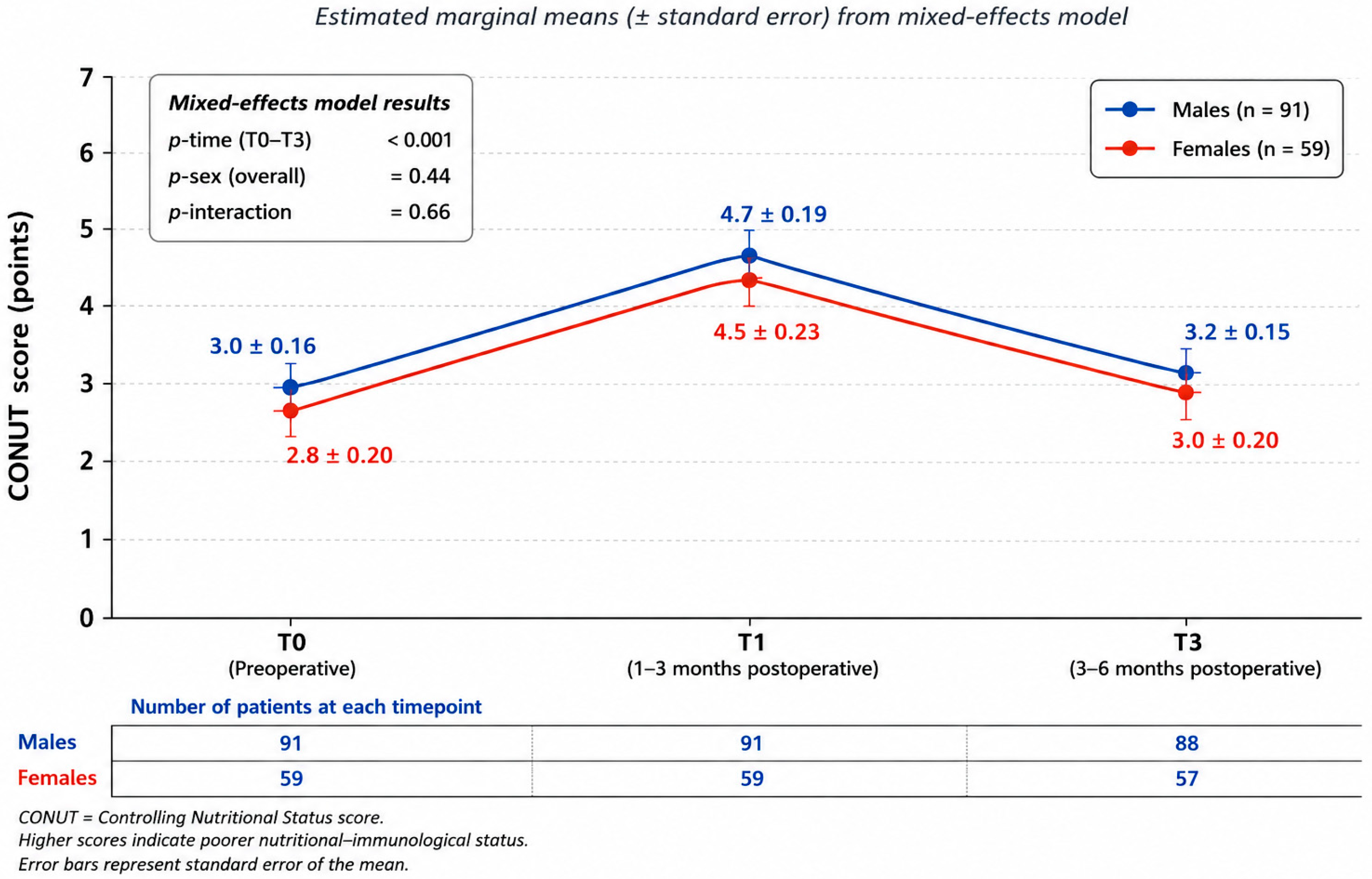
| CONUT score | T0 | 2.9 ± 1.6 | 3.0 ± 1.5 | 2.8 ± 1.7 | <0.001 | 0.44 † |
| T1 | 4.6 ± 1.9 | 4.7 ± 1.8 | 4.5 ± 2.0 | |||
| T3 | 3.1 ± 1.5 | 3.2 ± 1.4 | 3.0 ± 1.6 |
| Variable | Total (n = 150) | Males (n = 91) | Females (n = 59) | p-Value |
|---|---|---|---|---|
| Weight loss at 3 months, % | 8.6 ± 4.1 | 8.9 ± 4.3 | 8.1 ± 3.8 | 0.29 † |
| Albumin T1, g/dL | 3.18 ± 0.47 | 3.15 ± 0.45 | 3.22 ± 0.49 | 0.38 † |
| Albumin T3, g/dL | 3.71 ± 0.43 | 3.68 ± 0.41 | 3.75 ± 0.46 | 0.34 † |
| Lymphocytes T1, ×109/L | 1.34 ± 0.39 | 1.31 ± 0.37 | 1.38 ± 0.42 | 0.31 † |
| Lymphocytes T3, ×109/L | 1.69 ± 0.41 | 1.66 ± 0.40 | 1.73 ± 0.43 | 0.37 † |
| Total cholesterol T1, mg/dL | 142.7 ± 31.5 | 140.9 ± 30.8 | 145.4 ± 32.3 | 0.41 † |
| Total cholesterol T3, mg/dL | 161.5 ± 33.7 | 159.8 ± 32.9 | 164.1 ± 34.6 | 0.46 † |
| CONUT score T1 | 4.6 ± 1.9 | 4.7 ± 1.8 | 4.5 ± 2.0 | 0.52 † |
| CONUT score T3 | 3.1 ± 1.5 | 3.2 ± 1.4 | 3.0 ± 1.6 | 0.47 † |
| LA esophagitis, n (%) | 0.73 ‡ | |||
| Absent | 87 (58.0%) | 52 (57.1%) | 35 (59.3%) | |
| Grade A–B | 48 (32.0%) | 30 (33.0%) | 18 (30.5%) | |
| Grade C–D | 15 (10.0%) | 9 (9.9%) | 6 (10.2%) | |
| Bile reflux gastritis, n (%) | 0.68 ‡ | |||
| Absent | 79 (52.7%) | 47 (51.6%) | 32 (54.2%) | |
| Mild | 41 (27.3%) | 26 (28.6%) | 15 (25.4%) | |
| Moderate–Severe | 30 (20.0%) | 18 (19.8%) | 12 (20.3%) | |
| Dumping syndrome (Sigstad score > 7), n (%) | 36 (24.0%) | 23 (25.3%) | 13 (22.0%) | 0.65 ‡ |
| PPI use at 3 months, n (%) | 58 (38.7%) | 36 (39.6%) | 22 (37.3%) | 0.78 ‡ |
| PPI use at 6 months, n (%) | 44 (29.3%) | 27 (29.7%) | 17 (28.8%) | 0.91 ‡ |
| Variable | Adjusted OR | 95% CI | p Value |
|---|---|---|---|
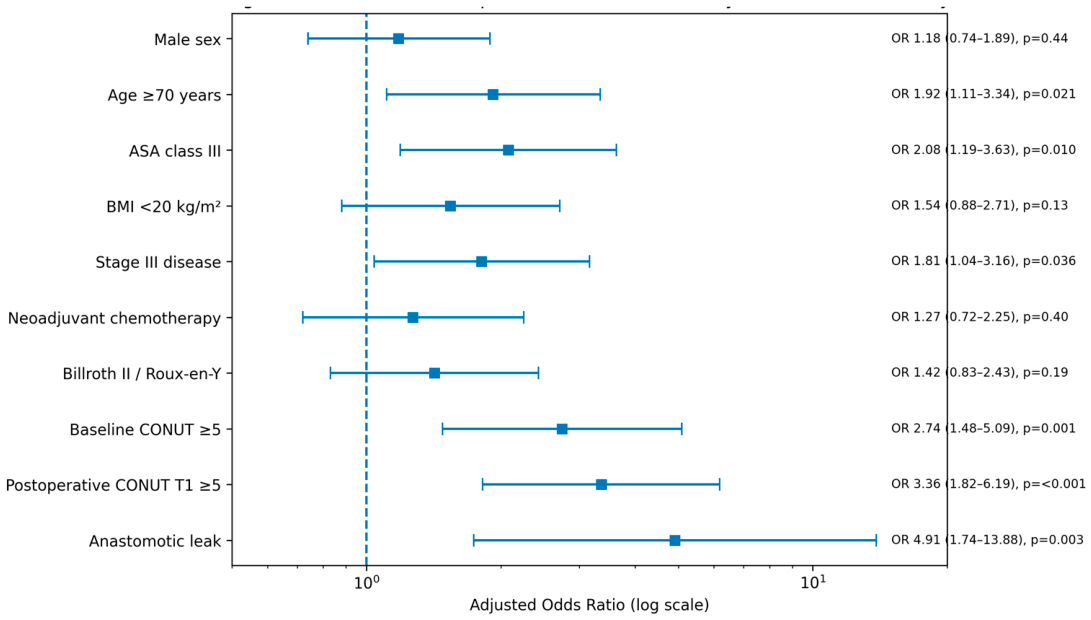
| Male sex | 1.18 | 0.74–1.89 | 0.44 |
| Age ≥ 70 years | 1.92 | 1.11–3.34 | 0.021 |
| ASA class III | 2.08 | 1.19–3.63 | 0.010 |
| Body mass index < 20 kg/m2 | 1.54 | 0.88–2.71 | 0.13 |
| Stage III disease | 1.81 | 1.04–3.16 | 0.036 |
| Neoadjuvant chemotherapy | 1.27 | 0.72–2.25 | 0.40 |
| Billroth II/Roux-en-Y reconstruction | 1.42 | 0.83–2.43 | 0.19 |
| Baseline CONUT score ≥ 5 | 2.74 | 1.48–5.09 | 0.001 |
| Postoperative CONUT score T1 ≥ 5 | 3.36 | 1.82–6.19 | <0.001 |
| Anastomotic leak | 4.91 | 1.74–13.88 | 0.003 |
Disclaimer/Publisher’s Note: The statements, opinions and data contained in all publications are solely those of the individual author(s) and contributor(s) and not of MDPI and/or the editor(s). MDPI and/or the editor(s) disclaim responsibility for any injury to people or property resulting from any ideas, methods, instructions or products referred to in the content. |
© 2026 by the authors. Licensee MDPI, Basel, Switzerland. This article is an open access article distributed under the terms and conditions of the Creative Commons Attribution (CC BY) license.
Share and Cite
Cosma, C.D.; Butiurca, V.O.; Botoncea, M.; Nicolescu, C.; Molnar, D.; Molnar, C. Perioperative Immunonutritional Status and Functional Recovery After Gastrectomy for Gastric Cancer: A Prospective Cohort Study of Sex-Related Differences. J. Clin. Med. 2026, 15, 4558. https://doi.org/10.3390/jcm15124558
Cosma CD, Butiurca VO, Botoncea M, Nicolescu C, Molnar D, Molnar C. Perioperative Immunonutritional Status and Functional Recovery After Gastrectomy for Gastric Cancer: A Prospective Cohort Study of Sex-Related Differences. Journal of Clinical Medicine. 2026; 15(12):4558. https://doi.org/10.3390/jcm15124558
Chicago/Turabian StyleCosma, Catalin Dumitru, Vlad Olimpiu Butiurca, Marian Botoncea, Cosmin Nicolescu, Dragos Molnar, and Călin Molnar. 2026. "Perioperative Immunonutritional Status and Functional Recovery After Gastrectomy for Gastric Cancer: A Prospective Cohort Study of Sex-Related Differences" Journal of Clinical Medicine 15, no. 12: 4558. https://doi.org/10.3390/jcm15124558
APA StyleCosma, C. D., Butiurca, V. O., Botoncea, M., Nicolescu, C., Molnar, D., & Molnar, C. (2026). Perioperative Immunonutritional Status and Functional Recovery After Gastrectomy for Gastric Cancer: A Prospective Cohort Study of Sex-Related Differences. Journal of Clinical Medicine, 15(12), 4558. https://doi.org/10.3390/jcm15124558