The Role of 3D/4D Transperineal Ultrasound in Risk Stratification for Pelvic Organ Prolapse Recurrence: Native Tissue Versus Mesh Repair
 , , and
Abstract
1. Introduction
2. Materials and Methods
2.1. Patient Inclusion
2.2. Surgical Interventions
2.3. Clinical Evaluation, Follow-Up, and Outcome Definitions
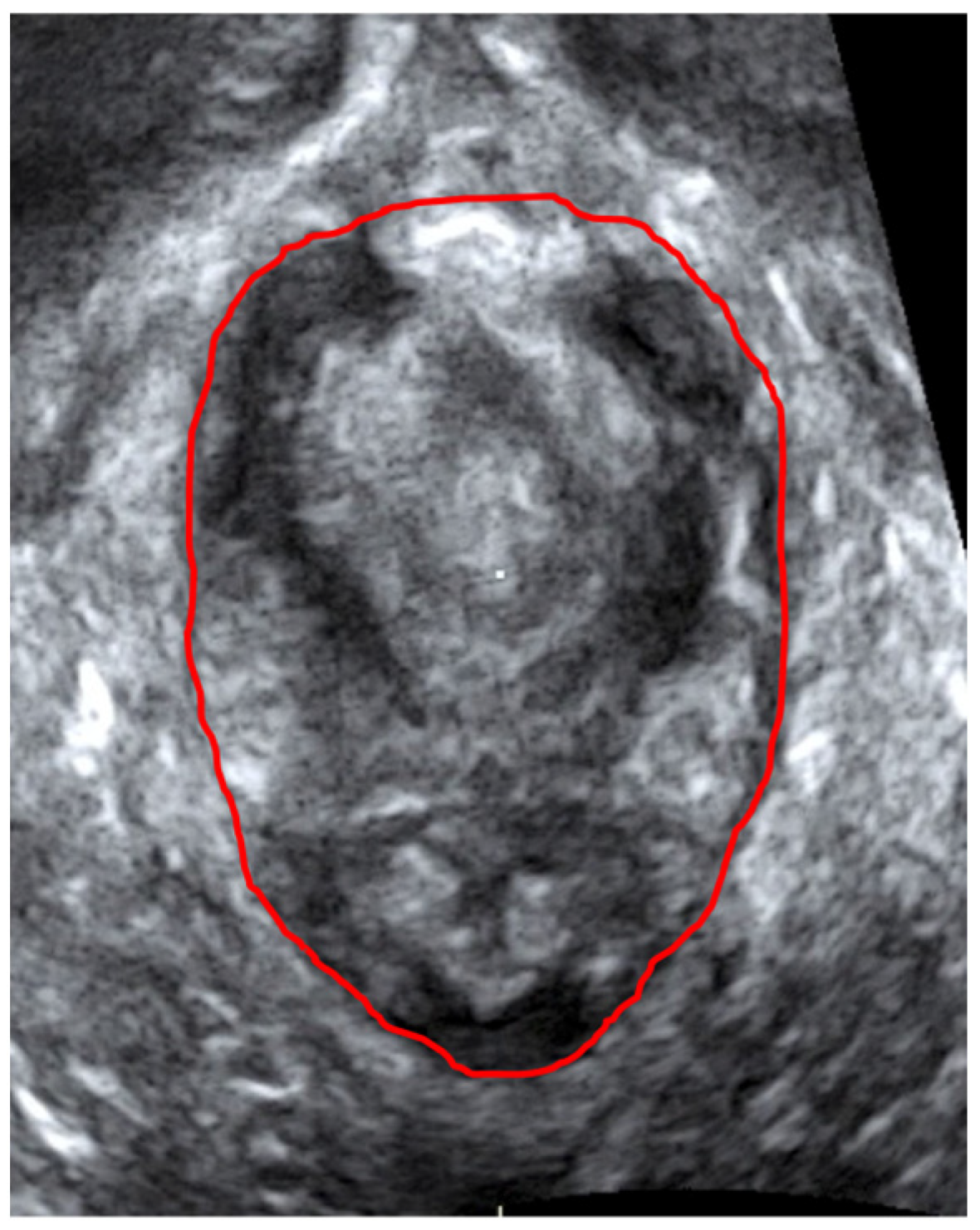
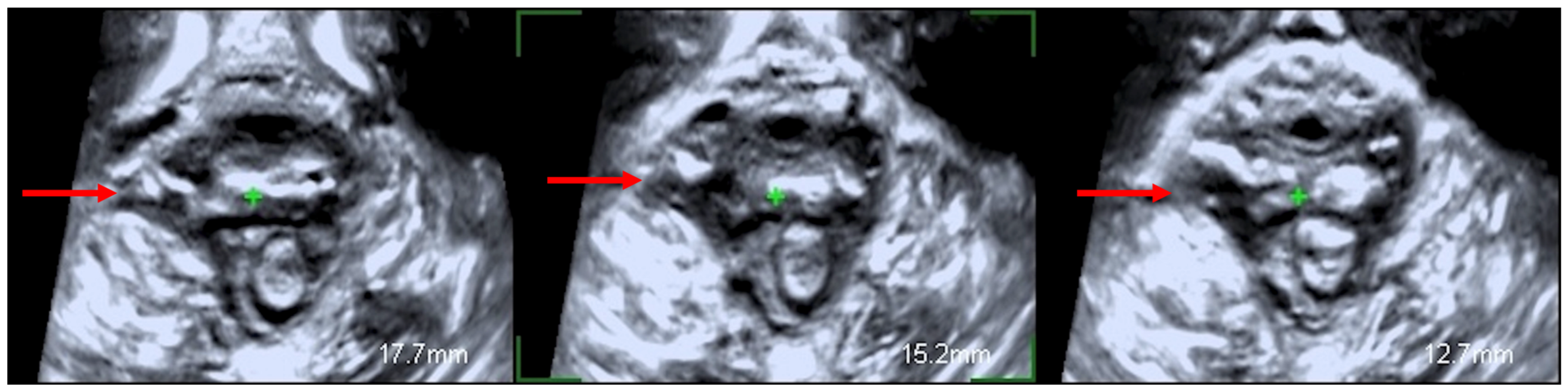
2.4. Ultrasound Examination
2.5. Statistical Analysis
3. Results
4. Discussion
Strengths and Limitations
5. Conclusions
Author Contributions
Funding
Institutional Review Board Statement
Informed Consent Statement
Data Availability Statement
Conflicts of Interest
Abbreviations
| BMI | Body Mass Index |
| BSC | Bilateral Sacrospinous |
| CI | Confidence Interval |
| IQR | Interquartile Range |
| LAM | Levator Ani Muscle |
| LHA | Levator Hiatus Area |
| POP | Pelvic Organ Prolapse |
| POP-Q | Pelvic Organ Prolapse Quantification System |
| SD | Standard Deviation |
References
- Maher, C.; Feiner, B.; Baessler, K.; Christmann-Schmid, C.; Haya, N.; Brown, J. Surgery for women with anterior compartment prolapse. Cochrane Database Syst. Rev. 2016, 11, CD004014. [Google Scholar] [CrossRef]
- Petros, P. Do hiatal expansion and levator avulsion have a role in causation of pelvic organ prolapse? Eur. J. Obstet. Gynecol. Reprod. Biol. 2022, 277, 97–100. [Google Scholar] [CrossRef]
- Wong, N.K.L.; Cheung, R.Y.K.; Lee, L.L.; Wan, O.Y.K.; Choy, K.W.; Chan, S.S.C. Women with advanced pelvic organ prolapse and levator ani muscle avulsion would significantly benefit from mesh repair surgery. Ultrasound Obstet. Gynecol. 2021, 57, 631–638. [Google Scholar] [CrossRef]
- Yeung, E.; Baessler, K.; Christmann-Schmid, C.; Haya, N.; Chen, Z.; Wallace, S.A.; Mowat, A.; Maher, C. Transvaginal mesh or grafts or native tissue repair for vaginal prolapse. Cochrane Database Syst. Rev. 2024, 3, CD012079. [Google Scholar] [CrossRef] [PubMed]
- Warembourg, S.; Labaki, M.; de Tayrac, R.; Costa, P.; Fatton, B. Reoperations for mesh-related complications after pelvic organ prolapse repair: 8-year experience at a tertiary referral center. Int. Urogynecol. J. 2017, 28, 1139–1151. [Google Scholar] [CrossRef] [PubMed]
- Fritel, X.; de Tayrac, R.; de Keizer, J.; Campagne-Loiseau, S.; Cosson, M.; Ferry, P.; Deffieux, X.; Lucot, J.P.; Wagner, L.; Debodinance, P.; et al. Serious complications and recurrences after pelvic organ prolapse surgery for 2309 women in the VIGI-MESH registry. BJOG 2022, 129, 656–663. [Google Scholar] [CrossRef]
- ACOG. Pelvic Organ Prolapse: ACOG Practice Bulletin, Number 214. Obstet. Gynecol. 2019, 134, e126–e142. [Google Scholar] [CrossRef]
- Skoczylas, L.C.; Turner, L.C.; Wang, L.; Winger, D.G.; Shepherd, J.P. Changes in prolapse surgery trends relative to FDA notifications regarding vaginal mesh. Int. Urogynecol. J. 2014, 25, 471–477. [Google Scholar] [CrossRef]
- Švabík, K.; El Haddad, R.; Mašata, J.; Hubka, P.; Martan, A. Correlation of subjective and objective assessment of vaginal prolapse surgery-secondary analysis of randomized controlled study in patients with pelvic floor injury treated with vaginal mesh or with sacrospinous ligament fixation. Ceska Gynekol. 2015, 80, 351–354. [Google Scholar] [PubMed]
- Liu, Z.; Sharen, G.; Wang, P.; Chen, L.; Tan, L. Clinical and pelvic floor ultrasound characteristics of pelvic organ prolapse recurrence after transvaginal mesh pelvic reconstruction. BMC Women’s Health 2022, 22, 102. [Google Scholar] [CrossRef]
- Dietz, H.P.; Chantarasorn, V.; Shek, K.L. Levator avulsion is a risk factor for cystocele recurrence. Ultrasound Obstet. Gynecol. 2010, 36, 76–80. [Google Scholar] [CrossRef]
- Shi, W.; Guo, L. Risk factors for the recurrence of pelvic organ prolapse: A meta-analysis. J. Obstet. Gynaecol. 2023, 43, 2160929. [Google Scholar] [CrossRef]
- Coll, S.; Vila, M.; Caminal, J.; Pagès, A.; Sanjosé, M.; Tresserra, F.; Rodríguez, I.; Fernández, R.; Barri-Soldevila, P.N. Long-term follow-up after laparoscopic reparation of pelvic organ prolapses in a large teaching gynecological center. Eur. J. Obstet. Gynecol. Reprod. Biol. 2024, 303, 146–152. [Google Scholar] [CrossRef] [PubMed]
- Friedman, T.; Eslick, G.D.; Dietz, H.P. Risk factors for prolapse recurrence: Systematic review and meta-analysis. Int. Urogynecol. J. 2018, 29, 13–21. [Google Scholar] [CrossRef]
- Nyhus, M.Ø.; Mathew, S.; Salvesen, K.Å.; Volløyhaug, I. The impact of levator ani muscle trauma and contraction on recurrence after prolapse surgery. Int. Urogynecol. J. 2022, 33, 2879–2885. [Google Scholar] [CrossRef] [PubMed]
- Oversand, S.H.; Cathrine Staff, A.; Volløyhaug, I.; Svenningsen, R. Impact of levator ani muscle avulsions on Manchester procedure outcomes: A 5-year follow-up study. Acta Obstet. Gynecol. Scand. 2025, 104, 1200–1206. [Google Scholar] [CrossRef]
- Yeung, E.; Malacova, E.; Maher, C. Is levator ani avulsion a risk factor for prolapse recurrence? A systematic review and meta-analysis. Int. Urogynecol. J. 2022, 33, 1813–1826. [Google Scholar] [CrossRef]
- Rodrigo, N.; Wong, V.; Shek, K.L.; Martin, A.; Dietz, H.P. The use of 3-dimensional ultrasound of the pelvic floor to predict recurrence risk after pelvic reconstructive surgery. Aust. N. Z. J. Obstet. Gynaecol. 2014, 54, 206–211. [Google Scholar] [CrossRef]
- Schulten, S.F.M.; Claas-Quax, M.J.; Weemhoff, M.; van Eijndhoven, H.W.; van Leijsen, S.A.; Vergeldt, T.F.; IntHout, J.; Kluivers, K.B. Risk factors for primary pelvic organ prolapse and prolapse recurrence: An updated systematic review and meta-analysis. Am. J. Obstet. Gynecol. 2022, 227, 192–208. [Google Scholar] [CrossRef] [PubMed]
- Serrano, S.; Henriques, A.; Valentim-Lourenço, A.; Pereira, I. Levator ani muscle avulsion in patients with pelvic floor dysfunction–Does it help in understanding pelvic organ prolapse? Eur. J. Obstet. Gynecol. Reprod. Biol. 2022, 279, 140–145. [Google Scholar] [CrossRef]
- Dietz, H.; Simpson, J. Levator trauma is associated with pelvic organ prolapse. BJOG 2008, 115, 979–984. [Google Scholar] [CrossRef] [PubMed]
- Liu, L.; Liu, X.; Liu, C.; Yao, M.; Xu, H. Transperineal pelvic floor ultrasound for analyzing the outcomes of pelvic floor surgery for the treatment of anterior compartment prolapse: A comparative study of transvaginal mesh and native-tissue repair. LUTS Low. Urin. Tract Symptoms 2021, 13, 456–462. [Google Scholar] [CrossRef] [PubMed]
- Handa, V.L.; Roem, J.; Blomquist, J.L.; Dietz, H.P.; Muñoz, A. Pelvic organ prolapse as a function of levator ani avulsion, hiatus size, and strength. Am. J. Obstet. Gynecol. 2019, 221, 41.e1–41.e7. [Google Scholar] [CrossRef]
- Șerbănescu, L.; Rotar, V.; Brezeanu, D.; Mirea, S.; Ionescu, E.-V.; Ionescu, P. Evaluating the Efficacy of Combined Intravaginal Estriol Therapy and Kegel Exercises in Managing Menopausal Atrophic Vulvovaginitis. Clin. Pract. 2025, 15, 20. [Google Scholar] [CrossRef]
- Handa, V.L.; Blomquist, J.L.; McDermott, K.C.; Friedman, S.; Muñoz, A. Pelvic floor disorders after vaginal birth: Effect of episiotomy, perineal laceration, and operative birth. Obstet. Gynecol. 2012, 119, 233–239. [Google Scholar] [CrossRef] [PubMed]



| All (n:276) | Native Tissue Repair (n:116) | Mesh Repair (n:160) | p | |
|---|---|---|---|---|
| Age (years) | 60.2 ± 9.2 | 59.2 ± 9.7 | 60.9 ± 8.8 | 0.012 |
| Age at menopause (years) | 49.8 ± 4.4 | 50.3 ± 4.0 | 49.3 ± 4.7 | 0.098 |
| Weight (Kg) | 69.9 ± 11.5 | 71.2 ± 12.0 | 68.9 ± 10.9 | 0.199 |
| Height (m) | 1.6 ± 0.1 | 1.6 ± 0.07 | 1.6 ± 0.06 | 0.573 |
| BMI | 27.1 ± 4.6 | 27.6 ± 4.7 | 26.7 ± 4.5 | 0.209 |
| Obstetric history | ||||
| Parity | 2.3 ± 1.1 | 2.4 ± 1.2 | 2.3 ± 1.0 | 0.542 |
| Cesarean sections | 0.1 ± 0.4 | 0.2 ± 0.5 | 0.08 ± 0.3 | 0.051 |
| Cystocele | 250 (90.6%) | 97 (83.6%) | 153 (95.6%) | 0.004 |
| Stage I | 9 (3.3%) | 3 (2.6%) | 6 (3.8%) | 0.003 |
| Stage II | 30 (10.87%) | 18 (15.5%) | 12 (7.5%) | |
| Stage III | 198 (71.7%) | 76 (65.5%) | 122 (76.3%) | |
| Stage IV | 13 (4.7%) | 0 (0.0%) | 13 (8.1%) | |
| Uterine prolapse | 177 (64.1%) | 43 (37.1%) | 134 (83.8%) | <0.001 |
| Stage I | 19 (6.9%) | 6 (5.2%) | 13 (8.1%) | 0.405 |
| Stage II | 51 (18.5%) | 9 (7.8%) | 42 (26.3%) | |
| Stage III | 94 (34.1%) | 26 (22.4%) | 68 (42.5%) | |
| Stage IV | 13 (4.7%) | 2 (1.7%) | 11 (6.9%) | |
| Cervical elongation | 59 (21.4%) | 52 (44.8%) | 7 (4.4%) | <0.001 |
| Stage I | 4 (1.4%) | 4 (3.4%) | 0 (0%) | 0.100 |
| Stage II | 16 (5.8%) | 15 (12.9%) | 1 (0.6%) | |
| Stage III | 38 (13.8%) | 33 (28.4%) | 5 (3.1%) | |
| Stage IV | 1 (0.4%) | 0 (0%) | 1 (0.6%) | |
| Rectocele | 170 (61.6%) | 42 (36.2%) | 128 (80%) | <0.001 |
| Stage I | 47 (17.0%) | 17 (14.7%) | 30 (18.8%) | 0.059 |
| Stage II | 94 (34.1%) | 17 (14.7%) | 77 (48.1%) | |
| Stage III | 29 (10.5%) | 8 (6.9%) | 21 (13.1%) | |
| Enterocele | 14 (5.1%) | 9 (7.8%) | 5 (3.1%) | 0.157 |
| Stage I | 3 (1.1%) | 2 (1.7%) | 1 (0.6%) | 0.237 |
| Stage II | 4 (1.4%) | 4 (3.4%) | 0 (0%) | |
| Stage III | 7 (2.5%) | 3 (2.6%) | 4 (2.5%) | |
| LHA at Valsalva | 33.2 ± 8.3 | 28.9 ± 8.2 | 36.7 ± 6.6 | <0.001 |
| Ballooning | 210 (76.1%) | 70 (60.3%) | 140 (87.5%) | <0.001 |
| Avulsion | 94 (34.1%) | 16 (13.8%) | 78 (48.8%) | <0.001 |
| With Avulsion & Native Tissue (n:16) | Without Avulsion & Native Tissue (n:100) | With Avulsion & Mesh (n:78) | Without Avulsion & Mesh (n:78) | p1 | p2 | p3 | p4 | |
|---|---|---|---|---|---|---|---|---|
| Subjective recurrence | 3 (18.8%) | 20 (20.0%) | 3 (3.8%) | 5 (6.4%) | 0.825 | 0.717 | 0.097 | 0.018 |
| Objective recurrence | 5 (31.3%) | 33 (33.0%) | 17 (21.8%) | 14 (17.9%) | 0.882 | 0.688 | 0.624 | 0.037 |
| Time to recurrence (days) | 694.8 ± 555.1 | 724.1 ± 498.9 | 512.3 ± 425.5 | 340.1 ± 157.1 | ||||
| Cystocele recurrence | 5 (31.3%) | 27 (27%) | 14 (17.9%) | 13 (16.7%) | 0.959 | 1.000 | 0.387 | 0.145 |
| Uterine prolapse recurrence | 0 (0%) | 5 (5%) | 3 (3.8%) | 1 (1.3%) | 0.802 | 0.613 | 0.987 | 0.345 |
| Cervical elongation recurrence | 0 (0%) | 0 (0.0%) | 1 (1.3%) | 1 (1.3%) | --- | 0.477 | 0.378 | 0.901 |
| Rectocele recurrence | 0 (0%) | 15 (15.0%) | 3 (3.8%) | 0 (0%) | 0.210 | 0.244 | 0.987 | 0.122 |
| Enterocele recurrence | 0 (0%) | 0 (0%) | 0 (0%) | 0 (0%) | --- | --- | --- | --- |
| With Ballooning & Native Tissue (n:70) | Without Ballooning & Native Tissue (n:46) | With Ballooning & Mesh (n:140) | Without Ballooning & Mesh (n:14) | p1 | p2 | p3 | p4 | |
|---|---|---|---|---|---|---|---|---|
| Subjective recurrence | 15 (21.4%) | 8 (17.4%) | 8 (5.7%) | 0 (0.0%) | 0.768 | 0.774 | 0.001 | 0.219 |
| Objective recurrence | 25 (35.7%) | 13 (28.3%) | 30 (21.4%) | 1 (7.1%) | 0.526 | 0.357 | 0.040 | 0.202 |
| Time to recurrence (days) | 750.2 ± 500.7 | 662.7 ± 509.9 | 453.9 ± 343.2 | |||||
| Cystocele recurrence | 22 (31.4%) | 10 (21.7%) | 27 (19.3%) | 0 (0.0%) | 0.352 | 0.149 | 0.074 | 0.133 |
| Uterine prolapse recurrence | 3 (4.3%) | 2 (4.3%) | 4 (2.9%) | 0 (0.0%) | --- | --- | --- | --- |
| Cervical elongation recurrence | 2 (2.9%) | 0 (0.0%) | 1(0.7%) | 1 (7.1%) | --- | 0.431 | 0.723 | 0.525 |
| Rectocele recurrence | 10 (14.3%) | 5 (10.9%) | 3 (2.1%) | 0 (0%) | 0.799 | 0.645 | 0.002 | 0.462 |
| Enterocele recurrence | 0 (0.0%) | 0 (0.0%) | 0 (0.0%) | 0 (0%) | --- | --- | --- | --- |
| Subjective Recurrence | Objective Recurrence | |||||||
|---|---|---|---|---|---|---|---|---|
| Univariate Analysis | Multivariate Analysis | Univariate Analysis | Multivariate Analysis | |||||
| OR (95% CI) | p | OR (95% CI) | p | OR (95% CI) | p | OR (95% CI) | p | |
| Age (years) | 1.042 (1.002; 1.084) | 0.041 | 1.020 (0.992; 1.049) | 0.160 | ||||
| Menopause | 1.691 (0.736; 3.889) | 0.216 | 1.396 (0.753; 2.589) | 0.290 | ||||
| Age at menopause | 0.951 (0.853; 1.060) | 0.362 | 0.961 (0.895; 1.033) | 0.281 | ||||
| BMI | 1.007 (0.929; 1.091) | 0.866 | 0.942 (0.889; 0.998) | 0.044 | ||||
| Parity | 1.768 (1.158; 2.701) | 0.008 | 1.809 (1.175; 2.787) | 0.007 | 1.021 (0.810; 1.289) | 0.858 | ||
| Cesarean sections | 0.860 (0.350; 2.111) | 0.741 | 1.037 (0.518; 2.097) | 0.917 | ||||
| LHA at rest | 1.015 (0.933; 1.103) | 0.735 | 1.027 (0.956; 1.103) | 0.467 | ||||
| LHA at Valsalva | 1.019 (0.975; 1.066) | 0.404 | 0.993 (0.960; 1.026) | 0.669 | ||||
| Ballooning | 1.251 (0.529; 2.959) | 0.610 | 0.858 (0.438; 0.681) | 0.655 | ||||
| Avulsion | 2.397 (0.947; 6.067) | 0.065 | 1.174 (0.656; 2.102) | 0.589 | ||||
| Native tissue repair | 5.315 (2.315; 12.497) | <0.001 | 4.575 (1.965;10.654) | <0.001 | 1.786 (1.057; 3.020) | 0.030 | 1.752 (1.024; 2.999) | 0.041 |
Disclaimer/Publisher’s Note: The statements, opinions and data contained in all publications are solely those of the individual author(s) and contributor(s) and not of MDPI and/or the editor(s). MDPI and/or the editor(s) disclaim responsibility for any injury to people or property resulting from any ideas, methods, instructions or products referred to in the content. |
© 2026 by the authors. Licensee MDPI, Basel, Switzerland. This article is an open access article distributed under the terms and conditions of the Creative Commons Attribution (CC BY) license.
Share and Cite
García-Mejido, J.A.; Nuñez-Matas, M.J.; Salas-Álvarez, O.; Crespo-Rodriguez, A.; Fernández-Palacín, A.; Sainz-Bueno, J.A. The Role of 3D/4D Transperineal Ultrasound in Risk Stratification for Pelvic Organ Prolapse Recurrence: Native Tissue Versus Mesh Repair. J. Clin. Med. 2026, 15, 4627. https://doi.org/10.3390/jcm15124627
García-Mejido JA, Nuñez-Matas MJ, Salas-Álvarez O, Crespo-Rodriguez A, Fernández-Palacín A, Sainz-Bueno JA. The Role of 3D/4D Transperineal Ultrasound in Risk Stratification for Pelvic Organ Prolapse Recurrence: Native Tissue Versus Mesh Repair. Journal of Clinical Medicine. 2026; 15(12):4627. https://doi.org/10.3390/jcm15124627
Chicago/Turabian StyleGarcía-Mejido, José Antonio, María José Nuñez-Matas, Olaya Salas-Álvarez, Alejandro Crespo-Rodriguez, Ana Fernández-Palacín, and José Antonio Sainz-Bueno. 2026. "The Role of 3D/4D Transperineal Ultrasound in Risk Stratification for Pelvic Organ Prolapse Recurrence: Native Tissue Versus Mesh Repair" Journal of Clinical Medicine 15, no. 12: 4627. https://doi.org/10.3390/jcm15124627
APA StyleGarcía-Mejido, J. A., Nuñez-Matas, M. J., Salas-Álvarez, O., Crespo-Rodriguez, A., Fernández-Palacín, A., & Sainz-Bueno, J. A. (2026). The Role of 3D/4D Transperineal Ultrasound in Risk Stratification for Pelvic Organ Prolapse Recurrence: Native Tissue Versus Mesh Repair. Journal of Clinical Medicine, 15(12), 4627. https://doi.org/10.3390/jcm15124627