Article

Some CYP21A2 Polymorphisms in the Exon 7 Region Might Be Associated with Cortisol Secretion in Polycystic Ovary Syndrome


1
Department of Endocrinology, Faculty of Medicine, Medical University-Sofia, USHATE “Acad. Iv. Penchev”, 1000 Sofia, Bulgaria
2
Genetic Medico-Diagnostic Laboratory “Genica”, 1000 Sofia, Bulgaria
3
National Genetic Laboratory, Medical Faculty, Medical University-Sofia, University Hospital of Obstetrics and Gynecology “Maichin Dom”, 1000 Sofia, Bulgaria
*
Author to whom correspondence should be addressed.
J. Clin. Med. 2026, 15(12), 4626; https://doi.org/10.3390/jcm15124626
Submission received: 23 April 2026 / Revised: 7 June 2026 / Accepted: 12 June 2026 / Published: 14 June 2026
(This article belongs to the Special Issue Advances in Gynecological Diseases (Second Edition))

Abstract

Background: Polycystic ovarian syndrome (PCOS) and the non-classic form of congenital adrenal hyperplasia (NC-CAH) are hyperandrogenic conditions with overlapping clinical symptoms but different genetic backgrounds. The possible interrelationships between the two conditions remain unclear; thus, the present study aims to investigate the prevalence of CYP21A2 exon 7 genetic variants in patients with PCOS and to explore the possible associations of the polymorphisms with adrenocortical hormonal production. Methods: The CYP21A2 exon 7 region was genotyped in 80 unrelated female patients with PCOS and 12 women with NC-CAH. The associations between genetic variants, clinical characteristics, and adrenocortical hormones were investigated. Results: The pathogenic CYP21A2 NC-CAH variant c.844G>T; p.(Val282Leu) was found in 66.7% (8/12) of patients with NC-CAH but in none of the individuals with PCOS. The benign rs1554305325, rs6465, rs6472, and rs6477 genetic polymorphisms were not related to clinical hyperandrogenism. The rs6472 polymorphic alleles were associated with increased adrenocorticotropic hormone (ACTH) (5.5 vs. 3.4 pmol/L, p = 0.022) and cortisol (460.5 vs. 366.5 nmol/L, p = 0.016) levels. The rs6465 variant alleles were significantly associated with lower pregnenolone (1.43 vs. 3.1 ng/mL, p = 0.031) and ACTH (2.5 vs. 4.5 pmol/L, p = 0.030) levels in the unadjusted model but not after adjustment for potential confounders (p > 0.05). Conclusions: The p.(Val282Leu) variant is very common among Bulgarian patients with NC-CAH but it has not been found in our cohort of women with PCOS. The CYP21A2 exon 7 polymorphisms might be associated with cortisol levels in the patients with PCOS. Further larger studies are needed to confirm or reject the current findings in different ethnic groups.

1. Introduction

Polycystic ovary syndrome (PCOS) is a heterogeneous condition affecting 1 in 10 women and is characterized by metabolic, reproductive, and psychological disturbances [1,2]. Androgen excess is among the most common complaints in the affected patients, but the exclusion of other diseases associated with hyperandrogenism is mandatory for the proper PCOS diagnosis [3,4]. For instance, non-classic congenital adrenal hyperplasia (NC-CAH) with late presentation might be clinically indistinguishable from PCOS in adolescent and adult females [5]. Increased adrenal androgens and 17-OH-progesterone have been found in both disorders despite different genetic backgrounds and various disturbances in steroidogenic pathways [6]. NC-CAH is an autosomal recessive disease caused mainly by a mild-to-moderate decrease in 21-hydroxylase enzyme activity leading to exaggerated adrenal androgen synthesis [7]. On the other hand, PCOS is a polygenic-determined condition associated with 17-hydroxylase/17,20-lyase overexpression and, therefore, enhanced ovarian and adrenal androgen production in most women [8]. Cortisol secretion is usually retained or slightly decreased in women with NC-CAH [7]. Conversely, in patients with PCOS, it might be normal or exaggerated because of an abnormal stress response or relative hypoglycemia in insulin-resistant individuals [9,10].
Alterations in adrenal steroidogenesis may be crucial for the development of PCOS symptoms; thus, it is prudent to evaluate possible associations between variations of the 21-hydroxylase gene (CYP21A2) and clinical and hormonal characteristics of patients with PCOS. According to Huang et al., patients with PCOS with hirsutism exhibited a significantly higher carrier rate of NC-CAH variants compared with non-hirsute women [11]. Additionally, CYP21A2 intron 2 polymorphisms have been associated with adrenal androgen excess in PCOS [12]. The most common pathogenic variant found in patients with NC-CAH is CYP21A2(NM_000500.9): c.844G>T, p.Val282Leu (CYP21A2:c.841G>T/p.V281L, according to older nomenclature), but its prevalence might differ significantly in distinct ethnic groups [13,14]. Therefore, the present study aims to investigate the prevalence of this genetic variant in patients with PCOS of Bulgarian (Caucasian) origin and to explore the possible associations between polymorphisms in the CYP21A2 exon 7 region and clinical and hormonal characteristics of PCOS.

2. Materials and Methods

2.1. Patients and Study Protocol

A total of 80 unrelated female patients (age 18–45 years) with PCOS diagnosed based on the Rotterdam criteria [3,4] were investigated. Additionally, 12 unrelated women (age 18–47 years) with NC-CAH, proven hormonally, were evaluated as positive controls. NC-CAH was diagnosed based on morning basal or Synacthen-stimulated 17-OH progesterone levels ≥ 30 nmol/L (<300 nmol/L) per the current guideline [7].
The patients with PCOS were selected consecutively from the women consulted at a tertiary endocrine clinic. The presence of hirsutism (Ferriman–Galway score ≥ 8), acne, polycystic ovaries, and menstrual disturbances was evaluated and recorded based on current guidelines [4]. The other possible causes for clinical complaints, e.g., CAH, Cushing syndrome, prolactinoma, premature ovarian failure, androgen-producing tumors, and overt (non-treated) hypothyroidism were excluded by appropriate tests. Patients with severe concomitant diseases that might influence hormonal levels were also excluded from the study. None of the patients were treated with corticosteroids; two had received oral contraceptives in the last three months, and 28 (35%) of the patients were on metformin therapy. Autoimmune thyroid disease was established in 20 patients (25%), with 12 of them (15%) being on L-thyroxin treatment.
Anthropometric (height, weight, body mass index [BMI]), biochemical, and hormonal investigations were performed in all patients. Blood samples were collected at 08–09:00 a.m. after a 12 h overnight fast in the early follicular phase of the menstrual cycle or in amenorrhea. Biochemical investigations included measurements of fasting glucose, high-density lipoprotein cholesterol (HDL-ch), low-density lipoprotein cholesterol (LDL-ch), triglycerides (TG), and total cholesterol. The biochemical parameters were measured enzymatically by an automatic analyzer (Roche Cobas E411). The hormonal investigations included total testosterone, dehydroepiandrosterone sulfate (DHEAS), and adrenocorticotropic hormone (ACTH), determined by electrochemiluminescence methods (Roche Cobas E411). Blood samples for ACTH were specifically collected in pre-chilled EDTA plasma tubes, transported on ice, and centrifuged at 4 °C with subsequent immediate plasma separation and measurement. The intra-assay coefficients of variation (CVs) were below 3.2%, while inter-assay CVs were below 5.3% for all parameters. Additionally, 17-OH progesterone and cortisol were determined by commercially available radioimmunological kits, with intra-assay CVs below 4.6% and inter-assay CVs below 7.6%. Pregnenolone levels were determined by ELISA, with intra-assay CV 10.6% and inter-assay CV 14.5% (Diagnostics Biochem Canada Inc., London, ON, Canada).
Blood samples with K2EDTA were obtained from all patients with PCOS and CAH and used for genetic analysis of the CYP21A2 exon 7 region, including the intron–exon boundaries. All patients provided written informed consent for participation in this study. This study was approved by the Ethics Committee of the Medical University, Sofia (Protocol №15/11 June 2025).

2.2. Genetic Analysis

The standard salt extraction method was used for obtaining genomic DNA from all participants. The genetic analysis for patients with PCOS and NC-CAH was targeted on the CYP21A2 exon 7 region and determined the pathologic variant c.844G>T; p.(Val282Leu). All samples were successfully genotyped. In women carrying the pathogenic c.844G>T; p.(Val282Leu) variant according to the initial analysis (n = 8), all CYP21A2 gene coding regions and exon–intron boundaries were additionally evaluated by Sanger sequencing and MLPA to confirm the findings. The test was performed using highly specific primers according to the in-house-modified protocol, as previously described [12]. The regions of interest were Sanger-sequenced with specific internal primers and BigDyeTerminator Cycle Sequencing Kit, v.3.1 (Thermo Fisher Scientific, Waltham, MA, USA) in accordance with the manufacturer’s instructions. After electrophoresis on the ABI3130xl Genetic DNA Analyzer (Thermo Fisher Scientific, Waltham, MA, USA), electropherograms were visualized using SeqScape software v2.7 (Thermo Fisher Scientific, Waltham, MA, USA). As a reference for CYP21A2, the sequence NM_000500.9 was used, and the genetic variants detected in the target region were named according to human genome variation nomenclature (HGVS).

2.3. Statistical Analysis

All parameters were presented as medians with interquartile ranges for continuous variables or as counts and frequencies (%) for categorical variables. Chi-square and Fisher’s exact tests were used to investigate differences between categorical variables. After Kolmogorov–Smirnov and Shapiro–Wilk tests for normality of the distribution, non-parametric tests (Mann–Whitney U and Kruskal–Wallis tests) were used to explore the differences between groups. Additionally, after natural logarithm (ln) transformation of parameters, linear regression was used, adjusting for obesity and medication use.
A p-level < 0.05 was accepted as statistically significant. The Bonferroni adjustment for multiple testing was subsequently applied, and the significance of the p-value was set at <0.013 (0.05/4, considering the four investigated polymorphisms). The data were analyzed by MedCalc® Statistical Software version 23.4.8 (MedCalc Software Ltd., Ostend, Belgium; https://www.medcalc.org; 2026) (accessed on 6 June 2026).

3. Results

A variety of CYP21A2 nucleotide substitutions were detected in our study. The pathogenic variant CYP21A2 c.844G>T; p.(Val282Leu) was found in 8 of the 12 patients with NC-CAH (66.7%): two of them were homozygous for this variant (confirmed by MLPA), five were compound heterozygous: c.844G>T; p.(Val282Leu) and another pathogenic allele (in three of them, variant c.293-13A/C>G), and one was a heterozygous carrier for c.844G>T; p.(Val282Leu) only. The genetic findings are shown in Table 1.
Conversely, none of the investigated 80 patients with PCOS carried the genetic substitution CYP21A2 c.844G>T; p.(Val282Leu). Thus, the prevalence of pathogenic alleles among the genotyped 160 alleles was 0%, with 95% CI (0.0–2.3%) according to the exact binomial Clopper–Pearson method (Sergeant, ESG, 2018. Epitools Epidemiological Calculators. Ausvet. http://epitools.ausvet.com.au, retrieved on 6 June 2026).
Clinical, metabolic, and hormonal characteristics of the PCOS group are presented in Table 2.
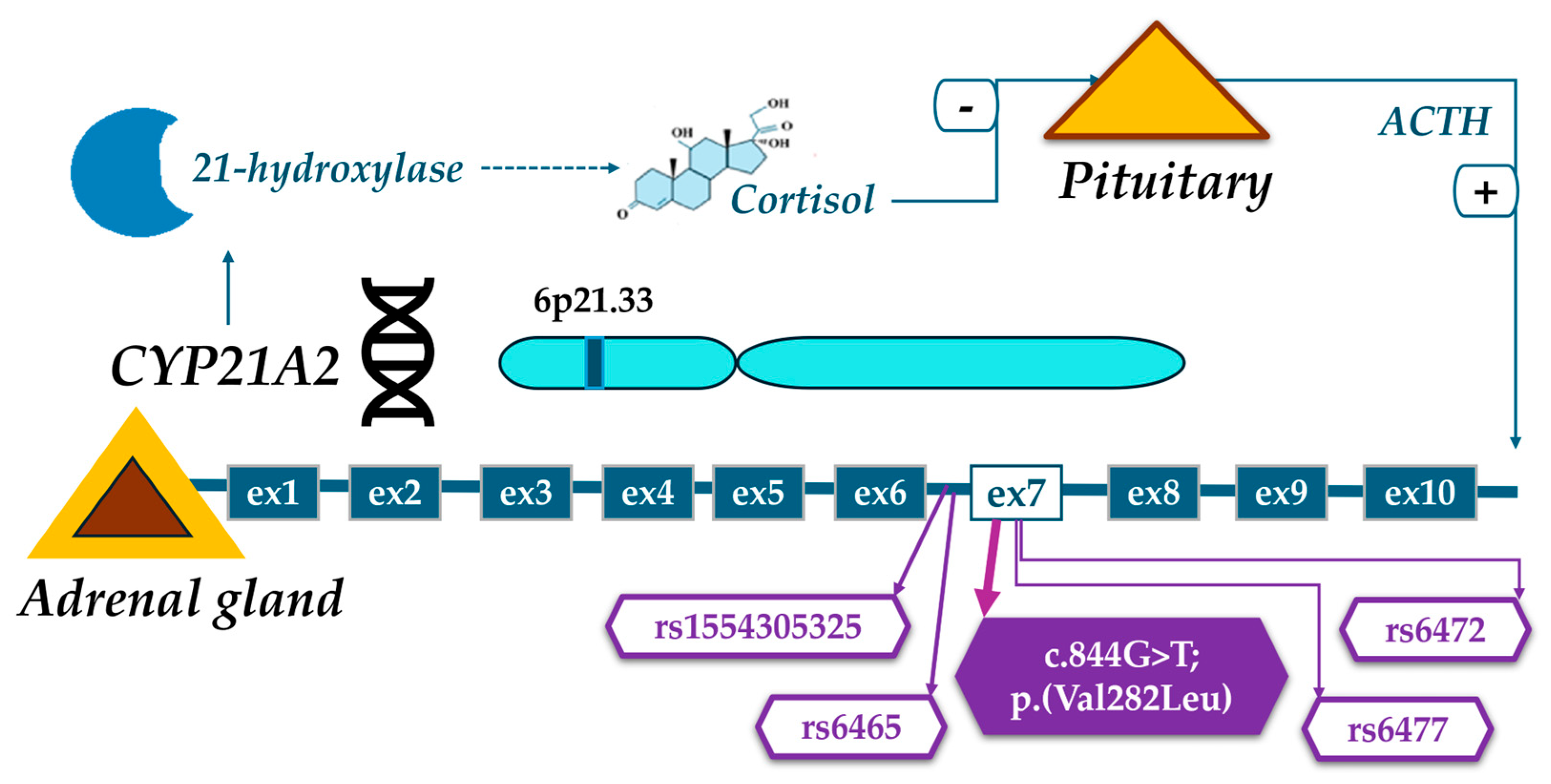
Four polymorphic genetic variants were detected in the region of interest among women with PCOS (Figure 1); the allele distribution is presented in Table 3.

3.1. Polymorphism rs1554305325, c.738+12delinsGT in Women with PCOS (Old Nomenclature: c.735+12delinsGT)

The homozygous and heterozygous rs1554305325 polymorphic GT variant carriers were combined due to the small number of homozygotes. The presence of the GT variant was not related to the investigated clinical signs (acne, hirsutism, obesity, or menstrual irregularities) in women with PCOS (p > 0.05 for all).
Morning cortisol levels were higher in patients with polymorphic alleles than in those with wild-type alleles, and ACTH levels showed a similar trend (Table 4). Other metabolic and hormonal parameters did not differ between women with PCOS with different rs1554305325 genotypes (p > 0.05 for all).

3.2. Polymorphism rs6465, c.739-21C>T in Women with PCOS (Old Nomenclature: c.736-21C>G)

The rs6465 polymorphism was not associated with acne, hirsutism, obesity, or menstrual irregularities in the investigated women (p > 0.05 for all). No differences in most metabolic and hormonal parameters were observed between patients with different genotypes (p > 0.05 for all); however, pregnenolone and ACTH levels were lower in the polymorphic C/T group compared with wild C/C carriers (Table 4).

3.3. Polymorphism rs6472, c.806G>C; p.(Ser269Thr) in Women with PCOS (Old Nomenclature: c.803G>C/p.Ser268Thr)

The rs6472 polymorphic variant was not related to the development of acne, hirsutism, obesity, or menstrual irregularities in the women with PCOS (p > 0.05 for all). Most metabolic and hormonal parameters were similar between patients with different rs6472 genotypes (p > 0.05 for all). ACTH and morning cortisol levels were higher in patients with the polymorphic G/C and C/C genotypes than in women with the usual G/G genotype (Table 4).

3.4. Polymorphism rs6477, c.747C>G; p.(Leu249=) in Women with PCOS (Old Nomenclature: c.744C>G/p.Leu248=)

The rs6477 polymorphic variant was also not related to the development of acne, hirsutism, obesity, or menstrual irregularities in the women with PCOS (p > 0.05 for all). Most metabolic and hormonal parameters were similar between patients with different rs6477 genotypes (p > 0.05 for all), while ACTH levels were lower in women with the polymorphic C/G and G/G genotypes than in patients with the C/C genotype (Table 4).
After Bonferroni correction for multiple comparisons, only the association between the rs6472 variant and cortisol levels remained close to borderline significance. The effect size was small-to-medium (r = 0.27, 95% CI [0.05, 0.47]), explaining about 7% of variation.

4. Discussion

A wide range of genetic variations in the CYP21A2 gene has been reported to date, including disease-causing mutations and polymorphisms. Our results show that 67% of female patients with NC-CAH in the current study are CYP21A2 c.844G>T; p.(Val282Leu) homozygous or heterozygous carriers, with a c.844G>T; p.(Val282Leu) allele frequency of 41.7% (10/24). It was acknowledged previously that CYP21A2 c.844G>T; p.(Val282Leu) variant frequency is ethnic-specific; for instance, its prevalence reached 74% in Sicilian and Ashkenazi Israeli cohorts, 54.1% in Argentinian, and 46% in Greek patients with non-classic CAH [15,16,17,18]. On the contrary, the same allele frequency is very low in Asian countries, e.g., China and Japan [19,20].
The c.844G>T; p.(Val282Leu) variant has been associated with a 50-80% reduction in normal 21-hydroxylase activity attributed to reduced hemoprotein content and conformational changes [21,22,23,24]. The moderate reduction in enzyme activity is usually associated with mild clinical symptoms caused solely by adrenal androgen excess; however, approximately one-third of patients with NC-CAH carrying the same variant show insufficient cortisol response to synthetic ACTH stimulation [25]. Additionally, severe forms of CAH in c.844G>T; p.(Val282Leu) homozygotes have rarely been described [13]. Nevertheless, the most common clinical complaints of patients with NC-CAH carrying the c.844G>T; p.(Val282Leu) variant include hirsutism, menstrual disturbances, and premature pubarche, and even asymptomatic individuals have been described [26,27].
On the other hand, heterozygous c.844G>T; p.(Val282Leu) female carriers from different ethnic groups might also present with pronounced hyperandrogenism and increased stimulated 17-OH progesterone levels [28,29]. These findings could be explained by the negative dominant effect of the mutant CYP21A2 c.844G>T; p.(Val282Leu) allele on the normal allele in the heterozygous state, reducing the enzyme activity by about 30% [30]. Therefore, several studies have investigated the prevalence of the c.844G>T; p.(Val282Leu) variant among hyperandrogenic women. Neocleous et al. genotyped the CYP21A2 gene in 205 female Cypriot patients with hirsutism, acne, or premature pubarche. The authors found 35 heterozygous carriers of CYP21A2 c.844G>T; p.(Val282Leu) (17% of the investigated hyperandrogenic group) [28]. Among other ethnic groups, heterozygous c.844G>T; p.(Val282Leu) carriers were found in 6.0% of women with PCOS in Italy and 1.8–3.0% of those in the USA and Greece [31,32,33]. Additionally, 3.3% of Chinese patients with acne and hirsutism were carriers of the same pathogenic variant [34]. On the contrary, we did not find c.844G>T; p.(Val282Leu) variant among the 160 genotyped alleles of women with PCOS, which confirms the ethnic heterogeneity in the pathologic CAH allele distribution worldwide.
The role of CYP21A2 polymorphisms in hyperandrogenic states and adrenal disorders beyond CAH is poorly investigated. Recently, a large Chinese study showed that the genetic intron polymorphism rs6465, located near exon 7, might influence the development of severe acne, with genotype TT being protective, especially in men [35]. The authors suggested that the intron variation might modulate 21-hydroxylase activity by affecting gene regulatory sequences [35]. In our cohort, the rare rs6465 TT genotype was not found; additionally, the frequency of acne and hirsutism did not differ between heterozygous CT and wild-type CC women. However, women with the CT genotype showed lower ACTH and pregnenolone levels in the unadjusted model, suggesting a possible influence of the rs6465 polymorphism on adrenal steroidogenesis; however, these differences were no longer significant after adjustment for multiple confounders. The rs6472 polymorphism (c.806G>C; p.(Ser269Thr)) might also be associated with adrenocortical hormonal fluctuations, considering that minor C-allele carriers showed significantly higher cortisol levels compared with other women with PCOS. Interestingly, the same polymorphism has been studied in Addison’s disease, and the C allele has been related to a lower risk of autoimmune adrenalitis [36]. The protective effect of the rs6472 minor C allele might be explained by the linkage with HLA protective variants [36] or by variant influence on cortisol secretion. However, in vitro functional assay has shown similar activity of p.S268T mutant compared with wild-type 21-hydroxylase protein [24]. On the other hand, functional clinical studies in patients with PCOS are currently lacking; thus, the role of the same polymorphism in vivo remains obscure. According to our results, the benign rs1554305325 polymorphism might also be associated with cortisol levels of the women with PCOS. A large study of healthy individuals and patients with non-functioning adrenal incidentalomas has shown that specific CYP21A2 haplotypes, comprising different polymorphic alleles, can modulate cortisol and 17-hydroxyprogesterone levels after ACTH stimulation, as well as basic aldosterone levels [37]. Thus, the influence of various CYP21A2 polymorphisms and haplotype groups on adrenal steroidogenesis in women with PCOS warrants further investigation across different ethnic groups.
The present study has an exploratory character, and several important limitations should be noted. For instance, the lack of a control group of healthy women and the small number of participants reduced statistical power. Moreover, radioimmunological methods were used instead of the recommended “gold standard” liquid chromatography with tandem mass spectrometry [38], and levels of stress in the cohort were not evaluated. The study was focused only on CYP21A2 exon 7, and functional enzyme analysis was not performed. Moreover, after Bonferroni correction for multiple comparisons, only the association between the rs6472 variant and cortisol levels tended to be significant. Nevertheless, the study shows possible associations between CYP21A2 polymorphisms and cortisol secretion in women with PCOS. Thus, the findings need to be confirmed in larger studies that consider the influence of CYP21A2 haplotypes on adrenal hormonal production in healthy women and patients with PCOS and non-classic CAH. The observed endocrine changes associated with the investigated CYP21A2 polymorphisms did not influence the PCOS phenotype or specific symptoms, rendering their clinical significance questionable. However, symptoms and signs in women with PCOS undergo marked age-related changes associated with androgen decrease and metabolic deterioration [39]. Thus, only a longitudinal follow-up of patients with PCOS could estimate the clinical significance of possible associations between different CYP21A2 benign polymorphisms and cortisol levels in basic and stress-related conditions.
In conclusion, the c.844G>T; p.(Val282Leu) variant is very common among Bulgarian patients with NC-CAH but it has not been found in our cohort of women with PCOS, unlike other studies. Thus, more scientific data should be gathered to establish the ethnic-specific distribution of NC-CAH-related alleles in patients with PCOS. Additionally, some CYP21A2 exon 7 benign polymorphisms might be associated with cortisol levels in patients with PCOS. Further larger studies are necessary to reveal the possible influence of benign CYP21A2 variants on adrenal steroidogenesis in women with PCOS and to explore the underlying pathophysiological mechanisms.

Author Contributions

Conceptualization, R.R. and S.A.; methodology, R.R., S.A., A.S., G.K., T.T. and I.Y.; formal analysis R.R. and S.A.; investigation, R.R., A.E., S.A., S.V., G.K., T.T. and I.Y.; writing—original draft preparation, R.R.; writing—review and editing, A.S., A.E., S.A., S.V., G.K., T.T. and I.Y.; project administration, A.S., A.E. and S.A.; funding acquisition, R.R. All authors have read and agreed to the published version of the manuscript.

Funding

This research was funded by Medical University-Sofia, GRANT 2025—№200/4 June 2025.

Institutional Review Board Statement

The study was conducted in accordance with the Declaration of Helsinki and approved by the Ethics Committee of the Medical University—Sofia (Protocol №15/11 June 2025).

Informed Consent Statement

Informed consent was obtained from all subjects involved in the study.

Data Availability Statement

Data are available after reasonable request.

Conflicts of Interest

The authors declare no conflicts of interest.

References

  1. Joham, A.E.; Norman, R.J.; Stener-Victorin, E.; Legro, R.S.; Franks, S.; Moran, L.J.; Boyle, J.; Teede, H.J. Polycystic ovary syndrome. Lancet Diabetes Endocrinol. 2022, 10, 668–680. [Google Scholar] [CrossRef] [PubMed]
  2. Sadeghi, H.M.; Adeli, I.; Calina, D.; Docea, A.O.; Mousavi, T.; Daniali, M.; Nikfar, S.; Tsatsakis, A.; Abdollahi, M. Polycystic Ovary Syndrome: A Comprehensive Review of Pathogenesis, Management, and Drug Repurposing. Int. J. Mol. Sci. 2022, 23, 583. [Google Scholar] [CrossRef] [PubMed]
  3. Rotterdam ESHRE/ASRM-Sponsored PCOS Consensus Workshop Group. Revised 2003 consensus on diagnostic criteria and long-term health risks related to polycystic ovary syndrome (PCOS). Hum. Reprod. 2004, 19, 41–47. [Google Scholar] [CrossRef] [PubMed]
  4. Teede, H.J.; Tay, C.T.; Laven, J.; Dokras, A.; Moran, L.J.; Piltonen, T.T.; Costello, M.F.; Boivin, J.; Redman, M.L.; Boyle, J.A.; et al. Recommendations from the 2023 International Evidence-based Guideline for the Assessment and Management of Polycystic Ovary Syndrome. Fertil. Steril. 2023, 120, 767–793. [Google Scholar] [CrossRef] [PubMed]
  5. Uslar, T.; Olmos, R.; Martínez-Aguayo, A.; Baudrand, R. Clinical Update on Congenital Adrenal Hyperplasia: Recommendations from a Multidisciplinary Adrenal Program. J. Clin. Med. 2023, 12, 3128. [Google Scholar] [CrossRef] [PubMed]
  6. Papadakis, G.; Kandaraki, E.A.; Tseniklidi, E.; Papalou, O.; Diamanti-Kandarakis, E. Polycystic Ovary Syndrome and NC-CAH: Distinct Characteristics and Common Findings. A Systematic Review. Front. Endocrinol. 2019, 10, 388. [Google Scholar] [CrossRef] [PubMed]
  7. Speiser, P.W.; Arlt, W.; Auchus, R.J.; Baskin, L.S.; Conway, G.S.; Merke, D.P.; Meyer-Bahlburg, H.F.L.; Miller, W.L.; Murad, M.H.; Oberfield, S.E.; et al. Congenital Adrenal Hyperplasia Due to Steroid 21-Hydroxylase Deficiency: An Endocrine Society Clinical Practice Guideline. J. Clin. Endocrinol. Metab. 2018, 103, 4043–4088. [Google Scholar] [CrossRef] [PubMed]
  8. Rosenfield, R.L.; Ehrmann, D.A. The Pathogenesis of Polycystic Ovary Syndrome (PCOS): The Hypothesis of PCOS as Functional Ovarian Hyperandrogenism Revisited. Endocr. Rev. 2016, 37, 467–520. [Google Scholar] [CrossRef] [PubMed]
  9. Góral, A.; Żywot, K.; Zalewski, W.; Jagodziński, A.; Murawski, M. Polycystic Ovary Syndrome and Eating Disorders-A Literature Review. J. Clin. Med. 2024, 14, 27. [Google Scholar] [CrossRef] [PubMed]
  10. Karakas, S.E. Reactive Hypoglycemia: A Trigger for Nutrient-Induced Endocrine and Metabolic Responses in Polycystic Ovary Syndrome. J. Clin. Med. 2023, 12, 7252. [Google Scholar] [CrossRef] [PubMed]
  11. Huang, Y.; Jiang, H.; Zhu, X.; Mao, A.; Cui, D.; Zhao, Y.; Wang, Y.; Long, X.; Qiao, J. Long-read sequencing analysis of non-classical congenital adrenal hyperplasia prevalence and carrier frequency in Chinese polycystic ovarian syndrome patients. J. Ovarian Res. 2025, 18, 252. [Google Scholar] [CrossRef] [PubMed]
  12. Robeva, R.; Andonova, S.; Todorov, T.; Feyzullova, A.; Elenkova, A.; Kirilov, G.; Savov, A.; Zacharieva, S.; Todorova, A. CYP21A2 Intron 2 Genetic Variants Might Be Associated with the Clinical Characteristics of Women with PCOS. Biomedicines 2024, 12, 1528. [Google Scholar] [CrossRef] [PubMed]
  13. New, M.I.; Abraham, M.; Gonzalez, B.; Dumic, M.; Razzaghy-Azar, M.; Chitayat, D.; Sun, L.; Zaidi, M.; Wilson, R.C.; Yuen, T. Genotype-phenotype correlation in 1,507 families with congenital adrenal hyperplasia owing to 21-hydroxylase deficiency. Proc. Natl. Acad. Sci. USA 2013, 110, 611–2616. [Google Scholar] [CrossRef] [PubMed]
  14. Pignatelli, D.; Carvalho, B.L.; Palmeiro, A.; Barros, A.; Guerreiro, S.G.; Macut, D. The Complexities in Genotyping of Congenital Adrenal Hyperplasia: 21-Hydroxylase Deficiency. Front. Endocrinol. 2019, 10, 432. [Google Scholar] [CrossRef] [PubMed]
  15. Marino, R.; Ramirez, P.; Galeano, J.; Perez Garrido, N.; Rocco, C.; Ciaccio, M.; Warman, D.M.; Guercio, G.; Chaler, E.; Maceiras, M.; et al. Steroid 21-hydroxylase gene mutational spectrum in 454 Argentinean patients: Genotype-phenotype correlation in a large cohort of patients with congenital adrenal hyperplasia. Clin. Endocrinol. 2011, 75, 427–435. [Google Scholar] [CrossRef] [PubMed]
  16. Wasniewska, M.; Di Pasquale, G.; Rulli, I.; Salzano, G.; Caruso, M.; Indovina, S.; Di Pasquale, L.; Zirilli, G.; De Luca, F. In the Sicilian ethnic group, non-classical congenital adrenal hyperplasia is frequently associated with a very mild genotype. J. Endocrinol. Investig. 2007, 30, 181–185. [Google Scholar] [CrossRef] [PubMed]
  17. Livadas, S.; Dracopoulou, M.; Dastamani, A.; Sertedaki, A.; Maniati-Christidi, M.; Magiakou, A.M.; Kanaka-Gantenbein, C.; Chrousos, G.P.; Dacou-Voutetakis, C. The spectrum of clinical, hormonal, and molecular findings in 280 individuals with nonclassical congenital adrenal hyperplasia caused by mutations of the CYP21A2 gene. Clin. Endocrinol. 2015, 82, 543–549. [Google Scholar] [CrossRef]
  18. Israel, S.; Weinrib, L.; Weintrob, N.; Miller, K.; Brautbar, C. Distribution of the V281L mutation of the CYP21 gene in Israeli congenital adrenal hyperplasia patients and its association with HLA- B14. Pediatr. Endocrinol. Rev. 2006, 3, 447–450. [Google Scholar] [PubMed]
  19. Xia, Y.; Shi, P.; Gao, S.; Liu, N.; Zhang, H.; Kong, X. Genetic analysis and novel variation identification in Chinese patients with congenital adrenal hyperplasia due to 21-hydroxylase deficiency. J. Steroid. Biochem. Mol. Biol. 2022, 222, 106156. [Google Scholar] [CrossRef] [PubMed]
  20. Shinagawa, T.; Horikawa, R.; Isojima, T.; Naiki, Y.; Tanaka, T.; Katsumata, N. Nonclassic Steroid 21-Hydroxylase Deficiency due to a Homozygous V281L Mutation in CYP21A2 Detected by the Neonatal Mass-Screening Program in Japan. Endocr. J. 2007, 54, 1021–1025. [Google Scholar] [CrossRef] [PubMed]
  21. Tusie-Luna, M.T.; Traktman, P.; White, P.C. Determination of functional effects of mutations in the steroid 21-hydroxylase gene (CYP21) using recombinant vaccinia virus. J. Biol. Chem. 1990, 265, 20916–20922. [Google Scholar] [CrossRef]
  22. Wu, D.A.; Chung, B.C. Mutations of P450c21 (steroid 21-hydroxylase) at Cys428, Val281, and Ser268 result in complete, partial, or no loss of enzymatic activity, respectively. J. Clin. Investig. 1991, 88, 519–523. [Google Scholar] [CrossRef] [PubMed]
  23. Neves Cruz, J.; da Costa, K.S.; de Carvalho, T.A.A.; de Alencar, N.A.N. Measuring the structural impact of mutations on cytochrome P450 21A2, the major steroid 21-hydroxylase related to congenital adrenal hyperplasia. J. Biomol. Struct. Dyn. 2020, 38, 1425–1434. [Google Scholar] [CrossRef] [PubMed]
  24. Prado, M.J.; Singh, S.; Ligabue-Braun, R.; Meneghetti, B.V.; Rispoli, T.; Kopacek, C.; Monteiro, K.; Zaha, A.; Rossetti, M.L.R.; Pandey, A.V. Characterization of Mutations Causing CYP21A2 Deficiency in Brazilian and Portuguese Populations. Int. J. Mol. Sci. 2021, 23, 296. [Google Scholar] [CrossRef] [PubMed]
  25. Bilici, M.E.; Iklar, Z.; Özsu, E.; Aycan, Z.; Uyanık, R.; Ceran, A.; Berberoğlu, M. Assessing cortisol levels in non-classical congenital adrenal hyperplasia: Focus on the V281L variant. Ther. Adv. Endocrinol. Metab. 2025, 16, 20420188251388397. [Google Scholar] [CrossRef] [PubMed]
  26. Patel, S.; Skamagas, M.; Levine, A.; Yau, M. Characterizing The Presentation of Non-Classical Congenital Adrenal Hyperplasia. J. Endocr. Soc. 2024, 8, bvae163.137. [Google Scholar] [CrossRef]
  27. Savas Erdeve, S.; Berberoglu, M.; Yurur-Kutlay, N.; Siklar, Z.; Hacihamdioglu, B.; Tukun, A.; Ocal, G. Characteristics and prevalence of non-classical congenital adrenal hyperplasia with a V2811 mutation in patients with premature pubarche. J. Pediatr. Endocrinol. Metab. 2011, 24, 965–970. [Google Scholar] [CrossRef] [PubMed]
  28. Neocleous, V.; Shammas, C.; Phedonos, A.A.; Phylactou, L.A.; Skordis, N. Phenotypic variability of hyperandrogenemia in females heterozygous for CYP21A2 mutations. Indian J. Endocrinol. Metab. 2014, 18, S72–S79. [Google Scholar] [CrossRef] [PubMed]
  29. Admoni, O.; Israel, S.; Lavi, I.; Gur, M.; Tenenbaum-Rakover, Y. Hyperandrogenism in carriers of CYP21 mutations: The role of genotype. Clin. Endocrinol. 2006, 64, 645–651. [Google Scholar] [CrossRef] [PubMed]
  30. Félix-López, X.; Riba, L.; Ordóñez-Sánchez, M.L.; Ramírez-Jiménez, S.; Ventura-Gallegos, J.L.; Zentella-Dehesa, A.; Tusié-Luna, M.T. Steroid 21-hydroxylase (P450c21) naturally occurring mutants I172N, V281L, and I236n/V237E/M239K exert a dominant negative effect on enzymatic activity when co-expressed with the wild-type protein. J. Pediatr. Endocrinol. Metab. 2003, 16, 1017–1024. [Google Scholar] [CrossRef] [PubMed]
  31. Pucci, L.; Lucchesi, D.; Longo, V.; Del Prato, S.; Maffei, S. Lack of association between CYP21 V281L variant and polycystic ovary syndrome in Italian women. Gynecol. Endocrinol. 2010, 26, 596–599. [Google Scholar] [CrossRef] [PubMed]
  32. Witchel, S.F.; Kahsar-Miller, M.; Aston, C.E.; White, C.; Azziz, R. Prevalence of CYP21 mutations and IRS1 variant among women with polycystic ovary syndrome and adrenal androgen excess. Fertil. Steril. 2005, 83, 371–375. [Google Scholar] [CrossRef] [PubMed]
  33. Settas, N.; Dracopoulou-Vabouli, M.; Dastamani, A.; Katsikis, I.; Chrousos, G.; Panidis, D.; Dacou-Voutetakis, C. CYP21A2 mutations in women with polycystic ovary syndrome (PCOS). Horm. Metab. Res. 2013, 45, 383–386. [Google Scholar] [CrossRef] [PubMed]
  34. Gao, Y.; Yu, B.; Mao, J.; Wang, X.; Nie, M.; Wu, X. The prevalence of heterozygous CYP21A2 deficiency in patients with idiopathic acne, hirsutism, or both. Endocrine 2020, 67, 665–672. [Google Scholar] [CrossRef] [PubMed]
  35. Yang, T.; Wu, W.J.; Tian, L.M.; Zhang, D.F.; Yang, X.Y.; Qi, J.; Tu, Y.; He, L. The Associations of Androgen-Related Genes CYP21A2 and CYP19A1 with Severe Acne Vulgaris in Patients from Southwest China. Clin. Cosmet. Investig. Dermatol. 2021, 14, 313–331. [Google Scholar] [CrossRef] [PubMed]
  36. Brønstad, I.; Skinningsrud, B.; Bratland, E.; Løvås, K.; Undlien, D.; Sverre Husebye, E.; Wolff, A.S. CYP21A2 polymorphisms in patients with autoimmune Addison’s disease, and linkage disequilibrium to HLA risk alleles. Eur. J. Endocrinol. 2014, 171, 743–750. [Google Scholar] [CrossRef] [PubMed]
  37. Doleschall, M.; Szabó, J.A.; Pázmándi, J.; Szilágyi, Á.; Koncz, K.; Farkas, H.; Tóth, M.; Igaz, P.; Gláz, E.; Prohászka, Z.; et al. Common genetic variants of the human steroid 21-hydroxylase gene (CYP21A2) are related to differences in circulating hormone levels. PLoS ONE 2014, 9, e107244. [Google Scholar] [CrossRef] [PubMed][Green Version]
  38. Bizuneh, A.D.; Joham, A.E.; Teede, H.; Mousa, A.; Earnest, A.; Hawley, J.M.; Smith, L.; Azziz, R.; Arlt, W.; Tay, C.T. Evaluating the diagnostic accuracy of androgen measurement in polycystic ovary syndrome: A systematic review and diagnostic meta-analysis to inform evidence-based guidelines. Hum. Reprod. Update 2025, 31, 48–63. [Google Scholar] [CrossRef] [PubMed]
  39. van Keizerswaard, J.; Dietz de Loos, A.L.P.; Louwers, Y.V.; Laven, J.S.E. Changes in individual polycystic ovary syndrome phenotypical characteristics over time: A long-term follow-up study. Fertil. Steril. 2022, 117, 1059–1066. [Google Scholar] [CrossRef] [PubMed]
Figure 1. Genetic region and investigated polymorphisms in women with polycystic ovary syndrome. ACTH—adrenocorticotropic hormone. CYP21A2—21-hydroxylase gene.
Jcm 15 04626 g001
Table 1. Genetic findings (pathogenic and benign variants) of the eight female patients who carried the c.844G>T; p.(Val282Leu) variant; all of them had a hormonally proven diagnosis of non-classic congenital adrenal hyperplasia per current guideline [7], though one of them turned out to be a heterozygous carrier. N-number.
NCYP21A2 Allele 1CYP21A2 Allele 2rs1554305325rs6465rs6477rs6472
1c.844G>T;p.(Val282Leu)c.293-13A/C>GAC/GTC/CC/GG/G
2c.844G>T;p.(Val282Leu)c.293-13A/C>GAC/GTC/CC/GG/G
3c.844G>T;p.(Val282Leu)c.293-13A/C>GAC/GTC/CC/GG/G
4c.844G>T;p.(Val282Leu)c.955C>T; p.(Gln319*)AC/GTC/CC/GG/G
5c.844G>T;p.(Val282Leu)c.1069C>T; p.(Arg357Trp)AC/GTC/CC/GG/G
6c.844G>T;p.(Val282Leu)c.844G>T;p.(Val282Leu)GT/GTC/CG/GG/G
7c.844G>T;p.(Val282Leu)c.844G>T;p.(Val282Leu)GT/GTC/CG/GG/G
8c.844G>T;p.(Val282Leu)-AC/GTC/CG/GG/G
Table 2. Clinical and laboratory characteristics of women with polycystic ovary syndrome (PCOS). Data presented as median (interquartile range) or percentage (n). ACTH—adrenocorticotropic hormone. LDL—low-density lipoprotein; HDL—high-density lipoprotein.
ParameterWomen with PCOS (n = 80)ParameterWomen with PCOS (n = 80)
Age (years)24.00 (21.00–27.00)HDL-cholesterol (mmol/L)1.29 (1.07–1.50)
BMI (kg/m2)27.67 (23.05–35.09)Triglycerides (mmol/L)0.88 (0.61–1.18)
Hirsutism (%)72.5% (58) Testosterone (nmol/L)1.66 (1.28–2.06)
Acne (%)41.25% (33)17-OH progesterone (nmol/L)4.15 (3.05–5.85)
Glucose (mmol/L)5.20 (4.97–5.61)Pregnenolone (ng/mL)2.90 (1.77–4.54)
Cholesterol (mmol/L)4.48 (4.02–5.04)ACTH (pmol/L)4.15 (2.48–7.80)
LDL-cholesterol (mmol/L)2.90 (2.44–3.60)Cortisol (nmolL)390.00 (280.00–521.00)
Table 3. Genotypes of CYP21A2 exon 7 region polymorphisms observed among investigated patients with PCOS in the present study.
Genetic VariantMajor Allele HomozygoteHeterozygoteMinor Allele Homozygote
Geno-TypeNGeno-TypeNGeno-TypeN
rs1554305325c.738+12delinsGTAC/AC57AC/GT19GT/GT4
rs6465c.739-21C>TC/C73 C/T7-0
rs6472c.806G>C, p.(Ser269Thr)G/G55 G/C21C/C4
rs6477c.747C>G, p.(Leu249=)C/C55 C/G22G/G3
Table 4. Laboratory characteristics of women with polycystic ovary syndrome according to CYP21A2 exon 7 region polymorphisms. BMI—body mass index; DHEAS—dehydroepiandrosterone sulfate; ACTH—adrenocorticotropic hormone; 17OHP—17-hydroxy progesterone. Data are presented as median (interquartile range). p—Mann–Whitney test; p *—linear regression model adjusted for obesity (BMI ≥/<30), metformin and LT-4 use; similar results were obtained after exclusion of the two women on oral contraceptives in the last three months.
rs6465 rs1554305325
C/C Genotype
(n = 73)
C/T Genotype
(n = 7)
pp *AC/AC Genotype
(n = 57)
AC/GT or GT/GT Genotype (n = 23)pp *
Age (years)24.0 (21.0–27.0)26.0 (23.0–31.0)0.203 25.0 (21.8–28.0)22.0 (21.0–24.7)0.127
BMI (kg/m2)27.8 (23.3–34.4)27.3 (21.0–37.4)0.845 28.0 (23.3–36.0)27.6 (22.8–33.6)0.632
Metformin use32.9% (24)57.1% (4)0.232 33.3% (19)39.1% (9)0.616
L-thyroxin use12.3% (9)42.9% (3)0.065 17.5% (10)8.7% (2)0.492
Testosterone (nmol/L)1.7 (1.3–2.1)1.4 (1.3–1.6)0.2720.7081.7 (1.3–2.1)1.6 (1.3–2.1)0.7460.568
DHEAS (µmol/L)9.27 (6.8–13.1)7.27 (6.5-14.8)0.5360.9238.7 (7.0–13.7)10.4 (5.7–11.5)0.8870.456
17-OHP (nmol/L)4.10 (2.9-5.8)5.5 (3.6-6.4)0.3670.3424.5 (3.0-5.9)3.9 (3.0-4.8)0.8560.647
Pregnenolone (ng/mL)3.1 (1.8–4.6)1.43 (1.3 – 2.5)0.0310.0772.9 (1.8–4.5)3.1 (1.6–4.6)0.9200.994
Cortisol (nmol/L)396.0
(283.0–521.5)
253.5
(186–380)
0.1540.105371.5
(232.0–445.5)
460.5
(372.0–530.0)
0.0380.035
ACTH (pmol/L)4.5 (2.9–8.3)2.5 (2.3–3.2)0.0300.0703.6 (2.4–6.7)5.5 (3.1–9.7)0.0590.076
rs6472 rs6477
G/G Genotype
(n = 55)
G/C or C/C
Genotype (n = 25)
pp *C/C Genotype
(n = 55)
C/G or G/G Genotype (n = 25)pp *
Age (years)25.0 (21.2–27.8)23.0 (21.0–25.3)0.269 23.0 (21.0–27.0)25.0 (21.8–27.2)0.428
BMI (kg/m2)28.0 (23.4–36.4)27.6 (22.7–33.9)0.513 28.0 (24.0–35.2)25.7 (21.5–34.4)0.237
Metformin use34.5% (19)36.0% (9)1.000 30.9% (17)44.0% (11)0.314
L-thyroxin use16.4% (9)12.0% (3)0.744 10.9% (6)24.0% (6)0.177
Testosterone (nmol/L)1.7 (1.3–2.1)1.6 (1.3–2.2)0.9710.7481.7 (1.3–2.2)1.6 (1.3–2.0)0.4640.538
DHEAS (µmol/L)9.1 (6.9–13.9)9.8 (6.3–11.4)0.7320.6029.1 (6.0–12.8)10.4 (7.3–14.7)0.4550.326
17-OHP (nmol/L)4.5 (3.1–5.9)3.9 (3.0–5.2)0.7360.8394.2 (3.0–6.0)3.9 (3.0–5.5)0.5640.401
Pregnenolone (ng/mL)2.7 (1.8–4.4)3.2 (1.7–4.6)0.8040.8883.1 (1.9–4.5)2.4 (1.4–4.6)0.1610.202
Cortisol (nmol/L)366.5
(232.0–442.0)
460.5
(373.0–546.0)
0.0160.013390
(281.0–493.0)
392.5
(240.5–565.5)
0.7170.791
ACTH (pmol/L)3.4 (2.4–6.5)5.5 (3.1–9.9)0.0220.0204.8 (2.9–8.5)3.1 (2.3–5.2)0.0480.059
Disclaimer/Publisher’s Note: The statements, opinions and data contained in all publications are solely those of the individual author(s) and contributor(s) and not of MDPI and/or the editor(s). MDPI and/or the editor(s) disclaim responsibility for any injury to people or property resulting from any ideas, methods, instructions or products referred to in the content.