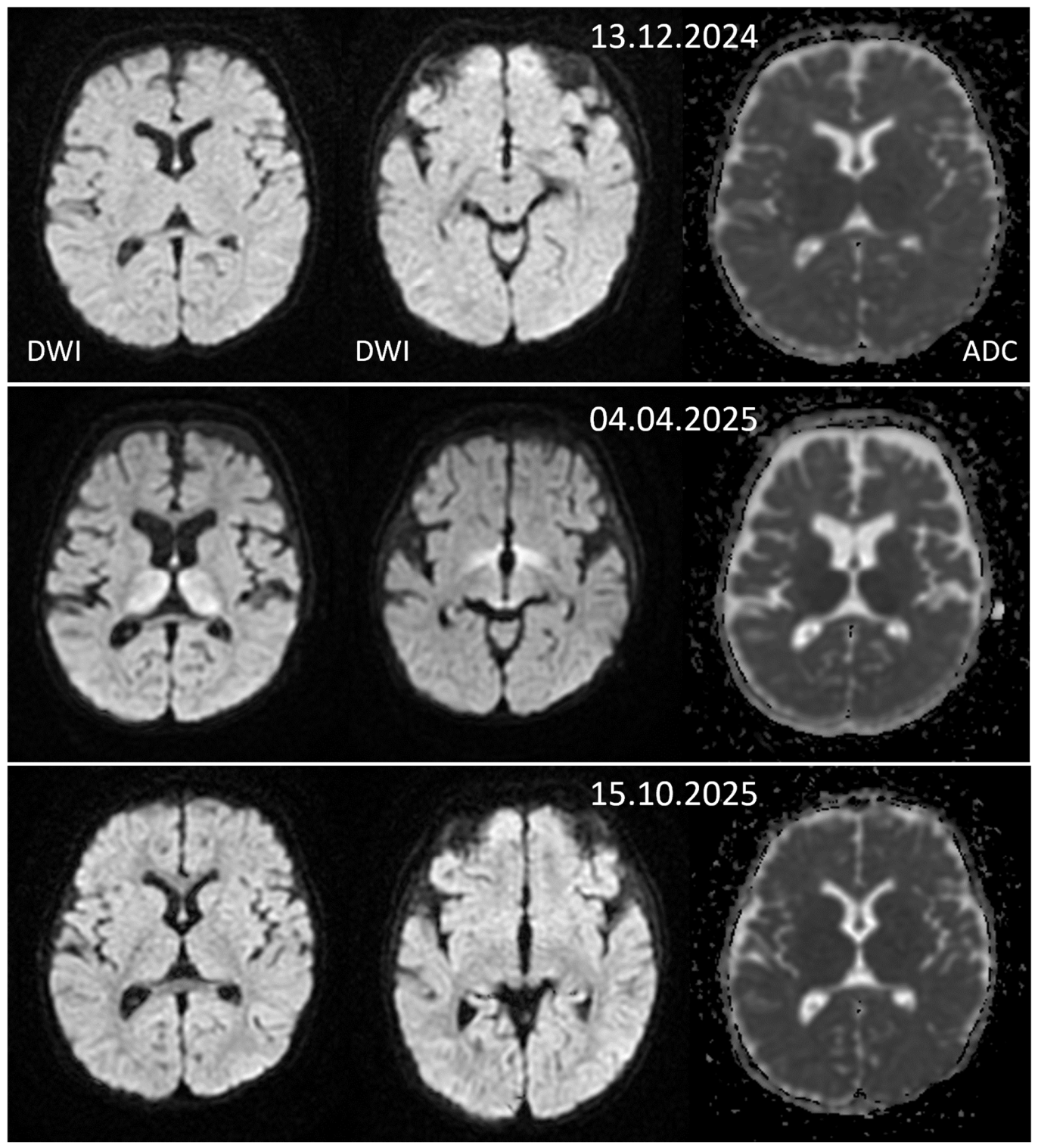
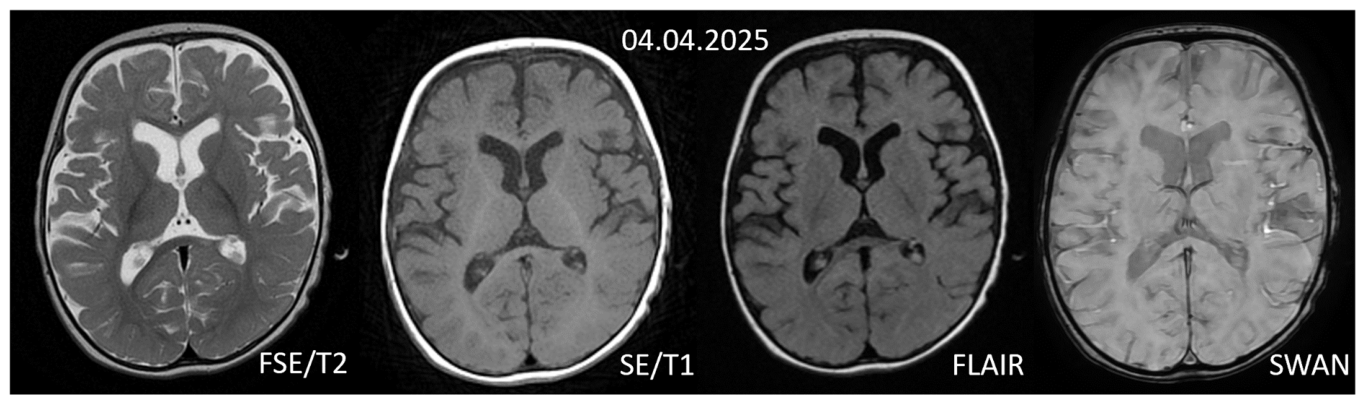
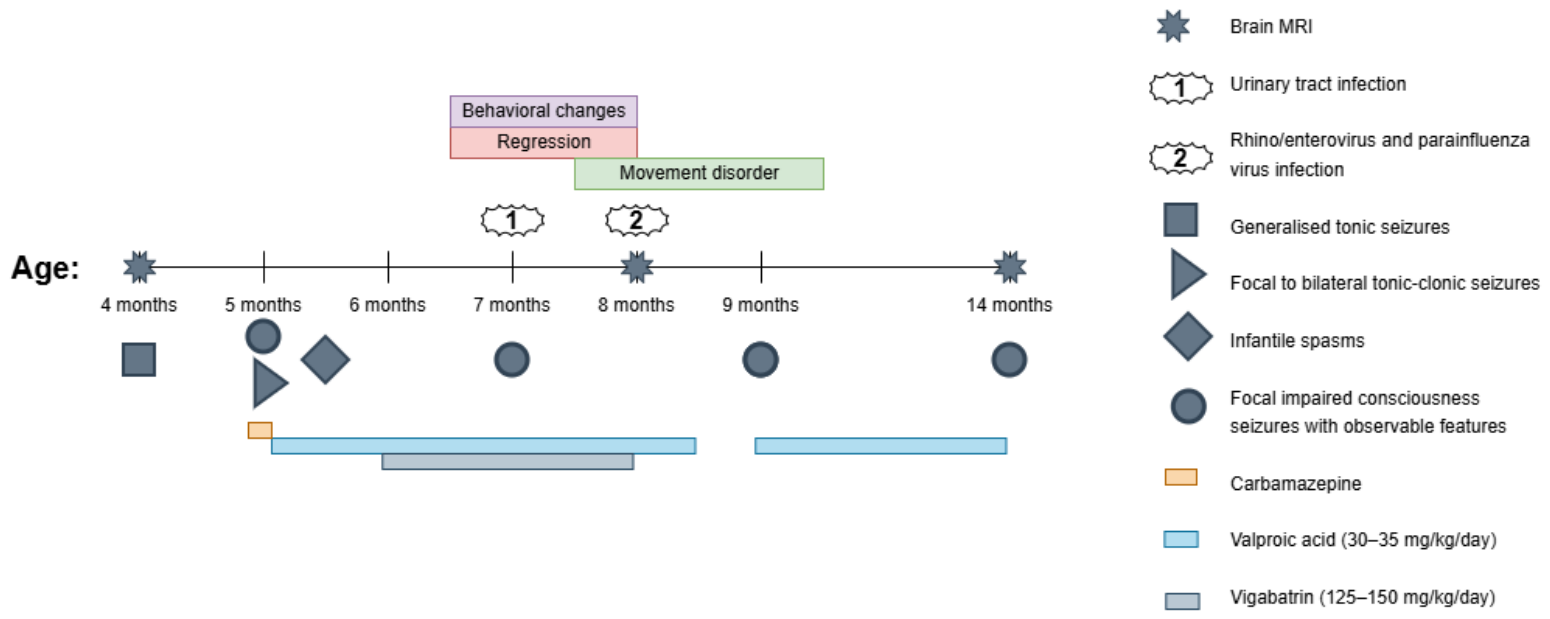
Vigabatrin-Associated Brain Abnormalities on MRI in a Patient with PCDH19-Clustering Epilepsy


Abstract
1. Introduction
2. Case Presentation
3. Discussion
4. Conclusions
Author Contributions
Funding
Institutional Review Board Statement
Informed Consent Statement
Data Availability Statement
Conflicts of Interest
References
- Zuberi, S.M.; Wirrell, E.; Yozawitz, E.; Wilmshurst, J.M.; Specchio, N.; Riney, K.; Pressler, R.; Auvin, S.; Samia, P.; Hirsch, E.; et al. ILAE Classification and Definition of Epilepsy Syndromes in the Neonate and Infant: Position Statement by the ILAE Task Force on Nosology and Definitions. Epilepsia 2022, 63, 1349–1397. [Google Scholar] [CrossRef]
- Symonds, J.D.; Zuberi, S.M.; Stewart, K.; McLellan, A.; O’Regan, M.; MacLeod, S.; Jollands, A.; Joss, S.; Kirkpatrick, M.; Brunklaus, A.; et al. Incidence and phenotypes of childhood-onset genetic epilepsies: A prospective population-based national cohort. Brain 2019, 142, 2303–2318. [Google Scholar] [CrossRef]
- Kowkabi, S.; Yavarian, M.; Kaboodkhani, R.; Mohammadi, M.; Shervin Badv, R. PCDH19-clustering epilepsy, pathophysiology and clinical significance. Epilepsy Behav. 2024, 154, 109730. [Google Scholar] [CrossRef]
- Marini, C.; Giardino, M. Novel treatments in epilepsy guided by genetic diagnosis. Br. J. Clin. Pharmacol. 2022, 88, 2539–2551. [Google Scholar] [CrossRef] [PubMed]
- Tobiasz, A.; Hager, M.; Dębowska, J.; Jaunich, A.; Paprocka, J. Tough to treat:. What we know about managing PCDH19-related epilepsy. Seizure 2025, 132, 98–109. [Google Scholar] [CrossRef] [PubMed]
- Corrêa, D.G.; Telles, B.; Freddi, T.A.L. The vigabatrin-associated brain abnormalities on MRI and their differential diagnosis. Clin. Radiol. 2024, 79, 94–101. [Google Scholar] [CrossRef]
- Stevering, C.; Lequin, M.; Szczepaniak, K.; Sadowski, K.; Ishrat, S.; De Luca, A.; Leemans, A.; Otte, W.; Kwiatkowski, D.J.; Curatolo, P.; et al. Vigabatrin-associated brain magnetic resonance imaging abnormalities and clinical symptoms in infants with tuberous sclerosis complex. Epilepsia 2025, 66, 356–368. [Google Scholar] [CrossRef] [PubMed]
- Ministry of Health. Program Badań Przesiewowych Noworodków w Polsce na Lata 2019–2026. Available online: https://www.gov.pl/web/zdrowie/program-badan-przesiewowych-noworodkow-w-polsce-na-lata-2019-2026 (accessed on 7 May 2024).
- Li, H.; Durbin, R. Fast and accurate short read alignment with Burrows-Wheeler transform. Bioinformatics 2009, 25, 1754–1760. [Google Scholar] [CrossRef]
- Tischler, G.; Leonard, S. biobambam: Tools for read pair collation based algorithms on BAM files. Source Code Biol. Med. 2014, 9, 13. [Google Scholar] [CrossRef]
- McKenna, A.; Hanna, M.; Banks, E.; Sivachenko, A.; Cibulskis, K.; Kernytsky, A.; Garimella, K.; Altshuler, D.; Gabriel, S.; Daly, M.; et al. The Genome Analysis Toolkit: A MapReduce framework for analyzing next-generation DNA sequencing data. Genome Res. 2010, 20, 1297–1303. [Google Scholar] [CrossRef]
- Poplin, R.; Ruano-Rubio, V.; DePristo, M.A.; Fennell, T.J.; Carneiro, M.O.; Van der Auwera, G.A.; Kling, D.E.; Gauthier, L.D.; Levy-Moonshine, A.; Roazen, N.; et al. Scaling accurate genetic variant discovery to tens of thousands of samples. bioRxiv 2017, 211178. [Google Scholar] [CrossRef]
- Garrison, E.; Marth, G. Haplotype-based variant detection from short-read sequencing. arXiv 2012, arXiv:1207.3907. [Google Scholar] [CrossRef]
- McLaren, W.; Gil, L.; Hunt, S.E.; Riat, H.S.; Ritchie, G.R.S.; Thormann, A.; Flicek, P.; Cunningham, F. The Ensembl Variant Effect Predictor. Genome Biol. 2016, 17, 122. [Google Scholar] [CrossRef]
- Landrum, M.J.; Lee, J.M.; Riley, G.R.; Jang, W.; Rubinstein, W.S.; Church, D.M.; Maglott, D.R. ClinVar: Public archive of relationships among sequence variation and human phenotype. Nucleic Acids Res. 2014, 42, D980–D985. [Google Scholar] [CrossRef]
- Foreman, J.; Perrett, D.; Mazaika, E.; Hunt, S.E.; Ware, J.S.; Firth, H.V. DECIPHER: Improving Genetic Diagnosis Through Dynamic Integration of Genomic and Clinical Data. Annu. Rev. Genom. Hum. Genet. 2023, 24, 151–176. [Google Scholar] [CrossRef] [PubMed]
- Rehm, H.L.; Berg, J.S.; Brooks, L.D.; Bustamante, C.D.; Evans, J.P.; Landrum, M.J.; Ledbetter, D.H.; Maglott, D.R.; Martin, C.L.; Nussbaum, R.L.; et al. ClinGen—The Clinical Genome Resource. N. Engl. J. Med. 2015, 372, 2235–2242. [Google Scholar] [CrossRef]
- Sherry, S.T.; Ward, M.H.; Kholodov, M.; Baker, J.; Phan, L.; Smigielski, E.M.; Sirotkin, K. dbSNP: The NCBI database of genetic variation. Nucleic Acids Res. 2001, 29, 308–311. [Google Scholar] [CrossRef]
- Online Mendelian Inheritance in Man (OMIM). McKusick-Nathans Institute of Genetic Medicine, Johns Hopkins University: Baltimore, MD, USA. Available online: https://www.omin.org/ (accessed on 7 May 2026).
- 1000 Genomes Project Consortium. A global reference for human genetic variation. Nature 2015, 526, 68–74. [Google Scholar] [CrossRef]
- Chen, S.; Francioli, L.C.; Goodrich, J.K.; Collins, R.L.; Kanai, M.; Wang, Q.; Alföldi, J.; Watts, N.A.; Vittal, C.; Gauthier, L.D.; et al. A genomic mutational constraint map using variation in 76,156 human genomes. Nature 2024, 625, 92–100. [Google Scholar] [CrossRef]
- Richards, S.; Aziz, N.; Bale, S.; Bick, D.; Das, S.; Gastier-Foster, J.; Grody, W.W.; Hegde, M.; Lyon, E.; Spector, E.; et al. Standards and guidelines for the interpretation of sequence variants: A joint consensus recommendation of the American College of Medical Genetics and Genomics and the Association for Molecular Pathology. Genet. Med. 2015, 17, 405–424. [Google Scholar] [CrossRef] [PubMed]
- Fromer, M.; Purcell, S.M. Using XHMM software to detect copy number variation in whole-exome sequencing data. Curr. Protoc. Hum. Genet. 2014, 81, 7.23.1–7.23.21. [Google Scholar] [CrossRef]
- Lheureux, P.E.; Hantson, P. Carnitine in the treatment of valproic acid-induced toxicity. Clin. Toxicol. 2009, 47, 101–111. [Google Scholar] [CrossRef]
- Kozina, A.A.; Okuneva, E.G.; Baryshnikova, N.V.; Fedonyuk, I.D.; Kholin, A.A.; Il’ina, E.S.; Krasnenko, A.Y.; Stetsenko, I.F.; Plotnikov, N.A.; Klimchuk, O.I.; et al. Two novel PCDH19 mutations in Russian patients with epilepsy with intellectual disability limited to females: A case report. BMC Med. Genet. 2020, 21, 209. [Google Scholar] [CrossRef] [PubMed]
- Dibbens, L.M.; Tarpey, P.S.; Hynes, K.; Bayly, M.A.; Scheffer, I.E.; Smith, R.; Bomani, J.; Raymond, F.L.; Stratton, M.R.; Gecz, J.; et al. X-linked protocadherin 19 mutations cause female-limited epilepsy and cognitive impairment. Nat. Genet. 2008, 40, 776–781. [Google Scholar] [CrossRef]
- Higurashi, N.; Nakamura, M.; Sugai, M.; Ohfu, M.; Sakauchi, M.; Sugawara, Y.; Nakamura, K.; Kato, M.; Usui, D.; Mogami, Y.; et al. PCDH19-related female-limited epilepsy: Further details regarding early clinical features and therapeutic efficacy. Epilepsy Res. 2013, 106, 191–199. [Google Scholar] [CrossRef] [PubMed]
- Specchio, N.; Marini, C.; Terracciano, A.; Mei, D.; Trivisano, M.; Sicca, F.; Fusco, L.; Cusmai, R.; Darra, F.; Bernardina, B.D.; et al. Spectrum of phenotypes in female patients with epilepsy due to protocadherin 19 mutations. Epilepsia 2011, 52, 1251–1257. [Google Scholar] [CrossRef] [PubMed]
- Dell’Isola, G.B.; Mencaroni, E.; Fattorusso, A.; Tascini, G.; Prontera, P.; Imperatore, V.; Di Cara, G.; Striano, P.; Verrotti, A. Expanding the genetic and clinical characteristics of Protocadherin 19 gene mutations. BMC Med. Genom. 2022, 15, 181. [Google Scholar] [CrossRef]
- Trivisano, M.; Pietrafusa, N.; Terracciano, A.; Carla, M.; Mei, D.; Darra, F.; Accorsi, P.; Battaglia, D.; Caffi, L.; Canevini, M.P.; et al. Defining the electroclinical phenotype and outcome of PCDH19-related epilepsy: A multicenter study. Epilepsia 2018, 59, 2260–2271. [Google Scholar] [CrossRef]
- Yang, L.; Arafat, A.; Peng, J.; Chen, C.; Ma, Y.; Yin, F. PCDH19 gene mutations lead to epilepsy with mental retardation limited to females in 2 cases and literature review. J. Cent. South Univ. 2017, 42, 730–736. [Google Scholar] [CrossRef]
- Dell’Isola, G.B.; Vinti, V.; Fattorusso, A.; Tascini, G.; Mencaroni, E.; Di Cara, G.; Striano, P.; Verrotti, A. The Broad Clinical Spectrum of Epilepsies Associated With Protocadherin 19 Gene Mutation. Front. Neurol. 2022, 12, 780053. [Google Scholar] [CrossRef]
- Lotte, J.; Bast, T.; Borusiak, P.; Coppola, G.; Cross, J.H.; Dimova, P.; Fogarasi, A.; Granata, T.; Guerrini, R.; Hjalgrim, H.; et al. Effectiveness of antiepileptic therapy in patients with PCDH19 mutations. Seizure 2016, 35, 106–110. [Google Scholar] [CrossRef]
- Reyes Valenzuela, G.; Crespo, A.; Princich, J.; Fassulo, L.; Semprino, M.; Gallo, A.; Rugilo, C.; Pociecha, J.; Calvo, A.; Caraballo, R.H. Vigabatrin-associated brain abnormalities on MRI and other neurological symptoms in patients with West syndrome. Epilepsy Behav. 2022, 129, 108606. [Google Scholar] [CrossRef]
- Hussain, S.A.; Tsao, J.; Li, M.; Schwarz, M.D.; Zhou, R.; Wu, J.Y.; Salamon, N. Risk of vigabatrin-associated brain abnormalities on MRI in the treatment of infantile spasms is dose-dependent. Epilepsia 2017, 58, 674–682. [Google Scholar] [CrossRef] [PubMed]
- Dracopoulos, A.; Widjaja, E.; Raybaud, C.; Westall, C.A.; Snead, O.C. Vigabatrin-associated reversible MRI abnormalities in an infant with infantile spasms. Epilepsia 2010, 51, 1297–1304. [Google Scholar] [CrossRef]
- Pearl, P.L.; Vezina, G.; Saneto, R.P.; McCarter, R.; Molloy-Wells, E.; Heffron, A.; Trzcinski, S.; McClintock, W.M.; Conry, J.A.; Elling, N.J.; et al. Cerebral MRI abnormalities associated with vigabatrin therapy. Epilepsia 2009, 50, 184–194. [Google Scholar] [CrossRef]
- Mohammad, S.S.; Angiti, R.R.; Biggin, A.; Morales-Briceno, H.; Goetti, R.; Perez-Duenas, B.; Gregory, A.; Hogarth, P.; Ng, J.; Papandreou, A.; et al. Magnetic resonance imaging pattern recognition in childhood bilateral basal ganglia disorders. Brain Commun. 2020, 2, fcaa178. [Google Scholar] [CrossRef]
- Schonstedt, V.; Stecher, X.; Venegas, V.; Silva, C. Vigabatrin-induced MRI changes associated with extrapyramidal symptoms in a child with infantile spasms. Neuroradiol. J. 2015, 28, 515–518. [Google Scholar] [CrossRef] [PubMed]
- Wheless, J.W.; Carmant, L.; Bebin, M.; Conry, J.A.; Chiron, C.; Elterman, R.D.; Frost, M.D.; Paolicchi, J.M.; Pellock, J.M.; Thiele, E.A.; et al. Magnetic resonance imaging abnormalities associated with vigabatrin in patients with epilepsy. Epilepsia 2009, 50, 195–205. [Google Scholar] [CrossRef] [PubMed]
- Ko, A.; Youn, S.E.; Chung, H.J.; Kim, S.H.; Lee, J.S.; Kim, H.D.; Kang, H.C. Vigabatrin and high-dose prednisolone therapy for patients with West syndrome. Epilepsy Res. 2018, 145, 127–133. [Google Scholar] [CrossRef]
- Sathe, R.; Shrestha, G.; Terango, A.; Tabibzadeh, D.; Rajaraman, R.R.; Nariai, H.; Hussain, S.A. Symptomatic vigabatrin-associated MRI toxicity is associated with simultaneous hormonal therapy among patients with infantile spasms. Epilepsia Open 2025, 10, 314–320. [Google Scholar] [CrossRef]
- Dijkstra, K.; Hofmeijer, J.; van Gils, S.A.; van Putten, M.J. A Biophysical Model for Cytotoxic Cell Swelling. J. Neurosci. 2016, 36, 11881–11890. [Google Scholar] [CrossRef]
- Balestrino, M.; Lensman, M.; Parodi, M.; Perasso, L.; Rebaudo, R.; Melani, R.; Polenov, S.; Cupello, A. Role of creatine and phosphocreatine in neuronal protection from anoxic and ischemic damage. Amino. Acids. 2002, 23, 221–229. [Google Scholar] [CrossRef]
- Virmani, M.A.; Cirulli, M. The Role of l-Carnitine in Mitochondria, Prevention of Metabolic Inflexibility and Disease Initiation. Int. J. Mol. Sci. 2022, 23, 2717. [Google Scholar] [CrossRef] [PubMed]
- Whitmer, J.T. L-carnitine treatment improves cardiac performance and restores high-energy phosphate pools in cardiomyopathic Syrian hamster. Circ. Res. 1987, 61, 396–408. [Google Scholar] [CrossRef]
- Dean, P.J.A.; Arikan, G.; Opitz, B.; Sterr, A. Potential for use of creatine supplementation following mild traumatic brain injury. Concussion 2017, 2, CNC34. [Google Scholar] [CrossRef] [PubMed]
- Cohen, J.A.; Fisher, R.S.; Brigell, M.G.; Peyster, R.G.; Sze, G. The potential for vigabatrin-induced intramyelinic edema in humans. Epilepsia 2000, 41, 148–157. [Google Scholar] [CrossRef]
- Mir, A.; Amer, F.; AlOtaibi, M.; Ismail, A.; Alhudaithy, A.; AlBaradie, R.; Shamlooh, N.M.; Rotenberg, A.; Bashir, S.; Alhazmi, R. Vigabatrin-associated brain abnormalities on MRI (VABAM) in children with epileptic spasms. Pediatr. Res. 2025. [Google Scholar] [CrossRef]
- Lunenburg, C.A.T.C.; van der Wouden, C.H.; Nijenhuis, M.; Crommentuijn-van Rhenen, M.H.; de Boer-Veger, N.J.; Buunk, A.M.; Houwink, E.J.F.; Mulder, H.; Rongen, G.A.; van Schaik, R.H.N.; et al. Dutch Pharmacogenetics Working Group (DPWG) guideline for the gene-drug interaction between DPYD and fluoropyrimidines. Eur. J. Hum. Genet. 2020, 28, 508–517. [Google Scholar] [CrossRef] [PubMed]
- Powell, C.A.; Nicholls, T.J.; Minczuk, M. Nuclear-encoded factors involved in mitochondrial translation and modification of mitochondrial tRNAs in human disease. Front. Genet. 2015, 6, 79. [Google Scholar] [CrossRef]
- Hoskins, B.E.; Cramer, C.H.; Silvius, D.; Zou, D.; Raymond, R.M.; Harrison, D.J.; Kimberling, W.; Smith, R.; Weil, D.; Petit, C.; et al. Transcription factor SIX5 is mutated in patients with branchio-oto-renal syndrome. Am. J. Hum. Genet. 2007, 80, 800–804. [Google Scholar] [CrossRef]
- Millichap, J.J.; Park, K.L.; Tsuchida, T.; Ben-Zeev, B.; Carmant, L.; Flamini, R.; Joshi, N.; Levisohn, P.M.; Marsh, E. KCNQ2 encephalopathy: Features, mutational hot spots, and ezogabine treatment of 11 patients. Neurol. Genet. 2016, 22, e96. [Google Scholar] [CrossRef] [PubMed]
- Kato, M.; Yamagata, T.; Kubota, M.; Arai, H.; Yamashita, S.; Nakagawa, T.; FujII, T.; Sugai, K.; Imai, K.; Uster, T.; et al. Clinical spectrum of early onset epileptic encephalopathies caused by KCNQ2 mutation. Epilepsia 2013, 54, 1282–1287. [Google Scholar] [CrossRef]
- Ketata, I.; Ellouz, E. From pathological mechanisms in Krabbe disease to cutting-edge therapy: A comprehensive review. Neuropathology 2024, 44, 255–277. [Google Scholar] [CrossRef]
- Lenkov, D.N.; Volnova, A.B.; Pope, A.R.; Tsytsarev, V. Advantages and limitations of brain imaging methods in the research of absence epilepsy in humans and animal models. J. Neurosci. Methods 2013, 212, 195–202. [Google Scholar] [CrossRef]
- Lenge, M.; Marini, C.; Canale, E.; Napolitano, A.; De Masi, S.; Trivisano, M.; Mei, D.; Longo, D.; Rossi Espagnet, M.C.; Lucenteforte, E.; et al. Quantitative MRI-Based Analysis Identifies Developmental Limbic Abnormalities in PCDH19 Encephalopathy. Cereb. Cortex 2020, 30, 6039–6050. [Google Scholar] [CrossRef] [PubMed]
- Klinaki, E.; Argyri, I.; Amountza, G.; Ioannidou, G.; Maritsi, D.; Garoufi, A.; Vartzelis, G. Vigabatrin-Induced Encephalopathy in a 5.5-Month-Old Girl with Infantile Spasms due to Tuberous Sclerosis. Case Rep. Pediatr. 2019, 2019, 7249237. [Google Scholar] [CrossRef]
- Iodice, A.; Marchio, G.; Asta, F.; Rocchetti, K.; Rosati, A. Vigabatrin-associated hyperkinetic movements in two children with epileptic spasms: Case reports and video phenomenology description. Seizure 2024, 120, 12–14. [Google Scholar] [CrossRef]
- Medicines and Healthcare Products Regulatory Agency (MHRA). Vigabatrin Use: Risk of Movement Disorders and Brain MRI Abnormalities; MHRA Public Assessment Report; Medicines and Healthcare Products Regulatory Agency (MHRA): London, UK, 2009.
- Nedimyer Horner, J.; Asfour, M.A.; Silva, G.; Chandra, T. Imaging Findings of Vigabatrin-Associated Neurotoxicity in a 12-Month-Old with Infantile Epileptic Spasm Syndrome. Cureus 2025, 17, e38223. [Google Scholar] [CrossRef] [PubMed]



| (A). List of single nucleotide variants. | |||||||||
| No. Variant | Gene | HGVS Nomenclature (Transcript, Protein Change; Chromosome, Position) | Phenotype MIM nr (OMIM) and Inheritance | Population Frequency | dbSNP | ACMG | ClinVar (as for 16.07.25) | Type of Variant | Genotype |
| 1 | PCDH19 | NM_001184880.2:c.1072del NP_001171809.1:p.Val358SerfsTer10) ChrX(hg38):100407525AC>A | Developmental and epileptic encephalopathy 9 (300088), XL | Novel | novel | LP | novel | frameshift | het. |
| 2 | DPYD | NM_000110.4:c.187A>G NP_000101.2:p.Lys63Glu Chr1(hg38):97828160T>C | 5-fluorouracil toxicity (274270), AR dihydropyrimidine dehydrogenase deficiency (274270), AR | 0.0032% | rs367619008 | LP | yes | missense | het. |
| 3 | TRMT5 | NM_020810.3:c.312_315del NP_065861.3:p.Ile105fs Chr14(hg38):60979582CTATT>C | Peripheral neuropathy with variable spasticity, exercise intolerance, and developmental delay (616539), AR | 0.1128% | rs755184077 | P | yes | frameshift | het. |
| 4 | KCNQ2 | NM_172107.4:c.2608C>T NP_742105.1:p.Pro870Ser Chr20(hg38):63406655G>A | Developmental and epileptic encephalopathy 7 (613720), AD Myokymia (121200), AD seizures, benign neonatal, 1 (121200), AD | NA | rs2516089887 | VUS | yes | missense | het. |
| 5 | SIX5 | NM_175875.5:c.1073C>G NP_787071.3:p.Pro358Arg Chr19(hg38):45766886G>C | Branchiootorenal syndrome 2 (610896), NA | NA | rs1344313680 | VUS | no | missense | het. |
| No.—Number, HGVS—Human Genome Variation Society, MIM nr—Phenotype Mendelian Inheritance in Man number, OMIM—Online Mendelian Inheritance in Man, dbSNP—Database of Single Nucleotide Polymorphisms, ACMG—American College of Medical Genetics and Genomics, PCDH19— Protocadherin 19, DPYD—Dihydropyrimidine Dehydrogenase Deficiency, TRMT5—Transfer Ribonucleic Acid Methyltransferase 5, KCNQ2—Potassium Voltage-Gated Channel Subfamily Q Member 2, SIX5—SIX Homeobox 5, P—pathogenic, LP—likely pathogenic, VUS—variant of uncertain or unknown significance; AR—autosomal recessive; AD—autosomal dominant; XL—X-linked; NA—not available, het.—heterozygous | |||||||||
| (B). Metabolic assumptions of genetic testing [9,10,11,12,13,14,15,16,17,18,19,20,21,22,23]. | |||||||||
| |||||||||
| The Risk Factor of VABAMR | Vote | Literature Source |
|---|---|---|
| The higher the dose of vigabatrin per kilogram of body weight per day (peak dose), the higher the risk. | Yes | [6,34,36] |
| The risk of VABAMR can be reduced by avoiding extremely high doses (peak dose > 165 mg/kg/day). | Yes | [33] |
| The risk of asymptomatic VABAMR can be reduced by avoiding extremely high doses (peak dose > 175 mg/kg/day). | Yes | [34] |
| No dependence of risk on the cumulative dose of vigabatrin | Yes | [34] |
| The use of concomitant hormonal therapy (corticosteroids and ACTH) increases the risk. | Yes | [34,40] |
| The risk of symptomatic VABAMR can be reduced by postponing concomitant hormonal therapy. | Yes | [33,34] |
| The risk is higher in infancy (<11 months old) compared to older age groups. | Yes | [33] |
| The risk is higher in infancy (<12 months old) compared to older age groups. | Yes | [6,36] |
| The risk is higher in infancy (<24 months old) compared to older age groups. | Yes | [43] |
| The VABAMR usually resolves after discontinuing vigabatrin after a period of 3 months | Probable | [33] |
| Other genetic, metabolic, and environmental (treatment) modifiers of VABAMR risk | Suspected | [34] |
| Duration of vigabatrin exposure | No | [43] |
| Infantile Spasm etiology | No | [43] |
| Microcephaly | No | [43] |
| Developmental delays | No | [43] |
| Being underweight | No | [43] |
| Concurrent use of more than three antiseizure medications | No | [43] |
| Concurrent use of oral steroids | No | [43] |
| Delayed brain myelination | No | [43] |
| Occurrence of infection during vigabatrin exposure | No | [43] |
Disclaimer/Publisher’s Note: The statements, opinions and data contained in all publications are solely those of the individual author(s) and contributor(s) and not of MDPI and/or the editor(s). MDPI and/or the editor(s) disclaim responsibility for any injury to people or property resulting from any ideas, methods, instructions or products referred to in the content. |
© 2026 by the authors. Licensee MDPI, Basel, Switzerland. This article is an open access article distributed under the terms and conditions of the Creative Commons Attribution (CC BY) license.
Share and Cite
Apanasenko, O.; Głodek-Brzozowska, E.; Guz, P.; Łobodzińska, A.; Perenc, L. Vigabatrin-Associated Brain Abnormalities on MRI in a Patient with PCDH19-Clustering Epilepsy. J. Clin. Med. 2026, 15, 4619. https://doi.org/10.3390/jcm15124619
Apanasenko O, Głodek-Brzozowska E, Guz P, Łobodzińska A, Perenc L. Vigabatrin-Associated Brain Abnormalities on MRI in a Patient with PCDH19-Clustering Epilepsy. Journal of Clinical Medicine. 2026; 15(12):4619. https://doi.org/10.3390/jcm15124619
Chicago/Turabian StyleApanasenko, Olena, Ewelina Głodek-Brzozowska, Paweł Guz, Agnieszka Łobodzińska, and Lidia Perenc. 2026. "Vigabatrin-Associated Brain Abnormalities on MRI in a Patient with PCDH19-Clustering Epilepsy" Journal of Clinical Medicine 15, no. 12: 4619. https://doi.org/10.3390/jcm15124619
APA StyleApanasenko, O., Głodek-Brzozowska, E., Guz, P., Łobodzińska, A., & Perenc, L. (2026). Vigabatrin-Associated Brain Abnormalities on MRI in a Patient with PCDH19-Clustering Epilepsy. Journal of Clinical Medicine, 15(12), 4619. https://doi.org/10.3390/jcm15124619