1. Introduction
Halitosis is one of the most common oral health complaints among older adults, with self-reported prevalence ranging between 24% and 51% in patients above 65 years of age. Although the literature has long established its multifactorial origin, geriatric halitosis differs from the adult presentation in several clinically important ways: it more often coexists with reduced salivary flow, polypharmacy-induced xerostomia, denture-related biofilms, and a generally compromised oral environment. These layered determinants mean that elderly patients can experience persistent malodor even after they have apparently completed routine dental treatment, and the resulting social withdrawal can compound the loneliness already common in this age group [
1,
2,
3].
Routine dental procedures performed in elderly patients (such as periodontal therapy, denture relining, partial denture adjustment, crown cementation, or implant restoration) modify the local ecology in different ways. Removable denture interfaces remain a particularly hospitable niche for sulfide-producing anaerobes such as
Porphyromonas spp.,
Prevotella spp., and
Solobacterium moorei; their biofilms can re-establish within days of cleaning if hygiene compliance is suboptimal. Fixed prostheses, in contrast, are easier to clean, but micro-gaps at restoration margins and around implants can still harbor odorigenic species [
4,
5]. The relative magnitude of these post-procedure halitosis risks across prosthesis types is not well characterized in older adults.
Salivary hypofunction is the second pillar of geriatric halitosis. Healthy unstimulated whole-saliva flow rate (uSFR) is conventionally ≥0.30 mL·min
−1, but in patients above 70 years of age, mean values frequently fall below 0.20 mL·min
−1, both because of glandular involution and because of the cumulative xerogenic burden of chronic medications. Anticholinergics, antihypertensives, antidepressants, antihistamines, diuretics, and proton pump inhibitors are all over-represented in geriatric prescriptions and are independently associated with reduced flow. Saliva normally dilutes precursors of volatile sulfur compounds (VSCs), buffers acidic pH, and delivers antimicrobial peptides; its loss therefore disinhibits VSC generation [
6,
7,
8,
9].
Polypharmacy, generally defined as the concomitant use of five or more medications, is reported in 30–60% of community-dwelling older adults and in over 80% of nursing home residents. Beyond xerostomia, polypharmacy reflects accumulated comorbidity (diabetes, hypertension, depression, COPD), each of which can independently alter oral ecology. Despite these clear linkages, very few studies have tried to separate the association of polypharmacy with halitosis from the portion of that association statistically explained by reduced salivary secretion. Exploratory mediation analysis is a useful descriptive framework for this question, but in a cross-sectional design it should be interpreted as an indirect statistical association rather than evidence that the exposure precedes the mediator or outcome [
10,
11,
12].
Self-perceived halitosis adds an additional layer of complexity. Older adults are sometimes unaware of their own malodor because of olfactory adaptation and age-related anosmia, while in other cases halitophobia leads to overestimation of the problem. Validated objective measures (Halimeter
® for total VSCs and organoleptic scoring by trained panelists) therefore must be combined with structured self-report to obtain a clinically meaningful picture. The Geriatric Oral Health Assessment Index (GOHAI) further captures the impact of oral malodor on quality of life, eating, and social interaction, and its inclusion alongside biochemical metrics gives a more rounded view of the patient’s experience [
13,
14,
15,
16,
17,
18,
19,
20,
21].
The present cross-sectional study addresses this gap by examining halitosis four weeks after routine dental procedures in 88 community-dwelling adults aged ≥65 years, stratified by the type of prosthetic rehabilitation they received. We aimed to (i) compare halitosis indicators across prosthesis types; (ii) assess whether the association between polypharmacy and VSC burden differed according to prosthesis type; (iii) explore the proportion of the polypharmacy–VSC association statistically explained by reduced uSFR; and (iv) build exploratory, internally unvalidated clinical screening models for self-perceived halitosis [
22,
23,
24,
25,
26,
27,
28,
29,
30]. By integrating biochemical, behavioral, and quality-of-life dimensions in the same elderly cohort, we hope to deliver evidence-based, low-cost recommendations for the dental team caring for older patients, while recognizing that the observational design cannot establish causality.
2. Materials and Methods
2.1. Study Design and Ethical Considerations
This was an observational, analytical cross-sectional study conducted between September 2023 and June 2024 at the geriatric dental outpatient unit of the Faculty of Dental Medicine, “Victor Babeș” University of Medicine and Pharmacy Timișoara. The protocol was developed in accordance with the Declaration of Helsinki and reviewed and approved by the Institutional Ethics Committee (approval code GD-2023-114, dated 12 July 2023). Reporting follows the Strengthening the Reporting of Observational Studies in Epidemiology (STROBE) checklist for cross-sectional studies, and the analytical plan was pre-registered before data collection began. The PICO framework was defined as follows: the population comprised community-dwelling adults aged 65 years or older who had completed a routine dental procedure within the four weeks preceding assessment; the exposures of interest were prosthetic rehabilitation type, polypharmacy status (≥5 chronic medications), and unstimulated salivary flow rate; the comparators were patients with different rehabilitation types, with or without polypharmacy, and with higher versus lower uSFR; and the outcomes were objective halitosis indicators (total VSC, organoleptic score) and self-perceived halitosis.
All participants provided written informed consent prior to enrolment; for individuals with mild cognitive impairment (Mini-Mental State Examination [MMSE] score 24–26), consent was countersigned by an accompanying caregiver. The procedures were entirely non-invasive (passive saliva collection, intraoral photograph, breath sampling, structured questionnaire) and no adverse events were reported. Personal identifiers were replaced by sequential numerical study IDs at the point of data entry, and the de-identified dataset was held on an encrypted institutional server with access limited to the principal investigator and the data manager. The study was conducted in compliance with the General Data Protection Regulation (GDPR), and participants retained the right to withdraw their data at any point. No financial compensation was offered, but participants received a complimentary oral hygiene kit and a written report of their breath assessment. The article processing charge will be covered by institutional research funds; no external sponsor influenced study design, conduct, or reporting. Ten participants (11.4%) had MMSE scores between 24 and 26; all were accompanied by a caregiver, and a sensitivity analysis excluding them was added to assess the robustness of self-reported outcomes.
2.2. Participants and Recruitment
Eligible patients were consecutively invited from the geriatric dental outpatient list during their routine four-week post-procedure follow-up visit. Inclusion criteria were: (i) age ≥ 65 years; (ii) completion of one of the three index procedures within the previous 28 ± 4 days (complete denture relining and occlusal adjustment; partial removable denture adjustment with abutment tooth cleaning; or fixed prosthesis/implant crown cementation); (iii) ability to attend an early-morning study visit; and (iv) MMSE score ≥ 24 to ensure reliable self-report. Exclusion criteria comprised: active upper-respiratory infection in the previous two weeks; antibiotic, antifungal, or antiseptic mouthwash use in the previous four weeks; head-and-neck radiotherapy or chemotherapy in the previous 12 months; uncontrolled Sjögren’s syndrome or other primary salivary gland disease; active untreated dental caries or probing pocket depths > 5 mm at the assessment visit; current smoking >10 cigarettes per day; nasogastric or gastrostomy feeding; and inability to provide informed consent. Patients undergoing surgical implant placement or any active osseointegration period were not included; implant-related cases in the fixed/implant group referred only to definitive crown cementation or restoration on implants already confirmed as osseointegrated for at least three months.
An a priori sample size calculation (G*Power 3.1.9.7) for the primary aim of detecting a between-group difference in mean log10-VSC across three prosthesis groups, assuming f = 0.40 (large effect size), α = 0.05, and 1 − β = 0.85, indicated 84 participants. Allowing for 10% attrition or unusable data, a target enrolment of 92 was set. Of 104 patients screened, 12 were excluded (5 because of recent antibiotic use, 4 because of active respiratory infection, and 3 declined participation), and 92 were enrolled. Four participants were lost between recruitment and data collection (rescheduling failures and one acute illness) so that the final analytical dataset comprised 88 participants. Allocation to the three analytical groups was determined by the index procedure: complete denture wearers (Group A, n = 30), partial removable denture wearers (Group B, n = 28), and fixed prosthesis/implant wearers (Group C, n = 30). Both authors involved in clinical assessments (a calibrated periodontist and a calibrated prosthodontist) were blinded to self-reported halitosis status during breath examination. The 28 ± 4-day visit was selected to capture routine post-treatment status after the immediate procedural phase, while recognizing that plaque and biofilm can re-establish within days; therefore, sensitivity analyses were added to test whether the main findings persisted after excluding implant-supported restorations.
2.3. Clinical Examination, Sampling Standards, and Variables
All assessments were performed in a single early-morning session (07:30–10:00 a.m.) in a temperature-controlled (22 ± 1 °C) operatory. Participants were instructed to refrain from food, drinks other than still water, oral hygiene practices, denture cleaning, chewing gum, smoking, and the use of perfumed personal care products from midnight until the examination. Compliance was verbally checked on arrival; non-compliant participants were rescheduled. The following sequence was followed to minimize cross-contamination of measurements: (i) structured questionnaire and self-perceived halitosis item; (ii) unstimulated saliva collection by passive drool over five minutes into pre-weighed low-evaporation polypropylene tubes (uSFR expressed in mL·min−1); (iii) two-minute mouth rest interval; (iv) total VSC measurement using portable sulfide monitor (Halimeter®, Interscan Corp., Los Angeles, CA, USA), expressed in parts-per-billion (ppb); (v) organoleptic scoring on the Rosenberg 0–5 scale by two calibrated examiners blinded to all other data, with consensus reached if scores differed by more than one point (weighted Cohen’s κ = 0.84); (vi) intraoral examination with tongue coating index (TCI) on the modified Winkel scale (six dorsal sextants scored 0–3, mean reported); and (vii) prosthesis or dentition examination, including denture biofilm index for removable prosthesis wearers (Augsburger–Elahi index, 0–4) or supragingival plaque index for fixed prosthesis wearers (Silness–Löe, 0–3).
Halimeter
® measurement protocol. Total VSC was measured according to the Interscan Halimeter RH17K manufacturer protocol [
31,
32,
33]. Before sampling, participants kept the mouth closed for 3 min and refrained from speaking; during sampling they breathed quietly through the nose, did not blow or suck through the sampling straw, and no nasal clip was used. A new disposable straw was inserted approximately 2–3 cm into the slightly opened mouth without lip closure around the straw. The instrument was zero-calibrated to ambient air before each measurement session and checked according to the manufacturer schedule. Three readings were obtained at 60 s intervals, and the mean of the two closest readings was used for analysis; when the three readings differed by more than 20 ppb, a fourth reading was obtained and the two closest values were averaged.
Biofilm/plaque definitions. For removable prostheses, the denture biofilm score followed the Augsburger–Elahi denture plaque index after disclosing solution application, with visible plaque/debris graded from 0 (no visible plaque) to 4 (very heavy plaque or confluent deposits) on the tissue-contacting and polished surfaces; the mean score was used [
31]. For fixed prostheses and implant crowns, plaque was recorded at crown/abutment margins using the Silness–Löe plaque index from 0 (no plaque) to 3 (abundant plaque visible to the naked eye) [
32]. This combined variable was labeled “denture biofilm/plaque” because the relevant surface differed by rehabilitation type.
Covariates collected through a structured interview and chart review included: age, sex, body mass index, number of chronic medications taken daily for at least the previous three months, polypharmacy status (≥5 medications, dichotomous), specific xerogenic medication use (anticholinergics, tricyclic antidepressants, diuretics, antihistamines), self-reported physician-diagnosed diabetes mellitus, smoking history, mouth breathing during sleep (validated single-item Sleep Breathing Questionnaire), nocturnal denture wear (for removable prosthesis groups), denture cleaning frequency (daily versus less than daily), and number of remaining natural teeth. Quality of life was assessed using the 12-item Geriatric Oral Health Assessment Index (GOHAI; range 12–60, lower scores indicating worse oral health-related quality of life). Functional status was captured with the Katz Activities of Daily Living scale (range 0–6), and a binary variable indicating any functional dependence (Katz ≤ 1) was derived for subgroup analysis. The structured questionnaire was administered face-to-face by a single trained interviewer to minimize self-report variability. All instruments and intraoral measurements had been calibrated against a senior reference examiner during a pilot phase of 15 patients in the four weeks preceding study commencement. A xerogenic medication count was additionally calculated by summing daily medications with recognized salivary adverse effects, including anticholinergics, antidepressants, antihistamines, diuretics, beta blockers, calcium channel blockers, anxiolytics/sedatives, and proton pump inhibitors; this count was analyzed as a sensitivity alternative to the binary polypharmacy variable. Tongue cleaning behavior, denture adhesive use, and the specific type of denture cleaning solution were not recorded systematically and were therefore addressed as limitations rather than regression covariates.
2.4. Statistical Analysis
The analyses were performed in IBM SPSS Statistics version 29.0 (IBM Corp., Armonk, NY, USA), R version 4.3.1 (R Foundation for Statistical Computing, Vienna, Austria) for the mediation analysis (R package “lavaan” and “mediation”), and Python 3.11 for figure preparation. Distributional assumptions were assessed through Shapiro–Wilk testing for normality and through Levene’s test for homogeneity of variance. Skewed variables (total VSC, organoleptic score, number of medications) were log10-transformed for parametric analyses, with non-parametric alternatives (Mann–Whitney U, Kruskal–Wallis) used to confirm robustness. Continuous data are presented as mean ± standard deviation and categorical data as frequency (percentage). Between-group comparisons across the three prosthesis groups used one-way ANOVA with Tukey’s honest significant difference post hoc test for continuous variables, and Pearson chi-square or Fisher’s exact test for categorical variables. Effect sizes were reported as partial η2 or Cohen’s d. Spearman rank correlations were calculated for bivariate associations among the principal continuous variables, with Bonferroni-corrected significance thresholds applied to the matrix.
To address the main hypothesis of effect modification, a 3 (prosthesis type) × 2 (polypharmacy) two-way ANOVA on log
10-VSC tested the main effects and the prosthesis × polypharmacy interaction. Predictors of log
10-VSC were evaluated using a theory-informed multivariable linear regression model. Variables were selected a priori based on clinical plausibility and prior literature rather than automatic stepwise selection, and included uSFR, TCI, polypharmacy, mouth breathing, number of remaining teeth, denture biofilm/plaque, age, and sex; multicollinearity was excluded by variance inflation factors below 2.0. The determinants of self-perceived halitosis were examined through a multivariable logistic regression; model fit was evaluated using the Hosmer–Lemeshow test and the Nagelkerke pseudo-R
2. Because the logistic model included eight predictors for 42 outcome events, the events-per-variable ratio was approximately 5.3, and odds ratios and discrimination metrics were interpreted as exploratory and potentially optimistic. No optimism correction, k-fold cross-validation, shrinkage procedure, or independent external validation sample was available. Discrimination of the full multivariable model and of a simplified four-item chairside composite was compared by receiver operating characteristic (ROC) analysis with bootstrap 95% confidence intervals (1000 resamples) and DeLong’s test. Mediation analysis was performed with 5000 bootstrap resamples to explore whether the association between polypharmacy and VSC was statistically explained by uSFR, following the conditional process framework of Hayes [
15]. For both the primary and sensitivity mediation models, bootstrap confidence intervals were calculated for the indirect effect and for the proportion explained, with the proportion defined as the indirect effect divided by the total effect on the log10-VSC scale. Because exposure, mediator, and outcome were measured at the same visit, mediation terms are interpreted as indirect statistical associations rather than proof of temporal or causal pathways. All tests were two-tailed with α = 0.05; missing values were rare (<1.2%) and handled by listwise deletion after confirming the missing completely at random pattern with Little’s test (
p = 0.59). Additional sensitivity analyses were then performed: (i) excluding implant-supported restorations from the fixed/implant group; (ii) excluding participants with MMSE scores of 24–26; (iii) repeating the mediation model after adding TCI and denture biofilm/plaque to the original covariate set; and (iv) replacing binary polypharmacy with the xerogenic medication count. TCI and biofilm/plaque were not included in the primary mediation model because they may represent parallel oral biofilm pathways or downstream correlates of low salivary clearance; they were therefore evaluated in an expanded sensitivity model to avoid overadjustment in the primary analysis. For the MMSE sensitivity analysis, the self-perceived halitosis logistic model was also re-estimated after excluding these participants and the direction and approximate magnitude of key adjusted odds ratios were compared with the primary model, rather than reporting only the interaction
p-value.
3. Results
Complete denture wearers were on average 6.7 years older than fixed prosthesis wearers (76.4 vs. 69.7 years, ANOVA
p < 0.001) and carried a heavier medication burden (6.3 vs. 3.4 daily medications,
p < 0.001), with seven out of 10 meeting criteria for polypharmacy compared with only 36.7% in the fixed prosthesis group (chi-square
p = 0.034). Mouth breathing during sleep showed a parallel descending gradient (40.0% vs. 25.0% vs. 13.3%;
p = 0.043), as did functional dependence (30.0% vs. 14.3% vs. 6.7%;
p = 0.039). Although sex distribution and BMI were comparable across groups (
p > 0.6), oral health metrics diverged sharply: unstimulated salivary flow declined from 0.28 mL·min
−1 in fixed prosthesis wearers to 0.18 mL·min
−1 in complete denture wearers (
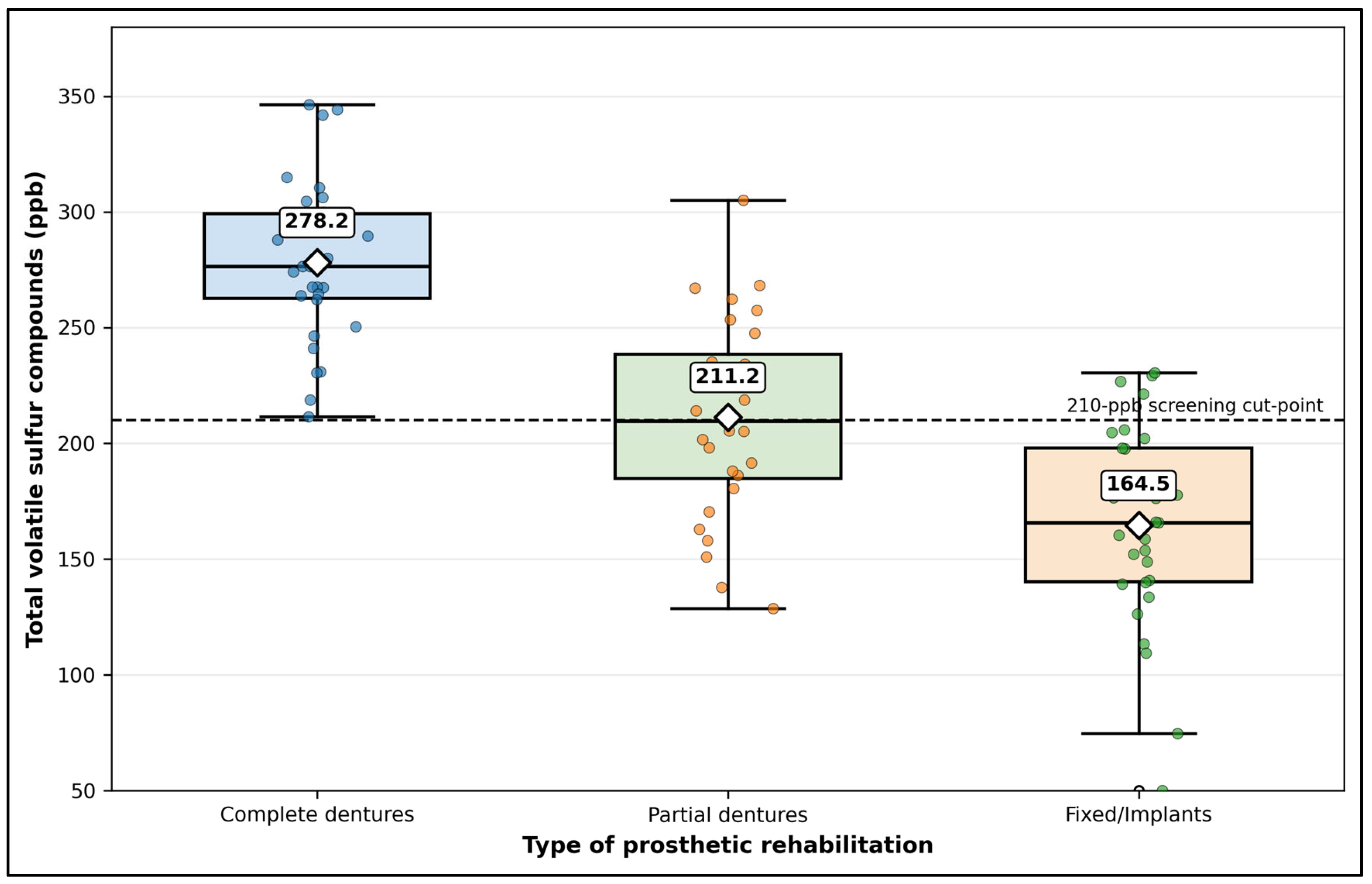
p < 0.001), while tongue coating, denture biofilm/plaque, total VSCs, and organoleptic score moved in the opposite direction. Notably, mean VSC of 278.2 ppb in complete denture wearers exceeded the conventional clinical threshold for socially perceptible halitosis (~200 ppb) by 39%, whereas the fixed prosthesis mean of 164.4 ppb sat comfortably below it. These baseline imbalances are important for interpretation: prosthesis type in this cohort also indexed broader differences in age, medication burden, functional dependence, remaining teeth, and oral environment status, and therefore should not be interpreted as an isolated causal exposure. The xerogenic medication count paralleled total medication burden (2.2 ± 1.1 in complete denture wearers, 1.5 ± 0.9 in partial denture wearers, and 1.1 ± 0.8 in fixed/implant wearers;
p = 0.001), supporting the decision to test xerogenic count as a medication-specific sensitivity variable. Ten patients had MMSE scores of 24–26 and were retained in the primary analysis with caregiver-countersigned consent (
Table 1).
Table 2 maps the bivariate architecture of geriatric halitosis and uncovers several biologically coherent gradients. Unstimulated salivary flow emerged as the strongest single correlate of total VSC (ρ = −0.61,
p < 0.001), implying that lower basal flow was associated with higher sulfur gas concentration. Tongue coating burden showed the second strongest VSC association (ρ = 0.56,
p < 0.001) and was itself inversely linked to salivary flow (ρ = −0.49), suggesting that diminished clearance may coexist with the accumulation of desquamated cells and bacteria on the dorsum. Notably, the number of chronic medications correlated positively with VSC (ρ = 0.49,
p < 0.001) and negatively with uSFR (ρ = −0.42), establishing the bivariate framework for the exploratory mediation analysis presented later. The denture biofilm/plaque index was significantly associated with VSC (ρ = 0.47), but was less strongly correlated with salivary flow (ρ = −0.36), indicating partial independence from the saliva–coating axis. Number of remaining teeth was protective in the expected direction (ρ = −0.39 with VSC), and GOHAI scores degraded as VSC rose (ρ = −0.51), confirming that objective sulfur burden was reflected in the patient’s oral-health-related quality of life. The organoleptic score correlated very strongly with instrumental VSCs (ρ = 0.71), supporting convergence between the panelist and instrumental olfactory assessments.
Table 3 shows an unadjusted monotonic gradient of halitosis severity across prosthesis types, with large between-group effect sizes. The Tukey post hoc test demonstrates that every pairwise comparison reached statistical significance for total VSC, log
10-VSC, organoleptic score, and tongue coating index. Cohen’s d values of 2.74 (complete vs. fixed), 1.56 (complete vs. partial), and 1.04 (partial vs. fixed) for VSC all exceed the threshold of 0.8 conventionally classed as “large.” The progression from 278.2 ppb in complete denture wearers to 164.4 ppb in fixed prosthesis wearers represents a 41% reduction in absolute sulfur output, sufficient to move group means from above to below the social acceptability threshold (~200 ppb). The parallel decline in organoleptic ratings (3.4 to 1.9 points on the 0–5 scale) confirms that this difference is perceptible to trained examiners. However, because prosthesis groups differed in age, medication burden, functional dependence, and remaining dentition, these gradients should be interpreted as adjusted only in subsequent multivariable models and not as proof that prosthesis type alone caused the observed VSC differences.
Table 4 summarizes a theory-informed multivariable model in which clinical variables jointly explained 62% of the inter-individual variation in log
10-VSC. Salivary flow showed the strongest independent association: each 0.1 mL·min
−1 decrease in uSFR corresponded to a 0.46-log
10 higher VSC value, equivalent to roughly a 35% higher ppb level at the cohort mean. Tongue coating retained a substantial independent association (β = 0.28,
p < 0.001), consistent with the dorsum biofilm acting as an ecological niche partially separable from salivary clearance. Polypharmacy remained positively associated with VSC after adjustment (β = 0.21,
p = 0.004), suggesting that the medication–halitosis association was not entirely captured by reduced saliva, since uSFR was already included in the model. Mouth breathing, denture biofilm/plaque, and number of remaining teeth all contributed modest yet statistically significant additional variance, in directions consistent with biological expectation. Age did not reach statistical significance once proximal variables were controlled (β = 0.08,
p = 0.187), supporting the interpretation that chronological age may operate largely through medication burden, functional status, and oral environment changes. Sex was likewise non-significant. The model should be interpreted as explanatory and hypothesis-generating rather than as a stable predictive equation, because it was not validated in an independent cohort.
Mann–Whitney U or independent samples t-test was used as appropriate; chi-square was used for categorical variables. The denture cleaning subgroup includes only complete and partial denture wearers (n = 58).
Table 5 isolates two behavioral exposures that often go un-asked in routine geriatric dental visits and shows that both have outsize effects on halitosis severity. Among the 23 patients who reported sleep mouth breathing, mean unstimulated salivary flow was 32% lower than in nasal breathers (0.17 vs. 0.25 mL·min
−1,
p < 0.001), and total VSC was approximately 30% higher (262.7 vs. 201.4 ppb,
p < 0.001). Tongue coating, denture biofilm, and organoleptic ratings all moved in the same direction, with effect sizes in the moderate-to-large range (Cohen’s d = 1.13 for VSC, 1.16 for organoleptic). The proportion of mouth breathers reporting subjective halitosis (69.6%) was nearly double that of nasal breathers (40.0%, chi-square
p = 0.014). The right-hand panel of the table, restricted to the 58 denture wearers, shows an even larger and arguably more clinically actionable contrast: patients who cleaned their dentures less than once daily had a mean VSC of 274.6 ppb compared with 218.4 ppb in daily cleaners (
p < 0.001), and their denture biofilm index was 69% higher. Although uSFR did not differ significantly between cleaning subgroups (
p = 0.083), tongue coating did (1.8 vs. 2.3,
p = 0.002), suggesting that poor denture hygiene seeds a broader oral cavity colonization rather than acting purely on the prosthesis surface.
Nagelkerke R2 = 0.58; Hosmer–Lemeshow goodness-of-fit χ2 = 6.12, df = 8, p = 0.634; correctly classified 81.8% of cases. Because there were 42 outcome events and eight predictors, the events-per-variable ratio was approximately 5.3; coefficients and classification performance should therefore be interpreted cautiously.
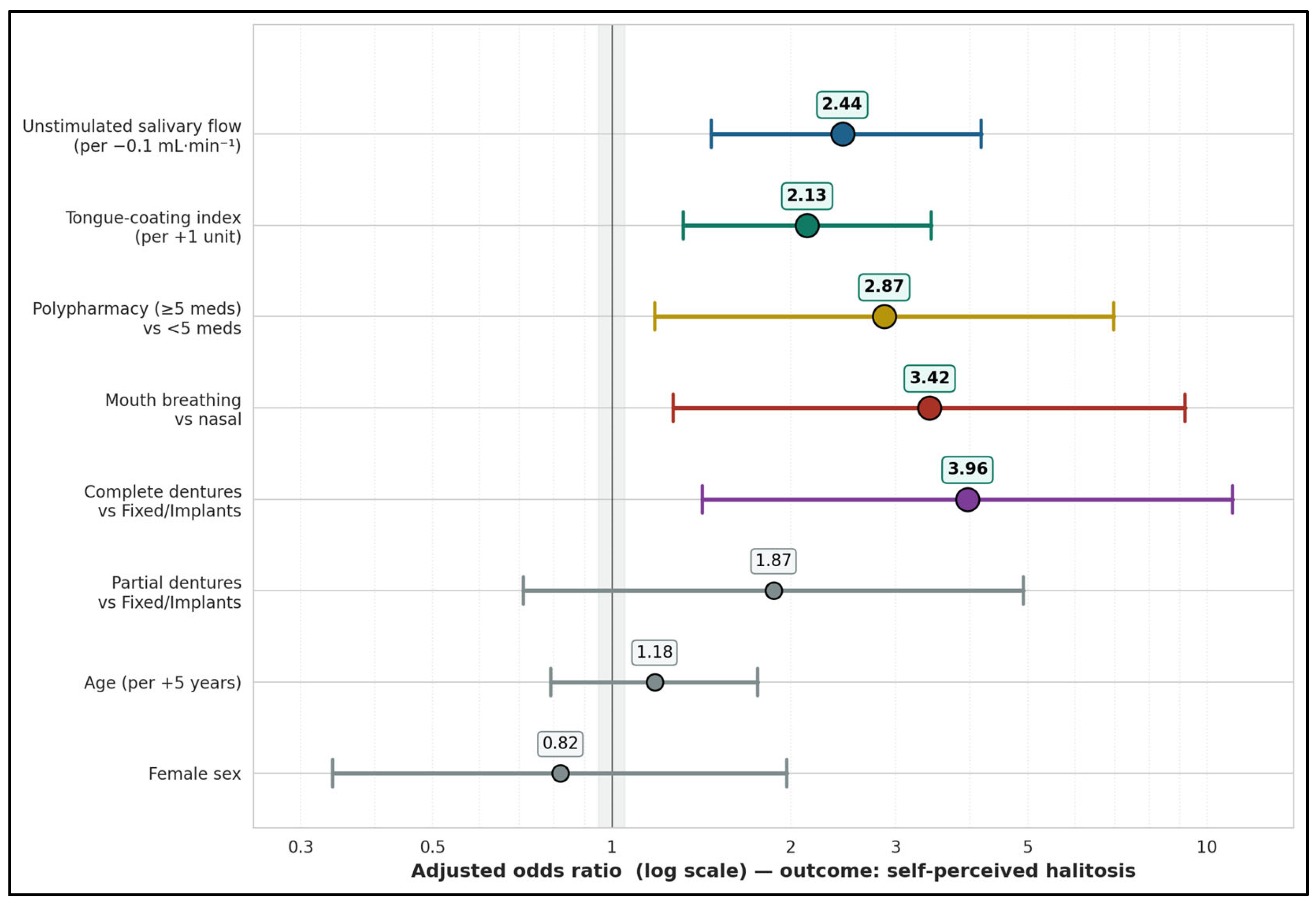
Table 6 quantifies how each predictor was associated with the patient’s subjective awareness of bad breath, and the magnitudes are clinically meaningful. A 0.1 mL·min
−1 rise in uSFR was associated with lower odds of reporting halitosis (OR = 0.41, 95% CI 0.24–0.68,
p < 0.001), reinforcing the protective association of preserved salivary function. Conversely, each unit increase in TCI more than doubled the odds (OR = 2.13,
p = 0.002), and each 50-ppb rise in instrumental VSC raised them by 48% (
p < 0.001), establishing a close link between chemical load and conscious perception. Polypharmacy emerged as an independent risk marker (OR = 2.87, 95% CI 1.18–6.97,
p = 0.020) even after adjustment for uSFR and biofilm metrics, suggesting that medication burden may capture additional pathways or residual comorbidity. Mouth breathing tripled the odds of self-reported halitosis (OR = 3.42,
p = 0.015), making it one of the most actionable risk markers in the table. Complete denture wearing carried roughly four-fold the odds compared with fixed prosthesis wearing (OR = 3.96,
p = 0.026), whereas partial denture wearing did not reach significance after adjustment, indicating that the most distinct risk profile attaches to full edentulism with removable prostheses rather than to denture wearing in general. Each five-tooth increment in remaining natural dentition reduced odds by 17% (
p = 0.040). Given the modest events-per-variable ratio, these estimates require confirmation in larger datasets.
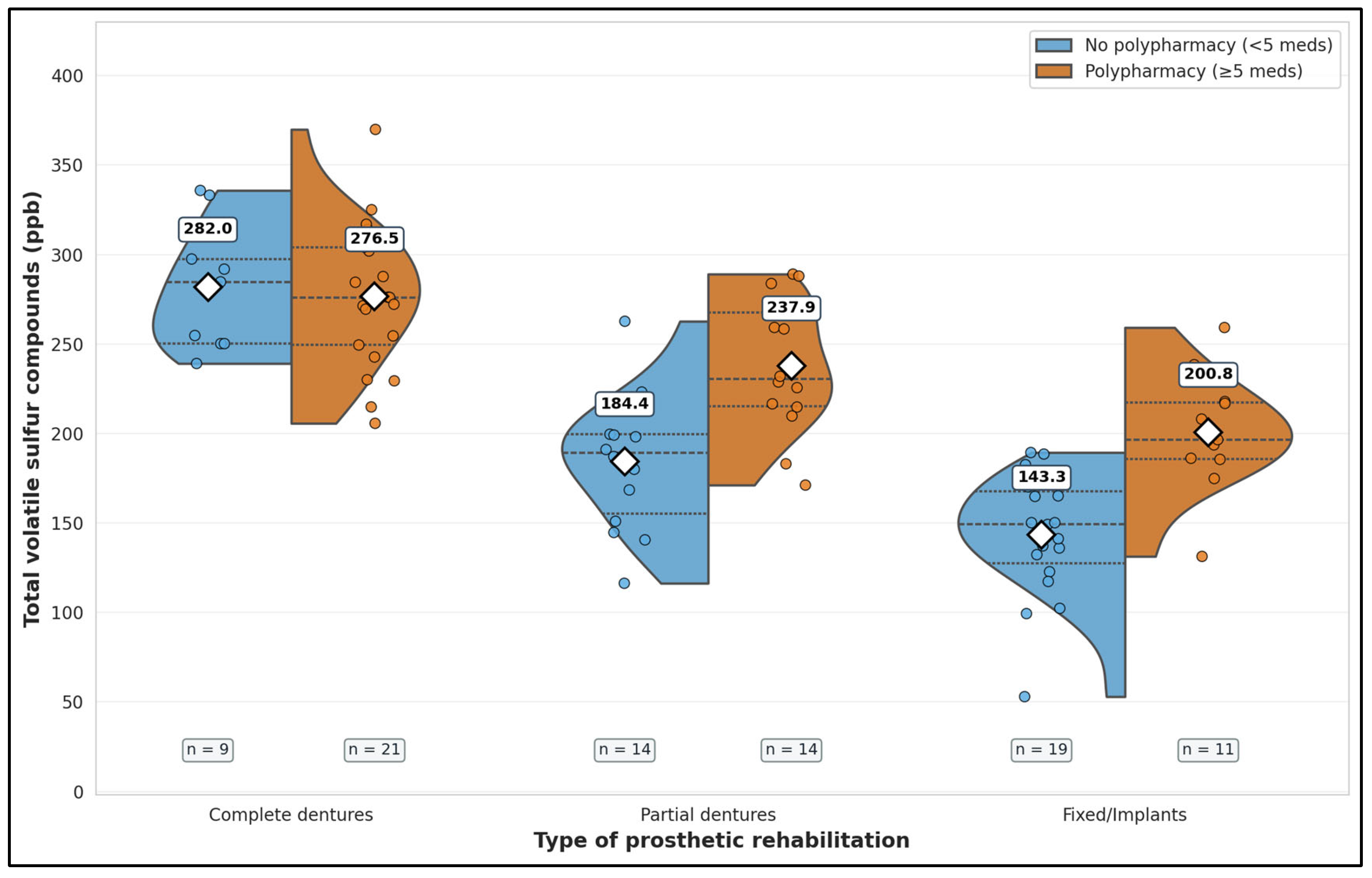
Table 7 shows the central statistical interaction identified in the study: polypharmacy and prosthesis type were not only additively associated with VSC output, but their association differed by rehabilitation group. The Panel A breakdown reveals a group-dependent polypharmacy difference—a near-zero −5.5 ppb difference among complete denture wearers (
p = 0.726) compared with +53.5 ppb in partial denture wearers (
p = 0.001) and +57.5 ppb in fixed prosthesis/implant wearers (
p < 0.001). A hypothesis-generating biological interpretation is one of possible ceiling saturation: complete denture wearers may already harbor extensive odorigenic biofilm reservoirs in the prosthesis–mucosa interface, so additional xerogenic medication burden may have limited measurable room to increase the substrate–enzyme cycle. In contrast, fixed prosthesis wearers had lower baseline VSC values, so reduced salivary flow associated with medication burden may be more visible. Panel B formalizes this asymmetric pattern statistically: the prosthesis main effect explains 52.2% of variance partial η
2 (η
2p), the polypharmacy main effect 23.5%, and the interaction term a smaller but significant 8.2% (F = 3.74,
p = 0.029). These estimates should be interpreted as cross-sectional associations rather than causal effects.
Coefficients are unstandardized. uSFR scaled in mL·min−1; outcome is log10-VSC. Sobel z = 3.50 supports a statistically significant indirect association. Covariates included: age, prosthesis type, and mouth breathing. Because all variables were measured cross-sectionally, this analysis does not establish temporal mediation or causality. The primary covariate set was intentionally limited to age, prosthesis type, and mouth breathing to avoid overadjusting for oral biofilm variables.
Table 8 presents an exploratory statistical decomposition of the association between polypharmacy and halitosis-related VSC. The total association (path c) of polypharmacy with log
10-VSC was 0.137 (
p < 0.001), corresponding to roughly a 37% higher absolute VSC level among patients on ≥5 medications. When uSFR was added as a statistical mediator, the direct association (path c′) decreased to 0.074 (
p = 0.006) but did not disappear, yielding a significant residual component and findings consistent with partial—rather than full—indirect association. The indirect association (a × b) was 0.063 with a bootstrap 95% confidence interval of 0.029 to 0.099, excluding zero, and the Sobel z of 3.50 (
p < 0.001) provided concordant inference. Overall, 45.9% of the observed polypharmacy–VSC association was statistically explained by lower salivary flow (bootstrap 95% CI 21.6–67.8%); however, because of the cross-sectional design, this estimate should not be interpreted as proof that polypharmacy temporally reduced uSFR or that reduced uSFR causally transmitted the effect of polypharmacy. When TCI and denture biofilm/plaque were added to the mediation covariates, the indirect association through uSFR remained statistically significant but was attenuated (a × b = 0.047, 95% CI 0.018–0.083;
p = 0.006), indicating that salivary flow did not merely proxy for tongue coating or prosthesis biofilm burden.
Overall, the sensitivity analyses supported the stability of the main findings. Excluding implant-supported restorations addressed the concern that the fixed/implant category might have included patients affected by a recent implant-related healing period, while excluding MMSE 24–26 participants addressed the reliability of self-reported halitosis. The expanded mediation model demonstrated that the salivary-flow indirect association persisted after accounting for tongue coating and denture biofilm/plaque, and the xerogenic medication analysis showed that the medication burden signal was not merely an artifact of using the standard ≥5-medication polypharmacy threshold. Importantly, the xerogenic count mediation proportion of 41.2% is now accompanied by its bootstrap 95% CI (19.4–62.7%), preventing the estimate from being presented as a single unsupported point value. In the MMSE exclusion model, protective and risk marker directions were preserved: higher uSFR remained associated with lower odds of self-perceived halitosis, whereas higher TCI, polypharmacy, mouth breathing, total VSC, and complete denture status remained associated with higher odds.
Table 9 translates the predictive results into the practical language of bedside screening, providing operating characteristics that a clinician can interpret without further computation. Total VSC at the Youden optimal threshold of 210 ppb yielded sensitivity of 78.6% and specificity of 76.1%, with a positive predictive value of 75.0% in the observed prevalence setting (47.7%). The single best individual cut point was the organoleptic score ≥ 2.5, which delivered a sensitivity of 76.2% with the highest specificity among single predictors (82.6%) and a positive likelihood ratio of 4.38, sufficient to meaningfully shift post-test probability. uSFR ≤ 0.21 mL·min
−1 and TCI ≥ 1.95 each performed in the moderate range, with sensitivities and specificities clustered around 70%, suggesting limited utility as standalone tests but potential value as components of a composite indicator. Indeed, the composite score (counting how many of four binary criteria—high VSC, low uSFR, heavy tongue coating, polypharmacy—were present) substantially outperformed any single component: at a threshold of ≥3 of 4, sensitivity reached 85.7% with specificity 78.3% (LR+ = 3.95, LR− = 0.18), making it a strong rule-out tool for ambulatory geriatric clinics. At the more stringent threshold of ≥4 of 4, specificity climbed to 93.5% and LR+ to 9.86, making it a strong rule-in tool when high specificity is required. To avoid ambiguity, the apparent AUC of 0.92 refers to the full multivariable logistic model in
Table 6, whereas the apparent AUC of 0.89 refers to the simplified four-item chairside composite model described here. Neither AUC was optimism-corrected or externally validated. These values should therefore be read as apparent in-sample discrimination rather than validated clinical performance estimates.
Table 10 reports the missing bootstrap 95% CI for the xerogenic count proportion explained and gives the coefficient direction for the MMSE exclusion halitosis model.




 ,
,