Ophthalmic and Visual System Changes in Human Spaceflight: A Review of Mechanisms, Measurement, and Countermeasures


 , , , and
Abstract
1. Introduction
2. Methods
3. Spaceflight Drivers and Design Variables
3.1. Microgravity Physiology and Fluid Shifts
3.2. Intraocular Pressure Dynamics Under Microgravity: Acute Responses, Adaptation, and Clinical Implications
4. Anterior Segment Complications in Spaceflight: Risk Factors and Mechanisms
4.1. Types of Anterior Segment Complications
4.1.1. Spaceflight Associated Dry Eye Syndrome (SADES)
4.1.2. Corneal Edema
4.2. Risk Factors
4.2.1. Cabin Environment and Tear-Film Destabilization
4.2.2. Microgravity-Induced Oculofacial and Visual Changes
4.2.3. Radiation Environment Across Mission Profiles
4.2.4. Extraterrestrial Dust, Foreign Body Exposure, and Systemic Factors Increasing Dry Eye Susceptibility
4.2.5. Ocular Infection and Viral Reactivation in the Spaceflight Immune Milieu
4.3. Countermeasures for Anterior-Segment Complications
5. Microgravity-Induced Ocular Structural Remodeling and Refractive Consequences
6. Spaceflight Associated Neuro-Ocular Syndrome (SANS)—The Clinical Spectrum
6.1. Time Course and Clinical Progression of SANS
6.2. Pathophysiology of SANS
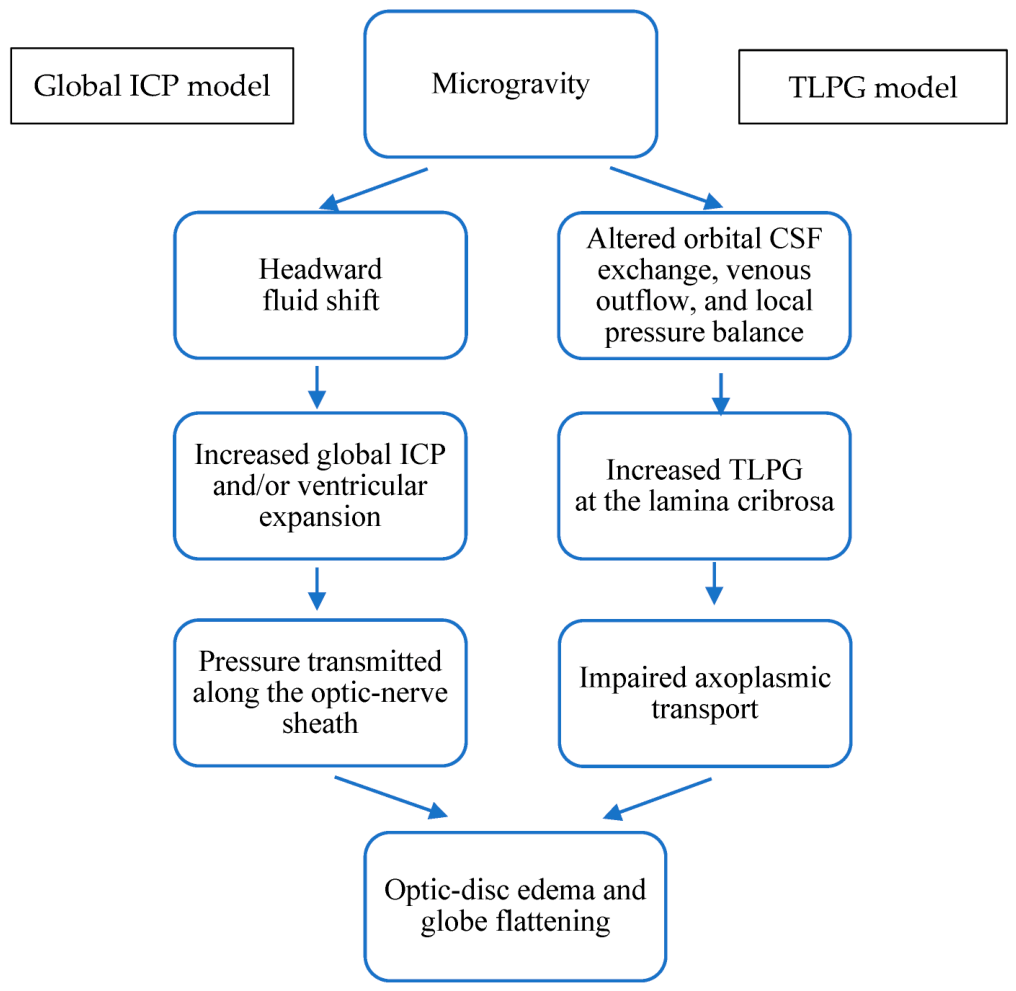
6.2.1. Mechanical Forces and Pressure Gradients
6.2.2. CSF Dynamics and Glymphatic Failure
6.2.3. Vascular Mechanisms
6.2.4. Cellular and Molecular Changes
6.2.5. Evidence from Animal Models
6.3. Differentiation of SANS from Idiopathic Intracranial Hypertension
6.4. SANS Risk Modifiers and Susceptibility
6.5. In-Flight Monitoring and Diagnostic Toolkit
6.5.1. Core Operational Tools (Flight-Ready)
6.5.2. Advanced Imaging and Emerging Modalities
6.6. SANS Countermeasures (Mechanical, Environmental, Nutritional)
7. Terrestrial Analogues (Head-Down Tilt Bed Rest, Dry Immersion, Limb Suspension, Parabolic Flight)
8. Long-Term Ocular Risks
Cataractogenesis and Radiation-Associated Risk
9. Limitations
10. Conclusions
Author Contributions
Funding
Institutional Review Board Statement
Informed Consent Statement
Data Availability Statement
Conflicts of Interest
Appendix A
Appendix A.1. Search Strategy and PRISMA Details
Appendix A.2. Full Search Strategies
- PubMed/MEDLINE (template)
- Scopus (template)
- Web of Science Core Collection (template)
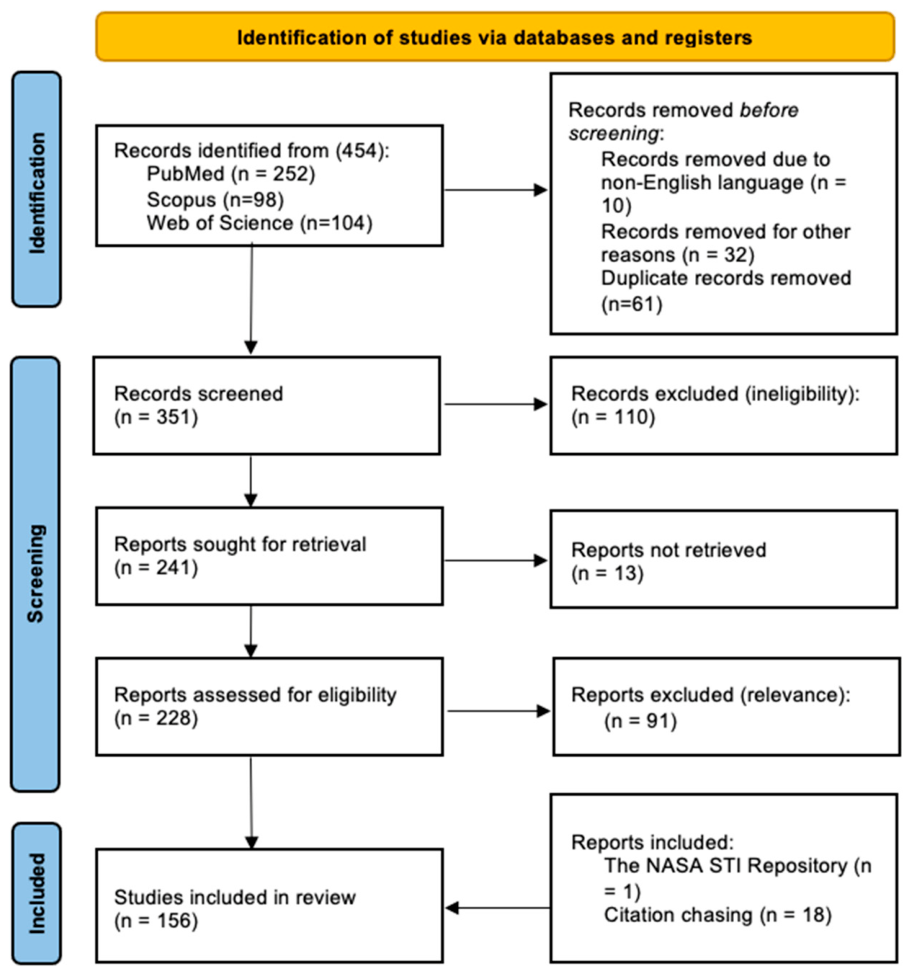
Appendix A.3. PRISMA 2020 Flow Diagram Numbers

Appendix B. Computational Approaches
Appendix C. Implications for Spacecraft Design and Mission Operations
Appendix C.1. Suggested Onboard “Minimum Kit” and Operational Footprint
- -
- OCT: A spectral-domain OCT (SD-OCT) with both posterior segment (ONH, RNFL, ganglion cell-inner plexiform layer, choroid) and anterior segment (corneal thickness, anterior chamber depth, lens) imaging capability.
- -
- Ultrasound system: A portable unit with a high-frequency linear probe (7–15 MHz) for ONSD assessment and, where available, a low-frequency phased-array probe for cerebral and ocular hemodynamic evaluation.
- -
- Routine functional testing (visual acuity, Amsler grid, contrast sensitivity) can be performed with existing crew medical equipment and software-based tools without additional stowage.
Appendix C.2. Trigger-Based Operational Decision Support
- -
- Total retinal thickness (ΔTRT) increase > 10%, Frisén grade ≥ 2 optic disc edema or ONSD > 15% increase from preflight baseline: Initiate enhanced monitoring (weekly OCT + ONSD ultrasound); optimize CO2 management; consider LBNP or thigh-cuff deployment sessions as a first mechanical countermeasure.
- -
- Lens opacification progression: Flag for post-mission cataract surveillance; incorporate into individual long-term risk counseling.
Appendix C.3. Design Levers, Evidence Gaps, and Verification Roadmap

| Hazard | Outcome | Primary Detection | Mitigation Levers | Verification Platforms |
|---|---|---|---|---|
| Fluid shift/venous congestion | SANS, refractive shift, mission impact | OCT trending + US/ONSD | LBNP, cuffs, posture, TLPG, CO2, nutrition | HDTBR, dry immersion, ISS |
| Cabin CO2 (elevated vs. Earth) | Modifier of posterior findings | Cabin telemetry + OCT/US | CO2 removal (design) + exposure management (ops) | HDTBR ± mild hypercapnia |
| Nutritional + genetic susceptibility (one-carbon pathway) | Stratified risk for ODE/SANS indicators | Preflight biomarkers/genotyping; enhanced monitoring | B-vitamin supplementation; tailored monitoring intensity | Cohort stratification: controlled trials needed |
| Airflow, Humidity, dust | Dry eye; infection; performance | Symptoms + tear metrics; functional testing | Environment optimization; lubrication | In-flight monitoring |
| Deep-space radiation (HZE/high-LET) | Cataractogenesis (late effect); programmatic burden | Lens surveillance + dosimetry | Shielding, storm shelter; exposure management | Astronaut cohorts, heavy-ion animal studies |
| Perfusion dynamics (OCTA/LSFG) | SANS trajectory marker | OCTA; LSFG (MBR) | Adjunct endpoint for response verification | HDT, parabolic analogues |
References
- Ax, T.; Ganse, B.; Fries, F.N.; Szentmáry, N.; de Paiva, C.S.; March de Ribot, F.; Jensen, S.O.; Seitz, B.; Millar, T.J. Dry Eye Disease in Astronauts: A Narrative Review. Front. Physiol. 2023, 14, 1281327. [Google Scholar] [CrossRef]
- Lee, R.; Ong, J.; Waisberg, E.; Kumar, R.; Ngo, A.; Mader, T.H.; Berdahl, J.; Karandikar, U.C.; Grattoni, A.; Lee, A.G. Advanced Ocular Drug Delivery in Microgravity: Nanotherapeutic Applications as Cardiovascular and Ophthalmic Countermeasures. Nanomedicine 2025, 68, 102845. [Google Scholar] [CrossRef]
- Lee, A.G. Neuroimaging in Space Flight Associated Neuro-Ocular Syndrome (SANS). Eye 2021, 35, 1799–1800. [Google Scholar] [CrossRef] [PubMed]
- Ong, J.; Tarver, W.; Brunstetter, T.; Mader, T.H.; Gibson, C.R.; Mason, S.S.; Lee, A. Spaceflight Associated Neuro-Ocular Syndrome: Proposed Pathogenesis, Terrestrial Analogues, and Emerging Countermeasures. Br. J. Ophthalmol. 2023, 107, 895–900. [Google Scholar] [CrossRef] [PubMed]
- Lee, A.G.; Mader, T.H.; Gibson, C.R.; Tarver, W.; Rabiei, P.; Riascos, R.F.; Galdamez, L.A.; Brunstetter, T. Spaceflight Associated Neuro-Ocular Syndrome (SANS) and the Neuro-Ophthalmologic Effects of Microgravity: A Review and an Update. npj Microgravity 2020, 6, 7. [Google Scholar] [CrossRef] [PubMed]
- Chylack, L.T.; Peterson, L.E.; Feiveson, A.H.; Wear, M.L.; Manuel, F.K.; Tung, W.H.; Hardy, D.S.; Marak, L.J.; Cucinotta, F.A. NASA Study of Cataract in Astronauts (NASCA). Report 1: Cross-Sectional Study of the Relationship of Exposure to Space Radiation and Risk of Lens Opacity. Radiat. Res. 2009, 172, 10–20. [Google Scholar] [CrossRef]
- Chylack, L.T.; Feiveson, A.H.; Peterson, L.E.; Tung, W.H.; Wear, M.L.; Marak, L.J.; Hardy, D.S.; Chappell, L.J.; Cucinotta, F.A. NASCA Report 2: Longitudinal Study of Relationship of Exposure to Space Radiation and Risk of Lens Opacity. Radiat. Res. 2012, 178, 25–32. [Google Scholar] [CrossRef]
- Sibony, P.A.; Laurie, S.S.; Ferguson, C.R.; Pardon, L.P.; Young, M.; Rohlf, F.J.; MacIas, B.R. Ocular Deformations in Spaceflight-Associated Neuro-Ocular Syndrome and Idiopathic Intracranial Hypertension. Invest. Ophthalmol. Vis. Sci. 2023, 64, 32. [Google Scholar] [CrossRef]
- Valencia, W.E.; Mason, S.S.; Brunstetter, T.J.; Sargsyan, A.E.; Schaefer, C.M.; Tarver, W.J.; Van Baalen, M.G.; Gibson, C.R.; Lee, A.G.; Danilichev, S.N.; et al. Evaluation of Optic Disc Edema in Long-Duration Spaceflight Crewmembers Using Retinal Photography. J. Neuro-Ophthalmol. 2023, 43, 364–369. [Google Scholar] [CrossRef]
- Soares, B.; Ong, J.; Osteicoechea, D.; Kadipasaoglu, C.M.; Waisberg, E.; Sarker, P.; Zaman, N.; Tavakkoli, A.; Vizzeri, G.; Lee, A.G. Ultrasound Biomicroscopy as a Novel, Potential Modality to Evaluate Anterior Segment Ophthalmic Structures during Spaceflight: An Analysis of Current Technology. Diagnostics 2024, 14, 639. [Google Scholar] [CrossRef]
- Hamada, N.; Sato, T. Cataractogenesis Following High-LET Radiation Exposure. Mutat. Res./Rev. Mutat. Res. 2016, 770, 262–291. [Google Scholar] [CrossRef]
- Dynlacht, J.R.; Valluri, S.; Lopez, J.; Greer, F.; DesRosiers, C.; Caperell-Grant, A.; Mendonca, M.S.; Bigsby, R.M. Estrogen Protects against Radiation-Induced Cataractogenesis. Radiat. Res. 2008, 170, 758–764. [Google Scholar] [CrossRef] [PubMed]
- Dynlacht, J.R.; Valluri, S.; Garrett, J.; Mendonca, M.S.; Lopez, J.T.; Caperell-Grant, A.; Bigsby, R.M. Age and Hormonal Status as Determinants of Cataractogenesis Induced by Ionizing Radiation. I. Densely Ionizing (High-LET) Radiation. Radiat. Res. 2010, 175, 37–43. [Google Scholar] [CrossRef]
- Garrett, J.; Valluri, S.; Mendonca, M.S.; Bigsby, R.M.; Lopez, J.; Caperell-Grant, A.; Nees, J.; Dynlacht, J.R. The Protective Effect of Estrogen Against Radiation Cataractogenesis Is Dependent Upon the Type of Radiation. Radiat. Res. 2020, 194, 557–565. [Google Scholar] [CrossRef] [PubMed]
- Richardson, R.B. The Role of Oxygen and the Goldilocks Range in the Development of Cataracts Induced by Space Radiation in US Astronauts. Exp. Eye Res. 2022, 223. [Google Scholar] [CrossRef] [PubMed]
- Kleiman, N.J.; David, J.; Elliston, C.D.; Hopkins, K.M.; Smilenov, L.B.; Brenner, D.J.; Worgul, B.V.; Hall, E.J.; Lieberman, H.B. Mrad9 and Atm Haploinsufficiency Enhance Spontaneous and X-Ray-Induced Cataractogenesis in Mice. Radiat. Res. 2007, 168, 567–573. [Google Scholar] [CrossRef]
- Venegas, J.M. Spaceflight-Associated Neuro-Ocular Syndrome: Potential Etiologies and Connections to the Glymphatic System. J. Neurophysiol. 2024, 131, 785–788. [Google Scholar] [CrossRef]
- Spaide, R.F.; Gemmy Cheung, C.M.; Matsumoto, H.; Kishi, S.; Boon, C.J.F.; van Dijk, E.H.C.; Mauget-Faysse, M.; Behar-Cohen, F.; Hartnett, M.E.; Sivaprasad, S.; et al. Venous Overload Choroidopathy: A Hypothetical Framework for Central Serous Chorioretinopathy and Allied Disorders. Prog. Retin. Eye Res. 2022, 86, 100973. [Google Scholar] [CrossRef]
- Ong, J.; Mader, T.H.; Gibson, C.R.; Mason, S.S.; Lee, A.G. Spaceflight Associated Neuro-Ocular Syndrome (SANS): An Update on Potential Microgravity-Based Pathophysiology and Mitigation Development. Eye 2023, 37, 2409–2415. [Google Scholar] [CrossRef]
- Waisberg, E.; Ong, J.; Lee, A.G. Anaemia, Idiopathic Intracranial Hypertension (IIH) and Spaceflight Associated Neuro-Ocular Syndrome (SANS). Eye 2024, 38, 1029–1030. [Google Scholar] [CrossRef]
- Aleci, C. From International Ophthalmology to Space Ophthalmology: The Threats to Vision on the Way to Moon and Mars Colonization. Int. Ophthalmol. 2020, 40, 775–786. [Google Scholar] [CrossRef]
- Lee, A.G.; Mader, T.H.; Gibson, C.R.; Brunstetter, T.J.; Tarver, W.J. Space Flight-Associated Neuro-Ocular Syndrome (SANS). Eye 2018, 32, 1164–1167. [Google Scholar] [CrossRef]
- Seidler, R.D.; Mao, X.W.; Tays, G.D.; Wang, T.; zu Eulenburg, P. Effects of Spaceflight on the Brain. Lancet Neurol. 2024, 23, 826–835. [Google Scholar] [CrossRef] [PubMed]
- Bateman, G.A.; Bateman, A.R. A Perspective on the Evidence for Glymphatic Obstruction in Spaceflight Associated Neuro-Ocular Syndrome and Fatigue. npj Microgravity 2024, 10, 23. [Google Scholar] [CrossRef] [PubMed]
- Rodrigues, G.A.; Russomano, T.; Santos Oliveira, E. Understanding the Relationship between Intracranial Pressure and Spaceflight Associated Neuro-Ocular Syndrome (SANS): A Systematic Review. npj Microgravity 2025, 11, 22. [Google Scholar] [CrossRef]
- Nusbaum, D.M.; Wu, S.M.; Frankfort, B.J. Elevated Intracranial Pressure Causes Optic Nerve and Retinal Ganglion Cell Degeneration in Mice. Exp. Eye Res. 2015, 136, 38–44. [Google Scholar] [CrossRef]
- Mader, T.H.; Gibson, C.R.; Otto, C.A.; Sargsyan, A.E.; Miller, N.R.; Subramanian, P.S.; Hart, S.F.; Lipsky, W.; Patel, N.B.; Lee, A.G. Persistent Asymmetric Optic Disc Swelling after Long-Duration Space Flight: Implications for Pathogenesis. J. Neuro-Ophthalmol. 2017, 37, 133–139. [Google Scholar] [CrossRef]
- Paez, Y.M.; Mudie, L.I.; Subramanian, P.S. Spaceflight Associated Neuro-Ocular Syndrome (Sans): A Systematic Review and Future Directions. Eye Brain 2020, 12, 105–117. [Google Scholar] [CrossRef]
- Stern, C.; Yücel, Y.H.; zu Eulenburg, P.; Pavy-Le Traon, A.; Petersen, L.G. Eye-Brain Axis in Microgravity and Its Implications for Spaceflight Associated Neuro-Ocular Syndrome. npj Microgravity 2023, 9, 56. [Google Scholar] [CrossRef]
- Pardon, L.P.; Cheng, H.; Chettry, P.; Patel, N.B. Optic Nerve Head Morphological Changes Over 12 Hours in Seated And-Down Tilt Postures. Invest. Ophthalmol. Vis. Sci. 2020, 61, 21. [Google Scholar] [CrossRef] [PubMed]
- Liu, K.C.; Fleischman, D.; Lee, A.G.; Killer, H.E.; Chen, J.J.; Bhatti, M.T. Current Concepts of Cerebrospinal Fluid Dynamics and the Translaminar Cribrosa Pressure Gradient: A Paradigm of Optic Disk Disease. Surv. Ophthalmol. 2020, 65, 48–66. [Google Scholar] [CrossRef]
- Wostyn, P.; Mader, T.H.; Gibson, C.R.; Killer, H.E. The Escape of Retrobulbar Cerebrospinal Fluid in the Astronaut’s Eye: Mission Impossible? Eye 2019, 33, 1519–1524. [Google Scholar] [CrossRef]
- Huang, A.S.; Stenger, M.B.; Macias, B.R. Gravitational Influence on Intraocular Pressure: Implications for Spaceflight and Disease. J. Glaucoma 2019, 28, 756–764. [Google Scholar] [CrossRef]
- Joe, B. Spaceflight Associated Neuro-Ocular Syndrome: Connections with terrestrial Eye and Brain Disorders. Front. Ophthalmol. 2024, 4, 1487992. [Google Scholar] [CrossRef] [PubMed]
- Chen, W.; Chen, Z.-Q.; Xiang, Y.; Deng, C.-H.; Zhang, H.; Wang, J.-M. Analogs of Microgravity: The Function of Schlemm’s Canal, Intraocular and Autonomic Nervous during the Head-down Tilt Test in Healthy. Int. J. Ophthalmol. 2021, 14, 1419–1423. [Google Scholar] [CrossRef] [PubMed]
- Chung, K.; Woo, S.J.; Yi, S.; Choi, G.; Ahn, C.; Hur, G.; Lim, J.; Kim, T.-W. Diurnal Pattern of Intraocular Pressure Is Affected by Microgravity When in Space with the Pressure Phosphene Tonometer (PPT). J. Glaucoma 2011, 20, 488–491. [Google Scholar] [CrossRef]
- Zarrinbakhsh, A.; Gupta, N.; Sinha, J.; Zhou, X.; Chen, S.; Khan, H.M.; Navajas, E.V.; Beg, M.F.; Liang, Y.; Yucel, Y. Intraocular Pressure and Retinal Nerve Fiber Layer Changes in a Microgravity Mouse Model and Relevance to Spaceflight-Associated Neuro-Ocular Syndrome. Eye Brain 2025, 17, 137–149. [Google Scholar] [CrossRef]
- Lavery, W.J.; Kiel, J.W. Effects of Head down Tilt on Episcleral Venous Pressure in a Rabbit Model. Exp. Eye Res. 2013, 111, 88–94. [Google Scholar] [CrossRef] [PubMed]
- Jasien, J.V.; Fazio, M.A.; Samuels, B.C.; Johnston, J.M.; Downs, J.C. Quantification of Translaminar Pressure Gradient (TLPG) with Continuous Wireless Telemetry in Nonhuman Primates (NHPS). Transl. Vis. Sci. Technol. 2020, 9, 18. [Google Scholar] [CrossRef]
- Scott, J.M.; Tucker, W.J.; Martin, D.; Crowell, J.B.; Goetchius, E.; Ozgur, O.; Hamilton, S.; Otto, C.; Gonzales, R.; Ritter, M.; et al. Association of Exercise and Swimming Goggles with Modulation of Cerebro-Ocular Hemodynamics and Pressures in a Model of Spaceflight-Associated Neuro-Ocular Syndrome. JAMA Ophthalmol. 2019, 137, 652–659. [Google Scholar] [CrossRef]
- Taibbi, G.; Cromwell, R.L.; Kapoor, K.G.; Godley, B.F.; Vizzeri, G. The Effect of Microgravity on Ocular Structures and Visual Function: A Review. Surv. Ophthalmol. 2013, 58, 155–163. [Google Scholar] [CrossRef]
- Meer, E.; Grob, S.; Antonsen, E.L.; Sawyer, A. Ocular Conditions and Injuries, Detection and Management in Spaceflight. npj Microgravity 2023, 9, 37. [Google Scholar] [CrossRef]
- Meer, E.; Grob, S.R.; Lehnhardt, K.; Sawyer, A. Ocular Complaints and Diagnoses in Spaceflight. npj Microgravity 2024, 10, 1. [Google Scholar] [CrossRef]
- Suh, A.; Ong, J.; Waisberg, E.; Lee, A.G. Neurostimulation as a Technology Countermeasure for Dry Eye Syndrome in Astronauts. Life Sci. Space Res. 2024, 42, 37–39. [Google Scholar] [CrossRef]
- Lee, R.; Ong, J.; Waisberg, E.; Suh, A.; Kadipasaoglu, M.; Mader, T.; Gibson, C.R.; Berdahl, J.; Lee, A.G.; Lee, A.G.; et al. Defining Spaceflight Associated Dry Eye Syndrome (SADES): Mechanisms, Complications, and Countermeasures. Exp. Eye Res. 2025, 258, 110513. [Google Scholar] [CrossRef] [PubMed]
- Lee, R.; Ong, J.; Waisberg, E.; Lee, A.G. Spaceflight Associated Dry Eye Syndrome (SADES): Radiation, Stressors, and Ocular Surface Health. Life Sci. Space Res. 2024, 43, 75–81. [Google Scholar] [CrossRef] [PubMed]
- Lee, R.; Ong, J.; Sampige, R.; Panzo, N.; Memon, H.; Suh, A.; Waisberg, E.; Mader, T.; Berdahl, J.; Chévez-Barrios, P.; et al. Corneal Edema and the Endothelium in Spaceflight. Aerosp. Med. Hum. Perform. 2025, 96, 569–577. [Google Scholar] [CrossRef]
- Gibson, C.R.; Mader, T.H.; Lipsky, W.; Schallhorn, S.C.; Tarver, W.J.; Suresh, R.; Hague, T.N.; Brunstetter, T.J. Photorefractive Keratectomy and Laser-Assisted In Situ Keratomileusis on 6-Month Space Missions. Aerosp. Med. Hum. Perform. 2024, 95, 278–281. [Google Scholar] [CrossRef]
- Gibson, C.R.; Mader, T.H.; Schallhorn, S.C.; Pesudovs, K.; Lipsky, W.; Raid, E.; Jennings, R.T.; Fogarty, J.A.; Garriott, R.A.; Garriott, O.K.; et al. Visual Stability of Laser Vision Correction in an Astronaut on a Soyuz Mission to the International Space Station. J. Cataract Refract. Surg. 2012, 38, 1486–1491. [Google Scholar] [CrossRef]
- Kohnen, T. Effects of Refractive Surgery in Extreme Altitude or Space. J. Cataract Refract. Surg. 2012, 38, 1307–1308. [Google Scholar] [CrossRef] [PubMed]
- Li, X.; Zhang, Z.; Ye, L.; Meng, J.; Zhao, Z.; Liu, Z.; Hu, J. Acute Ocular Hypertension Disrupts Barrier Integrity and Pump Function in Rat Corneal Endothelial Cells. Sci. Rep. 2017, 7, 6951. [Google Scholar] [CrossRef]
- Shah, J.; Ong, J.; Lee, R.; Suh, A.; Waisberg, E.; Gibson, C.R.; Berdahl, J.; Mader, T.H. Risk of Permanent Corneal Injury in Microgravity: Spaceflight-Associated Hazards, Challenges to Vision Restoration, and Role of Biotechnology in Long-Term Planetary Missions. Life 2025, 15, 602. [Google Scholar] [CrossRef]
- Stenger, M.B.; Tarver, W.J.; Brunstetter, T.; Gibson, C.R.; Laurie, S.S.; Lee, S.M.C.; Macias, B.R.; Mader, T.H.; Otto, C.; Smith, S.M.; et al. Risk of Spaceflight Associated Neuro-Ocular Syndrome (SANS); Johnson Space Center: Jacksonville, FL, USA, 2017. [Google Scholar]
- Sampige, R.; Ong, J.; Waisberg, E.; Berdahl, J.; Lee, A.G. The Hypercapnic Environment on the International Space Station (ISS): A Potential Contributing Factor to Ocular Surface Symptoms in Astronauts. Life Sci. Space Res. 2025, 44, 122–125. [Google Scholar] [CrossRef]
- Ax, T.; Bothe, T.L.; Craig, J.P.; Dean, S.J.; March de Ribot, F.; Fries, F.N.; Jensen, S.O.; Millar, T.; Seitz, B. The Effect of Short-Term Microgravity and Hypergravity on Eyelid and Brow Position. Orbit 2025, 44, 535–543. [Google Scholar] [CrossRef]
- Juhl, O.J.; Buettmann, E.G.; Friedman, M.A.; DeNapoli, R.C.; Hoppock, G.A.; Donahue, H.J. Update on the Effects of Microgravity on the Musculoskeletal System. npj Microgravity 2021, 7, 28. [Google Scholar] [CrossRef]
- Gupta, U.; Baig, S.; Majid, A.; Bell, S.M. The Neurology of Space Flight; How Does Space Flight Effect the Human Nervous System? Life Sci. Space Res. 2023, 36, 105–115. [Google Scholar] [CrossRef] [PubMed]
- Hupfeld, K.E.; Mcgregor, H.R.; Koppelmans, V.; Beltran, N.E.; Kofman, I.S.; De Dios, Y.E.; Riascos, R.F.; Reuter-Lorenz, P.A.; Wood, S.J.; Bloomberg, J.J.; et al. Brain and Behavioral Evidence for Reweighting of Vestibular Inputs with Long-Duration Spaceflight. Cereb. Cortex 2022, 32, 755–769. [Google Scholar] [CrossRef] [PubMed]
- Tays, G.D.; Hupfeld, K.E.; McGregor, H.R.; Beltran, N.E.; De Dios, Y.E.; Mulder, E.; Bloomberg, J.J.; Mulavara, A.P.; Wood, S.J.; Seidler, R.D. Daily Artificial Gravity Partially Mitigates Vestibular Processing Changes Associated with Head-down Tilt Bedrest. npj Microgravity 2024, 10, 27. [Google Scholar] [CrossRef] [PubMed]
- Howle, L.E.; Weber, P.W.; Hada, E.A.; Vann, R.D.; Denoble, P.J. The Probability and Severity of Decompression Sickness. PLoS ONE 2017, 12, e0172665. [Google Scholar] [CrossRef]
- Suh, A.; Ditelberg, S.; Szeto, J.J.; Kumar, D.; Ong, J.; Robert Gibson, C.; Mader, T.H.; Waisberg, E.; Lee, A.G. Safety Protocols, Precautions, and Countermeasures Aboard the International Space Station to Prevent Ocular Injury. Surv. Ophthalmol. 2025, 70, 1003–1012. [Google Scholar] [CrossRef]
- Sannita, W.G.; Narici, L.; Picozza, P. Positive Visual Phenomena in Space: A Scientific Case and a Safety Issue in Space Travel. Vis. Res. 2006, 46, 2159–2165. [Google Scholar] [CrossRef] [PubMed]
- Meyers, V.E.; Garca, H.D.; Monds, K.; Cooper, B.L.; James, J.T. Ocular Toxicity of Authentic Lunar Dust. BMC Ophthalmol. 2012, 12, 26. [Google Scholar] [CrossRef]
- Clément, G.R.; Boyle, R.D.; George, K.A.; Nelson, G.A.; Reschke, M.F.; Williams, T.J.; Paloski, W.H. Challenges to the Central Nervous System during Human Spaceflight Missions to Mars. J. Neurophysiol. 2020, 123, 2037–2063. [Google Scholar] [CrossRef] [PubMed]
- Sampige, R.; Ong, J.; Waisberg, E.; Berdahl, J.; Lee, A.G. The Ocular Surface–Gut Axis in Spaceflight: Implications of Intestinal Changes in Microgravity on Tear Film Physiology. J. Clin. Transl. Ophthalmol. 2024, 2, 79–86. [Google Scholar] [CrossRef]
- Cheung, H.C.; De Louche, C.; Komorowski, M. Artificial Intelligence Applications in Space Medicine. Aerosp. Med. Hum. Perform. 2023, 94, 610–622. [Google Scholar] [CrossRef]
- Lee, R.; Kumar, R.; Shah, J.; Ong, J.; Waisberg, E.; Tavakkoli, A. Tear Film and Keratitis in Space: Fluid Dynamics and Nanomedicine Strategies for Ocular Protection in Microgravity. Pharmaceutics 2025, 17, 847. [Google Scholar] [CrossRef]
- Mehta, S.K.; Laudenslager, M.L.; Stowe, R.P.; Crucian, B.E.; Feiveson, A.H.; Sams, C.F.; Pierson, D.L. Latent Virus Reactivation in Astronauts on the International Space Station. npj Microgravity 2017, 3, 11. [Google Scholar] [CrossRef]
- Rooney, B.V.; Crucian, B.E.; Pierson, D.L.; Laudenslager, M.L.; Mehta, S.K. Herpes Virus Reactivation in Astronauts during Spaceflight and Its Application on Earth. Front. Microbiol. 2019, 10, 16. [Google Scholar] [CrossRef]
- Masalkhi, M.; Ong, J.; Waisberg, E.; Lee, A.G. Ocular Immunology and Inflammation under Microgravity Conditions and the Pathogenesis of Spaceflight Associated Neuro-Ocular Syndrome (SANS). Eye 2024, 38, 1799–1801. [Google Scholar] [CrossRef] [PubMed]
- Cucinotta, F.A.; Manuel, F.K.; Jones, J.; Iszard, G.; Murrey, J.; Djojonegro, B.; Wear, M. Space Radiation and Cataracts in Astronauts. Radiat. Res. 2001, 156, 460–466. [Google Scholar] [CrossRef]
- Ax, T.; Bothe, T.L.; Craig, J.; Fries, F.N.; de Ribot, F.M.; Jensen, S.O.; Seitz, B. Nasal Neurostimulation as a Countermeasure for Dry Eye Disease in Astronauts: Feasibility Study in Microgravity During Parabolic Flights. In Proceedings of the AIAA Aviation Forum and Ascend 2025, Las Vegas, NV, USA, 21–25 July 2025. [Google Scholar]
- MacIas, B.R.; Patel, N.B.; Gibson, C.R.; Samuels, B.C.; Laurie, S.S.; Otto, C.; Ferguson, C.R.; Lee, S.M.C.; Ploutz-Snyder, R.; Kramer, L.A.; et al. Association of Long-Duration Spaceflight with Anterior and Posterior Ocular Structure Changes in Astronauts and Their Recovery. JAMA Ophthalmol. 2020, 138, 553–559. [Google Scholar] [CrossRef] [PubMed]
- SVORONOS, A.A.; O’GRADY, C.S.; WALKER, E.V.A.N.; AFSHARI, N.A.; MACIAS, B.R.; LAURIE, S.S.; WEINREB, R.N.; HUANG, A.S. Analysis of Spaceflight-Associated Biometric and Refractive Changes in Astronauts. Am. J. Ophthalmol. 2025, 276, 146–156. [Google Scholar] [CrossRef]
- Pardon, L.P.; Macias, B.R.; Ferguson, C.R.; Greenwald, S.H.; Ploutz-Snyder, R.; Alferova, I.V.; Ebert, D.; Dulchavsky, S.A.; Hargens, A.R.; Stenger, M.B.; et al. Changes in Optic Nerve Head and Retinal Morphology during Spaceflight and Acute Fluid Shift Reversal. JAMA Ophthalmol. 2022, 140, 763–770. [Google Scholar] [CrossRef]
- Friberg, T.R.; Lace, J.W. A Comparison of the Elastic Properties of Human Choroid and Sclera. Exp. Eye Res. 1988, 47, 429–436. [Google Scholar] [CrossRef]
- Wahlin, A.; Holmlund, P.; Fellows, A.M.; Malm, J.; Buckey, J.C.; Eklund, A. Optic Nerve Length before and after Spaceflight. Ophthalmology 2021, 128, 309–316. [Google Scholar] [CrossRef]
- Rim, T.H.; Lee, C.S.; Kim, K.; Kim, S.S. Assessment of Choroidal Thickness before and after Steep Trendelenburg Position Using Swept-Source Optical Coherence Tomography. Br. J. Ophthalmol. 2015, 99, 493–499. [Google Scholar] [CrossRef]
- Dai, X.; Ye, S.; Chen, X.; Jiang, T.; Huang, H.; Li, W.; Yu, H.; Bao, J.; Chen, H. Rodent Retinal Microcirculation and Visual Electrophysiology Following Simulated Microgravity. Exp. Eye Res. 2020, 194, 108023. [Google Scholar] [CrossRef]
- Sampige, R.; Ong, J.; Waisberg, E.; Lee, A.G. The Natural and Artificial Intraocular Lens in Spaceflight. Eye 2024, 38, 3035–3036. [Google Scholar] [CrossRef]
- Waisberg, E.; Ong, J.; Paladugu, P.; Kamran, S.A.; Zaman, N.; Lee, A.G.; Tavakkoli, A. Dynamic Visual Acuity as a Biometric for Astronaut Performance and Safety. Life Sci. Space Res. 2023, 37, 3–6. [Google Scholar] [CrossRef] [PubMed]
- Waisberg, E.; Ong, J.; Zaman, N.; Kamran, S.A.; Lee, A.G.; Tavakkoli, A. Head-Mounted Dynamic Visual Acuity for G-Transition Effects During Interplanetary Spaceflight: Technology Development and Results from an Early Validation Study. Aerosp. Med. Hum. Perform. 2022, 93, 800–805. [Google Scholar] [CrossRef] [PubMed]
- Mader, T.H.; Gibson, C.R.; Pass, A.F.; Kramer, L.A.; Lee, A.G.; Fogarty, J.; Tarver, W.J.; Dervay, J.P.; Hamilton, D.R.; Sargsyan, A.; et al. Optic Disc Edema, Globe Flattening, Choroidal Folds, and Hyperopic Observed in Astronauts after Long-Duration Space Flight. Ophthalmology 2011, 118, 2058–2069. [Google Scholar] [CrossRef]
- Laurie, S. Risk of Spaceflight Associated Neuro-Ocular Syndrome (SANS). Available online: https://humanresearchroadmap.nasa.gov/Risks/risk.aspx?i=105 (accessed on 27 October 2025).
- Ferguson, C.R.; Pardon, L.P.; Laurie, S.S.; Young, M.H.; Gibson, C.R.; Brunstetter, T.J.; Tarver, W.J.; Mason, S.S.; Sibony, P.A.; Macias, B.R. Incidence and Progression of Chorioretinal Folds during Long-Duration Spaceflight. JAMA Ophthalmol. 2023, 141, 168–175. [Google Scholar] [CrossRef]
- Macias, B.R.; Ferguson, C.R.; Patel, N.; Gibson, C.; Samuels, B.C.; Laurie, S.S.; Lee, S.M.C.; Ploutz-Snyder, R.; Kramer, L.; Mader, T.H.; et al. Changes in the Optic Nerve Head and Choroid Over 1 Year of Spaceflight. JAMA Ophthalmol. 2021, 139, 663–667. [Google Scholar] [CrossRef] [PubMed]
- Milner, D.C.; Subramanian, P.S. Insights into Spaceflight-Associated Neuro-Ocular Syndrome with Review of Intraocular and Orbital Findings. Curr. Opin. Ophthalmol. 2023, 34, 493–499. [Google Scholar] [CrossRef]
- Laurie, S.S.; Lee, S.M.C.; Macias, B.R.; Patel, N.; Stern, C.; Young, M.; Stenger, M.B. Optic Disc Edema and Choroidal Engorgement in Astronauts during Spaceflight and Individuals Exposed to Bed Rest. JAMA Ophthalmol. 2020, 138, 165–172. [Google Scholar] [CrossRef] [PubMed]
- Carter, K.J.; Ferguson, C.R.; O’grady, C.S.; Poczatek, M.J.; Chen, X.; Young, M.; Huang, A.S.; Laurie, S.S.; Macias, B.R. Prediction of Optic Disc Edema Progression During Spaceflight. JAMA Ophthalmol. 2025, 144, 34–40. [Google Scholar] [CrossRef]
- Mader, T.H.; Gibson, C.R.; Barratt, M.R.; Miller, N.R.; Subramanian, P.S.; Killer, H.E.; Tarver, W.J.; Sargsyan, A.E.; Garcia, K.; Hart, S.F.; et al. Persistent Globe Flattening in Astronauts Following Long-Duration. Neuro-Ophthalmology 2021, 45, 29–35. [Google Scholar] [CrossRef]
- Wostyn, P.; Gibson, C.R.; Mader, T.H. The Odyssey of the Ocular and Cerebrospinal Fluids during a Mission to Mars: The “Ocular Glymphatic System” under Pressure. Eye 2022, 36, 686–691. [Google Scholar] [CrossRef] [PubMed]
- Fleischman, D.; Kaskar, O.; Shams, R.; Zhang, X.; Olson, D.; Zdanski, C.; Thorp, B.D.; Kuznetsov, A.V.; Grace, L.; Lee, Y.Z. A Novel Porcine Model for the Study of Cerebrospinal Fluid Dynamics: Development and Preliminary Results. Front. Neurol. 2019, 10, 1137. [Google Scholar] [CrossRef]
- Alperin, N.; Bagci, A.M. Spaceflight-Induced Visual Impairment and Globe Deformations in Astronauts Are Linked to Orbital Cerebrospinal Fluid Volume Increase. In Proceedings of the Intracranial Pressure & Neuromonitoring XVI; Heldt, T., Ed.; Springer International Publishing: Cham, Switzerland, 2018; pp. 215–219. [Google Scholar]
- Feola, A.J.; Myers, J.G.; Raykin, J.; Mulugeta, L.; Nelson, E.S.; Samuels, B.C.; Ethier, C.R. Finite Element Modeling of Factors Influencing Optic Nerve Head Deformation Due to Intracranial Pressure. Invest. Ophthalmol. Vis. Sci. 2016, 57, 1901–1911. [Google Scholar] [CrossRef] [PubMed]
- Morgan, W.H.; Balaratnasingam, C.; Lind, C.R.P.; Colley, S.; Kang, M.H.; House, P.H.; Yu, D.Y. Cerebrospinal Fluid Pressure and the Eye. Br. J. Ophthalmol. 2016, 100, 71–77. [Google Scholar] [CrossRef]
- Wostyn, P.; Mader, T.H.; Gibson, C.R.; Nedergaard, M. Does Long-Duration Exposure to Microgravity Lead to Dysregulation of the Brain and Ocular Glymphatic Systems? Eye Brain 2022, 14, 49–58. [Google Scholar] [CrossRef] [PubMed]
- Lee, A.G.; Tarver, W.J.; Mader, T.H.; Gibson, C.R.; Hart, S.F.; Otto, C.A. Neuro-Ophthalmology of Space Flight. J. Neuro-Ophthalmol. 2016, 36, 85–91. [Google Scholar] [CrossRef] [PubMed]
- Mampre, D.; Spaide, R.; Mason, S.; Van Baalen, M.; Gibson, C.R.; Mader, T.H.; Wostyn, P.; Briggs, J.; Brown, D.; Lee, A.G.; et al. Spaceflight Associated Neuro-Ocular Syndrome as a Potential Variant of Venous Overload Choroidopathy. Aerosp. Med. Hum. Perform. 2025, 96, 496–508. [Google Scholar] [CrossRef] [PubMed]
- Bateman, G.A.; Bateman, A.R. A Perspective on Spaceflight Associated Neuro-Ocular Syndrome Causation Secondary to Elevated Venous Sinus Pressure. npj Microgravity 2022, 8, 3. [Google Scholar] [CrossRef]
- Spaide, R.F. CHOROIDAL BLOOD FLOW Review and Potential Explanation for the Choroidal Anatomy Including the Vortex Vein System. Retin. J. Retin. Vitr. Dis. 2020, 40, 1851–1864. [Google Scholar] [CrossRef]
- Huang, A.S.; Jalili, J.; Walker, E.; Weinreb, R.N.; Laurie, S.S.; Macias, B.R.; Christopher, M. Artificial Intelligence Deep Learning Models to Predict Spaceflight Associated Neuro-Ocular Syndrome. Am. J. Ophthalmol. 2025, 278, 115–123. [Google Scholar] [CrossRef]
- Bélanger Nzakimuena, C.; Masís Solano, M.; Marcotte-Collard, R.; Lesk, M.R.; Costantino, S. Spatial and Temporal Changes in Choroid Morphology Associated with Long-Duration Spaceflight. Invest. Ophthalmol. Vis. Sci. 2025, 66, 17. [Google Scholar] [CrossRef]
- Wojcik, P.; Batliwala, S.; Rowsey, T.; Galdamez, L.A.; Lee, A.G. Spaceflight-Associated Neuro-Ocular Syndrome (SANS): A Review of Proposed Mechanisms and Analogs. Expert Rev. Ophthalmol. 2020, 15, 249–258. [Google Scholar] [CrossRef]
- Vyas, R.J.; Young, M.; Murray, M.C.; Predovic, M.; Lim, S.; Jacobs, N.M.; Mason, S.S.; Zanello, S.B.; Taibbi, G.; Vizzeri, G.; et al. Decreased Vascular Patterning in the Retinas of Astronaut Crew Members as New Measure of Ocular Damage in Spaceflight-Associated Neuro-Ocular Syndrome. Invest. Ophthalmol. Vis. Sci. 2020, 61, 34. [Google Scholar] [CrossRef]
- Banker, L.A.; Salazar, A.P.; Lee, J.K.; Beltran, N.E.; Kofman, I.S.; De Dios, Y.E.; Mulder, E.; Bloomberg, J.J.; Mulavara, A.P.; Seidler, R.D. The Effects of a Spaceflight Analog with Elevated CO2 on Sensorimotor Adaptation. J. Neurophysiol. 2021, 125, 426–436. [Google Scholar] [CrossRef] [PubMed]
- Galdamez, L.A.; Brunstetter, T.J.; Lee, A.G.; Tarver, W.J. Origins of Cerebral Edema: Implications for Spaceflight-Associated Neuro-Ocular Syndrome. J. Neuro-Ophthalmol. 2020, 40, 84–91. [Google Scholar] [CrossRef]
- Crucian, B.E.; Zwart, S.R.; Mehta, S.; Uchakin, P.; Quiriarte, H.D.; Pierson, D.; Sams, C.F.; Smith, S.M. Plasma Cytokine Concentrations Indicate That In Vivo Hormonal Regulation of Immunity Is Altered during Long-Duration Spaceflight. J. Interferon Cytokine Res. 2014, 34, 778–786. [Google Scholar] [CrossRef] [PubMed]
- Liu, J.-S.; Yan, N.-Q.; Mao, Y.-Y.; Xin, C.; Mou, D.-P.; Gao, X.-X.; Guo, J.; Wang, N.-L.; Zhu, S.-Q. Impact of Microgravity on Retinal Neuroimmune Responses and Visual in Rats. Int. J. Ophthalmol. 2025, 18, 1409–1425. [Google Scholar] [CrossRef]
- Liu, M.; Wang, Y.; Ren, F.; Zhang, W.; Zheng, H.; Shi, Q.; Zhang, R.; Gao, C.; Luo, L.; Gu, J.; et al. Alterations of Retinal Autophagy after a Blast Simulated Microgravity in Rats. Exp. Eye Res. 2025, 255, 110366. [Google Scholar] [CrossRef] [PubMed]
- Li, S.; Song, Q.; Wu, B.; Kan, G.; Wang, F.; Yang, J.; Zhu, S. Structural Damage to the Rat Eye Following Long-Term Simulated Weightlessness. Exp. Eye Res. 2022, 223, 109200. [Google Scholar] [CrossRef]
- Patel, N.; Pass, A.; Mason, S.; Gibson, C.R.; Otto, C. Optical Coherence Tomography Analysis of the Optic Nerve Head and Surrounding Structures in Long-Duration International Space Station Astronauts. JAMA Ophthalmol. 2018, 136, 193–200. [Google Scholar] [CrossRef]
- Marshall-Goebel, K.; Macias, B.R.; Kramer, L.A.; Hasan, K.M.; Ferguson, C.; Patel, N.; Ploutz-Snyder, R.J.; Lee, S.M.C.; Ebert, D.; Sargsyan, A.; et al. Association of Structural Changes in the Brain and Retina After-Duration Spaceflight. JAMA Ophthalmol. 2021, 139, 781–784. [Google Scholar] [CrossRef]
- Sivaprasad, S.; Ranjan, K.; Wang, N.; Cheng, Y.; Ren, T. Biomechanical Homeostasis in Ocular Diseases: A Mini-Review. Front. Public Health 2023, 11, 1106728. [Google Scholar]
- Pardon, L.P.; Greenwald, S.H.; Ferguson, C.R.; Patel, N.B.; Young, M.; Laurie, S.S.; MacIas, B.R. Identification of Factors Associated with the Development of Optic Disc Edema During Spaceflight. JAMA Ophthalmol. 2022, 140, 1193–1200. [Google Scholar] [CrossRef]
- Zwart, S.R.; Laurie, S.S.; Chen, J.J.; Macias, B.R.; Lee, S.M.C.; Stenger, M.; Grantham, B.; Carey, K.; Young, M.; Smith, S.M. Association of Genetics and B Vitamin Status with the Magnitude of Optic Edema During 30-Day Strict Head-Down Tilt Bed Rest. JAMA Ophthalmol. 2019, 137, 1195–1200. [Google Scholar] [CrossRef]
- Zwart, S.R.; Macias, B.R.; Laurie, S.S.; Ferguson, C.; Stern, C.; Suh, A.; Melin, M.M.; Young, M.; Bershad, E.; Smith, S.M. Optic Disc Edema during Strict 6° Head-down Tilt Bed Rest Is Related to one-Carbon Metabolism Pathway Genetics and Optic Cup Volume. Front. Ophthalmol. 2023, 3, 1279831. [Google Scholar] [CrossRef] [PubMed]
- Brunstetter, T.J.; Zwart, S.R.; Brandt, K.; Brown, D.M.; Clemett, S.J.; Douglas, G.L.; Gibson, C.R.; Laurie, S.S.; Lee, A.G.; Macias, B.R.; et al. Severe Spaceflight-Associated Neuro-Ocular Syndrome in an Astronaut with 2 Predisposing Factors. JAMA Ophthalmol. 2024, 142, 808–817. [Google Scholar] [CrossRef]
- He, Y.; Karanjia, R.; Zhang, X.; Wanderer, D.; Walker, E.; Lee, S.H.; Poczatek, M.J.; O’Grady, C.S.; Marion, K.M.; Young, M.; et al. Optic Nerve Vasculature and Countermeasure Assessment in a Bedrest Analogue of Spaceflight-Associated Neuro-Ocular Syndrome. Am. J. Ophthalmol. 2025, 278, 317–327. [Google Scholar] [CrossRef] [PubMed]
- Brunstetter, T.J.; Mason, S.S.; Osborne, S.; Young, M.; Oswald, T.; Gibson, C.R.; Patel, N.; Mader, T.H.; Lee, A.G.; Brown, D.M.; et al. Predicting Spaceflight-Associated Neuro-Ocular Syndrome in International Station Astronauts. JAMA Ophthalmol. 2025, 143, 933–937. [Google Scholar] [CrossRef]
- Mader, T.H.; Gibson, C.R.; Pass, A.F.; Lee, A.G.; Killer, H.E.; Hansen, H.-C.; Dervay, J.P.; Barratt, M.R.; Tarver, W.J.; Sargsyan, A.E.; et al. Optic Disc Edema in an Astronaut After Repeat Long-Duration Space Flight. J. NEURO-Ophthalmol. 2013, 33, 249–255. [Google Scholar] [CrossRef]
- Makarov, I.A.; Voronkov, Y.I.; Bogomolov, V.V.; Alferova, I.V. Spaceflight-Associated Neuro-Ocular Syndrome: Clinical Features and Classification. Hum. Physiol. 2021, 47, 612–618. [Google Scholar] [CrossRef]
- Fall, D.A.; Lee, A.G.; Bershad, E.M.; Kramer, L.A.; Mader, T.H.; Clark, J.B.; Hirzallah, M.I. Optic Nerve Sheath Diameter and Spaceflight: Defining Shortcomings and Future Directions. npj Microgravity 2022, 8, 42. [Google Scholar] [CrossRef]
- Ong, J.; Tavakkoli, A.; Strangman, G.; Zaman, N.; Kamran, S.A.; Zhang, Q.; Ivkovic, V.; Lee, A.G. Neuro-Ophthalmic Imaging and Visual Assessment Technology for Spaceflight Associated Neuro-Ocular Syndrome (SANS). Surv. Ophthalmol. 2022, 67, 1443–1466. [Google Scholar] [CrossRef] [PubMed]
- Sater, S.H.; Sass, A.M.; Rohr, J.J.; Marshall-Goebel, K.; Ploutz-Snyder, R.J.; Ethier, C.R.; Stenger, M.B.; Kramer, L.A.; Martin, B.A.; Macias, B.R. Automated MRI-Based Quantification of Posterior Ocular Globe Flattening and Recovery after Long-Duration Spaceflight. Eye 2021, 35, 1869–1878. [Google Scholar] [CrossRef]
- Soares, B.; Ong, J.; Waisberg, E.; Sarker, P.; Zaman, N.; Tavakkoli, A.; Lee, A.G. Imaging in Spaceflight Associated Neuro-Ocular Syndrome (SANS): Current Technology and Future Directions in Modalities. Life Sci. Space Res. 2024, 42, 40–46. [Google Scholar] [CrossRef]
- Khossravi, E.A.; Hargens, A.R. Visual Disturbances during Prolonged Space Missions. Curr. Opin. Ophthalmol. 2021, 32, 69–73. [Google Scholar] [CrossRef]
- Hearon, C.M.; Dias, K.A.; Babu, G.; Marshall, J.E.T.; Leidner, J.; Peters, K.; Silva, E.; Macnamara, J.P.; Campain, J.; Levine, B.D. Effect of Nightly Lower Body Negative Pressure on Choroid Engorgement in a Model of Spaceflight-Associated Neuro-Ocular Syndrome: A Randomized Crossover Trial. JAMA Ophthalmol. 2022, 140, 59–65. [Google Scholar] [CrossRef] [PubMed]
- Mao, X.W.; Byrum, S.; Nishiyama, N.C.; Pecaut, M.J.; Sridharan, V.; Boerma, M.; Tackett, A.J.; Shiba, D.; Shirakawa, M.; Takahashi, S.; et al. Impact of Spaceflight and Artificial Gravity on the Mouse Retina: Biochemical and Proteomic Analysis. Int. J. Mol. Sci. 2018, 19, 2546. [Google Scholar] [CrossRef] [PubMed]
- Waisberg, E.; Ong, J.; Masalkhi, M.; Shimada, K.; Lee, A.G. Artificial Gravity as a Potential Countermeasure for Spaceflight Associated Neuro-Ocular Syndrome. Eye 2024, 38, 2847–2848. [Google Scholar] [CrossRef] [PubMed]
- Nguyen, T.; Ong, J.; Brunstetter, T.; Gibson, C.R.; Macias, B.R.; Laurie, S.; Mader, T.; Hargens, A.; Buckey, J.C.; Lan, M.; et al. Spaceflight Associated Neuro-Ocular Syndrome (SANS) and Its Countermeasures. Prog. Retin. Eye Res. 2025, 106, 101340. [Google Scholar] [CrossRef]
- Masood, M.T.; Wang, J.W.; Zoumi, E.A.; Jain, K.; Suh, A.; Ong, J.; Waisberg, E.; Masalkhi, M.; Lee, A.G. Impedance Threshold Device as a Countermeasure for Spaceflight Associated Neuro-Ocular Syndrome (SANS): Mitigating Mechanisms in Proposed Pathophysiology. Life Sci. Space Res. 2024, 42, 99–107. [Google Scholar] [CrossRef]
- Waisberg, E.; Ong, J.; Masalkhi, M.; Paladugu, P.; Lee, A.G.; Berdahl, J. Precisional Modulation of Translaminar Pressure Gradients for Ophthalmic Diseases. Eur. J. Ophthalmol. 2024, 34, 1328–1336. [Google Scholar] [CrossRef]
- Waisberg, E.; Ong, J.; Masalkhi, M.; Lee, A.G. Near Infrared/ Red Light Therapy a Potential Countermeasure for Mitochondrial Dysfunction in Spaceflight Associated Neuro-Ocular Syndrome (SANS). Eye 2024, 38, 2499–2501. [Google Scholar] [CrossRef]
- Pandiarajan, M.; Hargens, A.R. Ground-Based Analogs for Human Spaceflight. Front. Physiol. 2020, 11, 716. [Google Scholar] [CrossRef]
- Taibbi, G.; Cromwell, R.L.; Zanello, S.B.; Yarbough, P.O.; Ploutz-Snyder, R.J.; Godley, B.F.; Vizzeri, G. Ocular Outcomes Comparison between 14- and 70-Day Head-down-Tilt Bed Rest. Invest. Ophthalmol. Vis. Sci. 2016, 57, 495–501. [Google Scholar] [CrossRef]
- Laurie, S.S.; Greenwald, S.H.; Marshall-Goebel, K.; Pardon, L.P.; Gupta, A.; Lee, S.M.C.; Stern, C.; Sangi-Haghpeykar, H.; Macias, B.R.; Bershad, E.M. Optic Disc Edema and Chorioretinal Folds Develop during Strict 6° Head-down Tilt Bed Rest with or without Artificial Gravity. Physiol. Rep. 2021, 9, e14977. [Google Scholar] [CrossRef]
- Li, J.; Shang, S.; Zhang, M.; Yue, P.; Ren, W.; Zhang, P.; Wang, Z.; Wu, D. Effects of Short-Term-30° HDT on Contrast Sensitivity. Perception 2023, 52, 502–513. [Google Scholar] [CrossRef]
- Holmlund, P.; Stoverud, K.-H.; Wahlin, A.; Wiklund, U.; Malm, J.; Johannesson, G.; Eklund, A. Posture-Dependent Collapse of the Optic Nerve Subarachnoid Space: A MRI and Modeling Study. Invest. Ophthalmol. Vis. Sci. 2021, 62, 26. [Google Scholar] [CrossRef] [PubMed]
- Ustick, J.J.; Pardon, L.P.; Chettry, P.; Patel, N.B.; Cheng, H. Effects of Head-down Tilt on Optic Nerve Sheath Diameter in Healthy. Ophthalmic Physiol. Opt. 2023, 43, 1531–1539. [Google Scholar] [CrossRef]
- Kermorgant, M.; Chedmail, T.; Varenne, F.; Bareille, M.P.; Beck, A.; Billette de Villemeur, R.; Fournié, P.; Grondin, L.; Hélissen, O.; Membrives, C.; et al. Neuro-Ophthalmological Changes in Healthy Females Exposed to a 5-Day Dry Immersion: A Pilot Study. npj Microgravity 2024, 10. [Google Scholar] [CrossRef] [PubMed]
- Nguyen, T.; Ong, J.; Aman, S.; Weaver, A.; Garcia, A.; Song, A.; Shakarchi, F.; Waisberg, E.; Lee, A.G. Parabolic Flight as a Research Platform to Investigate Ophthalmic Changes in Microgravity. Life Sci. Space Res. 2025, 46, 100–105. [Google Scholar] [CrossRef]
- Kleiman, N.J.; Edmondson, E.F.; Weil, M.M.; Fallgren, C.M.; King, A.; Schmidt, C.; Hall, E.J. Radiation Cataract in Heterogeneous Stock Mice after γ-Ray or HZE Ion Exposure. Life Sci. Space Res. 2024, 40, 97–105. [Google Scholar] [CrossRef]
- Henderson, M.A.; Valluri, S.; DesRosiers, C.; Lopez, J.T.; Batuello, C.N.; Caperell-Grant, A.; Mendonca, M.S.; Powers, E.-M.; Bigsby, R.M.; Dynlacht, J.R. Effect of Gender on Radiation-Induced Cataractogenesis. Radiat. Res. 2009, 172, 129–133. [Google Scholar] [CrossRef] [PubMed]
- Kleiman, N.J.; Stewart, F.A.; Hall, E.J. Modifiers of Radiation Effects in the Eye. Life Sci. Space Res. 2017, 15, 43–54. [Google Scholar] [CrossRef]
- Chauhan, V.; Grybas, V.S.; Hoopfer, D.; Higginson, C.; Ainsbury, E.A.; Azimzadeh, O.; Beheshti, A.; Blattnig, S.; Boerma, M.; Costes, S.V.; et al. Adverse Outcome Pathways Applied to Space Radiation Research. Environ. Mol. Mutagen. 2025, 66, 442–462. [Google Scholar] [CrossRef]
- Frey, M.A. Radiation Health: Mechanisms of Radiation-Induced Cataracts in Astronauts. Aviat. Space Environ. Med. 2009, 80, 575–576. [Google Scholar] [CrossRef]
- George, S.P.; Gaza, R.; Matthiä, D.; Laramore, D.; Lehti, J.; Campbell-Ricketts, T.; Kroupa, M.; Stoffle, N.; Marsalek, K.; Przybyla, B.; et al. Space Radiation Measurements during the Artemis I Lunar Mission. Nature 2024, 634, 48–52. [Google Scholar] [CrossRef] [PubMed]
- Restier-Verlet, J.; El-Nachef, L.; Ferlazzo, M.L.; Al-Choboq, J.; Granzotto, A.; Bouchet, A.; Foray, N. Radiation on Earth or in Space: What Does It Change? Int. J. Mol. Sci. 2021, 22, 3739. [Google Scholar] [CrossRef] [PubMed]
- Langell, J.; Jennings, R.; Clark, J.; Ward, J.B. Pharmacological Agents for the Prevention and Treatment of Toxic Radiation Exposure in Spaceflight. Aviat. Space Environ. Med. 2008, 79, 651–660. [Google Scholar] [CrossRef]
- Schoenfeld, M.P.; Ansari, R.R.; Nakao, A.; Wink, D. A Hypothesis on Biological Protection from Space Radiation through the Use of New Therapeutic Gases as Medical Counter Measures. Med. Gas Res. 2012, 2, 8. [Google Scholar] [CrossRef] [PubMed]
- Mader, T.H.; Robert Gibson, C.; Schmid, J.F.; Lipsky, W.; Sargsyan, A.E.; Garcia, K.; Williams, J.N. Intraocular Lens Use in an Astronaut during Long Duration Spaceflight. Aerosp. Med. Hum. Perform. 2018, 89, 63–65. [Google Scholar] [CrossRef]
- Lee, C.; Rohr, J.; Sass, A.; Sater, S.; Zahid, A.; Macias, B.; Stenger, M.B.; Samuels, B.C.; Martin, B.A.; Oshinski, J.N.; et al. In Vivo Estimation of Optic Nerve Sheath Stiffness Using Noninvasive MRI Measurements and Finite Element Modeling. J. Mech. Behav. Biomed. Mater. 2020, 110, 103924. [Google Scholar] [CrossRef]
- Kamran, S.A.; Hossain, K.F.; Ong, J.; Waisberg, E.; Zaman, N.; Baker, S.A.; Lee, A.G.; Tavakkoli, A. FA4SANS-GAN: A Novel Machine Learning Generative Adversarial Network to Further Understand Ophthalmic Changes in Spaceflight Associated Neuro-Ocular Syndrome (SANS). Ophthalmol. Sci. 2024, 4, 100493. [Google Scholar] [CrossRef]
- Sampige, R.; Ong, J.; Waisberg, E.; Zaman, N.; Sarker, P.; Tavakkoli, A.; Lee, A.G. XR-SANS: A Multi-Modal Framework for Analyzing Visual Changes with Extended Reality (XR) in Spaceflight Associated Neuro-Ocular Syndrome (SANS). Eye 2024, 38, 2680–2685. [Google Scholar] [CrossRef]
- Ong, J.; Tavakkoli, A.; Zaman, N.; Kamran, S.A.; Waisberg, E.; Gautam, N.; Lee, A.G. Terrestrial Health Applications of Visual Assessment Technology and Machine Learning in Spaceflight Associated Neuro-Ocular Syndrome. npj Microgravity 2022, 8, 37. [Google Scholar] [CrossRef]
- Ong, J.; Waisberg, E.; Masalkhi, M.; Kamran, S.A.; Lowry, K.; Sarker, P.; Zaman, N.; Paladugu, P.; Tavakkoli, A.; Lee, A.G. Artificial Intelligence Frameworks to Detect and Investigate the Pathophysiology of Spaceflight Associated Neuro-Ocular Syndrome (SANS). Brain Sci. 2023, 13, 1148. [Google Scholar] [CrossRef] [PubMed]

| SADES Mechanisms: | |
|---|---|
| Shared Terrestrial and Spaceflight: | Spaceflight-Specific: |
| Reduced blinking frequency | Strong cabin airflow |
| Meibomian gland dysfunction | Elevated ambient CO2 |
| Immune dysregulation/inflammation | Radiation exposure (ionising, HZE, SPE) |
| Tear film instability/evaporative loss | Microgravity-induced periorbital edema |
| Foreign body exposure | Orbicaularis oculi weakening |
| Altered eyelid position (reverse ptosis, brow elevation) | |
| Ocular decompression sickness | |
| Lunar/Martian dust toxicity | |
| Altered tear dynamics | |
| Structural Change | Possible Functional Consequence |
|---|---|
| Axial length reduction (0.05–0.08 mm) | Hyperopic shift |
| Anterior lens displacement | |
| Anterior chamber volume reduction | |
| Peripapillary choroidal thickening | Possible contributor to hyperopic shift |
| ONH/disc swelling | Impaired fine visual acuity |
| Globe flattening | Reduced dynamic visual acuity during G-transitions [82] |
| Peripapillary choroidal thickening and ONH edema | Possible visual field deficits |
| Optic nerve elongation (0.8 mm mean) | May affect ONH compliance; correlates with SANS severity |
| Feature | SANS | IIH |
|---|---|---|
| Symptoms | Rare headaches, tinnitus, diplopia, or visual obscurations | Frequent headaches, pulsatile tinnitus, diplopia, transient visual obscurations |
| ICP profile | Normal or mildly elevated; compartmentalised CSF pressures suggested | Uniformly elevated ICP (typically >25 cm H2O) |
| RNFL thickening | ~108 µm (modest) | ~300 µm (marked) |
| Bruch’s membrane opening deformation | Bidirectional (some posterior deepening); residual recession in veterans | Large anterior displacement |
| Choroidal folds | Common (24% of eyes with early ODE) | Least common fold type (10%) |
| Symmetry | Often asymmetric; can be unilateral | Typically bilateral and symmetric |
| Recovery after Earth return | Variable; incomplete structural recovery documented | Usually resolves with ICP lowering |
| HDT Bed Rest | Dry Immersion | Parabolic Flight | |
|---|---|---|---|
| Typical exposure duration | Days to weeks (3 h to 70 d in studies) | Days (5 d in the cited study) | Seconds per parabola (20–40 s), repeated |
| Main physiological features reproduced |
|
|
|
| Key ocular outcomes |
|
|
|
| Strength |
|
|
|
| Limitations |
|
|
|
Disclaimer/Publisher’s Note: The statements, opinions and data contained in all publications are solely those of the individual author(s) and contributor(s) and not of MDPI and/or the editor(s). MDPI and/or the editor(s) disclaim responsibility for any injury to people or property resulting from any ideas, methods, instructions or products referred to in the content. |
© 2026 by the authors. Licensee MDPI, Basel, Switzerland. This article is an open access article distributed under the terms and conditions of the Creative Commons Attribution (CC BY) license.
Share and Cite
Lange, N.; Wylęgała, F.; Bolek, B.; Sędziak-Marcinek, B.; Piłat, J.; Wylęgała, E.; Wylęgała, A. Ophthalmic and Visual System Changes in Human Spaceflight: A Review of Mechanisms, Measurement, and Countermeasures. J. Clin. Med. 2026, 15, 4537. https://doi.org/10.3390/jcm15124537
Lange N, Wylęgała F, Bolek B, Sędziak-Marcinek B, Piłat J, Wylęgała E, Wylęgała A. Ophthalmic and Visual System Changes in Human Spaceflight: A Review of Mechanisms, Measurement, and Countermeasures. Journal of Clinical Medicine. 2026; 15(12):4537. https://doi.org/10.3390/jcm15124537
Chicago/Turabian StyleLange, Natalia, Filip Wylęgała, Bartłomiej Bolek, Bogumiła Sędziak-Marcinek, Jarosław Piłat, Edward Wylęgała, and Adam Wylęgała. 2026. "Ophthalmic and Visual System Changes in Human Spaceflight: A Review of Mechanisms, Measurement, and Countermeasures" Journal of Clinical Medicine 15, no. 12: 4537. https://doi.org/10.3390/jcm15124537
APA StyleLange, N., Wylęgała, F., Bolek, B., Sędziak-Marcinek, B., Piłat, J., Wylęgała, E., & Wylęgała, A. (2026). Ophthalmic and Visual System Changes in Human Spaceflight: A Review of Mechanisms, Measurement, and Countermeasures. Journal of Clinical Medicine, 15(12), 4537. https://doi.org/10.3390/jcm15124537