Effectiveness of Immersive and Non-Immersive Virtual Reality Interventions on Cognitive Function in People with Multiple Sclerosis: A Systematic Review

 , ,
, ,  ,
,  ,
,
Abstract
1. Introduction
2. Materials and Methods
2.1. Protocol and Registration
2.2. Eligibility Criteria
2.3. Information Search Process and Database
2.4. Study Selection Process and Data Collection
2.5. Methodological Quality Assessment
2.6. Data Collection Process
2.7. Risk of Bias
2.8. Meta-Analysis Measures
2.9. Certainty of Evidence
3. Results
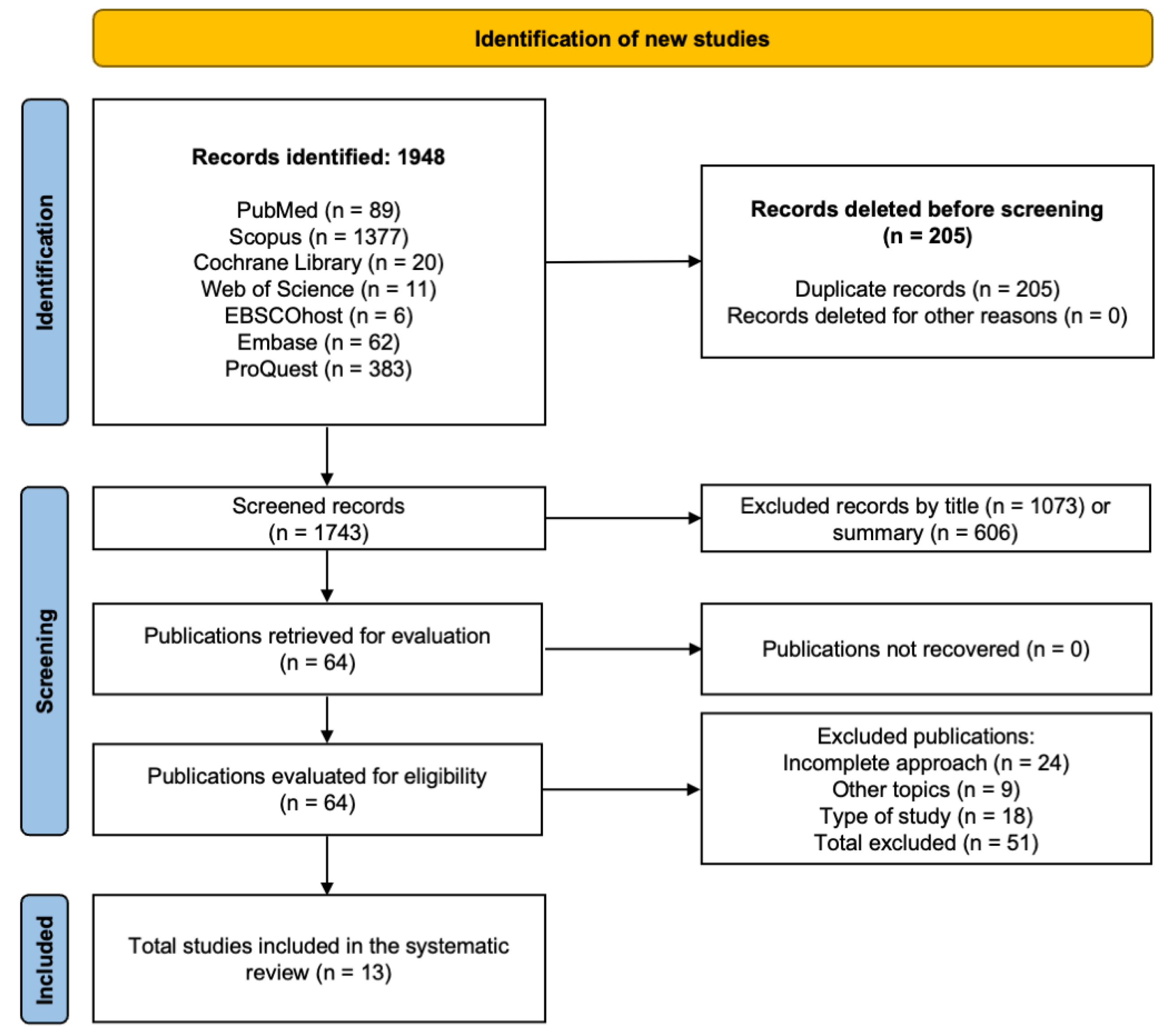
3.1. Study Selection
3.2. Methodological Quality
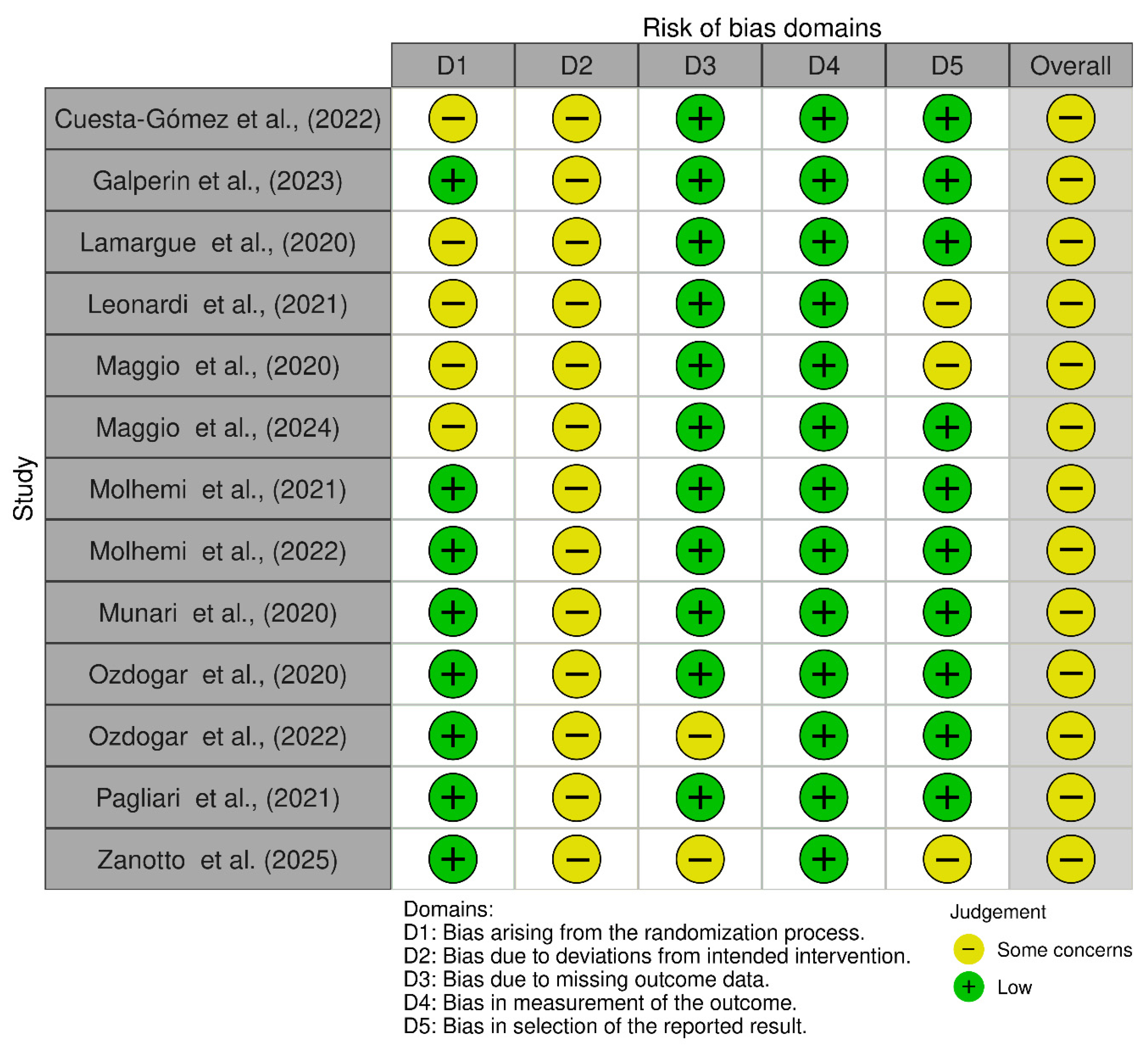
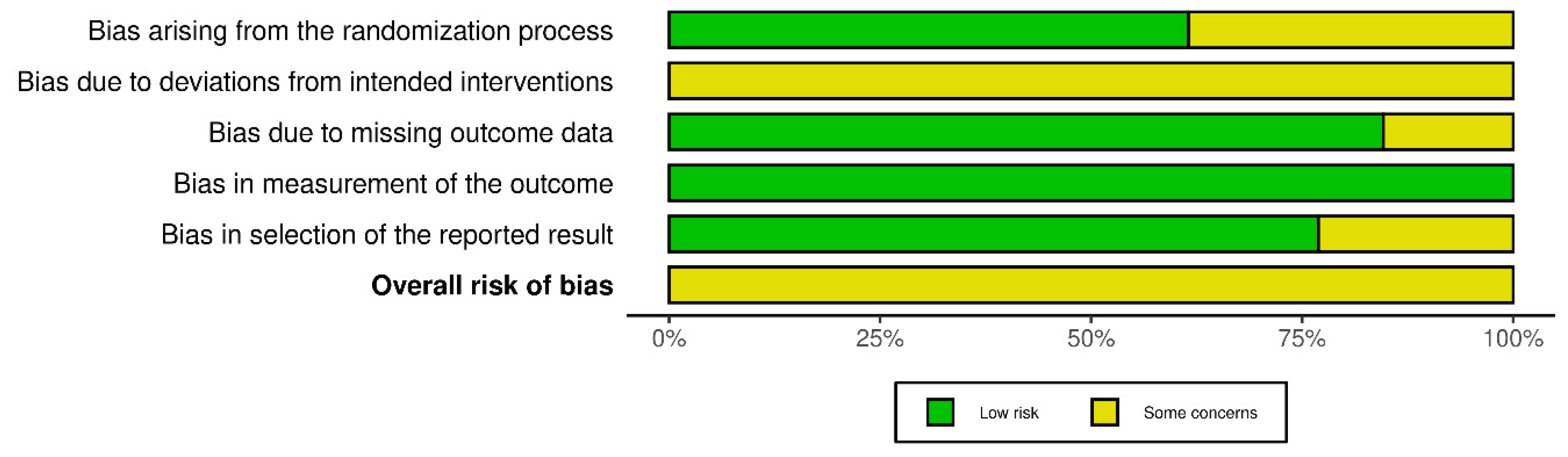
3.3. Risk of Bias
3.4. Characteristics of the Studies
3.5. Sample Characteristics
3.6. Dosages and Interventions Performed
3.7. Cognitive Function
3.8. Certainty of Evidence
3.9. Effects Adverse and Adherence
4. Discussion
4.1. Cognitive Function
4.2. Limitations and Strengths
4.3. Practical Applications
4.4. Clinical Applications
5. Conclusions
Supplementary Materials
Author Contributions
Funding
Institutional Review Board Statement
Informed Consent Statement
Data Availability Statement
Conflicts of Interest
References
- Yi, X.; Zhang, Y.; Du, Q.; Kang, J.; Song, S.; Li, T.; Jiang, Y. Global prevalence of fatigue in patients with multiple sclerosis: A systematic review and meta-analysis. Front. Neurol. 2024, 15, 1457788. [Google Scholar] [CrossRef] [PubMed]
- Moura, J.A.; Teixeira, L.A.C.; Tanor, W.; Lacerda, A.C.R.; Mezzarane, R.A. Prevalence of multiple sclerosis in Brazil: An updated systematic review with meta-analysis. Clin. Neurol. Neurosurg. 2025, 249, 108741. [Google Scholar] [CrossRef]
- Walton, C.; King, R.; Rechtman, L.; Kaye, W.; Leray, E.; Marrie, R.A.; Robertson, N.; La Rocca, N.; Uitdehaag, B.; van der Mei, I.; et al. Rising prevalence of multiple sclerosis worldwide: Insights from the Atlas of MS, third edition. Mult. Scler. J. 2020, 26, 1816–1821. [Google Scholar] [CrossRef] [PubMed]
- Forouhari, A.; Taheri, G.; Salari, M.; Moosazadeh, M.; Etemadifar, M. Multiple Sclerosis Epidemiology in Asia and Oceania: A Systematic Review and Meta-Analysis. Mult. Scler. Relat. Disord. 2021, 54, 103119. [Google Scholar] [CrossRef]
- Vasanthaprasad, V.; Khurana, V.; Vadapalle, S.; Palace, J.; Adlard, N. Systematic Review and Meta-Analysis of the Prevalence of Secondary Progressive Multiple Sclerosis in the USA, Europe, Canada, Australia and Brazil. BMC Neurol. 2022, 22, 301. [Google Scholar] [CrossRef]
- Salter, A.; Lancia, S.; Kowalec, K.; Fitzgerald, K.C.; Marrie, R.A. Prevalence of comorbidities in multiple sclerosis clinical trials: An individual participant data meta-analysis. Neurology 2024, 102, e209135. [Google Scholar] [CrossRef]
- Rayegani, S.M.; Heidari, S.; Seyed-Nezhad, M.; Kiyani, N.; Moradi-Joo, M. Effectiveness of Cognitive Rehabilitation Compared with Usual Rehabilitation Methods in Patients with Multiple Sclerosis: A Systematic Review and Meta-Analysis. Mult. Scler. J. Exp. Transl. Clin. 2024, 10, 20552173241272561. [Google Scholar] [CrossRef]
- National Institute for Health and Care Excellence. Evidence Review for Non-Pharmacological Management of Memory and Cognitive Problems. In Multiple Sclerosis in Adults: Management; NICE Guideline No. 220; National Institute for Health and Care Excellence: London, UK, 2022. [Google Scholar]
- Cotter, J.; Firth, J.; Enzinger, C.; Kontopantelis, E.; Yung, A.R.; Elliott, R.; Drake, R.J. Social cognition in multiple sclerosis: A systematic review and meta-analysis. Neurology 2016, 87, 1727–1736. [Google Scholar] [CrossRef] [PubMed]
- Feng, D.; Jia, S.; Li, S.; Wang, P.; Liu, C.; Wang, X.; Si, Y. Effect of Non-Pharmacological Interventions on Cognitive Function in Multiple Sclerosis Patients: A Systematic Review and Network Meta-Analysis. Mult. Scler. Relat. Disord. 2025, 99, 106500. [Google Scholar] [CrossRef]
- Vásquez-Carrasco, E.; Rojas, M.; Larenas, L.; Ferrada, A.; Hernandez-Martinez, J.; Ahumada-Méndez, F.; Leiva-Bianchi, M.; Carmine, F.; Sandoval, C.; Branco, B.H.M.; et al. Effectiveness of non-pharmacological interventions for sleep disorders in enhancing quality of life, cognitive function, and sleep quality in older adults with mild cognitive impairment: A systematic review and meta-analysis. Medicina 2025, 61, 583. [Google Scholar] [CrossRef]
- Hernandez-Martinez, J.; Cid-Calfucura, I.; Herrera-Valenzuela, T.; Fritz-Silva, N.; Mello, J.B.; Perez-Carcamo, J.; Vásquez-Carrasco, E.; Merellano-Navarro, E.; Branco, B.H.M.; Valdés-Badilla, P. Xbox Kinect Sports vs. Nintendo Switch Sports and their effects on body composition and physical performance in older females: A randomized controlled trial. J. Clin. Med. 2024, 13, 4987. [Google Scholar] [CrossRef]
- Vásquez-Carrasco, E.; Gómez, C.S.; Valdés-Badilla, P.; Hernandez-Martinez, J.; Villagrán-Silva, F.; Sandoval, C.; Miralles, P.M. Xbox Kinect Sports effects on cognition status and physical performance in physically inactive older females: A randomized controlled trial. J. Clin. Med. 2025, 14, 2165. [Google Scholar] [CrossRef]
- Kamari, M.Z.; Siqueira, V.; Bakare, J.; Sebastião, E. Virtual reality technology for physical and cognitive function rehabilitation in people with multiple sclerosis. Rehabil. Res. Pract. 2024, 2024, 2020263. [Google Scholar] [CrossRef]
- Redero, D.; Lázaro, E.; Vázquez, N.; Soria, C. Neuropsychological rehabilitation in patients with relapsing–remitting multiple sclerosis: A systematic review. Appl. Neuropsychol. Adult 2025, 32, 1496–1504. [Google Scholar] [CrossRef]
- Truijen, S.; Abdullahi, A.; Bijsterbosch, D.; van Zoest, E.; Conijn, M.; Wang, Y.; Struyf, N.; Saeys, W. Effect of Home-Based Virtual Reality Training and Telerehabilitation on Balance in People with Parkinson’s Disease, Multiple Sclerosis, and Stroke: A Systematic Review and Meta-Analysis. Neurol. Sci. 2022, 43, 2995–3006. [Google Scholar] [CrossRef]
- Vásquez-Carrasco, E.; Hernandez-Martinez, J.; Sepúlveda-Ramírez, M.; Carmine, F.; Sandoval, C.; Nobari, H.; Valdés-Badilla, P. Effectiveness of virtual reality interventions on quality of life, cognitive function and physical function in older people with Alzheimer’s disease: A systematic review. Ageing Res. Rev. 2025, 109, 102785. [Google Scholar] [CrossRef] [PubMed]
- Zhang, J.; Song, W.; Lin, X.; Zhang, J.; Wu, M.; Zhu, L. Effects of virtual reality-based rehabilitation on cognitive function and mood in multiple sclerosis: A systematic review and meta-analysis of randomized controlled trials. Mult. Scler. Relat. Disord. 2024, 87, 105643. [Google Scholar] [CrossRef] [PubMed]
- De Angelis, M.; Lavorgna, L.; Carotenuto, A.; Petruzzo, M.; Lanzillo, R.; Brescia Morra, V.; Moccia, M. Digital Technology in Clinical Trials for Multiple Sclerosis: Systematic Review. J. Clin. Med. 2021, 10, 2328. [Google Scholar] [CrossRef] [PubMed]
- Calafiore, D.; Invernizzi, M.; Ammendolia, A.; Marotta, N.; Fortunato, F.; Paolucci, T.; Ferraro, F.; Curci, C.; Cwirlej-Sozanska, A.; de Sire, A. Efficacy of virtual reality and exergaming in improving balance in patients with multiple sclerosis: A systematic review and meta-analysis. Front. Neurol. 2021, 12, 773459. [Google Scholar] [CrossRef]
- Proschinger, S.; Kuhwand, P.; Zimmer, P.; Joisten, N.; Warnke, C.; Thomas, K.; Oberste, M.; Bloch, W. Physical fitness, physical activity, and exercise in multiple sclerosis: A systematic review. J. Neurol. 2022, 269, 2922–2940. [Google Scholar] [CrossRef]
- Higgins, J.P.T.; Thomas, J.; Chandler, J.; Cumpston, M.; Li, T.; Page, M.; Welch, V.A. (Eds.) Chapter 8: Assessing risk of bias in a randomized trial. In Cochrane Handbook for Systematic Reviews of Interventions, 2nd ed.; The Cochrane Collaboration and John Wiley & Sons: Chichester, UK, 2019; pp. 205–228. Available online: https://www.cochrane.org/authors/handbooks-and-manuals/handbook/current/chapter-08 (accessed on 29 September 2025).
- Page, M.J.; McKenzie, J.E.; Bossuyt, P.M.; Boutron, I.; Hoffmann, T.C.; Mulrow, C.D.; Shamseer, L.; Tetzlaff, J.M.; Akl, E.A.; Brennan, S.E.; et al. PRISMA 2020 statement: An updated guideline for reporting systematic reviews. BMJ 2021, 372, n71. [Google Scholar] [CrossRef]
- Manterola, D.C.; Zavando, D. Práctica clínica basada en la evidencia, niveles de evidencia. Rev. Chil. Cir. 2009, 61, 582–595. [Google Scholar] [CrossRef]
- Higgins, J.P.; Thomas, J.; Chandler, J.; Cumpston, M.; Li, T.; Page, M.J.; Welch, V.A. Cochrane Handbook for Systematic Reviews of Interventions; Version 6.3; Cochrane: London, UK, 2022; Available online: https://training.cochrane.org/handbook (accessed on 30 September 2025).
- Cuesta-Gómez, A.; Martín-Díaz, P.; Sánchez-Herrera Baeza, P.; Martínez-Medina, A.; Ortiz-Comino, C.; Cano-de-la-Cuerda, R. Nintendo Switch Joy-Cons’ infrared motion camera sensor for training manual dexterity in people with multiple sclerosis: A randomized controlled trial. J. Clin. Med. 2022, 11, 3261. [Google Scholar] [CrossRef]
- Galperin, I.; Mirelman, A.; Schmitz-Hübsch, T.; Hsieh, K.L.; Regev, K.; Karni, A.; Brozgol, M.; Cornejo Thumm, P.; Lynch, S.G.; Paul, F. Treadmill training with virtual reality to enhance gait and cognitive function among people with multiple sclerosis: A randomized controlled trial. J. Neurol. 2023, 270, 1388–1401. [Google Scholar] [CrossRef] [PubMed]
- Lamargue, D.; Koubiyr, I.; Deloire, M.; Saubusse, A.; Charre-Morin, J.; Moroso, A.; Coupé, P.; Brochet, B.; Ruet, A. Effect of cognitive rehabilitation on neuropsychological and semiecological testing and on daily cognitive functioning in multiple sclerosis: The REACTIV randomized controlled study. J. Neurol. Sci. 2020, 415, 116929. [Google Scholar] [CrossRef]
- Leonardi, S.; Maggio, M.G.; Russo, M.; Bramanti, A.; Arcadi, F.A.; Naro, A.; Calabrò, R.S.; De Luca, R. Cognitive recovery in people with relapsing/remitting multiple sclerosis: A randomized clinical trial on virtual reality-based neurorehabilitation. Clin. Neurol. Neurosurg. 2021, 208, 106828. [Google Scholar] [CrossRef] [PubMed]
- Maggio, M.G.; De Luca, R.; Manuli, A.; Buda, A.; Foti Cuzzola, M.; Leonardi, S.; D’Aleo, G.; Bramanti, P.; Russo, M.; Calabrò, R.S. Do patients with multiple sclerosis benefit from semi-immersive virtual reality? A randomized clinical trial on cognitive and motor outcomes. Appl. Neuropsychol. Adult 2020, 29, 59–65. [Google Scholar] [CrossRef]
- Maggio, M.G.; Rizzo, A.; Quartarone, A.; Manuli, A.; Calabrò, R.S. Virtual reality rehabilitation in patients affected by multiple sclerosis: Impact on quality of life and sexual functions. Mult. Scler. Relat. Disord. 2024, 84, 105470. [Google Scholar] [CrossRef] [PubMed]
- Molhemi, F.; Monjezi, S.; Mehravar, M.; Shaterzadeh-Yazdi, M.J.; Salehi, R.; Hesam, S.; Mohammadianinejad, E. Effects of virtual reality vs conventional balance training on balance and falls in people with multiple sclerosis: A randomized controlled trial. Arch. Phys. Med. Rehabil. 2021, 102, 290–299. [Google Scholar] [CrossRef]
- Molhemi, F.; Mehravar, M.; Monjezi, S.; Salehi, R.; Negahban, H.; Shaterzadeh-Yazdi, M.J.; Majdinasab, N. Effects of exergaming on cognition, lower limb functional coordination, and stepping time in people with multiple sclerosis: A randomized controlled trial. Disabil. Rehabil. 2022, 45, 1343–1351. [Google Scholar] [CrossRef]
- Munari, D.; Fonte, C.; Varalta, V.; Battistuzzi, E.; Cassini, S.; Montagnoli, A.P.; Gandolfi, M.; Modenese, A.; Filippetti, M.; Smania, N.; et al. Effects of robot-assisted gait training combined with virtual reality on motor and cognitive functions in patients with multiple sclerosis: A pilot randomized controlled trial. Restor. Neurol. Neurosci. 2020, 38, 151–164. [Google Scholar] [CrossRef] [PubMed]
- Ozdogar, A.T.; Ertekin, O.; Kahraman, T.; Yigit, P.; Ozakbas, S. Effect of video-based exergaming on arm and cognitive function in persons with multiple sclerosis: A randomized controlled trial. Mult. Scler. Relat. Disord. 2020, 40, 101966. [Google Scholar] [CrossRef]
- Ozdogar, A.T.; Baba, C.; Kahraman, T.; Sagici, O.; Dastan, S.; Ertekin, O.; Ozakbas, S. Effects and safety of exergaming in persons with multiple sclerosis during corticosteroid treatment: A pilot study. Mult. Scler. Relat. Disord. 2022, 63, 103823. [Google Scholar] [CrossRef]
- Pagliari, C.; Di Tella, S.; Jonsdottir, J.; Mendozzi, L.; Rovaris, M.; De Icco, R.; Milanesi, T.; Federico, S.; Agostini, M.; Goffredo, M.; et al. Effects of home-based virtual reality telerehabilitation system in people with multiple sclerosis: A randomized controlled trial. J. Telemed. Telecare 2021, 30, 344–355. [Google Scholar] [CrossRef]
- Zanotto, T.; Galperin, I.; Pradeep Kumar, D.; Mirelman, A.; Yehezkyahu, S.; Regev, K.; Karni, A.; Schmitz-Hübsch, T.; Paul, F.; Lynch, S.G.; et al. Effects of a 6-week treadmill training with and without virtual reality on frailty in people with multiple sclerosis. Arch. Phys. Med. Rehabil. 2025, 106, 187–194. [Google Scholar] [CrossRef]
- Vásquez-Carrasco, E.; Jamett-Oliva, P.; Hernandez-Martinez, J.; Riquelme-Hernández, C.; Villagrán-Silva, F.; Branco, B.H.M.; Sandoval, C.; Valdés-Badilla, P. Effectiveness of occupational therapy interventions on activities of daily living, cognitive function, and physical function in middle-aged and older people with chronic stroke: A systematic review with meta-analysis. J. Clin. Med. 2025, 14, 2197. [Google Scholar] [CrossRef]
- Stuifbergen, A.K.; Becker, H.; Morrison, J.; Kullberg, V. A randomized controlled trial of a cognitive rehabilitation intervention for persons with multiple sclerosis. Clin. Rehabil. 2012, 26, 882–893. [Google Scholar] [CrossRef] [PubMed]
- Stuifbergen, A.K.; Becker, H.; Perez, F.; Morrison, J.; Brown, A.; Kullberg, V.; Zhang, W. Computer-assisted cognitive rehabilitation in persons with multiple sclerosis: Results of a multi-site randomized controlled trial with six-month follow-up. Disabil. Health J. 2018, 11, 427–434. [Google Scholar] [CrossRef]
- Solari, A.; Motta, A.; Mendozzi, L.; Pucci, E.; Forni, M.; Mancardi, G.; Pozzilli, C. Computer-aided retraining of memory and attention in people with multiple sclerosis: A randomized double-blind controlled trial. J. Neurol. Sci. 2004, 222, 99–104. [Google Scholar] [CrossRef]
- Gangemi, A.; De Luca, R.; Fabio, R.A.; Lauria, P.; Rifici, C.; Pollicino, P.; Marra, A.; Olivo, A.; Quartarone, A.; Calabrò, R.S. Effects of virtual reality cognitive training on neuroplasticity: A quasi-randomized clinical trial in patients with stroke. Biomedicines 2023, 11, 3225. [Google Scholar] [CrossRef] [PubMed]
- Wankhede, N.L.; Koppula, S.; Ballal, S.; Doshi, H.; Kumawat, R.; Raju, S.; Arora, I.; Sammeta, S.S.; Khalid, M.; Zafar, A.; et al. Virtual reality modulating dynamics of neuroplasticity: Innovations in neuro-motor rehabilitation. Neuroscience 2025, 566, 97–111. [Google Scholar] [CrossRef] [PubMed]
- Vásquez-Carrasco, E.; Huenchuquen, C.; Ferrón, C.; Hernandez-Martinez, J.; Landim, S.F.; Helbig, F.; Carmine, F.; Valdés-Badilla, P.; Sandoval, C.; Gómez, C.S.; et al. Effectiveness of leisure-focused occupational therapy interventions in middle-aged and older people with mild cognitive impairment: A systematic review. Healthcare 2024, 12, 2521. [Google Scholar] [CrossRef] [PubMed]
- Vásquez-Carrasco, E.; Jamett-Oliva, P.; Quijada, A.; Hernandez-Martinez, J.; Branco, B.H.M.; Carmine-Peña, E.; Sepúlveda, P.; Sandoval, C.; Valdés-Badilla, P. Effects of non-invasive brain stimulation combined with cognitive training on cognitive functions in older people with mild cognitive impairment: A systematic review with meta-analysis. Front. Med. 2025, 12, 1659208. [Google Scholar] [CrossRef] [PubMed]



| Category | Inclusion | Exclusion |
|---|---|---|
| Population | Studies involving populations aged 18 years or older, diagnosed with MS. | Studies involving populations whose primary condition is not related to MS (i.e., other neurological disorders). |
| Intervention | Studies involving cognitive rehabilitation interventions or programs using VR (immersive or non-immersive) for four weeks or more. | Studies using VR for non-rehabilitative purposes (education, assessment only, entertainment, or non-cognitive training). |
| Comparison | Interventions with an experimental group focused on conventional cognitive rehabilitation. | Absence of control group. |
| Outcomes | At least one cognitive function assessment. | Studies without baseline data and/or follow-ups. |
| Study design | RCTs with pre- and post-intervention assessments. | Non-randomized controlled studies, cross-sectional, retrospective, and prospective studies. |
| Study | Country | Study Design | Sample | Groups (n) | Average Age (Years) | Types of Intervention | Types of VR | Volume Training | Cognitive Function | Main Results | ||
|---|---|---|---|---|---|---|---|---|---|---|---|---|
| Weeks | Frequency (Sessions/ Week) | Session Duration (Min) | ||||||||||
| [26] | ES | RCT | People with MS | EG: 11 CG: 10 | 50.9 years old | EG: VR + Conventional CG: Conventional | Non-immersive | 8 | 2 | 60 | TMT-A | ↑ TMT-A (p = 0.012) |
| [27] | ISR, US and DE | RCT | People with MS | EG: 62 CG: 62 | 49.1 years old | EG: Treadmill + VR CG: Treadmill only | Non-immersive | 6 | 3 | 45 | SDMT and CVLT | ↑ Cognitive processing speed (SDMT) (p = 0.001) ↑ California Verbal Learning Test (CLVT) |
| [28] | FR | RCT | People with MS | EG: 18 CG: 17 | 41 years old | SCR vs. NSI | Non-immersive | 17 | 3 | 45 | SDMT, PASAT, CVLT, BVMT-R, TMT-A and TMT-B | ↑ Information processing speed (SDMT) (p < 0.01) ↑ Attention and processing speed (PASAT-3) (p < 0.05) ↑ Verbal memory (CVLT) (p < 0.05) ↑ Visuospatial memory (BVMT-R) (p < 0.05) ↑ Cognitive flexibility and processing speed (TMT-A and TMT-B) (p < 0.05) |
| [29] | IT | RCT | People with MS | EG: 15 CG: 15 | 54.6 years old | VR-based cognitive rehabilitation vs. conventional cognitive rehab | Semi-immersive mode | 8 | 3 | 45 | MoCA, SRT-LTS and WLG | ↑ Global cognitive functioning (MoCA) (p < 0.001) ↑ Learning ability and verbal short-term memory (SRT-LTS) (p < 0.001) ↑ Lexical access ability (WLG) (p < 0.001) |
| [30] | IT | RCT | People with MS | EG: 15 CG: 15 | 39.3 years old | EG: VR + Cognitive training conventional CG: Cognitive training conventional | Semi-immersive mode | 8 | 3 | 60 | MoCA, SRT-LTS, WLG and MSQoL-MT | ↑ Global cognitive functioning (MoCA) (p < 0.001) ↑ Learning ability and verbal short-term memory (SRT-LTS) (p < 0.001) ↑ Lexical-access ability (WLG) (p < 0.001) ↑ Quality of life-related to mental state (MSQoL-MT) (p < 0.001) |
| [31] | IT | RCT | People with MS | EG: 35 CG: 35 | 42.8 years old | VR-based rehabilitation using BTS-Nirvana vs. traditional cognitive rehabilitation | Semi-immersive mode | 8 | 3 | 60 | MSQoL-54 | ↑ Physical health (p < 0.001) ↑ Emotional wellbeing (p < 0.001) ↑ Energy (p < 0.001) ↑ Health perceptions (p < 0.001) ↑ Social functions (p < 0.001) ↑ Cognitive function (p < 0.001) ↓ Health distress (p < 0.001) ↑ Sexual function (p < 0.001) ↑ Change in health (p < 0.001) ↑ Satisfaction with sexual function (p < 0.001) ↑ Overall quality of life (p < 0.001) ↑ Physical health—composite score (p < 0.001) ↑ Mental health—composite score (p < 0.001) |
| [32] | IR | RCT | People with MS | EG: 19 CG: 20 | NR | VR-based balance training using Kinect vs. conventional balance training | Non-immersive | 6 | 3 | 30 | Cognitive-motor performance via dual-task tests | ↓ Cognitive-motor interference (Cognitive TUG time) (p = 0.038) ↓ Dual-task cost during TUG (DTC-TUG) (p = 0.031) |
| [33] | IR | RCT | People with MS | EG: 18 CG: 18 | 36 years old | EG: VR CG: Conventional rehabilitation | Non-immersive | 6 | 3 | 45 | TMT-A and TMT-B | ↓ TMT-B (p < 0.003) and TMT B-A (p < 0.002) at post-intervention ↓ SSST at both post-intervention (p < 0.002) and follow-up (p < 0.04) |
| [34] | IT | RCT | People with MS | EG: 8 CG: 9 | 44 years old | Robot-assisted gait training with VR vs. without VR | Non-immersive | 6 | 2 | 40 | PASAT | ↑ Executive functions (PASAT) (p = 0.012) |
| [35] | TR | RCT | People with MS | EG: 21 CG: 39 | 40.1 years old | Video-based exergaming vs. conventional rehab vs. control (no intervention) | Non-immersive | 8 | 1 | 45 | SDMT, CVLT and BVMT-R | ↑ Information processing speed (SDMT) (p = 0.014) ↑ Verbal memory (CVLT) (p < 0.001) ↑ Visuospatial memory (BVMT-R) (p = 0.002) |
| [36] | TR | RCT | People with MS | EG: 15 CG: 15 | 37.6 years old | Exergaming vs. CR | Non-immersive | 8 | Diary during hospitalization | 45 | CVLT and SDMT | ↑ Verbal memory (CVLT) (p < 0.05) ↑ Information processing speed (SDMT) (p < 0.05) |
| [37] | IT | RCT | People with MS | EG: 35 CG: 35 | 49 years old | Home-based VR telerehabilitation vs. conventional home-based rehab | Semi-immersive mode | 6 | 5 | 45 | MoCA, SRT-LTS, SRT-CLTR, SRT-DR, SPART and PASAT | ↑ Global cognitive functioning (MoCA) (p = 0.046) ↑ Verbal memory (SRT-LTS) (p = 0.002) ↑ Verbal memory (SRT-CLTR) (p = 0.030) ↑ Verbal memory (SRT-DR) (p = 0.006) ↑ Visuospatial memory (SPART) (p = 0.007) ↑ Attention/processing speed (PASAT) (p = 0.004) |
| [38] | US, ISR and DE | RCT | People with MS | EG: 44 CG: 39 | 49 years old | Treadmill training with VR vs. treadmill training only | Non-immersive | 6 | 3 | 30–40 | FI-Cognitive (subset of frailty index) | Treadmill + VR Group (TT + VR): ↓ Cognitive frailty index (FI-Cognitive) (p = 0.019) ↓ Overall frailty index (FI-total) (p = 0.002) frailty in TT + VR compared to TT (p = 0.019) |
| Certainty of Evidence | No of Patients | Effect | Certainty | ||||||||
|---|---|---|---|---|---|---|---|---|---|---|---|
| No of Studies | Study Design | Risk of Bias | Inconsistency | Indirect Evidence | Vagueness | Other Considerations | [Intervention] | [Comparison] | Relative (95% CI) | Absolute (95% CI) | |
| 13 | RCT | Serious | Not serious | Not serious | Not serious | None | 337/649 (51.9%) | 312/649 (48.1%) | Not estimable | +++ Moderate | |
Disclaimer/Publisher’s Note: The statements, opinions and data contained in all publications are solely those of the individual author(s) and contributor(s) and not of MDPI and/or the editor(s). MDPI and/or the editor(s) disclaim responsibility for any injury to people or property resulting from any ideas, methods, instructions or products referred to in the content. |
© 2025 by the authors. Licensee MDPI, Basel, Switzerland. This article is an open access article distributed under the terms and conditions of the Creative Commons Attribution (CC BY) license.
Share and Cite
López-Andaur, R.; Vásquez-Carrasco, E.; Guerra-Labbé, L.; Hernandez-Martinez, J.; Valdés-Badilla, P.; Sandoval-Vásquez, C.; Carmine-Peña, E.; Lorca, C.; Calvo-Vera, A.B. Effectiveness of Immersive and Non-Immersive Virtual Reality Interventions on Cognitive Function in People with Multiple Sclerosis: A Systematic Review. J. Clin. Med. 2026, 15, 4534. https://doi.org/10.3390/jcm15124534
López-Andaur R, Vásquez-Carrasco E, Guerra-Labbé L, Hernandez-Martinez J, Valdés-Badilla P, Sandoval-Vásquez C, Carmine-Peña E, Lorca C, Calvo-Vera AB. Effectiveness of Immersive and Non-Immersive Virtual Reality Interventions on Cognitive Function in People with Multiple Sclerosis: A Systematic Review. Journal of Clinical Medicine. 2026; 15(12):4534. https://doi.org/10.3390/jcm15124534
Chicago/Turabian StyleLópez-Andaur, Roberto, Edgar Vásquez-Carrasco, Luisa Guerra-Labbé, Jordan Hernandez-Martinez, Pablo Valdés-Badilla, Cristian Sandoval-Vásquez, Eduardo Carmine-Peña, Constanza Lorca, and Ana Belén Calvo-Vera. 2026. "Effectiveness of Immersive and Non-Immersive Virtual Reality Interventions on Cognitive Function in People with Multiple Sclerosis: A Systematic Review" Journal of Clinical Medicine 15, no. 12: 4534. https://doi.org/10.3390/jcm15124534
APA StyleLópez-Andaur, R., Vásquez-Carrasco, E., Guerra-Labbé, L., Hernandez-Martinez, J., Valdés-Badilla, P., Sandoval-Vásquez, C., Carmine-Peña, E., Lorca, C., & Calvo-Vera, A. B. (2026). Effectiveness of Immersive and Non-Immersive Virtual Reality Interventions on Cognitive Function in People with Multiple Sclerosis: A Systematic Review. Journal of Clinical Medicine, 15(12), 4534. https://doi.org/10.3390/jcm15124534