Associations of Dietary Factors, Body Mass Index, and Physical Activity with Tinnitus: A Scoping Review



Abstract
1. Introduction
- To perform a scoping review of all relevant studies investigating the role of diet, micronutrients, macronutrients, body mass index (BMI), obesity, weight loss, and physical activity in tinnitus occurrence, onset, severity, and tinnitus-related outcomes.
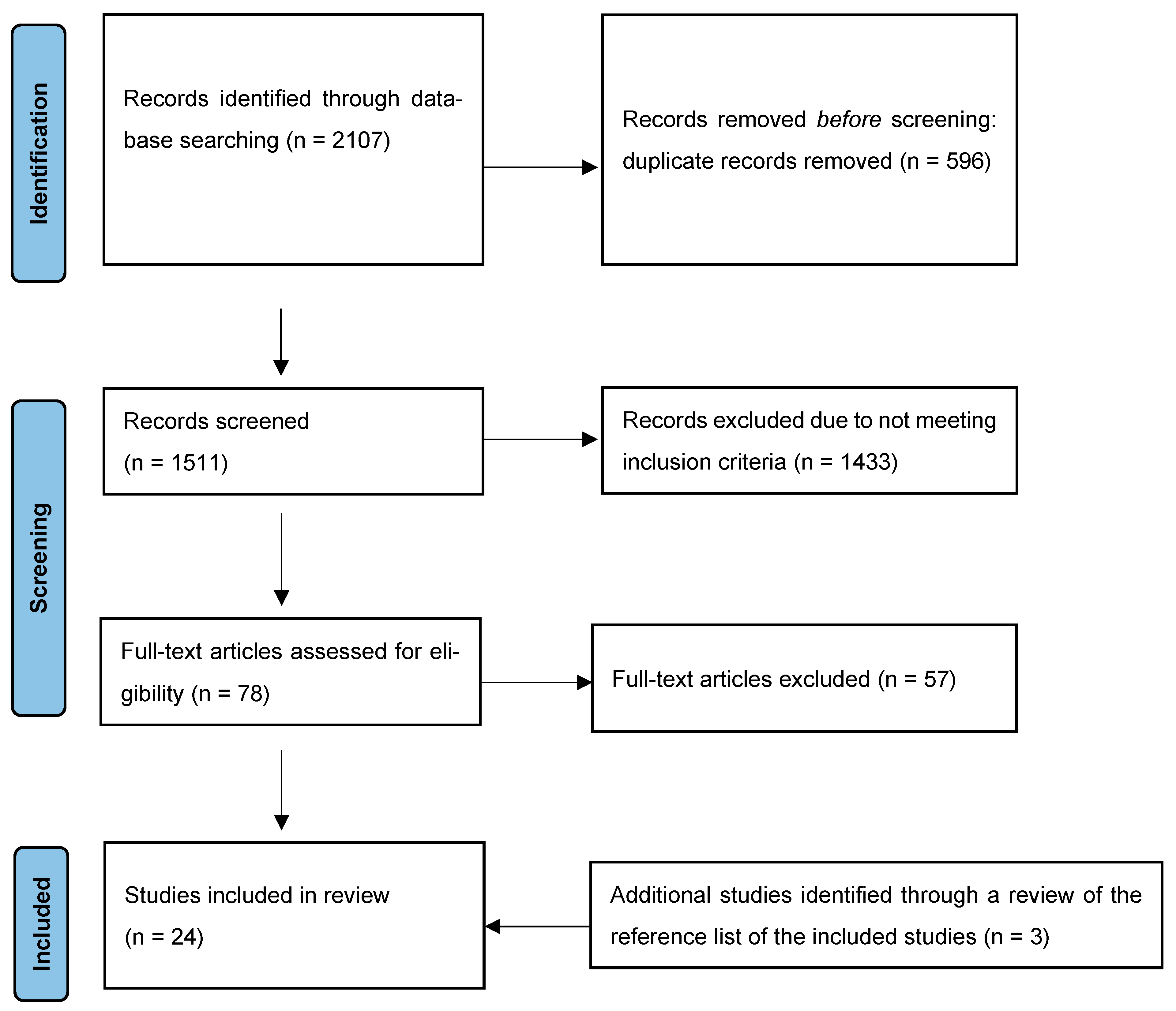
- To include randomized controlled trials, cohort studies, case–control studies, and cross-sectional studies and to summarize their findings through synthesis presented in narrative analysis.
2. Materials and Methods
3. Results
3.1. Associations Between Macronutrient Intake and Tinnitus
3.1.1. Protein Intake
3.1.2. Fat Intake and Cholesterol Levels
3.2. Associations Between Micronutrient Status, Supplementation, and Tinnitus
3.2.1. Vitamin B2, B3 and B12
3.2.2. Vitamin D3
3.2.3. Antioxidants and Multivitamin Supplements
3.2.4. Minerals
3.3. Associations Between BMI, Weight Loss, Physical Activity, and Tinnitus
4. Discussion
4.1. Limitations
4.2. Future Research
5. Conclusions
Supplementary Materials
Author Contributions
Funding
Institutional Review Board Statement
Informed Consent Statement
Data Availability Statement
Conflicts of Interest
References
- Baguley, D.; McFerran, D.; Hall, D. Tinnitus. Lancet 2013, 382, 1600–1607. [Google Scholar] [CrossRef] [PubMed]
- Skarżyński, H.; Rogowski, M.; Fabijańska, A.; Bartnik, G.; Raj-Koziak, D. The Epidemiology of Hearing Disorders in Poland. In Proceedings of the 4th European Congress of Oto-Rhino-Laryngology Head and Neck Surgery, Berlin, Germany, 13–18 May 2000; Jahnke, K., Fischer, M., Eds.; Monduzzi Editore: Bologna, Italy, 2000; pp. 159–163. [Google Scholar]
- Raj-Koziak, D.; Gos, E.; Świerniak, W.; Skarżyński, H.; Skarżyński, P.H. Prevalence of Tinnitus in a Sample of 43,064 Children in Warsaw, Poland. Int. J. Audiol. 2021, 60, 614–620. [Google Scholar] [CrossRef]
- Henton, A.; Tzounopoulos, T. What’s the Buzz? The Neuroscience and the Treatment of Tinnitus. Physiol. Rev. 2021, 101, 1609–1632. [Google Scholar] [CrossRef]
- Perez-Carpena, P.; Lopez-Escamez, J.A.; Gallego-Martinez, Á. A Systematic Review on the Genetic Contribution to Tinnitus. J. Assoc. Res. Otolaryngol. 2024, 25, 13–33. [Google Scholar] [CrossRef]
- Świerniak, W.; Gos, E.; Skarżyński, P.H.; Czajka, N.; Skarżyński, H. Personal Music Player Use and Other Noise Hazards among Children 11 to 12 Years Old. Int. J. Environ. Res. Public Health 2020, 17, 6934. [Google Scholar] [CrossRef]
- Mennink, L.M.; Aalbers, M.W.; van Dijk, P.; van Dijk, J.M.C. The Role of Inflammation in Tinnitus: A Systematic Review and Meta-Analysis. J. Clin. Med. 2022, 11, 1000. [Google Scholar] [CrossRef]
- Chmiela, S.; Skarżyński, P.H.; Raj-Koziak, D. Znaczenie BMI i redukcji masy ciała w prewencji oraz terapii szumów usznych: Przegląd literatury. Nowa Audiofonologia 2025, 14, 20–28. [Google Scholar] [CrossRef]
- Newman, C.W.; Jacobson, G.P.; Spitzer, J.B. Development of the Tinnitus Handicap Inventory. Arch. Otolaryngol. Head Neck Surg. 1996, 122, 143–148. [Google Scholar] [CrossRef]
- Meikle, M.B.; Henry, J.A.; Griest, S.E.; Stewart, B.J.; Abrams, H.B.; McArdle, R.; Myers, P.J.; Newman, C.W.; Sandridge, S.; Turk, D.C.; et al. The Tinnitus Functional Index: Development of a New Clinical Measure for Chronic, Intrusive Tinnitus. Ear Hear. 2012, 33, 153–176. [Google Scholar] [CrossRef] [PubMed]
- Skarżyński, H.; Gos, E.; Raj-Koziak, D.; Skarżyński, P.H. Skarżyński Tinnitus Scale: Validation of a Brief and Robust Tool for Assessing Tinnitus in a Clinical Population. Eur. J. Med. Res. 2018, 23, 54. [Google Scholar] [CrossRef] [PubMed]
- Fuller, T.; Cima, R.; Langguth, B.; Mazurek, B.; Vlaeyen, J.W.S.; Hoare, D.J. Cognitive Behavioural Therapy for Tinnitus. Cochrane Database Syst. Rev. 2020, 1, CD012614. [Google Scholar] [CrossRef] [PubMed]
- Tricco, A.C.; Lillie, E.; Zarin, W.; O’Brien, K.K.; Colquhoun, H.; Levac, D.; Moher, D.; Peters, M.D.J.; Horsley, T.; Weeks, L.; et al. PRISMA Extension for Scoping Reviews (PRISMA-ScR): Checklist and Explanation. Ann. Intern. Med. 2018, 169, 467–473. [Google Scholar] [CrossRef]
- Dawes, P.; Cruickshanks, K.J.; Marsden, A.; Moore, D.R.; Munro, K.J. Relationship Between Diet, Tinnitus, and Hearing Difficulties. Ear Hear. 2020, 41, 289–299. [Google Scholar] [CrossRef]
- Jarach, C.M.; Lugo, A.; Garavello, W.; van den Brandt, P.A.; Odone, A.; Cederroth, C.R.; Bosetti, C.; Gallus, S. The Role of Diet in Tinnitus Onset: A Hospital-Based Case-Control Study from Italy. Nutrients 2023, 15, 621. [Google Scholar] [CrossRef]
- Lee, H.J.; Lee, D.C.; Kim, C.O. The Association Between Serum Lipid Levels and Tinnitus Prevalence and Severity in Korean Elderly: A Nationwide Population-Based Cross-Sectional Study. Yonsei Med. J. 2024, 65, 156–162. [Google Scholar] [CrossRef]
- Sutbas, A.; Yetiser, S.; Satar, B.; Akcam, T.; Karahatay, S.; Saglam, K. Low-Cholesterol Diet and Antilipid Therapy in Managing Tinnitus and Hearing Loss in Patients with Noise-Induced Hearing Loss and Hyperlipidemia. Int. Tinnitus J. 2007, 13, 143–149. [Google Scholar]
- Lee, D.Y.; Kim, Y.H. Relationship Between Diet and Tinnitus: Korea National Health and Nutrition Examination Survey. Clin. Exp. Otorhinolaryngol. 2018, 11, 158–165. [Google Scholar] [CrossRef] [PubMed]
- Berkiten, G.; Kumral, T.L.; Saltürk, Z.; Yildirim, G.; Atar, Y.; Uyar, Y. Vitamin B12 Levels in Patients with Tinnitus and Effectiveness of Vitamin B12 Treatment on Tinnitus. J. Laryngol. Otol. 2013, 127, 480–484. [Google Scholar]
- Singh, C.; Kawatra, R.; Gupta, J. Therapeutic Role of Vitamin B12 in Patients of Chronic Tinnitus: A Pilot Study. Noise Health 2016, 18, 93–97. [Google Scholar] [CrossRef]
- Nowaczewska, M.; Wrzosek, M.; Wrzosek, P.; Wojciak, R.W. The Role of Vitamin D in Subjective Tinnitus—A Case-Control Study. PLoS ONE 2021, 16, e0255482. [Google Scholar] [CrossRef] [PubMed]
- Aliyeva, A.; Han, J.S.; Kim, Y.; Lim, J.H.; Seo, J.H.; Park, S.N. Vitamin D Deficiency as a Risk Factor of Tinnitus: An Epidemiological Study. Ann. Otol. Rhinol. Laryngol. 2024, 133, 647–653. [Google Scholar] [CrossRef]
- Petridou, A.I.; Zagora, E.T.; Petridis, P.; Korres, G.S.; Gazouli, M.; Xenelis, I.; Kyrodimos, E.; Kontothanasi, G.; Kaliora, A.C. The Effect of Antioxidant Supplementation in Patients with Tinnitus and Normal Hearing or Hearing Loss: A Randomized, Double-Blind, Placebo Controlled Trial. Nutrients 2019, 11, 3037. [Google Scholar] [CrossRef]
- Savastano, M.; Brescia, G.; Marioni, G. Antioxidant Therapy in Idiopathic Tinnitus: Preliminary Outcomes. Arch. Med. Res. 2007, 38, 456–459. [Google Scholar] [CrossRef]
- Polanski, J.F.; Soares, A.D.; de Mendonça Cruz, O.L. Antioxidant Therapy in the Elderly with Tinnitus. Braz. J. Otorhinolaryngol. 2016, 82, 269–274. [Google Scholar] [CrossRef]
- Tang, D.; Shekhawat, G.S.; Burlutsky, G.; Mitchell, P.; Gopinath, B. The Association between Dietary Intakes of Vitamins and Minerals with Tinnitus. Nutrients 2024, 16, 2535. [Google Scholar] [CrossRef]
- Person, O.C.; Puga, M.E.; da Silva, E.M.; Torloni, M.R. Zinc Supplementation for Tinnitus. Cochrane Database Syst. Rev. 2016, 11, CD009832. [Google Scholar] [CrossRef]
- Gallus, S.; Lugo, A.; Garavello, W.; Bosetti, C.; Santoro, E.; Colombo, P.; Perin, P.; La Vecchia, C.; Langguth, B. Prevalence and Determinants of Tinnitus in the Italian Adult Population. Neuroepidemiology 2015, 45, 12–19. [Google Scholar] [CrossRef]
- Martines, F.; Sireci, F.; Cannizzaro, E.; Costanzo, R.; Martines, E.; Mucia, M.; Plescia, F.; Salvago, P. Clinical Observations and Risk Factors for Tinnitus in a Sicilian Cohort. Eur. Arch. Otorhinolaryngol. 2015, 272, 2719–2729. [Google Scholar] [CrossRef] [PubMed]
- Torun, M.T.; Yildirim, E.; Dagli, S.; Ozkan, M.; Demirci, S. Do Body Mass Index and Demographic Data Affect Subjective Tinnitus? Int. J. Clin. Exp. Med. 2016, 9, 8610–8614. [Google Scholar]
- Sogebi, O.A. Characterization of Tinnitus in Nigeria. Auris Nasus Larynx 2013, 40, 356–360. [Google Scholar] [CrossRef] [PubMed]
- Han, S.Y.; Lee, S.Y.; Suh, M.W.; Lee, J.H.; Park, M.K. Associations between Tinnitus and Body Composition: A Cross-Sectional Study. Sci. Rep. 2024, 14, 16373. [Google Scholar] [CrossRef]
- Chalimourdas, A.; Hansen, D.; Verboven, K.; Michiels, S. The Relationship between Physical Activity and Tinnitus Loudness and Severity: A Cross-Sectional Study. Ear Hear. 2025, 46, 1470–1478. [Google Scholar] [CrossRef]
- Chen, S.; Yang, X.; Jiang, Y.; Wu, F.; Li, Y.; Qiu, J.; Tong, B.; Liu, Y. Associations between Physical Activity, Tinnitus, and Tinnitus Severity. Ear Hear. 2023, 44, 619–626. [Google Scholar] [CrossRef]
- Özbey-Yücel, Ü.; Aydoğan, Z.; Tokgöz-Yilmaz, S.; Uçar, A.; Ocak, E.; Beton, S. The Effects of Diet and Physical Activity Induced Weight Loss on the Severity of Tinnitus and Quality of Life: A Randomized Controlled Trial. Clin. Nutr. ESPEN 2021, 44, 159–165. [Google Scholar] [CrossRef] [PubMed]
- Özbey-Yücel, Ü.; Uçar, A.; Aydoğan, Z.; Tokgöz-Yilmaz, S.; Beton, S. The Effects of Dietary and Physical Activity Interventions on Tinnitus Symptoms: An RCT. Auris Nasus Larynx 2023, 50, 40–47. [Google Scholar] [CrossRef]
- Ismail, A.M.A.; Tolba, A.M.N. Effectiveness of Lifestyle-Modification Approach (a Randomized-Controlled Program of Diet Restriction and Treadmill Walking Exercise) on Elderly’s Metabolic Syndrome-Associated Subjective Tinnitus. Eur. Arch. Otorhinolaryngol. 2025, 282, 4307–4315. [Google Scholar] [CrossRef] [PubMed]
- Neri, S.; Mauceri, B.; Cilio, D.; Bordonaro, F.; Messina, A.; Malaguarnera, M.; Savastano, M.; Brescia, G.; Manci, S.; Celadini, M. Tinnitus and Oxidative Stress in a Selected Series of Elderly Patients. Arch. Gerontol. Geriatr. Suppl. 2002, 8, 219–223. [Google Scholar] [CrossRef]
- Brazier, J.E.; Harper, R.; Jones, N.M.; O’Cathain, A.; Thomas, K.J.; Usherwood, T.; Westlake, L. Validating the SF-36 Health Survey Questionnaire: New Outcome Measure for Primary Care. BMJ 1992, 305, 160–164. [Google Scholar] [CrossRef]
- Spankovich, C.; Le Prell, C.G. Associations between Dietary Quality, Noise, and Hearing: Data from the National Health and Nutrition Examination Survey, 1999–2002. Int. J. Audiol. 2014, 53, 796–809. [Google Scholar] [CrossRef]
- Hildesheimer, M.; Rubinstein, M.; Nuttal, A.L.; Lawrence, M. Influence of Blood Viscosity on Cochlear Action Potentials and Oxygenation. Hear. Res. 1982, 8, 187–198. [Google Scholar] [CrossRef] [PubMed]
- Suzuki, K.; Kaneko, M.; Murai, K. Influence of Serum Lipids on Auditory Function. Laryngoscope 2000, 110, 1736–1738. [Google Scholar] [CrossRef]
- Cunningham, D.R.; Goetzinger, C.P. Extra-High Frequency Hearing Loss and Hyperlipidemia. Int. J. Audiol. 1974, 13, 470–484. [Google Scholar] [CrossRef]
- Rosen, S.; Olin, P.; Rosen, H.V. Dietary Prevention of Hearing Loss. Acta Otolaryngol. 1970, 70, 242–247. [Google Scholar] [CrossRef]
- Boecking, B.; Klasing, S.; Brueggemann, P.; Rose, M.; Mazurek, B. Lipid Parameters and Depression in Patients with Chronic Tinnitus: A Cross-Sectional Observation. J. Psychosom. Res. 2024, 179, 111613. [Google Scholar] [CrossRef]
- Neri, S.; Signorelli, S.; Pulvirenti, D.; Mauceri, B.; Cilio, D.; Bordonaro, F.; Abate, G.; Interlandi, D.; Misseri, M.; Ignaccolo, L.; et al. Oxidative Stress, Nitric Oxide, Endothelial Dysfunction and Tinnitus. Free Radic. Res. 2006, 40, 615–618. [Google Scholar] [CrossRef] [PubMed]
- Hulshof, J.H.; Vermeij, P. The Effect of Nicotinamide on Tinnitus: A Double-Blind Controlled Study. Clin. Otolaryngol. 1987, 12, 211–214. [Google Scholar] [CrossRef] [PubMed]
- Schieffer, K.M.; Connor, J.R.; Pawelczyk, J.A.; Sekhar, D.L. The Relationship between Iron Deficiency Anemia and Sensorineural Hearing Loss in the Pediatric and Adolescent Population. Am. J. Audiol. 2017, 26, 155–162. [Google Scholar] [CrossRef] [PubMed]
- Biswas, R.; Genitsaridi, E.; Trpchevska, N.; Lugo, A.; Schlee, W.; Cederroth, C.R.; Gallus, S.; Hall, D.A. Low Evidence for Tinnitus Risk Factors: A Systematic Review and Meta-Analysis. J. Assoc. Res. Otolaryngol. 2023, 24, 81–94. [Google Scholar] [CrossRef]
- Kim, H.J.; Lee, H.J.; An, S.Y.; Sim, S.; Park, B.; Kim, S.W.; Lee, J.S.; Hong, S.K.; Choi, H.G. Analysis of the Prevalence and Associated Risk Factors of Tinnitus in Adults. PLoS ONE 2015, 10, e0127578. [Google Scholar] [CrossRef]
- Hobeika, L.; Fillingim, M.; Tanguay-Sabourin, C.; Roy, M.; Londero, A.; Samson, S.; Vachon-Presseau, E. Tinnitus Risk Factors and Its Evolution over Time. Nat. Commun. 2025, 16, 4244. [Google Scholar] [CrossRef]


| Study | Design | Population | N | Exposure/Factor | Tinnitus Definition/Assessment | Adjustment Variables | Key Findings | Key Limitations |
|---|---|---|---|---|---|---|---|---|
| Dawes et al., [14] | Cross-sectional | UK Biobank adults | 34,576 | Protein intake | Self-reported tinnitus | Demographic, lifestyle, and health-related factors | Higher protein intake associated with lower odds of tinnitus | Cross-sectional design; dietary self-report; residual confounding possible |
| Jarach et al., [15] | Case–control | Hospital-based sample, Italy; tinnitus vs. controls | 383 | Diet; protein-rich foods | Idiopathic tinnitus case status | Sex, age, education, BMI, smoking, alcohol consumption, and hearing loss | Higher poultry, prosciutto, and legume intake associated with lower odds of tinnitus | Case–control design; recall bias; hospital-based controls |
| Lee HJ et al., [16] | Cross-sectional | KNHANES; adults ≥ 60 y | 6021 | Lipids; TG, TC/HDL-C | Self-reported tinnitus prevalence and annoyance severity | Age, sex, hypertension, diabetes, dyslipidemia, smoking, obesity, noise exposure, psychological factors | Hypertriglyceridemia and high TC/HDL-C associated with tinnitus and severe annoyance | Cross-sectional design; self-reported tinnitus; residual confounding possible |
| Sutbas et al., [17] | Interventional, non-RCT | Men with hyperlipidemia and tinnitus | 42 | Low-cholesterol diet ± statin therapy | Tinnitus rating 1–10 and tinnitus questionnaire | Limited/not clearly multivariable adjusted | Lipid responders showed lower tinnitus scores; non-responders showed no comparable benefit | Small sample; male-only; no randomized control group |
| Lee DY et al., [18] | Cross-sectional | KNHANES | 7621 | Vitamin B2/B3 intake | Self-reported tinnitus prevalence and annoyance | Multivariable nutritional analysis; covariates as reported | Lower B2 associated with higher prevalence; lower B3 associated with greater annoyance | Cross-sectional design; dietary self-report; residual confounding possible |
| Berkiten et al., [19] | Case–control + replacement | Non-pulsatile tinnitus vs. controls | 120 | Vitamin B12 status; IM B12 in deficient patients | Non-pulsatile tinnitus; VAS | Limited/not clearly adjusted | B12 deficiency common in both groups; replacement associated with minimal non-significant VAS change overall | Small control group; uncontrolled replacement phase |
| Singh et al., [20] | RCT, placebo-controlled | Chronic tinnitus patients | 40 | IM methylcobalamin | Chronic tinnitus; TSI and VAS | Randomization; subgroup by B12 deficiency | Improvement observed only in B12-deficient treatment subgroup | Small sample; short follow-up; subgroup findings |
| Nowaczewska et al., 2021 [21] | Case–control | Chronic subjective tinnitus vs. controls | 300 | Serum 25(OH)D | Chronic subjective tinnitus; THI and VAS | Not clearly reported | Lower vitamin D in tinnitus; deficiency associated with higher THI/VAS | Case–control design; no intervention; lifestyle, sun/noise exposure, physical activity and diet not fully accounted for |
| Aliyeva et al., [22] | Cross-sectional | KNHANES adults | 16,408 | Vitamin D quartiles | Self-reported tinnitus prevalence | Demographic and lifestyle factors | Lowest vitamin D quartile associated with higher tinnitus odds | Cross-sectional design; residual confounding possible |
| Petridou et al., [23] | RCT, double-blind placebo-controlled | Tinnitus ≥ 6 months | 63 | Multivitamin-multimineral + α-lipoic acid | Tinnitus loudness, MML, THI, VAS, TFI subscales | Randomization | Active arm showed lower loudness/MML and improved patient-reported outcomes | Modest sample; multi-compound intervention; limited attribution to individual nutrients |
| Savastano et al., [24] | Pre-post trial | Unilateral idiopathic tinnitus | 31 | Antioxidant regimen | Tinnitus loudness, VAS; ROS markers | No placebo control/limited adjustment | Lower loudness and VAS; lower MDA/4-HNE after treatment | Small sample; uncontrolled design; short-term follow-up |
| Polanski et al., [25] | RCT, double-blind placebo-controlled | ≥60 y; tinnitus with SNHL | 58 | Ginkgo/ALA + VitC/papaverine + VitE | Chronic tinnitus with SNHL; THI | Randomization | No significant benefit vs. placebo | Older SNHL population; multiple regimens; limited power for subgroup effects |
| Tang et al., [26] | Prospective cohort | Adults ≥ 50 y | 2947 | Dietary iron and zinc intake | Incident tinnitus over 10 years | Age, sex, dizziness symptoms, middle ear infections, and hearing loss | Lowest iron and zinc intake associated with higher incident tinnitus | Dietary self-report; residual confounding possible |
| Person et al., [27] | Systematic review | Tinnitus patients in RCTs | 209 | Zinc supplementation | Tinnitus loudness, severity, disability | Not applicable | No consistent benefit vs. placebo | Limited number and quality of included trials |
| Gallus et al., [28] | Cross-sectional | National sample, Italy | 2952 | BMI categories | Self-reported tinnitus, including chronic tinnitus | Demographic/lifestyle variables, as reported | Obesity associated with higher tinnitus odds, stronger for chronic tinnitus | Cross-sectional design; self-reported tinnitus; residual confounding possible |
| Martines et al., [29] | Case–control | ENT clinic; tinnitus vs. controls | 120 | BMI and metabolic factors, including hypertension | Chronic tinnitus; audiometric evaluation performed | Age/sex matching; clinical and metabolic variables | Obesity and large neck circumference more common; obesity + hypertension associated with markedly higher odds | Small sample; case–control design; residual confounding possible |
| Torun et al., [30] | Case–control | Chronic tinnitus vs. controls | 213 | BMI | Chronic subjective tinnitus | Age/sex matching | Higher BMI and more frequent overweight/obesity in tinnitus patients | Case–control design; limited adjustment |
| Sogebi et al., [31] | Cross-sectional observational | ENT clinic patients | NR | BMI/obesity | Self-reported tinnitus symptoms; PTA performed | Limited/not clearly adjusted | Obesity more common among tinnitus patients than controls | Clinic-based sample; selection bias; limited adjustment |
| Han et al., [32] | Cross-sectional | KNHANES | 2257 | Body composition; fat %, waist circumference | Self-reported tinnitus | Demographic/clinical variables, as reported | Central adiposity associated with tinnitus, particularly in men | Cross-sectional design; sex-specific findings; residual confounding possible |
| Chalimourdas et al., [33] | Cross-sectional | Adults with chronic tinnitus | 2751 | Physical activity, IPAQ | Chronic tinnitus; loudness and severity | Covariates as reported in the original study | Higher activity associated with lower loudness and severity | Cross-sectional design; self-reported activity; residual confounding possible |
| Chen et al., [34] | Cross-sectional | NHANES adults | 3826 | Physical activity, minutes/week | Self-reported tinnitus prevalence | Demographic and health covariates, as reported | Any PA associated with lower prevalence; moderate PA showed most favorable association | Cross-sectional design; self-reported exposure/outcome; residual confounding possible |
| Özbey-Yücel et al., [35] | RCT | Obese tinnitus patients | 46 | Diet vs. diet + PA vs. control | Chronic tinnitus; THI, VAS; SF-36 | Randomization | Lifestyle arms showed lower THI/VAS and higher QoL vs. control | Small sample; short duration; selected obese population |
| Özbey-Yücel et al., [36] | RCT | Obese tinnitus patients | 63 | Diet vs. PA vs diet + PA vs. control | Chronic tinnitus; THI and VAS | Randomization | All active arms improved; combined diet + PA showed greatest changes | Small groups; short follow-up; selected obese population |
| Ismail et al., [37] | RCT | ≥65 y; metabolic syndrome and tinnitus | 60 | Dietary restriction + treadmill exercise | Chronic subjective tinnitus; THI, VAS severity/discomfort | Randomization | Significant improvements vs. control | Selected metabolic syndrome population; short duration |
Disclaimer/Publisher’s Note: The statements, opinions and data contained in all publications are solely those of the individual author(s) and contributor(s) and not of MDPI and/or the editor(s). MDPI and/or the editor(s) disclaim responsibility for any injury to people or property resulting from any ideas, methods, instructions or products referred to in the content. |
© 2026 by the authors. Licensee MDPI, Basel, Switzerland. This article is an open access article distributed under the terms and conditions of the Creative Commons Attribution (CC BY) license.
Share and Cite
Raj-Koziak, D.; Chmiela, S.; Skarżyński, H.; Skarżyński, P.H. Associations of Dietary Factors, Body Mass Index, and Physical Activity with Tinnitus: A Scoping Review. J. Clin. Med. 2026, 15, 4274. https://doi.org/10.3390/jcm15114274
Raj-Koziak D, Chmiela S, Skarżyński H, Skarżyński PH. Associations of Dietary Factors, Body Mass Index, and Physical Activity with Tinnitus: A Scoping Review. Journal of Clinical Medicine. 2026; 15(11):4274. https://doi.org/10.3390/jcm15114274
Chicago/Turabian StyleRaj-Koziak, Danuta, Szymon Chmiela, Henryk Skarżyński, and Piotr H. Skarżyński. 2026. "Associations of Dietary Factors, Body Mass Index, and Physical Activity with Tinnitus: A Scoping Review" Journal of Clinical Medicine 15, no. 11: 4274. https://doi.org/10.3390/jcm15114274
APA StyleRaj-Koziak, D., Chmiela, S., Skarżyński, H., & Skarżyński, P. H. (2026). Associations of Dietary Factors, Body Mass Index, and Physical Activity with Tinnitus: A Scoping Review. Journal of Clinical Medicine, 15(11), 4274. https://doi.org/10.3390/jcm15114274