Open, Hybrid and Endovascular Management of Aortic Arch Aneurysms: Recent Updates and Future Directions



Abstract
1. Introduction
2. Diagnostic Workup
3. Surveillance, Medical Management, and Interventions
3.1. Medical Management and Surveillance
3.2. Guidelines on Surgical Management
4. Operative Management Techniques
4.1. Open Repair vs. Hybrid and Endovascular Repair
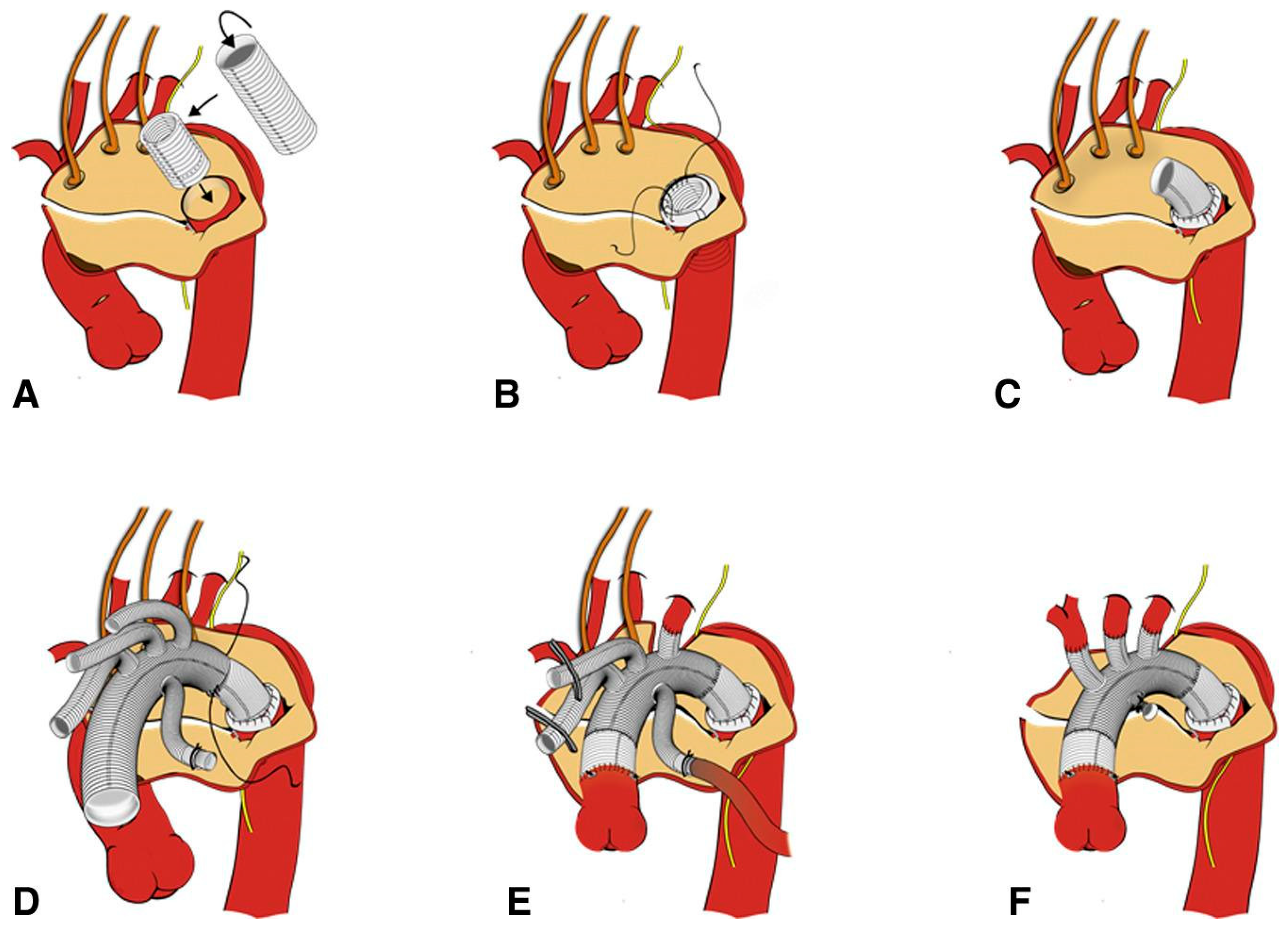
4.2. The Elephant Procedure
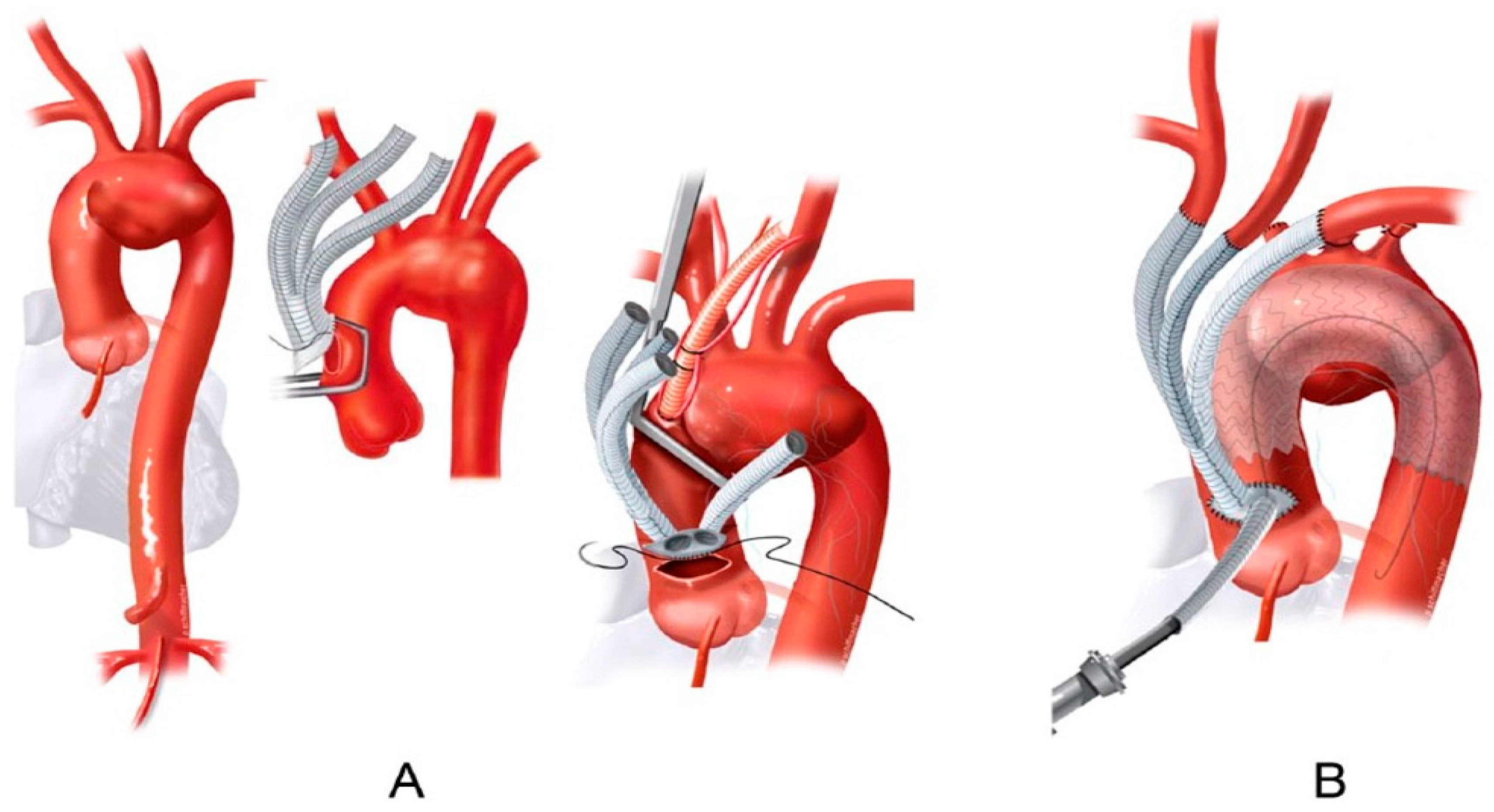
5. Hybrid Management Techniques
6. Endovascular Techniques
6.1. Branched, Fenestrated, and Parallel Endovascular Approaches
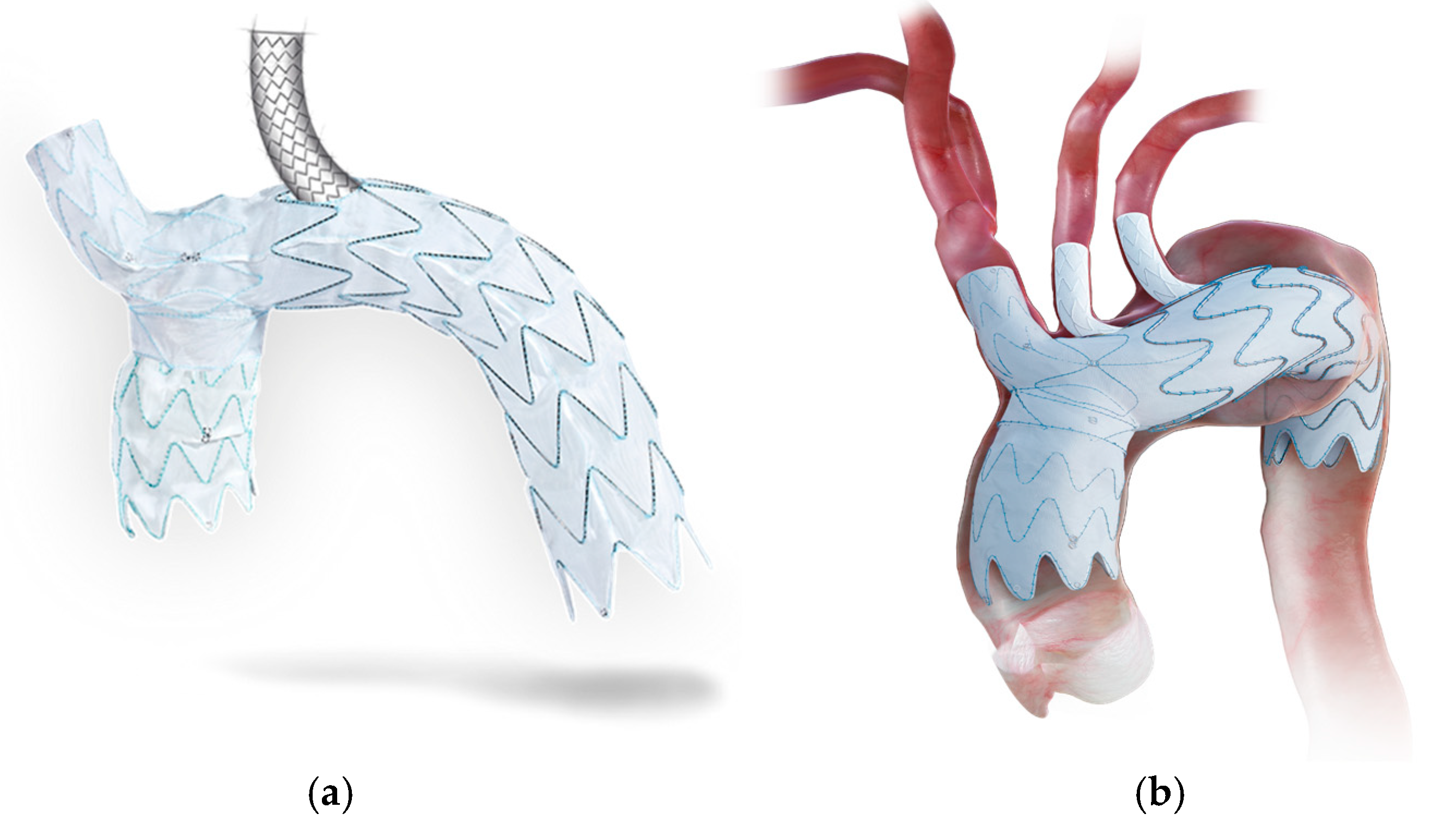
6.2. Off-the-Shelf Modular and Single-Branch Systems: NEXUS Duo and NEXUS TRE
6.3. GORE® TAG® Thoracic Branch Endoprosthesis (TBE)
6.4. Custom and Physician-Modified Endografts
6.5. Adjunctive Strategies: Chimney/Periscope Techniques and In Situ Fenestration
6.6. Overall Outcomes, Future Directions, and Decision-Making
7. Limitations and Conclusions
7.1. Limitations
7.2. Conclusions
Author Contributions
Funding
Data Availability Statement
Conflicts of Interest
Abbreviations
| FET | Frozen elephant trunk |
| CTA | Computed tomography angiography |
| MRA | Magnetic resonance angiography |
| TBE | Thoracic branch endoprosthesis |
| TTE | Transthoracic echocardiography |
| TEE | Transesophageal echocardiography |
| TEVAR | Thoracic endovascular aortic repair |
References
- Obel, L.M.; Diederichsen, A.C.; Steffensen, F.H.; Frost, S.; Lambrechtsen, J.; Busk, M.; Urbonaviciene, G.; Egstrup, K.; Karon, M.; Radmussen, L.M.; et al. Population-Based Risk Factors for Ascending, Arch, Descending, and Abdominal Aortic Dilations for 60-74–Year-Old Individuals. J. Am. Coll. Cardiol. 2021, 78, 201–211. [Google Scholar] [CrossRef] [PubMed]
- Isselbacher, E.M. Thoracic and Abdominal Aortic Aneurysms. Circulation 2005, 111, 816–828. [Google Scholar] [CrossRef] [PubMed]
- Sethi, S.; Parekh, U. Aortic Arch Aneurysm. In StatPearls; StatPearls Publishing: Treasure Island, FA, USA, 2025. [Google Scholar]
- Imran, M.; Zafar, M.A.; Chkhikvadze, T.; Ziganshin, B.A.; Elefteriades, J.A. Aortic Arch Aneurysms. In Cardiac Surgery; Raja, S.G., Ed.; Springer International Publishing: Berlin/Heidelberg, Germany, 2020; pp. 529–544. [Google Scholar] [CrossRef]
- Isselbacher, E.M.; Preventza, O.; Hamilton Black, J.; Augoustides, J.G.; Beck, A.W.; Bolen, M.A.; Braverman, A.C.; Bray, B.E.; Brown-Zimmerman, M.M.; Chen, E.P.; et al. 2022 ACC/AHA Guideline for the Diagnosis and Management of Aortic Disease: A Report of the American Heart Association/American College of Cardiology Joint Committee on Clinical Practice Guidelines. Circulation 2022, 146, e334–e482. [Google Scholar] [CrossRef]
- Lindsay, M.E.; Dietz, H.C. The Genetic Basis of Aortic Aneurysm. Cold Spring Harb. Perspect. Med. 2014, 4, a015909. [Google Scholar] [CrossRef]
- Coady, M.A.; Rizzo, J.A.; Goldstein, L.J.; Elefteriades, J.A. Natural history, pathogenesis, and etiology of thoracic aortic aneurysms and dissections. Cardiol. Clin. 1999, 17, 615–635. [Google Scholar] [CrossRef]
- Davies, R.R.; Goldstein, L.J.; Coady, M.A.; Tittle, S.L.; Rizzo, J.A.; Kopf, G.S.; Elefteriades, J.A. Yearly rupture or dissection rates for thoracic aortic aneurysms: Simple prediction based on size. Ann. Thorac. Surg. 2002, 73, 17–28. [Google Scholar] [CrossRef]
- Erbel, R. Aortic dimensions and the risk of dissection. Heart 2006, 92, 137–142. [Google Scholar] [CrossRef]
- Cheng, S.W.K. Aortic arch pathologies–incidence and natural history. Gefässchirurgie 2016, 21, 212–216. [Google Scholar] [CrossRef]
- Patel, H.J.; Deeb, G.M. Ascending and Arch Aorta: Pathology, Natural History, and Treatment. Circulation 2008, 118, 188–195. [Google Scholar] [CrossRef] [PubMed]
- Yiu, R.S.; Cheng, S.W.K. Natural history and risk factors for rupture of thoracic aortic arch aneurysms. J. Vasc. Surg. 2016, 63, 1189–1194. [Google Scholar] [CrossRef]
- Mazzolai, L.; Teixido-Tura, G.; Lanzi, S.; Boc, V.; Bossone, E.; Brodmann, M.; Bura-Riviere, A.; De Backet, J.; Deglise, S.; Della Corte, A.; et al. 2024 ESC Guidelines for the management of peripheral arterial and aortic diseases: Developed by the task force on the management of peripheral arterial and aortic diseases of the European Society of Cardiology (ESC) Endorsed by the European Association for Cardio-Thoracic Surgery (EACTS), the European Reference Network on Rare Multisystemic Vascular Diseases (VASCERN), and the European Society of Vascular Medicine (ESVM). Eur. Heart J. 2024, 45, 3538–3700. [Google Scholar] [CrossRef] [PubMed]
- Lopez, L.; Saurers, D.L.; Barker, P.C.A.; Cohen, M.S.; Colan, S.D.; Dwyer, J.; Forsha, D.; Friedberg, M.K.; Lai, W.W.; Printz, B.F.; et al. Guidelines for Performing a Comprehensive Pediatric Transthoracic Echocardiogram: Recommendations from the American Society of Echocardiography. J. Am. Soc. Echocardiogr. 2024, 37, 119–170. [Google Scholar] [CrossRef] [PubMed]
- Litmanovich, D.; Bankier, A.A.; Cantin, L.; Raptopoulos, V.; Boiselle, P.M. CT and MRI in Diseases of the Aorta. Am. J. Roentgenol. 2009, 193, 928–940. [Google Scholar] [CrossRef]
- Schlösser, F.J.V.; Mojibian, H.R.; Dardik, A.; Verhagen, H.J.M.; Moll, F.L.; Muhs, B.E. Simultaneous sizing and preoperative risk stratification for thoracic endovascular aneurysm repair: Role of gated computed tomography. J. Vasc. Surg. 2008, 48, 561–570. [Google Scholar] [CrossRef][Green Version]
- Patil, T.; Nierich, A. Transesophageal echocardiography evaluation of the thoracic aorta. Ann. Card. Anaesth. 2016, 19, S44–S55. [Google Scholar] [CrossRef]
- Zaki, H.A.; Albaroudi, B.; Shaban, E.E.; Alkahlout, B.H.; Yigit, Y.; Elnabawy, W.; Kasharat, K.; Almarri, N.D.; Azad, A.M. Comparison between transthoracic echocardiography and transoesophageal echocardiography in the diagnosis of acute aortic dissection from an emergency perspective. A systematic review and meta-analysis. Front. Cardiovasc. Med. 2024, 10, 1283703. [Google Scholar] [CrossRef]
- Klompas, M. Does This Patient Have an Acute Thoracic Aortic Dissection? JAMA 2002, 287, 2262–2272. [Google Scholar] [CrossRef]
- Solomon, M.D.; Leong, T.; Sung, S.H.; Lee, C.; Allen, J.G.; Huh, J.; LaPunzina, P.; Lee, H.; Mason, D.; Melikian, V.; et al. Association of Thoracic Aortic Aneurysm Size with Long-term Patient Outcomes: The KP-TAA Study. JAMA Cardiol. 2022, 7, 1160–1169. [Google Scholar] [CrossRef]
- Verhagen, J.M.; Kempers, M.; Cozijnsen, L.; Bouma, B.J.; Duijnhouwer, A.L.; Post, J.G.; Hilhorst-Hofstee, Y.; Bekkers, S.C.A.M.; Kerstjens-Frederikse, W.S.; Van Brakel, T.J.; et al. Expert consensus recommendations on the cardiogenetic care for patients with thoracic aortic disease and their first-degree relatives. Int. J. Cardiol. 2018, 258, 243–248. [Google Scholar] [CrossRef] [PubMed]
- Milewicz, D.M.; Cecchi, A.C. Heritable Thoracic Aortic Disease Overview; University of Washington: Seattle, WA, USA, 1993. [Google Scholar]
- Czerny, M.; Schmidli, J.; Adler, S.; Van Den Berg, J.C.; Bertoglio, L.; Carrel, T.; Chiesa, R.; Clough, R.E.; Eberle, B.; Etz, C.; et al. Editor’s Choice–Current Options and Recommendations for the Treatment of Thoracic Aortic Pathologies Involving the Aortic Arch: An Expert Consensus Document of the European Association for Cardio-Thoracic Surgery (EACTS) & the European Society for Vascular Surgery (ESVS). Eur. J. Vasc. Endovasc. Surg. 2019, 57, 165–198. [Google Scholar] [CrossRef]
- Danyi, P.; Elefteriades, J.A.; Jovin, I.S. Medical Therapy of Thoracic Aortic Aneurysms: Are We There Yet? Circulation 2011, 124, 1469–1476. [Google Scholar] [CrossRef] [PubMed]
- Writing Group Members; Hiratzka, L.F.; Bakris, G.L.; Beckman, J.A.; Bersin, R.M.; Carr, V.F.; Casey, D.E.; Eagle, K.A.; Hermann, L.K.; Isselbacher, E.M.; et al. 2010 ACCF/AHA/AATS/ACR/ASA/SCA/SCAI/SIR/STS/SVM Guidelines for the Diagnosis and Management of Patients with Thoracic Aortic Disease: A Report of the American College of Cardiology Foundation/American Heart Association Task Force on Practice Guidelines, American Association for Thoracic Surgery, American College of Radiology, American Stroke Association, Society of Cardiovascular Anesthesiologists, Society for Cardiovascular Angiography and Interventions, Society of Interventional Radiology, Society of Thoracic Surgeons, and Society for Vascular Medicine. Circulation 2010, 121, e266–e369. [Google Scholar] [CrossRef]
- Czerny, M.; Grabenwöger, M.; Berger, T.; Aboyans, V.; Della Corte, A.; Chen, E.P.; Desai, N.D.; Dumfarth, J.; Elefteriades, J.A.; Etz, C.D.; et al. EACTS/STS Guidelines for diagnosing and treating acute and chronic syndromes of the aortic organ. Eur. J. Cardio-Thorac. Surg. 2024, 65, ezad426. [Google Scholar] [CrossRef] [PubMed]
- Minatoya, K.; Inoue, Y.; Sasaki, H.; Tanaka, H.; Seike, Y.; Oda, T.; Omura, A.; Iba, Y.; Ogino, H.; Kobayashi, J. Total arch replacement using a 4-branched graft with antegrade cerebral perfusion. J. Thorac. Cardiovasc. Surg. 2019, 157, 1370–1378. [Google Scholar] [CrossRef]
- Iafrancesco, M.; Ranasinghe, A.M.; Dronavalli, V.; Adam, D.J.; Claridge, M.W.; Riley, P.; McCafferty, I.; Mascaro, J.G. Open aortic arch replacement in high-risk patients: The gold standard. Eur. J. Cardio-Thorac. Surg. 2016, 49, 646–651. [Google Scholar] [CrossRef]
- Chung, J.; Stevens, L.M.; Chu, M.W.; Dagenais, F.; Peterson, M.D.; Boodhwani, M.; Bozinovski, J.; El-Hamamsy, I.; Yamashita, M.H.; Atoui, R.; et al. The impact of age on patients undergoing aortic arch surgery: Evidence from a multicenter national registry. J. Thorac. Cardiovasc. Surg. 2021, 162, 759–766.e1. [Google Scholar] [CrossRef]
- Spath, P.; Campana, F.; Tsilimparis, N.; Gallitto, E.; Pini, R.; Faggioli, G.; Caputo, S.; Gargiulo, M. Outcomes of Fenestrated and Branched Endografts for Partial and Total Endovascular Repair of the Aortic Arch—A Systematic Review and Meta-Analysis. Eur. J. Vasc. Endovasc. Surg. 2024, 67, 106–116. [Google Scholar] [CrossRef]
- Di Bartolomeo, R.; Leone, A.; Di Marco, L.; Pacini, D. When and how to replace the aortic arch for type A dissection. Ann. Cardio-Thorac. Surg. 2016, 5, 383–388. [Google Scholar] [CrossRef]
- Hughes, G.C.; Vekstein, A. Current state of hybrid solutions for aortic arch aneurysms. Ann. Cardio-Thorac. Surg. 2021, 10, 731–743. [Google Scholar] [CrossRef]
- Brown, J.A.; Arnaoutakis, G.J.; Szeto, W.Y.; Serna-Gallegos, D.; Sultan, I. Endovascular repair of the aortic arch: State of the art. J. Card. Surg. 2021, 36, 4292–4300. [Google Scholar] [CrossRef]
- Ribeiro, T.S.; Gadelha Júnior, H.D.P.; Santos, M.A.D. Hybrid Repair versus Conventional Open Repair Approaches for Aortic Arch Disease: A Comprehensive Review. Braz. J. Cardiovasc. Surg. 2021, 36, 244–252. [Google Scholar] [CrossRef]
- Preventza, O.; Garcia, A.; Cooley, D.A.; Haywood-Watson, R.J.L.; Simpson, K.; Bakaeen, F.G.; Cornwell, L.D.; Omer, S.; De La Cruz, K.I.; Price, M.D.; et al. Total aortic arch replacement: A comparative study of zone 0 hybrid arch exclusion versus traditional open repair. J. Thorac. Cardiovasc. Surg. 2015, 150, 1591–1600. [Google Scholar] [CrossRef]
- Yoshitake, A.; Okamoto, K.; Yamazaki, M.; Kimura, N.; Hirano, A.; Iida, Y.; Abe, T.; Shimizu, H. Comparison of aortic arch repair using the endovascular technique, total arch replacement and staged surgery. Eur. J. Cardio-Thorac. Surg. 2017, 51, 1142–1148. [Google Scholar] [CrossRef] [PubMed]
- Chen, C.W.; Hu, J.; Li, Y.Y.; Chen, G.X.; Zhang, W.; Chen, X.Y. The outcomes of aortic arch repair between open surgical repair and debranching endovascular hybrid surgical repair: A systematic review and meta-analysis. J. Vasc. Surg. 2024, 79, 1510–1524. [Google Scholar] [CrossRef] [PubMed]
- Joo, H.C.; Youn, Y.N.; Kim, J.H.; Lee, S.H.; Lee, S.; Yoo, K.J. Conventional Open Versus Hybrid Arch Repair of Aortic Arch Disease: Early and Long-Term Outcomes. Ann. Thorac. Surg. 2019, 107, 1380–1388. [Google Scholar] [CrossRef]
- Kawatou, M.; Minakata, K.; Sakamoto, K.; Nakatsu, T.; Tazaki, J.; Higami, H.; Uehara, K.; Yamazaki, K.; Inoue, K.; Kimura, T.; et al. Comparison of endovascular repair with branched stent graft and open repair for aortic arch aneurysm. Interact. Cardiovasc. Thorac. Surg. 2017, 25, 246–253. [Google Scholar] [CrossRef]
- Gökalp, O. Treatment of aortic arch aneurysms: Open surgery or hybrid procedure? Turk. J. Thorac. Cardiovasc. Surg. 2018, 26, 351–358. [Google Scholar] [CrossRef] [PubMed]
- Hori, D.; Okamura, H.; Yamamoto, T.; Nishi, S.; Yuri, K.; Kimura, N.; Yamaguchi, A.; Adachi, H. Early and mid-term outcomes of endovascular and open surgical repair of non-dissected aortic arch aneurysm. Interact. Cardiovasc. Thorac. Surg. 2017, 24, 944–950. [Google Scholar] [CrossRef]
- De Rango, P.; Ferrer, C.; Coscarella, C.; Musumeci, F.; Verzini, F.; Pogany, G.; Montalto, A.; Cao, P. Contemporary comparison of aortic arch repair by endovascular and open surgical reconstructions. J. Vasc. Surg. 2015, 61, 339–346. [Google Scholar] [CrossRef]
- Cazavet, A.; Alacoque, X.; Marcheix, B.; Chaufour, X.; Rousseau, H.; Glock, Y.; Leobon, B. Aortic arch aneurysm: Short- and mid-term results comparing open arch surgery and the hybrid procedure. Eur. J. Cardio-Thorac. Surg. 2016, 49, 134–140. [Google Scholar] [CrossRef]
- Tokuda, Y.; Oshima, H.; Narita, Y.; Abe, T.; Araki, Y.; Mutsuga, M.; Fujimoto, K.; Terazawa, S.; Yagami, K.; Ito, H.; et al. Hybrid versus open repair of aortic arch aneurysms: Comparison of postoperative and mid-term outcomes with a propensity score-matching analysis. Eur. J. Cardio-Thorac. Surg. 2016, 49, 149–156. [Google Scholar] [CrossRef]
- Iba, Y.; Minatoya, K.; Matsuda, H.; Sasaki, H.; Tanaka, H.; Oda, T.; Kobayashi, J. How should aortic arch aneurysms be treated in the endovascular aortic repair era? A risk-adjusted comparison between open and hybrid arch repair using propensity score-matching analysis. Eur. J. Cardio-Thorac. Surg. 2014, 46, 32–39. [Google Scholar] [CrossRef] [PubMed]
- Sood, V.; Patel, H.J.; Williams, D.M.; Dasika, N.L.; Yang, B.; Deeb, G.M. Open and endovascular repair of the nontraumatic isolated aortic arch aneurysm. J. Vasc. Surg. 2014, 60, 57–63. [Google Scholar] [CrossRef] [PubMed]
- Zhan, Y.; Kooperkamp, H.; Lofftus, S.; McGrath, D.; Kawabori, M.; Chen, F.Y. Conventional open versus hybrid aortic arch repair: A meta- analysis of propensity-matched studies. J. Thorac. Dis. 2021, 13, 4714–4722. [Google Scholar] [CrossRef] [PubMed]
- Chakos, A.; Jbara, D.; Yan, T.D.; Tian, D.H. Long-term survival and related outcomes for hybrid versus traditional arch repair—A meta-analysis. Ann. Cardio-Thorac. Surg. 2018, 7, 319–327. [Google Scholar] [CrossRef]
- Miao, L.; Song, L.; Sun, S.K.; Wang, Z.G. Meta-analysis of open surgical repair versus hybrid arch repair for aortic arch aneurysm. Interact. Cardiovasc. Thorac. Surg. 2017, 24, 34–40. [Google Scholar] [CrossRef]
- Benedetto, U.; Melina, G.; Angeloni, E.; Codispoti, M.; Sinatra, R. Current results of open total arch replacement versus hybrid thoracic endovascular aortic repair for aortic arch aneurysm: A meta-analysis of comparative studies. J. Thorac. Cardiovasc. Surg. 2013, 145, 305–306. [Google Scholar] [CrossRef]
- Wen, Q.; Zhang, Y.; Wei, J.; Shen, M.; Wu, G.; Du, X.; Li, X.; Zhou, M. Physician Modified Fenestrated Endografts for Endovascular Aortic Arch Repair in Zone 0. Eur. J. Vasc. Endovasc. Surg. 2024, 68, 190–199. [Google Scholar] [CrossRef]
- Spear, R.; Clough, R.E.; Fabre, D.; Roeder, B.; Hertault, A.; Martin Gonzalez, T.; Azzaoui, R.; Sobocinski, J.; Haulon, S. Total Endovascular Treatment of Aortic Arch Disease Using an Arch Endograft with 3 Inner Branches. J. Endovasc. Ther. 2017, 24, 534–538. [Google Scholar] [CrossRef]
- Tenorio, E.R.; Oderich, G.S.; Kölbel, T.; Dias, N.V.; Sonesson, B.; Karelis, A.; Farber, M.A.; Parodi, F.E.; Timaran, C.H.; Scott, C.K.; et al. Multicenter global early feasibility study to evaluate total endovascular arch repair using three-vessel inner branch stent-grafts for aneurysms and dissections. J. Vasc. Surg. 2021, 74, 1055–1065.e4. [Google Scholar] [CrossRef]
- Planer, D.; Elbaz-Greener, G.; Mangialardi, N.; Lindsay, T.; D’Onofrio, A.; Schelzig, H.; Chaykovska, L.; Hill, A.; Holden, A.; Antonello, M.; et al. NEXUS Arch: A Multicenter Study Evaluating the Initial Experience with a Novel Aortic Arch Stent Graft System. Ann. Surg. 2023, 277, e460–e466. [Google Scholar] [CrossRef]
- Spanos, K.; Haulon, S.; Eleshra, A.; Rohlffs, F.; Tsilimparis, N.; Panuccio, G.; Kölbel, T. Anatomical Suitability of the Aortic Arch Arteries for a 3-Inner-Branch Arch Endograft. J. Endovasc. Ther. 2021, 28, 14–19. [Google Scholar] [CrossRef]
- Houérou, T.L.; Nana, P.; Pernot, M.; Guihaire, J.; Gaudin, A.; Lerisson, E.; Costanzo, A.; Fabre, D.; Haulon, S. Systematic Review on In Situ Laser Fenestrated Repair for the Endovascular Management of Aortic Arch Pathologies. J. Clin. Med. 2023, 12, 2496. [Google Scholar] [CrossRef]
- Tan, S.Z.C.P.; Jubouri, M.; Mohammed, I.; Bashir, M. What Is the Long-Term Clinical Efficacy of the Thoraflex™ Hybrid Prosthesis for Aortic Arch Repair? Front Cardiovasc Med. 2022, 9, 842165. [Google Scholar] [CrossRef]
- Eleshra, A.; Heo, W.; Lee, K.H.; Kim, T.H.; Sim, S.A.; Sharafeldin, H.; Song, S.W. Mid-term outcomes of hybrid debranching endovascular aortic arch repair in landing zones 0–2. Vascular 2023, 31, 447–454. [Google Scholar] [CrossRef]
- Hiraoka, A.; Chikazawa, G.; Totsugawa, T.; Tamura, K.; Ishida, A.; Sakaguchi, T.; Yoshitaka, H. Objective analysis of midterm outcomes of conventional and hybrid aortic arch repair by propensity-score matching. J. Thorac. Cardiovasc. Surg. 2017, 154, 100–106.e1. [Google Scholar] [CrossRef]
- Zerwes, S.; Leissner, G.; Gosslau, Y.; Jakob, R.; Bruijnen, H.K.; Oertl, F.; Woelfle, K. Clinical outcomes in hybrid repair procedures for pathologies involving the aortic arch. Vascular 2015, 23, 9–16. [Google Scholar] [CrossRef]
- Hanif, H.; Dubois, L.; Ouzounian, M.; Peterson, M.D.; El-Hamamsy, I.; Dagenais, F.; Hassan, A.; Chu, M.W.A. Aortic Arch Reconstructive Surgery with Conventional Techniques vs Frozen Elephant Trunk: A Systematic Review and Meta-Analysis. Can. J. Cardiol. 2018, 34, 262–273. [Google Scholar] [CrossRef]
- Leontyev, S.; Borger, M.A.; Etz, C.D.; Moz, M.; Seeburger, J.; Bakhtiary, F.; Misfeld, M.; Mohr, F.W. Experience with the conventional and frozen elephant trunk techniques: A single-centre study. Eur. J. Cardio-Thorac. Surg. 2013, 44, 1076–1083. [Google Scholar] [CrossRef]
- Moula, A.I.; Romeo, J.L.R.; Parise, G.; Parise, O.; Maessen, J.G.; Natour, E.; Bidar, E.; Gelsomino, S. The evolution of arch surgery: Frozen elephant trunk or conventional elephant trunk? Front. Cardiovasc. Med. 2022, 9, 999314. [Google Scholar] [CrossRef]
- Hage, A.; Hage, F.; Dagenais, F.; Ouzounian, M.; Chung, J.; El-Hamamsy, I.; Peterson, M.D.; Boodhwani, M.; Bozinovski, J.; Moon, M.C.; et al. Frozen Elephant Trunk for Aortic Arch Reconstruction is Associated with Reduced Mortality as Compared to Conventional Techniques. Semin. Thorac. Cardiovasc. Surg. 2022, 34, 386–392. [Google Scholar] [CrossRef]
- Vernice, N.A.; Wingo, M.E.; Walker, P.B.; Demetres, M.; Stalter, L.N.; Yang, Q.; De Biasi, A.R. The great vessel freeze-out: A meta-analysis of conventional versus frozen elephant trunks in aortic arch surgery. J. Card. Surg. 2022, 37, 2397–2407. [Google Scholar] [CrossRef]
- DiBartolomeo, A.D.; Ding, L.; Weaver, F.A.; Han, S.M.; Magee, G.A. Risk of Stroke with Thoracic Endovascular Aortic Repair of the Aortic Arch. Ann. Vasc. Surg. 2023, 97, 37–48. [Google Scholar] [CrossRef]
- Sultan, I.; Bavaria, J.E.; Szeto, W. Hybrid Techniques for Aortic Arch Aneurysm Repair. Semin. Cardio-Thorac. Vasc. Anesth. 2016, 20, 327–332. [Google Scholar] [CrossRef]
- Criado, F.J.; Barnatan, M.F.; Rizk, Y.; Clark, N.S.; Wang, C.F. Technical Strategies to Expand Stent-Graft Applicability in the Aortic Arch and Proximal Descending Thoracic Aorta. J. Endovasc. Ther. 2002, 9, II32-8. [Google Scholar] [CrossRef]
- Shu, C.; Li, J.; Luo, M.; Li, Q.; Fang, K. Endovascular Management of Aortic Arch Diseases: Current Status and Future Trends. Cardiol. Discov. 2022, 2, 263–268. [Google Scholar] [CrossRef]
- Nana, P.; Spanos, K.; Dakis, K.; Giannoukas, A.; Kölbel, T.; Haulon, S. Systematic Review on Customized and Non-customized Device Techniques for the Endovascular Repair of the Aortic Arch. J. Endovasc. Ther. 2024, 31, 505–521. [Google Scholar] [CrossRef]
- Kudo, T.; Kuratani, T.; Shirakawa, Y.; Shimamura, K.; Kin, K.; Sakamoto, T.; Shijo, T.; Watanabe, Y.; Masada, K.; Sakaniwa, R.; et al. Comparison of the Outcomes of Total Endovascular Aortic Arch Repair Between Branched Endograft and Chimney Endograft Technique in Zone 0 Landing. J. Endovasc. Ther. 2022, 29, 427–437. [Google Scholar] [CrossRef]
- Nowak-Machen, M. The role of transesophageal echocardiography in aortic surgery. Best Pract. Res. Clin. Anaesthesiol. 2016, 30, 317–329. [Google Scholar] [CrossRef]
- D’Onofrio, A.; Lachat, M.; Mangialardi, N.; Antonello, M.; Schelzig, H.; Chaykovska, L.; Hill, A.; Holden, A.; Lindsay, T.; Ten Tan, K.; et al. Three-year follow-up of aortic arch endovascular stent grafting with the Nexus device: Results from a prospective multicentre study. Eur. J. Cardio-Thorac. Surg. 2022, 63, ezac561. [Google Scholar] [CrossRef]
- DiLosa, K.; Pozolo, C.; Heafner, T.; Humphries, M.; Kwong, M.; Maximus, S. Early experience with the Gore TAG thoracic branch endoprosthesis for treatment of acute aortic pathology. J. Vasc. Surg. Cases Innov. Tech. 2024, 10, 101363. [Google Scholar] [CrossRef]
- Liang, N.L.; Dake, M.D.; Fischbein, M.P.; Bavaria, J.E.; Desai, N.D.; Oderich, G.S.; Singh, M.J.; Fillinger, M.; Suckow, B.D.; Matsumura, J.S.; et al. Midterm Outcomes of Endovascular Repair of Aortic Arch Aneurysms with the Gore Thoracic Branch Endoprosthesis. Eur. J. Vasc. Endovasc. Surg. 2022, 64, 639–645. [Google Scholar] [CrossRef] [PubMed]
- Rizza, A.; Trimarchi, G.; Di Sibio, S.; Bastiani, L.; Murzi, M.; Palmieri, C.; Foffa, I.; Berti, S. Outcomes of Zone 2 Thoracic Endovascular Aortic Repair Using Castor Single-Branched Stent Grafts: A Single-Center Experience. J. Clin. Med. 2023, 12, 7593. [Google Scholar] [CrossRef]
- Rizza, A.; Sica, S.; Ferreresi, M.; Tinelli, G.; Tshomba, Y.; Rossi, G.; Trimarchi, G.; Foffa, I.; Bastini, L.; Di Sibio, S.; et al. Proximal Sealing in Zone 1–2 Using the Castor Stent-Graft: Early Results from an Italian Multicenter Registry. Med. Sci. 2026, 14, 185. [Google Scholar] [CrossRef] [PubMed]
- Starnes, B.W.; Zettervall, S.; Larimore, A.; Singh, N. Long-Term Results of Physician-Modified Endografts for the Treatment of Elective, Symptomatic, and Ruptured Juxtarenal Abdominal Aortic Aneurysms. Ann. Surg. 2024, 280, 633–639. [Google Scholar] [CrossRef]
- Makaloski, V.; Tsilimparis, N.; Rohlffs, F.; Heidemann, F.; Debus, E.S.; Kölbel, T. Endovascular total arch replacement techniques and early results. Ann. Cardio-Thorac. Surg. 2018, 7, 380–388. [Google Scholar] [CrossRef]
- Li, Y.; Hu, Z.; Wang, J.; Zhang, Y.; Chen, Z.; Zhang, H. Endovascular Chimney Technique for Aortic Arch Pathologies Treatment: A Systematic Review and Meta-Analysis. Ann. Vasc. Surg. 2018, 47, 305–315. [Google Scholar] [CrossRef] [PubMed]
- Li, G.; Li, M.; Dong, Z.; Gu, J.; Liu, H.; Xu, X.; Gu, W.; Shao, Y.; Ni, B. In situ needle fenestration for aortic arch conditions during thoracic endovascular aortic repair. BMC Cardiovasc. Disord. 2024, 24, 625. [Google Scholar] [CrossRef]



| Genetic Causes | ||
| Etiology | Mechanism | % of Aortic Arch Aneurysms |
| Marfan syndrome | FBN1 mutation → defective fibrillin-1 → medial degeneration of aortic wall | <5% |
| Loeys-Dietz syndrome | TGFBR1/2, SMAD3, TGFB2 mutations → abnormal TGF-β signaling → aggressive aneurysm progression | <5% |
| Ehlers–Danlos syndrome | COL3A1 mutation → fragile connective tissue, aneurysm/dissection risk | <1% |
| Familial thoracic aortic aneurysm/dissection (FTAAD) | Non-syndromic, linked to ACTA2, MYH11, MYLK, PRKG1 mutations | ~5% |
| Bicuspid aortic valve (BAV) aortopathy | Genetic predisposition and abnormal flow dynamics → aortic arch dilation | ~5–10% |
| Acquired Causes | ||
| Etiology | Mechanism | % of Aortic Arch Aneurysms |
| Atherosclerosis | Degenerative changes in intima/media from lipid deposition and inflammation | 60–70% |
| Inflammatory aortitis | Giant cell arteritis, Takayasu arteritis, idiopathic aortitis cause wall weakening | ~2–5% |
| Infectious (mycotic) aneurysms | Due to bacteria (Staphylococcus, Salmonella), syphilitic aortitis | <2% |
| Trauma | Blunt thoracic trauma, iatrogenic post-surgical/endovascular injury | <1% |
| Imaging Technique | Utility | Advantages | Disadvantages and Risks | Sensitivity and Specificity |
|---|---|---|---|---|
| Transthoracic echocardiography (TTE) | 1st line; initial evaluation at bedside. | Rapid and widely available with no radiation exposure. | Operator-dependent and hence may have limited view of the arch and aorta. | Sensitivity: 79% Specificity: 88% |
| CT angiography (CTA), often ECG-gated | 2nd line; definitive assessment and pre-op planning. | Excellent spatial resolution with 3D reconstruction. | Exposure to radiation and iodinated contrast. | Sensitivity: 100% Specificity: 100% |
| Magnetic resonance imaging (MRI/MRA) | 3rd line or alternative to CTA. | Accurate characterization of diameters and flow; no radiation exposure, thus good for serial surveillance. | Longer scan than CT, concerns about gadolinium exposure in renal failure. | Sensitivity: 98% Specificity: 98% |
| Transesophageal echocardiography (TEE) | 2nd/3rd line; often used for intraoperative/procedural guidance. | High sensitivity for ascending aorta. | Semi-invasive requiring sedation. | Sensitivity: 91% Specificity: 99% |
| Chest radiograph (CXR) | Adjunctive, triage | Fast and inexpensive | Cannot be used to rule out aneurysm/dissection or to plan therapy. | Sensitivity: 71% Specificity: Variable |
| Strategy | Recommendation | Rationale and Notes |
|---|---|---|
| Blood pressure control | Target < 130/80–140/90 mmHg using β-blockers, ACE inhibitors, or ARBs | Decreases aneurysm growth, β-blockers preferred in Marfan syndrome |
| Lipid management | LDL-C < 55 mg/dL with statin therapy | Reduces atherosclerotic risk |
| Smoking cessation | Complete abstinence advised | Decreases aneurysm growth rate |
| Imaging surveillance (<4.0 cm) | CTA or MRA every 12 months (if aneurysm < 4.0 cm) or every 6 months (if >4.0 cm) | Evaluate aneurysm growth |
| Category | Indications and Recommendations | Preferred Approach |
|---|---|---|
| Isolated arch disease | Symptomatic, aneurysm ≥ 5.5 cm, and acute or chronic dissections | Open total arch replacement |
| Multi-segment disease involving the ascending or descending aorta | Ascending aneurysm that extends into the proximal aortic arch, or an aneurysm of the aortic arch extends into the proximal descending aorta | Frozen elephant trunk with distal anastomosis in arch zone 2 if descending aorta is involved Hemiarch replacement if only ascending aorta involved |
| High-risk patients | Severe comorbidities, including COPD, renal failure, previous stroke, coronary artery disease, and/or previous cardiac surgery | Hybrid or branched endovascular repair |
| Category | Technique | Description |
|---|---|---|
| Open repair | Total arch replacement (TAR) |
|
| Zone-2 arch replacement |
| |
| Conventional elephant trunk (ET) |
| |
| Hybrid repair | Surgical debranching + TEVAR |
|
| Frozen elephant trunk (FET) |
| |
| Endovascular repair | Branched or fenestrated grafts |
|
| Lead Author | Publication Year (Study Period) | Center | Indication | Approach | Result | Newcastle-Ottawa Scale Score |
|---|---|---|---|---|---|---|
| Chen [37] | 2024 | N/A, meta-analysis of sixteen studies | Open vs. hybrid | Hybrid had fewer perioperative bleeding (open vs. hybrid repair: 8.07% vs. 3.96%, respectively; p = 0.01), postoperative pulmonary (14.75% vs. 5.02%, respectively; p < 0.0001), and renal complications (7.54% vs. 5.17%, respectively; p = 0.03); open repair saw fewer neurologic complications (5.1% vs. 17.35%, respectively; p = 0.01) and better 3- (hybrid vs. open repair hazard ratio: 1.69; p = 0.01) and 5-year survival rates (HR: 1.68; p = 0.01). | ||
| Wen [51] | 2024 | Multicenter Study | Aortic Arch Aneurysm | Fenestrated endovascular repair | Fenestrated endovascular repair in zone 0 saw 94.2% survival and 81.8% freedom from secondary intervention at one year. | |
| Houérou [56] | 2023 | N/A, systematic analysis of 6 studies | Aortic Arch Aneurysm | In situ fenestrated endovascular grafts | In situ fenestrated endovascular repair saw a technical success rate of 98%. Stroke occurred in 4.5%. Mortality was observed in 3.2% of patients (mean follow-up = 15 months). | |
| Planer [54] | 2023 | Multicenter Study | Aortic Arch Aneurysm | NEXUS endovascular graft | The NEXUS Aortic Arch Stent Graft System saw a 100% procedural success rate, with one-year survival of 89.3% and a stroke rate of 3.6%. | |
| Zhan [47] | 2021 | N/A, meta-analysis of five studies | Open vs. hybrid | Open repair had significantly superior 1-year (OR 0.42; 95% CI: 0.20–0.88; p = 0.02) and 2-year (OR 0.48; 95% CI: 0.26–0.88; p = 0.02) survival rates, and hybrid repair saw significantly higher stroke rates (p = 0.0004). Other outcomes had no significant differences. | ||
| Tenorio [53] | 2021 (2016–2019) | Multicenter Study | Aortic Arch Aneurysm | Branched endovascular graft | 3-vessel inner-branch endovascular grafts saw survival and stroke rates of 90% and 5%, respectively; this was similar to rates that have been seen in open surgical repair in high-risk patients, though the rate of secondary interventions was high (31%). | |
| Spanos [55] | 2021 | Multicenter Study | Branched endovascular graft | The 3-inner-branch Cook Zenith Arch endograft was found to have a 79% suitability rate, particularly in anatomy with a 90 mm distance between the opening of the first and third inner branches. | ||
| Joo [38] | 2019 (2002–2017) | Yonsei University College of Medicine | Aortic Aneurysm | Open vs. hybrid | Hybrid and open repair had similar in-hospital mortalities with open repair seeing fewer stroke rates and superior survival rates at 5 and 10 years (42.6% versus 74.7%, respectively; p = 0.043). | 9/9 |
| Gokalp [40] | 2018 (2004–2010) | İzmir Katip Celebi University | Aortic Arch Aneurysm | Open vs. hybrid | There was no significant difference in neurologic events or survival at 1 and 5 years. Open repair required more postoperative revision (p = 0.01) and ventilation (p = 0.017). | 7/9 |
| Chakos [48] | 2018 | N/A, meta-analysis of nine studies | Open vs. hybrid | Hybrid repair saw significantly higher survival rates at 1, 2, 3, 5, and 7 years on pooled Kaplan–Meier analysis [HR 0.82 (0.69; 0.99), p = 0.04], though this was sensitive to the results of one specific study. Exclusion of the particular study yielded results that favored survival in the open repair group. | ||
| Miao [49] | 2017 | N/A, meta-analysis of seven studies | Open vs. hybrid | Hybrid and open repair did not have significant differences in operative mortality, late mortality, neurologic deficits, though hybrid repair did see higher reintervention rates (OR 3.43; 95% CI 1.72–6.84; p = 0.0005). | ||
| Hori [41] | 2017 (2008–2016) | Saitama Medical Center | Isolated Aortic Arch Aneurysm | Open vs. endovascular | Open repair had superior mid-term survival rates (p < 0.001) and freedom from reintervention (p = 0.009). | 9/9 |
| Kawatou [39] | 2017 (2007–2014) | Kyoto University Graduate School of Medicine | Aortic Arch Aneurysm | Open vs. branched endovascular | Endovascular approach had higher reintervention rates (open vs. endovascular repair: 3.3% vs. 26.8%, respectively; p < 0.05) with similar survival through 5 years. | 7/9 |
| Yoshitake [36] | 2017 (2001–2016) | Keio University School of Medicine | Aortic Aneurysm | Open vs. endovascular | Endovascular repair saw shorter ICU and hospital stays (p < 0.001 for both) with no significant difference in 30-day mortality, 3-year survival, 5-year survival, and postoperative complications. | 9/9 |
| Spear [52] | 2017 | Hospital Center University De Lille | Branched endovascular grafts | Custom-made 3-inner-branched endovascular grafts yielded encouraging perioperative results and were patent at 6 months in patients at high risk for open surgery. | ||
| Cazavet [43] | 2016 (2002–2014) | University Hospital of Toulouse | Aortic Arch Aneurysm | Open vs. hybrid | Hybrid and open repair did not have significant differences in in-hospital mortality, nor in survival at 1, 3, 5, and 7 years. Open repair had significantly lower reintervention rates (p = 0.045, 95 CI: 0.06–0.97). | 7/9 |
| Tokuda [44] | 2016 (2002–2014) | Nagoya University Graduate School of Medicine | Aortic Arch Aneurysm | Open vs. hybrid | Both groups had similar short-term mortality rates, but hybrid repair saw a lower rate of freedom from aortic events than the open repair group (79 and 99% at 24 months, respectively; p < 0.0001). | 9/9 |
| De Rango [42] | 2015 (2007–2013) | Hospital S. Camillo-Forlanini, Rome | Aortic Arch Aneurysm | Open vs. endovascular | Endovascular and open repair had similar 30-day mortality and 4-year survival rates. | 7/9 |
| Iba [45] | 2014 (2008–2013) | National Cerebral and Cardiovascular Center, Japan | Aortic Arch Aneurysm | Open vs. hybrid | There was no significant difference in early mortality and survival at 3 years between the 2 groups; the hybrid group saw shorter ICU stays (open vs. hybrid; 4.7 vs. 1.6 days, p = 0.018) but higher reintervention rates at 3 years (1% vs. 20%, respectively, p < 0.001). | 9/9 |
| Sood [46] | 2014 (1993–2013) | University of Michigan | Isolated Aortic Arch Aneurysm | Open vs. endovascular | Endovascular and open repair had no significant differences in 5-year survival, but endovascular had higher reintervention rates (open 94% vs. endovascular or hybrid 78% at 2 years; p = 0.018). | 9/9 |
| Benedetto [50] | 2013 | N/A, meta-analysis of four studies | Open vs. hybrid | Hybrid and open repair had similar operative mortality rates and neurologic deficits postoperatively. |
| Landing Zone | Typical Techniques | Neurologic Risk Profile | Key Considerations |
|---|---|---|---|
| Zone 0 | Total arch debranching + TEVAR, branched endografts, FET | Highest stroke risk; increased embolic burden and cerebral manipulation; higher SCI risk in extensive coverage | Requires manipulation near supra-aortic vessels and ascending aorta; careful cerebral protection and patient selection essential |
| Zone 1 | Partial debranching + TEVAR | Intermediate stroke risk | Reduced arch manipulation compared with Zone 0 but still requires supra-aortic vessel intervention |
| Zone 2 | Left subclavian artery coverage with/without revascularization; single-branch devices | Lowest neurologic complication rates among arch endovascular repairs | Often technically simpler with lower embolic burden and shorter procedural duration |
| Technique/Device | Reported Endoleak Rate | Follow-Up Duration | Comments |
|---|---|---|---|
| Branched endografts | ~2.6% | Mid-term follow-up | Lower endoleak rates compared with fenestrated techniques |
| Fenestrated endografts | ~9.8% | Mid-term follow-up | Increased risk due to fenestration alignment challenges |
| Parallel graft/chimney techniques | Up to 21–40% | Perioperative to long-term | Higher gutter-related endoleak incidence |
| In situ fenestration | Variable; low early incidence reported | Mean follow-up ~15 months | Limited long-term durability data |
| GORE® TAG® TBE | No endoleak reported in early/mid-term studies | Up to 3 years | Limited cohort sizes |
| NEXUS systems | Low reported endoleak incidence | 1–3 years | Further long-term data needed |
| Hybrid debranching + TEVAR | Variable across studies | Heterogeneous | Reporting inconsistent between series |
Disclaimer/Publisher’s Note: The statements, opinions and data contained in all publications are solely those of the individual author(s) and contributor(s) and not of MDPI and/or the editor(s). MDPI and/or the editor(s) disclaim responsibility for any injury to people or property resulting from any ideas, methods, instructions or products referred to in the content. |
© 2026 by the authors. Licensee MDPI, Basel, Switzerland. This article is an open access article distributed under the terms and conditions of the Creative Commons Attribution (CC BY) license.
Share and Cite
Patel, D.R.; Elshabrawi, M.N.; Rahouma, M.; Kumar, A. Open, Hybrid and Endovascular Management of Aortic Arch Aneurysms: Recent Updates and Future Directions. J. Clin. Med. 2026, 15, 4272. https://doi.org/10.3390/jcm15114272
Patel DR, Elshabrawi MN, Rahouma M, Kumar A. Open, Hybrid and Endovascular Management of Aortic Arch Aneurysms: Recent Updates and Future Directions. Journal of Clinical Medicine. 2026; 15(11):4272. https://doi.org/10.3390/jcm15114272
Chicago/Turabian StylePatel, Dhruv R., Mohamed N. Elshabrawi, Mohammed Rahouma, and Akshay Kumar. 2026. "Open, Hybrid and Endovascular Management of Aortic Arch Aneurysms: Recent Updates and Future Directions" Journal of Clinical Medicine 15, no. 11: 4272. https://doi.org/10.3390/jcm15114272
APA StylePatel, D. R., Elshabrawi, M. N., Rahouma, M., & Kumar, A. (2026). Open, Hybrid and Endovascular Management of Aortic Arch Aneurysms: Recent Updates and Future Directions. Journal of Clinical Medicine, 15(11), 4272. https://doi.org/10.3390/jcm15114272