Reduced Circulating MOTS-c Levels in Hashimoto’s Thyroiditis Reflect Integrated Autoimmune and Metabolic Dysregulation: A Cross-Sectional Study

 , , , and
Abstract
1. Introduction
2. Materials and Methods
2.1. Ethical Approval
2.2. Study Design and Population
2.3. Clinical and Laboratory Assessments
2.4. Statistical Analysis
3. Results
3.1. Baseline Characteristics
3.2. Correlation Analyses
3.3. Multivariable Regression Analysis
3.4. ROC Analysis
3.5. Impact of Levothyroxine (LT4) Treatment
4. Discussion
4.1. Strengths and Limitations
4.2. Clinical Implications
4.3. Future Directions
5. Conclusions
Supplementary Materials
Author Contributions
Funding
Institutional Review Board Statement
Informed Consent Statement
Data Availability Statement
Acknowledgments
Conflicts of Interest
References
- Ragusa, F.; Fallahi, P.; Elia, G.; Gonnella, D.; Paparo, S.R.; Giusti, C.; Churilov, L.P.; Ferrari, S.M.; Antonelli, A. Hashimotos’ Thyroiditis: Epidemiology, Pathogenesis, Clinic and Therapy. Best Pract. Res. Clin. Endocrinol. Metab. 2019, 33, 101367. [Google Scholar] [CrossRef] [PubMed]
- Weetman, A.P. An update on the pathogenesis of Hashimoto’s thyroiditis. J. Endocrinol. Investig. 2021, 44, 883–890. [Google Scholar] [CrossRef]
- Vargas-Uricoechea, H.; Castellanos-Pinedo, A.; Urrego-Noguera, K.; Pinzón-Fernández, M.V.; Meza-Cabrera, I.A.; Vargas-Sierra, H. A Scoping Review on the Prevalence of Hashimoto’s Thyroiditis and the Possible Associated Factors. Med. Sci. 2025, 13, 43. [Google Scholar] [CrossRef]
- Lee, H.J.; Li, C.W.; Hammerstad, S.S.; Stefan, M.; Tomer, Y. Immunogenetics of autoimmune thyroid diseases: A comprehensive review. J. Autoimmun. 2015, 64, 82–90. [Google Scholar] [CrossRef] [PubMed]
- Qiu, K.; Li, K.; Zeng, T.; Liao, Y.; Min, J.; Zhang, N.; Peng, M.; Kong, W.; Chen, L.-L. Integrative Analyses of Genes Associated with Hashimoto’s Thyroiditis. J. Immunol. Res. 2021, 2021, 8263829. [Google Scholar] [CrossRef]
- Tomer, Y.; Huber, A. The etiology of autoimmune thyroid disease: A story of genes and environment. J. Autoimmun. 2009, 32, 231–239. [Google Scholar] [CrossRef]
- Abdalrahman, S.S.; Smail, H.O.; Shallal, A.F. Genetic and epigenetic markers in Hashimoto’s thyroiditis (Review). Int. J. Epigenetics 2025, 5, 1. [Google Scholar] [CrossRef]
- Kim, S.J.; Xiao, J.; Wan, J.; Cohen, P.; Yen, K. Mitochondrially derived peptides as novel regulators of metabolism. J. Physiol. 2017, 595, 6613–6621. [Google Scholar] [CrossRef] [PubMed]
- Yoon, S.H.; Yuan, F.; Zhu, X.; Tang, H.; Abdurakhimoova, D.; Krier, J.; Eirin, A.; Lerman, A.; Cohen, P.; Lerman, L.O. Systemic MOTS-c levels are increased in adults with obesity in association with metabolic dysregulation and remain unchanged after weight loss. J. Clin. Transl. Endocrinol. 2025, 43, 100429. [Google Scholar] [CrossRef]
- Lee, C.; Kim, K.H.; Cohen, P. MOTS-c: A novel mitochondrial-derived peptide regulating muscle and fat metabolism. Free Radic. Biol. Med. 2016, 100, 182–187. [Google Scholar] [CrossRef]
- Kong, B.S.; Min, S.H.; Lee, C.; Cho, Y.M. Mitochondrial-encoded MOTS-c prevents pancreatic islet destruction in autoimmune diabetes. Cell Rep. 2021, 36, 109447. [Google Scholar] [CrossRef]
- Tekin, S.; Bir, L.S.; Avci, E.; Şenol, H.; Tekin, I.; Çınkır, U. Comparison of Serum Mitochondrial Open Reading Frame of the 12S rRNA-c (MOTS-c) Levels in Patients With Multiple Sclerosis and Healthy Controls. Cureus 2022, 14, e26981. [Google Scholar] [CrossRef] [PubMed]
- Luo, Y.H.; Xie, L.; Li, J.Y.; Xie, Y.; Li, M.Q.; Zhou, L. Serum MOTS-C Levels are Decreased in Obese Children and Associated with Vascular Endothelial Function. Diabetes Metab. Syndr. Obes. 2023, 16, 1013–1020. [Google Scholar] [CrossRef]
- Girişgen, İ.; Altıncık, S.A.; Avcı, E.; Öcal, M.; Becerir, T.; Öztekin, G.M.; Özhan, B.; Yuksel, S. Could MOTS-c Levels in Children with Type 1 Diabetes Mellitus Be an Indicator for Early Diabetic Kidney Disease? J. Clin. Res. Pediatr. Endocrinol. 2025, 17, 168–175. [Google Scholar] [CrossRef]
- Du, C.; Zhang, C.; Wu, W.; Liang, Y.; Wang, A.; Wu, S.; Zhao, Y.; Hou, L.; Ning, Q.; Luo, X. Circulating MOTS-c levels are decreased in obese male children and adolescents and associated with insulin resistance. Pediatr. Diabetes 2018, 19, 1058–1064. [Google Scholar] [CrossRef] [PubMed]
- Delgadillo, F.; Agrawal, D.K. Immunopathogenesis, Diagnosis, and Treatment of Hashimoto’s Thyroiditis. Arch. Intern. Med. Res. 2026, 9, 1–13. [Google Scholar] [CrossRef] [PubMed]
- Wojciechowska, M.; Pruszyńska-Oszmałek, E.; Kołodziejski, P.A.; Krauss, H.; Leciejewska, N.; Szczepankiewicz, D.; Bień, J.; Skrzypski, M.; Wilczak, M.; Sassek, M. Changes in MOTS-c Level in the Blood of Pregnant Women with Metabolic Disorders. Biology 2021, 10, 1032. [Google Scholar] [CrossRef]
- Mehran, L.; Amouzegar, A.; Azizi, F. Thyroid disease and the metabolic syndrome. Curr. Opin. Endocrinol. Diabetes Obes. 2019, 26, 256–265. [Google Scholar] [CrossRef]
- Ruggeri, R.M.; Giuffrida, G.; Campennì, A. Autoimmune endocrine diseases. Minerva Endocrinol. 2018, 43, 305–322. [Google Scholar] [CrossRef]
- Nuttall, F.Q. Body Mass Index: Obesity, BMI, and Health: A Critical Review. Nutr. Today 2015, 50, 117–128. [Google Scholar] [CrossRef]
- Matthews, D.R.; Hosker, J.P.; Rudenski, A.S.; Naylor, B.A.; Treacher, D.F.; Turner, R.C. Homeostasis model assessment: Insulin resistance and beta-cell function from fasting plasma glucose and insulin concentrations in man. Diabetologia 1985, 28, 412–419. [Google Scholar] [CrossRef] [PubMed]
- Luo, J.; Zhou, L.; Sun, A.; Min, Y.; Lin, Y.; Han, L. Clinical comparative efficacy and therapeutic strategies for the Hashimoto’s thyroiditis: A systematic review and network meta-analysis. Heliyon 2024, 10, e35114. [Google Scholar] [CrossRef]
- Alzahrani, A.S. The risk of expanding risk stratification in thyroid cancer. J. Clin. Endocrinol. Metab. 2023, 108, e1147–e1148. [Google Scholar] [CrossRef]
- Huo, J.; Xu, Y.; Yu, J.; Guo, Y.; Hu, X.; Ou, D.; Qu, R.; Zhao, L. Causal association between body mass index and autoimmune thyroiditis: Evidence from Mendelian randomization. Eur. J. Med. Res. 2023, 28, 526. [Google Scholar] [CrossRef]
- Versini, M.; Jeandel, P.-Y.; Rosenthal, E.; Shoenfeld, Y. Obesity in autoimmune diseases: Not a passive bystander. Autoimmun. Rev. 2014, 13, 981–1000. [Google Scholar] [CrossRef]
- Song, R.-H.; Wang, B.; Yao, Q.-M.; Li, Q.; Jia, X.; Zhang, J.-A. The impact of obesity on thyroid autoimmunity and dysfunction: A systematic review and meta-analysis. Front. Immunol. 2019, 10, 2349. [Google Scholar] [CrossRef] [PubMed]
- Taylor, P.N.; Razvi, S.; Pearce, S.H.; Dayan, C.M. A review of the clinical consequences of variation in thyroid function within the reference range. J. Clin. Endocrinol. Metab. 2013, 98, 3562–3571. [Google Scholar] [CrossRef]
- Delitala, A.P.; Steri, M.; Fiorillo, E.; Marongiu, M.; Lakatta, E.G.; Schlessinger, D.; Cucca, F. Adipocytokine correlations with thyroid function and autoimmunity in euthyroid sardinians. Cytokine 2018, 111, 189–193. [Google Scholar] [CrossRef] [PubMed]
- Chang, Y.-C.; Hua, S.-C.; Chang, C.-H.; Kao, W.-Y.; Lee, H.-L.; Chuang, L.-M.; Huang, Y.-T.; Lai, M.-S. High TSH level within normal range is associated with obesity, dyslipidemia, hypertension, inflammation, hypercoagulability, and the metabolic syndrome: A novel cardiometabolic marker. J. Clin. Med. 2019, 8, 817. [Google Scholar] [CrossRef]
- Gierach, M.; Gierach, J.; Junik, R. Insulin resistance and thyroid disorders. Endokrynol. Pol. 2014, 65, 70–76. [Google Scholar] [CrossRef]
- Duntas, L.H.; Orgiazzi, J.; Brabant, G. The interface between thyroid and diabetes mellitus. Clin. Endocrinol. 2011, 75, 1–9. [Google Scholar] [CrossRef] [PubMed]
- Roos, A.; Bakker, S.J.; Links, T.P.; Gans, R.O.; Wolffenbuttel, B.H. Thyroid function is associated with components of the metabolic syndrome in euthyroid subjects. J. Clin. Endocrinol. Metab. 2007, 92, 491–496. [Google Scholar] [CrossRef] [PubMed]
- Eom, Y.S.; Wilson, J.R.; Bernet, V.J. Links between Thyroid Disorders and Glucose Homeostasis. Diabetes Metab. J. 2022, 46, 239–256. [Google Scholar] [CrossRef] [PubMed]
- Siriwardhane, T.; Krishna, K.; Ranganathan, V.; Jayaraman, V.; Wang, T.; Bei, K.; Ashman, S.; Rajasekaran, K.; Rajasekaran, J.J.; Krishnamurthy, H. Significance of Anti-TPO as an Early Predictive Marker in Thyroid Disease. Autoimmune Dis. 2019, 2019, 1684074. [Google Scholar] [CrossRef]
- Bozdag, A.; Gundogan Bozdag, P. Evaluation of systemic inflammation markers in patients with Hashimoto’s thyroiditis. J. Int. Med. Res. 2024, 52, 3000605241280049. [Google Scholar] [CrossRef]
- Kong, B.S.; Lee, H.; L’Yi, S.; Hong, S.; Cho, Y.M. Mitochondrial-encoded peptide MOTS-c prevents pancreatic islet cell senescence to delay diabetes. Exp. Mol. Med. 2025, 57, 1861–1877. [Google Scholar] [CrossRef]
- Guo, Q.; Chang, B.; Yu, Q.L.; Xu, S.T.; Yi, X.J.; Cao, S.C. Adiponectin treatment improves insulin resistance in mice by regulating the expression of the mitochondrial-derived peptide MOTS-c and its response to exercise via APPL1-SIRT1-PGC-1α. Diabetologia 2020, 63, 2675–2688. [Google Scholar] [CrossRef]
- Shen, C.; Wang, J.; Feng, M.; Peng, J.; Du, X.; Chu, H.; Chen, X. The Mitochondrial-Derived Peptide MOTS-c Attenuates Oxidative Stress Injury and the Inflammatory Response of H9c2 Cells Through the Nrf2/ARE and NF-κB Pathways. Cardiovasc. Eng. Technol. 2022, 13, 651–661. [Google Scholar] [CrossRef]
- Ozkaya, D.Y.; Haymana, C.; Demirci, I.; Duman, U.G.; Küpçük, E.; Koç, G.E.; Tasci, I.; Sonmez, Y.A. MOTS-C levels ın ındividuals with and without obesity and ıts association with ınflammation, insulin resistance and endothelial dysfunction. Arch. Endocrinol. Metab. 2025, 69, e250063. [Google Scholar] [CrossRef]
- Cataldo, L.R.; Fernández-Verdejo, R.; Santos, J.L.; Galgani, J.E. Plasma MOTS-c levels are associated with insulin sensitivity in lean but not in obese individuals. J. Investig. Med. 2018, 66, 1019–1022. [Google Scholar] [CrossRef]
- Kim, S.J.; Miller, B.; Kumagai, H.; Yen, K.; Cohen, P. MOTS-c: An equal opportunity insulin sensitizer. J. Mol. Med. 2019, 97, 487–490. [Google Scholar] [CrossRef]
- Kochman, J.; Jakubczyk, K.; Bargiel, P.; Janda-Milczarek, K. The Influence of Oxidative Stress on Thyroid Diseases. Antioxidants 2021, 10, 1442. [Google Scholar] [CrossRef] [PubMed]
- Ruggeri, R.M.; CampennÌ, A.; Giuffrida, G.; Casciaro, M.; Barbalace, M.C.; Hrelia, S.; Trimarchi, F.; Cannavò, S.; Gangemi, S. Oxidative stress as a key feature of autoimmune thyroiditis: An update. Minerva Endocrinol. 2020, 45, 326–344. [Google Scholar] [CrossRef]
- Giannakou, M.; Saltiki, K.; Mantzou, E.; Loukari, E.; Philippou, G.; Terzidis, K.; Stavrianos, C.; Kyprianou, M.; Psaltopoulou, T.; Karatzi, K.; et al. The effect of obesity and dietary habits on oxidative stress in Hashimoto’s thyroiditis. Endocr. Connect. 2018, 7, 990–997. [Google Scholar] [CrossRef]
- Gluvic, Z.; Sudar, E.; Tica, J.; Jovanovic, A.; Zafirovic, S.; Tomasevic, R.; Isenovic, E.R. Effects of levothyroxine replacement therapy on parameters of metabolic syndrome and atherosclerosis in hypothyroid patients: A prospective pilot study. Int. J. Endocrinol. 2015, 2015, 147070. [Google Scholar] [CrossRef] [PubMed]
- Shahidin; Wang, Y.; Wu, Y.; Chen, T.; Wu, X.; Yuan, W.; Zhu, Q.; Wang, X.; Zi, C. Selenium and Selenoproteins: Mechanisms, Health Functions, and Emerging Applications. Molecules 2025, 30, 437. [Google Scholar] [CrossRef]
- Garofalo, V.; Condorelli, R.A.; Cannarella, R.; Aversa, A.; Calogero, A.E.; La Vignera, S. Relationship between Iron Deficiency and Thyroid Function: A Systematic Review and Meta-Analysis. Nutrients 2023, 15, 4790. [Google Scholar] [CrossRef]
- Lewandowski, H.; Maslyk, M.; Kaminska, H.; Szarpak, L. The role of gut microbiota in autoimmune thyroid diseases: Nutritional determinants and diet-based modulation. Front. Endocrinol. 2026, 17, 1785878. [Google Scholar] [CrossRef] [PubMed]



| Variable | Hashimoto’s Thyroiditis (n = 90) | Control (n = 90) | p Value |
|---|---|---|---|
| Age (years) † | 42.5 (32.0–48.0) | 35.5 (27.0–46.0) | 0.071 |
| Female sex, n (%) ‡ | 74 (82.2%) | 70 (77.8%) | 0.47 |
| Height (cm) † | 160.0 (155.0–165.0) | 162.0 (156.0–167.0) | 0.21 |
| Weight (kg) † | 68.0 (58.0–75.0) | 64.0 (56.0–72.0) | 0.18 |
| BMI (kg/m2) † | 26.99 (23.96–29.41) | 24.59 (22.16–28.75) | 0.040 |
| HbA1c (%) † | 5.3 (5.1–5.6) | 5.2 (5.0–5.5) | 0.22 |
| Fasting glucose (mg/dL) † | 92.0 (87.0–95.75) | 89.5 (84.0–94.75) | 0.175 |
| Insulin (µIU/mL) † | 5.87 (3.37–12.24) | 8.42 (6.80–10.00) | 0.004 |
| HOMA-IR † | 1.45 (0.83–3.02) | 2.08 (1.68–2.47) | 0.004 |
| Total cholesterol (mg/dL) † | 201.0 (179.0–223.0) | 196.0 (172.0–218.0) | 0.31 |
| LDL cholesterol (mg/dL) † | 124.0 (103.0–147.0) | 118.0 (99.0–141.0) | 0.28 |
| Triglycerides (mg/dL) † | 118.0 (89.0–151.0) | 111.0 (86.0–145.0) | 0.33 |
| Uric acid (mg/dL) † | 4.6 (3.9–5.3) | 4.4 (3.8–5.1) | 0.29 |
| AST (U/L) † | 18.0 (15.0–22.0) | 17.0 (14.0–21.0) | 0.41 |
| ALT (U/L) † | 17.0 (13.0–23.0) | 16.0 (12.0–22.0) | 0.48 |
| GGT (U/L) † | 15.0 (11.0–21.0) | 14.0 (10.0–20.0) | 0.52 |
| Creatinine (mg/dL) † | 0.71 (0.64–0.81) | 0.73 (0.66–0.82) | 0.44 |
| TSH (mIU/L) † | 2.76 (1.90–3.85) | 1.64 (1.05–2.20) | <0.001 |
| Free T3 (pg/mL) † | 2.98 (2.40–3.42) | 3.05 (2.51–3.51) | 0.19 |
| Free T4 (ng/dL) † | 1.26 (1.09–1.42) | 1.29 (1.12–1.45) | 0.27 |
| Anti-TPO (IU/mL) † | 186.0 (72.0–412.0) | 9.2 (6.4–13.8) | <0.001 |
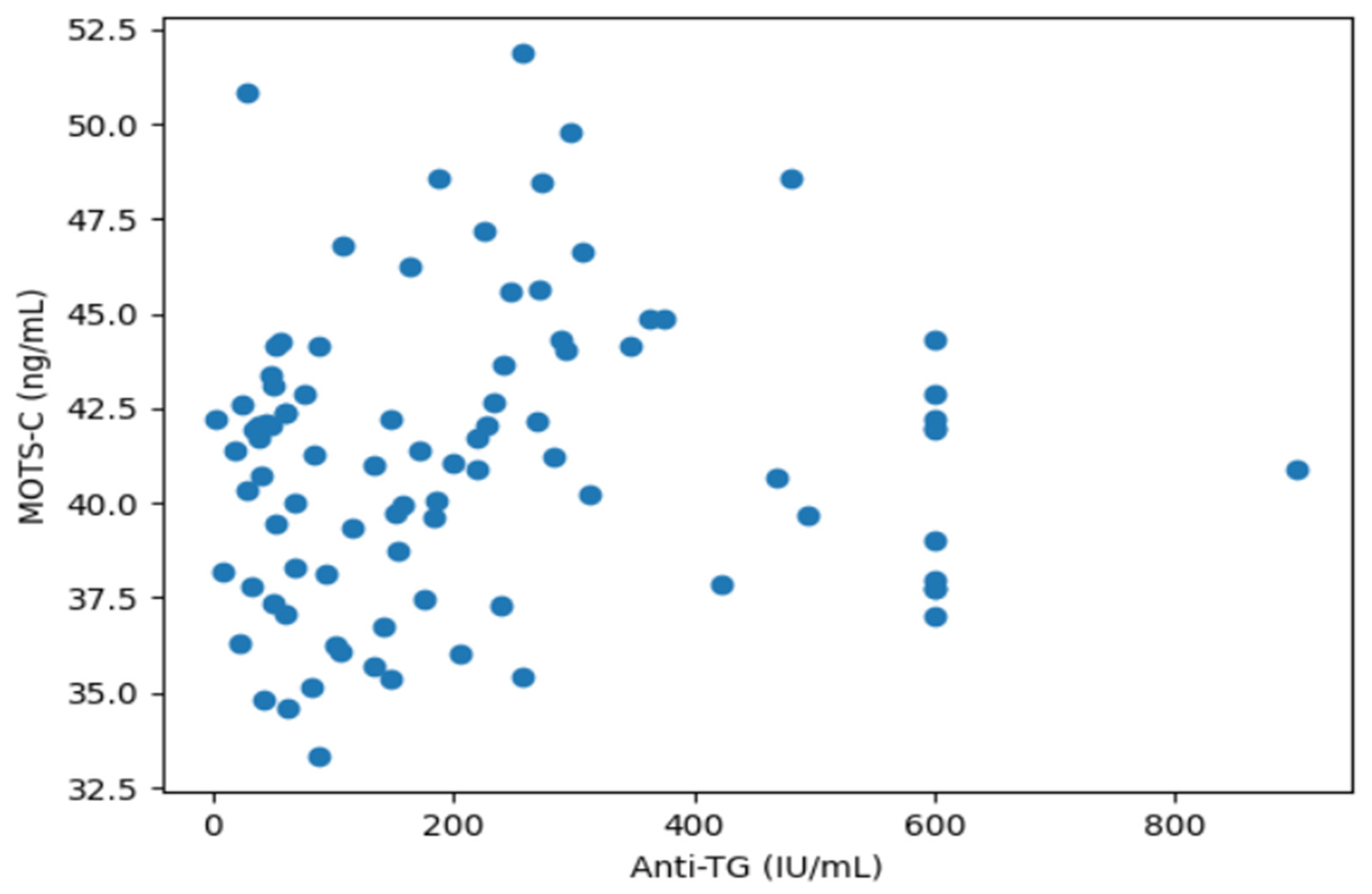
| Anti-TG (IU/mL) † | 132.0 (58.0–268.0) | 12.5 (7.1–18.3) | <0.001 |
| CRP (mg/L) † | 1.42 (0.78–2.31) | 1.18 (0.62–2.04) | 0.17 |
| Levothyroxine (LT4) use, n (%) ‡ | 56 (62.2%) | 0 (0%) | <0.001 |
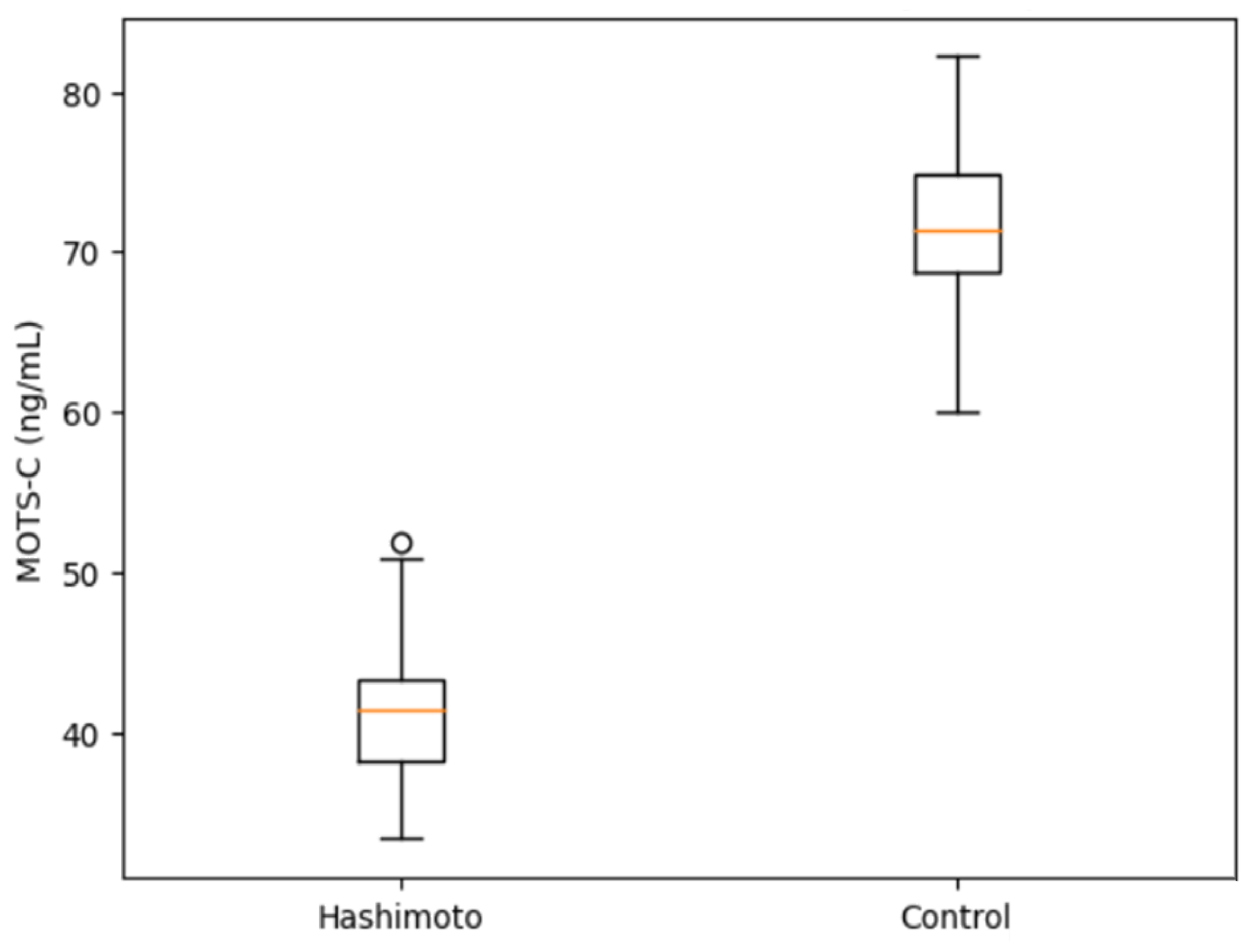
| MOTS-C (ng/mL) † | 41.33 (38.15–43.28) | 71.30 (68.69–74.80) | <0.001 |
| (A) Whole Cohort (n = 180). | |||
| Variable | Spearman’s ρ | 95% CI | p Value |
| Age (years) | −0.09 | −0.23 to 0.06 | 0.21 |
| BMI (kg/m2) | −0.32 | −0.45 to −0.18 | <0.001 |
| Fasting glucose (mg/dL) | −0.18 | −0.32 to −0.03 | 0.015 |
| HbA1c (%) | −0.21 | −0.35 to −0.06 | 0.006 |
| HOMA-IR | −0.48 | −0.59 to −0.35 | <0.001 |
| TSH (mIU/L) | −0.41 | −0.53 to −0.27 | <0.001 |
| Free T3 (pg/mL) | 0.12 | −0.03 to 0.26 | 0.10 |
| Free T4 (ng/dL) | 0.09 | −0.06 to 0.24 | 0.19 |
| Anti-TPO (IU/mL) | −0.52 | −0.62 to −0.40 | <0.001 |
| Anti-TG (IU/mL) | −0.47 | −0.58 to −0.34 | <0.001 |
| CRP (mg/L) | −0.26 | −0.39 to −0.12 | 0.001 |
| (B) Hashimoto’s Thyroiditis Subgroup (n = 90). | |||
| Variable | Spearman’s ρ | 95% CI | p Value |
| Age (years) | −0.11 | −0.31 to 0.10 | 0.29 |
| BMI (kg/m2) | −0.28 | −0.46 to −0.08 | 0.008 |
| Fasting glucose (mg/dL) | −0.22 | −0.42 to −0.01 | 0.036 |
| HbA1c (%) | −0.24 | −0.44 to −0.03 | 0.024 |
| HOMA-IR | −0.55 | −0.70 to −0.36 | <0.001 |
| TSH (mIU/L) | −0.46 | −0.63 to −0.27 | <0.001 |
| Anti-TPO (IU/mL) | −0.58 | −0.72 to −0.40 | <0.001 |
| Anti-TG (IU/mL) | −0.50 | −0.66 to −0.31 | <0.001 |
| CRP (mg/L) | −0.31 | −0.50 to −0.10 | 0.004 |
| (C) Control Subgroup (n = 90). | |||
| Variable | Spearman’s ρ | 95% CI | p Value |
| Age (years) | −0.03 | −0.24 to 0.18 | 0.756 |
| BMI (kg/m2) | 0.23 | 0.02 to 0.41 | 0.033 |
| Fasting glucose (mg/dL) | 0.08 | −0.13 to 0.29 | 0.432 |
| HbA1c (%) | 0.03 | −0.18 to 0.24 | 0.777 |
| HOMA-IR | 0.10 | −0.11 to 0.30 | 0.354 |
| TSH (mIU/L) | 0.05 | −0.16 to 0.25 | 0.640 |
| Free T3 (pg/mL) | 0.18 | −0.03 to 0.38 | 0.085 |
| Free T4 (ng/dL) | 0.22 | 0.02 to 0.41 | 0.033 |
| Anti-TPO (IU/mL) | 0.14 | −0.07 to 0.34 | 0.177 |
| Anti-TG (IU/mL) | 0.00 | −0.21 to 0.21 | 0.987 |
| CRP (mg/L) | 0.06 | −0.15 to 0.26 | 0.598 |
| Model 1. Unadjusted. | |||
| Variable | β (SE) | 95% CI | p Value |
| Hashimoto’s thyroiditis | −30.26 (0.72) | −31.68 to −28.84 | <0.001 |
| Model 2. Adjusted for Age and Sex. | |||
| Variable | β (SE) | 95% CI | p Value |
| Hashimoto’s thyroiditis | −30.21 (0.71) | −31.60 to −28.82 | <0.001 |
| Age (years) | −0.04 (0.03) | −0.10 to 0.02 | 0.19 |
| Female sex | −0.58 (0.62) | −1.80 to 0.64 | 0.35 |
| Model 3. Metabolic Adjustment. | |||
| Variable | β (SE) | 95% CI | p Value |
| Hashimoto’s thyroiditis | −30.13 (0.70) | −31.50 to −28.76 | <0.001 |
| Age (years) | −0.03 (0.03) | −0.09 to 0.03 | 0.31 |
| Sex (Female) | −0.51 (0.61) | −1.70 to 0.68 | 0.41 |
| Body mass index (kg/m2) | −0.12 (0.07) | −0.26 to 0.01 | 0.097 |
| HOMA-IR | −0.88 (0.19) | −1.25 to −0.51 | <0.001 |
| Model 4. Fully Adjusted Model. | |||
| Variable | β (SE) | 95% CI | p Value |
| Hashimoto’s thyroiditis | −30.04 (0.71) | −31.43 to −28.65 | <0.001 |
| Age (years) | −0.03 (0.03) | −0.09 to 0.03 | 0.34 |
| Female sex | −0.49 (0.61) | −1.69 to 0.71 | 0.43 |
| Body mass index (kg/m2) | −0.10 (0.07) | −0.24 to 0.03 | 0.14 |
| HOMA-IR | −0.85 (0.20) | −1.24 to −0.46 | <0.001 |
| TSH (mIU/L) | −0.18 (0.12) | −0.41 to 0.05 | 0.12 |
| CRP (mg/L) | −0.21 (0.17) | −0.55 to 0.13 | 0.22 |
| Levothyroxine (LT4) use | −0.67 (0.63) | −1.90 to 0.56 | 0.29 |
Disclaimer/Publisher’s Note: The statements, opinions and data contained in all publications are solely those of the individual author(s) and contributor(s) and not of MDPI and/or the editor(s). MDPI and/or the editor(s) disclaim responsibility for any injury to people or property resulting from any ideas, methods, instructions or products referred to in the content. |
© 2026 by the authors. Licensee MDPI, Basel, Switzerland. This article is an open access article distributed under the terms and conditions of the Creative Commons Attribution (CC BY) license.
Share and Cite
Sonay, H.O.; Duran, E.N.; Algemi, M.; Sahtiyanci, B.; Utku, I.K.; Çokiçli, E.; Misirlioglu, N.F.; Simsek, G.; Uzun, H.; Tabak, O. Reduced Circulating MOTS-c Levels in Hashimoto’s Thyroiditis Reflect Integrated Autoimmune and Metabolic Dysregulation: A Cross-Sectional Study. J. Clin. Med. 2026, 15, 4002. https://doi.org/10.3390/jcm15114002
Sonay HO, Duran EN, Algemi M, Sahtiyanci B, Utku IK, Çokiçli E, Misirlioglu NF, Simsek G, Uzun H, Tabak O. Reduced Circulating MOTS-c Levels in Hashimoto’s Thyroiditis Reflect Integrated Autoimmune and Metabolic Dysregulation: A Cross-Sectional Study. Journal of Clinical Medicine. 2026; 15(11):4002. https://doi.org/10.3390/jcm15114002
Chicago/Turabian StyleSonay, Hanişe Ozkan, Eda Nur Duran, Murvet Algemi, Berrak Sahtiyanci, Irem Kirac Utku, Esra Çokiçli, Naile Fevziye Misirlioglu, Gonul Simsek, Hafize Uzun, and Omur Tabak. 2026. "Reduced Circulating MOTS-c Levels in Hashimoto’s Thyroiditis Reflect Integrated Autoimmune and Metabolic Dysregulation: A Cross-Sectional Study" Journal of Clinical Medicine 15, no. 11: 4002. https://doi.org/10.3390/jcm15114002
APA StyleSonay, H. O., Duran, E. N., Algemi, M., Sahtiyanci, B., Utku, I. K., Çokiçli, E., Misirlioglu, N. F., Simsek, G., Uzun, H., & Tabak, O. (2026). Reduced Circulating MOTS-c Levels in Hashimoto’s Thyroiditis Reflect Integrated Autoimmune and Metabolic Dysregulation: A Cross-Sectional Study. Journal of Clinical Medicine, 15(11), 4002. https://doi.org/10.3390/jcm15114002