Combined Assessment of Immunonutritional Indices and the Triglyceride-Glucose Index in Coronary Slow Flow Phenomenon in a Non-Elderly Population


Abstract
1. Introduction
2. Materials and Methods
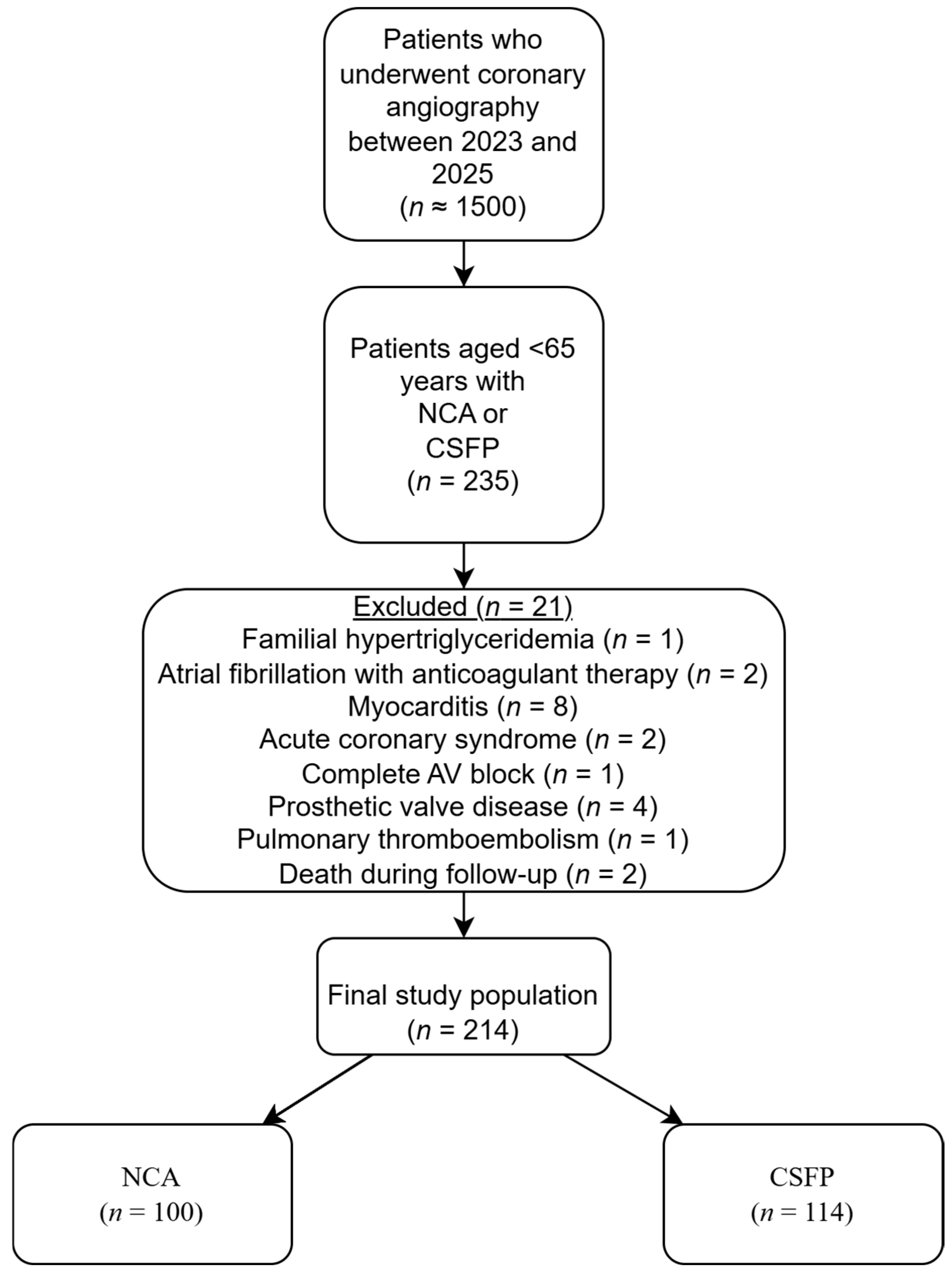
2.1. Study Design and Population
2.2. Clinical Definitions and Classification of Variables
2.3. Evaluation of Coronary Flow Using TIMI Frame Count
2.4. Laboratory Measurements
2.5. Atherogenic and Nutritional Indices
2.6. Statistical Analysis
3. Results
3.1. Baseline Clinical and Demographic Profile of the Study Population
3.2. Laboratory and Angiographic Findings
3.3. Atherogenic, Metabolic, and Nutritional Indices
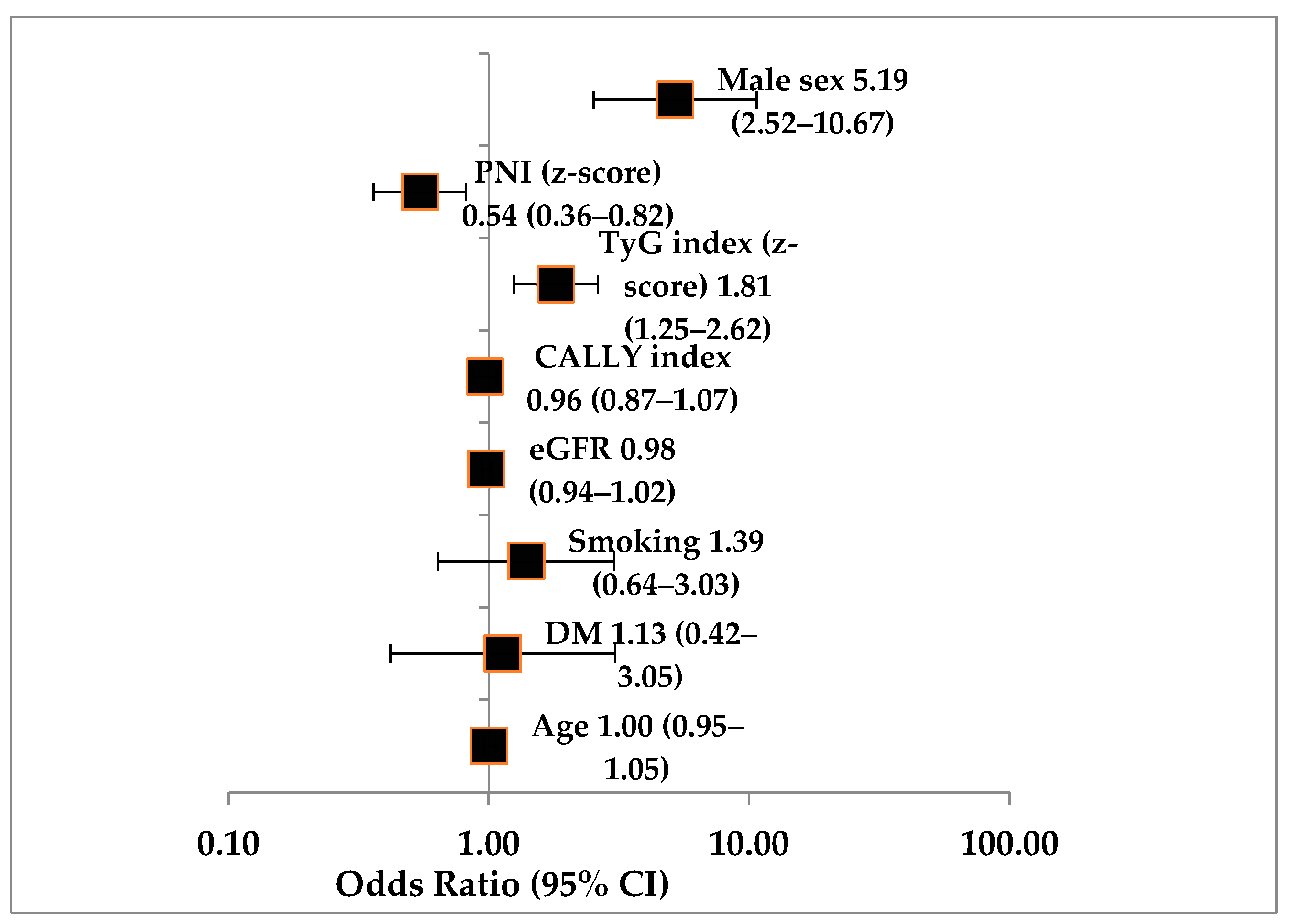
3.4. Analysis of Independent Predictors of CSFP
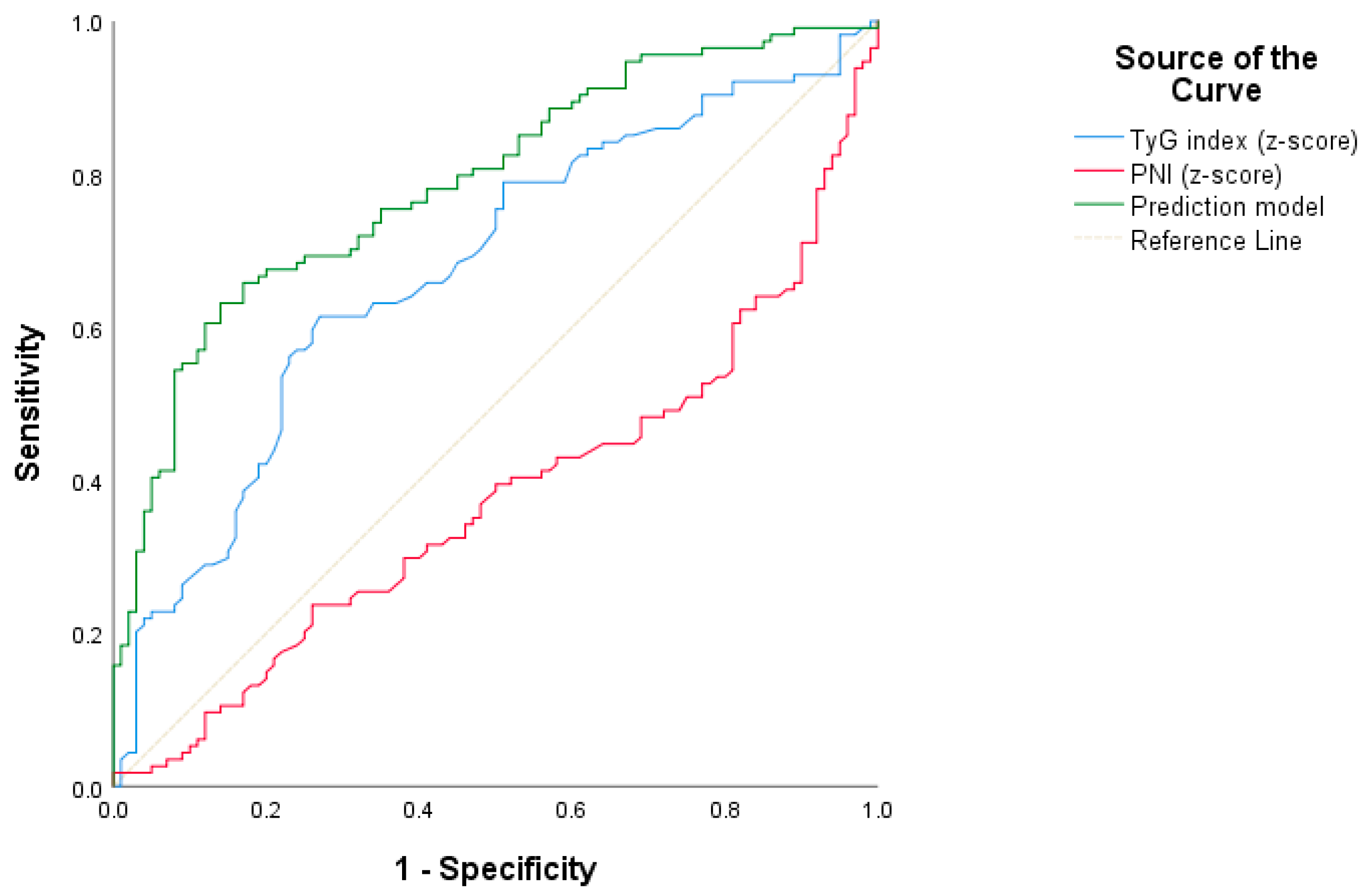
3.5. Diagnostic Performance of Predictive Models for CSFP
4. Discussion
4.1. Limitations
4.2. Future Directions
5. Conclusions
Supplementary Materials
Author Contributions
Funding
Institutional Review Board Statement
Informed Consent Statement
Data Availability Statement
Conflicts of Interest
References
- Wang, X.; Nie, S.P. The coronary slow flow phenomenon: Characteristics, mechanisms and implications. Cardiovasc. Diagn. Ther. 2011, 1, 37–43. [Google Scholar]
- Pasupathy, S.; Tavella, R.; Zeitz, C.; Edwards, S.; Worthley, M.; Arstall, M.; Beltrame, J.F. Randomised Placebo-Controlled Pilot Trial Evaluating the Anti-Anginal Efficacy of Ticagrelor in Patients with Angina with Nonobstructive Coronary Arteries and Coronary Slow Flow Phenomenon. J. Clin. Med. 2024, 13, 5235. [Google Scholar] [CrossRef]
- Aparicio, A.; Cuevas, J.; Morís, C.; Martín, M. Slow Coronary Blood Flow: Pathogenesis and Clinical Implications. Eur. Cardiol. 2022, 17, e08. [Google Scholar] [CrossRef] [PubMed]
- Zhu, Q.; Wang, S.; Huang, X.; Zhao, C.; Wang, Y.; Li, X.; Jia, D.; Ma, C. Understanding the pathogenesis of coronary slow flow: Recent advances. Trends Cardiovasc. Med. 2024, 34, 137–144. [Google Scholar] [CrossRef]
- Chen, X.; Yang, J.; Wang, D.; Liu, J.; Jin, H.; Zhang, Y.; Xiang, Q. Impact of triglyceride-glucose index on risk of cardiovascular disease among non-diabetic hypertension patients: A 10-year prospective cohort study. BMC Public Health 2025, 25, 326. [Google Scholar] [CrossRef] [PubMed]
- Demir, A.K.; Şahin, Ş.; Çıtıl, R.; Demir, O.; Özmen, Z.C. Utility of TyG-Based Indices for Predicting Insulin Resistance in Turkish Adults: Insights from the TEKHAP Study. J. Clin. Med. 2025, 14, 8965. [Google Scholar] [CrossRef]
- Lopez-Jaramillo, P.; Gomez-Arbelaez, D.; Martinez-Bello, D.; Abat, M.E.M.; Alhabib, K.F.; Avezum, Á.; Barbarash, O.; Chifamba, J.; Diaz, M.L.; Gulec, S.; et al. Association of the triglyceride glucose index as a measure of insulin resistance with mortality and cardiovascular disease in populations from five continents (PURE study): A prospective cohort study. Lancet Healthy Longev. 2023, 4, e23–e33. [Google Scholar] [CrossRef]
- Bilen, M.N.; Barman, H.A.; Dogan, O.; Ebeoglu, A.O.; Çetin, I.; Erdoğan, A.; Atıcı, A. The triglyceride-glucose index as a predictive marker for coronary slow flow phenomenon. Eur. Rev. Med. Pharmacol. Sci. 2024, 28, 3016–3023. [Google Scholar]
- Nan, J.; Meng, S.; Jia, R.; Chen, W.; Yang, X.; Hu, H.; Han, L.; Jin, Z. Comparison of TyG and modified TyG indices in predicting coronary slow flow phenomenon. BMC Cardiovasc. Disord. 2025, 25, 340. [Google Scholar] [CrossRef] [PubMed]
- Zhou, C.; Zhou, Y.; Wang, T.; Wang, Y.; Liang, X.; Kuang, X. Association of prognostic nutritional index with all-cause mortality and cardiovascular mortality: A nationwide population-based cohort study. Front. Nutr. 2025, 12, 1530452. [Google Scholar] [CrossRef]
- Fărcaș, D.A.; Cerghizan, A.; Maior, R.; Mîndrilă, A.C.; Tarcea, M. CONUT Score as a Predictor of Mortality Risk in Acute and Chronic Heart Failure: A Meta-Analytic Review. Nutrients 2025, 17, 1736. [Google Scholar] [CrossRef]
- Bolgen, C.; Mazıcan, M. The Naples Prognostic Score as a Predictor of High-Risk Coronary Plaques Detected on Coronary CT Angiography in Chronic Coronary Syndrome. J. Clin. Med. 2025, 14, 2661. [Google Scholar] [CrossRef]
- Han, D.; Wu, L.; Zhou, H.; Xue, Y.; He, S.; Ma, Z.; Su, S.; Li, P.; Liu, S.; Huang, Z. Associations of the C-reactive protein-albumin-lymphocyte index with all-cause and cardiovascular mortality among individuals with cardiovascular disease: Evidence from the NHANES 2001–2010. BMC Cardiovasc. Disord. 2025, 25, 144. [Google Scholar] [CrossRef] [PubMed]
- Özmen, M.; Altınkaya, O.; Aydemir, S.; Aydın, S.Ş.; Aydınyılmaz, F. The Role of Prognostic Nutritional Index in Predicting Coronary Slow Flow Phenomena. Diagnostics 2025, 15, 2324. [Google Scholar] [CrossRef]
- Gibson, C.M.; Cannon, C.P.; Daley, W.L.; Dodge, J.T., Jr.; Alexander, B., Jr.; Marble, S.J.; McCabe, C.H.; Raymond, L.; Fortin, T.; Poole, W.K.; et al. TIMI frame count: A quantitative method of assessing coronary artery flow. Circulation 1996, 93, 879–888. [Google Scholar] [CrossRef]
- Levey, A.S.; Stevens, L.A.; Schmid, C.H.; Zhang, Y.L.; Castro, A.F., 3rd; Feldman, H.I.; Kusek, J.W.; Eggers, P.; Van Lente, F.; Greene, T.; et al. CKD-EPI (Chronic Kidney Disease Epidemiology Collaboration). A new equation to estimate glomerular filtration rate. Ann. Intern. Med. 2009, 150, 604–612. [Google Scholar] [CrossRef] [PubMed]
- Tan, J.; Shi, X.; Pi, Y.; Xiang, M.; Li, T. Nutritional scores predict the prognosis of patients with pulmonary tuberculosis. Front. Nutr. 2024, 11, 1454207. [Google Scholar] [CrossRef]
- Ye, J.; Chen, L.; Xu, D.; Li, R.; Lan, R.; Chen, S.; He, X.; Lin, M. Inverse association between CALLY index and angina pectoris in US adults: A population-based study. BMC Cardiovasc. Disord. 2025, 25, 94. [Google Scholar] [CrossRef]
- Chalikias, G.; Tziakas, D. Slow Coronary Flow: Pathophysiology, Clinical Implications, and Therapeutic Management. Angiology 2021, 72, 808–818. [Google Scholar] [CrossRef]
- Martín, M.; Flores, R.; Ortiz DE Zárate, J.F.; Rozado, J. New perspectives in slow coronary flow: A review and update. Panminerva Med. 2025, 67, 72–86. [Google Scholar] [CrossRef] [PubMed]
- Kayan, F.; Kömek, H.; Kepenek, F.; Yildirim, M.S. The Role of the Triglyceride-Glucose Index and Other Prognostic Factors in Predicting Coronary Slow Flow. J. Cardiovasc. Dev. Dis. 2026, 13, 55. [Google Scholar] [CrossRef]
- Zhang, W.; Liu, L.; Chen, H.; Li, S.; Wan, M.; Mohammed, A.Q.; Xu, B.; Yin, G.; Lv, X.; Shi, T.; et al. Association between the triglyceride-glucose index and the presence and prognosis of coronary microvascular dysfunction in patients with chronic coronary syndrome. Cardiovasc. Diabetol. 2023, 22, 113. [Google Scholar] [CrossRef]
- Ozyildirim, S.; Barman, H.A.; Dogan, O.; Ersanli, M.K.; Dogan, S.M. The Relationship between Coronary Flow Reserve and the TyG Index in Patients with Gestational Diabetes Mellitus. Medicina 2023, 59, 1811. [Google Scholar] [CrossRef]
- Nascimento, M.A.L.; Ferreira, L.G.R.; Alves, T.V.G.; Rios, D.R.A. Inflammatory Hematological Indices, Cardiovascular Disease and Mortality: A Narrative Review. Arq. Bras. Cardiol. 2024, 121, e20230752. [Google Scholar] [PubMed]
- Wada, H.; Dohi, T.; Miyauchi, K.; Jun, S.; Endo, H.; Doi, S.; Konishi, H.; Naito, R.; Tsuboi, S.; Ogita, M.; et al. Relationship between the prognostic nutritional index and long-term clinical outcomes in patients with stable coronary artery disease. J. Cardiol. 2018, 72, 155–161. [Google Scholar] [CrossRef] [PubMed]
- Gradel, K.O. Interpretations of the Role of Plasma Albumin in Prognostic Indices: A Literature Review. J. Clin. Med. 2023, 12, 6132. [Google Scholar] [CrossRef]
- Islam, M.M.; Satici, M.O.; Eroglu, S.E. Unraveling the clinical significance and prognostic value of the neutrophil-to-lymphocyte ratio, platelet-to-lymphocyte ratio, systemic immune-inflammation index, systemic inflammation response index, and delta neutrophil index: An extensive literature review. Turk. J. Emerg. Med. 2024, 24, 8–19. [Google Scholar]
- Yuksel, Y.; Yildiz, C. Evaluation of triglyceride-glucose index in coronary slow flow patients. Kardiologiia 2023, 63, 62–67. [Google Scholar] [CrossRef] [PubMed]
- Kaplangoray, M.; Toprak, K.; Başanalan, F.; Palice, A.; Aydın, C.; Demirkıran, A.; Cekici, Y. Investigation of the Relationship Between Triglycerides-Glucose İndex and Coronary Slow Flow: A Retrospective Case-Control Study. Arq. Bras. Cardiol. 2023, 120, e20220679. [Google Scholar] [CrossRef]
- Zhou, Y.; Xie, Y.; Dong, J.; He, K.; Che, H. Insulin Resistance-Nutritional Index: A Simple Index and Potential Predictor of Mortality Risk in Patients with Chronic Heart Failure and Type 2 Diabetes. Diabetes Metab. Syndr. Obes. 2024, 17, 4177–4190. [Google Scholar] [CrossRef]
- Zhu, Y.; He, H.; Qiu, H.; Zhang, X.; Wang, L.; Li, W. Prognostic Nutritional Index Combined with Triglyceride-Glucose Index to Contrast a Nomogram for Predicting Contrast-Induced Kidney Injury in Type 2 Diabetes Mellitus Patients with Acute Coronary Syndrome After Percutaneous Coronary Intervention. Clin. Interv. Aging 2023, 18, 1663–1673. [Google Scholar] [CrossRef] [PubMed]



| Variables | NCA (n = 100) | CSFP (n = 114) | p-Value |
|---|---|---|---|
| Age (years) | 50.98 ± 8.16 | 53.03 ± 8.23 | 0.070 |
| BMI (kg/m2) | 27.45 ± 4.12 | 28.15 ± 4.02 | 0.209 |
| EF (%) | 60.61 ± 4.60 | 59.94 ± 5.21 | 0.322 |
| Male sex, n (%) | 43 (43.0%) | 84 (73.7%) | <0.001 |
| HT, n (%) | 35 (35.0%) | 50 (43.9%) | 0.186 |
| DM, n (%) | 13 (13.0%) | 26 (22.8%) | 0.064 |
| Smoking, n (%) | 19 (19.0%) | 38 (33.3%) | 0.018 |
| COPD, n (%) | 9 (9.0%) | 15 (13.2%) | 0.336 |
| Hypothyroidism, n (%) | 8 (8.0%) | 6 (5.3%) | 0.419 |
| Baseline pharmacotherapy | |||
| ACEI/ARB use, n (%) | 29 (29.0%) | 39 (34.2%) | 0.414 |
| Beta-blocker use, n (%) | 11 (11.0%) | 21 (18.4%) | 0.129 |
| CCB use, n (%) | 7 (7.0%) | 11 (9.6%) | 0.486 |
| Oral antidiabetic use, n (%) | 13 (13.0%) | 26 (22.8%) | 0.064 |
| Insulin use, n (%) | 1 (1.0%) | 5 (4.4%) | 0.134 |
| Antiplatelet use, n (%) | 28 (28.0%) | 33 (28.9%) | 0.878 |
| Variables | NCA (n = 100) | CSFP (n = 114) | p-Value |
|---|---|---|---|
| Glucose (mg/dL) | 105.60 ± 33.26 | 114.07 ± 38.89 | 0.087 |
| Triglycerides (mg/dL) | 128.79 ± 58.97 | 167.59 ± 71.92 | <0.001 |
| Total cholesterol (mg/dL) | 184.68 ± 35.00 | 187.59 ± 36.94 | 0.557 |
| HDL-C (mg/dL) | 52.14 ± 12.38 | 49.77 ± 12.72 | 0.170 |
| LDL-C (mg/dL) | 106.78 ± 28.87 | 108.69 ± 27.99 | 0.623 |
| Albumin (g/dL) | 4.38 ± 0.26 | 4.24 ± 0.33 | 0.001 |
| Creatinine (mg/dL) | 0.78 ± 0.13 | 0.86 ± 0.12 | <0.001 |
| eGFR (mL/min/1.73 m2) | 98.12 ± 10.05 | 94.73 ± 9.61 | 0.013 |
| CRP (mg/L) | 2.49 ± 1.09 | 2.85 ± 1.19 | 0.023 |
| Neutrophil count (×103/µL) | 4.38 ± 1.29 | 4.63 ± 1.58 | 0.204 |
| Lymphocyte count (×103/µL) | 2.63 ± 0.78 | 2.47 ± 0.84 | 0.157 |
| Corrected LAD TFC | 22.04 ± 5.40 | 35.86 ± 6.59 | <0.001 |
| LAD TFC | 37.47 ± 9.19 | 60.96 ± 11.20 | <0.001 |
| LCX TFC | 22.50 ± 6.33 | 36.72 ± 9.02 | <0.001 |
| RCA TFC | 20.61 ± 6.32 | 34.36 ± 8.02 | <0.001 |
| Mean TFC | 21.72 ± 4.29 | 35.65 ± 5.15 | <0.001 |
| Variables | NCA (n = 100) | CSFP (n = 114) | p-Value |
|---|---|---|---|
| TyG index | 8.71 ± 0.49 | 9.02 ± 0.55 | <0.001 |
| AIP | 0.37 ± 0.21 | 0.50 ± 0.23 | <0.001 |
| RC (mg/dL) | 25.57 ± 16.10 | 29.13 ± 20.38 | 0.156 |
| CRI-I | 3.69 ± 0.95 | 3.93 ± 1.01 | 0.076 |
| CRI-II | 2.16 ± 0.79 | 2.29 ± 0.73 | 0.222 |
| AC | 2.69 ± 0.95 | 2.93 ± 1.01 | 0.076 |
| NLR | 1.79 ± 0.74 | 2.04 ± 1.06 | 0.045 |
| LMR | 6.11 ± 2.92 | 5.61 ± 1.93 | 0.149 |
| Naples score | 0.91 ± 0.85 | 1.10 ± 0.98 | 0.138 |
| CONUT score | 0.56 ± 0.57 | 0.55 ± 0.68 | 0.932 |
| PNI | 56.92 ± 4.70 | 54.72 ± 5.77 | 0.002 |
| CALLY index | 5.63 ± 3.46 | 4.58 ± 3.25 | 0.024 |
| Variable | Univariate OR (95% CI) | p-Value | Multivariate OR (95% CI) | p-Value |
|---|---|---|---|---|
| Age | 1.031 (0.997–1.066) | 0.071 | 1.002 (0.953–1.053) | 0.932 |
| DM | 1.977 (0.954–4.098) | 0.067 | 1.129 (0.419–3.046) | 0.810 |
| Smoking | 2.132 (1.131–4.016) | 0.019 | 1.389 (0.637–3.030) | 0.409 |
| eGFR (mL/min/1.73 m2) | 0.965 (0.938–0.993) | 0.014 | 0.977 (0.937–1.018) | 0.269 |
| CALLY index | 0.907 (0.831–0.990) | 0.028 | 0.963 (0.868–1.068) | 0.473 |
| TyG index (z-score) | 1.894 (1.397–2.568) | <0.001 | 1.811 (1.251–2.622) | 0.002 |
| PNI (z-score) | 0.646 (0.481–0.868) | 0.004 | 0.544 (0.362–0.817) | 0.003 |
| Male sex | 3.712 (2.089–6.595) | <0.001 | 5.187 (2.520–10.674) | <0.001 |
| Variables | AUC | 95% CI | p-Value | Cut-Off | Sensitivity (%) | Specificity (%) |
|---|---|---|---|---|---|---|
| TyG index | 0.675 | 0.603–0.747 | <0.001 | 8.68 | 74.6 | 50 |
| PNI | 0.376 | 0.301–0.450 | 0.002 | 54 | 53.5 | 20 |
| Predicted probability (multivariable model) | 0.789 | 0.729–0.849 | <0.001 | 0.5 | 71.1 | 68 |
Disclaimer/Publisher’s Note: The statements, opinions and data contained in all publications are solely those of the individual author(s) and contributor(s) and not of MDPI and/or the editor(s). MDPI and/or the editor(s) disclaim responsibility for any injury to people or property resulting from any ideas, methods, instructions or products referred to in the content. |
© 2026 by the authors. Licensee MDPI, Basel, Switzerland. This article is an open access article distributed under the terms and conditions of the Creative Commons Attribution (CC BY) license.
Share and Cite
Kaynak, C.; Aslan, M. Combined Assessment of Immunonutritional Indices and the Triglyceride-Glucose Index in Coronary Slow Flow Phenomenon in a Non-Elderly Population. J. Clin. Med. 2026, 15, 4004. https://doi.org/10.3390/jcm15114004
Kaynak C, Aslan M. Combined Assessment of Immunonutritional Indices and the Triglyceride-Glucose Index in Coronary Slow Flow Phenomenon in a Non-Elderly Population. Journal of Clinical Medicine. 2026; 15(11):4004. https://doi.org/10.3390/jcm15114004
Chicago/Turabian StyleKaynak, Cagdas, and Muzaffer Aslan. 2026. "Combined Assessment of Immunonutritional Indices and the Triglyceride-Glucose Index in Coronary Slow Flow Phenomenon in a Non-Elderly Population" Journal of Clinical Medicine 15, no. 11: 4004. https://doi.org/10.3390/jcm15114004
APA StyleKaynak, C., & Aslan, M. (2026). Combined Assessment of Immunonutritional Indices and the Triglyceride-Glucose Index in Coronary Slow Flow Phenomenon in a Non-Elderly Population. Journal of Clinical Medicine, 15(11), 4004. https://doi.org/10.3390/jcm15114004