Prehabilitation Before Cardiac Surgery and Structural Heart Interventions: An Umbrella Review of Pooled Evidence

 , , , ,
Abstract
1. Introduction
2. Materials and Methods
2.1. Study Design
2.2. Eligibility Criteria
2.3. Search Strategy
2.4. Study Selection and Data Extraction
2.5. Quality Assessment
2.6. Certainty of Evidence Assessment
2.7. Assessment of Overlap
2.8. Data Synthesis
3. Results
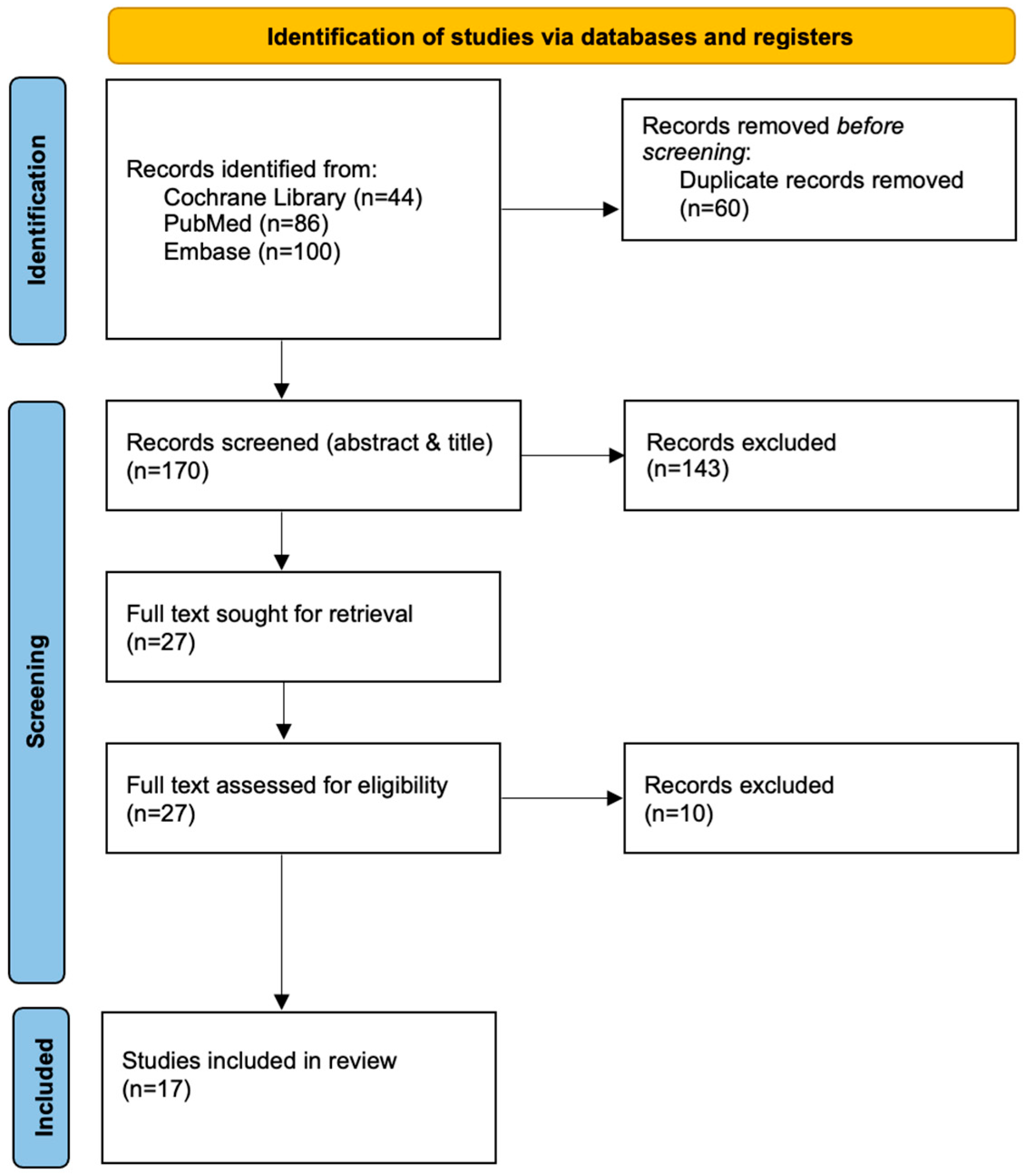
3.1. Study Selection
3.2. Characteristics of Included Reviews

| Study | Population | Intervention(s) | Number of Studies [n Participants] | Design | Meta-Analysis Effect Model | Heterogeneity | Outcomes Extracted | Other Reported Outcomes |
|---|---|---|---|---|---|---|---|---|
| Cursino de Moura et al. (2024) [18], Brazil | Elective surgery (CABG/valve) | IMT | 8 [696] | Meta-analysis | Random | I2, X2 | Pneumonia, total LOS, mortality | PFTs; MVT; ET/FC; PPCs |
| Elbadrawy et al. (2025) [27], New Zealand | Elective surgery (CABG/valve) Elective TAVI | PT, IMT, education | 17 [3299] | Meta-analysis | Random | I2 | Total LOS | ICU LOS; MVT; ET/FC; PFTs; QoL; PPCs |
| Gomes Neto et al. (2017) [20], Brazil | Elective surgery (CABG/valve) | IMT | 8 [574] * | Meta-analysis | Random | I2 | Total LOS | Inspiratory muscle strength; PFTs; PPCs |
| Hulzebos et al. (2012) [21], Netherlands | Elective surgery (CABG/valve) | PT, IMT | 8 [NR] | Cochrane review | Random | I2, X2 | Pneumonia, total LOS, mortality | PPCs; QoL; ET/FC; Economic costs |
| Hurtado-Borrego et al. (2025) [22], Spain | Elective surgery (CABG/valve) | PT, IMT | 9 [873] | Meta-analysis/regression | Random | I2 | Total LOS, mortality | ET/FC; frailty; sarcopenia; POCs; MVT; ICU LOS; QoL |
| Katsura et al. (2015) [31], Japan | Mixed surgical cohort | IMT | 12 [448 estimated cardiac participants] | Cochrane review | Random | I2, X2 | Pneumonia | PPCs; MVT; QoL; adverse events; PFTs; drop-out; economic costs; total LOS; mortality |
| Kendall et al. (2018) [32], Portugal | Mixed surgical cohort | IMT | NR | Meta-analysis | Random | I2 | Total LOS | PPCs |
| Marmelo et al. (2018) [4], Portugal | Elective surgery (CABG/valve) | PT, IMT | NR | Meta-analysis | Random | I2 | Total LOS | POCs; PFTs; ET/FC; QoL; anxiety and depression |
| Rodrigues et al. (2021) [24], Portugal | Elective surgery (CABG/valve) | IMT | 11 [1240] | Meta-analysis | Random | I2 | Total LOS | PPCs; PFTs |
| Shahood et al. (2022) [26], Hungary | Elective surgery (CABG/valve) | PT, IMT, education | 10 [1458] | Meta-analysis | Random | I2 | Total LOS | PPCs; PFTs; surgery time; ICU LOS; MVT |
| Snowdon et al. (2014) [25], Australia | Elective surgery (CABG/valve) | PT, IMT, education | 17 [2689] | Meta-analysis | Fixed + random | I2 | Total LOS | PPCs; MVT; ICU LOS; economic costs |
| Steinmetz et al. (2023) [7], Germany | Elective surgery (CABG/valve) | PT, IMT, education | 6 [665] | Meta-analysis | Random | I2 | Pneumonia, total LOS, mortality | ET/FC; ICU LOS; POCs; economic costs |
| Steinmetz et al. (2026) [29], Germany | Elective surgery (CABG/valve) Elective TAVI | PT, IMT, education, medication, psychology | 44 [3925] | Meta-analysis | Random | I2 | Pneumonia, total LOS, mortality | ICU LOS; QoL; ET/FC; POCs; safety |
| Thybo Karanfil & Møller (2018) [23], Denmark | Elective surgery (CABG/valve) | IMT | 5 [451] | Meta-analysis | Fixed + random | I2 | Pneumonia | PPCs |
| Wang et al. (2023) [28], China | Elective surgery (CABG/valve) Elective TAVI | IMT | 6 [925] | Meta-analysis | Random | I2 | Total LOS | MVT; ICU LOS |
| Wang et al. (2024) [30], China | Elective surgery (CABG/valve) Elective TAVI | PT, IMT, education | 21 [2895] | Meta-analysis | Random | I2 | Pneumonia, total LOS | PPCs; ICU LOS |
| Yau et al. (2021) [5], Hong Kong | Elective surgery (CABG/valve) | PT, IMT, education | 7 [726] | Meta-analysis | Random | I2, X2 | Pneumonia, total LOS, mortality | POCs; ET/FC; QoL; anxiety and depression; frailty; ICU LOS; economic costs; cardiac rehab enrolment |
3.3. Methodological Quality of Included Reviews
3.4. Certainty of Evidence
3.5. Nature of Prehabilitation Interventions
3.5.1. Respiratory-Focused (IMT) Interventions
3.5.2. Multimodal Prehabilitation
3.6. Evidence from Pooled Analyses
3.6.1. Postoperative Pneumonia
3.6.2. Hospital Length of Stay
3.6.3. Mortality
4. Discussion
4.1. Principal Findings
4.2. Interpretation in the Wider Context of the Literature
4.3. Limitations
4.4. Future Directions
5. Conclusions
Author Contributions
Funding
Institutional Review Board Statement
Informed Consent Statement
Data Availability Statement
Acknowledgments
Conflicts of Interest
Abbreviations
| AMSTAR 2 | A Measurement Tool to Assess Systematic Reviews 2 |
| CABG | Coronary artery bypass graft |
| CCA | Corrected covered area |
| CI | Confidence interval |
| ET | Exercise tolerance |
| FC | Functional capacity |
| GRADE | Grading of Recommendations Assessment, Development and Evaluation |
| ICU | Intensive care unit |
| IMT | Inspiratory muscle training |
| LOS | Length of stay |
| MD | Mean difference |
| MVT | Mechanical ventilation time |
| NNT | Number needed to treat |
| NR | Not reported |
| OR | Odds ratio |
| OSF | Open Science Framework |
| PFTs | Pulmonary function tests |
| PICO | Population, Intervention, Comparator, Outcome |
| POCs | Postoperative complications |
| PPCs | Postoperative pulmonary complications |
| PRISMA | Preferred Reporting Items for Systematic Reviews and Meta-Analyses |
| PROMs | Patient-reported outcome measures |
| PT | Physical therapy |
| QoL | Quality of life |
| RoB | Risk of bias |
| RR | Risk ratio |
| SR | Systematic review |
| TAVI | Transcatheter aortic valve implantation |
Appendix A. PRISMA 2020 Checklist
| Section and Topic | Item # | Checklist Item | Location Where Item Is Reported |
| TITLE | |||
| Title | 1 | Identify the report as a systematic review. | Page 1, Lines 1–3 |
| ABSTRACT | |||
| Abstract | 2 | See the PRISMA 2020 for Abstracts checklist. | Pages 30 & 31, Appendix D |
| INTRODUCTION | |||
| Rationale | 3 | Describe the rationale for the review in the context of existing knowledge. | Page 2, Lines 41–67 |
| Objectives | 4 | Provide an explicit statement of the objective(s) or question(s) the review addresses. | Page 2, Lines 68–77 |
| METHODS | |||
| Eligibility criteria | 5 | Specify the inclusion and exclusion criteria for the review and how studies were grouped for the syntheses. | Page 3, Lines 90–99 |
| Information sources | 6 | Specify all databases, registers, websites, organisations, reference lists and other sources searched or consulted to identify studies. Specify the date when each source was last searched or consulted. | Page 3, Lines 101–107 |
| Search strategy | 7 | Present the full search strategies for all databases, registers and websites, including any filters and limits used. | Page 28, Appendix B |
| Selection process | 8 | Specify the methods used to decide whether a study met the inclusion criteria of the review, including how many reviewers screened each record and each report retrieved, whether they worked independently, and if applicable, details of automation tools used in the process. | Page 3, Lines 108–120 |
| Data collection process | 9 | Specify the methods used to collect data from reports, including how many reviewers collected data from each report, whether they worked independently, any processes for obtaining or confirming data from study investigators, and if applicable, details of automation tools used in the process. | Page 3, Lines 108–120 |
| Data items | 10a | List and define all outcomes for which data were sought. Specify whether all results that were compatible with each outcome domain in each study were sought (e.g., for all measures, time points, analyses), and if not, the methods used to decide which results to collect. | Page 3, Lines 90–99 |
| 10b | List and define all other variables for which data were sought (e.g., participant and intervention characteristics, funding sources). Describe any assumptions made about any missing or unclear information. | Pages 7 & 8, Table 1 | |
| Study risk of bias assessment | 11 | Specify the methods used to assess risk of bias in the included studies, including details of the tool(s) used, how many reviewers assessed each study and whether they worked independently, and if applicable, details of automation tools used in the process. | Page 3, Lines 108–130 |
| Effect measures | 12 | Specify for each outcome the effect measure(s) (e.g., risk ratio, mean difference) used in the synthesis or presentation of results. | Page 4, Lines 156–165 |
| Synthesis methods | 13a | Describe the processes used to decide which studies were eligible for each synthesis (e.g., tabulating the study intervention characteristics and comparing against the planned groups for each synthesis (item #5)). | Pages 7 & 8, Table 1 |
| 13b | Describe any methods required to prepare the data for presentation or synthesis, such as handling of missing summary statistics, or data conversions. | NA | |
| 13c | Describe any methods used to tabulate or visually display results of individual studies and syntheses. | NA | |
| 13d | Describe any methods used to synthesize results and provide a rationale for the choice(s). If meta-analysis was performed, describe the model(s), method(s) to identify the presence and extent of statistical heterogeneity, and software package(s) used. | NA | |
| 13e | Describe any methods used to explore possible causes of heterogeneity among study results (e.g., subgroup analysis, meta-regression). | Page 4, Lines 153–155 | |
| 13f | Describe any sensitivity analyses conducted to assess robustness of the synthesized results. | NA | |
| Reporting bias assessment | 14 | Describe any methods used to assess risk of bias due to missing results in a synthesis (arising from reporting biases). | Pages 3 & 4, Lines 121–152 |
| Certainty assessment | 15 | Describe any methods used to assess certainty (or confidence) in the body of evidence for an outcome. | Pages 3 & 4, Lines 131–152 |
| RESULTS | |||
| Study selection | 16a | Describe the results of the search and selection process, from the number of records identified in the search to the number of studies included in the review, ideally using a flow diagram. | Page 4, Lines 166–172 |
| 16b | Cite studies that might appear to meet the inclusion criteria, but which were excluded, and explain why they were excluded. | NA | |
| Study characteristics | 17 | Cite each included study and present its characteristics. | Pages 7 & 8, Table 1 |
| Risk of bias in studies | 18 | Present assessments of risk of bias for each included study. | Pages 29 & 30, Appendix C |
| Results of individual studies | 19 | For all outcomes, present, for each study: (a) summary statistics for each group (where appropriate) and (b) an effect estimate and its precision (e.g., confidence/credible interval), ideally using structured tables or plots. | Pages 12-15, Table 3, Table 4 and Table 5 |
| Results of syntheses | 20a | For each synthesis, briefly summarise the characteristics and risk of bias among contributing studies. | Pages 10 & 11, Lines 230–279 |
| 20b | Present results of all statistical syntheses conducted. If meta-analysis was done, present for each the summary estimate and its precision (e.g., confidence/credible interval) and measures of statistical heterogeneity. If comparing groups, describe the direction of the effect. | NA | |
| 20c | Present results of all investigations of possible causes of heterogeneity among study results. | Pages 5 & 6, Lines 198–211 | |
| 20d | Present results of all sensitivity analyses conducted to assess the robustness of the synthesized results. | Page 10, Lines 218–222 | |
| Reporting biases | 21 | Present assessments of risk of bias due to missing results (arising from reporting biases) for each synthesis assessed. | NA |
| Certainty of evidence | 22 | Present assessments of certainty (or confidence) in the body of evidence for each outcome assessed. | Page 10, Lines 218–222 |
| DISCUSSION | |||
| Discussion | 23a | Provide a general interpretation of the results in the context of other evidence. | Page 17, Lines 345–364 |
| 23b | Discuss any limitations of the evidence included in the review. | Page 17, Lines 365–375 | |
| 23c | Discuss any limitations of the review processes used. | Page 17, Lines 365–375 | |
| 23d | Discuss implications of the results for practice, policy, and future research. | Page 17, Lines 376–386 | |
| OTHER INFORMATION | |||
| Registration and protocol | 24a | Provide registration information for the review, including register name and registration number, or state that the review was not registered. | Page 2, Lines 82–89 |
| 24b | Indicate where the review protocol can be accessed, or state that a protocol was not prepared. | Page 2, Line 86 | |
| 24c | Describe and explain any amendments to information provided at registration or in the protocol. | NA | |
| Support | 25 | Describe sources of financial or non-financial support for the review, and the role of the funders or sponsors in the review. | Page 18, Line 400 |
| Competing interests | 26 | Declare any competing interests of review authors. | Page 18, Line 410 |
| Availability of data, code and other materials | 27 | Report which of the following are publicly available and where they can be found: template data collection forms; data extracted from included studies; data used for all analyses; analytic code; any other materials used in the review. | NA |
Appendix B
Appendix C. AMSTAR 2 Methodological Appraisal Table
| Study | PICO | Protocol * | Design Choice | Search * | Selection Duplicate | Extraction Duplicate | Excluded Studies * | Included Study Details | RoB Tool * | Funding of Primary Studies | Meta Methods * | RoB Impact on Synthesis | RoB in Interpretation * | Heterogeneity | Publication Bias * | Review COI | Overall |
| Cursino de Moura 2024 [18] | Yes | Yes | Yes | Yes | Yes | Yes | No | Yes | Yes | No | Yes | No | Partial | Yes | No | Yes | Critically low |
| Elbadrawy 2025 [27] | Yes | No | Yes | Partial | Partial | Yes | No | Yes | Yes | Partial | Yes | No | Partial | Yes | No | Yes | Critically low |
| Gomes Neto 2017 [20] | Yes | No | Yes | Partial | Yes | Yes | No | Yes | No | No | Yes | No | No | Yes | No | Yes | Critically low |
| Hulzebos 2012 [21] | Yes | Yes | Yes | Yes | Yes | Yes | Yes | Yes | Yes | No | Yes | No | Yes | Yes | Partial | Yes | Moderate |
| Hurtado-Borrego 2025 [22] | Yes | Yes | Yes | Yes | Yes | Yes | No | Yes | Yes | No | Yes | No | Yes | Yes | Yes | Yes | Low |
| Katsura 2015 [31] | Yes | Yes | Yes | Yes | Yes | Yes | Yes | Yes | Yes | No | Yes | Yes | Yes | Yes | Yes | Yes | High |
| Kendall 2018 [32] | Yes | No | Yes | Partial | Yes | No | No | Yes | No | No | Yes | No | Partial | Yes | Yes | Yes | Critically low |
| Marmelo 2018 [4] | Yes | No | Yes | Partial | No | No | No | Yes | Yes | No | Yes | No | No | Yes | No | Yes | Critically low |
| Rodrigues 2021 [24] | Yes | No | Yes | Partial | Yes | No | No | Yes | Yes | No | Yes | No | Partial | Yes | No | Partial | Critically low |
| Shahood 2022 [26] | Yes | Yes | Yes | Partial | Partial | Partial | No | Yes | Yes | No | Yes | No | Partial | Yes | No | Yes | Critically low |
| Snowdon 2014 [25] | Yes | No | Yes | Yes | Yes | Yes | No | Yes | Yes | No | Yes | No | Partial | Yes | No | Yes | Critically low |
| Steinmetz 2023 [7] | Yes | Yes | Yes | Partial | Yes | No | No | Yes | Yes | No | Yes | No | Yes | Yes | Partial | Yes | Low |
| Steinmetz 2026 [29] | Yes | Yes | Yes | Yes | Yes | Yes | No | Yes | Yes | No | Yes | No | Yes | Yes | Partial | Yes | Low |
| Thybo Karanfil 2018 [23] | Yes | Yes | Yes | Yes | Yes | Yes | No | Yes | Yes | No | Yes | No | No | Yes | No | Yes | Critically low |
| Wang 2023 [28] | Yes | No | Yes | Partial | Yes | Yes | No | Yes | Yes | No | Yes | No | Partial | Yes | No | Partial | Critically low |
| Wang 2024 [30] | Yes | No | Yes | Partial | Yes | No | No | Yes | Yes | No | Yes | No | Partial | Yes | No | Yes | Critically low |
| Yau 2021 [5] | Yes | Yes | Yes | Yes | Yes | Yes | No | Yes | Yes | No | Yes | No | Yes | Yes | No | Yes | Critically low |
| * Critical AMSTAR 2 domains. | |||||||||||||||||
Appendix D. PRISMA 2020 Abstract Checklist
| Topic | No. | Item | Reported? |
| TITLE | |||
| Title | 1 | Identify the report as a systematic review. | Yes |
| BACKGROUND | |||
| Objectives | 2 | Provide an explicit statement of the main objective(s) or question(s) the review addresses. | No |
| METHODS | |||
| Eligibility criteria | 3 | Specify the inclusion and exclusion criteria for the review. | No |
| Information sources | 4 | Specify the information sources (e.g., databases, registers) used to identify studies and the date when each was last searched. | No |
| Risk of bias | 5 | Specify the methods used to assess risk of bias in the included studies. | Yes |
| Synthesis of results | 6 | Specify the methods used to present and synthesize results. | No |
| RESULTS | |||
| Included studies | 7 | Give the total number of included studies and participants and summarise relevant characteristics of studies. | Yes |
| Synthesis of results | 8 | Present results for main outcomes, preferably indicating the number of included studies and participants for each. If meta-analysis was done, report the summary estimate and confidence/credible interval. If comparing groups, indicate the direction of the effect (i.e., which group is favoured). | Yes |
| DISCUSSION | |||
| Limitations of evidence | 9 | Provide a brief summary of the limitations of the evidence included in the review (e.g., study risk of bias, inconsistency and imprecision). | Yes |
| Interpretation | 10 | Provide a general interpretation of the results and important implications. | Yes |
| OTHER | |||
| Funding | 11 | Specify the primary source of funding for the review. | No |
| Registration | 12 | Provide the register name and registration number. | No |
Appendix E
| Overlap Matrix—Pneumonia (■ = Primary Study Included in Review) | |||||||||||
| Systematic Review | Weiner 1998 [38] | Hulzebos 2006 (Helders) [33] | Hulzebos 2006 (van Meeteren) [37] | Ferreira 2009 [36] | Carvalho 2011 [34] | Herdy 2008 [39] | Chen 2019 [35] | Stammers 2016 [40] | Valkenet 2017 [42] | Argunova 2022 [41] | |
| Cursino de Moura 2024 [18] | ■ | ■ | ■ | ■ | ■ | ■ | |||||
| Hulzebos 2012 [21] | ■ | ■ | ■ | ■ | ■ | ||||||
| Katsura 2015 [31] | ■ | ■ | ■ | ■ | ■ | ||||||
| Steinmetz 2023 [7] | ■ | ■ | |||||||||
| Steinmetz 2026 [29] | ■ | ■ | ■ | ■ | ■ | ||||||
| Thybo Karanfil & Møller 2018 [23] | ■ | ■ | ■ | ■ | ■ | ||||||
| Wang 2024 [30] | ■ | ■ | ■ | ■ | ■ | ■ | ■ | ||||
| Yau 2021 [5] | ■ | ■ | |||||||||
| Frequency | 6 | 6 | 5 | 5 | 5 | 3 | 2 | 2 | 2 | 1 | |
| Note: Frequencies represent the number of systematic reviews in which each primary study appears. Columns are ordered by frequency (highest to lowest). This matrix illustrates which primary studies were included in each systematic review reporting pneumonia (■ = included). The clustering of squares around specific studies demonstrates substantial overlap, with multiple reviews drawing on the same core set of evidence. | |||||||||||
| Overlap Matrix—Length of Stay (■ = Primary Study Included in Review) | |||||||||||
| Systematic Reviews | Hulzebos 2006 (Helders) [33] | Hulzebos (van Meeteren) [37] | Arthur 2000 [43] | Chen 2019 [35] | Sawatzky 2014 [50] | Sobrinho 2014 [53] | Valkenet 2017 [42] | Herdy 2008 [39] | Rosenfeldt 2011 [49] | Savci 2011 [52] | Rajendran 1998 [47] |
| Cursino de Moura 2024 [18] | ■ | ■ | ■ | ||||||||
| Elbadrawy 2025 [27] | ■ | ■ | |||||||||
| Gomes Neto 2017 [20] | ■ | ■ | |||||||||
| Hulzebos 2012 [21] | ■ | ■ | ■ | ||||||||
| Hurtado-Borrego 2025 [22] | ■ | ■ | ■ | ||||||||
| Kendall 2018 [32] | |||||||||||
| Marmelo 2018 [4] | ■ | ■ | ■ | ■ | ■ | ■ | ■ | ||||
| Rodrigues 2021 [24] | ■ | ■ | ■ | ■ | |||||||
| Shahood 2022 [26] | ■ | ■ | ■ | ■ | ■ | ■ | |||||
| Snowdon 2014 [25] | ■ | ■ | ■ | ||||||||
| Steinmetz 2023 [7] | ■ | ■ | ■ | ■ | |||||||
| Steinmetz 2026 [29] | ■ | ■ | ■ | ■ | ■ | ■ | |||||
| Wang 2023 [28] | ■ | ■ | ■ | ■ | ■ | ||||||
| Wang 2024 [30] | ■ | ■ | ■ | ■ | ■ | ■ | ■ | ■ | ■ | ■ | |
| Yau 2021 [5] | ■ | ■ | |||||||||
| Frequency | 10 | 9 | 6 | 5 | 5 | 5 | 5 | 4 | 4 | 4 | 3 |
| Note: Frequencies represent the number of systematic reviews in which each primary study appears. Columns are ordered by frequency (highest to lowest). Due to volume of papers only those included more than twice are included. This matrix illustrates which primary studies were included in each systematic review reporting LOS (■ = included). The clustering of squares around specific studies demonstrates substantial overlap, with multiple reviews drawing on the same core set of evidence. | |||||||||||
| Overlap Matrix—Mortality (■ = Primary Study Included in Review) | |||||||||||||||
| Systematic Reviews | Arthur 2000 [43] | Hulzebos 2006 [33] | Akowuah 2023 [48] | Ferreira 2009 [36] | Herdy 2008 [39] | Stammers 2016 [40] | Furze 2009 [64] | Lopez-Hernandez 2023 [78] | Rideout 2012 [79] | Rief 2017 [80] | Rosenfeldt 2005 [70] | Rosenfeldt 2011 [49] | Steinmetz 2020 [65] | Waite 2017 [77] | Yau 2025 [51] |
| Cursino de Moura 2024 [18] | ■ | ■ | |||||||||||||
| Hulzebos 2012 [21] | ■ | ■ | ■ | ||||||||||||
| Hurtado-Borrego 2025 [22] | ■ | ■ | ■ | ■ | ■ | ||||||||||
| Steinmetz 2023 [7] | ■ | ■ | ■ | ■ | |||||||||||
| Steinmetz 2026 [29] | ■ | ■ | ■ | ■ | ■ | ||||||||||
| Yau 2021 [5] | ■ | ■ | ■ | ■ | |||||||||||
| Frequency | 3 | 3 | 2 | 2 | 2 | 2 | 1 | 1 | 1 | 1 | 1 | 1 | 1 | 1 | 1 |
| Note: Frequencies represent the number of systematic reviews in which each primary study appears. Columns are ordered by frequency (highest to lowest). | |||||||||||||||
References
- Chandiramani, A.; Ali, J.M. Frailty in Cardiac Surgery-Assessment Tools, Impact on Outcomes, and Optimisation Strategies: A Narrative Review. J. Cardiovasc. Dev. Dis. 2025, 12, 127. [Google Scholar] [CrossRef]
- Wannamethee, S.G.; Atkins, J.L. Sarcopenic Obesity and Cardiometabolic Health and Mortality in Older Adults: A Growing Health Concern in an Ageing Population. Curr. Diab Rep. 2023, 23, 307–314. [Google Scholar] [CrossRef] [PubMed]
- Scheede-Bergdahl, C.; Minnella, E.M.; Carli, F. Multi-modal prehabilitation: Addressing the why, when, what, how, who and where next? Anaesthesia 2019, 74, 20–26. [Google Scholar] [CrossRef] [PubMed]
- Marmelo, F.; Rocha, V.; Moreira-Goncalves, D. The impact of prehabilitation on post-surgical complications in patients undergoing non-urgent cardiovascular surgical intervention: Systematic review and meta-analysis. Eur. J. Prev. Cardiol. 2018, 25, 404–417. [Google Scholar] [CrossRef] [PubMed]
- Yau, D.K.W.; Underwood, M.J.; Joynt, G.M.; Lee, A. Effect of preparative rehabilitation on recovery after cardiac surgery: A systematic review. Ann. Phys. Rehabil. Med. 2021, 64, 101391. [Google Scholar] [CrossRef]
- Winkle, M.J.; Sankari, A. Respiratory Muscle Strength Training; BTI–StatPearls: Treasure Island, FL, USA, 2024. [Google Scholar]
- Steinmetz, C.; Bjarnason-Wehrens, B.; Walther, T.; Schaffland, T.F.; Walther, C. Efficacy of Prehabilitation Before Cardiac Surgery: A Systematic Review and Meta-analysis. Am. J. Phys. Med. Rehabil. 2023, 102, 323–330. [Google Scholar] [CrossRef]
- Scheenstra, B.; van Susante, L.; Bongers Bart, C.; Lenssen, T.; Knols, H.; van Kuijk, S.; Nieman, M.; Maessen, J.; van’t Hof, A.; Sardari Nia, P.; et al. The Effect of Teleprehabilitation on Adverse Events After Elective Cardiac Surgery. JACC 2025, 85, 788–800. [Google Scholar] [CrossRef]
- Fleurent-Gregoire, C.; Burgess, N.; McIsaac, D.I.; Chevalier, S.; Fiore, J.F., Jr.; Carli, F.; Levett, D.; Moore, J.; Grocott, M.P.; Copeland, R.; et al. Towards a common definition of surgical prehabilitation: A scoping review of randomised trials. Br. J. Anaesth. 2024, 133, 305–315. [Google Scholar] [CrossRef]
- Pufulete, M.; Coyle, V.; Provan, D.; Shaw, C.; Kunzmann, P.; Bowrey, D.J.; Barlow, R.; Grocott, M.P.W.; Shah, T.; Atkinson, C. Prehabilitation provision and practice in the UK: A freedom of information survey. Br. J. Anaesth. 2024, 132, 815–819. [Google Scholar] [CrossRef]
- Gibbison, B.; Pufulete, M. Prehabilitation before cardiac surgery. Br. J. Anaesth. 2025, 134, 5–7. [Google Scholar] [CrossRef]
- Wang, D.; Lu, Y.; Sun, M.; Huang, X.; Du, X.; Jiao, Z.; Sun, F.; Xie, F. Pneumonia After Cardiovascular Surgery: Incidence, Risk Factors and Interventions. Front. Cardiovasc. Med. 2022, 9, 911878. [Google Scholar] [CrossRef]
- Page, M.J.; McKenzie, J.E.; Bossuyt, P.M.; Boutron, I.; Hoffmann, T.C.; Mulrow, C.D.; Shamseer, L.; Tetzlaff, J.M.; Akl, E.A.; Brennan, S.E.; et al. The PRISMA 2020 statement: An updated guideline for reporting systematic reviews. BMJ 2021, 372, n71. [Google Scholar] [CrossRef]
- Page, M.J.; Moher, D.; Bossuyt, P.M.; Boutron, I.; Hoffmann, T.C.; Mulrow, C.D.; Shamseer, L.; Tetzlaff, J.M.; Akl, E.A.; Brennan, S.E.; et al. PRISMA 2020 explanation and elaboration: Updated guidance and exemplars for reporting systematic reviews. BMJ 2021, 372, n160. [Google Scholar] [CrossRef]
- Boney, O.; Bell, M.; Bell, N.; Conquest, A.; Cumbers, M.; Drake, S.; Galsworthy, M.; Gath, J.; Grocott, M.P.; Harris, E.; et al. Identifying research priorities in anaesthesia and perioperative care: Final report of the joint National Institute of Academic Anaesthesia/James Lind Alliance Research Priority Setting Partnership. BMJ Open 2015, 5, e010006. [Google Scholar] [CrossRef] [PubMed]
- Shea, B.J.; Reeves, B.C.; Wells, G.; Thuku, M.; Hamel, C.; Moran, J.; Moher, D.; Tugwell, P.; Welch, V.; Kristjansson, E.; et al. AMSTAR 2: A critical appraisal tool for systematic reviews that include randomised or non-randomised studies of healthcare interventions, or both. BMJ 2017, 358, j4008. [Google Scholar] [CrossRef]
- Higgins, J.P.T.; Thomas, J.; Chandler, J.; Cumpston, M.; Li, T.; Page, M.J.; Welch, V.; Flemyng, E. (Eds.) Cochrane Handbook for Systematic Reviews of Interventions; Version 6.5 (updated August 2024); Cochrane: London, UK, 2024. [Google Scholar]
- Cursino de Moura, J.F.; Oliveira, C.B.; Coelho Figueira Freire, A.P.; Elkins, M.R.; Pacagnelli, F.L. Preoperative respiratory muscle training reduces the risk of pulmonary complications and the length of hospital stay after cardiac surgery: A systematic review. J. Physiother. 2024, 70, 16–24. [Google Scholar] [CrossRef]
- Pieper, D.; Antoine, S.L.; Mathes, T.; Neugebauer, E.A.; Eikermann, M. Systematic review finds overlapping reviews were not mentioned in every other overview. J. Clin. Epidemiol. 2014, 67, 368–375. [Google Scholar] [CrossRef]
- Gomes Neto, M.; Martinez, B.P.; Reis, H.F.; Carvalho, V.O. Pre- and postoperative inspiratory muscle training in patients undergoing cardiac surgery: Systematic review and meta-analysis. Clin. Rehabil. 2017, 31, 454–464. [Google Scholar] [CrossRef]
- Hulzebos, E.H.; Smit, Y.; Helders, P.P.; van Meeteren, N.L. Preoperative physical therapy for elective cardiac surgery patients. Cochrane Database Syst. Rev. 2012, 11, CD010118. [Google Scholar] [CrossRef] [PubMed]
- Hurtado-Borrego, J.C.; Bayonas-Ruiz, A.; Bonacasa, B. Exercise-Based Prehabilitation Before Cardiac Surgery: A Systematic Review, Meta-Analysis, Meta-Regression, and Proposal for a Clinical Implementation Model. J. Clin. Med. 2025, 14, 8195. [Google Scholar] [CrossRef] [PubMed]
- Thybo Karanfil, E.O.; Møller, A.M. Preoperative inspiratory muscle training prevents pulmonary complications after cardiac surgery—A systematic review. Dan. Med. J. 2018, 65, A5450. [Google Scholar]
- Rodrigues, S.N.; Henriques, H.R.; Henriques, M.A. Effectiveness of preoperative breathing exercise interventions in patients undergoing cardiac surgery: A systematic review. Rev. Port. Cardiol. 2021, 40, 229–244. [Google Scholar] [CrossRef]
- Snowdon, D.; Haines, T.P.; Skinner, E.H. Preoperative intervention reduces postoperative pulmonary complications but not length of stay in cardiac surgical patients: A systematic review. J. Physiother. 2014, 60, 66–77. [Google Scholar] [CrossRef] [PubMed]
- Shahood, H.; Pakai, A.; Kiss, R.; Eva, B.; Szilagyi, N.; Sandor, A.; Verzar, Z. Effectiveness of Preoperative Chest Physiotherapy in Patients Undergoing Elective Cardiac Surgery, a Systematic Review and Meta-Analysis. Medicina 2022, 58, 911. [Google Scholar] [CrossRef] [PubMed]
- Elbadrawy, S.; Gul, M.; Abdelwahed, H. Effectiveness of Combined Preoperative and Postoperative Rehabilitation Versus Postoperative-Only Rehabilitation in Cardiac Surgery Patients: A Systematic Review. Cureus 2025, 17, e98060. [Google Scholar] [CrossRef]
- Wang, J.; Wang, Y.Q.; Shi, J.; Yu, P.M.; Guo, Y.Q. Effect of preoperative inspiratory muscle training on postoperative outcomes in patients undergoing cardiac surgery: A systematic review and meta-analysis. World J. Clin. Cases 2023, 11, 2981–2991. [Google Scholar] [CrossRef] [PubMed]
- Steinmetz, C.; Tran, P.T.; Heinemann, S.; Arroyo-Ariza, D.; Jurayj, J.; Katz, N.B.; Hartog, J.; Schmidt, T.; Scheenstra, B.; Amonoo, H.L.; et al. Prehabilitation in Patients Undergoing Cardiac Procedures: A Systematic Review and Meta-Analysis. JACC Adv. 2026, 5, 102587. [Google Scholar] [CrossRef]
- Wang, J.; Li, H.; Yan, W.; Xue, N.; Yin, J.; Nawsherwan; Yin, S. Prehabilitation Interventions for Cardiac Surgery to Prevent Postoperative Pulmonary Complications: Systematic Review and Meta-Analysis. Iran. J. Public Health 2024, 53, 2167–2179. [Google Scholar] [CrossRef]
- Katsura, M.; Kuriyama, A.; Takeshima, T.; Fukuhara, S.; Furukawa, T.A. Preoperative inspiratory muscle training for postoperative pulmonary complications in adults undergoing cardiac and major abdominal surgery. Cochrane Database Syst. Rev. 2015, 2015, CD010356. [Google Scholar] [CrossRef]
- Kendall, F.; Oliveira, J.; Peleteiro, B.; Pinho, P.; Bastos, P.T. Inspiratory muscle training is effective to reduce postoperative pulmonary complications and length of hospital stay: A systematic review and meta-analysis. Disabil. Rehabil. 2018, 40, 864–882. [Google Scholar] [CrossRef]
- Hulzebos, E.H.J.; Helders, P.J.M.; Favié, N.J.; De Bie, R.A.; Brutel de la Riviere, A.; Van Meeteren, N.L.U. Preoperative Intensive Inspiratory Muscle Training to Prevent Postoperative Pulmonary Complications in High-Risk Patients Undergoing CABG SurgeryA Randomized Clinical Trial. JAMA 2006, 296, 1851–1857. [Google Scholar] [CrossRef]
- Carvalho, T.; Bonorino, K.C.; Panigas, T.F. Preoperative respiratory muscle training reduces complications in coronary artery bypass surgery. Eur. Heart J. 2011, 32, 328. [Google Scholar]
- Chen, X.; Hou, L.; Zhang, Y.; Liu, X.; Shao, B.; Yuan, B.; Li, J.; Li, M.; Cheng, H.; Teng, L.; et al. The effects of five days of intensive preoperative inspiratory muscle training on postoperative complications and outcome in patients having cardiac surgery: A randomized controlled trial. Clin. Rehabil. 2019, 33, 913–922. [Google Scholar] [CrossRef] [PubMed]
- Ferreira, P.E.G.; Rodrigues, A.J.; Évora, P.R.B. Effects of an inspiratory muscle rehabilitation program in the postoperative period of cardiac surgery. Arq. Bras. Cardiol. 2009, 92, 275–282. [Google Scholar]
- Hulzebos, E.H.J.; van Meeteren, N.L.U.; van den Buijs, B.J.W.M.; de Bie, R.A.; de la Rivière, A.B.; Helders, P.J.M. Feasibility of preoperative inspiratory muscle training in patients undergoing coronary artery bypass surgery with a high risk of postoperative pulmonary complications: A randomized controlled pilot study. Clin. Rehabil. 2006, 20, 949–959. [Google Scholar] [CrossRef] [PubMed]
- Weiner, P.; Zeidan, F.; Zamir, D.; Pelled, B.; Waizman, J.; Beckerman, M.; Weiner, M. Prophylactic inspiratory muscle training in patients undergoing coronary artery bypass graft. World J. Surg. 1998, 22, 427–431. [Google Scholar] [CrossRef] [PubMed]
- Herdy, A.H.; Marcchi, P.L.; Vila, A.; Tavares, C.; Collaco, J.; Niebauer, J.; Ribeiro, J.P. Pre- and postoperative cardiopulmonary rehabilitation in hospitalized patients undergoing coronary artery bypass surgery: A randomized controlled trial. Am. J. Phys. Med. Rehabil. 2008, 87, 714–719. [Google Scholar] [CrossRef]
- Stammers, A. Optimizing the Pre-Operative Risk Profile of Older Adults Undergoing Elective Cardiac Surgery: A Randomized Controlled Trial. Master’s Thesis, University of Manitoba, Winnipeg, MB, Canada, 2016. [Google Scholar]
- Argunova, Y.; Belik, E.; Gruzdeva, O.; Ivanov, S.; Pomeshkina, S.; Barbarash, O. Effects of Physical Prehabilitation on the Dynamics of the Markers of Endothelial Function in Patients Undergoing Elective Coronary Bypass Surgery. J. Pers. Med. 2022, 12, 471. [Google Scholar] [CrossRef]
- Valkenet, K.; Trappenburg, J.C.A.; Hulzebos, E.H.; van Meeteren, N.L.U.; Backx, F.J.G. Effects of a pre-operative home-based inspiratory muscle training programme on perceived health-related quality of life in patients undergoing coronary artery bypass graft surgery. Physiotherapy 2017, 103, 276–282. [Google Scholar] [CrossRef]
- Arthur, H.M.; Daniels, C.; McKelvie, R.; Hirsh, J.; Rush, B. Effect of a preoperative intervention on preoperative and postoperative outcomes in low-risk patients awaiting elective coronary artery bypass graft surgery. A randomized, controlled trial. Ann. Intern. Med. 2000, 133, 253–262. [Google Scholar] [CrossRef]
- Gnanavelu, H.; Rajavel, K.; Tyagi, D. The effect of pre-habilitation programs on surgical outcomes among patients undergoing elective cardiac surgery. Bioinformation 2024, 20, 1935–1938. [Google Scholar] [CrossRef]
- Nejkov, S.; Bokan-Mirkovic, V.; Dukic-Macut, N.; Vukovic, M. Effect of Preoperative Respiratory Rehabilitation in Patients Undergoing Cardiac Surgery. Acta Clin. Croat. 2020, 59, 597–604. [Google Scholar] [CrossRef] [PubMed]
- Niazi, S.M.D.; Gisour, B.B.M.S.; Tafti, S.H.A.M.D.; Aliannejad, R.M.D.; Khah, A.S.M.D.; Shahi, M.H.P.M.D. Effectiveness of preoperative respiratory rehabilitation on ICU stay and social pain in patients undergoing heart surgery. J. Pain Manag. 2022, 15, 207–214. [Google Scholar]
- Rajendran, A.J.; Pandurangi, U.M.; Murali, R.; Gomathi, S.; Vijayan, V.K.; Cherian, K.M. Pre-operative short-term pulmonary rehabilitation for patients of chronic obstructive pulmonary disease undergoing coronary artery bypass graft surgery. Indian Heart J. 1998, 50, 531–534. [Google Scholar]
- Akowuah, E.F.; Wagnild, J.M.; Bardgett, M.; Prichard, J.G.; Mathias, A.; Harrison, S.L.; Ogundimu, E.O.; Hancock, H.C.; Maier, R.H.; PREPs Trial investigators. A randomised controlled trial of prehabilitation in patients undergoing elective cardiac surgery. Anaesthesia 2023, 78, 1120–1128. [Google Scholar] [CrossRef] [PubMed]
- Rosenfeldt, F.; Braun, L.; Spitzer, O.; Bradley, S.; Shepherd, J.; Bailey, M.; van der Merwe, J.; Leong, J.-Y.; Esmore, D. Physical conditioning and mental stress reduction--a randomised trial in patients undergoing cardiac surgery. BMC Complement. Altern. Med. 2011, 11, 20. [Google Scholar] [CrossRef]
- Sawatzky, J.A.; Kehler, D.S.; Ready, A.E.; Lerner, N.; Boreskie, S.; Lamont, D.; Luchik, D.; Arora, R.C.; Duhamel, T.A. Prehabilitation program for elective coronary artery bypass graft surgery patients: A pilot randomized controlled study. Clin. Rehabil. 2014, 28, 648–657. [Google Scholar] [CrossRef]
- Yau, D.K.W.; Ng, F.F.; Wong, M.H.; Underwood, M.J.; Wong, R.H.L.; Joynt, G.M.; Lee, A. Effect of exercise prehabilitation on quality of recovery after cardiac surgery: A single-centre randomised controlled trial. Br. J. Anaesth. 2025, 134, 45–53. [Google Scholar] [CrossRef]
- Savci, S.; Degirmenci, B.; Saglam, M.; Arikan, H.; Inal-Ince, D.; Turan, H.N.; Demircin, M. Short-term effects of inspiratory muscle training in coronary artery bypass graft surgery: A randomized controlled trial. Scand. Cardiovasc. J. 2011, 45, 286–293. [Google Scholar] [CrossRef]
- Sobrinho, M.T.; Guirado, G.N.; Silva, M.A. Preoperative therapy restores ventilatory parameters and reduces length of stay in patients undergoing myocardial revascularization. Rev. Bras. Cir. Cardiovasc. 2014, 29, 221–228. [Google Scholar] [CrossRef][Green Version]
- Tung, H.H.; Shen, S.F.; Shih, C.C.; Chiu, K.M.; Lee, J.Y.; Liu, C.Y. Effects of a preoperative individualized exercise program on selected recovery variables for cardiac surgery patients: A pilot study. J. Saudi Heart Assoc. 2012, 24, 153–161. [Google Scholar] [CrossRef][Green Version]
- Leguisamo, C.P.; Kalil, R.A.K.; Furlani, A.P. Effectiveness of a preoperative physiotherapeutic approach in myocardial revascularization. Braz. J. Cardiovasc. Surg. 2005, 20, 134–141. [Google Scholar] [CrossRef]
- Valkenet, K.; De Heer, F.; Backx, F.J.; Trappenburg, J.C.; Hulzebos, E.H.; Kwant, S.; van Herwerden, L.A.; van de Port, I.G. Effect of inspiratory muscle training before cardiac surgery in routine care. Phys. Ther. 2013, 93, 611–619. [Google Scholar] [CrossRef] [PubMed]
- Turky, K.; Afify, A.M.A. Effect of Preoperative Inspiratory Muscle Training on Alveolar-Arterial Oxygen Gradients After Coronary Artery Bypass Surgery. J. Cardiopulm. Rehabil. Prev. 2017, 37, 290–294. [Google Scholar] [CrossRef]
- Rice, V.H.; Mullin, M.H.; Jarosz, P. Preadmission self-instruction effects on postadmission and postoperative indicators in CABG patients: Partial replication and extension. Res. Nurs. Health 1992, 15, 253–259. [Google Scholar] [CrossRef] [PubMed]
- Deyirmenjian, M.; Karam, N.; Salameh, P. Preoperative patient education for open-heart patients: A source of anxiety? Patient Educ. Couns. 2006, 62, 111–117. [Google Scholar] [CrossRef]
- Mahler, H.I.; Kulik, J.A. Effects of preparatory videotapes on self-efficacy beliefs and recovery from coronary bypass surgery. Ann. Behav. Med. 1998, 20, 39–46. [Google Scholar] [CrossRef] [PubMed]
- Watt-Watson, J.; Stevens, B.; Costello, J.; Katz, J.; Reid, G. Impact of preoperative education on pain management outcomes after coronary artery bypass graft surgery: A pilot. Can. J. Nurs. Res. Arch. 2000, 31, 41–56. [Google Scholar]
- Watt-Watson, J.; Stevens, B.; Katz, J.; Costello, J.; Reid, G.J.; David, T. Impact of preoperative education on pain outcomes after coronary artery bypass graft surgery. Pain 2004, 109, 73–85. [Google Scholar] [CrossRef][Green Version]
- Shuldham, C.M. Pre-operative education for the patient having coronary artery bypass surgery. Patient Educ. Couns. 2001, 43, 129–137. [Google Scholar] [CrossRef]
- Furze, G.; Dumville, J.C.; Miles, J.N.; Irvine, K.; Thompson, D.R.; Lewin, R.J. “Prehabilitation” prior to CABG surgery improves physical functioning and depression. Int. J. Cardiol. 2009, 132, 51–58. [Google Scholar] [CrossRef]
- Steinmetz, C.; Bjarnason-Wehrens, B.; Baumgarten, H.; Walther, T.; Mengden, T.; Walther, C. Prehabilitation in patients awaiting elective coronary artery bypass graft surgery—Effects on functional capacity and quality of life: A randomized controlled trial. Clin. Rehabil. 2020, 34, 1256–1267. [Google Scholar] [CrossRef]
- Auer, C.J.; Laferton, J.A.C.; Shedden-Mora, M.C.; Salzmann, S.; Moosdorf, R.; Rief, W. Optimizing preoperative expectations leads to a shorter length of hospital stay in CABG patients: Further results of the randomized controlled PSY-HEART trial. J. Psychosom. Res. 2017, 97, 82–89. [Google Scholar] [CrossRef]
- Dao, T.K.; Youssef, N.A.; Armsworth, M.; Wear, E.; Papathopoulos, K.N.; Gopaldas, R. Randomized controlled trial of brief cognitive behavioral intervention for depression and anxiety symptoms preoperatively in patients undergoing coronary artery bypass graft surgery. J. Thorac. Cardiovasc. Surg. 2011, 142, e109–e115. [Google Scholar] [CrossRef]
- Furon, Y.; Dang Van, S.; Blanchard, S.; Saulnier, P.; Baufreton, C. Effects of high-intensity inspiratory muscle training on systemic inflammatory response in cardiac surgery—A randomized clinical trial. Physiother. Theory Pract. 2024, 40, 778–788. [Google Scholar] [CrossRef]
- O’Gara, B.P.; Mueller, A.; Gasangwa, D.V.I.; Patxot, M.; Shaefi, S.; Khabbaz, K.; Banner-Goodspeed, V.; Pascal-Leone, A.; Marcantonio, E.R.; Subramaniam, B. Prevention of Early Postoperative Decline: A Randomized, Controlled Feasibility Trial of Perioperative Cognitive Training. Anesth. Analg. 2020, 130, 586–595. [Google Scholar] [CrossRef] [PubMed]
- Rosenfeldt, F.; Marasco, S.; Lyon, W.; Wowk, M.; Sheeran, F.; Bailey, M.; Esmore, D.; Davis, B.; Pick, A.; Rabinov, M.; et al. Coenzyme Q10 therapy before cardiac surgery improves mitochondrial function and in vitro contractility of myocardial tissue. J. Thorac. Cardiovasc. Surg. 2005, 129, 25–32. [Google Scholar] [CrossRef] [PubMed]
- Sahar, W.; Ajaz, N.; Haider, Z.; Jalal, A. Effectiveness of Pre-operative Respiratory Muscle Training versus Conventional Treatment for Improving Post operative Pulmonary Health after Coronary Artery Bypass Grafting. Pak. J. Med. Sci. 2020, 36, 1216–1219. [Google Scholar] [CrossRef] [PubMed]
- Shokri, H.; Ali, I. Intravenous iron supplementation treats anemia and reduces blood transfusion requirements in patients undergoing coronary artery bypass grafting-A prospective randomized trial. Ann. Card. Anaesth. 2022, 25, 141–147. [Google Scholar] [CrossRef]
- Tully, V.; Wolever, T.M.; Darling, P.; Errett, L.; Keith, M.E. Pre-operative modification of dietary glycemic index improves pre but not post-operative indices of insulin resistance in patients undergoing coronary artery bypass graft surgery. J. Am. Coll. Nutr. 2008, 27, 168–176. [Google Scholar] [CrossRef]
- Ulas, M.M.; Hizarci, M.; Kunt, A.; Ergun, K.; Kocabeyoglu, S.S.; Korkmaz, K.; Lafci, G.; Gedik, S.; Cagli, K. Protective Effect of Ambroxol on Pulmonary Function After Cardiopulmonary Bypass. J. Cardiovasc. Pharmacol. 2008, 52, 518–523. [Google Scholar] [CrossRef]
- Weber, M.; Klein, U.; Weigert, A.; Schiller, W.; Bayley-Ezziddin, V.; Wirtz, D.C.; Welz, A.; Werner, N.; Grube, E.; Nickenig, G.; et al. Use of Pre- and Intensified Postprocedural Physiotherapy in Patients with Symptomatic Aortic Stenosis Undergoing Transcatheter Aortic Valve Replacement Study (the 4P-TAVR Study). J. Interv. Cardiol. 2021, 2021, 8894223. [Google Scholar] [CrossRef]
- Stiller, K.; Montarello, J.; Wallace, M.; Dajf, M.; Grant, R.; Jenkins, S.; Hall, B.; Yates, H. Efficacy of Breathing and Coughing Exercises in the Prevention of Pulmonary Complications After Coronary Artery Surgery. Chest 1994, 105, 741–747. [Google Scholar] [CrossRef]
- Waite, I.; Deshpande, R.; Baghai, M.; Massey, T.; Wendler, O.; Greenwood, S. Home-based preoperative rehabilitation (prehab) to improve physical function and reduce hospital length of stay for frail patients undergoing coronary artery bypass graft and valve surgery. J. Cardiothorac. Surg. 2017, 12, 91. [Google Scholar] [CrossRef]
- Lopez-Hernandez, A.; Arguis, M.J.; Gimeno-Santos, E.; Navarro, R.; Coca-Martinez, M.; Martinez-Palli, G. Feasibility and effects of prehabilitation in cardiac surgery. Preliminary study. Rev. Esp. Anestesiol. Reanim. 2023, 70, 218–223. [Google Scholar] [CrossRef] [PubMed]
- Rideout, A.; Lindsay, G.; Godwin, J. Patient mortality in the 12 years following enrolment into a pre-surgical cardiac rehabilitation programme. Clin. Rehabil. 2012, 26, 642–647. [Google Scholar] [CrossRef] [PubMed]
- Rief, W.; Shedden-Mora, M.C.; Laferton, J.A.; Auer, C.; Petrie, K.J.; Salzmann, S.; Schedlowski, M.; Moosdorf, R. Preoperative optimization of patient expectations improves long-term outcome in heart surgery patients: Results of the randomized controlled PSY-HEART trial. BMC Med. 2017, 15, 4. [Google Scholar] [CrossRef] [PubMed]
- Waterland, J.L.; McCourt, O.; Edbrooke, L.; Granger, C.L.; Ismail, H.; Riedel, B.; Denehy, L. Efficacy of Prehabilitation Including Exercise on Postoperative Outcomes Following Abdominal Cancer Surgery: A Systematic Review and Meta-Analysis. Front. Surg. 2021, 8, 628848. [Google Scholar] [CrossRef]
- Punnoose, A.; Claydon-Mueller, L.S.; Weiss, O.; Zhang, J.; Rushton, A.; Khanduja, V. Prehabilitation for Patients Undergoing Orthopedic Surgery: A Systematic Review and Meta-analysis. JAMA Netw. Open 2023, 6, e238050. [Google Scholar] [CrossRef]
- Mauriello, A.; Correra, A.; Maratea, A.C.; Russo, V.; Liccardo, B.; Gragnano, F.; Acerbo, V.; Cesaro, A.; Pacileo, M.; Riccio, C.; et al. The Evolution of Cardiac Rehabilitation from Supervised Models to New Frontiers in Digital Health. J. Clin. Med. 2026, 15, 2515. [Google Scholar] [CrossRef]

| Outcome | Relative Effect (95% CI) | Anticipated Absolute Effects | No. of Participants [Studies] | Certainty of Evidence (GRADE) | Comments |
|---|---|---|---|---|---|
| Pneumonia | RR 0.44 (0.25 to 0.78) | Risk with control: 100 per 1000 Risk with intervention: 44 per 1000 (25–78) NNT 18 (range 14–46) | 645 [6] | Moderate | Cardiac-only evidence (Cursino de Moura 2024) [18] |
| Hospital LOS | MD −1.77 days (−2.65 to −0.89) | Mean LOS reduced by 1.77 days | 925 [6] | Moderate | Consistent reduction (Wang 2023) [28] |
| Mortality | OR 1.30 (0.28 to 5.95) | No clear difference | 532 [4] | Low | Imprecise, rare events (Yau 2021) [5] |
| Study | Population | Model Used | Type of Intervention | Dates of Included Studies | Number of Studies (Participants) [Reference] | Pneumonia Events (Intervention/ Control) | Heterogeneity | Effect Size [95% CI] |
|---|---|---|---|---|---|---|---|---|
| Cursino de Moura et al. (2024) [18] | Elective surgery (CABG/valve) | Meta-analysis | IMT | 1998–2019 | 6 (645) [33,34,35,36,37,38] | 16/36 | I2 = 0% | RR 0.44 [0.25–0.78] |
| Hulzebos et al. (2012) [21] | Elective surgery (CABG/valve) | Cochrane review | IMT | 1998–2011 | 5 (448) [33,34,36,37,38] | 13/29 | I2 = 0% | RR 0.45 [0.24–0.83] (p = 0.01) |
| Katsura et al. (2015) [31] | Elective surgery (CABG/valve) | Cochrane review | Education, IMT | 1998–2011 | 5 (448) [33,34,36,37,38] | 13/29 | I2 = 0% | RR 0.44 [0.23–0.83] (p = 0.01) |
| Steinmetz et al. (2023) [7] | Elective surgery (CABG/valve) | Meta-analysis | Education, PT, IMT | 2008–2016 | 2 (82) [39,40] | NR | I2 = 0% | RR 0.12 [0.02–1.00] (p = 0.05) |
| Steinmetz et al. (2026) [29] | Elective surgery (CABG/valve) Elective TAVI | Meta-analysis | Education, PT, IMT | 1998–2022 | 5 (729) [33,38,39,41,42] | 18/53 | I2 = 0% | OR 0.33 [0.15–0.72] (p = 0.017) |
| Thybo Karanfil & Møller (2018) [23] | Elective surgery (CABG/valve) | Meta-analysis | Education, IMT | 1998–2011 | 5 (448) [33,34,36,37,38] | 13/29 | I2 = 0% | RR 0.44 [0.23–0.83] (p = 0.01) |
| Wang et al. (2024) [30] | Elective surgery (CABG) | Meta-analysis | IMT | 1998–2019 | 7 (880) [33,34,35,36,37,38,42] | 24/54 | I2 = 0% | OR 0.41 [0.25–0.67] (p = 0.0004) |
| Yau et al. (2021) [5] | Elective surgery (CABG/valve) | Meta-analysis | Education, PT, IMT | 2008–2016 | 2 (82) [39,40] | NR | I2 = 67% | RR 0.38 [0.01–14.64] |
| Study | Population | Model Used | Type of Intervention | Dates of Included Studies | Number of Studies (Participants) [Reference] | Heterogeneity | Effect Size MD (Days) [95% CI] |
|---|---|---|---|---|---|---|---|
| Cursino de Moura et al. (2024) [18] | Elective surgery (CABG/valve) | Meta-analysis | IMT | 2006–2019 | 4 (531) [33,34,35,37] | I2 = 0% | −1.7 [−2.4 to −1.1] |
| Elbadrawy et al. (2025) [27] | Elective surgery (CABG/valve) | Meta-analysis | Education, PT, IMT | 2000–2022 | 5 (695) [37,43,44,45,46] | I2 = 87% | −2.92 [−4.52 to −1.31] (p = 0.0004) |
| Gomes Neto et al. (2017) [20] | Elective surgery (CABG) | Meta-analysis | IMT | 2006 | 2 (302) [33,37] | I2 = 0% | −2.04 [−3.37 to −0.72] (p = 0.003) |
| Hulzebos et al. (2012) [21] | Elective surgery (CABG/valve) | Cochrane review | IMT | 1998–2006 | 3 (347) [33,37,47] | I2 = 64% | −3.21 [−5.73 to −0.69] (p = 0.01) |
| Hurtado-Borrego et al. (2025) [22] | Elective surgery (CABG/valve) | Meta-analysis | Education, PT, IMT | 2008–2025 | 5 (501) [39,48,49,50,51] | I2 = 84% | −0.63 [−1.44 to 0.18] |
| Kendall et al. (2018) [32] | Elective surgery (CABG) | Meta-analysis | IMT | NR | 5 | I2 = 0% | −1.19 [−1.88 to −0.49] |
| Marmelo et al. (2018) [4] | Elective surgery (CABG/valve) | Meta-analysis | Education, PT, IMT | 2000–2015 | 8 (945) [33,37,42,43,50,52,53,54] | I2 = 93% | −0.56 [−1.13 to 0.01] (p = 0.05) |
| Rodrigues et al. (2021) [24] | Elective surgery (CABG/valve) | Meta-analysis | IMT | 2005–2019 | 7 (1050) [33,35,37,53,55,56,57] | I2 = 34% | −0.81 [−1.38 to −0.48] |
| Shahood et al. (2022) [26] | Elective surgery (CABG/valve) | Meta-analysis | PT, IMT | 2006–2019 | 8 (1228) [33,35,37,42,52,53,54,56] | I2 = 41% | −1.02 [−1.42 to −0.61] (p < 0.00001) |
| Snowdon et al. (2014) [25] | Elective surgery (CABG) | Meta-analysis | Education, PT, IMT | 1992–2009 | 10 (1573) [33,37,47,58,59,60,61,62,63,64] | I2 = 76% | −0.55 [−1.32 to 0.23] |
| Steinmetz et al. (2023) [7] | Elective surgery (CABG/valve) | Meta-analysis | Education, PT, IMT | 2000–2020 | 6 (621) [39,40,43,49,50,65] | I2 = 92% | −1.00 [−1.78 to −0.23] (p = 0.01) |
| Steinmetz et al. (2026) [29] | Elective surgery (CABG/valve) Elective TAVI | Meta-analysis | Medication, psychological, education, PT, IMT | 1992–2024 | 18 (1531) [33,39,42,43,48,49,50,57,58,66,67,68,69,70,71,72,73,74] | I2 = 94% | −0.95 [−1.77 to −0.13] (p = 0.026) |
| Wang et al. (2023) [28] | Elective surgery (CABG/valve) Elective TAVI | Meta-analysis | Education, IMT | 2006–2021 | 6 (925) [33,35,42,52,53,75] | I2 = 17% | −1.77 [−2.41 to −1.12] (p < 0.00001) |
| Wang et al. (2024) [30] | Elective surgery (CABG) | Meta-analysis | IMT | 1998–2019 | 8 (924) [33,34,35,37,42,47,52,53] | I2 = 52% | −1.57 [−2.33 to −0.81] (p < 0.0001) |
| Elective surgery (CABG) Elective TAVI | Meta-analysis | PT | 1994–2021 | 5 (607) [39,43,49,75,76] | I2 = 94% | −1.82 [−3.38 to −0.27] (p = 0.02) | |
| Yau et al. (2021) [5] | Elective surgery (CABG/valve) | Meta-analysis | Education, PT | 2000–2014 | 2 (235) [43,50] | I2 = 0% | −0.62 [−0.93 to −0.32] |
| Study | Population | Model Used | Type of Intervention | Dates of Included Studies | Number of Studies (Participants) [Reference] | Mortality Events (Intervention/ Control) | Heterogeneity | Effect Size [95% CI] |
|---|---|---|---|---|---|---|---|---|
| Cursino de Moura et al. (2024) [18] | Elective surgery (CABG/valve) | Meta-analysis | IMT | 2006–2009 | 2 (306) [33,36] | 3 / 5 | I2 = 71% | RR 0.63 [0.17–2.33] |
| Hulzebos et al. (2012) [21] | Elective surgery (CABG/valve) | Cochrane review | PT, IMT | 2000–2009 | 3 (552) [33,36,43] | 3 / 5 | I2 = 71% | RR 0.66 [0.02–18.48] (p = 0.81) |
| Hurtado-Borrego et al. (2025) [22] | Elective surgery (CABG/valve) | Meta-analysis | PT, IMT | 2011–2025 | 5 (523) [48,49,51,77,78] | NR | I2 = 0% | OR 0.67 [0.25–1.77] (p = 0.42) |
| Steinmetz et al. (2023) [7] | Elective surgery (CABG/valve) | Meta-analysis | Education, PT, IMT | 2000–2020 | 4 (531) [39,40,43,65] | NR | I2 = 59% | OR 0.54 [0.14–2.06] (p = 0.36) |
| Steinmetz et al. (2026) [29] | Elective surgery (CABG/valve) Elective TAVI | Meta-analysis | Medication, psychological, PT, IMT | 2005–2023 | 5 (770) [33,48,70,79,80] | 33/45 | I2 = 23% | OR 0.82 [0.27–2.46] (p = 0.64) |
| Yau et al. (2021) [5] | Elective surgery (CABG/valve) | Meta-analysis | Education, PT, IMT | 2000–2016 | 4 (532) [39,40,43,64] | 4/3 | I2 = 0% | OR 1.30 [0.28–5.95] |
Disclaimer/Publisher’s Note: The statements, opinions and data contained in all publications are solely those of the individual author(s) and contributor(s) and not of MDPI and/or the editor(s). MDPI and/or the editor(s) disclaim responsibility for any injury to people or property resulting from any ideas, methods, instructions or products referred to in the content. |
© 2026 by the authors. Licensee MDPI, Basel, Switzerland. This article is an open access article distributed under the terms and conditions of the Creative Commons Attribution (CC BY) license.
Share and Cite
Hughes, E.H.; Lotto, R.; Dawson, E.A.; Saber, M.; Richards, E.; Morris, A.; Mayhew, D.; Faraz, F.; Ashrafi, R.; Jones, J.D. Prehabilitation Before Cardiac Surgery and Structural Heart Interventions: An Umbrella Review of Pooled Evidence. J. Clin. Med. 2026, 15, 3821. https://doi.org/10.3390/jcm15103821
Hughes EH, Lotto R, Dawson EA, Saber M, Richards E, Morris A, Mayhew D, Faraz F, Ashrafi R, Jones JD. Prehabilitation Before Cardiac Surgery and Structural Heart Interventions: An Umbrella Review of Pooled Evidence. Journal of Clinical Medicine. 2026; 15(10):3821. https://doi.org/10.3390/jcm15103821
Chicago/Turabian StyleHughes, Elen H., Robyn Lotto, Ellen A. Dawson, Mohamed Saber, Ethan Richards, Adrian Morris, David Mayhew, Fahmi Faraz, Reza Ashrafi, and Julia D. Jones. 2026. "Prehabilitation Before Cardiac Surgery and Structural Heart Interventions: An Umbrella Review of Pooled Evidence" Journal of Clinical Medicine 15, no. 10: 3821. https://doi.org/10.3390/jcm15103821
APA StyleHughes, E. H., Lotto, R., Dawson, E. A., Saber, M., Richards, E., Morris, A., Mayhew, D., Faraz, F., Ashrafi, R., & Jones, J. D. (2026). Prehabilitation Before Cardiac Surgery and Structural Heart Interventions: An Umbrella Review of Pooled Evidence. Journal of Clinical Medicine, 15(10), 3821. https://doi.org/10.3390/jcm15103821